Council of Europe Candidate guide:
Elements ability tests
Why use ability tests?
Ability tests measure your ability to perform or carry out different tasks and have been found to be one of the
strongest predictors of future job performance.
We use ability tests in recruitment because:
they provide an independent measure of important work-related abilities
they give an indication of someone’s potential
they measure important skills which are difficult to measure in other recruitment procedures (such as
an interview)
they are objective
Types of ability tests
The tests most commonly used are:
Verbal reasoning - these are designed to measure your ability to interpret verbal information and
reach correct conclusions. Verbal reasoning is important for any work involving the communication of
ideas or the understanding of written information. It can also be important for work requiring
analytical thinking.
Numerical reasoning - these are designed to measure your ability to analyse and draw inferences
from numerical information and data. Numerical reasoning ability is important for a variety of roles
where working with data is key.
Logical reasoning - these are designed to test your ability to analyse abstract information and apply
this in determining outcomes and patterns. Logical reasoning ability is important for a variety of roles
requiring complex problem solving.
How to prepare
There is no specific topic or subject you need to learn before, so it is possible to complete the tests without
any preparation. In order to reach your full potential, however, there are some things you can do to help you
prepare. Here is some guidance:
Practice
Putting time into practising the kinds of questions you may face in ability tests is the best way of maximising
your performance and boosting your confidence.
Try developing your reasoning skills via online practice tests. We have provided a link below to the Elements
practice ability tests, which will be the same format as the real tests. Although other practice assessments
are available online, they will not necessarily be the same as the ones you will need to complete.
You could also work through relevant mathematics or language quizzes to improve your speed and accuracy
for numerical and verbal reasoning tests, or try completing logic puzzles to improve your logical reasoning
ability.
Try the Elements practice tests online (click on the link or paste this URL into your browser
https://login.talentqgroup.com/Login/SelfService/QHMPSAJDXX)
© Talent Q Page 1 of 5Special requirements
If you have a special requirement that you would like to be taken into consideration before you complete the
test, you should inform us as soon as possible before the day of assessment by sending an email to
recruitment@coe.int.
Candidates with any special requirements will be considered on a case-by-case basis in order to ensure that
any necessary adjustments made to tests are appropriate. Note that depending on the requirements, you
may be required to provide a medical certificate.
How to complete - a guide to Elements
Elements is a suite of three ability tests that measure your reasoning skills in: interpreting written information
and reports; using figures, data and statistics; understanding and manipulating abstract or logical symbols.
How does it work?
All three tests are completed online, via our assessment system. There is no overall time limit for each test
but within the tests, each question will have a time limit (see below). If you don't answer the question within
the time limit, the test will move onto the next question automatically and you won't be able to re-visit
previous questions during the test. You will receive warnings when you get close to the time limit for each
question. On average, each Elements test takes 12 minutes to complete (up to a maximum of 16 minutes).
About Elements Verbal
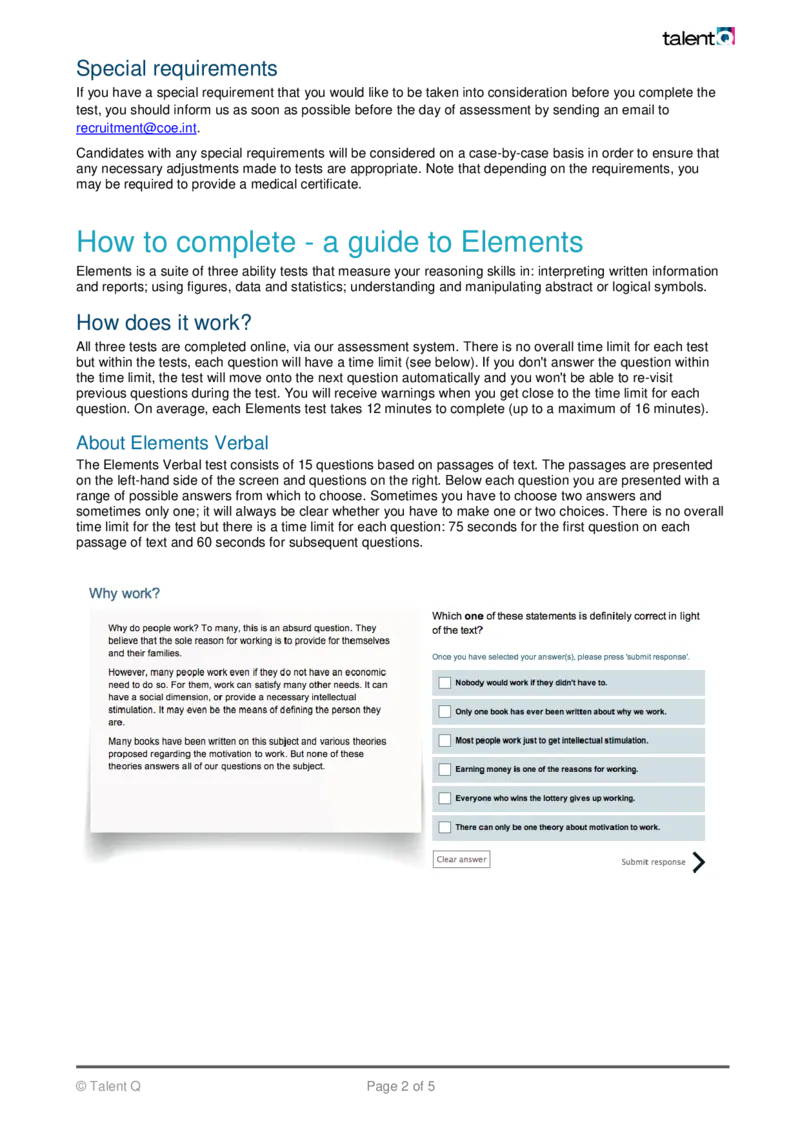
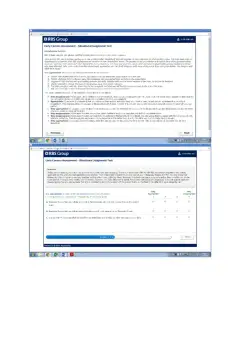
The Elements Verbal test consists of 15 questions based on passages of text. The passages are presented
on the left-hand side of the screen and questions on the right. Below each question you are presented with a
range of possible answers from which to choose. Sometimes you have to choose two answers and
sometimes only one; it will always be clear whether you have to make one or two choices. There is no overall
time limit for the test but there is a time limit for each question: 75 seconds for the first question on each
passage of text and 60 seconds for subsequent questions.
© Talent Q Page 2 of 5About Elements Numerical
The Elements Numerical test consists of 12 questions based on information presented in tables. The tables
are presented on the left-hand side of the screen and questions on the right. Below each question you have
a choice of answers to pick from, presented in a drop-down list. There is no overall time limit for the test but
there is a time limit for each question: 90 seconds for the first question on each table (or set of tables) and 75
seconds for subsequent questions.
About Elements Logical
The Elements Logical test consists of 12 questions based on an incomplete series of symbols. Your task is
to identify the missing symbol from a number of alternatives. The symbols have no meaning, but the series
always follows a logical sequence, both from left to right and from top to bottom. There is no overall time limit
for the test but there is a time limit for each question: 75 seconds.
Adaptive testing
All three of the Elements tests are 'adaptive'. This means the system selects what questions to administer
based on your previous responses and whether they were correct or incorrect.
You begin with a question of average difficulty. If you answer the question right within the time limit, you
progress to a more difficult question. If you answer incorrectly, or fail to answer within the time limit, the
system selects an easier question next. This process is repeated until you reach the end of your test.
As a result of the adaptive nature of the test, you will feel continuously challenged and stretched so don't
worry if you feel the questions are difficult.
© Talent Q Page 3 of 5Speed and accuracy
When completing ability tests, it is important that you work both quickly and accurately to achieve your best
score. Ensure you read each question and the response options carefully, while maintaining a good pace.
Avoid skimming over the material presented and ensure you are fully focused on the information presented
to you.
As you have a time limit for each question, the best strategy is to use the full time given and not to rush into
an unconsidered answer. Always make sure that you understand what the time limits are, so that you can
respond appropriately.
If you have selected your answer for a question but the time runs out before you click through to the next
question, you do not need to worry as your answer will be submitted. Therefore by making a selection, this
will count as your submitted answer.
Results
Your responses for each Elements test are compared with the scores of a comparison group. In this case, it
will be a large group of professionals at a level similar to that required, who have previously completed the
Elements ability tests. The result is then given as a percentile (e.g. if your score is in the 75th percentile, you
have done better than 75% of the comparison group, or ‘above average’).
You will receive your results for all three of the Elements ability tests, in relation to the comparison group.
Elements practice tests
Try the Elements practice tests online (click on the link or paste this URL into your browser
https://login.talentqgroup.com/Login/SelfService/QHMPSAJDXX).
After completing each practice test, the system will provide you with a general indication of your
performance. Note, however, that as the comparison group used for the practice tests is different to the real
tests, there is no guarantee that your performance will exactly match that in the real tests.
Top tips for assessment day
You've read up about how the assessments work and completed our practice assessments to test your
reasoning abilities, so what's left to prepare for your assessment day?
© Talent Q Page 4 of 5Managing test anxiety
It is natural to feel some anxiety before and/or during the assessment process. While a little anxiety can be
helpful to ensure you approach the assessment at a good pace, it is important to be as relaxed as possible
when you sit down to complete the assessment.
Simply having a good night’s rest and making sure you’ve had a good breakfast can have a positive effect on
your ability to perform. Try to avoid rushing around before your assessment and make sure you have left
yourself enough time before the assessment begins, so you can approach it in a relaxed and focused frame
of mind.
Check your equipment
If you are being asked to complete the Elements Numerical test you will need a calculator. Check to ensure it
is working properly beforehand. For all assessments, make sure you have some note paper and a pencil
available.
Read the instructions
When you have logged in to the My Talent Q assessment system, take a couple of minutes to carefully read
the online instructions provided.
Final practice
When you login to the assessment system, you will have the opportunity to complete a couple of final
practice questions before you start the real assessment. Make sure you do this, as it will help familiarise you
with the look, feel and functionality of the assessment system.
Questions
Any questions about the ability tests and the recruitment procedure should be addressed to
recruitment@coe.int.
Good luck!
© Talent Q Page 5 of 5