Numerical Comprehension Test 2
Solutions Booklet
Instructions
This numericalcomprehension test comprises18 questions, and you will have 18 minutes in
which to correctly answer as many as you can. Calculators are permitted for this test, and it is
recommended you have some rough paper to work on.
You will have to work quickly and accurately to perform well in this test. If you don't know the
answer to a question, leave it and come back to it if you have time. Each question will have
five possible answers, one of which is correct. If the exact correct answer is not provided,
select the closest possible answer. You may click Back and Next during the test to review or
skip questions.
You can submit your test at any time. If the time limit is up before you click submit the test will
automatically be submitted with the answers you have selected. It is recommended to keep
working until the time limit is up.
Try to find a time and place where you will not be interrupted during the test.The test will
begin on the next page.
AssessmentDay
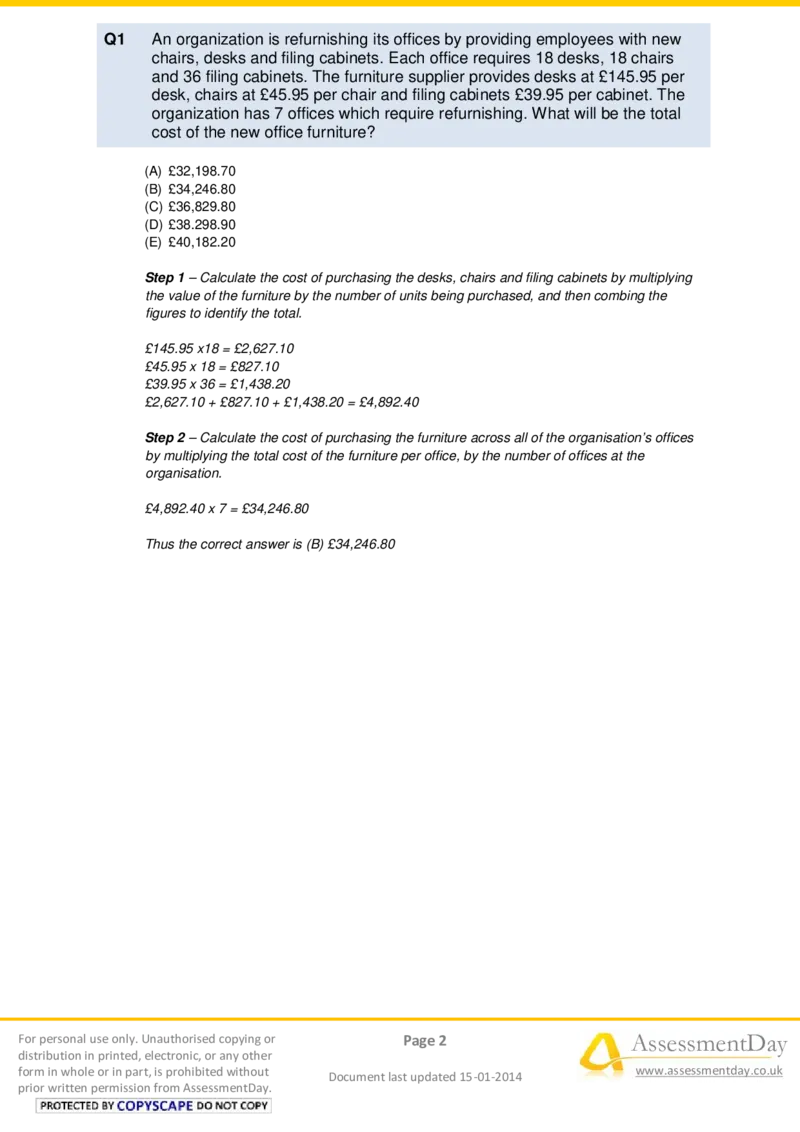
Practice Aptitude TestsQ1 An organization is refurnishing its offices by providing employees with new
chairs, desks and filing cabinets. Each office requires 18 desks, 18 chairs
and 36 filing cabinets. The furniture supplier provides desks at £145.95 per
desk, chairs at £45.95 per chair and filing cabinets £39.95 per cabinet. The
organization has 7 offices which require refurnishing. What will be the total
cost of the new office furniture?
(A) £32,198.70
(B) £34,246.80
(C) £36,829.80
(D) £38.298.90
(E) £40,182.20
Step 1–Calculatethe cost of purchasing the desks,chairs and filing cabinets by multiplying
the value of the furniture by the number of units being purchased,and then combing the
figures to identify the total.
£145.95x18 = £2,627.10
£45.95x 18 = £827.10
£39.95x 36 = £1,438.20
£2,627.10 + £827.10 + £1,438.20 = £4,892.40
Step 2–Calculate the cost of purchasing the furniture across all of the organisation’s offices
by multiplying the total cost of the furniture per office, by the number of offices at the
organisation.
£4,892.40x 7 =£34,246.80
Thus the correct answer is(B)£34,246.80
For personal useonly. Unauthorised copying or Page2 AssessmentDay
distribution in printed, electronic, or any other
form in whole or in part, is prohibited without www.assessmentday.co.uk
Document last updated 15-01-2014
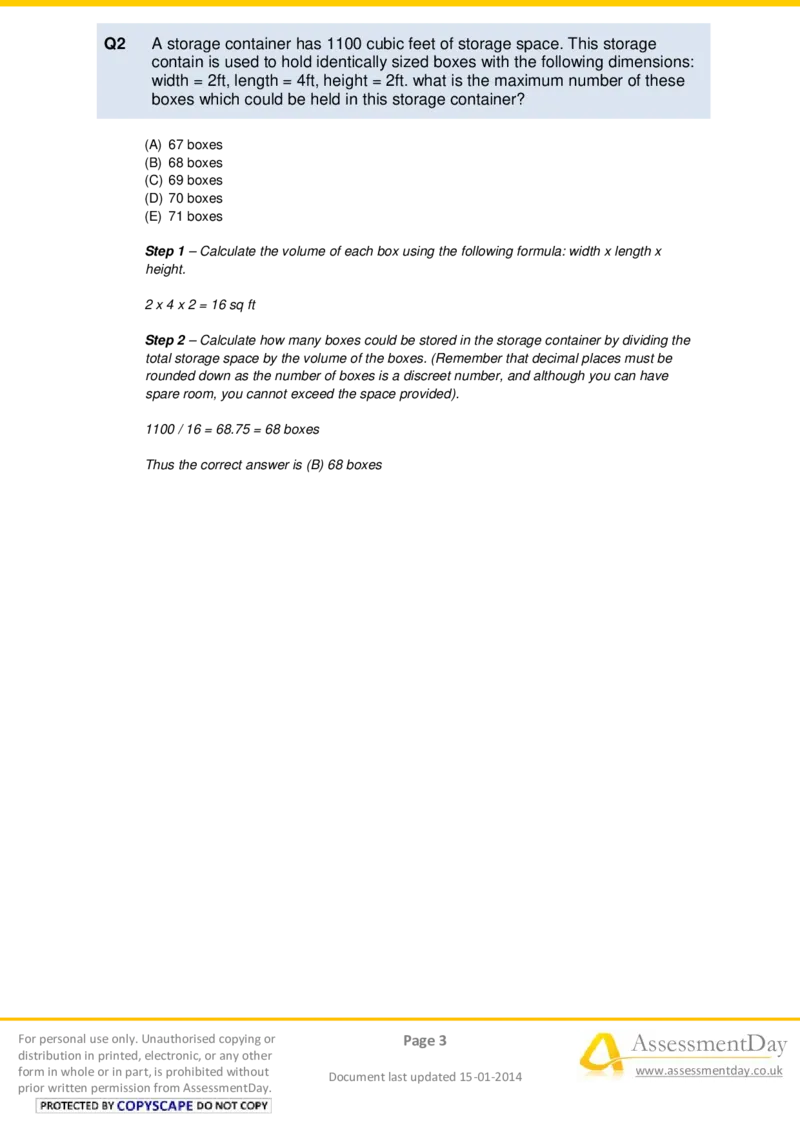
prior written permission from AssessmentDay.Q2 A storage container has 1100 cubic feet of storage space. This storage
contain is used to hold identically sized boxes with the following dimensions:
width = 2ft, length = 4ft, height = 2ft. what is the maximum number of these
boxes which could be held in this storage container?
(A) 67boxes
(B) 68 boxes
(C) 69boxes
(D) 70boxes
(E) 71boxes
Step 1–Calculate the volume of each box using the following formula: width x length x
height.
2 x 4 x 2 = 16 sq ft
Step 2–Calculate how many boxes could be storedin the storage container by dividing the
total storage space by the volume of the boxes. (Remember that decimal places must be
rounded down as the number of boxes is a discreet number, and although you can have
spare room, you cannot exceed the space provided).
1100 / 16 = 68.75 = 68 boxes
Thus the correct answer is (B)68 boxes
For personal useonly. Unauthorised copying or Page3 AssessmentDay
distribution in printed, electronic, or any other
form in whole or in part, is prohibited without www.assessmentday.co.uk
Document last updated 15-01-2014
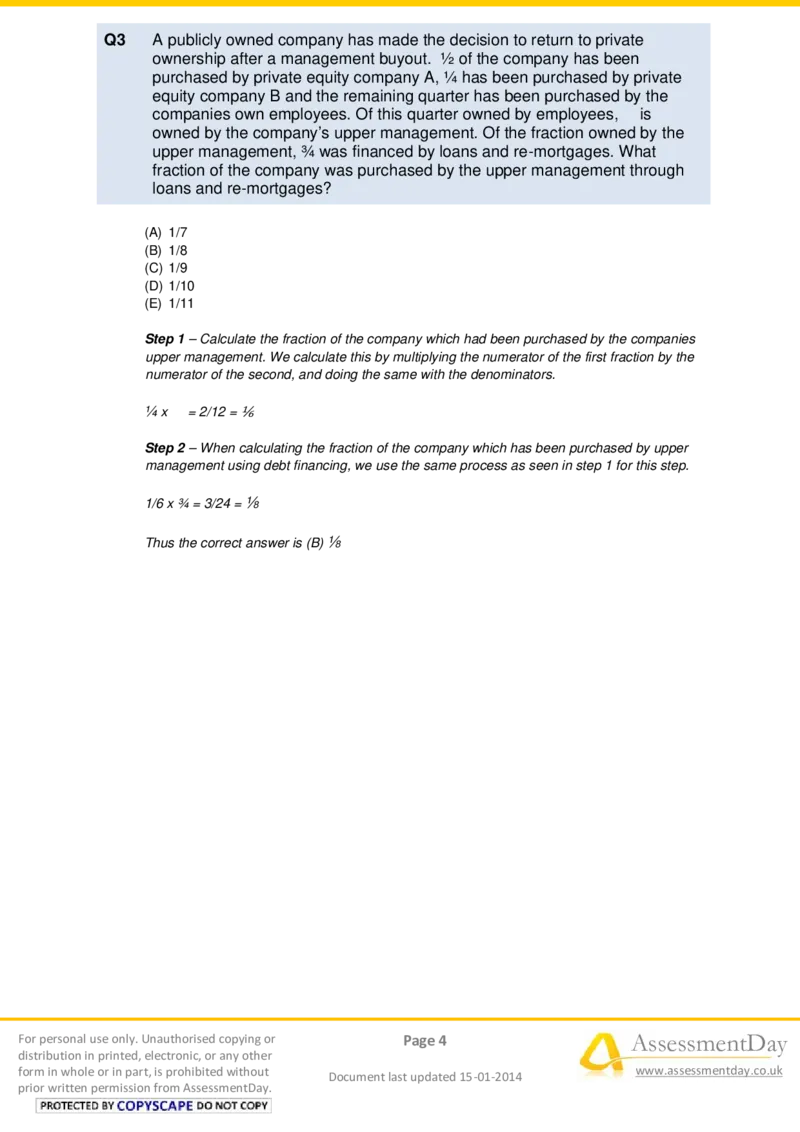
prior written permission from AssessmentDay.Q3 A publicly owned company has made the decision to return to private
ownership after a management buyout. ½ of the company has been
purchased by private equity company A, ¼ has been purchased by private
equity company B and the remaining quarter has been purchased by the
companies own employees. Of this quarter owned by employees, ⅔ is
owned by the company’s upper management. Of the fraction owned by the
upper management, ¾ was financed by loans and re-mortgages. What
fraction of the company was purchased by the upper management through
loans and re-mortgages?
(A) 1/7
(B) 1/8
(C) 1/9
(D) 1/10
(E) 1/11
Step 1–Calculate the fraction of the company which had been purchased by the companies
upper management.We calculate this by multiplying the numerator of the first fraction by the
numerator of the second, and doing the same with the denominators.
¼x⅔ =2/12 =
Step 2–When⅙ calculatingthe fraction of the company which has been purchased by upper
management using debt financing, we use the same process as seen in step 1 for this step.
1/6 x ¾ = 3/24 =⅛
Thus the correct answer is(B)⅛
For personal useonly. Unauthorised copying or Page4 AssessmentDay
distribution in printed, electronic, or any other
form in whole or in part, is prohibited without www.assessmentday.co.uk
Document last updated 15-01-2014
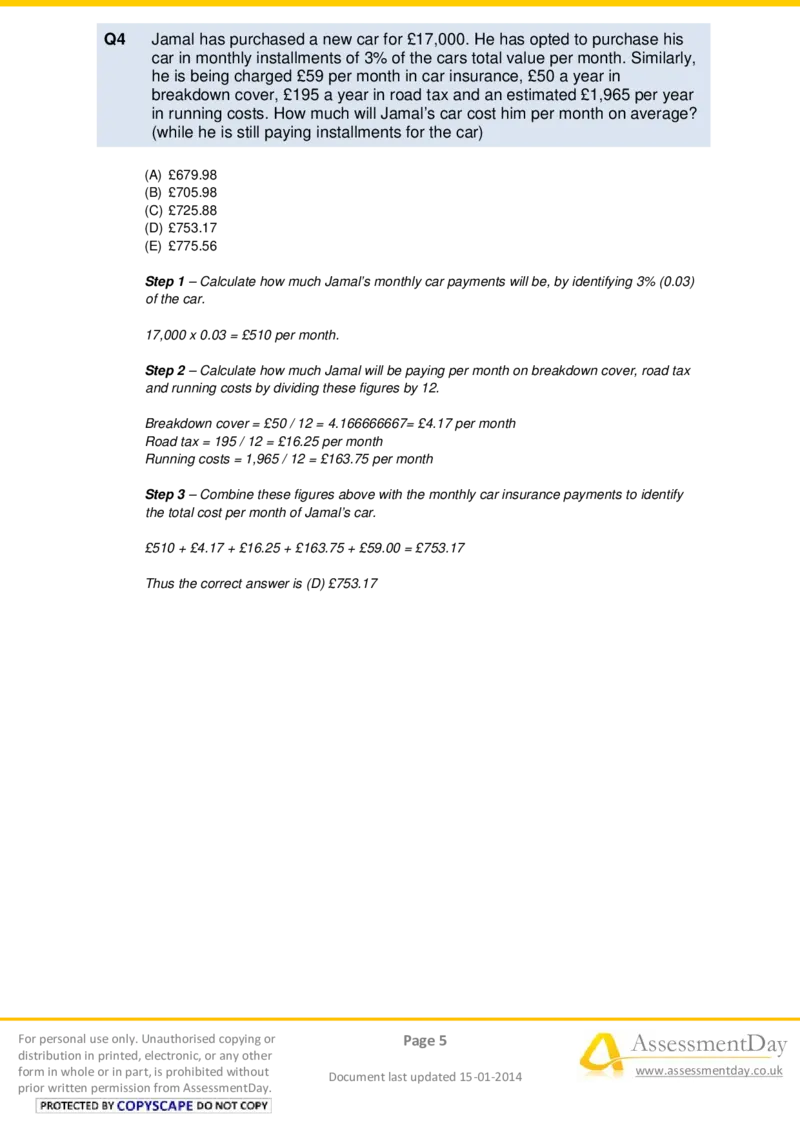
prior written permission from AssessmentDay.Q4 Jamal has purchased a new car for £17,000. He has opted to purchase his
car in monthly installments of 3% of the cars total value per month. Similarly,
he is being charged £59 per month in car insurance, £50 a year in
breakdown cover, £195 a year in road tax and an estimated £1,965 per year
in running costs. How much will Jamal’s car cost him per month on average?
(while he is still paying installments for the car)
(A) £679.98
(B) £705.98
(C) £725.88
(D) £753.17
(E) £775.56
Step 1–Calculate how much Jamal’s monthly carpayments will be,byidentifying 3% (0.03)
of the car.
17,000 x 0.03 = £510 per month.
Step 2–Calculate how much Jamal will be paying per month on breakdown cover, road tax
and running costs by dividing these figures by 12.
Breakdown cover = £50/ 12 =4.166666667= £4.17per month
Road tax = 195 / 12 = £16.25 per month
Running costs = 1,965 / 12 = £163.75 per month
Step 3–Combine these figures above with the monthlycar insurance payments to identify
the total cost per month of Jamal’s car.
£510 + £4.17 +£16.25 + £163.75 + £59.00 = £753.17
Thus the correct answer is(D)£753.17
For personal useonly. Unauthorised copying or Page5 AssessmentDay
distribution in printed, electronic, or any other
form in whole or in part, is prohibited without www.assessmentday.co.uk
Document last updated 15-01-2014
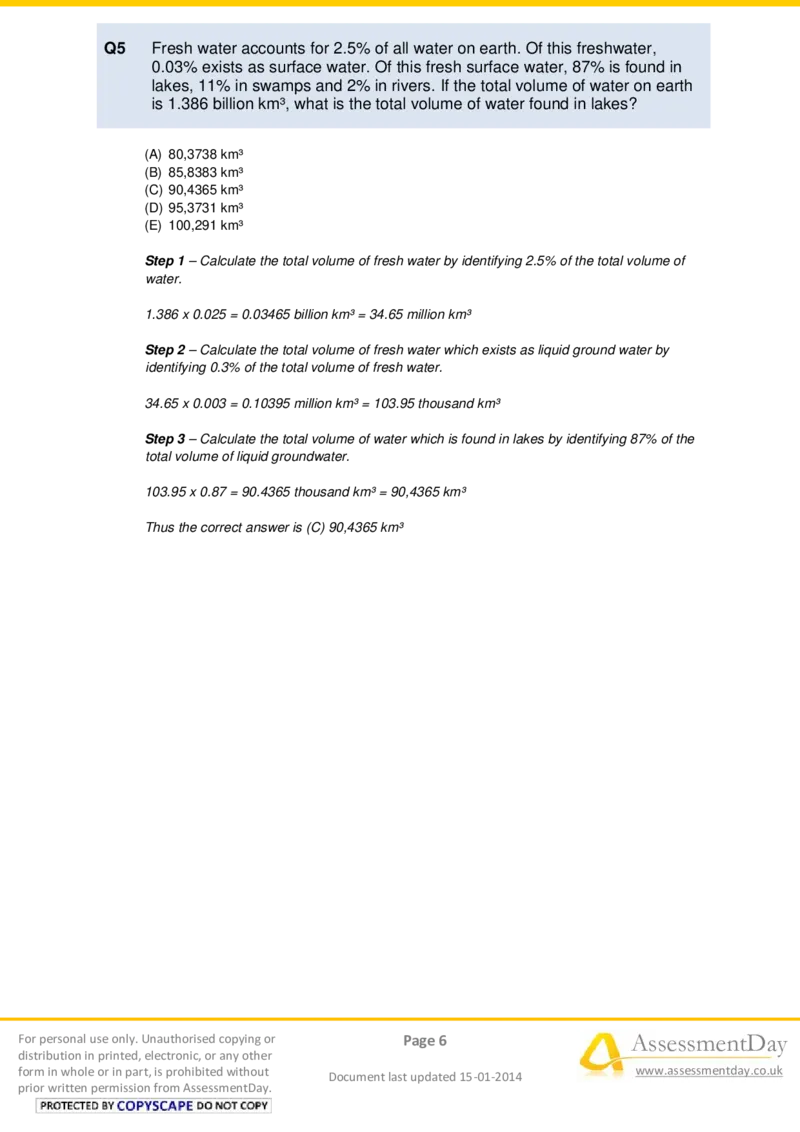
prior written permission from AssessmentDay.Q5 Fresh water accounts for 2.5% of all water on earth. Of this freshwater,
0.03% exists as surface water. Of this fresh surface water, 87% is found in
lakes, 11% in swamps and 2% in rivers. If the total volume of water on earth
is 1.386 billion km³, what is the total volume of water found in lakes?
(A) 80,3738km³
(B) 85,8383km³
(C) 90,4365km³
(D) 95,3731km³
(E) 100,291km³
Step 1–Calculatethe total volumeof fresh water by identifying 2.5% of the total volume of
water.
1.386 x0.025=0.03465billionkm³ =34.65million km³
Step 2–Calculate the total volume of fresh water which exists as liquid ground water by
identifying0.3% of the total volume of fresh water.
34.65x 0.003=0.10395million km³ = 103.95 thousand km³
Step 3–Calculate the total volume of water which is found in lakes by identifying 87% of the
total volume of liquid groundwater.
103.95x 0.87 =90.4365 thousandkm³ = 90,4365 km³
Thus the correct answer is(C)90,4365 km³
For personal useonly. Unauthorised copying or Page6 AssessmentDay
distribution in printed, electronic, or any other
form in whole or in part, is prohibited without www.assessmentday.co.uk
Document last updated 15-01-2014
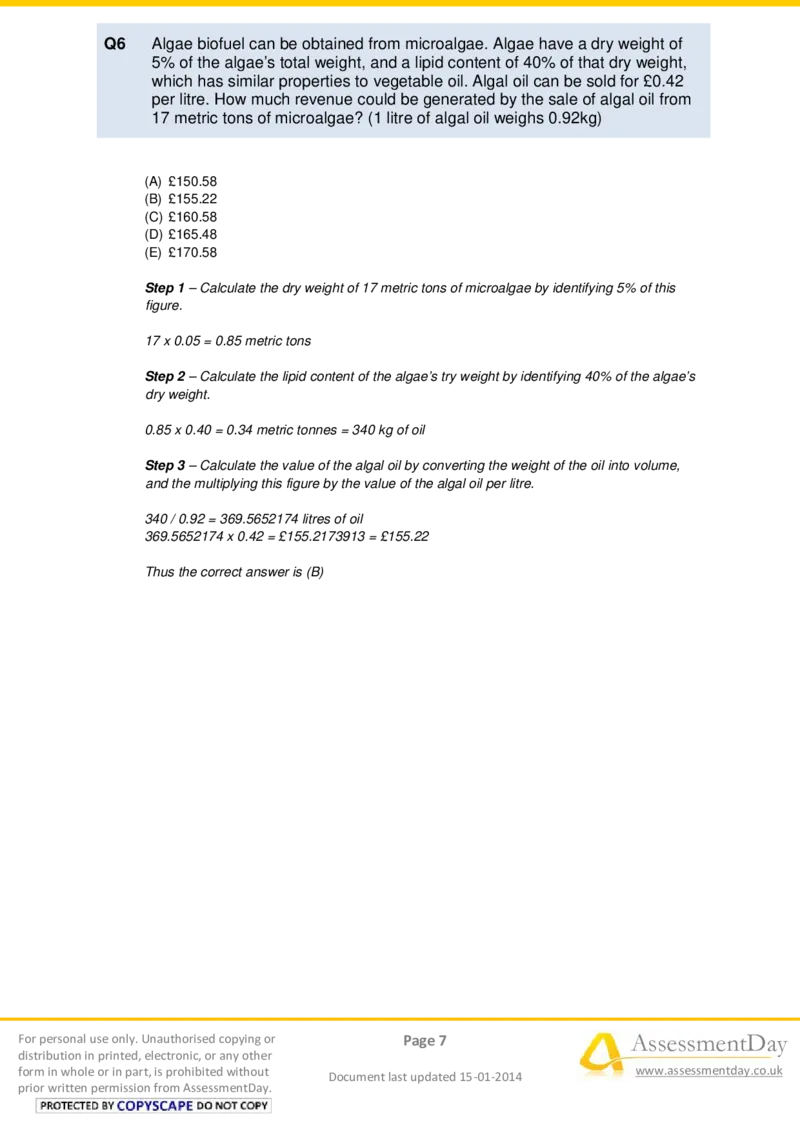
prior written permission from AssessmentDay.Q6 Algae biofuel can be obtained from microalgae. Algae have a dry weight of
5% of the algae’s total weight, and a lipid content of 40% of that dry weight,
which has similar properties to vegetable oil. Algal oil can be sold for £0.42
per litre. How much revenue could be generated by the sale of algal oil from
17 metric tons of microalgae? (1 litre of algal oil weighs 0.92kg)
(A) £150.58
(B) £155.22
(C) £160.58
(D) £165.48
(E) £170.58
Step 1–Calculate the dry weight of 17 metric tons of microalgae by identifying 5% of this
figure.
17 x 0.05 = 0.85 metric tons
Step 2–Calculate the lipid content of the algae’s try weight by identifying 40% of the algae’s
dry weight.
0.85 x 0.40 = 0.34metric tonnes = 340 kg of oil
Step 3–Calculate the value of the algal oil by converting the weight of the oil into volume,
and the multiplying this figure by the value of the algal oil per litre.
340 / 0.92 = 369.5652174 litres of oil
369.5652174 x 0.42 = £155.2173913 = £155.22
Thus the correct answer is(B)
For personal useonly. Unauthorised copying or Page7 AssessmentDay
distribution in printed, electronic, or any other
form in whole or in part, is prohibited without www.assessmentday.co.uk
Document last updated 15-01-2014
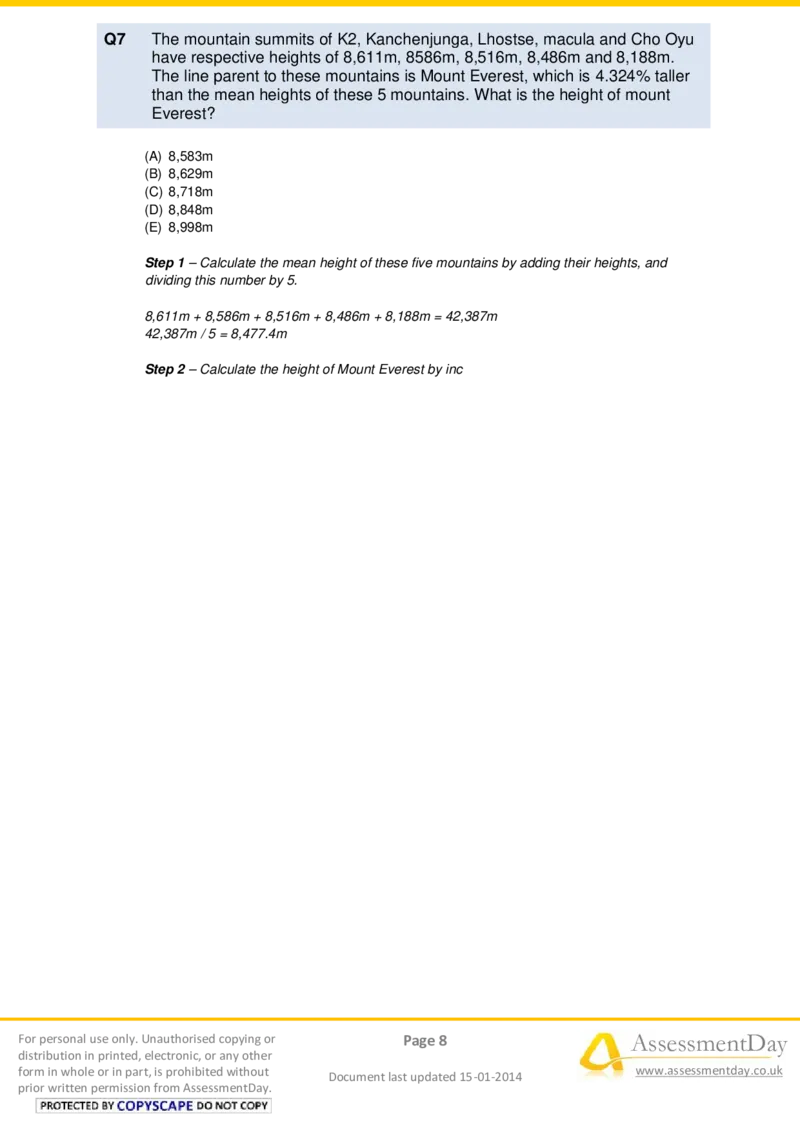
prior written permission from AssessmentDay.Q7 The mountain summits of K2, Kanchenjunga, Lhostse, macula and Cho Oyu
have respective heights of 8,611m, 8586m, 8,516m, 8,486m and 8,188m.
The line parent to these mountains is Mount Everest, which is 4.324% taller
than the mean heights of these 5 mountains. What is the height of mount
Everest?
(A) 8,583m
(B) 8,629m
(C) 8,718m
(D) 8,848m
(E) 8,998m
Step 1–Calculate the mean height of these five mountains by adding their heights, and
dividing this number by 5.
8,611m + 8,586m + 8,516m + 8,486m + 8,188m = 42,387m
42,387m / 5 = 8,477.4m
Step 2–Calculate the height of Mount Everest by inc
For personal useonly. Unauthorised copying or Page8 AssessmentDay
distribution in printed, electronic, or any other
form in whole or in part, is prohibited without www.assessmentday.co.uk
Document last updated 15-01-2014
prior written permission from AssessmentDay.For personal useonly. Unauthorised copying or Page9 AssessmentDay
distribution in printed, electronic, or any other
form in whole or in part, is prohibited without www.assessmentday.co.uk
Document last updated 15-01-2014
prior written permission from AssessmentDay.reasing the mean height of these summits by 4.324% by multiplying this figure by 104.324%
(1.04324).
8,477.4m x 1.04324 = 8,843.962776m
Thus the correct answer is (D) 8,848m
(Tip: The instructions askyou to select the closest possible answer if the exact answer is not
present, making D the correct answer.)
For personal useonly. Unauthorised copying or Page10 AssessmentDay
distribution in printed, electronic, or any other
form in whole or in part, is prohibited without www.assessmentday.co.uk
Document last updated 15-01-2014
prior written permission from AssessmentDay.Q8 An international train service travels from country A to country B at an
average speed of 66 miles per hour without stopping. The distance between
the train stations in country A and country B is 430km, how long would it take
to reach city B from city A via train? (1 mile = 1.609344 km).
(A) 2 hours
(B) 3 hours
(C) 4 hours
(D) 5 hours
(E) 6 hours
Step 1–Convert the length of the journey fromkilometres into milesusing the mile to
kilometre ratio shown above.
430 / 1.609344 =267.1896127miles
Step 2–Calculate how many hours the journey would take by dividing the length of the
journey by the speed of the train.
267.1896127/66=4.048327465= 4hours
Thus the correct answer is(C)4hours
For personal useonly. Unauthorised copying or Page11 AssessmentDay
distribution in printed, electronic, or any other
form in whole or in part, is prohibited without www.assessmentday.co.uk
Document last updated 15-01-2014
prior written permission from AssessmentDay.Q9 A dam generates a total of 1TWh (1,000 GWh or 1,000,000 MWh) of power
per year (non-leap year). This dam has 12 turbines which generate an equal
amount of power. How much power is generated per turbine each day on
average?
(A) 188.2836446MWh
(B) 192.3837929MWh
(C) 204.2866738MWh
(D) 216.2827363MWh
(E) 228.3105023 MWh
Step 1–Calculate how much power is generated per day by the dam by dividing the total
power production by the number of days per year.
1 / 365 = 0.002739726 TWh = 2.739726027 GWh
Step 2–Divide the power production per day by 12 to identify the daily powerproduction per
turbine.
2.739726027 / 12 = 0.228310502GWh = 228.3105023 MWh
Thus the correct answer is (E) 228.3105023 MWh
For personal useonly. Unauthorised copying or Page12 AssessmentDay
distribution in printed, electronic, or any other
form in whole or in part, is prohibited without www.assessmentday.co.uk
Document last updated 15-01-2014
prior written permission from AssessmentDay.Q10 A commodities broker charges a fee of 2% of the total value per transaction
each time a commodity is sold. The broker’s client purchased 25 ounces of
platinum at the market price of £951.82 per ounce. After 4 months the client
decides to sell the metal at the current market price of £1,217.28 per ounce.
How much profit will be client receive from this transaction?
(A) £5,259.38
(B) £5,529.92
(C) £5,753.39
(D) £6,027.86
(E) £6,250.39
Step 1–Calculate the total value of the purchase by multiplying the number of ounces
purchased by their value at the time per ounce.
£951.82x25 = £23,795.50
Step 2–Calculate the value of the metal at the current market price by multiplying the
number of ounces by their current value per ounce.
£1,217.28x 25 = £30,432.00
Step 3–Remove 2% of the transaction to take into account the brokers fee by multiplying by
2% (0.02).
£30,432.00x 0.98 = £29,823.36
Step 4–Subtract the revenue generated (minus the fee) by the sale of the metal by the
metals original value to identify the profit generated.
£29,823.36-£23,795.50 =£6,027.86
Thus the correct answer is(D)£6,027.86
For personal useonly. Unauthorised copying or Page13 AssessmentDay
distribution in printed, electronic, or any other
form in whole or in part, is prohibited without www.assessmentday.co.uk
Document last updated 15-01-2014
prior written permission from AssessmentDay.Q11 A pharmaceutical company generates 15 metric tons of paracetamol per
month, 4.5 metric tons of Ibuprofen per week and 160 metric tons of aspirin
per year. The pharmaceutical company can sell paracetamol for £5 per kilo,
ibuprofen for £17 per kilo and aspirin for £9 per kilo. How much revenue is
generated in 1 year by this pharmaceutical company’s sale of paracetamol,
ibuprofen and aspirin?
(A) £5,672,000
(B) £5,829.000
(C) £6,029,000
(D) £6,198,000
(E) £6,318,000
Step 1–Calculate the total revenue generated by paracetamol sales in one year by
calculating how much is produced in one year, and then multiplying this by its sale price.
15 x 12 = 180 metric tons per year
180 x 1000 = 180,000 kg per year
180,000 x £5 =£900,000 per year
Step 2–Calculate the total revenue generated by ibuprofen sales in one year by calculating
how much is produced in one year, and then multiplying this by its sale price.
4.5 x 52 = 234 metric tons per year
234 x 1000 = 234,000 kg peryear
234,000 x £17 = £3,978,000 per year
Step 3–Calculate the total revenue generated by aspirin sales in one year by calculating by
multiplying the annual production by its sale price. Then,we combine the revenues for the
three painkillers, identifying the total revenue.
160 x 1000 = 160,000 kg per year
160,000 x 9 =£1,440,000 per year
£900,000 + £3,978,000 + £1,440,000 = £6,318,000
Thus the correct answer is (E) £6,318,000
For personal useonly. Unauthorised copying or Page14 AssessmentDay
distribution in printed, electronic, or any other
form in whole or in part, is prohibited without www.assessmentday.co.uk
Document last updated 15-01-2014
prior written permission from AssessmentDay.Q12 Before commercial whaling in the 18th century, the sperm whale population
was estimated at 1,100,000. However by 1880 the total sperm whale
population had decreased by 29%. Between 1880 and 1946 the population
recovered slightly, growing by 5.9% from the 1880 population. However, from
1946 to 1980 only 33% of the 1946 population remained. What was the size
of the sperm whale population in 1980?
(A) 272,936
(B) 282,272
(C) 292,372
(D) 302,381
(E) 312,937
Step 1–Calculate the sperm whale population in 1880 bylowering the number of sperm
whales in the 18thcenturyby 29%(0.71)
1,100,000 x 0.71 = 781,000
Step 2–Calculate the sperm whale population in 1946 by increasing the previous number by
5.9%
781000 x 1.059 = 827,079
Step 3–Calculate the 1980 sperm whale population by identifying 33% of the 1946whale
population.
827,079 x 0.33 = 272,936.07 = 272,936
Thus the correct answer is(A)272,936
For personal useonly. Unauthorised copying or Page15 AssessmentDay
distribution in printed, electronic, or any other
form in whole or in part, is prohibited without www.assessmentday.co.uk
Document last updated 15-01-2014
prior written permission from AssessmentDay.Q13 ¾ of an organisation’s staff have recently been provided with a smart phone.
By purchasing these phones in bulk, the organisation has saved 17% of the
costs per phone. The organisation has 3500 members of staff and the each
phone originally cost £125 per unit. How much did the organisation spend on
providing employees with these phones?
(A) £254,483.50
(B) £263,383.00
(C) £272,343.75
(D) £283,389.00
(E) £294,389.50
Step 1–Calculate the amount of money spent per phone by decreasing the original number
by 17% (0.83)
£125 x 0.83 = 103.75
Step 2–Calculate the number of people which received a smart phone by identifying 75% of
the total staff number.
3,500 x 0.75 = 2,625
Step 3–Multiply the number of staff that received a phone by the actual cost of the phone to
identify how much theorganisation spent.
2,625 x £103.75 = £272,343.75
Thus the correct answer is (C)£272,343.75
For personal useonly. Unauthorised copying or Page16 AssessmentDay
distribution in printed, electronic, or any other
form in whole or in part, is prohibited without www.assessmentday.co.uk
Document last updated 15-01-2014
prior written permission from AssessmentDay.Q14 Calcium carbonate used in industry is extracted direct via mining or
quarrying. A mining operation can produce 50 metric tons of magnesium
carbonate per day. The market price for pure elemental magnesium is $2.90
per kilogram. If all of the daily production of magnesium carbonate is
converted into elemental magnesium, how much revenue per year (non-leap
year) could the mine generate from the sale of that magnesium? (Assume
magnesium carbonate is 25% elemental magnesium)
(A) $13,002,500
(B) $13,107,000
(C) $13,231,250
(D) $13,378,750
(E) $13,496,250
Step 1–Calculate total amount of calcium carbonate produced in 1 year by multiplying the
daily production figure by 365.
50 x 365 =18,250metric tons
Step 2–Calculate the amount of elemental magnesium that can be extracted from the yearly
production of magnesium carbonate by identifying 25% (0.25).
18,250x 0.25 =4,562.5metric tons
Step 3–Calculatethe value of the elemental magnesium by converting the yearly production
of magnesium into kg, and then multiplying by the current market price.
4,562.5x 1000 = 4,562,500kg
4,562,500 x 2.9 = $13,231,250.00
Thus the correct answer is(C)$13,231,250.00
For personal useonly. Unauthorised copying or Page17 AssessmentDay
distribution in printed, electronic, or any other
form in whole or in part, is prohibited without www.assessmentday.co.uk
Document last updated 15-01-2014
prior written permission from AssessmentDay.Q15 As a rule of thumb, a household of two people are able to borrow 2.5 times
their joint yearly income before tax when applying for a mortgage. A couple
have monthly incomes of £2,500 per month and £2,000 before tax, and
between them they have saved £15,000. What is the largest amount of
money the couple could borrow with a mortgage requiring a 10% deposit
based on the rule of thumb?
(A) £135,000
(B) £140,000
(C) £145,000
(D) £150,000
(E) £155,000
Step 1–Calculate the couples joint monthly income by adding together their respective
incomes.
£2,500 + £2,000 = £4,500
Step 2–Calculate the couple’s yearly income by multiplying their joint monthly income by 12.
£4,500 x 12 = £54,000
Step 3–Based on the rule of thumb, calculate the amount of money that could be borrowed
by multiplying the join yearly income by 2.5 (note: do not calculate the amount of money that
could be borrowed by the amount of money saved for the deposit, as the question states
“using the rule of thumb”).
£54,000 x 2.5 = £135,000
Step 4–Identify if the couple can afford the deposit on the loan by identifying 10% of the loan
amount and comparing this with the money saved.
£135,000 x 0.1 = £13,500
£15,000 > £13,500
Thus the correct answer is(A)£135,000
For personal useonly. Unauthorised copying or Page18 AssessmentDay
distribution in printed, electronic, or any other
form in whole or in part, is prohibited without www.assessmentday.co.uk
Document last updated 15-01-2014
prior written permission from AssessmentDay.Q16 An investor purchases $350 worth of shares in company A, $450 worth of
shares in company B and $750 worth of shares in company C. These shares
have the following annual dividend yields: Company A = 5.7%, Company B =
6.2% Company C = 4.9%. The average dividend yield for the Dow Jones
Average Index (DJIA) is 2.8%. How much larger will the annual dividend
income from the purchased shares be compared to an equally sized
investment in the DJIA as a whole? (assume that dividends are not
reinvested)
(A) $35.90
(B) $38.80
(C) $41.20
(D) $44.10
(E) $47.50
Step 1–Calculate the annual dividend income earned bymultiplyingthe value of the shares
by the respective dividend yield,and then combining these figures.
Company A: $350 x 0.057 =$19.95
Company B: $450 x 0.062=$27.9
Company C: $750 x 0.049 = $36.75
Total income = 19.95 + 27.9 + 36.75 = $84.60
Step 2–Calculate the annual dividend income earned from purchasingan equal value of
shares ofthe DJIA by calculating the total value of the shares, and multiplying this by the
dividend yield.
$350 +$450 + $750 = $1,550
$1,550 x 0.028 = $43.40
Step 3–Subtract the total dividend incomeearnedfromthe purchasedshares,from the
dividend incomefrom the DJIA shares.
$84.60-$43.40 = $41.20
Thus the correct answer is(C)$41.20
For personal useonly. Unauthorised copying or Page19 AssessmentDay
distribution in printed, electronic, or any other
form in whole or in part, is prohibited without www.assessmentday.co.uk
Document last updated 15-01-2014
prior written permission from AssessmentDay.Q17 A management consultancy generated 46% of its revenue through strategy
consulting, of which company A is the consultancy’s biggest client in terms of
fees, accounting for ¼ of the consultancy’s strategy revenue. The
consultancy currently has 35 strategy consultants working with company A,
each charging an effective day rate of £2,000 per working day. What is the
total daily revenue generated by the consultancy?
(A) £608,695.65
(B) £612,625.30
(C) £616,382.75
(D) £620,382.80
(E) £624,289.20
Step 1–Calculate how much per day,consultants to company Aare generating in
consultancy fees by multiplying the average fee per consultant by the number of consultants.
35 x 2000 =£70,000 per day.
Step 2–Calculate how muchrevenue is generated by the consultancy’s strategy function,by
dividing the fees charged to company A by ¼ (0.25)
£70,000 / 0.25 = £280,000per day
Step 3–Calculate the total revenue generated per day by the consultancy,by dividing the
dailystrategy function revenue by 46% (0.46)
£280,000/0.46= £608,695.65
Thus the correct answer is(A)£608,695.65
For personal useonly. Unauthorised copying or Page20 AssessmentDay
distribution in printed, electronic, or any other
form in whole or in part, is prohibited without www.assessmentday.co.uk
Document last updated 15-01-2014
prior written permission from AssessmentDay.Q18 Francis has £8,200 in a high interest individual savings account (ISA), which
provides 0.3% interest per month, which remains in his ISA. He also holds
£5,500 in fixed rate bonds, which pays monthly interest directly into Francis’s
current account at an annual rate of 3.5%. Finally, Francis owns £3,670
worth of shares, which have an average annual dividend yield of 2.8%, also
paid directly into his current account monthly. Assuming that Francis’s
current account does not generate interest, and that all investments were
made at the same time, how much income would Francis make in the first 3
months of his investments?
(A) £119.28
(B) £126.39
(C) £133.27
(D) £140.38
(E) £147.85
Step 1–Calculate the monthly interest received over the three months by calculating 0.3% of
the total savings, and then when calculating following months, takinginto account the
previous interest payments (compounding interest).
£8,200 x 1.003 = £8,224.60
£8,224.60 x 1.003 = £8,249.2738
£8,249.2738 x 1.003 = £8,274.021621 = £8,274.02
£8,274.03-£8,200 = £74.02
Step 2–Calculate the interest generated by the fixed rate bonds by identifying the annual
interest and dividing by 12to identify the monthly interest,and then multiplying this by 3.
5,500 x 0.035 = £192.50
£192.50 / 12 =16.041666667
16.041666667 x 3 = 48.125 = £48.13
Step 3–Calculate the dividend income generated by Francis’s shares byidentifying the
annual dividendincome earned anddividing this by 12 to identifymonthly dividend income,
and then multiplying this by 3.
£3,670 x 0.028 = £102.76
£102.76 / 12 = £8.563333333
£8.563333333 x 3 = £25.69
Step 4–Combine these figures to identify the total income Francis earned over 3 months.
£74.02 + £48.13 + £25.69 = £147.85
Thus the correct answer is (E) £147.84
-- End of Test --
For personal useonly. Unauthorised copying or Page21 AssessmentDay
distribution in printed, electronic, or any other
form in whole or in part, is prohibited without www.assessmentday.co.uk
Document last updated 15-01-2014
prior written permission from AssessmentDay.