Numerical Comprehension Test 3
Solutions Booklet
Instructions
This numerical reasoning test comprises 18 questions, and you will have 18 minutes in
which to correctly answer as many as you can. Calculators are permitted for this test, and it is
recommended you have some rough paper to work on.
You will have to work quickly and accurately to perform well in this test. If you don't know the
answer to a question, leave it and come back to it if you have time. Each question will have
five possible answers, one of which is correct. If the exact correct answer is not provided,
select the closest possible answer. You may click Back and Next during the test to review or
skip questions.
You can submit your test at any time. If the time limit is up before you click submit the test will
automatically be submitted with the answers you have selected. It is recommended to keep
working until the time limit is up.
Try to find a time and place where you will not be interrupted during the test.The test will
begin on the next page.
AssessmentDay
Practice Aptitude TestsQ1 A local utilities company exclusively provides electricity and natural gas to a
small village containing 342 households. Each household purchases on
average £75 of gas and electricity per month. If the village’s natural gas sales
account for ¾ of the utilities company’s revenue, how much revenue is
generated in one year from electricity sales in the village? (assume the
company has no customers outside the village)
(A) £73,750
(B) £74,500
(C) £76,950
(D) £78,150
(E) Cannot say
Step 1–Calculate the total revenue produced by the village throughelectricity and natural
gas sales per monthby multiplying the number of households (342) by the average electricity
and gas bill per month (£75).
342 x £75 =£25,650.00
Step 2–Calculate the total annual sales of electricity and gas in the village bymultiplying the
monthly revenue (£25,650.00) by the number of months in a year (12).
£25,650.00 x 12 = £307,800.00
Step 3–Calculate the proportion of revenue generated by electricity sales by identifying 25%
(0.25) of the total annual sales of gas andelectricity (£307,800.00)
£307,800.00 x 0.25 = £76,950
Thus the correct answer is(C)£76,950
For personal use only. Unauthorised copying or Page2 AssessmentDay
distribution in printed, electronic, or any other
form in whole or in part, is prohibited without www.assessmentday.co.uk
Document last updated12-06-2014
prior written permission from AssessmentDay.Q2 A commercial property contains 750 square feet of flooring space. A real
estate agency has the property on sale at the asking price of £465 per
square foot, along with a commission of 3.5% of the properties value. If a
customer makes on offer on the property of £300,000 (which includes the
commission), how much cheaper per square foot is this offer compared to
the asking price? (not including the commission)
(A) £78.53
(B) £80.49
(C) £82.45
(D) £84.93
(E) £86.24
Step 1–Calculate thevalue of the offer without the real estate agents commission by dividing
the total amount (£300,000) by 3.5% (1.035).
£300,000/ 1.035 = £289,855.07250 = £289,855.07
Step 2–Calculate the price per square foot offered for the commercial property by dividing
the total offer without the real estate agents commission (£289,855.07) by the area of the
commercial property (750 square feet).
£289,855.07/ 750 = £386.4734267= £386.47
Step 3–Subtract the value of the offer per square foot (£386.47) by the value of the asking
price (£465) to identify the extent in which the offer is cheaper.
£465–386.47 =£78.53
Thus the correct answer is(A)£78.53
For personal use only. Unauthorised copying or Page3 AssessmentDay
distribution in printed, electronic, or any other
form in whole or in part, is prohibited without www.assessmentday.co.uk
Document last updated12-06-2014
prior written permission from AssessmentDay.Q3 The Interest rate for a savings account is 3% per annum, paid in four
quarterly payments. If a customer has £20,000 and they do not make any
deposits or withdrawals, what will be the total value of the savings account
after the first three quarterly interest payments?
(A) £20,447.53
(B) £20,450.00
(C) £20,453.39
(D) £20,455.21
(E) £20,457.00
Step 1–Calculate the total value of the savings account after the first quarterly payment by
multiplying thevalue of the account (£20,000) by 1.0075%(3% / 4= 0.75%).
(£20,000x1.0075) + £20,000 = £20,150
Step 2–Calculate the total value of the savings account after thesecondquarterly payment
by multiplying thenewvalue of the account(£20,015)by 1.0075 % (3% / 4 = 0.75%)
(Compoundinginterest).
£20,150x 1.0075=£20,301.1250=£20,301.13
Step 3–Calculate the total value of thesavings account after the thirdquarterly payment by
multiplyingthe new value of the account (£2,030.11) by 1.0075 % (3% / 4 = 0.75%)
(compounding interest).
£20,301.13x1.0075=£20,453.38848=£20,453.39
Thus the correct answer is(C)£20,453.39
For personal use only. Unauthorised copying or Page4 AssessmentDay
distribution in printed, electronic, or any other
form in whole or in part, is prohibited without www.assessmentday.co.uk
Document last updated12-06-2014
prior written permission from AssessmentDay.Q4 ¼ of interns will be offered a full time position at our company. Of those
interns selected, ½ will be transferred to the consulting function. Of those
interns transferred to consulting, they will be split equally between the
company’s strategy, risk, marketing, finance, organization and operations
departments. With an internship cohort of 425 at the start, how many interns
will hold full time consulting positions in the strategy function?
(A) 9
(B) 10
(C) 11
(D) 12
(E) Cannot say
Step 1–Calculate ¼ of the internship cohort by multiplying the total internship cohort (425)
by 25% (0.25).
425 x 0.25 = 106.25 =106
Step 2–Calculate the number of interns which will be transferred to consulting by multiplying
the number of interns offered full time positions (106) by 50% (0.5).
106 x 0.5 = 53
Step 3–Calculate the number of initial internswhich will be working at the company’s
strategy function by dividing the number of interns transferred to consulting (53) by the
number of consulting functions (6).
53 / 6 = 8.833333333333 = 9 (rounding up to the nearest whole intern)
Thus the correct answer is(A)9
For personal use only. Unauthorised copying or Page5 AssessmentDay
distribution in printed, electronic, or any other
form in whole or in part, is prohibited without www.assessmentday.co.uk
Document last updated12-06-2014
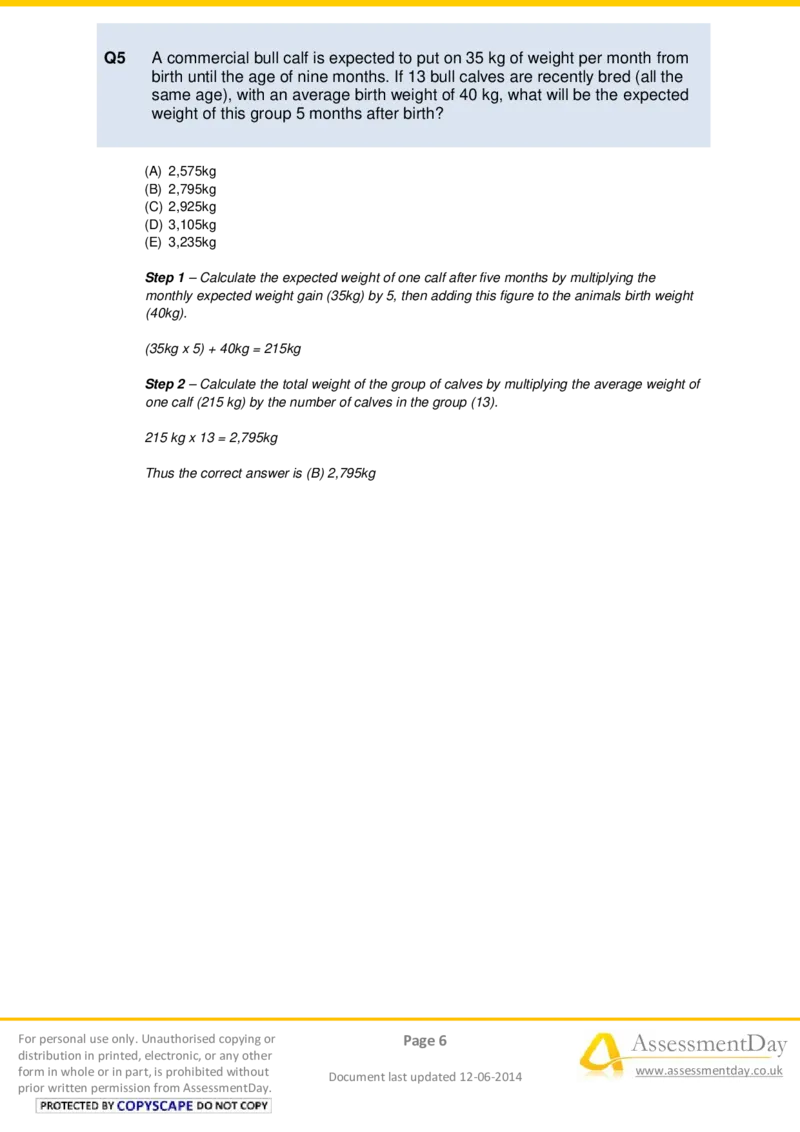
prior written permission from AssessmentDay.Q5 A commercial bull calf is expected to put on 35 kg of weight per month from
birth until the age of nine months. If 13 bull calves are recently bred (all the
same age), with an average birth weight of 40 kg, what will be the expected
weight of this group 5 months after birth?
(A) 2,575kg
(B) 2,795kg
(C) 2,925kg
(D) 3,105kg
(E) 3,235kg
Step 1–Calculate the expected weight of one calf after five months by multiplying the
monthly expected weight gain (35kg) by 5, then adding this figure to the animalsbirth weight
(40kg).
(35kg x 5) + 40kg = 215kg
Step 2–Calculate the total weight of the group of calves by multiplying the average weight of
one calf (215 kg) by the number of calves in the group (13).
215 kg x 13 =2,795kg
Thus the correct answer is(B)2,795kg
For personal use only. Unauthorised copying or Page6 AssessmentDay
distribution in printed, electronic, or any other
form in whole or in part, is prohibited without www.assessmentday.co.uk
Document last updated12-06-2014
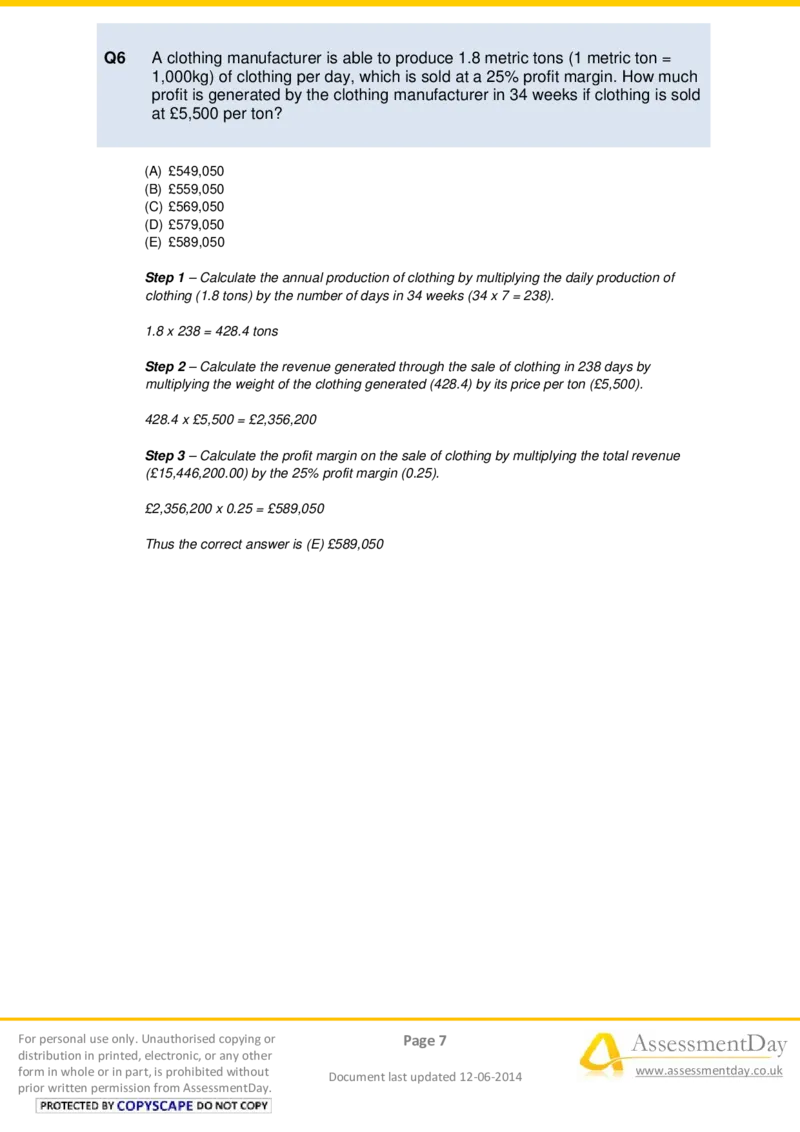
prior written permission from AssessmentDay.Q6 A clothing manufacturer is able to produce 1.8 metric tons (1 metric ton =
1,000kg) of clothing per day, which is sold at a 25% profit margin. How much
profit is generated by the clothing manufacturer in 34 weeks if clothing is sold
at £5,500 per ton?
(A) £549,050
(B) £559,050
(C) £569,050
(D) £579,050
(E) £589,050
Step 1–Calculate the annual production of clothing by multiplying the daily production of
clothing (1.8 tons) by the number of days in 34 weeks (34 x 7 = 238).
1.8 x 238 =428.4tons
Step2–Calculate the revenue generated through the sale of clothing in 238 days by
multiplying the weight of the clothing generated (428.4) by its price per ton (£5,500).
428.4x £5,500 =£2,356,200
Step 3–Calculate the profit margin on the sale ofclothing by multiplying the total revenue
(£15,446,200.00) bythe25%profit margin(0.25).
£2,356,200x 0.25 = £589,050
Thus the correct answer is(E)£589,050
For personal use only. Unauthorised copying or Page7 AssessmentDay
distribution in printed, electronic, or any other
form in whole or in part, is prohibited without www.assessmentday.co.uk
Document last updated12-06-2014
prior written permission from AssessmentDay.Q7 A box of antibiotics contains 4 packs of pills. Each pack of pills contains 24
individual antibiotic pills, with each pill containing 12mg of the antibiotic.
Patients proscribed the antibiotic are required to take four 36mg servings per
day for 14 days. How many boxes of antibiotics would patients require for the
14 day course?
(A) 2 boxes
(B) 3 boxes
(C) 4 boxes
(D) 5 boxes
(E) Cannot say
Step 1–Calculate the number of pillsrequired per serving by diving the amount of antibiotic
in each pill (12mg) by the serving size (36mg).
36 / 12 = 3 pills per serving
Step 2–Calculate the number of pillsconsumed per day by multiplying the number of pills
consumed per serving (3) by the number of servings per day(4).
3 x 4 = 12 pills per day.
Step 3–Calculate how many pack are required for a 14 day course ofantibiotics by
multiplying the number of days in the course (14) by the number of pills consumed per day
(12).
12 x 14 = 168 pills per course.
Step 4–Calculate the number of packs required for a 14 day course by dividing the number
of pills (168) by the number of pills in a pack. We then divide that number by the number of
packs in a box (4), giving us the correct answer.
168 / 24 = 7 packs
7 / 4 = 1.75 = 2 boxes
Thus the correct answer is(A)2 boxes
For personal use only. Unauthorised copying or Page8 AssessmentDay
distribution in printed, electronic, or any other
form in whole or in part, is prohibited without www.assessmentday.co.uk
Document last updated12-06-2014
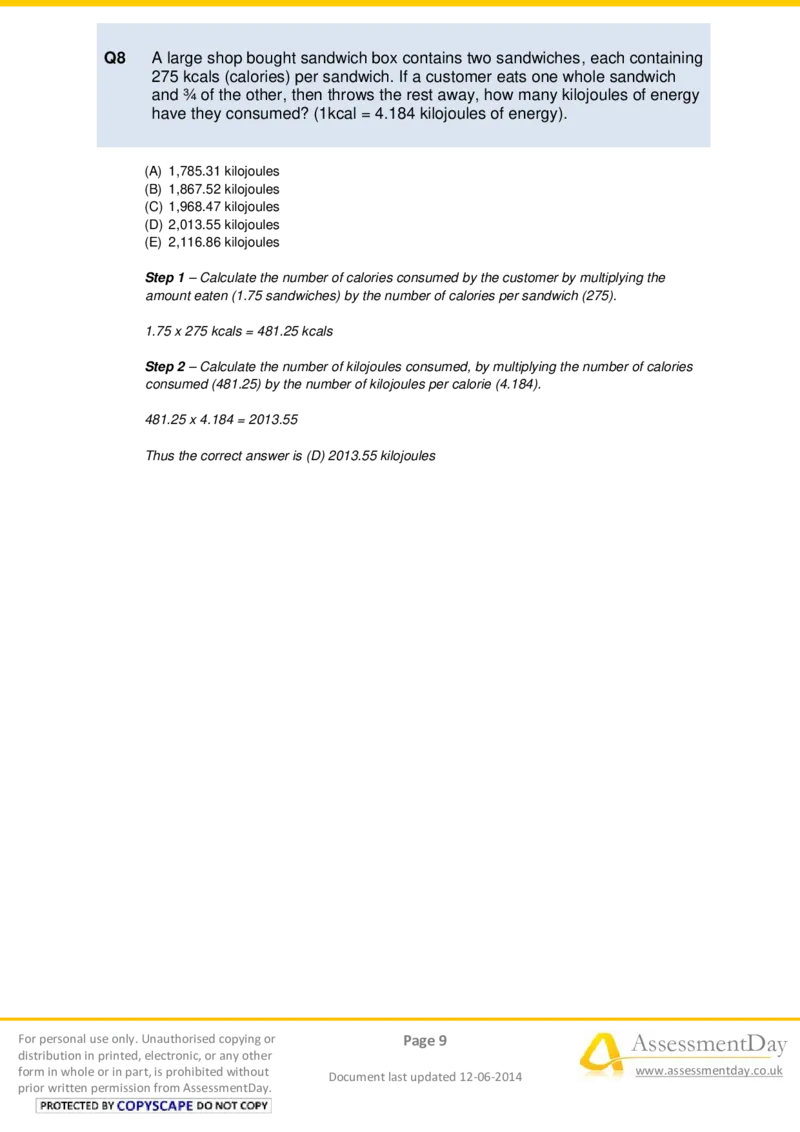
prior written permission from AssessmentDay.Q8 A large shop bought sandwich box contains two sandwiches, each containing
275 kcals (calories) per sandwich. If a customer eats one whole sandwich
and ¾ of the other, then throws the rest away, how many kilojoules of energy
have they consumed? (1kcal = 4.184 kilojoules of energy).
(A) 1,785.31kilojoules
(B) 1,867.52kilojoules
(C) 1,968.47kilojoules
(D) 2,013.55 kilojoules
(E) 2,116.86kilojoules
Step 1–Calculate the number of calories consumed by the customer by multiplying the
amount eaten (1.75 sandwiches) by the number of calories per sandwich (275).
1.75 x 275 kcals = 481.25 kcals
Step 2–Calculate the number of kilojoules consumed,by multiplyingthe number of calories
consumed (481.25) by the number of kilojoules per calorie (4.184).
481.25 x 4.184 = 2013.55
Thus the correct answer is(D)2013.55kilojoules
For personal use only. Unauthorised copying or Page9 AssessmentDay
distribution in printed, electronic, or any other
form in whole or in part, is prohibited without www.assessmentday.co.uk
Document last updated12-06-2014
prior written permission from AssessmentDay.Q9 Between January and July, the average temperature raises from 5°C to
23°C. What does this temperature change correspond to in Fahrenheit? Note
that:
Fahrenheit temperature = [(Celsius temperature x 1.8) + 32]
(A) 26.9°F
(B) 30.5°F
(C) 32.4 F
(D) 38.2°F
(E) 42.6°F
Step 1–Calculatethe average temperature in January (5°C)andthe average temperature in
July (23°C)in Fahrenheitusing the equation stated above.
(5°C x 1.8) + 32= 41°F
(23°C x 1.8) + 32= 73.3.4°F
Step 2–Calculate the temperature change in Fahrenheitbysubtracting the two converted
temperatures.
73.3–41 =32.4 F
Thus the correct answer is(C)32.4 F
For personal use only. Unauthorised copying or Page10 AssessmentDay
distribution in printed, electronic, or any other
form in whole or in part, is prohibited without www.assessmentday.co.uk
Document last updated12-06-2014
prior written permission from AssessmentDay.Q10 One troy ounce of gold is currently valued at £926.17. An investor purchased
6 troy ounces of gold at the previous market price of £827.29. If the investor
sells this gold at the current market price, at what profit margin would the
metal be sold? (profit margin = [(profit / revenue) x 100])
(A) 6.58%
(B) 7.24%
(C) 8.62%
(D) 9.54%
(E) 10.68%
Step 1–Calculate the profit generated from selling the gold at the current market price by
subtracting the previous price of gold per ounce (£827.29) by the current market price ofgold
per ounce (£926.17).
£926.17-£827.29= £98.88
Step 2–Divide the profit per troy ounce (£98.88) by the revenue per troy ounce (£926.17).
£98.88/£926.17=0.106762257=0.1068
Step 3–Calculateprofit margin by multiplying the above figure by100.
0.1068x 100 = 10.68
Thus the correct answer is(E)10.68%
For personal use only. Unauthorised copying or Page11 AssessmentDay
distribution in printed, electronic, or any other
form in whole or in part, is prohibited without www.assessmentday.co.uk
Document last updated12-06-2014
prior written permission from AssessmentDay.Q11 A telephone landline contract stipulates that calls between the hours of 6am-
6pm during weekdays costs 7.5p (£0.075) per minute, with all calls outside
these hours costing 1.5p (0.015) per minute. If during a week, a customer
makes 2 hours’ worth of phone calls during the week between 6am-6pm and
30 minutes worth of calls at the weekend, what would their weekly phone bill
be?
(A) £9.15
(B) £9.45
(C) £9.75
(D) £9.95
(E) £10.15
Step 1–Calculate the cost of the weekday calls by multiplying the number of minutes (2 x 60
= 120 minutes) worth of phone calls by the cost of phone calls per minute (7.5p).
Step 2–120 x 7.5 = 900p
Step 3–calculate the cost of the weekend calls bymultiplying the number of minutes (30
minutes) worth of phone calls by the cost of phone calls per minute (1.5p).
30 x 1.5 = 45p
Step 4–Calculate the total weekly phone bill by adding the cost of the weekday calls (900p)
to the weekend calls (45p)
900p + 45p= 945p= £9.45
Thus the correct answer is(B)£9.45
For personal use only. Unauthorised copying or Page12 AssessmentDay
distribution in printed, electronic, or any other
form in whole or in part, is prohibited without www.assessmentday.co.uk
Document last updated12-06-2014
prior written permission from AssessmentDay.Q12 1 barrel of crude oil can produce an average of 40% petroleum. Each barrel
contains 159 liters of crude oil. On average, how many litres of hydrocarbons
can be produced from 15 barrels of crude oil?
(A) 886 litres
(B) 915 litres
(C) 938 litres
(D) 954 litres
(E) Cannot say
Step 1–The question asks “how many litres of hydrocarbons can be produced”, not “how
many litres of petrol can be produced”. Since we are not told how many litres of hydrocarbons
can be produced, we cannot make a conclusion with the information provided.
Thus the correct answer is(E)cannotsay
For personal use only. Unauthorised copying or Page13 AssessmentDay
distribution in printed, electronic, or any other
form in whole or in part, is prohibited without www.assessmentday.co.uk
Document last updated12-06-2014
prior written permission from AssessmentDay.Q13 An Olympic sized swimming pool when full contains 2,500,000 litres of water.
To keep the swimming pool disinfected, the pool needs to maintain a chlorine
concentration of 0.5ml of chlorine per litre of water. Assuming the swimming
pool is emptied and re-chlorinated every day, how much chlorine is needed
to disinfect an Olympic sized swimming pool for 5 days? (1 litre = 1000ml)
(A) 5,750 litres
(B) 6,000 litres
(C) 6,250 litres
(D) 6,500 litres
(E) 6,750 litres
Step 1–Calculate how many ml of chlorine is needed to reach the requiredconcentration by
multiplying the required concentration of chlorine (0.5ml) by the number of litres of water in an
Olympic sized swimming pool (2,500,000 litres).
0.5 x 2,500,000 litres =1,250,000 ml = 1,250 litres
Step 2–Calculate the volume ofchlorine used over five days by multiply the volume of
chlorine per day (1250) bythe number of days (5).
1,250 x 5 =6,250 litres
Thus the correct answer is(C)6,250 litres
For personal use only. Unauthorised copying or Page14 AssessmentDay
distribution in printed, electronic, or any other
form in whole or in part, is prohibited without www.assessmentday.co.uk
Document last updated12-06-2014
prior written permission from AssessmentDay.Q14 The People’s Republic of China is currently the largest exporter of tea,
accounting for 30.4% of global tea exports. India is ranked second and
Kenya third, accounting for 24.4% and 9.5% of global tea exports
respectively. If 4,211,397 tons of tea were produced globally, what
percentage of global tea production is accounted for by these three
countries?
(A) 2,569,620tons
(B) 2,469,560tons
(C) 2,568,970tons
(D) 2,689,350tons
(E) 2,712,140tons
Step 1–Calculate the total percentageof global tea production accounted for by these three
countries by combining their respective percentages together.
30.4+24.4+9.5=64.3%
Step 2–Calculate the amount of tea production accounted for by these three countries by
identifying 64.4% of4,211,397tons.
4,211,397x 0.644 =2,712,139.668=2,712,140tons
Thus the correct answer is2,712,140tons
For personal use only. Unauthorised copying or Page15 AssessmentDay
distribution in printed, electronic, or any other
form in whole or in part, is prohibited without www.assessmentday.co.uk
Document last updated12-06-2014
prior written permission from AssessmentDay.Q15 A sales executive is paid a monthly commission of a quarter of their total
monthly sales. Similarly, the sales executive is given a performance related
bonus if they reach their sales target (10% of monthly base salary). If the
executive’s base salary is £2000 per month, with a monthly sales target of
£3,000 per month, what would the executive’s minimum annual remuneration
be if they bill £4000 every month?
(A) £34,200
(B) £35,700
(C) £36,100
(D) £37,600
(E) £38,400
Step 1–Calculate the amount of commission paid per year by multiplying theexecutive’s
monthly sales total (£4,000) by a quarter (0.25) and then multiplying this figure by 12 (to find
the annual commission).
£4,000 x 0.25 = £1,000
£1,000 x 12 = £12,000
Step 2–Calculate the total performance related bonus paid to theexecutiveby multiplying
theexecutive’s base salary by 10% (0.1) and multiplying this figure by 12.
£2,000 x 0.1 = £200
£200 x 12 = £2,400
Step 3–Calculate the total remuneration by multiplying theexecutive’s base salary by 12 (to
identify annual salary), then add the bonus(£2,400)and commission(£12,000).
£2,000 x 12 = £24,000
£24,000 + £2,400 + £12,000 = £38,400
Thus the correct answer is(E)£38,400
For personal use only. Unauthorised copying or Page16 AssessmentDay
distribution in printed, electronic, or any other
form in whole or in part, is prohibited without www.assessmentday.co.uk
Document last updated12-06-2014
prior written permission from AssessmentDay.Q16 John buys 13 pens, four A4 booklets and 3 packs of coloured pencils. Pens
cost £0.99 each, A4 booklets cost £1.99 each and packs of coloured pencils
cost £1.49 each. If John uses his loyalty card, which gives him a 7.5%
discount, and a £2.50 off voucher, how much will John need to pay?
(voucher is applied after the 7.5% discount)
(A) £19.30
(B) £20.90
(C) £21.50
(D) £22.40
(E) £23.80
Step 1–Calculate the gross amount John would have to pay without any discounts by
multiplying the price of the stationary by the number of products purchased, the combining
these figures to identify the total. .
13 x £0.99 =£12.87
4 x £1.99 = £4.47
3 x £1.49 = £7.96
£12.87+£4.47+£7.96= £25.30
Step 2–Calculate the total after the loyalty discount has applied by decreasing the gross
total (£25.30) by 7.5% (0.075).
£25.30-(£25.30 x 0.075) =23.4025= £23.40
Step 3–Calculate the total amount payable by subtracting £2.50 from the total amount
payable minus the loyalty discount (£23.40)
£23.40–£2.50 = £20.90
Thus the correct answer is(B)£20.90
For personal use only. Unauthorised copying or Page17 AssessmentDay
distribution in printed, electronic, or any other
form in whole or in part, is prohibited without www.assessmentday.co.uk
Document last updated12-06-2014
prior written permission from AssessmentDay.Q17 An office water cooler can store 15 litres of water when completely filled. The
average employee consumes 450ml of water per working day from the water
cooler. The 15 litre container is replaced once it has run out of water and
filled back up to the full 15 litres. If there are 20 employees at the office, how
many times on average would the water container be replaced in three
weeks?
(A) 9
(B) 10
(C) 11
(D) 12
(E) 13
Step 1–calculate the daily water consumption at the office by multiplying the average water
consumption per day (450ml) by the number of employees at the office (20).
450ml x 20 = 9000ml = 9L
Step 2–Calculate the water consumption at the office over 3 weeks by multiplying the daily
water consumption by15(3workingweeks).
9L x15= 135L
Step 3–Calculate the number of times which the water cooler would need to be replaced by
dividing the water consumption over 3 weeks by the volume of the water container (15L).
135L / 15L =9
Thus the correct answer is(A)9
For personal use only. Unauthorised copying or Page18 AssessmentDay
distribution in printed, electronic, or any other
form in whole or in part, is prohibited without www.assessmentday.co.uk
Document last updated12-06-2014
prior written permission from AssessmentDay.Q18 A car with a fuel efficiency of 40 miles per gallon of petrol is traveling to city B
from city A. If the distance from city A to city B is 350 miles, and the cost of
petrol is £5.90 per gallon, what would the cost of petrol be for this journey?
(A) £51.63
(B) £52.45
(C) £53.95
(D) £54.26
(E) £55.31
Step 1–Calculate the fuel consumption of this journey by dividing the number of miles
between city A and city B (350 miles) by the fuel efficiency of the car (40 miles per gallon).
350 / 40 =8.75gallons
Step 2–Calculate the cost of petrol by multiplying the fuel consumption (8.75) by the price of
petrol per gallon (£5.90).
8.75x5.90= £51.625= £51.63
Thus the correct answer is(A)£51.63
-- End of Test --
For personal use only. Unauthorised copying or Page19 AssessmentDay
distribution in printed, electronic, or any other
form in whole or in part, is prohibited without www.assessmentday.co.uk
Document last updated12-06-2014
prior written permission from AssessmentDay.