文档内容
Guidelines
Welcome to the first step of the recruitment process at Bain & Company, Inc. You are about to
get a firsthand experience on practical Bain casework. The test is based on modified Bain cases
and is designed to assess your approach to problem solving using strategic thinking and deductive
reasoning. At Bain, we are more interested in ‘how you think’ rather than ‘what you’ve learnt’.
We work on diverse complex situations spanning across multiple industries and sectors, but
present only concise, relevant information to our clients. In order to do the same, we understand
the data, interpret the insights, and finally present what we infer in an organized manner. This
test is designed to simulate the same experience for you!
While attempting this paper:
Understand: Read the case studies carefully and identify the underlying problem. Make sure
you do not leave out any inputs or key data points
Interpret: Focus on details in the text and charts. Pay attention to the period of analyses and
units used
Structure your approach: Manage your time by answering the questions smartly. For instance,
some questions do not require calculations but only involve simple elimination of choices. Always
do a quick check before answering
Instructions
This booklet consists of 25 questions with multiple choices. Each question has a single correct
answer
It not necessary to answer all questions. You may attempt these questions according to your
strengths and time. Read the question extremely well and attempt it only when you have fully
understood what is to be done
Use of any electronic devices (calculators, mobile phones, etc.) is strictly prohibited while
answering the test
You have 60 minutes to complete the test. Keep your composure and best of luck!Case Study 1
Global Camera Co with significant presence in China is operating in a price sensitive market due to which
its share price performance has slipped considerably into negative when compared to the broader peer
set over the last five years. Shareholders are not pleased with the management and expect recovery.
Market for its core imaging business, which accounts for majority of its revenue, is shrinking with
increasing technological advancements in smart phones. Profitability has been a concern for the company
with operating margins continuously sliding.
Its current medium term strategy which requires the company to focus on growth with investments in
adjacency businesses, has failed to deliver results. Co’s current CEO is from its non-core business unit and
hence has approached Bain to devise a near-term strategy to turnaround its share price performance.
Bain partners are of the view that it is Camera Co’s conservative M&A strategy which resulted in its poor
share price run. Bain ACs performed an analysis which suggested high co-relation between share price
performance and profitability. Further analysis suggested innovation to be the key lever to drive
profitability as customers easily shell out extra dollars when they see additional value in the product.
Q1. Which of the following most accurately describes why Camera Co. has approached Bain?
a. To help company innovate new products
b. To look for M&A opportunities
c. To analyze global camera market and deliver recommendations for next steps
d. To develop a strategy to improve shareholder returns
Q2. Which of the following most accurately describes Bain’s initial hypothesis in addressing the client’s
problem?
a. More aggressive M&As
b. Optimize the product mix through innovation
c. Cost structure improvements
d. Increasing the Average Selling Price (ASP)
Q3. Bain approached the case with three sequential modules:
1. Identified the levers to drive share price
2. Collected KPI data for client co and its peers
3. Created a hypothesis to address the problem
From the information above, what was the course of action according to you?
a. 123
b. 321
c. 312
d. 213
Q4. What according to you would be the closest adjacency for the client co?
a. Augmented reality
b. Industrial cameras
c. Smart phones
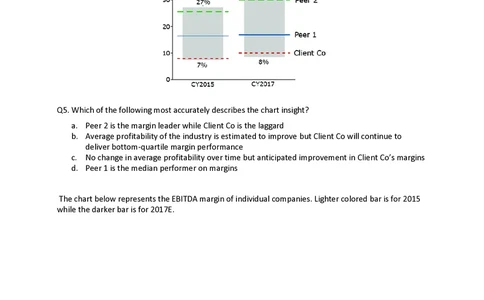
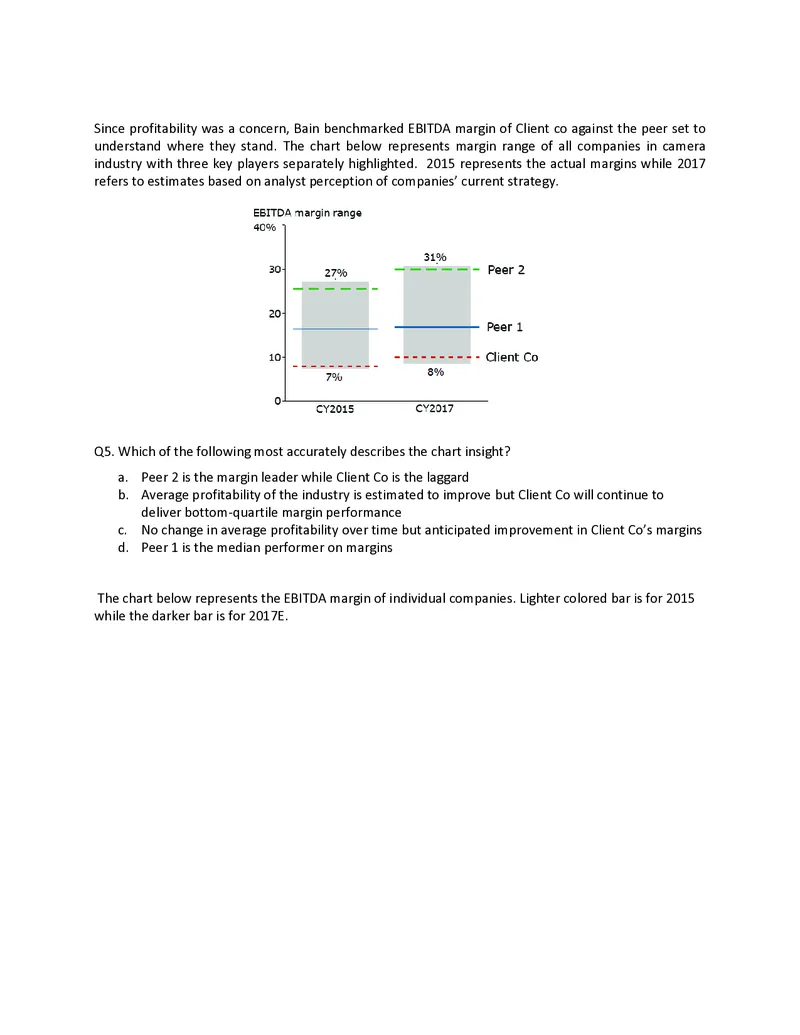
d. LED PanelsSince profitability was a concern, Bain benchmarked EBITDA margin of Client co against the peer set to
understand where they stand. The chart below represents margin range of all companies in camera
industry with three key players separately highlighted. 2015 represents the actual margins while 2017
refers to estimates based on analyst perception of companies’ current strategy.
Q5. Which of the following most accurately describes the chart insight?
a. Peer 2 is the margin leader while Client Co is the laggard
b. Average profitability of the industry is estimated to improve but Client Co will continue to
deliver bottom-quartile margin performance
c. No change in average profitability over time but anticipated improvement in Client Co’s margins
d. Peer 1 is the median performer on margins
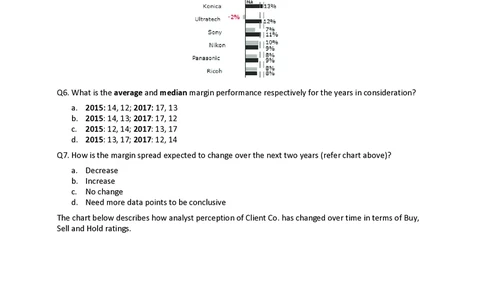
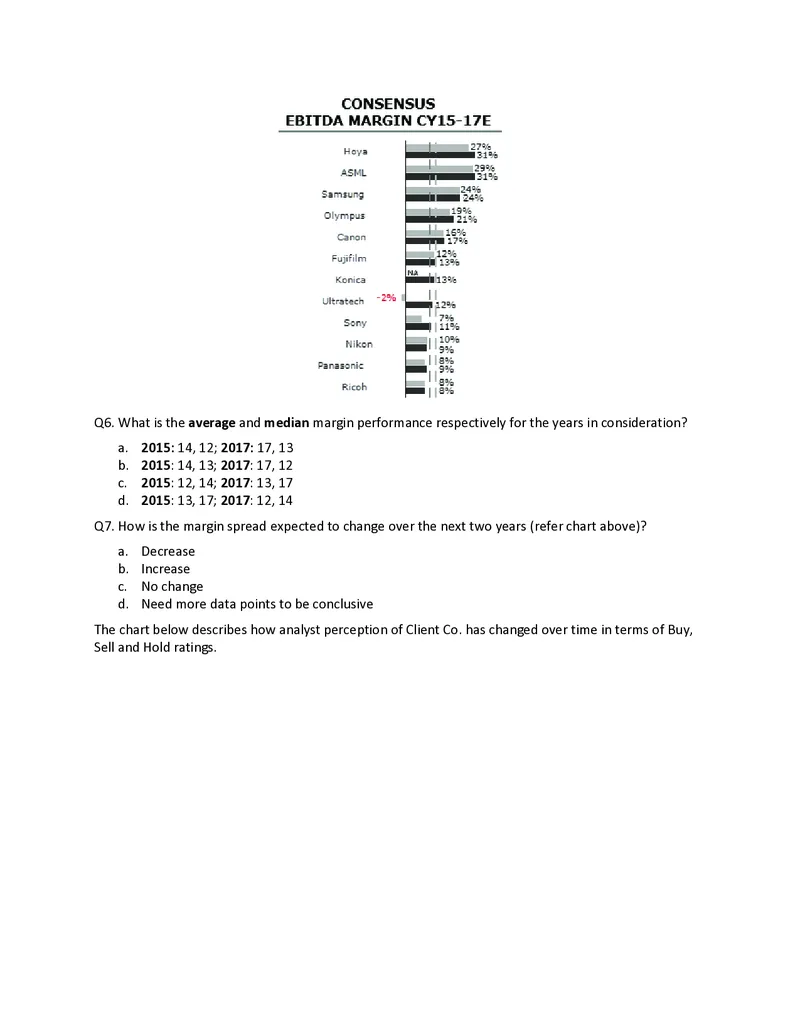
The chart below represents the EBITDA margin of individual companies. Lighter colored bar is for 2015
while the darker bar is for 2017E.Q6. What is the average and median margin performance respectively for the years in consideration?
a. 2015: 14, 12; 2017: 17, 13
b. 2015: 14, 13; 2017: 17, 12
c. 2015: 12, 14; 2017: 13, 17
d. 2015: 13, 17; 2017: 12, 14
Q7. How is the margin spread expected to change over the next two years (refer chart above)?
a. Decrease
b. Increase
c. No change
d. Need more data points to be conclusive
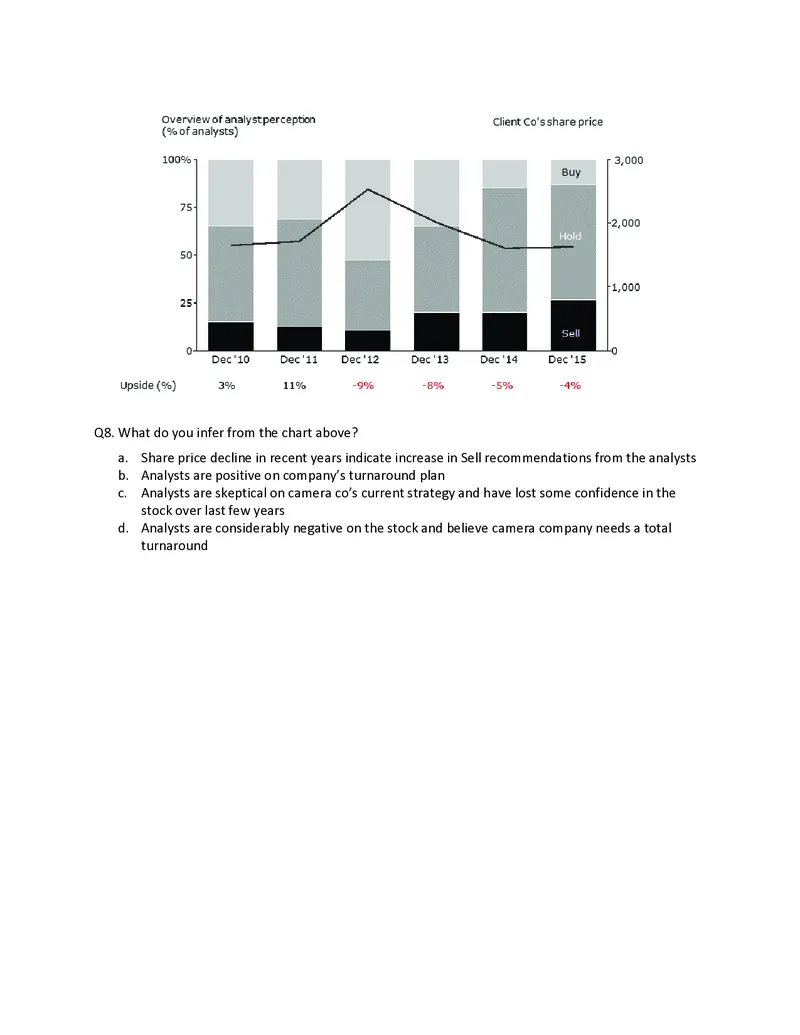
The chart below describes how analyst perception of Client Co. has changed over time in terms of Buy,
Sell and Hold ratings.Q8. What do you infer from the chart above?
a. Share price decline in recent years indicate increase in Sell recommendations from the analysts
b. Analysts are positive on company’s turnaround plan
c. Analysts are skeptical on camera co’s current strategy and have lost some confidence in the
stock over last few years
d. Analysts are considerably negative on the stock and believe camera company needs a total
turnaroundAfter a series of further analysis, Bain reached conclusions that are different from its initial hypothesis
and findings. Bain’s final recommendations to the Camera co. were in-line with key analysts. Below is
some commentary from the Camera Co’s analyst reports.
“Camera Co. is going to enhance its sales channels in emerging markets...we, however, think that the
company should cut its numbers of new models and decrease related costs including R&D…”
“We believe that Camera Co. should focus on cost cutting and improving production efficiency in the
camera business, instead of entering into new business areas, because Camera Co’s risk tolerance
should decline due to the structural decline of its core business.” – Analyst, September 2015
Q9. Which of the following do you believe were Bain’s recommendations to the Camera Co.?
1. Focus on expansion in emerging markets
2. Focus on cost savings
3. Focus on launching new models
4. Not enter into new business areas
From the information above, what do you think were Bain’s final recommendations?
a. Only 2
b. 1 and 2
c. Only 4
d. 2 and 4Case Study 2
MataSky is a large, national cable operator in the Bahamas. MataSky sells their services through a variety
of retail and e-tail partners and all channel partners are treated equally with no performance incentives.
Contracts with these partners were negotiated 5-10 years ago and lack aligned incentives.
The market has evolved over the last few years with new developments in the Consumer Electronics
market such as high share of online sales. Despite this, offline sales remain important for MataSky.
The company is working on a new IT system which will enable complex commissioning and a streamlined
sales process, thereby presenting an opportunity for new contracts. The new management has engaged
Bain to assist them to model a new commission structure based on cost of customer acquisition by partner
and customer lifetime value (CLV).
Q1. Which of the following steps do you think Bain would have followed to arrive at a new commission
structure?
1 Build fact base on the state Consumer Electronics, with focus on cable services
2 Interview current partners to identify best practices in contracts and relationships
3 Develop a new commission structure aligned with customer lifetime value (CLV)
4 Model the impact of new commissions
a. 1, 3 and 4
b. 2, 3 and 4
c. 1, 2 and 3
d. 1, 2, 3 and 4
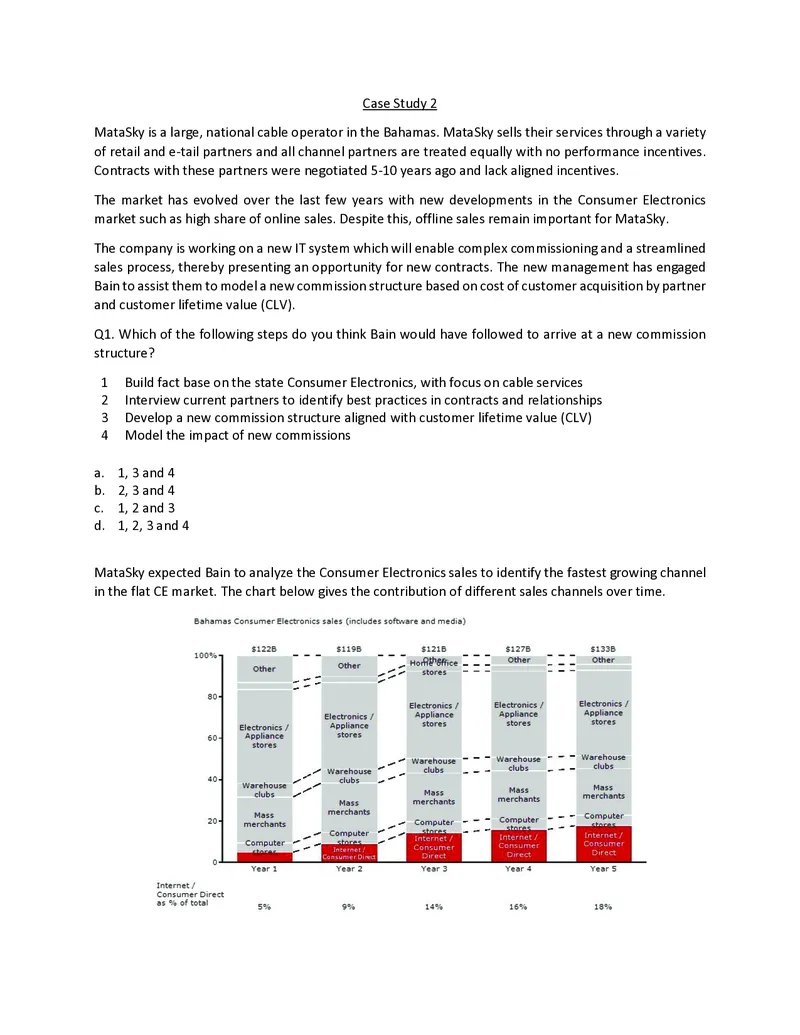
MataSky expected Bain to analyze the Consumer Electronics sales to identify the fastest growing channel
in the flat CE market. The chart below gives the contribution of different sales channels over time.Q2. What is the cumulative annual growth rate (CAGR) of Internet/Consumer Direct channel during Yr. 1-
5?
a. ~45%
b. ~40%
c. ~35%
d. ~30%
Q3. What is the average approximate share of Top 3 sales channels during Yr. 3-5?
a. 85%
b. 95%
c. 70%
d. Cannot be calculated
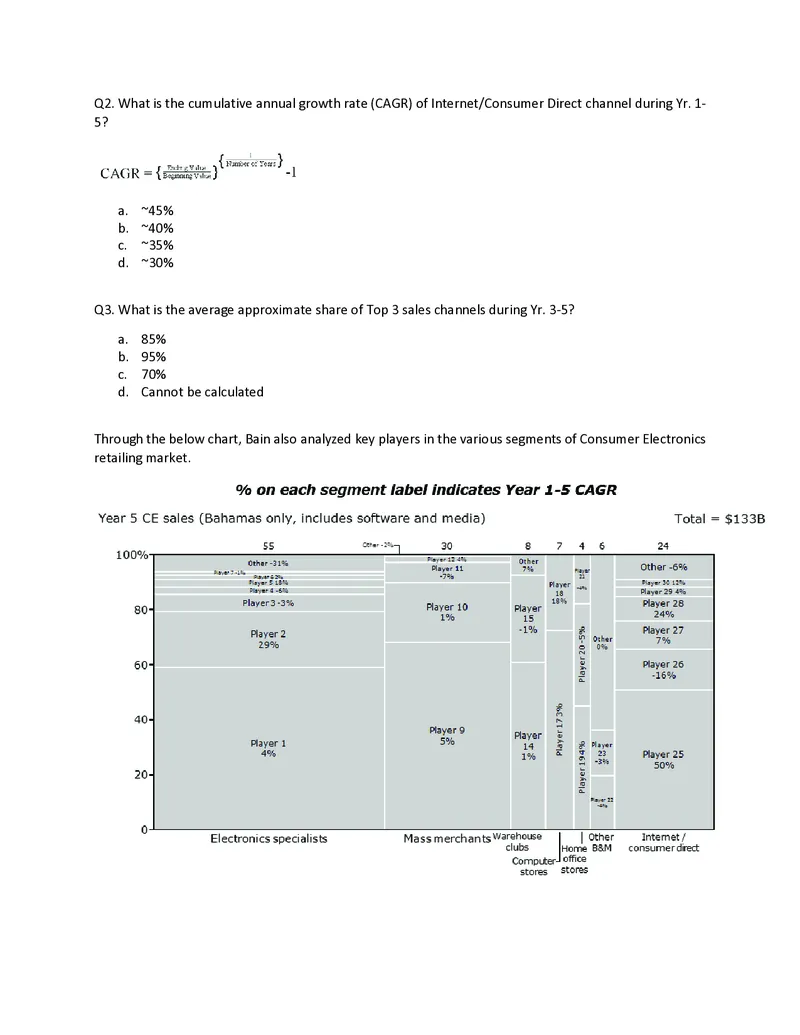
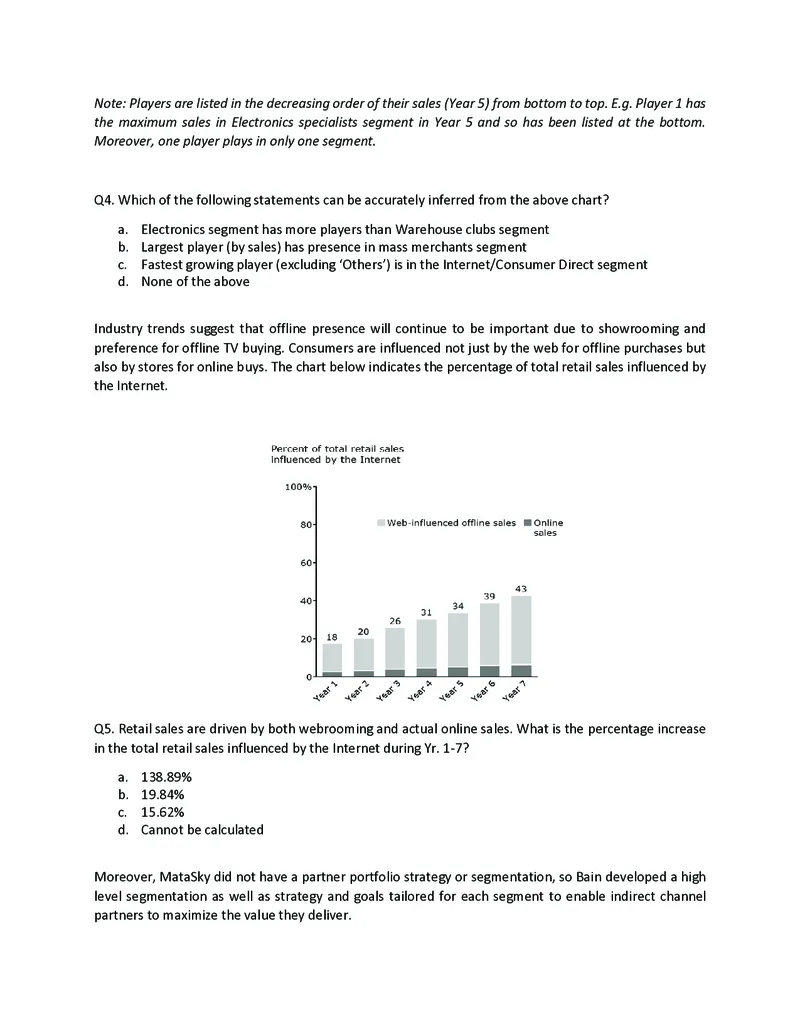
Through the below chart, Bain also analyzed key players in the various segments of Consumer Electronics
retailing market.Note: Players are listed in the decreasing order of their sales (Year 5) from bottom to top. E.g. Player 1 has
the maximum sales in Electronics specialists segment in Year 5 and so has been listed at the bottom.
Moreover, one player plays in only one segment.
Q4. Which of the following statements can be accurately inferred from the above chart?
a. Electronics segment has more players than Warehouse clubs segment
b. Largest player (by sales) has presence in mass merchants segment
c. Fastest growing player (excluding ‘Others’) is in the Internet/Consumer Direct segment
d. None of the above
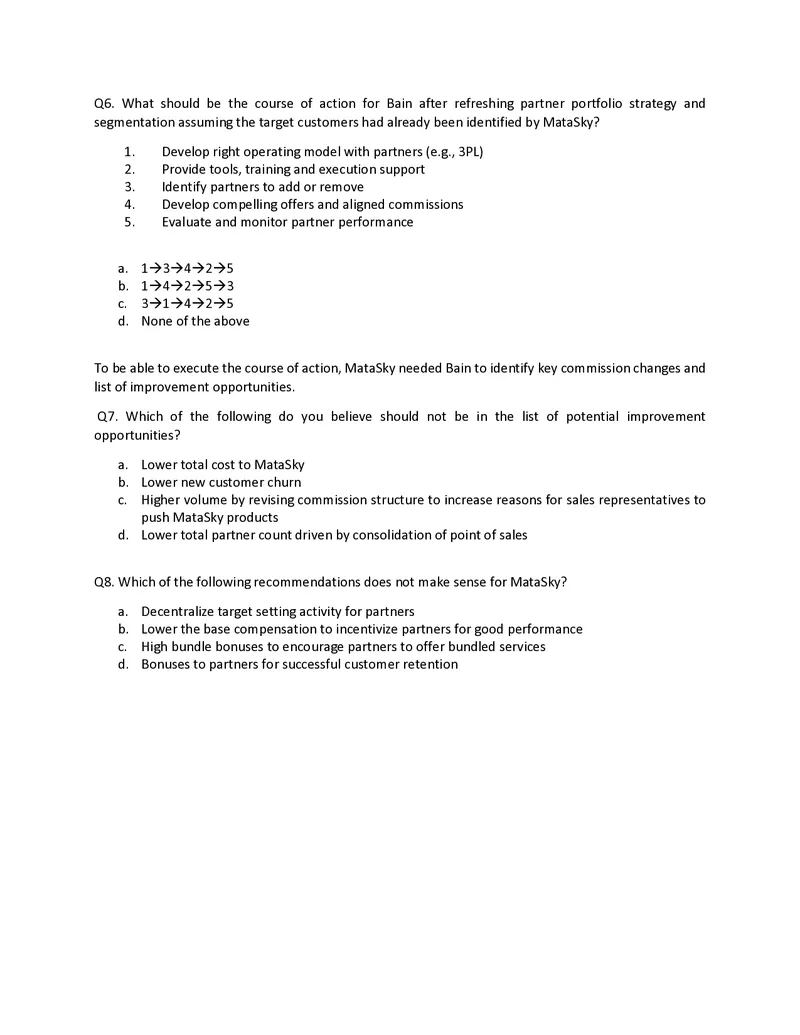
Industry trends suggest that offline presence will continue to be important due to showrooming and
preference for offline TV buying. Consumers are influenced not just by the web for offline purchases but
also by stores for online buys. The chart below indicates the percentage of total retail sales influenced by
the Internet.
Q5. Retail sales are driven by both webrooming and actual online sales. What is the percentage increase
in the total retail sales influenced by the Internet during Yr. 1-7?
a. 138.89%
b. 19.84%
c. 15.62%
d. Cannot be calculated
Moreover, MataSky did not have a partner portfolio strategy or segmentation, so Bain developed a high
level segmentation as well as strategy and goals tailored for each segment to enable indirect channel
partners to maximize the value they deliver.Q6. What should be the course of action for Bain after refreshing partner portfolio strategy and
segmentation assuming the target customers had already been identified by MataSky?
1. Develop right operating model with partners (e.g., 3PL)
2. Provide tools, training and execution support
3. Identify partners to add or remove
4. Develop compelling offers and aligned commissions
5. Evaluate and monitor partner performance
a. 13425
b. 14253
c. 31425
d. None of the above
To be able to execute the course of action, MataSky needed Bain to identify key commission changes and
list of improvement opportunities.
Q7. Which of the following do you believe should not be in the list of potential improvement
opportunities?
a. Lower total cost to MataSky
b. Lower new customer churn
c. Higher volume by revising commission structure to increase reasons for sales representatives to
push MataSky products
d. Lower total partner count driven by consolidation of point of sales
Q8. Which of the following recommendations does not make sense for MataSky?
a. Decentralize target setting activity for partners
b. Lower the base compensation to incentivize partners for good performance
c. High bundle bonuses to encourage partners to offer bundled services
d. Bonuses to partners for successful customer retentionCase 3
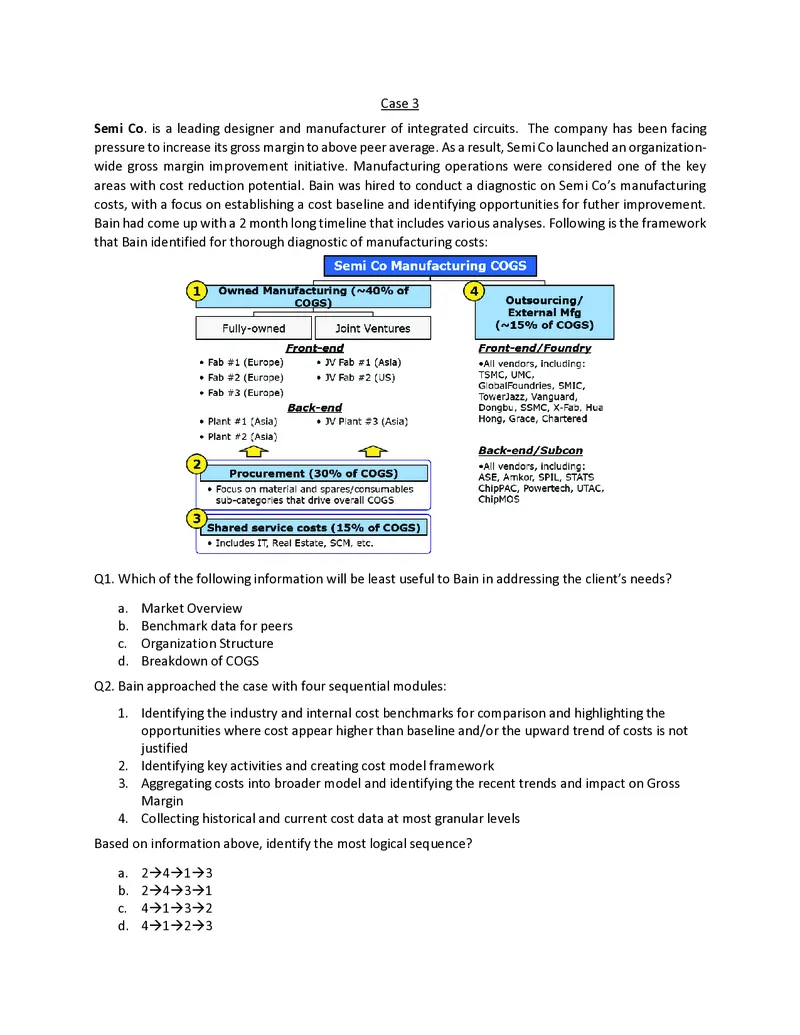
Semi Co. is a leading designer and manufacturer of integrated circuits. The company has been facing
pressure to increase its gross margin to above peer average. As a result, Semi Co launched an organization-
wide gross margin improvement initiative. Manufacturing operations were considered one of the key
areas with cost reduction potential. Bain was hired to conduct a diagnostic on Semi Co’s manufacturing
costs, with a focus on establishing a cost baseline and identifying opportunities for futher improvement.
Bain had come up with a 2 month long timeline that includes various analyses. Following is the framework
that Bain identified for thorough diagnostic of manufacturing costs:
Q1. Which of the following information will be least useful to Bain in addressing the client’s needs?
a. Market Overview
b. Benchmark data for peers
c. Organization Structure
d. Breakdown of COGS
Q2. Bain approached the case with four sequential modules:
1. Identifying the industry and internal cost benchmarks for comparison and highlighting the
opportunities where cost appear higher than baseline and/or the upward trend of costs is not
justified
2. Identifying key activities and creating cost model framework
3. Aggregating costs into broader model and identifying the recent trends and impact on Gross
Margin
4. Collecting historical and current cost data at most granular levels
Based on information above, identify the most logical sequence?
a. 2413
b. 2431
c. 4132
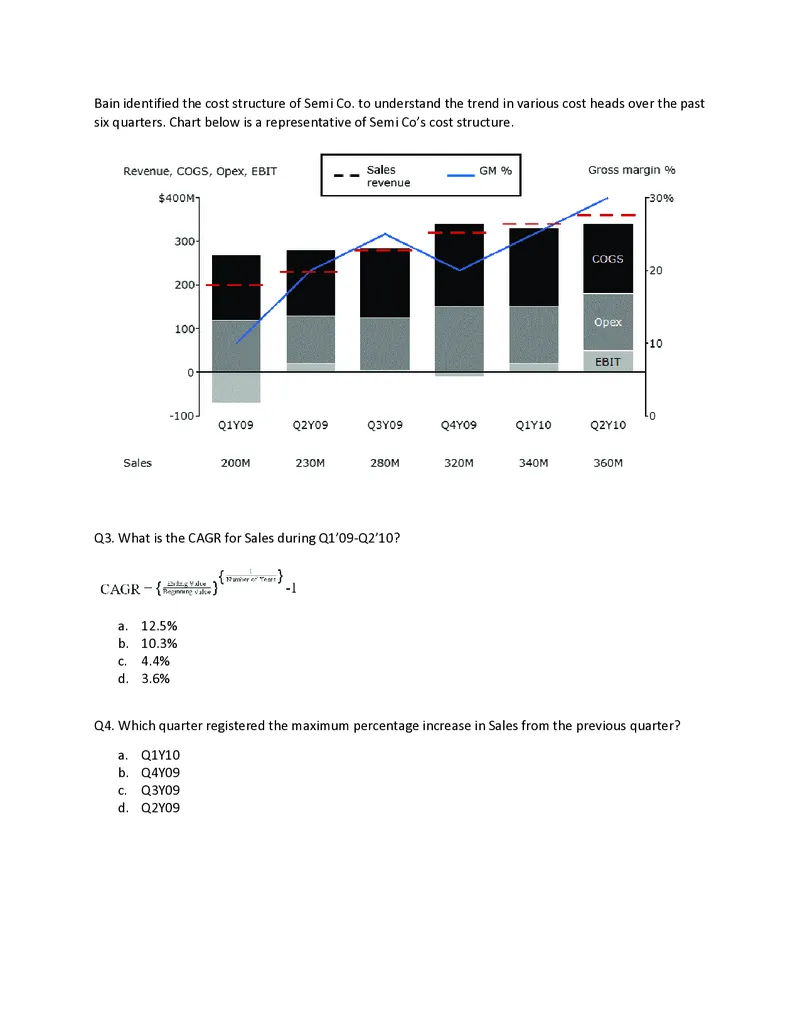
d. 4123Bain identified the cost structure of Semi Co. to understand the trend in various cost heads over the past
six quarters. Chart below is a representative of Semi Co’s cost structure.
Q3. What is the CAGR for Sales during Q1’09-Q2’10?
a. 12.5%
b. 10.3%
c. 4.4%
d. 3.6%
Q4. Which quarter registered the maximum percentage increase in Sales from the previous quarter?
a. Q1Y10
b. Q4Y09
c. Q3Y09
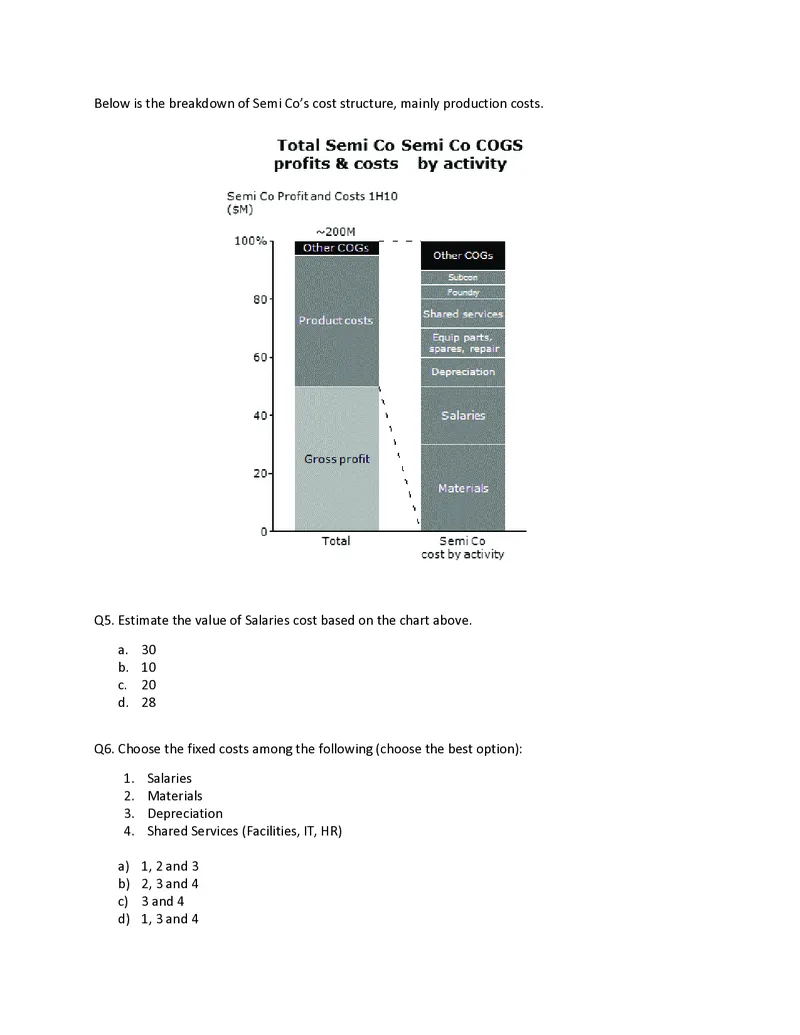
d. Q2Y09Below is the breakdown of Semi Co’s cost structure, mainly production costs.
Q5. Estimate the value of Salaries cost based on the chart above.
a. 30
b. 10
c. 20
d. 28
Q6. Choose the fixed costs among the following (choose the best option):
1. Salaries
2. Materials
3. Depreciation
4. Shared Services (Facilities, IT, HR)
a) 1, 2 and 3
b) 2, 3 and 4
c) 3 and 4
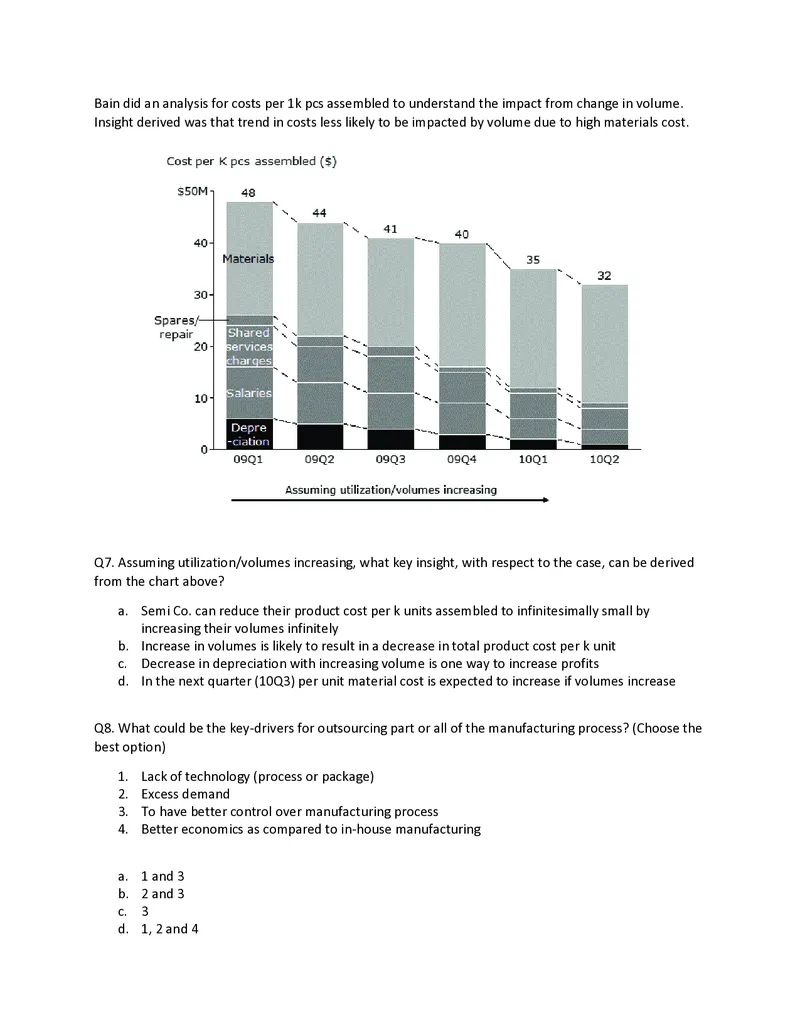
d) 1, 3 and 4Bain did an analysis for costs per 1k pcs assembled to understand the impact from change in volume.
Insight derived was that trend in costs less likely to be impacted by volume due to high materials cost.
Q7. Assuming utilization/volumes increasing, what key insight, with respect to the case, can be derived
from the chart above?
a. Semi Co. can reduce their product cost per k units assembled to infinitesimally small by
increasing their volumes infinitely
b. Increase in volumes is likely to result in a decrease in total product cost per k unit
c. Decrease in depreciation with increasing volume is one way to increase profits
d. In the next quarter (10Q3) per unit material cost is expected to increase if volumes increase
Q8. What could be the key-drivers for outsourcing part or all of the manufacturing process? (Choose the
best option)
1. Lack of technology (process or package)
2. Excess demand
3. To have better control over manufacturing process
4. Better economics as compared to in-house manufacturing
a. 1 and 3
b. 2 and 3
c. 3
d. 1, 2 and 4Guidelines
Welcome to the first step of the recruitment process at Bain & Company, Inc. You are about to
get a firsthand experience on practical Bain casework. The test is based on modified Bain cases
and is designed to assess your approach to problem solving using strategic thinking and deductive
reasoning. At Bain, we are more interested in ‘how you think’ rather than ‘what you’ve learnt’.
We work on diverse complex situations spanning across multiple industries and sectors, but
present only concise, relevant information to our clients. In order to do the same, we understand
the data, interpret the insights, and finally present what we infer in an organized manner. This
test is designed to simulate the same experience for you!
While attempting this paper:
Understand: Read the case studies carefully and identify the underlying problem. Make sure
you do not leave out any inputs or key data points
Interpret: Focus on details in the text and charts. Pay attention to the period of analyses and
units used
Structure your approach: Manage your time by answering the questions smartly. For instance,
some questions do not require calculations but only involve simple elimination of choices. Always
do a quick check before answering
Instructions
This booklet consists of 25 questions with multiple choices. Each question has a single correct
answer
It not necessary to answer all questions. You may attempt these questions according to your
strengths and time. Read the question extremely well and attempt it only when you have fully
understood what is to be done
Use of any electronic devices (calculators, mobile phones, etc.) is strictly prohibited while
answering the test
You have 60 minutes to complete the test. Keep your composure and best of luck!Case 1
Beverage Co is a local-MNC joint venture in the Indonesian non-alcoholic beverage market. Non-alcoholic
beverages include liquid refreshment beverages (LRB) such as bottled water, value-added water,
carbonated soft drinks, ready-to-drink coffee and tea, energy drinks and fruit based beverages.
Beverage Co is a distant follower in mainstream categories while a leader in niche categories. Its sales
have been declining in the mainstream categories and its distribution reach has also shrunk in the past
few years.
The company has been facing portfolio issues as it has a wide and fragmented portfolio of products with
over 20+ SKUs (SKUs are distinct type of products/services on sale with each SKU having different attributes
such as manufacturer, description, material, size, colour, etc.); however, its innovation track record has
been fairly poor with only a few SKUs driving sales volume and margins. The company categorizes its
products into 5 categories–Hero, Emerging hero, Core, Support and Delist–in the decreasing order of
performance, i.e. ‘hero’ are the best performing while ‘delist’ are the worst performing SKUs.
To add to its woes, high distribution and manufacturing costs are hindering Beverage Co’s ability to
expand. The CEO Ajeng Yin is worried and has approached Bain to devise a medium-term strategy to
improve overall performance.
Q1. Which of the following most accurately describes why Beverage Co. has approached Bain?
a. Expand client’s footprint in new growing product categories to drive sales
b. Cut costs by optimizing distribution channels
c. Exploring new geographies to increase sales avenues
d. Optimize product portfolio to drive sustainable and profitable growth
Q2. Which of the following information will be least useful for Bain in addressing the client’s needs?
a. Competitors’ cost structure
b. Market overview
c. Competitors’ geographical footprint
d. Company’s sales figures for the past five years
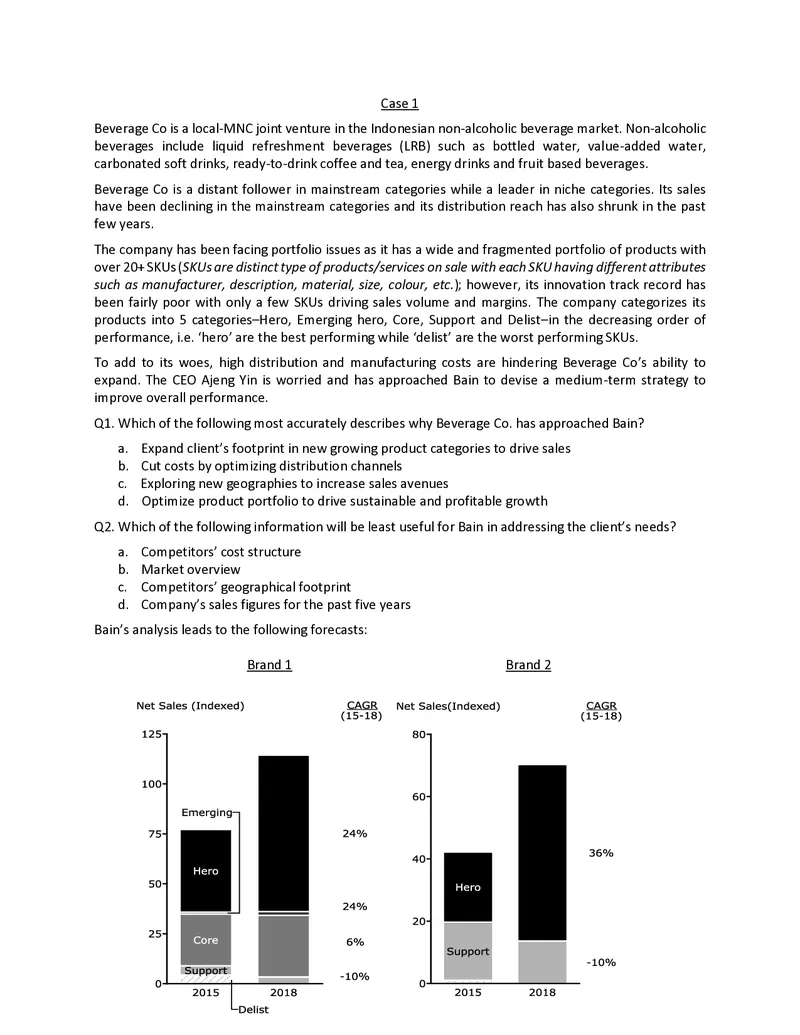
Bain’s analysis leads to the following forecasts:
Brand 1 Brand 2Q3. The above forecast is based on three sequential modules.
1. Focus the sales force on select SKUs
2. Determine product mix that fits shoppers’ needs
3. Analyst the improvement in margins through greater volume sales
What according to you was the most likely sequence that Bain followed to crack Beverage Co’s issues?
a. 1 →2→3
b. 3→2→1
c. 3→1→2
d. 2→ 1→3
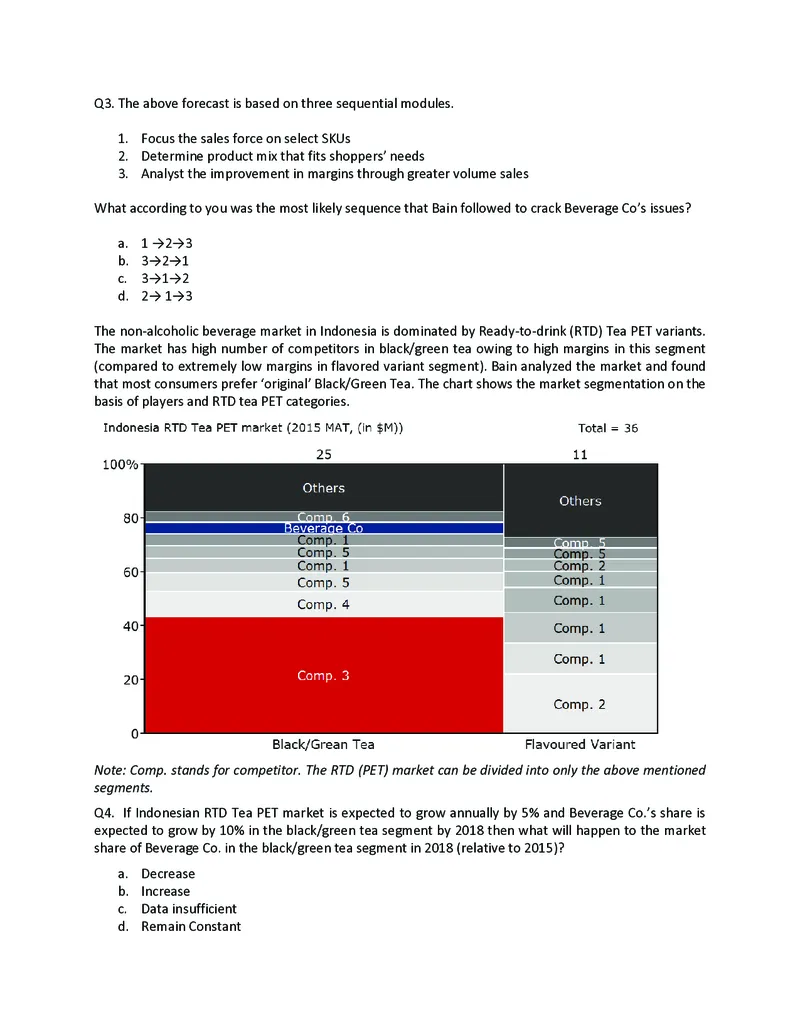
The non-alcoholic beverage market in Indonesia is dominated by Ready-to-drink (RTD) Tea PET variants.
The market has high number of competitors in black/green tea owing to high margins in this segment
(compared to extremely low margins in flavored variant segment). Bain analyzed the market and found
that most consumers prefer ‘original’ Black/Green Tea. The chart shows the market segmentation on the
basis of players and RTD tea PET categories.
Note: Comp. stands for competitor. The RTD (PET) market can be divided into only the above mentioned
segments.
Q4. If Indonesian RTD Tea PET market is expected to grow annually by 5% and Beverage Co.’s share is
expected to grow by 10% in the black/green tea segment by 2018 then what will happen to the market
share of Beverage Co. in the black/green tea segment in 2018 (relative to 2015)?
a. Decrease
b. Increase
c. Data insufficient
d. Remain ConstantQ5. If it is known that competitor 3 is the market leader in black/green tea and offers 10 different SKUs in
the same segment, which of the following will most likely not be the potential course of action for
Beverage co?
Assumptions:
1) Beverage co has SKUs across all the top 3 performing categories (hero, emerging hero, core) in
Black/ Green tea segment
2) Beverage co has presence throughout Indonesia whereas competitor 3 is present only in highly
populated areas of Indonesia
3) Black/green tea shoppers are increasingly getting price sensitive
a. Focus on producing new ‘hero’ SKUs or upgrading ‘non-hero’ SKUs to ‘hero’ in the black/green
tea segment
b. Divert resources to flavored variants segment to develop market leadership there
c. Follow price leadership strategy for ‘hero’ SKUs to gain market share
d. Both a and c
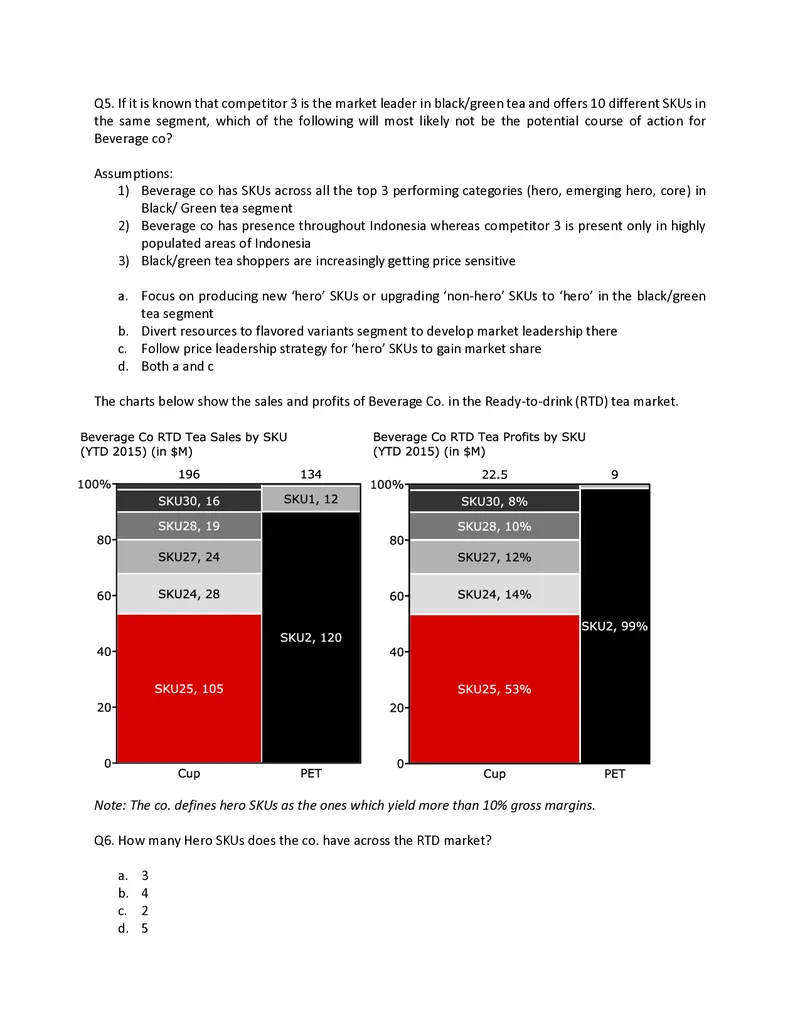
The charts below show the sales and profits of Beverage Co. in the Ready-to-drink (RTD) tea market.
Note: The co. defines hero SKUs as the ones which yield more than 10% gross margins.
Q6. How many Hero SKUs does the co. have across the RTD market?
a. 3
b. 4
c. 2
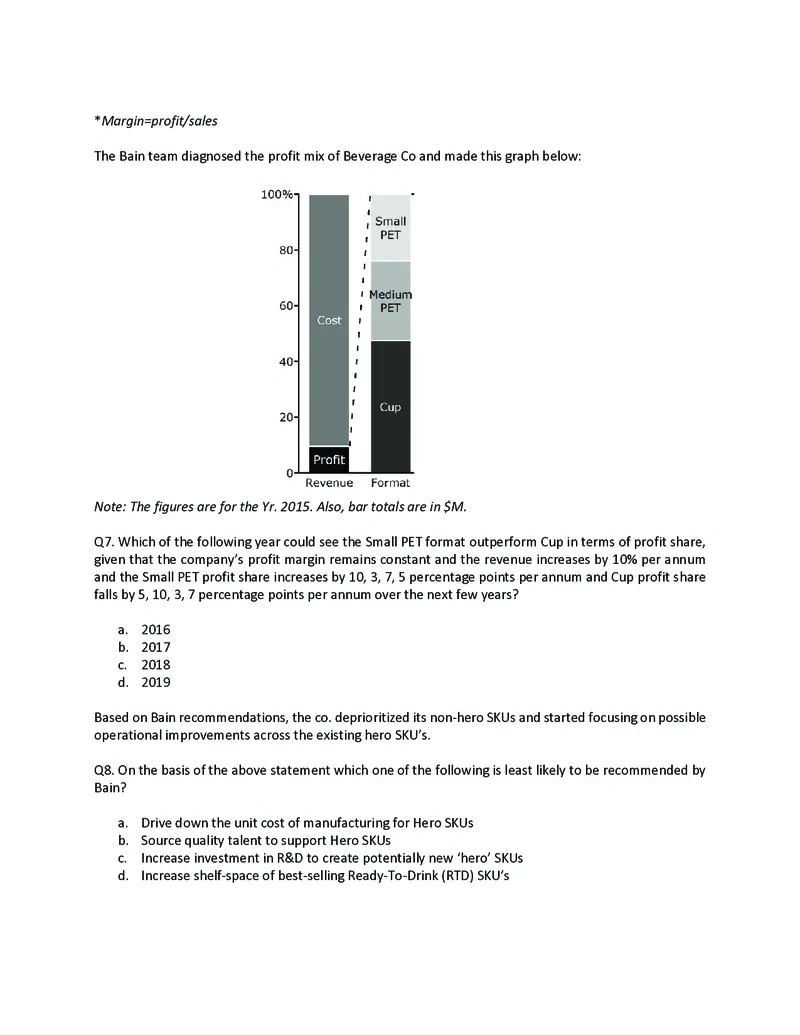
d. 5*Margin=profit/sales
The Bain team diagnosed the profit mix of Beverage Co and made this graph below:
Note: The figures are for the Yr. 2015. Also, bar totals are in $M.
Q7. Which of the following year could see the Small PET format outperform Cup in terms of profit share,
given that the company’s profit margin remains constant and the revenue increases by 10% per annum
and the Small PET profit share increases by 10, 3, 7, 5 percentage points per annum and Cup profit share
falls by 5, 10, 3, 7 percentage points per annum over the next few years?
a. 2016
b. 2017
c. 2018
d. 2019
Based on Bain recommendations, the co. deprioritized its non-hero SKUs and started focusing on possible
operational improvements across the existing hero SKU’s.
Q8. On the basis of the above statement which one of the following is least likely to be recommended by
Bain?
a. Drive down the unit cost of manufacturing for Hero SKUs
b. Source quality talent to support Hero SKUs
c. Increase investment in R&D to create potentially new ‘hero’ SKUs
d. Increase shelf-space of best-selling Ready-To-Drink (RTD) SKU’sCase 2
Chemical Co. is a global specialty chemicals company operating in 16+ distinct businesses. Its profit and
market value doubled during 2005-10, though the revenues remained flat. Chemical Co. aspires to double
its revenue over the next five years by 2015.
To achieve this target, the CEO of Chemical Co. approached Bain. As a Bain AC your job is to clearly
understand the businesses that Chemical Co. operates in, define the core business that accounts for
majority of Chemical Co’s profit, identify a strategy for its core business to take it to its full potential and
identify opportunities in near adjacencies.
Q1. Based on the information given in the paragraph, which of the following statements aptly describe
one of Bain and Co.’s objectives?
a) To analyze the specialty chemicals market and look for acquisitions
b) To understand the scope for development of underperforming businesses
c) For a radical restructuring of their businesses
d) To identify growth opportunities in core business and adjacencies
Q2. Which of the following information will be least useful for Bain in addressing the client’s needs?
a) List of businesses wherein Chemical Co. operates
b) New technologies that Chemical Co. would need to develop to serve new markets
c) Attractive markets where Chemical Co. could serve their current customers
d) Profit contribution from various business units
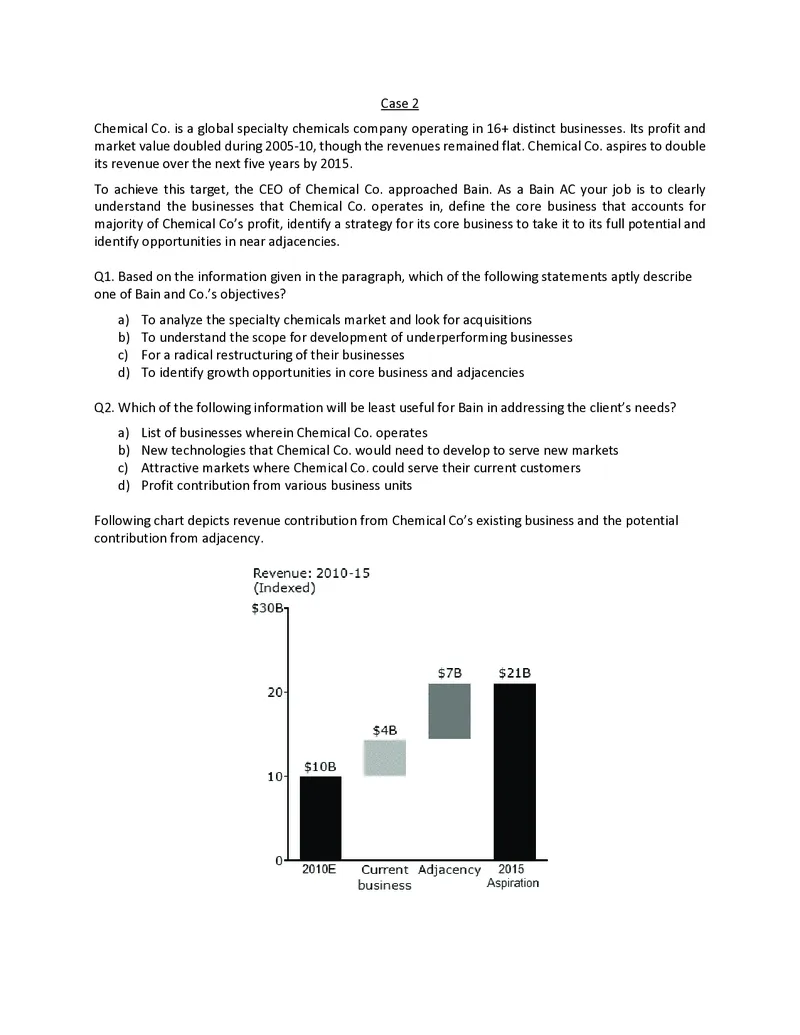
Following chart depicts revenue contribution from Chemical Co’s existing business and the potential
contribution from adjacency.Q3. Based on the above chart, calculate the 1st year revenue from adjacencies if the adjacency business
is to grow at a CAGR = 25%.
a) $ 1.6B
b) $ 2.9B
c) $ 3.2B
d) $ 4.8B
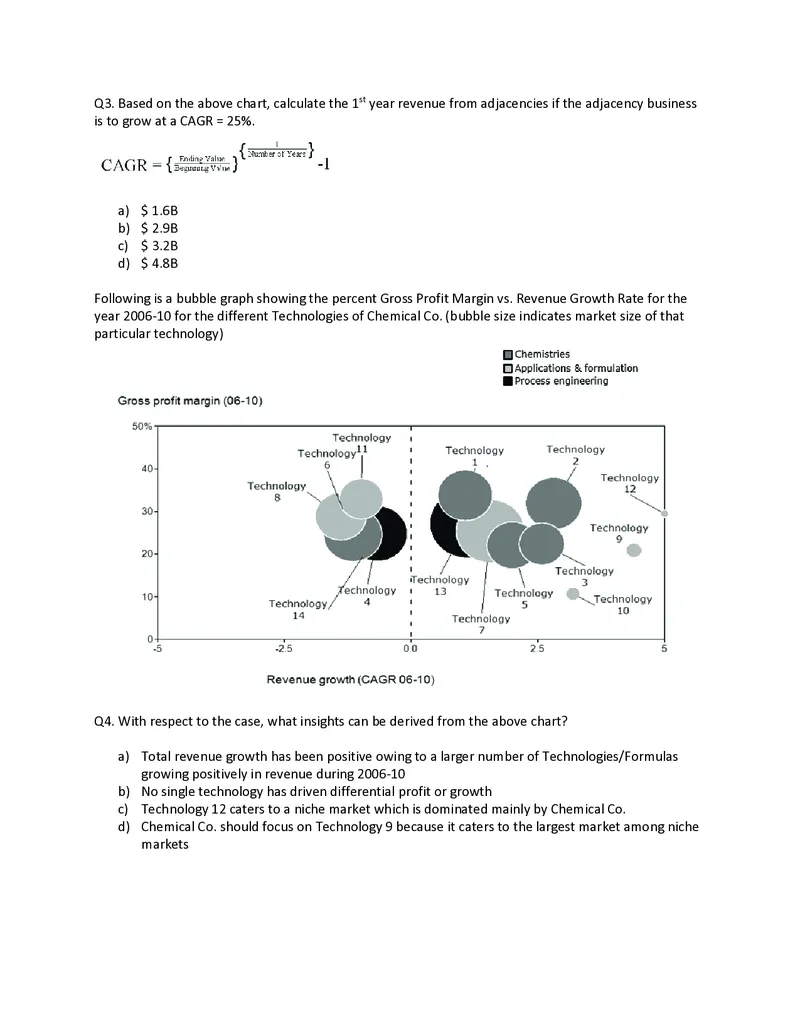
Following is a bubble graph showing the percent Gross Profit Margin vs. Revenue Growth Rate for the
year 2006-10 for the different Technologies of Chemical Co. (bubble size indicates market size of that
particular technology)
Q4. With respect to the case, what insights can be derived from the above chart?
a) Total revenue growth has been positive owing to a larger number of Technologies/Formulas
growing positively in revenue during 2006-10
b) No single technology has driven differential profit or growth
c) Technology 12 caters to a niche market which is dominated mainly by Chemical Co.
d) Chemical Co. should focus on Technology 9 because it caters to the largest market among niche
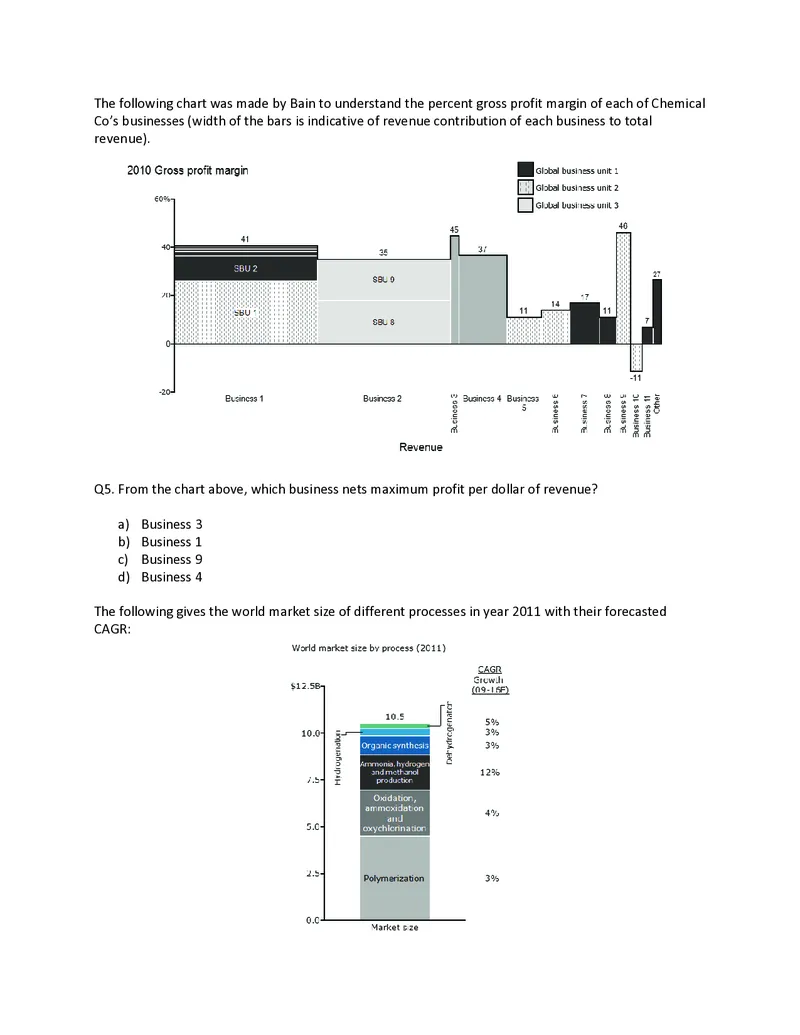
marketsThe following chart was made by Bain to understand the percent gross profit margin of each of Chemical
Co’s businesses (width of the bars is indicative of revenue contribution of each business to total
revenue).
Q5. From the chart above, which business nets maximum profit per dollar of revenue?
a) Business 3
b) Business 1
c) Business 9
d) Business 4
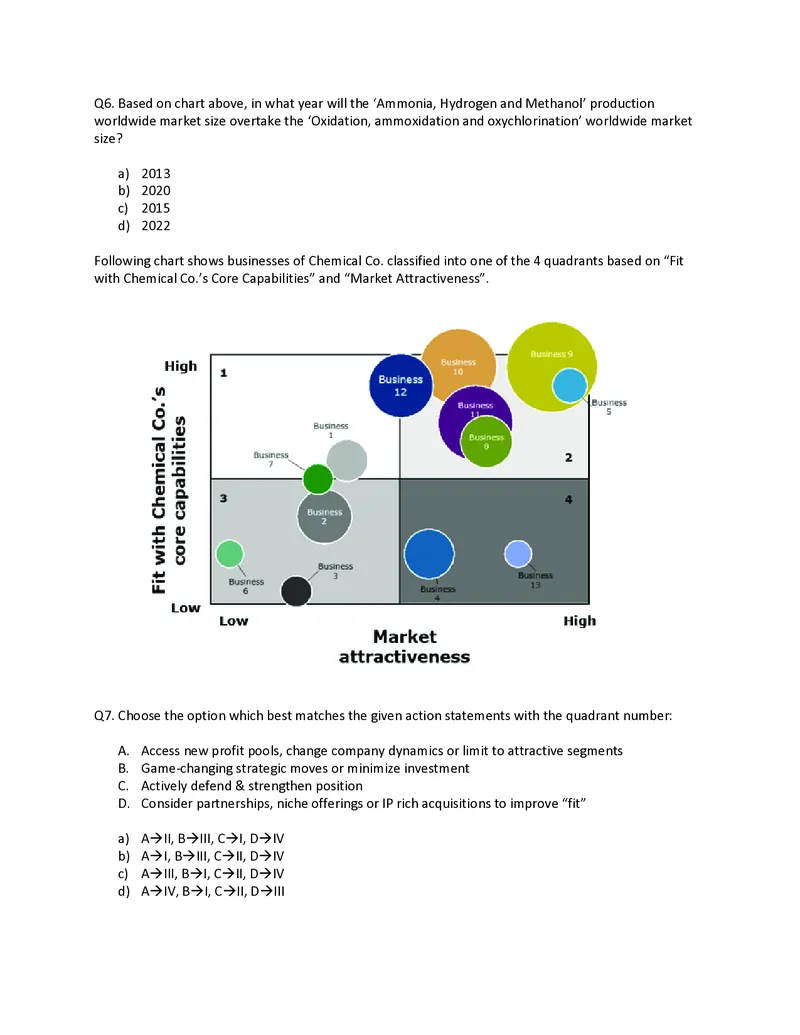
The following gives the world market size of different processes in year 2011 with their forecasted
CAGR:Q6. Based on chart above, in what year will the ‘Ammonia, Hydrogen and Methanol’ production
worldwide market size overtake the ‘Oxidation, ammoxidation and oxychlorination’ worldwide market
size?
a) 2013
b) 2020
c) 2015
d) 2022
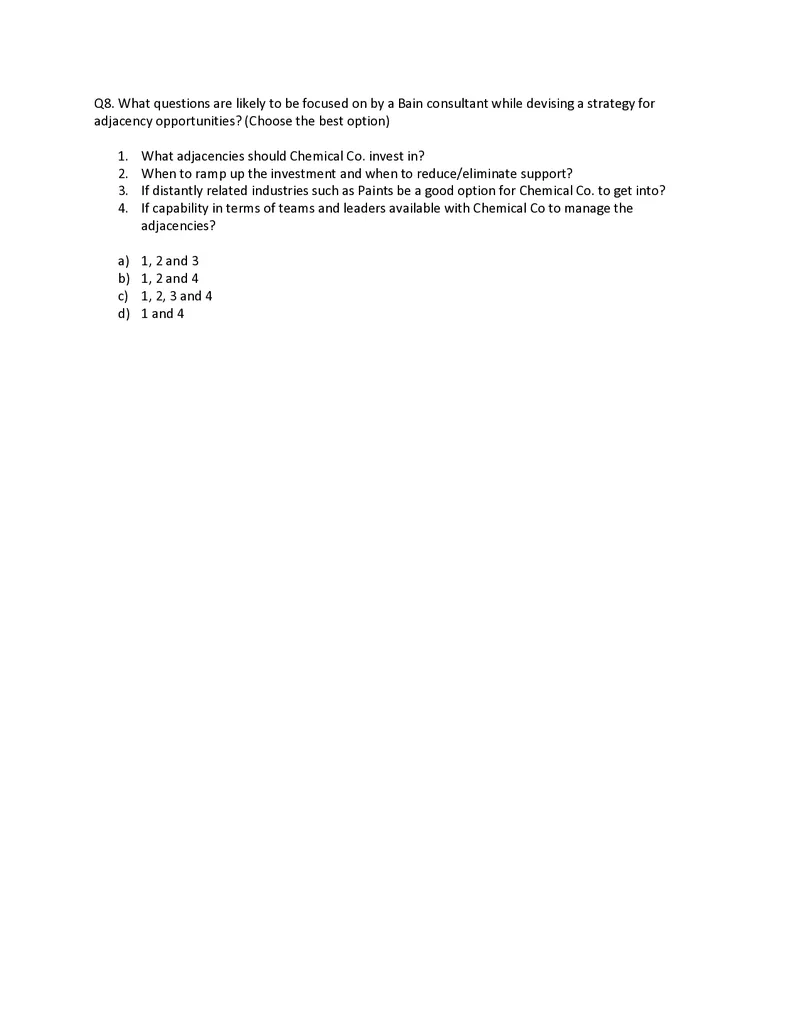
Following chart shows businesses of Chemical Co. classified into one of the 4 quadrants based on “Fit
with Chemical Co.’s Core Capabilities” and “Market Attractiveness”.
Q7. Choose the option which best matches the given action statements with the quadrant number:
A. Access new profit pools, change company dynamics or limit to attractive segments
B. Game-changing strategic moves or minimize investment
C. Actively defend & strengthen position
D. Consider partnerships, niche offerings or IP rich acquisitions to improve “fit”
a) AII, BIII, CI, DIV
b) AI, BIII, CII, DIV
c) AIII, BI, CII, DIV
d) AIV, BI, CII, DIIIQ8. What questions are likely to be focused on by a Bain consultant while devising a strategy for
adjacency opportunities? (Choose the best option)
1. What adjacencies should Chemical Co. invest in?
2. When to ramp up the investment and when to reduce/eliminate support?
3. If distantly related industries such as Paints be a good option for Chemical Co. to get into?
4. If capability in terms of teams and leaders available with Chemical Co to manage the
adjacencies?
a) 1, 2 and 3
b) 1, 2 and 4
c) 1, 2, 3 and 4
d) 1 and 4Case 3
HealthMax operates in the healthcare insurance industry in Brazil and has a considerable market share
in the Brazilian market with a number of products across most of market segments. Four years ago it
created a new product to enter the low end segment, but results were far from expected so it had to
exit the market.
The company believes that low-end segment is expected to grow faster than other segments in the
coming years as there has been a growth of 57% from 2009 to 2015 in the number of people that use
some kind of private health care services. The company now wants to reenter the low end market and
aspires to gain greater market share against its competitors.
Meanwhile, the leading health insurance companies that play in the intermediate and premium
market segments have strengthened their positions through acquisitions over the last 5 years and the
market is getting more and more concentrated. Moreover, a significant decline in profitability is also
projected for the traditional intermediate and premium segments due to future reductions in financial
revenue as a result of interest rate reductions, adding pressure on the business to find alternative
revenue streams for growth. In light of this Ana Luiza, CEO, has asked Bain to help them grow and
achieve their medium term goals.
Q1. Based on the information given in the paragraph, which of the following statements most aptly
describes overall Bain and Co.’s objective?
a. Devise new product for the company by innovating the older product
b. Create market leadership strategy in the health insurance industry
c. Develop market entry and positioning strategy in the target market segment
d. Plan attractive market segments in healthcare industry for creating a new offering
Q2. Which of the following information will be least useful for Bain in addressing the client’s needs?
a. Low end market growth drivers
b. Factors limiting low end market growth
c. Margins from HealthMax’s different products
d. Competitors’ product portfolio in low end market
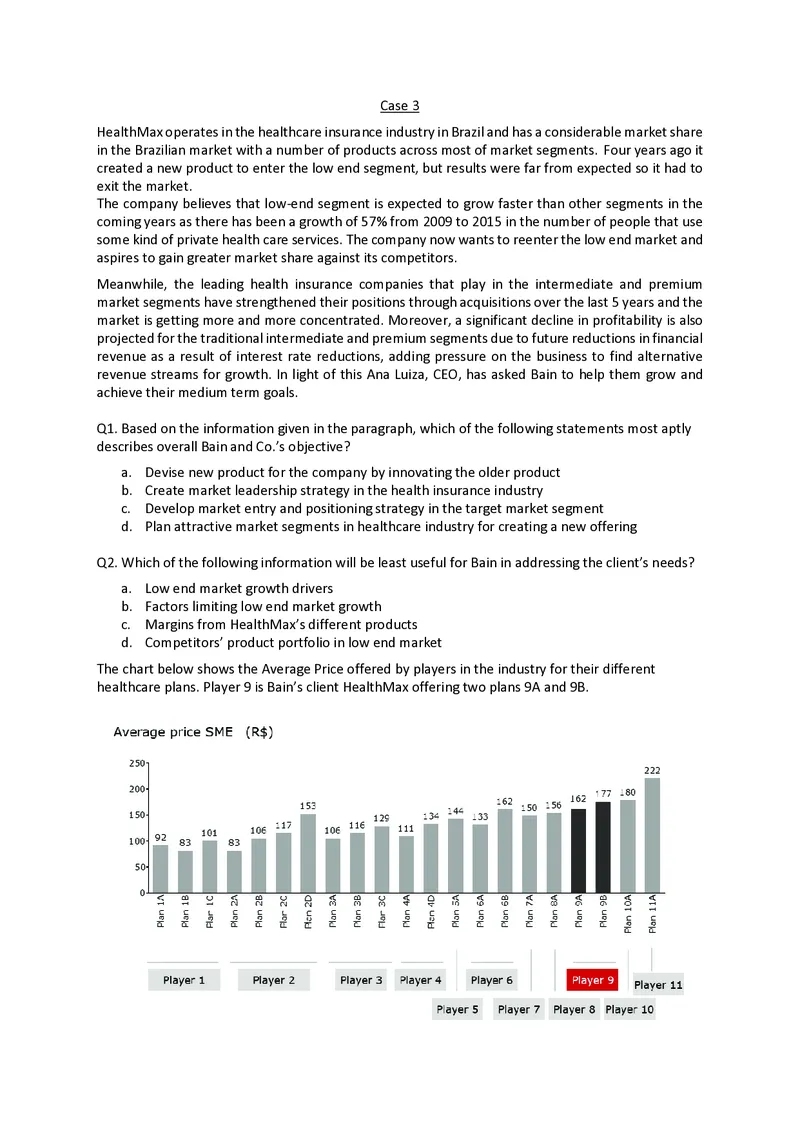
The chart below shows the Average Price offered by players in the industry for their different
healthcare plans. Player 9 is Bain’s client HealthMax offering two plans 9A and 9B.Q3. From the above chart, calculate if the average price of plans offered by Bain’s client is higher or
lower as compared to the competitors’ average price and also tell by how much percent is it higher
or lower?
a) Higher by 30%
b) Higher by 100%
c) Lower by 10%
d) Lower by 50%
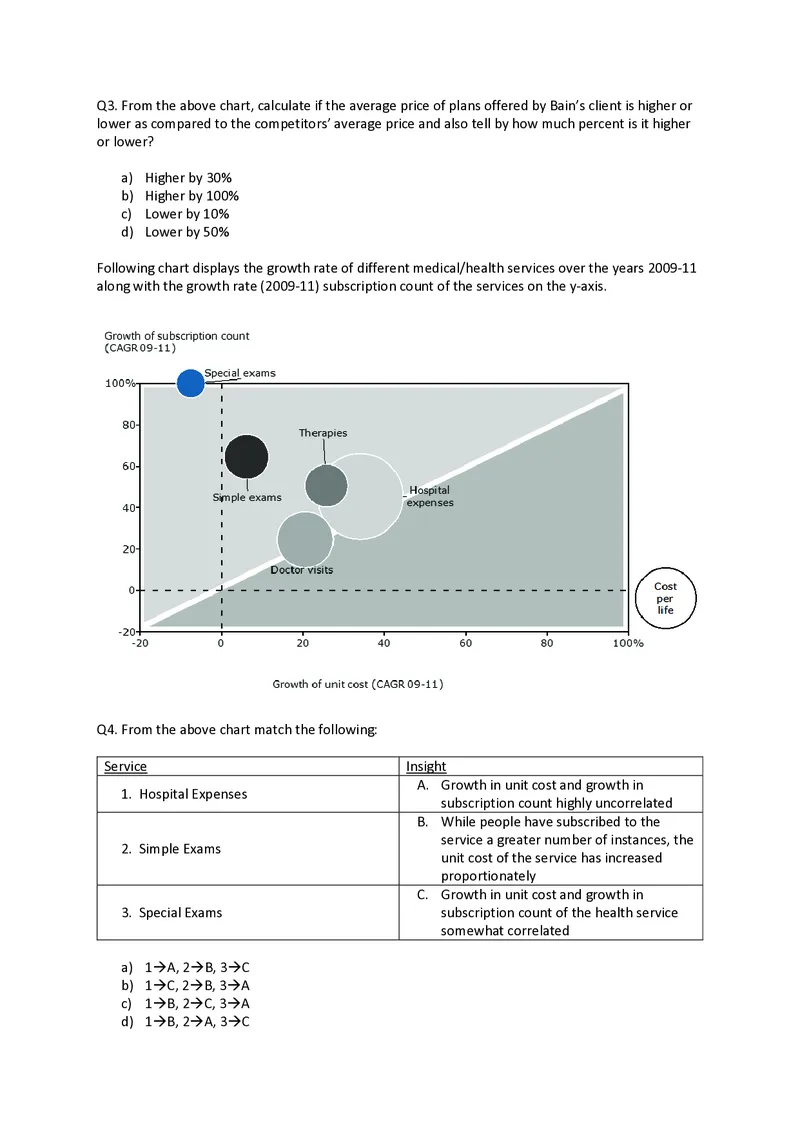
Following chart displays the growth rate of different medical/health services over the years 2009-11
along with the growth rate (2009-11) subscription count of the services on the y-axis.
Q4. From the above chart match the following:
Service Insight
A. Growth in unit cost and growth in
1. Hospital Expenses
subscription count highly uncorrelated
B. While people have subscribed to the
service a greater number of instances, the
2. Simple Exams
unit cost of the service has increased
proportionately
C. Growth in unit cost and growth in
3. Special Exams subscription count of the health service
somewhat correlated
a) 1A, 2B, 3C
b) 1C, 2B, 3A
c) 1B, 2C, 3A
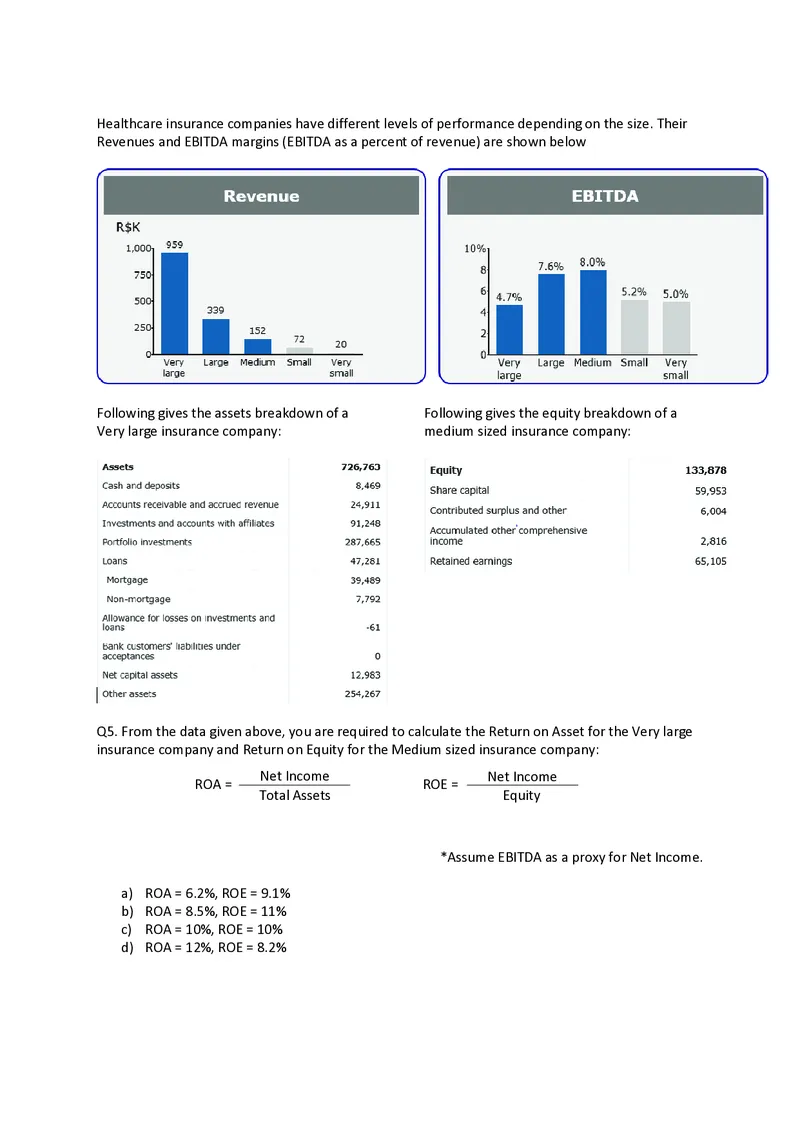
d) 1B, 2A, 3CHealthcare insurance companies have different levels of performance depending on the size. Their
Revenues and EBITDA margins (EBITDA as a percent of revenue) are shown below
Following gives the assets breakdown of a Following gives the equity breakdown of a
Very large insurance company: medium sized insurance company:
Q5. From the data given above, you are required to calculate the Return on Asset for the Very large
insurance company and Return on Equity for the Medium sized insurance company:
Net Income Net Income
ROA = ROE =
Total Assets Equity
*Assume EBITDA as a proxy for Net Income.
a) ROA = 6.2%, ROE = 9.1%
b) ROA = 8.5%, ROE = 11%
c) ROA = 10%, ROE = 10%
d) ROA = 12%, ROE = 8.2%Q6. Bain pursued the case by developing a four phase approach.
1. Create appropriate operations model for new offering
2. Market analysis and point of view (POV) about low end segment
3. Business analysis of profitability and current offerings in all segments
4. Construct a 5-year growth plan
From the information above, what was the course of action according to you?
a. 3241
b. 2314
c. 3421
d. 3214
Q7. Bain further performed market analysis and recommended that HealthMax should enter the low
end segment. On analysis of which of the following factors would Bain have made its
recommendation? (Select the most appropriate option)
1. Low end market growth rate
2. Existing providers operating model in low end market
3. Cost efficiencies in the segment
4. Synergies in sales channel
5. Brazilian population expansion and demand for overall healthcare services
Choose the most appropriate option
a. 1,4 and 5
b. 1,2,3 and 5
c. 1,2, 4 and 5
d. 1,2 and 4
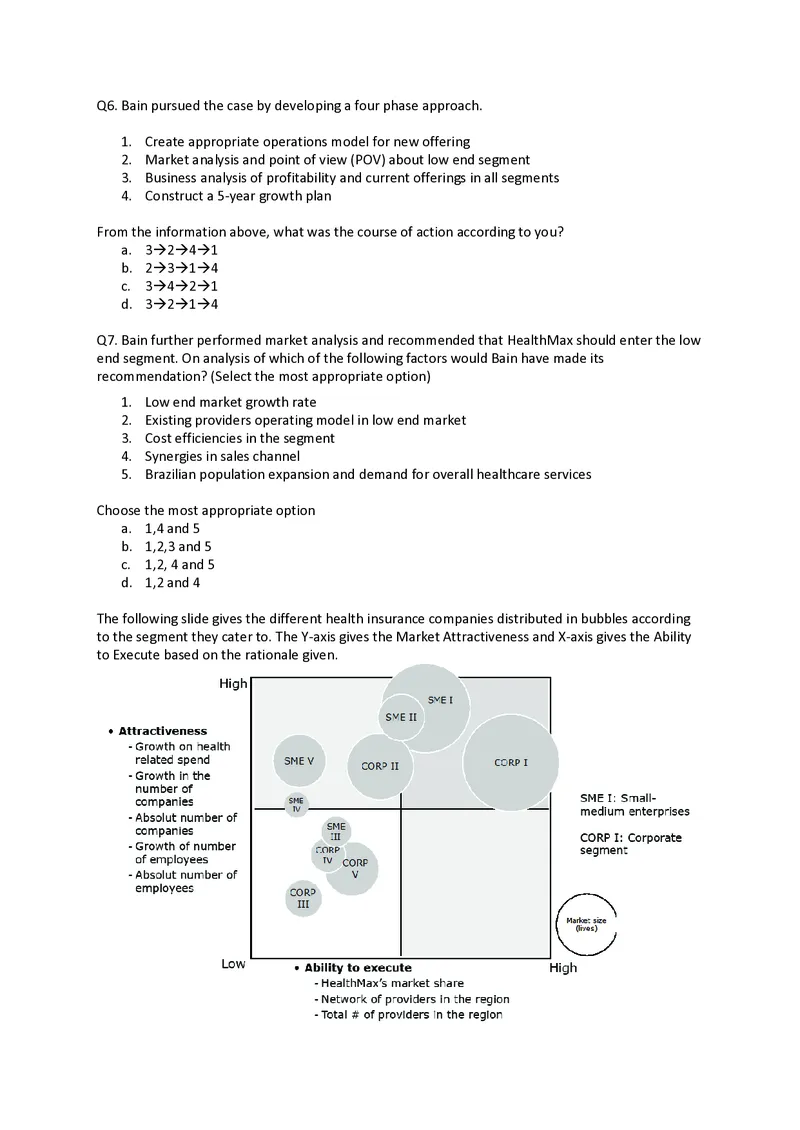
The following slide gives the different health insurance companies distributed in bubbles according
to the segment they cater to. The Y-axis gives the Market Attractiveness and X-axis gives the Ability
to Execute based on the rationale given.Q8. From the above slide identify the most logical target segments in both SME and CORP.
a) SME IV and V; CORP III
b) SME III; CORP III, IV and V
c) SME I and II; CORP I and II
d) SME II; CORP II
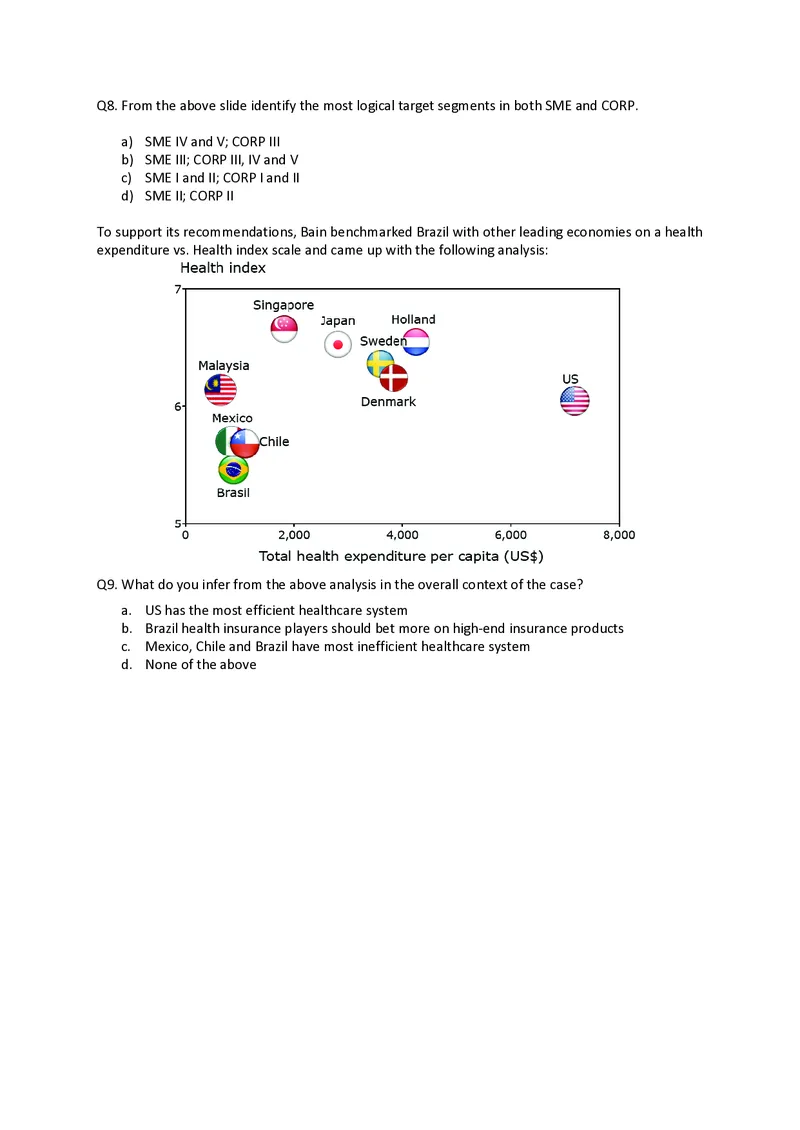
To support its recommendations, Bain benchmarked Brazil with other leading economies on a health
expenditure vs. Health index scale and came up with the following analysis:
Q9. What do you infer from the above analysis in the overall context of the case?
a. US has the most efficient healthcare system
b. Brazil health insurance players should bet more on high-end insurance products
c. Mexico, Chile and Brazil have most inefficient healthcare system
d. None of the aboveGuidelines
Welcome to the first step of the recruitment process at Bain & Company, Inc. You are about to get a firsthand
experience on practical Bain casework. The test is based on modified Bain cases and is designed to assess your
approach to problem solving using strategic thinking and deductive reasoning. At Bain, we are more interested in
‘how you think’ rather than ‘what you’ve learnt’.We work on diverse complex situations spanning across multiple
industries and sectors, but present only concise, relevant information to our clients. In order to do the same, we
understand the data, interpret the insights, and finally present what we infer in an organized manner. Thistest is
designed to simulate the same experience for you!
While attempting this paper:
Understand:Read the case studies carefully and identify the underlying problem. Make sure you do not
leave out any inputs or key data points
Interpret:Focuson detailsin the text and charts. Pay attention to the period of analyses and units used
Structure your approach: Manage your time by answering the questions smartly. For instance, some
questions do not require calculations but only involve simple elimination of choices. Always do a quick check
before answering
Instructions
This booklet consists of 25questionswithmultiple choices. Each question has a single correct answer
It not necessary to answer allquestions. You mayattempt these questionsaccording toyour strengths and
time.Read the question extremely well and attempt it only when you have fully understood what is to be
done
Use of any electronic devices (calculators, mobile phones, etc.) is strictly prohibited while answering the
test
You have 60 minutes to complete the test. Keep your composure and best of luck!CASE STUDY 1
Our client, Energy Co., is a major integrated oil company that engages in the exploration, production, refinement
and distribution of oil and gas present in 70 countries. Although they enjoy a relatively good position in the
market, they have witnessed increasing costs and internal inefficiencies in the organization. This has resulted in flat
returns in a growing market.
The global market is becoming increasingly challenging for the company, especially given the fact that they are
playing across a huge number of geographies. Although having strong market share, other strong players have
emerged with greater cost reduction capabilities, pushing the CEO to become apprehensive. This has forced him into
action and he has expressed to Bain that he is seriously contemplating serious cost reduction measures and establish
newer synergistic relationships with other organizations for the same.
Energy Co, like other MNCs,also wants to capitalize on their superior technology and market dominance to further
their presence in the Oil and Gas industry.
Q1. Based on the information given in the paragraph, which of the following statements aptly describe one of Bain
and Co.’s objectives?
a. Expand client’s footprint in fast growing geographies
b. Cost cutting by adopting cheaper methods of production
c. Find cost savings by reducing organizational complexity and optimizing geographic portfolio
d. Tap into complimentary business segments to drive profitability
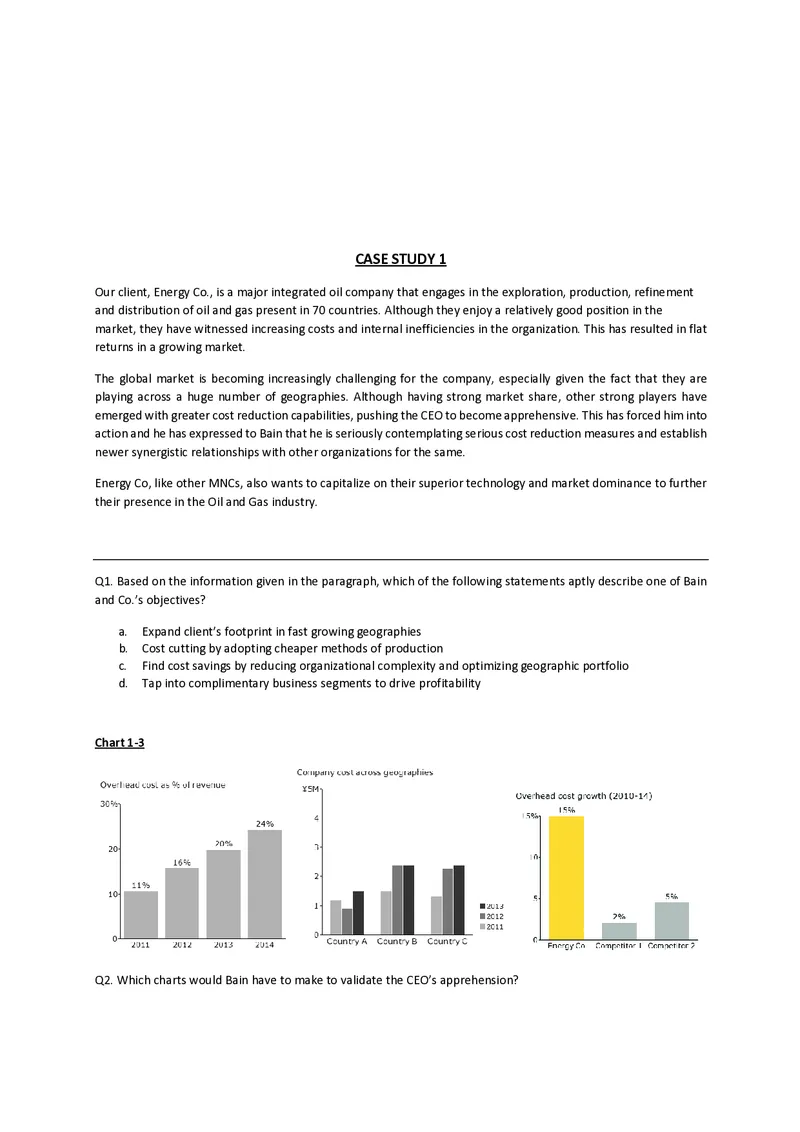
Chart 1-3
Q2. Which charts would Bain have to make to validate the CEO’s apprehension?a. 1& 3
b. 2and 3
c. 2only
d. 1only
Q3. If fixed cost = ¥3M in 2011 and assuming overhead to be the only cost, we want to find profitability of the
company in 2013. Which of the following data points wouldbe sufficientto calculate this?
a. Revenue across years
b. Profit % in 2011 and revenue growth between 2011-13
c. Revenue growth in 2011-13 and growth in “fixed cost% of total”
d. None of the above
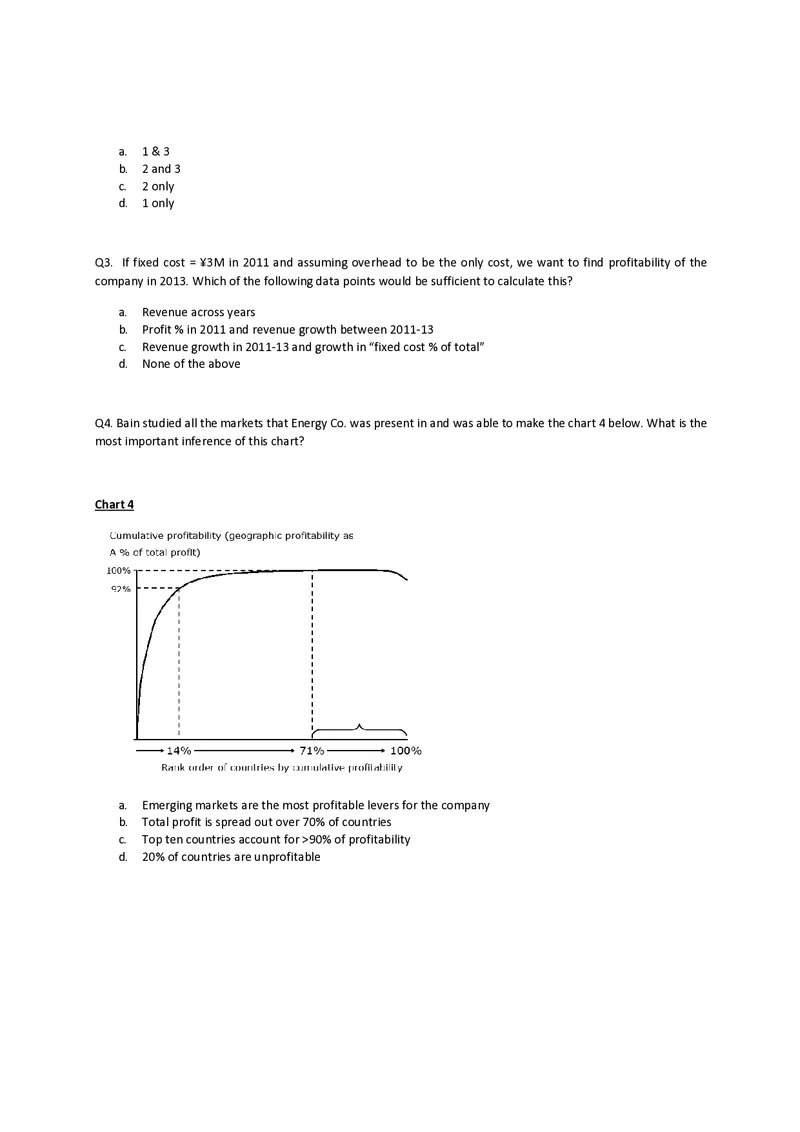
Q4. Bain studied all the markets that Energy Co. was present in and was able to make the chart 4below. What is the
most important inference of this chart?
Chart 4
a. Emerging markets are the most profitable levers for the company
b. Total profit is spread out over 70% of countries
c. Top ten countries account for >90% of profitability
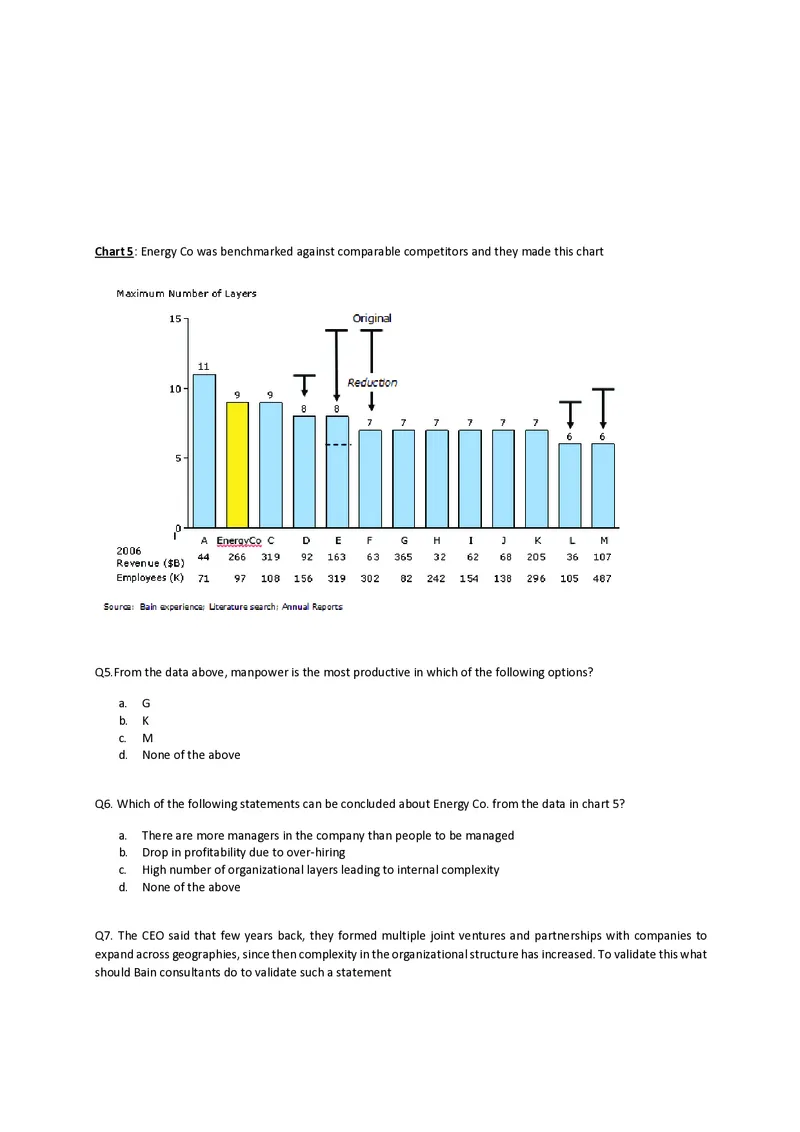
d. 20% of countries are unprofitableChart 5: Energy Co was benchmarked against comparable competitors and they made this chart
Q5.From the data above, manpower is the most productive in which of the following options?
a. G
b. K
c. M
d. None of the above
Q6. Which of the following statements can be concluded about Energy Co.from the data in chart 5?
a. There are more managers in the company than people to be managed
b. Drop in profitability due to over-hiring
c. High number of organizational layers leading to internal complexity
d. None of the above
Q7. The CEO said that few years back, they formed multiple joint ventures and partnerships with companies to
expand across geographies, since then complexity in the organizational structure has increased. To validate this what
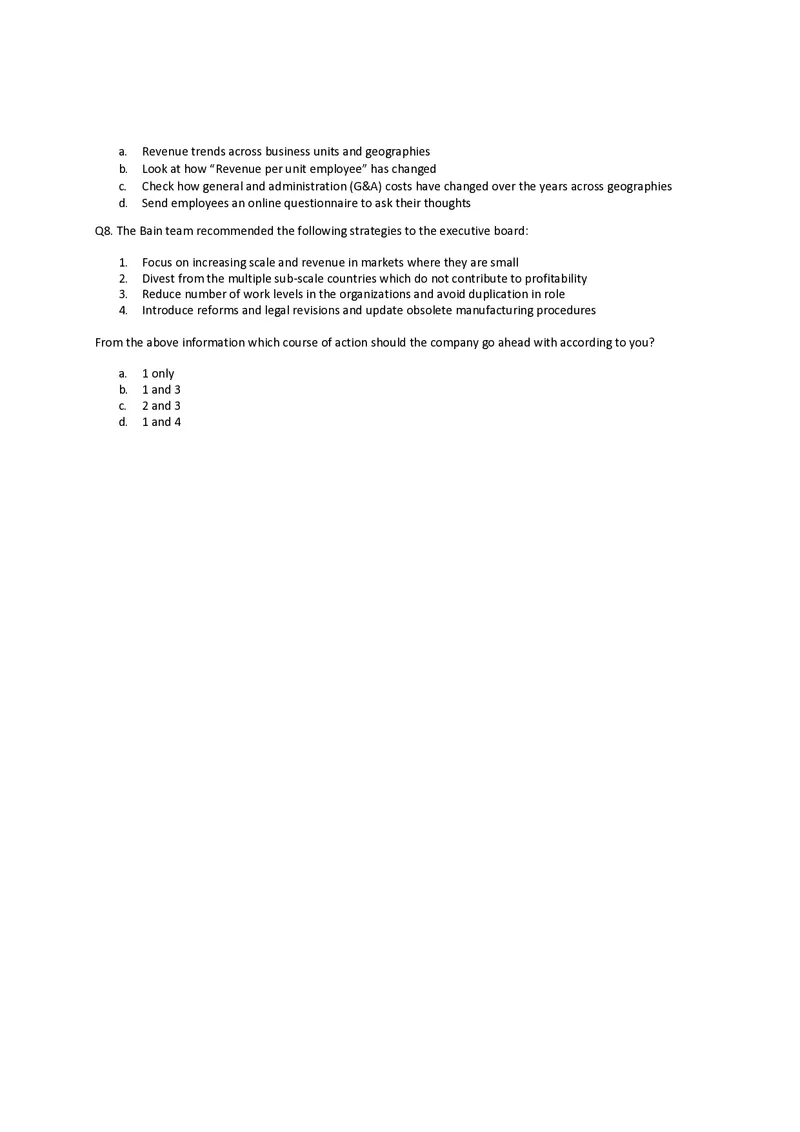
should Bain consultants do to validate such a statementa. Revenue trends across business units and geographies
b. Look at how “Revenue per unit employee” has changed
c. Check how general and administration (G&A) costs have changed over the years across geographies
d. Send employees an online questionnaire to ask their thoughts
Q8. The Bain team recommended the following strategies to the executive board:
1. Focus on increasing scale and revenue in markets where they are small
2. Divest from the multiple sub-scale countries which do not contribute to profitability
3. Reduce number of work levels in the organizations and avoid duplication in role
4. Introduce reforms and legal revisions and update obsolete manufacturing procedures
From the above information which course of action should the company go ahead with according to you?
a. 1only
b. 1and 3
c. 2and 3
d. 1and 4CASE STUDY 2
Apparel Co. is a leadingapparel retailer concentrated on men, women and kids wear in Shanghai. Having been in
existence for several decades, it has earned solid reputation for itself and commands a loyal set of customers in
the region. Apparel Co. has 10 stores in four differentlocations. Recently, it also made foray into offering its
products through online channels as well.
The CEO of Apparel Co.has been informed that though the top lines have remained stable in comparison to
competitors, the profitability has been declining.
To promote its online channel, the company has recently set up a comprehensive website for its customers and is
engaging itself in actively advertising it through print and social media. The plan is to drive ~50% of total sales
through online channels by 2020.
Out of the four locations that Apparel Co. runs its stores from, some of them have multiple stores located within a
short driving distance of each other and are not contributing much to the profitability. In addition, the rentpaid for
some of the stores is relatively higher due to the store being located in a posh locality. However, Apparel Co. has
been doing a good job at controlling its distribution costs due to company stores spread across the city.
The CEO wants Bain to investigate the issue in detail and devise a blueprint for the future. Bain has a team of five
members on the case and you are the Associate Consultant on the team. In your opinion:
Q9. Which of the following most accurately describes why Apparel Co.approached Bain?
a. To chalk out a plan for the company on how to increase profitability by driving revenues
b. To understand the scope for further development of sales through online channel
c. To re-evaluate their brand image to create prime product perception
d. To devise a profitability plan by understanding the company’s operating costs
Q10. Which of the following do you think is the most relevant step that the client should take to address the issue?
a. Develop its online platform to drive total revenues and henceimprove profitability
b. Close its online channel as significant costs are being incurred in advertising its website
c. Optimize its current store foot print by identifying store clusters with low contribution to profitability
d. Open new stores across the city to drive revenues and hence improve profitability
Q11.Which of the following information will be least useful for Bain in addressing the client’s needs?
a. Benchmarking metrics and data on its competitors’ profitability
b. Market attractiveness of the variousstore locationsc. Financials of individual stores
d. Overall profitability figures of Apparel Co. for the last 5 years
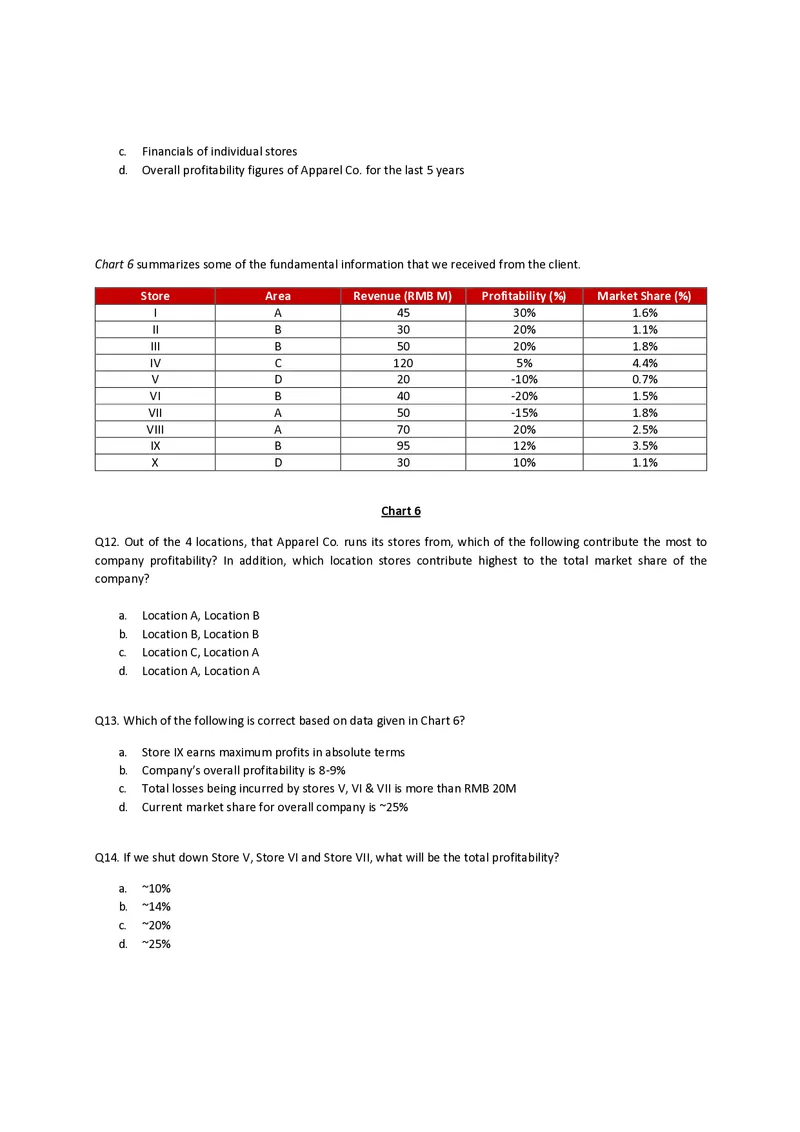
Chart 6summarizes some of the fundamental information that we received from the client.
Store Area Revenue (RMB M) Profitability(%) Market Share(%)
I A 45 30% 1.6%
II B 30 20% 1.1%
III B 50 20% 1.8%
IV C 120 5% 4.4%
V D 20 -10% 0.7%
VI B 40 -20% 1.5%
VII A 50 -15% 1.8%
VIII A 70 20% 2.5%
IX B 95 12% 3.5%
X D 30 10% 1.1%
Chart6
Q12. Out of the 4 locations, that Apparel Co. runs its stores from, which of the following contribute the most to
company profitability? In addition, which location stores contribute highest to the total market share of the
company?
a. Location A, Location B
b. Location B, Location B
c. Location C, Location A
d. Location A, Location A
Q13. Which of the following is correct based on data given in Chart 6?
a. Store IX earns maximum profits in absolute terms
b. Company’s overall profitability is 8-9%
c. Total losses being incurred by stores V, VI & VII is more than RMB 20M
d. Current market share for overall company is ~25%
Q14. If we shut down Store V, Store VI and Store VII, what will be the total profitability?
a. ~10%
b. ~14%
c. ~20%
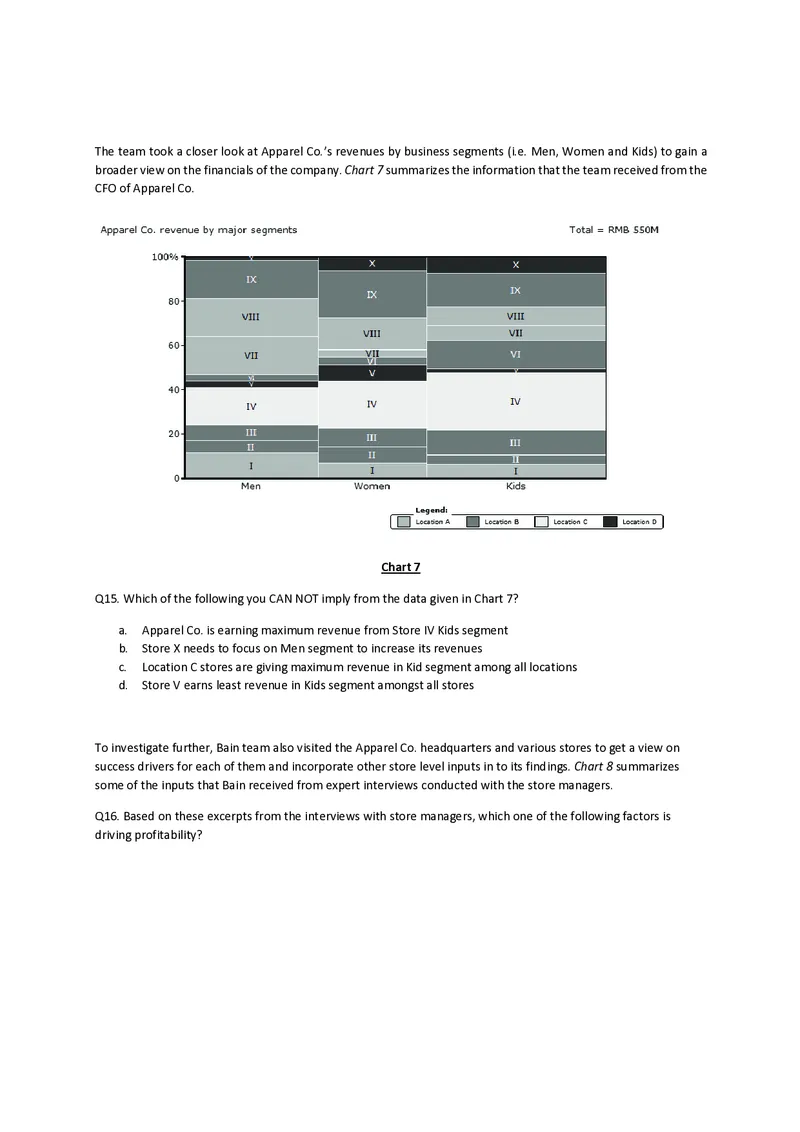
d. ~25%The team took a closer look at Apparel Co.’s revenues by business segments (i.e. Men, Women and Kids) to gain a
broader view on the financials of the company. Chart 7summarizes the information that the team received from the
CFO of Apparel Co.
Chart 7
Q15. Which of the following youCAN NOTimply from the data given in Chart 7?
a. Apparel Co. is earning maximum revenue from Store IV Kids segment
b. Store X needs to focus on Men segment to increase its revenues
c. Location C stores are giving maximum revenue in Kid segment among all locations
d. Store V earns least revenue in Kids segment amongst all stores
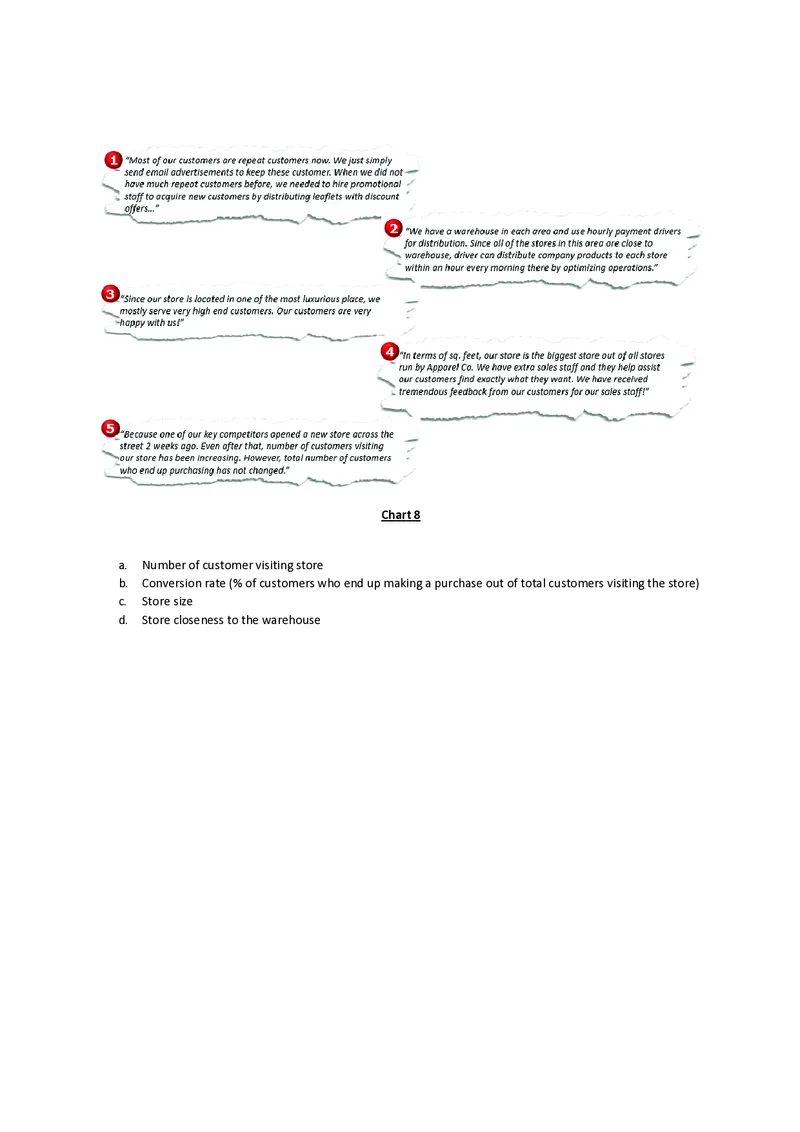
To investigate further, Bain team also visited the Apparel Co. headquarters and various stores to get a view on
success drivers for each of them and incorporate other store level inputs in to its findings. Chart 8summarizes
some of the inputs that Bain received from expert interviews conducted with the store managers.
Q16. Based on these excerpts from the interviews with store managers, which one of the following factorsis
driving profitability?Chart 8
a. Number of customer visiting store
b. Conversion rate (% of customers who end up making a purchase out of total customers visiting the store)
c. Store size
d. Store closeness to the warehouseCASE STUDY 3
It is 2010 and the automobile Industry is one of the fastest growing industries in the world as the disposable incomes
around the world has been increasing. Every company has devised elaborate strategies to strengthen their foothold.
Car Co. is active in China, but the company is lagging behind direct competitors and losing share. Global volume
ambitions require Car Co. to grow over-proportionally in China, the biggest vehicle market worldwide. Car Co. has
ambitious plans of expanding in China, which is one of the biggest economies in the world. The regional China market
has seen entrance of several major international players and consequently a lot of joint venture and local partnership
activity.
There has been a big shift in the demand for more expensive luxury vehicles in China. Analysts speculate this is still
very short of full potential. Different provinces of China market have different growth cycles due to the unique
regional demographics.Affluence level is an important metric for this industry and China has seen a rise in affluence
levels majorly driven by the expansion of high paying white collar jobs from new players that have entered the
manufacturing and service sector in the country.
Within the Tier 1 cities, the Eastern cities have seen more of these high paying affluent jobs. Consequently some of
these cities have become big targets for luxury vehicle players and the trend is said to continue
Given the activity, Car Co also wants to look at local players and their capabilities, with the aim of integration to scale
production, sales and services. The CEO wants to investigate and scan the market and understand its dynamics and
has called in Bain.
Q17. What could be the eventual objectives of Bain’s engagement with Car Co.?
a. Technological development of Car Co’s manufacturing facilities
b. Entry into the Chinese fast growing automobile market
c. Expansion strategy into newer market segments in the Chinese automobile industry
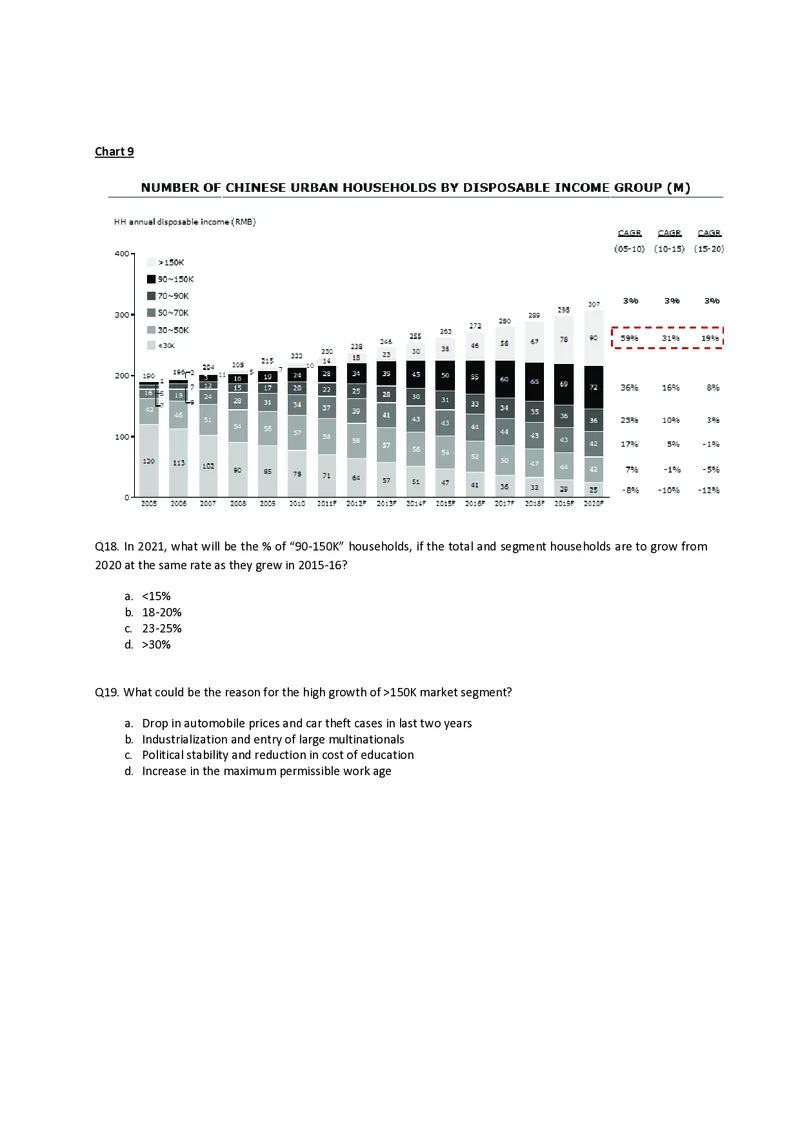
d. The client wants Bain to devise a new supply chain management strategy in ChinaChart 9
Q18. In 2021, what will be the % of “90-150K” households, if the total and segment households are to grow from
2020 at the same rate as they grew in 2015-16?
a. <15%
b. 18-20%
c. 23-25%
d. >30%
Q19. What could be the reason for the high growth of >150K market segment?
a. Drop in automobile prices and car theft cases in last two years
b. Industrialization and entry of large multinationals
c. Political stability and reduction in costof education
d. Increase in the maximum permissible work ageChart 10
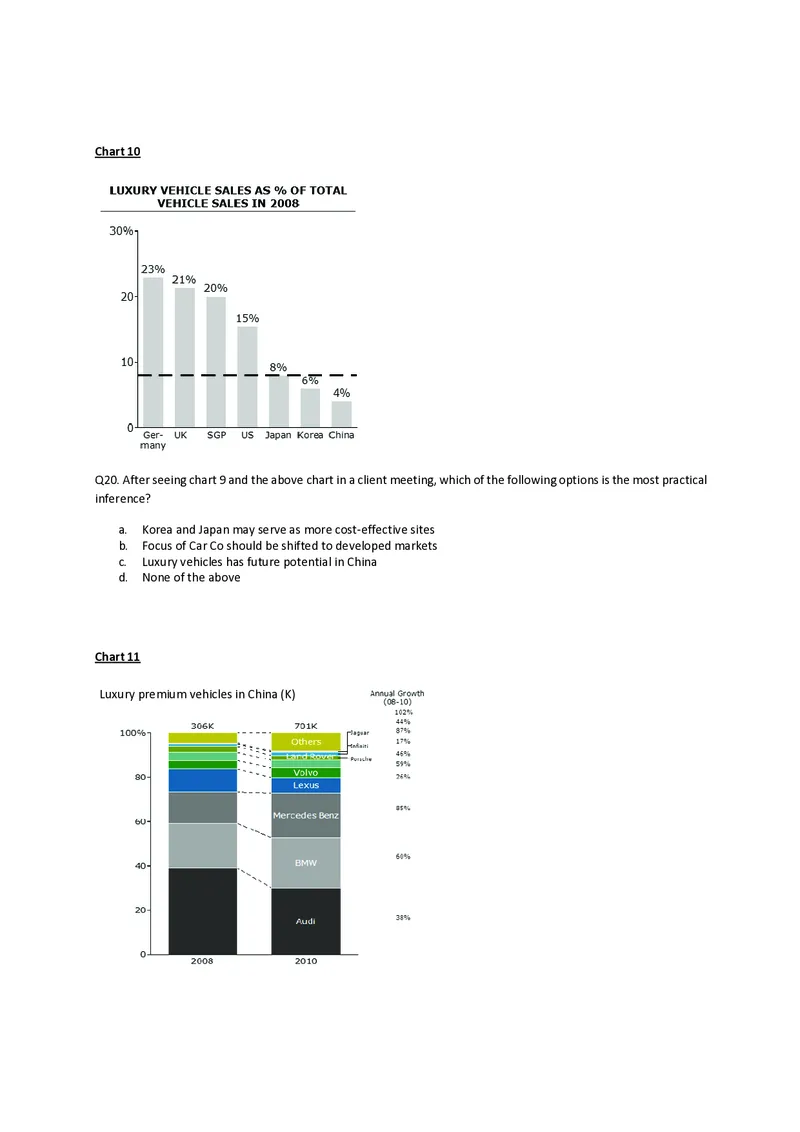
Q20. After seeing chart 9and the above chart in a client meeting, which of the following options is the most practical
inference?
a. Korea and Japan may serve as more cost-effective sites
b. Focus of Car Co should be shifted to developed markets
c. Luxury vehicles has future potential in China
d. None of the above
Chart 11
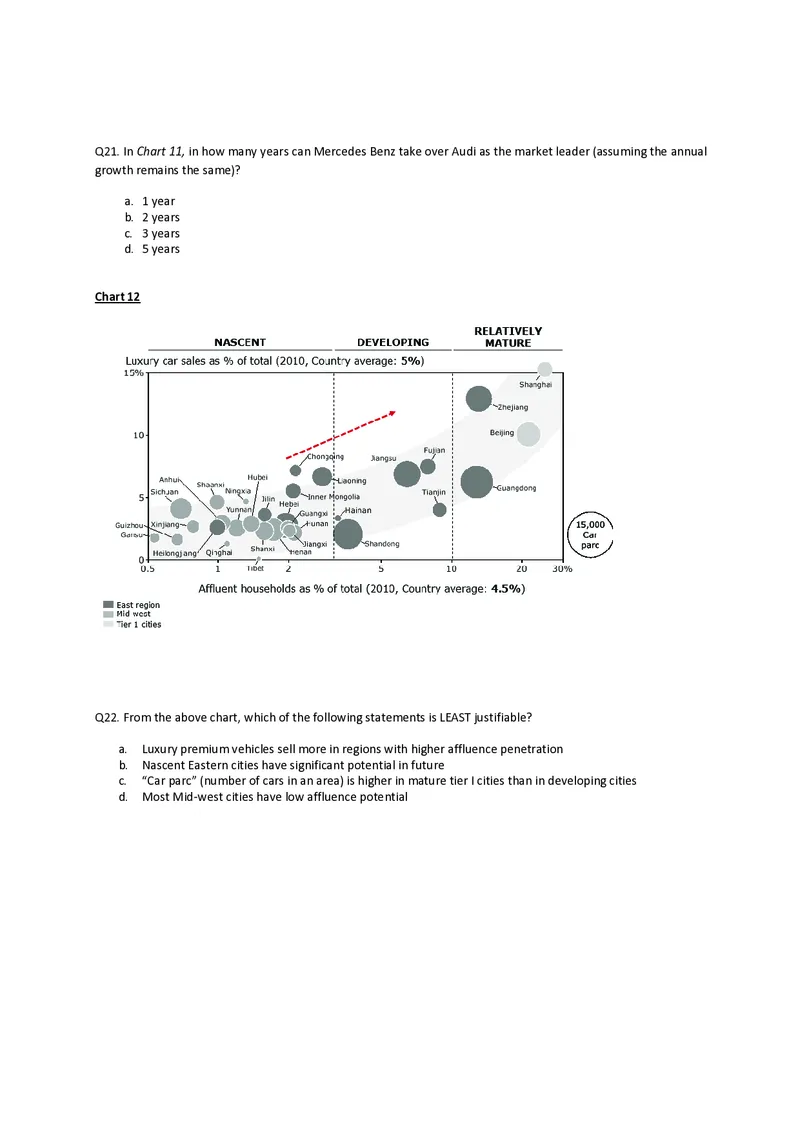
Luxury premium vehicles in China (K)Q21. In Chart 11, in how many years can Mercedes Benz take over Audi as the market leader (assuming the annual
growth remains the same)?
a. 1 year
b. 2 years
c. 3 years
d. 5 years
Chart 12
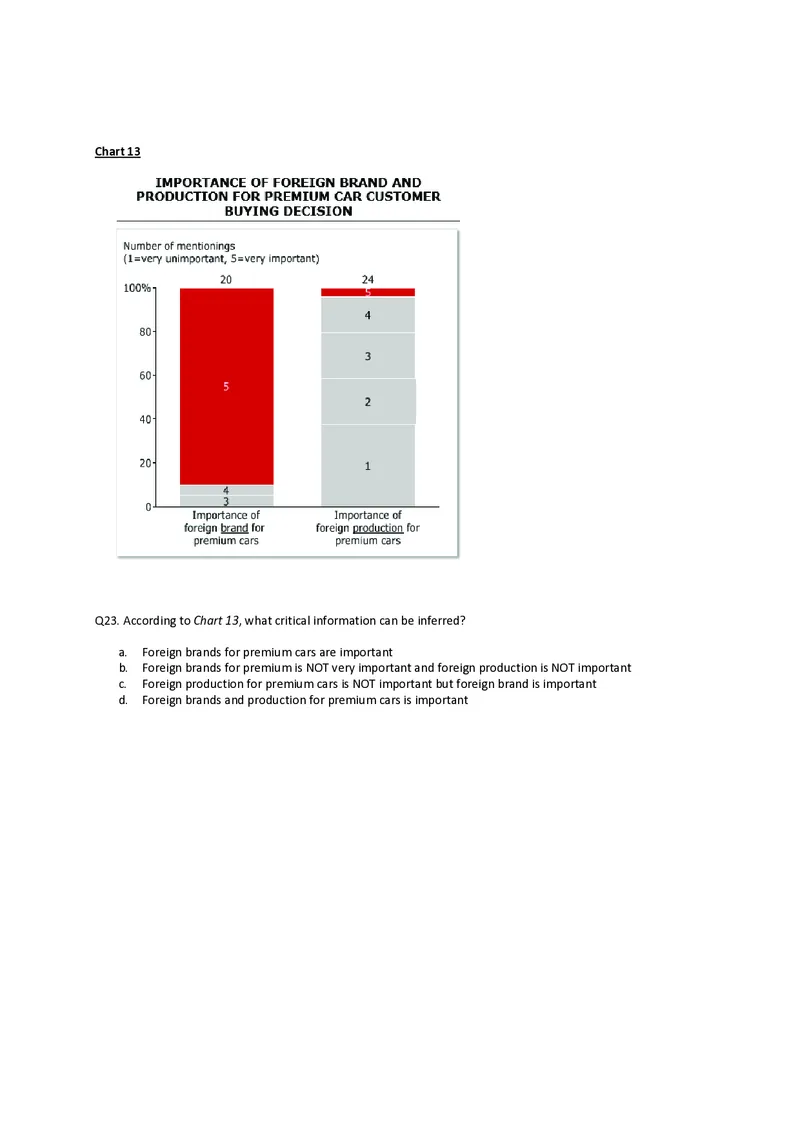
Q22. From the above chart, which of the following statements is LEASTjustifiable?
a. Luxury premium vehicles sell more in regions with higher affluence penetration
b. Nascent Eastern citieshave significant potential in future
c. “Car parc” (number of cars in an area) is higher in mature tier I cities than in developing cities
d. Most Mid-west cities have low affluence potentialChart13
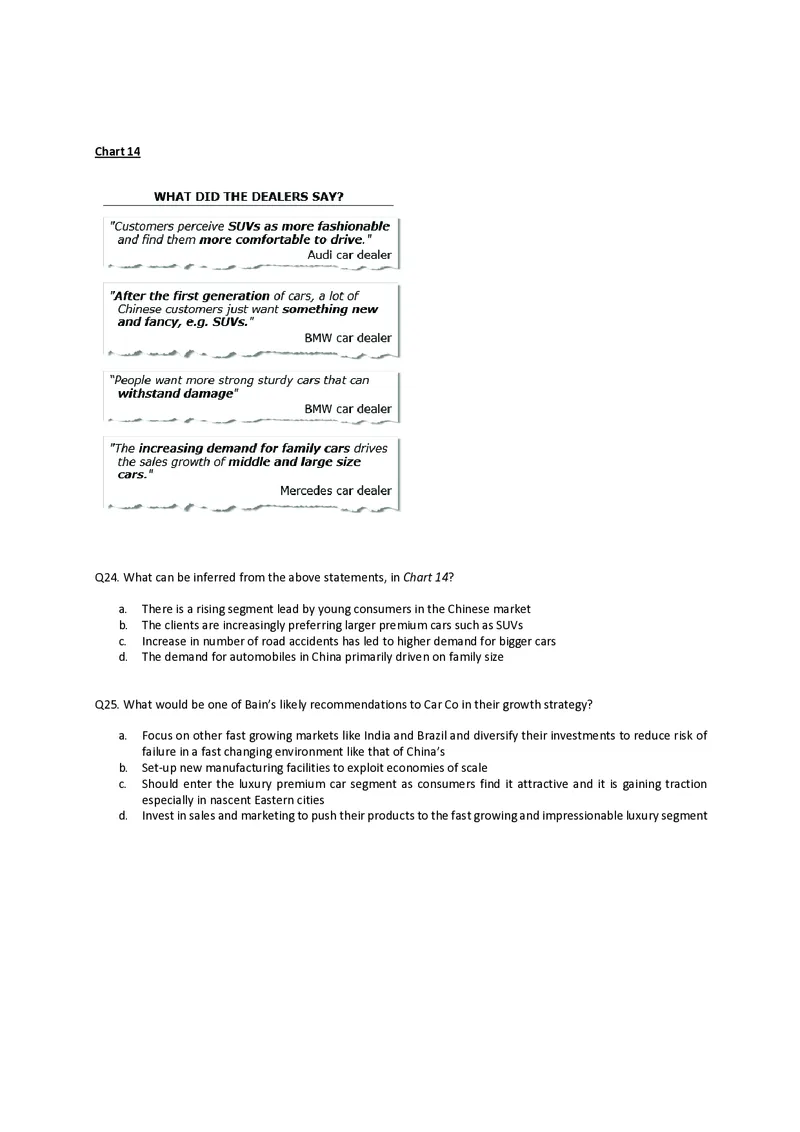
Q23.According to Chart 13, what critical information can be inferred?
a. Foreign brands for premium cars are important
b. Foreign brands for premium is NOT very important and foreign production is NOT important
c. Foreign production for premium cars is NOT important but foreign brand is important
d. Foreign brands and production for premium cars is importantChart 14
Q24. What can be inferred from the above statements, in Chart 14?
a. There is a rising segment lead by young consumers in the Chinese market
b. The clients are increasingly preferring larger premium cars such as SUVs
c. Increase in number of road accidents has led to higher demand for bigger cars
d. The demand for automobiles in China primarily driven on family size
Q25. What would be one of Bain’s likely recommendations to Car Co in their growth strategy?
a. Focus on other fast growing markets like India and Brazil and diversify their investments to reduce risk of
failure in a fast changing environment like that of China’s
b. Set-up new manufacturing facilities to exploit economies of scale
c. Should enter the luxury premium car segment as consumers find it attractive and it is gaining traction
especially in nascent Eastern cities
d. Invest in sales and marketing to push their products to the fast growing and impressionable luxury segmentGuidelines
Welcome to the first step of the recruitment process at Bain & Company, Inc. You are about to get a firsthand
experience on practical Bain casework. The test is based on modified Bain cases and is designed to assess your
approach to problem solving using strategic thinking and deductive reasoning. At Bain, we are more interested in
‘how you think’ rather than ‘what you’ve learnt’.We work on diverse complex situations spanning across multiple
industries and sectors, but present only concise, relevant information to our clients. In order to do the same, we
understand the data, interpret the insights, and finally present what we infer in an organized manner. This test is
designed to simulate the same experience for you!
While attempting this paper:
♥ Understand:Read the case studies carefully and identify the underlying problem. Make sure you do not
leave out any inputs or key data points
♥ Interpret:Focuson detailsin the text and charts. Pay attention to the period of analyses and units used
♥ Structure your approach: Manage your time by answering the questions smartly. For instance, some
questions do not require calculations but only involve simple elimination of choices. Always do a quick check
before answering
Instructions
♥ This booklet consists of 25questionswith multiple choices. Each question has a single correct answer
♥ It not necessary to answer allquestions. You mayattempt these questionsaccording toyour strengths and
time.Read the question extremely well and attempt it only when you have fully understood what is to be
done
♥ Use of any electronic devices (calculators, mobile phones, etc.) is strictly prohibited while answering the
test
You have 60 minutes to complete the test. Keep your composure and best of luck!CASE STUDY 1
Grocery Co is a global retailer existing inChinafor more than a decade now. With the appointment of a new CEO
and rehaul of the top management team, China is a global growth priority for the company.
China’s grocery retail market has strong regional characteristics with consumer tastes differing across regions and
with local brands in demand. There is large income gap and average household income is low compared to other
developed markets. There is emphasis on fresh foods and leading players are investingmore in it to draw traffic.
The distribution network is fragmented with cold chain almost non-existing.
Grocery Co is under-performing in almost all dimensions thatmatter, especially in comparison tothe market
leader. Sales productivity (per store and per sq. meter) and profitability are low and the organization is skeptical of
change due to previously failed attempts. As communicated by the management, stretched goals and expansion
plans, resulting in ineffective decision-makingand undesirable behaviors,led to the failure of past attempts to
bring a change in the organization.
New senior management team is not aligned yet, both internally and as well as with global stakeholders. New CEO
engaged Bain to help him assist in buildinga100 daysplanto address the issues by conducting an objective
assessment of the business and industryto guide consistent andtough decisions.
Q1. Which of the following most accurately describes why Grocery Co. hasapproached Bain?
a. To analyze the Chinese grocery market andlook for possible acquisitions
b. To understand the scope for further development of sales
c. To help the new CEO understand the business and get up to speed
d. To build a transformation roadmap and support teams on key initiatives implementation
Q2. Which of the following information will be least useful for Bain in addressing the client’s needs?
a. Benchmarking metrics and data on its competitors’ profitability
b. Market overview
c. Decision effectiveness data
d. Organization structure
Q3. Bain approached the case with three sequential modules:
A. Focus on formulation of strategy and high-level organization design
B. Focus on detailed strategy translationand execution across entire organization
C. Assess broad set of issues for Grocery Co. and focus on big issues with some detailed analysis
From the above information what was the course of action according to you?a. A→C→B
b. C→A→B
c. B→C→A
d. C→B→A
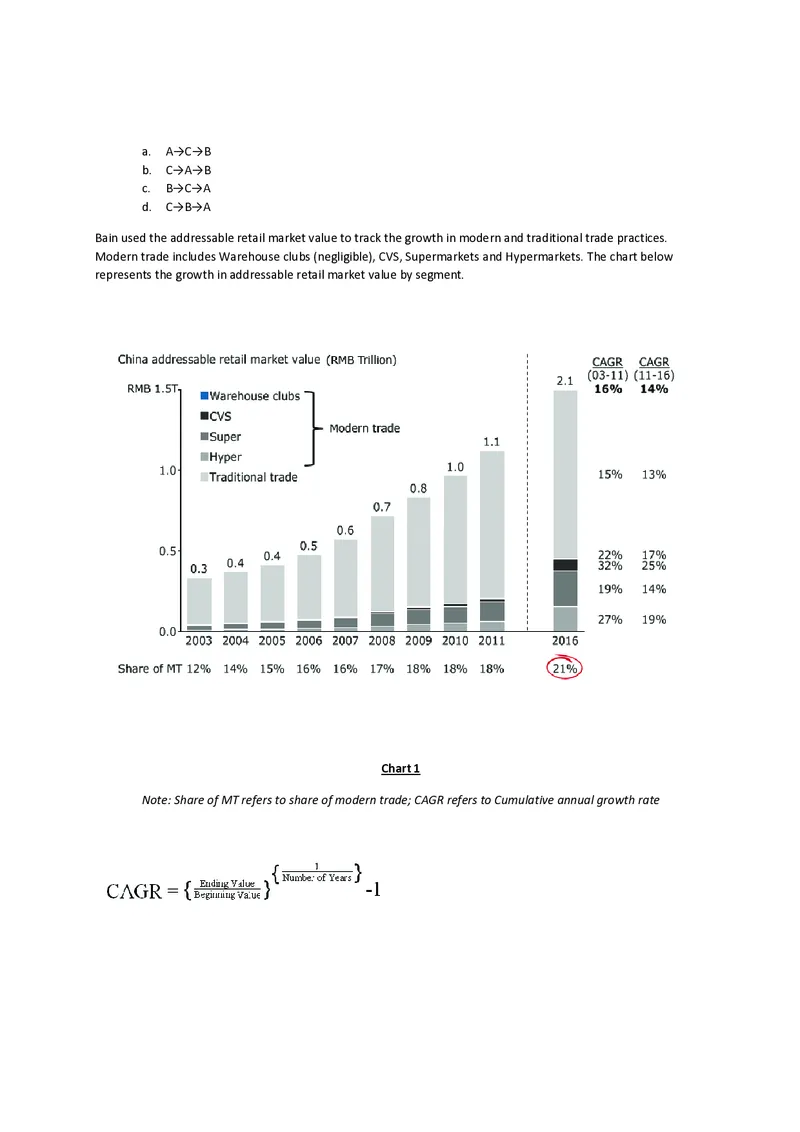
Bain used the addressable retail market value to track the growth in modern and traditional trade practices.
Modern trade includes Warehouse clubs (negligible), CVS, Supermarkets and Hypermarkets. The chart below
represents the growth in addressable retail market value by segment.
Chart 1
Note: Share of MT refers to share of modern trade;CAGR refers to Cumulative annual growth rateQ4. The addressable retail market value is a combination of modern and traditional trade practices. What is the
overall increase in the addressable retail market value for traditional trade in China between 2003 and 2011?
a. 80-110%
b. 130-160%
c. 180-200%
d. 230-250%
Q5. What is the cumulative annual growth rate(CAGR)for 2011-16 for modern trade?
a. ~28%
b. ~25%
c. ~17%
d. ~14%
Q6. In which year will modern trade overtake traditional trade in China in addressable retail market value? In
addition, by how much will modern trademarket value exceed traditional trade market value in percentage
points?
Assumptions:
1. The addressable retail market grows to RMB 3 trillion in 2017 with modern trade capturing 1/3rdof the market
2. Post 2017, modern trade continues to grow 50% every year whereas traditional trade grows at 10% every year
a. 2019, ~31%
b. 2020, ~32%
c. 2020, ~27%
d. 2019, ~27%
The company’s CEO wants Bain to chart the competitor landscape in the grocery market (modern trade) to get a
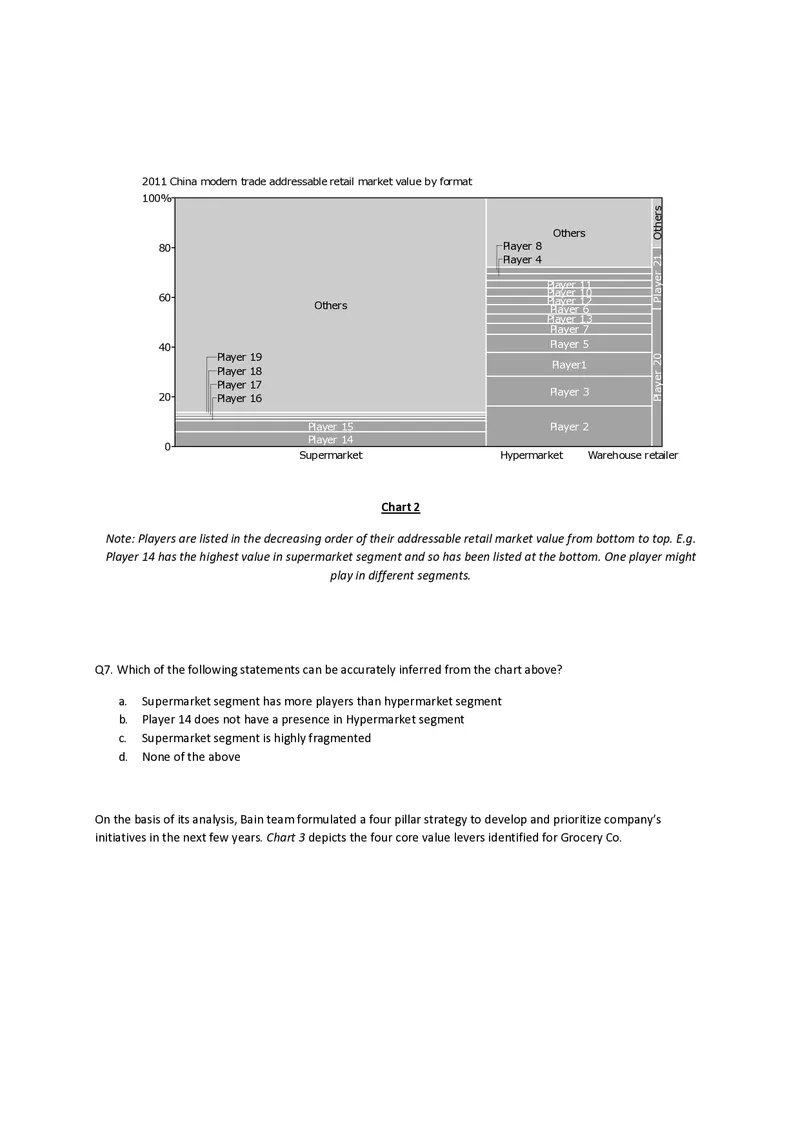
better picture and devise appropriate strategies to capture a more share in the market.100%
Others
80
Player11
Player10
60 Player12
Others Player6
Player13
Player7
40 Player5
Player1
Player3
20
Player15 Player2
Player14
0
Supermarket
srehtO
12reyalP
02reyalP
2011Chinamoderntradeaddressableretailmarketvaluebyformat
Player8
Player4
Player19
Player18
Player17
Player16
Hypermarket Warehouseretailer
Chart 2
Note: Players are listed in the decreasing order of their addressable retail market value from bottom to top. E.g.
Player 14 has the highest value in supermarket segment and so hasbeen listed at the bottom. One player might
play in different segments.
Q7. Which of the following statements can be accurately inferred from the chart above?
a. Supermarket segment has more playersthan hypermarket segment
b. Player 14 does not have a presence in Hypermarket segment
c. Supermarket segment is highly fragmented
d. None of the above
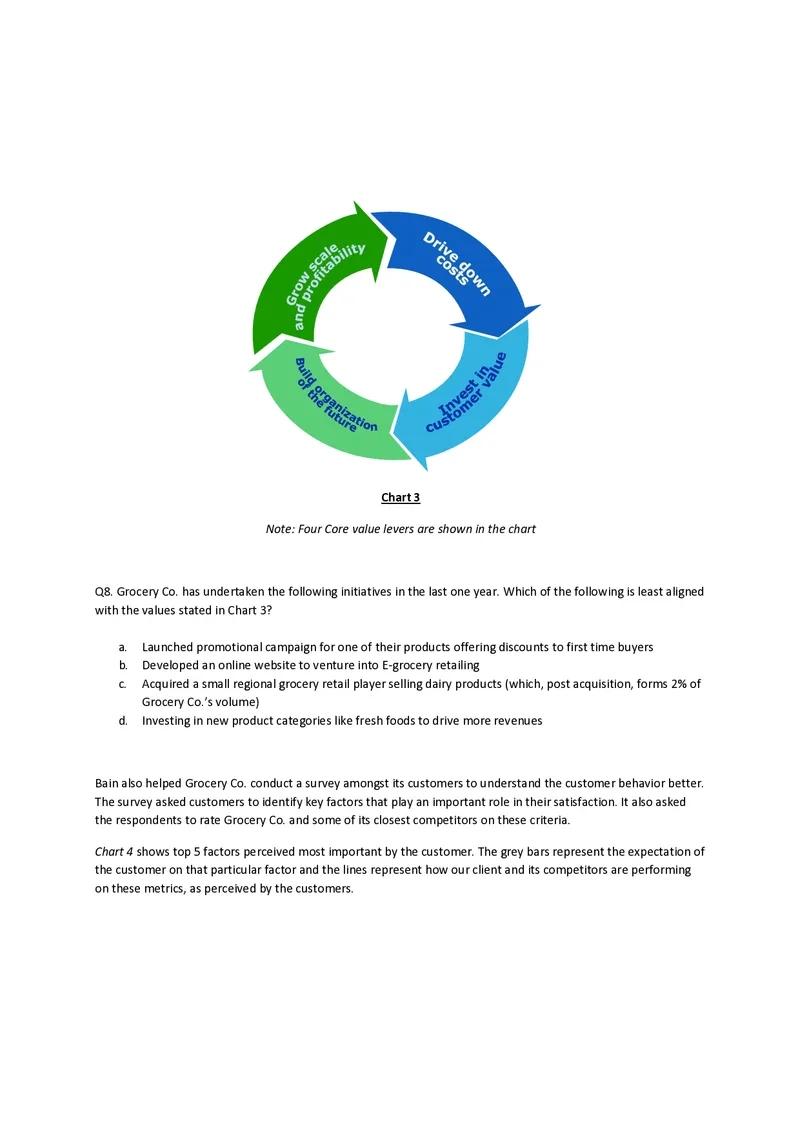
On the basis of its analysis, Bain team formulated a four pillar strategy to develop and prioritize company’s
initiatives in the next few years. Chart 3depicts the four core value levers identified for Grocery Co.Chart 3
Note: Four Core value levers are shown in the chart
Q8. Grocery Co. has undertaken the following initiatives in the last one year. Which of the following is least aligned
with the values stated in Chart 3?
a. Launched promotional campaign for one of their products offering discounts to first time buyers
b. Developed an online website to venture into E-grocery retailing
c. Acquired a small regional grocery retail player selling dairy products (which, post acquisition, forms 2% of
Grocery Co.’s volume)
d. Investing in new product categories like fresh foods to drive more revenues
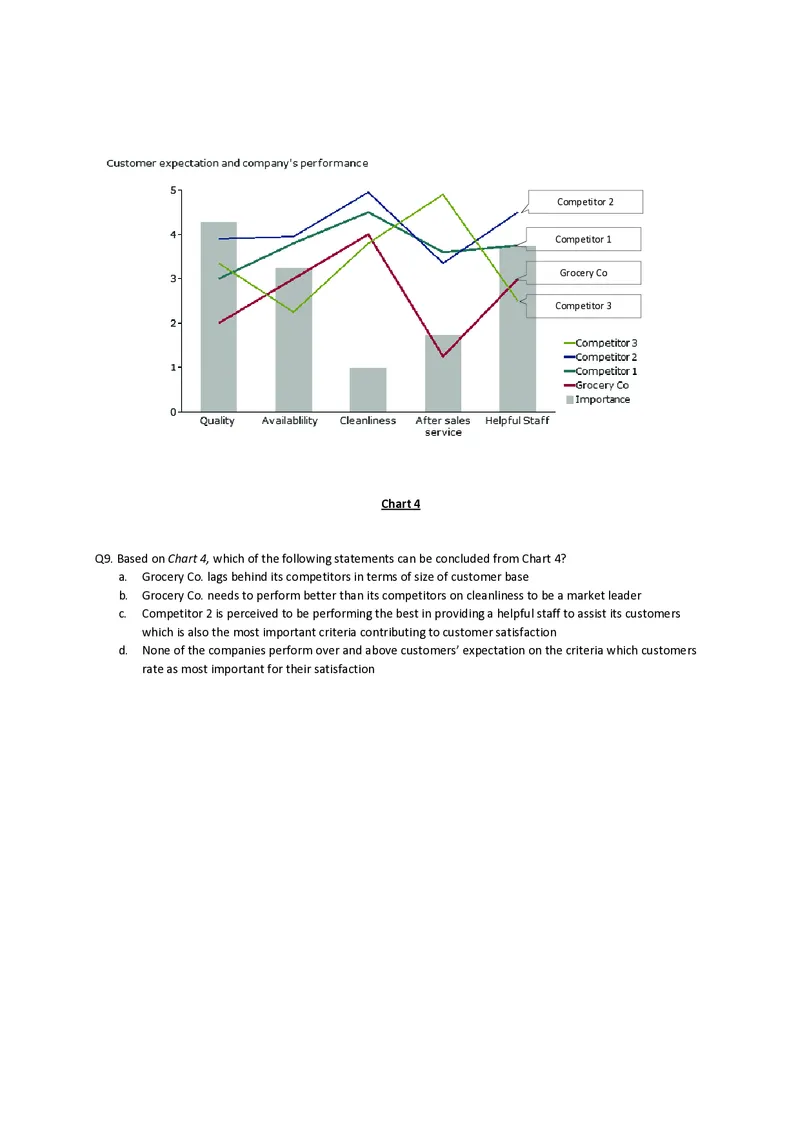
Bain alsohelped Grocery Co. conduct a survey amongst its customers to understand the customer behavior better.
The survey asked customers to identify key factors that play an important role in their satisfaction. It also asked
the respondents to rate Grocery Co. and some of its closest competitors on these criteria.
Chart 4shows top 5 factors perceived most important by the customer. The grey bars represent the expectation of
the customer on that particular factor and the lines represent how our client and its competitors are performing
on these metrics, as perceived by the customers.Competitor 2
Competitor 1
Grocery Co
Competitor 3
Chart 4
Q9. Based on Chart 4,which of the following statements canbe concluded from Chart 4?
a. Grocery Co. lags behind its competitors in terms of size of customer base
b. Grocery Co. needs to perform better than its competitors on cleanliness to be a market leader
c. Competitor 2 is perceived to be performing the best in providing a helpful staff to assist its customers
which is also the most important criteria contributing to customer satisfaction
d. None of the companies perform over and above customers’ expectation on the criteria which customers
rate as most important for their satisfactionCASE STUDY 2
Our client, Toy Co is a leading MNC with toys as its core business and operates licensing model in other consumer
products categories. Toy Co has identified licensing business as a key growth driver. Of its brand portfolio, 2 brands
have been identified as thefocus of the project; one of them has been operating licensing business in China across
~40 product categories and the other has presence in 1 category only.
China licensing market is currently small, both in absolute and relative terms. This is attributed to issues of high
fees paid as royalty, and generally lower consumer savings driven by high taxes, respectively. Compared to
developed countries, the consumer spend on such products is also low. Licensing market is fragmented with over
800 licensors; Disney, the leading player, accounts for only ~10% market share. There are ~9 macro categories in
the China licensing market of which Apparel, Entertainment/Service, Home and Footwear are expected to lead the
growth in the coming years.
Licensing market in China is supply-based as majority of consumers cannot differentiate licensed from self-
operated products. China’s consumer spend on overall consumer products expects double digit annual growth; led
by Food, Electronics and Apparel sectors.
Licensing can be done through multiple ways. The most prevalent are Brand (Lego, BMW), Character (Mickey
Mouse, Superman) and others like NBA and Harvard University. Loosening of restrictions on comic movies and
popular marketing events have increased character awareness; brand is relatively established compared to
character.
The CEO of Toy Co, an old friend of the Bain Partner, believes that licensing opportunities in mainland China were
not fully understood nor captured. Despite having been in the licensing business in China for quite some time, the
revenue is still insignificant. Also, there is a lack of collaboration between the core toy and licensing businesses to
take advantage of synergies (in terms of marketing & channels).
Q10. Which of the following most accurately describes why the client engaged Bain & Company?
a. The client wishes to analyze why his revenue growth is slow in the Chinese market
b. The client seeks to know if the Chinese toy market is already saturated
c. The client wants Bain to develop and strategize their China licensing plan
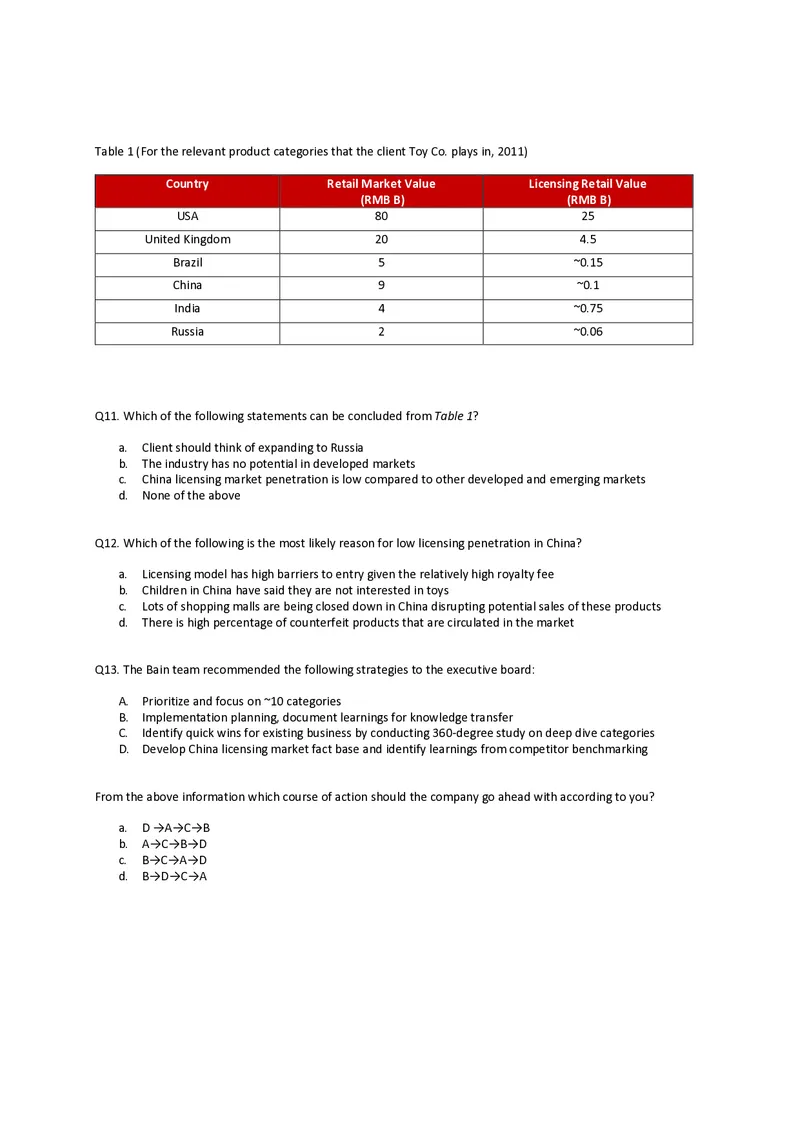
d. The client wants to Bain to devise an exit strategyTable 1 (For the relevant product categories that the client Toy Co. plays in, 2011)
Country Retail Market Value Licensing Retail Value
(RMB B) (RMB B)
USA 80 25
United Kingdom 20 4.5
Brazil 5 ~0.15
China 9 ~0.1
India 4 ~0.75
Russia 2 ~0.06
Q11. Which of the following statements can be concluded from Table 1?
a. Client should think of expanding to Russia
b. The industry has no potential in developed markets
c. China licensing market penetration is low compared to other developed and emerging markets
d. None of the above
Q12. Which of the following is the most likely reason for low licensing penetration in China?
a. Licensing model has high barriers to entry given the relatively high royalty fee
b. Children in China have said they are not interested in toys
c. Lots of shopping malls are being closed down in China disrupting potential sales of these products
d. There is high percentage of counterfeit products that are circulated in the market
Q13. The Bain team recommended the following strategies to the executive board:
A. Prioritize and focus on ~10 categories
B. Implementation planning, document learnings for knowledge transfer
C. Identify quick wins for existing business by conducting 360-degree study on deep dive categories
D. Develop China licensing market fact base and identify learnings from competitor benchmarking
From the above information which course of action should the company go ahead with according to you?
a. D →A→C→B
b. A→C→B→D
c. B→C→A→D
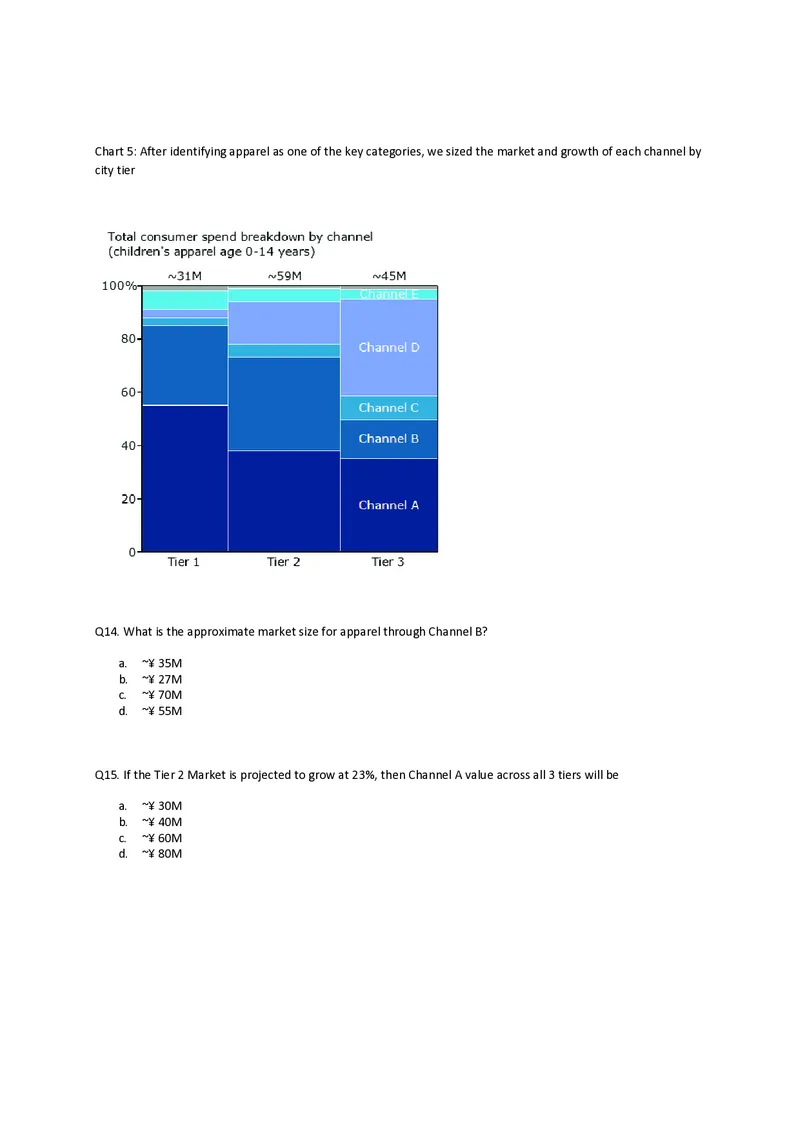
d. B→D→C→AChart 5: After identifying apparel as one of the key categories, we sized the market and growth of each channel by
city tier
Q14. What is the approximate market size for apparel through Channel B?
a. ~¥ 35M
b. ~¥ 27M
c. ~¥ 70M
d. ~¥ 55M
Q15. If the Tier 2 Market is projected to grow at 23%, then Channel A value across all 3 tiers will be
a. ~¥ 30M
b. ~¥ 40M
c. ~¥ 60M
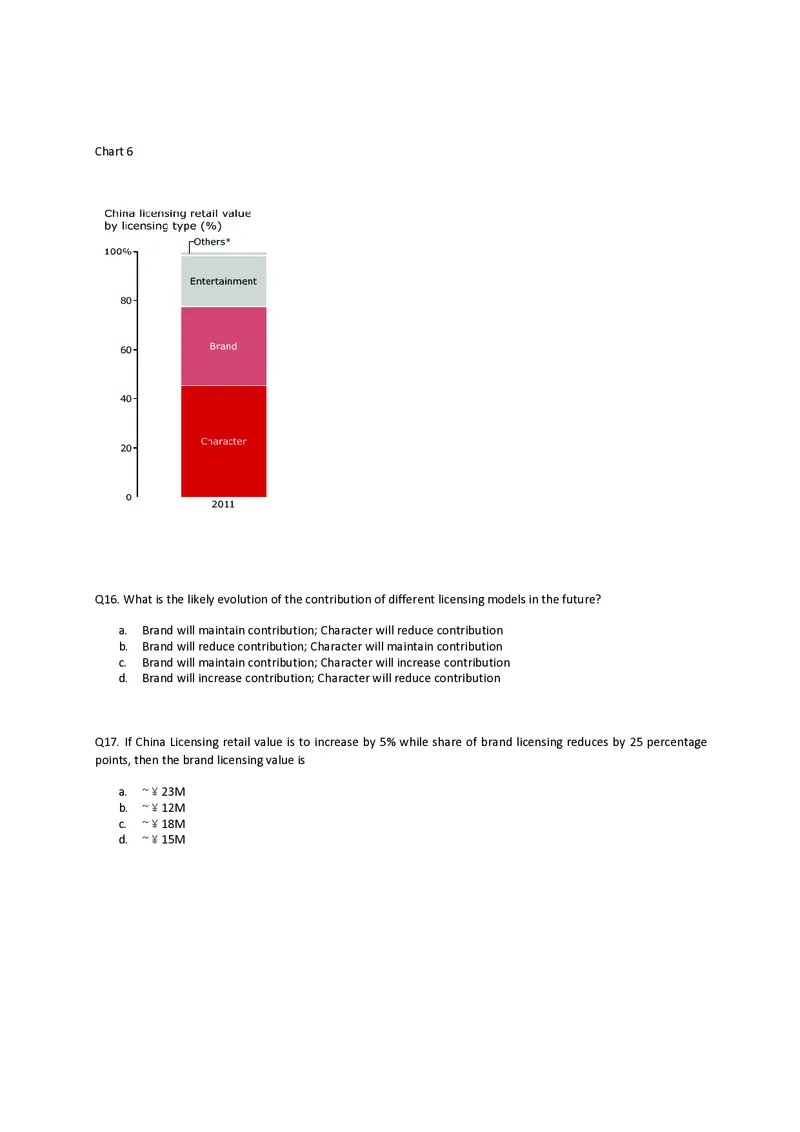
d. ~¥ 80MChart 6
Q16. What is the likely evolution of the contribution of different licensing models in the future?
a. Brand will maintain contribution; Character will reduce contribution
b. Brand will reduce contribution; Character will maintain contribution
c. Brand will maintain contribution; Character will increase contribution
d. Brand will increase contribution; Character will reduce contribution
Q17. If China Licensing retail value is to increase by 5% while share of brand licensing reduces by 25 percentage
points, then the brand licensing value is
a. ~ ¥ 23M
b. ~ ¥ 12M
c. ~ ¥ 18M
d. ~ ¥ 15MCASE STUDY 3
Pharma Co.is one of China’slargest pharmaceutical companies. Headquartered in Beijing, the companyhas a wide
range of successful products on the markets that include various drugs for erectile dysfunction, lowering blood
cholesterol, anxiety disorders, anti-inflammatory drugs, antidepressants, etc.
Currently, the client has only one product in the market for cancer treatment (FC-600) which generated RMB200M
sales in 2014. In the next 1 year, the client is planning to introduce a new cancer drug in the market. This particular
drug, RFC-9000, will also be for cancer patients and if taken in combination with FC-600, it will speed up treatment
process. There is no other drug available in the market similar to RFC-9000 and the drug will be first of its kind. The
current sales force includes 750 sales representatives who support the company's cancer drug that is already in the
market. The management is still in the planning phase and has taken no concrete steps for introduction of the drug
in the market. The CEO of Pharma Co., Mr.Yang, also wants to file for approval from CFDA (China Food and Drug
Administration), which he feels would not take much time and money.
Pharma Co. has two alternatives available with it to go forward with the manufacture of RFC-9000. First alternative
isto produce it in-house. In-house production will involve incurring of significant production costs, as production of
this drug requires use of advanced technology. An alternative route is to outsource the production of the drug to
other companies. Under the outsourcing agreement, Pharma Co. will utilize the production facilities and
technology of the outsourcer, but will provide its own raw material and ingredients for the drug. However, there
can be stringent terms and conditions imposed by each of these companies on Pharma Co. which Mr. Yang is still
to look at.
Upon discussion with Mr. Yang, Bain has found out that divergent views exist on the two alternatives available
among the top management, which is resulting in delay of production and launch.
Mr. Yangwants Bain to investigate the issue in detail and devise a blueprint for the future. Bain has a team of five
members on the case and you are the Associate Consultant on the team. In your opinion:
Q18. Which of the following most accurately describes why Pharma Co.approached Bain?
a. To resolve the differences of opinion on alternatives of production routes among top management
b. To understand the scope customer audience for RFC-9000
c. To devise a comprehensive production and launch strategy for Pharma Co.
d. To decide which production route should Pharma Co. opt for
Q19. What are the sequence of steps that Pharma Co. should follow before going forward with the launch of the
product?
1. Seek approval from CFDA to go ahead with launch of RFC-9000
2. Deviselaunch strategy and put in place a trained and knowledgeable marketing team in place
3. Analyze cost implications of the various production alternatives available and their impact on profitability
4. Quantify challenges and assess current market share of other companies producing the cancer drugs
a. 1(cid:4)4(cid:4)3(cid:4)2b. 1(cid:4)3(cid:4)4(cid:4)2
c. 3(cid:4)2(cid:4)4(cid:4)1
d. 2(cid:4)1(cid:4)4(cid:4)3
Q20.Which of the following is not a potential cost for Pharma Co. irrespective of producing RFC-9000 in-house or
outsourcing production?
a. Marketing costs
b. Sales and distribution costs
c. Research and development costs
d. Costs of ingredients/ raw material
Pharma Co. claims that if RC-9000, the new drug, is taken in combination with FC-600 (already existing drug), the
recovery process of cancer patients will pace up. Hence, Mr. Yang believes that Pharma Co. has a ready customer
audience for the new drug.
According to statisticsreported in 2015, the population of China is 1.5B out of which 1% of the population suffers
with cancer. It is expected that population of cancer patients will increase by 2% every year in future.
As reported by Pharma Co., FC-600 is consumed by 2/3rd of the current cancer patient population in China (as of
2015). This is expected to remain constant in the forthcoming years. Also, it is projected that the acceptance by
current consumers for RFC-9000 will be 60% in the first year of launch and will increase by 10 percentage points
every year.
Q21. The company goes forward with the launch of RFC-9000 in 2016. What will be the total number of cancer
patients consuming RFC-9000 by the end of first year?
a. 10,200,000
b. 9,120,000
c. 6,200,000
d. 6,120,000
Q22. Assume that Pharma Co. decides to go ahead with second alternative of production, i.e., outsourcing. The
following were the potential companieswith relevant technology under consideration. Which of the following
companies would you outsource production facilities to maximize value for next 3 years?
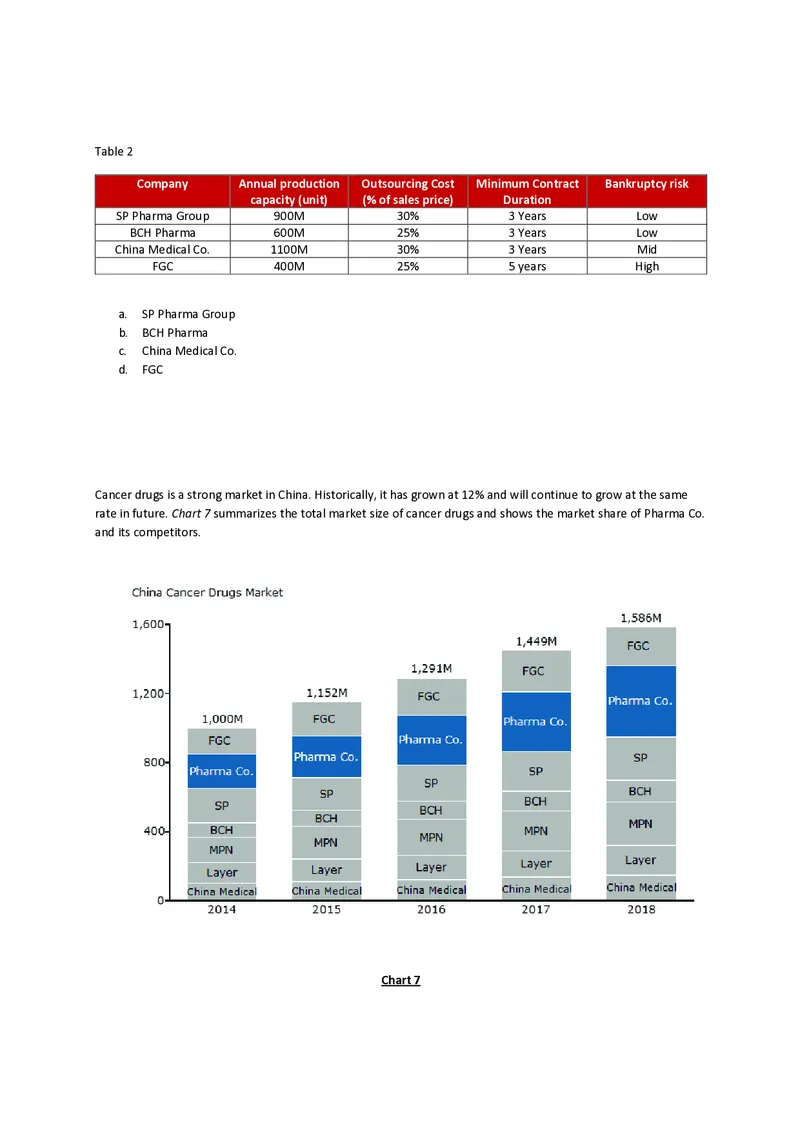
Assumption: Every consumeris expected to consume100 units of RFC-9000 in a yearTable 2
Company Annual production Outsourcing Cost Minimum Contract Bankruptcy risk
capacity(unit) (% of sales price) Duration
SP Pharma Group 900M 30% 3 Years Low
BCH Pharma 600M 25% 3 Years Low
China Medical Co. 1100M 30% 3 Years Mid
FGC 400M 25% 5 years High
a. SP Pharma Group
b. BCH Pharma
c. ChinaMedical Co.
d. FGC
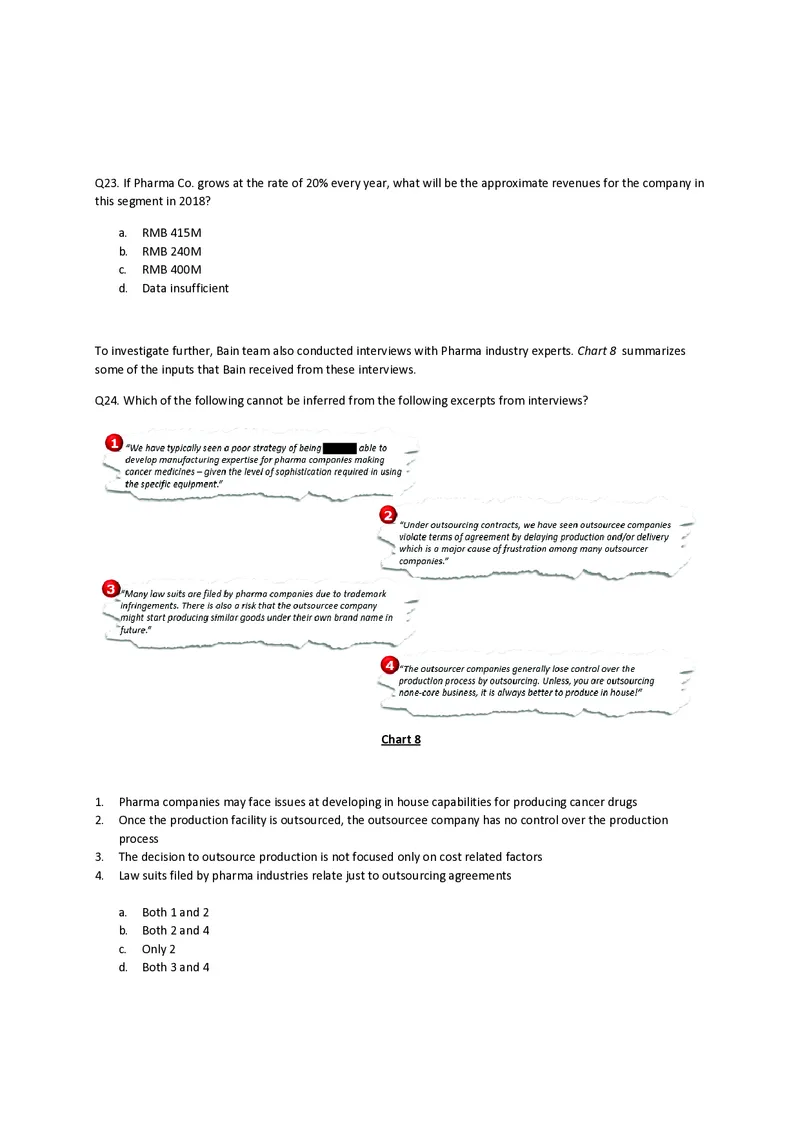
Cancer drugs is a strong market in China. Historically, it has grown at 12% and will continue to grow at the same
rate in future. Chart 7summarizes the total market size of cancer drugs and shows the market share of Pharma Co.
and its competitors.
Chart 7Q23. If Pharma Co. grows at the rate of 20% every year, what will be the approximate revenues for the company in
this segment in 2018?
a. RMB 415M
b. RMB 240M
c. RMB 400M
d. Data insufficient
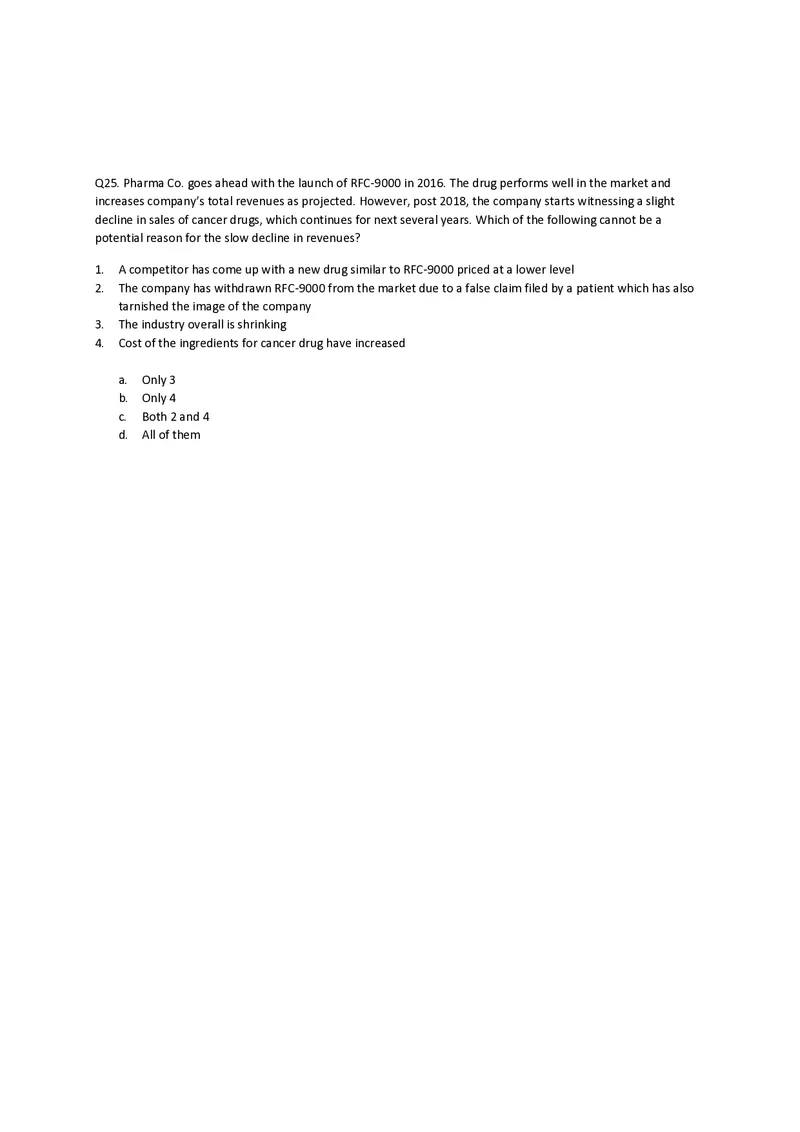
To investigate further, Bain team also conducted interviews with Pharma industry experts. Chart 8 summarizes
some of the inputs that Bain received from these interviews.
Q24. Which of the following cannot be inferred from the following excerpts from interviews?
Chart 8
1. Pharma companies may face issues at developing in house capabilities for producing cancer drugs
2. Once the production facility is outsourced, the outsourcee company has no control over the production
process
3. The decision to outsource production is not focused only on cost related factors
4. Law suits filed by pharma industries relate just to outsourcing agreements
a. Both 1 and 2
b. Both 2 and 4
c. Only 2
d. Both 3 and 4Q25. Pharma Co. goes ahead with the launch of RFC-9000 in 2016. The drug performs well in the market and
increases company’s total revenues as projected. However, post 2018, the company starts witnessing a slight
decline in sales of cancer drugs, which continues for next several years. Which of the following cannot be a
potential reason for the slow decline in revenues?
1. A competitor has come up with a new drug similar to RFC-9000 priced at a lower level
2. The company has withdrawn RFC-9000 from the market due to a false claim filed by a patient which has also
tarnished the image of the company
3. The industry overall is shrinking
4. Costof the ingredients for cancer drug have increased
a. Only 3
b. Only 4
c. Both 2 and 4
d. All of them