绝密 启用前
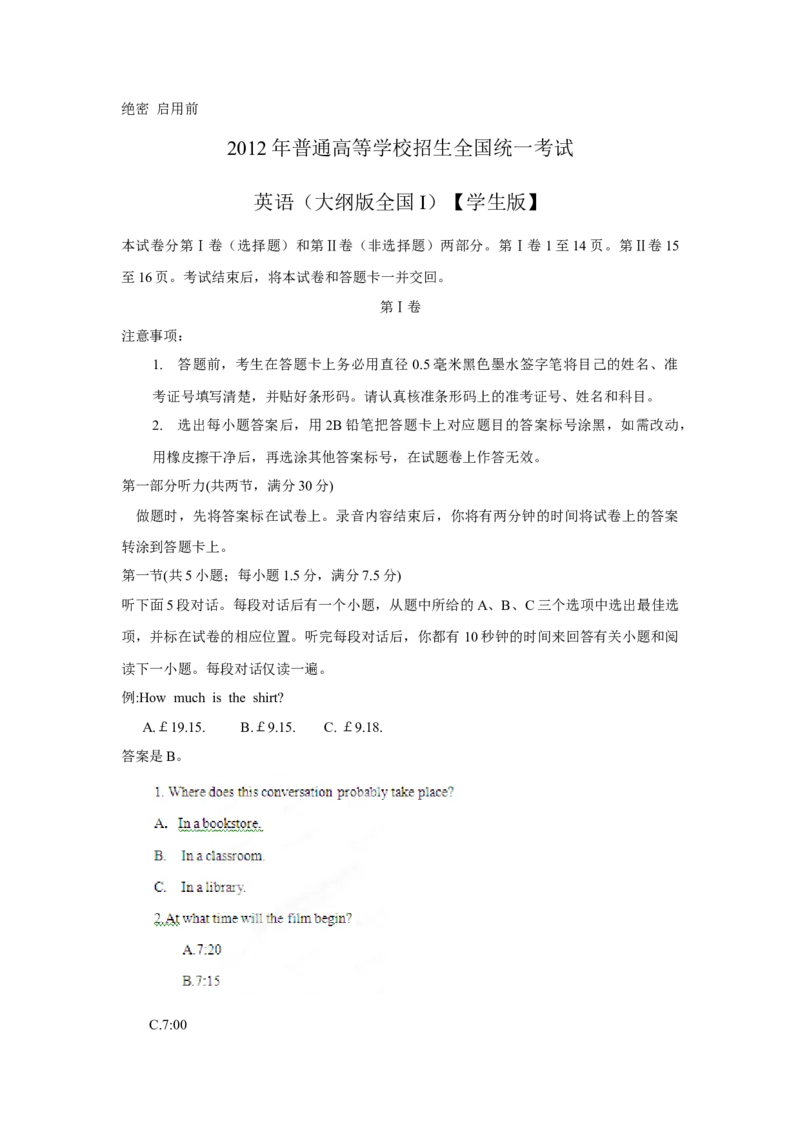
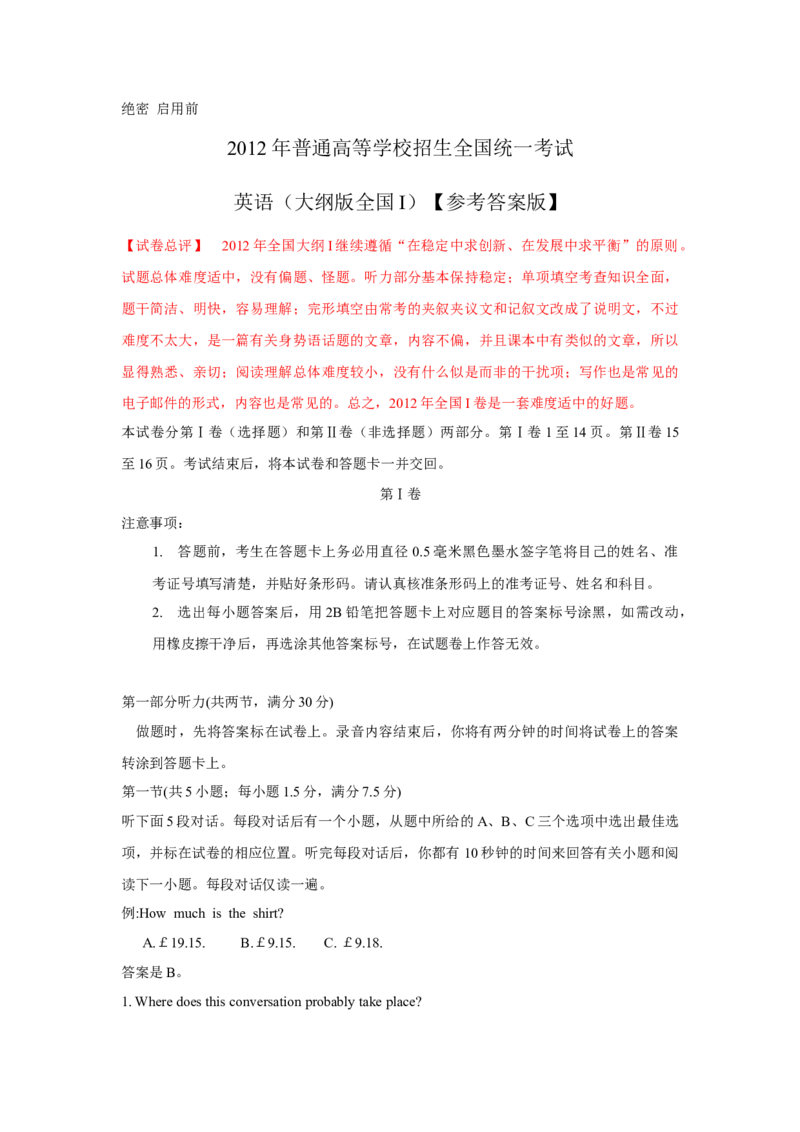
2012年普通高等学校招生全国统一考试
英语(大纲版全国I)【学生版】
本试卷分第Ⅰ卷(选择题)和第Ⅱ卷(非选择题)两部分。第Ⅰ卷1至14页。第Ⅱ卷15
至16页。考试结束后,将本试卷和答题卡一并交回。
第Ⅰ卷
注意事项:
1. 答题前,考生在答题卡上务必用直径 0.5毫米黑色墨水签字笔将目己的姓名、准
考证号填写清楚,并贴好条形码。请认真核准条形码上的准考证号、姓名和科目。
2. 选出每小题答案后,用2B铅笔把答题卡上对应题目的答案标号涂黑,如需改动,
用橡皮擦干净后,再选涂其他答案标号,在试题卷上作答无效。
第一部分听力(共两节,满分30分)
做题时,先将答案标在试卷上。录音内容结束后,你将有两分钟的时间将试卷上的答案
转涂到答题卡上。
第一节(共5小题;每小题1.5分,满分7.5分)
听下面5段对话。每段对话后有一个小题,从题中所给的A、B、C三个选项中选出最佳选
项,并标在试卷的相应位置。听完每段对话后,你都有 10秒钟的时间来回答有关小题和阅
读下一小题。每段对话仅读一遍。
例:How much is the shirt?
A.£19.15. B.£9.15. C. £9.18.
答案是B。
C.7:00[来源:Zxxk.Com]
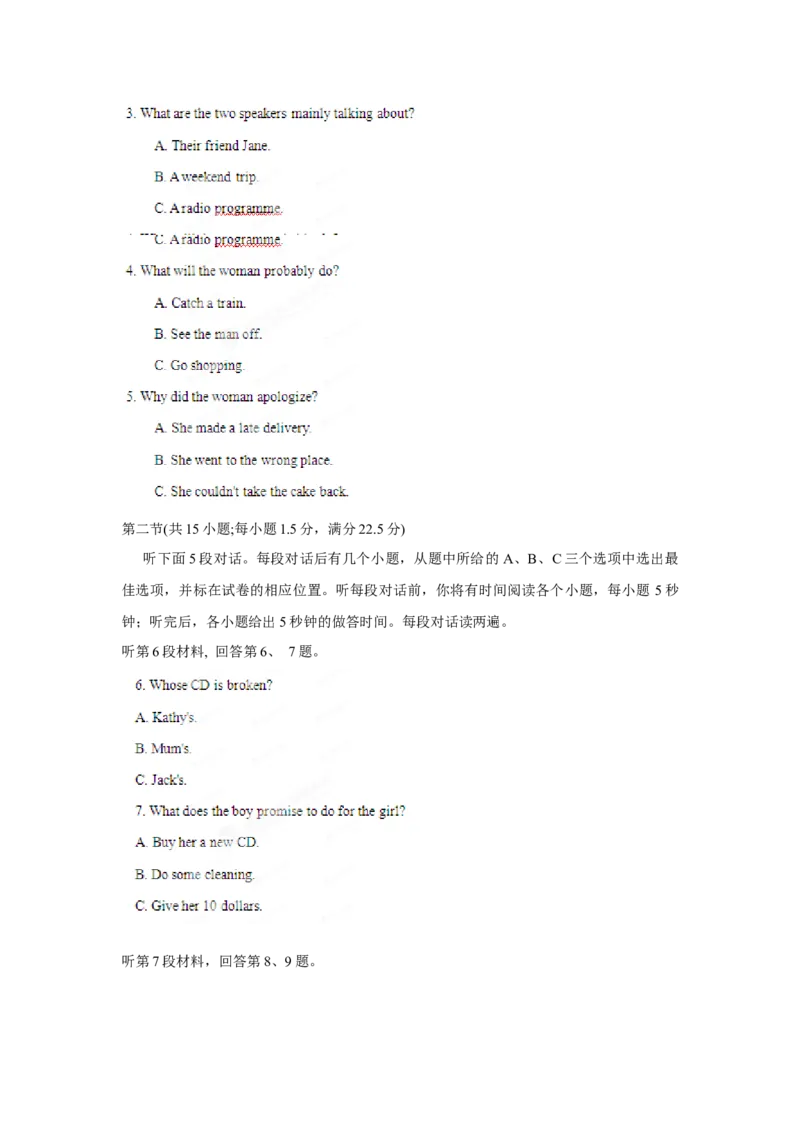
第二节(共15小题;每小题1.5分,满分22.5分)
听下面5段对话。每段对话后有几个小题,从题中所给的 A、B、C三个选项中选出最
佳选项,并标在试卷的相应位置。听每段对话前,你将有时间阅读各个小题,每小题 5秒
钟;听完后,各小题给出5秒钟的做答时间。每段对话读两遍。
听第6段材料, 回答第6、 7题。
[来源:学科网ZXXK]
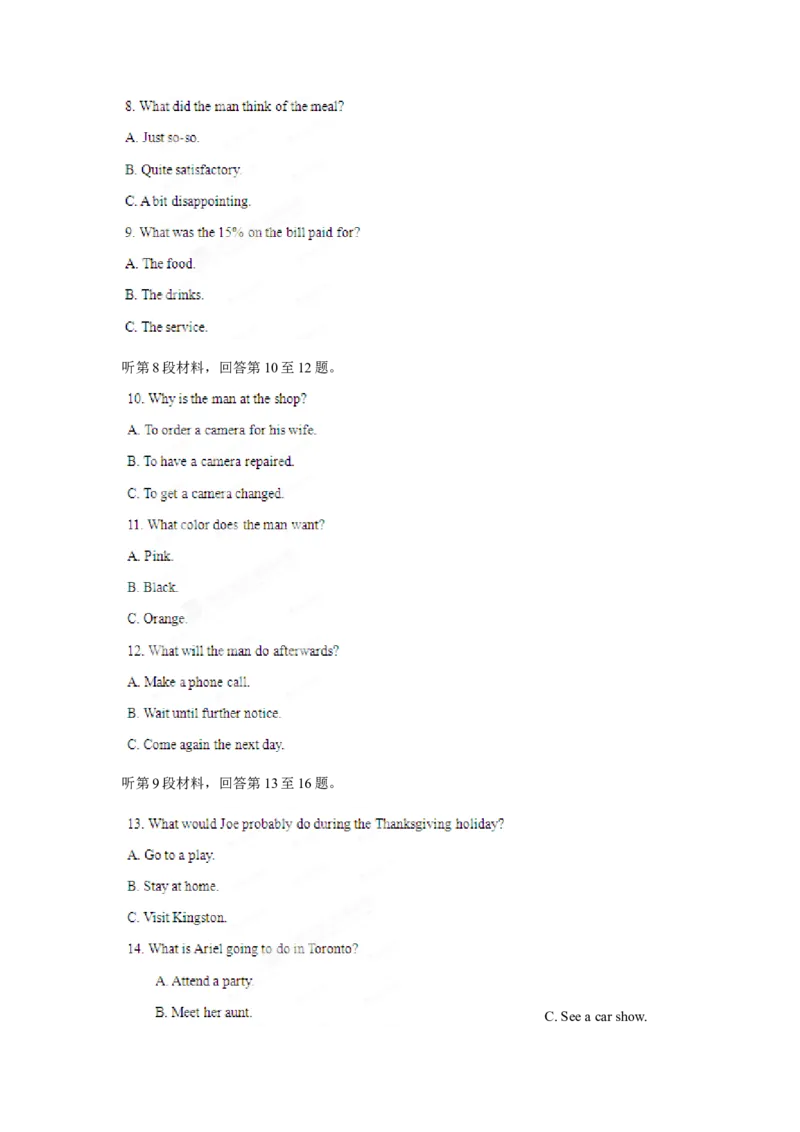
听第7段材料,回答第8、9题。听第8段材料,回答第10至12题。
听第9段材料,回答第13至16题。
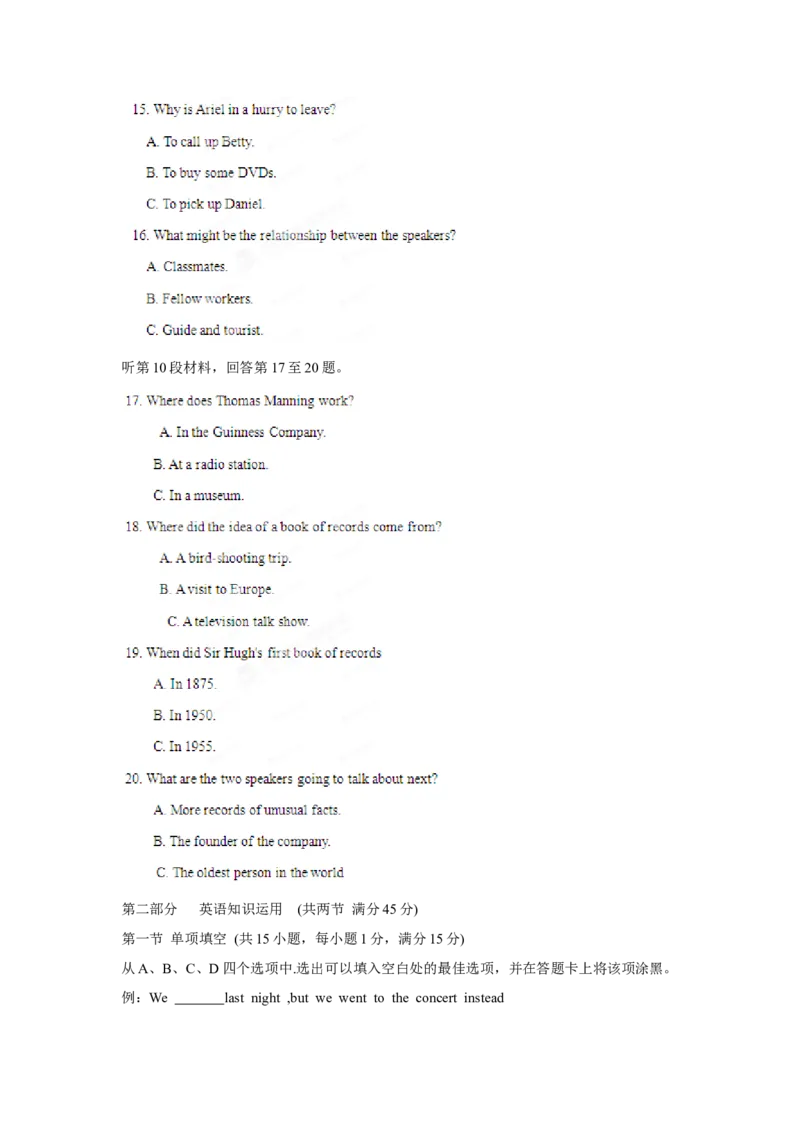
C. See a car show.听第10段材料,回答第17至20题。
第二部分 英语知识运用 (共两节 满分45分)
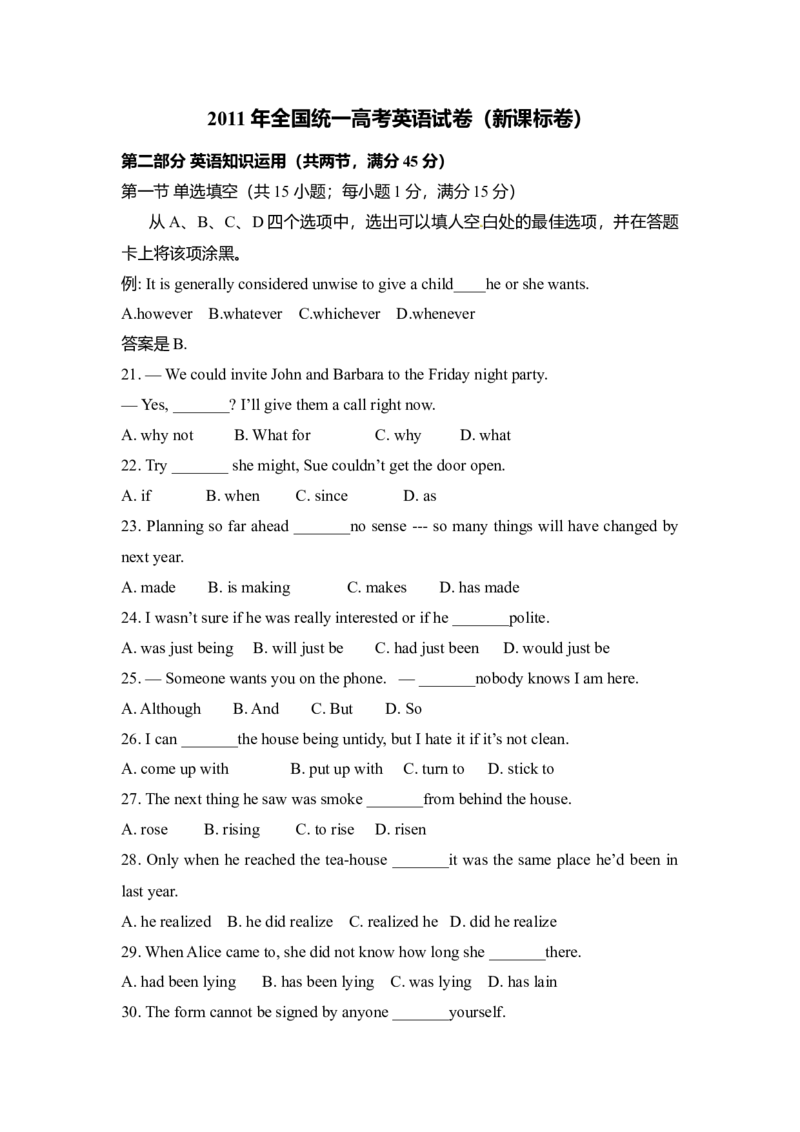
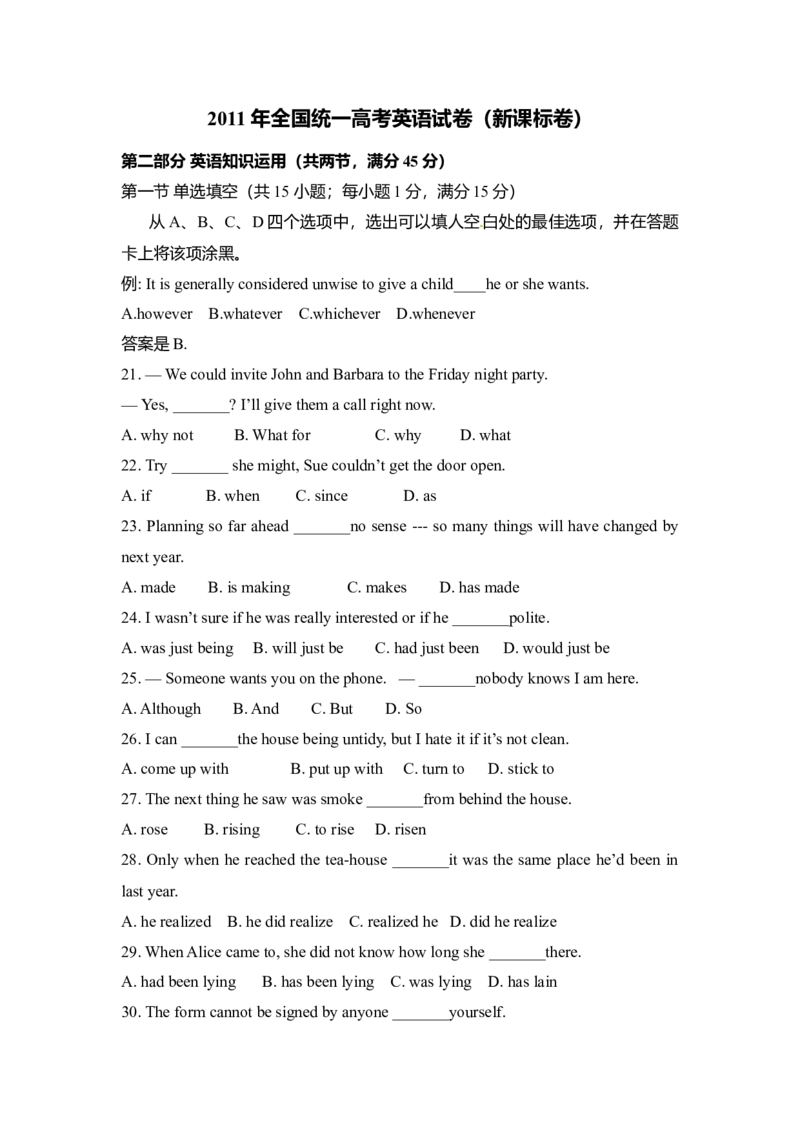
第一节 单项填空 (共15小题,每小题1分,满分15分)
从A、B、C、D四个选项中.选出可以填入空白处的最佳选项,并在答题卡上将该项涂黑。
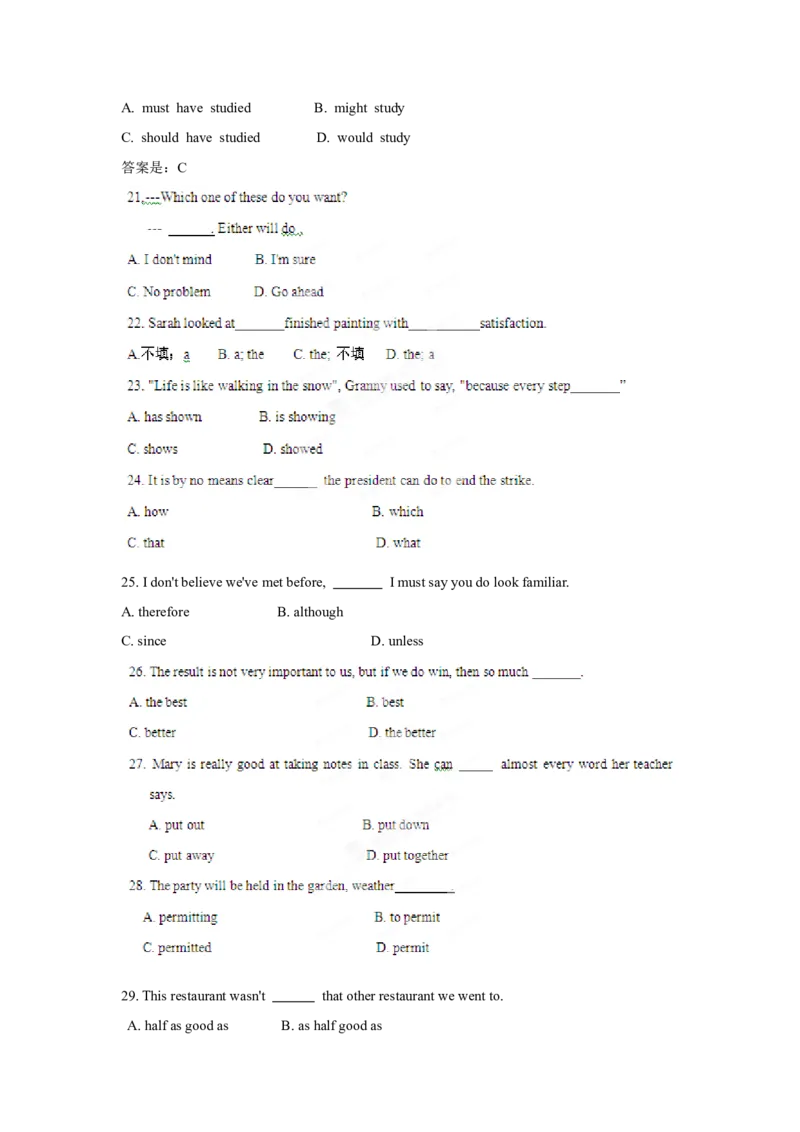
例:We last night ,but we went to the concert insteadA. must have studied B. might study
C. should have studied D. would study
答案是:C
25. I don't believe we've met before, I must say you do look familiar.
A. therefore B. although
C. since D. unless
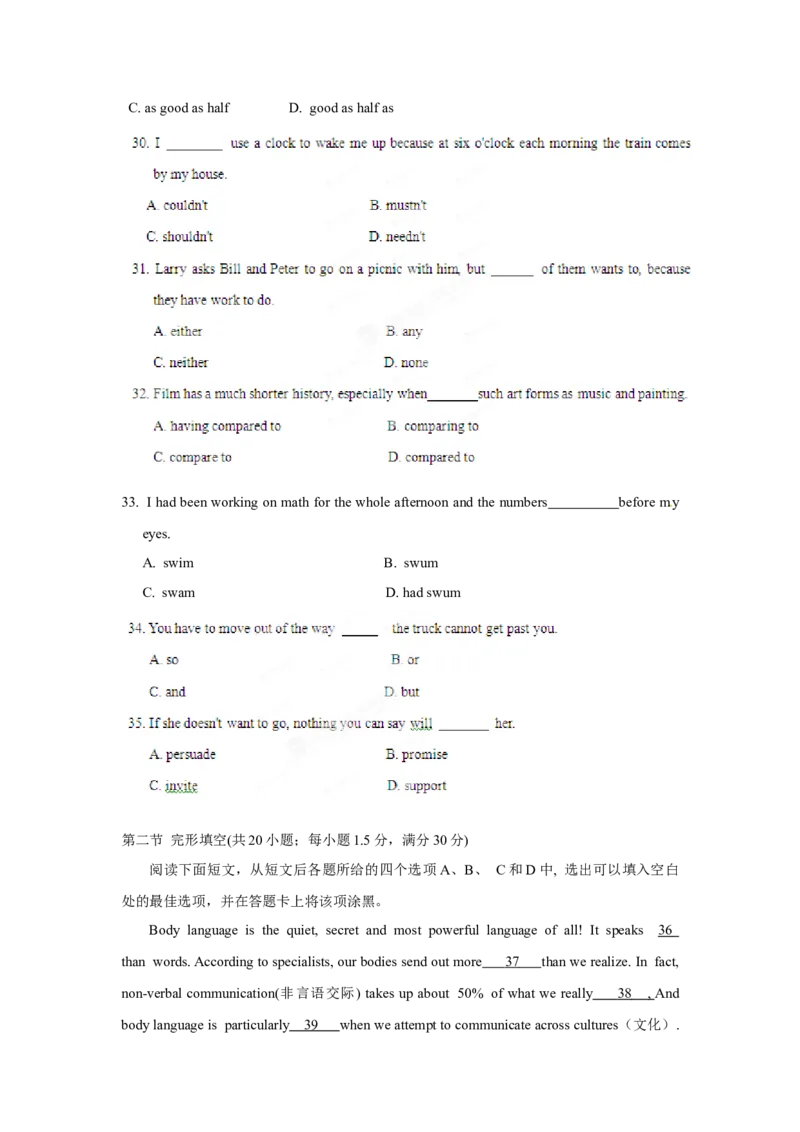
29. This restaurant wasn't that other restaurant we went to.
A. half as good as B. as half good asC. as good as half D. good as half as
33. I had been working on math for the whole afternoon and the numbers before my
eyes.
A. swim B. swum
C. swam D. had swum
第二节 完形填空(共20小题;每小题1.5分,满分30分)
阅读下面短文,从短文后各题所给的四个选项A、B、 C和D中, 选出可以填入空白
处的最佳选项,并在答题卡上将该项涂黑。
[来源:学.科.网Z.X.X.K]
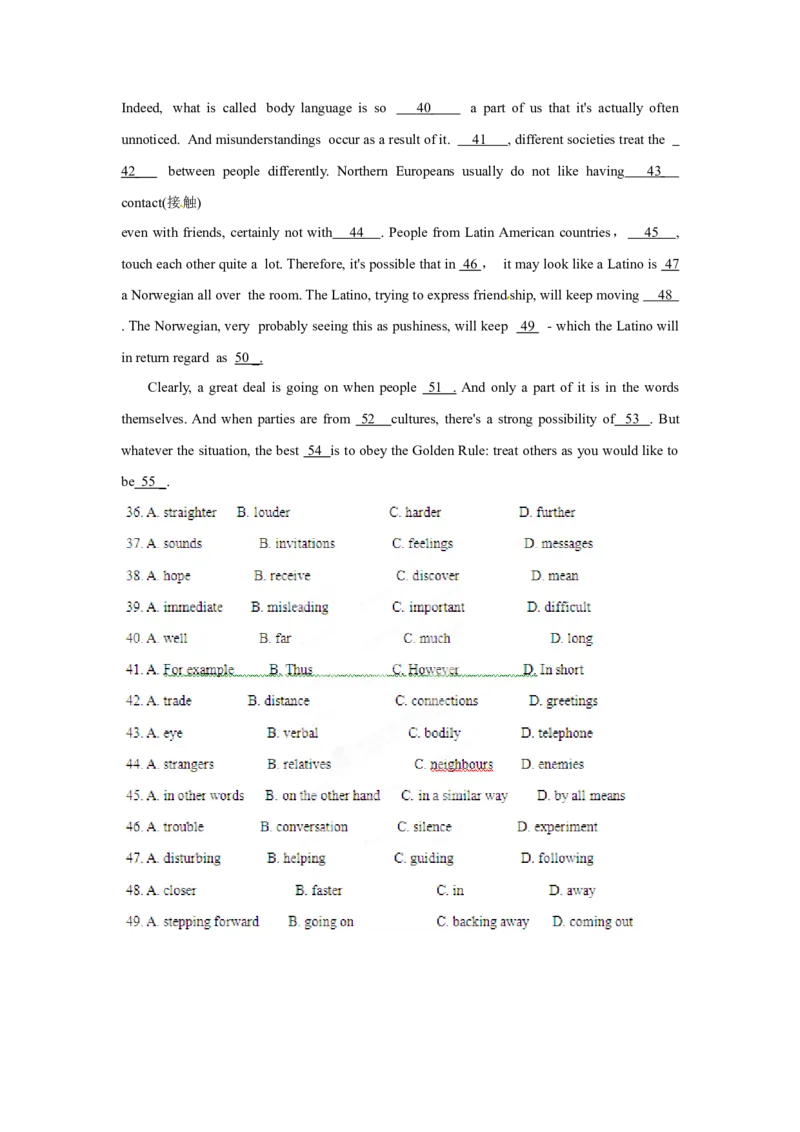
Body language is the quiet, secret and most powerful language of all! It speaks 36
than words. According to specialists, our bodies send out more 37 than we realize. In fact,
non-verbal communication(非言语交际) takes up about 50% of what we really 38 , And
body language is particularly 39 when we attempt to communicate across cultures(文化).Indeed, what is called body language is so 40 a part of us that it's actually often
unnoticed. And misunderstandings occur as a result of it. 4 1 , different societies treat the
42 between people differently. Northern Europeans usually do not like having 43
contact(接触)
even with friends, certainly not with 44 . People from Latin American countries, 45 ,
touch each other quite a lot. Therefore, it's possible that in 46 , it may look like a Latino is 47
a Norwegian all over the room. The Latino, trying to express friendship, will keep moving 48
. The Norwegian, very probably seeing this as pushiness, will keep 49 - which the Latino will
in return regard as 50 _.
Clearly, a great deal is going on when people 51 . And only a part of it is in the words
themselves. And when parties are from 52 cultures, there's a strong possibility of 53 . But
whatever the situation, the best 54 is to obey the Golden Rule: treat others as you would like to
be 55 _.第三部分阅读理解(共20 小题,每小题2分,满分40分)
阅读下列短文,从每题所给的四个选项(A, B, C和D)中,选出最佳选项.并在答且卡
上将该项涂黑。
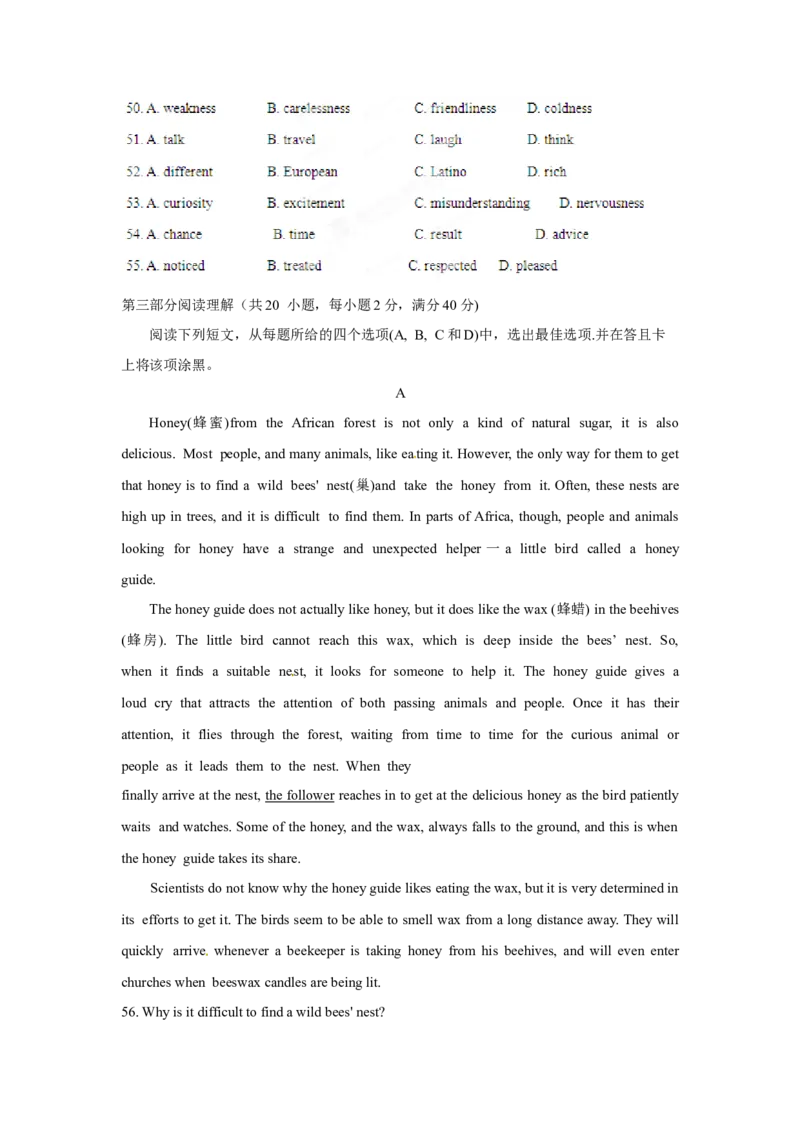
A
Honey(蜂蜜)from the African forest is not only a kind of natural sugar, it is also
delicious. Most people, and many animals, like eating it. However, the only way for them to get
that honey is to find a wild bees' nest(巢)and take the honey from it. Often, these nests are
high up in trees, and it is difficult to find them. In parts of Africa, though, people and animals
looking for honey have a strange and unexpected helper 一 a little bird called a honey
guide.
The honey guide does not actually like honey, but it does like the wax (蜂蜡) in the beehives
(蜂房). The little bird cannot reach this wax, which is deep inside the bees’ nest. So,
when it finds a suitable nest, it looks for someone to help it. The honey guide gives a
loud cry that attracts the attention of both passing animals and people. Once it has their
attention, it flies through the forest, waiting from time to time for the curious animal or
people as it leads them to the nest. When they
finally arrive at the nest, the follower reaches in to get at the delicious honey as the bird patiently
waits and watches. Some of the honey, and the wax, always falls to the ground, and this is when
the honey guide takes its share.
Scientists do not know why the honey guide likes eating the wax, but it is very determined in
its efforts to get it. The birds seem to be able to smell wax from a long distance away. They will
quickly arrive whenever a beekeeper is taking honey from his beehives, and will even enter
churches when beeswax candles are being lit.
56. Why is it difficult to find a wild bees' nest?A. It's small in size.
B
[来源:学。科。网Z。X。X。K]
About twenty of us had been fortunate enough to receive invitations to a film-
studio(影棚)to take part in a crowd-scene. Although our "act" would last only for a short time, we
could see quite a number of interesting things.
We all stood at the far end of the studio as workmen prepared the scene, setting up trees at
the edge of a winding path. Very soon, bright lights were turned on and the big movie-camera was
wheeled into position. The director shouted something to the camera operator and then went to
speak to the two famous actors nearby. Since it was hot in the studio, it came as a surprise to us to
see one of the actors put on a heavy overcoat and start walking along the path. A big fan began
blowing tiny white feathers down on him, and soon the trees were covered in "snow". Two more
fans were turned on, and a "strong wind" blew through the trees. The picture looked so real that it
made us feel cold.
The next scene was a complete contrast (对比). The way it was filmed was quite unusual.Pictures in front taken on an island in the Pacific were shown on a glass screen (幕). An actor and
actress stood of the scene so that they looked as if they were at the water’s edge on an
island. By a simple trick like this, palm trees, sandy beaches, and blue, clear skies had been
brought into the studio!
Since it was our turn next, we were left wondering what scene would be prepared for us. For
a full three minutes in our lives we would be experiencing the excitement of being film "stars"!
C
Last night I was driving from Harrisburg to Lewisburg,distance of about eighty miles. It was
late. Several times I got stuck behind a slow-moving truck on a narrow road with a solid white line
on my left, and I became increasingly impatient.
At one point along an open road, I came to a crossing with a traffic light. I was alone on the
road by now, but as I drove near the light, it turned red and I made a stop. I looked
left, right and behind me. Nothing. Not a car, no suggestion of car lamps, but there I sat,waiting for the light to change, the only human being for at least a mile in any direction.
I started wondering why I refused to run the light I was not afraid of being caught, because
there was clearly no policeman around, and there certainly would have been no danger in
going through it.
Much later that night, the question of why I'd stopped for that light came back to me. I think I
stopped because it's part of a contract(契约)we all have with each other. It's not only the
law, but it is an agreement we have, and we trust each other to honor it: we don't go through red
lights.
Trust is our first inclination(倾向).Doubting others does not seem to be natural to us.
The whole construction of our society depends on mutual(相互)trust, not distrust. We do
what we say we'll do; we show up when we say we'll show up; and we pay when we
say we'll pay. We trust each other in these matters, and we're angry or disappointed with
the person or organization that breaks the trust we have in them.
I was so proud of myself for stopping for the red light that night.66. Why was the author proud of himself?
A. He kept his promise.
B. He held back his anger.
C. He followed his inclination.
D. He made a right decision.
D
Grown-ups are often surprised by how well they remember something they learned as
children but have never practiced ever since. A man who has not had a chance to go
swimming for years can still swim as well as ever when he gets back in the water. He can get
on a bicycle after many years and still ride away. He can play catch and hit a ball as well as his
son. A mother who has not thought about the words for years can teach her daughter the
poem that begins "Twinkle, twinkle, little star" or remember the story of Cinderella or
Goldilocks and the Three Bears.
One explanation is the law of overlearning, which can be stated as follows: Once we have
learned something, additional learning trials(尝试) increase the length of time we will
remember it.
In childhood we usually continue to practice such skills as swimming, bicycle riding, and
playing baseball long after we have learned them. We continue to listen to and remind ourselves
of words such as "Twinkle, twinkle, little star" and childhood tales such as Cinderella and
Goldilocks. We not only learn but overlearn.
The multiplication tables(乘法口诀表) are an exception to the general rule that we
forget rather quickly the things that we learn in school, because they are another of the
things we overlearn in childhood.
The law of overlearning explains why cramming(突击学习)for an examination, though
it may result in a passing grade, is not a satisfactory way to learn a college course. By cramming,
a student may learn the subject well enough to get by on the examination, but he is likely soon
to forget almost everything he learned. A little overlearning, on the other hand, is really
necessary for one's future development.
67. What is the main idea of paragraph 1?
A. People remember well what they learned in childhood.
B. Children have a better memory than grown-ups.C. Poem reading is a good way to learn words.
D. Stories for children are easy to remember.
E
Are you looking for some new and exciting places to take your kids (孩子) to? Try some
of these
places:
Visit art museums. They offer a variety of activities to excite your kids' interest. Many offer
workshops for making land-made pieces, traveling exhibits, book signings by children's
[来源:学_科_网
Z_X_X_K]
favorite writer, and even musical performances and other arts Head to a natural history museum. This is where kids can discover the past from
dinosaur(恐龙) models to rock collections and pictures of stars in the sky. Also, ask what
kind of workshops and educational programs are prepared for kids and any special events
that are coming up.
Go to a Youtheater. Look for one in your area offering plays for child and family visitors.
Pre-show play shops are conducted by area artists and educators where kids can discover the
secret about performing arts. Puppet(木偶)making and stage make-up are just a couple
of the special offerings you might find.
Try hands-on science. Visit one of the many hands-on science museums around the country.
These science play-lands are great fun for kids and grown-ups alike. They'll keep your child
mentally and physically active the whole day through while pushing buttons, experimenting,
and building. When everyone is tired, enjoy a fun family science show, commonly found in
these museums.
75. Where does
this text
probably come from?A. A science textbook.
B. A tourist map.
C. A museum guide.
D. A news report.
绝密*启用前
2012 年普通高等学校招生全国统一考试
英语
第 II 卷
注意事项:
1.答题前,考生先在答题卡上用直径0.5毫米黑色墨水签字笔将自己的姓名、准考证号
填写清楚,然后贴好条形码。请认真核准条形码上的准考证号、姓名和科目.
2.第II卷共2页,请用直径0.5毫米黑色墨水签字笔在答题卡上各题的答题区域内作答,
在试题卷上作答无效
四部 分写作(共两节,满分35分)
第一节短文改错(共10小题;每小题1分,满分l0分)
(注意:在试题卷上作答无效)
此题要求改正所给短文中的错误。对标有题号的每一行作出判断:如无错误,在该行右
边横线上画一个勾(√);如有错误(每行只有一个错误),则按下列情况改正:
此行多一个词:把多余的词用斜线(\)划掉,在该行右边横线上写出该词,并也用斜
线划掉。
此行缺一个词:在缺词处加一个漏字符号( ),在该行右边横线上写出该加的词。
此行错一个词:在错的词下划一横线,在该行右边横线上写出改正后的词。
注意:原行没有错的不要改。work by bike once and twice a week, and we can also buy 81_____________________
smaller cars that burn less oil. Other way is to watch our 82_____________________
everyday use of water and electric at home. For example, 83_____________________
how many times have you walked out of a room and leave the 84_____________________
lights or television when no one else was there? 85_____________________
第二节 书面表达(满分25分)(注意:在试题卷上作答无效)