英 语 试 题
(选择题部分)
第一部分:英语知识运用(共两节,满分30分)
第一节:单项填空(共20题,每小题0.5分,满分10分)
从A、B、C和D四个选项中,选出可以填入空白处的最佳选项,并在答题纸将该选
项标号涂黑。
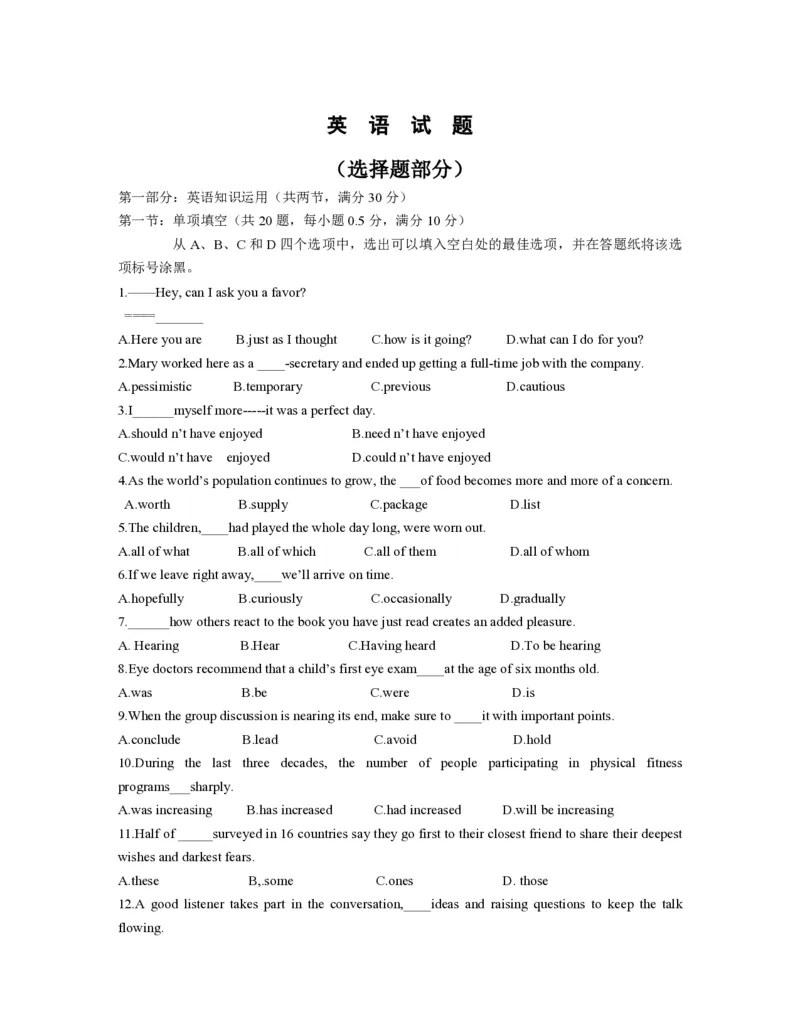
1.——Hey, can I ask you a favor?
====_______
A.Here you are B.just as I thought C.how is it going? D.what can I do for you?
2.Mary worked here as a ____-secretary and ended up getting a full-time job with the company.
A.pessimistic B.temporary C.previous D.cautious
3.I______myself more-----it was a perfect day.
A.should n’t have enjoyed B.need n’t have enjoyed
C.would n’t have enjoyed D.could n’t have enjoyed
4.As the world’s population continues to grow, the ___of food becomes more and more of a concern.
A.worth B.supply C.package D.list
5.The children,____had played the whole day long, were worn out.
A.all of what B.all of which C.all of them D.all of whom
6.If we leave right away,____we’ll arrive on time.
A.hopefully B.curiously C.occasionally D.gradually
7.______how others react to the book you have just read creates an added pleasure.
A. Hearing B.Hear C.Having heard D.To be hearing
8.Eye doctors recommend that a child’s first eye exam____at the age of six months old.
A.was B.be C.were D.is
9.When the group discussion is nearing its end, make sure to ____it with important points.
A.conclude B.lead C.avoid D.hold
10.During the last three decades, the number of people participating in physical fitness
programs___sharply.
A.was increasing B.has increased C.had increased D.will be increasing
11.Half of _____surveyed in 16 countries say they go first to their closest friend to share their deepest
wishes and darkest fears.
A.these B,.some C.ones D. those
12.A good listener takes part in the conversation,____ideas and raising questions to keep the talk
flowing.A.realizing B.copying C.offering D.misunderstanding
13.The museum will open in the spring with an exhibition and a viewing platform____visitors can
watch the big glasshouses being built.
A.what B.where C.when D.why
14.It will be a big help if you go to the store and get what we need for dinner._____,I’ll set the table.
A.As a result B.On the whole C.In the meanwhile D.As a matter of fact
15.People develop______preference for a particular style of learning at______early age and these
preferences affect learning.
A.a; an B.a;不填 C.不填;the D.the ;an
16. The only way to succeed at the highest level is to have total belief_____you are better than anyone
else on the sports field.
A.how B,that C.which D.whether
17.Bears_____fat stores throughout the summer and fall to have energy enough to last them through
their winter sleep.
A.pack up B.build up C.bring up D.take up
18.If what your friend comes up with surprise you ,don’t reject it immediately._____,imagine that it is
true.
A/Thus B.Besides C.Rather D.Otherwise
19.There are some health problems that, when ____in time, can become bagger ones later on.
A.not treated B,not being treated C.not to be treated D.not having been treated
20.-----Excuse me, but could I trouble you for some change?
------_______.Will pennies do?
A. I know B.Never mind C.I am sure D.Let me see
第二节 完型填空(共20小题,每小题1分, 满分20分)
阅读下面短文, 掌握其大意, 然后从21到40各题所给的4个选项 A,B,C和D中选出最佳
选项, 并在答题纸上将该选项标号涂黑。
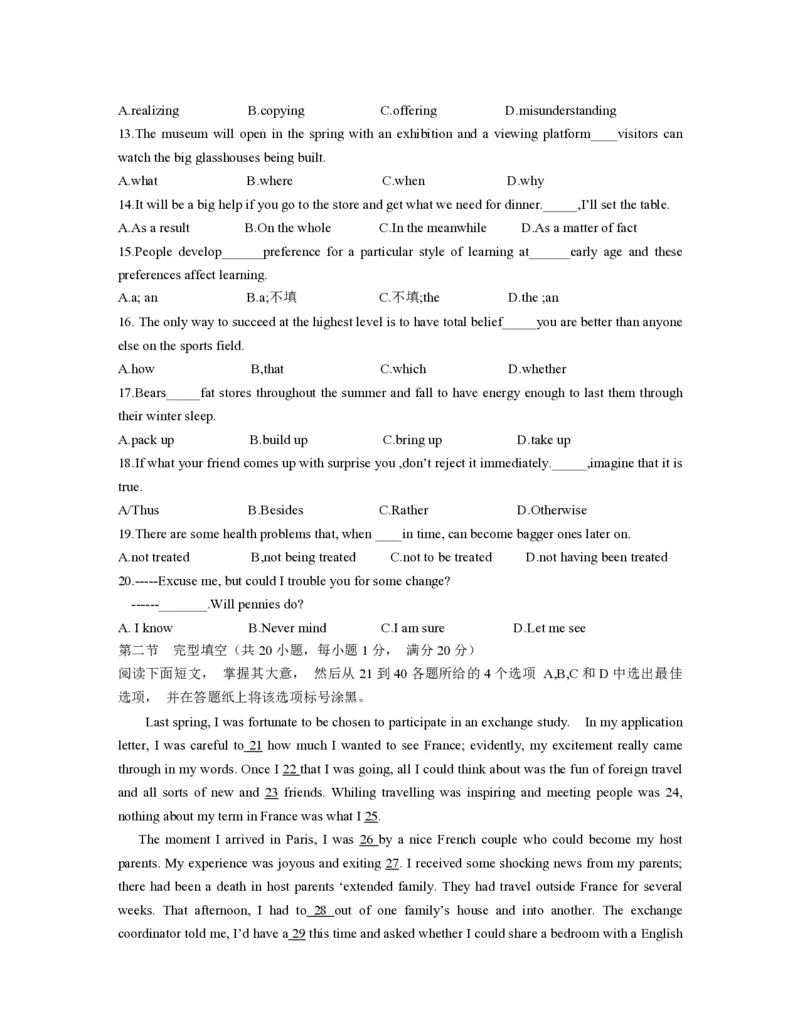
Last spring, I was fortunate to be chosen to participate in an exchange study. In my application
letter, I was careful to 21 how much I wanted to see France; evidently, my excitement really came
through in my words. Once I 22 that I was going, all I could think about was the fun of foreign travel
and all sorts of new and 23 friends. Whiling travelling was inspiring and meeting people was 24,
nothing about my term in France was what I 25.
The moment I arrived in Paris, I was 26 by a nice French couple who could become my host
parents. My experience was joyous and exiting 27. I received some shocking news from my parents;
there had been a death in host parents ‘extended family. They had travel outside France for several
weeks. That afternoon, I had to 28 out of one family’s house and into another. The exchange
coordinator told me, I’d have a 29 this time and asked whether I could share a bedroom with a Englishspeaker. To avoid the temptation(诱惑) to 30 my native language, I asked not to be 31 with an
English-speaking language roommate. When I got to my new room , I 32 myself new roommate
Paolo, a Brazilian(巴西人) the people . Whom I was surprised to find playing one of my favorite
Cos! In just a few hours, we knew we would be good friends for the rest of the 33.
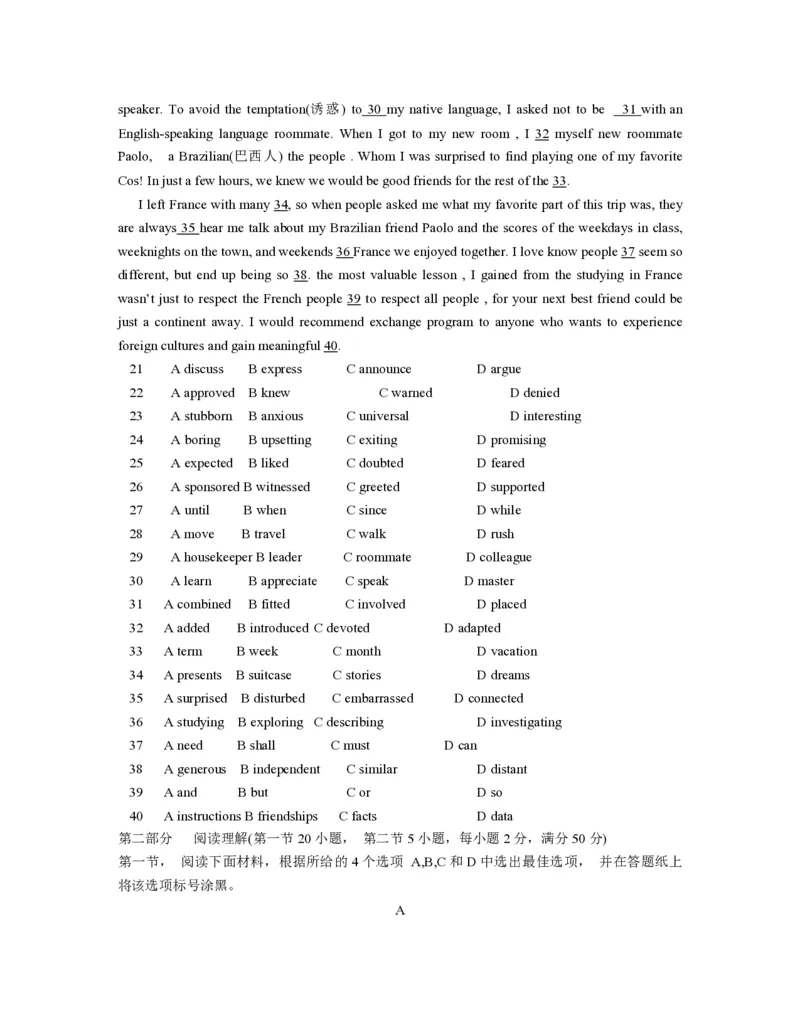
I left France with many 34, so when people asked me what my favorite part of this trip was, they
are always 35 hear me talk about my Brazilian friend Paolo and the scores of the weekdays in class,
weeknights on the town, and weekends 36 France we enjoyed together. I love know people 37 seem so
different, but end up being so 38. the most valuable lesson , I gained from the studying in France
wasn’t just to respect the French people 39 to respect all people , for your next best friend could be
just a continent away. I would recommend exchange program to anyone who wants to experience
foreign cultures and gain meaningful 40.
21 A discuss B express C announce D argue
22 A approved B knew C warned D denied
23 A stubborn B anxious C universal D interesting
24 A boring B upsetting C exiting D promising
25 A expected B liked C doubted D feared
26 A sponsored B witnessed C greeted D supported
27 A until B when C since D while
28 A move B travel C walk D rush
29 A housekeeper B leader C roommate D colleague
30 A learn B appreciate C speak D master
31 A combined B fitted C involved D placed
32 A added B introduced C devoted D adapted
33 A term B week C month D vacation
34 A presents B suitcase C stories D dreams
35 A surprised B disturbed C embarrassed D connected
36 A studying B exploring C describing D investigating
37 A need B shall C must D can
38 A generous B independent C similar D distant
39 A and B but C or D so
40 A instructions B friendships C facts D data
第二部分 阅读理解(第一节20小题, 第二节5小题,每小题2分,满分50分)
第一节, 阅读下面材料,根据所给的4个选项 A,B,C和D中选出最佳选项, 并在答题纸上
将该选项标号涂黑。
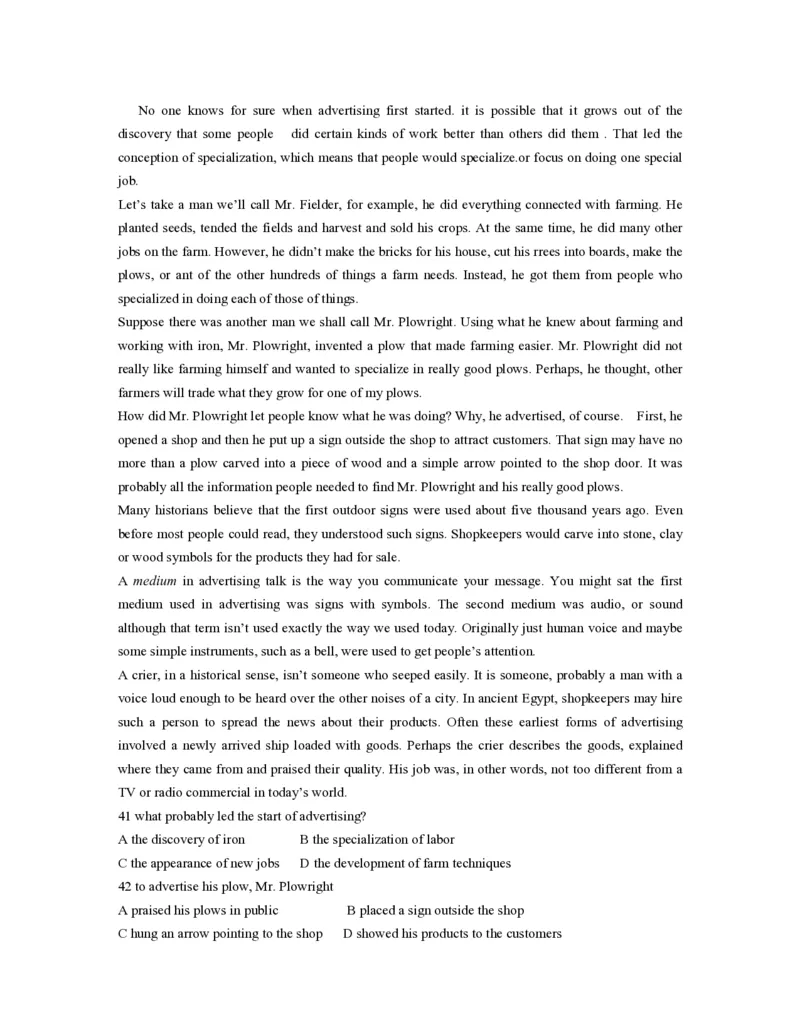
ANo one knows for sure when advertising first started. it is possible that it grows out of the
discovery that some people did certain kinds of work better than others did them . That led the
conception of specialization, which means that people would specialize.or focus on doing one special
job.
Let’s take a man we’ll call Mr. Fielder, for example, he did everything connected with farming. He
planted seeds, tended the fields and harvest and sold his crops. At the same time, he did many other
jobs on the farm. However, he didn’t make the bricks for his house, cut his rrees into boards, make the
plows, or ant of the other hundreds of things a farm needs. Instead, he got them from people who
specialized in doing each of those of things.
Suppose there was another man we shall call Mr. Plowright. Using what he knew about farming and
working with iron, Mr. Plowright, invented a plow that made farming easier. Mr. Plowright did not
really like farming himself and wanted to specialize in really good plows. Perhaps, he thought, other
farmers will trade what they grow for one of my plows.
How did Mr. Plowright let people know what he was doing? Why, he advertised, of course. First, he
opened a shop and then he put up a sign outside the shop to attract customers. That sign may have no
more than a plow carved into a piece of wood and a simple arrow pointed to the shop door. It was
probably all the information people needed to find Mr. Plowright and his really good plows.
Many historians believe that the first outdoor signs were used about five thousand years ago. Even
before most people could read, they understood such signs. Shopkeepers would carve into stone, clay
or wood symbols for the products they had for sale.
A medium in advertising talk is the way you communicate your message. You might sat the first
medium used in advertising was signs with symbols. The second medium was audio, or sound
although that term isn’t used exactly the way we used today. Originally just human voice and maybe
some simple instruments, such as a bell, were used to get people’s attention.
A crier, in a historical sense, isn’t someone who seeped easily. It is someone, probably a man with a
voice loud enough to be heard over the other noises of a city. In ancient Egypt, shopkeepers may hire
such a person to spread the news about their products. Often these earliest forms of advertising
involved a newly arrived ship loaded with goods. Perhaps the crier describes the goods, explained
where they came from and praised their quality. His job was, in other words, not too different from a
TV or radio commercial in today’s world.
41 what probably led the start of advertising?
A the discovery of iron B the specialization of labor
C the appearance of new jobs D the development of farm techniques
42 to advertise his plow, Mr. Plowright
A praised his plows in public B placed a sign outside the shop
C hung an arrow pointing to the shop D showed his products to the customers43 the writer makes up the two stories of Mr. .Fielder and Mr. Plowright in order to
A explain the origin of advertising B predict the future of advertising
C expose the problem in advertising D provide suggestions for advertising
44 in ancient Egypt was a crier was probably someone who
A owned a ship
B had the loudest voice
C ran a shop selling goods to farmers
D functioned like today’s TV or commercial
44 the last two paragraphs are mainly about
A the history of advertising B the benefits of advertising
C the early forms of advertising D the basic design of advertising
B
Below is a selection from a popular science book.
If blood is red ,why are verns(静脉)blue?
Actually, veins are not blue at all. They are more of a clear, yellowish color. Although blood looks
red when it’s outside the body, when it’s sitting in a vein near the surface of the skin, it’s more of a
dark reddish purple color. At the right depth, these blood-filled veins reflect less red light than the
surrounding skin, making them look blue by comparison.
Which works harder, your heart or your brain?
That kind of depends on whether you’re busy thinking or busy exercising. Your heart works up to
three times harder during exercise, and shifts enough blood over a lifetime to fill a supertanker.
But ,in the long run, your brain probably tips it, because even when you ‘re sitting still your brain is
using twice as much energy as your heart, and it takes four to five times as much blood to feed it .
Why do teeth fall out, and why don’t they grow back in grown-ups?
Baby (or “milk ”) teeth do not last long ; they fall out to make room for bigger, stronger adult teeth
later on. Adult teeth fall out when they become damaged, decayed and infected by bacteria. Once this
second set of teeth has grown in, you’re done. When they’re gone, they’re gone. This is because
nature figures you’re set for life, and what controls regrowth of your teeth switches off.
Do old people shrink as they age?
Yes and no. Many people do get shorter as they age. But, when they do, it isn’t because they’re
shrinking all over. They simply lose height as their spine(脊柱) becomes shorter and more curved due
to disuse and the effects of gravity(重力) . Many (but not all) men and women do lose height as they
get older. Men lose an average of 3-4 cm in height as they age, while women may lose 5cm or more.
If you live to be 200 years old, would you keep shrinking till you were, like 60 cm tall, like a little boy
again? No, because old people don’t really shrink! It is not that they are growing backwards --theirlegs. arms and backbones getting shorter. When they do get shorter, it’s because the spine has
shortened a little. Or, more often, become more bent and curved.
Why does spinning make you dizzy(眩晕的)?
Because your brain gets confused between what you’re seeing and what you’re feeling. The brain
senses that you’re spinning using special gravity-and motion-sensing organs in your inner ear, which
work together with your eyes to keep your vision and balance stable. But, when you suddenly stop
spinning the system goes out of control, and your brain thinks you’re moving while you’re not!
Where do feelings and emotions come from?
Mostly from an ancient part of the brain called the limbic system. All mammals have this brain
area --from mice to dogs, cats, and humans. So all mammals feel basic emotions like fear, pain and
pleasure. But since human feelings also involve other, newer bits of the brain, we feel more complex
emotions than any other animal on the planet
If exercise wears you out, how can it be good for you?
Because our bodies adapt to everything we do to them. And as far as your body is concerned, it’s
“use it, or lose it”! It’s not that exercise makes you healthy; it’s more that a lack of exercise leaves
your body weak and easily affected by disease.
46.When is the colour of blood in a vein near the surface of the skin?
A. Blue. B. Light yellow.
C. Red D. Dark reddish purple.
47.Why do some old people look a little shrunken as they age?
A. Because their spine is in active use.
B. Because they are more easily affected by gravity.
C. Because they keep growing backwards.
D. Because their spine becomes more bent.
48. Which of the following statements about our brain is true?
A. In the long run, our brain probably works harder than our heart.
B. When our brain senses the spinning, we will feel dizzy.
C. The brains of the other mammals are as complex as those of humans.
D. Our feelings and emotions come from the most developed area in our brain.
49. What is the main purpose of the selection?
A. To give advice on how to stay healthy.
B. To provide information about our body.
C. To challenge new findings in medical research.
D. To report the latest discoveries in medical science.C
The baby monkey is much more developed at brith than the human baby. Almost from the moment
it is born,the baby monkey can move around and hold tightly to its mother. During the first few days
of its life the baby will approach and hold onto almost any large,warm, and soft object in its
environment , particularly if that object also gives it milk. After a week or so , however, the baby
monkey begins to avoid newcomers and focuses its attentions on “mother”-----the real mother or the
mother-substitute(母亲代替物).
During the first two weeks of its life warmth is perhaps the most important psychological(心理
的)thing that a monkey mother has to give to its baby. The Harlows, a couple who are both
psychologists, discovered this fact by offering baby monkeys a choice fo two types of mother-
substitutes ----one covered with cloth and one make of bare wire. IF the two artificial mothers were
both the same temperature, the little monkeys always preferred the cloth mother. However, if the wire
model was heated, while the cloth model was cool, for the first two weeks after brith the baby
monkeys picked the warm wire mother-substitutes as their favorites. Thereafter they switched and
spent most of their time on the more comfortable cloth mother.
Why is cloth preferable to bare wire? Sometime that the Harlows called contact(接触)comfort
seems to be the answer, and a most powerful influence it is. Baby monkeys spend much of their time
rubbing against their mothers’ skins, putting themselves in as close contact with the parent as they
can. Whenever the young animal is frightened, disturbed, or annoyed, it typically rushes to its mother
and rubs itself against her body. Wire does n’t “rub”as well as does soft cloth. Prolonged(长时
间)”contact comfort” with a cloth mother appears to give the babies confidence and is much more
rewarding to them than is either warmth or milk.
According to the Harlows, the basic quality of a baby’s love for its mother os trust. If the baby is
put into an unfamiliar playroom without its mother, the baby ignores the toys no matter how
interesting they might be. It screams in terror and curls up into a furry little ball. If its cloth mother is
now introduced into the playroom, the baby rushes to it and holds onto it for dear life. After a few
minutes of contact comfort, it obviously begins to feel more secure. It then climbs down from the
mother-substitute and begins to explore the toys, but often rushes back for a deep embrace (拥抱) as if
to make sure that its mother is still there and that all is well. Bit by bit its fears of the new environment
are gone and it spends more and more time playing with the toys and less and less time holding onto
its”mother”.
50. Psychologically, what does the baby monkey desire most during the first two weeks of its life?
A.Warmth B.Milk C.contact D.trust
51. After the first two weeks of their life,baby monkeys prefer the cloth mother to the wire mother
because the former is_______.
A. larger in size B.closer to themC.less frightening and less disturbing D.more comfortable to rub against
52. What does the baby monkey probably gain from prolonged”contact comfort”?
A.Attention. B.Softness C.confidence D.interest .
53. It can be inferred that when the baby monkey feels secure,____.
A.it frequently rushes back for a deep embrace when exploring the toys
B.it spend more time time screaming to get rewards
C.it is less attracted to the toys though they are interesting
D.it cares less about whether its mother is still around
54.The main purpose of the passage is to______.
A.give the reasons for the experiment
B.present the findings of the experiment.
C.introduce the method of the experiment
D.describe the process of the experiment
D
In 1974, after filling out fifty applications, going through four interviews, and winning one offer, I
took what I could get ---- a teaching job at what I considered a distant wild area ; western New Jersey.
My characteristic optimism was alive only when I reminded myself that I would be doing what I had
wanted to do since I was fourteen---- teaching English.
School started, but I felt more and more as if I were in a foreign country. Was this rural area
really New Jersey? My studies took a week off when hunting season began. I was told they were also
frequently absent in late October to help their fathers make hay on the farms. I was a young woman
from New York City, who thought that”Make hay while the sun shines”just meant to have a good
time.
But, still, I was teaching English. I worked hard, taking time off only to eat and sleep. And then
there was my sixth-grade class ------seventeen boys and five girls who were only six years younger
than me. I had a problem long before I know it. I was struggling in my work as a young idealistic
teacher . I wanted to make literature come alive and to promote a love of the written word. The
students wanted to throw spitballs and whisper dirty words in the back of the room
In college I had been taught that a successful educator should ignore bad behavior . So I did,
confident that, as the textbook had said, the bad behavior would disappear as I gave my students
positive attention. It sounds reasonable, but the text evidently ignored the fact that humans,
particularly teenagers, rarely seem reasonable/ By the time my boss, who was also my
taskmaster ,known to be the strictest, most demanding, most quick to fire inexperienced teachers,
came into the classroom to observe me, the students exhibited very little good behavior to praise.
My boss sat in the back of the room. The boys in the class were making animal noises, hitting
each other while the girls their nails or read magazines. I just pretended it all was n’t happening, andwent on lecturing and tried to ask some inspiring questions. My boss, sitting in the back of the room,
seemed to be growing bigger and bigger. After twenty minutes he left, silently. Visions of
unemployment marches before my eyes.
I felt mildly victorious that I got through the rest of class without crying, but at my next free
period I had to face him. I wondered if he would let me finish out the day. I walked to his office, took
a deep breath, and opened the door.
He was gitting in his chair, and he looked at me long and hard. I said nothing. All I could think of
was that I was not an English teacher; I had been lying to myself, pretending that everything was fine.
When he spoke, he said simply, without accusation,”You had nothing to say to them.”
“You had nothing to say to them.”he repeated,”No wonder they’re bored. Why not get to the
meat of the literature and stop talking about symbolism.”Talk with them, not at them. And more
important, why do you ignore their bad behavior?’”We talked. He named my problems and offered
solutions. We role played. He was the bad student, and I was the forceful, yet ,warm,teacher/
As the year progressed, we spent many hours discussing literature and ideas about human being.
And their attentions ,he helped me identify my weakness and my strengths. In short, he made a teacher
of me by teaching me the reality of Emerson’s words;”The secret to education lies in respecting the
pupil.”
Fifteen years later I still drive that same winding road to the same school. Thanks to the help I
received that difficult first year, the school is my home now.
55. It can be inferred from the story that in 1974_______.
A. The writer became an optimistic person
B. The writer was very happy about her new job
C. It was rather difficult to get a job in the USA
D. It was easy to get a teaching job in New Jersey
56. According to the passage, which of the following is most probably the writher’s problem as a new
teacher?
A. She had blind trust in what she learnt at college.
B. She did n’t ask experienced teachers for advice.
C. She took too much time off to eat and sleep.
D. She did n’t like teaching English literature
57.What is the writer’s biggest worry after her taskmaster’s observation of her class?
A.She might lose her teaching job.
B.She might lose her students’ respect
C.She could n’t teach the same class any more .
D.She could n’t ignore her students’ bad behavior any more
58.Which of the following gives the writher a sense of mild victory?A.Her talk about symbolism sounded convincing
B.Her students behaved a little better than usual.
C.She managed to finish the class without crying.
D.She was invited for a talk by her boss after class.
59.The students behaved badly in the writer’s classed because_____.
A. they were eager to embarrass her
B. she did n’t really understand them
C. they did n’t regard her as a good teacher
D. she did n’t have a good command of English
60.The taskmaster’s attitude towards the writer after his observation of her class can be best described
as________.
A. cruel but encouraging B. Fierce but forgiving
B. C.sincere and supportive D.angry and aggressive
第二节:下面文章中有 5个段落需要添加首句(第 61~65题)。请从以下选项(A、B、C、
D、E和F)选出适合各段落的首句,并在答题纸上将相应选项的标号涂黑。选项中有一项是
多余选项。
A. Time can run out .
B. Tomorrow won’t be better
C. Ideas need time to develop
D. Your professor will be impatient
E. You blow off your chances for help
F. You’re probably overestimating(高估)the pain.
Never put off until tomorrow what you can do today
Want to put off studying for the physics test? Or writing that thirty-page research paper on future
uses of biotechnology? Sure you do? And who would n’t ?But it’s still a silly idea to put off doing
something until a future time. Here’s why.......
61.______The task will be still the same. It won’t be any more fun and you still won’t want to do
it. As the deadline gets closer and closer, the task seems to become larger and larger if you have n’t
started the work. And the stress increased. Now not only do you have to write that paper, you have to
do it under great pressure.
62._______Before you start, it seems that the task is unlikely to be accomplished. But you know
what ?you’re probably miscalculating . Get started----maybe on a small place-----and you’ll discover
that you have more resources and know more about the subject than you thought. Result? You won’t
experience nearly as much suffering as you expected to .Things are guaranteed----100percent----to get
better.
63.________If you leave your work until the night before it’s due, you give up the possibility ofgetting input from your professor. Professors regularly give advice----or at least a few useful tips----
during office hours. Unfortunately, though, they don’t usually hold office hours at midnight, so you’ll
be out of luck when you discover the night before the midterm that you have no idea how to do the
questions that will count for two-thirds of your grade.
64._______Ever wonder why the professor assigns the paper two weeks before it’s due?It’s because
he or she expects you to be thinking about the issue, or doing the research ,for two weeks. No, not
every waking moment, but at least some of the time.After all, the professor could just as easily have
given the assignment one week before it was due if he or she expected less thinking. Most college
papers require you to have some kind of idea, then to spend some time thinking about it, revising it,
and polishing it. When you throw together a paper or a report at the last minute,your ideas are half-
baked. And your professor will know it.
65.________If you put things off till the last minute, you might find that you haven’t budgeted
enough minutes to finish the necessary tasks. It’s the easiest thing in the world to miscalculate how
long it’ll take to do all the work especially when new issues arise---like illness, family problems,
computer breakdowns, trouble at work, and all the other things ---as you’re thinking through your
paper argument or preparing yourself for the coming test. If you keep delaying, you don’t allow
yourself time for those various life events that have an adverse(不利的)effect on your ability to
complete your assignment.
非选择题部分(共40分)
第三部分 写作(共两节,满分40分)
第一节 短文改错(共10小题, 每小题1分, 满分10分)
下面短文中有10处错误。请在有错误的地方增加,删除或修改某个单词
增加:在缺词处加一个漏词符号(∧),并在其下面写上该加的词。
删除:把多余的词用斜线(﹨)划掉。
修改:在错的词下划一横线,并在该词下面写上修改后的词。
注意:1. 每处错误及其修改均仅限一词;
2. 只允许修改10处,多者(从第11处起)不计分。
Dear Diary,
Here I am in the middle of a city,350miles far away from our farmhouse. Do you want to
know why we move last week? Dad lost his job, and as Mom explained,”He was lucky to find other
one ”. His new job meant I had to say goodbye to my classmate, my school or just everything else I
love in the world . To make matters bad, now I have to share a room with my younger sister, Maggie.Tomorrow is first day of school. I am awfully tiring, but I know I’ll never fall sleep.
Good night and remember, you , dear diary, is my only souvenir from my past life and my
only friend.
Yours,
Rosemary
第二节:书面表达(满分30分)
请以“one thing I’m proud of”为题, 用英语写一篇100—120个词的短文, 记述一见你自
己认为要求如下:
1. 记述事情经过
2. 简要说明你感到得意的原因或从中得到的启示
注意: 文章的标题已给出(不计词数).
One Thing I’m Proud of
英语试题参考答案
第一部分
第一节(10分, 每小题0.5分)
DBDBD AABAB DCBCA BBCAD
第二节(20分, 每小题1分)
BBDCA CAACC DBACA BDCBB
第二部分(50分,每小题2分)
BBADC DDABA DCDBC AACBC BFECA
第三部分
第一节(10分, 每小题1分)
Dear diary,
Here I am in the middle of a city, 350 miles far away from our farmhouse. Do you want toknow why we move last week? Dad lost his job, and as mom explained, “He was lucky to find
moved
other one.” His new job meant I had to say goodbye to my classmate , my school or just
another classmates and
everything else I love in the world. To make matters bad, now I have to share a room with my younger
worse
sister, Maggie. Tomorrow is ∧ first day of school. I am awfully tiring, but I know I’ll never fall sleep.
the /my tired
asleep
Good night and remember, you, dear diary, is my only souvenir from my past life and my only
friend.
are Yours,
Rosemarry2013年浙江省高考英语试卷真题解析
第一部分 英语知识运用(共两节,满分30分)
D. 单项填空(共20题;每小题0.5分,满分10分)
从A、B、C、D四个选项中,选出可以填入空白处的最佳选项,并在答题纸上将该选项符号
涂黑。
1. —Hey, can I ask you a favor?
—Sure, _________.
A. here you are B. just as I thought
C. how is it going D. what can I do for you?
考得是口语情景交流:一方提出帮忙请求,另一方做出确定的回应,选项D是习惯的以问句
形式表达的肯定的回应方式。选错选项A/B/C都是平时对口语交流表达方式陌生的表现,或许
平时外国电影/连续剧本身看得就很少,一味海量做题并不可取,对习惯表达也就自然极为陌
生。
E.Mary worked here as a ______ secretary and ended up getting a full-time job with the company.
E. pessimistic B. temporary C. previous D. Cautious
这道题表面考词汇其实考得是前后句义的理解 getting a full-time job当然前面的工作是
temporary,现在考题已经不再强调单词难度或者句子语法难度,而是句意的理解!
3. I ______ myself more —it was a perfect day.
A. shouldn’t have enjoyed B. needn’t have enjoyed
C. wouldn’t have enjoyed D. couldn’t have enjoyed
考情态动词加完成体用法,这是很多考生头疼的;其实关键的单词是it was a perfect day这两
个词表肯定意思,那么前面这句话就是在强调了,也应该是表肯定意思;A说不应该,B说没
必要,Cwould表示(过去习惯性)的预测/或者态度委婉的表达,Dcould not have done过去不可
能,不过注意到后面还有一个词more,意思就变成是肯定了,这是英语中形式上的否定表达意
义上的肯定的表达方式。应该平时多注意英语思维与中文思维不同的表达方式。
18.As the world’s population continues to grow, the ______ of food becomes more and more of a
concern.
56. worth B. supply C. package D. List
看前面句子的关键词汇continues to grow,那么人就要eat就有demand就有supply的问题了
16.The children, ______ had played the whole day long, were worn out.
B.all of what B. all of which C. all of them D. all of whom
定语从句里缺少主语
If we leave right away, ______ we’ll arrive on time.
B.hopefully B. curiously C. occasionally D. Gradually
选哪个语法上都对,但是看on time,就知道只能选A,还是考句意
C. _______ how others react to the book you have just read creates an added pleasure.
3.Hearing B. Hear C. Having heard D. To be hearing
考非谓语结构(分词和动词不定式),是难点;而且结合定语从句the book you have just read 和
名词性从句how others react to the book考,也是难点;creates是整句话的关键谓语动词,那么
前面就是主语,只能选A/D,但是听到了没有?听到了!所以选A动名词
B.Eye doctors recommend that a child’s first eye exam _____ at the age of six months old.
B.was B. be C. were D. Is
关键词汇recommend那么后面的宾语从句用虚拟语气(should)+be/do
9. When the group discussion is nearing its end, make sure to _____ it with important point.
B.conclude B. lead C. avoid D. Hold
前后句子中的关键词汇discussion is nearing its end,with important point;那么选A考句意,不是
考语法
52. During the last three decades, the number of people participating in physical fitness programs
______ sharply.17. was increasing B. has increased C. had increased D. will be increasing
看状语During the last three decades(指的是一个时间区间)到现在的变化影响sharply,选B
E. Half of _____ surveyed in 16 countries say they go first to their closest friend to share their deepest
wishes and darkest fears.
A. these B. some C. ones D. those
过去分词结构surveyed in 16 countries作后置定语,修饰前置代词,Cones是泛指一类人或物;
some是不确定的指代;选Dthose=a particular group of people
B.A good listener takes part in the conversation, _______ ideas and raising questions to keep the talk
flowing.
A. realizing B. copying C. offering D. Misunderstanding
关键看A good listener限定条件/keep the talk flowing目的,那么选C才符合句意
A“认识到”马上排除B/D不符合A good listener
E. The museum will open in the spring with an exhibition and a viewing platform ______ visitors can
watch the big glasshouses being built.
B. what B. where C. when D. Why
两个句子中间考不是连词就是后面这句变成从句;定语从句前面是地点选B
57. It will be a big help if you go to the store and get what we need for dinner. _______, I’ll set the
table.
8.As a result B. On the whole C. In the meanwhile D. As a matter of fact
考连接词(在句子间起逻辑作用的各种词),实际上考前后句子关系,对连词要注意用法多写
15.People develop _______ preference for a particular style of learning at _____ early age and these
preferences affect learning.
58.a; an B. a; 不填 C. 不填; the D. the; an
句子后面的these preferences是特指前面提到过的,那么前面的preference就是泛指;后面状语
年龄与之对应也是泛指
第三节The only way to succeed at the highest level is to have total belief _____ you are better than
anyone else on the sports field.
10.how B. that C. which D. Whether
两个句子中间考不是连词就是后面这句变成从句;同位语从句前面是抽象名词选B
E. Bears _______ fat stores throughout the summer and fall to have enough energy to last them
through their winter sleep.
21.pack up B. build up C. bring up D. take up
考动词短语,必考题,看似无头绪因为很难记住意思,其实这类动词短语大多很生活化,只有
平时多用才行;选B build up =make sth gradually become bigger
49. If what your friend comes up with surprises you, don’t reject it immediately. ______, imagine that
it is true.
E.Thus B. Besides C. Rather D. Otherwise
和14题一样考连接词(在句子间起逻辑作用的各种词),表转折,选C不是D
rather=to introduce a statement that indicates what is true after you have said what is not true
otherwise=if not /or else
看英语解释就知道不是otherwise而是rather,误选otherwisehe很大程度上是一味记单词中文意
思而不顾其在句子里真时用法造成的,学英语要勤查字典
19. There are some health problems that, when ______ in time, can become bigger ones later on.
3. not treated B. not being treated C. not to be treated D. not have been treated
考察插入语状语分句 when not treated in time省略的用法,可以还原为状语分句when they are
not treated in time,当然可以认为是考查过去分词用法
B. —Excuse me, but could I trouble you for some change?
—_______. Will pennies do?
A. I know B. Never mind C. I am sure D. Let me see
考日常对话,想想对话的生活场景,其实这种题就马上做出来了;some change找零钱,后面又问了一句Will pennies do?do指够不够,行不行,选项D;其他选项意思用法都不确切。还
有对日常会话习惯用语要熟悉。
第二节:完形填空(共20小题;每小题1分,满分20分)
21. 正确选项为B。从后面宾语内容可判断是作者想要"传达对于法国有多么的向往",是一种
情感,只能选择express。
22. 正确选项为B。此处还是延续传达作者对于法国的向往之情,一得知要去法国,便在大脑
中想象各种情景,所以答案应为knew。
23. 正确选项为D。Interesting可对应前句出现的exciting, fun等词。
24. 正确选项为 C。And前后并列内容为 traveling...inspiring可推断 meeting people...exciting,
同样可对应前文已经出现的exciting, fun等字眼。
25. 正确选项为 A。此处通过 while我们可得知,作者对于 term并没有期待,所以选
expected。
26. 正确选项为C。作者一达到巴黎,就受到了一对nice夫妇的问候,所以选greeted。
27. 正确选项为A。因为前一句话中出现joyous, exciting,而后句出现的是shocking news可知
激动心情的终结,转而变成不好的事情。肯定句+Until便是"直到...结束"。
28. 正确选项为A。此选项较为简单,move out of one family's house and into another。
29. 正确选项为C。从后文我们可知文章的重要人物即作者的"roommate"隆重登场了。
30. 正确选项为C。动词后出现的是宾语language,当然只能是"speak",初中已学的搭配。
31. 正确选项为 D。因为作者不想说母语,所以要求不跟说英语的人住在一起,纵观四个选
项,只有place符合逻辑。
32. 正确选项为B。因为是new roommate,自然需要互相"introduce"。
33. 正确选项为A。见面几分钟便知彼此为成为good friends,在接下来的term中。
34. 正 确 选 项 为 C。 根 据 下 文 的 描 述 weekdays in class, weeknights on the town,
weekends...France,便可知作者在法国与室友发生了很多的事情,故选"story"。
35. 正确选项为 A。前半部提到人们问作者这次旅行中最喜欢的部分,作者却说的是他的室
友,并不是首段中作者的设想,此结果不仅让他人surprised,就连作者本人都没有想到。
36. 正确选项为B。根据后接宾语France可知是一地方,只能选择explore"探索"。
37. 正确选项为D。此处是情态动词中关于can的客观性猜测考点。
38. 正确选项为C。前文出现different, but后显而易见出现相反结果,即反义词"similar"。
39. 正确选项为B。...not to...the foreign people与后面...to...all people可知情况相反,选择but。
40. 正确选项为B。最后一题为点明文章主旨,在前文中出现有关roommate的描述,又在前
句中出现friends,可推断本文作者做大的收益便是"friendships"。
关键注意完形并不是考纯粹的语法或者词汇,考的是上下文前后句子间的关系,看一句做一个
空的做题习惯是要戒除的,否则对文章篇章理解出错错误率就会很高!
第二部分 阅读理解(第一节 20 小题,第二节 5 小题,满分 50 分)
第一节:阅读下列材料,从每题所给的四个选项(A、B、C 和 D)中,选出最
佳选项,并在答题纸上将该选项标号涂黑。
A
No one knows for sure when advertising first started. It is possible that it grew out of
the discovery that some people did certain kinds of work better than others did them. That
led to the concept of specialization, which means that people would specialize, or focus,
on doing one specific job.
Let's take a man we'll call Mr. Fielder, for example. He did everything connected
with farming. He planted seeds, tended the fields, and harvested and sold his crops. Atthe same time, he did many other jobs on the farm. However, he didn't make the bricks
for his house, cut his trees into boards, make the plows(犁), or any of the other
hundreds of things a farm needs. Instead, he got them from people who specialized in
doing each of those things.
Suppose there was another man we shall call Mr. Plowright. Using what he knew
about farming and working with iron, Mr. Plowright invented a plow that made farming
easier. Mr. Plowright did not really like farming himself and wanted to specialize in
making really good plows. Perhaps, he thought, other farmers will trade what they grow
for one of my plows.
How did Mr. Plowright let people know what he was doing? Why, he advertised, of
course. First he opened a shop and then he put up a sign outside the shop to attract
customers. That sign may have been no more than a plow carved into a piece of wood
and a simple arrow pointing to the shop door. It was probably all the information people
needed to find Mr. Plowright and his really good plows.
Many historians believe that the first outdoor signs were used about five thousand
years ago. Even before most people could read, they understood such signs. Shopkeepers
would carve into stone, clay, or wood symbols for the products they had for sale.
A medium, in advertising talk, is the way you communicate your message. You
might say that the first medium used in advertising was signs with symbols. The second
medium was audio, or sound, although that term is not used exactly in the way we use it
today. Originally, just the human voice and maybe some kind of simple instrument, such
as a bell, were used to get people's attention.
A crier, in the historical sense, is not someone who weeps easily. It is someone,
probably a man, with a voice loud enough to be heard over the other noises of a city. In
ancient Egypt, shopkeepers might hire such a person to spread the news about their
products. Often this primitive form of advertising involved a newly arrived ship loaded
with goods. Perhaps the crier described the goods, explained where they came from, and
praised their quality. His job was, in other words, not too different from a TV or radio
commercial in today's world.
41. What probably led to the start of advertising?
A. The discovery of iron B. The specialization of labor
C. The appearance of new jobs D. The development of farming technique
见第一段蓝色部分是题目关键词/红色为与选项一致的关键词,细节题
42. To advertise his plows, Mr. Plowright __________.
A. praised his plows in public B. placed a sign outside the shop
C. hung an arrow pointing to the shop D. showed his products to the customers
见第四段蓝色部分是题目关键词/红色为与选项一致的关键词,细节题
43. The writer makes up the two stories of Mr. Field and Mr. Plowright in order to
________.
A. explain the origin of advertising B. predict the future of advertising
C. expose problems in advertising D. provide suggestions for advertising
见第二,三段蓝色部分是题目关键词/第五段红色为与选项相关的关键词,推断题
44. In ancient Egypt, a crier was probably someone who _________.
A. owned a ship
B. had the loudest voice
C. ran a shop selling goods to farmersD. functioned like today’s TV of radio commercial
见最后一段蓝色部分是题目关键词/红色为与选项一致的关键词,细节题
45. The last two paragraphs are mainly about ________.
A. the history of advertising B. the benefits of advertising
C. the early forms of advertising D. the basic design of advertising
A medium, in advertising talk, is the way you communicate your message.
Often this primitive form of advertising involved a newly arrived ship loaded with goods.
归纳题
B
Below is a selection from a popular science book.
If blood is red, why are veins(静脉)blue?
Actually, veins are not blue at all. They are more of a clear, yellowish colour.
Although blood looks red when it’s outside the body, when it’s sitting in a vein near the
surface of the skin, it’s more of a dark reddish purple colour. At the right depth, these
blood-filled veins reflect less red light than the surrounding skin, making them look blue
by comparison.
Which works harder, your heart or your brain?
That kind of depends on whether you’re busy thinking or busy exercising. Your
heart works up to three times harder during exercise, and shifts enough blood over a
lifetime to fill a supertanker. But, in the long run, your brain probably tips it, because
even when you’re sitting still your brain is using twice as much as your heart, and it takes
four to five times as much blood to feed it.
Why do teeth fall out, and why don’t they grow back in grown-up?
Baby (or “milk”) teeth do not last long; they fall out to make room for bigger,
stronger adult teeth later on. Adult teeth fall out when they become damaged, decayed
and infected by bacteria. Once this second set of teeth has grown in, you’re done. When
they’re gone, they’re gone. This is because nature figures you’re set for life, and what
controls regrowth of your teeth switches off.
Do old people shrink as they age?
Yes and no. Many people do get shorter as they age. But, when they do, it isn’t
because they’re shrinking all over. They simply lose height as their spine(脊柱)becomes
shorter and more curved due to disuse and the effects of gravity(重力). Many (but not
all) men and women do lose height as they get older. Men lose an average of 3—4 cm in
height as they age, while women may lose 5 cm or more. If you live to be 200 years old,
would you keep shrinking till you were, like 60 cm tall, like a little boy again? No,
because old people don’t really shrink! It is not that they are growing backwards—their
legs, arms and backbones getting shorter. When they do get shorter, it’s because the spine
has shortened a little. Or, more often, become more bent and curved.
Why does spinning make you dizzy(眩晕的)?
Because your brain gets confused between what you’re seeing and what you’re
feeling.The brain senses that you’re spinning using specialgravity-and-motion-sensing
organs in your inner ear, which work together with your eyes to keep your vision and
balance stable. But, when you suddenly stop spinning the system goes out control, and
your brain thinks you’re moving while you’re not!
Where do feelings and emotions come from?Mostly from an ancient part of the brain called the limbic system. All mammals
have this brain area—from mice to dogs, cats, and humans. So all mammals feel basic
emotions like fear, pain and pleasure. But since human feelings also involve other, newer
bits of the brain, we feel more complex emotions than any other animals on the planet.
If exercise wears you out, how can it be good for you?
Because our bodies adapt to everything we do to them. And as far as your body is
concerned, it’s “use it, or lose it”! It’s not that exercise makes you healthy; it’s more that
a lack of exercise leaves your body weak and easily affected by disease.
46. What is the colour of blood in a vein near the surface of the skin?
A. Blue B. Light yellow C. Red D. Dark reddish purple
见第二段蓝色部分是题目关键词/红色为与选项一致的关键词,细节题
47. Why do some old people look a little shrunken as they age?
A. Because their spine is in active use.
B. Because they are more easily affected by gravity.
C. Because they keep growing backwards.
D. Because their spine become more bent.
见第五段蓝色部分是题目关键词/红色为与选项一致的关键词,细节题
48. Which of the following statements about our brain is true?
A. In the long run, our brain probably works harder than our heart.
B. When our brain senses the spinning, we will feel dizzy.
C. The brains of the other mammals are as complex as those of humans.
D. Our feelings and emotions come from the most developed area in our brain.
见第三段蓝色部分是题目关键词/红色为与选项一致的关键词,细节题
49. What is the main purpose of the selection?
A. To give advice on how to stay healthy.
B. To provide information about our body.
C. To challenge new findings in medical research.
D. To report the latest discoveries in medical science.
看文章的每段标题既可以推断出选项
C
The baby monkey is much more developed at birth than the human baby. Almost
from the moment it is born, the baby monkey can move around and hold tightly to its
mother. During the first few days of its life the baby will approach and hold onto almost
any large, warm, and soft object in its environment, particularly if that object also gives it
milk. After a week or so, however, the baby monkey begins to avoid newcomers and
focuses its attentions on “mother” —the real mother or the mother-substitute(母亲替代
物).
During the first two weeks of its life warmth is perhaps the most important
psychological(心理的)thing that a monkey mother has to give to its baby. The Harlows,
a couple who are both psychologists, discovered this fact by offering baby monkeys a
choice of two types of mother- substitutes—one covered with cloth and one made of bare
wire. If the two artificial mothers were both the same temperature, the little monkeys
always preferred the cloth mother. However, if the wire model was heated, while the
cloth model was cool, for the first two weeks after birth the baby monkeys picked the
warm wire mother- substitutes as their favorites. Thereafter they switched and spent most
of their time on the more comfortable cloth mother.Why is cloth preferable to bare wire? Something that the Harlows called contact (接
触)comfort seems to be the answer, and a most powerful influence it is. Baby monkeys
spend much of their time rubbing against their mothers’skins, putting themselves in as
close contact with the parent as they can. Whenever the young animal is frightened,
disturbed, or annoyed, it typically rushes to its mother and rubs itself against her body.
Wire doesn’t “rub” as well as does soft cloth. Prolong(长时间的)“contact comfort” with
a cloth mother appears to give the babies confidence and is much more rewarding to them
than is either warmth or milk.
According to the Harlows, the basic quality of a baby’s love for its mother is trust. If
the baby is put into an unfamiliar playroom without its mother, the baby ignores the toys
no matter how interesting they might be. It screams in terror and curls up into a furry
little ball. If its cloth mother is now introduced into the playroom, the baby rushes to it
and holds onto it for dear life. After a few minutes of contact comfort, it obviously begins
to feel more secure. It then climbs down from the mother- substitute and begins to
explore the toys, but often rushes back for a deep embrace (拥抱) as if to make sure that
its mother is still there and that all is well. Bit by bit its fears of the new environment are
gone and it spends more and more time playing with the toys and less and less time
holding onto its “mother.”
50. Psychologically, what does the baby monkey desire most during the first two weeks
of its life?
A. Warmth B. Milk C. Contact D. Trust
见第二段蓝色部分是题目关键词/红色为与选项一致的关键词,细节题
51. After the first two weeks of their life, baby monkeys prefer the cloth mother to the
wire mother because the former is _______.
A. larger in size B. closer to them
C. less frightening and less disturbing D. more comfortable to rub against
见第二,三段蓝色部分是题目关键词/红色为与选项一致的关键词,细节题
52. What does the baby monkey probably gain from prolonged “contact comfort”?
A. Attention B. softness C. Confidence D. Interest
见第三段蓝色部分是题目关键词/红色为与选项一致的关键词,细节题
53. It can be inferred that when the baby monkey feels secure, ___________.
A. it frequently rushes back for a deep embrace when exploring the toys
B. it spends more time screaming to get rewards
C. it is less attracted to the toys though they are interesting
D. it cares less about whether its mother is still around
见第最后一段蓝色部分是题目关键词/红色为与选项一致的关键词,与其说是推断
题还不如说是细节题
54. The main purpose of the passage is to _______.
A. give the reasons for the experiment
B. present the findings of the experiment
C. introduce the method of the experiment
D. describe the process of the experiment
做完前面题目自然就选B
DIn 1974, after filling out fifty applications, going through four interviews, and
winning one offer, I took what I could get — a teaching job at what I considered a distant
wild area: western New Jersey. My characteristic optimism was alive only when I
reminded myself that I could be doing what I had wanted to do since I was fourteen—
teaching English.
School started, but I felt more and more as if I were in a foreign country. Was this
rural area really New Jersey? My students took a week off when hunting season began. I
was told they were also frequently absent in late October to help their fathers make hay
on the farms. I was a young woman from New York City, who thought that “Make hay
while the sun shines” just meant to have a good time.
But, still, I was teaching English. I worked hard, taking time off only to eat and
sleep. And then there was my sixth-grade class —seventeen boys and five girls who were
only six years younger than me. I had a problem long before I knew it. I was struggling in
my work as a young idealistic teacher. I wanted to make literature come alive and to
promote a love of the written word. The students wanted to throw spitballs and whisper
dirty words in the back of the room.
In college I had been taught that a successful educator should ignore bad behavior.
So I did, confident that, as the textbook had said, the bad behavior would disappear as I
gave my students positive attention. It sounds reasonable, but the text evidently ignored
the fact that humans, particularly teenagers, rarely seem reasonable. By the time my boss,
who was also my taskmaster, known to be the strictest, most demanding, most quick to
fire inexperienced teachers, came into the classroom to obverse me, the students
exhibited very little good behavior to praise.
My boss sat in the back of the room. The boys in the class were making animal
noises, hitting each other while the girls filed their nails or read magazines. I just
pretended it all wasn’t happening, and went on lecturing and tried to ask some inspiring
questions. My boss, sitting in the back of the room, seemed to be growing bigger and
bigger. After twenty minutes he left, silently. Visions of unemployment marched before
my eyes.
I felt mildly victorious that I got through the rest of class without crying, but at my
next free period I had to face him. I wondered if he would let me finish out the day. I
walked to his office, took a deep breath, and opened the door.
He was sitting in his chair, and he looked at me long and hard. I said nothing. All I
could think of was that I was not an English teacher; I had been lying to myself,
pretending that everything was fine.
When he spoke, he said simply, without accusation, “You had nothing to say to
them.”
“You had nothing to say to them,” he repeated. “No wonder they’re bored. Why not
get to the meat of the literature and stop talking about symbolism. Talk with them, not at
them. And more important, why do you ignore their bad behavior?” We talked. He
named my problems and offered solutions. We role-played. He was the bad student, and I
was the forceful, yet, warm, teacher.
As the year progressed, we spent many hours discussing literature and ideas about
human beings and their motivations.
He helped me identify my weaknesses and strengths. In short, he made a teacher of
me by teaching me the reality of Emerson’s words: “The secret to education lies inrespecting the pupil.”
Fifteen years later I still drive that same winding road to the same school. Thanks to
the help I received that difficult first year, the school is my home now.
55. It can be inferred from the story that in 1974 ________.
A. the writer became an optimistic person
B. the writer was very happy about her new job
C. it was rather difficult to get a job in the USA
D. it was easy to get a teaching job in New Jersey
见第一段蓝色部分是题目关键词/红色为与选项一致的关键词,这个推断题难度系
数低
56. According to the passage, which of the following is most probably the writer’s
problem as a new teacher?
A. She had blind trust in what she learnt at college.
B. She didn’t ask experienced teachers for advice.
C. She took too much time off to eat and sleep.
D. She didn’t like teaching English literature.
见第三,四段蓝色部分是题目关键词/红色为与选项一致的关键词,这个推断题难
度系数大
57. What is the writer’s biggest worry after her taskmaster’s observation of her class?
A. She might lose her teaching job.
B. She might lose her students’ respect.
C. She couldn’t teach the same class any more.
D. She couldn’t ignore her students’ bad behavior any more.
见第四,五段蓝色部分是题目关键词/红色为与选项一致的关键词,此细节题难度
系数中等
58. Which of the following gives the writer a sense of mild victory?
A. Her talk about symbolism sounded convincing.
B. Her students behaved a little better than usual.
C. She managed to finish the class without crying.
D. She was invited for a talk by her boss after class.
见第六段蓝色部分是题目关键词/红色为与选项一致的关键词,细节题,难度低
59. The students behaved badly in the writer’s classes because _______.
A. They were eager to embarrass her.
B. She didn’t really understand them.
C. They didn’t regard her as a good teacher.
D. She didn’t have a good command of English.
见倒数第二,三,四段红色部分为与选项意思一致的关键词,这个推断题难度系数
大
60. The taskmaster’s attitude towards the writer after his observation of her class can be
described as _________.
A. cruel but encouraging
B. fierce but forgiving
C. sincere and supportive
D. angry and aggressive
看后面四段就可以得知选项C最为贴切把握文章结构、段落结构和句子结构的能力在阅读是最为重要的环节
第二节:下面文章中有 5 个段落需要添加首句(第 61—65 题)。请从以下选项
(A、B、C、D、E 和 F)中选出适合各段落的首句,并在答题纸上将相应选项的标
号涂黑。选项中有一项是多余选项。
A. Time can run out.
B. Tomorrow won’t be better.
C. Ideas need time to develop.
D. Your professor will be impatient.
E. You blow off your chances for help.
F. You are probably overestimating the pain.
Never Put off Tomorrow What You Can Do Today
Want to put off studying for the physics test? Or writing that thirty-five-page research
paper on future uses of biotechnology? Sure you do? And who wouldn’t? But it’s still a
silly idea to put off doing something until a future time. Here is why ....
61. Tomorrow won’t be better. The task will be still the same. It won’t be any more fun
and you still won’t want to do it. As the deadline gets closer and closer, the task seems to
become larger and larger if you haven’t started the work. And the stress increases. Now
not only do you have to write that paper, you have to do it under great pressure.
62. You are probably overestimating the pain.Before you start, it seems that the task is
unlikely to be accomplished. But you know what? You’re probably miscalculating. Get
started—maybe on a small piece —and you will discover that you have more resources
and know more about the subject than you thought. Result? You won’t experience nearly
as much suffering as you expected to. Things are guaranteed —100 percent — to get
better.
63. You blow off your chances for help.If you leave your work before the night before
it’s due, you give up the possibility of getting input from your professor. Professors
regularly give advice—or at least a few useful tips—during office hours. Unfortunately
though, they don’t usually hold office hours at midnight, so you will be out of luck when
you discover the night before the midterm that you have no idea how to do the questions
that will count for two-thirds of your grade.
64.Ideas need time to develop. Ever wonder why the professor assigns the papers two
weeks before it’s due? It’s because he or she expects you to be thinking about the issue,
or doing the research, for two weeks. No, not every waking moment, but at least some of
the time. After all, the professor could just as easily have given the assignment one week
before it was due if he or she expected less thinking. When you throw together a paper or
a report at the last minute, your ideas are half-baked. And your professor will know it.
65. Time can run out. If you put things off at the last minute, you might find that you
haven’t budgeted enough minutes to finish the necessary tasks. It’s the easiest thing in the
world to miscalculate how long it will take to do all the work especially when new issues
arise—like illness, family problems, computer breakdowns, trouble at work, and all the
other things—as you are thinking through your paper argument or preparing yourself for
the coming test. If you keep delaying, you don’t allow yourself time for those various life
events that have an adverse (不利的) effect on your ability to complete your assignment.
这道题考得就是英语的基本功,难度系数大的原因不是什么新题型,而是平时不注重段落篇章结构的理解一味注重单个词汇/单个句子的学习是一种不良学习习惯。
非选择题部分(共 40 分)
第三部分:写作(共两节,满分40分)
第一节:短文改错(共10小题;每小题1分,满分10分)
下面短文中有10处语言错误。请在有错误的地方增加、删除或修改某个单词。
Dear Diary,
Here I am in the middle of a city, 350 miles far away from our farmhouse. Do you want to know why
we move last week? Dad lost his job and as Mom explained, “He was lucky to find other
moved another
one.” His new job meant I had to say goodbye to my classmate, my school, or just everything else
classmates and
I love in the world. To make matters bad, now I have to share a room with my younger sister,
worse
Maggie. Tomorrow is∧ first day of school. I am awfully tiring, but I know I will never fall sleep.
the/my tired asleep
Good night and remember, you, dear diary, is my only souvenir from my past life and my only
friend. are
Yours,
Rosemary
比较基础的一块,看得就是学生平时的基本功,一般平时不太写作的同学这一块得分往往不太
理想。
第二节:书面表达 (满分30分)
请以“One Thing I’m Proud of”为题,用英语写一篇 100—120个词的短文,记述
一件你自己认为得意的事情。要求如下:
59.记述事情经过;
60.简要说明你感到得意的原因或从中得到的启示。
注意:文章的标题已给出(不计词数)。
One Thing I’m Proud of
I still remember how I became a good table tennis player.
The first day I went to high school, I saw some of my classmates playing table
tennis. Amazed at how skillful they were, I was determined to be just as good. Later on, I
often watched them carefully to learn their techniques. Then I kept practicing until I
became confident enough to challenge the good players. At the end of the term I became
one of the best players in my class.
I am really proud of this experience, because it helps me realize that we all can
fulfill our potential and achieve our goals through hard work. It also helps me better
understand the proverb “Practice makes perfect”.
今年作文是开放性作文,看似没有要要点无从下手,其实考生只要随意拿出自己日常生活中的
一件事情来记叙就可以,关键只要在后文处写出值得学生自己骄傲的意义加以评论就可以了,
关键还是平时对于学生校园/日常生活圈子的事情写的多不多,靠背背模板显然是不太有效果
的。