绝密★启用前
2014 年普通高等学校招生全国统一考试(上海卷)
英语试卷
(满分150分,考试时间100分钟)
考生注意:
1. 考试时间120分钟, 试卷满分150分。
2. 本考试设试卷和答题纸两部分。试卷分为第I卷(第1-12页)和第II卷(第13页),
全卷共13页。所有答题必须涂(选择题)或写(非选择题)在答题纸上,做在试卷上
一律不得分。
答题前,务必在答题纸上填写准考证号和姓名,并将核对后的条形码贴在指定位置上,在答题
纸反而清楚地填写姓名。
第I卷(共103分)
I. Listening Comprehension
Section A
Directions: In Section A, you will hear ten short conversations between two speakers. At the end
of each conversation, a question will be asked about what was said. The conversations and the
questions will be spoken only once. After you hear a conversation and the question about it, read
the four possible answers on your paper, and decide which one is the best answer to the question
you have heard.
1. A. A policewoman. B. A judge. C. A reporter. D. A waitress.
2. A. Confident. B. Puzzled. C. Satisfied. D. Worried.
3. A. At a restaurant. B. At a car rental agency.
C. In a bank. D. In a driving school.
4. A. A disaster. B. A new roof. C. A performance. D. A TV station.
5. A. Catch the train. B. Meet Jane.
C. Get some stationery. D. Clean the backyard.
6. A. Ask for something cheaper. B. Buy the vase she really likes.
C. Protect herself from being hurt. D. Bargain with the shop assistant.
7. A. Use a computer in the lab. B. Take a chemistry course.
C. Help him revise his report. D. Get her computer repaired.
8. A. Amused. B. Embarrassed.C. Shocked. D. Sympathetic.
9. A. She doesn't plan to continue studying next year.
B. She has already told the man about her plan.
C. She isn't planning to leave her university.
D. She recently visited a different university.
10. A. It spoke highly of the mayor.
B. It misinterpreted the mayor's speech.
C. It made the mayor's view clearer.
D. It carried the mayor's speech accurately.
Section B
Directions: In Section B, you will hear two short passages, and you will be asked three questions
on each of the passages. The passages will be read twice, but the questions will be spoken only
once. When you hear a question, read the four possible answers on your paper and decide which
one would be the best answer to the question you have heard.
Questions 11 through 13 are based on the following passage.
11. A. 70. B. 20. C. 25. D. 75.
12. A. The houses there can't be sold. B. It is a place for work and holiday.
C. The cabins and facilities are shared. D. It is run by the residents themselves.
13. A. A skiing resort. B. A special community.
C. A splendid mountain. D. A successful businesswoman.
Questions 14 through 16 are based on the following news.
14. A. Those who often sent text messages. B. Those who suffered from heart disease.
C. Those who did no physical exercise. D. Those who were unmarried.
15. A. They responded more slowly than usual. B. They sent more messages.
C. They typed 10 percent faster on average. D. They edited more passages.
16. A. Why chemical therapy works.
B. Why marriage helps fight cancer.
C. How unmarried people survive cancer.
D. How cancer is detected after marriage.
Section C
Directions: In Section C, you will hear two longer conversations. The conversations will be read
twice. After you hear each conversation, you are required to fill in the numbered blanks with theinformation you have heard. Write your answers on your answer sheet.
Blanks 17 through 20 are based on the following conversation.
Complete the form. Write ONE WORD for each answer.
Travellers' Survey Sheet
Travel purpose: for a(n) __17__ in London
Comments on the airport environment / facilities:
Likes: ·__18__
·__19__ walkways
Dislikes: ·__20__ shops
·small trolleys
Blanks 21 through 24 are based on the following conversation.
Complete the form. Write NO MORE THAN THREE WORDS for each answer.
What is critical thinking in reading? Assessing the writer's ideas and thinking about
the _ _ 21 __ of what the writer is saying.
What is the first step in reading an academic Finding out the argument and the writer's main
text critically? line of _ _ 22 __.
What may serve as the evidence? __ 23 _ _ , survey results, examples, etc
What is the key to critical thinking? To read actively and __24__
II. Grammar and Vocabulary
Section A
Directions: After reading the passages below, fill in the blanks to make the passages coherent and
grammatically correct. For the blanks with a given word, fill in each blank with the proper form
of the given word; for the other blanks, use one word that best fits each blank.
(A)
My Stay in New York
After graduation from university, I had been unable to secure a permanent job in my small
town. So I decided to leave home for New York, (25)______I might have a better chance to
find a good job. (26)______ (earn) some money to pay the daily expenses, I started work in a
local café as a waiter. I believe that (27)______ ______ ______ I was offered a good position, I
would resign at once.
Over time, the high cost of living became a little burden on my already (28)______
(exhaust) shoulder. On the other hand, my search for a respectable job had not met with much
success. As I had studied literature at university, I found it quite difficult to secure a suitablejob in big companies. Mother had just said that (29)______ I want to have a better career
advancement, I had to find work in the city. Perhaps (30)______my mother had told me
was deeply rooted in my mind. I just did as she had expected.
Soon I had lived in the city for over six months but I still did not like it. Apparently, I
had difficulty (31)______ (adapt) myself to life in the city, let alone finding a job to my
delight. After nine months of frustration, I eventually decided to go back to my small town.
Not until I returned (32)______I realize that a quiet town life was the best for me.
(B)
The giant vending machine (自动售货机) is a new village shop
Villagers have long been used to facing a drive when they run out of basic supplies. How-
ever, help is now nearer at hand in form of the country’s first automatic push-button shop. Now
residents in the Derbyshire Village of Clifton can buy groceries around the clock after the huge
vending was installed outside a pub in the village this week.
Peter Fox, who is (33)______electrical engineer, spent two and a half years working on
the project. The machine (34)______ (equip) with securing cameras and alarms and looks like
a mini shop with a brick front, a grey roof and a display window.
Mr. Fox said he hoped his invention, (35)_____ is set to be installed in other villages in
the area over the coming months, will mark a return to convenience shopping for rural communi-
ties.
He said:“ I had this idea a few years ago but I couldn’t find a manufacture who could deliver what
I wanted, so I did it by (36)_____. The result is what amounts to huge outdoor vending ma-
chine. Yet I think the term “automatic shop” is far (37)______ (appropriate)
In recent years, the commercial pressure from supermarket chains (38)_____ (force) vil-
lage shops across the country to close. In 2010, it was estimated that about 400 village shops
closed, (39)______ (urge) the local government to give financial support to struggling shops or
set-up new communities stores.
Hundreds of communities have since stepped in and opened up their won volunteer-run
shops, but Mr. Fox hopes his new invention will offer a solution (40)______those villages
without a local shop.Section B
Directions: Complete the following passage by using the words in the box. Each word can only
be used once. Note that there is one word more than you need.
A. alert B. classify C. commit D. delicately E. gentle F. impose
G. labels H. moderation I. relieve J. signals K. simply
Let's say you've decided you want to eat more healthfully. However, you don't have time to
carefully plan menus for meals or read food 4 1 at the supermarket. Since you really 4 2
yourself to a healthier lifestyle, a little help would come in handy, wouldn't it? This is where a
"choice architect" can help 4 3 some of the burden of doing it all yourself. Choice architects are
people who organize the contexts in which customers make decisions. For example, the person
who decides the layout of your local supermarket-including which shelf the peanut butter goes on,
and how the oranges are piled up — is a choice architect.
Governments don’t have to 4 4 healthier lifestyles through laws for example, smoking
bans. Rather, if given an environment created by a choice architect-one that encourages us to
choose what is best-we will do the right things. In other words, there will be designs that gently
push customers toward making healthier choices, without removing freedom of choice. This idea
combines freedom to choose with 4 5 hints from choice architects, who aim to help people live
longer, healthier, and happier lives.
The British and Swedish governments have introduced a so-called "traffic light system" to
4 6 foods as healthy or unhealthy. This means that customers can see at a glance how much fat,
sugar, and salt each product contains 4 7 by looking at the lights on the package. A green light
4 8 that the amounts of the three nutrients are healthy; yellow indicates that the customer should
be 4 9 ; and red means that the food is high in at least one of the three nutrients and should be
eaten in 5 0 . The customer is given important health information, but is still free to decide
what to choose.
III. Reading Comprehension
Section A
Directions: For each blank in the following passage there are four words or phrases marked A, B,
C and D. Fill in each blank with the word or phrase that best fits the context.
Research has shown that two-thirds of human conversation is taken up not with discussion ofthe cultural or political problems of the day, not heated debates about films we've just watched or
books we've just finished reading, but plain and simple 5 1 .
Language is our greatest treasure as a species, and what do we 5 2 do with it? We gossip.
About others' behaviour and private lives, such as who's doing what with whom, who's in and
who's out-and why; how to deal with difficult 5 3 situations involving children, lovers, and col-
leagues.
So why are we keen on gossiping? Are we just natural 5 4 , of both time and words? Or do
we talk a lot about nothing in particular simply to avoid facing up to the really important issues of
life? It's not the case according to Professor Robin Dunbar. In fact, in his latest book, Grooming,
Gossip and the Evolution of Language, the psychologist says gossip is one of these really 5 5
issues.
Dunbar 5 6 the traditional view that language was developed by the men at the early
stage of social development in order to organize their manly hunting activities more effectively, or
even to promote the exchange of poetic stories about their origins and the supernatural. Instead he
suggests that language evolved among women. We don't spend two-thirds of our time gossiping
just because we can talk, argues Dunbar— 5 7 , he goes on to say, language evolved specifi-
cally to allow us to gossip.
Dunbar arrived at his cheery theory by studying the 5 8 of the higher primates(灵长类动
物)like monkeys. By means of grooming--cleaning the fur by brushing it, monkeys form groups
with other individuals on whom they can rely for support in the event of some kind of conflict
within the group or 5 9 from outside it.
As we human beings evolve from a particular branch of the primate family, Dunbar 6 0
that at one time in our history we did much the same. Grouping together made sense because the
bigger the group, the greater the 6 1 it provided; on the other hand, the bigger the group, the
greater the stresses of living close to others. Grooming helped to 6 2 the pressure and calm ev-
erybody down.
But as the groups got bigger and bigger, the amount of time spent in grooming activities also
had to be 6 3 to maintain its effectiveness. Clearly, a more 6 4 kind of grooming was
needed, and thus language evolved as a kind of vocal(有声的)grooming which allowed humans to
develop relationship with ever-larger groups by exchanging information over a wider network ofindividuals than would be possible by one-to-one 6 5 contact.
51.A. claim B. description C. gossip D. language
52.A. occasionally B. habitually C. independently D. originally
53.A. social B. political C. historical D. cultural
54.A. admirers B. masters C. users D. wasters
55.A. vital B. sensitive C. ideal D. difficult
56.A. confirms B. rejects C. outlines D. broadens
57.A. for instance B. in addition C. on the contraryD. as a result
58.A. motivation B. appearance C. emotion D. behaviour
59.A. attack B. contact C. inspection D. assistance
60.A. recalls B. denies C. concludes D. confesses
61.A. prospect B. responsibility C. leadership D. protection
62.A. measure B. show C. maintain D. ease
63.A. saved B. extended C. consumed D. gained
64.A. common B. efficient C. scientific D. Thoughtful
65.A. indirect B. daily C. physical D. secret
Section B
Directions: Read the following three passages. Each passage is followed by several questions or
unfinished statements. For each of them there are four choices marked A, B, C and D. Choose the
one that fits best according to the information given in the passage you have just read.
(A)
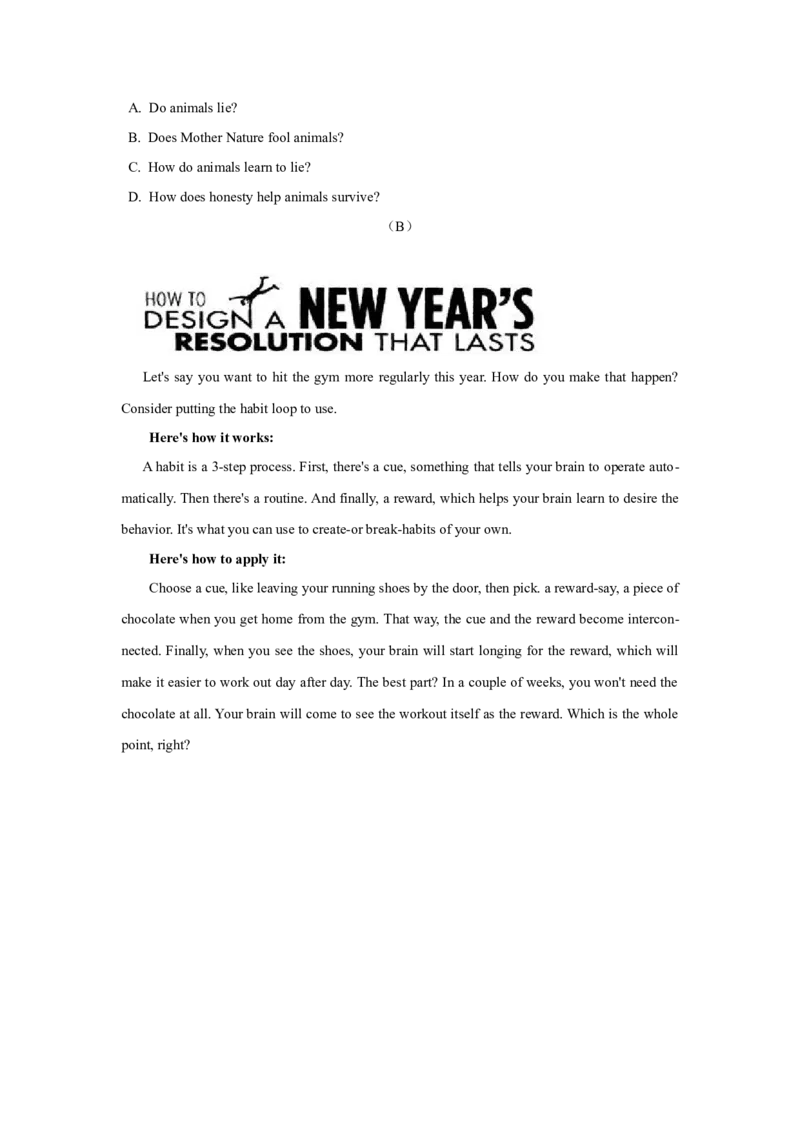
Most people agree that honesty is a good thing. But does Mother Nature agree? Animals can't
talk, but can they lie in other ways? Can they lie with their bodies and behavior?
Animal experts may not call it lying, but they do agree that many animals, from
birds to chimpanzees, behave dishonestly to fool other animals. Why? Dishonesty
often helps them survive.
Many kinds of birds are very successful at fooling other animals. For example, a bird called
the plover sometimes pretends to be hurt in order to protect its young. When a predator(猎食动
物)gets close to its nest, the plover leads the predator away from the nest. How? It pretends to
have a broken wing. The predator follows the "hurt" adult, leaving the baby birds safe in the nest.
Another kind of bird, the scrub jay, buries its food so it always has something to eat. Scrubjays are also thieves. They watch where others bury their food and steal it. But clever scrub jays
seem to know when a thief is watching them. So they go back later, unbury the food, and bury it
again somewhere else.
Birds called cuckoos have found a way to have babies without doing much work. How? They
don't make nests. Instead, they get into other birds' nests secretly. Then they lay their eggs and fly
away. When the baby birds come out, their adoptive parents feed them.
Chimpanzees, or chimps, can also be sneaky. After a fight, the losing chimp will give its hand
to the other. When the winning chimp puts out its hand, too, the chimps are friendly again. But an
animal expert once saw a losing chimp take the winner's hand and start fighting again.
Chimps are sneaky in other ways, too. When chimps find food that they love, such as ba-
nanas, it is natural for them to cry out. Then other chimps come running. But some clever chimps
learn to cry very softly when they find food. That way, other chimps don't hear them, and they
don't need to share their food.
As children, many of us learn the saying "You can't fool Mother Nature." But maybe you
can't trust her, either.
66.A plover protects its young from a predator by______.
A. getting closer to its young
B. driving away the adult predator
C. leaving its young in another nest
D. pretending to be injured
67.By "Chimpanzees, or chimps, can also be sneaky" (paragraph 5), the author means______.
A. chimps are ready to attack others
B. chimps are sometimes dishonest
C. chimps are jealous of the winners
D. chimps can be selfish too
68.Which of the following is true according to the passage?
A. Some chimps lower their cry to keep food away from others.
B. The losing chimp won the fight by taking the winner's hand.
C. Cuckoos fool their adoptive parents by making no nests.
D. Some clever scrub jays often steal their food back.
69.Which of the following might be the best title of the passage?A. Do animals lie?
B. Does Mother Nature fool animals?
C. How do animals learn to lie?
D. How does honesty help animals survive?
(B)
Let's say you want to hit the gym more regularly this year. How do you make that happen?
Consider putting the habit loop to use.
Here's how it works:
A habit is a 3-step process. First, there's a cue, something that tells your brain to operate auto-
matically. Then there's a routine. And finally, a reward, which helps your brain learn to desire the
behavior. It's what you can use to create-or break-habits of your own.
Here's how to apply it:
Choose a cue, like leaving your running shoes by the door, then pick. a reward-say, a piece of
chocolate when you get home from the gym. That way, the cue and the reward become intercon-
nected. Finally, when you see the shoes, your brain will start longing for the reward, which will
make it easier to work out day after day. The best part? In a couple of weeks, you won't need the
chocolate at all. Your brain will come to see the workout itself as the reward. Which is the whole
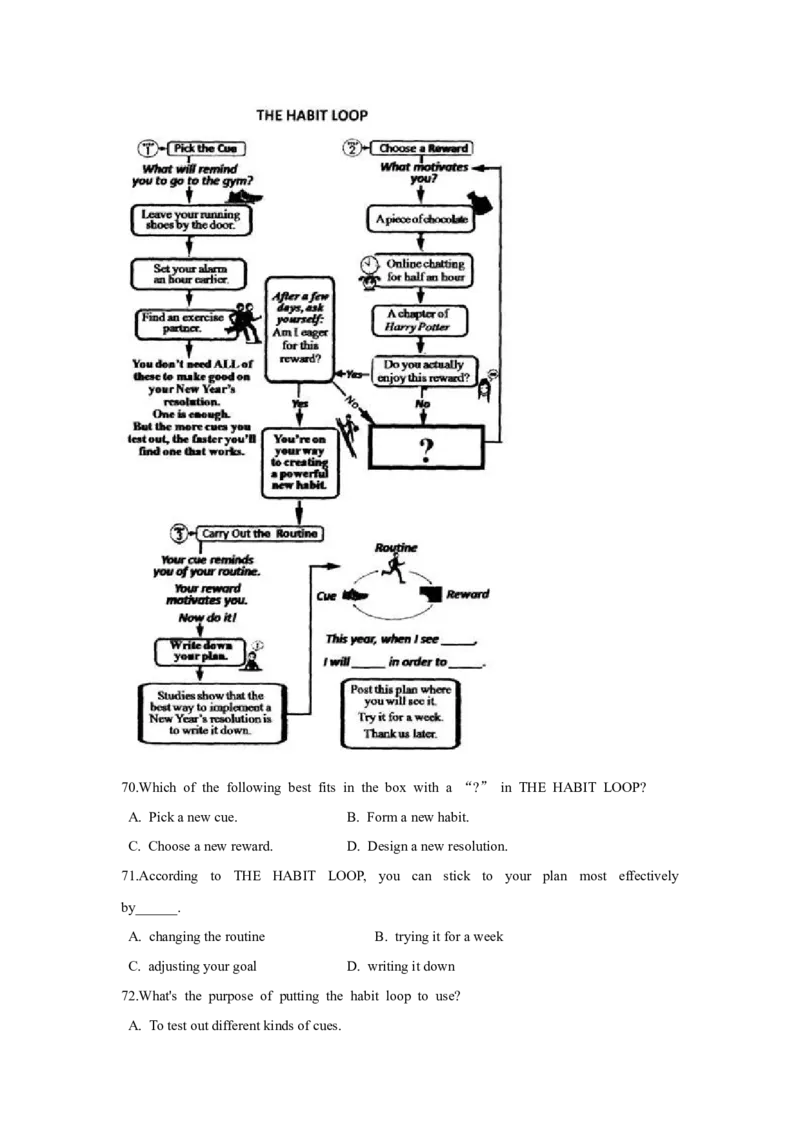
point, right?70.Which of the following best fits in the box with a “?” in THE HABIT LOOP?
A. Pick a new cue. B. Form a new habit.
C. Choose a new reward. D. Design a new resolution.
71.According to THE HABIT LOOP, you can stick to your plan most effectively
by______.
A. changing the routine B. trying it for a week
C. adjusting your goal D. writing it down
72.What's the purpose of putting the habit loop to use?
A. To test out different kinds of cues.B. To do something as a habit even without rewards.
C. To work out the best New Year's resolution.
D. To motivate yourself with satisfactory rewards.
73.“This year when I see the Harry Potter poster, I will read 30 pages of an English
novel or anEnglish newspaper in order to watch TV for half an hour." What is the cue
in this resolution?
A. The Harry Potter poster. B. Reading 30 pages of an English novel.
C. An English newspaper. D. Watching TV for half an hour.
(C)
If you could be anybody in the world, who would it be? Your neighbour or a super star? A
few people have experienced what it might be like to step into the skin of another person, thanks
to an unusual virtual reality(虚拟现实)device. Rikke Wahl, an actress, model and artist, was one
of the participants in a body swapping experiment at the Be Another lab, a project developed by a
group of artists based in Barcelona. She swapped with her partner, an actor, using a machine called
The Machine to Be Another and temporarily became a man. "As I looked down, I saw my whole
body as a man, dressed in my partner's pants," she said. "That's the picture I remember best."
The set-up is relatively simple. Both users wear a virtual reality headset with a camera on the
top. The video from each camera is sent to the other person, so what you see is the exact view of
your partner. If she moves her arm, you see it. If you move your arm, she sees it.
To get used to seeing another person's body without actually having control of it, participants start
by raising their arms and legs very slowly, so that the other can follow along. Eventually, this kind
of slow synchronised(同步的)movement becomes comfortable, and participants really start to feel
as though they are living in another person's body.
Using such technology promises to alter people's behaviour afterwards-potentially for the
better. Studies have shown that virtual reality can be effective in fighting racism-the bias(偏
见)that humans have against those who don't look or sound like them. Researchers at the Univer-
sity of Barcelona gave people a questionnaire called the Implicit Association Test, which measures
the strength of people's associations between, for instance, black people and adjectives such as
good, bad, athletic or awkward. Then they asked them to control the body of a dark skinned digital
character using virtual reality glasses, before taking the test again. This time, the participants' biasscores were lower. The idea is that once you've "put yourself in another's shoes" you're less likely
to think ill of them, because your brain has internalised the feeling of being that person.
The creators of The Machine to Be Another hope to achieve a similar result. "At the end of
body swapping, people feel like holding each other in their arms," says Arthur Pointeau, a pro-
grammer with the project. "It's a really nice way to have this kind of experience. I would really, re-
ally recommend it to everyone."
74.The word "swapping" (paragraph 1) is closest in meaning to______.
A. building B. exchanging C. controlling D. transplanting
75.We can infer from the experiment at the Be Another lab that______.
A. our feelings are related to our bodily experience
B. we can learn to take control of other people's bodies
C. participants will live more passionately after the experiment
D. The Machine to Be Another can help people change their sexes
76.In the Implicit Association Test, before the participants used virtual reality glasses to control a
dark skinned digital character, ______.
A. they fought strongly against racism
B. they scored lower on the test for racism
C. they changed their behaviour dramatically
D. they were more biased against those unlike them
77.It can be concluded from the passage that______.
A. technology helps people realize their dreams
B. our biases could be eliminated through experiments
C. virtual reality helps promote understanding among people
D. our points of view about others need changing constantly
Section C
Directions: Read the passage carefully. Then answer the questions or complete the statements in
the fewest possible words.
More and more corporations are taking an interest in corporate social responsibility (CSR).
CSR is made up of three broad layers. The most basic is traditional corporate charity work. Com-
panies typically spend about 1% of pre-tax profits on worthy projects. But many feel that simplywriting cheques to charities is no longer enough. In some companies, shareholders want to know
that their money is being put to good use, and employees want to be actively involved in good
works.
Money alone is not the answer when companies come under attack for their behavior. Hence
the second layer of CSR, which is a branch of risk management. Starting in the 1980s, with envi-
ronmental disasters such as the explosion at Bhopal and the Exxon Valdez oil spill, industry after
industry has suffered blows to its reputation.
So, companies often responded by trying to manage the risks. They talk to non-governmental
organisations (NGOs) and to governments, create codes of conduct(行为准则) and devote them-
selves to more transparency(透明)in their operations. Increasingly, too. they, along with their com-
petitors, set common rules to spread risks.
All this is largely defensive, but there are also opportunities for those that get ahead of the
game. The emphasis on opportunity is the third layer of CSR: the idea that it can help to create
value. If approached in a strategic way, CSR could become part of a company's competitive ad-
vantage. That is just the sort of thing chief executives like to hear. The idea of "doing well by do-
ing good" has become popular.
Nevertheless, the business of trying to be good is bringing difficult questions to executives.
Can you measure CSR performance? Should you be cooperating with NGOs and you’re your
competitors? Is there any really competitive advantage to be had from a green strategy?
Corporate social responsibility is now seen as a mainstream. Big companies want to tell the
world about their good citizenship with their devotion to social responsibilities. Done badly, CSR
is often just window-dressing and can be positively harmful. Done well, though, it is not some
separate activity that companies do on the side, a corner of corporate life reserved for virtue(美德):
it is just good business.
(Note: Answer the questions or complete the statements in NO MORE THAN TEN WORDS)
78.Both _________ in some companies find it no longer enough to simply donate money to chari-
ties.
79.Give one example of the defensive measures of risk management according to the passage.
80.With the emphasis on opportunity, the third layer of CSR is meant to_________.
81.According to the passage, "good business" (paragraph 6) means that corporations ________while making profits.
第II卷(共47分)
I. Translation
Directions: Translate the following sentences into English, using the words given in the brackets.
1. 我习惯睡前听点轻音乐。(accustomed)
2. 将来过怎样的生活取决于你自己。(be up to)
3.没有什么比获准参加太空旅行项目更令人兴奋的了。(than)
4.家长嘱咐孩子别在河边嬉戏,以免遭遇不测。(for fear)
5.虽然现代社会物资丰富,给予消费者更多的选择,但也使不少人变成购物狂。(turn)
II. Guided Writing
Directions: Write an English composition in 120-150 words according to the instructions given
below in Chinese.
学校英语报正在酝酿改版,拟从现有的三个栏目(健康、娱乐、文化)中去除一个,
并从三个备选栏目(时尚、职业规划、读者反馈)中挑选一个纳入该报。假设你是该校学
生程飞,给校报编辑写一封电子邮件,表达你的观点。邮件须包括以下内容:
1.你建议去除的栏目及去除的理由;
2.你建议增加的栏目及增加的理由。2014年上海英语参考答案
第I卷
第一大题第1至第10小题,每题1分;第11至第16小题,每题2分:第17至第24小题,
每题1分。共30分。
1. A 2.D 3.B 4.A 5.B 6.D 7.A 8.C 9.C 10.B
11.C 12.D 13.B 14.C 15.A 16.B
17. conference 18. daylight 19. moving 20. overcrowded
21. implications and conclusions 22. reasoning 23. Figures 24. keep questioning
第二大题每小题1分。共26分。
25. where 26. To earn 27. as soon as / as long as 28. exhausted 29. if
30. what 31. adapting 32. did 33. an 34. is equipped 35. which
36. myself 37. more appropriate 38. has forced 39. urging 40. to
41. G 42. C 43.1 44. F 45. E 46. B 47. K 48. J 49. A 50. H
第三大题第51至65小题,每题1分;第“至”小题,每题2分;第78至81小题,每题2
分。共47分。
51. C 52. B 53. A 54. D 55. A 56. B 57. C 58. D 59. A 60. C
61. D 62. D 63. B 64. B 65. C 66. D 67. B 68. A 69. A 70. C
71.D 72.B 73.A 74.B 75.A 76.D 77.C
78. shareholders and employees
79. Companies talk to non-governmental organisations (NGOs) and to governments. / Companies
create codes of conduct. / Companies devote themselves to more transparency in their opera-
tions. / Companies set common rules with their competitors to spread risks.
80. create value
81. take social responsibilities
第II卷
I.翻译共22分。
1. I'm accustomed to listening to some light music before sleep.
2. It's up to you what kind of life you will lead in the future.
3. There is nothing more exciting than being allowed to take part in the space travel program.
4. Parents ask their kids not to play by the river for fear that something terrible might happen.
5. While modern society, rich in material resources, has given consumers more choices, it alsoturns many of them into crazy shoppers.
II.写作共25分。
Dear Editor,
I’ve learned that our English Post is being reformed and one of the three columns is to be re-
placed by a new one. I’m writing this e-mail to share with you my opinions.
Needless to say, the columns will definitely be designed according to students’ interest and have
positive effects on their study and life.
Compared to the entertainment , I hold the view that the value of the columns concerning
health and culture is more important . The main factor is that it is of great significance to keep
healthy while loss of health means kissing goodbye to life. Consequently, more knowledge of how
to keep fit can improve the quality of life. In addition, the progress in acquiring cultures contrib-
utes to broadening one’s horizons, which in turn is beneficial to one’s study and the establishment
of philosophy of life.
Furthermore, the career planning should be taken into account in the school English Post . On
the one hand, it covers one’s career development a great deal .On the other hand, it makes a great
difference to one’s career success in the future.
What has been mentioned above is my personal ideas. Here I am in the hope that my advice
will add a brilliant touch to the improved version of our school English Post.
Yours sincerely,
Cheng Fei2014年上海英语高考听力原文
I. Listening Comprehension
Section A
Directions: In section A, you will hear ten short conversations between two speakers. At the end of
each conversation, a question will be asked about what was said. The conversation and the ques-
tion will be spoken only once. After you hear a conversation and the question about it, read the
four possible answers on your paper, and decide which one is the best answer to the question you
have heard.
1. W: What can I do for you, sir?
M: I want to report a theft. My briefcase was stolen.
Q: Who is most probably the woman?
2. W: You will take care, won’t you? The roads are very very icy.
M: I will drive very slowly. I promise.
Q: How does the woman feel?
3. M: Morning, I have a reservation. The name is Blake Smith.
W: OK. We’ve got a nice car ready. I’ll need to see your driver’s license and your credit card.
Q: Where does the conversation most probably take place?
4. W: CCTV is reporting an enormous flood now! Look at those people on the roof.
M: I hope it doesn’t cause much damage.
Q: What are the two speakers talking about?
5. W: Would you help me clean the backyard today?
M: Sure. I am picking Jane up from the railway station at 3, but I will help you as soon as I get
back.
Q: What will the man do first?
6. W: The vase is amazing! But it’s a bit more than I want to spend.
M: Maybe you can get a better price.It can’t hurt to ask.
Q: What does the man suggest the women do?
7. W: My computer’s broken down. Could I use yours to write a chemistry paper?
M: Sorry, I am in the middle of revising my report. You know, the computer lab is still open.
Q: What does the man imply the women should do?
8. W: I’ve declined their offer to exhibit some of my paintings in this gallery.
M: Are you kidding? Any art student I know would die to have an exhibition here.
Q: How does the man feel on hearing the woman’s decision?
9. M: You are not planning to transfer to a different university next year, are you?
W: If I were, you’d be the firstto know.
Q: What does the woman imply?
10. M: Did you read the editorial in the newspaper about the mayor’s speech?
M: I sure did. But I think they twisted the meaning of what he said.
Q: What does the man say of the editorial?
Section B
Directions: In section B, you will hear two short passages, and you will be asked three questions
on each of the passages. The passages will be read twice, but the questions will be spoken only
once. When you hear a question, read the four possible answers on your paper, and decide whichone would be the best answer to the question you ave heard.
Questions 11 through 13 are based on the following passage.
About 70 miles north-east of Vancouver is one of Canada’s most beautiful tourist regions. Visitors
come to enjoy fishing, skiing or the splendid mountain scenery. Over 20 years ago, Kirsty
Bourne, a successful businesswoman, came here and founded Paradise Ridge, a cabin park.
She said, “I wanted to live somewhere where everybody knows everybody else and all your prob-
lems are shared.” Paradise Ridge is now home to 25 families. Each family owns their own small
cabin, but they share ownership of the park and the common facilities. This is a real,living com-
munity, and residents aren’t allowed to use their cabins as a holiday home.
The heart of the Paradise Ridge community is a large house. Shared meals take place 3 times a
week and once a month there is a meeting when important decisions are made. Families can sell
their homes if they want to leave, but the whole community must vote on new families before they
are allowed to join.
“Keeping the community together is hard work,” says Kirsty. “Everybody has to take responsi-
bility for the day-to-day running of the community.But it seems that there is no shortage of the
families who want to join. There are 75 on the waiting list.”
11. How many families are living in the Paradise Ridge now?
12. What is special about Paradise Ridge?
13. What is the passage mainly about?
Questions 14 through 16 are based on the following passage.
It’s 3 p.m.,time for news from the World of Medicine.
Does sitting make you sad? Australian researchers found that middle-aged women who sat for
over 7 hours a day were 47 percent more likely to show signs of depression than those who sat for
4 hours or fewer. Those who engaged in no physical activity were 26 percent more likely to have
symptoms of depression 3 years later than those who exercised regularly. Sitting for long periods
has also been linked to heart disease.
How can you detect a liar through text message? Watch for a delayed response. When college
students were asked to tell a lie during an interview with a computer, they took 10 percent longer
on average to send the message, and they did more editing than usual.
Can marriage beat cancer? Married people were 20 percent less likely to die from the disease
than those who were unmarried, according to a Harvard study of more than 730,000 people. They
were also more likely to get the disease detected at an earlier stage and receive proper treatment. A
husband or wife can urge you to seek medical help and support you during tough chemical ther-
apy, radiation, and other treatments.
14. Who were most likely to suffer from depression according to Australian researchers?
15. How did students behave when they told a lie during an interview with a computer?
16 What is the third piece of news mainly about?
Section C
Directions: In section C, you will hear two longer conversations. The conversations will be read
twice. After you hear each conversation, you are required to fill in the numbered blanks with the
information you have heard. Write your answers on your answer sheet.
Blanks 17 through 20 are based on the following conversation.
W: Excuse me, I’m Linda Lee from the Airport Research Division. May I ask you a few ques-
tions about the environment andfacilities here?M: OK.
W: Are you on a business trip?
M: Yes, I’m heading off for a conference in London.
W: What do you like most about the airport environment?
M: Well, I really appreciate the daylight.
W: Daylight?
M: Yes.The windows here make it seem as if you’re outside. Another thing I like is the moving
walkways. You don’t have to walk for miles to the boarding gate.
W: I see. Anything you don’t like?
M: Mm...The shops are often overcrowded. There is not enough space to move around comfort-
ably.And also I suppose the trolleys are too small.
W: Well, thanks for your time.
Complete the form. Write ONE WORD for each answer.
Blanks 21 through 24 are based on the following conversation.
W: Professor King, what exactly is critical thinking?
M: Well, when you read critically, you should assess the writer’s ideas and think about the impli-
cations andconclusions of what the writer is saying.
W: Can you give me an example?
M: When you read an academic text, first, you should identify the argument and work out the
writer’s main line of reasoning.
W: OK. What then?
M: Try to analyze and criticize the argument.
W: I see. That’s why you often ask whether the argument is presented in a logical way.
M: Right! Then, assess the evidence the writer gives you. That may be in the form of figures, sur-
vey results, examples, etc.
W: How about the writer’s conclusions?
M: Ask yourself if they are supported by the evidence.
W: Got it. Thanks, Professor King.
M: Remember, the key to critical thinking is to read actively and keep asking yourself questions
rather than just accepting.
Complete the form. Write NO MORE THAN THREE WORDS for each answer.
答案:
1. A 2.D 3.B 4.A 5.B 6.D 7.A 8.C 9.C 10.B
11.C 12.D 13.B 14.C 15.A 16.B
17. conference 18. daylight 19. moving 20. overcrowded
21. implications and conclusions 22. reasoning 23. Figures 24. keep questioning2014年全国普通高等学校招生统一考试
上海 英语试卷
第I卷 (共103分)
I. Listening Comprehension
Section A
Directions: In Section A, you will hear ten short conversations between two speakers. At the end
of each conversation, a question will be asked about what was said. The conversations and the
questions will be spoken only once. After you hear a conversation and the question about it, read
the four possible answers on your paper, and decide which one is the best answer to the question
you have heard.
1. A. policewoman. B. A judge. C. A reporter. D. A waitress.
2. A. Confident. B. Puzzled. C. Satisfied. D. Worried.
3. A. At a restaurant. B. At a car rental agency.
C. In a bank. D. In a driving school.
4. A. A disaster. B. A new roof. C. A performance. D. A TV station.
5. A. Catch the train. B. Meet Jane.
C. Get some stationery. D. Clean the backyard.
6. A. Ask for something cheaper. B. Buy the vase she really likes.
C. Protect herself from being hurt. D. Bargain with the shop assistant.
7. A. Use a computer in the lab. B. Take a chemistry course.
C. Help him revise his report. D. Gel her computer repaired.
8. A. Amused. B. Embarrassed. C. Shocked. D. Sympathetic.
9.A. She doesn't plan to continue studying next year.
B. She has already told the man about her plan.
C. She isn’t planning to leave her university.
D. She recently visited a different university.
10. A. It spoke highly of the mayor. B. It misinterpreted the mayor’s speech.C. It made the mayor’s view clearer. D. It earned the mayor’s speech accurately.
Section B
Directions: In Section B, you will hear two short passages, and you will be asked three questions
on each of the passages. The passages will be read twice, but the questions will be spoken only
once. When you hear a question, read the four possible answers on your paper and decide which
one would be the best answer to the question you have heard.
Questions 11 through 13 are based on the following passage.
11. A. 70 B. 20 C. 25. D. 75
12. A. The houses there can't be B. It is a place for work and holiday.
C. he cabins and facilities D. It is run by the residents themselves.
13. A. A skiing B. A special community
C. A splendid mountain D. A successful businesswoman
Questions 14 through 16 are based on the following news.
14. A. Those who often sent text messages. B. Those who suffered from heart disease.
C. Those who did no physical exercise. D. whose who were unmarried
15. A. They responded more slowly than usual. B. They sent more messages.
C. They typed 10 percent faster on average. D. They edited more passages.
16. A. Why chemical therapy works.
B. Why marriage helps fight cant
C. How unmarried people survive
D. How cancer is detected after marriage.
Section C
Directions: In Section C, you will hear two longer conversations. The conversations will be read
twice. After you hear each conversation, you are required to fill in the numbered blanks with the
information you have heard. Write your answers on your answer sheet.
Blanks 17 through 20 are based on the following conversation.
Complete the form. Write ONE WORD for each answer.Travelers’ Survey Sheet
Travel purpose: for a(n) 17 in London
Comments on the airport environment / facilities:
Likes: • 18
• 19 walkways
Dislikes: • 20 shops
• small trolleys
Blanks 21 through 24 are based on the following conversation.
Complete the form. Write NO MORE THAN THREE WORDS for each answer.
Assessing the writer’s ideas and thinking about
What is critical thinking in reading?
the 21 of what the writer is saying.
What is the first step in reading an academic Finding out the argument and the writer's main
text critically? line of 22 .
What may serve as the evidence? 23 , survey results, examples, etc.
What is the key to critical thinking? To read actively and 24 .
II. Grammar and vocabulary
Section A
Directions: After reading the passages below, fill in the blanks to make the passages coherent and
grammatically correct. For the blanks with a given word, fill in each blank with the proper form of
the given word; for the other blanks, use one word that best fits each blank.
(A)
My Stay in New York
After graduation from university, I had been unable to secure a permanent job in my small
town. So I decided to leave home for New York, (25)______I might have a better chance to find a
good job. (26) ______ (earn) some money to pay the daily expenses, I started work in a local café
as a waiter. I believe that (27) ______ ______ ______ I was offered a good position, I would re-
sign at once.Over time, the high cost of living became a little burden on my already (28) ______ (ex-
haust) shoulder. On the other hand, my search for a respectable job had not met with much suc-
cess. As I had studied literature at university, I found it quite difficult to secure a suitable job in big
companies. Mother had just said that (29) ______ I want to have a better career advancement, I
had to find work in the city. Perhaps (30) ______my mother had told me was deeply rooted in my
mind. I just did as she had expected.
Soon I had lived in the city for over six months but I still did not like it. Apparently, I had dif-
ficulty (31) ______ (adapt) myself to life in the city, let alone finding a job to my delight. After
nine months of frustration, I eventually decided to go back to my small town. Not until I returned
(32) ______I realize that a quiet town life was the best for me.
【小题4】过了一段时间,高生活成本在我已经疲惫的肩膀成了一个负担。考查形容词
“疲惫的”:exhausted
【小题5】 妈妈说过,如果我想有个更好的事业的进步,我就得到城市里面找工作。这里
需要连词“如果”:if【小题6】妈妈说的话深深的扎根到我的思想中了。What引导的是主语从句。
【小题7】很显然我适应城市的生活有困难。这里使用了have difficulty in doing sth,所以
填动名词:adapting
【小题8】直到我回来我才发现安静的小镇生活对我才是最好的。Not until放在句学科网首,
后面的主句要倒装。用助动词did提到主语前面。
考点:考查故事类短文
(B)
The giant vending machine (自动售货机) is a new village shop
Villagers have long been used to facing a drive when they run out of basic supplies. However,
help is now nearer at hand in form of the country’s first automatic push-button shop. Now resi-
dents in the Derbyshire Village of Clifton can buy groceries around the clock after the huge vend-
ing was installed outside a pub in the village this week.
Peter Fox, who is (33)______electrical engineer, spent two and a half years working on the
project. The machine (34)______ (equip) with securing cameras and alarms and looks like a mini
shop with a brick front, a grey roof and a display window.
Mr. Fox said he hoped his invention, (35)______ is set to be installed in other villages in the
area over the coming months, will mark a return to convenience shopping for rural communities.
He said:“ I had this idea a few years ago but I couldn’t find a manufacture who could deliver
what I wanted, so I did it by (36)______. The result is what amounts to huge outdoor vending ma-
chine. Yet I think the term “automatic shop” is far (37)______ (appropriate)
In recent years, the commercial pressure from supermarket chains (38)______ force village
shops across the country to close. In 2010, it was estimated that about 400 village shops closed,
(39)______ (urge) the local government to give financial support to struggling shops or set-up
new communities stores.
Hundreds of communities have since stepped in and opened up their won volunteer-run shops,
but Mr. Fox hopes his new invention will offer a solution (40)______these villages without a local
shop.Section B
Directions: Complete the following passage by using the words in the box. Each word can only
be used once. Note that there is one word more than you need.
A. alert B. classify C. commit D. delicately E. gentle F. impose
G. labels H. moderation I. relieve J. signals K. simply
Let's say you've decided you want to eat more healthfully. However, you don't have time to
carefully plan menus for meals or read food __41__ at the supermarket. Since you really__42__
yourself to a healthier lifestyle, a little help would come in handy, wouldn't it? This is where a
"choice architect" can help__43__some of the burden of doing it all yourself. Choice architects are
people who organize the contexts in which customers make decisions. For example, the person
who decides the layout of your local supermarket-including which shelf the peanut butter goes on,
and how the oranges are piled up—is a choice architect.
Governments don't have to__44__healthier lifestyles through laws for example, smoking
bans. Rather, if given an environment created by a choice architect-one that encourages us to
choose what is best-we will do the right things. In other words, there will be designs that gently
push customers toward making healthier choices, without removing freedom of choice. This idea
combines freedom to choose with__45__hints from choice architects, who aim to help people live
longer, healthier, and happier lives.The British and Swedish governments have introduced a so-called "traffic light system" to
__46__foods as healthy or unhealthy. This means that customers can see at a glance how much fat,
sugar, and salt each product contains__47__by looking at the lights on the package. A green light
__48__that the amounts of the three nutrients are healthy; yellow indicates that the customer
should be__49__; and red means that the food is high in at least one of the three nutrients and
should be eaten in __50__. The customer is given important health information, but is still free to
decide what to choose.【小题8】绿色的灯表示这三种营养的含量是健康的。这里需要动词“发信号,表示”sig-
nal,所以选J
【小题9】黄灯表示消费者应该警觉了。这里使用形容词“警觉的“alert”,所以选A
【小题10】红灯表示这些食物至少有一种营养是含量很高的,所以应该被适当的食用。考
查名词“适度”moderation,所以选H
考点:考查健康类短文III. Reading Comprehension
Section A
Directions: For each blank in the following passage there are four words or phrases marked A, B,
C and D. Fill in each blank with the word or phrase that best fits the context.
Research has shown that two-thirds of human conversation is taken up not with discussion of
the cultural or political problems of the day, not heated debates about films we've just watched or
books we've just finished reading, but plain and simple __51__.
Language is our greatest treasure as a species, and what do we __52__ do with it? We gossip.
About others' behaviour and private lives, such as who's doing what with whom, who's in and
who's out-and why; how to deal with difficult __53__ situations involving children, lovers, and
colleagues.
So why are we keen on gossiping? Are we just natural __54__, of both time and words? Or
do we talk a lot about nothing in particular simply to avoid facing up to the really important issues
of life? It's not the case according to Professor Robin Dunbar. In fact, in his latest book, Groom-
ing, Gossip and the Evolution of Language, the psychologist says gossip is one of these real-
ly__55__issues.
Dunbar __56__ the traditional view that language was developed by the men at the early
stage of social development in order to organize their manly hunting activities more effectively, or
even to promote the exchange of poetic stories about their origins and the supernatural. Instead he
suggests that language evolved among women. We don't spend two-thirds of our time gossiping
just because we can talk, argues Dunbar—__57__, he goes on to say, language evolved specifi-
cally to allow us to gossip.
Dunbar arrived at his cheery theory by studying the __58__ of the higher primates(灵长类
动物)like monkeys. By means of grooming--cleaning the fur by brushing it, monkeys form
groups with other individuals on whom they can rely for support in the event of some kind of con-
flict within the group or__59__ from outside it.
As we human beings evolve from a particular branch of the primate family, Dunbar __60__
that at one time in our history we did much the same. Grouping together made sense because the
bigger the group, the greater the __61__ it provided; on the other hand, the bigger the group, thegreater the stresses of living close to others. Grooming helped to __62__ the pressure and calm ev-
erybody down.
But as the groups got bigger and bigger, the amount of time spent in grooming activities also
had to be __63__ to maintain its effectiveness. Clearly, a more __64__ kind of grooming was
needed, and thus language evolved as a kind of vocal(有声的)grooming which allowed hu-
mans to develop relationship with ever-larger groups by exchanging information over a wider net-
work of individuals than would be possible by one-to-one __65__ contact.
【小题1】 A. claim B. description C. gossip D. language
【小题2】A. occasionally B. habitually C. independently D. originally
【小题3】 A. social B. political C. historical D. cultural
【小题4】 A. admirers B. masters C. users D. wasters
【小题5】 A. vital B. sensitive C. ideal D. difficult
【小题6】A. confirms B. rejects C. outlines D. broadens
【小题7】A. for instance B. in addition C. on the contrary D. as a result
【小题8】A. motivation B. appearance C. emotion D. behaviour
【小题9】A. attack B. contact C. inspection D. assistance
【小题10】A. recalls B. denies C. concludes D. confesses
【小题11】A. prospect B. responsibility C. leadership D. protection
【小题12】A. measure B. show C. maintain D. ease
【小题13】A. saved B. extended C. consumed D. gained
【小题14】A. common B. efficient C. scientific D. Thoughtful
【小题15】A. indirect B. daily C. physical D. secret
【答案】
【小题1】C
【小题2】B
【小题3】A
【小题4】D
【小题5】A
【小题6】B
【小题7】C
【小题8】D【小题9】A
【小题10】C
【小题11】D
【小题12】D
【小题13】B
【小题14】B
【小题15】C
【解析】【小题12】D考查动词辨析。根据上文:on the other hand, the bigger the group, the greater
the stresses of living
Section B
Directions: Read the following three passages. Each passage is followed by several questions or
unfinished statements. For each of them there are four choices marked A, B, C and D. Choose the
one that fits best according to the information given in the passage you have just read.
(A)
Most people agree that honesty is a good thing. But does Mother Na-
ture agree? Animals can't talk, but can they lie in other ways? Can they lie
with their bodies and behavior? Animal experts may not call it lying, but
they do agree that many animals, from birds to chimpanzees, behave dis-
honestly to fool other animals. Why? Dishonesty often helps them survive.
Many kinds of birds are very successful at fooling other animals. For example, a bird called
the plover sometimes pretends to be hurt in order to protect its young. When a predator(猎食动
物)gets close to its nest, the plover leads the predator away from the nest. How? It pretends tohave a broken wing. The predator follows the "hurt" adult, leaving the baby birds safe in the nest.
Another kind of bird, the scrub jay, buries its food so it always has something to eat. Scrub
jays are also thieves. They watch where others bury their food and steal it. But clever scrub jays
seem to know when a thief is watching them. So they go back later, unbury the food, and bury it
again somewhere else.
Birds called cuckoos have found a way to have babies without doing much work. How? They
don't make nests. Instead, they get into other birds' nests secretly. Then they lay their eggs and fly
away. When the baby birds come out, their adoptive parents feed them.
Chimpanzees, or chimps, can also be sneaky. After a fight, the losing chimp will give its
hand to the other. When the winning chimp puts out its hand, too, the chimps are friendly again.
But an animal expert once saw a losing chimp take the winner's hand and start fighting again.
Chimps are sneaky in other ways, too. When chimps find food that they love, such as ba-
nanas, it is natural for them to cry out. Then other chimps come running. But some clever chimps
learn to cry very softly when they find food. That way, other chimps don't hear them, and they
don't need to share their food.
As children, many of us learn the saying "You can't fool Mother Nature." But maybe you
can't trust her, either.
【小题1】A plover protects its young from a predator by______.
A. getting closer to its young B. driving away the adult predator
C. leaving its young in another nest D. pretending to be injured
【小题2】By "Chimpanzees, or chimps, can also be sneaky" (paragraph 5), the author mean-
s______.
A. chimps are ready to attack others B. chimps are sometimes dishonest
C. chimps are jealous of the winners D. chimps can be selfish too
【小题3】Which of the following is true according to the passage?
A. Some chimps lower their cry to keep food away from others.
B. The losing chimp won the fight by taking the winner's hand.
C. Cuckoos fool their adoptive parents by making no nests.
D. Some clever scrub jays often steal their food back.
【小题4】Which of the following might be the best title of the passage?A. Do animals lie? B. Does Mother Nature fool animals?
C. How do animals learn to lie? D. How does honesty help animals survive?
【答案】
【小题1】D
【小题2】B
【小题3】A
【小题4】A
【解析】
【小题1】细节题:根据第二段的第二句话:a bird called the plover sometimes pretends to be
hurt in order to
(B)Let's say you want to hit the
gym more regularly this year.
How do you make that happen?
Consider putting the habit loop
to use.
Here's how it works:
A habit is a 3-step process. First,
there's a cue, something that tells
your brain to operate automati-
cally. Then there's a routine. And
finally, a reward, which helps your
brain learn to desire the behavior.
It's what you can use to create-or
break-habits of your own.
Here's how to apply it:
Choose a cue, like leaving your
running shoes by the door, then
pick. a reward-say, a piece of
chocolate when you get home
from the gym. That way, the cue
and the reward become intercon-
nected. Finally, when you see the
shoes, your brain will start longing for the reward, which will make it easier to work out day after
day. The best part? In a couple of weeks, you won't need the chocolate at all. Your brain will come
to see the workout itself as the reward. Which is the whole point, right?
【小题1】Which of the following best fits in the box with a “?” in THE HABIT LOOP?
A. Pick a new cue. B. Form a new habit.
C. Choose a new reward. D. Design a new resolution.
【小题 2】According to THE HABIT LOOP, you can stick to your plan most effectively
by______.A. changing the routine B. trying it for a week
C. adjusting your goal D. writing it down
【小题3】. What's the purpose of putting the habit loop to use?
A. To test out different kinds of cues.
B. To do something as a habit even without rewards.
C. To work out the best New Year's resolution.
D. To motivate yourself with satisfactory rewards.
【小题4】 “This year when I see the Harry Potter poster, I will read 30 pages of an English
novel or an English newspaper in order to watch TV for half an hour." What is the cue in this
resolution?
A. The Harry Potter poster.
B. Reading 30 pages of an English novel.
C. An English newspaper.
D. Watching TV for half an hour.
【答案】
【小题1】C
【小题2】D
【小题3】B
【小题4】A
【解析】
【小题1】推理题:根据文章图表里面内容的句子:可知如果对这个奖励不满意,可以选
择一个新的奖励,Choose a new reward最适合The Habit Loop里面的有问号的方框,所以
选C。(C)
If you could be anybody in the world, who would it be? Your neighbour or a super star? A few
people have experienced what it might be like to step into the skin of another person, thanks to an
unusual virtual reality(虚拟现实)device. Rikke Wahl, an actress, model and artist, was one of
the participants in a body swapping experiment at the Be Another lab, a project developed by a
group of artists based in Barcelona. She swapped with her partner, an actor, using a machine called
The Machine to Be Another and temporarily became a man. "As I looked down, I saw my whole
body as a man, dressed in my partner's pants," she said. "That's the picture I remember best."
The set-up is relatively simple. Both users wear a virtual reality headset with a camera on the
top. The video from each camera is sent to the other person, so what you see is the exact view of
your partner. If she moves her arm, you see it. If you move your arm, she sees it.
To get used to seeing another person's body without actually having control of it, participants
start by raising their arms and legs very slowly, so that the other can follow along. Eventually, this
kind of slow synchronised(同步的)movement becomes comfortable, and participants really
start to feel as though they are living in another person's body.
Using such technology promises to alter people's behaviour afterwards-potentially for the
better. Studies have shown that virtual reality can be effective in fighting racism-the bias(偏见)
that humans have against those who don't look or sound like them. Researchers at the University
of Barcelona gave people a questionnaire called the Implicit Association Test, which measures the
strength of people's associations between, for instance, black people and adjectives such as good,
bad, athletic or awkward. Then they asked them to control the body of a dark skinned digital char-
acter using virtual reality glasses, before taking the test again. This time, the participants' bias
scores were lower. The idea is that once you've "put yourself in another's shoes" you're less likely
to think ill of them, because your brain has internalised the feeling of being that person.
The creators of The Machine to Be Another hope to achieve a similar result. "At the end of
body swapping, people feel like holding each other in their arms," says Arthur Pointeau, a pro-
grammer with the project. "It's a really nice way to have this kind of experience. I would really, re-
ally recommend it to everyone."
【小题1】The word "swapping" (paragraph 1) is closest in meaning to______.
A. building B. exchanging C. controlling D. transplanting【小题2】 We can infer from the experiment at the Be Another lab that______.
A. our feelings are related to our bodily experience
B. we can learn to take control of other people's bodies
C. participants will live more passionately after the experiment
D. The Machine to Be Another can help people change their sexes
【小题3】 In the Implicit Association Test, before the participants used virtual reality glasses to
control a dark skinned digital character, ______.
A. they fought strongly against racism
B. they scored lower on the test for racism
C. they changed their behaviour dramatically
D. they were more biased against those unlike them
【小题4】 It can be concluded from the passage that______.
A. technology helps people realize their dreams
B. our biases could be eliminated through experiments
C. virtual reality helps promote understanding among people
D. our points of view about others need changing constantlySection C
Directions: Read the passage carefully. Then answer the questions or complete the statements in
the fewest possible words.
More and more corporations are taking an interest in corporate social responsibility (CSR).
CSR is made up of three broad layers. The most basic is traditional corporate charity work. Com-
panies typically spend about 1% of pre-tax profits on worthy projects. But many feel that simply
writing cheques to charities is no longer enough. In some companies, shareholders want to know
that their money is being put to good use, and employees want to be actively involved in good
works.
Money alone is not the answer when companies come under attack for their behavior. Hence the
second layer of CSR, which is a branch of risk management. Starting in the 1980s, with environ-
mental disasters such as the explosion at Bhopal and the Exxon Valdez oil spill, industry after in-
dustry has suffered blows to its reputation.
So, companies often responded by trying to manage the risks. They talk to non-governmental
organisations (NGOs) and to governments, create codes of conduct(行为准则) and devote them-
selves to more transparency(透明)in their operations. Increasingly, too. they, along with their
competitors, set common rules to spread risks.
All this is largely defensive, but there are also opportunities for those that get ahead of the
game. The emphasis on opportunity is the third layer of CSR: the idea that it can help to create
value. If approached in a strategic way, CSR could become part of a company's competitive ad-
vantage. That is just the sort of thing chief executives like to hear. The idea of "doing well by do-ing good" has become popular.
Nevertheless, the business of trying to be good is bringing difficult questions to executives. Can
you measure CSR performance? Should you be cooperating with NGOs and you’re your competi-
tors? Is there any really competitive advantage to be had from a green strategy?
Corporate social responsibility is now seen as a mainstream. Big companies want to tell the
world about their good citizenship with their devotion to social responsibilities. Done badly, CSR
is often just window-dressing and can be positively harmful. Done well, though, it is not some
separate activity that companies do on the side, a corner of corporate life reserved for virtue(美
德):it is just good business.
(Note: Answer the questions or complete the statements in NO MORE THAN TEN WORDS)
【小题1】Both _________ in some companies find it no longer enough to simply donate money
to charities.
【小题2】Give one example of the defensive measures of risk management according to the pas-
sage.
【小题3】With the emphasis on opportunity, the third layer of CSR is meant to_________.
【小题 4】According to the passage, "good business" (paragraph 6) means that corporations
________ while making profits.
【答案】
【小题1】Shareholders and employees
【小题2】Companies talk to non-government organizations(NGOs) and to governments./Com-
panies create codes of conduct. /Companies devote themselves to more transparency in their oper-
ations./Companies set common rules with their competitors to spread risks.
【小题3】Create value
【小题4】 take social responsibilities
【解析】第II卷(共47分)
I. Translation
Directions: Translate the following sentences into English, using the words given in the brackets.
【小题1】我习惯睡前听点轻音乐。(accustomed)
【小题2】将来过怎样的生活取决于你自己。(be up to)
【小题3】没有什么比获准参加太空旅行项目更令人兴奋的了。(than)
【小题4】家长嘱咐孩子别在河边嬉戏,以免遭遇不测。(for fear)
【小题5】虽然现代社会物资丰富,给予消费者更多的选择,但也使不少人变成购物狂。
(turn)
【答案】
【小题1】I’m accustomed to listening to some light music before sleep.
【小题2】It’s up to you what kind of life will lead in the future.
【小题3】There is nothing more exciting than being allowed to take part in the space travel pro-gramme.
【小题 4】Parents ask their kids not to play by the river for fear that something terrible might
happen.
II. Guided Writing
Directions: Write an English composition in 120-150 words according to the instructions given
below in Chinese.
学校英语报正在酝酿改版,拟从现有的三个栏目(健康、娱乐、文化)中去除一个,
并从三个备选栏目(时尚、职业规划、读者反馈)中挑选一个纳入该报。假设你是该校学
生程飞,给校报编辑写一封电子邮件,表达你的观点。邮件须包括以下内容:
1. 你建议去除的栏目及去除的理由;
2. 你建议增加的栏目及增加的理由。考点:考查提纲类书面表达