bike, helmet, and bottled water. All riders are equipped with reflective vests and safety lights.
2018 年全国统一高考英语试卷(新课标Ⅰ卷)
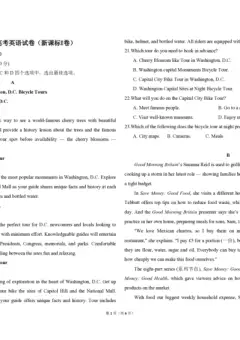
21.Which tour do you need to book in advance?
第二部分 阅读理解(共两节,满分40分)
A. Cherry Blossom like Tour in Washington, D.C.
第一节 (共15小题;每小题2分,满分30分)
B. Washington capital Monuments Bicycle Tour.
阅读下列短文,从每题所给的A、B、C和D四个选项中,选出最佳选项。
C. Capital City Bike Tour in Washington, D.C.
A
D. Washington Capital Sites at Night Bicycle Tour.
Washington, D.C. Bicycle Tours
22.What will you do on the Capital City Bike Tour?
Cherry Blossom Bike Tour in Washington, D.C.
A. Meet famous people. B. Go to a national park.
Duration Tour
C. Visit well-known museums. D. Enjoy interesting stories.
This small group bike tour is a fantastic way to see a world-famous cherry trees with beautiful
23.Which of the following does the bicycle tour at night provide?
flowers of Washington, D.C. Your guide will provide a history lesson about the trees and the famous
A. City maps. B. Cameras. C. Meals D. Safety lights
monuments where they blossom. Reserve your spot before availability — the cherry blossoms —
disappear! B
Washington Capital Monuments Bicycle Tour Good Morning Britain’s Susanna Reid is used to grilling guests on the sofa every morning, but she is
Duration: 3 hours (4 miles) cooking up a storm in her latest role — showing families how to prepare delicious and nutritious meals on
Join a guided bike tour and view some of the most popular monuments in Washington, D.C. Explore
a tight budget.
the monuments and memorials on the National Mall as your guide shares unique facts and history at each In Save Money: Good Food, she visits a different home each week and with the help of chef Matt
stop. Guided tour includes bike, helmet, cookies and bottled water. Tebbutt offers top tips on how to reduce food waste, while preparing recipes for under £5 per family a
Capital City Bike Tour In Washington, D.C.
day. And the Good Morning Britain presenter says she’s been able to put a lot of what she’s leant into
Duration: 3 hours
practice in her own home, preparing meals for sons, Sam, 14, Finn, 13, and Jack, 11.
Morning or Afternoon, this bike tour is the perfect tour for D.C. newcomers and locals looking to
“We love Mexican churros, so I buy them on my phone from my local Mexican takeaway restaurant,”
experience Washington, D.C. in a healthy way with minimum effort. Knowledgeable guides will entertain
she explains. “I pay £5 for a portion (一份), but Matt makes them for 26p a portion, because they are
you with the most, interesting stories about Presidents, Congress, memorials, and parks. Comfortable
flour, water, sugar and oil. Everybody can buy takeaway food, but sometimes we’re not aware how
bikes and a smooth tour route (路线) make cycling between the sites fun and relaxing.
cheaply we can make this food ourselves.”
Washington Capital Sites at Night Bicycle Tour
The eight-part series (系列节自), Save Money: Good Food, follows in the footsteps of ITV’s Save
Duration: 3 hours (7miles)
Money: Good Health, which gave viewers advice on how to get value from the vast range of health
Join a small group bike tour for an evening of exploration in the heart of Washington, D.C. Get up
products on the market.
close to the monuments and memorials as your bike the sites of Capitol Hill and the National Mall.
With food our biggest weekly household expense, Susanna and Matt spend time with a different
Frequent stops are made for photo taking as your guide offers unique facts and history. Tour includes
family each week. In tonight’s Easter special they come to the aid of a family in need of some deliciousinspiration on a budget. The team transforms the family’s long weekend of celebration with less expensive Soon afterwards, many of those people started settling down to become farmers, and their languages
but still tasty recipes. too became more settled and fewer in number. In recent centres, trade, industrialisation, the development
24. What do we know about Susanna Reid? of the nation-state and the spread of universal compulsory education. Especially glbalisation and better
A. She enjoys embarrassing her guests. communications in the past few decades, all have caused many Languages to disappear, and dominant
B. She has started a new programme. languages such as English. Spanish and Chinese are increasingly taking over.
C. She dislikes working early in the morning.
At present, the world has about 6,800 languages. The distribution of these languages is hugely
D. She has had a light budget for her family.
uneven. The general rule is that mild zones have relatively few languages. Often spoken by many people
25. How does Matt Tebbutt help Susanna?
while hot, wet zones have lots, often spoken by small numbers. Europe has only around 200 Languages:
A. He buys cooking materials for her.
the Americas about 1,000. Africa 2,400; and Asia and the Pacific perhaps 3,200, of which Papua New
B. He prepares food for her kids.
Guinea alone accounts for well over 800. The median number (中位数) of speakers is a mere 6.000,
C. He assists her in cooking matters.
which means that half the worlds languages are spoken by fewer people than that.
D. He invites guest families for her.
Already well over 400 of the total of 6,800 languages are close to extinction(消亡), with only a few
26. What does the author intend to do in paragraph 4?
elderly speakers left. Pick, at random, Busuu in Cameroon (eight remaining speakers), Chiapaneco in
A. Summarize the previous paragraphs.
Mexico(150). Lipan Apache in the United States (two or three) or Wadjigu in Australia (one, with a
B. Provide some advice for the readers.
question-mark): none of these seems to have much chance of survival.
C. Add some background information.
28. What can we infer about languages in huntergatherer times?
D. Introduce a new topic for discussion.
A.They developed very fast. B. They were large in number.
27. What can be a suitable title for the text?
C. They had similar patters. D. They were closely connected
A. Keeping Fit by Eating Smart
29. Which of the following best explains “dominant” underlined in paragraph 2?
B. Balancing Our Daily Diet
A.Complex. B. Advanced. C.Powerful. D.Modem.
C. Making yourself a Perfect Chef
30. How many languages are spoken by less than 6,000 people at present?
D. Cooking Well for Less
A.About 6,800. B.About 3,400. C.About 2,400. D.About 1,200.
31. What is the min idea of the text?
C
A. New languages will be created.
Languages have been coming and going for thousands of years, but in recent times there has been less
B. Peoples lifestyles are reflected in languages
coming and a lot more going. When the the world was still populated by hunter-gatherers, small, tightly
C. Human development results in fewer languages
knit (联系) groups developed their own patterns of speech independent of each other. Some language
D. Geography determines language evolution.
experts believe that 10,000 years ago, when the world had just five to ten million people, they spoke
perhaps 12,000 languages between them.
DWe may think we’re a culture that gets rid of our worn technology at the first sight of something shiny B. To test the life cycle of a product.
and new, but a new study shows that we keep using our old devices (装置) well after they go out of style. C. To update consumers on new technology.
That’s bad news for the environment — and our wallets — as these outdated devices consume much more D. To find out electricity consumption of the devices.
energy than the newer ones that do the same things. 34. Which of the following uses the least energy?
To figure out how much power these devices are using, Callie Babbitt and her colleagues at the A. The box-set TV. B. The tablet.
C. The LCD TV. D. The desktop computer.
Rochester Institute of Technology in New York tracked the environmental costs for each product
35. What does the text suggest people do about old electronic devices?
throughout its life — from when its minerals are mined to when we stop using the device. This method
A. Stop using them. B. Take them apart.
provided a readout for how home energy use has evolved since the early 1990s. Devices were grouped by
C. Upgrade them. D. Recycle them.
generation — Desktop computers, basic mobile phones, and box-set TVs defined 1992. Digital cameras
arrived on the scene in 1997. And MP3 players, smart phones, and LCD TVs entered homes in 2002,
第二节 (共5小题;每小题2分,满分10分)
before tablets and e-readers showed up in 2007.
根据短文内容,从短文后的选项中选出能填入空白处的最佳选项。选项中有两项为多余选项。
As we accumulated more devices, however, we didn’t throw out our old ones. “The living-room
Color is fundamental in home design — something you’ll always have in every room. A grasp of how
television is replaced and gets planted in the kids’ room, and suddenly one day, you have a TV in every
to manage color in your spaces is one of the first steps to creating rooms you’ll love to live in. Do you
room of the house,” said one researcher. The average number of electronic devices rose from four per
want a room that’s full of life? Professional? Or are you just looking for a place to relax after a long day?
household in 1992 to 13 in 2007. We’re not just keeping these old devices — we continue to use them.
36 , color is the key to making a room feel the way you want it to feel.
According to the analysis of Babbitt’s team, old desktop monitors and box TVs with cathode ray tubes are
Over the years, there have been a number of different techniques to help designers approach this
the worst devices with their energy consumption and contribution to greenhouse gas emissions(排放)
important point. 37 , they can get a little complex. But good news is that there’re really only three
more than doubling during the 1992 to 2007 window.
kinds of decisions you need to make about color in your home: the small ones, the medium ones, and the
So what’s the solution(解决方案)? The team’s data only went up to 2007, but the researchers also
large ones.
explored what would happen if consumers replaced old products with new electronics that serve more
38 . They’re the little spots of color like throw pillows, mirrors and baskets that most of us use to
than one function, such as a tablet for word processing and TV viewing. They found that more on-demand
add visual interest to our rooms. Less tiring than painting your walls and less expensive than buying a
entertainment viewing on tablets instead of TVs and desktop computers could cut energy consumption by
colorful sofa, small color choices bring with them the significant benefit of being easily changeable.
44%.
Medium color choices are generally furniture pieces such as sofas, dinner tables or bookshelves
32. What does the author think of new devices?
39 . They require a bigger commitment than smaller ones, and they have a more powerful effect on
A. They are environment-friendly. B. They are no better than the old.
the feeling of a space.
C. They cost more to use at home. D. They go out of style quickly.
The large color decisions in your rooms concern the walls, ceilings, and floors. Whether you’re
33. Why did Babbitt's team conduct the research?
looking at wallpaper or paint, the time, effort and relative expense put into it are significant. 40 .
A. To reduce the cost of minerals.
A. While all of them are usefulB. Whatever you’re looking for 44. A. title B. competitor C. textbook D. instructor
C. If you’re experimenting with a color 45. A. urged B. demanded C. held D. meant
D. Small color choices are the ones we’re most familiar with 46. A. fastest B. easiest C. best D. rarest
E. It’s not really a good idea to use too many small color pieces 47.A. interview B. meet C. challenge D. beat
F. So it pays to be sure, because you want to get it right the first time 48. A. chance B. qualification C. honor D. job
G. Color choices in this range are a step up from the small ones in two major ways 49. A. real B. perfect C. clear D.possible
50. A. attend B. pass C. skip D. observe
第三部分 语言知识运用 (共两节,满分45分) 51. A. add B. expose C. apply D. compare
第一节 完形填空 (共20小题;每小题1.5分,满分30分) 52. A. eventually B. naturally C. directly D. normally
阅读下面短文,从短文后各题所给的A、B、C和D四个选项中,选出可以填入空白处的最佳 53. A. game B. presentation C. course D. experiment
选项。 54. A. criterion B. classroom C. department D. situation
During my second year at the city college, I was told that the education department was offering a 55. A. taught B. wrote C. questioned D. promised
“free” course, called Thinking Chess, for three credits. I 41 the idea of taking the class because, after all, 56. A. fact B. step C. manner D. skill
who doesn’t want to 42 a few dollars? More than that, I’d always wanted to learn chess. And, even if I 57. A. grades B. decisions C. impressions D. comments
58. A. analyze B. describe C. rebuild D. control
weren’t 43 enough about free credits, news about our 44 was appealing enough to me. He was an
59. A. announce B. signal C. block D. evaluate
international grandmaster, which 45 I would be learning from one of the game’s 46 . I could hardly
60. A. role B. desire C. concern D. behavior
wait to 47 him.
Maurice Ashley was kind and smart, a former graduate returning to teach, and this 48 was no game
第二节(共10小题;每小题1.5分,满分15分)
for him: he meant business. In his introduction, he made it 49 that our credits would be hard-earned. In
阅读下面短文,在空白处填入1个适当的单词或括号内单词的正确形式。
order to 50 the class, among other criteria, we had to write a paper on how we plan to 51 what we would
According to a review of evidence in a medical journal, runners live three years 61 (long) than non-
learn in class to our future professions and, 52 , to our lives. I managed to get an A in that 53 and
runners. You don’t have to run fast or for long 62 (see) the benefit. You may drink, smoke, be overweight
learned life lessons that have served me well beyond the 54 .
and still reduce your risk of 63 (die) early by running.
Ten years after my chess class with Ashley, I’m still putting to use what he 55 me: “The absolute most
While running regularly can’t make you live forever, the review says it 64 (be) more effective at
important 56 that you learn when you play chess is how to make good 57 . On every single move you
lengthening life 65 walking, cycling or swimming. Two of the authors of the review also made a study
have to 58 a situation, process what your opponent (对手) is doing and 59 the best move from among
published in 2014 66 showed a mere five to 10 minutes A day of running reduced the risk of heart
all your options.” These words still ring true today in my 60 as a journalist.
disease and early deaths from all 67 (cause).
41. A. put forward B. jumped at C. tried out D. turned down
The best exercise is one that you enjoy and will do. But otherwise…it’s probably running. To avoid
42. A. waste B. earn C. save D. pay
knee pain, you can run on soft surfaces, do exercises to 68 (strength) your leg muscles (肌肉), avoid hills
43. A. excited B. worried C. moved D. tiredand get good running shoes. Running is cheap,easy and it’s always 69 (energy). If you are time poor,
you need run for only half the time to get the same benefits as other sports, so perhaps we should all give
70 a try.
第四部分 写作 (共两节,满分35分)
第一节 短文改错(共10小题,每小题1分,满分10分)
假定英语课上老师要求同桌之间交换修改作文,请你修改你同桌写的以下作文。文中共有 10
处语言错误,每句中最多有两处。每处错误仅涉及一个单词的增加、删除或修改。
增加:在缺词处加一个漏字符号(Λ),并在其下面写出该加的次。
删除:把多余的用斜线(\)划掉。
修改:在错的词下划一横线,并在该词下面写出修改后的词。
注意:1. 每处错误及其修改均仅限一词;
2. 只允许修改10处,多者(从第l1处起)不计分。
During my last winter holiday, I went to countryside with my father to visit my grandparents. I find a
change there. The first time I went there, they were living in a small house with dogs, ducks, and another
animals. Last winter when I went here again, they had a big separate house to raise dozens of chicken.
They also had a small pond, which they raised fish. My grandpa said last summer they earned quite a lot
by sell the fish. I felt happily that their life had improved. At the end of our trip, I told my father that I
planned to return for every two years, but he agreed.
第二节 书面表达 (满分25分)
假定你是李华,你的新西兰朋友Terry将去中国朋友家做客,发邮件向你询问有关习俗。请你
回复邮件。内容包括:
1. 到达时间;
2. 合适的礼物;
3. 餐桌礼仪.
注意:
1. 词数100左右;
2. 可以适当增加细节,以使行文连贯.