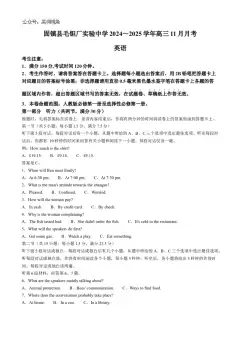
固镇县毛钽厂实验中学 2024~2025 学年高三 11 月月考
英语
考生注意:
1.满分150分,考试时间120分钟。
2.考生作答时,请将答案答在答题卡上。选择题每小题选出答案后,用2B铅笔把答题卡上
对应题目的答案标号涂黑;非选择题请用直径0.5毫米黑色墨水签字笔在答题卡上各题的答
题区域内作答,超出答题区域书写的答案无效,在试题卷、草稿纸上作答无效。
3.本卷命题范围:人教版必修第一册至选择性必修第一册。
第一部分 听力(共两节,满分30分)
做题时,先将答案标在试卷上。录音内容结束后,你将有两分钟的时间将试卷上的答案转涂到答题卡上。
第一节(共5小题;每小题1.5分,满分7.5分)
听下面5段对话。每段对话后有一个小题,从题中所给的A、B、C三个选项中选出最佳选项。听完每段对
话后,你都有 10秒钟的时间来回答有关小题和阅读下一小题。每段对话仅读一遍。
例:How much is the shirt?
A.£19.15. B.£9.18. C.£9.15.
答案是C。
1.When will Ben meet Emily?
A.At 6:30 pm. B.At 7:00 pm. C.At 7:30 pm.
2.What is the man's attitude towards the changes?
A.Pleased. B.Confused. C.Worried.
3.How will the woman pay?
A.In cash. B.By credit card. C.By check.
4.Why is the woman complaining?
A.The fish tasted bad. B.She didn't order the fish. C.It's cold in the restaurant.
5.What will the speakers do first?
A.Get some gas. B.Watch a play. C.Eat something.
第二节(共15小题;每小题1.5分,满分22.5分)
听下面5段对话或独白。每段对话或独白后有几个小题,从题中所给的A、B、C三个选项中选出最佳选项。
听每段对话或独白前,你将有时间阅读各个小题,每小题5秒钟;听完后,各小题将给出5秒钟的作答时
间。每段对话或独白读两遍。
听第6段材料,回答第6、7题。
6.What are the speakers mainly talking about?
A.Animal protection. B.Bees' communication. C.Ways to find food.
7.Where does the conversation probably take place?
A.At home. B.In a zoo. C.In a library.
听第7段材料,回答第8、9题。
学科网(北京)股份有限公司8.Why does the man decide to go to Hong Kong?
A.To seek further education.
B.To attend a graduation party.
C.To take over his uncle's company.
9.What does Lily want to be?
A.A scientist. B.A doctor. C.An engineer.
听第8段材料,回答第10至12题。
10.What is the relationship between the speakers?
A.Neighbors. B.Co-workers. C.Schoolmates.
11.From which place did Christina move?
A.Nebraska. B.Washington. C.Texas.
12.What is Bryce's real interest?
A.Drawing. B.Teaching. C.Making furniture.
听第9段材料,回答第13至16题。
13.What did the man like in the museum?
A.Old paintings. B.Old clocks. C.Old stamps.
14.What does the man say about the castle?
A.It was very warm. B.It was a little dark. C.It was full of items.
15.What did the man do during the trip?
A.He took photos of the church.
B.He bought a big model castle.
C.He learned the museum's history.
16.What made the man give up buying the book about Durham?
A.The high price. B.His classmate's advice. C.Limited shopping time.
听第10段材料,回答第17至20题。
17.Who is responsible for directing the play?
A.Lisa Nanni-Messegee. B.The speaker. C.Todd Messegee.
18.What will participants do on the fifth day?
A.Recite their material. B.Attend a lecture on acting. C.Perform on stage formally.
19.How long does the practice last daily?
A.For four hours. B.For seven hours. C.For nine hours.
20.What is suggested by the speaker at the end of the passage?
A.Ensuring safety. B.Signing up early. C.Doing more training.
第二部分 阅读(共两节,满分50分)
第一节(共15小题;每小题2.5分,满分37.5分)
阅读下列短文,从每题所给的 A、B、C、D四个选项中选出最佳选项。
A
Where to Eat and Drink at Museums
Museums, like department stores and airports, are now counting food among their attractions. The following
museum restaurants would be worth a meal even if not surrounded by masterpieces. Most of them can be visited
学科网(北京)股份有限公司independently of the museums.
Met Breuer
Flora Bar
The food from a brief menu is anything but: refined, excellent and pleasantly served. It begins with breakfast
when it pays to arrive before the famous cinnamon buns (肉桂面包) run out. Open for lunch from 11:30 am to
3:30 pm Tuesdays through Fridays; dinner from5:30 pm to 10 pm Tuesdays through Saturdays and 5:30 pm to 9 pm
Sundays (reservations, no museum admission required).
Tel: 646-558-5383
Asia Society
Garden Court Café
Here Steamed Chinese Dumplings served in bamboo baskets share the menu with Indian samosas, Korean
Japchae Glass Noodles and a Japanese bento box assortment. Wine and beer are served. Open daily from 11:30 am
to 3 pm, except Mondays (reservations, no museum admission required).
Tel: 212-570-5202
El Museo del Barrio
Side Park Café
Mexican street food, done with some refinement, is the order of the day. Open from 8 am Mondays through
Fridays, and 11 am Saturdays and Sundays, until 8 pm Wednesdays through Saturdays and 6 pm Sundays through
Tuesdays (no reservations, no museum admission required).
Tel: 212-831-7272
Museum of Arts and Design
Robert
Crowd-pleasing food includes crab cakes, Wagyu beef sliders and duck breast. Lunch: 11:30 am to 2:30 pm
Mondays through Fridays; dinner: 5 pm to 11 pm Wednesdays through Saturdays, and 5 pm to 10 pm Sundays
through Tuesdays (reservations, no museum admission required).
Tel: 212-299-7730
21.Which number can you call if you want to try some Chinese food?
A.646-558-5383. B.212-831-7272. C.212-570-5202. D.212-299-7730.
22.What do we know about Side Park Café?
A.It opens seven days a week. B.It offers museum-goers discounts.
C.It requires reservations in advance. D.It is known for its delicious duck breast.
23.When can diners eat at Robert?
A.At 10 am on Monday. B.At 9:30 pm on Wednesday.
C.At 11 am on Tuesday. D.At 10:30 pm on Sunday.
B
Madeleine L'Engle died more than a decade ago, but her work lives on in the more than 40 books she
published. Last month, L'Engle's granddaughters, Lena Roy and Charlotte Jones Voiklis, published Becoming
Madeleine, a biography of the legendary (传奇的) author."We wanted to do something to honor her memory," Roy
said.
学科网(北京)股份有限公司L'Engle was born on November 29, 1918. Her father was a writer. Young Madeleine watched him writing,
absorbed in his creation of stories — real and fictional — and saw that it gave him both pleasure and frustration
(失望). When L'Engle was 11, her parents dropped her off at boarding school and left her there. Although the
experience was challenging, L'Engle later said that "it helped me become a writer." In 1959, L'Engle began to
write A Wrinkle in Time, which won the 1963 Newberyn Medal.
Roy is also the author of the novel Edges. Edges was much harder to write than Becoming Madeleine. Roy
noted. "Edges was my 'learning how to write' experience," she said. "There was just so much I didn't know."
Roy added that working with her sister on their biography was very meaningful. "We don't have sibling rivalry
(兄弟姐妹间的对抗) anymore," she joked.
The biographers focus their story on L'Engle's childhood. That is the period about which their 11-and 12-year-
old selves would have been the most curious. "I'm so interested in how people become who they are," Roy said.
"What are all the experiences? Her Becoming Madeleine has been part of me becoming Lena."
Roy got valuable writing advice from her grandmother. "There is always a message of hope in her writing,"
Roy said, "and she believes that books should end on a positive note."
Roy, in turn, has her own advice for aspiring (有志成为……的) writers. "Keep writing," she said. "Read as
much as you can. In writing and reading, we develop sympathy because we step into somebody else's shoes. Read
as much as you can about other cultures. Have experiences with people who are different from you. Don't be
afraid."
24.What do we know about young L'Engle?
A.She liked going to boarding school. B.She wrote her first medal-winning work.
C.She learned a lot at boarding school. D.She enjoyed listening to various stories.
25.What is Becoming Madeleine about?
A.Madeleine's literary achievements. B.Madeleine's childhood experiences.
C.The authors' competition with siblings. D.The authors' experience of writing novels.
26.What did Roy learn from her grandmother?
A.Show hope to readers. B.Be thoughtful and brave.
C.Learn from other cultures. D.Talk with different people.
27.What is the best title for the text?
A.Becoming Madeleine B.Struggling to Become a Writer
C.Young Author's Advice on Writing D.Madeleine L' Engle, Author of A Wrinkle in Time
C
The first formal count of polar bears in waters between the United States and Russia indicates they're doing
better than some of their cousins elsewhere.
Polar bears are listed as a threatened species because of reduced sea ice due to climate change. But university
and federal researchers estimate a healthy population of nearly 3,000 animals in the Chukchi Sea off Alaska's
northwest coast, according to a study published in Scientific Reports.
"In the short term, it's absolutely good news," said lead author Eric Regehr. In the long term, it doesn't mean
the Chukchi Sea bear population will not be affected. "Polar bears need ice to hunt seals, and the ice is likely to
decline until the problem of climate change is addressed," Regehr said. "Polar bears spend most of their lives on sea
学科网(北京)股份有限公司ice. Less sea ice means less productive time to hunt ice seals, more time on shore and longer swims."
The study shows there is variation around the world in the effects of sea ice loss on polar bears. "Some
subpopulations are already declining while others are still doing OK," Regehr said.
Fewer cubs (幼熊) were surviving into their second year and adult males weighed less and had smaller skulls
(头骨). Researcher Steven Amstrup said the trends were consistent with changes in nutritional status likely
associated with declines in Sea ice.
A more recent study by researcher Karyn Rode found that Chukchi bears spend more time on shore and have
almost 30 fewer days to hunt seals on ice than 20 years ago. However, that doesn't appear to have affected the
population. Polar bears have an amazing ability to build fat reserves, and the Chukchi's copious seal population
apparently allows bears to compensate for the loss of hunting time.
28.What news is reported at the beginning of the text?
A.Polar bears are severely affected by sea ice loss.
B.Polar bears have been listed as a threatened species.
C.A large polar bear population has been found in the Chukchi Sea.
D.The melting of Arctic sea ice may lead to severe climate change.
29.What might Regehr think of the Chukchi bears?
A.They might be found in other areas.
B.They might be endangered in the near future.
C.They might help scientists fight climate change.
D.They might decrease in numbers in the distant future.
30.Which of the following is the effect of sea ice loss on polar bears?
A.They have to stay in water.
B.They have to live in groups.
C.They are becoming lazier than before.
D.They are suffering from changes in their nutrition.
31.What does the underlined word "copious" in the last paragraph mean?
A.Decreasing. B.Plentiful. C.Diverse. D.Adult.
D
The "open science" concept is gaining more followers, especially through the efforts of United Nations
Educational, Scientific and Cultural Organization (UNESCO). Over the past several years, the Organization has
been consulting on how science can become more collaborative (协作的), transparent, accessible, equitable and
inclusive. At the end of last year, UNESCO published a report on the current status of this effort.
UNESCO's report described several examples of positive initiatives, such as in research collaboration, open-
access scientific publishing and public engagement in science. For example, in 2020, the Brazilian government
launched the National Platform of Research Infrastructure, a digital platform in which scientific institutions can
register their available facilities and make them available to researchers outside their organization. The European
Commission, based in Brussels, was an early supporter of open science. Between 2002 and 2020, it increased its
funding for societal engagement projects from €88 million to €462 million.
Other indicators are less rosy, however. Around three-quarters of publications in open- access databases are in
学科网(北京)股份有限公司just six languages — with nearly half being in English alone. And in spite of some of the progress mentioned,
overall the report finds that scientific institutions, such as universities, national science academies and journals, are
struggling to include communities, in all their diversity, in the process of creating scientific knowledge itself.
The United Nations (UN)'s Sustainable Development Goals (SDGs) are the best attempt to map a pathway
towards a better future, and a more open approach to science could have a larger part to play in achieving them.
That attempt needs as much help as it can get: Monitoring SDGs indicators is one obvious way that citizen
scientists can help. Some of the largest gaps in the collection of relevant SDGs data are in low-and middle-income
countries, which is where citizen research can really make a difference.
The UNESCO report shines a much-needed light on some promising developments in open science. The
challenge will be how to accumulate (累积) individual examples of good practice into something similar to a
critical mass, so that, in cases such as monitoring the SDGs, they can be made use of to get the world to where it
needs to be.
32.How did the Brazilian government contribute to open science?
A.It made Internet more accessible worldwide.
B.It set up a digital resource-sharing platform.
C.It funded Europe's societal engagement projects.
D.It translated publications into multiple languages.
33.What is paragraph 3 mainly about?
A.Examples of some new initiatives.
B.Indicators of a promising science field.
C.Problems of current open science.
D.Difficulties of creating scientific knowledge.
34.What is a suggested way to help achieve SDGs?
A.Helping the poor increase their incomes.
B.Creating city maps around the world.
C.Providing more support for online technology.
D.Encouraging citizens to engage in science.
35.What can we learn from the text?
A.There is a long way to go for global open science.
B.Professional scientists should give way to citizens.
C.Poor countries are unlikely to benefit from open science.
D.More successful models are needed to convince UNESCO.
第二节(共5小题;每小题2.5分,满分12.5分)
阅读下面短文,从短文后的选项中选出可以填入空白处的最佳选项。选项中有两项为多余选项。
When something goes wrong, do you tend to recover quickly or fall apart? Some might find it extremely
difficult to cope with the barriers. Following are some strategies to help you handle a personal setback (挫折) and
get back on track to achieve your goal.
● Understand it's normal. Fewer than 20 percent of people succeed in reaching their goal on the first attempt.
In other words it's not whether a challenge will happen, but it's when. 3 6
学科网(北京)股份有限公司● Don't deny it. Sometimes it can be difficult to identify a setback. The problem can be staring you right in
the face, but you may deny there's any cause for alarm. 37 This inability to acknowledge the problem doesn't
mean you' re stupid. It's just that denial can cloud your awareness of the issue. It's important to be open to the
honest feedback.
● 38 Stop and consider carefully what went wrong. The most common causes of a setback are personal
worries, overconfidence, and poor coping skills. Take a look at any factor that may have contributed to the setback:
where you were, who you were with, what you were thinking and feeling.
● Learn from it. Learn from your analysis of the setback, and adjust your plan to try to prevent similar things
from happening next time. Each time you adapt your plan and put it into action again, you actually improve your
chances of eventual success. 39
Remind yourself that your setback is a slip instead of a fall. 40 After adjusting, you can still make
progress toward success again.
A.Don't take it seriously.
B.Analyze what happened.
C.Persist in pursuing your goals regardless of challenges.
D.Despite concerns, you may still refuse to acknowledge it.
E.You haven't lost all of the knowledge, skills, and support.
F.Thus, the key lies in managing setbacks effectively when they arise.
G.This is because you learn from each misstep to make your plan more effective.
第三部分 语言运用(共两节,满分30分)
第一节(共15小题;每小题1分,满分15分)
阅读下面短文,从每题所给的A、B、C、D四个选项中选出可以填入空白处的最佳选项。
As a growing family, we gathered lots of stuff, especially toys. After our first boy was born, friends and family
gave him lots of gifts, 41 our once big rooms with many colorful playthings.
42 my son's countless possessions robbed me of the mood to enjoy life. My spare time melting away, my
43 began to mount up.
Then one day, the weight of the mess became too much to bear. I 44 ! It was time to make a 45 . I
grabbed trash bags and rushed into my son's bedroom, 46 the scattered (散落的) toys on the floor quickly.
Then I took those bags of toys immediately to the basement (地下室). Of course, there was the initial crying over
losing his toys, but gradually he managed to 47 it.
Days went by. Then weeks. 48 , the absence of disorder seemed to promote a deeper sense of appreciation
for the toys that 49 . With fewer toys, my son had to rely on his imagination, like 50 a paper box into a
spaceship and going on a fantasy adventure in it. It's been months, and those 51 toys are still in the basement.
With each passing day, the 52 of our minimalist lifestyle became more apparent. Freed from the burden
of cleaning up the house, we 53 a world where less really became more. Minimalism allows me to see more
54 in life, and my boy is becoming more 55 when playing with a reduced number of toys.
41.A.flooding B.connecting C.comparing D.presenting
42.A.Selling B.Sorting C.Counting D.Delivering
43.A.laziness B.anxiety C.regret D.shame
学科网(北京)股份有限公司44.A.retired B.escaped C.cheered D.exploded
45.A.donation B.record C.promise D.change
46.A.playing with B.putting aside C.picking up D.throwing away
47.A.accept B.believe C.share D.remember
48.A.Originally B.Hopefully C.Unexpectedly D.Unfortunately
49.A.waited B.appeared C.increased D.remained
50.A.placing B.turning C.dividing D.mixing
51.A.worn B.collected C.packed D.displaced
52.A.benefits B.symbols C.impressions D.patterns
53.A.missed B.disconnected C.imagined D.unlocked
54.A.problems B.possibilities C.preparations D.predictions
55.A.generous B.courageous C.creative D.supportive
第二节(共10小题;每小题1.5分,满分15分)
阅读下面短文,在空白处填入1个适当的单词或括号内单词的正确形式。
China's traditional tea-making was added on Tuesday to the intangible cultural heritage list of the United
Nations Educational, Scientific and Cultural Organization (UNESCO). The item "Traditional tea processing
techniques and associated social practices in China" 56 (pass) the examination at the 17th session of the
UNESCO Intergovernmental Committee.
China now has 43 items on the intangible cultural heritage list, 57 (continue) to be the most enlisted
country in the world.
The traditional tea processing techniques and associated social practices in China consist 58 knowledge,
skills, and practices concerning the 59 (manage) of tea plantations, picking of tea leaves, manual processing,
drinking, and sharing of tea.
Since ancient times, Chinese people have been planting, picking, making and drinking tea.
60 (base) on natural conditions and local customs, Chinese tea producers have developed six 61
(category) of tea: green, yellow, dark, white, oolong and black. Besides, there are other varieties, 62 contain
flower-scented teas, and more than 2,000 tea products.
The traditional tea making techniques are 63 (general) concentrated in the four tea regions in China.
Associated social practices, however, 64 (spread) throughout the country and shared by multiple ethnic
groups.
Tea is popular in Chinese people's daily life, served in families, workplaces, tea houses, restaurants and
temples, to name a few. 65 is also an important part of socialization and ceremonies such as weddings and
sacrifices.
第四部分 写作(共两节,满分40分)
第一节(满分15分)
新年即将来临,学生会将于下周五晚上在学校报告厅举办一场英语晚会。请你以学生会的名义发一则通知,
欢迎全校师生参加。内容包括:
1.晚会主题;
2.活动内容。
学科网(北京)股份有限公司注意:
1.词数80左右;
2.可以适当增加细节,以使行文连贯。
NOTICE
____________________________________________________________________________________________
____________________________________________________________________________________________
The Students' Union
第二节(满分25分)
阅读下面材料,根据其内容和所给段落开头语续写两段,使之构成一篇完整的短文。
I loved the spelling bee (拼字比赛) so much that every afternoon after school, I would diligently train.
However, little did I know that my opponent in the spelling bee would one day become a cherished friend.
On Friday morning, I woke up at 6:27. My usual waking time was 7:01, granting me an unexpected thirty-
four extra minutes to study. As the best speller in my class, I was determined to win the Meadowbrook Middle
School spelling bee and defeat my opponent, Nathan Fortescue.
Nathan was a devotee of science and math. He wasn't really a speller at heart; he was a mathematician. Nathan
and I had nothing in common except being good spellers. Besides, he seemed to spell well without much effort.
I went to the kitchen and found Dad making breakfast. I told him about the spelling test and my anxiety. He
quizzed me on some words, but they were easy for me. Then he asked, "How do you spell 'argument'?" I
confidently replied, "Easy, A-R-G-U-E-M-E-N-T," without a second thought.
Dad shook his head. I didn't believe him, so I checked the dictionary. When I came back, he said I should
thank him because that word might be on the test.
As I shut the classroom door, a voice came from the back of the room. "You're looking a bit pale. I'm afraid
you might not make it through the spelling bee," Nathan said with a smile as he closed a giant book with dancing
numbers on its cover.
"I bet a literature word will knock you out in the first round," I replied.
Then Ms. Hawking entered the room, explaining the rules — one miss and you are out — and the spelling
test began. After four intense rounds, only Nathan and I remained. "Olivia, your word is 'algorithm'," Ms. Hawking
announced. I had never heard that word before, but I spelt it: "A-L-G-O-R-Y-T-H-M."
注意:
1.续写词数应为150左右;
2.请按如下格式在答题卡的相应位置作答。
Ms. Hawking frowned (皱眉) and said that's incorrect. ________________________________________
____________________________________________________________________________________________
After class, I sobbed (啜泣) when I felt a hand on my arm. ________________________________________
____________________________________________________________________________________________
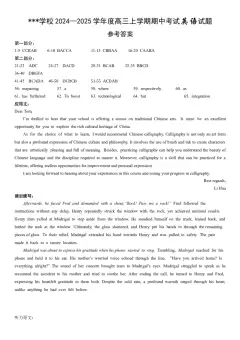
固镇县毛钽厂实验中学 2024~2025 学年高三 11 月月考·英语
参考答案、提示及评分细则
学科网(北京)股份有限公司听力(共20小题;每小题1.5分,满分30分)
题
1 2 3 4 5 6 7 8 9 10 11 12 13 14 15 16 17 18 19 20
号
答
C A C A B B C A B A A C B C A A C C B B
案
阅读(共20小题;每小题2.5分,满分50分)
题
21 22 23 24 25 26 27 28 29 30 31 32 33 34 35 36 37 38 39 40
号
答
C A B C B A A C D D B B C D A F D B G E
案
完形填空(共15小题;每小题1分,满分15分)
题
41 42 43 44 45 46 47 48 49 50 51 52 53 54 55
号
答
A B B D D C A C D B C A D B C
案
21.C 细节理解题。根据 Garden Court Café 部分中的“Steamed Chinese Dumplings served in bamboo
baskets”可知。
22.A 细节理解题。根据Side Park Café部分中的“Open from 8 am Mondays through Fridays, and 11 am
Saturdays and Sundays,until 8 pm Wednesdays through Saturdays and 6 pm Sundays through Tuesdays”可知,
这家餐厅一周七天都营业。
23.B 细节理解题。根据Robert 部分中的“11:30 am to 2:30 pm Mondays through Fridays; dinner: 5 pm to
11 pm Wednesdays through Saturdays, and 5 pm to 10 pm Sundays through Tuesdays”可知。
24.C 推理判断题。根据第二段中的“her parents dropped her off at boarding school... L'Engle later said that
'it helped me become a writer.'”可推知,L'Engle在寄宿学校学到很多东西,为日后成为一名作家打下了坚实
的基础。
25.B 细节理解题。根据第五段中的“The biographers focus their story on L'Engle's childhood.”可知,这本
传记主要讲述了L'Engle童年时期的经历,正是这些经历使她成长为她后来的样子。
26.A 细节理解题。根据倒数第二段内容可知,Madeleine L'Engle的作品总是积极乐观,能给读者带来
希望,而这也正是Roy从祖母那里学到的东西。
27.A 标题判断题。本文主要介绍了 Madeleine L'Engle 的两个孙女为祖母写的传记 Becoming
Madeleine。用Becoming Madeleine作标题,既是在介绍该书的名称,又突出了孙女(Roy)向祖母学习,
最终通过自己的努力成为一名像祖母那样的作家的主题,一语双关。
28.C 细节理解题。根据第二段中的“university and federal researchers estimate a healthy population of
nearly 3,000 animals in the Chukchi Sea off Alaska's northwest coast, according to a study published in Scientific
Reports”可知,文章开头报道了一项新的发现:楚科奇海生活着大量健康的北极熊。
29.D 推理判断题。根据第三段中的“In the long term, it doesn't mean the Chukchi Sea bear population will
not be affected”和 Regehr 所说的“Polar bears need ice to hunt seals, and the ice is likely to decline until the
problem of climate change is addressed”可知,虽然楚科奇海的北极熊短期内不会受到环境变化的影响,但是
由于北极熊大部分时间都是在冰上度过,故海冰的不断减少会严重影响它们的生存。因此可推知,Regehr
认为如果环境问题得不到解决,未来楚科奇海的北极熊数量也可能会减少。
30.D 细节理解题。根据倒数第二段内容可知,由于海冰减少,北极熊的营养状况会受到影响,幼熊难
以存活、成年公熊体重减轻且头骨变小。
学科网(北京)股份有限公司31.B 词义猜测题。根据画线词下文“allows bears to compensate for the loss of hunting time”可推知,楚科
奇海的海豹数量很多,可以弥补狩猎时间变少的问题。
32.B 细节理解题。根据第二段中“For example, in 2020, the Brazilian government launched the National
Platform of Research Infrastructure, a digital platform in which scientific institutions can register their available
facilities and make them available to researchers outside their organization.”可知,巴西政府创建了共享资源的
数字平台来助力开放科学。
33.C 段落大意题。根据第二段中“UNESCO's report described several examples of positive initiatives”和第
三段内容,尤其是“Other indicators are less rosy, however.”可知,第三段主要介绍当前开放科学存在的一些
问题。
34.D 细节理解题。根据第四、第五段内容可知,应该多依靠公民科学家参与科学研究来帮助实现联合
国可持续发展目标。
35.A 推理判断题。通读全文,尤其是最后一段推断可知,全球范围内的开放科学还有很长的路需要走。
36.F 根据上文“Fewer than 20 percent of people succeed in reaching their goal on the first attempt. In other
words it's not whether a challenge will happen, but it's when.”可知,挫折大概率是会发生的,只是早晚的区别,
F项承接上文。
37.D 根据上文“Sometimes it can be difficult to identify a setback. The problem can be staring you right in the
face, but you may deny there's any cause for alarm.”和下文“This inability to acknowledge the problem”可知,即
使有担忧,你也可能无法承认问题的存在,D项符合语境。
38.B 根据下文“Stop and consider carefully what went wrong.”可知,此处是指分析发生的事情,所以 B
项可以概括本段内容。
39.G 根据上文“Learn from it. Learn from your analysis of the setback, and adjust your plan to try to prevent
similar things from happening next time. Each time you adapt your plan and put it into action again, you actually
improve your chances of eventual success.”可知,从挫折中吸取的教训会让你的计划更高效,所以G项符合
逻辑。
40.E 根据上文“Remind yourself that your setback is a slip instead of a fall.”和下文“After adjusting, you
can still make progress toward success again.”可知,此处是讲即使面对挫折你仍然具有的优势,所以E项承
上启下。
41.A 随着第一个男孩的出生,朋友和家人送给他很多礼物,这些礼物使得原本宽敞的房间被五颜六色
的玩具淹没了。flooding在这里表示房间被玩具填满,符合上下文。
42.B 这里描述的是作者对整理(sorting)儿子无数的玩具感到有压力,这使得作者失去了享受生活的
心情。
43.B 根据上文“My spare time melting away”可知,随着空闲时间的失去,作者的焦虑(anxiety)开始
累积。
44.D 混乱的重量变得无法承受,作者的情绪爆发(exploded),决定采取行动。
45.D 根据下文可知,作者决定采取行动,做出改变(make a change)。
46.C 作者迅速捡起(picking up)散落在地板上的玩具并将其装入垃圾袋。
47.A 尽管儿子最初因为失去玩具而哭泣,但渐渐地他接受了(accept)这个事实。
48.C 随着时间的推移,出乎意料的是(Unexpectedly),不再杂乱的环境似乎促使作者的儿子对剩余
(remained)玩具的更深的欣赏感。
学科网(北京)股份有限公司49.D 见上题解析。
50.B 儿子通过想象力将简单的物品变成有趣的玩具,比如把一个纸盒变成(turning into)太空船。
51.C 那些被收纳的(packed)玩具仍然被留在地下室。
52.A 随着时间的推移,作者一家极简生活方式的好处(benefits)变得更加明显。
53.D 作者一家揭开了(unlocked)一个更少即是更多的世界。
54.B 极简主义让作者看到生活中更多的可能性(possibilities)。
55.C 作者的儿子在玩更少的玩具时变得更加有创造力(creative)。
语法填空(共10小题;每小题1.5分,满分15分)
56.passed考查谓语动词时态。根据上文语境和下文“at the 17th session of the UNESCO Intergovernmental
Committee”可知,这个项目通过了检测,用一般过去时,故填passed。
57.continuing考查非谓语动词。用现在分词短语作伴随状语,意为“(中国)继续(continuing)是世界
上(在非物质文化遗产名录上)项目数最多的国家”,故填continuing。
58.of考查介词。consist of为固定搭配,意为“由……组成”,故填of。
59.management考查名词。根据上文the和下文of可知,此处应用名词形式,意为“关于茶种植的管理”,
故填management。
60.Based考查非谓语动词。Based on natural conditions and local customs用作状语,表原因。由base构成
的分词短语一般位于句首,分词短语中的分词要用过去分词形式,故填Based。
61.categories 考查名词复数。根据上文 six 和 category 为可数名词可知,此处应用复数形式,故填
categories。
62.which考查非限制性定语从句。修饰先行词varieties,表物,故填which。
63.generally考查副词。此处需要副词来修饰动词短语are concentrated in,故填generally。
64.are spread考查谓语动词的时态、语态。主语Associated social practices(相关的社会习俗)与spread为
被动关系且描述的是现在的情况,用一般现在时的被动语态,故填are spread。
65.It考查代词。指代上文所提到的Tea,故填It。
应用文写作(满分15分)
参考范文
NOTICE
In order to celebrate the coming new year, an English evening party with a theme of Welcome New Year and
Enjoy Your English is going to be held by our Students' Union from 8 pm to 10 pm next Friday, in the lecture hall.
There will be many activities from the students, such as English short play performances and English songs.
What's more, some foreign students will be invited to sing Chinese songs for us at the party.
All the students as well as the teachers are expected to attend it on time. We are sure you will enjoy yourself.
The Students ' Union
读后续写(满分25分)
参考范文
Ms. Hawking frowned (皱眉) and said that's incorrect . The classroom grew quiet, and all eyes turned to
me. My heart sank as I realized my mistake. Nathan, on the other hand, looked confident. He spelled all the words
correctly and was declared the winner. I felt a mix of disappointment and frustration. I had trained so hard, but in
the end, it was a word I had never encountered that tripped me up. As the class cheered for Nathan, I silently
学科网(北京)股份有限公司packed up my things.
After class, I sobbed (啜泣) when I felt a hand on my arm. It was Nathan. He sat down next to me and
handed me a tissue. His expression was sympathetic. "Olivia, don't be too hard on yourself. Spelling is just a game.
This one word doesn't define you," he said gently. His words were unexpectedly comforting. We started chatting
and found that we actually shared many interests beyond spelling. That day, we became friends. Losing a title, I
gained a valuable lesson. Life spells out something greater than a victory: friendship.(156 words)
附听力材料
(Text 1)
W: Ben, it's me. We are meeting at the gate of the restaurant at 6:30 pm, right?
M: Sorry, Emily. I have to work overtime for half an hour. So I will get there one hour later than scheduled to meet
you.
(Text 2)
W: Did you hear about the changes to the city center? There will be more bicycle tracks and less street parking next
month.
M: Good. There will be less pollution downtown. I'm sure there will be fewer accidents, too.
(Text 3)
W: How much is it?
M: $660. Will that be cash or credit card? We also accept checks.
W: I'll pay by check. I don't carry that much cash with me.
(Text 4)
M: Is there anything wrong, madam?
W: There certainly is. This fish is not fit to eat. To start with, it's overcooked, and then it's cold, too.
M: I'm sorry about that. I'll have it changed.
(Text 5)
W: Did you get some gas for the car?
M: Oh, I forgot. We'd better get some on our way back. Shall we get something to eat now?
W: I'm not hungry now. Hurry up! The play is about to start.
(Text 6)
M: Do you know bees can interact with one another?
W: Really? How?
M: They use body language to show which direction the food is in, how far away it is, and how much food is
available.
W: You're kidding.
M: No! See that bee outside? See how she's going around and around in circles, like she's dancing? That means the
food is nearby. If the food is farther away, the bee points toward it with her body.
W: Wow! You really know about bees! You must have read a lot of books about them here.
M: Yeah. I like reading books here and often borrow some books from here.
(Text 7)
M: Hi, Lily. Great graduation party, isn't it?
W: Yes. Everyone here is having a good time. Any ideas for the future?
学科网(北京)股份有限公司M: Well, I'm interested in finance and my uncle runs a company in Hong Kong, so I decide to go to the University
of Hong Kong. What about you?
W: I'd like to go to some university in Beijing.
M: What do you want to take as your major, computer science or medicine?
W: I prefer medicine. It's always been my dream to be a doctor.
(Text 8)
W: Hello. My name is Christina. I'm just stopping by to bring you some cookies and introduce myself.
M: Hi, Christina. I'm Bryce. It's very nice to meet you. Please come in.
W: Sure.
M: Thank you for the cookies. Would you like something to drink?
W: Water is fine. Thank you.
M: Here you go. Take a seat. So, where were you living before?
W: My husband and I were living in Nebraska, but he got a job out here, so that's why we moved. I love
Washington so much now.
M: I've been in Washington for ten years. I was born in Texas and came here for college. I've stayed ever since.
W: What do you do for work?
M: I'm a teacher. It's a good job but my real passion in life is making furniture.
W: That's interesting. I do a lot of painting in my spare time, although I'm a banker during the day.
(Text 9)
W: What about your school trip to Durham?
M: Well, we visited three places — the church, the museum and the castle. The castle opens only in the morning,
so we were taken there early. After that, we went to the other two places.
W: Was the trip good?
M: Not bad. In the museum, we saw old paintings and stamps, which I didn't like very much. But the guide showed
us some old clocks. I really enjoyed them and I also learned about their history.
W: And the castle?
M: You know some castles were just dark and empty. But this one was different. There were a lot of things to see.
However, it wasn't very warm.
W: Did you go to the church after lunch?
M: Yes. It was large. I took some photos of it.
W: Did you go shopping?
M: Yes, we had enough time, but I only bought some postcards. The book about Durham I wanted was too
expensive. Oh, one of my classmates bought a big model castle.
W: Sounds like a nice trip.
(Text 10)
Now we have a program for those who love acting. This program gives young actors the experience of
developing complex characters and performing a full-length production while receiving top-level training. Each
actor will receive a role and will be given time to shine on the stage at the end of the week. Children aged between
13 and 16 can take part in the program.
The play is written by Lisa Nanni-Messegee. Todd Messegee will be the director. On the first Monday we
学科网(北京)股份有限公司meet, actors act for some time to find a suitable role in the play. By the end of the day, they begin developing
characters and learning about the play. This continues through mid-week, along with focus on specialty skills that
may be needed in the production. On these days, they'll receive some training on acting. On Thursday, the actors
are running the show off-book and memorizing their material. On Friday, the whole group is performing on stage,
in a recorded performance. A digital copy of the performance will be shared with actors after the program is
complete. This is a very exciting challenge for any actor! It'll begin on 26th and end on 30th. Practicing time is
from 9:00 am to 4:00 pm every day. Only ten will be admitted. If you're interested, contact us early. Due to safety
restrictions, space is extremely limited in each age group. Registering early is recommended.
学科网(北京)股份有限公司