北京市昌平区新学道临川学校
2019-2020 学年九年级上学期期中英语试题
第一部分 听力
听录音,根据各题要求选择最佳答案;每项内容读两遍
第一节
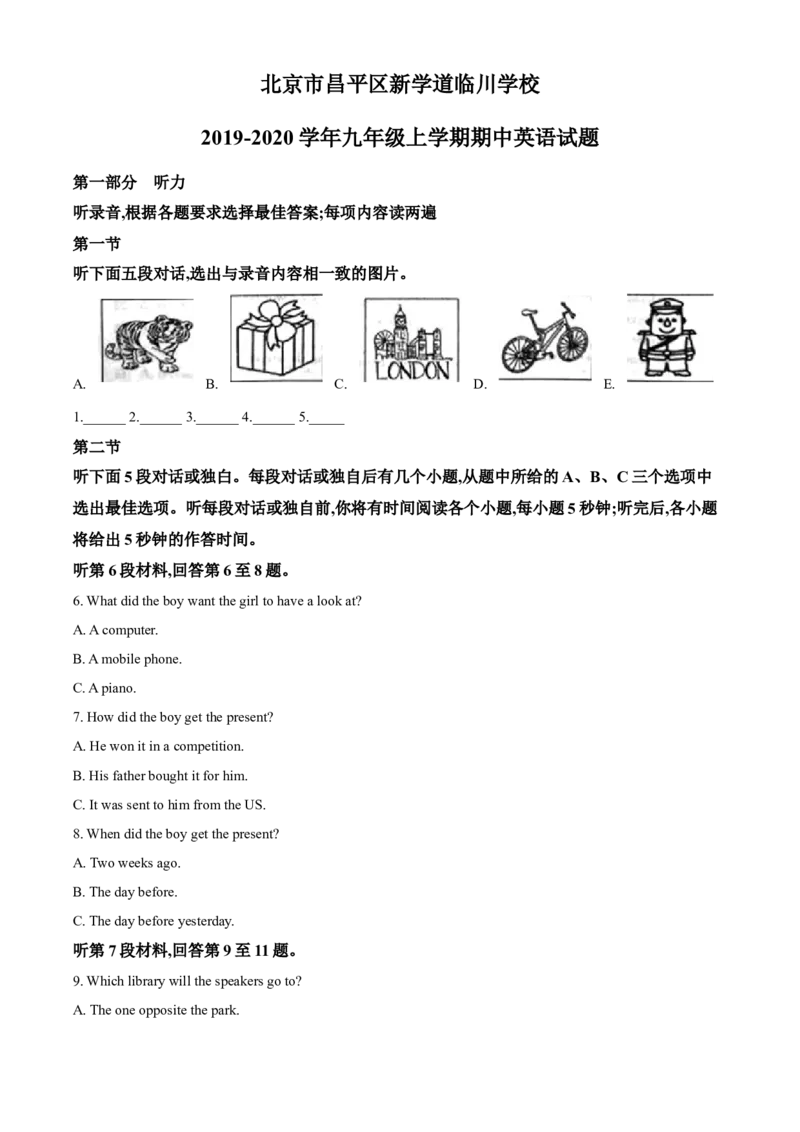
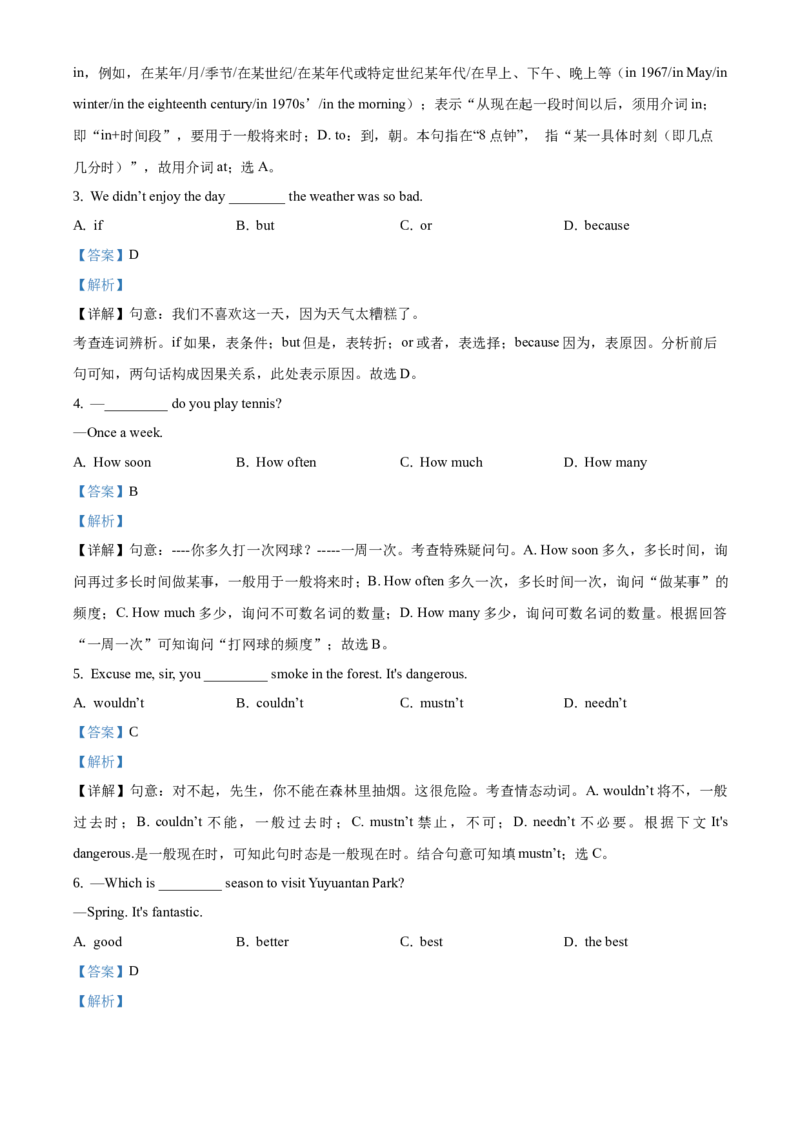
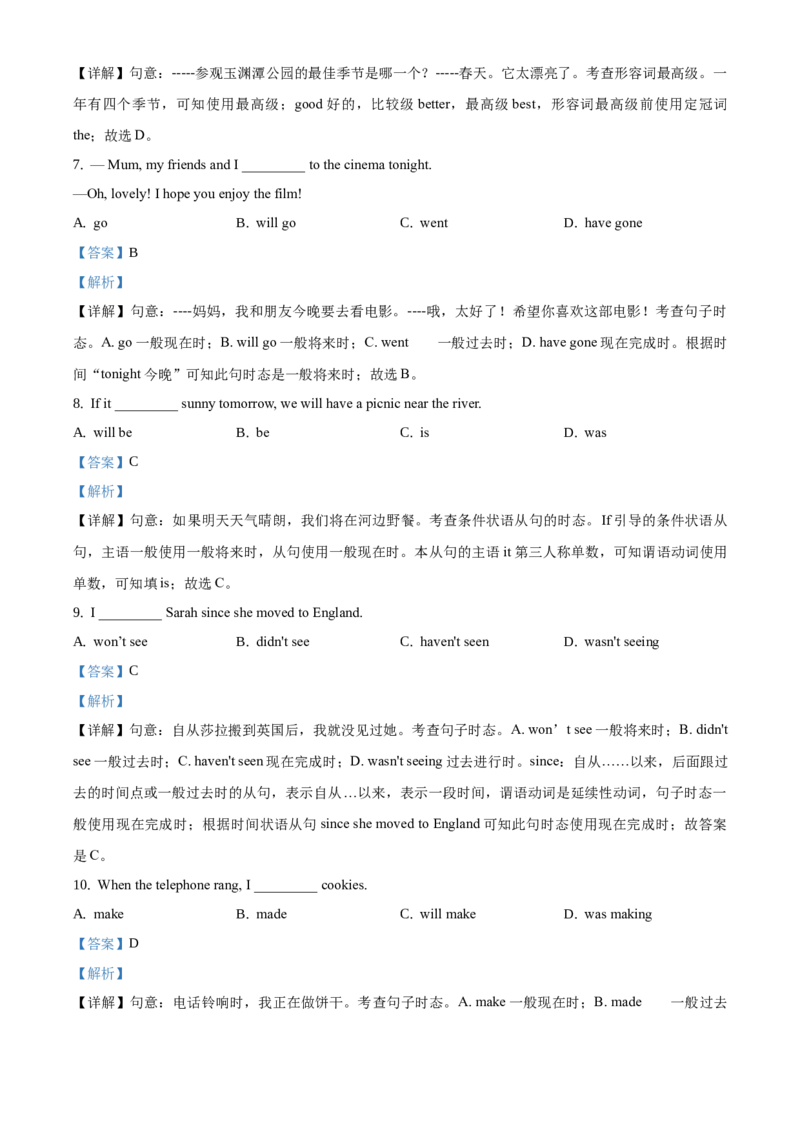
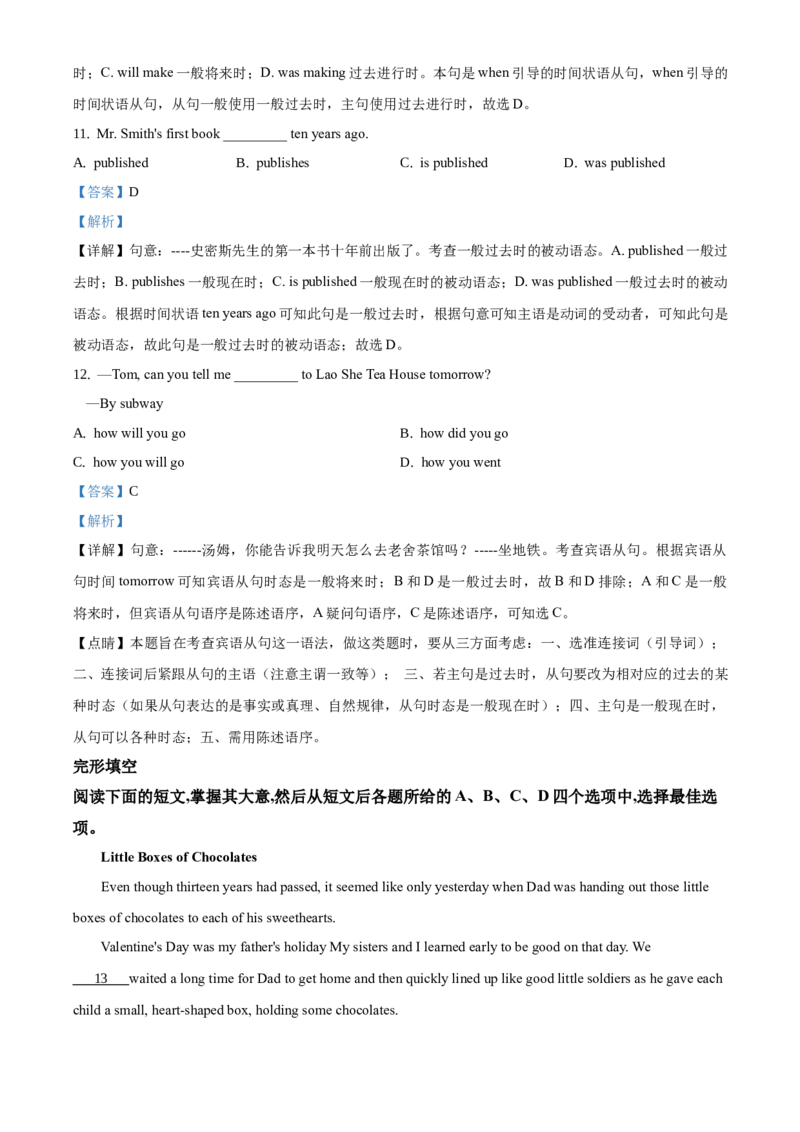
听下面五段对话,选出与录音内容相一致的图片。
A. B. C. D. E.
1.______ 2.______ 3.______ 4.______ 5._____
第二节
听下面5段对话或独白。每段对话或独自后有几个小题,从题中所给的A、B、C三个选项中
选出最佳选项。听每段对话或独自前,你将有时间阅读各个小题,每小题5秒钟;听完后,各小题
将给出5秒钟的作答时间。
听第6段材料,回答第6至8题。
6. What did the boy want the girl to have a look at?
A. A computer.
B. A mobile phone.
C. A piano.
7. How did the boy get the present?
A. He won it in a competition.
B. His father bought it for him.
C. It was sent to him from the US.
8. When did the boy get the present?
A. Two weeks ago.
B. The day before.
C. The day before yesterday.
听第7段材料,回答第9至11题。
9. Which library will the speakers go to?
A. The one opposite the park.B. The one near the shopping center.
C. The one by the hospital.
10. How will they go to the library?
A. By car.
B. On foot.
C. By bus.
11. What time will they meet?
A. At 10:00.
B. At 10:20.
C. At 10:30.
听第8段材料,回答第12至14题。
12. What did Fred do last night?
A. He went to the police station.
B. He drove into a shop and broke it up.
C. He went shopping with his girlfriend.
13. Whom did Fred have a fight with?
A. The shop-keeper.
B. A policeman.
C. His girlfriend.
14. Where is Fred's car now?
A. In the shop.
B In the street.
C. In the police station.
听第9段材料,回答第15至17题
15. What do you think Mary is?
A. An artist.
B. A singer.
C. A student.
16. Where will they perform?
A. At concert halls.
B. At restaurants.
C. At some parties.
17. Why is Mary not sure of joining the group at first?A. She is afraid she has forgotten all the songs.
B. She is very busy with her studies at weekends.
C. She isn't interested in performing with others.
听第10段材料,回答第18至20题。
18. Why does the speaker give the talk?
A. To tell what to take for bicycle tours.
B. To give some advice on bicycle tours.
.
C To explain the advantages of bicycle tours.
19. What is the most important thing for bicycle tours?
A. Water.
B. Clothes.
C. Safety.
20. What must a person do if he is going to travel by bike in winter?
A. Take plenty of water.
B. Take some warm clothes.
C. Take some medicine.
单项填空
从下列各题所给的A、B、C、D四个选项中,选择可以填入空白处的最佳选项。
1. Jim is a very kind boy. We all like _________.
A. me B. him C. her D. you
【答案】B
【解析】
【详解】句意:吉姆是个非常善良的男孩。我们都喜欢他。考查人称代词宾格。A. me我;B. him他;C.
her她;D. you你,你们。根据句意可知本词指代前文提到的Jim,第三人称单数,男孩,可知使用him指
代;故选B。
2. I have dancing classes every Saturday. They start _________ 8 o’clock.
A. at B. on C. in D. to
【答案】A
【解析】
【详解】句意:我每个星期六都上舞蹈课。舞蹈课8点开始。
考查时间介词。A. at指“某一具体时刻(即几点几分时)”或表示“在中午、在夜晚、在周末”时或很短
的时间;例如,at six/at that time/at night/at the moment;B. on“在具体的某一天”或“(在具体的某一天
的)早上、中午、晚上”;例如,on May 10th 1982,on a rainy morning; C. in在较长的时间里用介词in,例如,在某年/月/季节/在某世纪/在某年代或特定世纪某年代/在早上、下午、晚上等(in 1967/in May/in
winter/in the eighteenth century/in 1970s’/in the morning);表示“从现在起一段时间以后,须用介词in;
即“in+时间段”,要用于一般将来时;D. to:到,朝。本句指在“8点钟”, 指“某一具体时刻(即几点
几分时)”,故用介词at;选A。
3. We didn’t enjoy the day ________ the weather was so bad.
A. if B. but C. or D. because
【答案】D
【解析】
【详解】句意:我们不喜欢这一天,因为天气太糟糕了。
考查连词辨析。if如果,表条件;but但是,表转折;or或者,表选择;because因为,表原因。分析前后
句可知,两句话构成因果关系,此处表示原因。故选D。
4. —_________ do you play tennis?
—Once a week.
A. How soon B. How often C. How much D. How many
【答案】B
【解析】
【详解】句意:----你多久打一次网球?-----一周一次。考查特殊疑问句。A. How soon多久,多长时间,询
问再过多长时间做某事,一般用于一般将来时;B. How often多久一次,多长时间一次,询问“做某事”的
频度;C. How much多少,询问不可数名词的数量;D. How many多少,询问可数名词的数量。根据回答
“一周一次”可知询问“打网球的频度”;故选B。
5. Excuse me, sir, you _________ smoke in the forest. It's dangerous.
A. wouldn’t B. couldn’t C. mustn’t D. needn’t
【答案】C
【解析】
【详解】句意:对不起,先生,你不能在森林里抽烟。这很危险。考查情态动词。A. wouldn’t将不,一般
过去时;B. couldn’t 不能,一般过去时;C. mustn’t 禁止,不可;D. needn’t 不必要。根据下文 It's
dangerous.是一般现在时,可知此句时态是一般现在时。结合句意可知填mustn’t;选C。
6. —Which is _________ season to visit Yuyuantan Park?
—Spring. It's fantastic.
A. good B. better C. best D. the best
【答案】D
【解析】【详解】句意:-----参观玉渊潭公园的最佳季节是哪一个?-----春天。它太漂亮了。考查形容词最高级。一
年有四个季节,可知使用最高级;good好的,比较级better,最高级best,形容词最高级前使用定冠词
the;故选D。
7. — Mum, my friends and I _________ to the cinema tonight.
—Oh, lovely! I hope you enjoy the film!
A. go B. will go C. went D. have gone
【答案】B
【解析】
【详解】句意:----妈妈,我和朋友今晚要去看电影。----哦,太好了!希望你喜欢这部电影!考查句子时
态。A. go一般现在时;B. will go一般将来时;C. went 一般过去时;D. have gone现在完成时。根据时
间“tonight今晚”可知此句时态是一般将来时;故选B。
8. If it _________ sunny tomorrow, we will have a picnic near the river.
A. will be B. be C. is D. was
【答案】C
【解析】
【详解】句意:如果明天天气晴朗,我们将在河边野餐。考查条件状语从句的时态。If引导的条件状语从
句,主语一般使用一般将来时,从句使用一般现在时。本从句的主语it第三人称单数,可知谓语动词使用
单数,可知填is;故选C。
9. I _________ Sarah since she moved to England.
A. won’t see B. didn't see C. haven't seen D. wasn't seeing
【答案】C
【解析】
【详解】句意:自从莎拉搬到英国后,我就没见过她。考查句子时态。A. won’t see一般将来时;B. didn't
see一般过去时;C. haven't seen现在完成时;D. wasn't seeing过去进行时。since:自从……以来,后面跟过
去的时间点或一般过去时的从句,表示自从…以来,表示一段时间,谓语动词是延续性动词,句子时态一
般使用现在完成时;根据时间状语从句since she moved to England可知此句时态使用现在完成时;故答案
是C。
10. When the telephone rang, I _________ cookies.
A. make B. made C. will make D. was making
【答案】D
【解析】
【详解】句意:电话铃响时,我正在做饼干。考查句子时态。A. make一般现在时;B. made 一般过去时;C. will make一般将来时;D. was making过去进行时。本句是when引导的时间状语从句,when引导的
时间状语从句,从句一般使用一般过去时,主句使用过去进行时,故选D。
11. Mr. Smith's first book _________ ten years ago.
A. published B. publishes C. is published D. was published
【答案】D
【解析】
【详解】句意:----史密斯先生的第一本书十年前出版了。考查一般过去时的被动语态。A. published一般过
去时;B. publishes一般现在时;C. is published一般现在时的被动语态;D. was published一般过去时的被动
语态。根据时间状语ten years ago可知此句是一般过去时,根据句意可知主语是动词的受动者,可知此句是
被动语态,故此句是一般过去时的被动语态;故选D。
12. —Tom, can you tell me _________ to Lao She Tea House tomorrow?
.
—By subway
A. how will you go B. how did you go
C. how you will go D. how you went
【答案】C
【解析】
【详解】句意:------汤姆,你能告诉我明天怎么去老舍茶馆吗?-----坐地铁。考查宾语从句。根据宾语从
句时间tomorrow可知宾语从句时态是一般将来时;B和D是一般过去时,故B和D排除;A和C是一般
将来时,但宾语从句语序是陈述语序,A疑问句语序,C是陈述语序,可知选C。
【点睛】本题旨在考查宾语从句这一语法,做这类题时,要从三方面考虑:一、选准连接词(引导词);
二、连接词后紧跟从句的主语(注意主谓一致等); 三、若主句是过去时,从句要改为相对应的过去的某
种时态(如果从句表达的是事实或真理、自然规律,从句时态是一般现在时);四、主句是一般现在时,
从句可以各种时态;五、需用陈述语序。
完形填空
阅读下面的短文,掌握其大意,然后从短文后各题所给的A、B、C、D四个选项中,选择最佳选
项。
Little Boxes of Chocolates
Even though thirteen years had passed, it seemed like only yesterday when Dad was handing out those little
boxes of chocolates to each of his sweethearts.
Valentine's Day was my father's holiday My sisters and I learned early to be good on that day. We
___13___waited a long time for Dad to get home and then quickly lined up like good little soldiers as he gave each
child a small, heart-shaped box, holding some chocolates.It caused ___14___reactions (反应)as we went through the periods in life. In the elementary school years, we
would rush home and wait for Dad. In junior high, we felt a little embarrassed(尴尬的). In high school, we thought
we were too cool to be rushing home. However, we were still comforted knowing that Dad was home waiting for us
with his special ___15___.
My sisters and I thought the only way we would ever get out of this tradition was to move out of the house.
We were___16___. Even after we all moved out of the house, when Valentine's Day came, there was a little box of
chocolates waiting for each of us. So we still made the trip over to ___17___ it.
When Mum passed away, we thought this whole tradition would disappear gradually. Wrong again.
Grandchildren entered the picture and were also ___18___ in this tradition from the day they were born.
One year, everything changed. In that February, Valentine's Day___19___on Dad's bowling night, so he
handed out the chocolates a day early.
Then, Valentine's Day arrived. I was watching TV when the phone rang. It was the hospital. Dad had a heart
attack, and he didn't make it.
A few years later after his death, we finally went through the hard time and began___20___again. And come
February, when those little heart-shaped boxes of chocolates appear in store windows. Dad's tradition lives on my
heart.
13. A. wisely B. bravely C. patiently D. proudly
14. A. amazing B. correct C. different D. terrible
15. A. dream B. treat C. support D. interest
16. A. wrong B. clever C. afraid D. happy
17. A. buy B. send C. bring D. collect
18. A. caught B. challenged C. hurt D. included
19. A. fell B. depended C. lived D. walked
20. A. regretting B. celebrating C. complaining D. sharing
【答案】13. C 14. C 15. B 16. A 17. D 18. D 19. A 20. B
【解析】
【分析】本文讲述了情人节礼物------一小盒巧克力故事。作者的父亲在情人节那天,都会把小盒子的巧克
力分发给他的每一个情人------他的孩子和妻子。在人生的不同阶段时,作者和她的姐姐感受不同。在小学
的时候,她们会赶回家等爸爸。在初中,感到有点尴尬。在高中时,她们不回家,感觉太酷了。这种传统
一直没有中断,即使作者和姐姐搬出去,作者的母亲去世。在一年情人节前一天,她们的父亲提前一天分
发巧克力,情人节那天作者的父亲因心脏病去世了。可是爸爸的传统却在作者心中。经历几年悲痛以后,
作者又开始庆祝情人节。【13题详解】
句意:我们耐心地等了很长一段时间,等爸爸回家,当他给每个孩子一个心形的里面装着巧克力的小盒子
时候,我们像优秀的小士兵一样迅速排成一行。考查副词辨析。A. wisely聪明地;英明地;B. bravely勇敢
地;C. patiently耐心地;D. proudly自豪地,骄傲地。根据waited a long time(等了很长一段时间)可知“耐
心地等了很长一段时间”;故选C。
【14题详解】
句意:当我们经历人生的各个阶段时,它会引起不同的反应。考查形容词辨析。A. amazing惊异的,令人
惊奇的;B. correct 正确的;C. different不同的;D. terrible可怕的,糟糕的。根据下文“在小学的时候,
我们会赶回家等爸爸。在初中,我们感到有点尴尬。在高中时,我们觉得我们太酷了,而不能赶回家。”
可知“当我们经历人生的各个阶段时,它会引起不同的反应。”故选C。
【15题详解】
句意:然而,当我们知道爸爸在家用特别款待等我们时,我们仍然感到欣慰。考查名词辨析。A. dream梦
想;B. treat 款待,招待;C. support支持,拥护;D. interest兴趣。根据上文“我们仍然感到欣慰”可知
是“当我们知道爸爸在家用特别款待等我们时”;结合句意可知选B。
【16题详解】
句意:我们错了。考查形容词辨析。A. wrong错的;B. clever聪明;C. afraid害怕的;D. happy快乐的。根
据上文My sisters and I thought the only way we would ever get out of this tradition was to move out of the house.(我和
我的姐妹们认为,我们摆脱这一传统的唯一办法就是搬出去。)和下文 Even after we all moved out of the
house, when Valentine's Day came, there was a little box of chocolates waiting for each of us.(即使我们都搬出
了房子,当情人节到来时,也有一小盒巧克力等着我们每个人。)可知“我们错了。”故选A。
【17题详解】
句意:所以我们还是去收集它。考查动词辨析。A. buy购买;B. send发送;C. bring带来;D. collect收集。
根据上文“there was a little box of chocolates waiting for each of us也有一小盒巧克力等着我们每个人”可知
“所以我们还是去收集它”,故选D。
【18题详解】
句意:孙子们进入了这张照片,从他们出生的那一天起就被纳入了这个传统。考查动词辨析。A. caught
被抓住;B. challenged受到挑战;C. hurt受到伤害 ;D. included被包括在内。结合句意可知选D。
【19题详解】
句意:那年二月,情人节是父亲保龄球之夜,所以他提前一天分发巧克力。A. fell落下,fall on:落到,落
在;B. depended依靠,depend on:取决于,依赖,依靠;C. lived居住,生活,live on靠...生活; 以...为食;
D. walked步行,walk on向前走,继续走。Valentine's Day fell on Dad's bowling night:情人节是(落在)父
亲保龄球之夜,结合句意可知选A。【20题详解】
句意:在他去世以后的几年后,,我们终于度过了难关,开始再次庆祝。考查动词辨析。A. regretting后悔;
B. celebrating庆祝;C. complaining抱怨;D. sharing分享。根据下文“again”可知“开始再次庆祝”,故
选B。
【点睛】完形填空集阅读理解、语法、词法、句法于一体,考查语言的综合运用能力,是难度最大的题目。
解题的方法要带着空,通读文章,搞清事件发生的背景;再读全文,搞清短文内容;最后根据句意,联系
上下文确定每个空的正确答案。它的主要题型有(1)考查词义辨析:名词辨析,形容词副词辨析,冠词
辨析,介词连词辨析等;(2)考查句子时态,语态,要根据语境,选择正确的时态和语态的选项;(3)
考查从句(宾语从句,定语从句,主语从句等);(4)根据固定句型或短语结合语境选择正确的选项。
本题主要考查单词或短语辨析,做此类型题时,要知道每一个词的意义,然后结合上下文背景语境,选择
适合语境的选项。
阅读理解
阅读下面的四篇短文,根据短文内容,从短文后各题所给的A、B、C、D四个选项中,选择最佳
选项。
A
Top Four Unusual Shops
Senbikiya
If you are looking for something perfect, come to Senbikiya in Tokyo, Japan! You buy
fruit-perfect and very expensive fruit. There are apples for $25 each and 12 strawberries for$82.
Yes, it's expensive... but it's popular.
Beacon 's Closet
Are you looking for something old… something other people don’t want any more? Then
Beacon's Closet in New York, USA is the place for you. People bring clothes they don't want
and other people buy them. These second-hand clothes are of good quality -and cheap!
The Old Curiosity Shop
Sometimes the building is what makes your shopping experience special; for example,The
Old Curiosity Shop in London, England. It is a tiny old shop which Charles Dickens wrote
about in 1841. There are lots of big modern buildings around it. It is now a shoe shop.
El Ateneo Grand Splendid
From a tiny building to a huge one: the famous bookshop El Ateneo Grand Splendid in
Buenos Aires, Argentina. In 1919, the building opened as a theatre, but in February 2000, it
became one of the biggest-and most beautiful -bookshops in the world.
21. What can you buy in Senbikiya?
A. Shoes. B. Clothes. C. Books. D. Fruit.22. Beacon's Closet is in_____________.
A. Buenos Aires B. New York C. London D. Tokyo
23. Which shop did Charles Dickens write about?
A. Senbikiya. B. Beacon's Closet.
C. The Old Curiosity Shop. D. El Ateneo Grand Splendid.
【答案】21. D 22. B 23. C
【解析】
【分析】本文介绍了四大不寻常商店:日本东京的森比基亚水果店、美国纽约的灯塔衣橱店、英国伦敦老
古玩店鞋店、阿根廷布宜诺斯艾利斯著名的书店雅典人书店。
【21题详解】
细节理解题。根据表格一森比基亚店(Senbikiya)第2和3句You buy fruit-perfect and very expensive fruit.
(你买完美水果和很贵水果。)There are apples for $25 each and 12 strawberries for$82.(苹果25美元一个
草莓12个82美元一个。)可知在森比基亚(Senbikiya)商店你可以买到水果;故选D。
【22题详解】
细节理解题。根据表格二灯塔衣橱(Beacon's Closet)第2句Then Beacon's Closet in New York, USA is the
place for you.(那么,美国纽约的灯塔衣橱就是你的家。)可知灯塔的衣橱(Beacon's Closet)在纽约;故
选B。
【23题详解】
细节理解题。根据表格三The Old Curiosity Shop(老古玩店)第1和2句Sometimes the building is what makes
your shopping experience special; for example, The Old Curiosity Shop in London, England. It is a tiny old shop
which Charles Dickens wrote about in 1841.(有时候,这座建筑会让你的购物体验与众不同;例如,英国伦
敦的古玩店。这是查尔斯·狄更斯在1841年写的一家小店。)可知查尔斯·狄更斯写了一篇关于古玩店的
文章,故选C。
B
The Life of Jane Goodall
On the morning of July 14, 1960, Jane Goodall arrived at Lake Tanganyika in the Gombe National Park. Then
around 5 p. m, Jane went into the forest to find her first chimpanzee.
As a young woman, Jane Goodall was following her childhood dream of studying chimpanzees in Africa.After many months of difficult work she made three important discoveries: chimpanzees ate meat, they used tools
to get food, and they also made tools.
Every evening, Jane wrote her findings in her journal. She began to publish articles in magazines. After a
while, Jane was accepted by a university. Her work was also making her famous. There was a documentary (纪录
片)film,Miss Goodall and the Wild Chimpanzees (1963), and then My Friends the Wild Chimpanzees (1969), the
first of many books. During the 1970s, Gombe became a dangerous place to work. It is on the border of four
different countries and there was fighting among them. Many foreigners left, but Jane stayed to continue her
workand noted that chimpanzees could also be violent.
A different problem developed in Gombe in the 1980s. The forests were getting smaller and there was no
enough space for chimpanzees because of the increasing human population.As a result, there were only about a
hundred chimpanzees living in Gombe by t the end of the1980s. Jane realized something had to be done, so she
made a plan with the local community to grow more trees.
At the beginning of the 1990s, Jane left Gombe. She set up sanctuaries (庇护所)for chimpanzees which had
been caught because of the trade in chimpanzee meat. She also started giving speeches. She has very little spare
time but still spends part of every year in the forest in Gombe, watching her chimpanzees.
24. What was Jane's childhood dream?
A. To explore forests in Africa.
B. To make a documentary film.
C. To write books about animals.
D. To study chimpanzees in Africa.
25. What did Jane do in the 1970s?
A. She continued to work in Gombe.
B. She went to study in a university.
C. She found her first chimpanzee.
D. She published her first book.
26. What plan did Jane make to help chimpanzees in1980s?
A. To grow more trees B. To do more studies
C. To stop the fighting. D. To set up sanctuaries
【答案】24. D 25. A 26. A
【解析】
【分析】本文介绍了在非洲贡贝研究黑猩猩的简·古道尔。在非洲研究黑猩猩是简.古道尔儿时的梦想。
1960年7月14日上午,简·古道尔抵达贡贝国家公园。经过几个月的艰苦工作,她发现了三个重要的发现:黑猩猩吃肉,他们用工具来获取食物,他们还制造工具。每天晚上,简都把她的发现写在日记里,不
久在杂志上发表文章、拍纪录片、写书。20世纪70年代,即使贡贝爆发冲突,简仍然继续工作。20世纪
80年代,贡贝人类数量的增加,森林变得越来越小,威胁黑猩猩的生存,于是简为帮助黑猩猩制定了种更
多的树的计划。上世纪90年代初,简离开了贡贝。但她为黑猩猩设立了庇护所。她开始演讲。她几乎没有
空闲时间,但她每年仍去贡贝的森林里看她的黑猩猩。
【24题详解】
细节理解题。根据第2段第1句As a young woman, Jane Goodall was following her childhood dream of studying
chimpanzees in Africa.(作为一个年轻的女人,简.古道尔一直在追寻她儿时在非洲研究黑猩猩的梦想。)
可知“简童年的梦想是在非洲研究黑猩猩。”故选D。
【25题详解】
细节理解题。根据第 3段第5-7句During the 1970s, Gombe became a dangerous place to work. …… Many
foreigners left, but Jane stayed to continue her workand noted that chimpanzees could also be violent.(20世纪70年代
贡贝成了一个危险的工作场所。它在四个不同国家的边界上,他们之间发生了冲突。许多外国人离开了,
但简留下继续她的工作,并指出黑猩猩也可能是暴力的。)可知“简 20世纪70年代继续在贡贝工作。”
故选A。
【26题详解】
细节理解题。根据第4段最后一句Jane realized something had to be done, so she made a plan with the local
community to grow more trees.(简意识到必须做些什么,于是她与当地社区制定了一个计划,种植更多的树
木。)可知上世纪80年代,简为帮助黑猩猩制定了种更多的树的计划,故选A。
【点睛】阅读理解是最能体现学生英语能力的题型,分值较高,如何通过解题方法的掌握来提升自己解答
阅读理解题的技巧是学生最关心的问题。初中阅读理解一般考查学生的细节理解能力,主旨理解能力和推
理判断能力。做阅读理解题,首先要准确理解题意,然后根据题意根据短文内容做出正确的答案。(1)
考查细节理解能力,此类型题较简单,准确理解题意后,直接到文中找出答案。(2)考查猜词能力。做
这种题型时,要根据上下文意思准确猜出词意。3)考查推理判断能力,此类题型较难,准确理解题意后,
在文中找出相关的内容做出合理的推断。(4)考查主旨理解题。此类题型需通读全文,整体把握,根据
文本主要内容选择合适的选项。
C
Nature in Art
,
Many artists paint and use nature in their works but the results are very different. Here are four of them.Stanislaw Witkiewicz Stanislaw Witkiewicz was born in 1885 in
Zakopane, Poland. He died in 1939. Many people like Witkiewicz’s
paintings of nature and landscapes (风景). He painted this one in 1907.
It
shows the Hinczow Lakes in south Poland.
Ginger Riley Munduwalawala In the past, Aboriginal (原始的) people
painted pictures of nature on rocks. Modern aboriginal artists also paint
nature. This colorful painting by Ginger Riley Munduwalawala (1937 –
2002) shows hills, rivers, birds and kangaroos.
Ando Hiroshige Japanese art is famous for landscape paintings. You can
often see the sea and sky, the mountains, and trees. Ando Hiroshige, one of
Japan’s most famous artists, made and sold thousands of beautiful prints
in his lifetime, but he died poor.
Damien Hirst Damien Hirst is the richest artist in England. He is a
painter, but he is more famous for art with animals. In one room of a
gallery, he put lots of fruit and real butterflies. They flew around the
visitors.
27. When did Stanislaw paint the Hinczow Lakes?
A. In 1885. B. In 1907. C. In 1937. D. In 1939.
28. Where is Ando Hiroshige from?
A. Poland. B. Australia. C. Japan. D. England.
29. Who is famous for art with animals?
A. Stanislaw Witkiewicz. B. Ginger Riley Munduwalawala.
C. Ando Hisroshige. D. Damie Hirst.
【答案】27. B 28. C 29. D
【解析】
【分析】本文介绍了四位都绘画自然的艺术家:斯坦尼斯拉夫·维特基维奇,生姜莱利·蒙杜瓦拉瓦拉,
安藤裕志,达米安·赫斯特。
【27题详解】
细节题。根据表格一(Stanislaw Witkiewicz 斯坦尼斯拉夫·维特吉维奇)第 2-4 句 Many people like
Witkiewicz’s paintings of nature and landscapes (风景). He painted this one in 1907. It shows the Hinczow Lakesin south Poland.(许多人喜欢维特基维奇的自然和风景画。他在 1907年画了这幅画。它展示了波兰南部的
欣丘湖。)可知斯坦尼斯劳1907年画的欣丘湖;故选B。
【28题详解】
细节题。根据表格三(Ando Hiroshige 安藤裕志)第一句Japanese art is famous for landscape paintings.(日
本艺术以山水画闻名。)可知安藤裕志来自日本;故选C。
【29题详解】
细节题。根据表格四(Damien Hirst达米安·赫斯特)第2句He is a painter, but he is more famous for art with
animals.(他是个画家,但他更以动物艺术闻名。)可知达米安·赫斯特以动物艺术闻名;故选D。
D
Many scientists believe our love of sugar may actually be an addiction (上瘾). When we eat or drink sugary
foods, the sugar enters our blood and influences parts of our brain that make us feel good. Then the good feeling
goes away, leaving us wanting more. All tasty foods do this, but sugar has a particularly strong effect. In this way, it
is in fact addictive, and doctors suggest we all cut down on it.
“It seems like every time I study an illness, I find my way back to sugar,” says scientist Richard Johnson. One-
third of adults worldwide have high blood pressure ( 血 压 ), and up to 347 million have diabetes (糖尿病). Why?
“Sugar, we believe, is one of the reasons, if not the main reason,” says Johnson.
Our bodies are designed to survive on very little sugar. Early humans often had very little food, so our bodies
learned to keep sugar as fat. In this way, we had energy stored for when there was no food. But today, most people
have more than enough. So the very thing that once saved us may now be killing us.
So what is the solution? It’s obvious that we need to eat less sugar. The trouble is, in today’s world, it’s
extremely difficult to avoid. From breakfast cereals to after-dinner desserts, our foods are increasingly filled with it.
Some manufacturers ( 制造 商) even use sugar to replace taste in foods that are advertised as low in fat. This may
make the food appear as healthier, but large amounts of sugar are often added.
But there are those who are fighting back against sugar. Many schools are offering more fruit instead of
deserts. Other schools are building facilities for students to do exercise. The battle has not yet been lost.
30. Why is sugar addictive?
A. It makes us feel good and want more of it. B. It has a strong effect on our blood.
C. Tasty foods are full of sugar. D. There is sugar in medicine.
31. According to the passage, why is it so hard to avoid sugar?
A. We like candy too much. B. It gives us needed energy.
C. It is in so many foods and drinks. D. We get used to eating it at school.
32. What is the passage mainly about?A. Ways to avoid sugar. B. Our addiction to sugar.
C. Illnesses caused by sugar. D. Good sugar and bad sugar.
【答案】30. A 31. C 32. B
【解析】
【分析】本文主要介绍了我们对糖上瘾原因,吃糖多的危害,以及避免吃糖困难的原因。糖进入我们的血
液并影响我们大脑中使我们感觉良好,然后美好的感觉消失了,让我们想要更多。曾经救过我们的糖,现
在可能正在杀死我们。我们需要少吃糖。问题是,在当今世界,这是极难避免的。因为很多食物中都有糖。
【30题详解】
题意:为什么糖会上瘾?根据第1段第2和3句When we eat or drink sugary foods, the sugar enters our blood
and influences parts of our brain that make us feel good. Then the good feeling goes away, leaving us wanting
more.(当我们吃或喝含糖的食物时,糖进入我们的血液并影响我们大脑中使我们感觉良好的部分。然后美
好的感觉消失了,让我们想要更多。)可知“糖让我们感觉很好,想要更多。”故选A。
【31题详解】
题意:根据文章,为什么要避免吃糖这么难?根据第4段中From breakfast cereals to after-dinner desserts, our
foods are increasingly filled with it. Some manufacturers ( 制造 商) even use sugar to replace taste in foods that are
advertised as low in fat. This may make the food appear as healthier, but large amounts of sugar are often added.(从早餐
麦片到餐后甜点,我们的食物越来越多地充满了它。一些制造商甚至用糖来代替那些被宣传为低脂肪食品
的味道。这可能会使食物看起来更健康,但通常会添加大量的糖。)可知要避免吃糖这么难的原因是“糖
存在于许多食物和饮料中。”故选C。
【
32题详解】
题意:这篇文章主要是关于什么的?本文主要介绍了我们对糖上瘾原因,吃糖多的危害,以及避免吃到糖
困难的原因。这篇文章主要是关于我们对糖上瘾;故选B。
E
The Teenage Brain
Parents, teachers, and others who deal closely with teenagers know how difficult the adolescent(青少年的)
years can be. This was thought to be due to the “foolishness of youth.” Now, brain-imaging technology allows
scientists to study the physical development of the brain in more details than ever before. Their discoveries have led
a new theory of why teens act this way.
Recently, scientists have discovered that though our brains are almost at their full size by the age of six, they
are far from fully developed. Only during adolescence do our brains truly “grow up.” During this time, they go
through great changes, like a computer system being upgraded. This “upgrade” was once thought to be finished byabout age 12. Now scientists have found that our brains continue to change until age 25. Such changes make us
better at balancing impulses (冲动) with following rules. But a still-developing brain does this clumsily (笨拙地).
The result, scientists believe, is the unpredictable behavior seen in teenagers.
The studies show that teens are more likely to take risks. Luckily, the news isn’t all bad. As brain scientist B. J.
Casey points out, the teen brain inspires such behavior in order to help teens prepare for adult life.
One way the brain does this is by changing the way teens measure risk and reward (回报).
Researchers have found that when teens think about rewards, their brains release more of the chemicals that
create pleasure. Researchers believe this makes the rewards seem more important than the risks, and makes teens
feel the excitement of new experience.
Research into the structure of the teen brain have also found that it makes social connection seem especially
rewarding. As such, teens have a strong need to meet new people. Because it is still developing, a teen brain can
change to deal with new situations. So it connects social rewards with even more pleasure. In this way, the brain
encourages teens to have a wide circle of friends, which is believed to make them more successful in life.
Unluckily, this need for greater rewards can sometimes lead teens to make bad decisions. However, it also
means that teens are more likely, and less afraid, to try new things or to be independent. And in the long run, the
impulses of the teen brain are what help teens leave their parents’ care and live their own life successfully.
33. According to Paragraph 2, what have the scientists discovered now?
A. A changing brain helps follow the rules.
B. Our brains finish upgrading by age of twelve.
C. Our brains are fully developed by the age of six.
D. A developing brain can cause unpredictable behaviors.
34. The writer probably agrees that .
A. teenagers should learn from their bad decisions
B. many teenagers are able to change their behaviors
C. the way the teen brain works makes them less afraid
D. the impulses of a teenage brain should be controlled
35. What can we learn from the passage?
A. The teen brain makes risks less exciting.
B. The impulse of teen brain can benefit teenagers.
C. Teenagers with more friends are more successful.
D. Teenagers make wrong decisions because of their brain.
【答案】33. D 34. C 35. B【解析】
【分析】本文介绍了青春期的大脑。从脑发育解释了年轻人的行为是不可预测的,更愿意冒险,与社会接
触的原因,不好的事情,有时会导致错误的决定,但是这帮助青少年在生活中取得更大的成功和独立。这
也意味着青少年更有可能、更少害怕尝试新事物或独立。从长远来看,青少年大脑的冲动帮助他们离开父
母的照顾,成功地过上自己的生活。
【33题详解】
推理判断题。第2段讲述了科学家们发现虽然我们的大脑在6岁时几乎达到了最大尺寸,但它们还远未完
全发育成熟。我们的大脑在25岁之前一直在变化。科学家认为,其结果是青少年不可预测的行为。我们可
知根据第二段,科学家们现在发现了发育中的大脑会导致不可预测的行为。故选D。
【34题详解】
考查细节理解题。根据最后一段第2句it also means that teens are more likely, and less afraid,(这也意味着青
少年更可能,也更少害怕)可知“作者可能同意青少年大脑的工作方式让他们不那么害怕”;故选C。
【35题详解】
主旨理解题。根据最后一段可知“虽然青少年冲动行为有时会导致错误的决定,但是这帮助青少年在生活
中取得更大的成功和独立。这也意味着青少年更有可能、更少害怕尝试新事物或独立。从长远来看,青少
年大脑的冲动帮助他们离开父母的照顾,成功地过上自己的生活。”故我们能从这篇文章中了解到“青少
年大脑的冲动可以使青少年受益。”故选B。
【点睛】对于阅读理解题,首先要粗读文章了解大意,其次通过细读,理解全文。在粗读的基础上,仔细
阅读题后所给的题目,根据题目要求,再有重点地返回来仔细阅读。在阅读理解的题目中,所设问题主要
有以下几种方式:找主题或概括文章的中心思想、就文中的具体事实和情节进行提问、根据文章的表层意
思进行深层次的推理判断等,在细读时,要根据设问的方式,进行有侧重地阅读。1、考查主旨题,概括
文章中心思想。1)文首呈现主题句。2)文尾出现主题句。3)首尾呼应展现主题。4)文中表述主题。前面提出
问题,文中的主题由随之陈述的细节或合乎逻辑的引申在文中导出,而后再做进一步的解释。5)文章没有
主题句。在这种情况下,考生要把所有的细节综合起来。进行逻辑推理,概括归纳出文章的主题句。例如,
第3小题。2.细节理解题,掌握文章的具体事实和重要情节。在考题中,经常会见到就文章中某一具体事
实和重要情节进行测试的题目。这就要求考生在阅读时要注意辨认和记忆具体事实,重要情节,事物的起
因、过程、结果及发生的地点、时间等,这些都有可能作为测试点。例如,第 2小题;3.推理判断题,要
求考生在理解的基础上,通过自己的思维将理解的内容系统化,比如计算、排序等题型。例如,第1小题。
阅读短文,根据短文内容回答问题。
World Kindness Day is a celebration which takes place on 13 November each year. It was introduced in 1998
by the World Kindness Movement. It is celebrated in many countries, including Canada, Japan, Australia and someother countries. World Kindness Day is celebrated to highlight acts of kindness passing on the positive(正面
的)power.
Why be kind? Few people would disagree with the idea that a kind action is good for the soul(灵魂). It is a
win-win situation because it leads to a sense of well-being both for thereceiver of this kind action, as well as for the
person who does the action. As a simple example,let's imagine you have a workmate who always does a very good
job. How about taking a moment to mention this to them, just in conversation or perhaps by email? The effects of
this will probably be quite clear: your workmate will be happy to receive some praise and, in addition, you will
probably feel good about yourself for having spread a little joy.
Many organisations try to encourage people to be kind, wherever and whenever they can. Perhaps the
strongest supporters of this idea are the Random Acts of Kindness (RAK) Foundation. The RAK website suggests
some ways to show kindness. Generally, these fall into three categories. The first is interpersonal kindness. Some
examples are giving old clothes to charity(慈善机构) or writing a good comment about a restaurant that you like.
The second is environmental kindness, which could mean simply recycling or organising a group event to clean a
local park or beach. The third category is less obvious: personal kindness, which means treating yourself kindly.
Some examples are taking a walk in nature or setting yourself an objective to complain less. The logic is that by
being kind to yourself, you will surely be kinder to the world around you.
Most experts on kindness agree that it has a sort of ripple effect. This means that one kind action is more likely
to lead to more and more. So don't wait for kindness to find you today, go and start a new ripple!
36. When is World Kindness Day?
________________________________________________________
37. Why is World Kindness Day celebrated?
________________________________________________________
38. Why should people be kind?
________________________________________________________
39. According to RAK, what does"personal kindness” mean?
________________________________________________________
40. What does the passage mainly tell us?
________________________________________________________
【答案】36. It's on 13 November each year.
37. To highlight acts of kindness(passing on the positive power).
38. It is good for the soul. /It is a win-win situation./ It leads to a sense of well-being both for the receiver of this
kind action, as well as for the person who does the action.39. Treating yourself kindly.
40. What World Kindness Day is, why and how to be kind.
【解析】
【分析】本文介绍了世界慈善日。它在每年11月13日。它起源于1998年世界慈善运动,在许多国家都很
受欢迎。庆祝世界慈善日是为了突出的慈善行为。仁慈的行为有益于灵魂。它既能给这种行为的接受者带
来幸福感,也能给做这种行为的人带来幸福感。慈善基金会提供了一些表示善意的方法,主要分为三类:
人际友好、环境友好、善待自己。
【36题详解】
题意:世界慈善日是什么时候?考查细节理解。根据第1段第1句World Kindness Day is a celebration which
takes place on 13 November each year.(世界慈善日在每年11月13日庆祝。)可知世界慈善日是每年11月13
日;故答案是It's on 13 November each year.。
【37题详解】
题意:为什么要庆祝世界慈善日?考查细节理解。根据第 1段第4句World Kindness Day is celebrated to
highlight acts of kindness passing on the positive(正面的)power.(庆祝世界慈善日是为了突出传递积极力量的
慈善行为。)可知答案是To highlight acts of kindness(passing on the positive power).。
【38题详解】
题意:为什么人们要友善?考查细节理解。根据第2段第2和3句Few people would disagree with the idea that
a kind action is good for the soul(灵魂). It is a win-win situation because it leads to a sense of well-being both for
thereceiver of this kind action, as well as for the person who does the action.(很少有人会反对这样一个观点:
仁慈的行为有益于灵魂。这是一种双赢的局面,因为它既能给这种行为的接受者带来幸福感,也能给做这
种行为的人带来幸福感。)可知答案是It is good for the soul. /It is a win-win situation./ It leads to a sense of
well-being both for the receiver of this kind action, as well as for the person who does the action.。
【39题详解】
题意:根据慈善基金会的说法,“个人的善良”是什么意思?考查细节理解。根据第3段第8句personal
kindness, which means treating yourself kindly(个人的善良,这意味着善待自己。)可知答案是 Treating
yourself kindly.。
【40题详解】
题意:这篇文章主要告诉我们什么?考查主旨理解。本文介绍了世界慈善日。第1段介绍了什么是世界慈
善日,第二段介绍了为什么要慈善,第三段介绍了如何慈善,最后介绍慈善会激起涟漪反应。故 “这篇文
章主要告诉我们什么是世界善日,为什么要慈善,如何慈善。”答案是What World Kindness Day is, why and
how to be kind.。
书面表达41. 文段表达
假如你是李华,今天下午你应邀参加演讲比赛,因此无法参加外教的口语课。请用英语向外教Mr
Green写一张请假条,说明你缺课的原因,以及你将如何补上这节课。
提示词语: speech competition, borrow, notebook, homework
提示问题:● Why will you miss the class?
● What will you do to make up for it?
Dear Mr Green,
I'm writing to you to ask for a leave this afternoon. ________________________
___________________________________________________________________________
___________________________________________________________________________
___________________________________________________________________________
Thank you for your understanding.
,
Yours
Li Hua
【答案】例文
Dear Mr Green,
I’m writing to you to ask for a leave this afternoon. I’m invited to take part in a speech competition. So I am
very sorry that I will have to miss your English speaking class. I’ll be sure to make up for it when I am back. I’ll
borrow the notebooks from my classmates to learn by myself. I promise that I will hand in my homework on time.
Thank you for your understanding.
Yours,
Li Hua
【解析】
【详解】1. 题干解读:本题属于应用文写作,开头和结尾已给出,要求根据材料内容写一张请假条。写作
时要紧扣提示问题并用上所给提示词语,可进行适当发挥。适当使用副词和连词等增加亮点。写好时,再
阅读一遍,减少语法错误,不要犯单词拼写上的错误。
2. 例文点评:这是一篇比较优秀的例文。例文紧扣开篇点题,写出请假的原因及如何补课,最后保证自己
会按时上交家庭作业。用上了所给提示词语。例文中简明扼要,结构清晰,语言表达到位。
3. 高分亮点:
短语:ask for a leave;take part in;speech competition;have to;be sure to;make up for;learn by oneself;
hand in;on time。
句型:that引导的宾语从句;when引导的时间状语从句;祈使句。