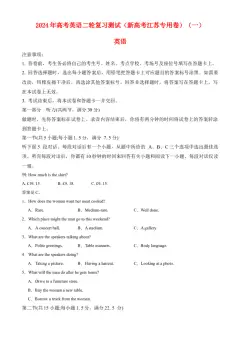
2024 年高考英语二轮复习测试(新高考浙江专用卷)(一)
英语(全析全解)
注意事项:
1. 答卷前,考生务必将自己的考生号、姓名、考点学校、考场号及座位号填写在答题卡上。
2. 回答选择题时,选出每小题答案后,用铅笔把答题卡上对应题目的答案标号涂黑。如需要
改动,用橡皮擦干净后,再选涂其他答案标号。回答非选择题时,将答案写在答题卡上。写
在本试卷上无效。
3. 考试结束后,将本试卷和答题卡一并交回。
第一部分 听力(共两节,满分30分)
做题时,先将答案标在试卷上。录音内容结束后,你将有两分钟的时间将试卷上的答案转涂
到答题卡上。
第一节(共5小题;每小题1. 5分,满分 7. 5分)
听下面5 段对话。每段对话后有一个小题,从题中所给的 A、B、C三个选项中选出最佳选
项。听完每段对话后,你都有10秒钟的时间来回答有关小题和阅读下一小题。每段对话仅读
一遍。
例: How much is the shirt?
A. £19. 15. B. £9. 18. C. £9. 15.
答案是C。
1.Why does the man refuse the cola?
A.He dislikes the taste. B.He needs to lose weight. C.He doesn’t want to be sleepless.
2.Who left the water on in the bathroom?
A.Sam. B.Jenny. C.Mom.
3.When will David hand in the paper?
A.On April 21st. B.On April 22nd. C.On April 23rd.
4.Where probably is the woman?
A.At an airport B.In the street. C.In a mall.
5.What will the woman do next?
A.Meet Andrew. B.Have her car fixed. C.See her grandparents.
第二节(共15小题;每小题1. 5分,满分22. 5 分)听下面5段对话或独白。每段对话或独白后有几个小题,从题中所给的 A、B、C三个选项
中选出最佳选项。听每段对话或独白前,你将有时间阅读各个小题,每小题 5秒钟;完后,各
小题给出5 秒钟的作答时间。每段对话或独白读两遍。
听第6段材料,回答第6、7题。
6.What’s the relationship between the speakers?
A.Husband and wife. B.Colleagues. C.Friends.
7.What can we know about the man’s website?
A.It’s an idea-sharing website. B.It’s used for fun. C.It’s a finished
website.
听第7段材料,回答第8至10题。
8.What is the man?
A.A driver. B.A librarian. C.An applicant.
9.What is needed to borrow a book?
A.A deposit. B.Any identification. C.A driving test.
10.What does the man mean in the end?
A.He misunderstood the woman.
B.He can make an exception.
C.He will stick to the rules.
听第8段材料, 回答第11至13题。
11.For what occasion does the woman make the cake?
A.A festival. B.A wedding. C.A birthday.
12.What does the man put in the cake mix?
A.Lemonade. B.Apple juice. C.Bread crumbs.
13.What will the speakers do next?
A.Bake the cake. B.Taste the cake mix. C.Put some salt in the cake.
听第9段材料,回答第14至17题。
14.What will Edward be responsible for?
A.Doing online marketing. B.Organizing the musicians. C.Sending
out the invitations.
15.What is the woman going to do first?
A.Draw the posters. B.Make the guest list. C.Design the invitations.16.Who will be in charge of making the room reservations?
A.Nancy. B.John. C.Tim.
17.Where is Nancy now?
A.In a hotel. B.On a train. C.In the hospital.
听第10段材料,回答第18至20题。
18.What’s the main reason for students starting businesses?
A.To realize their career potential.
B.To meet the need of making money.
C.To gain better development chances.
19.How many students learn business-starting from student organizations?
A.22.58%. B.17.15% C.28.32%.
20.Why do 32.5% of the students choose to stick in big cities?
A.They see the rapid growth there.
B.They enjoy the convenient traffic.
C.They want to seize the opportunities.
第二部分 阅读(共两节,满分 50分)
第一节(共15小题;每小题2. 5分,满分 37. 5 分)
阅读下列短文,从每题所给的A、B、C、D 四个选项中选出最佳选项。
A
There is no better way to explore the Great Wall in China than by hiking or walking along it. Here we
recommend three most popular hiking routes for you. Take your time and feel the history coming to life.
Route 1: Jinshanling-Simatai (West)
This route is also called Jinshanling Great Wall hiking. It is definitely the best hiking route if you want to see
the original Great Wall. It includes some ruined sections as well as some breathtaking scenery with the Wall
snaking along the mountain ridges into the distance.
Distance from Beijing: 1.5 hours by road Wall conditions: half ruined
Time needed: about 3 hours on the Wall Length: 5 kilometers
Difficulty:****Route 2: Mutianyu-Simatai
Mutianyu is the best fully restored section of the Great Wall with convenient access from Beijing. Simatai is
the most spectacular wild section of the Wall but this route is the most visitor-friendly. An overnight stay in a hotel
at Gubei Water Town will allow you to have a relaxing tour of the Simatai Great Wall section.
Distance from Beijing: 5 hours by road Wall conditions: totally ruined
Time needed: two days Length: 10 kilometers
Difficulty: ***
Route 3: Jiankou-Mutianyu (Wild Hike)
The experience will be extraordinary. When you reach the mountain ridges, you have conquered the most
challenging Great Wall section. What's more, there are no crowds around you-it's just you, the mountains, the
ruined wall, your guide, and the history behind these ancient ruins.
Distance from Beijing: 2. 5 hours by road Wall conditions: partly ruined
Time needed: about 4 hours on the Wall Length: 7 kilometers
Difficulty: *****
If you love a hiking trip with pleasant surprises and no disappointments, just pick one from the above routes.
21.What elements are included in the above three routes?
A.Equipment and scenery. B.Length and ticket prices.
C.Distance and time needed. D.Time and weather conditions.
22.Why is Route 2 the most suitable one for elderly visitors?
A.It includes a night’s stay to relax. B.It covers the most original section.
C.It offers a full view of the Great Wall. D.It provides best sites for taking photos.
23.Where is this text probably taken from?
A.A novel. B.A brochure. C.A course plan. D.A book review.
B
I keep remembering odd things: the way she loved daffodils, jokes she told at the dinner table, the look in hereyes when she talked about my future. I knew about college before I’d never heard of high school was Mom’s
second chance at the degree she never had.
Her parents pushed her too much, too hard, and she always wished she hadn’t let the pressure defeat her. She
dropped out of college after one term for marriage and a secretarial job. While she never regretted marrying my
father, she always regretted giving up her dream of becoming an accountant. She was determined her eldest
daughter would never miss an opportunity.
One of the most extremely special times of my life was Christmas in my second school year, when I played
Tiny Tim in a local community theater production of “A Christmas Carol.” Mom delighted in my endless rehearsal
stories and spent hours helping me work out ways of disguising my long hair. There’s a line in the show: “And it
was always said of him that he knew how to keep Christmas well, if any man alive possessed the knowledge.”
Change the pronouns and that sentence describes Mom perfectly.
She was the one person I could talk to about anything. She was right about so much, so often—much more
than I gave her credit for at the time.
I never imagined she wouldn’t be here now. I never thought cancer could strike so quickly, could kill someone
so strong and determined in only a year. She’s the one person I couldn’t imagine living without; now, since last
January, I’ve had to. Suddenly, I have no one to talk to about meaningless little things, no one whose advice I trust
completely to help me with decisions. When I come home from school, I come home to an empty house, troubled
by memories of the year she spent here dying. I remember the disastrous Thanksgiving when she was feeling
terrible, and our wonderful last Christmas Eve together.
What I feel cheated of is the future we’ll never have.
24.What can be learned about the author’s mother in Paragraph 2?
A.She gave in to her parents. B.She had an obedient daughter.
C.She fell in love with her husband in college. D.She wished her kids to follow her example.
25.What made the Christmas in the author’s second school year special?
A.Her rehearsal stories. B.Her mother’s company.
C.Her favorite line from the show. D.Her mother’s skills in doing hair.
26.What does the author think of her mother?
A.Clever and passionate. B.Caring and humorous.
C.Supportive and reliable. D.Talented and hard-working.
27.What is the author’s purpose of writing the passage?A.To show her mother’s great sadness. B.To tell anecdotes about her mother.
C.To talk about the cruelty of the disease. D.To share fond memories of her mother.
C
The dog is moving through the grass, closely followed by bear biologist Carrie Hunt, who is observing his
reactions as he sees the grizzly bear carcass (尸体) for the first time. “Find it, ” says Hunt, encouraging the two-
month-old puppy. The puppy’s ears and tail are up as he approaches the bear, but with the confidence that Hunt is
looking for in a bear conflict dog.
This is a Karelian bear dog, a type of animal known to be fearless and capable of standing up to large
mammals. People once used them to hunt. Today, Hunt is using them to keep bears alive.
Karelian puppies undergo a series of procedures where trainers teach them the right behaviours and evaluate
their personality and how they react. Just 20% will make the cut as bear conflict dogs. When ready, they are
distributed across North America-for example, working with the Alaska fire service to keep firefighters safe and
reduce the number of bears killed.
In America, bears live in landscapes where the human footprint is expanding. Consequently, people and
predators (捕食性动物) are forced to share space, setting the stage for increased conflicts. Historically, wildlife
managers tried to scare bears away with noise makers and rubber bullets (子弹), but that did not always work. Now
the wildlife department is employing dogs. When a bear dares to come too close, the dogs chase it away in a brief
pursuit. “For the bear, it is a bad experience, ” Hunt says. Bears are born to be wary of animals of the dog family as
wolves can kill their babies. The lesson taught by the dogs is one that the bears seem to remember. A study found
that bears that had encounters with bear dogs spent less time in urban areas.
“The dogs make me a better biologist because they allow me to keep bears in the landscape as long as I
possibly can, rather than having to kill and remove them, ” Hunt says.
28.What do you think of the dog from his reaction at the first sight of the carcass?
A.Observant and aggressive.
B.Mindful but fearful.
C.Determined and skilled.
D.Cautious but brave.
29.What do we know about the training?
A.It starts with dogs recognizing bear carcasses.
B.A very small percentage survives the selection.C.Personality tests really weigh the most heavily.
D.Firefighters teamed with dogs further the training.
30.What do the underlined words “be wary of” most probably mean?
A.Be watchful of. B.Be ashamed of.
C.Be envious of. D.Be fond of.
31.What is the purpose of training the bear conflict dogs?
A.To keep more bear dogs alive.
B.To evaluate the training procedures.
C.To train would-be biologists.
D.To resolve human-animal conflicts.
D
One of the biggest challenges that traditional educators face is how to unlock students’ love of learning. Once
students overcome their fear or unwillingness, they will be on the track of becoming motivated learners.
In order to help students discover the joy in learning, some teachers are turning to a simple but effective
strategy called gamification-using game-related elements such as activities and rewards to promote students’
engagement in class. With an origin in educational psychology, this approach is designed to reach students by
making the learning process funny and interesting.
What’s more, researches show that gamification can also make assignments less stressful. Without too much
pressure, students will associate learning with curiosity and joy. Accordingly, they feel like continuing the journey
because positive feelings have boosted their confidence.
But like any other strategies, gamification has its drawbacks when used incorrectly. It is very likely that some
students only focus on winning rewards but have no interest in understanding concepts or learning new skills-
exactly the opposite of the desired outcome. To avoid this, teachers can help prevent students from becoming
wrongly motivated by choosing suitable rewards. Instead of class parties or snacks, try rewards that help students
develop a passion for academic subjects.
For example, have students earn points towards a class field trip by behaving and doing their assignments, or
pair subjects that a student dislikes with fun books or activities to encourage motivation. That way, they associate
fun with reading, math, or other skills. More examples include competing on a leader-board, holding a talent show,
or playing other team-building games. All activities and rewards need to be carefully selected and well arranged.
If you’re having a hard time getting your class interested in learning, talk with them together or individuallyabout what motivates them and include it into your student engagement strategies.
32.What can we learn about gamification from the first two paragraphs?
A.It improves students' critical thinking.
B.It advocates a traditional teaching style.
C.It motivates students to be active learners.
D.It promotes the use of video games in class.
33.What is the author's attitude to the application of gamification?
A.Favorable. B.Worried. C.Doubtful. D.Objective.
34.How should teachers avoid the drawbacks of gamification?
A.Set learning goals for different students.
B.Associate learning process with assignments.
C.Encourage teamwork by holding class parties.
D.Select suitable rewards for teaching activities.
35.What is the text mainly about?
A.The analysis of a teaching strategy.
B.The future influences of gamification.
C.A discovery about motivating learners.
D.Recent research on education system.
第二节(共5小题;每小题2.5分,满分12.5分)
阅读下面短文,从短文后的选项中选出可以填入空白处的最佳选项。选项中有两项为多余选
项。
A March 2023 report from Goldman Sachs estimated that AI could do a quarter of all the work currently done
by humans. 36 It would not just happen to individuals, but it could be pretty systemic.
37 There are still things AI isn’t capable of. There are generally three categories that are probably
going to be relatively secure in the foreseeable future. 38 That means you’re not doing formulaic work, but
generating new ideas. For example, in science, medicine and law, where your job is coming up with a new legal
strategy or business strategy, there’s going to continue to be a place for human beings.
The second category is jobs that require complicated interpersonal relationships like nurses, business
consultants and investigative journalists. These are jobs where you need a very deep understanding of people. 39
The third safe zone are jobs that really require lots of mobility and problem-solving ability in unpredictable
environments. Electricians, plumbers, and the like all fall under this umbrella, where you’re dealing with a newsituation all the time. They are probably the hardest of anything to automate.
It’s important to note that an advanced education is not a defence against AI takeover. In many cases, more
educated workers are going to be more threatened than then even the least educated workers. 40 It’s really
hard to automate that job.
In short, seeking roles in dynamic, shifting environments that include unpredictable tasks is good way to avoid
job loss to AI.
A.And that could be terrible.
B.Thankfully, it’s not all bad news.
C.The robots really are coming for some jobs.
D.The first would be jobs that are genuinely creative.
E.Think of the person that works cleaning hotel rooms.
F.That doesn’t necessarily mean all jobs that are considered ”creative” are safe.
G.It’ll be a long time before AI has the ability to really build relationships and interact.
第三部分 语言运用(共两节,满分30分)
第一节 (共15小题;每小题1分,满分15分)
阅读下面短文,从每题所给的A、B、C、D四个选项中选出最佳选项。
One day, I was standing on the boat when a very large female leopard seal swam by. I put on my diving gear
and got my camera. I was 41 . My mouth was dry. At first, I couldn’t even move. But I knew it was time
to 42 this mysterious creature.
I jumped into the freezing water. Immediately, the seal swam toward me. Then she put my entire camera—and
much of my 43 — into her mouth. Although the seal was putting me at risk, I tried not to 44
any fear. After a few seconds, she let go of my head. She 45 me a few more times and swam away. Then
she 46 with a live penguin. She even tried to show me how to 47 it. She tried to push the
penguin into my camera — she thought the camera was my 48 ! The seal thought I was just another large
animal, and she was trying to 49 me, I realized.
By now, she didn’t seem very 50 . She stayed by me for four days. One time, she noticed another
leopard seal 51 behind me. She made a deep, threatening sound and 52 the other seal away.
Those four days were the most incredible experience I ever had as a wildlife 53 . I got some amazing
pictures. I also learned that animals do not always behave the way we 54 . My relationship with this
powerful and 55 animal will stay with me forever.41.A.enthusiastic B.amused C.frightened D.cautious
42.A.rescue B.approach C.hunt D.treat
43.A.head B.leg C.neck D.body
44.A.arouse B.feel C.overcome D.reveal
45.A.threatened B.attacked C.confused D.disturbed
46.A.communicated B.disappeared C.competed D.returned
47.A.eat B.digest C.injure D.seize
48.A.eyes B.mouth C.stomach D.nose
49.A.adopt B.discipline C.feed D.observe
50.A.dangerous B.powerful C.gentle D.sensitive
51.A.come back B.come across C.come up D.come over
52.A.directed B.drove C.waved D.took
53.A.painter B.manager C.photographer D.advocate
54.A.work B.demand C.react D.expect
55.A.accessible B.intelligent C.anxious D.primitive
第二节(共10小题;每小题1.5分,满分15分)
阅读下面短文,在空白处填入1个适当的单词或括号内单词的正确形式。
Long Chenchen, the mascot for China’s upcoming Dragon Spring Festival Gala, 56 (release) recently,
with a lot of design details showing the aesthetics of Chinese cultural elements.
57 (celebrate) the year 2024, “Long Chenchen” has been designed as a cute yet lively dragon, colored
orange and red and with a pair of doll eyes. The 58 (seem) cute-looking dragon takes inspiration from
Chinese archaeological discoveries. The design of its nose was inspired by a dragon-shaped jade item that was
discovered in the Erlitou Ruins, 59 major site in Luoyang, Central China’s Henan province that witnessed
the rise and fall of the Xia and Shang dynasties. The fire shape pattern on its shoulder was inspired by a bronze
piece with cloud patterns dating back to the Spring and Autumn Period, 60 multiple materials appeared and
social changes were underway.
61 receiving many likes, the mascot has also sparked criticism. Some netizen doubt the dragon
character might have been synthesized (合成) by artificial intelligence. 62 (admit) that it has some
“imperfections”, CMG, a design studio said it was created by designers “one stroke after another” and that “all the
details about the dragon, including its patterns, colors and face, have been revised by designers through a lot ofversions.”
Along with such verbal 63 (explain), a short video showing the design team working on the mascot
has been posted on Sina Weibo by CMG. The media group’s response to the character’s design has become a 64
(trend) topic on Sina Weibo and has been viewed by more than 200 million netizen. “ 65 it was created by
AI or human beings, I think the mascot has successfully delivered the spirit of the dragon.” one netizen posted on
Sina Weibo.
第四部分 写作(共两节,满分40分)
第一节 (满分15分)
假定你是李华,打算参加你校即将举办的主题为“用英语讲中国故事”的演讲比赛。请你写一篇演讲稿。
内容包括:
1. 介绍你要讲的中国故事;
2. 你喜欢它的原因。
注意:
1. 词数80左右;
2. 可适当增加细节,以使行文连贯。
____________________________________________________________________________________________
____________________________________________________________________________________________
____________________________________________________________________________________________
____________________________________________________________________________________________
______________________________________________________________________________________
第二节 (满分25分)
阅读下面材料,根据其内容和所给段落开头语续写两段,使之构成一篇完整的短文。
Sara Savick remembers one special Easter when she was nine years old. Her parents gave her a baby duckling
in a yellow basket.
“Mom said later that she bought the little duck because she felt sorry for it,” recalled Sara. The people at the
pet store colored the feathers pink for Easter. Sara named the duck Pinky.
Sara’s mother really didn’t think the baby duck would survive very long. But to her surprise, Pinky grew and
got stronger and stronger. Soon, the little duckling was a healthy, hungry duck with white feathers.
“We fed Pinky oatmeal, cooked and uncooked, and small pieces of vegetables,” said Sara. Pinky lived inside
the house with Sara and her family. She specially fancied taking baths with Sara. Everyone treated Pinky as afamily member.
But just when everything appeared to be perfect, the night of the “talk” came. Sara’s Mom and Dad sat her
down, explaining that the best thing for Pinky was to live a normal duck life, with other ducks. It was not natural
for ducks to live indoors with a family, her father told her. He added Pinky needed to swim in ponds and do all the
same things that ducks in the wild do.
Sara started to cry, knowing what was going to happen. Sara’s parents decided to take Pinky to a park, which
was two miles away. There was a pond with a lot of other ducks. Pinky would have the chance to live a natural life
and Sara could still visit her.
The big day came, Sara and her parents put Pinky in a box and drove to the park. Sara said that Pinky did not
look happy; maybe Pinky was convinced that she was a human, not a duck.
注意:
所续写短文的词数应为 l50 左右;
续写部分分为两段,每段的开头语已为你写好;
Paragraph 1
Everyone was sad when they left Pinky at the pond, even Sara’s father.
____________________________________________________________________________________________
______________________________________
Paragraph 2
The next morning, when looking out of the kitchen window, Sara couldn’t believe her eyes!
____________________________________________________________________________________________
_______________________