第 14 讲 动词时态之一般时
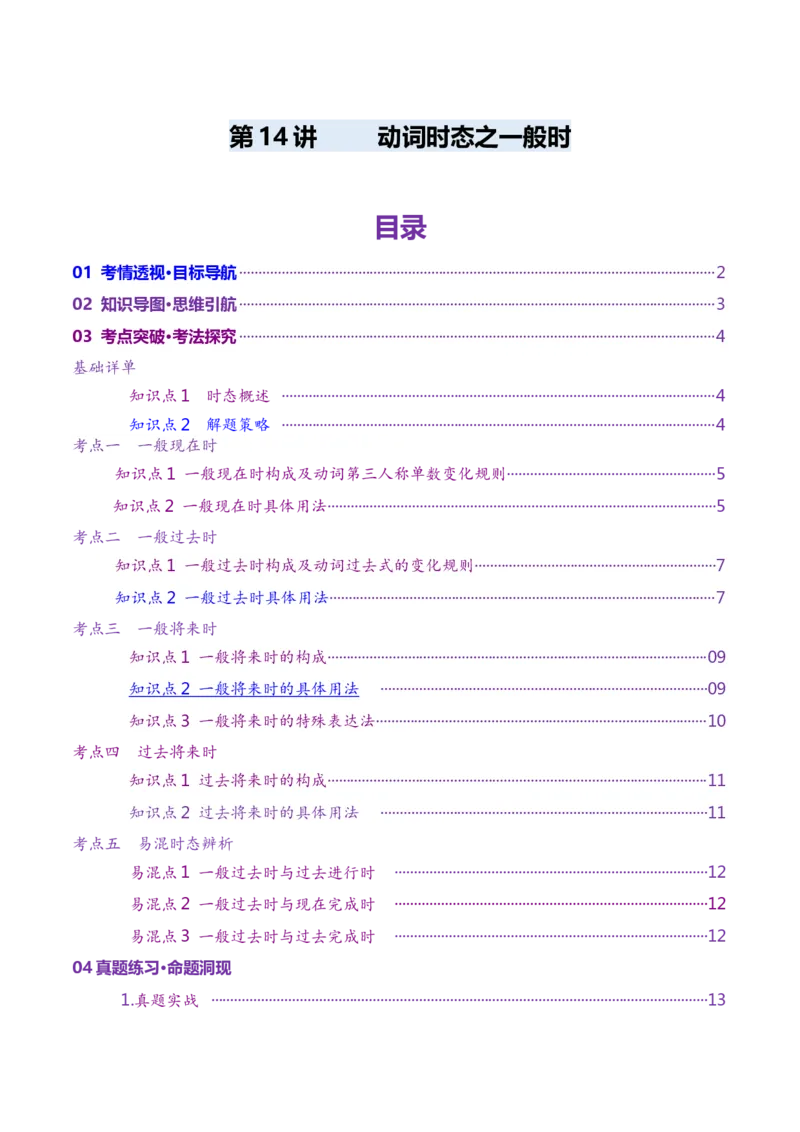
目录
01 考情透视·目标导航····························································································································2
02 知识导图·思维引航····························································································································3
03 考点突破·考法探究····························································································································4
基础详单
知识点1 时态概述 ·················································································································4
知识点2 解题策略 ·················································································································4
考点一 一般现在时
知识点1 一般现在时构成及动词第三人称单数变化规则······················································5
知识点2 一般现在时具体用法·····································································································5
考点二 一般过去时
知识点1 一般过去时构成及动词过去式的变化规则·······························································7
知识点2 一般过去时具体用法·····································································································7
考点三 一般将来时
知识点1 一般将来时的构成···································································································09
知识点 2 一般将来时的具体用法 ·····················································································09
知识点3 一般将来时的特殊表达法······················································································10
考点四 过去将来时
知识点1 过去将来时的构成···································································································11
知识点2 过去将来时的具体用法 ·····················································································11
考点五 易混时态辨析
易混点1 一般过去时与过去进行时 ·················································································12
易混点2 一般过去时与现在完成时 ·················································································12
易混点3 一般过去时与过去完成时 ·················································································12
04真题练习·命题洞现
1.真题实战 ·································································································································132.命题演练 ·································································································································13
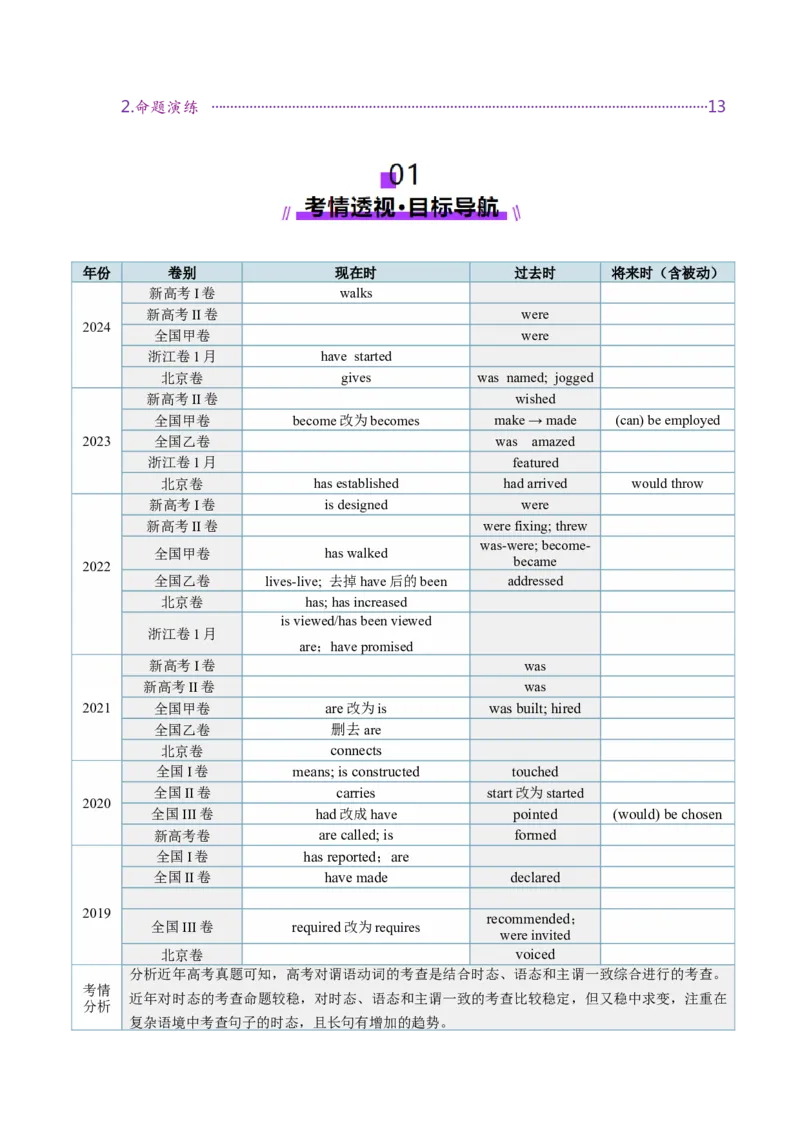
年份 卷别 现在时 过去时 将来时(含被动)
新高考I卷 walks
新高考II卷 were
2024
全国甲卷 were
浙江卷1月 have started
北京卷 gives was named; jogged
新高考II卷 wished
全国甲卷 become改为becomes make → made (can) be employed
2023 全国乙卷 was amazed
浙江卷1月 featured
北京卷 has established had arrived would throw
新高考I卷 is designed were
新高考II卷 were fixing; threw
was-were; become-
全国甲卷 has walked
became
2022
全国乙卷 lives-live; 去掉have后的been addressed
北京卷 has; has increased
is viewed/has been viewed
浙江卷1月
are;have promised
新高考I卷 was
新高考II卷 was
2021 全国甲卷 are改为is was built; hired
全国乙卷 删去are
北京卷 connects
全国I卷 means; is constructed touched
全国II卷 carries start改为started
2020
全国III卷 had改成have pointed (would) be chosen
新高考卷 are called; is formed
全国I卷 has reported;are
全国II卷 have made declared
2019
recommended;
全国III卷 required改为requires
were invited
北京卷 voiced
分析近年高考真题可知,高考对谓语动词的考查是结合时态、语态和主谓一致综合进行的考查。
考情
近年对时态的考查命题较稳,对时态、语态和主谓一致的考查比较稳定,但又稳中求变,注重在
分析
复杂语境中考查句子的时态,且长句有增加的趋势。【复习目标】
1. 系统复习并掌握时态的基本知识
2. 熟练运用各种时态尤其是一般现在时、一般过去式和现在完成时。
3. 掌握几种易混时态的区别。
4. 强化在复杂语境中辨别时态的能力。
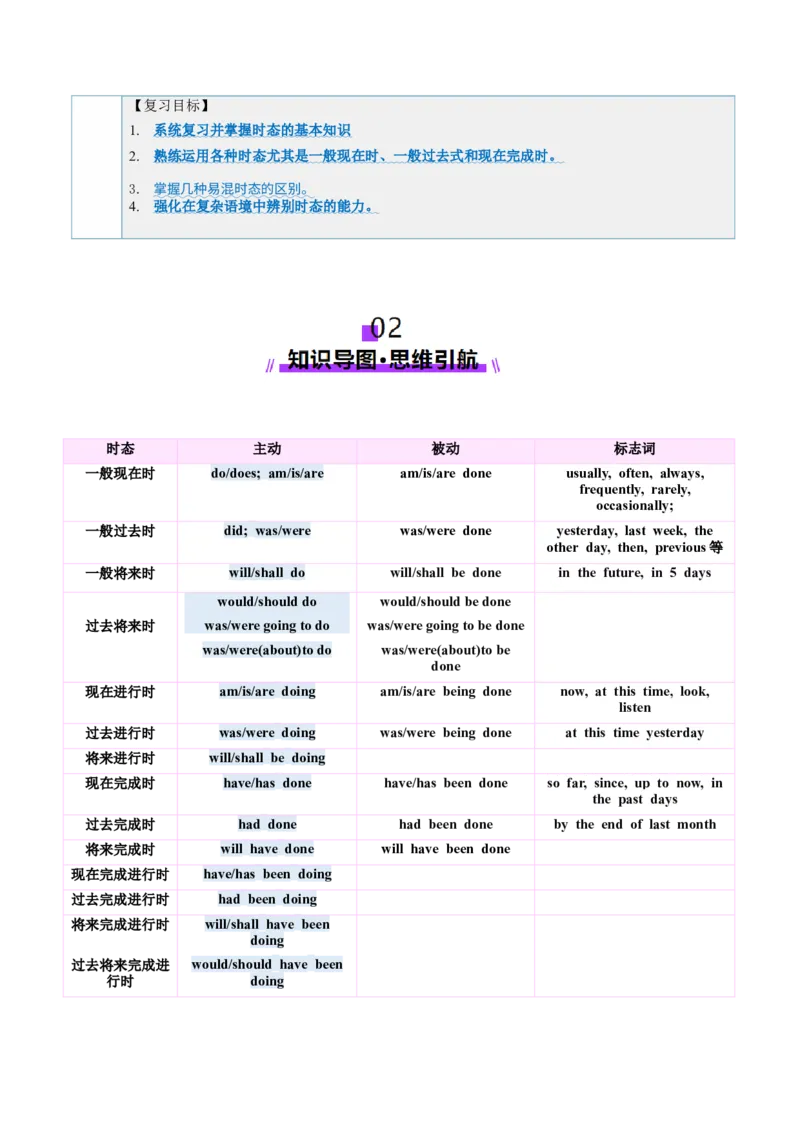
时态 主动 被动 标志词
一般现在时 do/does; am/is/are am/is/are done usually, often, always,
frequently, rarely,
occasionally;
一般过去时 did; was/were was/were done yesterday, last week, the
other day, then, previous等
一般将来时 will/shall do will/shall be done in the future, in 5 days
would/should do would/should be done
过去将来时 was/were going to do was/were going to be done
was/were(about)to do was/were(about)to be
done
现在进行时 am/is/are doing am/is/are being done now, at this time, look,
listen
过去进行时 was/were doing was/were being done at this time yesterday
将来进行时 will/shall be doing
现在完成时 have/has done have/has been done so far, since, up to now, in
the past days
过去完成时 had done had been done by the end of last month
将来完成时 will have done will have been done
现在完成进行时 have/has been doing
过去完成进行时 had been doing
将来完成进行时 will/shall have been
doing
过去将来完成进 would/should have been
行时 doing【基础详单】
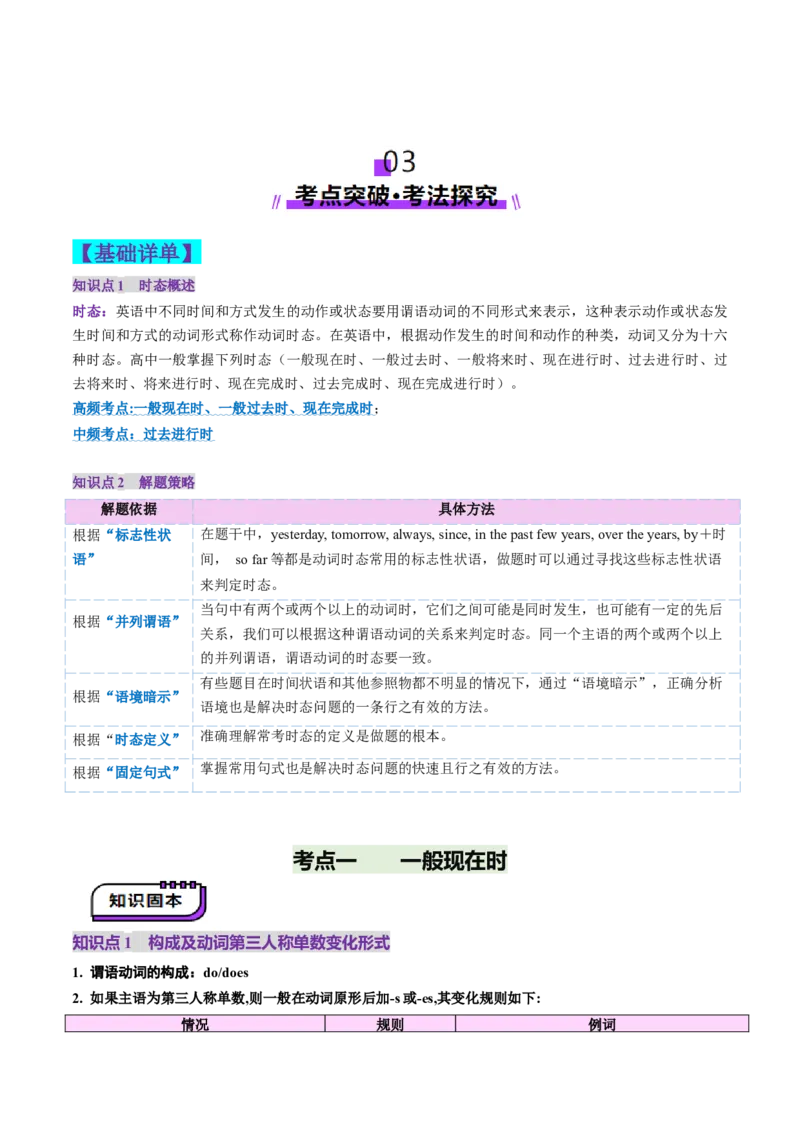
知识点1 时态概述
时态:英语中不同时间和方式发生的动作或状态要用谓语动词的不同形式来表示,这种表示动作或状态发
生时间和方式的动词形式称作动词时态。在英语中,根据动作发生的时间和动作的种类,动词又分为十六
种时态。高中一般掌握下列时态(一般现在时、一般过去时、一般将来时、现在进行时、过去进行时、过
去将来时、将来进行时、现在完成时、过去完成时、现在完成进行时)。
高频考点 : 一般现在时、一般过去时、现在完成时 ;
中频考点:过去进行时
知识点2 解题策略
解题依据 具体方法
根据“标志性状 在题干中,yesterday, tomorrow, always, since, in the past few years, over the years, by+时
语” 间, so far等都是动词时态常用的标志性状语,做题时可以通过寻找这些标志性状语
来判定时态。
当句中有两个或两个以上的动词时,它们之间可能是同时发生,也可能有一定的先后
根据“并列谓语”
关系,我们可以根据这种谓语动词的关系来判定时态。同一个主语的两个或两个以上
的并列谓语,谓语动词的时态要一致。
有些题目在时间状语和其他参照物都不明显的情况下,通过“语境暗示”,正确分析
根据“语境暗示”
语境也是解决时态问题的一条行之有效的方法。
根据“时态定义” 准确理解常考时态的定义是做题的根本。
掌握常用句式也是解决时态问题的快速且行之有效的方法。
根据“固定句式”
考点一 一般现在时
知识点1 构成及动词第三人称单数变化形式
1. 谓语动词的构成:do/does
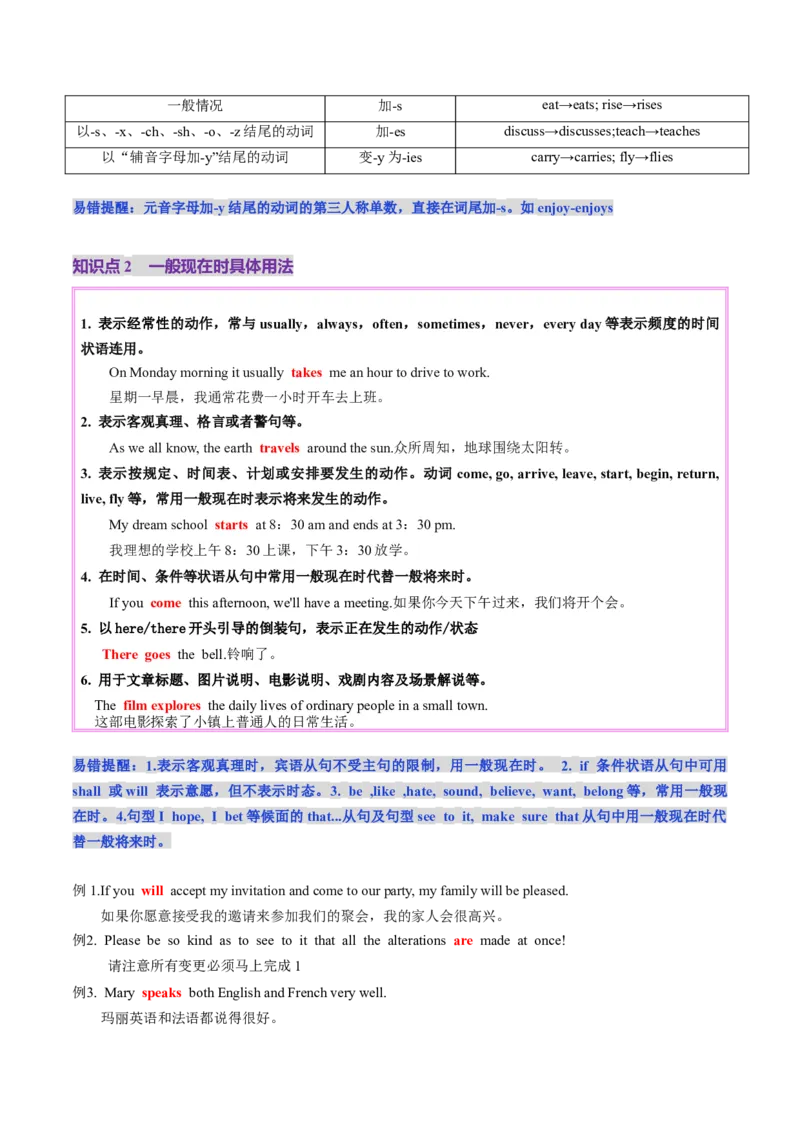
2. 如果主语为第三人称单数,则一般在动词原形后加-s或-es,其变化规则如下:
情况 规则 例词一般情况 加-s eat→eats; rise→rises
以-s、-x、-ch、-sh、-o、-z结尾的动词 加-es discuss→discusses;teach→teaches
以“辅音字母加-y”结尾的动词 变-y为-ies carry→carries; fly→flies
易错提醒:元音字母加-y结尾的动词的第三人称单数,直接在词尾加-s。如enjoy-enjoys
知识点2 一般现在时具体用法
1. 表示经常性的动作,常与usually,always,often,sometimes,never,every day等表示频度的时间
状语连用。
On Monday morning it usually takes me an hour to drive to work.
星期一早晨,我通常花费一小时开车去上班。
2. 表示客观真理、格言或者警句等。
As we all know, the earth travels around the sun.众所周知,地球围绕太阳转。
3. 表示按规定、时间表、计划或安排要发生的动作。动词 come, go, arrive, leave, start, begin, return,
live, fly等,常用一般现在时表示将来发生的动作。
My dream school starts at 8:30 am and ends at 3:30 pm.
我理想的学校上午8:30上课,下午3:30放学。
4. 在时间、条件等状语从句中常用一般现在时代替一般将来时。
If you come this afternoon, we'll have a meeting.如果你今天下午过来,我们将开个会。
5. 以here/there开头引导的倒装句,表示正在发生的动作/状态
There goes the bell.铃响了。
6. 用于文章标题、图片说明、电影说明、戏剧内容及场景解说等。
The film explores the daily lives of ordinary people in a small town.
这部电影探索了小镇上普通人的日常生活。
易错提醒:1.表示客观真理时,宾语从句不受主句的限制,用一般现在时。 2. if 条件状语从句中可用
shall 或will 表示意愿,但不表示时态。3. be ,like ,hate, sound, believe, want, belong等,常用一般现
在时。4.句型I hope, I bet等候面的that...从句及句型see to it, make sure that从句中用一般现在时代
替一般将来时。
例1.If you will accept my invitation and come to our party, my family will be pleased.
如果你愿意接受我的邀请来参加我们的聚会,我的家人会很高兴。
例2. Please be so kind as to see to it that all the alterations are made at once!
请注意所有变更必须马上完成1
例3. Mary speaks both English and French very well.
玛丽英语和法语都说得很好。典例1.(2024年山东省烟台市高三期中)International Chinese Language Day (fall) on April 20, and
this year a series of celebrations, themed Together for the Future, were held by three different organizations at home
and abroad successfully.
典例2.(福建省龙岩第一中学2023-2024学年高三试题)The park ___ (stretch) across the provinces of
Jilin and Heilongjiang.
变式训练1.(2024届福建省泉州市高中毕业班质量检测) It (include) acupuncture (针灸),
Chinese herbal medicine, tai chi, qigong, tuina, guasha, cupping and so on.
变式训练2.(2024届辽宁省沈阳市浑南区东北育才学校一模试题)Working with a billion-dollar budget, he
combined them to create a work of architecture that can excite visitors as much as the art collection inside
(do).
考点二 一般过去时
知识点1 构成及动词过去式的变化规则
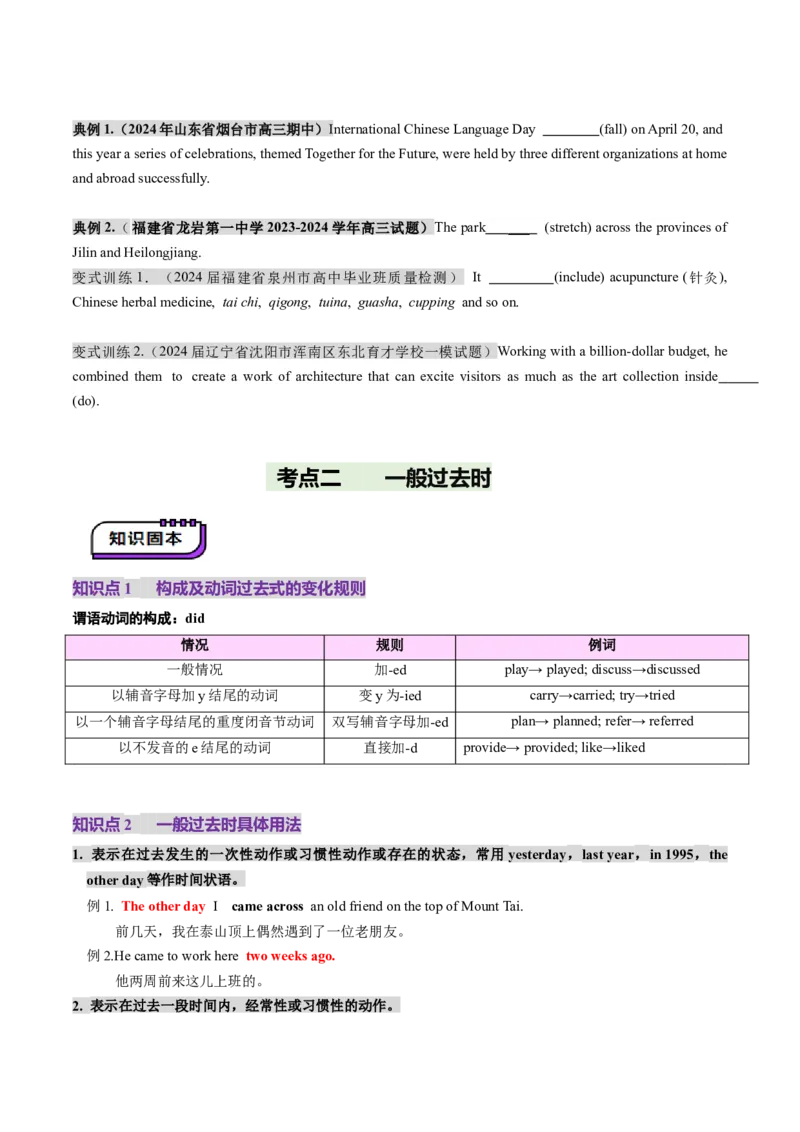
谓语动词的构成:did
情况 规则 例词
一般情况 加-ed play→ played; discuss→discussed
以辅音字母加y结尾的动词 变y为-ied carry→carried; try→tried
以一个辅音字母结尾的重度闭音节动词 双写辅音字母加-ed plan→ planned; refer→ referred
以不发音的e结尾的动词 直接加-d provide→ provided; like→liked
知识点2 一般过去时具体用法
1. 表示在过去发生的一次性动作或习惯性动作或存在的状态,常用yesterday,last year,in 1995,the
other day等作时间状语。
例1. The other day I came across an old friend on the top of Mount Tai.
前几天,我在泰山顶上偶然遇到了一位老朋友。
例2.He came to work here two weeks ago.
他两周前来这儿上班的。
2. 表示在过去一段时间内,经常性或习惯性的动作。例1.When I was a child, I often played football in the street. 我小时候,经常在大街上踢足球。
例2.Whenever the Browns went during their visit, they were given a warm welcome. Brown
妇访问期间,不论走到哪里,都受到了热烈的欢迎。
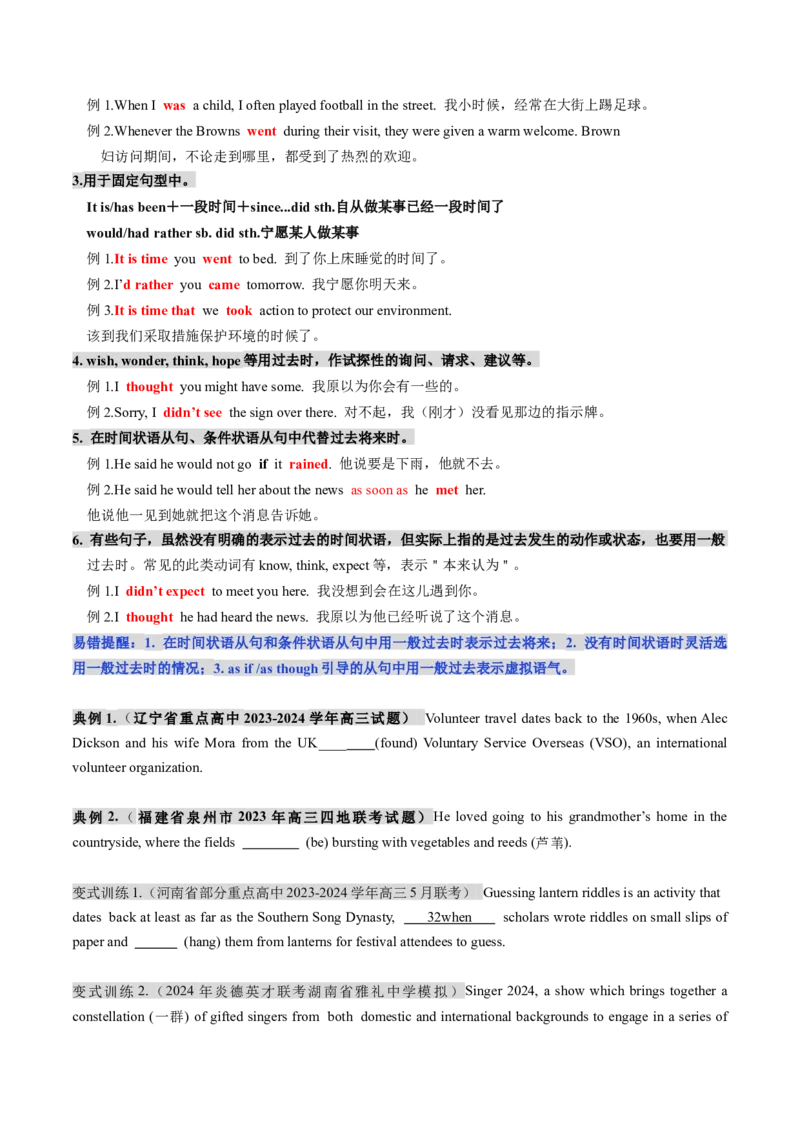
3.用于固定句型中。
It is/has been+一段时间+since...did sth.自从做某事已经一段时间了
would/had rather sb. did sth.宁愿某人做某事
例1.It is time you went to bed. 到了你上床睡觉的时间了。
例2.I’d rather you came tomorrow. 我宁愿你明天来。
例3.It is time that we took action to protect our environment.
该到我们采取措施保护环境的时候了。
4. wish, wonder, think, hope等用过去时,作试探性的询问、请求、建议等。
例1.I thought you might have some. 我原以为你会有一些的。
例2.Sorry, I didn’t see the sign over there. 对不起,我(刚才)没看见那边的指示牌。
5. 在时间状语从句、条件状语从句中代替过去将来时。
例1.He said he would not go if it rained. 他说要是下雨,他就不去。
例2.He said he would tell her about the news as soon as he met her.
他说他一见到她就把这个消息告诉她。
6. 有些句子,虽然没有明确的表示过去的时间状语,但实际上指的是过去发生的动作或状态,也要用一般
过去时。常见的此类动词有know, think, expect等,表示"本来认为"。
例1.I didn’t expect to meet you here. 我没想到会在这儿遇到你。
例2.I thought he had heard the news. 我原以为他已经听说了这个消息。
易错提醒:1. 在时间状语从句和条件状语从句中用一般过去时表示过去将来;2. 没有时间状语时灵活选
用一般过去时的情况;3. as if /as though引导的从句中用一般过去表示虚拟语气。
典例 1.(辽宁省重点高中 2023-2024 学年高三试题) Volunteer travel dates back to the 1960s, when Alec
Dickson and his wife Mora from the UK____ (found) Voluntary Service Overseas (VSO), an international
volunteer organization.
典例 2.(福建省泉州市 2023 年高三四地联考试题)He loved going to his grandmother’s home in the
countryside, where the fields (be) bursting with vegetables and reeds (芦苇).
变式训练1.(河南省部分重点高中2023-2024学年高三5月联考) Guessing lantern riddles is an activity that
dates back at least as far as the Southern Song Dynasty, 32when scholars wrote riddles on small slips of
paper and (hang) them from lanterns for festival attendees to guess.
变式训练 2.(2024 年炎德英才联考湖南省雅礼中学模拟)Singer 2024, a show which brings together a
constellation (一群) of gifted singers from both domestic and international backgrounds to engage in a series ofexcellent performances,_________ (kick) off on May 10, 2024.
考点三 一般将来时
知识点1 一般将来时的构成
谓语动词的构成:
1. will/shall+动词原形
2. be going to+动词原形
3. be to+动词原形
4. be about to do sth.
知识点2 一般将来时具体用法
1.一般将来时表示将来某一时刻的动作或状态,即单纯的将来事实。shall用于第一人称,常被will 所代替。
will 在陈述句中用于各人称,在征求意见时常用于第二人称。
例1.Which paragraph shall I read first? 我先读哪一段呢?
例2.He will graduate from Beijing University next year.
明年,他将毕业于北京大学。
2. be going to do sth.表示计划、打算要做某事或者有预兆要发生某事。
例1.What are you going to do tomorrow? 明天打算作什么呢?
例2.The play is going to be produced next month。这出戏下月开播。
例3.Look at the cloud. It is going to rain.
瞧那乌云,天要下雨了。
3.be to do sth.表示按计划或安排即将要做某事,或者按照职责、义务、规定等要做某事。
例1.We are to obey these rules when we go into the library.
当我们进了图书馆,就要遵守这些规章制度。
4. be about to do sth.表示即将要发生某事。
例1.The train is about to leave.
火车即将开出。
例2.He is about to leave for Beijing.
他马上要去北京。
易错提醒:be about to do 不能与tomorrow, next week 等表示明确将来时的时间状语连用。知识点3 一般将来时的特殊表达法
a. 下列动词come,go,arrive,leave,start,begin,return的一般现在时可以表示将来,主要用来表示
在时间上已确定或安排好的事情。
例1.The train leaves at six tomorrow morning. 火车明天上午六点开。
例2.The train stars in ten minutes. 火车十分钟后发车。
b. 以here,there等开始的倒装句,表示动作正在进行。
例1.Here comes the bus. = The bus is coming. 车来了。
例2.There goes the bell. = The bell is ringing. 铃响了。
c. 在时间或条件句中。
例1.When Bill comes ask him to wait for me. 比尔来后,让他等我。
例2.I’ll write to you as soon as I arrive there. 我到了那里,就写信给你。
易错提醒:when引导的时间状语从句中,用一般现在时代替一般将来时,一般过去时代替过去将来时。
但when引导的别的从句(如名词性从句或定语从句)中正常使用各种时态。
d. 在动词hope,take care that,make sure that等的宾语从句中。
例1. I hope they have a nice time next week.
我希望他们下星期玩得开心。
例2. Make sure that the windows are closed before you leave the room.
离开房间前,务必把窗户关了。
e.用现在进行时表示将来。下列动词come, go, arrive, leave, start, begin, return等现在进行时可以表示将来。
例1.I’m leaving tomorrow. 明天我要走了。
例2.Are you staying here till next week? 你会在这儿待到下周吗?
易错辨析
用于条件句时, The best exercise is one that you enjoy and will do.
will
will表意愿 最好的运动是你喜欢并且愿意做的运动。
用于条件句时, If you are going to make a journey, you’d better get ready for it
be going to
be going to表将来 as soon as possible.
表示客观安排或受人指
be to do I am to play football tomorrow afternoon. (客观安排)
示而做某事
be going to 表示主观的打算或计划 I’m going to play football tomorrow afternoon. (主观安排)
典例1.(2024届辽宁省本溪市高中高三一模试题)Only when we learn to live in harmony with nature __
we stop being a threat to wildlife and to our planet.典例2.(河北省新时代NT教育2023-2024学年高三试题)“Efforts (make) to promote high-level
protection and facilitate the promulgation (颁布) of the National Park Law,” Guan said,adding that China will also
increase the application of new technologies, build a world-class scientific research monitoring platform, and
strengthen national park management capabilities.
变式训练1.I guess most parents (support) the new plan at the meeting tomorrow.
变式训练2.The plan they paid much attention to (discuss) at tomorrow’s meeting.
考点四 过去将来时
知识点1 过去将来时构成
谓语动词的构成: would/should+动词原形
was/were about to+动词原形
was/were doing
was/were to+动词原形
知识点2 过去将来时具体用法
1. 从过去某一时间看将要发生的事情,多用于主从复合句中。
例1.He said he would be here at eight o'clock.他说他将在8点到这里。
例2.I thought it was going to rain.我当时觉得要下雨。
2. 过去本打算做而未做的事情。
例1.I was going to go to the party, but I suddenly remembered I had homework to do.
我本打算要参加聚会,但是我突然记起来我有作业要做。
3. was/were about to do 一般不接时间状语,但可以用于固定句式 was/were about to do +when...表示
“正要做某事,突然......”。
例1. I was about to leave when a friend dropped in.
我正要离开,这时一位朋友来访。
4. go, come leave等动词过去进行时时表将要发生的动作。
例1.I didn’t know he was coming until this morning. 直到今天上午我才知道他要来。考点五 易混时态辨析
知识点1 一般过去时与过去进行时
一般过去时侧重说明过去发生的动作的事实,往往已经完成。过去进行时表示在过去某一时刻正在进行的
动作,侧重强调动作的持续,一般还没有完成。
例1. They built a skyscraper. 他们建了一座摩天大楼。(已经完成)
例2. They were building a skyscraper.他们正在建一座摩天大楼。(没有完成)
例3. He took exercise after he got up.起床后他去锻炼身体了。
例4. He was taking exercise when he met Mr Smith.他在锻炼身体时碰到了史密斯先生。
知识点2 一般过去时与现在完成时
一般过去时侧重说明在过去某个时间发生的事情、存在的状态或经常发生的动作,不强调对现在产生的影
响,常与确定的过去时间状语连用。现在完成时表示发生在过去的动作对现在造成的影响或结果,不与确
定的过去时间状语连用。
例1. He cleaned the room an hour ago, but it’s dirty now.
他一小时前打扫过房间,可是现在房间又脏了。
例2. He has cleaned the room. 他已经打扫房间了。
知识点3 一般过去时与过去完成时
一般过去时是相对现在而言的,过去完成时是相对于过去某一时刻而言的,两种时态建立的时间参照不同。
过去完成时必须又一个过去的时间来衬托,必须是“过去的过去”才可以用过去完成时。
例1. Last week they learned Lesson 6.上周他们学了第六课。
例2. By the end of last week they had learned 3 units.
到上周末为止,他们已经学习了3个单元。
一、 真题实战
1.(2024年新高考I卷语法填空)Further, the Silk Route Garden around the greenhouse ____
____ (walk) visitors through a journey influenced by the ancient Silk Road, by which silk as well as many plant
species came to Britain for the first time.
2.(2024年新高考II卷语法填空)“Some of the things that Tang was writing about ______ (be)alsoShakespeare’s concerns.
3.(2024 年北京卷)My heart went out to him, and I ______ (jog) over to him. As I handed him the glasses, he
looked at me and said, “Thanks!”
4.(2023年浙江卷1月语法填空)The large siheyuan of these high-ranking officials and wealthy businessmen
often______ (feature)beautifully carved and painted roof beams and pillars(柱子).
5.(2023年全国乙卷改错)She put the new color on her hair and sat still for 30 minutes, just as the directions
said.
二、 命题演练
1.(福建省泉州市2023年高三四地联考试题)Deep in a rainforest in Hainan province, Zhang Chenliang picks
up a daddy longlegs (长腿蜘蛛) and (present) it to the camera, explaining its features and living habits
for the benefit of viewers on a short video platform.
2.(福建省泉州市2023年高三四地联考试题)He loved going to his grandmother’s home in the countryside,
where the fields (be) bursting with vegetables and reeds (芦苇).
3.(福建省宁德第一中学2023-2024学年高三检测试题)The choice of “Turret of Palace Museum” as the
theme for the mini building block project (base) on several factors.
4.(河北省新时代NT教育2023-2024学年高三试题)“Efforts (make) to promote high-level
protection and facilitate the promulgation (颁布) of the National Park Law,” Guan said,adding that China will also
increase the application of new technologies, build a world-class scientific research monitoring platform, and
strengthen national park management capabilities.
5.(河北省 2023-2024学年高三全过程纵向评价试题)At first, Minguez (perform) house calls, but
demand increased to the point where he decided to open a practice in his living room. But this, too, soon proved
insufficient to care for all the people coming in and so he went on to set up a clinic.
6.(2023-2024 学年河北省省级联测高三试题)Dingling Tomb, the joint tomb of Zhu Yijun and his two
empresses, ______(be) the first imperial tomb in China to be excavated (发掘) according to the
archaeological plan. The architecture of the underground palace of Dingling Tomb is deep and unique.
7.(2023-2024学年河北省省级联测高三试题) It is called the “Thirteen Ming Tombs” and_____ (list) as a
World Heritage Site in 2003.
8.(江苏省苏州中学校2023-2024学年高三试题) Besides their obvious monetary value, they all carry their
own cultural value as well. For example, on the back of the 5-yuan banknote Taishan Mountain in
Shandong.
9.The remarkable development of this city, which is consciously designed to protect the past while stepping into
the modern world, (mean) there is always something new to discover here, and I could be
photographing Beijing for the next 50 years.
10.Breaking deeply imbedded habitual tendencies such as procrastination, impatience, criticalness, or selfishness
that violate basic principles of human effectiveness (involve) more than a little willpower and a few
minor changes in our lives.