文档文本内容
Unit 1 Art
\s\up7()
本单元的中心话题是西方绘画和中国艺术的历史、中西方各种艺术形式与风格,不同时
代的著名画家以及他们的作品。语言知识的选择和听说读写等语言技能的训练主要围绕
“绘画艺术”这一主题进行。本单元的目的在于帮助学生掌握与“绘画艺术”这一主题有
关的词汇知识,引导学生了解绘画艺术及其各个历史发展时期的不同风格,培养他们对艺术
的兴趣以及理解美、欣赏美、创造美的能力。
本单元的主要教学内容如下表所示:
类别 课程标准要求掌握的内容
话题 A brief history of Western painting and Chinese art;famous artists and works of art
[来源:Z#xx#k.Com] adopt v. 采用;采纳;收养 scholar n. 学者
[来源:学+科+网]
possess v. 拥有;具有;支配 preference n. 喜爱;偏爱
[来[来源源:学:Z科,xx网,k.ZCXoXmK]] attempt v.& n. 尝试;企图 reputation n. 名声;名誉
predict v. 预言;预告;预测 civilization n. 文明;文化
[来源:学,科,网] appeal v. 呼吁,求助 Egypt n. 埃及
词 aim n. 目标;目的 v. 瞄准 district n. 区;区域
汇 typical adj. 典型的;有代表性的 committee n. 委员会
specific adj. 确切的;特定的 signature n. 署名;签字
carve v. 雕刻;刻记 abstract adj. 抽象的;深奥的
sculpture n. 雕塑 conventional adj. 常规的;传统的
gallery n. 画廊;美术陈列室 evident adj. 明显的;明白的
faith n. 信任;信念 superb adj. 卓越的;杰出的
possession n. 所有;财产 ridiculous adj. 荒谬的;可笑的
technique n. 技术;方法;技能 controversial adj. 争论的;争议的
coincidence n. 巧合;相合 delicate adj. 脆弱的;容易生病的
shadow n. 阴影;影子 allergic adj. 过敏性的;对……过敏的
figure n. 画像;身材;数字 aggressive adj. 侵略的;好斗的
clay n. 黏土 fragile adj. 精细的;易碎的
marble n. 大理石 Egyptian adj. 埃及的;埃及人的
cafe n. 咖啡馆;小餐馆 visual adj. 视觉的;看得见的
exhibition n. 展览;陈列;展览会 fragrant adj. 香的;令人愉快的
flesh n. 肉;肉体 contemporary adj. 当代的;同时代的
geometry n. 几何学 permanent adj. 永久的;持久的
bunch n. 束;串 faithfully adv. 忠实地
avenue n. 林荫道;大街
词
a great deal 大量 attempt to do sth. 企图做某事
汇
on the other hand (可是)另一方面 be allergic to 对……过敏
appeal to (对某人)有吸引力 have a preference for 喜欢
make sculptures 制作雕塑 in the flesh 活着的;本人
by coincidence 巧合地
1.If you were an artist,what kind of pictures would you paint?(the subjunctive mood)
2.If the rules of perspective had_not_been_discovered,no one would_have_been able to paint such
realistic pictures.(the subjunctive mood)
句 3.There are scores of modern art styles,but without the Impressionists,many of these painting
型
styles might_not_exist.(the subjunctive mood)
4.Among_the_painters_who broke away from the traditional style of painting were the
Impressionists,who lived and worked in Paris.(inversion)
1功
能
虚拟语气(Subjunctive Mood)(1)(I wish I were/did/could/would...;If I did...,I would do...)
If you could have three of these paintings on the walls of your classrooms,which would you
语
choose?
法
If you were an artist,what kind of pictures would you paint?
Have you ever wished you could paint as well as a professional artist?
1.Get students to know about Western painting and Chinese art,famous artists and works of art.
教 2.Have students learn some useful new words and expressions about painting and art and let them
学 learn effective ways to master them.
重 3.Enable students to grasp and use the expressions of preference.
点 4.Let students learn the new grammar item:the subjunctive mood(1).
5.Develop students' listening,speaking,reading and writing ability.
1.Enable students to master the use of the subjunctive mood.
教学
2.Let students learn to write a letter of suggestion.
难点
3.Develop students' integrative skills.
Periods needed:6
Period 1 Warming Up,Pre-reading,Reading and Comprehending
课
Period 2 Language Study
时
Period 3 Grammar—the Subjunctive Mood(1)
安
Period 4 Listening and Speaking
排
Period 5 Reading and Writing
Period 6 Summing Up,Learning Tip and Assessment
Period 1 Warming Up,
Pre-reading,Reading and Comprehending
\s\up7()
教学内容分析
This is the first teaching period of this unit.The central part of this period is the reading
passage with the name of A Short History of Western Painting showing the students the history of
Western painting.
Warming Up gives students four questions to discuss,aiming at preparing students for both
the content and the grammar of the unit.
Pre-reading provides three questions to help students focus on the topic of the reading
passage and leads the students to think about any personal experiences of Western art they may
have,such as things about art galleries,paintings in galleries,some Western artists and paintings.
Reading mainly introduces the history of Western painting.There are four major movements
in Western art.Social , political and cultural changes contribute to the changes in artistic
styles.There are four pictures of paintings in the passage representing the four major
movements.After a glance at the title of the text and the headlines within it we know that it is a
2historical report,in which there are many time expressions.Then we can know the topic of the text
and how the information is organized—in the order of time,from the earliest to the present.
Comprehending consists of four written or oral exercises for the students to do so as to help
the students to get a better understanding of the text,that is to say,to help the teacher to check
how much the students have understood the text.
三维目标设计
Knowledge and skills
1.To understand the meanings of the following new words and phrases:abstract(抽象的),
sculpture(雕塑),gallery(画廊),faith(信念),aim(目标),conventional(传统的),typical(典型的,
有代表性的),evident(明显的),adopt(采用),possess(拥有),superb(卓越的,杰出的),
possession(财产),technique(技术),by coincidence(巧合地),a great deal(大量),shadow(阴影),
ridiculous(可笑的),controversial(争议的),attempt(尝试;企图),on the other hand(另一方面),
predict(预测).
2.To learn about some major movements in Western art and how art has changed stylistically
over the centuries.
3.To learn how the information is organized.
4.To develop the students' reading ability by skimming and scanning the passage.
5.To develop the students' speaking ability by talking about Western paintings.
Process and methods
1.While doing Warming Up the teacher can lead in the topic of this unit by showing students
some Chinese and Western-style paintings to recall their own knowledge and opinions about
various art forms.Students should also be introduced to the subjunctive mood and try to use it
when talking about the art forms.
2.During Pre-reading the teacher can go around the classroom and discuss the questions
with several students.This discussion should be student-centered and arouse students' interest in
Western painting.The teacher should also ask the students to look at the paintings in the reading
passage and try to identify which style each of them belongs to so as to let them have a general
knowledge of these paintings.
3.While doing Reading and Comprehending,the teacher may first ask the students to read
the text quickly to get the general idea of each paragraph.After reading the passage,students are
encouraged to answer some questions and discuss the text structure.
4.To consolidate the contents of the reading passage,the students should be required to retell
the history of Western art in their own words at the end of the class.
Emotion,attitude and value
1.To stimulate students' sense of beauty and the ability of understanding,enjoying and
creating beauty.
2.To develop students' sense of cooperative learning.
教学重、难点
1.To enable the students to learn about the history of Western art and to develop their
reading ability.
2.To enable the students to talk about Western paintings.
\s\up7()
Step 1 Warming up
1.Warming up by looking and talking
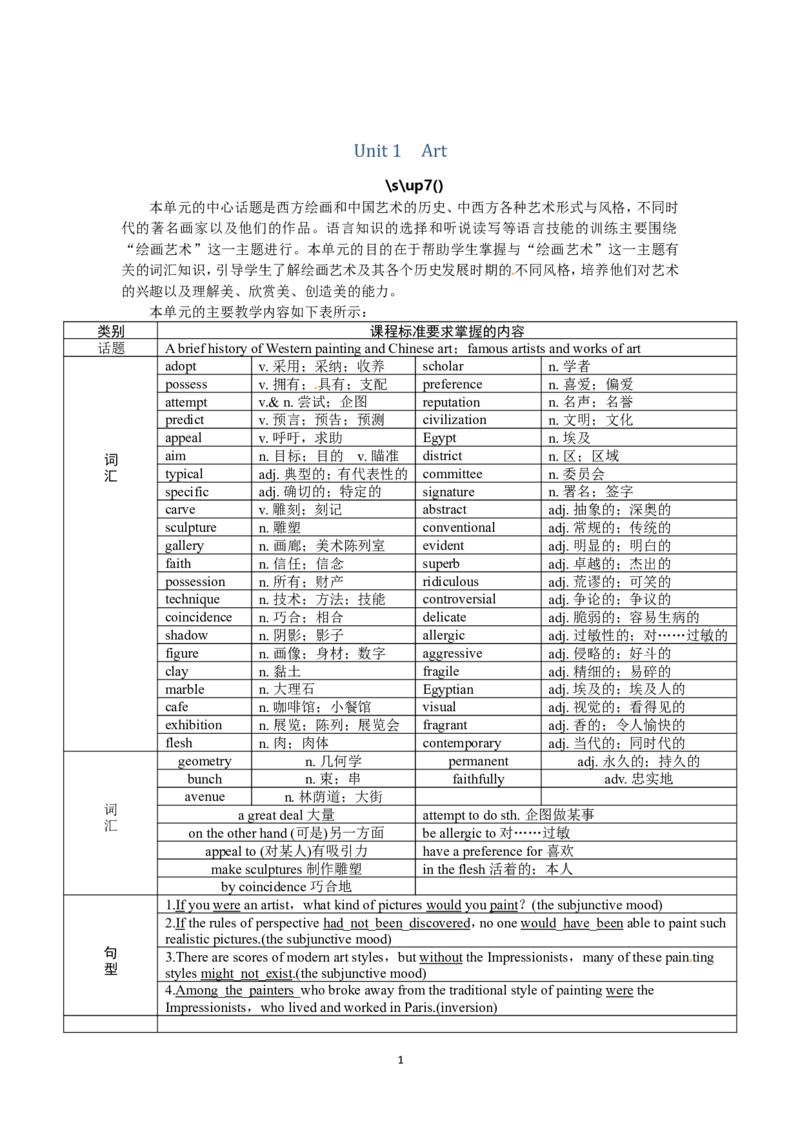
3Show the following paintings to the students and let them find out their favorites and give the
reasons.Then help them find out the differences between the first three pictures and the next three
ones.
Sample expressions:
If I were to choose paintings on the wall,I would choose the first one,because...
If I were an artist,I would paint horses.Because...
2.Warming up by reading the short passage below.
The Chinese have for centuries seen painting as the highest form of art.Chinese paintings
have an air of living nature,harmony and peace that is not always found in the art of other
civilizations.It is entirely different from Western painting,but that difference is hard to grasp and
express.The following are some different forms of art:
Figure painting:It includes portraits,story painting and genre painting(风俗画)with figures
as the main subject.Lines are the key point.
Landscape painting:Chinese landscape paintings can be divided into blue-and-green
landscape,gold-and-green landscape,light-purple-red landscape and water ink landscape
according to the colors used in paintings.The one without outlines is called boneless landscape.
Flower and bird painting:Flowers,rocks and birds are usually the main subjects of this
kind of paintings.Technically,there are detailed style with colors and free style with ink.
Court painting:It refers to the works done by those professional painters employed by the
royal court,or imitations of their works by other painters.
The passage above is about Chinese art forms.With this,the teacher can arouse students'
interest to read the passage about Western painting.
Step 2 Pre-reading
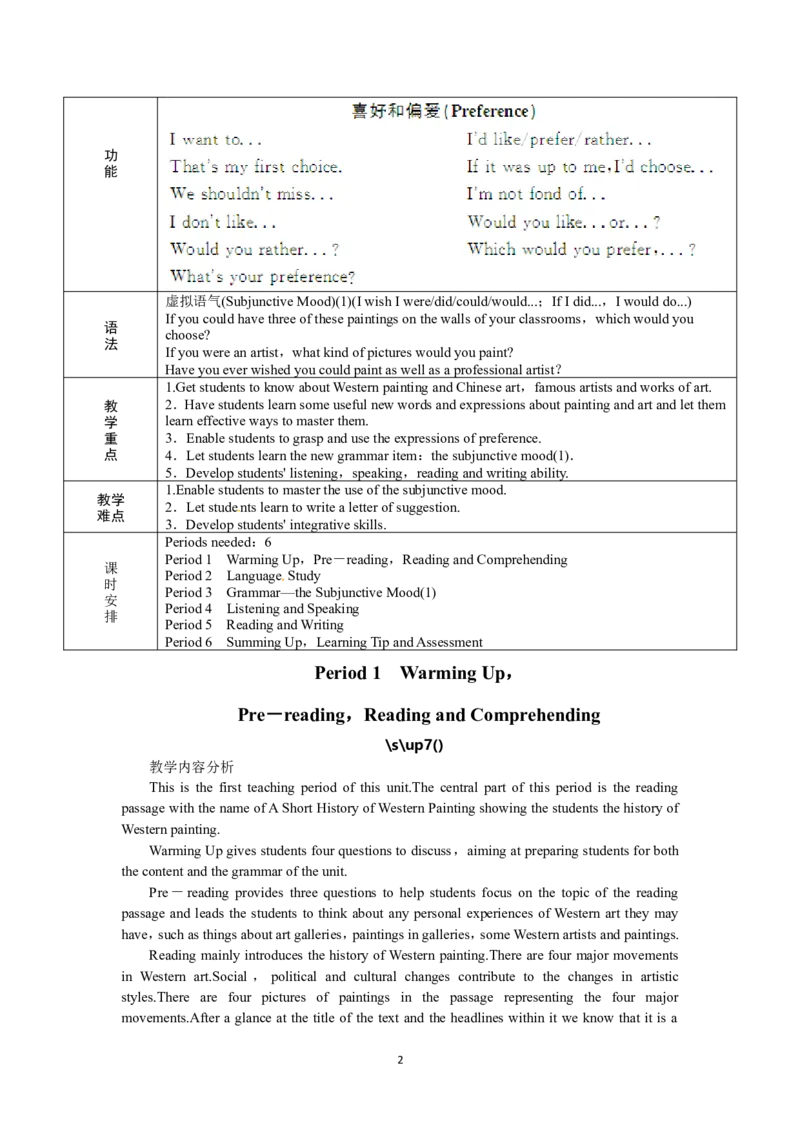
1.Match the paintings and their painters.
Suggested answers: Painting 1:Picasso;Painting 2:Masaccio;Painting 3:Da Vinci;
4Painting 4:Van Gogh
2.Encourage students to talk more about the paintings and the artists.
Keys for reference:Leonardo da Vinci was born in 1452 in the village of Vinci.Leonardo
began his career working for a master painter in Florence.His masterpiece is Mona Lisa.Leonardo
was truly a “Renaissance Man” skilled in many fields.He was a scientist and an inventor as well as
an artist.He made notes and drawings of everything he saw.Leonardo invented clever machines,
and even designed imitation wings that he hoped would let a person fly like a bird.
Step 3 Reading and comprehending
1.Fast-reading
Ask students to skim the passage to get the key words and general idea of each paragraph and
answer the following questions:
(1)What's the main idea of the text?
________________________________________________________________________
(2)How many styles of Western art are mentioned in the text? What are they?
________________________________________________________________________
Suggested answers:
(1)The style of Western art has changed a lot as time goes by.
(2)Four.They are:the Middle Ages,the Renaissance,Impressionism and Modern art.
2.Detailed-reading
(1)Ask students to read the text carefully to get some specific information and fill in the chart
below.
Characteristics of the
Period Main aim of painters Representative artist
paintings
The Middle Ages(5th To represent __①__
Religious,realistic __②__
to 15th century AD) themes
The Renaissance (15th To paint __③__ as Perspective,realistic,
Masaccio
to 16th century) they really were new oil paints
To show how __⑤__
Not detailed,painted
Impressionism(__④__ fell on objects at
outdoors,painted Not mentioned
century) different times of the
changes in light
day
To concentrate on
__⑥__(20th century
certain qualities of the __⑦__,very realistic Not mentioned
to today)
object
(2)Ask students to scan the passage for detailed information and do the following multiple
choices.
①In the Renaissance,painters ______.
A.painted religious scenes in a more realistic style
B.focused more on religion than on humans
C.began to paint outdoors
D.returned to classical Roman and Greek ideas about art
②______ discovered how to make paintings look more real by using perspective.
A.Giotto di Bondone B.Masaccio C.Claude Monet D.Pablo Picasso
③According to the text,art is influenced less likely by ______.
A.social changes B.the way of life
C.agriculture D.beliefs of people
④When did people focus more on people and less on religion?
5A.From 5th to 15th century AD.
B.From 15th to 16th century.
C.From late 19th to early 20th century.
D.From 20th century to today.
⑤Most people hate the Impressionists' style of painting at first because they thought ______.
A.their paintings were very abstract
B.they broke away from the traditional style of painting
C.their paintings were very realistic
D.their paintings were very ridiculous
⑥What does the text mainly tell us?
A.How religious painting developed.
B.How oil painting developed.
C.How Impressionist painting developed.
D.How Western art developed.
(3)Guess which period the following pictures belong to.
Suggested answers:(1)①religious ②Giotto di Bondone ③people and nature ④late
19th to early 20th ⑤light and shadow ⑥Modern Art ⑦Abstract
(2)①D ②B ③C ④B ⑤D ⑥D
(3)Painting 1:the Renaissance;Painting 2:the Middle Ages;Painting 3:Modern Art;
Painting 4:Impressionism
Step 4 Language study
Dealing with any language problems (words or sentences students might not understand)to
help the students to have a better understanding of the text.
Step 5 Listening,reading aloud and underlining
Ask students to read the passage aloud to the tape and let them pay attention to the
pronunciation of each word and the pauses within each sentence.Tell them to pick out all the
useful expressions or collocations from the passage while reading and copy them to the notebook
after class as homework.
Collocations:concentrate on,adopt a humanistic attitude to life,possess sth.,be convinced
that,by coincidence,a great deal,lead to,break away from,attempt to do,on the other hand.
Step 6 Structure analyzing
After reading,ask students to discuss the text structure.
Keys for reference:
This passage is a historical report.The first paragraph introduces the topic and the theme of
the text.The rest of the report presents the information in chronological order.A feature of
historical reports is the abundance of time expressions.The last sentence of the report functions as
a conclusion.In addition,each section begins with a topic sentence.
Step 7 Retelling
6Ask students to talk about the history of Western painting in their own words.Give them
some key words and expressions on the blackboard.Then let them try to retell the passage.
Step 8 Homework
1.Learn the useful new words and expressions in this part by heart.
2.Try to find a book with reproductions of Western paintings or Chinese paintings and
explain what you like or dislike about them.
Step 9 Reflection after teaching
________________________________________________________________________
________________________________________________________________________
________________________________________________________________________
________________________________________________________________________
________________________________________________________________________
________________________________________________________________________
________________________________________________________________________
\s\up7()
Chinese Painting
Chinese painting is generally divided by subject matter into four broad categories:figures,
landscapes,flowers and birds,and bamboo and rocks.The first three categories succeeded each
other in the summits of their developments,while the painting of bamboo and rocks became a
casual pleasure of the educated elite from the 12th century on.Before the Han Dynasty,founded in
202 B.C.,there was already a tradition of figure painting and portraiture of which remnants
survive on later bronzes,jades,and pottery.During the Han Dynasty,the art of depicting figures
became increasingly elaborate.Rulers used didactic art to emphasize codes of
government.Surviving examples of stone engraving and wall painting show strong and lively
drawing.
Landscape
The art of landscape painting formed the central and most standing tradition in Chinese
painting.On a basis of Taoist communion with nature and strengthened by Buddhism,there was a
strong literary tradition of seclusion among,and meditation upon the forests,streams and
mountains.China's landscape painting brought nature's presence to wherever man desired
it.Elements of landscape are already present in art of the Han Dynasty,but development did not
really begin until the Tang Dynasty.
The succeeding Northern Sung Dynasty(960-1127)has often been called the Golden Age of
Chinese Landscape.The differences in approach and technique that naturally appeared became
gradually categorized into traditions:the northern and southern schools.
Birds and Flowers
In the Tang Dynasty at least one painter,Tiao Kuang-yin,was already known as a specialist
in birds and flowers.However,the first two important names in bird and flower painting,Huang
Chuan and Hsu Hsi,occur in the 10th century.Huang Chuan,a subject of the latter Shu Dynasty,
inherited the traditions of the Tang Dynasty.His paintings of flowers and birds were in an
accordingly archaic style,with strict conventions and conservative attention to careful realism.Hsu
His,who lived under the Southern Tang Dynasty created the “boneless” mo-ku style in which
forms are built up with pale washes and outlines are not used.His inspirations were unrestrained
and the school he initiated was considered much the more creative.Mi Fu,the leading literati critic
7of the 11th century remarked that ten paintings by Huang Chuan were not worth one by Hsu
Hsi.Later bird and flower painters generally belonged to either the Huang or the Hsu tradition.
Stones and Bamboo
Stones and bamboo originally appeared as background objects in other types of paintings but
gradually evolved into a separate genre.The 10th century Southern Tang ruler Li Hou-chu
developed a trembling brush technique in calligraphy that was also particularly suitable for
painting bamboo and rocks.Tang Hsi-ya,an artist of the same time,adapted it for that purpose.In
the following Sung Dynasty,the painting of bamboo became more and more popular and many
famous scholars such as Wen T'ung and Su Shih were also well known for their paintings of
bamboo.
8