文档文本内容
Unit 2 Poems
\s\up7()
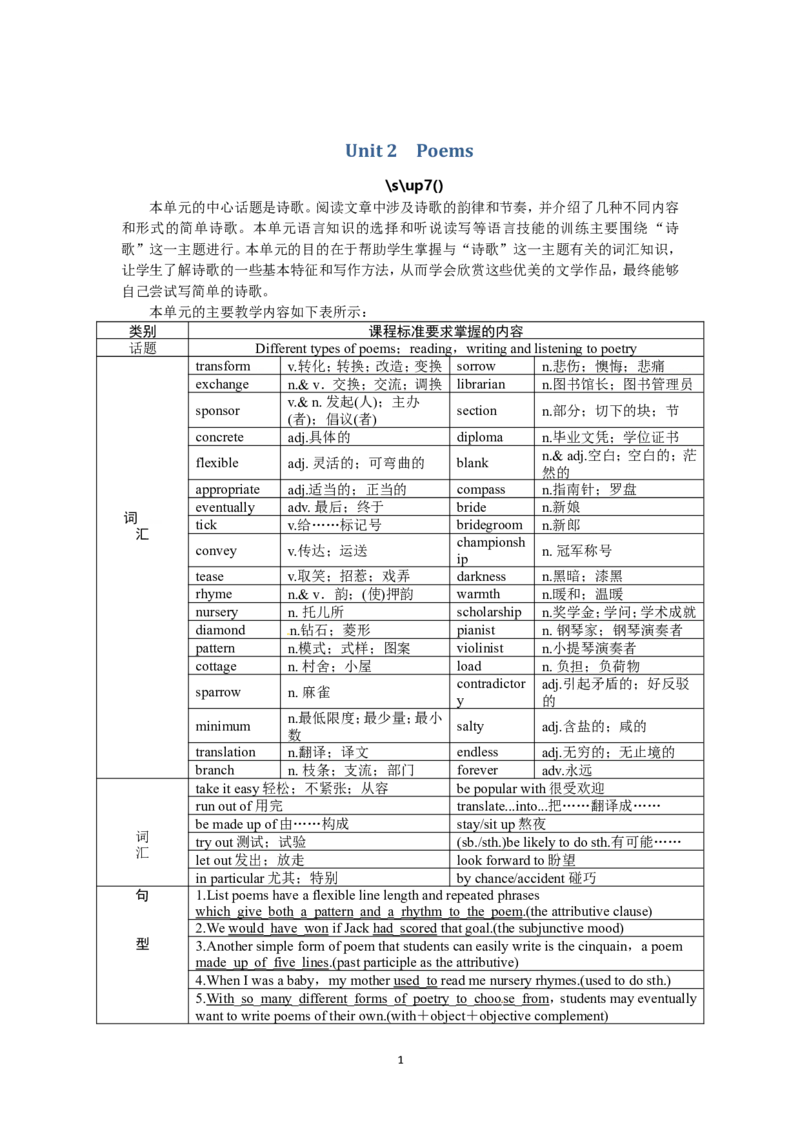
本单元的中心话题是诗歌。阅读文章中涉及诗歌的韵律和节奏,并介绍了几种不同内容
和形式的简单诗歌。本单元语言知识的选择和听说读写等语言技能的训练主要围绕“诗
歌”这一主题进行。本单元的目的在于帮助学生掌握与“诗歌”这一主题有关的词汇知识,
让学生了解诗歌的一些基本特征和写作方法,从而学会欣赏这些优美的文学作品,最终能够
自己尝试写简单的诗歌。
本单元的主要教学内容如下表所示:
类别 课程标准要求掌握的内容
话题 Different types of poems;reading,writing and listening to poetry
transform v.转化;转换;改造;变换 sorrow n.悲伤;懊悔;悲痛
[来源:学§科§网] [来源:Z#xx#k.Com]
exchange n.& v.交换;交流;调换 librarian n.图书馆长;图书管理员
v.& n. 发起(人);主办
sponsor section n.部分;切下的块;节
(者);倡议(者)
[来源:学科网]
concrete adj.具体的 diploma n.毕业文凭;学位证书
n.& adj.空白;空白的;茫
[来源:学|科|网] flexible adj. 灵活的;可弯曲的 blank
然的
appropriate adj.适当的;正当的 compass n.指南针;罗盘
eventually adv. 最后;终于 bride n.新娘
词
[来源:学科网ZXXK] tick v.给……标记号 bridegroom n.新郎
汇
championsh
convey v.传达;运送 n. 冠军称号
ip
tease v.取笑;招惹;戏弄 darkness n.黑暗;漆黑
rhyme n.& v.韵;(使)押韵 warmth n.暖和;温暖
nursery n. 托儿所 scholarship n.奖学金;学问;学术成就
diamond n.钻石;菱形 pianist n. 钢琴家;钢琴演奏者
pattern n.模式;式样;图案 violinist n.小提琴演奏者
cottage n. 村舍;小屋 load n. 负担;负荷物
contradictor adj.引起矛盾的;好反驳
sparrow n. 麻雀
y 的
n.最低限度;最少量;最小
minimum salty adj.含盐的;咸的
数
translation n.翻译;译文 endless adj.无穷的;无止境的
branch n. 枝条;支流;部门 forever adv.永远
take it easy轻松;不紧张;从容 be popular with很受欢迎
run out of 用完 translate...into...把……翻译成……
be made up of由……构成 stay/sit up 熬夜
词
try out测试;试验 (sb./sth.)be likely to do sth.有可能……
汇
let out发出;放走 look forward to盼望
in particular尤其;特别 by chance/accident 碰巧
句 1.List poems have a flexible line length and repeated phrases
which_give_both_a_pattern_and_a_rhythm_to_the_poem.(the attributive clause)
2.We would_have_won if Jack had_scored that goal.(the subjunctive mood)
型 3.Another simple form of poem that students can easily write is the cinquain,a poem
made_up_of_five_lines.(past participle as the attributive)
4.When I was a baby,my mother used_to read me nursery rhymes.(used to do sth.)
5.With_so_many_different_forms_of_poetry_to_choose_from,students may eventually
want to write poems of their own.(with+object+objective complement)
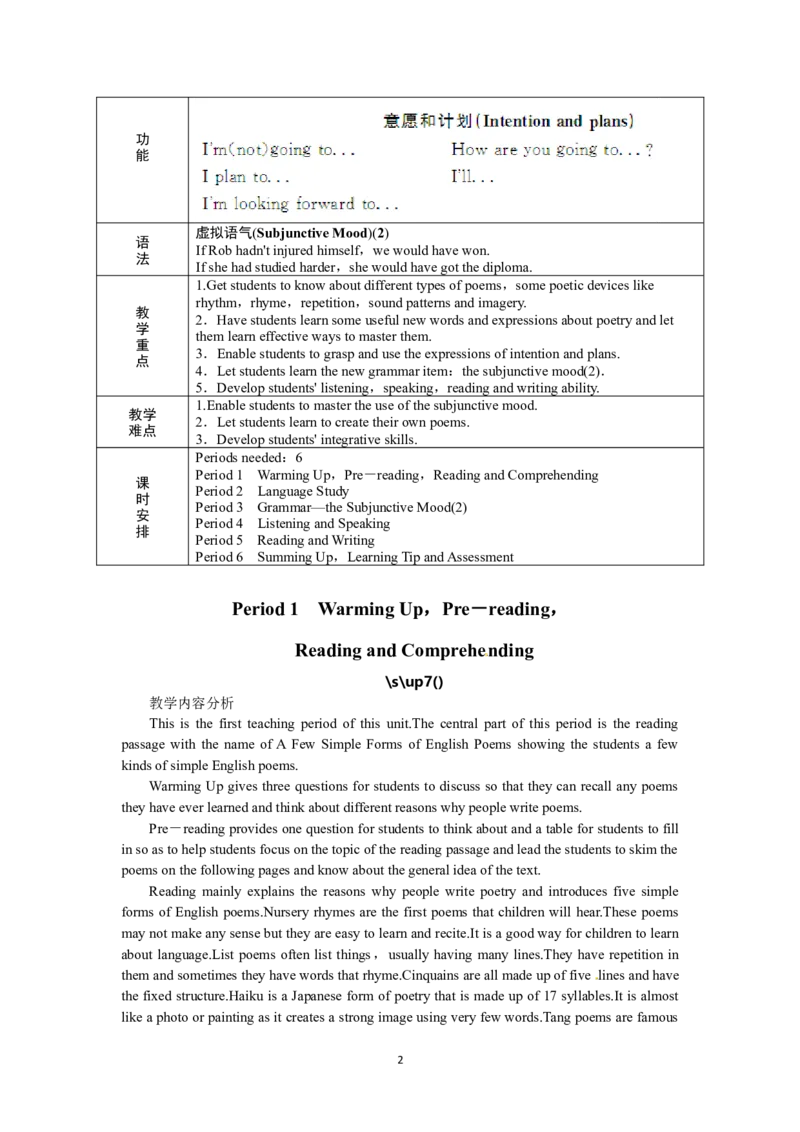
1功
能
虚拟语气(Subjunctive Mood)(2)
语
If Rob hadn't injured himself,we would have won.
法
If she had studied harder,she would have got the diploma.
1.Get students to know about different types of poems,some poetic devices like
rhythm,rhyme,repetition,sound patterns and imagery.
教
2.Have students learn some useful new words and expressions about poetry and let
学
them learn effective ways to master them.
重
3.Enable students to grasp and use the expressions of intention and plans.
点
4.Let students learn the new grammar item:the subjunctive mood(2).
5.Develop students' listening,speaking,reading and writing ability.
1.Enable students to master the use of the subjunctive mood.
教学
2.Let students learn to create their own poems.
难点
3.Develop students' integrative skills.
Periods needed:6
Period 1 Warming Up,Pre-reading,Reading and Comprehending
课
Period 2 Language Study
时
Period 3 Grammar—the Subjunctive Mood(2)
安
Period 4 Listening and Speaking
排
Period 5 Reading and Writing
Period 6 Summing Up,Learning Tip and Assessment
Period 1 Warming Up,Pre-reading,
Reading and Comprehending
\s\up7()
教学内容分析
This is the first teaching period of this unit.The central part of this period is the reading
passage with the name of A Few Simple Forms of English Poems showing the students a few
kinds of simple English poems.
Warming Up gives three questions for students to discuss so that they can recall any poems
they have ever learned and think about different reasons why people write poems.
Pre-reading provides one question for students to think about and a table for students to fill
in so as to help students focus on the topic of the reading passage and lead the students to skim the
poems on the following pages and know about the general idea of the text.
Reading mainly explains the reasons why people write poetry and introduces five simple
forms of English poems.Nursery rhymes are the first poems that children will hear.These poems
may not make any sense but they are easy to learn and recite.It is a good way for children to learn
about language.List poems often list things,usually having many lines.They have repetition in
them and sometimes they have words that rhyme.Cinquains are all made up of five lines and have
the fixed structure.Haiku is a Japanese form of poetry that is made up of 17 syllables.It is almost
like a photo or painting as it creates a strong image using very few words.Tang poems are famous
2poems from Ancient China.They have strong imagery and are often about the bringing together of
opposites.
Comprehending consists of three groups of exercises for the students to do so as to help the
students to get a better understanding of the text,that is to say,to help the teacher to check how
much the students have understood the text.
三维目标设计
Knowledge and skills
1.To know the meanings of the following new words and phrases:
tick(给……标记号),rhyme(韵;押韵),convey(传达;运送),nursery(托儿所),concrete(具
体的),contradictory(引起矛盾的;好反驳的),diamond(钻石;菱形),flexible(灵活的;可弯曲
的),pattern(模式;式样;图案),cottage(村舍;小屋),sparrow(麻雀),take it easy(轻松;不紧张;
从容),run out of(用完),be made up of(由……构成),tease(取笑;招惹;戏弄),salty(含盐的;咸
的),endless(无穷的;无止境的),minimum(最低限度;最少量),translation(翻译;译文),
branch(枝条;支流;部门),in particular(尤其;特别)
2.To learn about some simple forms of English poems.
3.To develop the students' reading ability by skimming and scanning the passage.
4.To develop the students' speaking ability by talking about some features of some simple
forms of English poems.
Process and methods
1.While doing Warming Up the teacher can ask the students to think back and try to
remember poems from both their early childhood and more recent years.Ask students to complete
Exercise 1 in groups.Ask them what they notice about these poems,then get students to recite any
poems or parts of poems they can remember so as to arouse their interest in studying the whole
unit.
2.During Pre-reading the teacher can go around the classroom and discuss the questions
with several students.This discussion should be student-centered and arouse students' interest in
English poetry.The teacher should also ask the students to skim the text so as to let them have a
general knowledge of some simple forms of English poems.
3.While doing Reading and Comprehending,the teacher may first have the students close
their books and listen to the text with their eyes closed.This gives the students the opportunity to
listen to the sounds or “music” of the poems before reading them in more detail.Then ask the
students to read the text quickly to get the general idea of the passage.After detailed reading of the
passage,students are encouraged to answer some questions and discuss the features of each kind
of the poems.
4.To consolidate the contents of the reading passage,the students should be required to retell
the five kinds of poems in their own words at the end of the class.
Emotion,attitude and value
1.To cultivate students' appreciation of poetry and the ability of understanding,enjoying and
writing poems.
2.To develop students' sense of cooperative learning.
教学重、难点
1.To enable the students to learn about some simple forms of English poetry and to develop
their reading ability.
2.To enable the students to write their own poems.
3\s\up7()
Step 1 Warming up
1.Vocabulary in Reading
Match the words and phrases with their proper meanings.
1.convey ( )A.sameness of sound between words or syllables,esp.in the end of
lines
2.cottage ( )B.a strong feeling such as love,fear or anger
3.tease ( )C.make fun of somebody in an unkind way
4.rhyme ( )D.a place where young children are cared for
5.translate ( )E.make(ideas,feelings,etc.)known to another person
6.endless ( )F.use up
7.nursery ( )G.small simple house,esp.in the country
8.emotion ( )H.relax
9.take it easy ( )I.express sth.in a different language
10.run out of ( )J.without end
Suggested answers:1.E 2.G 3.C 4.A 5.I 6.J 7.D 8.B 9.H 10.F
2.Warming up by asking students to complete Exercise 1 in groups.Get the students to recite
the little poems and songs they can remember.Ask them what they notice about these poems.For
example,perhaps they have a strong beat,or they rhyme,or they play with words and sounds,or
perhaps some of them are funny because they make no sense.
3.Warming up by doing Exercise 2 with students.Then get them into groups as this might
prompt their memories.Get the students to recite any poems or parts of poems they can remember.
(If the students can't recite any poems or parts of poems,prepare a couple of poems that they
would know,in Chinese or English.)
4.Tell students that there are many reasons why people write poetry.Give the examples in
Exercise 3.Ask students the reasons they think the poets wrote the poems they have just
recited.Write their suggestions on the blackboard.
Step 2 Pre-reading
1.Match the following information.
Du Fu Tang Dynasty
Fan Zhongyan Song Dynasty
Meng Haoran Modern
Guo Moruo Modern
Xu Zhimo Tang Dynasty
Byron America
Shelly England
Whitman England
Tagore India
Suggested answers:Du Fu:Tang Dynasty;Fan Zhongyan:Song Dynasty;Meng Haoran:
Tang Dynasty;Guo Moruo:Modern;Xu Zhimo:Modern;Byron:England;Shelly:England;
Whitman:America;Tagore:India
2.Ask students to do Exercise 1 in groups.Get them to tell the class their favourite poems
and the reasons.This might be something they find hard to articulate as the poem might just give
them a special feeling that's hard to talk about.Or they might say things like:It makes me feel
4sad.I like the sounds in it.I like its language,it's funny,and my mother used to recite it to me...
3.The purpose of Exercise 2 is to practice an important reading skill:scanning a text,that
is,looking through a text quickly to find specific information.
Suggested answers:
Which poem A B C D E F G H
describes a person? √
tells a story? √
describes an aspect of a season? √ √ √
is about sport? √
is about things that don't make sense? √
is recited to a baby? √
describes a river scene? √
has rhyming words at the end of lines? √ √
repeats words or phrases? √ √ √
Step 3 Reading and comprehending
1.Fast-reading:Read the reading passage quickly,try to get its general idea and answer the
following questions.
(1)What is the main idea of the reading passage?
________________________________________________________________________
(2)How many kinds of poems does the reading passage talk about? And which of the
following is not mentioned?
A.Nursery rhymes. B.Tang poems. C.Haiku. D.Adverb poems. E.List poems.
F.Cinquain.
Suggested answers:
(1)A brief introduction of a few simple forms of English poems.
(2)Five.D is not mentioned.
2.Detailed-reading:Read the text thoroughly and do the following exercises.(You may do
some searching reading when necessary.)
(1)Give out the names of the forms of poems according to the descriptions.
①______ are the first poems that children will hear.They are often sung.Children love to
move and dance to them because they have strong regular rhythms.They enjoy the rhymes and the
way they play with sounds.
②______ is made up of five lines and has the following structure:
Line 1:a noun that names the subject of the poem
Line 2:two adjectives that describe the subject
Line 3:three verbs ending with-ing that describe the subject's actions
Line 4:four words that give the writer's opinions or feelings about the subject
Line 5:a word that gives another name for the subject
③______ is a centuries-old form of Japanese poetry.It is made up of 17 syllables and has
the following structure:
Line 1:5 syllables
Line 2:7 syllables
Line 3:5 syllables
④______ are a list of things.They can have as many lines as the writer likes.Sometimes they
have repetition in them and sometimes they have words that rhyme.When a list poem has rhyming
words,it also has a regular rhythm.
5⑤When translated into English,______ have a free form(that is,without a regular
rhythm)and do not rhyme.They have strong imagery and are often about the bringing together of
opposites.
(2)Find the strong rhythm and rhyme in Poem A.
e.g.In the first two lines,there are word_&_mockingbird. So in the following lines,there are
______;______;______;______.
(3)What's the difference between Poems B and C though they are both list poems?
________________________________________________________________________
(4)Which of the poems in the reading passage can give you a clear picture in your mind?
________________________________________________________________________
(5)Can you find out the 17 syllables in Poem F?
e.g.“A” has 1 syllable,“fallen” has 2 syllables,while “blossom” has 2 syllables.
________________________________________________________________________.
(6)Can you give a proper title to Poem H either in English or Chinese?
________________________________________________________________________
Suggested answers:
(1)①Nursery rhymes ②The cinquain ③Haiku ④List poems ⑤Tang poems
(2)sing & ring;brass & looking-glass;broke & billy-goat;away & today
(3)Poem B repeats phrases and rhymes,while Poem C does not.
(4)Most probably Poems D,F,G and H.
(5)A(1);fallen(2);blossom(2);Is(1);coming(2);back(1);to(1);the(1);branch(1);Look(1);
a(1);butterfly(3)
(6)望夫石/A Loyal Wife
Step 4 Language study
Deal with language problems if any(words or sentences students might not understand)to
help the students to have a better understanding of the text.
Step 5 Listening,reading aloud and underlining
Ask students to read the passage aloud to the tape and let them pay attention to the
pronunciation of each word and the pauses within each sentence.Tell them to pick out all the
useful expressions or collocations from the passage while reading and copy them to the notebook
after class as homework.
Collocations:make sense,give...a strong impression,on fire,take it easy,run out of,make
up of,be translated into,day by day,in particular.
Step 6 Structure analyzing
After reading,ask students to discuss the text structure.
Keys for reference:
This passage is an introduction of some of the simple forms of English poems.The first
paragraph introduces the topic and the theme of the text,explaining the purpose of poetry
writing,that is,to give readers a strong impression or to convey certain emotions.From the second
paragraph,the text analyses the different kinds of poems and gives examples for reference.The
last paragraph encourages students to have a try and write poems of their own.
Step 7 Retelling
Ask students to talk about the different kinds of poems in their own words.Give them some
key words and expressions on the blackboard.Then let them try to retell the passage.
6Step 8 Homework
1.Learn the useful new words and expressions in this period by heart.
2.Try to find some selections of poems and appreciate their beauty and eventually try to
write some poems of your own.
Step 9 Reflection after teaching
________________________________________________________________________
________________________________________________________________________
Reading:A Few Simple Forms of English Poems
李东玲,海南省儋州市民族中学,本教案获2008年度“教科杯”
海南省中小学教师教学论文和教学设计大赛二等奖
教学 Unit 2 Poems
课题 A Few Simple Forms Of English Poems(Reading)
《基础教育课程改革纲要(试行)》对于课程实施和教学过程有明确的
要求:倡导学生主动参与、乐于探究、勤于动手,培养学生搜集和处理信
教学
息的能力、获取新知识的能力、分析和解决问题的能力以及交流与合作
设计
的能力。教师在教学过程中应与学生积极互动、共同发展,要处理好传授
理论
知识与培养能力的关系,注重培养学生的独立性和自主性,引导学生质
依据
疑、调查、探究,在实践中学习,促进学生在教师指导下主动地、富有个
性地学习。
本课是新课标高中英语选修6第二单元中的阅读课,是一篇介绍诗
歌基础知识的文章。文章从诗歌创作的动机、种类、特点及读者对象等方
教材
面简要介绍了五种不同风格、不同特色的诗歌。旨在通过本单元的学习,
分析
使学生在初步了解和掌握诗歌这一文学形式的基础常识的基础上,进行
简单的诗歌创作。
本节课的教学对象是高二学生,他们很了解中文诗歌的种类、风格、
特色,对英文诗歌的学习充满了浓厚的兴趣,想知道:中英文诗歌是否一
样?同时他们也有着丰富的想象力和活跃的思维,具有一定的分析和解
决问题的能力,已掌握相关的认知策略,如分析、想象、推理、归类、总
学情
结、记忆等。大部分学生的基础知识仍然较为薄弱,运用英语进行交际活
分析
动的能力较差,但他们好胜心强,渴望在班集体里得到他人的承认。个别
学生基础较好,能主动配合老师,具有独立、爱表现的特点。因此,只有
设计使他们感兴趣的活动,因材施教,才能让全班同学投入到课堂活动
中来。
三维目标:
1.知识目标
Make the students master the following words,phrases and sentence
patterns.
★Important words:
poem,poetry,recite,aspect,convey,rhyme,rhythm,nursery,diamond,
教 cottage,balloon,sparrow,tease,salty,endless,branch,translation,
学 transform
目 ★Important phrases:
标 take it easy,run out of,make up of
★Important sentence patterns:
...they delight small children because...
We would have won...if Jack had scored that goal.
2.能力目标
★To learn the main developing steps of the history of English poetry.
★To learn the characteristics of different forms of poems.
7★To improve students' reading ability.
★To practice writing simple poems.
3.情感态度目标
利用多媒体手段营造积极、和谐的教学气氛,使学生不自觉地进入情景
之中,充分调动学生的思维活动和情感体验,引起学生的共鸣。本部分旨
在培养学生通过阅读手段,获取有关英国诗歌方面的知识,提高他们的
素质,扩大他们的国际视野,提高阅读能力,强化文化意识,激发他们热
教 爱我国瑰丽的诗歌文化宝库的爱国热情。
学 教学重点:
目 ★Master the important new words,phrases and sentence patterns.
标 ★Collect the reasons why the poets write poems.
★The similarities and differences between the Chinese and English poets
and poems.
教学难点:
★Find out the characteristics of each kind of poems.
★Practice writing simple poems.
教 ★培养学生搜集与处理信息的能力(“有意义接受学习”教学法)
学 ★培养学生获取新知识的能力(探究式教学法)
策 ★培养学生分析和解决问题的能力(问题式学习教学法、任务型教学法)
略 ★培养学生交流与合作的能力(合作学习教学法)
教
★多媒体辅助:将本课所需要的动画、录音、图片、文字、图表和音乐制成
学
CAI软件使抽象的语言变得直观,为学生运用英语进行交际创设情景。
用
★黑板:展示本课的重点单词、短语、句型。
具
教学过程设计
教学步骤 活动内容 设计意图
运用“有意义接受学习”教学
法:
★Talk about poets and poems the 提示学生先回忆原有知识,获得
Task 1 Warming students learned before. 成就感,增强自信心,并总结出
Up (4 minutes) ★Let some students list the reasons why 写诗意图,激发学生积极思考,
people write poems on the blackboard. 领悟本课教学目标。为学习英文
诗歌作好铺垫,阐明新旧知识的
各种关系,促进新知识的理解。
★Listen to the tape about the reading
运用探究式教学法:
Task 2 passage.
该任务鼓励学生主动参与、主动
Presentation (5 ★After listening,tick the correct box(es)
探究、主动思考,概括出每首诗
minutes) of each question in the form in Pre-
歌的主题大意。
reading.
★According to the Chinese meaning,fill
in the correct form of the word.
e.g.The music is written in a ______(节
奏)of three beats to a bar. 运用问题式学习教学法、任务型
教学法:
★Ask the students to answer the
学生带着问题再一次详细阅读
questions in Exercise 2 and Exercise 3 in
并理解全文,解决问题,完成任
Comprehending according to the text.
Task 3 Practice 务,做好语言输入储备工作。该
★Find out the information to complete
(15 minutes) 任务提高了学生的探究能力,充
the following form.
分发挥学生的自主性。此过程
Forms of poems Characteristics
中,还能体现师生、生生之间互
相交流、互相探讨的合作学习精
神。
8运用合作学习教学法:
★Hold an English poem writing
以竞赛为前提,唤起学生的好胜
Task 4 Group competition:
激情。小组成员各抒己见,培养
Work(15 Four students work as a group.Practice
学生交流与合作能力。把学生所
minutes) writing simple poems.Then show their
学知识发散、扩展、升华并输出,
poems to others.
学以致用,学生又获得成就感。
★Practice writing more poems. 运用任务型教学法:
★Ask the students to collect at least five 课外作业,课堂小组活动延伸到
Homework(1
English poems with different forms. 课外,学生仍然可以互相合作完
minute)
You can search the Internet if you want to 成该写作任务。该环节是本课所
know more about English poems. 有教学环节的延续。
\s\up7()
Ⅰ.Famous poetry in English
Reading poetry brings people from different places and different times together.More than
any other form of literature,poetry plays with sounds,words and grammar.That makes poetry
difficult to write,but very interesting to read.Poetry also calls up all the colors,feelings,
experiences and curious images of a dream world.
Though it has a short history,there is a lot of good English poetry around.The seventeenth
century was a great time for English poetry.Shakespeare is most famous for his plays.His sonnets,
however,belong to the best English poetry.In the next generation of the English poets we meet
John Donne.Chinese readers admire his works because of his use of surprising images that
reminds them of the works of poets such as Su Dongpo.
Before the end of the century ,there was another famous writer ,John Milton.Once
published,his works became famous for the absence rhyme at the end of each line.In the
eighteenth century it was Alexander Pope who wrote the finest poetry in England.
The next period that produced a great number of fine poets was the nineteenth
century.Greatly loved in China are the English Romantic poets.John Keats died at a very young
age in 1821,while William Wordsworth,who spent much of his time in his English Lake
District,lived to the age of the 80 and died in 1850.The nature poems by William Wordsworth,
George Gordon Byron's Isles of Greece and the sonnets and long poems by John Keats have long
been favorites.The style in their poems has often led to comparisons with poets such as Du Fu and
Li Bai.
Finally,modern poets have their special attraction because they stand closest to us both in the
language and images they use.Among them we find the American poet Robert Frost.
More and more people are interested to read modern poetry in English.Translation can be
good,but being able to read English gives you much choice.Besides,no matter how well a poet is
translated,something of the spirit of the original work is lost.Reading poetry in English also opens
the door to finding new ways of expressing yourself in Chinese.
Ⅱ.What is free verse?
Free verse is a modern form of poetry which does not follow any specific rhyme or metrical
scheme,although it does not completely abandon the basic poetic precepts of heightened language
and songs.Free verse poetry is said to have been popularized by such notable poets as Walt
Whitman and Emily Dickinson during the late 19th century,although earlier poets like the mystic
William Blake were beginning to pull away from the restrictions of the formal poetry of their
day.Whitman's signature collection,Leaves of Grass,is almost entirely composed of free verse
poetry.Dickinson,however,still wrote much of her poetry according to the metrics and rhyme of a
favored hymn composer.
9The free verse style of poetry soon became popular with rebellious young poets such as the
Frenchman Artur Rimbaud(阿图尔·兰波),who wrote many of his best free verse poems before
the age of 18.Other poets embraced free verse poetry as a way to express raw emotions or
unbridled passion not generally found in the formal poetry of their time.Whitman himself referred
to this artistic awakening as the great YAWP ,a call for all artists to break free of social
conventions and live life to its fullest.
Free verse poetry continued to evolve throughout the 20th century,beginning with poets such as
Carl Sandburg(卡尔·桑博格)and Robert Frost(罗伯特·弗罗斯特),both of whom were equally
comfortable with formal and free verse poetry.Perhaps the most admired free verse poet was the
expatriate Ezra Pound,who became a mentor to many of the 20th century's most famous
authors and poets.
10