学校:___________姓名:___________班级:___________考号:___________
Unit1 What's the matter
单元话题(健康与救护)阅读理解18篇
说明:此专题分三个难度层次,基础入门训练<进阶拓展训练< 能力综合实践,老师根据学生实际情
况进行针对性难度训练。
基础入门训练6篇
(23-24八年级下·山东德州·期末)A boy helped save the life of his friend from choking (噎) in the
dining hall at school while having their lunch there. A video of the incident (事故) has been watched by many
people online.
In the video, freshman Jackson just got a seat and ate his chicken sandwich. Suddenly the food stuck (卡住)
in his throat and he hiccuped (打嗝). Hunter Olsen sat across from Jackson. He thought that Jackson was just
joking and laughed at it along with his friends. But soon it became clear that Jackson was really choking and tried
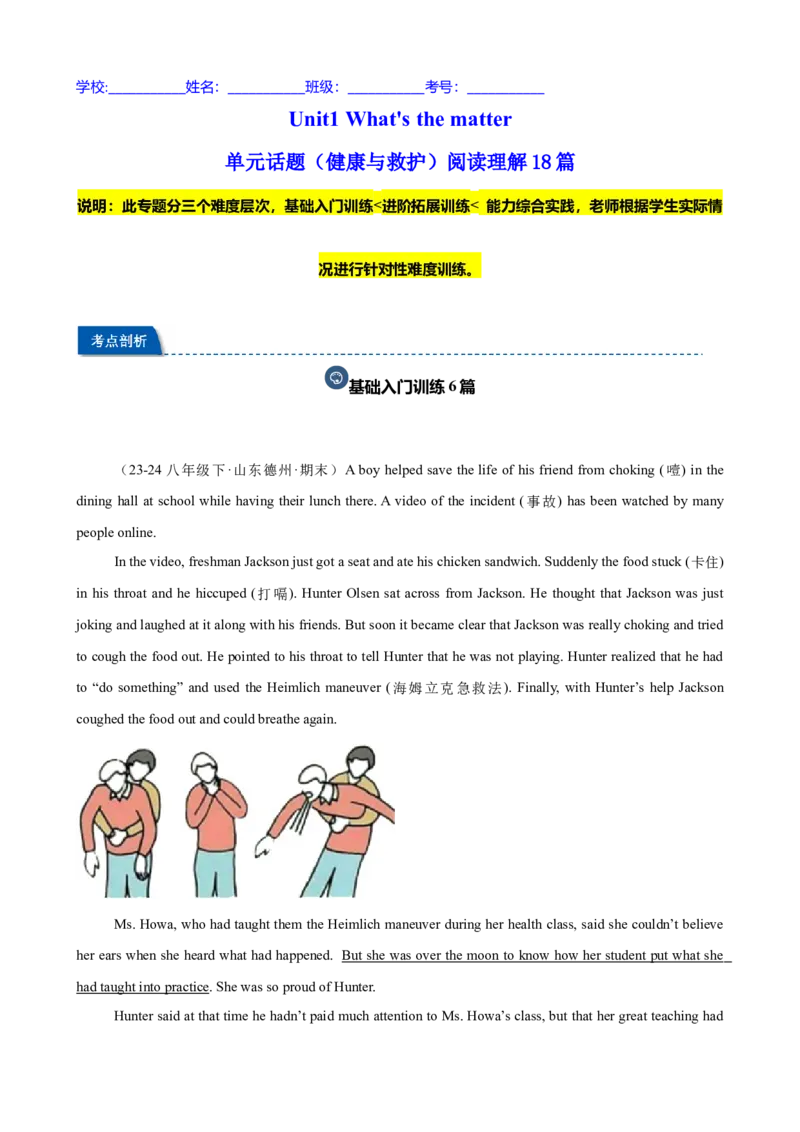
to cough the food out. He pointed to his throat to tell Hunter that he was not playing. Hunter realized that he had
to “do something” and used the Heimlich maneuver (海姆立克急救法). Finally, with Hunter’s help Jackson
coughed the food out and could breathe again.
Ms. Howa, who had taught them the Heimlich maneuver during her health class, said she couldn’t believe
her ears when she heard what had happened. But she was over the moon to know how her student put what she
had taught into practice. She was so proud of Hunter.
Hunter said at that time he hadn’t paid much attention to Ms. Howa’s class, but that her great teaching hadhelped him know what to do when needed. Then he said, “I just thought that doing something was better than
doing nothing.”
1.Why did Hunter laugh with his friends?
A.His friends were telling jokes.
B.He saw the food stuck in Jackson’s throat.
C.He thought Jackson was fooling.
D.Jackson looked very funny when he hiccuped.
2.When did Hunter realize Jackson was really choking?
A.When he just sat down with his friends.
B.When Jackson started to hiccup.
C.When his friends began to laugh.
D.When Jackson pointed to his throat.
3.How do you understand the underlined sentence?
A.Ms. Howa went over to see what had happened.
B.Ms. Howa felt happy with what Hunter had done.
C.Ms. Howa didn’t believe Hunter had saved Jackson.
D.Ms. Howa wanted to know how Hunter saved Jackson.
4.What did Hunter think of Ms. Howa’s health class before the incident?
A.It was very important. B.It was not very useful.
C.It was very interesting. D.It was too difficult.
5.Why does the writer write the passage?
A.Tell a story that a boy saved his friend.
B.Introduce what the Heimlich maneuver is.
C.Warn us not to play jokes while having a meal.
D.Teach us how to use the Heimlich maneuver.
(23-24八年级下·甘肃兰州·期末)What if you scrape (擦伤) your face? Accidents happen to everyone.
Luckily, you can control most small wounds (伤口) without visiting a hospital. That’s why it’s a good idea to
prepare some medicine at home.
The first thing to do is to stop any bleeding at once. Small cuts and scrapes usually stop on their own. If
not, cover the wound with clean cloth or a bandage. Then press on it until the bleeding stops.
Next, it’s necessary to wash the wound to avoid infection (避免感染). Use warm water and soap to clean it
in order to remove something dirty.Then, cover the wound to keep germs (细菌) out by using a bandage or other kinds of clean covers.
Finally, be kind to your wound. When the bandage gets wet or dirty, change it. After a scab (痂) starts,
keep the wound in the fresh air so that it can heal (愈合) faster.
1.We can use ________ to cover the wound.
A.wet cloth B.wet paper C.clean cloth D.clean paper
2.We need to wash the wound to ________.
A.avoid infection B.stop bleeding C.keep the scab clean D.keep the germs out
3.What does the underlined word “it” in Paragraph 5 refer to (指代)?
A.The wound. B.The germ. C.The bandage. D.The medicine.
4.What is the last thing to do when caring for a wound?
A.Pressing on it. B.Changing the bandage.
C.Washing it carefully. D.Keeping it in the fresh air.
5.What’s the best title for the passage?
A.Safety Rules for School Students B.Advice on Controlling Small Wounds
C.Terrible Accidents in Our Daily Life D.Several Kinds of Usual Wounds
(23-24八年级下·宁夏吴忠·期末)
Name: Bruce Smith
Job: A teacher
Trouble: He thinks he is too old to have four classes every day. He has a sore throat.
Advice: Don’t talk too much. Drink a lot of water.
Name: David King
Job: A programmer (程序员)
Trouble: He spends six hours on the computer every day. He has a pain in his neck.
Advice: Do some exercise. Take some medicine.
Name: John Hill
Job: A worker
Trouble: He often complains (抱怨) about the noise around him. He has a headache.
Advice: Wear good earplugs (耳塞).
Name: Rose Pan
Job: A policewoman
Trouble: She stands outside too long. Bad air makes her cough a lot.
Advice: Go to see a doctor and take some medicine.1.What’s the matter with Bruce Smith?
A.He has a sore back. B.He has a sore throat.
C.He has a fever. D.He has a sore neck.
2.What causes David King’s trouble?
A.Spending too many hours on the computer. B.Too much stress.
C.Standing too long. D.Too much noise.
3.What’s the advice for John Hill?
A.To keep away from the noise. B.To wear thick clothes.
C.To wear good earplugs. D.To take two days off.
4.What troubles Rose Pan?
A.Noise around her. B.Studying too long.
C.Talking too much. D.A cough.
(23-24八年级下·广东汕头·期末)
This morning I fell over and broke my leg when playing soccer. The teacher took me to
the hospital. The doctor asked me to stay here for three days. She said that when I get home, I
must stay in bed for at least two more weeks.
Last week I fell down when I was playing games with my friend. I hit my teeth badly. My
mom took me to the dentist’s in her car. The dentist checked (检查) my teeth and told me to take
some medicine. He also said that I might have a toothache for a week.
I went to the cinema with my parents. It was very hot in the cinema and I started to feel
sick. I then fell on the floor (地面) and my mom tried to wake me up. My dad called an
ambulance. A doctor came with the ambulance and listened to my heart. I woke up and the
doctor checked the rest of my body. He said I was fine, but he also told me to go home and rest
for two days.
1.How long did the doctor ask Naomi to stay in the hospital?
A.For two days. B.For three days.
C.For a week. D.For two weeks.
2.What happened to Lisa?
A.She felt sick. B.She had a cough.
C.She hit her teeth. D.She broke her leg.
3.Who called the ambulance for Nancy?
A.Her mom. B.Her dad. C.Her friend. D.Her teacher.4.What did the doctor ask Nancy to do?
A.To have a rest. B.To drink more water.
C.To do more exercise. D.To take some medicine.
5.What do the three students talk about?
A.Hobbies. B.Accidents.
C.Careless mistakes. D.School activities.
(23-24八年级下·安徽滁州·期末)What’s a headache? The meaning of the headache is “a pain in the
head”. It covers the whole head, one side of the head, or maybe the front or the back of the head.
Almost everyone may get headaches. Some people get headaches often or the headaches usually last for a
long time. Lots of different things can cause headaches. Most headaches have something to do with watching TV
or using the computer for a long time, listening to loud music, being short of sleep or having a long trip in a car.
The flu can also cause headaches.
However, you needn’t be afraid of headaches. Most headaches will go away if you have a good rest or
sleep. When you get a headache, lie down in a quiet room, close your eyes and relax. If your headache doesn’t go
away or it's really bad, you need to see a doctor. The doctor may ask you when your headache starts, how often it
happens, or if you’re taking any medicine.
There are also some ways to help you stay away from headaches. For example, you’d better get a good
sleep every night, drink enough water every day and eat less cold food. If you can do these things, you may have
fewer headaches.
1.Who may get headaches?
A.Only babies. B.Only teenagers. C.Only old people. D.Almost every body.
2.What can we learn from the text?
A.A long car ride may cause a headache.
B.A headache usually lasts for a short time.
C.A headache always covers the whole head.
D.You don’t need to see a doctor when you have a headache.
3.What can you do to stay away from headaches?
A.Drink hot tea.
B.Have enough sleep.
C.Ea1 much cold food.
D.Lie down in a noisy room.(23-24八年级下·河南周口·期末)What’s sleepwalking? Sleepwalking usually happens in the first few
hours of sleep. Not all sleepwalkers walk when they are sleeping. Some just sit up or stand in bed or do things like
they’re awake, but they’re asleep! Most get up and walk around for a few minutes or half an hour.
Sleepwalkers’ eyes are open and they usually go back to bed by themselves and they won’t remember it the
next day. About 15% of kids sleepwalk. Sleepwalking sometimes happens when a person is ill, worried, or doesn’t
get much sleep.
If sleepwalking happens often, then you should see a doctor; if it doesn’t, then you don’t need to worry.
Here are some ways to help stopping sleepwalking:
Listen to some light music and relax at bed-time.
Go to sleep at a regular time every night.
Keep your bedroom quiet and dark when you’re trying to sleep.
Don’t drink a lot of water in the evening and be sure to go to the bathroom before going to bed.
1.What don’t sleepwalkers do while sleepwalking?
A.Sit up. B.Stand in bed.
C.Wake up. D.Walk.
2.Sleepwalkers usually go back to bed ________.
A.after being woken up B.with the help of others
C.by themselves D.after waking up
3.What’s the Chinese meaning of the underlined word “regular”?
A.无规律的 B.有规律的 C.短暂的 D.忙碌的
4.You’d better go and see a doctor if ________.
A.you sleepwalk several times
B.you never sleepwalk
C.you often sleepwalk
D.you hardly ever sleepwalk frequently (频繁地)
5.What should we do to stop sleepwalking before going to bed?
A.Keep the light on.
B.Listen to light music and relax.
C.Drink much water.
D.Listen to loud music.进阶拓展训练6篇
(23-24八年级下·广东肇庆·期末)Many people catch a cold in spring and autumn. There are hundreds
of kinds of viruses (病毒) .You never know which one you will get, so there isn’t a cure (疗法) for each one.
When a virus attacks (攻击) your body, you may work hard to get rid of it. Blood rushes to your nose and
brings congestion (充血) with it. You feel terrible because you can’t breathe well, but your body is actually
“eating” the virus. Your temperature rises and you get a fever, but the heat of your body is killing the virus. You
also have a runny nose to stop the virus from getting to your cells. You may feel miserable (痛苦的), but actually
your body is trying to fight against the cold.
Different people have different remedies for colds. In the United States and some other countries, for
example, people might eat chicken soup to feel better. Some people take hot baths and drink warm liquids (液体).
Other people take the medicine to stop the fever, congestion, and runny nose.
There is one interesting thing to note—some scientists say taking the medicine when you have a cold is
actually bad for you. The virus stays in you longer because your body doesn’t have a way to fight it or kill it.
Bodies can do an amazing job on their own.
1.When you have nose congestion, you ________.
A.can’t breathe well B.will have a fever C.can’t speak wellD.will kill the
virus
2.What can kill the virus?
A.Chicken soup. B.Your runny nose.
C.The heat of your body. D.Warm liquids.
3.What does the underlined word “remedies” mean?
A.Feelings. B.Cure. C.Medicine. D.Reasons.
4.When people have a cold, what won’t they do?
A.Eat chicken soup. B.Take hot baths. C.Drink warm liquids. D.Run for a
long time.
5.In some scientists’ opinion, taking the medicine when you have a cold is ________ for you.
A.good B.bad C.helpful D.necessary
(23-24八年级下·广东东莞·期末)
First Aid Course (急救课程) For StudentsStudents may have accidents at school. About 400, 000students get hurt in the UK every year. According to the Red Cross, only 25% of students know first aid skills.
Most students feel nervous when they face accidents. It’s very important for more students to take a first aid
course. In this way, they will be prepared when accidents happen. If parents can only teach children one thing
about first aid, they should teach them how to stay cool first. Things will get worse if they are too scared.
Although students can learn the 20- hour first aid course online, it is much better to take the face- to-
face course. William, a doctor from the Red Cross in the UK, said students must take a face-to-face course for
at least 6 hours.
Here are three tips from the first aid course.
*How to deal with burns
Children should be careful when using fire. If they get burnt, they should cool the burn with running
water or ice first. Then put some medicine on it. After that, bandage the burn.
*How to deal with small cuts
Clean the cut and put a bandage on it. If the blood doesn’t stop, press the cut until it stops. When
bleeding stops, put a new clean bandage on it.
*How to deal with fracture (骨折)
Don’t move the person. Go and look for adults or call 120 for help. Before helpers come, keep talking to
the person to cheer him up.
1.Which chart shows the number of the students who know first aid skills?
(■students who know first aid skills □students who don’t know first aid skills)
A. B. C. D.
2.What’s the first thing parents should teach their children?
A.To call 120. B.To keep cool. C.To stay away. D.To take lessons.
3.Which first aid course may William tell a student to take?
A.An online course for 18 hours. B.An online course for 10 hours.
C.A face-to-face course for 8 hours. D.A face-to-face course for 4 hours.
4.What is the first step if children get cut?
A.Cleaning the cut. B.Cooling the cut. C.Bandaging the cut. D.Putting
medicine on the cut.
5.What is the purpose (意图) of the passage?A.To tell the number of first aid course. B.To introduce the Red Cross.
C.To tell the difficulty of first aid course. D.To tell the importance of first aid course.
(23-24八年级下·山东枣庄·期末)What should we do if one of our classmates suddenly falls ill or gets
hurt? Here are some steps you should follow. But always remember to look for medical care after first aid (急救)
if the wound (伤口) is serious.
Broken bones (骨头): Take away clothing from the wound. Use an ice pack. Don’t move the hurt body part
while waiting for the doctor to arrive.
Animal bites (咬伤): Wash the bite area with soap and water. Pack the wound with a clean cloth if it is
bleeding. If the bleeding has stopped, cover the area with a bandage and take the person to the hospital. Make sure
you remember what kind of animal it is so the doctor can find the right way to treat him or her at once.
Fainting (昏厥): Have him or her lie with feet lifted a little. Don’t move the body if you think there might
be wounds from the fall. Make sure he or she can breathe and let in fresh air. Clean the person’s face with a cool
cloth.
Nosebleeds: Have the person sit up with his or her head tilted (倾斜) forward a little. Do not have the
person tilt his or her head back because this may cause heavy breathing or coughing. Pinch (捏) the lower part of
the nose for at least 10 minutes.
1.When dealing with the problems of ________, we shouldn’t move the body.
A.animal bites and nosebleeds B.fainting and nosebleed
C.broken bones and animal bites D.broken bones and fainting
2.You can probably see this passage on ________ part of a magazine.
A.health B.sports C.news D.education
3.This passage is mainly about ________.
A.first aid for some accidental wounds B.advice on ways not to get hurt
C.ways to ask for help in getting hurt D.steps of looking for medical care
(23-24八年级下·广东湛江·期末)
▲How nosebleeds happen:
Nosebleeds are very common among children. Blowing the nose too hard or getting hit on the nose
while playing can cause nosebleeds. Catching a cold can also cause nosebleeds. Usually, the nosebleed isn’t
very serious and it will stop in less than ten minutes.▲When nosebleeds happen:
Your child may be afraid that there is something seriously wrong. Crying may make the bleeding worse,
so it is important for you to tell him that he will be fine.▲How to give first aid (急救):
Let your child sit upright (直立) and tell him to put his head down. Help your child press both sides ofthe nose for ten minutes. Do not stop to see if the bleeding has stopped.▲If first aid works:
Rest your child for the next 12-24 hours. Tell him to do quiet activities such as drawing, reading or
watching TV.
Tell him not to take a hot shower for at least 24 hours after a nosebleed.
Tell him not to touch or blow his nose for 24 hours.▲If first aid doesn’t work:
You’d better take him to hospital.
1.How many reasons does the writer give for nosebleeds?
A.One. B.Two. C.Three. D.Four.
2.What may children feel when nosebleeds happen?
A.Scared. B.Surprised. C.Shy. D.Smart.
3.What activity shouldn’t people do after a nosebleed?
A.Drawing B.Reading C.Watching TV D.Playing basketball
4.Which of the following is TRUE from the passage?
A.Stop to see if the bleeding has stopped.
B.One should take a hot shower as soon as the bleeding stops.
C.It’s wrong to blow the nose as soon as the bleeding stops.
D.One should go to hospital right away if he has a nosebleed.
5.Who is this passage mainly written for?
A.Children. B.Parents. C.Nurses. D.Doctors.
(23-24八年级下·安徽六安·期末)What should we do if one of our classmates suddenly falls ill or gets
hurt? Here are some steps about first aid you should follow.
Broken bones (骨折): Take away clothing from the hurt. Use an ice pack. Don’t move the hurt body part
while waiting for the doctor to arrive.
Animal bites (咬伤): Wash the bite area with soap and water. Pack the hurt with a clean cloth if it is
bleeding. If the bleeding has stopped, cover the area with a bandage and take the person to the hospital. Make sure
you remember what kind of animal it is so the doctor can find the right way to treat him or her at once.
Fainting (昏厥): Have him or her lie with feet lifted a little. Don’t move the body if you think there might
be hurts from the fall. Make sure he or she can breathe and let in fresh air. Clean the person’s face with a cool
cloth.
Nosebleeds: Have the person sit up with his or her head tilted (倾斜) forward a little. Do not have the
person tilt his or her head back because this may cause heavy breathing or coughing. Pinch (捏) the lower part of
the nose for at least 10 minutes.Please always remember to look for medical care after first aid if the hurt is serious.
1.What should we do first when an animal bite happens?
A.Put an ice pack on the hurt.
B.Wash the bite area with soap and water.
C.Try to stop the bleeding with a clean cloth.
D.Take the hurt person to the hospital.
2.Which of the following is not right when a boy’s nose bleeds?
A.Let his head not tilt back. B.Let his head tilt forward a little.
C.Let him sit up. D.Pinch his nose for less than 10 minutes.
3.What’s the main idea of the passage?
A.First aid for some accidental hurts. B.Steps of looking for medical care.
C.Advice on ways not to get hurt. D.Ways to ask for help for getting hurt.
4.What’s the structure (结构) of this passage?
A. B. C. D.
(23-24八年级下·辽宁丹东·期末)It is important for you to learn some knowledge about first aid (急救)
in your everyday life. If a person has an accident, other people should try their best to help him immediately.
When you give first aid, you must know several things. First, when a person stops breathing, open his mouth.
Second, if a person can’t breathe, you can use a mouth-to-mouth way to help him. Third, if a person is hurt by a
knife, you should stop the bleeding at once. You can clean it and put a piece of clean paper round the cut. If a
person loses one third of the blood, he may die. Fourth, when a person is burned, wash and cool the area of the
skin (皮肤) under the cold water for a while. Then put a piece of dry clean cloth over the burn.
Many accidents may happen at home. All parents should know first aid to deal with common injuries (伤
害). Besides, parents must put dangerous things in safe places where children can’t touch them. And parents must
tell children the danger.Everybody should know some first aid to save life. Sometimes, life or death is just decided in a few
seconds.
1.Which word is closest to the underlined word “immediately”?
A.Slowly. B.Quickly. C.Clearly. D.Bravely.
2.How many things must you know when you give first aid?
A.Five. B.Four. C.Three. D.Two.
3.What should you do if you cut your finger?
① Clean the cut of the finger.
② Stop the bleeding at once.
③ Put a dry cloth on the finger.
④ Put the clean paper round the cut.
⑤ Wash and cool the area of the skin.
A.①⑤③ B.②①④ C.②④⑤ D.②③④
4.What can we learn from the text?
A.It’s necessary for everyone to know first aid.
B.If a person loses one third of his blood, he can’t die.
C.When a person stops breathing, just wait for the doctors.
D.Children should put the dangerous things in safe places.
5.Where is the text probably from?
A.A novel. B.A diary. C.A story book. D.A magazine.
能力综合实践6篇
(23-24八年级下·陕西安康·期末)Schools should be safe places for children. Sadly, the International
Committee of the Red Cross (ICRC) has seen accidents happen in schools from time to time. For this reason, the
ICRC began its education program in 2017. First-aid training in schools around the world is one of its plans.
Kate is a 16-year-old student who wants to become a doctor. She lives in New York. She took part in
ICRC’s first-aid training in spring of 2021. One important lesson she learned was that in dangerous situations,
everyone must take care of themselves first before helping others. Since attending the training, Kate has already
helped her friend John. He hurt his hand with broken glass. Kate was able to stop the bleeding and bandage the
wound herself. She even taught some of the other students who could not take part in the training, as well as her
younger cousins some of the skills she learned. “The training is important,” Kate said. “The teachers and students
in our school used to know little about first aid. Now we can carry out some of the techniques correctly indifferent situations.”
Thanks to the ICRC’s first-aid training, many students and teachers, like Kate, have become professional
(专业的) first aiders.
1.What did Kate learn from first-aid training?
A.Everyone must help others first in dangerous situations.
B.Everyone must look after themselves first in dangerous situations.
C.Everyone knows how to help others in dangerous situations.
D.Everyone must help babies first in dangerous situations.
2.What does the underline word “techniques” mean?
A.Skills. B.Feelings. C.Situations. D.Opinions.
3.What does the passage mainly tell us?
A.Some important kinds of first-aid skills.
B.We should take part in the ICRC.
C.The ICRC’s education programs.
D.The importance of giving first-aid training.
(23-24 八年级下·河南周口·期末)There was a car accident yesterday afternoon. Some policemen
arrived there. They found some witnesses (目击者) in the street after the accident happened. The policemen asked
them some questions. Here are their answers.
Witness Description
I was walking along the street when the accident happened. The white car hit the
Mr. Green
black car and the white car ran away quickly.
When the car accident happened, I was shopping. I remembered the car number of
Mrs. James
the white car.
I was calling my parents when the car accident happened. I was so afraid and I forgot
Alice
to remember the car number.
I was walking my dog along the street at around 3:30 when it happened. Then I
George
called the police at once. There were lots of people around it.
1.What did Mrs. James do when the accident happened?
A.She called the police. B.She ran away quickly.
C.She stopped the white car. D.She remembered the car number.
2.Who was walking the dog when the accident happened?A.Alice. B.George. C.Mrs. James. D.Mr. Green.
3.What information can’t the police get from the four witnesses?
A.The time of the accident. B.The colors of the two cars.
C.The number of the white car. D.The names of the two car drivers.
(23-24八年级下·江西上饶·阶段练习)What are you going to do if you are in a house on fire? How will
you run away? Do you know how to save yourself? Please read the following passage.
Running away from a fire is a serious matter. Knowing what to do during a fire can save your life. It is
important to know the ways you can use and show them to everyone in the family, such as stairways (楼梯), but
not lifts (电梯).
From the lower floors of the buildings, escaping through windows is possible. Learn the best way of
leaving through windows with the least chance of getting serious injury (受伤).
The second floor window is usually not very high from the ground. An average (普通的) person, hanging
by the fingertips, will have a drop of about six feet to the ground. It is about the height of an average man. Of
course, it is safer (更安全的) to jump a short way than to stay in a burning building.
Windows are also useful when you are waiting for help. Be sure to keep the door closed. Or smoke (烟) and
fire may be drawn into the room. Keep your head low at the window to be sure you get fresh air rather than
smoke.
On the second or third floor, the best windows for running away are those that open onto a roof (屋顶). From the
roof a person can drop to the ground more safely.
Dropping onto cement ground (水泥地面) might end in injury. Bushes (灌木丛) and grass can help to
break a fall (减轻下降的力量).
1.What does the underlined word “escaping” in Paragraph 3 probably mean?
A.Giving away. B.Setting up. C.Running away. D.Calling up.
2.How tall is an average man according to the passage?
A.About 5.5 feet. B.About 6 feet. C.About 6.5 feet. D.About 7 feet.
3.Why should we keep the door closed in a fire?
A.To keep the smoke or fire out. B.To stop fresh air to run out.
C.To find an easy way to run away. D.To make other people interested.
4.Check the right ways to keep yourself safe in a fire.
①Run away by stairways. ②Drop onto cement ground from a high building.
③Keep your head low at the window. ④Stay in the house on fire quietly.⑤Drop onto bushes and grass from the second floor.
A.①②⑤ B.②③⑤ C.①③⑤ D.②④⑤
5.What does the passage mainly talk about?
A.Waiting for help in a fire. B.The importance of fresh air in a fire.
C.Houses with windows on the roof. D.How to save yourself in a house on fire.
(23-24八年级下·广东惠州·期中)
Welcome to Health First Aid Courses WHO: For any community (社区)
member, volunteer, coach or parent (must be over 18 years old) who communicates with young
people.
WHAT: Youth Mental Health First Aid (青少年心理健康急救) is an 8-bour course that teaches
those who take part in the course about young people’s common mental health.
SUBJECTS: How to help young people dealing with mental health problems.
WHEN:
May 7th & 14th ●5 pm—9 pm. *must attend both
June 5th. ●8 am—4:30 pm *30 minutes lunch break
June 17th. ●9am—4:30 pm *working lunch
Address: Green Ave. Public Library-300N. Green Ave.
Connect us: Http://mentalhealth.com
OR send an email to JessicaBrown@highchools.org
OR visit Ms. Brown’s office—3500 Mountain Li Dr. Green Ave.
WHY:
—1 in 10 persons in the community feel sad or hopeless every day for two weeks
—Youth who have an adult to go to for help are less likely to hurt themselves
**We offer the course for free thanks to the Project Mental Health**
1.The courses are for ______.
A.primary school students B.coaches over 18 years old
C.volunteers under 18 years old D.all the community doctors
2.The course on June 5th lasts ______.
A.30 minutes B.4 hours C.7.5 hours D.8 hours
3.People can book the course in ______.
A.one way B.two ways C.three ways D.four ways
4.From the passage, we can learn that______.
A.yet can take the course only on May 14thB.90% persons feel sad every day for two weeksC.the course can’t help parents and their children D.you don’t need to pay for the course
5.This passage is most probably from______.
A.a science magazine B.a community website C.a school board D.a travel
guide
(23-24八年级下·江西上饶·阶段练习)Monday, January 18th
I’m Mark, a virus (病毒) for the common cold. It has been a long time since I infected (感染) humans last
time. Today I tried to infect a boy in a primary school all day.
His name is Sam. I waited on his desk. When he touched the desk, I jumped on his finger. Unluckily, Sam
didn’t touch his eyes, mouth or nose. Then, right after class, he washed his hands.
Tuesday, January 19th
This morning I jumped into the nose of Sam’s best friend, Bill. Unluckily, the mucus (黏液) in his nose
caught me. I thought it was over for me. Suddenly, Bill sneezed (打喷嚏) while he was talking to Sam. I knew that
would send me right into Sam’s face! However, Sam quickly gave Bill a tissue (纸巾), and Bill sneezed into that
instead! Infecting people is harder than I imagined.
Thursday, January 21st
I’m feeling very unhappy today. Some scientists caught my friend Harry and put him under a microscope
(显微镜). Harry is a flu virus and he’s a dangerous little guy. Besides, Sam ate all his vegetables today. He’s
exercising, and he gets eight hours of sleep every night. His body is too strong for me!
Friday, January 22nd
I tried to infect Sam again today, but he washed his hands five times and never touched his face! He also
gave tissues to every student in his class who was sneezing. It’s impossible to give him a cold! So I have to give
up and I’m moving to another school.
1.When did some scientists catch Harry?
A.On Monday. B.On Tuesday. C.On Thursday. D.On Friday.
2.Put the things in the right order.
a.Mark felt unhappy. b.Mark jumped into Bill’s nose.
c.Mark jumped on Sam’s finger. d.Mark moved to another school.
A.c-a-d-b B.b-a-d-c C.b-a-c-d D.c-b-a-d
3.What can we know about Sam from the passage?
A.He never washes his face. B.He has a friend called Bill.
C.He is a middle school student. D.He gets nine hours of sleep every night.4.Why did Mark give up at last?
A.Because Sam is a poor boy. B.Because Sam is friendly to others.
C.Because it’s impossible for him to make Sam ill. D.Because some scientists caught his friend Harry.
5.What would be the best title for the passage?
A.Mark’s diary B.Sam’s school life
C.Bill’s best friend D.Unlucky Harry
(23-24八年级下·广东河源·期末)One of your classmates is suddenly haying a nosebleed. What can
you do at this moment? If you know some first-aid skills, you can ask him or her to sit down and press the sides of
his nose after putting his head down. If the bleeding doesn’t stop after five or six minutes, find your teacher for
help. Learning first-aid skills is beneficial, because it can help you save someone’s life in dangerous situations.
However, in China, fewer than one percent of adults have first-aid skills. So the Ministry of Education
(MOE) has asked all schools in China to teach students first-aid skills, including CPR training. Then how does
CPR help? CPR is a lifesaving skill used in many dangerous situations when someone’s breathing or heartbeat has
stopped. If you do CPR correctly within the first four to six minutes, the person who is in danger may remain
alive. Even when you’re unsure how to do CPR, it’s always better to try than to do nothing. The difference
between doing something and doing nothing could save someone’s life. ________.
A survey from the Development Research Center of the state Council shows that 64.6% of schools already
have these classes. However, the results are not good. We hope the results in the future will be better if students
take it seriously.
1.What does the underlined word “beneficial” in Paragraph 1 mean?
A.Terrible. B.Useful. C.Interesting. D.Meaningless.
2.Why has MOE asked all schools to give students first-aid lessons?
A.Because students get hurt easily. B.Because first aid helps people live longer.
C.Because few Chinese have first-aid skills. D.Because more people die from accidents.
3.Which is the best sentence to fill in the blank “_________” in Paragraph 2?
A.Students should make a good decision
B.It’s necessary for students to learn CPR
C.It’s better to do CPR quickly than to ask for help
D.Students must remember life is the most important
4.The first-aid training classes _________.
A.have changed the world B.have brought great help to studentsC.will have to stop in the future D.haven’t achieved a complete success
5.What is the passage mainly about?
A.The importance of first-aid skills. B.The bright future for first-aid workers.
C.The best time of doing first aid. D.The way to solve dangerous problems.