Unit 1 What’s the matter?
一、重点词汇及拓展
1.stomachache (n.)→ (n.) 胃;腹部 2.foot (n.)→ (pl.) 脚;足
3.rest (n.)→ (近义词) 间歇;休息 4.cough (n.)→ (形近词) (catch的过去式)接住;拦
住
5.toothache (n.)→ (n.) 牙;齿 6.headache (n.)→ (n.) 头;头部
7.climber (n.)→ (v.) 攀登;爬 8.knife (n.)→ (pl.) 刀
9.importance (n.)→ (adj.)重要的;有重大影响的
10.decision (n.)→ (v.) 决定;选定
11.death (n.)→ (adj.)死的;失去生命的→ (adj.) 垂死的
12.feeling (n.)→ (v.) 觉得;感到
13.satisfaction (n.)→ (v.) 使满意;使满足→ (adj.)满意的;满足的;欣慰的
二、重点词组自测
1.感冒 2.胃痛 3.量体温 4.发烧
5.休息 6.下车 7.使……惊讶的是;出乎……的意料
8.立即;马上 9.说得太多 10.喝足够的水
11.嗓子非常疼 12.喝一些加蜂蜜的热茶 13.看牙医
14.拍X光片 15.在……上面敷一些药 ____________ _
16..习惯于……;适应于…… 17.冒险 18.用尽;耗尽
19.切除 20.离开;从……出来 21.放弃
22.用绷带包扎…… __ _23.感到恶心 24.呼吸困难
25.登山运动 ______ _26.掌管;管理 27.处于困境中
28.继续(或坚持)做某事 29.做出决定 30.撞到头部
三、重点句型自测
1. --你怎么了? --我咳嗽嗓子疼。
--_______________________________? – I have ____________ and ______________.
2. --我应该去看医生吗? --是的。
--___________________________________________? --Yes, you _______________________.
3. 我刚才正在做饭,不小心切到了手。I ______________________________________ and I ________________________ by accident.
4. 你需要离开电脑休息一下了。
You need to ______________________________________the computer.
5.他呼吸困难。He has .
6.作为一名登山者,他习惯于冒险。
a mountain climber,he is taking risks.
7.为免失血过多,他用左手给自己绑上绷带。
With his left arm,he bandaged himself he would not lose too much blood.
8.他是如此酷爱爬山,以至于即使在这次经历之后,他还继续爬山。
His love for mountain climbing is great he
climbing mountains even after this experience.
考点 1. advice n. 建议,忠告,劝告
(1)advice是不可数名词,表示"一条建议""两条建议""一些建议"可用:a piece of advice;two
pieces of advice;some advice。不可用:an advice;two advices;some advices。
(2)advice作名词时的常用搭配:
ask sb for advice 征询某人的建议
give sb some advice
给某人提出一些建议
=give some advice to sb
give advice on sth 在某方面给出建议
take (follow) one’s advice 接受某人的建议
☞ He often gives us some advice. 他经常给我们一些建议。
=He often gives some advice to us.
【经典练】1.—I want to make my English better. What’s your ________?
—Why not join an English club?
A.mistake B.advice C.preparation D.step
【写作佳句】(2023·辽宁营口·中考真题)It is necessary to ask your parents or teachers for some advice
before you make the final decision.在你做最后决定之前,向父母或老师征求一些建议是有必要的。
考点 2. —What’s the matter? 怎么了?—I have a stomachache. 我胃痛。
(1)What’s the matter? 意为"怎么了? ",常用来询问身体不适、疾病等健康方面的问题;也可用来询问有什么麻烦或出了什么事。常与with 连用,后可跟sb/sth,意为"某人或某物怎么了?"。
☞ —What’s the matter(with you)? (你)怎么了?—I lost my pen. 我把我的钢笔弄丢了。
(2)have a stomachache意为"胃痛;腹痛"。英语中常用"have+a + _____________"来表达身体的不
适。 常见表达"疼痛"的四种方式:
①have a + 身体部位名词加词缀_____________
②have a _____________+ 身体部位名词
③身体部位+ _____________或ache(s)
④have a pain + _____________+ 身体部位名词
☞ I have a cold/fever/toothache/headache/sore back. 我感冒/发烧/牙痛/头痛/背疼。
【知识拓展】
"(你)怎么了?"各种常见表达:
What’s the matter (with you)?
=What’s the trouble (with you)?
=What’s the problem (with you)?
=What’ s wrong (with you)?
=What’s up?
=What happened?
【温馨提示】①此类句型中,matter,problem前需加定冠词the,trouble前可加the或形容词性物主代词;
wrong是形容词,其前不加任何修饰词。
②此类句型中,what即为句子主语,本身构成陈述语序,故当句子以宾语从句身份出现时,
不可将be移至the matter/trouble/problem之后。
【经典练】1.—You don’t look well. What’s the matter with you?
—__________.
A.I won the game B.Maybe I have a fever C.That’s too badD.I can’t help her
考点 3 when
[教材原句] At 9: 00 a.m. yesterday, bus No. 26 was going along Zhonghua Road when the driver saw an
old man lying on the side of the road. 昨天上午九点, 二十六路公交车正沿着中华路行驶; 突然司机看到
一位老人躺在路边。
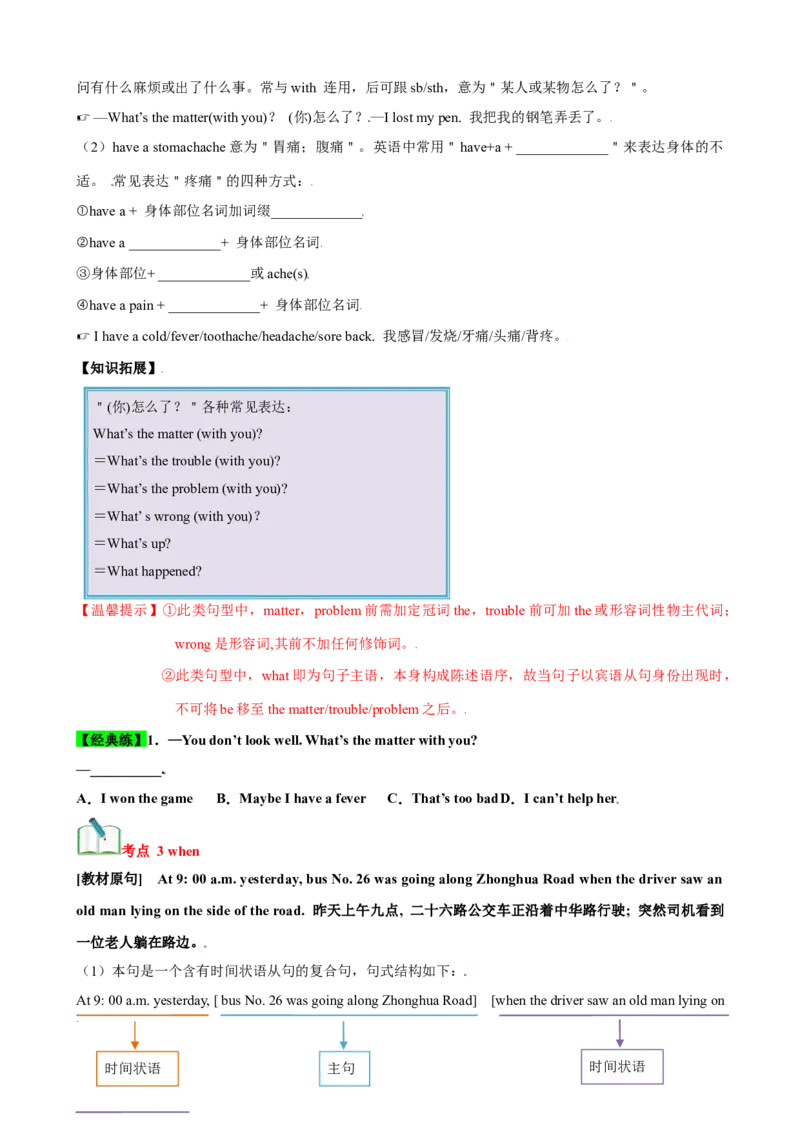
(1)本句是一个含有时间状语从句的复合句,句式结构如下:
At 9: 00 a.m. yesterday, [ bus No. 26 was going along Zhonghua Road] [when the driver saw an old man lying on
时间状语 主句 时间状语the side of the road.]
when引导时间状语从句,除常有"当……时"之意外,放在过去进行时构成的主句之后,还意为"就在
此/那时;突然",相当于at this/that time。
☞ He was just getting into the shower when the telephone rang. 他正要去沐浴间,这时(突然)电话响了起来。
(2)see sb doing sth与see sb do sth
see sb doing sth 看见某人正在做某事(看见动作正在进行)
see sb do sth 看见某人做某事(看见动作全过程或经常性的动作)
☞ I often see him play basketball after school. 我经常看见他放学后打篮球。
☞ I saw him playing the piano in the music room just now. 我刚刚看见他正在音乐室弹钢琴。
【魔法记忆】
v.+sb+doing/do的常见动词:
一感(feel),二听(listen to,hear),四看(see,look at, watch, notice)
【经典练】
1.I missed my elder sister very much. Yesterday afternoon I ________ about her ________ someone knocked on
the door. It was her!
A.think; when B.thought; while C.was thinking; when D.am thinking; while
2.At that time, Rose saw her dog __________ (lie) on the floor.
【写作佳句】(2023·湖南湘西·统考中考真题)It is necessary to wear a helmet (头盔) when we are riding a
bicycle to ensure our safety.当我们骑自行车时,有必要戴上头盔以确保我们的安全。
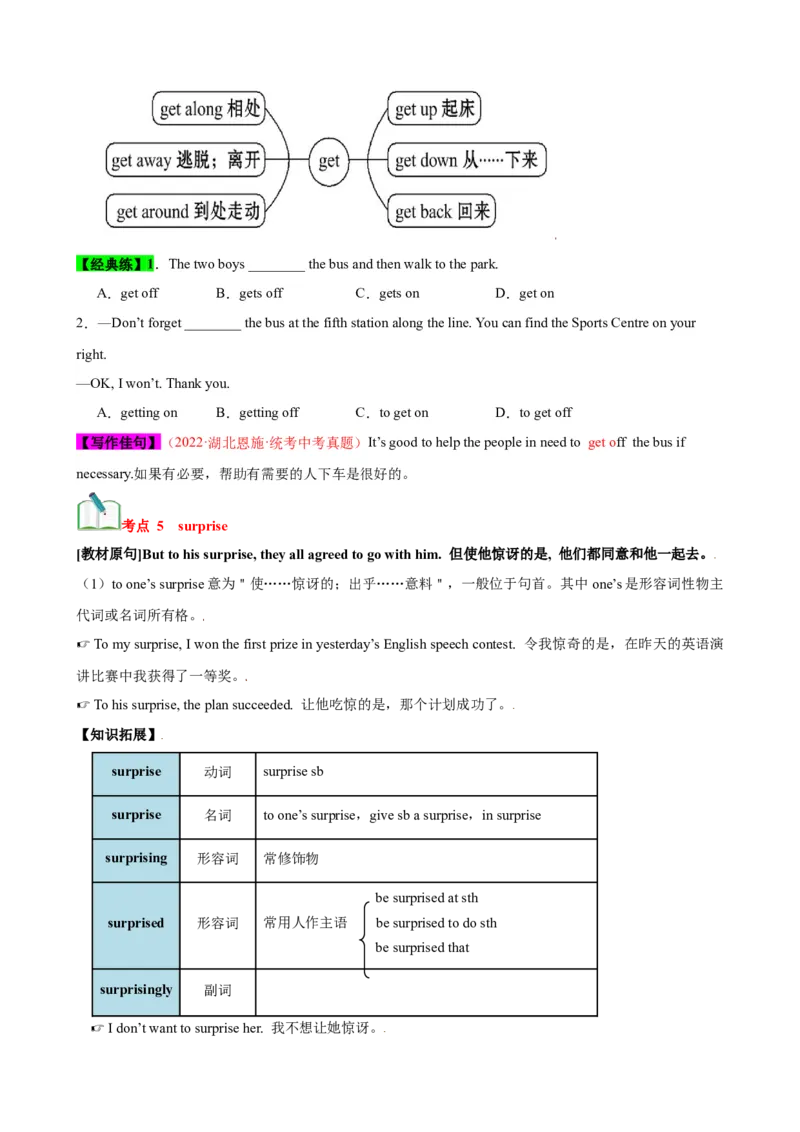
考点 4 get off意为"下车"
[教材原句] He got off and asked the woman what happened. 他下车问那位妇女发生了什么事。
get off意为"下车",其反义短语为get on"上车"。
☞ Excuse me, I have to get off at the next stop. 劳驾,我必须在下一站下车。
☞ He got off at Guangming Road. 他在光明路下车了。
☞ Don’t get on the No.8 bus. 不要上8路公交车
【归纳拓展】 常见get构成的短语:【经典练】1.The two boys ________ the bus and then walk to the park.
A.get off B.gets off C.gets on D.get on
2.—Don’t forget ________ the bus at the fifth station along the line. You can find the Sports Centre on your
right.
—OK, I won’t. Thank you.
A.getting on B.getting off C.to get on D.to get off
【写作佳句】(2022·湖北恩施·统考中考真题)It’s good to help the people in need to get off the bus if
necessary.如果有必要,帮助有需要的人下车是很好的。
考点 5 surprise
[教材原句]But to his surprise, they all agreed to go with him. 但使他惊讶的是, 他们都同意和他一起去。
(1)to one’s surprise意为"使……惊讶的;出乎……意料",一般位于句首。其中 one’s是形容词性物主
代词或名词所有格。
☞ To my surprise, I won the first prize in yesterday’s English speech contest. 令我惊奇的是,在昨天的英语演
讲比赛中我获得了一等奖。
☞ To his surprise, the plan succeeded. 让他吃惊的是,那个计划成功了。
【知识拓展】
surprise 动词 surprise sb
surprise 名词 to one’s surprise,give sb a surprise,in surprise
surprising 形容词 常修饰物
be surprised at sth
surprised 形容词 常用人作主语 be surprised to do sth
be surprised that
surprisingly 副词
☞ I don’t want to surprise her. 我不想让她惊讶。☞ Let’s give Mom a surprise! 咱们给妈妈一个惊喜吧!
☞ What surprising news! 多么令人惊讶的消息呀!
☞ I was surprised at the news. 我对这个消息感到意外。
☞ She looked surprisingly well. 她看上去身体出奇地好。
(2)agree意为"同意",作动词。常用结构:agree to do sth意为"同意做某事"。
☞ I agree to help Mary with her Chinese. 我同意帮助玛丽学习汉语。
【经典练】1.I’m very ________ to know he didn’t pass the exam. I can’t believe it.
A.careful B.successful C.surprised D.normal
2.Are you ________ when someone looks at you in ________?
A.surprised; surprised B.surprised; surprise
C.surprised; surprising D.surprising; surprise
【写作佳句】(2023·青海·统考中考真题)To our surprise, local villagers are successful in planting
strawberries without soil in Hainan.让我们惊讶的是,当地村民在海南成功地种植了无土草莓。
考点 6. lie v. 躺,平躺
lie的各种含义
You should lie down. 你应该躺下。
lie v. 躺,位于,平放 lay—lain—lying
His school lies in the north of the city. 他的学校位于城北。
lie v. 说谎 lied—lied—lying He often lies. 他经常说谎。
【巧学妙记】
lie的用法口诀
规则是说谎(lieliedlied),
不规则是躺(lielaylain)。
【拓展】
lay v. 下蛋,放置
☞ The hens lay a lot of eggs every day. 母鸡每天下很多蛋。
☞ Please lay the table before dinner. 饭前请摆好餐具。
【经典练】1.—What should I do?
—You should ________ and have a rest.
A.lie down B.get up C.move away D.go out
2.They prefer ________ in bed rather than ________ horses.
A.to lie; to ride B.lying; riding C.to lie; ride D.lying; ride【写作佳句】(2023上·上海青浦·八年级校考期末)Being tired after the training, the player lay down on
the bed and fell asleep.训练之后很累,运动员们躺在床上就睡着了。
考点7. feel v. 摸起来
feel常用作系动词,其后跟形容词作表语。其主要用法有:
①表示某物摸起来给人的感觉,通常要以被摸之物作主语,不可用于进行时态。
☞ Your hand feels cold. 你的手摸起来很凉。
☞ Silk feels soft and smooth. 丝绸摸起来柔软平滑。
②表示某人的感觉,以人作主语,可用于进行时态。
☞ I feel fine. / I’m feeling fine. 我感觉良好。/我现在感觉良好。
☞ He feels / is feeling tired. 他觉得很累。
【归纳拓展】
(1)常用的感官动词:
feel摸起来,look 看起来,sound听起来,taste尝起来,smell闻起来。
(2)feel like+n. 意为"摸起来像……"
☞ This wallet feels like leather. 这个钱包摸起来像是皮的。
【经典练】
1.He always makes me ________.
A.to feel happy B.feel more happy C.to feel happily D.feel happy
【写作佳句】(2023·山东东营·统考中考真题)A new study shows that sunshine can make men feel
hungry. They will eat more food after receiving UVB rays (紫外线) from the sun.一项新的研究表明,阳光
会让人感到饥饿。在接受了来自太阳的紫外线后,他们会吃更多的食物。
考点8. without prep. 没有,缺乏
(1)without后接名词、代词宾格或v-ing作宾语,其反义词为with。
☞ We got there without any trouble. 我们到了那儿,一路上没遇到任何麻烦。
☞ Can you finish your homework without him? 没有他你能完成你的家庭作业吗?
☞ She left the room without saying a word. 她一句话没有说就离开了房间。
(2)without用于否定句,还可以表示条件,意为"如果没有",相当于if引导的否定条件句。
☞ We couldn’t live without air.=We couldn’t live if there weren’t air.如果没有空气,我们就不能活。
【经典练】1.—Robert often doesn’t feel well and goes to the doctor.
—I know why. He often goes to school ________ breakfast. It’s bad for his health.A.during B.without C.between D.across
2.Most teenagers can’t live ________ phones. They think phones play an important role in their life.
A.with B.without C.for D.of
【写作佳句】(2023·山东东营·统考中考真题)Bees (蜜蜂) can help plants grow. Without bees, we
wouldn’t have enough food.蜜蜂能帮助植物生长。没有蜜蜂,我们将没有足够的食物。
考点9. trouble n. 问题;苦恼
trouble常用作不可数名词,相当于difficulty,意为"困难;苦恼",常用短语及句式:
(1)get (sb.) into trouble意为"(使某人)陷入困境"。学!科网
☞ If I don’t clock in before 9, I’ll get into trouble!
我要是9点前没有上班打卡,我就会遇到麻烦的!
(2)be in trouble意为"陷入困境中"。
☞ Now he is in trouble, we should go all out to help him.
现在他遇到了麻烦,我们应该全力以赴去帮助他。
(3)have trouble /difficulty/problems with sth.=have trouble /difficulty/problems (in) doing sth.表示"做某事
有困难"。
☞ His son had trouble climbing up the hill. 他儿子爬这座山很困难。
(4)What’s the trouble (with you)? (你)怎么了?
(5)trouble动词,表示"使烦恼,使忧虑;麻烦"。
☞ Could I trouble you to open the door? 能麻烦你开一下门吗?
【经典练】1.A good friend is the one who will give you a hand when you are _________.
A.in trouble B.by mistake C.in silence
【写作佳句】(2023·黑龙江齐齐哈尔·统考中考真题)When you are in trouble, a friend who runs away
from you is not a true one.当你遇到麻烦时,从你身边逃跑的朋友不是真正的朋友。
考点10 be interested in"对……感兴趣"
be interested in为固定短语,意为"对……感兴趣",其后可接名词、代词或动词-ing形式作宾语。
☞ He was interested in science when he was young. 他小时候就对科学感兴趣。
☞ Are you interested in swimming? 你对游泳感兴趣吗?
【易混辨析】 interested与interesting
He became interested in fishing. 他变得对钓
"感兴趣的",多作表语,通常用来说明 鱼感兴趣。
interested
人。"引起兴趣的;有趣的",作表语或定 The cartoon is very interesting. 这部动画片
语,通常用来说明或修饰事物。 很有趣。
interesting
【经典练】1.Not only my friends but also I _________ interested in football and Messy is our favourite star.
A.be B.am C.is D.are
2.No one buys this book, so there may be ______ in it.
A.something interesting B.interesting something C.nothing interesting D.interesting nothing
【写作佳句】(2021·江苏淮安·统考中考真题)Both Sandy and Millie are interested in cooking. They often
learn to cook at weekends.Sandy和Millie都对烹饪感兴趣。他们经常在周末学习做饭。
考点11 be used to"习惯于……;适应于……"
As a mountain climber, Aron is used to taking risks. 作为一名登山者, 阿伦习惯于冒险。
be used to意为"习惯于……;适应于……",其中to是介词,后跟名词、代词或动词-ing形式。
☞ He is used to taking cold showers even in winter. 他习惯了甚至在冬天也用冷水淋浴。
☞ He is used to getting up early. 他习惯于早起。学科*网
【归纳拓展】
意为"习惯于……",相当于短语get used to。
be used to sth / doing sth ☞ Be patient and you will be used to the life here soon.
耐心些!很快你就会习惯这儿的生活的。
意为"被用来做某事",是动词use的被动结构。
be used to do sth
☞ Plastics can be used to make all kinds of things.
(=be used for doing sth )
塑料能被用来制造各种各样的东西。
意为"过去常做某事",表达过去。
used to do sth ☞ I used to go to the cinema, but I hardly ever have time for films now.
我过去经常去看电影,但现在我几乎没有时间看电影了。
【经典练】1.I ________ a worker, but now I am an actor.
A.used to be B.used to being C.was used being
【写作佳句】(2023·黑龙江哈尔滨·统考中考真题)His name is Harry. He used to be short, but he is tall
now.他叫Harry。他过去很矮,但他现在很高了。
考点12 run out
But when his water ran out, he knew that he would have to do something to save his own life. 但是当他的
水用尽时,他知道他必须做一些事情来拯救自己的生命。
run out作不及物动词短语,意为"用尽;耗尽",主语通常是时间、金钱、水、食物等无生命名词。
☞ His strength ran out. 他的力气用完了。☞ After a long walk, he ran out of his water. 长途跋涉后,他用尽了他的水。
【易混辨析】 run out与run out of
是"动词+副词"型动词短语,主语通常是时间、食物、金钱等名词。
run out
☞ His money soon ran out. 他的钱很快花完了。
作及物动词用(=use up),后接宾语,主语通常是人。
run out of ☞ I have run out of my money before payday.
在发工资的日子之前我已经用尽了我的钱。
【注意】 run out of... 其原意为"从……中跑出"。
☞ Lots of students ran out of the classroom to see what had happened.
很多学生从教室里跑出来看看发生了什么事。
【经典练】1.We should pay much attention to saving natural resources. Otherwise(否则), they will one
day________.
A.hand out B.run out C.sell out
2.On our way to the picnic, we found we ________ our water and our food ________, too.
A.ran out; run outB.ran out of; ran out C.ran out; ran out of D.ran out of; ran out of
【写作佳句】(2023·江苏南通·统考中考真题)The wind energy costs very little and will never run out.
Besides, it produces little pollution.风能花费很少并永远不会被用光。除此之外,它产生很少的污染。
考点13 so ... that..."如此……以至于……"
His love for mountain climbing is so great that he kept on climbing mountains even after this experience.
他对登山的热爱是如此深厚以至于在这次经历之后他还继续登山。
(1)"so ... that..."意为"如此……以至于……",that引导结果状语从句。此句型中,so是副词,常用
来修饰形容词或副词。常用句型结构为:主语+谓语+so+adj./adv.+ that从句。
☞ The math problem is so difficult that I can’t work it out. 这道数学题是如此难以至于我解不出来。
☞ The boy is so young that he can’t go to school. 这个男孩太小还不能去上学。
【易混辨析】 such... that与so... that的区别
(1)so+ adj./adv.
adj. + a/an + _________
many/few + 可数名词复数 + that从句
much/little+___________
(2)such + a/an + adj. + 单数名词adj. + ___________ +that从句
adj. + 复数名词
【注意】 如果so... that...句型中,that引导的从句中的主语与主句中的主语一致,在否定句中可与too...
to...或not... enough to...结构转换。
☞ He is so young that he can’t go to school. 他太小了,不能去上学。
=He is too young to go to school. =He isn’t old enough to go to school.
【经典练】1.He felt ________ surprised ________ he couldn’t say a word.
A.such; that B.too; to C.so; that D.very; as
【写作佳句】(2023·黑龙江牡丹江·统考中考真题)Red Star over China (《红星照耀中国》) is so popular
that two thirds of the students in our class have finished reading it.《红星照耀中国》非常受欢迎,我们班三分
之二的学生都读完了。
考点14 feel well
5. —Are you OK? 你还好吗?
—No, I don’t feel well. 不,我觉得不舒服。
feel well意为"身体好;感觉舒服"。其中feel意为"感觉",为系动词,后常接形容词作表语。well表
示健康状况时,是形容词,意为"健康的"。
☞ I think I’ll go and lie down — I don’t feel well. 我想我得去躺一会儿,我感到不大舒服。
【易混辨析】 good与well的区别
是形容词,意为"好的;优秀的",在句中常用作表语或定语。
good ☞ I have a good friend. 我有一个好朋友。
作副词,意为"很好地",常用来修饰动词,在句中作状语。
☞ She speaks English well. 她英语说得好。
well
作形容词,常用来表示健康状况,意为"健康的",在句中常用作表语。
☞ I hope she is well. 我希望她身体健康。
【经典练】
1. 要是我身体感觉不舒服该怎么办?
What should I do if I am not _____________ _____________?
2. 玛丽是一位优秀的游泳选手。她游得很好。
Mary is a _____________ swimmer. She swims very _____________.
3.—I think our English teacher is working hard. She teaches us ________.—Yes, but she hasn’t come today. She doesn’t feel ________.
A.good; well B.well; good C.well; well
【写作佳句】—I don’t want to eat anything, Mum. I’m not feeling well.我不想吃任何东西,妈妈。我感觉不
舒服。
考点15. decision n. 决定;抉择
decision常用于短语make a decision/decisions意为"作决定"。
make a decision to do sth.=decide to do sth.=make up one’s mind to do sth. 决定做某事。
He made a decision/decided to go to New York finally. 最后他决定去纽约。
【经典练】1.I can’t make the ________ for you. It’s up to you.
A.invitation B.example C.decision D.promise
2.—Mum, must I be a teacher like you when I grow up?
—No, you needn’t. You can make your own ________.
A.development B.decision C.difference D.achievement
【写作佳句】(2021·四川广元·统考中考真题)As a middle school student, you should learn to depend on
yourself to make a decision.作为一个中学生,你应该学会依靠自己做决定。
一.语法精讲
表达病痛的结构
要表达身体某一部位疼痛或不舒服,可以用以下结构:
1. 某人+ have/has + 病症.
☞ The twins have colds. 这对双胞胎感冒了。
2. 某人+ have/has a(n) + 身体部位-ache(headache / toothache / stomachache / backache / earache)
☞ She had a stomachache last night. 她昨晚胃痛。
3. 某人+ have / has a sore + 身体部位.
☞ He has a sore throat. 他喉咙痛。
4. 某人+ hurt(s) + 身体部位或反身代词.
☞ He hurt his leg. 他的腿受伤了。5. 身体部位 + hurt(s).
☞ My head hurts badly. 我头痛得厉害。
6. 某人+ have/has a pain in one’s + 身体部位.
☞ I have a pain in my chest. 我胸口痛。
7. (There is) something wrong with one’s + 身体部位.
☞ There is something wrong with my right eye. 我的右眼不舒服。
8. 其他表达方式
☞ She has a heart trouble. 她有心脏病。
☞ He got hit on the head. 他头部受到了撞击。
☞ She cut her finger. 她割破手指了。
(二)情态动词should的用法
should 作情态动词,有实际的词义,但它不可单独作谓语,须与动词原形连用,没有人称和数的变
化。其否定形式在其后加not,可缩写为shouldn’t;变为一般疑问句时,should 提到主语之前。它的用法
如下:
1. 表示委婉地提出意见或建议,一般意为"应该;应当"。
☞ You should eat lots of healthy food. 你应该多吃些健康的食品。
☞ You should help each other. 你们应该互相帮助。
2. 表示义务、责任,也意为"应该;应当"。
☞ You should study hard. 你应当努力学习。
☞ He should pay for the books. 他应当付书钱。学科*网
3. 表示命令和要求,语气比较强烈。
☞ We should respect our teachers and parents. 我们应该尊敬老师和父母。
☞ You shouldn’t be so careless. 你不应该这么粗心。
4. 表示预测和可能性。
☞ He should be a teacher. 他可能是一位老师。
☞ They should be in the classroom. 他们应该在教室里。
5. 表示说话人的感情,如惊奇、愤怒、失望等,多见于以why,who,how,what等开头的特殊疑问句中。
☞ Why should I invite her? 为什么我要邀请她?
☞ How should I know? 我怎么会知道?
(三)反身代词反身代词是由第一人称、第二人称形容词性物主代词或第三人称的人称代词宾格形式,词尾加-self
或-selves组成的。反身代词意为"本人""本身",为加强语气,也可翻译为"亲自""自己"。
1. 反身代词构成
人称 第一人称 第二人称 第三人称
数
单数 myself yourself himself/herself/itself
复数 ourselves yourselves themselves
2. 反身代词的用法
☞ The boy can dress himself. 这个男孩能给自己穿衣服。
作动词宾语或
介词宾语 ☞ Take good care of yourself. 好好照顾你自己。
☞ Mrs Black herself is a lawyer. 布莱克夫人本人就是一名律师。
作主语或宾
☞ You had better ask the driver himself. 你最好问司机本人。
语的同位语
☞ Just be yourself. 做你自己就好了。
作表语
☞ Mary hasn’t been herself recently. 玛丽近来感到不适。
3. 易错点
反身代词必须与其所指代的名词或代词形成相互关系,在人称、性和数上保持一致。
☞ The children are enjoying themselves in the park. 孩子们正在公园里玩得很高兴。
4. 反身代词的常用短语
teach oneself=learn by oneself 自学 enjoy oneself 过得愉快
help oneself to... 随便吃/用…… look after oneself 照顾某人自己
dress oneself 给自己穿衣服
二、健康与急救
Unit 1 What’s the matter?
单元写作专题
【话题分析】
本单元以“健康和急救”为话题,围绕这一话题描述生活中存在的健康问题与急救方法。在写相关的作文时,首先要学会运用“have+a+疾病名词”的一般现在时或一般过去时来描述某人存在的健康问
题。然后针对这些问题,运用should/shouldn't提出合理的建议。
【单元写作素材】
▶▶▶话题短语
1. 牙痛 have a toothache
2 感到恶心feel sick
3. 肚子痛 have a stomachache
4. 流鼻血 have a nosebleed
5. 感冒 have a cold
6. 摔倒fall down
7. 膝盖受伤 hurt one’s knee
8. 割伤cut oneself
9. 撞到头 get hit on the head
10. 躺下来休息 lie down and rest
11. 喝热的蜂蜜水 drink hot tea with honey
12. 看牙医 go to the dentist
10. 休息几天 rest for a few days
11. 去看医生 go to a doctor
12. 量体温 take one’s temperature
13. 在……敷药 put some medicine on.....
14. 用绑带包扎 put a bandage on...
15. 在水下冲 run under the water
16. 去医院 go to the hospital
▶▶▶话题句型积累
1.朱迪怎么了?
What's the matter with Judy?
2.你应该喝加了蜂蜜的热茶。
You should drink hot with honey
3.你下次不应该吃太多。
You shouldn't eat too much next time.
4.充足的睡眠对我们的健康有好处。
Enough sleep is good for our health.
【话题范文剖析】要求:
1.不要逐条翻译,可适当发挥;
2.不少于70词。
参考词汇:healthy diet 健康的饮食
◆◆思路点拨
◆◆范文欣赏
How to Keep Healthy
It's important for us to keep healthy.As a middle school student,we should have a healthy lifestyle.Here is
some advice.
First,we should do exercise at least one hour a day,such as running and walking.Second,have a healthy
diet.Eat more fruit and vegetables.Try not to eat junk food.Third,we shouldn't spend too much time going
online.It is bad for/It is harmful to our eyes and study.Fourth,go to bed early and don't stay up too late,because
enough sleep is good for our health.Finally,be happy as possible as we can.Learn to smile at ourselves at any
time.
If we do so,I believe we can keep healthy.Unit 1 What’s the matter?
重点短语
1. What's the matter? 怎么了? 2. have a cold/a fever/a cough 感冒/发烧/咳嗽
3.have a stomachache/toothache/headache 胃痛/牙痛/头痛
4. have a sore throat/back 喉咙痛/背痛
5. cut oneself 割到自己 6. lie down and rest 躺下休息
7. drink some hot tea with honey 喝些加蜂蜜的热茶 8. drink enough water 喝足够的水
9. get an X-ray 拍X光片 10.take one's temperature 量某人的体温
11. cough badly 咳嗽得厉害 12. see a dentist/a doctor 看牙医/看医生
13. take breaks away from the computer 离开电脑休息
14. sit in the same way for too long 用相同的姿势坐很久
15. shout for help 大声呼救 16.without thinking twice 不假思索
17.get off 下车 18. have a heart problem有心脏病
19. to one's surprise 出乎某人的意料 20. right away 立刻
21. get into trouble 陷人麻烦 22. put some medicine on the cut 在伤口上敷点药
23. put a bandage on it 绑上绷带 24. run... under water 在水下冲洗······
25. press the sides of your nose 按住你鼻子的两边26. put one's head down 低头
27. feel sick 感到不舒服 28. have a nosebleed 流鼻血
29. get hit on the head 撞到头 30. fall down 摔倒
31. have problems breathing 呼吸有问题 32. get hit by a ball 被球撞了一下
33. get sunburned 晒伤 34. a mountain climber 一个登山运动员
35. be used to doing sth. 习惯于做某事 36.take risks 冒险
37.lose one's life 失去性命 38. because of accidents 由于事故
39. run out(of) 用 40. use sth. to do sth. 使用某物去做某事
41. cut off 切除 42. so that 以便于;为了
43. a book called... 一本叫······的书 44. get out of 离开;从·····出来
45. the importance of..... 的重要性 46. make decisions 做决定
47. be in control of 掌管;管理 48.so...that... 如此····以至于····
49. keep on doing sth.继续做某事 50. in a very dangerous situation 在非常危险的情况下
51.free his arm 解放他的手 52. have the same spirit as 有着和······同样的精神
53. do something to save his own life 做某事来拯救他自己的生命
54. give up doing sth. 放弃做某事重点句型
1.-What's the matter(with you)? (你)怎么了?
-I have a stomachache. 我胃痛。
-You shouldn't eat so much next time. 你下次不应该吃这么多。
2.-What should I do? 我该怎么办?
-You should lie down and rest. 你应该躺下休息一下。
3.-Do you have a fever? 你发烧了吗?
-Yes,I do./No,I don't. 是的,我发烧了。/不,我没有发烧。
4. -Does he have a toothache? 他牙痛吗?
-Yes,he does. 是的,他牙痛。
-He should see a dentist and get an X-ray. 他应该看牙医并拍X光片。
5. -Should I put some medicine on it? 我应该敷药吗?
-Yes,you should./No, you shouldn't. 是的,你应该敷药。/不,你不应该敷药。
6. Thanks to Mr. Wang and the passengers, the man was saved by the doctors in time.
多亏了王先生和乘客们,医生及时挽救了老人的性命。
7. It's sad that many people don't want to help others because they don't want any trouble.
许多人因为不想有麻烦而不想帮助别人,这真令人难受。
8. If your head and neck still hurt tomorrow, then go to a doctor.
如果你的头和脖子明天仍然疼痛,那么就要去看医生了。
9. Did you hurt yourself playing soccer? 在踢足球时你伤到自己了吗?
10. His love for mountain climbing is so great that he kept on climbing mountains even after this experience.
他对爬山的热爱是如此的强烈以至于他在这次经历后仍继续爬山。