文档文本内容
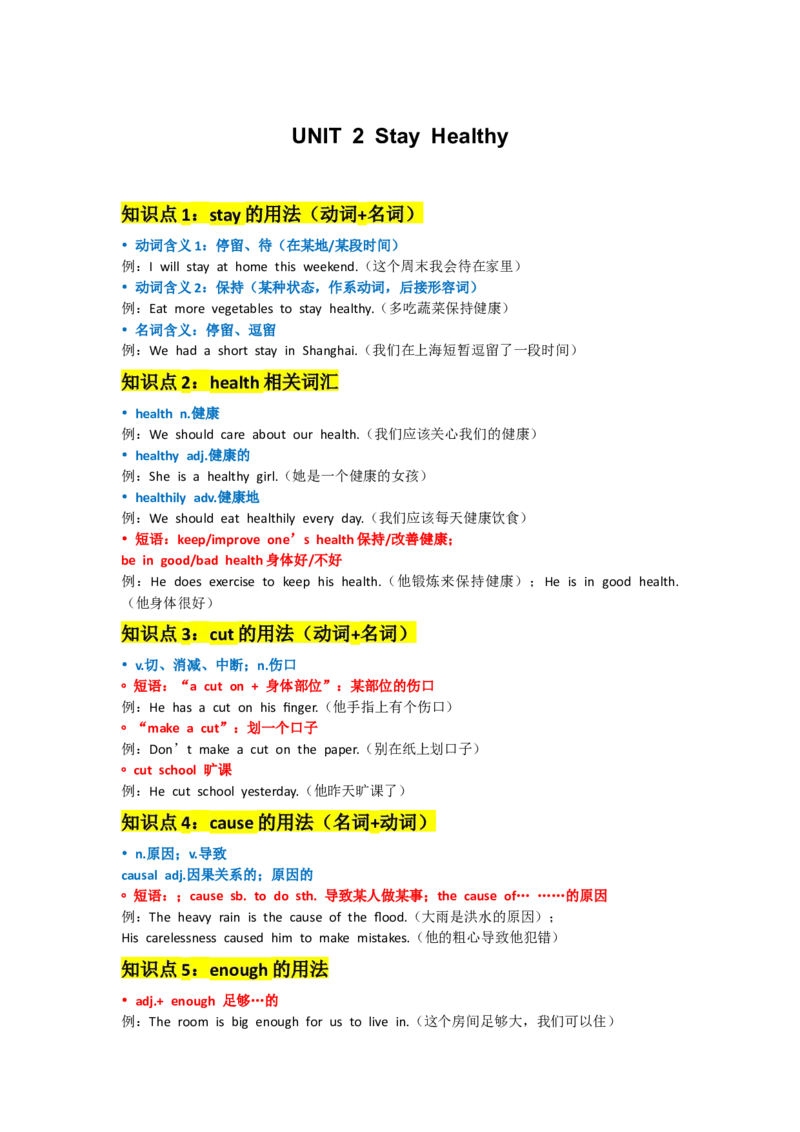
UNIT 2 Stay Healthy
知识点1:stay的用法(动词+名词)
• 动词含义1:停留、待(在某地/某段时间)
例:I will stay at home this weekend.(这个周末我会待在家里)
• 动词含义2:保持(某种状态,作系动词,后接形容词)
例:Eat more vegetables to stay healthy.(多吃蔬菜保持健康)
• 名词含义:停留、逗留
例:We had a short stay in Shanghai.(我们在上海短暂逗留了一段时间)
知识点2:health相关词汇
• health n.健康
例:We should care about our health.(我们应该关心我们的健康)
• healthy adj.健康的
例:She is a healthy girl.(她是一个健康的女孩)
• healthily adv.健康地
例:We should eat healthily every day.(我们应该每天健康饮食)
• 短语:keep/improve one’s health保持/改善健康;
be in good/bad health身体好/不好
例:He does exercise to keep his health.(他锻炼来保持健康);He is in good health.
(他身体很好)
知识点3:cut的用法(动词+名词)
• v.切、消减、中断;n.伤口
◦ 短语:“a cut on + 身体部位”:某部位的伤口
例:He has a cut on his finger.(他手指上有个伤口)
◦ “make a cut”:划一个口子
例:Don’t make a cut on the paper.(别在纸上划口子)
◦ cut school 旷课
例:He cut school yesterday.(他昨天旷课了)
知识点4:cause的用法(名词+动词)
• n.原因;v.导致
causal adj.因果关系的;原因的
◦ 短语:;cause sb. to do sth. 导致某人做某事;the cause of… ……的原因
例:The heavy rain is the cause of the flood.(大雨是洪水的原因);
His carelessness caused him to make mistakes.(他的粗心导致他犯错)
知识点5:enough的用法
• adj.+ enough 足够…的
例:The room is big enough for us to live in.(这个房间足够大,我们可以住)• enough + n.足够的…
例:We have enough food to eat.(我们有足够的食物吃)
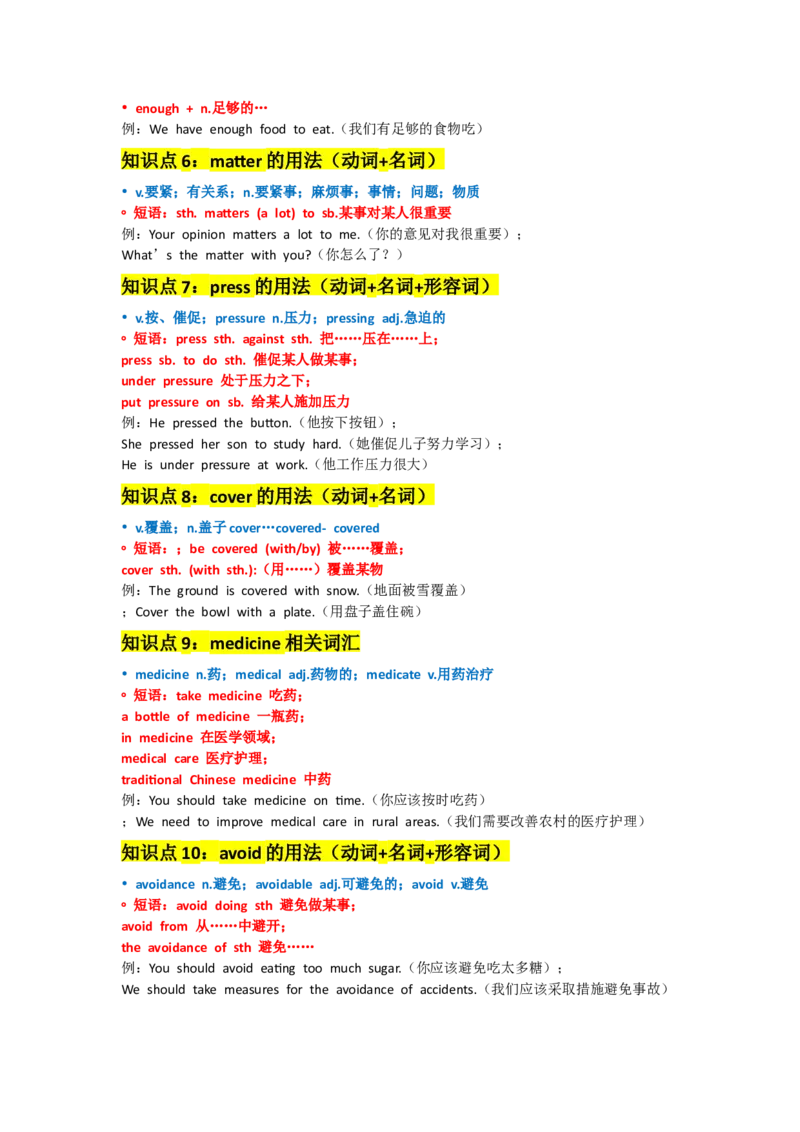
知识点6:matter的用法(动词+名词)
• v.要紧;有关系;n.要紧事;麻烦事;事情;问题;物质
◦ 短语:sth. matters (a lot) to sb.某事对某人很重要
例:Your opinion matters a lot to me.(你的意见对我很重要);
What’s the matter with you?(你怎么了?)
知识点7:press的用法(动词+名词+形容词)
• v.按、催促;pressure n.压力;pressing adj.急迫的
◦ 短语:press sth. against sth. 把……压在……上;
press sb. to do sth. 催促某人做某事;
under pressure 处于压力之下;
put pressure on sb. 给某人施加压力
例:He pressed the button.(他按下按钮);
She pressed her son to study hard.(她催促儿子努力学习);
He is under pressure at work.(他工作压力很大)
知识点8:cover的用法(动词+名词)
• v.覆盖;n.盖子cover…covered- covered
◦ 短语:;be covered (with/by) 被……覆盖;
cover sth. (with sth.):(用……)覆盖某物
例:The ground is covered with snow.(地面被雪覆盖)
;Cover the bowl with a plate.(用盘子盖住碗)
知识点9:medicine相关词汇
• medicine n.药;medical adj.药物的;medicate v.用药治疗
◦ 短语:take medicine 吃药;
a bottle of medicine 一瓶药;
in medicine 在医学领域;
medical care 医疗护理;
traditional Chinese medicine 中药
例:You should take medicine on time.(你应该按时吃药)
;We need to improve medical care in rural areas.(我们需要改善农村的医疗护理)
知识点10:avoid的用法(动词+名词+形容词)
• avoidance n.避免;avoidable adj.可避免的;avoid v.避免
◦ 短语:avoid doing sth 避免做某事;
avoid from 从……中避开;
the avoidance of sth 避免……
例:You should avoid eating too much sugar.(你应该避免吃太多糖);
We should take measures for the avoidance of accidents.(我们应该采取措施避免事故)知识点11:care的用法(动词+形容词+副词)
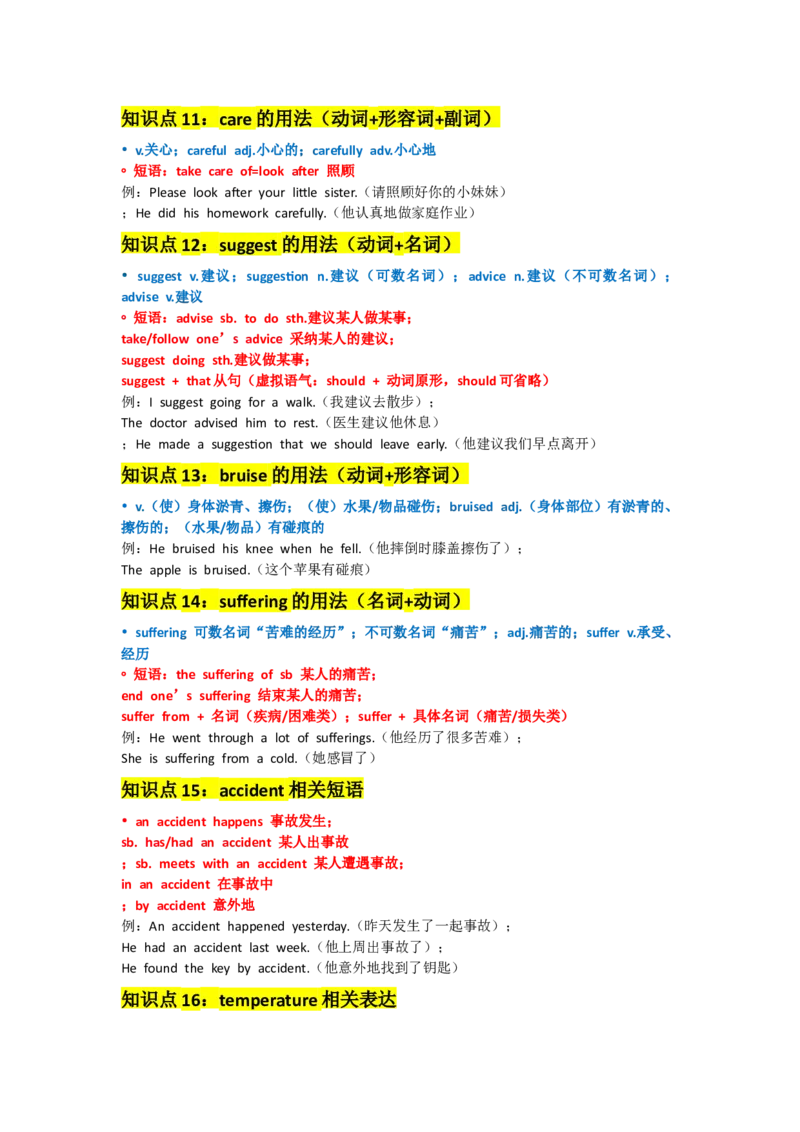
• v.关心;careful adj.小心的;carefully adv.小心地
◦ 短语:take care of=look after 照顾
例:Please look after your little sister.(请照顾好你的小妹妹)
;He did his homework carefully.(他认真地做家庭作业)
知识点12:suggest的用法(动词+名词)
• suggest v.建议;suggestion n.建议(可数名词);advice n.建议(不可数名词);
advise v.建议
◦ 短语:advise sb. to do sth.建议某人做某事;
take/follow one’s advice 采纳某人的建议;
suggest doing sth.建议做某事;
suggest + that从句(虚拟语气:should + 动词原形,should可省略)
例:I suggest going for a walk.(我建议去散步);
The doctor advised him to rest.(医生建议他休息)
;He made a suggestion that we should leave early.(他建议我们早点离开)
知识点13:bruise的用法(动词+形容词)
• v.(使)身体淤青、擦伤;(使)水果/物品碰伤;bruised adj.(身体部位)有淤青的、
擦伤的;(水果/物品)有碰痕的
例:He bruised his knee when he fell.(他摔倒时膝盖擦伤了);
The apple is bruised.(这个苹果有碰痕)
知识点14:suffering的用法(名词+动词)
• suffering 可数名词“苦难的经历”;不可数名词“痛苦”;adj.痛苦的;suffer v.承受、
经历
◦ 短语:the suffering of sb 某人的痛苦;
end one’s suffering 结束某人的痛苦;
suffer from + 名词(疾病/困难类);suffer + 具体名词(痛苦/损失类)
例:He went through a lot of sufferings.(他经历了很多苦难);
She is suffering from a cold.(她感冒了)
知识点15:accident相关短语
• an accident happens 事故发生;
sb. has/had an accident 某人出事故
;sb. meets with an accident 某人遭遇事故;
in an accident 在事故中
;by accident 意外地
例:An accident happened yesterday.(昨天发生了一起事故);
He had an accident last week.(他上周出事故了);
He found the key by accident.(他意外地找到了钥匙)
知识点16:temperature相关表达• 询问温度用“What’s the temperature...?”;
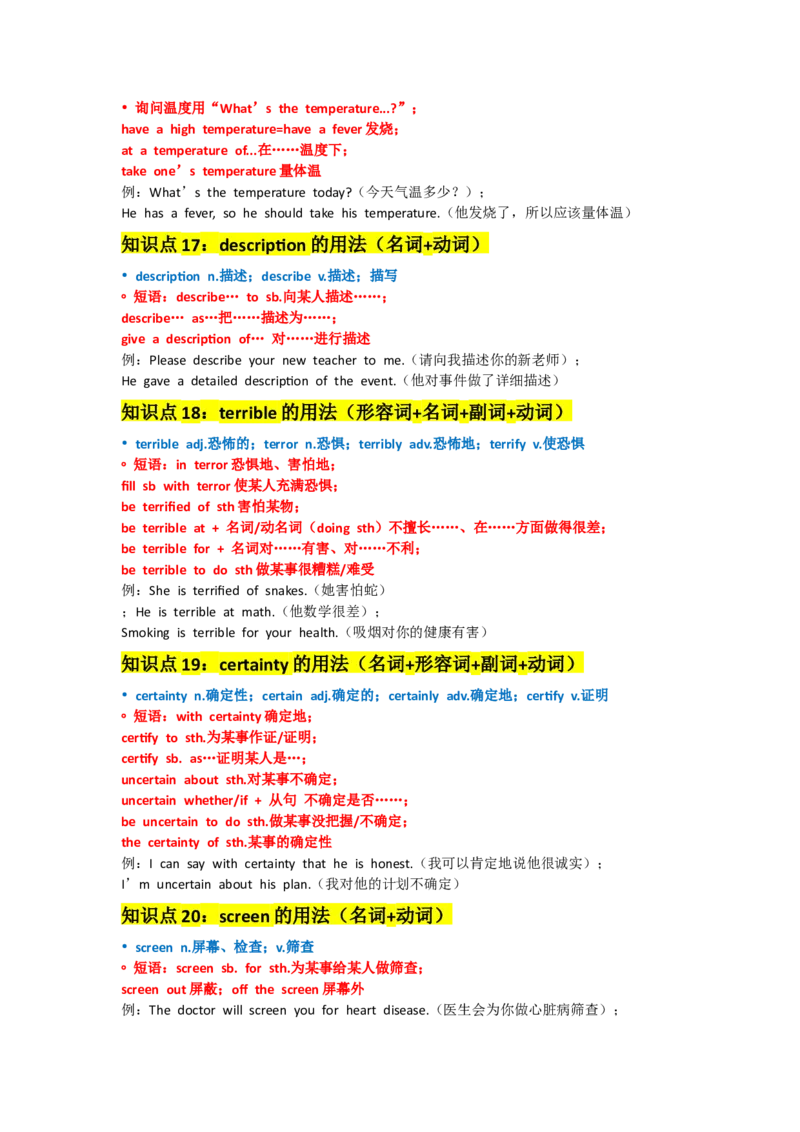
have a high temperature=have a fever发烧;
at a temperature of...在……温度下;
take one’s temperature量体温
例:What’s the temperature today?(今天气温多少?);
He has a fever, so he should take his temperature.(他发烧了,所以应该量体温)
知识点17:description的用法(名词+动词)
• description n.描述;describe v.描述;描写
◦ 短语:describe… to sb.向某人描述……;
describe… as…把……描述为……;
give a description of… 对……进行描述
例:Please describe your new teacher to me.(请向我描述你的新老师);
He gave a detailed description of the event.(他对事件做了详细描述)
知识点18:terrible的用法(形容词+名词+副词+动词)
• terrible adj.恐怖的;terror n.恐惧;terribly adv.恐怖地;terrify v.使恐惧
◦ 短语:in terror恐惧地、害怕地;
fill sb with terror使某人充满恐惧;
be terrified of sth害怕某物;
be terrible at + 名词/动名词(doing sth)不擅长……、在……方面做得很差;
be terrible for + 名词对……有害、对……不利;
be terrible to do sth做某事很糟糕/难受
例:She is terrified of snakes.(她害怕蛇)
;He is terrible at math.(他数学很差);
Smoking is terrible for your health.(吸烟对你的健康有害)
知识点19:certainty的用法(名词+形容词+副词+动词)
• certainty n.确定性;certain adj.确定的;certainly adv.确定地;certify v.证明
◦ 短语:with certainty确定地;
certify to sth.为某事作证/证明;
certify sb. as…证明某人是…;
uncertain about sth.对某事不确定;
uncertain whether/if + 从句 不确定是否……;
be uncertain to do sth.做某事没把握/不确定;
the certainty of sth.某事的确定性
例:I can say with certainty that he is honest.(我可以肯定地说他很诚实);
I’m uncertain about his plan.(我对他的计划不确定)
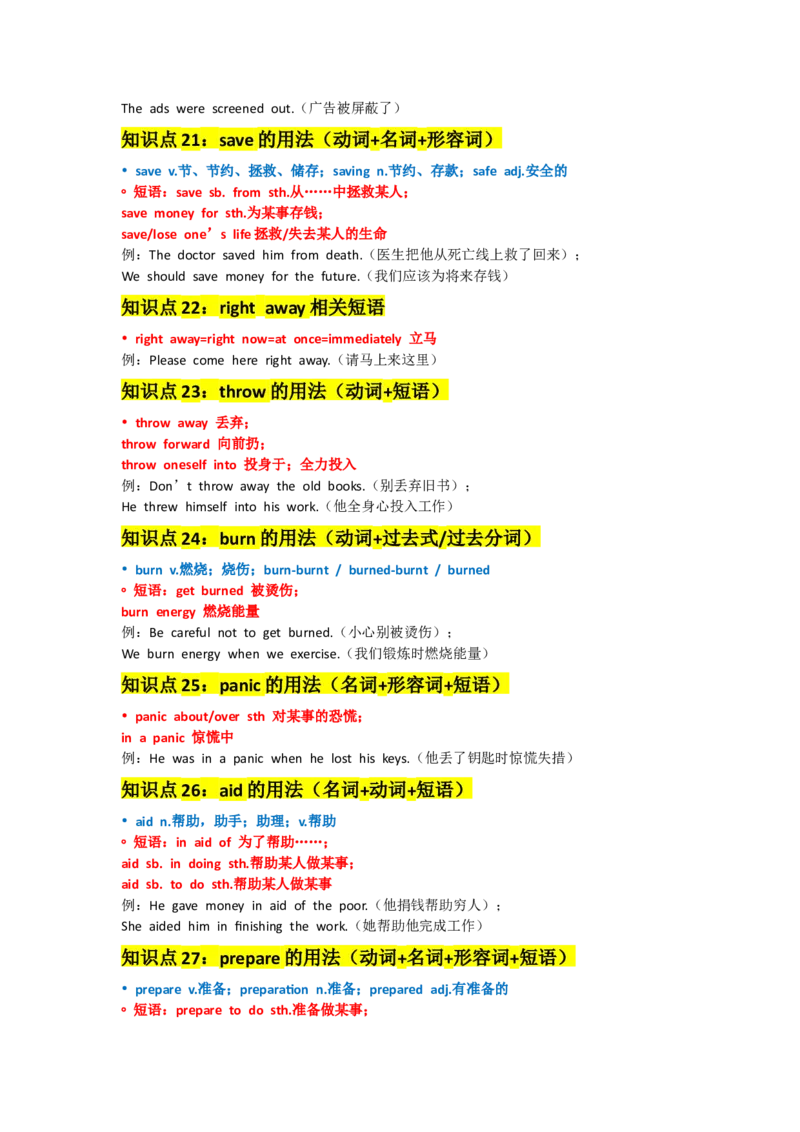
知识点20:screen的用法(名词+动词)
• screen n.屏幕、检查;v.筛查
◦ 短语:screen sb. for sth.为某事给某人做筛查;
screen out屏蔽;off the screen屏幕外
例:The doctor will screen you for heart disease.(医生会为你做心脏病筛查);The ads were screened out.(广告被屏蔽了)
知识点21:save的用法(动词+名词+形容词)
• save v.节、节约、拯救、储存;saving n.节约、存款;safe adj.安全的
◦ 短语:save sb. from sth.从……中拯救某人;
save money for sth.为某事存钱;
save/lose one’s life拯救/失去某人的生命
例:The doctor saved him from death.(医生把他从死亡线上救了回来);
We should save money for the future.(我们应该为将来存钱)
知识点22:right away相关短语
• right away=right now=at once=immediately 立马
例:Please come here right away.(请马上来这里)
知识点23:throw的用法(动词+短语)
• throw away 丢弃;
throw forward 向前扔;
throw oneself into 投身于;全力投入
例:Don’t throw away the old books.(别丢弃旧书);
He threw himself into his work.(他全身心投入工作)
知识点24:burn的用法(动词+过去式/过去分词)
• burn v.燃烧;烧伤;burn-burnt / burned-burnt / burned
◦ 短语:get burned 被烫伤;
burn energy 燃烧能量
例:Be careful not to get burned.(小心别被烫伤);
We burn energy when we exercise.(我们锻炼时燃烧能量)
知识点25:panic的用法(名词+形容词+短语)
• panic about/over sth 对某事的恐慌;
in a panic 惊慌中
例:He was in a panic when he lost his keys.(他丢了钥匙时惊慌失措)
知识点26:aid的用法(名词+动词+短语)
• aid n.帮助,助手;助理;v.帮助
◦ 短语:in aid of 为了帮助……;
aid sb. in doing sth.帮助某人做某事;
aid sb. to do sth.帮助某人做某事
例:He gave money in aid of the poor.(他捐钱帮助穷人);
She aided him in finishing the work.(她帮助他完成工作)
知识点27:prepare的用法(动词+名词+形容词+短语)
• prepare v.准备;preparation n.准备;prepared adj.有准备的
◦ 短语:prepare to do sth.准备做某事;be prepared for为……做好准备;
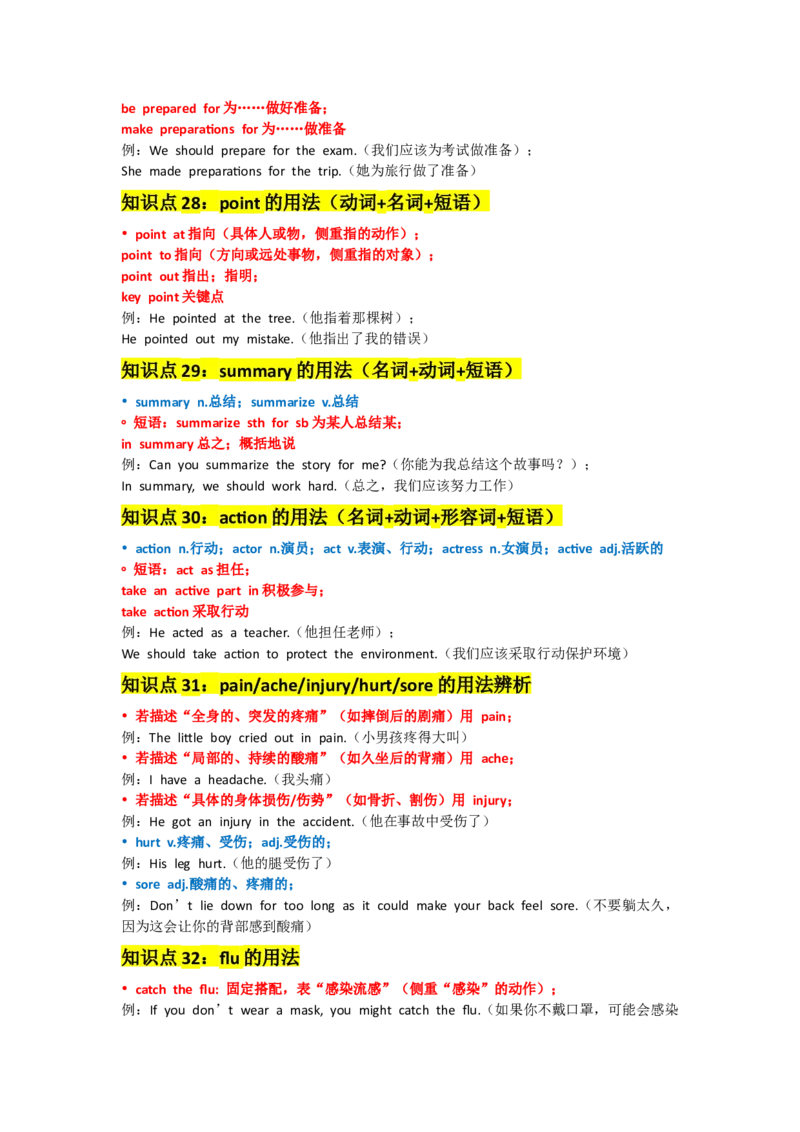
make preparations for为……做准备
例:We should prepare for the exam.(我们应该为考试做准备);
She made preparations for the trip.(她为旅行做了准备)
知识点28:point的用法(动词+名词+短语)
• point at指向(具体人或物,侧重指的动作);
point to指向(方向或远处事物,侧重指的对象);
point out指出;指明;
key point关键点
例:He pointed at the tree.(他指着那棵树);
He pointed out my mistake.(他指出了我的错误)
知识点29:summary的用法(名词+动词+短语)
• summary n.总结;summarize v.总结
◦ 短语:summarize sth for sb为某人总结某;
in summary总之;概括地说
例:Can you summarize the story for me?(你能为我总结这个故事吗?);
In summary, we should work hard.(总之,我们应该努力工作)
知识点30:action的用法(名词+动词+形容词+短语)
• action n.行动;actor n.演员;act v.表演、行动;actress n.女演员;active adj.活跃的
◦ 短语:act as担任;
take an active part in积极参与;
take action采取行动
例:He acted as a teacher.(他担任老师);
We should take action to protect the environment.(我们应该采取行动保护环境)
知识点31:pain/ache/injury/hurt/sore的用法辨析
• 若描述“全身的、突发的疼痛”(如摔倒后的剧痛)用 pain;
例:The little boy cried out in pain.(小男孩疼得大叫)
• 若描述“局部的、持续的酸痛”(如久坐后的背痛)用 ache;
例:I have a headache.(我头痛)
• 若描述“具体的身体损伤/伤势”(如骨折、割伤)用 injury;
例:He got an injury in the accident.(他在事故中受伤了)
• hurt v.疼痛、受伤;adj.受伤的;
例:His leg hurt.(他的腿受伤了)
• sore adj.酸痛的、疼痛的;
例:Don’t lie down for too long as it could make your back feel sore.(不要躺太久,
因为这会让你的背部感到酸痛)
知识点32:flu的用法
• catch the flu: 固定搭配,表“感染流感”(侧重“感染”的动作);
例:If you don’t wear a mask, you might catch the flu.(如果你不戴口罩,可能会感染流感)
• have the flu: 表“患有流感”(侧重“患病”的状态);
例:He has the flu, so he can’t go to school.(他得了流感,所以不能上学)
知识点33:disorder/order/strange/tight/nervous的用法
• disorder n.混乱;order n.命令、秩序;v.命令;
例:The room was in disorder.(房间一片混乱);
He gave an order to stop.(他下令停止)
• in order to do sth为了做某事;out of order出故障;in order按顺序;
例:He got up early in order to catch the bus.(他早起为了赶公交车)
;The machine is out of order.(机器出故障了)
• strange adj.奇怪的;陌生的;stranger n.陌生人;strangely adv.奇怪地、陌生地;
例:It’s strange that he didn’t come.(他没来很奇怪);
A stranger came to the door.(一个陌生人来到门口)
• tight adj./adv.紧紧的(地);tighten v.拉紧、绷紧;be tight with sb 和某人关系亲密;
例:Hold the rope tight.(紧紧抓住绳子);
He is tight with his classmates.(他和同学关系亲密)
• be nervous to do sth. 做某事时感到紧张;
例:She is nervous to speak in public.(她在公众面前讲话很紧张)
知识点34:allergy/promise/ingredient的用法
• allergy n.过敏症;allergic adj.过敏的;
例:I have an allergy to cats.(我对猫过敏)
;He is allergic to peanuts.(他对花生过敏)
• make a promise (to sb.)(向某人)许下诺言;
keep one’s promise 遵守诺言;
break one’s promise 违背诺言;
promise to do sth. 承诺做某事;
例:He made a promise to help me.(他承诺帮助我);
You should keep your promise.(你应该遵守诺言)
• ingredient/ɪnˈɡriːdiənt/n.原料;
例:Flour is a key ingredient in bread.(面粉是面包的关键原料);
Check the ingredients of the food.(检查食物的成分)
知识点35:aware/awareness/strain的用法
• aware adj.意识到的;awareness n.意识;unaware adj.未意识到的;lack of awareness
缺乏意识;
例:We should be aware of the danger.(我们应该意识到危险);
There is a lack of awareness about mental health.(关于心理健康缺乏意识)
• strain v.拉紧;绷紧(物体);使承受压力;连累(人/事物);n.压力;负担;
strain oneself尽力;勉强自己;
strain one’s eyes眯眼细看;
例:Don’t strain your eyes by reading in the dark.(别在黑暗中看书伤眼睛);
He is under a lot of strain at work.(他工作压力很大)知识点36:treat/vision的用法
• treat v./n. 对待;款待;v.治疗;treatment n.治疗;款待;
例:The doctor will treat his illness.(医生会治疗他的病);
We should treat others with kindness.(我们应该友善地对待他人)
• vision n.视力、构想、景象;visual adj.视觉的;看得见的;
例:He has poor vision.(他视力不好);
We need to have a clear vision for the future.(我们需要对未来有清晰的构想)
单元短语总结
1. sore throat(喉咙痛) 30. take care of oneself(照顾自己)
2. stomachache(胃痛) 31. protect oneself(保护自己)
3. headache(头痛) 32. at a friend's birthday party(在朋友的生
4. toothache(牙痛) 日派对上)
5. backache(背痛) 33. fall during a...(在……期间摔倒)
6. cut(伤口) 34. eat too many...(吃太多……)
7. runny nose(流鼻涕) 35. talk too much(说太多话)
8. fever(发烧) 36. next time(下次)
9. have the flu(患流感) 37. for now(目前)
10. throat hurts(喉咙痛) 38. flu season(流感季节)
11. take some medicine(吃药) 39. in one's hands(由某人掌控)
12. drink enough water(喝足够的水) 40. act out(表演)
13. rest at home(在家休息) 41. guess what it is(猜是什么)
14. wear a mask(戴口罩) 42. pour oil into a pan(把油倒进平底锅)
15. see a dentist(看牙医) 43. turn on the stove(打开炉灶)
16. get an X-ray(拍X光片) 44. leave the oil to heat(让油加热)
17. eat some soft food(吃些软食) 45. prepare the chicken(准备鸡肉)
18. be more careful(更小心) 46. hear the front door open(听到前门打
19. rest and drink enough water(休息并喝足 开)
够的水) 47. follow sb. into the living room(跟着某人
20. drink some water with honey(喝些加蜂 进入客厅)
蜜的水) 48. hear all about sth.(详细了解某事)
21. clean the area and cover it(清洁伤口并49. smell something burning(闻到有东西烧焦
覆盖) 的味道)
22. press down on your nose(按住鼻子) 50. rush back into the kitchen(冲回厨房)
23. put something warm on your stomach51. be on fire(着火)
(给胃敷些温暖的东西) 52. large flames jump into the air(大火苗蹿
24. avoid using your phone too often(避免 到空中)
频繁使用手机) 53. turn off the stove at once(立刻关掉炉
25. listen to music(听音乐) 灶)
26. talk to your friends(和朋友交谈) 54. throw oneself to the floor(扑倒在地)
27. hurt oneself(伤到自己) 55. put out the fire by rolling on the ground
28. by oneself(独自) (通过在地上滚动灭火)
29. enjoy oneself(玩得开心) 56. get water(取水)57. be about to do so(正要这么做) 93. be allergic to peanuts(对花生过敏)
58. stop short(突然停下) 94. jump into action(立即行动)
59. thanks to sth.(多亏了某事) 95. take sb. to the hospital at once(立刻送
60. first aid and safety classes(急救与安全课 某人去医院)
程) 96. tell sb. what happened(告诉某人发生了
61. make oil fires much worse(让油火变得更 什么)
严重) 97. give sb. some medicine right away(立刻
62. run to get the fire extinguisher(跑去拿灭 给某人吃药)
火器) 98. take better care of oneself(更好地照顾自
63. in seconds(几秒钟内) 己)
64. run cool water over sth.(用冷水冲洗某99. check the ingredients(检查配料)
物) 100.work in a group(小组合作)
65. eat out(外出就餐) 101.focus on(专注于)
66. fall off(从……摔下来) 102.do some research on sth.(对某事做研
67. cry out in pain(疼得大叫) 究)
68. catch the flu(得流感) 103.create a health brochure(制作健康手
69. do sport(做运动) 册)
70. get an injury(受伤) 104.present to the class(向班级展示)
71. have to rest(不得不休息)
72. ear hurt(耳朵疼)
73. lie down(躺下)
74. make sth. feel sore(让某物感到酸痛)
75. hit sb. hard(重重地撞到某人)
76. throw sb. to the ground(把某人甩到地
上)
77. be coloured with fear(因恐惧而脸色变
化)
78. suffer from shock(休克)
79. first aid(急救)
80. call for help(呼救)
81. check sth. carefully(仔细检查某物)
82. X-ray show(X光显示)
83. arm be broken(手臂骨折)
84. avoid doing sth.(避免做某事)
85. look at one's phone(看手机)
86. cross the road(过马路)
87. invite sb. to one's house(邀请某人到家
里)
88. have sth. to oneself(独自享用某物)
89. order pizza, salad, and juice(点披萨、沙
拉和果汁)
90. start to feel strange(开始感觉不对劲)
91. feel warm(感觉发热)
92. feel tight(感觉发紧)初中情态动词总结
1. can / could(“能做、可以做、可能是”,日常最常用)
• 用法1:表“能力”(会做某事,can表现在,could表过去)
例1:我现在会游泳→I can swim now.
例2:我5岁时会骑车→I could ride a bike when I was 5.
• 用法2:表“许可”(请求或允许做某事,could比can更客气)
例1:我能借你笔吗?→Can I borrow your pen?
例2:你能帮我搬书吗?(更客气)→Could you help me carry books?
• 用法3:表“可能性”(会不会是、可能吗,can只用于“不可能”,could可表“可
能”)
例1:这不可能是他的书包(他书包是蓝色的)→This can't be his schoolbag.
例2:这可能是妈妈买的水果→This could be the fruit Mom bought.
• 易错提醒:用could客气请求时,回答别说“could”,比如别人问“Could you help
me?”,要答“Yes, I can.”(不是“Yes, I could.”)
2. may / might(“可以做、可能是”,比can更委婉、正式)
• 用法1:表“许可”(请求允许,比can正式;或同意别人做某事)
例1:老师,我可以进来吗?(更正式)→May I come in, teacher?
例2:你可以用我的尺子→You may use my ruler.
• 用法2:表“可能性”(可能会、也许,might比may“可能性更小”)
例1:明天可能会下雨(概率50%)→It may rain tomorrow.
例2:她也许不来派对(概率30%)→She might not go to the party.
• 易错提醒:别说“may not”表“禁止”,比如“这里不许抽烟”,不能说“You may
not smoke here”,要改说“You mustn't smoke here”。
3. must / mustn't(“必须做、绝不许做、肯定是”,语气最硬)
• 用法1:表“必须”(有义务、要负责,否定说“不必”,用needn't)
例1:我们必须按时交作业→We must finish homework on time.
例 2:问:我现在必须交吗?答:不,不必→—Must I hand it in now? —No, you
needn't.
• 用法2:表“禁止”(绝对不能做,语气强,比如安全规则、纪律)
例1:红灯时绝不许过马路→You mustn't cross the road at red lights.
例2:课堂上不许说话→You mustn't talk in class.
• 用法3:表“肯定推测”(有依据的“一定是”,只用于肯定句)
例1:他抱着书包跑,一定是要迟到了→He's running with his schoolbag. He must be
late.• 易错提醒:别把mustn't当“不必”,比如“不必等我”,不能说“You mustn't wait
for me”,要改说“You needn't wait for me”。
4. need(“需要做”,分两种用法,别混)
• 用法1:作“情态动词”(只用于“否定句、疑问句”,后接动词原形)
例1:你不必等我(否定)→You needn't wait for me.
例2:我们现在需要开始吗?(疑问)→Need we start now?
• 用法2:作“实义动词”(肯定、否定、疑问都能用,后接“to+动词”)
例1:我需要买本新笔记本(肯定)→I need to buy a new notebook.
例2:她不需要早走(否定)→She doesn't need to go early.
• 易错提醒:别用“情态动词 need”说肯定句,比如“我需要完成作业”,不能说“I
need finish homework”,要改说“I need to finish homework”。
5. should / ought to(“应该做”,提建议、说责任)
• 核心用法:都表“应该”,ought to语气比should稍强,ought to后面必须加“to”,
should不用
例1:你应该听父母的话(提建议)→You should listen to your parents.
例2:我们应该帮助老人(说责任)→We ought to help the old.
• 否定/疑问:should的否定是shouldn't(不应该),ought to的否定是oughtn't to(不
应该)
例1:你不应该看太多电视→You shouldn't watch too much TV.
例2:我们应该告诉他真相吗?→Ought we to tell him the truth?(别漏了to,不能说
Ought we help him?)
反身代词
一、核心定义
反身代词核心是“指代主语本身”,表“自己、亲自”,【不能单独作主语,需绑定主语
使用,避免指代模糊(如“她自己整理书包”,明确动作执行者是“她”而非他人)。】
二、人称对应表
• 第一人称:单数(myself 我自己)、复数(ourselves 我们自己)
• 第二人称:单数(yourself 你自己)、复数(yourselves 你们自己)
• 第三人称:单数(himself 他自己、herself 她自己、itself 它自己)、复数(themselves
他们/她们/它们自己)
三、3类高频用法
1. 作宾语:跟在动词或介词后,强调“动作作用于自己”。
○ 动词后:He washes himself every morning.(他每天早上自己洗澡)
○ 介词后:We should look after ourselves.(我们要照顾好自己)
2. 作同位语:跟在主语/宾语后,起“强调作用,省略后不影响句意”。
○ 主语后:My mother herself made this cake.(我妈妈亲自做的这个蛋糕)
○ 宾语后:You can ask Tom himself about it.(你可以问汤姆本人这件事)
3. 作表语,需置于系动词(如be、feel、seem等)之后,说明主语的身份、状态,强调
“主语本身”
• 核心用法:
○ 系动词为be时,表“主语就是自身”,例:“It’s myself.”(是我本人。)
○ 系动词为feel、seem等感官动词时,表“主语的自身状态(是否正常)”,例:“I
don’t feel myself today.”(我今天感觉不舒服/不像自己。)牢记固定搭配
by oneself 独自、亲自
help oneself to 随便吃/用(某物)
enjoy oneself 玩得开心、过得愉快
hurt oneself 伤到自己
look after oneself 照顾自己
dress oneself 自己穿衣服
make oneself at home 别拘束、像在自己家一样
lose oneself in 沉迷于……、全神贯注于……
teach oneself 自学
introduce oneself 自我介绍
say to oneself 自言自语
come to oneself 苏醒、恢复意识
devote oneself to 致力于……、投身于……
be oneself 恢复常态、保持本色