Unit 2 I’ll help to clean up the city parks.
第4课时 Section B (2a-2e)
1.重点单词的含义及用法:letter;Miss;disabled;blind;deaf;imagine;
difficulty;open;door;carry;train;excited;training;kindness;clever;
重点词汇 understand;change
2.重难短语:set up;make a difference;be excited about;make it possible
1.I’d like to thank you for giving money to Animal Helpers.
2.Lucky makes a big difference to my life.
重点句型
3.I was excited about the idea of having a dog.
4.In what other ways do you think dogs are able to help people?
5.You helped to make it possible for me to have Lucky.
1.能够用语言和语法知识进行阅读并理解文章意思。
2.如果学校开展志愿者活动,能比较流利的讲述自己能够做的事情。
技能目标
3.提高学生听、说、读、写的综合能力。培养学生为他人着想,热爱公益事业,乐
于助人的优良品质。
重难单词默写与词性变换
1. 信;函 n.
2. 女士;小姐 n.
3. 丧失能力的;有残疾的 adj. →能够 adj.
4. 瞎的;失明的 adj.
5. 聋的 adj.
6. 想象;设想 v.
7. 困难;难题 n.8. 开;打开 v.
9. 门 n.
10. 拿;提;扛 v.
11. 训练;培训 v. →训练;培训 n.
12. 激动的;兴奋的 adj.
13. 仁慈;善良 n. →善良的;友好的adj.
14. 聪明的;聪颖的 adj.
15. 理解;领会 v. →过去式:
16. 变化;改变 v.&n.
经典短语默写:
1. 建立;设立
2. 残疾人
3. 影响;有作用
4. 能够
5. 课外阅读项目
6. 对……感到激动
7. 接电话
8. 使高兴起来
9.立刻
10.考虑
经典句型过关:
1.我想要谢谢你寄钱给“动物帮手”。
I’d like to you money to Animal Helpers.
2.对于拥有一只狗的想法,我感到很兴奋。
I was the idea of a dog.
3.你认为狗还在其他什么方面能帮助人?
In what do you think dogs help
people?
4.现在的大部分人只是为找一份能挣许多钱的好工作而着急。
Most people today are only getting good jobs make lots of
money.
5.在你的帮助下,我才有可能拥有“幸运儿”。
You helped to for me to have Lucky.
6.Lucky对我的生活产生了巨大影响。
Lucky my life.1.I’m sure you know that this group was set up to help disabled people like me.我确定你知道这个团
体是为了帮助像我这样的残疾人而建立的。
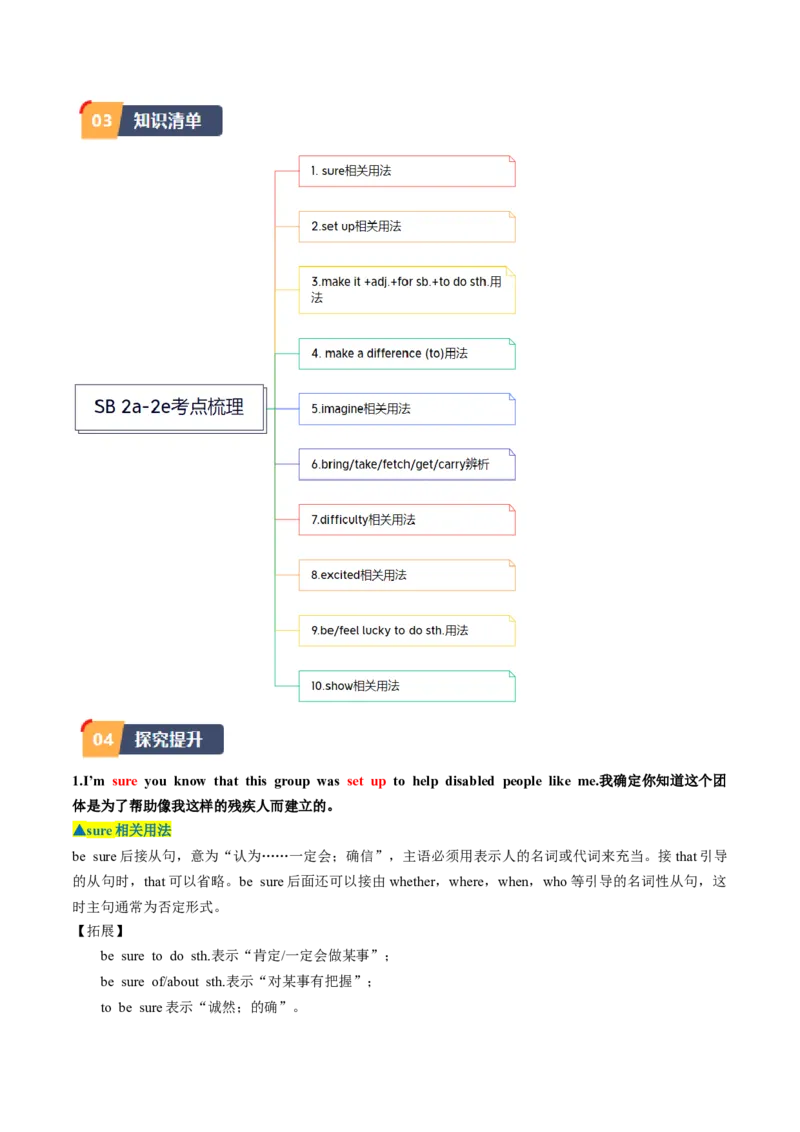
▲sure相关用法
be sure后接从句,意为“认为……一定会;确信”,主语必须用表示人的名词或代词来充当。接that引导
的从句时,that可以省略。be sure后面还可以接由whether,where,when,who等引导的名词性从句,这
时主句通常为否定形式。
【拓展】
be sure to do sth.表示“肯定/一定会做某事”;
be sure of/about sth.表示“对某事有把握”;
to be sure表示“诚然;的确”。牛刀小试
1.It’s sure ________ tomorrow. You’d better take an umbrella.
A.rain B.to rain C.raining D.will rain
2.My parents want me to be a violinist, but I am not sure _______ that.
A.about B.in C.on D.at
▲set up相关用法
set up建立;设立(组织/机构/团体)
set up 意为“建立;设立;开办”,后常接某一组织、机构、团体
等。
build 意为“建造,修理”,后常接建筑物、机械等。
例:They set up an organization to help the poor build houses. 他们设立了一个组织来帮助穷人建造房子。
牛刀小试
人们正在建立更多的自然保护区来保护野生动物。
People are more nature protection areas to protect wild animals.
2.You helped to make it possible for me to have Lucky. 有了你的帮助,我才有可能拥有“幸运儿”。
▲make it +adj.+for sb.+to do sth.用法
make it +adj.+for sb.+to do sth.使某人做某事变得……,it为 形式宾语,真正的宾语是后面的动词不定式
短语,类似还有think,find等。
例:This stone bridge makes it convenient for the villagers to cross the river. 这座石桥使村民过河变得
方便起来。
I found it very difficult to learn a foreign language well. 我发现学好一门外语很难。
【拓展】
▲make it 成功、做到、按时到达
▲“make +宾语+宾语补足语”结构的其他形式:
(1)“make +宾语+形容词”, 意为“使某人/某物处于某种状态”
例:Light music always makes me relaxed. 轻音乐总是令我放松。
(2)“make +宾语+名词(短语)”,意为“使某人/某物成为……”。
例:The teacher tries his best to make himself a good friend of his students.
那位老师尽力使自己成为学生们的好朋友。
(3) “ make +宾语+ do sth.”,意为“让某人做某事”。
例:Don’t make the baby cry anymore. 不要再让那个小孩哭了。
【注意】
make, let等使役动词以及look, watch, see, hear, listen等感官动词在主动语态中常接不带to的动词不定式作宾语补足语,但是在被动语态中to要还原。
牛刀小试
努力学习使我们通过考试成为可能。
Studying hard us to pass the exam.
3. Lucky makes a big difference to my life. Lucky对我的生活产生了巨大影响。
▲make a difference (to)用法
make a difference (to)意为“(对……)有影响;(对……起)作用”。其中to 是介词,其后可接名词、代词或
v.-ing 形式作宾语。difference 前面还可用 some,big,great 等词修饰,make a big /great difference表示
“有重大影响;起很大作用”。
【拓展】
make no difference 没有影响;无关紧要
make all the difference 关系重大;大不相同
例:Whether she is rich or not makes no difference to me. 她是否富有对我并没有影响。
牛刀小试
仅仅一件小事也能对环境产生很大影响。
Only a little thing can a big to the environment.
4. Or imagine you can’t walk or use your hands easily. 或者想象一下你不能走路或者不能轻易地使用
你的双手。
▲imagine相关用法
imagine作动词, 意为“想象; 设想”, 不可用于进行时。其名词形式为 imagination,意为“想象”。
例:Can you imagine life on the moon? 你能想象在月球上的生活吗?
【拓展】
imagine doing sth.想象做某事
imagine sb.to do sth.想象某人做某事
imagine + that/what 从句
例:He tried to imagine being on the moon. 他试着想象是在月球上。
She imagines herself to be a famous singer. 她把自己想象成一位有名的歌手。
I can’t imagine what will happen next. 我想象不到接下来将发生什么。
牛刀小试
—Can you imagine ________ chess with AI Robots?
—That must be very exciting.A.playing B.to playing C.played D.to play
5.I can’t use my arms or legs well, so normal things like answering the telephone, opening and
closing doors, or carrying things are difficult for me. 我不能很好的使用我的手和腿,所以一些像是接
电话、开关门或者搬东西之类的事对于我而言很困难。
▲bring/take/fetch/get/carry辨析
单词 辨析
bring 指从别处把某人或某物带到说话人所在的地点,动作由远及近。
take 指从说话者所在地把某人或某物带走,动作由近及远。
fetch/get 指从说话者所在地道某处,然后从某处把某物带回到说话者所在地,动作是先去后
回。
carry 不特别表示带到什么地方,而携带或搬运的方式可以是提、扛、背、抱、抬等。
牛刀小试
用bring,take,carry,fetch和get的适当形式填空
1.Can you the photo to school tomorrow?
2.I your child to the zoo yesterday.
3.You'd better your raincoat with you.
4.You can me some money from my mother.
5.He a bag of books in his hand.
6.During these days, he always a book.
6.Most people would never think about this, but many people have these difficulties. 大多数人永远
不会考虑这些,但是很多人都有这些困难。
▲difficulty相关用法
difficulty/ 'dɪfɪkəltɪ / n.困难;难题强调具体的“困难”时,为可数名词;指笼统的“困难;艰难”时,为不
可数名词。
例:There are lots of children with reading difficulties. 有很多存在阅读困难的儿童。
常考搭配:
have difficulty (in) doing sth.= have trouble (in) doing sth.做某事有困难
in difficulty/difficulties 处境困难
例:—Do you have any difficulty in learning English? 你在学习英语上有困难吗?
—No. I had no difficulty in learning English. 不,我没有任何困难。
牛刀小试
Jack has some difficulty ________ the task by himself within two days.A.finish B.finishing C.to finish D.to finishing
7.I love animals and I was excited about the idea of having a dog.对于拥有一只狗的想法,我感到很
兴奋。
▲excited相关用法
excited为形容词, 意为“兴奋的;激动的; 感到兴奋的”。常用句型为:be excited about…对……感到兴
奋;be excited to do...很兴奋做……。
例:We are very excited about hearing of your success. 听说你们的成功,我们非常兴奋。
【拓展】
exciting与excited辨析
(1)exciting令人兴奋的,表示某事(物)给人的感受,主语一般是物,在句中作表语或定语。
例:The news is so exciting that we can’t go to sleep. 这个消息让我们兴奋得无法入睡。
(2)excited感到兴奋的,表示人的心理感受,作表语时,主语一般是人。
例:Everybody was excited at the news of victory. 每个人都为这胜利的消息而激动。
牛刀小试
1.听到关于她父亲的消息,她感到很兴奋。
She felt excited the news about her father.
2.外教下学期将要教我们。我们对这个消息感到兴奋。
A foreign teacher will teach us next term. We the news.
3.Peter is very ________. His father says he will give him an ________ birthday party.
A.exciting; exciting B.excited; excited
C.exciting; excited D.excited; exciting
8.Because I feel very lucky to have him. 拥有他我感到很幸运。
▲be/feel lucky to do sth.用法
be/feel lucky to do sth.意为“做某事感到很幸运”,其中lucky为形容词,意为 “幸运的”。
例:She felt lucky to catch the last flight.她很幸运地赶上了最后一班航班。
牛刀小试
知道自己是在一支胜利之队让他感到幸运。
It made him that he was on a winning team.
9.I’ll send you a photo of him if you like, and I could show you how he helps me. 如果你喜欢,
我会把它的一张照片寄给你,并可以让你看看它是怎样帮助我的。
▲show相关用法show作动词,意为 “出示;显示”。
(1)句型:show sb. sth./show sth.to sb.把某物给某人看。
例:She showed us her new sweater.=She showed her new sweater to us. 她把她的新毛衣给我们看。
(2)show sb.+疑问词+不定式 “给某人示范”
例:Please show me how to do it. 请给我展示怎么做。
(3)show sb. around带领某人参观
例:He showed the students around the factory. 他带领学生参观工厂。
(4)show sb.the way to告知某人去……路
例:Would you please show me the way to the library? 你可以给我指一下去图书馆的路吗?
牛刀小试
不要把这些照片展示给别人看。
Don’t these photos others.一、单项选择
1.The woman ________ two pairs of shoes to try on.
A.showed me B.showed for me C.showed to D.showed to me
2.—What should we do for the disabled children?
—You should _______ a study group to help them.
A.take up B.set up C.look up D.put up
3.I need two more people to ________ the heavy boxes.
A.take B.carry C.bring D.give
4.Through the stories behind the idioms(习惯用语), we would be able to fully________ China's culture, history
and tradition.A.understand B.search C.compare D.imagine
5.I can’t imagine ________ without computers.
A.living B.to live C.lives D.lived
6.—We are going to have the sports meeting ________ the beginning of April.
—Really? Are you sure ________ it?
A.at; with B.from; about C.at; about D.in; with
7.The old man is ________. He can't use his legs well.
A.interesting B.disabled C.smart D.successful
8.Studying hard makes ________ possible for me to go to university successfully.
A.it B.that C.it's D.this
9.—Why do you look so ________, Bruce?
—My father promised to take me to watch the football match this weekend.
A.excited B.lonely C.strong D.upset
10.—I have great ________ in finishing the work by myself. Could you help me?
—No problem.
A.fun B.success C.advice D.difficulty
二、根据所给提示填空,每空一词
1.Let’s help that (失明的) man. He’s walking across the road.
2.Kate is very (聪明的) and she can work out the difficult math problem.
3.After six months of (训练), the children got stronger than before.
4.We felt (兴奋的) about the good news.
5.He is (聋的) and can’t hear anything.
6.I'd like (send) these letters after school.
7.I can (easy) finish the work tonight.
8.A friend of (my) wants me to buy some fruit for her.
9.I think “Lucky” is a special (train) dog.
10.You can’t imagine how many (difficult) we met in that country.
11.We should do something to help those (able) people like the blind or the deaf.
12.My Chinese teacher made a big (different) to my life.
13.—I really hate myself for what I said to Mom the other day.
—I know the (feel). It's awful(很坏的), isn't it?
三、完成句子
1.去年政府为孩子们建立了一所医院。
The government a hospital for children last year.
2.我确信总有一天他会成功的。
I he will succeed one day.3.那次事故对他的人生产生了很大的影响。
That accident a big to his life.
4.孩子们对明天的运动会感到很兴奋。
Children are tomorrow's sports meeting.
5.再次感谢你改变了我的生活。
Thank you again my life.
四、选词填空
A
feel lucky, at once, give…orders, a good name for, make it possible
1.The old lady said she to have a kind neighbor.
2.My cat sleeps all day,and her name is Lazy. I think it is her.
3.The dog is so clever that he can understand what to do when the owner him .
4.New technology for people to live in space.
5.The teacher asked the students to read the new words and the students did it .
B
kind, change, understand, open, deaf, blind, carry, train, imagine, clever
1.Let's help that man. He's walking across the road.
2. what our life will be like if we don't have water.
3.Kate is very and she can work out the difficult math problem.
4.After six months of , the children got stronger than before.
5.I wanted to thank them for all their .
6.At last, I what she said. How happy I was!
7.Scott, can you the door? The little dog wants to go out right now.
8.He is and can't hear anything.
9.The man is a heavy box on his back.
10.Do you think the air pollution will the weather?
五、阅读理解
The Beijing Hearing Dog Association has a plan. They plan to choose some stray dogs (流浪狗) and train them.
Then the dogs will be able to help the old and the deaf.
They will choose young dogs, because it's easier to train them. The kind of dog is not important.
Twenty-four volunteers will join the training. They all have some experience of keeping dogs and they all love
dogs. They will learn a special language first from the coach (教练) and they teach the dogs. This training will take
180 days. Then the better-performed dogs will enter the next training. They will learn to understand different sounds,
such as knocking on a door and water boiling. Then the dogs will live with the deaf or the old for 30 days.Some people think the plan won't work, because it will cost a lot of money. But some people like the plan and
they would like to be the volunteers.
1.Why does the association want to choose young dogs?
A.Because young dogs are cuter. B.Because young dogs are stronger.
C.Because it's easier to train them. D.Because it will cost less to train them.
2.What do the volunteers have in common?
A.They all want to help the young. B.They all keep lots of dogs.
C.They all work in the association. D.They all have experience of keeping dogs and they all love
dogs.
3.What will the dogs learn in the second training?
A.They will learn to understand different languages.
B.They will learn to understand different sounds.
C.They will learn to understand old people's living habits.
D.They will learn to understand different ways to open the door.
4.What can we learn from the article?
A.The association will train police dogs. B.The first training will take 180 days.
C.All dogs will enter the second training. D.All the people like the plan.
5.What is the best title for the article?
A.Stray dogs will help people. B.Dogs are very clever.
C.The old need dogs' help. D.It's difficult to train a dog.