Unit 3 Growing Up
核心语法精练(连词 although、until 和 so that 的用法)
目录
A 考点概览·知识回顾..............................................................................................................................................1
B 考点夯基·专项突破..............................................................................................................................................3
一、单项选择.........................................................................................................................................................3
二、完成句子.........................................................................................................................................................9
C 综合攻坚·能力跃升............................................................................................................................................12
题型一 语法填空...............................................................................................................................................12
题型二 阅读理解.................................................................................................................................................15
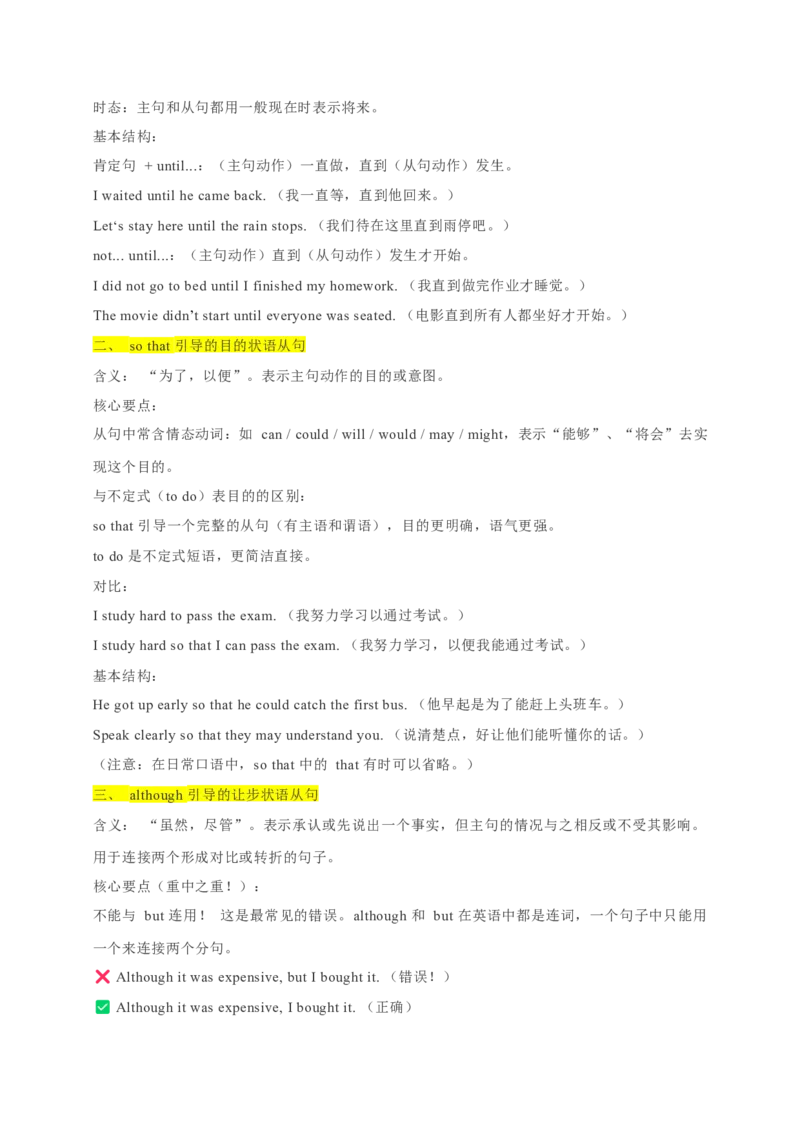
连词 从句类型 核心含义 关键点与例句
看主句动词:延续性动词用肯定;非延续性动词用否定
时间状语 “直到…… (not...until)。
until
从句 为止” Wait until I call you. (等我叫你。)
I won‘t leave until you promise. (你答应了我才走。)
从句中常带情态动词(can, will等)。
目的状语 “为了,以
so that He saved money so that he could buy a bike. (他攒钱是为了能买辆自
从句 便”
行车。)
绝不能与 but 同时使用!表达转折只用其一。
althoug 让步状语 “虽然,尽
Although she was tired, she helped me. = She was tired, but she helped
h 从句 管”
me. (她虽然累了,但还是帮助了我。)
一、 until 引导的时间状语从句
含义: “直到……为止”。表示主句的动作或状态持续到从句动作发生或某个时间点为止。
核心要点:
主句动词:通常是延续性动词(如 wait, stay, work, live)或含有 not 的非延续性动词(瞬间动
词)。时态:主句和从句都用一般现在时表示将来。
基本结构:
肯定句 + until...:(主句动作)一直做,直到(从句动作)发生。
I waited until he came back. (我一直等,直到他回来。)
Let‘s stay here until the rain stops. (我们待在这里直到雨停吧。)
not... until...:(主句动作)直到(从句动作)发生才开始。
I did not go to bed until I finished my homework. (我直到做完作业才睡觉。)
The movie didn’t start until everyone was seated. (电影直到所有人都坐好才开始。)
二、 so that 引导的目的状语从句
含义: “为了,以便”。表示主句动作的目的或意图。
核心要点:
从句中常含情态动词:如 can / could / will / would / may / might,表示“能够”、“将会”去实
现这个目的。
与不定式(to do)表目的的区别:
so that 引导一个完整的从句(有主语和谓语),目的更明确,语气更强。
to do 是不定式短语,更简洁直接。
对比:
I study hard to pass the exam. (我努力学习以通过考试。)
I study hard so that I can pass the exam. (我努力学习,以便我能通过考试。)
基本结构:
He got up early so that he could catch the first bus. (他早起是为了能赶上头班车。)
Speak clearly so that they may understand you. (说清楚点,好让他们能听懂你的话。)
(注意:在日常口语中,so that 中的 that 有时可以省略。)
三、 although 引导的让步状语从句
含义: “虽然,尽管”。表示承认或先说出一个事实,但主句的情况与之相反或不受其影响。
用于连接两个形成对比或转折的句子。
核心要点(重中之重!):
不能与 but 连用! 这是最常见的错误。although 和 but 在英语中都是连词,一个句子中只能用
一个来连接两个分句。
❌ Although it was expensive, but I bought it. (错误!)
✅ Although it was expensive, I bought it. (正确)✅ It was expensive, but I bought it. (正确)
基本结构:
Although it rained heavily, we went out to play football. 尽管雨下得很大,我们还是出去踢足球了。
He is unhappy although he has a lot of money. 他并不快乐,虽然他很有钱。
Although 可以放在句首或句中。放在句首时,通常用逗号与主句隔开。
一、单项选择
1.________ they are tired, they feel very happy because they finally won the game.
A.Although B.But C.So D.Because
2.—Did your school team win the basketball game last week?
—Not really. ________ we tried our best, we lost it in the end.
A.Because B.If C.Unless D.Though
3.Our parents love us so much, ________ they don’t often say “I love you”.
A.because B.although C.unless D.until
4.I like learning English a lot ________ it seems difficult sometimes.
A.if B.though C.because D.so
5.________ he didn’t feel well, he still went to school on time.
A.Though B.And C.So
6.________ the rule is strict, it is necessary for our safety.
A.Although B.If C.So D.But
7.________ it was very cold, ________ my grandfather still went swimming in Nanhu River last weekend.
A.Although; but B.Although; / C.But; although D./; although
8.—Why do you look so tired and unhappy?
—I studied late every night __________ I could study better.
A.so that B.such as C.so far D.because of
9.Anna learns a lot about Anhui’s history she can become a tour guide in the future.
A.if B.because C.although D.so that
10.You should go now ________ you won’t be late.
A.so that B.so C.if D.when
11.Everybody studies really hard ________ they can get good grades in the exams.A.because B.but C.so that
12.People often put the tokens on pieces of string ________ they could carry them around easily.
A.if B.so that C.as soon as D.when
13.Mike got up early ________ he could catch the train.
A.so that B.but C.after
14.Please turn up the radio a bit ________ Grandpa can hear clearly.
A.so that B.as for C.because of
15.It’s a good idea to speak loudly ________ everyone in the room can hear us clearly.
A.because of B.so that C.in order to
16.—Time to go home, Peter?
—Wait a minute. I can’t go home_________ I finish cleaning the hallway.
A.until B.but C.so D.because
17.—It’s too late. I have to go.
—Oh, it’s raining outside. I’m afraid you can’t leave ________ it stops.
A.until B.since C.while D.after
18.I waited for Alan in the hotel. However, he didn’t come ________ I left there.
A.if B.of C.but D.until
19.The volunteers kept planting trees at the foot of the mountain ________ it got dark. They hoped to make our
hometown greener.
A.if B.after C.when D.until
20.Tom kept working on the math problem ________ he found the answer.
A.when B.after C.unless D.until
二、完成句子
21.He went to sleep after his mother came back last night. (保持句意不变)
He go to sleep his mother came back last night.
22.比赛一直是平局,直到对方在最后一分钟得分。
The game was a tie the other team the last minute.
23.医生直到检查完才离开。
The doctor leave he finished checking.
24.The little boy went to sleep after his mother came back. (保持句意基本不变)The little boy go to sleep his mother came back.
25.Nelly was very tired, but she felt happy. (改为同义句)
Nelly was very tired, she felt happy.
26.尽管我学习不好,但我从未放弃过。
I didn’t do well in my lessons, I gave up.
27.尽管他已经过65岁了,但他很健壮且热爱工作。
he is over 65, he is very fit and still .
28.我在你桌上放了一个闹钟,以便你随时查看时间。
I put a clock on your desk you can check it anytime you want.
29.Alex works hard. He wants to achieve A grades.(两句合并为一句)
Alex works hard he can achieve A grades.
30.我们那么早起,是为了赶上早班车。
We got up early we could catch the first bus.
题型一 语法填空
阅读下面短文,在空白处填入1个适当的单词或括号内单词的正确形式。
I am a happy girl. I have many friends. One of them is special, and also my favorite. It’s my radio. When I was
in the middle school, my family 1 (move) to Shanghai during the winter vacation. I didn’t have friends there. I
couldn’t talk to 2 (someone). I missed my hometown (家乡), and I hoped 3 (go) back one day. There is an
old 4 (say), “The Moon in hometown is the brightest”. Sometimes I became sad. Thank God, my radio made my
life 5 (interesting) than before.
Last week, my father said the radio was so old that I couldn’t hold it 6 (comfortable). So he bought me a
new one. Although the new one isn’t as 7 (cheaper) as the old one, I still think my old radio is 8 (good)
friend in my life. Every time I turn on the radio, it tells me the news 9 (quickly) than TV. Because 10 my
radio, my life is full of happiness.
阅读下面短文,根据语境或所给单词的提示,在每个空格内填入一个恰当的词,要求所填的词意义准确、
形式正确,使短文意思完整、行文连贯。
Did you want to run away from the world for a while? Everyone needs to take time out sometimes. 1(make) your own quiet space (空间) or calm down corner will help. It 2 (provide) you somewhere to go when
you want to relax.
A calm down corner can make you become less 3 (worry). It can be anywhere that lets you spend time
by 4 (you) and take a small break alone. If you’re feeling angry or upset, the 5 (relax) time can calm your
thoughts and let you think more clearly. Studies show that this can help you feel less stressed (有压力的) and sleep
much 6 (good) at night. Calm down corners are a great way to help you solve problems and think up fresh
ideas.
How can we make a calm down corner? First, choose 7 area. It could be a favorite chair, or a 8 (sun)
window seat or a small space of a room. Make it comfortable by adding pillows (枕头). Next, choose a style and
decorate your space with drawings, pictures or photos of friends, families or pets. Most importantly, make a screen-
free space and fill a basket 9 things you can reach for, such as coloring books or a favorite soft toy. Why not
have a try? Just 10 the English saying goes, “Keep calm.”
题型二 阅读理解
You are having a test at school today, and you may feel awful (糟糕的). You may have a headache (头痛) or
a stomachache (胃痛). That means you are too worried. You’re worried about your test maybe because you didn’t do
well in the last one and your parents wanted you to do better in the next exam, or maybe you’re nervous (紧张的)
because you did well in the last one. So what should you do?
Ask for help. Talk to your mom, dad or your teacher. Talking to someone about it can make you feel better.
They can help you find some solutions.
Be prepared. Do your homework. Study for the test. On the test day, you’re more likely to feel that you know
the answers.
Believe in yourself. Say to yourself, “I studied and I’m ready to do my best.” Don’t tell yourself “I’m not good
at it.” or “I’m going to be in trouble if I get a bad grade.” These thoughts can make it harder for you to do well.
Take good care of yourself. You’ll do your best if you get enough playtime, sleep and healthy food. This isimportant all the time.
1.Which of the following shows you are nervous?
①Have a headache. ②Want to do better. ③Have a stomachache. ④Feel awful.
A.①②③ B.②③④ C.①②④ D.①③④
2.According to the passage, how many pieces of advice can you get when you are nervous?
A.2. B.3. C.4. D.5.
3.What does the underlined word “solutions” mean in paragraph 2?
A.Hopes. B.Ways. C.Replies. D.Experiences.
4.Which of the following is TRUE according to the passage?
A.It’s OK if you didn’t prepare for your test.
B.Having enough sleep can help you do your best.
C.Doing well or not in your last exam doesn’t make you nervous at all.
D.Talking to your parents about your worries can not make you feel better.
If a friend helps you, it’s a good idea to write a thank-you note to him or her. But in fact, how many of us sit
down to do this? “People don’t seem to give thanks to people quite often,” Professor Kumar said. Why don’t people
like to send thank-you notes? And how do people feel when they get one?
Kumar and his team asked some students to write a thank-you note to another person by e-mail. Then, they
asked both the writer and the receiver how sending or getting these notes made them feel. Here is the result.
They found that these writers didn’t like to write the notes because they felt like they had to think too much
about them. They worried about what to say and how to say it. The receivers, however, felt glad when they got the
notes. “When you are a receiver, you really care about the warmth of the notes,” Kumar said.
Also, the writers didn’t like to write the notes because they thought it might be awkward (尴尬的) for the
receiver to get a thank-you note. But in fact, it’s not true. “They feel quite happy,” Kumar said. “They don’t really
feel awkward at all. If people know that writing a thank-you note could be so important to others, they will do it more
often.”
In a word, simple and small changes in our everyday lives can make a big difference to how we treat (对待)
other people and how we feel.
1.How did the writer start the passage?
A.By asking questions.B.By using a saying.C.By using numbers. D.By making a survey.
2.We know from the passage that if a friend helps us, it’s a good idea to ________.A.just say thank you B.write a thank-you note to him or her
C.sit down with him or her D.get a thank-you note from him or her
3.Which of the following is TRUE?
A.Writing a thank-you note isn’t important to others at all.
B.People like to write thank-you notes when someone helps them.
C.People don’t feel awkward after getting thank-you notes.
D.When getting thank-you notes, people don’t care about the warmth.
4.Which of the following is the best structure of the passage?
A.①/②/③④/⑤ B.①②/③/④⑤ C.①②③/④/⑤ D.①/②/③④⑤
5.What is the main purpose of this passage?
A.To teach people how to write thank-you notes.
B.To show that people like receiving thank-you notes.
C.To encourage people to write thank-you notes more often.
D.To explain why people feel awkward getting thank-you notes.