Unit 3 Growing up
课时 5 Section B Vocabulary in use 2a-2c 分层作业
核心知识速记 01 基础达标 02 能力提升 03 拓展培优 0 4 思维进阶
词汇
joyful adj. 高兴的;令人愉快的 thankful adj. 感谢的;感激的
negative adj. 否定的;消极的 bully n. 霸凌;恶霸 v. 欺凌
behave v. 表现;举止得体 differently adv. 不同地
physics n. 物理;物理学 awake adj. 醒着的
normal adj. 正常的;普通的 mad adj. 发狂的;疯的
mean adj. 刻薄的;吝啬的 deep adj. 深的
hurt v. 伤害 n. 伤痛
短语
shout at sb 冲某人喊叫 from time to time 不时;偶尔
take a deep breath 深呼吸 feel lonely 感到孤独
get/be mad at sb 对某人生气 under stress 在压力下
lie awake 醒着躺着 be worried about 担心……
be shocked to hear 听到……感到震惊 say no to bullying 对霸凌说不
句型
1. 表达感受与状态
What should I do if I feel lonely after moving to a new city?搬到一个新城市后如果感到孤独该怎么办?
I’m really worried about failing physics. 我真的很担心物理不及格。
2. 描述情绪与行为关联
People can behave differently under stress. 人在压力下可能会表现不同。
Although it is normal to get mad at others from time to time, we should always try our best to control our anger.
虽然偶尔对别人生气是正常的,但我们应尽量控制自己的怒气。3. 提出建议与应对策略
Try taking a deep breath. That gives you an opportunity to calm down.
试着深呼吸,这给你一个平静下来的机会。
You can also take a walk, go for a run, or write about your feelings.
你也可以散步、跑步或写下你的感受。
一、单词默写。
1. ______ /ˈdʒɔɪfl/ adj. 高兴的 2. ______ /ˈθæŋkfl/ adj. 感谢的
3. ______ /ˈneɡətɪv/ adj. 消极的 4. ______ /ˈbʊli/ n. 霸凌;恶霸
5. ______ /bɪˈheɪv/ v. 表现 6. ______ /ˈdɪfrəntli/ adv. 不同地
7. ______ /ˈfɪzɪks/ n. 物理学 8. ______ /əˈweɪk/ adj. 醒着的
9. ______ /ˈnɔːml/ adj. 正常的 10. ______ /mæd/ adj. 发狂的
二、词组默写。
1. 冲某人喊叫 ______ 2. 不时;偶尔 ______
3. 深呼吸 ______ 4. 感到孤独 ______
5. 对某人生气 ______ 6. 在压力下 ______
7. 醒着躺着 ______ 8. 担心…… ______
9. 听到……感到震惊 ______ 10. 对霸凌说不 ______
三、根据要求完成句子
1. 你不可能总是赢,但你可以选择如何应对。
You can’t win them all, but you can choose how you ________.
2. 虽然偶尔感到有压力是正常的,但我们应该学会管理它。
________ it is normal to feel stressed ________ ________ ________, we should learn to manage it.
3. 直到你和别人谈谈,你才会感觉好一些。
You ________ feel better ________ you talk to someone.
4. 我们可以写下自己的感受,以便更好地理解它们。
We can write down our feelings ________ ________ we can understand them better.
5. 如果你对某人生气,试着先深呼吸。
________ you are mad at someone, try ________ ________ a deep breath first.
6. 人们感到担忧时,行为可能会有所不同。
People may behave ________ when they ________ worried.
7. 听到校园霸凌的消息,我感到非常震惊。
I was ________ ________ hear about the bullying at school.
8. 他对自己的失败感到很沮丧,整晚都醒着躺着。He felt so upset about his failure that he ________ ________ all night.
四、请根据句意和首字母提示,用本课所学词汇或短语填空。
1. It's n________ to feel angry sometimes, but we should try to control it.
2. When you are under s________, try to take a deep breath.
3. It is not good to s________ at others when you are mad.
4. We should say no to b________ and help those who are bullied.
5. Everyone can b________ differently when facing difficulties.
6. She was so w________ that she lay a________ all night.
7. Let’s be t________ for what we have and try to stay positive.
8. Don’t say m________ words to others because they can hurt people deeply.
五 、用所给词的适当形式填空
1. If you feel ________ (lonely), try to join some school activities.
2. I was ________ (shock) to hear that he failed the exam.
3. People may behave ________ (different) when they are under pressure.
4. It is important to control your ________ (angry) and not shout at others.
5. She is very ________ (worry) about her physics test next week.
6. We should be ________ (thank) for our friends' help and support.
7. Taking a ________ (deeply) breath can help you calm down quickly.
8. It is ________ (normal) to feel joyful when something good happens.
六、同义句转换。
使用本课所学句型或短语改写句子,保持句意基本不变。
1. It is not unusual to feel angry sometimes, but we should control it.
It is ________ to feel angry ________ ________ ________, but we should control it.
2. When you feel stressed, taking a walk can be helpful.
When ________ ________, try taking a walk.
3. She couldn’t sleep because she was very worried.
She ________ ________ most of the night because of ________.
4. You should not say unkind things to others.
You should not say ________ ________ to others.
5. Learning to calm down is important when you are angry.
When you are angry, it’s important to ________ ________ ________.
七、情景选择。
根据语境选择最合适的选项完成对话或句子。
1. A: I heard you had a fight with Tom. Are you OK?
B: I’m still a bit ________. He said some ________ words to me.
A. joyful; thankful B. mad; mean C. awake; deep2. A: I feel so ________ after moving here. I have no friends yet.
B: Don’t worry. Let’s join the school club together ________ you can meet new people.
A. lonely; although B. stressed; until C. lonely; so that
3. When you feel very angry, you should first ________ to calm down.
A. shout at someone B. take a deep breath C. behave differently
4. A: Why do you look so ________?
B: I’m ________ about the physics test. I didn’t sleep well.
A. shocked; thankful B. worried; negative C. awake; worried
5. We should always ________ bullying and help those who are treated badly.
A. say no to B. shout at C. be mad at
八、选词填空。
阅读短文,从方框中选择适当的词并用其正确形式填空,使短文通顺、意思完整,并将其答案写在答题卡
上相应的位置。每词限用一次。
help, way, a, sleep, feeling, easily, what, about, communicate, worry
Stress is a normal 1 . Sometimes stress can push us to move forward. But stress becomes bad if it
affects(影响) our everyday life and health. So how do you know you’re stressed out? And 2 can you do about
it?
Sometimes stress comes when you don’t realize it. Do you often feel a stomachache, a headache, or get angry
3 ? Do you find it difficult 4 well? If your answers are yes, you are probably facing a lot of stress and you
may need help.
Talking 5 your difficulty with someone always helps. You can have a talk a talk with your parents,
friends, teachers or even doctors. Tell them if you’re 6 about your schoolwork, or if you have difficult
relationships with your classmates. Then you can come up with a few 7 together. You can cut out your after-
school activities, spend more time on proper 8 with your family, and go for a short holiday.
There’s 9 important thing you need to remember: having some stress is normal. It is OK feel angry,
scared or lonely sometimes. Don’t be afraid to ask for 10 when you’re in need.
九、根据短文内容,从下列选项中选出能填入空白处的最佳选项,选项中有一项多余。
(A)
Do you often have negative (负面的) thoughts? Do you and your friends often complain (抱怨) about things?1_____
●Find the positive (积极乐观的), however small.
Bad things happen to all of us, but the most important thing is to focus on the positive. For example, next time
you are caught in traffic, think how great it is that you can finish listening to your favorite music. If you don’t have
much in your fridge, get creative and think of what you can invent with the ingredients (食材) you have. 2_____
●Focus on now
It’s easy to think too much about things that have already happened and to get worried about what will happen
tomorrow. 3 But remember, you can’t change the past, and no one can control the future, so the best thing is to
focus on the present.
● 4_____
Being around negative people will make you feel negative, too. Spend time with people who will make you
laugh and help you believe in yourself, not those that spend all day complaining. It’s hard to feel negative when you
have positive people around you.
●Be kind to others
One of the best ways to make yourself feel good is to help others. 5 Spending time helping other people
can give you a better perspective(视角)on life and make you value what you have.
A.We all do this sometimes.
B.Find positive friends and partners.
C.Always remind yourself to work hard.
D.It can be exciting to try something new.
E.Find ways to volunteer in your community.
F.The following can help you feel positive about life.
(B)
Have you ever tried to hide (隐藏) your emotions from someone during a conversation? 1____
“Scientists from the Ohio State University have found that people are able to know other people’s emotions
according to changes in the colour of their faces,” The Guardian reported. They studied pictures of people’s facial
expressions. They found that every facial expression has a different colour pattern (模式).
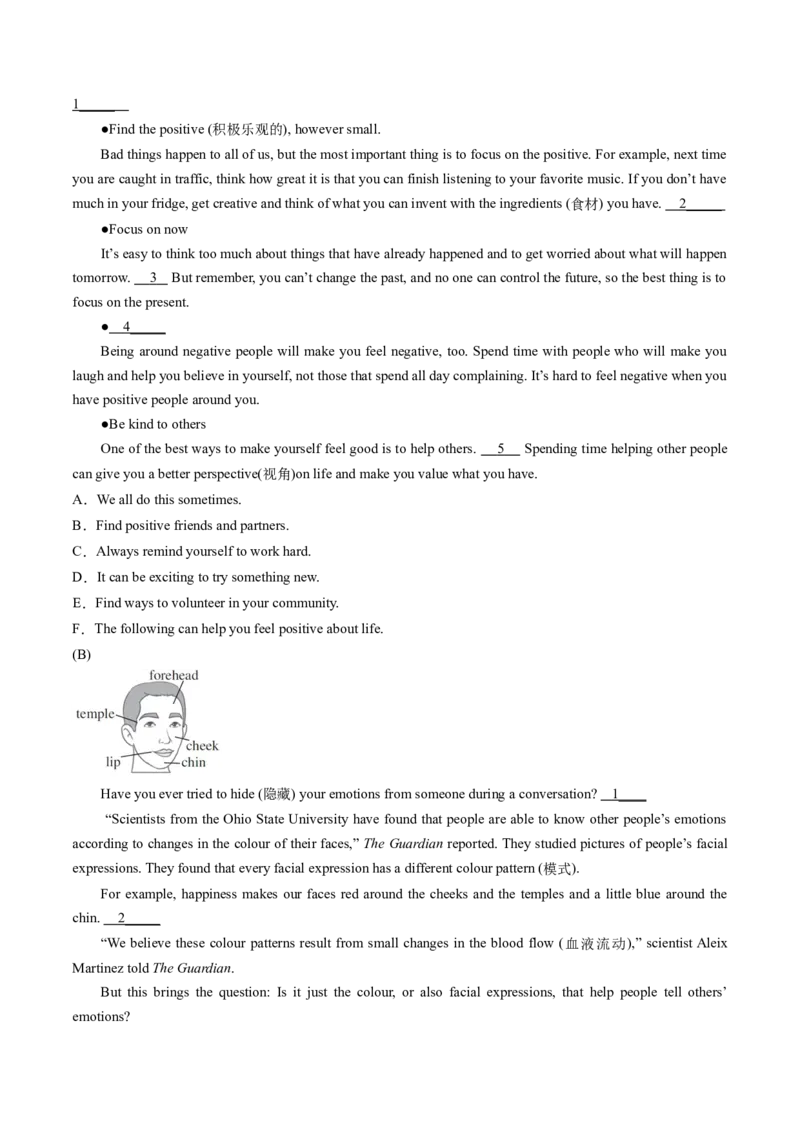
For example, happiness makes our faces red around the cheeks and the temples and a little blue around the
chin. 2_____
“We believe these colour patterns result from small changes in the blood flow (血液流动),” scientist Aleix
Martinez told The Guardian.
But this brings the question: Is it just the colour, or also facial expressions, that help people tell others’
emotions?To find this out, scientists added colour patterns to pictures of faces that showed no facial expressions. 3
Those people were able to tell the emotions right 75 percent of the time.
This may explain why there are some Chinese sayings about emotions and the colour of one’s face. For
example, when two people are fighting about something, we say they are mian hong er chi. 4
A.When a person is very angry, we say he or she is lian se fa qing.
B.Hate creates a blue-yellow colour around the lips and a red-green colour around the nose and the forehead.
C.Lots of people do this so that others can’t tell how they really feel.
D.It’s not always easy because the colours on your face may tell the truth.
E.They asked some people to tell what emotions the faces were showing.
十、任务型阅读。
根据短文完成表格,每空一词。
According to scientists, laughter is the best medicine. There are some positive influences of it.
What happens when we laugh? Firstly, laughter makes our bodies produce chemicals(化学物质), which
make us feel good. Secondly, laughing can keep us from heart problems. Thirdly, it can make our muscles(肌肉)
more relaxed for as long as 45 minutes after a good laugh.
Having a good sense of humor helps to keep our mind healthy, too. When you get a joke or watch a video and
it makes you laugh or simply smile, you relax a bit. And the relaxation helps us deal with bad feelings like sadness
or anger. What laughter does is to help us to think about our problems better, and then we can deal with them better.
If you hear someone laughing, you’re probably going to laugh along. The fact is, laughter brings people
together. When you are with people you like and share funny things, you will laugh easily. And studies show that
our closest relationships—with parents, brothers or sisters and partners—are improved greatly with shared laughter.
So, all you have to do is to laugh more often!
Positive Influences of Laughter
★Chemicals are produced because of laughter and they can make you feel good.
★You can stay away from 1
Good for your body
problems.
★A good laugh can keep your muscles more relaxed for about 45 minutes.
Good for your mind ★If you feel 2 or angry, laughter can help you relax.★It 3 you to think better about your problems.
★Laughter can bring people together.
Good for your 4
★Shared laughter can greatly 5 your closest relationships with others.
十一、完形填空。
阅读短文,理解其大意,从A、B、C、D四个选项中选出可以填入空白处的最佳选项。
If you often feel tired, sleepy or sad in winter, you might have seasonal affective disorder (SAD) (季节性情绪
低落). Some people also react (反应) 1 : eating more, finding it hard to focus, or losing interest in hobbies.
SAD usually 2 in fall or winter and ends in spring or early summer. When the weather gets colder and the days
get shorter, some people feel less 3 and more unhappy.
The main 4 for SAD is not clear, but scientists think it may be caused by changes in hormones (激素). In
winter, it is dark for most of the day. This makes the mind make more melatonin (褪黑素), a thing that makes
people feel 5 and less full of energy. Less sunlight might also change your body’s energy and feeling.
The best way to feel better is to get more sunlight. Doctors suggest spending some time outside every day in
winter, even if it’s just for a short walk. Even on cloudy days, natural light 6 ! Another way is to use “light
treatment”. This means using special lights at home to copy natural sunlight, which can help make the symptoms
(症状) less. You can also try moving your body more, like dancing or 7 .
If you still feel very sad, you should see a 8 . Talking to a doctor early is important—SAD can get worse if
you wait. Don’t forget to share your feelings with family or friends too. Don’t worry. SAD is a 9 problem, and
there are always ways to make you feel better during the cold months. Calling a friend or keeping a simple daily
plan might help you feel less 10 . Small steps, like drinking warm milk before bed, can also help!
1.A.happily B.clearly C.heavily D.differently
2.A.drops B.starts C.lasts D.manages
3.A.active B.tired C.shy D.lazy
4.A.purpose B.problem C.result D.reason
5.A.sleepy B.happy C.shocked D.angry
6.A.helps B.remains C.wastes D.folds
7.A.taking a seat B.lying down C.playing sports D.staying in
8.A.coach B.writer C.scientist D.doctor
9.A.serious B.common C.difficult D.colourful
10.A.bored B.friendly C.lonely D.nervous
The Weight of Silence
Part 1: Read and Explore
Sophie was known as the "quiet one" in her class. She wasn’t shy, just careful with her words. But when
group projects started, her silence became a wall. Her classmates saw it as disinterest. She must be so calm, theythought. Inside, Sophie was anything but calm. She felt a storm of stress—worried her ideas were stupid, afraid of
being laughed at.
This negative feeling grew until the day her group was struggling. They needed a creative idea for their
science poster, but everyone was stuck. Sophie’s mind was racing with a perfect concept, but her voice felt locked.
If I say it wrong, they'll think I'm foolish, she thought.
Her friend Leo noticed her clenched fists. "Sophie," he said gently, not to the group, but just to her. "You look
like you have an idea. Want to give it a try?" It wasn't a demand, but an invitation. Sophie took a deep breath.
"What if…," she started quietly, then explained her idea about showing the water cycle like a comic book.
The group fell silent, then erupted. "That's brilliant!" one said. Sophie felt a shock of joyful surprise. Her
worry hadn't vanished, but it was now mixed with proud relief. Leo smiled. "Sometimes," he whispered, "we hold
back our best ideas because we're afraid they're not good enough. But you won't know until you share them."
Sophie learned that day that "calm" didn't mean having no fear. It meant feeling the fear, but choosing to
speak so that the idea, and the person behind it, could be seen.
Task 1: Reading Comprehension
1. How did Sophie's classmates misunderstand her silence at first?
a) They thought she was angry.
b) They thought she was disinterested or simply calm.
c) They thought she was feeling sick.
d) They thought she was very confident.
2. What was the main reason Sophie didn't share her ideas?
a) She didn't have any ideas.
b) She was afraid her ideas would be laughed at or thought stupid.
c) She didn't like her group members.
d) She was too tired to speak.
3. How did Leo help Sophie?
a) He presented her idea for her.
b) He told the group to be quiet.
c) He gave her a direct, gentle invitation to speak in a safe way.
d) He criticized the group for not being creative.
4. What is the main lesson Sophie learned?
a) That it's better to always be quiet.
b) That true calm is about acting despite fear, not having no fear.
c) That science projects are always stressful.
d) That only brilliant ideas should be shared.
Task 2:mind map questions
请根据短文内容,完成下面关于 Sophie 情绪变化的思维导图。将右侧合适的选项编号填入左侧表格的相
应位置。
阶段 方面 内容描述 (请填入选项编号)开始 外在表现 (A) ______
内在感受 (B) ______
关键时刻 触发事件 Leo's gentle invitation
她的行动 Takes a deep breath and shares her idea
结 果 与 感 新的感受 (C) ______
悟
学到的道理 (D) True calm means speaking up despite fear.
Task 3:connect with real life
任务①:设计你的“勇气邀请卡”
在故事中,Leo的一句简单邀请帮助了Sophie。在生活中,我们也可以主动创造这种安全的时刻。
步骤1: 想一个你想鼓励的人(可以是朋友、家人或同学),以及一个他/她可能有点害怕尝试的小事
(如课堂发言、参加比赛、表演才艺)。
步骤2: 为他/她设计一张“勇气邀请卡”。
· 正面 (Front): 画一个简单图案或写一句鼓励的话,如“Your Idea Matters”。
· 背面 (Back): 写一句具体的、以 “What if…” 或 “I would love to hear…” 开头的邀请句,并至少使用
本单元的一个重点词汇(如 idea, share, try, calm)。
请写出邀请句:___________________________________________________________.
任务②:创建“情绪转换器”
当我们被负面情绪困住时,需要一个“转换器”帮我们找到出口。
步骤1: 选择一个你有时会有的负面情绪(如 Worried, Stressed, Afraid)。
步骤2: 为它设计一个简单的“三步转换器”。
· 第1步(承认): “I am feeling ___________________right now.” (承认情绪)
· 第2步(呼吸): “I will take three deep breaths.” (一个具体行动)
· 第3步(尝试): “I will try to _____________________.” (一个小尝试,用 “so that” 或 “if” 句型写
出目的)