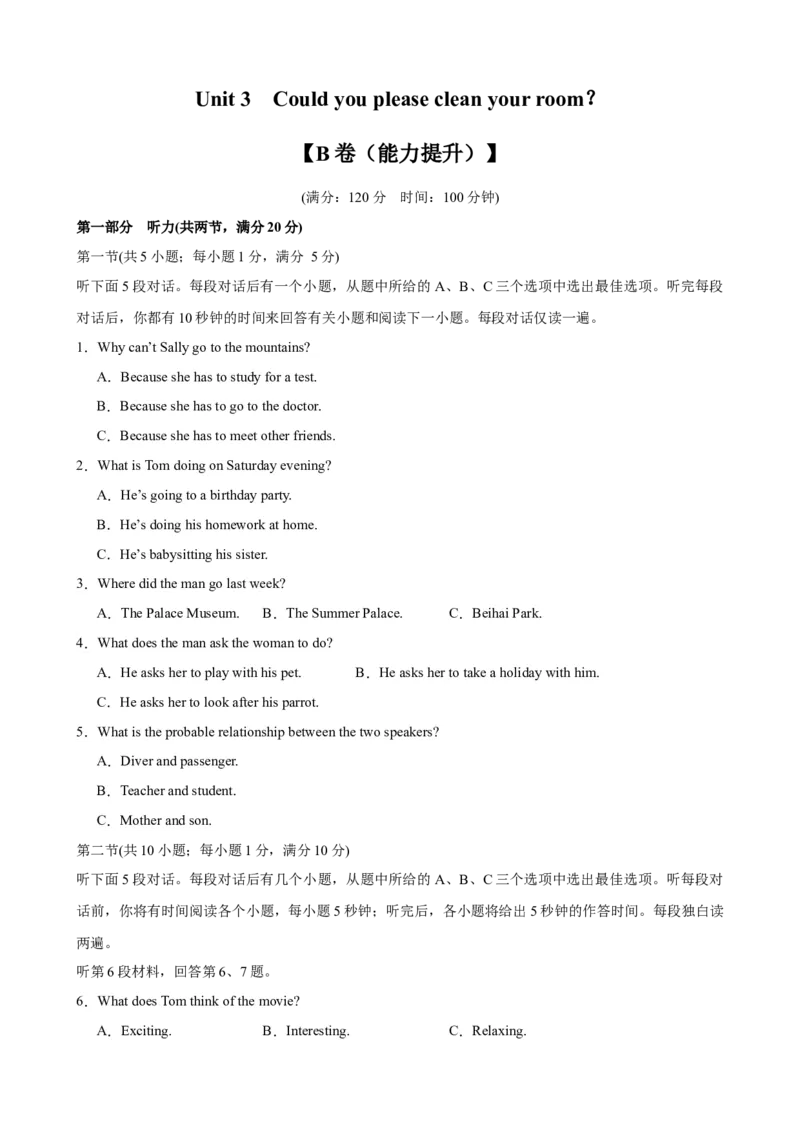
Unit 3 Could you please clean your room?
【B 卷(能力提升)】
(满分:120分 时间:100分钟)
第一部分 听力(共两节,满分20分)
第一节(共5小题;每小题1分,满分 5分)
听下面5段对话。每段对话后有一个小题,从题中所给的A、B、C三个选项中选出最佳选项。听完每段
对话后,你都有10秒钟的时间来回答有关小题和阅读下一小题。每段对话仅读一遍。
1.Why can’t Sally go to the mountains?
A.Because she has to study for a test.
B.Because she has to go to the doctor.
C.Because she has to meet other friends.
2.What is Tom doing on Saturday evening?
A.He’s going to a birthday party.
B.He’s doing his homework at home.
C.He’s babysitting his sister.
3.Where did the man go last week?
A.The Palace Museum. B.The Summer Palace. C.Beihai Park.
4.What does the man ask the woman to do?
A.He asks her to play with his pet. B.He asks her to take a holiday with him.
C.He asks her to look after his parrot.
5.What is the probable relationship between the two speakers?
A.Diver and passenger.
B.Teacher and student.
C.Mother and son.
第二节(共10小题;每小题1分,满分10分)
听下面5段对话。每段对话后有几个小题,从题中所给的A、B、C三个选项中选出最佳选项。听每段对
话前,你将有时间阅读各个小题,每小题5秒钟;听完后,各小题将给出5秒钟的作答时间。每段独白读
两遍。
听第6段材料,回答第6、7题。
6.What does Tom think of the movie?
A.Exciting. B.Interesting. C.Relaxing.7.When does the movie start?
A.At 7:40. B.At 8:00. C.At 8:20.
听第7段材料,回答第8、9题。
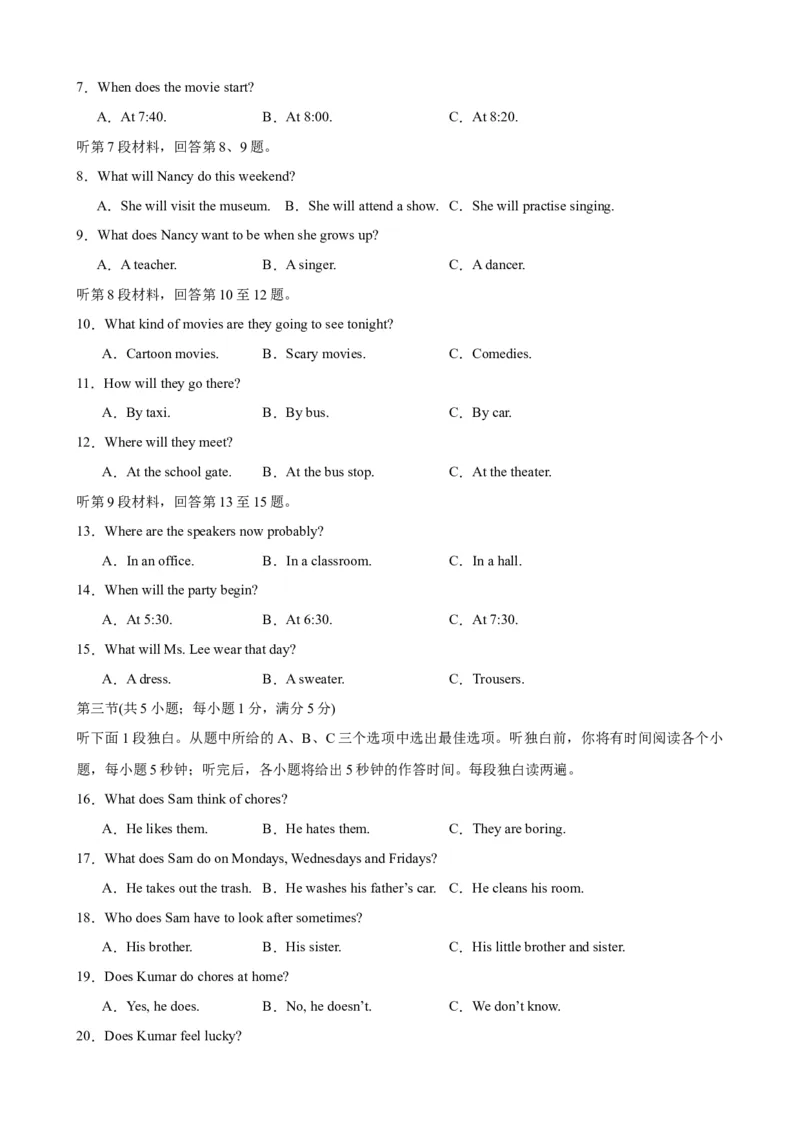
8.What will Nancy do this weekend?
A.She will visit the museum. B.She will attend a show. C.She will practise singing.
9.What does Nancy want to be when she grows up?
A.A teacher. B.A singer. C.A dancer.
听第8段材料,回答第10至12题。
10.What kind of movies are they going to see tonight?
A.Cartoon movies. B.Scary movies. C.Comedies.
11.How will they go there?
A.By taxi. B.By bus. C.By car.
12.Where will they meet?
A.At the school gate. B.At the bus stop. C.At the theater.
听第9段材料,回答第13至15题。
13.Where are the speakers now probably?
A.In an office. B.In a classroom. C.In a hall.
14.When will the party begin?
A.At 5:30. B.At 6:30. C.At 7:30.
15.What will Ms. Lee wear that day?
A.A dress. B.A sweater. C.Trousers.
第三节(共5小题;每小题1分,满分5分)
听下面1段独白。从题中所给的A、B、C三个选项中选出最佳选项。听独白前,你将有时间阅读各个小
题,每小题5秒钟;听完后,各小题将给出5秒钟的作答时间。每段独白读两遍。
16.What does Sam think of chores?
A.He likes them. B.He hates them. C.They are boring.
17.What does Sam do on Mondays, Wednesdays and Fridays?
A.He takes out the trash. B.He washes his father’s car. C.He cleans his room.
18.Who does Sam have to look after sometimes?
A.His brother. B.His sister. C.His little brother and sister.
19.Does Kumar do chores at home?
A.Yes, he does. B.No, he doesn’t. C.We don’t know.
20.Does Kumar feel lucky?A.Yes, he does. B.No, he doesn’t. C.We don’t know.
第二部分 英语知识运用(满分80分)
一、完型填空(共15小题;每小题1分,满分15分)
阅读下列短文,从每小题所给的A、B、C、D四个选项中选出一个最佳选项。
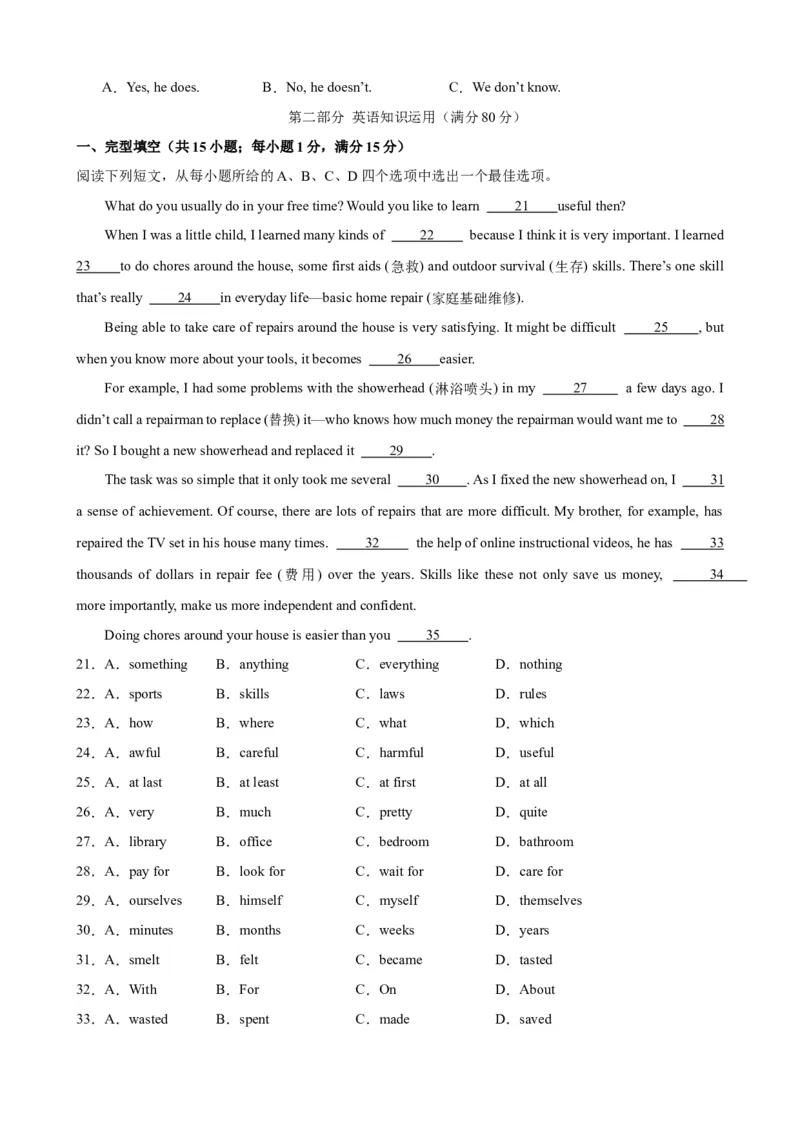
What do you usually do in your free time? Would you like to learn 21 useful then?
When I was a little child, I learned many kinds of 22 because I think it is very important. I learned
23 to do chores around the house, some first aids (急救) and outdoor survival (生存) skills. There’s one skill
that’s really 24 in everyday life—basic home repair (家庭基础维修).
Being able to take care of repairs around the house is very satisfying. It might be difficult 25 , but
when you know more about your tools, it becomes 26 easier.
For example, I had some problems with the showerhead (淋浴喷头) in my 27 a few days ago. I
didn’t call a repairman to replace (替换) it—who knows how much money the repairman would want me to 28
it? So I bought a new showerhead and replaced it 29 .
The task was so simple that it only took me several 30 . As I fixed the new showerhead on, I 31
a sense of achievement. Of course, there are lots of repairs that are more difficult. My brother, for example, has
repaired the TV set in his house many times. 32 the help of online instructional videos, he has 33
thousands of dollars in repair fee (费用) over the years. Skills like these not only save us money, 34
more importantly, make us more independent and confident.
Doing chores around your house is easier than you 35 .
21.A.something B.anything C.everything D.nothing
22.A.sports B.skills C.laws D.rules
23.A.how B.where C.what D.which
24.A.awful B.careful C.harmful D.useful
25.A.at last B.at least C.at first D.at all
26.A.very B.much C.pretty D.quite
27.A.library B.office C.bedroom D.bathroom
28.A.pay for B.look for C.wait for D.care for
29.A.ourselves B.himself C.myself D.themselves
30.A.minutes B.months C.weeks D.years
31.A.smelt B.felt C.became D.tasted
32.A.With B.For C.On D.About
33.A.wasted B.spent C.made D.saved34.A.and B.but C.so D.or
35.A.collect B.decide C.think D.choose
二、阅读理解(共20小题;每小题2分,满分40分)
阅读下列短文,从每小题所给的A、B、C、D四个选项中选出一个最佳选项。
A
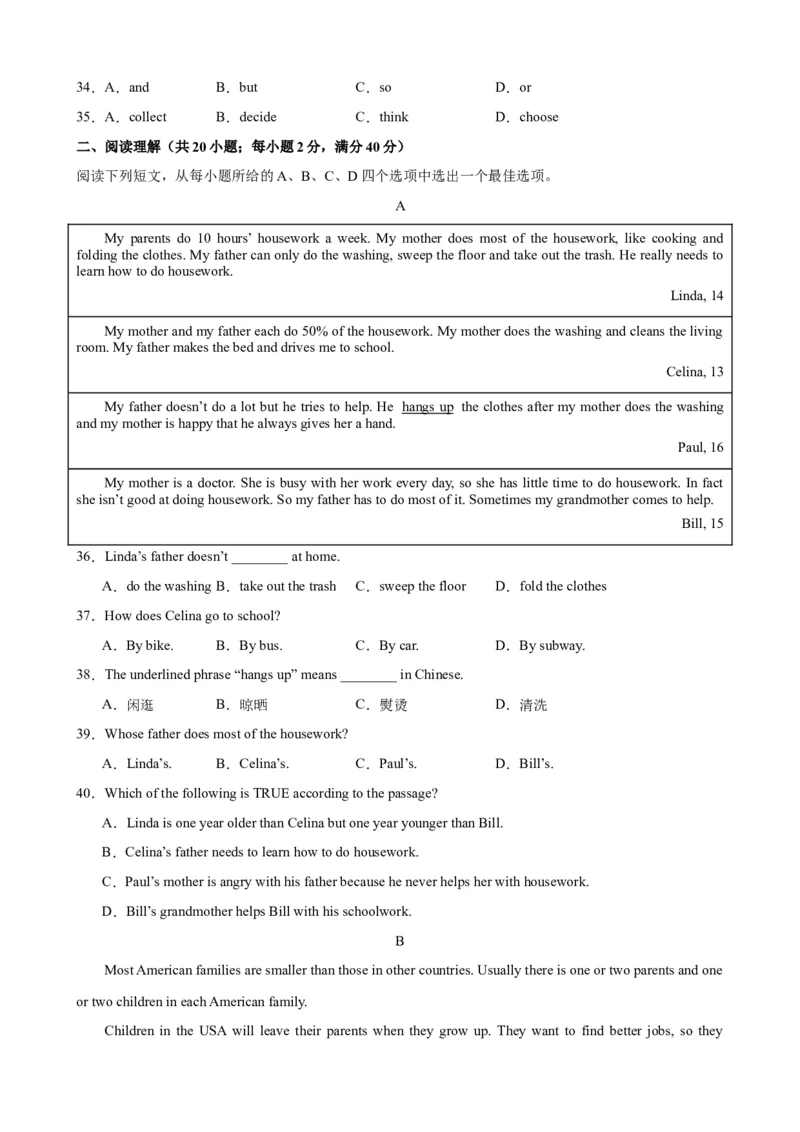
My parents do 10 hours’ housework a week. My mother does most of the housework, like cooking and
folding the clothes. My father can only do the washing, sweep the floor and take out the trash. He really needs to
learn how to do housework.
Linda, 14
My mother and my father each do 50% of the housework. My mother does the washing and cleans the living
room. My father makes the bed and drives me to school.
Celina, 13
My father doesn’t do a lot but he tries to help. He hangs up the clothes after my mother does the washing
and my mother is happy that he always gives her a hand.
Paul, 16
My mother is a doctor. She is busy with her work every day, so she has little time to do housework. In fact
she isn’t good at doing housework. So my father has to do most of it. Sometimes my grandmother comes to help.
Bill, 15
36.Linda’s father doesn’t ________ at home.
A.do the washing B.take out the trash C.sweep the floor D.fold the clothes
37.How does Celina go to school?
A.By bike. B.By bus. C.By car. D.By subway.
38.The underlined phrase “hangs up” means ________ in Chinese.
A.闲逛 B.晾晒 C.熨烫 D.清洗
39.Whose father does most of the housework?
A.Linda’s. B.Celina’s. C.Paul’s. D.Bill’s.
40.Which of the following is TRUE according to the passage?
A.Linda is one year older than Celina but one year younger than Bill.
B.Celina’s father needs to learn how to do housework.
C.Paul’s mother is angry with his father because he never helps her with housework.
D.Bill’s grandmother helps Bill with his schoolwork.
B
Most American families are smaller than those in other countries. Usually there is one or two parents and one
or two children in each American family.
Children in the USA will leave their parents when they grow up. They want to find better jobs, so theyusually live far away from their parents. They often write to their parents or call them. And they go to visit their
parents during their holidays.
Parents will ask their children to do some work around their house. In many families children will get money
for doing some housework so that they can learn to make money for their own. Parents usually let their children
choose their own jobs. Americans think that for young people it is important to decide on their lives by
themselves.
41.In most families in the USA there are usually ________.
A.no parents B.no children C.over 5 people D.less than 5 people
42.When they are old enough, American children will ________.
A.go to other countries B.decide on their lives by themselves
C.find jobs for their parents D.do better jobs around their house
43.Why do most American children live far away from their parents?
A.They are old enough to live all by themselves.
B.The parents are too busy to look after their children.
C.They want to have more chances to look for better jobs.
D.They can keep in touch (联系) with their parents by telephoning.
44.Parents will give their children some money if the children do some housework. What do the American
parents think of it?
A.Useful. B.Strange. C.Dangerous. D.Funny.
45.From the passage we can know that children in America ________.
A.leave their parents when they grow up B.often spend holidays at their parents’ house
C.sometimes look for jobs for their own parents D.often call or write to their parents for money
C
There are certain things you never imagine yourself saying.
“I just got a worm in my eye!” is one of them.
And yet I did say it—I screamed it, actually.
The family was all here and we were in the garden, when I saw a worm nearby. I asked my six-year-old
grandson to come over and remove the worm. He picked up the worm, studied it quickly and then threw it into the
air.
The worm quickly fell back to earth, landing on my face against my left eyelid. That’s when the screaming
started and the jumping up and down.
You know how they say when you meet a small creature, that the small creature is just as afraid of you as youare of it? They lie.
The worm showed no fear. I, however, am still having nightmares about the experience, which was several
days ago.
The most important thing in all this is that my grandson said he was sorry to me.
I’d just been reading a book that makes a connection between adults doing the slow and hard work of
teaching manners to children and greater levels of civility in society.
Table manners, language manners and even manners in dress all show levels of self-control.
Having self-control limits what we say and how we behave, making many of us appear a good deal better
than we really are.
Good manners also have the possibility to make mealtime a pleasant experience, even with small children.
All of my grandchildren, except the ones that can’t yet talk, ask to be excused before leaving the table.
It is a sign of respect for others at the table and a sign of respect for the meal itself. It’s also more pleasant
than pushing one’s chair back and running for the back yard.
Those tall enough, and even those not tall enough, also take their dishes to the kitchen.
Manners are what civilize us—around our tables, in our families, homes and our communities.
So when a little boy has the courage to apologize to a grandma who is screaming and jumping up and down,
at least we know that our years of teaching young people manners are paying off—one worm at a time.
46.Where were they when the author saw a worm?
A.In the house. B.In the garden.
C.In the park. D.In the back yard.
47.The worm fell down on the author’s________.
A.leg B.head C.left eyelid D.right eyelid
48.What does the underlined word “nightmares” mean?
A.好运 B.噩梦 C.回忆 D.愿望
49.The author believed that his grandson’s apology is________.
A.a good manner B.a bad behavior C.unnecessary D.a must
50.What does the passage tell us?
A.The importance of apology. B.The importance of good manners.
C.Many kinds of good manners. D.A story of a worm.
D
Our polite, little phrases
Many of us share these kinds of verbal habits: pausing at certain moments, filling in sentences with extra
words or qualifying statements to make them sound more honest.For example, have you ever been told by your friend: “I am only telling you this because I care about you—
you really need to lose weight”? Or, by your classmate: “No offense, but to be perfectly honest, you’ve done a
terrible job”?
These speech acts are called “verbal tee-ups”, according to a recent Wall Street Journal article. They are like
cushions meant to soften bad or unpleasant news. Other verbal tee-ups include: “Don’t take this the wrong way,
but…”, or “Don’t get mad, but…”.
For speakers, verbal tee-ups make it easier to say difficult things. They sound formal and polite. But aren’t
they dishonest?
According to James W. Pennebaker, Psychology Department chair at the University of Texas at Austin, US,
these phrases “are to formalize social relations so you don’t have to reveal your true self”, he told The Wall Street
Journal.
However, Anne Curzan, professor of English at the University of Michigan, US, says that verbal tee-ups are a
bit like traffic signals. “If we know that we’re about to say something potentially damaging, it can be nice to give
the listener a moment to prepare for the message,” she wrote in the article Verbal Tee-ups: A More Positive Spin,
published in The Chronicle of Higher Education.
Curzan gives an example. Suppose she needs an extension from an editor because she can’t get her article
done on time. She might start her request with “I’m sorry to have to ask…”, or “I understand if this isn’t
possible…”.
She could just say: “I need an extension”. But that doesn’t “feel very polite”, Curzan noted. Instead, it’s
“sudden” and doesn’t “give the editor any choice”.
51.What’s the purpose of pausing at certain moments and fill in sentences with extra words?
A.To give a pause.
B.To make them sound more honest.
C.To make an apology.
D.To give thanks.
52.What’s the function of “verbal tee-ups”?
A.To soften bad or unpleasant news.
B.To soften good news.
C.To give bad or unpleasant news.
D.To make others feel uncomfortable.
53.According to Anne Curzan, if we’re about to say something potentially damaging, it’s better to ________.
A.give a pauseB.use “verbal tee-ups”
C.say it directly
D.say sorry
54.If we don’t use “verbal tee-ups”, it means________.
A.we are honest B.we are polite
C.we are impolite D.we have news to say
55.What’s the passage mainly about?
A.“Verbal tee-ups”—a polite verbal habits.
B.“Verbal tee-ups”—a bad habits.
C.Verbal habits.
D.An honest pause.
三、补全对话(共5小题;每小题1分,满分5分)
根据对话内容,从文后的选项中选出能填入空白处的最佳选项,其中有两个为多余选项。
A: Hello, Kate! What are you doing now?
B: 56
A: Would you like to go to the movies with me after you finish your homework?
B: Sure, I’d love to. 57
A: I’m not sure about the name of the movie, but I know it’s an action movie.
B: Action movie? 58
A: That’s great! 59
B: Let’s meet at the school gate at 7: 30 this evening.
A: OK. 60
B: No. Let’s take a bus there.
A.I’m watching a movie on TV.
B.I like watching action movies best.
C.Shall we go there by bike?
D.What’s on today?
E.I’m doing my homework.
F.But I can’t stand action movies.
G.What time and where shall we meet?
四、A短文填空(共10小题;每小题1分,满分10分)
阅读下面短文,在空格处填入一个适当的词,或使用括号中词语的正确形式填空。
Sometimes parents think “Should we give the children chores? Isn’t it the parents’ job 61 (provide)a clean and comfortable environment for children?” Now children have 62 (little) free time than before.
Most of them have to go to after-school classes. 63 doing chores can really help children a lot. First, it
helps children be 64 (independence) and learn to take care of themselves. Second, children 65
(help) out around the house become better team players. 66 (three), children will become more
confident(自信的)when they find they are useful in 67 family. Fourth, most children do like to help
their parents—they want to spend time with 68 (them) parents and do the same work 69
their parents. Finally, it is fair for children to do some 70 (chore). They live in one house with their
parents, so they should do their part in keeping it clean and tidy.
五、阅读短文回答问题(共5小题;每小题2分,满分10分)
Polite problems
I’ve noticed a scary amount of politeness lately, and it has made me a little nervous.
I say “scary” because I am not used to being met at the door of a business and led to the proper area of a store
to find what I need.
In more familiar times, one would walk into a department store unnoticed, go up to a sales associate, and find
him or her talking on a telephone.
You would wait for a minute or so to ask a question of the person, usually a woman. And she, finally
deciding to notice you, would turn to face you and say “Yes?” impatiently.
You would ask if her department have a certain popular brand and she would point and say “If we do, they’re
over there” and turn back to her phone.
That type of behavior still exists in many stores. But I have noticed a Type B associate lately.
For instance, I was at a store the other day to purchase a battery.
I was met at the door by a friendly woman who gave me a basket, asked what I was looking for, and led me
to the battery I needed.
On the very same day, I stopped at a nearby grocery store. I was looking for a special type of bread and the
associate wanted to lead me to that too. I said no since I knew where it was, but she led me there anyhow.
Everyone was so sweet that I felt like I was drowning in maple syrup.
Later, I was on the phone to an incredibly polite bank associate who could not help me with an online
request. He was so upset that he couldn’t do so that I felt him nearly collapse. With sadness in his voice, he said I
had to appear in person at a nearby branch to do my business because they needed me to give them my Social
Security number in person. I said, “not a chance” and hung up, but then I began to worry if I had made him kill
himself. I think his name was Gary.
Gary, if you’re out there, think of your mom and your little sisters and don’t do anything crazy. It’s just thatI’m not used to politeness from a banker, and I forgive your sweetness.
71.Why does the author feel nervous when someone is extremely polite to him?
72.What does the author think of walking into a department store unnoticed?
73.Why didn’t the author want the associate to lead him to the bakery?
74.What did the author feel when people were so sweet?
75.What is the author’s attitude towards the banker?
第三部分 写作(满分20分)
六、书面表达(满分20分)
假如某报社正在以“We Should Do Chores at Home”为题进行征文比赛活动,请你根据表格中的提示
内容用英语写一篇短文参加比赛。
现存现象 你常做的家务 你的体会和看法
●整理床铺
许多学生不愿做家务,原因如
●浇花
下:
●打扫房间 ……
1. 认为做家务是父母的工作;
●倒垃圾
2. 做家务占用学习的时间。
……
要求:1. 表达准确,语句通顺;
2. 短文须包括所有提示内容,可适当发挥;
3. 词数80左右。
We Should Do Chores at Home
___________________________________________________________________________________________
___________________________________________________________________________________________
___________________________________________________________________________________________
___________________________________________________________________________________________
___________________________________________________________________________________________
_____