Unit 5 Nature’s Temper
Welcome to the unit & Grammar
1.掌握Unit 5 Nature’s Temper部分的重点单词、短语和句型;
单词:
1.temper n脾气;怒气 13.roof n屋顶;顶部
2.earthquake n地震 14.nearly adv.几乎;差不多;将近
3.typhoon n台风 15.trouble n苦恼;困难v.使忧虑、劳驾;麻烦
4.wildfire n野火 16.relative n亲戚;亲属
5.snowstorm n雪暴;暴风雪 17. supply n供应量;
6.flood n.水灾;洪水v泛滥;淹没 18.preparation n准备工作;预备
7.drought n久旱;旱灾 19.power n.电力供应;能量;力量
8.warn v.警告;提醒注意 20. soundly adv.睡觉酣畅地;可靠地;完全彻底
地
9.wave n波浪;波;挥手v.挥手;挥舞
21.thick adj.厚的;浓密的
10.interview n采访;面试v.采访;对某人进行面
试 22.beat v. 敲;打
11.possibly adv.可能;或许 23.hide v.躲藏;隐蔽
12.report n.&v.汇报;报道
短语:
1.make preparation作准备 8.get into an accident遭遇事故
2.do chores做家务 9.all of a sudden突然
3.during a typhoon在台风期间 10.take sb. by surprise 出乎某人意料
4.tall waves 巨浪,高浪 11.be worried about担心
5.get flooded 被淹没,遭洪水侵袭 12.come off 脱落,掉下;从...上下来
6.in the eye of a typhoon在台风眼中 13.slow down减速,放慢速度
7.advise sb to do sth建议某人做某事 14.close by 就在附近,旁边 句型:
1.It was raining hard while we were driving back. 我们开车返程时,雨下得正大。
2.We were driving home from our relative’s house when the strong winds started.
我们正从亲戚家开车回家,这时大风突然刮了起来。
3.Luckily, we covered our windows and moved our things off the floor before the typhoon started.幸运的是,
我们在台风来临前封好了窗户,还把东西从地板上挪走了。
4.I didn’t think it would be that strong.我当时没想到它会有那么猛烈。
5.The typhoon is slowing down as it moves west,but it is not over.台风向西移动时正在减弱,但还没有结
束。
2.掌握过去进行时的用法
一、单词默写
1. ______ v.警告;提醒注意 6. ______ n亲戚;亲属
2. ______ n雪暴;暴风雪 7. _____ n供应量
3. ______ adv.可能;或许 8. ______ n准备工作;预备
4. ______n.&v.汇报;报道 9. ______ adv.睡觉酣畅地;可靠地;完全彻底地
5. _____n苦恼;困难v.使忧虑、劳驾;麻烦 10. ______ v.躲藏;隐蔽
【答案】1.warn ; 2. snowstorm ; 3.possibly ; 4. report ; 5. trouble ; 6.relative;
7. supply; 8. preparation; 9.soundly; 10.hide
二、词组默写
1.作准备______ 4.突然______
2.被淹没,遭洪水侵袭______ 5.脱落,掉下;从...上下来 ______
3.遭遇事故______ 6.减速,放慢速度______
【答案】1.make preparation; 2.get flooded ; 3.get into an accident; 4.all of a sudden; 5.come off ;
6. slow down
第一部分 Welcome to the unit
【知识梳理1】 Nature’s Temper大自然的脾气
1. temper n. 脾气;怒气 。为可数名词,常用
其常见短语为:
lose one’s temper
keep one’s temper例句:Don’t lose your temper easily. 别轻易发脾气。
It’s hard to keep your temper in such a situation. 在这种情况下很难忍住脾气。
【答案】单数形式 单数形式 保持冷静
【即时练习】
1. He ______ his temper when he saw the broken bike.
A. lost B. kept C. took D. made
2. She is always in a bad ______ on Monday mornings.
A. temper B. mood C. feeling D. sense
【答案】1. A 2. B
【知识梳理2】 Xinyi was warning a neighbour/ having dinner.欣怡正在警告邻居/吃晚饭
1. warn v. 警告;告诫
过去式 / 过去分词:______ 现在分词:______
常见搭配: warn sb. 警告某人
例句:The teacher warned the students.老师警告了学生们。
warn sb. about sth. (警告某人某事)
例句:He warned me about the danger.他提醒我注意危险。
warn sb. not to do sth. (警告某人不要做某事)
例句:The sign warns people not to swim here.这个标志警告人们不要在这里游泳。
【答案】warned warning
【即时练习】
1. The sign warns people ______ in the river.
A. not swim B. not to swim C. don’t swim D. to not swim
2. My mother warned me ______ the strangers.
A. about B. for C. at D. with
【答案】1.B 2. A
【知识梳理3】Sometimes there are tall waves and the areas near the coast get flooded。有时会有巨浪,
海岸附近的地区会被淹没。
1. wave作名词时,意为“波浪;海浪;挥手,招手”,为可数名词。
例句:The waves are very high in a storm.暴风雨中浪很高。
常见搭配:give sb. a wave ______
a wave of the hand ______
wave作动词时,意为“挥手;挥舞”,常见搭配:wave to/at sb.向某人挥手
例句:She waved to me. 她向我挥手。
【答案】向某人挥手 挥手示意
【即时练习】1. There are some tall ______ in the sea during a storm.
A. seas B. waves C. water D. boats
2. She ______ goodbye to her friend and left.
A. waved B. shook C. moved D. ran
【答案】 1.B 2.A
【知识梳理4】Where did the interviews possibly take place? 采访可能在哪里进行?
1. interview n. 面试;采访;访谈 复数:
常用搭配:
do an interview 进行采访 / 面试
have an interview 参加面试
a job interview 求职面试
interview v,意为“采访;面试”。
短语:interview sb.意为“采访某人”。
2. possibly adv. 可能地;也许。形容词形式: (可能的)
3. take place发生;举行 注意:无被动语态
辨析:take place&happen
take place:指事先安排、计划好的事情发生。
The sports meeting will take place next week. 运动会下周举行。
happen:指偶然、突发性的事情发生。
An accident happened yesterday. 昨天发生了一起事故。
【答案】interviews possible
【即时练习】
1. Where ________ the party ________ last night?
A. did; take place B. was; take place C. did; happened D. was; happen
2. The meeting ________ in the hall yesterday.
A. took place B. was taken place C. was happened D. happened
3. She is ________ a famous actor for the school newspaper.
A. interviewing B. interviewed C. interview D. interviews
【答案】1.A. 2.A 3.A
【知识梳理5】Who are the speakers in the interviews and the weather report?采访和天气预报中的发
言人是谁?
1.report n,意为“报道;报告”。
常用短语:a weather report
a news report
a report on...make/do a report
例句:We have to write a short report on the conference. 我们得写一份关于这个会议的简短报告。
report v,意为“报道;公布”,过去式 / 过去分词: 现在分词:
常用于被动语态中,“It is reported that…”意为“据报道……”
例句:It is reported that exercise snacks can be as useful as traditional exercise methods.据报道,零食式锻炼与
传统的锻炼方法一样有用。
拓展:reporter 意为“记者”。
The reporter is reporting the news. 这名记者正在报道那则新闻。
【答案】天气预报 新闻报道 新闻报道 做报告 / 写报道 reported reporting
【即时练习】
1. The ______ said it would rain tomorrow.
A. report B. reporter C. reporting D. reported
2. The newspaper ______ a big fire in the city last night.
A. reported B. told C. spoke D. talked
【答案】1.A 2 . A
【知识梳理6】A window in the man’s house broke, and the roof nearly came off.这个男人家的窗户
破了,屋顶也几乎被掀翻。
1.nearly adv. 几乎;差不多 同义:almost
用法:修饰动词、形容词或副词。
例句:It is nearly 5 o'clock. 快 5 点了。
2.come off 短语动词,意为 “脱落;掉落”。
例句:The button came off my coat. 我外套上的扣子掉了。
【即时练习】
我自行车的轮子差点掉了。
【答案】The wheel of my bike nearly came off.
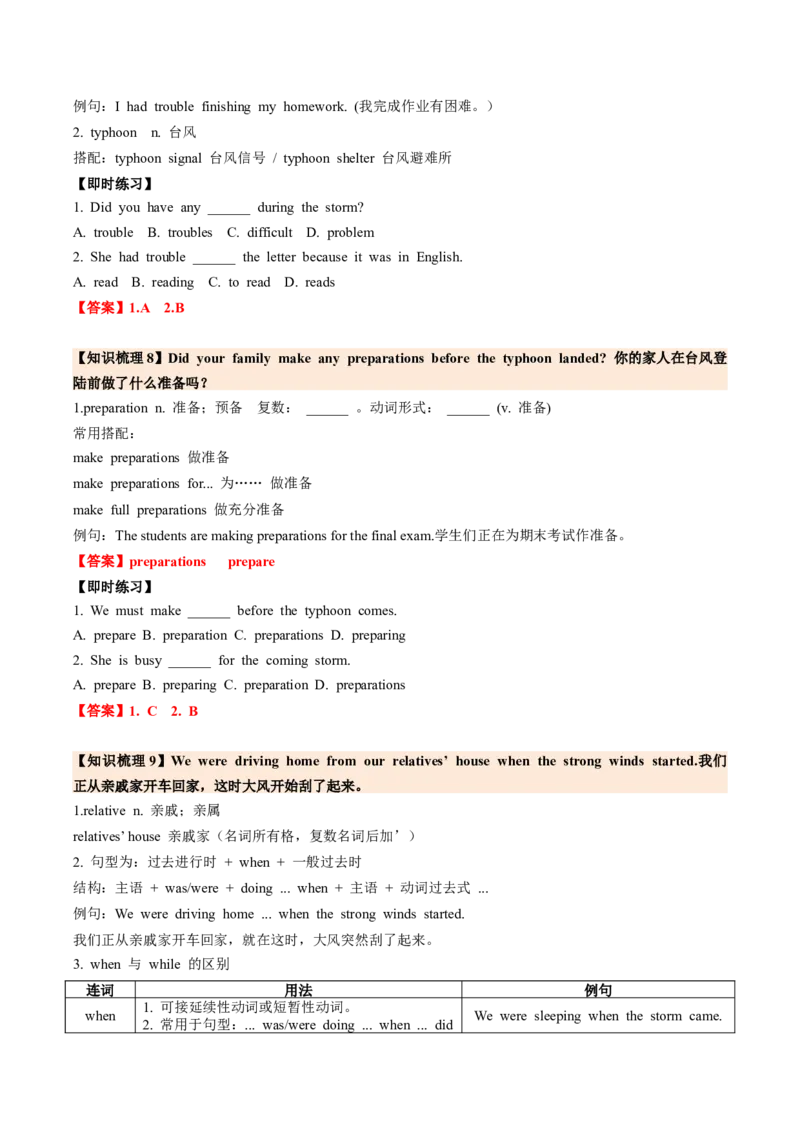
【知识梳理7】 Did you have any trouble during the typhoon?台风期间你遇到什么麻烦了吗?
1. trouble
n. 问题;麻烦;困难(不可数名词)
v. 使烦恼;麻烦
常用搭配:
have trouble (in) doing sth. 做某事有困难
ask for trouble 自找麻烦
get into trouble 陷入困境
in trouble 处于困境中例句:I had trouble finishing my homework. (我完成作业有困难。)
2. typhoon n. 台风
搭配:typhoon signal 台风信号 / typhoon shelter 台风避难所
【即时练习】
1. Did you have any ______ during the storm?
A. trouble B. troubles C. difficult D. problem
2. She had trouble ______ the letter because it was in English.
A. read B. reading C. to read D. reads
【答案】1.A 2.B
【知识梳理8】Did your family make any preparations before the typhoon landed? 你的家人在台风登
陆前做了什么准备吗?
1.preparation n. 准备;预备 复数: ______ 。动词形式: ______ (v. 准备)
常用搭配:
make preparations 做准备
make preparations for... 为…… 做准备
make full preparations 做充分准备
例句:The students are making preparations for the final exam.学生们正在为期末考试作准备。
【答案】preparations prepare
【即时练习】
1. We must make ______ before the typhoon comes.
A. prepare B. preparation C. preparations D. preparing
2. She is busy ______ for the coming storm.
A. prepare B. preparing C. preparation D. preparations
【答案】1. C 2. B
【知识梳理9】We were driving home from our relatives’ house when the strong winds started.我们
正从亲戚家开车回家,这时大风开始刮了起来。
1.relative n. 亲戚;亲属
relatives’ house 亲戚家(名词所有格,复数名词后加’)
2. 句型为:过去进行时 + when + 一般过去时
结构:主语 + was/were + doing ... when + 主语 + 动词过去式 ...
例句:We were driving home ... when the strong winds started.
我们正从亲戚家开车回家,就在这时,大风突然刮了起来。
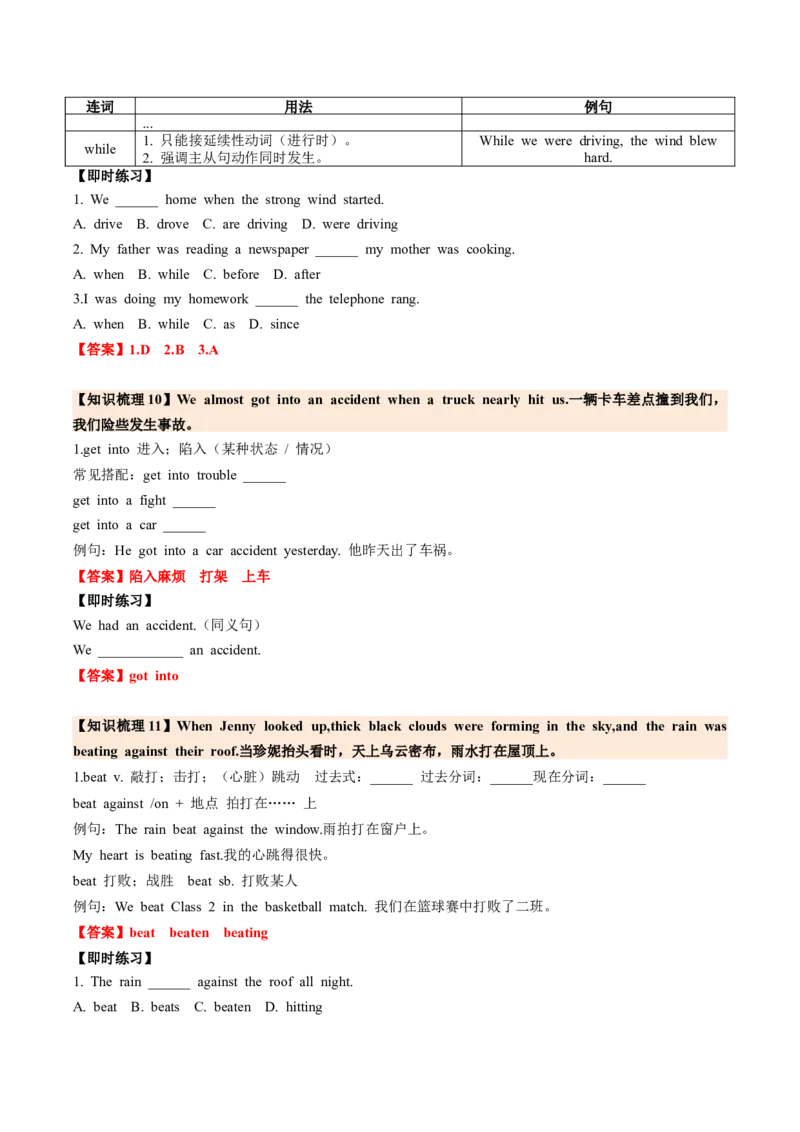
3. when 与 while 的区别
连词 用法 例句
1. 可接延续性动词或短暂性动词。
when We were sleeping when the storm came.
2. 常用于句型:... was/were doing ... when ... did连词 用法 例句
...
1. 只能接延续性动词(进行时)。 While we were driving, the wind blew
while
2. 强调主从句动作同时发生。 hard.
【即时练习】
1. We ______ home when the strong wind started.
A. drive B. drove C. are driving D. were driving
2. My father was reading a newspaper ______ my mother was cooking.
A. when B. while C. before D. after
3.I was doing my homework ______ the telephone rang.
A. when B. while C. as D. since
【答案】1.D 2.B 3.A
【知识梳理10】We almost got into an accident when a truck nearly hit us.一辆卡车差点撞到我们,
我们险些发生事故。
1.get into 进入;陷入(某种状态 / 情况)
常见搭配:get into trouble ______
get into a fight ______
get into a car ______
例句:He got into a car accident yesterday. 他昨天出了车祸。
【答案】陷入麻烦 打架 上车
【即时练习】
We had an accident.(同义句)
We ____________ an accident.
【答案】got into
【知识梳理11】When Jenny looked up,thick black clouds were forming in the sky,and the rain was
beating against their roof.当珍妮抬头看时,天上乌云密布,雨水打在屋顶上。
1.beat v. 敲打;击打;(心脏)跳动 过去式:______ 过去分词:______现在分词:______
beat against /on + 地点 拍打在…… 上
例句:The rain beat against the window.雨拍打在窗户上。
My heart is beating fast.我的心跳得很快。
beat 打败;战胜 beat sb. 打败某人
例句:We beat Class 2 in the basketball match. 我们在篮球赛中打败了二班。
【答案】beat beaten beating
【即时练习】
1. The rain ______ against the roof all night.
A. beat B. beats C. beaten D. hitting2. Our team ______ Class Three yesterday.
A. won B. beat C. beats D. wins
【答案】1.A 2.B
【知识梳理 12】 Dad gave her some chocolate and told her that they were hiding from an angry
lion.爸爸给了她一些巧克力,告诉她他们在躲避一只愤怒的狮子。
1. hide v. 躲藏;隐藏 过去式:______ 过去分词:______ 现在分词:______
(1)hide sth. (from sb.) 藏;隐藏(把某物藏起来)
例句:He hid the money under the bed. 他把钱藏在床底下。
She hid the gift from her brother. 她把礼物藏起来不让弟弟发现。
(2)hide (from sb./sth.) 躲藏;躲避(自己藏起来)
例句:The boy hid behind the door. 男孩躲在门后。
They were hiding from the storm. 他们在躲避暴风雨。
2. angry adj. 生气的;愤怒的 副词:angrily 生气地
常用搭配:be angry with sb. 生某人的气;
be angry at sth. 因某事生气
【答案】hid hidden hiding
【即时练习】
1. The little girl ______ behind the tree when she played hide-and-seek.
A. hide B. hid C. hidden D. hiding
2. They were ______ from the heavy rain under a big tree.
A. hide B. hid C. hidden D. hiding
3. He tried to ______ his mistake.
A. hide B. hid C. hidden D. hiding
【答案】1. B 2.D 3.A
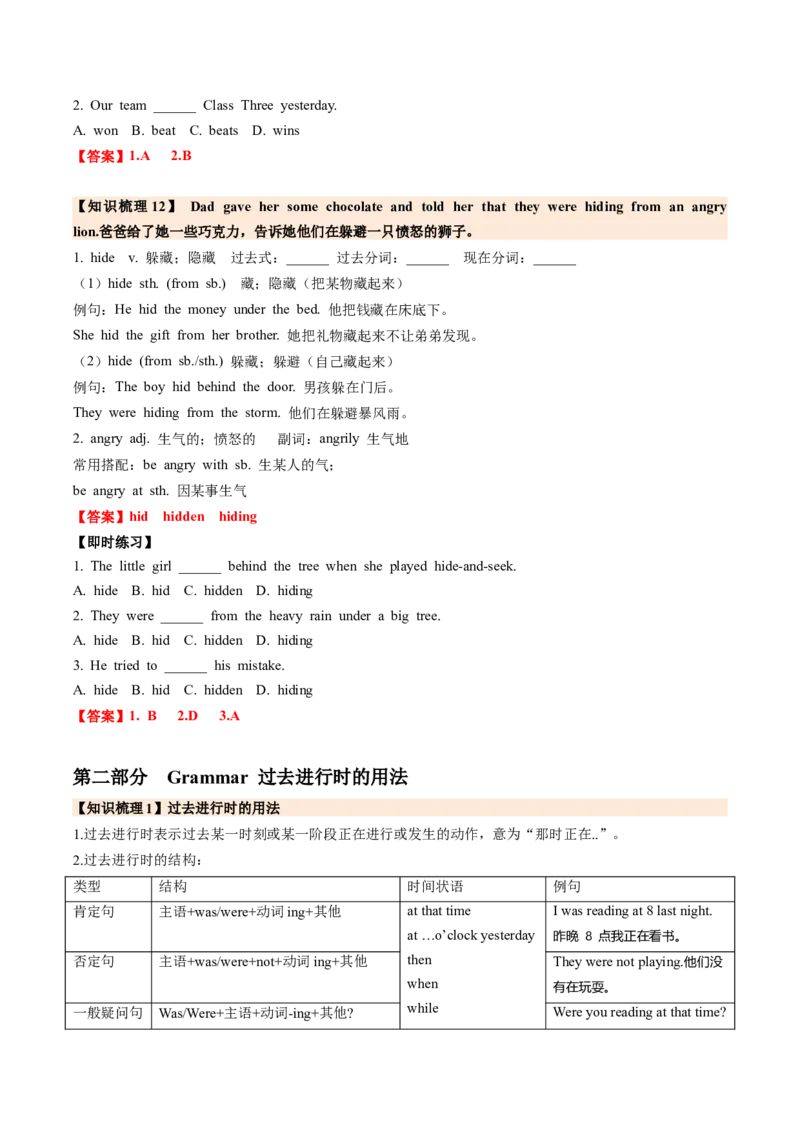
第二部分 Grammar 过去进行时的用法
【知识梳理1】过去进行时的用法
1.过去进行时表示过去某一时刻或某一阶段正在进行或发生的动作,意为“那时正在..”。
2.过去进行时的结构:
类型 结构 时间状语 例句
肯定句 主语+was/were+动词ing+其他 at that time I was reading at 8 last night.
at …o’clock yesterday 昨晚 8 点我正在看书。
否定句 主语+was/were+not+动词ing+其他 then They were not playing.他们没
when
有在玩耍。
一般疑问句 Was/Were+主语+动词-ing+其他? while Were you reading at that time?你那时在看书吗?
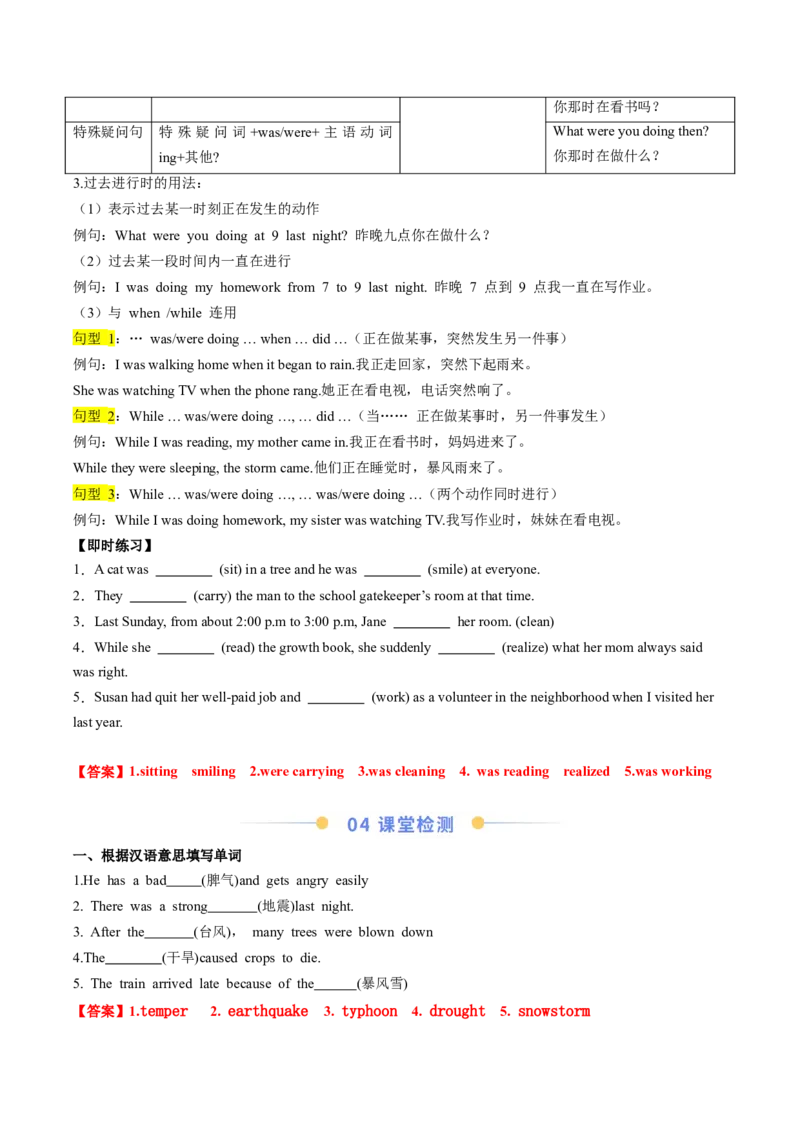
特殊疑问句 特 殊 疑 问 词 +was/were+ 主 语 动 词 What were you doing then?
ing+其他? 你那时在做什么?
3.过去进行时的用法:
(1)表示过去某一时刻正在发生的动作
例句:What were you doing at 9 last night? 昨晚九点你在做什么?
(2)过去某一段时间内一直在进行
例句:I was doing my homework from 7 to 9 last night. 昨晚 7 点到 9 点我一直在写作业。
(3)与 when /while 连用
句型 1:… was/were doing … when … did …(正在做某事,突然发生另一件事)
例句:I was walking home when it began to rain.我正走回家,突然下起雨来。
She was watching TV when the phone rang.她正在看电视,电话突然响了。
句型 2:While … was/were doing …, … did …(当…… 正在做某事时,另一件事发生)
例句:While I was reading, my mother came in.我正在看书时,妈妈进来了。
While they were sleeping, the storm came.他们正在睡觉时,暴风雨来了。
句型 3:While … was/were doing …, … was/were doing …(两个动作同时进行)
例句:While I was doing homework, my sister was watching TV.我写作业时,妹妹在看电视。
【即时练习】
1.A cat was (sit) in a tree and he was (smile) at everyone.
2.They (carry) the man to the school gatekeeper’s room at that time.
3.Last Sunday, from about 2:00 p.m to 3:00 p.m, Jane her room. (clean)
4.While she (read) the growth book, she suddenly (realize) what her mom always said
was right.
5.Susan had quit her well-paid job and (work) as a volunteer in the neighborhood when I visited her
last year.
【答案】1.sitting smiling 2.were carrying 3.was cleaning 4. was reading realized 5.was working
一、根据汉语意思填写单词
1.He has a bad (脾气)and gets angry easily
2. There was a strong (地震)last night.
3. After the (台风), many trees were blown down
4.The (干旱)caused crops to die.
5. The train arrived late because of the (暴风雪)
【答案】1.temper 2. earthquake 3. typhoon 4. drought 5. snowstorm二、用所给单词的适当形式填空
1. We need to make (prepare) for the coming storm.
2. He slept (sound) last night.
3.She (near) missed the bus.
4. They sent us medical (supply)
5. The boy (hide) under the bed when the earthquake started.
【答案】1.preparations 2. soundly 3. nearly 4. supplies 5. hid
三、根据汉语意思完成句子
1. 台风来的时候,我们需要待在家里。
We need to stay at home when a is coming.
2. 森林里的野火被消防员扑灭了。
The in the forest was by firefighters.
3.因为暴风雪太大,我们不能出去玩。
We can't to play because of the .
4. 大浪拍打着海滩,打湿了我们的衣服。
The big hit the and wet our clothes.
5.记者明天将采访这位著名的英雄。
The will the famous hero tomorrow.
6. 如果这个周末天气好,我们可能会去公园。
We go to the park if the weather is fine this weekend.
【答案】1. typhoon
2. wildfire;put out
3. go,out ;heavy,snowstorm
4. wave; beach
5.reporter; interview
6.possibly
一、单项选择
1.While my sister ________ for the bus, she saw a small cat on the street.
A.waits B.waited C.was waiting D.is waiting
【答案】C
【详解】句意:当我妹妹在等公交车时,她在街上看到一只小猫。
考查时态。根据“saw”(看见)可知,主句为一般过去时。while引导时间状语从句,强调主句动作发生
时从句动作正在进行,从句应用过去进行时(was/were doing)。主语“my sister”为第三人称单数,应用
was waiting。故选C。
2.When I got home yesterday evening, my parents ________ dinner in the kitchen.A.cook B.cooked C.are cooking D.were cooking
【答案】D
【详解】句意:当我昨晚到家时,我的父母正在厨房做晚饭。
考查过去进行时。根据时间状语“When I got home yesterday evening”可知,“我到家”是过去发生的动作,
而“父母做饭”是在“我到家”那一刻正在进行的动作,因此需用过去进行时was/were doing。主语“my
parents”是复数,故用were cooking。故选D。
3.The little girl ________ to music when her father came back from work.
A.listens B.listened C.was listening D.is listening
【答案】C
【详解】句意:当爸爸下班回家时,这个小女孩正在听音乐。
考查过去进行时。listens听,一般现在时第三人称单数;listened听,一般过去时;was listening正在听,
过去进行时;is listening正在听,现在进行时。根据从句“when her father came back from work”中的一般过
去时可知,主句动作发生在过去;且“听音乐”是在“爸爸回来”这一过去时间点正在进行的动作,需用
过去进行时。故选C。
4.________ my neighbour called, my family were having dinner.
A.As long as B.While C.When
【答案】C
【详解】句意:当我的邻居来访时,我们一家人正在吃晚饭。
考查连词辨析。As long as只要;While当……时候(后接延续性动词);When当……时候(后接延续性
或短暂性动词)。“called”是短暂性动作,用“when”引导时间状语从句。故选C。
5.—_______did the rainstorm come, Mr Liu?
—While we _______ a chemistry lesson yesterday afternoon.
A.While; have had B.While; have
C.When; are having D.When; were having
【答案】D
【详解】句意:——刘老师,暴风雨是什么时候来的?——昨天下午我们正在上化学课的时候。
考查特殊疑问词辨析和时态。根据答语“yesterday afternoon”可知,第一空应是询问时间,用When引导的
特殊疑问句,意为“什么时候”;根据“While we ... a chemistry lesson yesterday afternoon.”可知,第二空描
述过去某个时间点正在进行的动作,用过去进行时态,其结构为“was/were + 现在分词”。故选D。
6.My family ________ dinner when the earthquake started suddenly.
A.have B.had C.were having D.are having
【答案】C
【详解】句意:当地震突然发生的时候,我的家人正在吃晚饭。
考查动词时态。根据“when the earthquake started suddenly”可知,当地震发生的时候,我的家人正在吃晚
饭,表示过去某一时刻正在进行的动作,应该用过去进行时,其结构是“was/were+doing”,主语“My
family”在这里表示家人,是复数概念,所以be动词用were,“have”的现在分词是“having”,所以此处应
填“were having”。故选C。7.—________ you ________ a book at 9 last night?
—No, I was watching a movie.
A.Do; read B.Did; read C.Were; reading D.Are; reading
【答案】C
【详解】句意:——昨晚9点你正在读一本书吗?——不,我正在看电影。
考查过去进行时。根据答句“I was watching a movie”可知,问句询问过去某个具体时间正在进行的动作,
时间状语“at 9 last night”表示过去某一时刻,需用过去进行时was/were + doing。选项C为过去进行时结构,
符合语境。故选C。
8.—Did you meet Mr. Smith?
—Yes. When I arrived, he ______ for New York to attend a press conference.
A.was just leaving B.just left C.just leaves D.had just left
【答案】A
【详解】句意:——你见到史密斯先生了吗?——是的。当我到的时候,他正要去纽约参加一个记者招待
会。
考查动词时态。根据arrived可知,其主句也应该用过去的某种时态,再结合回答“Yes”可知,我到的时候,
他还没有离开,即他正要动身去纽约,应用过去进行时表将来,故选A。
9.—What do you think of the movie last night?
—When I got there it ______, so I only watched the end.
A.finished B.had finished C.was finishing D.has finished
【答案】C
【详解】句意:——你觉得昨晚的电影怎么样?——当我到达的时候它快要结束了,所以我只看了结尾。
考查动词时态。根据“so I only watched the end.”我只看了结尾,可知电影快结束了,还没有结束,用过去
进行时代替过去将来时,故选C。
10.When the heavy rainstorm hit the city last night, we ________ dinner in the restaurant.
A.have B.had C.were having D.have been having
【答案】C
【详解】句意:昨晚暴雨袭击这座城市时,我们正在餐馆吃晚饭。
考查时态。have吃,用于一般现在时;had吃,用于一般过去时;were having正在吃,用于过去进行时;
have been having一直在吃,用于现在完成进行时。根据从句“When the heavy rainstorm hit the city last
night”可知,主句动作发生在从句动作“hit”的瞬间,强调当时正在进行的动作,应用过去进行时。故选
C。
11.While the exchange students ________ about Chinese table manners, the teacher gave them some vivid
examples.
A.learn B.learned C.are learning D.were learning
【答案】D
【详解】句意:当交换生正在学习中国餐桌礼仪时,老师给他们举了一些生动的例子。
考查动词时态。learn学习,一般现在时;learned学习,一般过去时;are learning正在学习,现在进行时;were learning正在学习,过去进行时。主句“the teacher gave them...”使用了一般过去时,且从句动作“学
习”与主句动作“举例”同时发生,强调“正在学习”的持续过程,需用过去进行时。故选D。
12.He ________ for the scholarship since last year and finally got it last week.
A.applies B.applied C.had been applying D.was applying
【答案】C
【详解】句意:他从去年开始就一直在申请奖学金,上周终于拿到了。
考查动词时态。applies一般现在时;applied一般过去时;had been applying过去完成进行时;was applying
过去进行时。根据“since last year and finally got it last week”可知,动作从去年持续到上周,应用过去完成
进行时。故选C。
13.She told me that she had mailed part of the products and that the rest ______ in a few days.
A.has followed B.have followed C.was following D.were following
【答案】D
【详解】句意:她告诉我她已经邮寄了部分产品,剩下的几天以后再邮寄。
考查进行时表示将来时的用法。由句中“in a few days”可知,此句是说几天后要发生的事情,应用过去进
行时表示过去将来时,表示计划好要发生的事情,其构成为“was/were doing”,主语“the rest”指剩余的产
品,表示复数,应用 were构成过去进行时,故选D。
14.By the time he entered middle school, he ________ English for six years and could communicate fluently.
A.learned B.has learned C.had been learning D.was learning
【答案】C
【详解】句意:到他上中学时,他已经学了六年英语,并且能够流利地交流了。
考查时态辨析。learned一般过去时;has learned现在完成时;had been learning过去完成进行时;was
learning过去进行时。根据“By the time he entered middle school”可知,“进入中学”是过去的时间点,而
“学英语六年”是在此之前一直持续的动作,强调持续到过去某个时间点并可能仍在继续,需用过去完成
进行时。故选C。
15.By the time we arrived in Japan, our guide ________ for us at the airport for over an hour.
A.waited B.has waited C.had been waiting D.was waiting
【答案】C
【详解】句意:当我们到达日本时,我们的导游已经在机场等了我们一个多小时了。
考查时态。waited(一般过去时);has waited(现在完成时);had been waiting(过去完成进行时);was
waiting(过去进行时)。主句动作“等待”发生在“我们到达”之前,且“for over an hour”强调动作持续,
需用过去完成进行时表示在过去某一时间之前一直持续的动作。故选C。
二、完形填空
Last month, our city experienced a strong typhoon. Before it came, the weather report 1 us to stay
at home and get ready for it. My family and I 2 lots of food, water and candles. We also closed all the
windows tightly (紧紧地) and moved the plants from the balcony (阳台) into the room.
When the typhoon arrived, the wind blew 3 and the rain poured heavily. The trees outside wereshaking hard, and some branches even 4 off. We turned off the TV and computer to keep safe, and sat in
the living room talking. My little sister was a bit scared at first, but we told her to stay 5 and everything
would be fine.
After the typhoon 6 , we went outside to check the situation. Many roads were covered with fallen
leaves and branches, and some street signs were 7 . But luckily, our house was not damaged. The next
day, workers came to clean the roads and repair the broken signs.
This experience taught me that it’s very important to 8 the early warnings of disasters and prepare
well. It also made me realize that following rules and working together can help us 9 difficult times
easily. From then on, I pay more attention to weather reports and learn more about 10 to deal with
different kinds of disasters.
1.A.told B.said C.spoke D.talked
2.A.sent B.bought C.ate D.drank
3.A.softly B.gently C.strongly D.quietly
4.A.took B.fell C.turned D.got
5.A.angry B.sad C.calm D.excited
6.A.ended B.arrived C.started D.spread
7.A.broken B.fixed C.new D.clean
8.A.stick to B.get to C.shout to D.listen to
9.A.take out B.think about C.come up D.get through
10.A.what B.how C.when D.where
【答案】
1.A 2.B 3.C 4.B 5.C 6.A 7.A 8.D 9.D 10.B
【导语】本文是一篇记叙文。讲述了作者一家在台风来临前积极准备,台风过境时保持冷静,台风过后参
与清理,并从中认识到关注预警、做好准备以及团结协作重要性的经历。
1.句意:在它(台风)来之前,天气预报告诉我们要待在家里并做好准备。
told告诉;said说;spoke说(某种语言);talked谈话。根据“us to stay at home”可知,tell sb. to do
sth.“告诉某人做某事”为动词短语。故选A。
2.句意:我和家人买了许多食物、水和蜡烛。
sent寄送;bought购买;ate吃;drank喝。根据“lots of food, water and candles”可知,为应对台风而“购
买”物资。故选B。
3.句意:台风来临时,风猛烈地吹,雨倾盆而下。
softly柔软地;gently温柔地;strongly强烈地;quietly安静地。根据“a strong typhoon”和“the wind
blew...”可知,强台风的风力是“猛烈地”。故选C。
4.句意:外面的树摇晃得很厉害,一些树枝甚至掉了下来。
took拿走;fell掉落;turned转变;got得到。根据“some branches even...off”可知,在狂风中树枝被吹
“掉”。fall off“掉落”。故选B。5.句意:我的小妹妹起初有点害怕,但我们告诉她保持冷静,一切都会好起来的。
angry生气的;sad悲伤的;calm冷静的;excited兴奋的。根据“My little sister was a bit scared at first”可知,
为了安抚她,让她“保持冷静”。stay calm“保持冷静”。故选C。
6.句意:台风结束后,我们出去查看情况。
ended结束;arrived到达;started开始;spread传播。根据“we went outside to check the situation”可知,是
在台风“结束”之后。故选A。
7.句意:许多道路被落叶和树枝覆盖,一些路标也坏了。
broken坏的;fixed修理好的;new新的;clean干净的。根据“repair the broken signs”可知,路标需要修理,
所以是“坏了”。故选A。
8.句意:这次经历教会我,关注灾害的早期预警并做好准备非常重要。
stick to坚持;get to到达;shout to对……喊叫;listen to听,关注。根据“the early warnings of disasters”可
知,此处指“关注”预警信息。listen to“倾听,关注”。故选D。
9.句意:这也让我意识到,遵守规则和团结协作能帮助我们轻松度过困难时期。
take out取出;think about思考;come up想出;get through度过。根据“difficult times”可知,get
through“度过(难关)”符合语境。故选D。
10.句意:从那时起,我更关注天气预报,并学习更多关于如何应对不同灾害的知识。
what什么;how如何;when何时;where何地。根据“to deal with different kinds of disasters”可知,此处表
示应对灾害的“方式”,应用“how”。故选B。
三、语法填空
阅读下面短文,根据语境或所给单词的提示,在每个空格内填入一个恰当的词,要求所填的词意义准确、
形式正确,使短文意思完整、行文连贯。
Natural disasters are terrible events caused by nature. They include earthquakes, typhoons, floods,
snowstorms and so on. Every year, natural disasters 1 (happen) in many parts of the world, bringing
great damage and even 2 (lose) of lives.
It’s important for us to know how 3 (protect) ourselves when natural disasters strike. When an
earthquake happens, if you are indoors, you should stay away from windows and heavy furniture. You’d better 4
(hide) under a strong table or desk until the shaking stops. If you are outdoors, don’t stand near buildings, trees or
power lines.
When a typhoon comes, you must stay indoors and close all the windows and doors tightly. Don’t go out
5 (unless) it’s absolutely necessary. The strong winds may 6 (blow) down trees and signs, which are
very dangerous.
Floods are often caused by heavy rain. If you are in a flooded area, try to move to higher ground as soon as
possible. Don’t walk through deep water, because you 7 (not know) what’s under the water. It’s also
dangerous to drive through flooded roads.
After a natural disaster, we should stay calm and 8 (follow) the instructions of the government and
rescue workers. We should help each other and 9 (rebuild) our homes together.
In addition, we should pay attention to the weather forecast and early warnings. By 10 (prepare)well in advance, we can reduce the damage caused by natural disasters. Remember, safety is always the first
priority when facing natural disasters.
【答案】
1.happen 2.loss 3.to protect 4.hide 5.unless 6.blow 7.don’t know 8.
follow 9.rebuild 10.preparing
【导语】本文主要介绍了地震、台风、洪水等自然灾害,重点阐述了面对不同灾害时的具体自救方法,并
强调了提前准备、听从指挥以及灾后互助重建的重要性。
1.句意:每年,世界各地都会发生各种自然灾害,造成巨大的破坏,甚至导致人员伤亡。happen“发生”,
动词,又结合时间状语“Every year”及语境可知,该句时态为一般现在时,且主语disasters为第三人称复
数形式,应用happen的动词原形作谓语。故填happen。
2.句意:每年,世界各地都会发生各种自然灾害,造成巨大的破坏,甚至导致人员伤亡。lose“丢失”,
动词,又根据“…of lives”可知,此处应指“人员伤亡”,应用其对应的名词形式loss与之搭配,表示
“……的损失”。故填loss。
3.句意:对于我们来说,了解在自然灾害来袭时如何保护自己是非常重要的。protect“保护”,动词,又
根据“know how…ourselves”可知,此处应指“怎么样去保护自己”,应用其不定式形式to protect与之搭
配,“how to do sth.”表示“应该怎么去做”。故填to protect。
4.句意:你最好躲在坚固的桌子或书桌下面,直到震动停止。hide“躲藏,隐藏”,动词,且该句考查
“had better do sth.”,意为“最好做某事”,为动词短语,应用其动词原形与之搭配。故填hide。
5.句意:除非绝对必要,否则不要外出。unless“除非”,又根据“Don’t go out”及“it’s absolutely
necessary”可知,此处指如果(外出)不是绝对必要,就不要出去,指出了“可以外出的唯一条件”,应用
unless引条件状语从句。故填unless。
6.句意:强风可能会吹倒树木和标识牌,这非常危险。blow“吹”,动词,且情态动词may后应接动词原
形。故填blow。
7.句意:不要走进深水区,因为你无法确定水下有什么。not know“知道”的否定形式,再结合语境可知,
该句时态为一般现在时,则原因状语从句的时态也应一致又,从句中主语you为第二人称,助动词应用
don’t构成否定形式,后接动词know的原形。故填don’t know。
8.句意:在自然灾害发生后,我们应当保持冷静,并遵循政府和救援人员的指示。follow“跟随”,动词,
该句中and连接的两个并列的成分,则should后也应用follow的动词原形与stay并列作谓语动词。故填
follow。
9.句意:我们应当互相帮助,共同重建家园。rebuild“重建”,动词,该句中and连接的两个并列的成分,
则should后也rebuild的动词原形与help并列作谓语动词。故填rebuild。
10.句意:通过提前做好充分准备,我们能够减少自然灾害造成的损失。prepare“准备”,动词,且介词
by后应接其对应的动名词形式。故填preparing。
四、阅读问答
On Sunday morning, a strong earthquake hit Indonesia (印尼) and then big tsunamis (海啸) followed. They
soon went on to other countries in South and Southeast Asia as well as East Africa. Tsunamis are especially (特别)dangerous to children. By Wednesday, nearly 60,000 people died because of the tsunamis. One third (三分之一) of
them were children.
At least half of the people in Asia are children. The walls of water killed many members of Asian families. In
many Asian countries near the sea, poor kids helped their parents fish. So they were in danger when the tsunamis
came. In Sri Lanka (斯里兰卡), when the first waves hit, thousands of children came to the seaside. The waves
brought in fish. The old and the young collected them. Many waited to see more. Then the six-meter-high tsunami
hit the island of 19 million people. “They got caught and could not run to safety. This is the reason why so many
children died.” said a policeman in Sri Lanka.
Tsunamis are caused by earthquakes. When two large pieces of the earth run into one another, an earthquake
happens. The movement gives the seawater a sudden push (推力) and makes it move fast. Scientists don’t know
when an earthquake will happen, so they can’t tell people about the tsunamis. What should you do when there’s a
tsunami? Move to a safe place. If you are near the sea and you feel the earthquake, move to higher ground. Stay
away from rivers and streams.
1.When did the earthquake hit Indonesia?
2.How many children died by Wednesday because of tsunamis?
3.Why were poor kids in danger when the tsunamis came in Asia countries?
4.Can scientists tell people when tsunamis happen?
【答案】1.On Sunday morning. 2.Nearly 20,000. 3.Because they helped parents fish. 4.No,
they can’t.
【导语】本文主要介绍了印度尼西亚发生了地震并带来了海啸,造成了很大的伤亡,并介绍了死亡人数多
的原因,以及科学家没有办法预测和告诉我们应该怎样面对突发的地震和海啸。
1.根据第一段“On Sunday morning, a strong earthquake hit Indonesia (印尼)”可知印尼地震发生在周日早上。
故填On Sunday morning.
2.根据第一段“By Wednesday, nearly 60,000 people died because of the tsunamis. One third (三分之一) of
them were children.”可知,截至周三,近6万人死于海啸,其中三分之一是儿童,即近2万人是儿童。故填
Nearly 20,000.
3.根据第二段“In many Asian countries near the sea, poor kids helped their parents fish. So they were in danger
when the tsunamis came.”可知,在许多靠海的亚洲国家,贫穷的孩子帮助他们的父母捕鱼,所以当海啸来
临时,他们处于危险之中。故填Because they helped their parents fish.
4.根据第三段“Scientists don’t know when an earthquake will happen, so they can’t tell people about the
tsunamis.”可知,科学家不知道地震什么时候会发生,所以他们不能告诉人们海啸的情况。故填No, they
can’t.