Unit 5 Nature’s Temper
阅读理解10篇
内容导航
单元话题 基础语篇练习 重难语篇练习
单元话题聚焦
自然灾害
基础语篇练习
稳扎稳打 必拿分数:聚焦稳拿分数题目,确保基础分值
重难语篇练习
突破瓶颈 争夺高分:聚焦高难度题目,争夺关键分数
基础语篇练习
①In early January 2025, a huge fire broke out in Los Angeles, California. The strong Santa Ana wind made
the fire spread very quickly. The fire hurt not only people’s houses but also the environment around them.
②A lot of forests and grasslands were burned. Many trees turned black, and the green grass was gone. All
those plants were important for animals. Without them, animals lost their homes and food. Squirrels (松鼠) that
lived in tree holes had to run away. Deer that eat the grass had nothing to eat. Some small animals like mice and
rabbits died in the fire.
③The soil also got into big trouble. Plants usually help keep the soil in place. But after the fire, there were
no plants. When it rained, the rain washed the soil away. In some hilly places, mudslides (泥石流) occurred. They
broke roads and even destroyed some houses.
④The air became dirty too. The fire sent a lot of smoke and bad things into the air. People in the areas near
the fire had to wear masks. If someone had trouble breathing, they were in even more danger.
⑤All in all, the 2025 Los Angeles wildfire was a big blow to nature. It will take a very long time for
everything to get back to normal. People need to think about how to prevent this kind of fire in the future.
1.What made the wildfire in Los Angeles spread quickly in 2025?
A.Rain. B.Wind. C.Earthquakes. D.Snowstorms.
2.What does the underlined word “occurred” in Paragraph 3 probably mean?
A.Shared. B.Happened. C.Accepted. D.Changed.
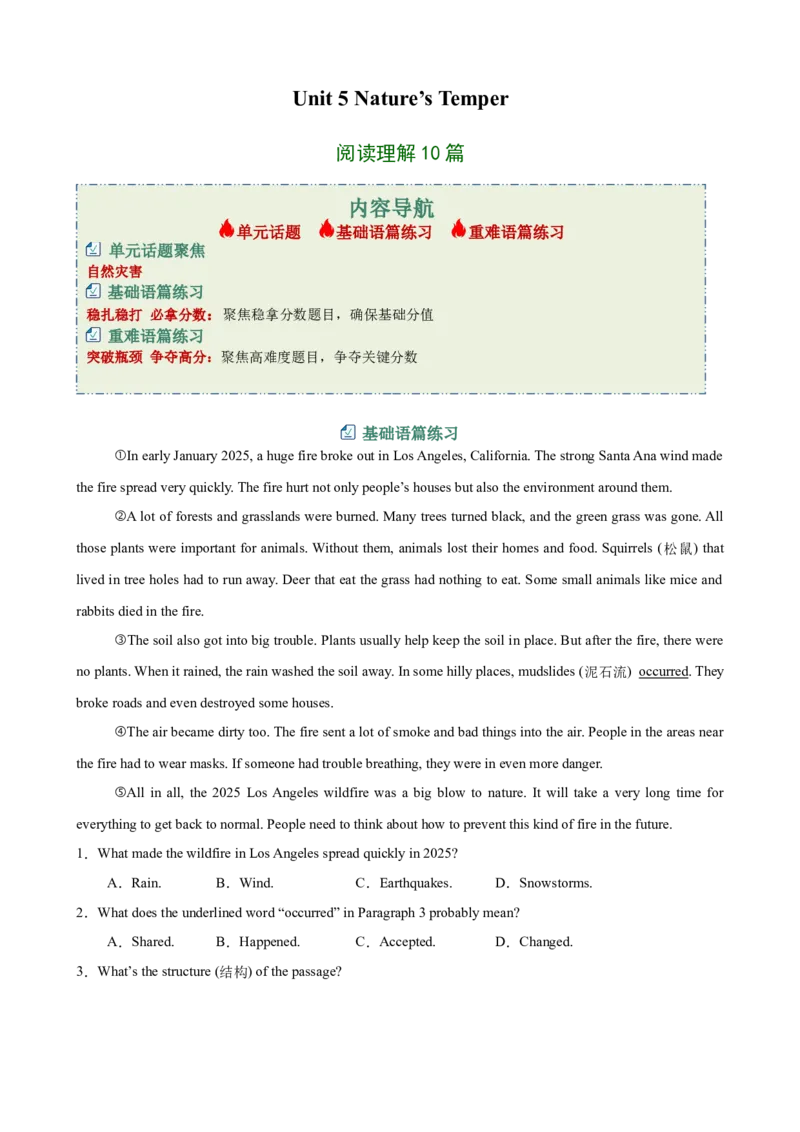
3.What’s the structure (结构) of the passage?A. B. C. D.
4.What is the best title for the passage?
A.The Wildfire in Los Angeles. B.The Firefighters in Los Angeles.
C.How to Prevent Wildfire in the Future. D.The Changes of Los Angeles.
In September 2024, Typhoon Yagi, a strong super typhoon, hit a small seaside town in Wenchang, Hainan
Province at around 16:20 on the 6th.
When Typhoon Yagi arrived, dark clouds covered the sky quickly. At first, the wind blew softly, but soon it
turned into a very loud roar with the strongest gusts over 17 levels. Big trees were pulled out of the ground, house
roofs were blown off, and roads were blocked by fallen branches and rubbish. People in the town were scared;
some moved to safe places with their families, some closed all windows tightly and stayed in strong rooms, and
others worried about their damaged homes and farms.
After the typhoon passed, the town was in a mess. Many houses were broken, local fields growing rice and
vegetables were flooded, and some public transport like buses and trains was stopped for a while. Luckily, most
people had been moved to safe places in advance.
Local volunteers arrived soon to clear the blocked roads and take away rubbish. The government sent food,
drinking water and tents to the affected families. In the following weeks, the townspeople worked together to
repair their houses, start again their farm work and clean up the streets. By early October, the town was full of life
again.
1.What kind of typhoon was Yagi?
A.Weak storm. B.Small rainstorm. C.Strong super typhoon.
2.Where did Typhoon Yagi hit Hainan?
A.Wenchang’s small seaside town.B.Sanya’s village. C.Haikou’s big city.
3.Which is the correct meaning for the underlined word “flooded”?
A.干旱. B.淹没. C.丰收.
4.Why were there not many people hurt?
A.Typhoon not strong. B.No one in the town. C.Moved to safe places early.
5.How did people help the town recover?A.Left forever. B.Fixed houses and cleaned streets. C.Waited for government help.
①Water is one of the most useful things on Earth. It gives us life but sometimes water is so powerful that it
can even be destructive (破坏性的). Here we talk about floods.
②There are two main kinds of floods: flash floods and slow floods. Flash floods are sudden floods of great
volumes of water. They overflow (溢出) the river banks and break everything they touch into pieces. Flash floods
are destructive. The other type is slow floods. They rise over a long time. Usually as more and more rain falls, the
water in rivers rises and the land floods. These slow floods happen in every country in the world.
③Floods are the world’s biggest natural killer. When floods happen, they damage (毁坏) crops, wash away
houses, destroy roads, and kill people. Every year in America, water kills over 100 people, most in flash floods.
Floods also cause huge economic losses (经济损失).
④Floods are a serious problem. Worse still, they may become more powerful and happen more often as
global (全球的) warming becomes more and more serious. Around the world, sea levels will rise, and the floods
will take more lives.
⑤Floods are a serious natural disaster and we must try to stop them from happening often to protect our
lives and homes.
1.What can we know about flash floods?
A.They happen suddenly.
B.They are slow, but powerful.
C.They are less destructive than slow floods.
D.They appear everywhere around the world.
2.How does the writer explain (解释) “Floods are the world’s biggest natural killer.”?
A.By giving facts. B.By telling stories.
C.By raising questions. D.By showing steps.
3.What does the underlined word “take” mean in Paragraph 4?
A.Warn. B.Protect.
C.Kill. D.Control.
4.Which of the following shows the structure of the text?
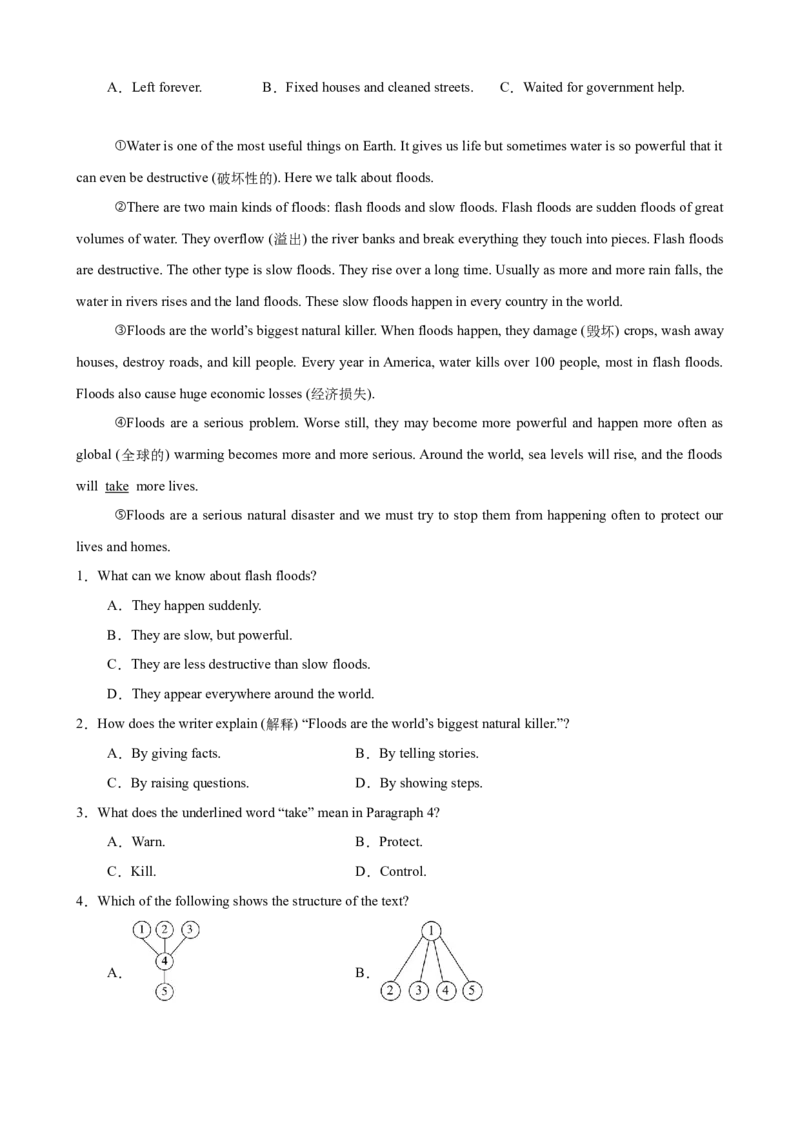
A. B.C. D.
Many natural disasters happen suddenly, On 7 January 2025, an earthquake hit Dingri County in Xizang.
The earthquake brought a lot of damage (损坏) and problems to the local area. However, China showed an
amazing rescue speed.
Just 10 minutes after the earthquake, rescue planes took off quickly. They carried things for rescue and
doctors to the disaster area. It showed the high speed of a country to act in an emergency. 30 minutes after the
earthquake, the rescue teams got to the earthquake’s most serious area. They began to look for people in the
damaged buildings right away. Volunteers and local people also helped with the rescue work actively. Drones flew
over the area to send food and provide help.
Six hours after the earthquake, the electricity in the disaster area came back to normal. People could use
lights again. On the same day, the internet service was almost back. ▲ The warm food not only made them
full, but also made them feel better.
Although the earthquake was very bad, the people of Dingri County still had hope. With the help from all
over China, they worked together to build their homes and their lives again. The fast rescue worked in Dingri
earthquake shows China’s strong power to face natural disasters. It also shows that the country cares a lot about
people’s lives.
1.When did the earthquake hit Dingri County in Xizang?
A.On 7 January, 2024. B.On 7 January, 2025.
C.On 1 July, 2024. D.On 1 July, 2025.
2.What does the underlined word “provide” mean in Paragraph 2?
A.Fix. B.Offer. C.Knock. D.Doubt.
3.Why were drones used in the rescue work?
A.To look for people in damaged buildings.
B.To carry doctors and rescue things.
C.To send food and give help.
D.To rebuild houses for local people.
4.Which of the following can we put “ ▲ ” in Paragraph 3?
A.That night, people in the disaster area had hot meals.B.However, it was hard to save people in the area.
C.As a result, more people came to help.
D.On the next day, people could ask for help on the internet.
5.What is the main purpose of the passage?
A.To describe the great damage caused by the Dingri earthquake.
B.To show how volunteers and locals helped in the rescue.
C.To introduce the use of drones in disaster relief.
D.To show China’s rapid rescue ability and care for people’s lives.
Different natural disasters can bring great harm to people’s lives and homes. Let’s learn about some
common ones and how to stay safe.
First, typhoons are strong tropical storms with heavy rain and strong winds. When a typhoon is coming,
you should close all windows and stay indoors. If you are outside, find a strong building to hide in and stay away
from trees.
Second, floods often happen after heavy rain or when rivers overflow. If there’s a flood warning, move to
higher ground quickly. Don’t walk or drive through deep water, as it’s easy to get stuck.
Third, earthquakes are sudden shakes of the ground. During an earthquake, if you are indoors, hide under a
strong table or desk. Stay away from windows and heavy furniture. If you are outdoors, move to an open area like
a playground.
Fourth, wildfires usually start in dry weather. If you are near a wildfire, move to a place with no trees or
grass. Cover your mouth and nose with a wet cloth to avoid breathing in smoke.
Remember, being prepared is the best way to stay safe during natural disasters!
1.What is the main idea of the passage?
A.How natural disasters form. B.Common natural disasters and safety tips.
C.The damage caused by typhoons. D.How to predict natural disasters.
2.What should you do when a typhoon is coming?
A.Stay indoors and close windows. B.Walk through deep water.
C.Hide under a strong table. D.Move to an open area.
3.When floods happen, you should ________.
A.stay in your home B.move to higher ground
C.drive through deep water D.plant more trees
4.During an earthquake, if you are outdoors, you should ________.A.hide under a desk B.stay near windows
C.go to an open area D.climb a tree
5.What can you do to avoid smoke during a wildfire?
A.Run quickly through the fire. B.Cover your mouth with a wet cloth.
C.Stay near trees. D.Breathe deeply.
URUMQI—An earthquake of level 7.1
Home/China/Society
struck Wushi county in Northwest China’s
7.1 magnitude quake hits Northwest Xinjiang at 2:09 a.m. Tuesday (Beijing Time),
China’s Xinjiang according to the China Earthquake Networks
Center (CENC).
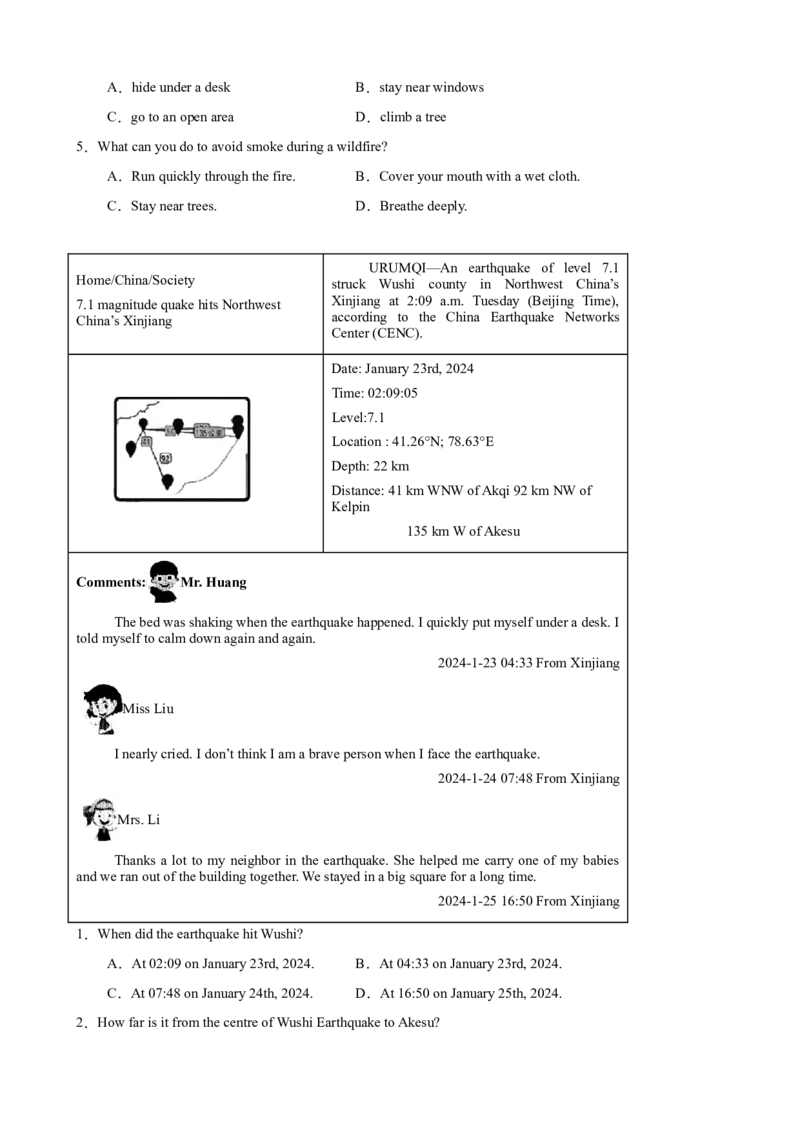
Date: January 23rd, 2024
Time: 02:09:05
Level:7.1
Location : 41.26°N; 78.63°E
Depth: 22 km
Distance: 41 km WNW of Akqi 92 km NW of
Kelpin
135 km W of Akesu
Comments: Mr. Huang
The bed was shaking when the earthquake happened. I quickly put myself under a desk. I
told myself to calm down again and again.
2024-1-23 04:33 From Xinjiang
Miss Liu
I nearly cried. I don’t think I am a brave person when I face the earthquake.
2024-1-24 07:48 From Xinjiang
Mrs. Li
Thanks a lot to my neighbor in the earthquake. She helped me carry one of my babies
and we ran out of the building together. We stayed in a big square for a long time.
2024-1-25 16:50 From Xinjiang
1.When did the earthquake hit Wushi?
A.At 02:09 on January 23rd, 2024. B.At 04:33 on January 23rd, 2024.
C.At 07:48 on January 24th, 2024. D.At 16:50 on January 25th, 2024.
2.How far is it from the centre of Wushi Earthquake to Akesu?A.22 kilometres.B.41 kilometres. C.92 kilometres. D.135 kilometres.
3.What do you think of Mrs. Li’s neighbor?
A.She is ugly but funny. B.She is kind and helpful.
C.She is thin but brave. D.She is calm and serious.
4.What can we know from the passage?
A.Mr Huang kept himself under the bed.
B.Miss Liu was afraid during the earthquake.
C.The earthquake struck Wushi on Thursday.
D.Mrs Li stayed inside a building.
5.Where can you read this text on the Internet?
A.http://www.hotsports.com B.http://www.chinadaily.com
C.http://www.brightschool.edu.cn D.http://www.historyworld.edu.cn
No one wants to be caught in a dangerous and extreme situation. If the unthinkable does take place, having
a plan and knowing what to do could make all the difference for you and your loved ones.
Flood Floods can happen very suddenly. Flood water can be deeper than it looks. It can carry you away, so
stay away! Glass, snakes, and dirty things can be in flood water. They can make you sick, so don’t drink it even if
you are thirsty.
Tornado A tornado happens during some storms. If there’s a tornado warning, go someplace, such as a
small and sturdy (结实的) bathroom, which is safe from the wind and flying things. Remember to keep away from
windows or anything heavy that might fall on you. Get down low and cover your head with your arms.
Earthquake You can stay safe during an earthquake by moving away from things that might fall. Get down
under something that’s strong if you can’t rush out of the building right away. Protect your neck and head with
your arms. If you’re outside, go to an open space. Stay away from trees or anything that might fall over and hurt
you.
Bushfire Bushfires, also known as wildfires, are common across the world during the hotter months. It is
important that you try to stay calm in a bushfire. Some fires can start so quickly that they threaten (威胁) homes
and lives within minutes, so your safest choice is always to leave early. You’d better prepare an emergency
survival kit and have it handy at all times.
1.What is the purpose of the passage?
A.To teach readers how to stay safe in natural disasters.
B.To introduce different types of natural disasters.C.To show that natural disasters are getting more common.
D.To warn readers to stay away from wildfire areas.
2.How many kinds of natural disasters are mentioned in the passage?
A.3 B.4 C.5 D.6
3.What can you do to keep safe when a tornado comes?
A.Drink flood water if thirsty. B.Wait for help in a bushfire.
C.Stay away from windows and flying things. D.Stay under trees after an earthquake.
4.What would be the best title for the passage?
A.Predictions About Natural Disasters B.Ways to Keep Safe in Natural Disasters
C.Reasons for Natural Disasters D.Types of Natural Disasters
5.Where can the passage be found?
A.A science magazine. B.A dictionary. C.A diary. D.A sports poster.
My dad and I went hiking in the mountain. We enjoyed the fresh air and decided to stay in the hotel for two
days. However, I had one of the most terrible experiences of my life! A storm woke me up early. I got up and
looked out of the window of our hotel. I listened to the thunder and watched the lightning. It wasn’t scary at that
time—it was exciting!
But then I looked at my phone and saw on the news that a hurricane was coming. I asked my dad what a
hurricane was and asked him if he knew what to do. He told me not to worry because a hurricane was just a big
storm. We stayed in our hotel room and by the afternoon, there was even more rain. And the winds were getting
stronger and stronger.
In the evening, a hotel worker asked all the visitors to go to the dining hall. When we were all inside, we
put tables in front of the doors and then we got down on the floor together in the corner. We waited and waited.
The winds got louder, the rain became heavier and then it suddenly went dark. I was so startled that I held (抓住)
my dad’s hand. We stayed there for a long time.
Finally, morning arrived. The storm was over. I felt so happy that we were safe. I hope I will never have a
night like that again.
1.The writer learned what a hurricane was ________.
A.on his phone B.in the newspaper
C.from his father D.on the computer
2.What does the underlined word “startled” in Paragraph 3 mean?
A.Happy. B.Afraid. C.Bored. D.Excited.3.How did the writer’s feelings change in the passage?
A.Excited→worried→scared→happy.
B.Worried→excited→happy→scared.
C.Scared→excited→worried→happy.
D.Happy→excited→worried→scared.
4.What’s the best title for the passage?
A.A Nice Hotel Worker B.A Piece of Bad News
C.Visiting a Special Hotel D.Experiencing a Hurricane
重难语篇练习
Ragasa (桦加沙), the 18th typhoon of 2025, was a super typhoon with the maximum wind near the center
reaching above level 17.
Ragasa was predicted to bring extreme rainfall to southern coastal areas of China, with minimal effects on
northern areas. While the typhoon’s effects were expected to end by late September, another typhoon moving west
into the South China Sea could affect the area in early October and might bring further wind and rain, requiring
continued vigilance (警戒).
Although Typhoon warnings would be cancelled as Ragasa weakened after landing, heavy rain and strong
winds might still cause secondary disasters such as flooding, mudslides and landslides. Close attention was still
essential. Generally, typhoons generated from June to August are classified as “summer typhoons”, while those
formed from September to November are referred to as “autumn typhoons”. From 1949 to 2024, there were 867
“summer typhoons”, making it the most active season for typhoons. “Autumn typhoons” totalled 859, accounting
for 49.8% of typhoons of each year, and ranking the second-most active period, China Media Group reported.
Ragasa is an “autumn typhoon”. According to weather data from 1949 to 2024, “autumn typhoons” tend to
be stronger and have a greater effect compared to the summer ones, according to CMG.
From August to September, the tropical (热带的) ocean temperatures in the Northern Hemisphere (半球)
reach the highest point, creating good conditions for typhoon formation and energy increase. As autumn sets in,
cold air becomes more active, speeding up the wind near the typhoon’s center, further leading to the
intensification of the storm. As a result, the possibility of severe or super typhoons happening in the autumn is
higher. Additionally, the combination of “autumn typhoons” and cold air can cause intense rainfall, leading to
more severe disasters.
1.How does the writer start the passage?
A.By listing numbers. B.By giving an example.C.By stating a fact. D.By telling a story.
2.What might happen in early October based on the passage?
A.Ragasa would return with stronger winds.
B.Another typhoon could bring wind and rain.
C.The South China Sea would become calm.
D.Summer typhoons would start to form.
3.What can we infer from Paragraph 3 about Ragasa?
A.Once a typhoon weakens, it causes no more danger at all.
B.Typhoons in autumn are much stronger than summer ones.
C.Most typhoons happen during the autumn season each year.
D.The period from June to August sees the most typhoons.
4.What does the underlined word “intensification” most likely mean in paragraph 5?
A.The process of becoming stronger.
B.The movement of changing direction
C.The process of becoming weaker.
D.The stop of all storm activities.
5.What is the main purpose of this passage?
A.To compare summer typhoons with autumn typhoons.
B.To explain why autumn typhoons are stronger.
C.To provide general knowledge about a super typhoon.
D.To warn people about the disasters caused by typhoons.
In recent years heat and droughts (干旱) happen in many places around the world. The droughts caused
serious problems, including shortages of food and energy, and problems with transportation. Droughts aren’t new,
but the earth’s rising temperatures because of global warming are making them much harder to avoid.
The drought in the Horn of Africa may be the most serious. For several years, the area has had very little
rain during the rainy seasons. The area suffered (遭受) from its worst drought in 40 years. The dry conditions
have killed millions of farm animals and damaged the crops. The United Nations warned that as many as 22
million people in the area were in danger of getting hungry.
Almost two-thirds of Europe suffered from what might be the worst drought in 500 years. With
temperatures reaching 40℃ and higher, many crops have died. The low water levels cut the amount of
hydroelectric (水力发电的) power that could be produced. Some rivers were so low that the heavy boats thatcarried coal couldn’t travel on them.
In the US, the two largest reservoirs (水库), Lake Mead and Lake Powell are fed by the Colorado River.
But they were at low levels because of the drought. The reservoirs are used to create hydroelectric energy. That
could end if water levels drop farther.
China faced similar problems. Some areas suffered from a terrible drought, with temperatures as high as
45℃. The drought dried up much of the water in the Yangtze River. That cut the amount of energy produced by
the world’s largest dam (大坝) by about 40%.
There are no easy ways of dealing with any of these droughts. Governments and people need to carefully
manage water resources as much as possible.
1.What problems did the droughts cause according to the first paragraph?
a. Lower costs of living. b. The rise in coal prices.
c. Shortages of food and energy. d. Problems with transportation.
A.a & b. B.a & c. C.c & d. D.b & d.
2.What does the underlined word “damaged” probably mean?
A.Harmed. B.Controlled. C.Collected. D.Dried.
3.Which is the right structure of the passage? (① = paragraph 1 ②= paragraph 2…)
A.①/②③④/⑤/⑥ B.①/②/③④⑤/⑥ C.①/②③④⑤⑥ D.①/②③④⑤/⑥
4.What is the writer’s purpose of writing the text?
A.To develop students’ interest in geography.
B.To explain why and how the droughts happened.
C.To introduced some important countries with droughts.
D.To show problems the droughts have caused around the world.
5.What can we learn from the passage?
A.The drought in Europe was the worst all over the world.
B.The droughts are hard to avoid because of global warming.
C.China didn’t suffer from high temperatures above 40℃.
D.Lake Mead and Lake Powell couldn’t produce hydroelectric energy.