Unit 6 Crossing Cultures(复习讲义)
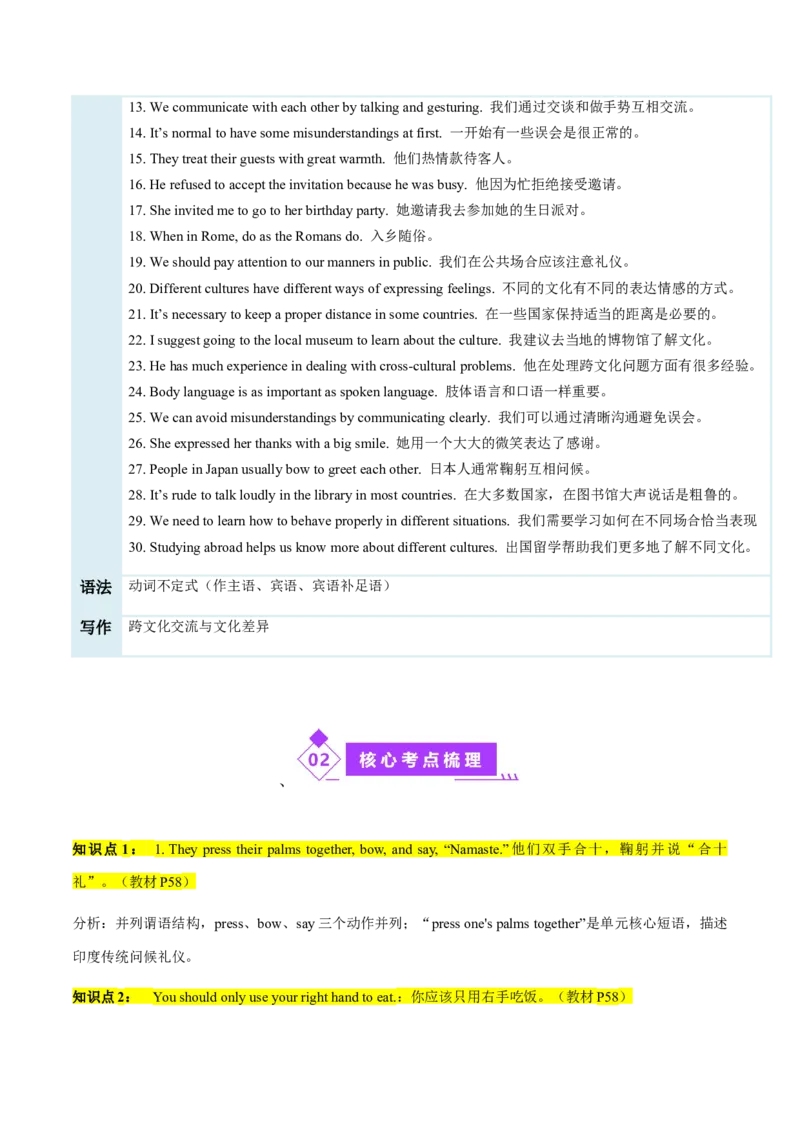
1. culture /ˈkʌltʃə(r)/ n. 文化;文明
2. cross /krɒs/ v. 穿过;越过;adj. 交叉的;跨文化的
3. greet /ɡriːt/ v. 问候;迎接
4. greeting /ˈɡriːtɪŋ/ n. 问候;招呼
5. custom /ˈkʌstəm/ n. 习俗;风俗
6. manner /ˈmænə(r)/ n. 方式;态度;(pl.) 礼仪,礼貌
7. polite /pəˈlaɪt/ adj. 有礼貌的;客气的
8. impolite /ˌɪmpəˈlaɪt/ adj. 不礼貌的;粗鲁的
9. direct /dəˈrekt/ adj. 直接的;直率的;v. 指挥;指导
10. avoid /əˈvɔɪd/ v. 避免;避开
11. subject /ˈsʌbdʒɪkt/ n. 话题;科目
12. conversation /ˌkɒnvəˈseɪʃn/ n. 交谈;谈话
13. private /ˈpraɪvət/ adj. 私人的;私密的
14. public /ˈpʌblɪk/ adj. 公共的;公开的;n. 公众
单词
15. behave /bɪˈheɪv/ v. 表现;举止
16. proper /ˈprɒpə(r)/ adj. 合适的;恰当的
17. basic /ˈbeɪsɪk/ adj. 基本的;基础的
18. express /ɪkˈspres/ v. 表达;表示
19. expression /ɪkˈspreʃn/ n. 表达;表情
20. gesture /ˈdʒestʃə(r)/ n. 手势;姿势;v. 做手势
21. smile /smaɪl/ v. & n. 微笑
22. nod /nɒd/ v. & n. 点头
23. shake /ʃeɪk/ v. (shook/shaken) 摇晃;握手
24. hug /hʌɡ/ v. & n. 拥抱
25. kiss /kɪs/ v. & n. 亲吻
26. bow /baʊ/ v. & n. 鞠躬;弯腰
27. personal /ˈpɜːsənl/ adj. 个人的;私人的
28. space /speɪs/ n. 空间;空地29. distance /ˈdɪstəns/ n. 距离;间距
30. touch /tʌtʃ/ v. 触摸;接触;n. 触碰
31. respect /rɪˈspekt/ v. & n. 尊重;尊敬
32. value /ˈvæljuː/ v. 重视;珍视;n. 价值
33. difference /ˈdɪfrəns/ n. 差异;不同
34. similar /ˈsɪmələ(r)/ adj. 相似的;类似的
35. common /ˈkɒmən/ adj. 共同的;常见的
36. local /ˈləʊkl/ adj. 当地的;本地的;n. 当地人
37. foreign /ˈfɒrən/ adj. 外国的;涉外的
38. foreigner /ˈfɒrənə(r)/ n. 外国人
39. visitor /ˈvɪzɪtə(r)/ n. 参观者;游客
40. guest /ɡest/ n. 客人;宾客
41. host /həʊst/ n. 主人;东道主;v. 主持
42. accept /əkˈsept/ v. 接受;承认
43. refuse /rɪˈfjuːz/ v. 拒绝;回绝
44. invite /ɪnˈvaɪt/ v. 邀请;招待
45. invitation /ˌɪnvɪˈteɪʃn/ n. 邀请;请柬
46. treat /triːt/ v. 对待;款待;n. 款待
47. understand /ˌʌndəˈstænd/ v. (understood/understood) 理解;明白
48. misunderstanding /ˌʌndəˈstændɪŋ/ n. 误解;误会
49. communicate /kəˈmjuːnɪkeɪt/ v. 交流;沟通
50. communication /kəˌmjuːnɪˈkeɪʃn/ n. 交流;沟通
51. clearly /ˈklɪəli/ adv. 清楚地;清晰地
52. mean /miːn/ v. (meant/meant) 意思是;打算
53. tip /tɪp/ n. 提示;技巧;小费
54. advice /ədˈvaɪs/ n. 建议;忠告(不可数)
55. suggest /səˈdʒest/ v. 建议;提议
56. suggestion /səˈdʒestʃən/ n. 建议;提议(可数)
57. experience /ɪkˈspɪəriəns/ n. 经历;经验;v. 体验
58. abroad /əˈbrɔːd/ adv. 在国外;到国外
59. normal /ˈnɔːml/ adj. 正常的;一般的;n. 常态
60. abroad /əˈbrɔːd/ adv. 在国外;到国外
61. fit /fɪt/ v. 适应;合身;adj. 健康的
1. cross cultures 跨文化
短语
2. cultural differences 文化差异3. greet sb. properly 恰当问候某人
4. basic manners 基本礼仪
5. be polite to sb. 对某人有礼貌
6. be impolite to do sth. 做某事不礼貌
7. avoid doing sth. 避免做某事
8. start a conversation 开启对话
9. private subject 私人话题
10. in public 当众;公开地
11. speak in a loud voice 大声说话
12. keep quiet 保持安静
13. behave well 表现良好
14. proper behavior 恰当的行为
15. express oneself clearly 清楚地表达自己
16. body language 肢体语言
17. shake hands 握手
18. hug sb. tightly 紧紧拥抱某人
19. kiss sb. on the cheek 亲吻某人的脸颊
20. bow to sb. 向某人鞠躬
21. nod one's head 点头
22. personal space 个人空间
23. keep a distance 保持距离
24. touch sb. by mistake 误触某人
25. show respect to sb. 向某人表示尊重
26. value the friendship 珍视友谊
27. be similar to 与……相似
28. have...in common 有……共同之处
29. local customs 当地风俗
30. foreign countries 外国
31. treat sb. warmly 热情款待某人
32. accept an invitation 接受邀请
33. refuse to do sth. 拒绝做某事
34. invite sb. to do sth. 邀请某人做某事
35. a formal invitation 正式的请柬
36. avoid misunderstandings 避免误解
37. communicate with sb. 与某人交流38. clear communication 清晰的沟通
39. the meaning of... ……的含义
40. give sb. some tips 给某人一些建议
41. offer advice 提供建议
42. suggest doing sth. 建议做某事
43. a useful suggestion 一条有用的建议
44. have experience in doing sth. 有做某事的经验
45. study abroad 出国留学
46. culture shock 文化冲击
47. get used to sth./doing sth. 习惯于某事/做某事
48. fit in with sb./sth. 融入……;适应……
49. take turns to do sth. 轮流做某事
50. follow the rules 遵守规则
51. make mistakes 犯错误
52. learn from mistakes 从错误中学习
53. talk about sth. 谈论某事
54. look into one's eyes 看着某人的眼睛
55. stand close to sb. 站得离某人近
56. in different situations 在不同的场合
57. a guest from abroad 一位外国来客
58. act as a host 担任主人
59. be important to sb. 对某人来说很重要
60. know about... 了解……
1. It’s polite to do sth. 做某事是有礼貌的。
2. It’s impolite to do sth. 做某事是不礼貌的。
3. We should avoid doing sth. 我们应该避免做某事。
4. It’s important to know about different cultural customs. 了解不同的文化习俗是很重要的。
5. People in different countries behave differently. 不同国家的人们行为方式不同。
6. They greet each other by shaking hands. 他们通过握手互相问候。
句型
7. He nodded his head to show his agreement. 他点头表示同意。
8. We should show respect to the local people. 我们应该尊重当地人。
9. It’s a good idea to learn about body language. 学习肢体语言是个好主意。
10. She is used to living in a foreign country. 她习惯了在国外生活。
11. I find it difficult to fit in with the new environment. 我发现适应新环境很难。
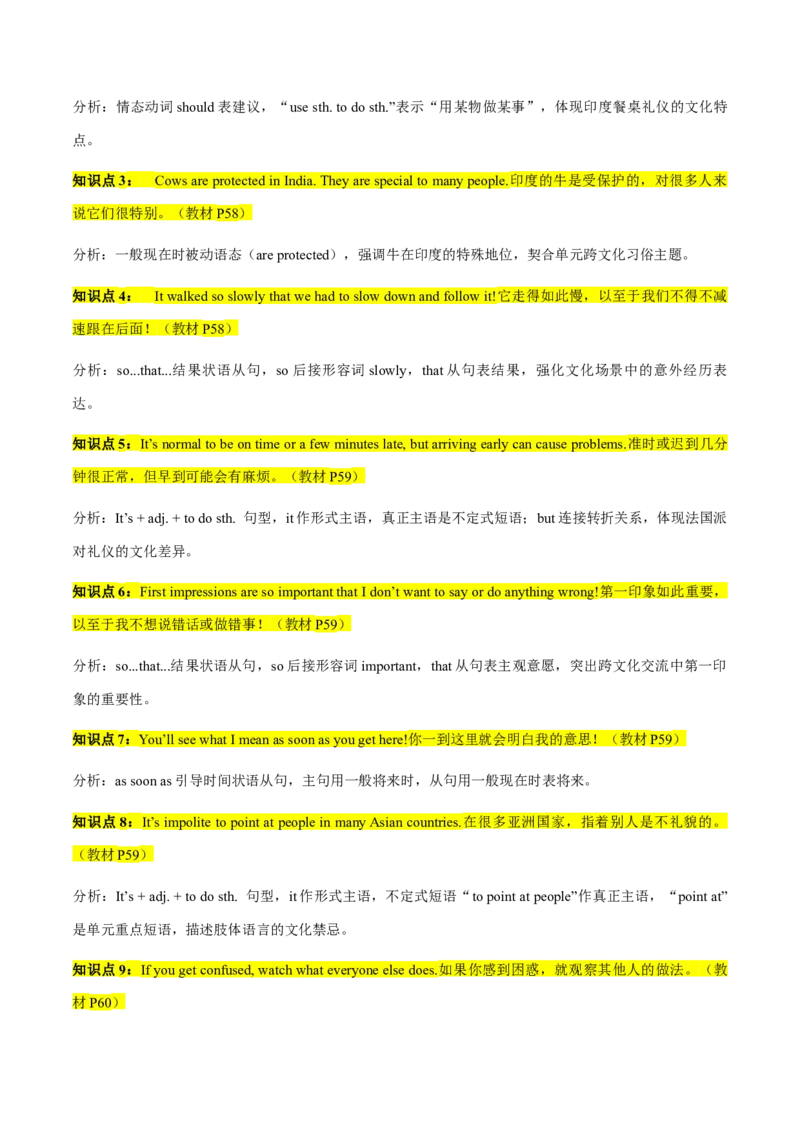
12. Could you give me some tips on cross-cultural communication? 你能给我一些跨文化交流的建议吗?13. We communicate with each other by talking and gesturing. 我们通过交谈和做手势互相交流。
14. It’s normal to have some misunderstandings at first. 一开始有一些误会是很正常的。
15. They treat their guests with great warmth. 他们热情款待客人。
16. He refused to accept the invitation because he was busy. 他因为忙拒绝接受邀请。
17. She invited me to go to her birthday party. 她邀请我去参加她的生日派对。
18. When in Rome, do as the Romans do. 入乡随俗。
19. We should pay attention to our manners in public. 我们在公共场合应该注意礼仪。
20. Different cultures have different ways of expressing feelings. 不同的文化有不同的表达情感的方式。
21. It’s necessary to keep a proper distance in some countries. 在一些国家保持适当的距离是必要的。
22. I suggest going to the local museum to learn about the culture. 我建议去当地的博物馆了解文化。
23. He has much experience in dealing with cross-cultural problems. 他在处理跨文化问题方面有很多经验。
24. Body language is as important as spoken language. 肢体语言和口语一样重要。
25. We can avoid misunderstandings by communicating clearly. 我们可以通过清晰沟通避免误会。
26. She expressed her thanks with a big smile. 她用一个大大的微笑表达了感谢。
27. People in Japan usually bow to greet each other. 日本人通常鞠躬互相问候。
28. It’s rude to talk loudly in the library in most countries. 在大多数国家,在图书馆大声说话是粗鲁的。
29. We need to learn how to behave properly in different situations. 我们需要学习如何在不同场合恰当表现
30. Studying abroad helps us know more about different cultures. 出国留学帮助我们更多地了解不同文化。
语法 动词不定式(作主语、宾语、宾语补足语)
写作 跨文化交流与文化差异
、
知识点 1: 1. They press their palms together, bow, and say, “Namaste.”他们双手合十,鞠躬并说“合十
礼”。(教材P58)
分析:并列谓语结构,press、bow、say三个动作并列;“press one's palms together”是单元核心短语,描述
印度传统问候礼仪。
知识点2: You should only use your right hand to eat.:你应该只用右手吃饭。(教材P58)分析:情态动词should表建议,“use sth. to do sth.”表示“用某物做某事”,体现印度餐桌礼仪的文化特
点。
知识点3: Cows are protected in India. They are special to many people.印度的牛是受保护的,对很多人来
说它们很特别。(教材P58)
分析:一般现在时被动语态(are protected),强调牛在印度的特殊地位,契合单元跨文化习俗主题。
知识点4: It walked so slowly that we had to slow down and follow it!它走得如此慢,以至于我们不得不减
速跟在后面!(教材P58)
分析:so...that...结果状语从句,so后接形容词slowly,that从句表结果,强化文化场景中的意外经历表
达。
知识点5:It’s normal to be on time or a few minutes late, but arriving early can cause problems.准时或迟到几分
钟很正常,但早到可能会有麻烦。(教材P59)
分析:It’s + adj. + to do sth. 句型,it作形式主语,真正主语是不定式短语;but连接转折关系,体现法国派
对礼仪的文化差异。
知识点6:First impressions are so important that I don’t want to say or do anything wrong!第一印象如此重要,
以至于我不想说错话或做错事!(教材P59)
分析:so...that...结果状语从句,so后接形容词important,that从句表主观意愿,突出跨文化交流中第一印
象的重要性。
知识点7:You’ll see what I mean as soon as you get here!你一到这里就会明白我的意思!(教材P59)
分析:as soon as引导时间状语从句,主句用一般将来时,从句用一般现在时表将来。
知识点8:It’s impolite to point at people in many Asian countries.在很多亚洲国家,指着别人是不礼貌的。
(教材P59)
分析:It’s + adj. + to do sth. 句型,it作形式主语,不定式短语“to point at people”作真正主语,“point at”
是单元重点短语,描述肢体语言的文化禁忌。
知识点9:If you get confused, watch what everyone else does.如果你感到困惑,就观察其他人的做法。(教
材P60)分析:if引导条件状语从句,主句为祈使句,“get confused”表示“感到困惑”,体现跨文化交流中的应对
技巧。
知识点10:When in Rome, do as the Romans do.入乡随俗。(教材P62)
分析:时间状语从句省略结构(When you are in Rome),as引导方式状语从句,是跨文化交流的核心谚
语,总结单元主题。
知识点11:Nancy was embarrassed when she arrived early at a French party—she didn’t know it’s normal to be a
few minutes late there.南希提前到法国派对时很尴尬,她不知道在那里迟到几分钟是正常的。(教材P62)
分析:when引导时间状语从句,破折号后补充说明原因;“it’s normal to do sth.”再次强化单元重点句型,
体现文化差异导致的误会。
知识点12: Once I was used to it, I became more curious and interested in learning about the culture there.一旦
我习惯了,就对了解那里的文化更感兴趣了。(教材P62)
分析:once引导条件状语从句,“be used to sth.”表示“习惯某物”,描述跨文化适应过程,契合单元“文
化理解”主题。
单元语法
动词不定式(作主语/宾语/宾语补足语)
1. 动词不定式作主语
基本结构:It + be + 形容词 + (for sb.) + to do sth.(it作形式主语,真正主语是后面的to do)
单元高频例句:
① It’s polite to greet others with a smile. 微笑问候他人是有礼貌的。
② It’s important for us to learn about cultural differences. 了解文化差异对我们来说很重要。
拓展:To do sth. + be + 名词/形容词(直接作主语,多用于正式表达)
→ To behave properly in public is a basic skill. 在公共场合举止得体是一项基本技能。
2. 动词不定式作宾语
直接接to do作宾语的单元核心动词:want, hope, learn, need, try, refuse, invite, decide, plan
例句:
① We need to avoid making mistakes in cross-cultural communication. 我们需要避免在跨文化交流中犯
错。
② She refused to accept the invitation from the foreign friend. 她拒绝接受外国朋友的邀请。
特殊结构:find it + 形容词 + to do sth.(it作形式宾语,to do作真正宾语)
→ I find it difficult to get used to local customs quickly. 我发现很难快速适应当地风俗。
3. 动词不定式作宾语补足语
基本结构:主语 + 谓语动词 + sb. + to do sth.
单元高频接带to宾补的动词:ask, tell, want, invite, teach, advise
例句:
① Our teacher tells us to show respect to everyone. 老师告诉我们要尊重每一个人。
② He advised me to learn some body language. 他建议我学一些肢体语言。
4. 省略to的动词不定式(使役/感官动词后)
核心动词:let, make, have(使役);see, watch, hear(感官)
结构:主语 + 使役/感官动词 + sb. + do sth.(主动语态省to,被动语态要还原to)
例句:
① The host made us feel at home. 主人让我们感觉宾至如归。(主动,省to)
② We were made to follow the local rules. 我们被要求遵守当地规则。(被动,还原to)
单元写作
单元核心主题“跨文化交流”,结合重点句型、短语和语法,以下有3条差异化作文思路,每条思路
包含主题定位、结构框架、素材方向和亮点表达,
思路一:个人跨文化经历类(叙事型)主题定位:讲述一次真实或虚构的跨文化接触经历(如接待外国友人、出国旅行、线上跨文化交流
等),突出文化差异与理解过程。
结构框架
1. 开头(引入场景):用过去时交代时间、地点和人物,点明跨文化接触的背景。
例:Last summer, my family hosted a foreign exchange student named Lisa from the US. It was my first time
getting close to a person from a different culture, and I was both excited and nervous.
2. 中间(描述差异与冲突):选取1-2个具体场景(如问候方式、餐桌礼仪、交流习惯),对比文化
差异,可加入小误会或困惑。
场景 1(问候礼仪):Lisa wanted to hug me when we met, but I felt embarrassed because we Chinese
usually shake hands or nod to greet others.
场景2(话题选择):She asked about my parents’ income directly, which made me uncomfortable—later I
learned that personal topics are not taboo in her country.
3. 结尾(感悟与收获):说明如何化解误会、理解差异,总结跨文化交流的意义。
例:Through talking with Lisa, I realized that cultural differences are not barriers but bridges to learn from
each other. We should respect different customs and communicate openly to avoid misunderstandings.
思路二:跨文化礼仪建议类(说明型)
主题定位:针对“如何进行得体的跨文化交流”提出建议,结合单元重点礼仪知识,体现对不同文化
的了解。
结构框架
1. 开头(点明重要性):用It’s important/necessary to...句型引出主题,说明跨文化礼仪的重要性。
例:With the development of globalization, cross-cultural communication is becoming more and more
common. It’s necessary to learn about different cultural customs to behave properly and show respect to others.
2. 中间(分点提建议):选取3-4个核心礼仪点(如问候方式、话题选择、肢体语言、餐桌礼仪),
每个建议配具体例子。
建议1(问候礼仪):Different countries have different greeting ways. People in Japan usually bow, whileWesterners often hug or kiss on the cheek. We should follow local customs to avoid making others uncomfortable.
建议 2(话题回避):We should avoid private subjects like age, income or marriage when talking with
foreigners. Instead, we can talk about hobbies, travel or culture.
建议 3(肢体语言):Body language is also important. For example, looking into others’ eyes shows
sincerity in some countries, but it may be considered rude in others.
3. 结尾(总结升华):强调“入乡随俗”的理念,呼吁尊重文化多样性。
例:In short, “When in Rome, do as the Romans do.” Respecting cultural differences is the key to successful
cross-cultural communication. Only by understanding and accepting different customs can we build better
relationships with people from all over the world.
思路三:文化差异对比类(议论型)
主题定位:对比中外某一具体文化领域(如礼仪、节日、交流方式)的差异,分析背后的原因,表达
对文化多样性的看法。
结构框架
1. 开头(提出主题):明确对比的文化领域,引出差异的存在。
例:There are many differences between Chinese and Western cultures, and greeting customs are one of the
most obvious ones. These differences reflect different cultural values and ways of thinking.
2. 中间(对比差异+分析原因):先具体描述差异,再简要分析差异产生的原因(如历史、价值观、
生活方式)。
差异描述:Chinese people usually greet each other with “Have you eaten?” or “Where are you going?”,
which shows care and kindness. However, Westerners often say “Hello” or “How are you?” to keep a proper
distance.
原因分析:The difference comes from different values. Chinese culture emphasizes group harmony and close
relationships, while Western culture values personal space and independence.
3. 结尾(表达观点):说明文化差异无优劣之分,应相互尊重、相互学习。
例:Every culture has its own characteristics, and there is no right or wrong. We should not judge othercultures by our own standards. Instead, we should learn from each other’s strengths and promote cultural exchange.
This is the true meaning of crossing cultures.
巩固练习
一、单项选择
1.—Alice, I wonder ________ you won the tug-of-war (拔河比赛) yesterday.
—Yeah! We pulled together and made it in the end.
A.though B.whether C.unless D.until
2.—Does the color red mean good things in Chinese culture?
—Yes. But writing one’s name in red is not good, and we usually ________ it.
A.allow B.advise C.avoid D.achieve
3.The students were ________ when their teacher showed them an ________ science experiment.
A.excited; excited B.exciting; exciting
C.excited; exciting D.exciting; excited
4.It’s ________ to use your mobile phone while crossing the street.
A.unfriendly B.unsafe C.unhealthy D.untidy
5.You need to wear ________ clothes for the job interview.
A.uncommon B.formal C.simple D.dirty
6.Tea is one of the most important symbols of Chinese ________.
A.competition B.comedy C.result D.culture
7.—Do you usually check your phone after waking up?
—Yeah, I’ll take a look at the messages ________ I open my eyes.
A.so that B.even though C.as soon as D.as long as
8.The game won’t start ________ everyone is ready.A.if B.because C.unless D.so
9.The city Nanchang is ________ popular ________ many people want to go there for a trip this year.
A.so; that B.such; that C.too; to D.very; that
10.The doctors were ________ busy ________ they had no time to rest.
A.such; that B.so; that C.too; to D.too; that
二、根据要求完成单词拼写
11.It’s (proper) to interrupt someone while they’re speaking.
12.If you want to succeed, (first), you must believe in yourself.
13.The desert in the (Asia) country is about 330 thousand square kilometers.
14.We have a lot of (tradition) festivals in China.
15.The lady looked at her baby son and couldn’t help (kiss) him on the face.
16.She s (摇动) the box to make sure there was nothing inside.
17.For your own safety, never answer the door u (除非) parents tell you to.
18.Giving is r (收到). We should be kind to others and help others in our life.
19.You can see many traffic signs along the m (主要的) road.
20.They shook hands and c (祝贺) each other on their excellent teamwork.
三、完形填空
Crossing cultures is an exciting journey that allows us to explore new worlds, meet different people, and gain
unique experiences. However, it also requires an open mind and basic knowledge of cultural differences to avoid
misunderstandings.
First, it’s necessary to learn about the 21 of the destination culture. Every culture has its own set of
customs, values, and behaviors. For example, in some Middle Eastern countries, it’s polite to decline an offer three
times before accepting it, while in Western countries, direct acceptance is more 22 . Knowing these
details can help us behave appropriately and show respect.Second, paying attention to body language is crucial. Body language varies greatly across cultures. A gesture
that is friendly in one culture may be 23 in another. For instance, nodding the head means “yes” in most
countries, but it means “no” in Bulgaria. We should observe and learn from the local people to avoid sending wrong
signals.
Third, having a respectful attitude is essential. We should not judge other cultures by our own standards.
Instead, we should try to understand the reasons behind their customs and traditions. Even if we don’t agree with
certain practices, we should 24 them as part of a different way of life.
Fourth, learning the local language can make a big difference. Even a few basic words like “hello”, “thank
you”, and “sorry” can break the ice and show our willingness to communicate. It also helps us 25 with
local people more deeply and experience the culture from a closer perspective.
However, even with careful preparation, we may still encounter unexpected cultural shocks. That’s why it’s
important to stay 26 and flexible. When facing misunderstandings, we should remain calm, ask for
clarification, and learn from the experience. Panic or anger will only make the situation worse.
In fact, cultural differences are not barriers but bridges that connect people from different backgrounds. By
embracing these differences, we can broaden our horizons and develop a more global perspective. 27 we
keep learning and respecting other cultures, we will be able to build better relationships with people around the
world.
Remember, every culture is unique and valuable. There is no “superior” or “inferior” culture. As we cross
cultures, we should 28 the beauty of diversity and carry forward the spirit of mutual understanding and
respect. This not only enriches our own lives but also contributes to a more harmonious world.
Crossing cultures is also a process of self-discovery. It challenges our existing beliefs and teaches us to be
more tolerant and 29 . Through this journey, we learn not only about others but also about ourselves.
In a word, crossing cultures is a rewarding experience that requires preparation, respect, and an open heart.
30 we approach it with the right attitude, we will gain unforgettable memories and valuable life lessons.
21.A.characteristic B.characteristics C.character D.characters
22.A.accept B.accepted C.accepting D.acceptable23.A.offensive B.hostile C.friendly D.politely
24.A.respect B.respects C.respected D.respecting
25.A.communicate B.communicates C.communicated D.communicating
26.A.calm B.calmly C.nervous D.nervously
27.A.If B.Unless C.Though D.Because
28.A.appreciate B.appreciates C.appreciated D.appreciating
29.A.understanding B.understand C.understood D.understandable
30.A.As long as B.As soon as C.Even if D.In order that
四、阅读理解
A
Avoid giving certain flowers in Russia
Be careful when giving flowers to your friends or business partners in Russia. Yellow flowers mean tricks or a
relationship break-up. No red carnations (康乃馨), either. Traditionally, red carnations have something to do with
death.
Don’t show up on time in Venezuela
Here’s one place. Being early or on time is viewed as being rude (粗鲁的) there.
In Venezuela, if you are invited to someone’s home for a meal, it’s suggested that you arrive 10 to 15 minutes later
than the requested time. Guests who arrive early or on time are viewed as being too eager (急切的).Always use a knife and fork in Norway
In Norway, table manners are quite important. Most food, including sandwiches, is eaten using utensils like knives
and forks.
Skip the bill in Turkey
When you’re doing business in Turkey, it’s the custom for your host to pay for your meal.
A request that you split (平摊) the bill will be viewed as a polite way, but won’t be accepted. If you would like to
pay your share, Turks suggest inviting your host to a follow-up meal.
31.What flowers can be given at a wedding in Russia?
①Pink roses. ②Red carnations.
③Purple flowers. ④Yellow flowers.
A.①② B.①③ C.①④ D.②④
32.If someone invites you to his home at 9 a.m. in Venezuela, which is a good time to arrive?
A. B. C. D.
33.According to the text, which country values table manners greatly?
A.Russia. B.Venezuela. C.Norway. D.Turkey.
34.When a man wants to pay for a whole meal for you in Turkey, what should you do?
A.Pay it all instead. B.Ask for a share of the bill.
C.Invite him for another meal. D.Invite him to your home.
35.Which part of a magazine does the text probably come from?A.Health. B.Culture. C.Education. D.Sports.
B
①As more and more people travel around the world, it is necessary (必要的) for them to know what to do in
different countries and how to deal with cultural differences. Here are different cultures from three countries.
②Canadians are easy to get along with and they usually say hello to each other even if they are strangers. When
men and women meet, women usually hold out their hands first. If a woman doesn’t want to shake hands, she can
just nod and smile. If a man wears gloves, he should take them off before shaking hands.
③Brazilians are very friendly and they always get ready to say hello to others. They stand very close to each
other when speaking and may touch each other’s arms or backs. And if you go to a business meeting in Brazil, you
are not expected to take a present.
④When you meet Indians, it is important to say hello to the oldest person first. But you’d better not hold out
your left hand when you say hello, because it is impolite. Also, many Indians are enthusiastic and they like to say
hello actively and have a conversation with you when you travel in India.
⑤Customs in different countries are like different flowers, forming a beautiful garden together. Learning to
respect others’ ways is like giving a friendly smile. It can bring people’s hearts closer.
36.What will Canadian women do if they don’t want to shake hands?
A.Say hello to others. B.Nod and smile.
C.Touch others’ arms. D.Wear a pair of gloves.
37.Match the countries with the customs and choose the right answer.
①India ②Canada ③Brazil
a. Men take off gloves before shaking hands.
b. People stand very close when speaking.
c. Greet the oldest person first.
A.①-c; ②-b; ③-a B.①-b; ②-c; ③-aC.①-c; ②-a; ③-b D.①-a; ②-c; ③-b
38.What does the underlined word “enthusiastic” mean?
A.Polite. B.Shy. C.Rude. D.Warm.
39.What can we learn from the passage?
A.Women in India usually hold out their hands first.
B.Men in India usually hold out their left hands to say hello.
C.People in Brazil don’t often touch each other when speaking.
D.People in Brazil needn’t take a gift to a business meeting.
40.What’s the structure of the passage?
A. B. C. D.
五、短文填空
阅读短文,在空白处填入一个适当的单词或用括号内所给词的正确形式填空,使短文通顺、连贯。
Lin is my new friend. She is from China while I am from Canada. Yesterday, she asked me to have dinner at
her house on time. And I promised 41 (be) at her house on time. Today, the traffic was heavy, but luckily
I was not late 42 dinner. After Lin opened the door for me, we greeted each other by 43 (kiss)
on the face. When I went into the house, I saw 44 old dinner table. It was full of dishes. During the meal,
I found that they ate 45 (quiet). Lin told me it’s 46 (proper) to make noise when eating soup
with spoons during the meal. Later, she showed me how to use 47 (chopstick). I tried many times.
Finally I picked up a piece of chicken on my 48 (five) try! I felt excited! I really enjoyed thanking Lin
for teaching me about Chinese table 49 (manner) and offering me such delicious Chinese food! The
dinner is important to me 50 it makes me know more about Chinese culture.六、书面表达
51.假设你是李华,这学期你们班来了几位外国同学,他们对中国的餐桌礼仪及饮食文化很感兴趣。
请你根据以下提示内容,用英语写一篇短文,向他们介绍相关情况。
内容包括:
1. 一日几餐以及用餐器具;
2. 餐食的具体内容;
3. 中国的餐桌礼仪。
要求:
1. 参考提示内容,可适当发挥;2. 语句通顺,意思连贯,书写工整;3. 文中不得出现任何真实信息(姓
名、校名和地名等);4. 词数 80—100(开头已给出,但不计入总词数)。
Meals in China are different from the ones in the West.
___________________________________________
____________________________________________________________________________________________
____________________________________________________________________________________________
____________________________________________________________________________________________
____________________________________________________________________________________________
____________________________________________________________________________________________
____________________________________________________________________________________________
____________________________________________________________________________________________
____________________________________________________________________________________________