文档文本内容
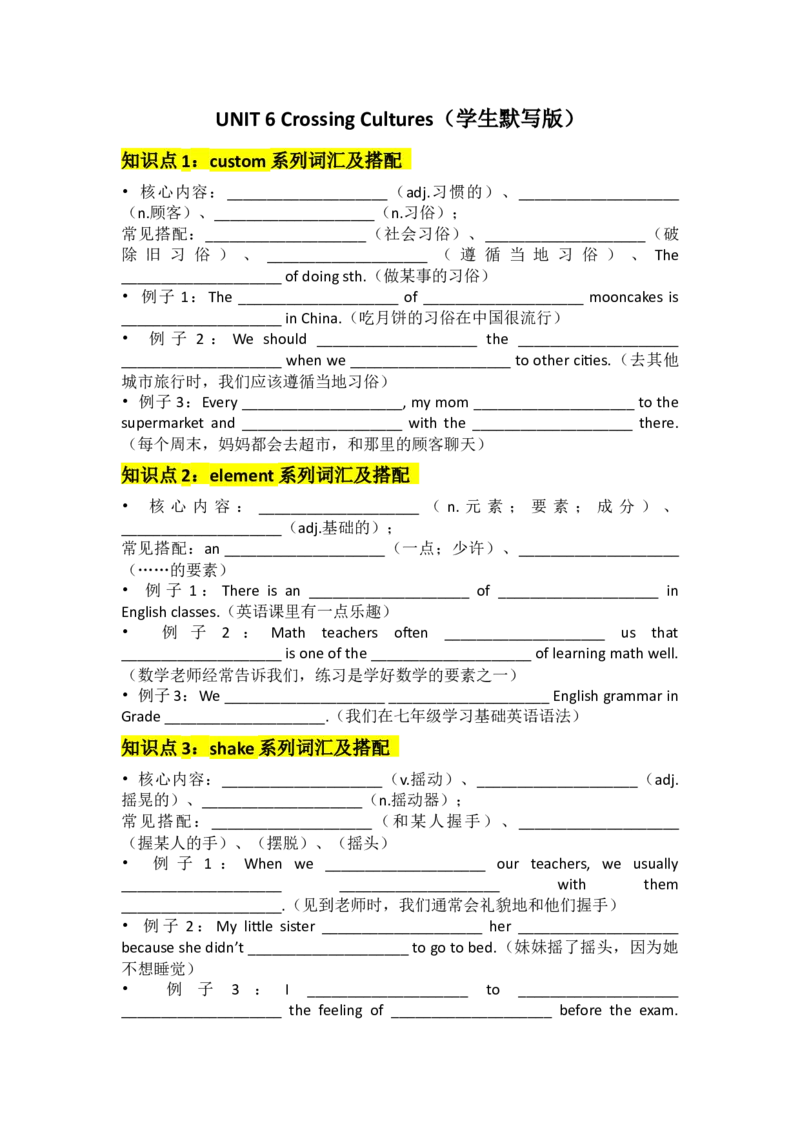
UNIT 6 Crossing Cultures(学生默写版)
知识点1:custom系列词汇及搭配
• 核心内容:____________________(adj.习惯的)、____________________
(n.顾客)、____________________(n.习俗);
常见搭配:____________________(社会习俗)、____________________(破
除 旧 习 俗 ) 、 ____________________ ( 遵 循 当 地 习 俗 ) 、 The
____________________ of doing sth.(做某事的习俗)
• 例子 1:The ____________________ of ____________________ mooncakes is
____________________ in China.(吃月饼的习俗在中国很流行)
• 例 子 2 : We should ____________________ the ____________________
____________________ when we ____________________ to other cities.(去其他
城市旅行时,我们应该遵循当地习俗)
• 例子 3:Every ____________________, my mom ____________________ to the
supermarket and ____________________ with the ____________________ there.
(每个周末,妈妈都会去超市,和那里的顾客聊天)
知识点2:element系列词汇及搭配
• 核 心 内 容 : ____________________ ( n. 元 素 ; 要 素 ; 成 分 ) 、
____________________(adj.基础的);
常见搭配:an ____________________(一点;少许)、____________________
(……的要素)
• 例 子 1 : There is an ____________________ of ____________________ in
English classes.(英语课里有一点乐趣)
• 例 子 2 : Math teachers often ____________________ us that
____________________ is one of the ____________________ of learning math well.
(数学老师经常告诉我们,练习是学好数学的要素之一)
• 例子3:We ____________________ ____________________ English grammar in
Grade ____________________.(我们在七年级学习基础英语语法)
知识点3:shake系列词汇及搭配
• 核心内容:____________________(v.摇动)、____________________(adj.
摇晃的)、____________________(n.摇动器);
常见搭配:____________________(和某人握手)、____________________
(握某人的手)、(摆脱)、(摇头)
• 例 子 1 : When we ____________________ our teachers, we usually
____________________ ____________________ with them
____________________.(见到老师时,我们通常会礼貌地和他们握手)
• 例子 2:My little sister ____________________ her ____________________
because she didn’t ____________________ to go to bed.(妹妹摇了摇头,因为她
不想睡觉)
• 例 子 3 : I ____________________ to ____________________
____________________ the feeling of ____________________ before the exam.(考试前,我努力摆脱疲惫感)
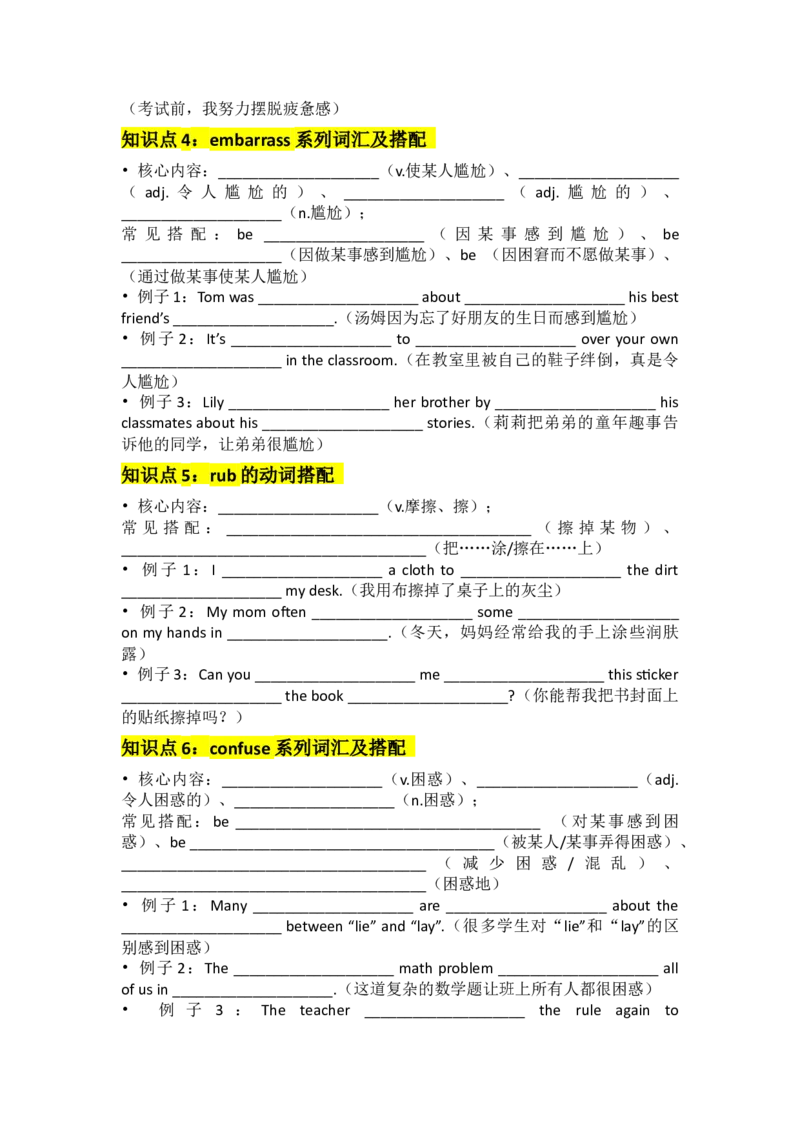
知识点4:embarrass系列词汇及搭配
• 核心内容:____________________(v.使某人尴尬)、____________________
( adj. 令 人 尴 尬 的 ) 、 ____________________ ( adj. 尴 尬 的 ) 、
____________________(n.尴尬);
常 见 搭 配 : be ____________________ ( 因 某 事 感 到 尴 尬 ) 、 be
____________________(因做某事感到尴尬)、be (因困窘而不愿做某事)、
(通过做某事使某人尴尬)
• 例子1:Tom was ____________________ about ____________________ his best
friend’s ____________________.(汤姆因为忘了好朋友的生日而感到尴尬)
• 例子 2:It’s ____________________ to ____________________ over your own
____________________ in the classroom.(在教室里被自己的鞋子绊倒,真是令
人尴尬)
• 例子 3:Lily ____________________ her brother by ____________________ his
classmates about his ____________________ stories.(莉莉把弟弟的童年趣事告
诉他的同学,让弟弟很尴尬)
知识点5:rub的动词搭配
• 核心内容:____________________(v.摩擦、擦);
常 见 搭 配 : ______________________________________ ( 擦 掉 某 物 ) 、
______________________________________(把……涂/擦在……上)
• 例子 1:I ____________________ a cloth to ____________________ the dirt
____________________ my desk.(我用布擦掉了桌子上的灰尘)
• 例子 2:My mom often ____________________ some ____________________
on my hands in ____________________.(冬天,妈妈经常给我的手上涂些润肤
露)
• 例子3:Can you ____________________ me ____________________ this sticker
____________________ the book ____________________?(你能帮我把书封面上
的贴纸擦掉吗?)
知识点6:confuse系列词汇及搭配
• 核心内容:____________________(v.困惑)、____________________(adj.
令人困惑的)、____________________(n.困惑);
常见搭配:be ______________________________________ (对某事感到困
惑)、be ______________________________________(被某人/某事弄得困惑)、
______________________________________ ( 减 少 困 惑 / 混 乱 ) 、
______________________________________(困惑地)
• 例子 1:Many ____________________ are ____________________ about the
____________________ between “lie” and “lay”.(很多学生对“lie”和“lay”的区
别感到困惑)
• 例子 2:The ____________________ math problem ____________________ all
of us in ____________________.(这道复杂的数学题让班上所有人都很困惑)
• 例 子 3 : The teacher ____________________ the rule again to____________________ ____________________ among students.(老师又解释了
一遍规则,以减少学生们的困惑)
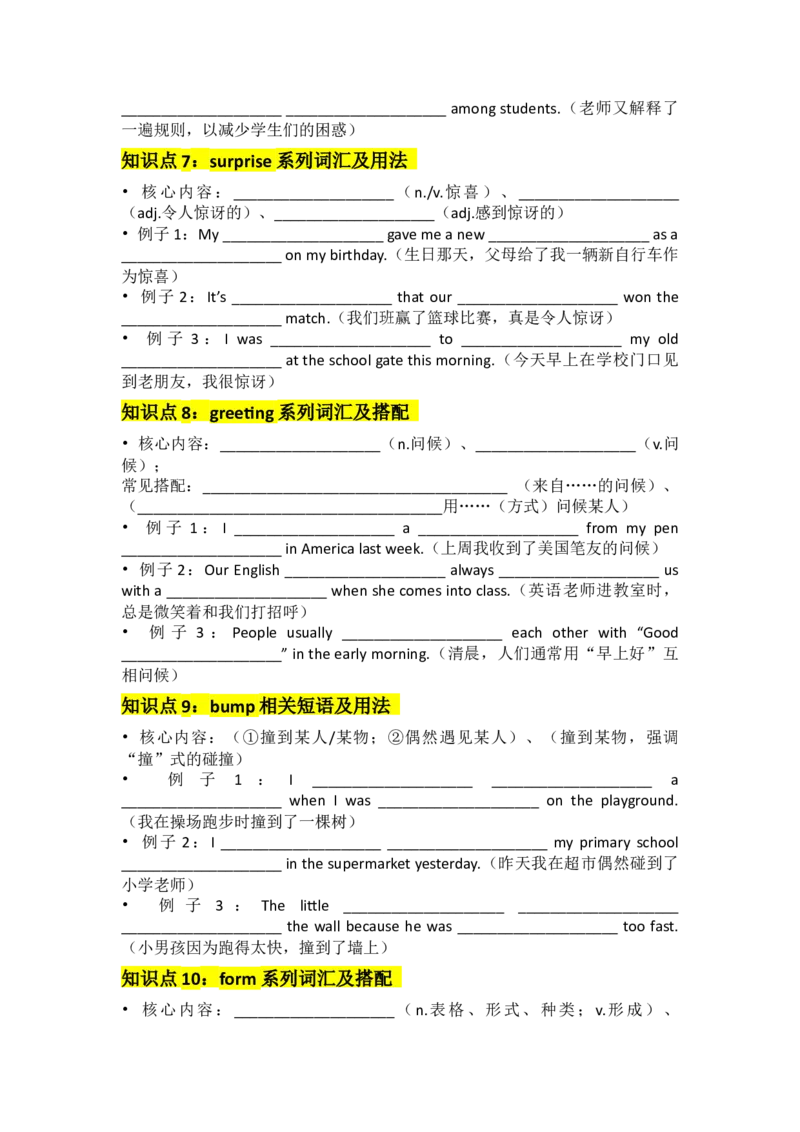
知识点7:surprise系列词汇及用法
• 核心内容:____________________(n./v.惊喜)、____________________
(adj.令人惊讶的)、____________________(adj.感到惊讶的)
• 例子1:My ____________________ gave me a new ____________________ as a
____________________ on my birthday.(生日那天,父母给了我一辆新自行车作
为惊喜)
• 例子 2:It’s ____________________ that our ____________________ won the
____________________ match.(我们班赢了篮球比赛,真是令人惊讶)
• 例 子 3 : I was ____________________ to ____________________ my old
____________________ at the school gate this morning.(今天早上在学校门口见
到老朋友,我很惊讶)
知识点8:greeting系列词汇及搭配
• 核心内容:____________________(n.问候)、____________________(v.问
候);
常见搭配:______________________________________ (来自……的问候)、
(______________________________________用……(方式)问候某人)
• 例 子 1 : I ____________________ a ____________________ from my pen
____________________ in America last week.(上周我收到了美国笔友的问候)
• 例子 2:Our English ____________________ always ____________________ us
with a ____________________ when she comes into class.(英语老师进教室时,
总是微笑着和我们打招呼)
• 例 子 3 : People usually ____________________ each other with “Good
____________________” in the early morning.(清晨,人们通常用“早上好”互
相问候)
知识点9:bump相关短语及用法
• 核心内容:(①撞到某人/某物;②偶然遇见某人)、(撞到某物,强调
“撞”式的碰撞)
• 例 子 1 : I ____________________ ____________________ a
____________________ when I was ____________________ on the playground.
(我在操场跑步时撞到了一棵树)
• 例子 2:I ____________________ ____________________ my primary school
____________________ in the supermarket yesterday.(昨天我在超市偶然碰到了
小学老师)
• 例 子 3 : The little ____________________ ____________________
____________________ the wall because he was ____________________ too fast.
(小男孩因为跑得太快,撞到了墙上)
知识点10:form系列词汇及搭配
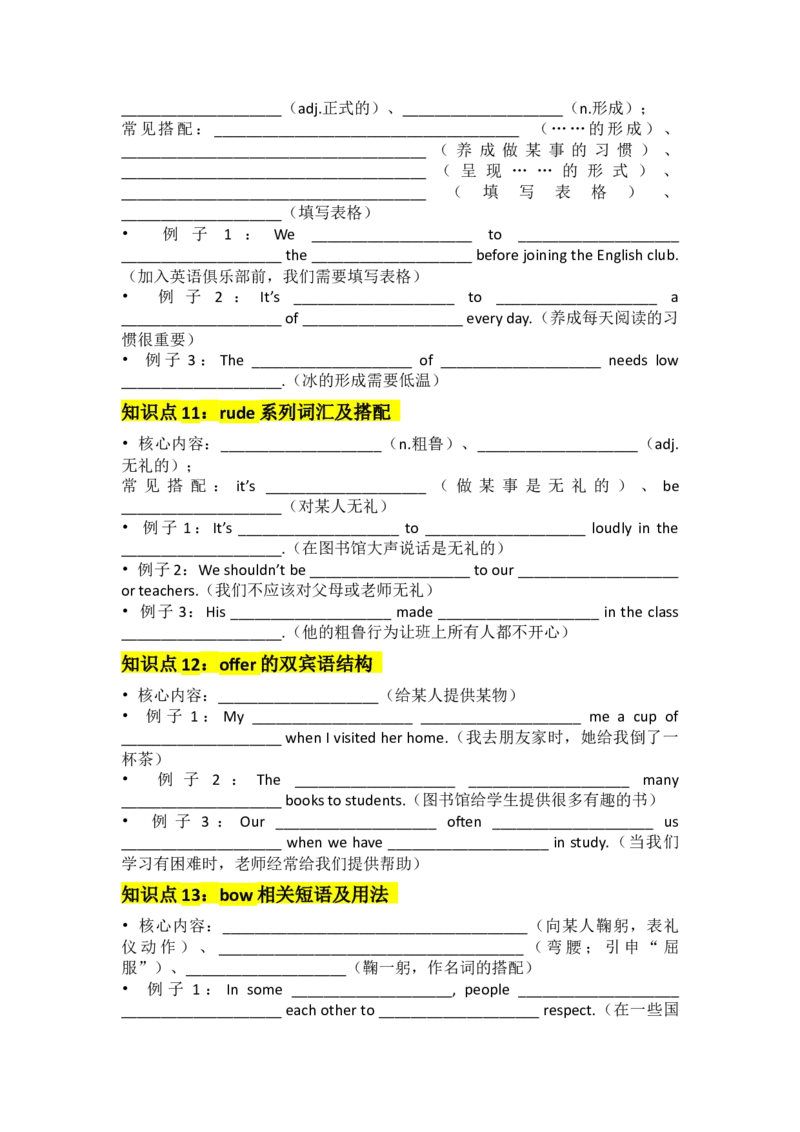
• 核心内容:____________________(n.表格、形式、种类;v.形成)、____________________(adj.正式的)、____________________(n.形成);
常见搭配:______________________________________ (……的形成)、
______________________________________ ( 养 成 做 某 事 的 习 惯 ) 、
______________________________________ ( 呈 现 … … 的 形 式 ) 、
______________________________________ ( 填 写 表 格 ) 、
____________________(填写表格)
• 例 子 1 : We ____________________ to ____________________
____________________ the ____________________ before joining the English club.
(加入英语俱乐部前,我们需要填写表格)
• 例 子 2 : It’s ____________________ to ____________________ a
____________________ of ____________________ every day.(养成每天阅读的习
惯很重要)
• 例子 3:The ____________________ of ____________________ needs low
____________________.(冰的形成需要低温)
知识点11:rude系列词汇及搭配
• 核心内容:____________________(n.粗鲁)、____________________(adj.
无礼的);
常 见 搭 配 : it’s ____________________ ( 做 某 事 是 无 礼 的 ) 、 be
____________________(对某人无礼)
• 例子 1:It’s ____________________ to ____________________ loudly in the
____________________.(在图书馆大声说话是无礼的)
• 例子2:We shouldn’t be ____________________ to our ____________________
or teachers.(我们不应该对父母或老师无礼)
• 例子 3:His ____________________ made ____________________ in the class
____________________.(他的粗鲁行为让班上所有人都不开心)
知识点12:offer的双宾语结构
• 核心内容:____________________(给某人提供某物)
• 例 子 1 : My ____________________ ____________________ me a cup of
____________________ when I visited her home.(我去朋友家时,她给我倒了一
杯茶)
• 例 子 2 : The ____________________ ____________________ many
____________________ books to students.(图书馆给学生提供很多有趣的书)
• 例 子 3 : Our ____________________ often ____________________ us
____________________ when we have ____________________ in study.(当我们
学习有困难时,老师经常给我们提供帮助)
知识点13:bow相关短语及用法
• 核心内容:______________________________________(向某人鞠躬,表礼
仪动作)、______________________________________(弯腰;引申“屈
服”)、____________________(鞠一躬,作名词的搭配)
• 例 子 1 : In some ____________________, people ____________________
____________________ each other to ____________________ respect.(在一些国家,人们互相鞠躬表示尊重)
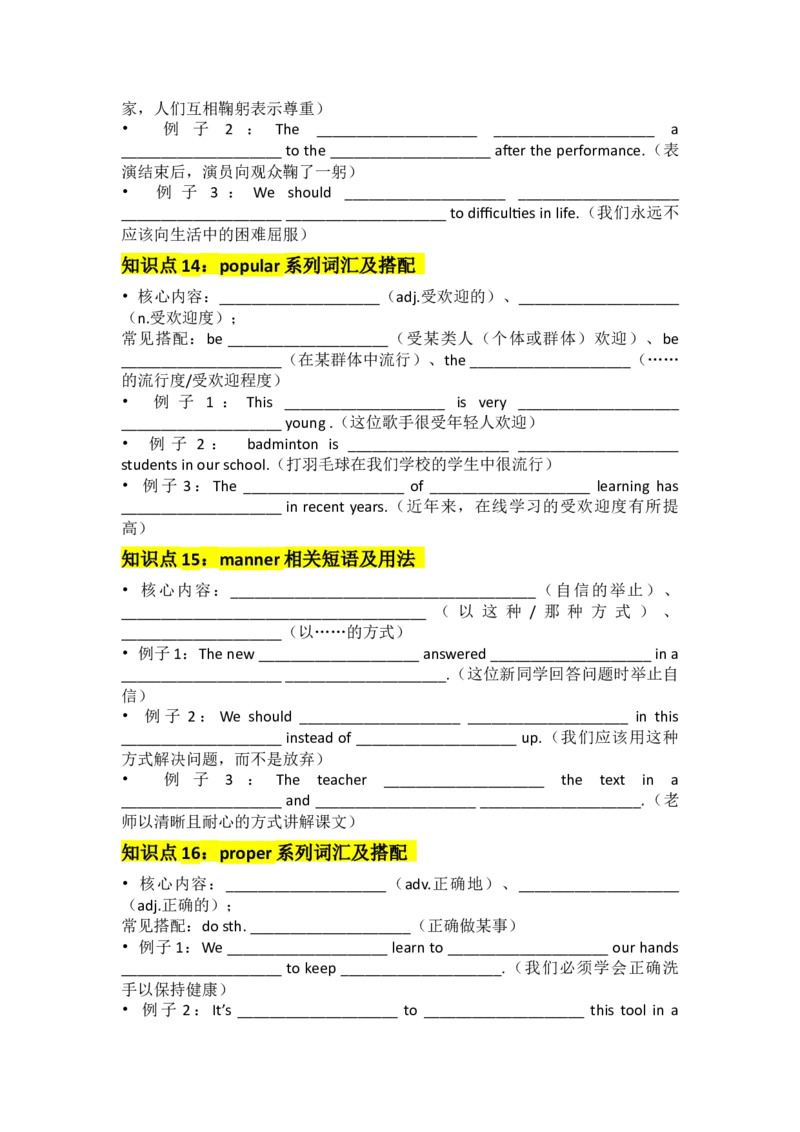
• 例 子 2 : The ____________________ ____________________ a
____________________ to the ____________________ after the performance.(表
演结束后,演员向观众鞠了一躬)
• 例 子 3 : We should ____________________ ____________________
____________________ ____________________ to difficulties in life.(我们永远不
应该向生活中的困难屈服)
知识点14:popular系列词汇及搭配
• 核心内容:____________________(adj.受欢迎的)、____________________
(n.受欢迎度);
常见搭配:be ____________________(受某类人(个体或群体)欢迎)、be
____________________(在某群体中流行)、the ____________________(……
的流行度/受欢迎程度)
• 例 子 1 : This ____________________ is very ____________________
____________________ young .(这位歌手很受年轻人欢迎)
• 例 子 2 : badminton is ____________________ ____________________
students in our school.(打羽毛球在我们学校的学生中很流行)
• 例子 3:The ____________________ of ____________________ learning has
____________________ in recent years.(近年来,在线学习的受欢迎度有所提
高)
知识点15:manner相关短语及用法
• 核心内容:______________________________________(自信的举止)、
______________________________________ ( 以 这 种 / 那 种 方 式 ) 、
____________________(以……的方式)
• 例子1:The new ____________________ answered ____________________ in a
____________________ ____________________.(这位新同学回答问题时举止自
信)
• 例子 2:We should ____________________ ____________________ in this
____________________ instead of ____________________ up.(我们应该用这种
方式解决问题,而不是放弃)
• 例 子 3 : The teacher ____________________ the text in a
____________________ and ____________________ ____________________.(老
师以清晰且耐心的方式讲解课文)
知识点16:proper系列词汇及搭配
• 核心内容:____________________(adv.正确地)、____________________
(adj.正确的);
常见搭配:do sth. ____________________(正确做某事)
• 例子1:We ____________________ learn to ____________________ our hands
____________________ to keep ____________________.(我们必须学会正确洗
手以保持健康)
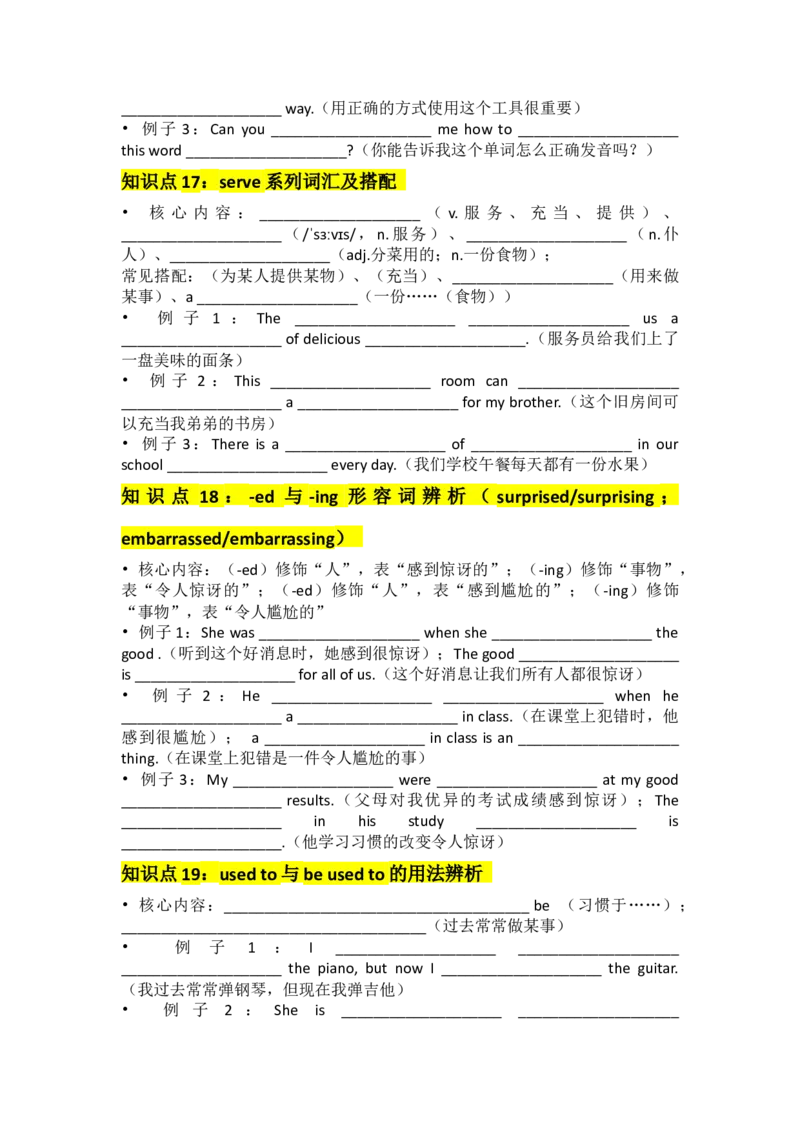
• 例子 2:It’s ____________________ to ____________________ this tool in a____________________ way.(用正确的方式使用这个工具很重要)
• 例子 3:Can you ____________________ me how to ____________________
this word ____________________?(你能告诉我这个单词怎么正确发音吗?)
知识点17:serve系列词汇及搭配
• 核 心 内 容 : ____________________ ( v. 服 务 、 充 当 、 提 供 ) 、
____________________(/ˈsɜːvɪs/,n.服务)、____________________(n.仆
人)、____________________(adj.分菜用的;n.一份食物);
常见搭配:(为某人提供某物)、(充当)、____________________(用来做
某事)、a ____________________(一份……(食物))
• 例 子 1 : The ____________________ ____________________ us a
____________________ of delicious ____________________.(服务员给我们上了
一盘美味的面条)
• 例 子 2 : This ____________________ room can ____________________
____________________ a ____________________ for my brother.(这个旧房间可
以充当我弟弟的书房)
• 例子 3:There is a ____________________ of ____________________ in our
school ____________________ every day.(我们学校午餐每天都有一份水果)
知 识 点 18 : -ed 与 -ing 形 容 词 辨 析 ( surprised/surprising ;
embarrassed/embarrassing)
• 核心内容:(-ed)修饰“人”,表“感到惊讶的”;(-ing)修饰“事物”,
表“令人惊讶的”;(-ed)修饰“人”,表“感到尴尬的”;(-ing)修饰
“事物”,表“令人尴尬的”
• 例子 1:She was ____________________ when she ____________________ the
good .(听到这个好消息时,她感到很惊讶);The good ____________________
is ____________________ for all of us.(这个好消息让我们所有人都很惊讶)
• 例 子 2 : He ____________________ ____________________ when he
____________________ a ____________________ in class.(在课堂上犯错时,他
感到很尴尬); a ____________________ in class is an ____________________
thing.(在课堂上犯错是一件令人尴尬的事)
• 例子 3:My ____________________ were ____________________ at my good
____________________ results.(父母对我优异的考试成绩感到惊讶);The
____________________ in his study ____________________ is
____________________.(他学习习惯的改变令人惊讶)
知识点19:used to与be used to的用法辨析
• 核心内容:______________________________________ be (习惯于……);
______________________________________(过去常常做某事)
• 例 子 1 : I ____________________ ____________________
____________________ the piano, but now I ____________________ the guitar.
(我过去常常弹钢琴,但现在我弹吉他)
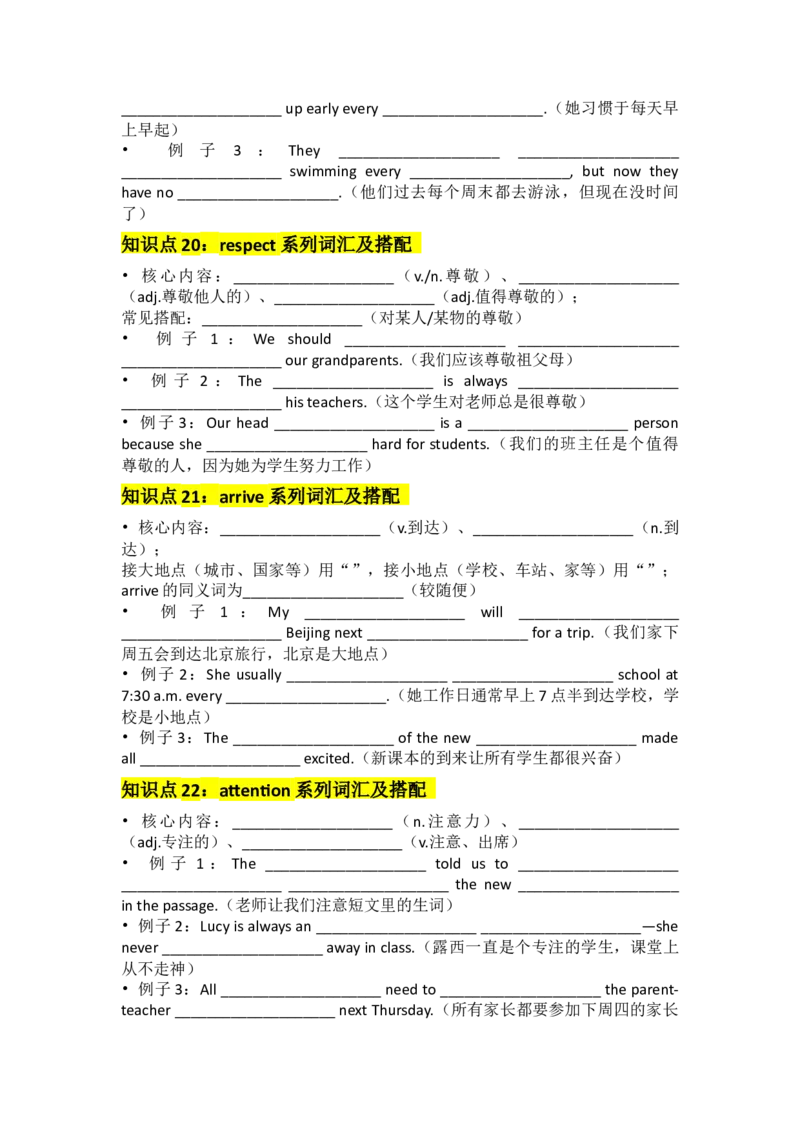
• 例 子 2 : She is ____________________ ________________________________________ up early every ____________________.(她习惯于每天早
上早起)
• 例 子 3 : They ____________________ ____________________
____________________ swimming every ____________________, but now they
have no ____________________.(他们过去每个周末都去游泳,但现在没时间
了)
知识点20:respect系列词汇及搭配
• 核心内容:____________________(v./n.尊敬)、____________________
(adj.尊敬他人的)、____________________(adj.值得尊敬的);
常见搭配:____________________(对某人/某物的尊敬)
• 例 子 1 : We should ____________________ ____________________
____________________ our grandparents.(我们应该尊敬祖父母)
• 例 子 2 : The ____________________ is always ____________________
____________________ his teachers.(这个学生对老师总是很尊敬)
• 例子 3:Our head ____________________ is a ____________________ person
because she ____________________ hard for students.(我们的班主任是个值得
尊敬的人,因为她为学生努力工作)
知识点21:arrive系列词汇及搭配
• 核心内容:____________________(v.到达)、____________________(n.到
达);
接大地点(城市、国家等)用“”,接小地点(学校、车站、家等)用“”;
arrive的同义词为____________________(较随便)
• 例 子 1 : My ____________________ will ____________________
____________________ Beijing next ____________________ for a trip.(我们家下
周五会到达北京旅行,北京是大地点)
• 例子 2:She usually ____________________ ____________________ school at
7:30 a.m. every ____________________.(她工作日通常早上7点半到达学校,学
校是小地点)
• 例子 3:The ____________________ of the new ____________________ made
all ____________________ excited.(新课本的到来让所有学生都很兴奋)
知识点22:attention系列词汇及搭配
• 核心内容:____________________(n.注意力)、____________________
(adj.专注的)、____________________(v.注意、出席)
• 例 子 1 : The ____________________ told us to ____________________
____________________ ____________________ the new ____________________
in the passage.(老师让我们注意短文里的生词)
• 例子2:Lucy is always an ____________________ ____________________—she
never ____________________ away in class.(露西一直是个专注的学生,课堂上
从不走神)
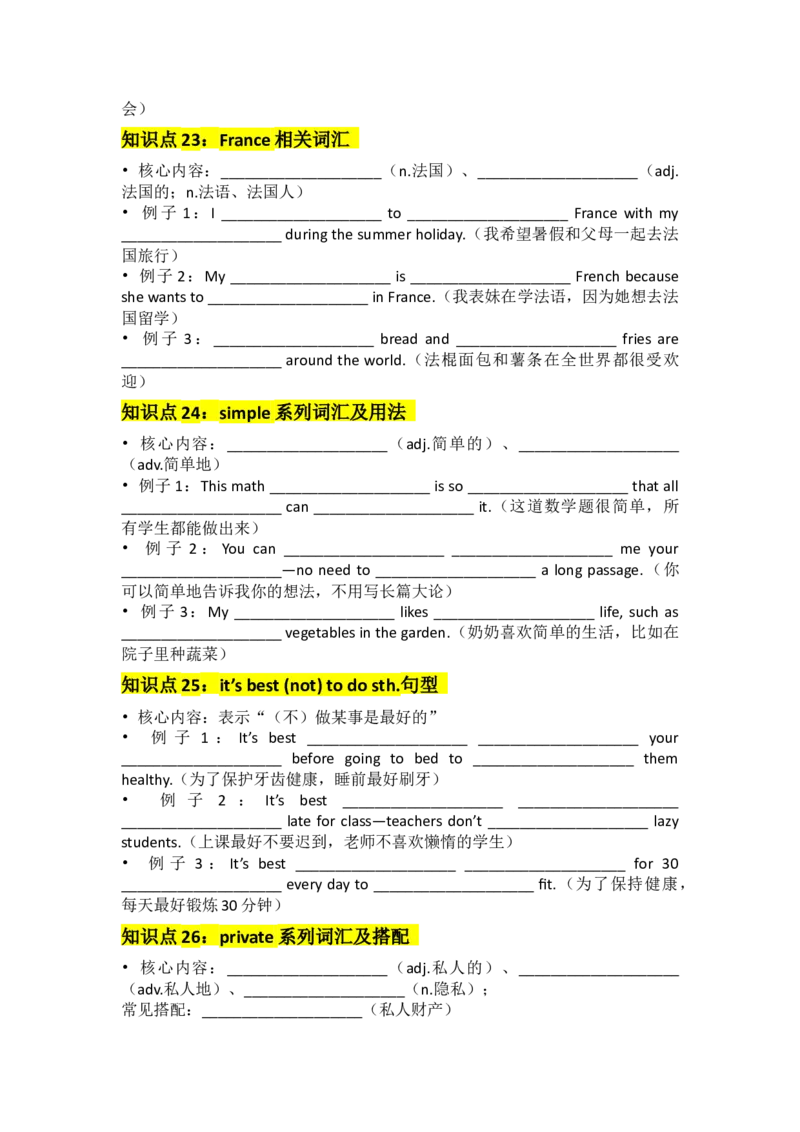
• 例子3:All ____________________ need to ____________________ the parent-
teacher ____________________ next Thursday.(所有家长都要参加下周四的家长会)
知识点23:France相关词汇
• 核心内容:____________________(n.法国)、____________________(adj.
法国的;n.法语、法国人)
• 例子 1:I ____________________ to ____________________ France with my
____________________ during the summer holiday.(我希望暑假和父母一起去法
国旅行)
• 例子 2:My ____________________ is ____________________ French because
she wants to ____________________ in France.(我表妹在学法语,因为她想去法
国留学)
• 例子 3:____________________ bread and ____________________ fries are
____________________ around the world.(法棍面包和薯条在全世界都很受欢
迎)
知识点24:simple系列词汇及用法
• 核心内容:____________________(adj.简单的)、____________________
(adv.简单地)
• 例子1:This math ____________________ is so ____________________ that all
____________________ can ____________________ it.(这道数学题很简单,所
有学生都能做出来)
• 例 子 2 : You can ____________________ ____________________ me your
____________________—no need to ____________________ a long passage.(你
可以简单地告诉我你的想法,不用写长篇大论)
• 例子 3:My ____________________ likes ____________________ life, such as
____________________ vegetables in the garden.(奶奶喜欢简单的生活,比如在
院子里种蔬菜)
知识点25:it’s best (not) to do sth.句型
• 核心内容:表示“(不)做某事是最好的”
• 例 子 1 : It’s best ____________________ ____________________ your
____________________ before going to bed to ____________________ them
healthy.(为了保护牙齿健康,睡前最好刷牙)
• 例 子 2 : It’s best ____________________ ____________________
____________________ late for class—teachers don’t ____________________ lazy
students.(上课最好不要迟到,老师不喜欢懒惰的学生)
• 例 子 3 : It’s best ____________________ ____________________ for 30
____________________ every day to ____________________ fit.(为了保持健康,
每天最好锻炼30分钟)
知识点26:private系列词汇及搭配
• 核心内容:____________________(adj.私人的)、____________________
(adv.私人地)、____________________(n.隐私);
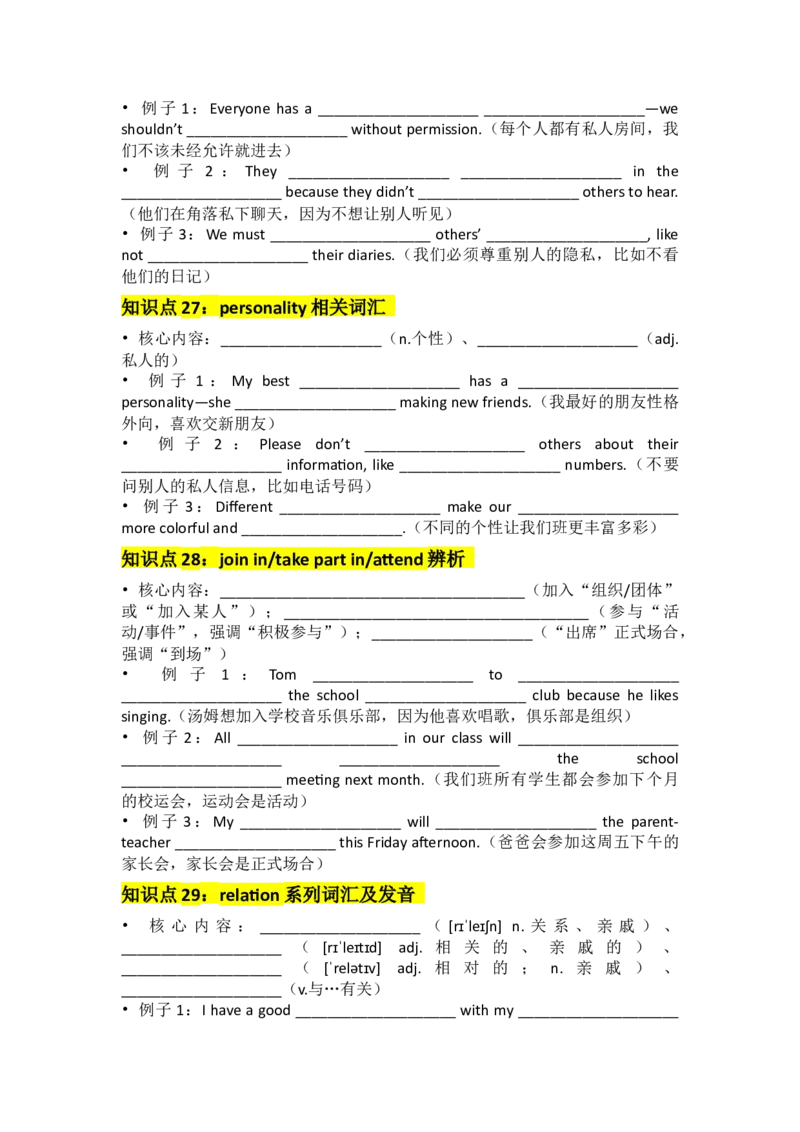
常见搭配:____________________(私人财产)• 例子 1:Everyone has a ____________________ ____________________—we
shouldn’t ____________________ without permission.(每个人都有私人房间,我
们不该未经允许就进去)
• 例 子 2 : They ____________________ ____________________ in the
____________________ because they didn’t ____________________ others to hear.
(他们在角落私下聊天,因为不想让别人听见)
• 例子 3:We must ____________________ others’ ____________________, like
not ____________________ their diaries.(我们必须尊重别人的隐私,比如不看
他们的日记)
知识点27:personality相关词汇
• 核心内容:____________________(n.个性)、____________________(adj.
私人的)
• 例 子 1 : My best ____________________ has a ____________________
personality—she ____________________ making new friends.(我最好的朋友性格
外向,喜欢交新朋友)
• 例 子 2 : Please don’t ____________________ others about their
____________________ information, like ____________________ numbers.(不要
问别人的私人信息,比如电话号码)
• 例子 3:Different ____________________ make our ____________________
more colorful and ____________________.(不同的个性让我们班更丰富多彩)
知识点28:join in/take part in/attend辨析
• 核心内容:______________________________________(加入“组织/团体”
或“加入某人”);______________________________________(参与“活
动/事件”,强调“积极参与”);____________________(“出席”正式场合,
强调“到场”)
• 例 子 1 : Tom ____________________ to ____________________
____________________ the school ____________________ club because he likes
singing.(汤姆想加入学校音乐俱乐部,因为他喜欢唱歌,俱乐部是组织)
• 例子 2:All ____________________ in our class will ____________________
____________________ ____________________ the school
____________________ meeting next month.(我们班所有学生都会参加下个月
的校运会,运动会是活动)
• 例子 3:My ____________________ will ____________________ the parent-
teacher ____________________ this Friday afternoon.(爸爸会参加这周五下午的
家长会,家长会是正式场合)
知识点29:relation系列词汇及发音
• 核 心 内 容 : ____________________ ( [rɪˈleɪʃn] n. 关 系 、 亲 戚 ) 、
____________________ ( [rɪˈleɪtɪd] adj. 相 关 的 、 亲 戚 的 ) 、
____________________ ( [ˈrelətɪv] adj. 相 对 的 ; n. 亲 戚 ) 、
____________________(v.与…有关)
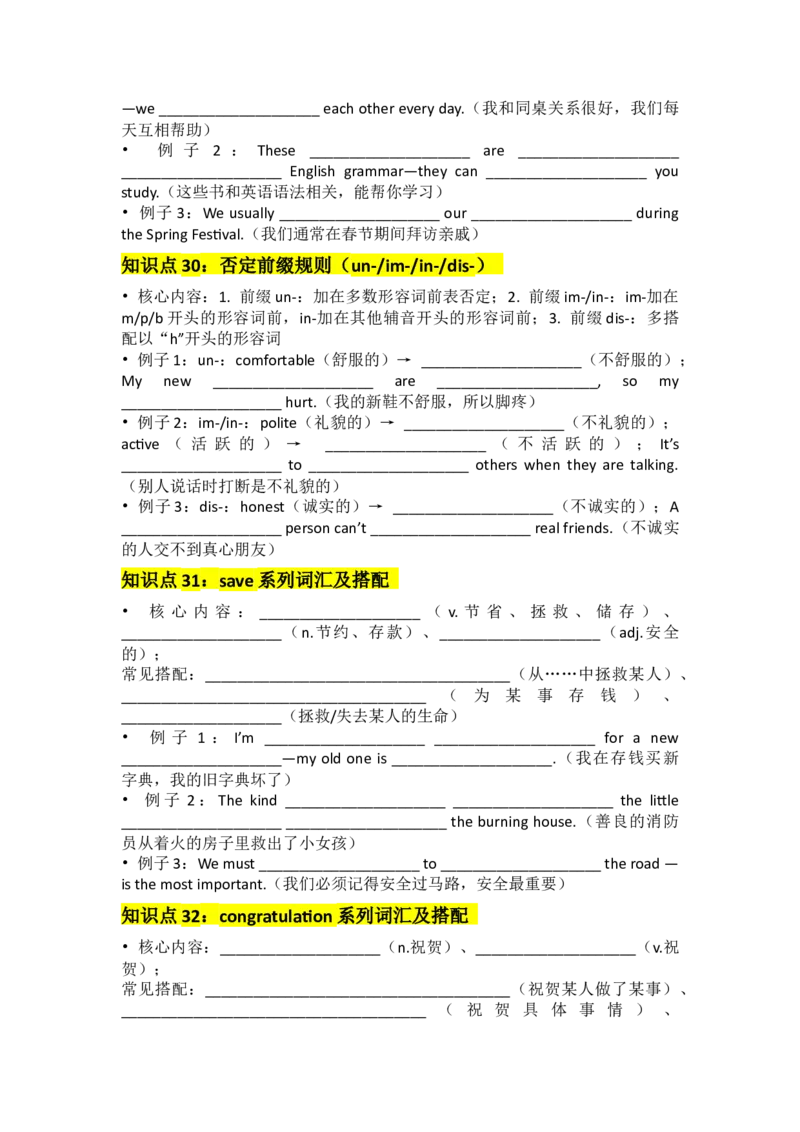
• 例子 1:I have a good ____________________ with my ____________________—we ____________________ each other every day.(我和同桌关系很好,我们每
天互相帮助)
• 例 子 2 : These ____________________ are ____________________
____________________ English grammar—they can ____________________ you
study.(这些书和英语语法相关,能帮你学习)
• 例子 3:We usually ____________________ our ____________________ during
the Spring Festival.(我们通常在春节期间拜访亲戚)
知识点30:否定前缀规则(un-/im-/in-/dis-)
• 核心内容:1. 前缀un-:加在多数形容词前表否定;2. 前缀im-/in-:im-加在
m/p/b开头的形容词前,in-加在其他辅音开头的形容词前;3. 前缀dis-:多搭
配以“h”开头的形容词
• 例子1:un-:comfortable(舒服的)→ ____________________(不舒服的);
My new ____________________ are ____________________, so my
____________________ hurt.(我的新鞋不舒服,所以脚疼)
• 例子2:im-/in-:polite(礼貌的)→ ____________________(不礼貌的);
active ( 活 跃 的 ) → ____________________ ( 不 活 跃 的 ) ; It’s
____________________ to ____________________ others when they are talking.
(别人说话时打断是不礼貌的)
• 例子3:dis-:honest(诚实的)→ ____________________(不诚实的);A
____________________ person can’t ____________________ real friends.(不诚实
的人交不到真心朋友)
知识点31:save系列词汇及搭配
• 核 心 内 容 : ____________________ ( v. 节 省 、 拯 救 、 储 存 ) 、
____________________(n.节约、存款)、____________________(adj.安全
的);
常见搭配:______________________________________(从……中拯救某人)、
______________________________________ ( 为 某 事 存 钱 ) 、
____________________(拯救/失去某人的生命)
• 例 子 1 : I’m ____________________ ____________________ for a new
____________________—my old one is ____________________.(我在存钱买新
字典,我的旧字典坏了)
• 例子 2:The kind ____________________ ____________________ the little
____________________ ____________________ the burning house.(善良的消防
员从着火的房子里救出了小女孩)
• 例子3:We must ____________________ to ____________________ the road —
is the most important.(我们必须记得安全过马路,安全最重要)
知识点32:congratulation系列词汇及搭配
• 核心内容:____________________(n.祝贺)、____________________(v.祝
贺);
常见搭配:______________________________________(祝贺某人做了某事)、
______________________________________ ( 祝 贺 具 体 事 情 ) 、______________________________________(向某人祝贺)
• 例子1:We all ____________________ Lily ____________________ winning the
English ____________________ competition.(我们都祝贺莉莉赢得了英语演讲比
赛)
• 例子2: passing your math —you ____________________ so hard!(祝贺你通
过数学考试,你付出了很多努力!)
• 例子 3:My ____________________ said “ you on your birthday!” this morning.
(今天早上父母对我说“祝你生日快乐!”)
知识点33:tradition系列词汇
• 核心内容:____________________(n.传统)、____________________(adj.
传统的)
• 例子1:____________________ dumplings during the Spring Festival is a Chinese
____________________.(春节吃饺子是中国的传统)
• 例 子 2 : My ____________________ can ____________________ many
____________________ Chinese dishes, like Kung Pao Chicken.(奶奶会做很多中
国传统菜,比如宫保鸡丁)
• 例 子 3 : We should ____________________ about our country’s
____________________ and ____________________ them on.(我们应该了解国
家的传统,并把它们传承下去)
知识点34:keep doing sth.句型
• 核心内容:表示“持续做某事”,强调动作的延续性
• 例 子 1 : My ____________________ ____________________
____________________ English books for 30 ____________________ every
morning.(我弟弟每天早上坚持读30分钟英语书)
• 例 子 2 : It ____________________ ____________________ all
____________________, so we couldn’t ____________________ out to play.(整个
周末一直在下雨,所以我们没法出去玩)
• 例子 3:She ____________________ ____________________ the piano after
____________________ because she wants to be a ____________________.(她放
学后一直练习钢琴,因为她想成为钢琴家)
知识点35:incorrect系列词汇及搭配
• 核心内容:____________________(adj.不正确的)、____________________
(v.纠正;adj.正确的)、____________________(n.正确性);
常见搭配:do sth. ____________________(做某事不正确)
• 例 子 1 : Your ____________________ to this ____________________ is
____________________—let me ____________________ you the right one.(你这
道题的答案不正确,我来告诉你正确的)
• 例 子 2 : The ____________________ ____________________ our
____________________ mistakes in the homework yesterday.(昨天老师批改了我
们作业里的拼写错误)
• 例子3:You should ____________________ the ____________________ of youranswers before ____________________ in the test paper.(交试卷前,你应该检查
答案的正确性)
知识点36:main系列词汇及搭配
• 核心内容:____________________(adj.主要的)、____________________
(n.主要性);
常见搭配:______________________________________(……的主要部分)、
______________________________________(在……方面主要的)
• 例 子 1 : Math and English are the ____________________
____________________ in middle school.(数学和英语是中学的主要科目)
• 例子 2:The ____________________ part of this ____________________ is
about a ____________________’s adventure in the forest.(这个故事的主要部分
是关于一个男孩在森林里的冒险)
• 例子 3:The ____________________ reason why I ____________________
reading is that it can ____________________ my mind.(我喜欢阅读的主要原因是
它能开阔我的眼界)
知识点37:cheerful系列词汇及搭配
• 核心内容:____________________(adj.高兴的)、____________________
(v.欢呼);
常见搭配:______________________________________ (开心地做某事)、
______________________________________ ( 为 … … 加 油 助 威 ) 、
____________________((使)振作起来、(使)开心起来)
• 例子 1:My little ____________________ is always ____________________ to
____________________ others—everyone ____________________ her.(我妹妹总
是开心地帮助别人,大家都喜欢她)
• 例子 2:All ____________________ went to the ____________________ to
____________________ ____________________ our basketball team.(所有同学
都去操场为我们的篮球队加油)
• 例 子 3 : I ____________________ a funny ____________________ to
____________________ ____________________ my friend who was
____________________.(我讲了个有趣的笑话,让难过的朋友振作起来)
知识点38:impress系列词汇及搭配
• 核 心 内 容 : ____________________ ( v. 给 … … 留 下 深 刻 印 象 ) 、
____________________(n.印象)、____________________(adj.令人印象深刻
的)、____________________(adj.感到印象深刻的);
常见搭配:______________________________________(给某人留下印象)、
______________________________________(使某人铭记某事)
• 例子 1:Her ____________________ speech ____________________ a deep
____________________ ____________________ all the teachers.(她精彩的演讲
给所有老师留下了深刻印象)
• 例子 2:The Great ____________________ is so ____________________ that
many ____________________ visitors love it.(长城令人印象深刻,很多外国游客都喜欢它)
• 例 子 3 : My ____________________ always ____________________ the
importance of ____________________ hard on me.(父母总是让我铭记努力学习
的重要性)
单元短语总结
1. ________________________________________ 握手
2. ________________________________________ 鞠躬
3. ________________________________________ 碰拳
4. ________________________________________ 擦鼻子(打招呼的方式)
5. ________________________________________ 亲吻脸颊
6. ________________________________________ 拥抱
7. ________________________________________ 双手合十
8. ________________________________________ 拜访朋友
9. ________________________________________ 在某人家吃晚餐
10. ________________________________________ 用某物做某事
11. ________________________________________ 很少做某事
12. ________________________________________ 等待某人做某事
13. ________________________________________ 用手拿……
14. ________________________________________ 做某事是粗鲁的/礼貌的
15. ________________________________________ 给某人提供某物
16. ________________________________________ 如此……以至于……
17. ________________________________________ 除非……
18. ________________________________________ 做某事的正确方式
19. ________________________________________ 在……流行
20. ________________________________________ 餐桌礼仪
21. ________________________________________ 饭后
22. ________________________________________ 等长辈先动筷
23. ________________________________________ 坐直
24. ________________________________________ 不要把胳膊肘放在餐桌上
25. ________________________________________ 站起来够食物
26. ________________________________________ 把菜递给某人
27. ________________________________________ 公筷
28. ________________________________________ 公勺
29. ________________________________________ 从共享餐盘里夹菜
30. ________________________________________ 对……感到惊讶
31. ________________________________________ 一……就……
32. ________________________________________ 脱掉你的鞋子
33. ________________________________________ 准时
34. ________________________________________ 把……插进……
35. ________________________________________ 避免做某事
36. ________________________________________ 叫某人的名字
37. ________________________________________ 文化冲击
38. ________________________________________ 与……不同39. ________________________________________ 下飞机
40. ________________________________________ 个人空间
41. ________________________________________ 站得离某人近
42. ________________________________________ 习惯某事
43. ________________________________________ 对……好奇
44. ________________________________________ 对……感兴趣
45. ________________________________________ 参加派对
46. ________________________________________ 到达时间
47. ________________________________________ 安全的聊天话题
48. ________________________________________ 要避免的话题
49. ________________________________________ 如何问候主人
50. ________________________________________ 带什么礼物
51. ________________________________________ 何时道别
52. ________________________________________ 收到某人的消息
53. ________________________________________ 起初
54. ________________________________________ 交朋友
55. ________________________________________ 了解
56. ________________________________________ 提前到派对
57. ________________________________________ 晚几分钟
58. ________________________________________ 造成问题
59. ________________________________________ 把一切准备好
60. ________________________________________ 带礼物
61. ________________________________________ 根据场合着装
62. ________________________________________ 私人问题
63. ________________________________________ 询问某人关于某事
64. ________________________________________ 聊天话题
65. ________________________________________ 建立更亲密的关系
66. ________________________________________ 很有用、有很大帮助
67. ________________________________________ 犯错误
68. ________________________________________ 头脑风暴建议
69. ________________________________________ 随身携带某物
70. ________________________________________ 和某人结婚
71. ________________________________________ 祝贺某人
72. ________________________________________ 祝某人生日快乐
73. ________________________________________ 用筷子吃饭
74. ________________________________________ 规则与传统
75. ________________________________________ 把菜往自己这边拉
76. ________________________________________ 指着别人
77. ________________________________________ 挥舞……
78. ________________________________________ 正确握住……
79. ________________________________________ 大量练习
80. ________________________________________ 学会做某事
81. ________________________________________ 邮件主题
82. ________________________________________ 邮件接收人83. ________________________________________ 邮件发送人
84. ________________________________________ 邮件落款
85. ________________________________________ 正文
86. ________________________________________ 还剩一周
87. ________________________________________ 做某事很兴奋
88. ________________________________________ 抵达某地
89. ________________________________________ 和某人待在一起
90. ________________________________________ 在某人四十多岁时
91. ________________________________________ 给某人一些建议
92. ________________________________________ 给某人带某物
93. ________________________________________ 正确的餐桌礼仪
94. ________________________________________ 做傻事
95. ________________________________________ 给某人错误的印象
96. ________________________________________ 第一印象
97. ________________________________________ 期待做某事
98. ________________________________________ 加入不同的小组
99. ________________________________________ 告诉某人关于某事
100. ________________________________________ 回到原小组
101. ________________________________________ 分享所学内容
102. ________________________________________ 文化差异
103. ________________________________________入乡随俗核心考点默写答案
一、知识点答案
知识点1:custom系列词汇及搭配
• 核心内容:customary(adj.习惯的)、customer(n.顾客)、custom(n.习俗)
• 常见搭配:social customs(社会习俗)、break with old customs(破除旧习俗)、follow
the local customs(遵循当地习俗)、The custom of doing sth.(做某事的习俗)
• 例子1:custom;eating;popular
• 例子2:follow;local;customs;travel
• 例子3:weekend;goes;talks;customers
知识点2:element系列词汇及搭配
• 核心内容:element(n.元素;要素;成分)、elementary(adj.基础的)
• 常见搭配:an element of...(一点;少许)、elements of...(……的要素)
• 例子1:element;fun
• 例子2:tell;practice;elements
• 例子3:learn;elementary;Seven
知识点3:shake系列词汇及搭配
• 核心内容:shake(v.摇动)、shaky(adj.摇晃的)、shaker(n.摇动器)
• 常见搭配:shake hands with sb.(和某人握手)、shake one’s hand(握某人的手)、
shake off(摆脱)、shake one’s head(摇头)
• 例子1:meet;shake;hands;politely
• 例子2:shook;head;want
• 例子3:tried;shake;off;tiredness
知识点4:embarrass系列词汇及搭配
• 核心内容:embarrass(v.使某人尴尬)、embarrassing(adj.令人尴尬的)、embarrassed
(adj.尴尬的)、embarrassment(n.尴尬)
• 常见搭配:be embarrassed about sth(因某事感到尴尬)、be embarrassed at doing sth
(因做某事感到尴尬)、be embarrassed to do sth(因困窘而不愿做某事)、embarrass sb
by doing sth(通过做某事使某人尴尬)
• 例子1:embarrassed;forgetting;birthday
• 例子2:embarrassing;trip;shoes
• 例子3:embarrassed;telling;childhood知识点5:rub的动词搭配
• 核心内容:rub(v.摩擦、擦)
• 常见搭配:rub sth. off(擦掉某物)、rub sth. on/onto(把……涂/擦在……上)
• 例子1:used;rub;off
• 例子2:rubs;lotion;winter
• 例子3:help;rub;off;cover
知识点6:confuse系列词汇及搭配
• 核心内容:confuse(v.困惑)、confusing(adj.令人困惑的)、confusion(n.困惑)
• 常见搭配:be confused about sth(对某事感到困惑)、be confused by sb/sth(被某人/某
事弄得困惑)、reduce confusion(减少困惑/混乱)、in confusion(困惑地)
• 例子1:students;confused;difference
• 例子2:complicated;confused;class
• 例子3:explained;reduce;confusion
知识点7:surprise系列词汇及用法
• 核心内容:surprise(n./v.惊喜)、surprising(adj.令人惊讶的)、surprised(adj.感到惊
讶的)
• 例子1:parents;bike;surprise
• 例子2:surprising;class;basketball
• 例子3:surprised;see;friend
知识点8:greeting系列词汇及搭配
• 核心内容:greeting(n.问候)、greet(v.问候)
• 常见搭配:a greeting from...(来自……的问候)、greet sb. with sth.(用……(方式)问
候某人)
• 例子1:received;greeting;pal
• 例子2:teacher;greets;smile
• 例子3:greet;morning
知识点9:bump相关短语及用法
• 核心内容:bump into sb./sth.(①撞到某人/某物;②偶然遇见某人)、bump against sth.
(撞到某物,强调“撞”式的碰撞)
• 例子1:bumped;into;tree;running
• 例子2:bumped;into;teacher
• 例子3:boy;bumped;against;running
知识点10:form系列词汇及搭配
• 核心内容:form(n.表格、形式、种类;v.形成)、formal(adj.正式的)、formation(n.
形成)
• 常见搭配:the formation of...(……的形成)、form a habit of doing sth.(养成做某事的
习惯)、take the form of(呈现……的形式)、fill in the form(填写表格)、fill out a form
(填写表格)
• 例子1:need;fill;in;form
• 例子2:important;form;habit;reading
• 例子3:formation;ice;temperature
知识点11:rude系列词汇及搭配
• 核心内容:rudeness(n.粗鲁)、rude(adj.无礼的)
• 常见搭配:it’s rude to do sth.(做某事是无礼的)、be rude to sb.(对某人无礼)• 例子1:rude;talk;library
• 例子2:rude;parents
• 例子3:rudeness;everyone;unhappy
知识点12:offer的双宾语结构
• 核心内容:offer sb. sth. (= offer sth. to sb.)(给某人提供某物)
• 例子1:friend;offered;tea
• 例子2:library;offers;interesting
• 例子3:teacher;offers;help;trouble
知识点13:bow相关短语及用法
• 核心内容:bow to sb.(向某人鞠躬,表礼仪动作)、bow down(弯腰;引申“屈服”)、
make a bow(鞠一躬,作名词的搭配)
• 例子1:countries;bow;to;show
• 例子2:actor;made;bow;audience
• 例子3:never;bow;down
知识点14:popular系列词汇及搭配
• 核心内容:popular(adj.受欢迎的)、popularity(n.受欢迎度)
• 常见搭配:be popular with(受某类人(个体或群体)欢迎)、be popular among(在某
群体中流行)、the popularity of...(……的流行度/受欢迎程度)
• 例子1:singer;popular;with;people
• 例子2:Playing;popular;among
• 例子3:popularity;online;increased
知识点15:manner相关短语及用法
• 核心内容:confident manner(自信的举止)、in this/that manner(以这种/那种方式)
in a... manner(以……的方式)
• 例子1:student;questions;confident;manner
• 例子2:solve;problems;manner;giving
• 例子3:explained;clear;patient;manner
知识点16:proper系列词汇及搭配
• 核心内容:properly(adv.正确地)、proper(adj.正确的)
• 常见搭配:do sth. properly(正确做某事)
• 例子1:must;wash;properly;healthy
• 例子2:important;use;proper
• 例子3:tell;pronounce;properly
知识点17:serve系列词汇及搭配
• 核心内容:serve(v.服务、充当、提供)、service(/ˈsɜːvɪs/,n.服务)、servant(n.仆
人)、serving(adj.分菜用的;n.一份食物)
• 常见搭配:serve sb. sth. = serve sth. to sb.(为某人提供某物)、serve as...(充当)、
serve to do sth(用来做某事)、a serving of sth.(一份……(食物))
• 例子1:waiter;served;plate;noodles
• 例子2:old;serve;as;study
• 例子3:serving;fruit;lunch
知识点18:-ed与-ing形容词辨析
• 核心内容:surprised(-ed)修饰“人”,表“感到惊讶的”;surprising(-ing)修饰
“事物”,表“令人惊讶的”;embarrassed(-ed)修饰“人”,表“感到尴尬的”;embarrassing(-ing)修饰“事物”,表“令人尴尬的”
• 例子1:surprised;heard;news;news;surprising
• 例子2:felt;embarrassed;made;mistake;Making;mistake;embarrassing
• 例子3:parents;surprised;exam;change;habits;surprising
知识点19:used to与be used to的用法辨析
• 核心内容:be used to (doing) sth.(习惯于……);used to do sth.(过去常常做某事)
• 例子1:used;to;play;play
• 例子2:used;to;getting;morning
• 例子3:used;to;go;weekend;time
知识点20:respect系列词汇及搭配
• 核心内容:respect(v./n.尊敬)、respectful(adj.尊敬他人的)、respectable(adj.值得尊
敬的)
• 常见搭配:respect for sb./sth.(对某人/某物的尊敬)
• 例子1:show;respect;for
• 例子2:student;respectful;to
• 例子3:teacher;respectable;works
知识点21:arrive系列词汇及搭配
• 核心内容:arrive(v.到达)、arrival(n.到达);接大地点用“arrive + in + 地点”,接
小地点用“arrive + at + 地点”;同义词get to
• 例子1:family;arrive;in;Friday
• 例子2:arrives;at;weekday
• 例子3:arrival;textbooks;students
知识点22:attention系列词汇及搭配
• 核心内容:attention(n.注意力)、attentive(adj.专注的)、attend(v.注意、出席)
• 例子1:teacher;pay;attention;to;words
• 例子2:attentive;student;looks
• 例子3:parents;attend;meeting
知识点23:France相关词汇
• 核心内容:France(n.法国)、French(adj.法国的;n.法语、法国人)
• 例子1:hope;visit;parents
• 例子2:cousin;learning;study
• 例子3:French;French;popular
知识点24:simple系列词汇及用法
• 核心内容:simple(adj.简单的)、simply(adv.简单地)
• 例子1:problem;simple;students;solve
• 例子2:simply;tell;idea;write
• 例子3:grandma;simple;growing
知识点25:it’s best (not) to do sth.句型
• 核心内容:表示“(不)做某事是最好的”
• 例子1:to;brush;teeth;keep
• 例子2:not;to;be;like
• 例子3:to;exercise;minutes;stay
知识点26:private系列词汇及搭配
• 核心内容:private(adj.私人的)、privately(adv.私人地)、privacy(n.隐私);常见搭配private property(私人财产)
• 例子1:private;room;enter
• 例子2:talked;privately;corner;want
• 例子3:respect;privacy;reading
知识点27:personality相关词汇
• 核心内容:personality(n.个性)、personal(adj.私人的)
• 例子1:friend;outgoing;likes
• 例子2:ask;personal;phone
• 例子3:personalities;class;interesting
知识点28:join in/take part in/attend辨析
• 核心内容:join in(加入“组织/团体”或“加入某人”);take part in(参与“活动/事
件”,强调“积极参与”);attend(“出席”正式场合,强调“到场”)
• 例子1:wants;join;in;music
• 例子2:students;take;part;in;sports
• 例子3:dad;attend;meeting
知识点29:relation系列词汇及发音
• 核心内容:relation([rɪˈleɪʃn] n.关系、亲戚)、related([rɪˈleɪtɪd] adj.相关的、亲戚的)、
relative([ˈrelətɪv] adj.相对的;n.亲戚)、relate(v.与…有关)
• 例子1:relation;deskmate;help
• 例子2:books;related;to;help
• 例子3:visit;relatives
知识点30:否定前缀规则
• 核心内容:un-加多数形容词;im-加m/p/b开头形容词,in-加其他辅音开头形容词;dis-
多搭配h开头形容词
• 例子1:uncomfortable;shoes;uncomfortable;feet
• 例子2:impolite;inactive;impolite;interrupt
• 例子3:dishonest;dishonest;make
知识点31:save系列词汇及搭配
• 核心内容:save(v.节省、拯救、储存)、savings(n.节约、存款)、safe(adj.安全的);
常见搭配save sb. from sth.(从……中拯救某人)、save money for sth.(为某事存钱)、
save/lose one’s life(拯救/失去某人的生命)
• 例子1:saving;money;dictionary;broken
• 例子2:firefighter;saved;girl;from
• 例子3:remember;cross;safely;Safety
知识点32:congratulation系列词汇及搭配
• 核心内容:congratulation(n.祝贺)、congratulate(v.祝贺);常见搭配congratulate sb.
on (doing) sth.(祝贺某人做了某事)、Congratulations on (doing) sth.(祝贺具体事情)、
Congratulations to sb. (on sth.)(向某人祝贺)
• 例子1:congratulated;on;speech
• 例子2:Congratulations;on;exam;worked
• 例子3:parents;Congratulations;to
知识点33:tradition系列词汇
• 核心内容:tradition(n.传统)、traditional(adj.传统的)
• 例子1:Eating;tradition• 例子2:grandma;cook;traditional
• 例子3:learn;traditions;pass
知识点34:keep doing sth.句型
• 核心内容:表示“持续做某事”,强调动作的延续性
• 例子1:brother;keeps;reading;minutes
• 例子2:kept;raining;weekend;go
• 例子3:keeps;practicing;school;pianist
知识点35:incorrect系列词汇及搭配
• 核心内容:incorrect(adj.不正确的)、correct(v.纠正;adj.正确的)、correctness(n.
正确性);常见搭配do sth. incorrectly(做某事不正确)
• 例子1:answer;question;incorrect;tell
• 例子2:teacher;corrected;spelling
• 例子3:check;correctness;handing
知识点36:main系列词汇及搭配
• 核心内容:main(adj.主要的)、mainness(n.主要性);常见搭配main part of…(……
的主要部分)、main in(在……方面主要的)
• 例子1:main;subjects
• 例子2:main;story;boy
• 例子3:main;like;open
知识点37:cheerful系列词汇及搭配
• 核心内容:cheerful(adj.高兴的)、cheer(v.欢呼);常见搭配be cheerful to do sth.
(开心地做某事)、cheer on(为……加油助威)、cheer up((使)振作起来、(使)开
心起来)
• 例子1:sister;cheerful;help;likes
• 例子2:classmates;playground;cheer;on
• 例子3:told;joke;cheer;up;sad
知识点38:impress系列词汇及搭配
• 核心内容:impress(v.给……留下深刻印象)、impression(n.印象)、impressive(adj.
令人印象深刻的)、impressed(adj.感到印象深刻的);常见搭配 make an impression on
sb.(给某人留下印象)、impress sth. on/upon sb.(使某人铭记某事)
• 例子1:excellent;made;impression;on
• 例子2:Wall;impressive;foreign
• 例子3:parents;impress;studying
二、单元短语答案
1. shake hands
2. bow
3. bump fists
4. rub noses
5. kiss cheeks
6. hug
7. press one’s palms together
8. visit friends
9. have dinner at one’s house
10. use sth. to do sth.11. seldom do sth.
12. wait for sb. to do sth.
13. hold... in one’s hand
14. It is rude/polite to do sth.
15. offer sb. sth.(= offer sth. to sb.)
16. so... that...
17. unless...
18. the proper way to do sth.
19. be popular in
20. table manners
21. after the meal
22. Wait for older people to start eating
23. Sit up straight
24. Keep your elbows off the table
25. stand up to reach for food
26. pass sb. the dish
27. serving chopsticks
28. serving spoons
29. take food from shared dishes
30. be surprised by
31. as soon as
32. take off your shoes
33. be on time
34. stick...into...
35. avoid doing sth.
36. use one's first name
37. culture shock
38. be different from
39. get off the plane
40. personal space
41. stand close to sb.
42. be used to sth.
43. be curious about
44. be interested in
45. attend a party
46. arrival time
47. safe conversation topics
48. topics to avoid
49. how to greet the host
50. what gifts to bring
51. when to say goodbye
52. hear from sb.
53. at first
54. make friends55. learn about
56. arrive early to a party
57. a few minutes late
58. cause problems
59. get everything ready
60. bring a gift
61. dress for the occasion
62. private questions
63. ask sb. about sth.
64. conversation topics
65. develop closer relationships
66. go a long way
67. make mistakes
68. brainstorm tips
69. take sth. with sb.
70. marry sb.
71. congratulate sb.
72. wish sb. happy birthday
73. eat with chopsticks
74. rules and traditions
75. pull dishes close to you
76. point at others
77. wave...about
78. hold...correctly
79. plenty of practice
80. learn to do sth.
81. email topic
82. person receiving the email
83. person sending the email
84. sign-off
85. main text
86. one more week to go
87. be excited to do sth.
88. land in + 地点
89. stay with sb.
90. in one’s forties
91. give sb. some advice
92. bring sb. sth.
93. right table manners
94. do something silly
95. give sb. the false impression
96. first impressions
97. look forward to doing sth.
98. join a different group99. tell sb. about sth.
100. rejoin one’s original group
101. share what one learnt
102. cultural differences
103. When in Rome, do as the Romans do.