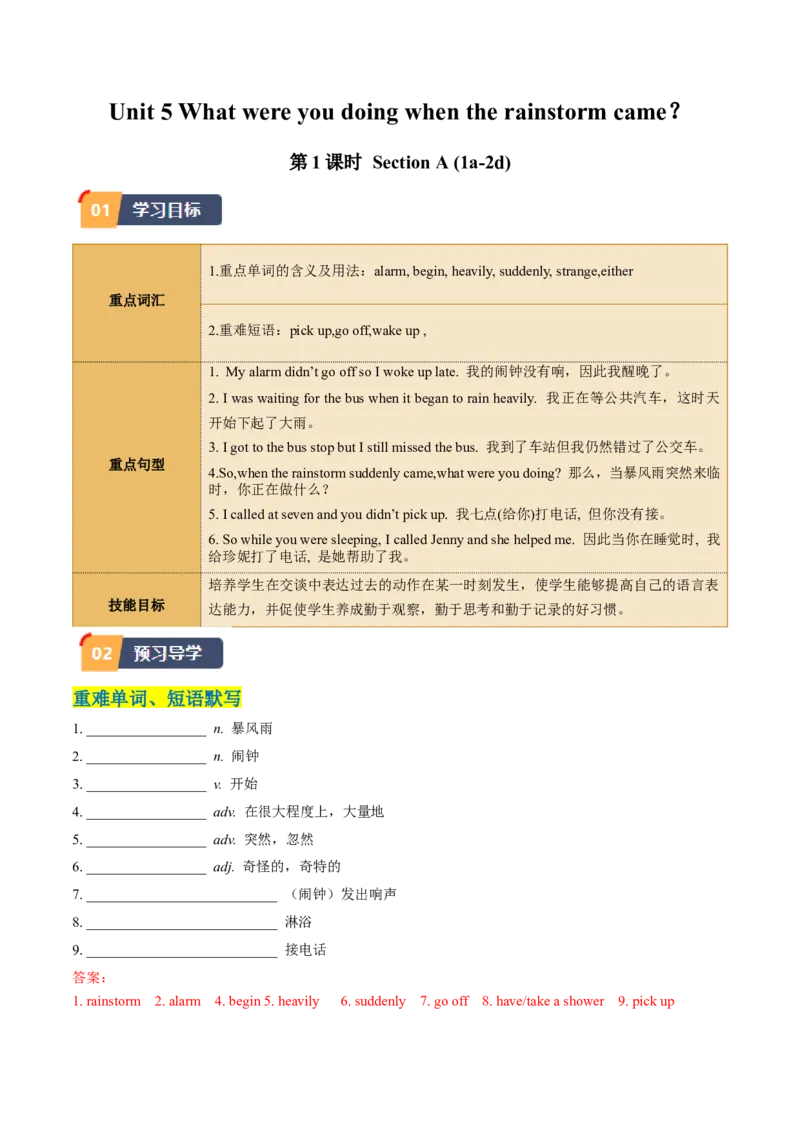
Unit 5 What were you doing when the rainstorm came?
第1课时 Section A (1a-2d)
1.重点单词的含义及用法:alarm, begin, heavily, suddenly, strange,either
重点词汇
2.重难短语:pick up,go off,wake up ,
1. My alarm didn’t go off so I woke up late. 我的闹钟没有响,因此我醒晚了。
2. I was waiting for the bus when it began to rain heavily. 我正在等公共汽车,这时天
开始下起了大雨。
3. I got to the bus stop but I still missed the bus. 我到了车站但我仍然错过了公交车。
重点句型
4.So,when the rainstorm suddenly came,what were you doing? 那么,当暴风雨突然来临
时,你正在做什么?
5. I called at seven and you didn’t pick up. 我七点(给你)打电话, 但你没有接。
6. So while you were sleeping, I called Jenny and she helped me. 因此当你在睡觉时, 我
给珍妮打了电话, 是她帮助了我。
培养学生在交谈中表达过去的动作在某一时刻发生,使学生能够提高自己的语言表
技能目标 达能力,并促使学生养成勤于观察,勤于思考和勤于记录的好习惯。
重难单词、短语默写
1. _________________ n. 暴风雨
2. _________________ n. 闹钟
3. _________________ v. 开始
4. _________________ adv. 在很大程度上,大量地
5. _________________ adv. 突然,忽然
6. _________________ adj. 奇怪的,奇特的
7. ___________________________ (闹钟)发出响声
8. ___________________________ 淋浴
9. ___________________________ 接电话
答案:
1. rainstorm 2. alarm 4. begin 5. heavily 6. suddenly 7. go off 8. have/take a shower 9. pick up经典句型过关:
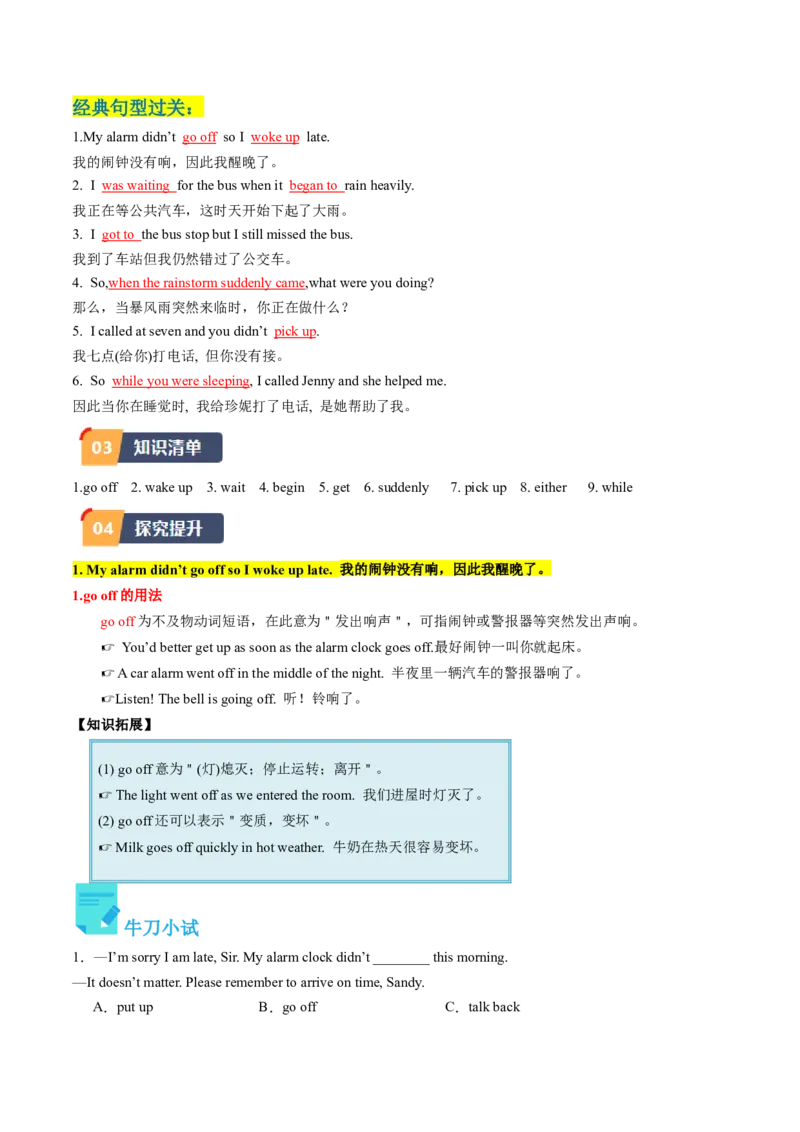
1.My alarm didn’t go off so I woke up late.
我的闹钟没有响,因此我醒晚了。
2. I was waiting for the bus when it began to rain heavily.
我正在等公共汽车,这时天开始下起了大雨。
3. I got to the bus stop but I still missed the bus.
我到了车站但我仍然错过了公交车。
4. So,when the rainstorm suddenly came,what were you doing?
那么,当暴风雨突然来临时,你正在做什么?
5. I called at seven and you didn’t pick up.
我七点(给你)打电话, 但你没有接。
6. So while you were sleeping, I called Jenny and she helped me.
因此当你在睡觉时, 我给珍妮打了电话, 是她帮助了我。
1.go off 2. wake up 3. wait 4. begin 5. get 6. suddenly 7. pick up 8. either 9. while
1. My alarm didn’t go off so I woke up late. 我的闹钟没有响,因此我醒晚了。
1.go off的用法
go off为不及物动词短语,在此意为"发出响声",可指闹钟或警报器等突然发出声响。
☞ You’d better get up as soon as the alarm clock goes off.最好闹钟一叫你就起床。
☞ A car alarm went off in the middle of the night. 半夜里一辆汽车的警报器响了。
☞Listen! The bell is going off. 听!铃响了。
【知识拓展】
(1) go off意为"(灯)熄灭;停止运转;离开"。
☞ The light went off as we entered the room. 我们进屋时灯灭了。
(2) go off还可以表示"变质,变坏"。
☞ Milk goes off quickly in hot weather. 牛奶在热天很容易变坏。
牛刀小试
1.—I’m sorry I am late, Sir. My alarm clock didn’t ________ this morning.
—It doesn’t matter. Please remember to arrive on time, Sandy.
A.put up B.go off C.talk back【答案】B
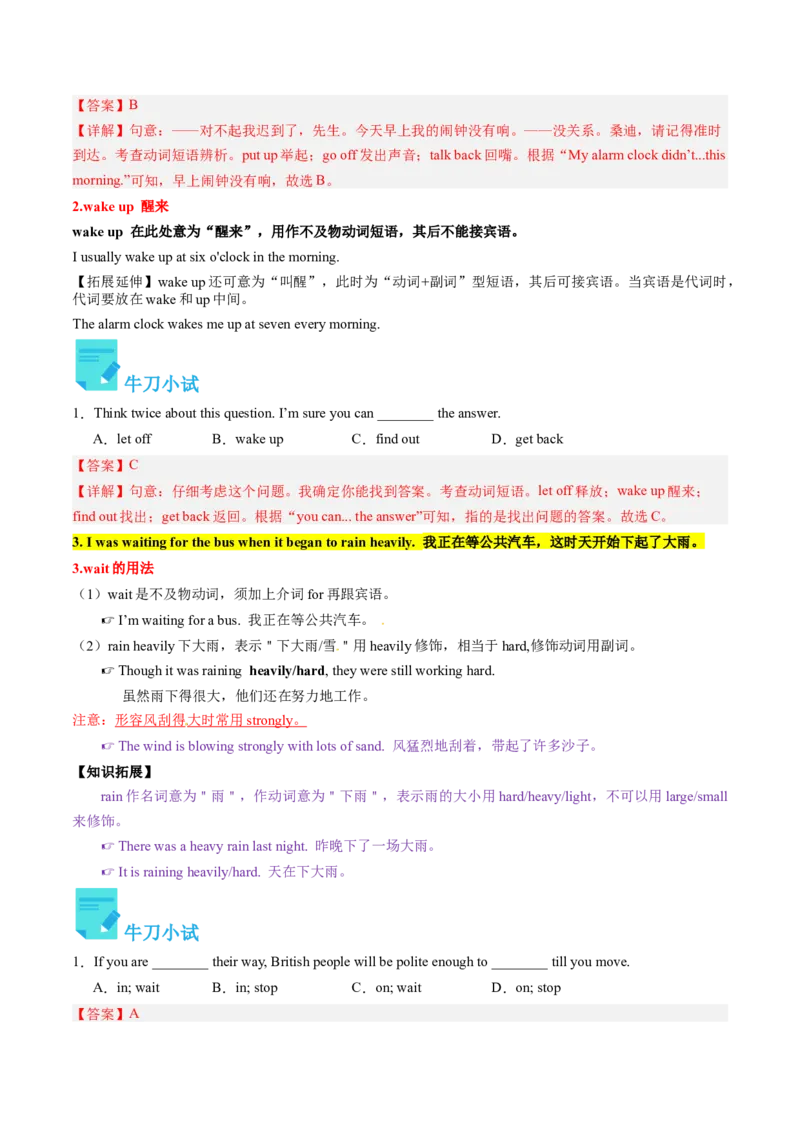
【详解】句意:——对不起我迟到了,先生。今天早上我的闹钟没有响。——没关系。桑迪,请记得准时
到达。考查动词短语辨析。put up举起;go off发出声音;talk back回嘴。根据“My alarm clock didn’t...this
morning.”可知,早上闹钟没有响,故选B。
2.wake up 醒来
wake up 在此处意为“醒来”,用作不及物动词短语,其后不能接宾语。
I usually wake up at six o'clock in the morning.
【拓展延伸】wake up还可意为“叫醒”,此时为“动词+副词”型短语,其后可接宾语。当宾语是代词时,
代词要放在wake和up中间。
The alarm clock wakes me up at seven every morning.
牛刀小试
1.Think twice about this question. I’m sure you can ________ the answer.
A.let off B.wake up C.find out D.get back
【答案】C
【详解】句意:仔细考虑这个问题。我确定你能找到答案。考查动词短语。let off释放;wake up醒来;
find out找出;get back返回。根据“you can... the answer”可知,指的是找出问题的答案。故选C。
3. I was waiting for the bus when it began to rain heavily. 我正在等公共汽车,这时天开始下起了大雨。
3.wait的用法
(1)wait是不及物动词,须加上介词for再跟宾语。
☞ I’m waiting for a bus. 我正在等公共汽车。
(2)rain heavily下大雨,表示"下大雨/雪"用heavily修饰,相当于hard,修饰动词用副词。
☞ Though it was raining heavily/hard, they were still working hard.
虽然雨下得很大,他们还在努力地工作。
注意:形容风刮得 大时常用 strongl y 。
☞ The wind is blowing strongly with lots of sand. 风猛烈地刮着,带起了许多沙子。
【知识拓展】
rain作名词意为"雨",作动词意为"下雨",表示雨的大小用hard/heavy/light,不可以用large/small
来修饰。
☞ There was a heavy rain last night. 昨晚下了一场大雨。
☞ It is raining heavily/hard. 天在下大雨。
牛刀小试
1.If you are ________ their way, British people will be polite enough to ________ till you move.
A.in; wait B.in; stop C.on; wait D.on; stop
【答案】A【详解】句意:如果你挡了英国人的道,他们会非常礼貌地等,直到你走开。考查介词及动词辨析。in
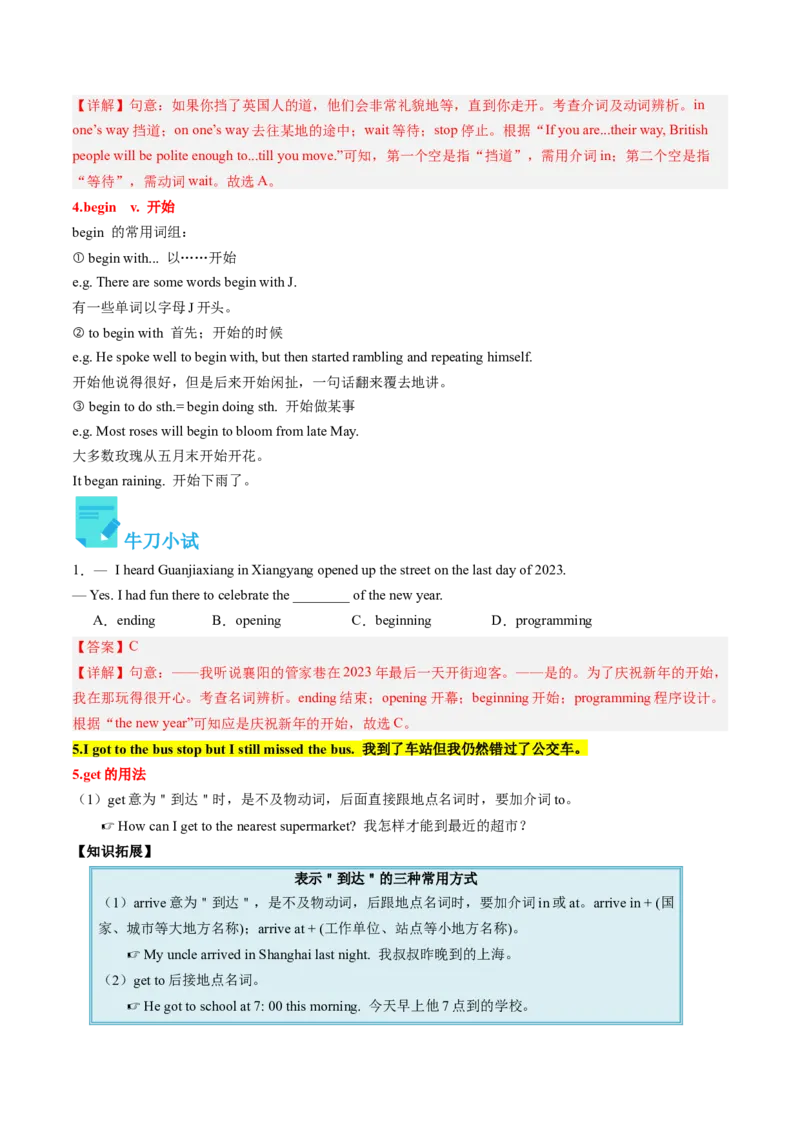
one’s way挡道;on one’s way去往某地的途中;wait等待;stop停止。根据“If you are...their way, British
people will be polite enough to...till you move.”可知,第一个空是指“挡道”,需用介词in;第二个空是指
“等待”,需动词wait。故选A。
4.begin v. 开始
begin 的常用词组:
① begin with... 以……开始
e.g. There are some words begin with J.
有一些单词以字母J开头。
② to begin with 首先;开始的时候
e.g. He spoke well to begin with, but then started rambling and repeating himself.
开始他说得很好,但是后来开始闲扯,一句话翻来覆去地讲。
③ begin to do sth.= begin doing sth. 开始做某事
e.g. Most roses will begin to bloom from late May.
大多数玫瑰从五月末开始开花。
It began raining. 开始下雨了。
牛刀小试
1.— I heard Guanjiaxiang in Xiangyang opened up the street on the last day of 2023.
— Yes. I had fun there to celebrate the ________ of the new year.
A.ending B.opening C.beginning D.programming
【答案】C
【详解】句意:——我听说襄阳的管家巷在2023年最后一天开街迎客。——是的。为了庆祝新年的开始,
我在那玩得很开心。考查名词辨析。ending结束;opening开幕;beginning开始;programming程序设计。
根据“the new year”可知应是庆祝新年的开始,故选C。
5.I got to the bus stop but I still missed the bus. 我到了车站但我仍然错过了公交车。
5.get的用法
(1)get意为"到达"时,是不及物动词,后面直接跟地点名词时,要加介词to。
☞ How can I get to the nearest supermarket? 我怎样才能到最近的超市?
【知识拓展】
表示"到达"的三种常用方式
(1)arrive意为"到达",是不及物动词,后跟地点名词时,要加介词in或at。arrive in + (国
家、城市等大地方名称);arrive at + (工作单位、站点等小地方名称)。
☞ My uncle arrived in Shanghai last night. 我叔叔昨晚到的上海。
(2)get to后接地点名词。
☞ He got to school at 7: 00 this morning. 今天早上他7点到的学校。(3)reach意为"到达",是及物动词,后面直接跟地点名词。
☞ When did you reach America? 你什么时候到的美国?
[来源:学§科§网]
【温馨提示】
后接地点副词,如here,there,home等时,去掉介词,即arrive/get/reach+地点副词。
(2)miss意为 “错过(机会),未赶上(车),未抓住(事物),遗漏”,后跟名词/代词/动名词,不接不定式。
☞ She missed seeing her son in the crowd.她在人群中未能看到她的儿子。
【知识拓展】
miss还可意为“想念,思念”,后跟名词/代词。
☞ I do miss the children. The house seems as silent as the tomb without them.
我真想念孩子们。他们不在家里显得太沉静了。
牛刀小试
1.—How do you usually _________ school, by bus or on foot?
—Neither. I go to school by bike.
A.get to B.arrive
C.arrive in D.get
【答案】A
【详解】句意:——你通常怎么去上去,坐公交还是步行?——都不是。我骑自行车去。
考查动词辨析。get to到达;arrive到达,不及物动词,后通常接in或at;arrive in到达大地点;get不及物
动词。get和arrive是不及物动词,排除B和D。学校是小地点,排除C。故选A。
6.So,when the rainstorm suddenly came,what were you doing? 那么,当暴风雨突然来临时,你正在做什么?
6.suddenly的用法
suddenly副词,意为“突然”,可在句首或句中作状语,但在句首时,通常要用逗号隔开。
☞ Suddenly, I have a good idea. 突然,我有了一个好主意。
【知识拓展】
(1)sudden adj.突然的
☞ His sudden death makes everybody sad. 他的突然去世使大家很悲伤。
(2)all of a sudden 意为“突然,猛地”,相当于suddenly
☞ All of a sudden,it began to rain.
=Suddenly,it began to rain.突然开始下雨了。
牛刀小试
1.—What happened on your way home, Lily?—I saw a car ______ running into a tree. But luckily, the driver wasn’t badly hurt.
A.lonely B.suddenly C.nervously D.hardly
【答案】B
【详解】句意:——莉莉,你回家的路上发生了什么事?——我看到一辆汽车突然撞到一棵树上。但幸运
的是,司机没有受重伤。考查副词辨析。lonely孤单的;suddenly突然地;nervously紧张地;hardly几乎不。
根据“a car...running into a tree”可知,这里指一辆汽车突然撞到一棵树上,故选B。
7.I called at seven and you didn’t pick up. 我七点(给你)打电话, 但你没有接。
pick up意为"接电话",是动副结构。当宾语是代词时,放在pick up中间,当宾语是名词时,放在pick
up中间或后面。
☞ The phone is ringing. Could you please pick it up for me? 电话响了。请你帮我接一下好吗?
【知识拓展】
pick up的其他含义
(1)pick up还指“拾起来,捡起”,接名词作宾语时,放在副词前后都可以,当接代词it/them作宾语
时,
只能放在动词和副词之间。
☞ Your pen is lying on the floor; please pick it up.你的钢笔在地板上,请把它拾起来。
(2)pick up还可意为“(开车)接(某人)”。
☞ I will pick you up at six tomorrow morning.明天早上六点钟我去接你。
(3)学会;(偶然)得到
☞ Here’s a tip I picked up from my mother.告诉你一个窍门,是我从妈妈那里学来的。
牛刀小试
1.—Shall we go to the airport to ________ Ben?
—No. He said he would come here by taxi.
A.pick up B.look after C.see off
【答案】A
【详解】句意:——我们去机场接本好吗?——不。他说他将乘出租车来这里。
考查动词短语辨析。pick up接人;look after照顾;see off送别。根据“go to the airport to … Ben”可知,此
处指去机场接Ben,故选A。
8. I called again at eight and you didn’t answer then either. 我8点又给你打电话,你那时也没接。
either此处用作副词,意为“也(不)”,用于否定句句末。
☞If you do not go, I shall not go either. 你不去,我也不去。
【易混辨析】either,also, too与as well
either“也(不)”,用于否定句,一般放在句末
also“也”,一般用于肯定句,常放在句中too“也”,一般用于肯定句或疑问句,常放在句末
as well“也”,用于肯定句或疑问句,位于句末
☞I didn’t come to school yesterday either. 我昨天也没来学校。
☞She speaks English and she also writes English. 她说英语,也写英语。
☞Are you going to work too? 你也要去上班吗?
☞I can swim as well. 我也会游泳。学@科网
牛刀小试
1.Here are two books about Chinese silk culture. You’re free to take _________ of them and leave one for me.
A.all B.both C.either
【答案】C
【详解】句意:这里有两本关于中国丝绸文化的书。你可以带走任何一本,给我留一本。
考查代词辨析。all三者及以上都;both两者都;either两者之中任意一个。根据“Here are two books”及
“leave one for me.”可知,此处是指拿走两本书的任意一本,用either。故选C。
9.So while you were sleeping, I called Jenny and she helped me. 因此当你在睡觉时, 我给珍妮打了电话, 是
她帮助了我。
while 为连词,表示"在……期间;当……的时候"。while引导的时间状语从句的谓语动词通常是延续性
动词。while用于表示一段较长的时间或一个过程,强调主句的动词和从句的动词表示的动作或状态是同时
发生的,常对同类的两个动作进行对比。
☞ I was writing a letter while Mom was watching TV. 妈妈在看电视的时候我在写信。
☞ Please write while I read. 我读的时候请写下来。
【知识拓展】
既可以表示时间点,也可以表示时间段,从句中谓语动词可以是延续性动词,也可以是
when
瞬间动词。
只表示某个时间段,从句谓语动词必须用延续性动词,且多用于进行时态。强调主句与
while
从句的动作同时发生或主句的动作发生在从句的动作过程中。
1.Nancy and Dora ________ the dishes while their mother was making her bed.
A.wash B.were washing
C.will wash D.have washed
【答案】B
【详解】句意:南希和朵拉在洗盘子,她们的妈妈在整理床铺。
考查动词时态。根据while以及was making可知,主句表示过去的某一段时间正在发生的事情,用过去进
行时,故选B。现在进行时与过去进行时的区别:
We are watching TV now.
含义:表示现在正在进行或现在某段时间一直在发生的动作。
结构:am/is/are + doing
时间状语:now, Look! Listen! at the moment
We were watching TV .
含义:表示过去某个时刻正在进行或过去某个时间段一直在发生的动作
结构:was/were + doing
时间状语:at the time of + 时间点,at 8:00 yesterday evening;at that time;when + 过去时...
words:rainstorm, alarm, begin, heavily, suddenly, strange;
phrases:at the time of,go off;
sentences:
1. So when the rainstorm suddenly came, what were you doing?
2. I was waiting for the bus when it began to rain heavily.
Use past progressive tense and simple past tense to talk about past events.
Give a report and tell a story.
一、单项选择
1.I ________ about my brother when my telephone rang. It was him!
A.think B.am thinking C.was thinking D.have thought
2.—Oh, what’s wrong with you, Helen? You look a little tired.
—I went to bed late last night and ________ early this morning.
A.picked up B.woke up C.stayed up D.put up
3.—When did the Shining Shopping Mall have a power cut?
—At 9 pm last night, while I ________ a film with my brother at the cinema.
A.have seen B.were seeing C.was seeing D.saw
4.My headteacher saw her ________ up some rubbish while he ________ by.
A.pick; was passing B.picking; was passing C.was picking; was passing
5.—I called you last night, but you didn’t answer the phone.
—Sorry. I ________ when you called me because the work made me so tired.
A.sleep B.slept C.was sleeping
6.— ________ when it started to rain?
— I was running in the park.
A.What are you doing B.What were you doing C.What did you do7.Earthquakes always happen ________, so it’s difficult to warn people about them.
A.carefully B.suddenly C.slowly D.luckily
8.—Whose hat is on the floor?
—Oh, it’s mine. Could you please help me ________?
A.pick them up B.look it up C.look them up D.pick it up
9.Henry ________ his homework when his hand began to hurt.
A.does B.was doing C.were doing D.do
10.The students ________ about the art show happily when the teacher ________.
A.were talking; was entering B.were talking; entered
C.talked; was entering D.talked; entered
二、完成句子
11.我到家的时候妈妈正在接电话。(phone)
My mother when I got home.
12.在餐馆工作时,我想起了他的名字。
While I in the restaurant, I remembered his name.
13.Jenney was talking on the phone when the Luding earthquake happened. (改为否定句)
Jenney on the phone when the Luding earthquake happened.
14.那天早上你来我家时,我正在洗澡。
I was when you came to my home that morning.
15.当闹钟响起时,梅正在看书。
When the alarm , May was reading books.
三、补全对话
Helen: Hi, Lucy. 16 I called you at six but no one answered the phone.
Lucy: Oh, I was washing the clothes in the bathroom.
Helen: I see. I called you at seven but you didn’t answer then, either.
Lucy: Oh, I was in the bathroom. 17
Helen: But I called you again at eight. You didn’t pick up, either.
Lucy: 18
Helen: Why didn’t you hear the phone?
Lucy: 19 By the way, why did you call me so many times?
Helen: Because I wanted to borrow your bike.
Lucy: 20
Helen: Yes, I do. But my bike was broken.
Lucy: I’m sorry.
Helen: It doesn’t matter. I have borrowed a bike from Jim.
A.When you called, I was taking a shower.
B.I was watching TV at that time.C.What were you doing last night?
D.Because the TV was so noisy, I didn’t hear the phone ringing.
E.I have gone to sleep.
F.Don’t you have a bike?
G.Sorry, I went out with my parents last night.
四、阅读理解
One day, I was with my friends. We were having a picnic in the field and I saw something strange. A white cat
with a pink nose was sitting in a tree. There was nothing strange about that, of course, but it was eating the leaves in
the tree!
That was strange! Cats don’t usually eat leaves. “Probably it’s very hungry,” I thought.
While I was looking at it, the cat got out of the tree, jumped down to the ground, walked across the field and sat
next to us. It was possible that it wanted some of our picnic to eat, but there was nothing for the cat. The cat got up
and came close to me. I talked to it and it smiled at me.
Was it a Cheshire cat (笑脸猫)? I found some biscuits in my pocket and gave them to the cat. Soon, it was eating
biscuits and smiling at us. Then, after a while, the cat got up and walked across the field. I thought it wasn’t hungry
anymore.
21.I was ________ in a field when I saw something strange.
A.playing footballB.having a picnic C.watching a game D.flying a kite
22.What was strange about the cat?
A.The cat was in a tree. B.The cat was white.
C.The cat was eating leaves. D.The cat had a pink nose.
23.I gave the cat some _________ to eat.
A.biscuits B.picnic C.fish D.meat
24.Why did the cat come close to us?
A.Because it was tired. B.Because it lost its way.
C.Because it was hungry. D.Because no leaves were left for it.
25.What’s the best title for the passage?
A.Close to nature B.A field trip C.A strange cat D.Goodbye to biscuits
参考答案:
1.C
【详解】句意:当我的电话铃响的时候,我正在想我的哥哥。是他!
考查动词的时态。根据“I…about my brother when my telephone rang.”可知,when引导的时间状语从句为一
般过去时,主句在描述过去某一时刻正在发生的事情,用过去进行时was/were doing。故选C。
2.B
【详解】句意:——哦,海伦,你怎么了?你看起来有点累。——我昨晚睡得很晚,今天早上醒得很早。
考查动词短语。picked up捡起;woke up醒来;stayed up熬夜;put up张贴。根据“early this morning.”可
知是早上醒得早。故选B。3.C
【详解】句意:——闪耀商场什么时候停电了?——昨晚9点,我和弟弟在电影院看电影的时候。
考查过去进行时。根据“At 9 pm last night, while I…a film with my brother at the cinema.”可知,此处描述的
是过去的某一时刻正在发生的动作,因此此处用过去进行时,其谓语动词构成是was/were doing,主语是
I,be动词用was。故选C。
4.B
【详解】句意:当我们的班主任老师路过的时候,看见她正在捡垃圾。
考查现在分词作宾语补足语和过去进行时。第一空考查see sb. do/doing sth.“看见某人做某事/正在做某事”,
结合句意,两个动作是同时发生,应使用see sb. doing sth.,再根据saw可知时态为过去时,while引导的时
间状语从句应用过去进行时,其谓语结构是was/were+现在分词。故选B。
5.C
【详解】句意:——我昨晚打电话给你,但你没有接电话。——对不起。你打电话给我的时候我正在睡觉,
因为工作让我很累。
考查时态。根据“when you called me”可知打电话时正在睡觉,用过去进行时was/were doing。故选C。
6.B
【详解】句意:——开始下雨的时候你正在做什么?——我正在公园里跑步。
考查动词时态。根据“I was running in the park”可知,问句用过去进行时was/were doing的结构,故选B。
7.B
【详解】句意:地震总是突然发生,所以很难对人们发出警告。
考查副词辨析。carefully仔细地;suddenly突然;slowly慢慢地;luckily幸运地。根据“so it is difficult to
warn people about them.”可知,地震很难预警,因此是突然发生。故选B。
8.D
【详解】句意:——谁的帽子在地板上?——哦,它是我的。你能帮我把它捡起来吗?
考查动词短语。pick them up把它们捡起来;look it up查阅;look them up查阅;pick it up把它捡起来。根
据上文“Whose hat is on the floor?”可知,hat“帽子”是单数,用it指代,排除A和C,此句应是“你能帮
我把帽子捡起来吗”,填pick it up。故选D。
9.B
【详解】句意:亨利正在做作业时,他的手开始痛了。
考查动词时态。根据“when his hand began to hurt”可知此处是when引导的时间状语从句,从句是一般过去
时,主句应用过去进行时,表示过去正在发生的动作。主语是单数,be动词用was,故选B。
10.B
【详解】句意:当老师进来时,学生们正在愉快地谈论艺术展览。
考查动词时态。根据“when”以及分析题干可知,本句是含有when的过去进行时,且enter不是延续性动
词,从句用一般过去时,主句用过去进行时。故选B。
11.was answering the phone
【详解】根据中英文对照可知,空处缺少“正在接电话”的英文表达,句子时态为过去进行时,结构为
was/were doing;主语为My mother,系动词用was;answer the phone“接电话”。故填was answering thephone。
12.was working
【详解】根据句意和题干可知,此处是while引导的时间状语从句,主句用了一般过去时,这里的从句应
用过去进行时。work“工作”,主语是第一人称I,be用was。故填was working。
13. wasn’t talking
【详解】句意:当泸定地震发生的时候,Jenny正在打电话。分析原句可知,主句时态是过去进行时,结构
是was+动词-ing形式,变成否定句,只要在was后加not,其他部分保持不变,故填wasn’t;talking。
14. taking a shower
【详解】take a shower“洗澡”,结合题干可知,句子用过去进行时,谓语结构是was/were doing,所以此时
动词take应是现在分词taking。故填taking;a;shower。
15. went off
【详解】根据中英文对照,句中缺少“响起”部分,闹钟的“响起”,英文表达为“go off”;分析句子,
可知这是when引导的时间状语从句,主句用过去进行时,从句通常用一般过去时,所以“go”要用其过去
式形式,故填went;off。
16.C 17.A 18.B 19.D 20.F
【导语】本文是Helen和Lucy两个人的对话,Helen询问了Lucy一直不接她电话的原因。
16.此空位于对话开始,根据下文“ I called you at six but no one answered the phone.”可知,Helen在询问
Lucy昨晚在干什么。选项D“昨晚你正在干什么?”符合情景,故选C。
17.由空格前一句“Oh, I was in the bathroom”可知,选项A“当你打电话时,我正在洗澡。”符合情景,故
选A。
18.由空格前文“But I called you again at eight. You didn’t pick up, either.”可知,此处要填没接电话的原因,
选项B“我那时正在看电视。”符合情景,故选B。
19.由空格前文“Why didn’t you hear the phone?”可知,此处要填没接电话的原因,结合第三题可知,选项
D,“因为电视太吵了,我没听到电话铃响。”符合情景,故选D。
20.由空格后文答语“ Yes, I do. ”可知,空格处应是与do相关的一般疑问句,选项F“你没有自行车
吗?”符合语境,故选F。
21.B 22.C 23.A 24.C 25.C
【分析】这是一篇记叙文。文章主要讲述的是作者和朋友野餐的时候发现一只猫,奇怪的事是猫吃树叶,
作者猜测它可能是饿了。后来作者给它饼干吃,猫吃完饼干就走了。
21.细节理解题。根据第一段“We were having a picnic in the field and I saw something strange”可知,当看
到奇怪的事发生时我正在野餐。故选B。
22.细节理解题。根据第一段“it was eating the leaves in the tree! That was strange! Cats don‘t usually eat
leaves”可知,猫的奇怪之处是它吃树叶。故选C。
23.细节理解题。根据最后一段“1 found some biscuits in my pocket and gave them to the cat”可知我给了猫
一些饼干。故选A。
24.细节理解题。根据倒数第二段“It was possible that it wanted some of our picnic to eat”可知,猫靠近我们
可能是因为它饿了,想吃我们野餐的东西。故选C。25.最佳标题题。文章主要讲述的是作者和朋友野餐的时候发现一只猫,猫因为饿了在吃树叶,作者猜测
它可能是饿了给它饼干吃。全文贯穿“strange”所以标题可概括为“A strange cat”。故选C。