Unit 3 Could you please clean your room?
第2课时 Section A (3a-4c)
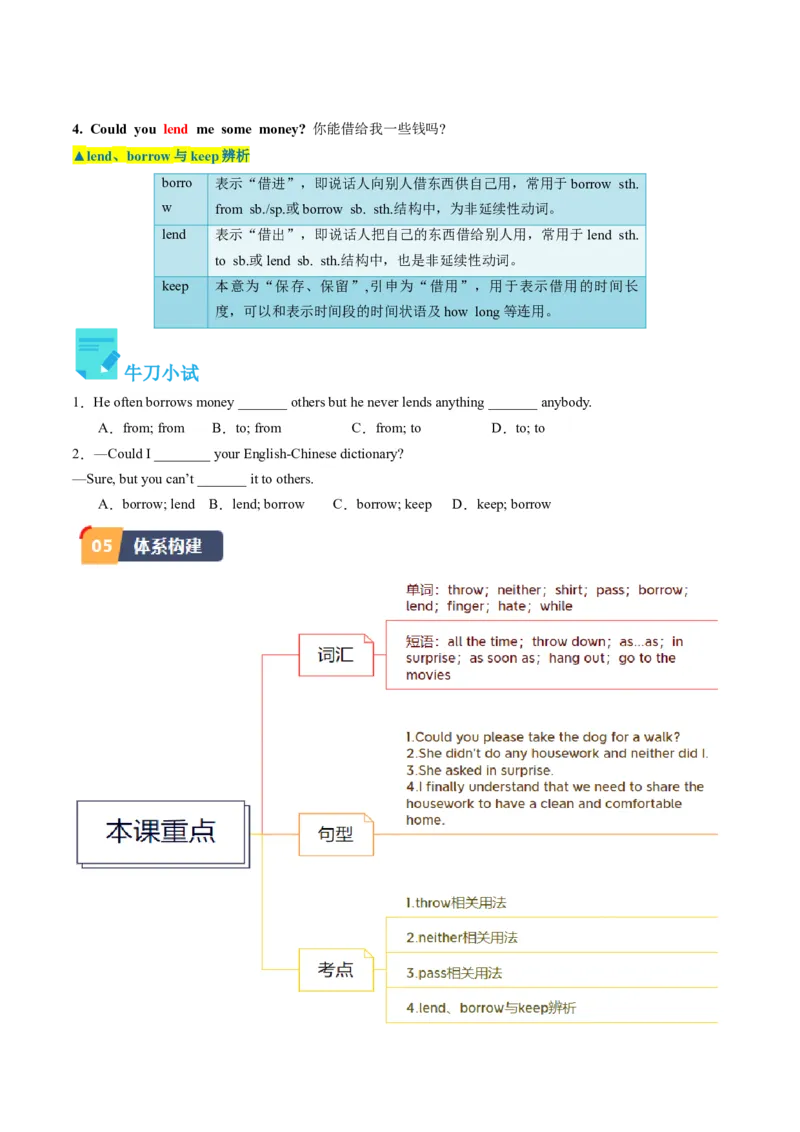
1.重点单词的含义及用法:throw;neither;shirt;pass;borrow;lend;finger;
hate;while
重点词汇
2.重难短语:all the time;throw down;as…as;in surprise;as soon as;hang
out;go to the movies
1.Could you please take the dog for a walk?
2.She didn’t do any housework and neither did I.
重点句型 3.She asked in surprise.
4.I finally understand that we need to share the housework to have a clean and
comfortable home.
1.学生能掌握并且使用所学新词和句型来表达日常生活中的琐事。
2.通过学习让学生受到爱的教育,爱父母,爱家庭,爱劳动,主动帮助父母承担家
技能目标 务。
3.在人际交往中学会礼貌用语,学会委婉的表达自己对事情的看法,做一个有修养
的好孩子。
重难单词默写与词性变换
1.扔;掷 v. →过去式:
2. 也不 adv.
3. 衬衫 n.
4. 给;递;走过;通过 v.
5. 借;借用 v.
6. 借给;借出 v. →过去式:
7. 手指 n.
8. 厌恶;讨厌 v.
9. 与……同时;当……的时候;而;然而conj.
经典短语默写:
1. 生某人的气
2. 扔下3. 在……前面
4. 过来;顺便拜访
5. 频繁;反复
6. 帮助解决
7. 惊讶地
8. 闲逛
9. 一……就
10. 去看电影
经典句型过关:
1.我扔下我的书包,去了起居室。
I my bag and I went to the living room.
2.在—周时间里,她没有做任何家务,我也没有做。
For one week, she did not do any housework and I.
3.当你帮我洗碗的时候,我会完成家庭作业。
I’ll finish my homework you me the dishes.
4.你能去遛遛狗吗?
Could you please the dog a walk?
5.她惊讶地问。
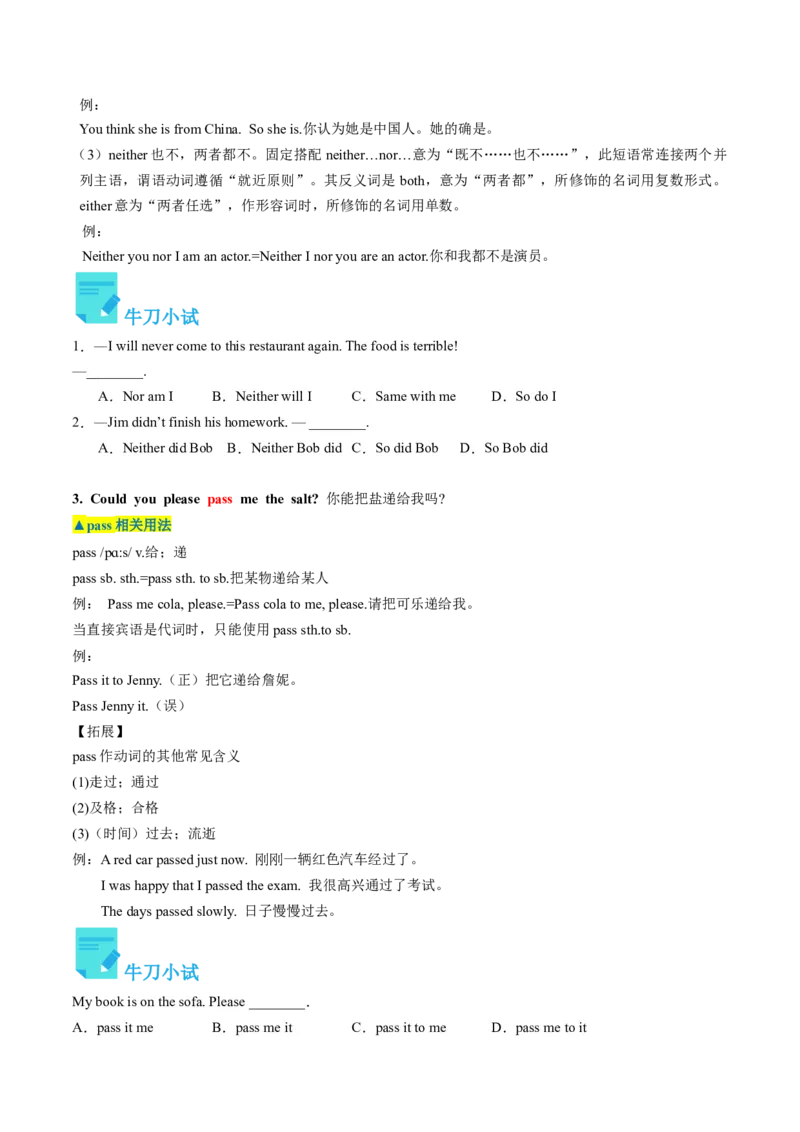
She asked .1. I threw down my bag and I went to the living room. 我扔下我的书包,去了起居室。
▲throw相关用法
throw-threw-thrown v.投, 掷,抛, 扔
用作及物动词,throw sb. sth.=throw sth. to sb.扔给某人某物。
例:
She threw me a towel.=She threw a towel to me. 她扔给我一块毛巾。
【拓展】
throw的其他常见短语:
throw away 扔掉;丢弃 throw to 投给……(不含有恶意) throw down 扔下
throw at 向……扔(恶意,带攻击性 )
例:
You should throw away those old newspapers. 你应该扔掉那些旧报纸。
He threw a ball to the dog. 他扔了一个球给这条狗。
Someone threw a stone at the car. 有人朝着这辆车扔石头。
She threw down her bag and lay on the sofa. 她扔下她的包,躺在沙发上。
牛刀小试
1.请扔掉这些垃圾。
Please the waste.
2.他扔下包就跳到河里去救那个男孩。
He his bag and jumped into the river to save that boy.
2.For one week, she did not do any housework and neither did I. 在—周时间里,她没有做任何家务,
我也没有做。
▲neither相关用法
“neither+助动词/系动词/情态动词+主语”表示上句否定的情况也适合于后者。“Neither +助动词/情态动
词/系动词+主语I”相当于Me neither。
例:
—They didn’t watch TV yesterday.他们昨天没有看电视。
—Me neither./ Neither did I.我也没看。
(1)“so+助动词/系动词(be)/情态动词+主语”表示后面的主语“亦如此,也同样”,说明前面的情况同
样也适用于后面。前面的主语和后面的主语不是同一个人/物。
例:
You can swim. So can I.你会游泳。我也会。
(2)“so+主语+助动词/系动词/情态动词”意为“正是那样,确实如此”,表示肯定上面的观点,前面的
主语和后面的主语是同一个人/物。例:
You think she is from China. So she is.你认为她是中国人。她的确是。
(3)neither也不,两者都不。固定搭配neither…nor…意为“既不……也不……”,此短语常连接两个并
列主语,谓语动词遵循“就近原则”。其反义词是 both,意为“两者都”,所修饰的名词用复数形式。
either意为“两者任选”,作形容词时,所修饰的名词用单数。
例:
Neither you nor I am an actor.=Neither I nor you are an actor.你和我都不是演员。
牛刀小试
1.—I will never come to this restaurant again. The food is terrible!
—________.
A.Nor am I B.Neither will I C.Same with me D.So do I
2.—Jim didn’t finish his homework. — ________.
A.Neither did Bob B.Neither Bob did C.So did Bob D.So Bob did
3. Could you please pass me the salt? 你能把盐递给我吗?
▲pass相关用法
pass /pɑ:s/ v.给;递
pass sb. sth.=pass sth. to sb.把某物递给某人
例: Pass me cola, please.=Pass cola to me, please.请把可乐递给我。
当直接宾语是代词时,只能使用pass sth.to sb.
例:
Pass it to Jenny.(正)把它递给詹妮。
Pass Jenny it.(误)
【拓展】
pass作动词的其他常见含义
(1)走过;通过
(2)及格;合格
(3)(时间)过去;流逝
例:A red car passed just now. 刚刚一辆红色汽车经过了。
I was happy that I passed the exam. 我很高兴通过了考试。
The days passed slowly. 日子慢慢过去。
牛刀小试
My book is on the sofa. Please ________.
A.pass it me B.pass me it C.pass it to me D.pass me to it4. Could you lend me some money? 你能借给我一些钱吗?
▲lend、borrow与keep辨析
borro 表示“借进”,即说话人向别人借东西供自己用,常用于borrow sth.
w from sb./sp.或borrow sb. sth.结构中,为非延续性动词。
lend 表示“借出”,即说话人把自己的东西借给别人用,常用于lend sth.
to sb.或lend sb. sth.结构中,也是非延续性动词。
keep 本意为“保存、保留”,引申为“借用”,用于表示借用的时间长
度,可以和表示时间段的时间状语及how long等连用。
牛刀小试
1.He often borrows money _______ others but he never lends anything _______ anybody.
A.from; from B.to; from C.from; to D.to; to
2.—Could I ________ your English-Chinese dictionary?
—Sure, but you can’t _______ it to others.
A.borrow; lend B.lend; borrow C.borrow; keep D.keep; borrow一、单项选择
1.—Will you go to Peter’s party this Saturday evening?
—I haven’t decided yet. If you don’t go, ________.
A.so do I B.neither do I C.so will I D.neither will I
2.Love your parents __________ they are alive. Don't wait until it is too late.
A.while B.though C.because D.unless
3.I hate __________ basketball with that kind of man.
A.playing B.play C.played D.plays
4.I’ll go to visit my aunt in England _______ the summer holiday starts.
A.while B.since C.until D.as soon as
5.Jenny has gone to Shanghai on business, but she’ll be back in 3 days. I will call you as soon as she ________.
A.returns B.will return C.returned D.has returned
6.—How long can I________ Robinson Crusoe, Mrs. Zhao?
—For two weeks.
A.keep B.get C.borrow D.lend
7.Students at Green High School often ________ books from their school library and can ________ them for a
week.
A.borrow; keep B.lend; keep C.borrow; borrow D.keep; borrow
8.John turned around and looked at Tom ________ surprise.
A.for B.with C.in D.to
9.— Could you tell me how to pay for the food by QR code (二维码) on the phone?
—__________.
A.Take it easy B.It doesn’t matter
C.You’re welcome D.Sure, I’d love to
10.—I didn’t go to Tom’s birthday party yesterday. What about you?
—________, because I was preparing for the exam all the time.
A.Neither was I B.Neither am I
C.Neither did I D.Neither do I
二、根据所给提示填空
1.The boy h eating rice day after day. He wants to eat something else.
2.Karen b a storybook from one of her friends yesterday because she likes reading.
3.He will leave for Shanghai as soon as he (finish) his work.
4.—My soup is not strong enough. Could you please p me some salt?
—Sure. Here you are.5.I was a little angry with him because he refused to l me some money.
6.My parents planned to buy a car, but n of them could drive the car.
7.I (扔)the ball to him, but he didn’t catch it.
8.The baby put one of his (手指)into his mouth to show that he needed food.
9.The kids saw the robot throw the ball into the box in (surprised).
10.These two sweaters are so expensive that I can afford n of them.
11.Could you keep quiet w I am doing my homework?
12.All the boys look so cool in white s and black trousers.
13.—Do you often help your parents do c at home?
—Yes, I clean the living room every day.
14.Jack went out of the classroom (angry).
15.My dog (come) over to welcome me as soon as I got back home.
三、选词填空
A
根据语境,从方框中选择恰当的单词填空,有的需要变换形式。
hang out, in surprise, do housework, the minute, in front of
1. Mr. Green came up with the good idea, he called me up.
2.There is a big park with beautiful trees and flowers our neighborhood.
3.After school, Mike by himself in the park and got back home late.
4.The one-year-old kid is looking at the cat in the picture .
5. is a good way to improve children's independence.
B
根据语境,从方框中选择恰当的单词填空,有的需要变换形式。
while, chore, lend, shirt, throw
1.—What did you buy in the store?
—I bought two and a pair of shoes for my father.
2.Emma her schoolbag on the sofa and went into her room.
3.—Do you like doing housework at home?
—Yes, I like doing like washing the clothes.
4.—I ran out of my money. Could you me some?
—Sure. How much do you need?
5.I lived in this apartment I was a student.
四、补全对话
根据对话内容,从A到F选项中,选出能填入空白处的最佳选项,每个选项只使用一次。选项中有一项为多余项。
A: Could I invite my friends to my birthday party on Saturday, Mom?
B: Of course! 1
A: Yeah, um.... 2
B: What for?
A: 3
B: Well, I will go shopping tomorrow. And I can buy some drinks and snacks for you.
A: Oh, good. Thank you, Mom.
B: You’re welcome. Oh, could you clean your room?
A: 4
B: You need to clean it again for your party.
A: OK. 5
B: That’s right. After you finish your homework, let’s clean the room. I can sweep the floor and do the dishes.
A: Great!
A.I cleaned it last week.
B.Could you give me some money?
C.That sounds like fun.
D.I need to buy some drinks and snacks.
E.Could you take out the rubbish?
F.But I need to do my homework first.
五、完形填空
After coming back from school, Nancy often has a walk 1 her dog. But last month, Nancy was too
2 to walk. She threw her schoolbag down and went to the living room to watch TV. As soon as she 3
the TV set, her mom came in and wanted her to take the 4 for a walk.
But Nancy wanted to watch TV first. Her mother became angry 5 she thought she did housework by herself
every day, but Nancy always watched TV and 6 helped her with the chores. However, Nancy thought she
was as tired as her mother. And she 7 back to her mother.
Nancy’s mother was so mad that she said 8 . She didn’t do any housework for a week, 9
did Nancy. As a result, everything was dirty.
Just at that time, Nancy realized that she was wrong. So she tried her best to 10 the room clean and
tidy. Her mother was surprised to see that, but she was happy.
From this story, we should know to share the housework with our parents to make a clean and comfortable
home.
1.A.for B.with C.to D.at
2.A.tired B.excited C.happy D.sad
3.A.turned into B.turned off C.turned down D.turned on
4.A.cat B.duck C.dog D.pig5.A.because B.while C.when D.though
6.A.always B.often C.sometimes D.never
7.A.turned B.shouted C.looked D.got
8.A.nothing B.anything C.something D.everything
9.A.either B.both C.neither D.so
10.A.take B.make C.know D.have