Unit 3 Could you please clean your room?
第1课时 Section A (1a-2d)
1.重点单词的含义及用法:rubbish;fold;sweep;floor;mess
重点词汇
2.重难短语:take out the rubbish;sweep the floor;make the bed;fold the
clothes
1.I’m going to work on the problem now.
2.Could you please help out with a few things?
重点句型
3.Peter, could you please take out the rubbish?
4.And she won’t be happy if she sees this mess.
5.Could I at least finish watching this show?
1.掌握表示家务劳动的短语
技能目标
2.听说结合,能让学生灵活地运用所学知识,增强学生的听说能力
重难单词默写与词性变换
1. 垃圾;废弃物 n.
2. 折叠;对折 v.
3. 扫;打扫 adj. →过去式:
4. 地板 n.
5. 杂乱;不整洁 n.
经典短语默写:
1. 倒垃圾
2. 扫地
3. 整理床铺
4. 叠衣服
5. 洗餐具6. 打扫起居室
7. 过来;顺便来访
8. 出去
9. 帮助解决
10. 从事;创作
11. 至少
12. 做完某事
13. 搭便车
经典句型过关:
1.彼得,你能把垃圾倒了吗?
Peter, could you please the ?
2.而且如果她看到这么乱,她会不高兴的。
And she happy if she this .
3.至少等我看完这个节目可以吗?
Could I finish this show?
4.我现在要致力于解决这个问题了。
I’m going to the problem now.
5.你能帮忙做几件事情吗?
Could you please a few things?1. Could you please take out the rubbish? 请你去倒一下垃圾好吗?
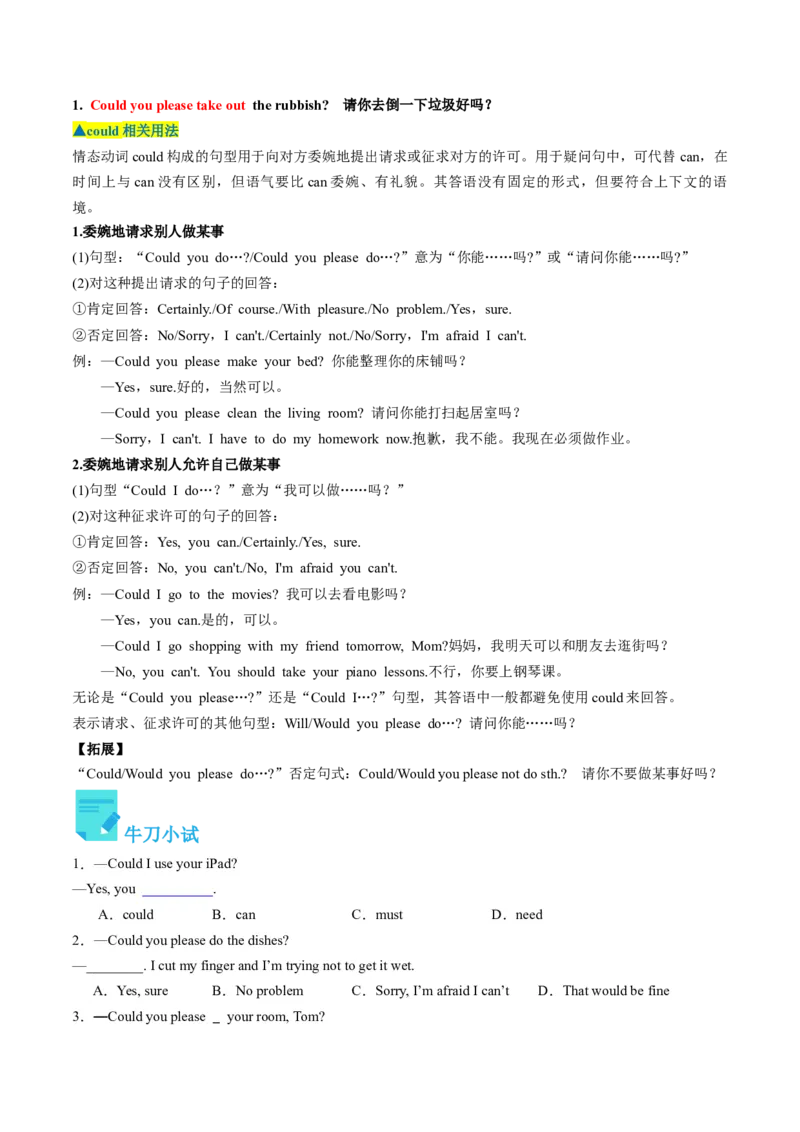
▲could相关用法
情态动词could构成的句型用于向对方委婉地提出请求或征求对方的许可。用于疑问句中,可代替can,在
时间上与can没有区别,但语气要比can委婉、有礼貌。其答语没有固定的形式,但要符合上下文的语
境。
1.委婉地请求别人做某事
(1)句型:“Could you do…?/Could you please do…?”意为“你能……吗?”或“请问你能……吗?”
(2)对这种提出请求的句子的回答:
①肯定回答:Certainly./Of course./With pleasure./No problem./Yes,sure.
②否定回答:No/Sorry,I can't./Certainly not./No/Sorry,I'm afraid I can't.
例:—Could you please make your bed? 你能整理你的床铺吗?
—Yes,sure.好的,当然可以。
—Could you please clean the living room? 请问你能打扫起居室吗?
—Sorry,I can't. I have to do my homework now.抱歉,我不能。我现在必须做作业。
2.委婉地请求别人允许自己做某事
(1)句型“Could I do…?”意为“我可以做……吗?”
(2)对这种征求许可的句子的回答:
①肯定回答:Yes, you can./Certainly./Yes, sure.
②否定回答:No, you can't./No, I'm afraid you can't.
例:—Could I go to the movies? 我可以去看电影吗?
—Yes,you can.是的,可以。
—Could I go shopping with my friend tomorrow, Mom?妈妈,我明天可以和朋友去逛街吗?
—No, you can't. You should take your piano lessons.不行,你要上钢琴课。
无论是“Could you please…?”还是“Could I…?”句型,其答语中一般都避免使用could来回答。
表示请求、征求许可的其他句型:Will/Would you please do…? 请问你能……吗?
【拓展】
“Could/Would you please do…?”否定句式:Could/Would you please not do sth.? 请你不要做某事好吗?
牛刀小试
1.—Could I use your iPad?
—Yes, you .
A.could B.can C.must D.need
2.—Could you please do the dishes?
—________. I cut my finger and I’m trying not to get it wet.
A.Yes, sure B.No problem C.Sorry, I’m afraid I can’t D.That would be fine
3.—Could you please your room, Tom?—________.
A.cleaning, No problem B.clean, Certainly
C.to clean, Of course D.clean, No I couldn’t
4.—Can you give me a ride to work tomorrow morning?
—________. I’ll pick you up at 8:00 a.m.
A.Sure B.I’m sorry C.Go ahead D.That’s right
▲take out相关用法
take out 拿出来, 取出来
take … out of … 把……从……中拿出来
例:He took a dictionary out. 他拿出来一本字典。
He took a dictionary out of his bag. 他从书包里拿出来一本字典。
牛刀小试
Oh, so much rubbish! Please ________ right now.
A.take out it B.take it out C.take out them D.take them out
2.I’m going to work on the problem now. 我现在要致力于解决这个问题了。
▲work on相关用法
work on是一个动词短语,on为介词,表示“从事某项工作;做某项工作或研究;创作作品、作画;开机
器等”。
例:My father is an author. He is working on a new novel. 我爸爸是一位作家。他正在写一部新小说。
work on sb./sth. 奏效,产生预期的结果
例:The pills work on cough well.这些药片对治疗咳嗽很有效果。
His charm doesn’t work on me.我不为他的魅力所动。
【拓展】
(1)work hard at意为“努力学习;努力做”。
例:My sister works hard at the new job. 我姐姐努力做着那份新工作。
(2)work out意为“算出;想出(办法等)”。
例:The math problem is too difficult. I can’t work it out. 这道数学题太难了,我算不出来。
(3)at work意为“在工作;在运转”,常作表语,与be动词连用。
例:Her mother is at work now.她母亲此时正在上班。
牛刀小试
You can’t use my computer because I'm ________ it.
A.using on B.working on C.working for D.using for3.Could I at least finish watching this show?至少等我看完这个节目可以吗?
▲finish相关用法
(1)finish在此为及物动词,意为“完成”,后常接名词、代词、动词-ing形式,不可接不定式。finish
有时也可以单独使用,后面不接任何成分,意为“(使)结束”。
例:Can you finish reading the book in three days? 你能在三天内读完这本书吗?
The play finished at 10:30.比赛于10:30结束。
(2)finish 作名词,意为“结束;结局;完成”。
例:They waited to see the finish of the race.他们等着看比赛的结局。
They won in the end but it was a tight finish.他们终于赢了,但比分十分接近。
【拓展】
只能接动词-ing形式作宾语的常见动词和动词短语
喜欢(enjoy) 盼望(look forward to) 介意(mind) 愉快(have fun)
完成(finish) 练习(practice) 忙(be busy) 考虑(consider)
想要(feel like) 放弃(give up)
牛刀小试
—Would you like to go shopping?
—I'd like to, but I have to finish ________ my homework first.
A.doing B.to do C.did D.do
4. And she won’t be happy if she sees this mess. 而且如果她看到这么乱,她会不高兴的。
▲mess相关用法
mess名词,意为“杂乱;不整洁”。常用短语:in a mess “乱七八糟”
例:The room was in a terrible mess. 房间里脏乱不堪。
The children made a mess in the living room. 孩子们把起居室弄得很乱。
牛刀小试
You’d better not ________ your bedroom a ________.
A.make, mess B.to make, mess C.make, messy D.to make, messy一、单项选择
1.—________ you give me a hand? I can't move the box by myself.
—No problem.
A.Could B.Should C.Must D.Need
2. For kids of this age, two hours of sitting in a classroom ________ too long.
A.is B.are C.was D.were
3.John, please _________your dictionary from the schoolbag and look up the new word.
A.take away B.take up C.take off D.take out
4.—What does Tom’s newest smart phone look like?
—It’s wonderful! You can ________ it in half just like closing a book.
A.hand B.open C.fold D.cut
5.—Could you help me with the math problem?
— _______________. I’m too busy now.
A.Yes, please B.No, sure C.Yes, you could D.Sorry, I can’t二、根据所给提示填空
1.Last Saturday my brother washed the clothes and I (打扫) the floor.
2.—Could you please (not smoke) in the room?
—Oh, I’m sorry.
3.Look! The old man is picking up r near the dustbin (垃圾箱).
4.Your room is in a (杂乱). I think you should tidy it up.
5.There are some books on the (地板). Are they yours?
6.Could you please help out with a f things in the kitchen?
7.Mr. Li f his clothes and put them in his bag.
8. Could you please (make)your bed.
9.—Could I (外出就餐) with Peter, Dad?
—Sure.
10.We (搭便车) into town because we missed the bus.
三、完成句子
1.房间里垃圾太多了。请你带出去倒掉好吗?
There is too much rubbish in the room. Could you please ?
2.——请你洗餐具,好吗?
——对不起,我不能,我得做作业
—Could you please ?
—Sorry, I can’t. I do my homework.
3.——请你扫一下地好吗?
——没问题。
— you the floor?
— .
4.起床后,请整理床铺。
Please after you get up.
5.——我可以去看电影吗?
——对不起, 你不能去。你得学习准备数学考试。
— I to the movies?
—Sorry, you . You study for the math test.
四、选词填空
根据语境,从方框中选择恰当的单词填空,有的需要变换形式。
mess, sweep, fold, floor
1.—During the Spring Festival people don’t clean the room, yes?—Yeah! They don’t want to away good luck.
2.Look, Jim! Your socks are on the .
3.—Where’s Helen?
—She’s her clothes in her room.
4.Your mom must be angry when she sees this in your room.
五、补全对话
根据对话内容,从方框中选择恰当的选项补全对话,其中有两项多余。
A: Jim, what are you doing?
B: 1
A: Oh, no! You made Emma’s room untidy. When she sees this, she’ll be angry.
B: 2
A: Very easy! Clean her room.
B: She will come back soon. 3
A: No problem. 4
B: First help me to clean her desk. Then help to tidy up her books.
A: OK. 5
B: Oh, no! Please help me first.
A: OK.
A.Could you please help out with a few things?
B.I’m playing with my pet dog in Emma’s room.
C.What’s the matter?
D.But could I finish my homework first?
E.What do you want me to do?
F.Thank you for your help.
G.What should I do?