Unit 1 What’s the matter?
第1课时 Section A (1a-2d)
1.重点单词的含义及用法: matter;sore;stomachache;foot;neck;stomach;
throat;fever;lie;rest;cough;X-ray;toothache;headache;break;hurt
重点词汇
2.重难短语:have a cold;have a stomachache;have a fever;have a sore
throat;hurt oneself;too much;lie down;see a dentist;get an X-ray;take one's
temperature;put some medicine on...;play computer games;all weekend;take
breaks/take a break
1.—What’s the matter with sb.?某人怎么了?
重点句型
—I have a.../He/She has a...我/他/她……
2.You/He/She should... 你/他/她应该……
1.能听懂并表述身体种种不适的话题。
技能目标
2.能就健康与安全问题提出合理的建议。
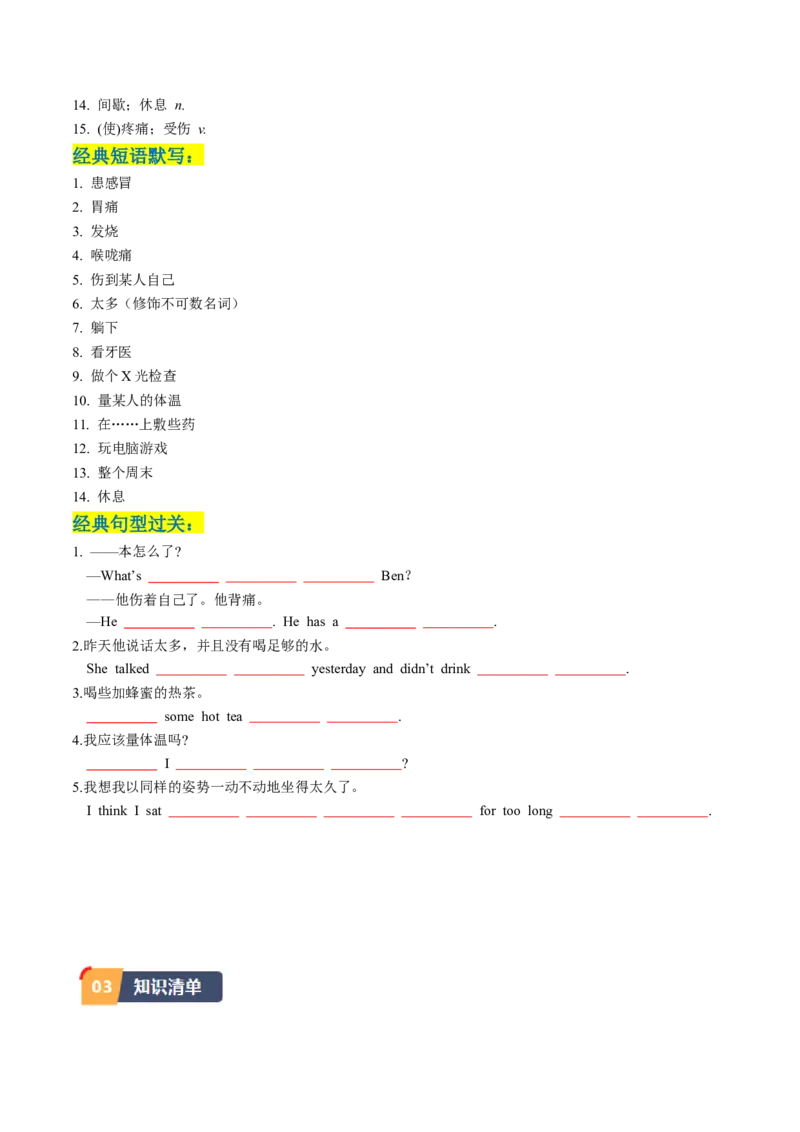
重难单词默写与词性变换
1.问题;事情 n.
2.胃痛;腹痛 n.
3.脚;足 n. →复数形式:
4. 颈;脖子 n.
5. 胃;腹部 n.
6. 咽喉;喉咙 n.
7. 发烧 n.
8. 躺;平躺 v. →过去式: →现在分词:
9. 放松;休息 v.&n.
10. 咳嗽 v.&n.
11. X射线;X光 n.
12. 牙痛 n.
13. 头痛 n.14. 间歇;休息 n.
15. (使)疼痛;受伤 v.
经典短语默写:
1. 患感冒
2. 胃痛
3. 发烧
4. 喉咙痛
5. 伤到某人自己
6. 太多(修饰不可数名词)
7. 躺下
8. 看牙医
9. 做个X光检查
10. 量某人的体温
11. 在……上敷些药
12. 玩电脑游戏
13. 整个周末
14. 休息
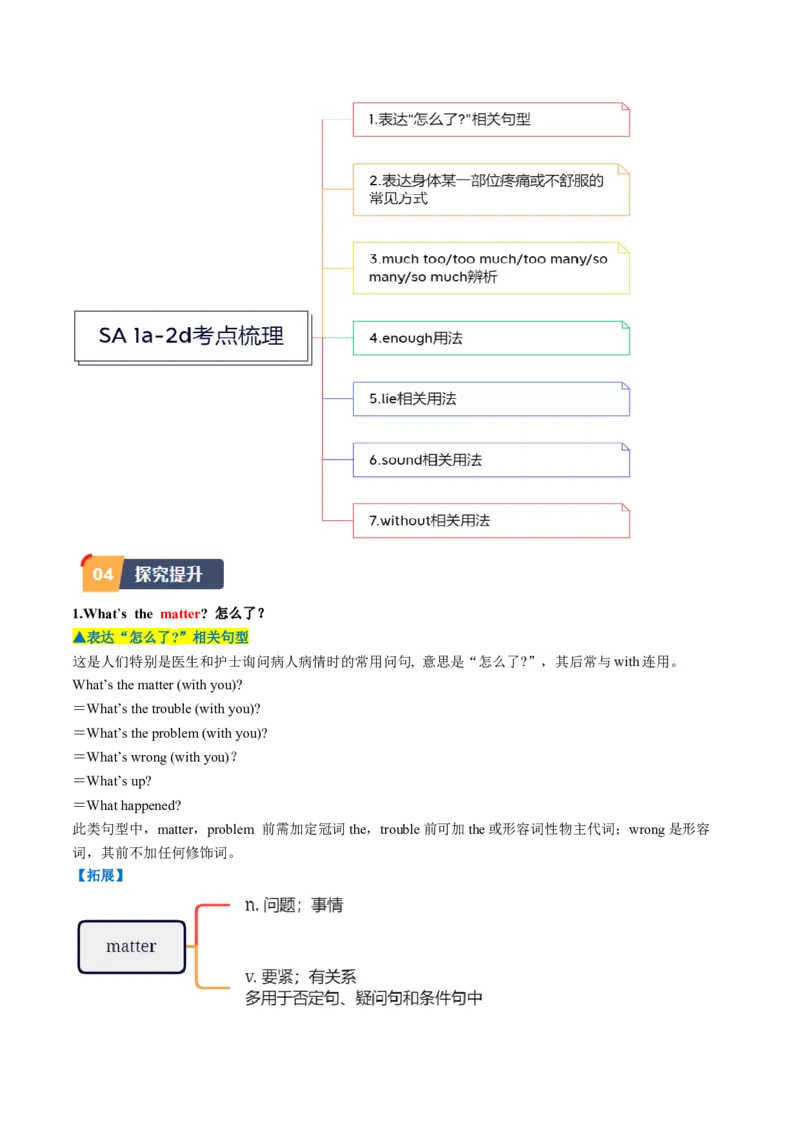
经典句型过关:
1. ——本怎么了?
—What’s Ben?
——他伤着自己了。他背痛。
—He . He has a .
2.昨天他说话太多,并且没有喝足够的水。
She talked yesterday and didn’t drink .
3.喝些加蜂蜜的热茶。
some hot tea .
4.我应该量体温吗?
I ?
5.我想我以同样的姿势一动不动地坐得太久了。
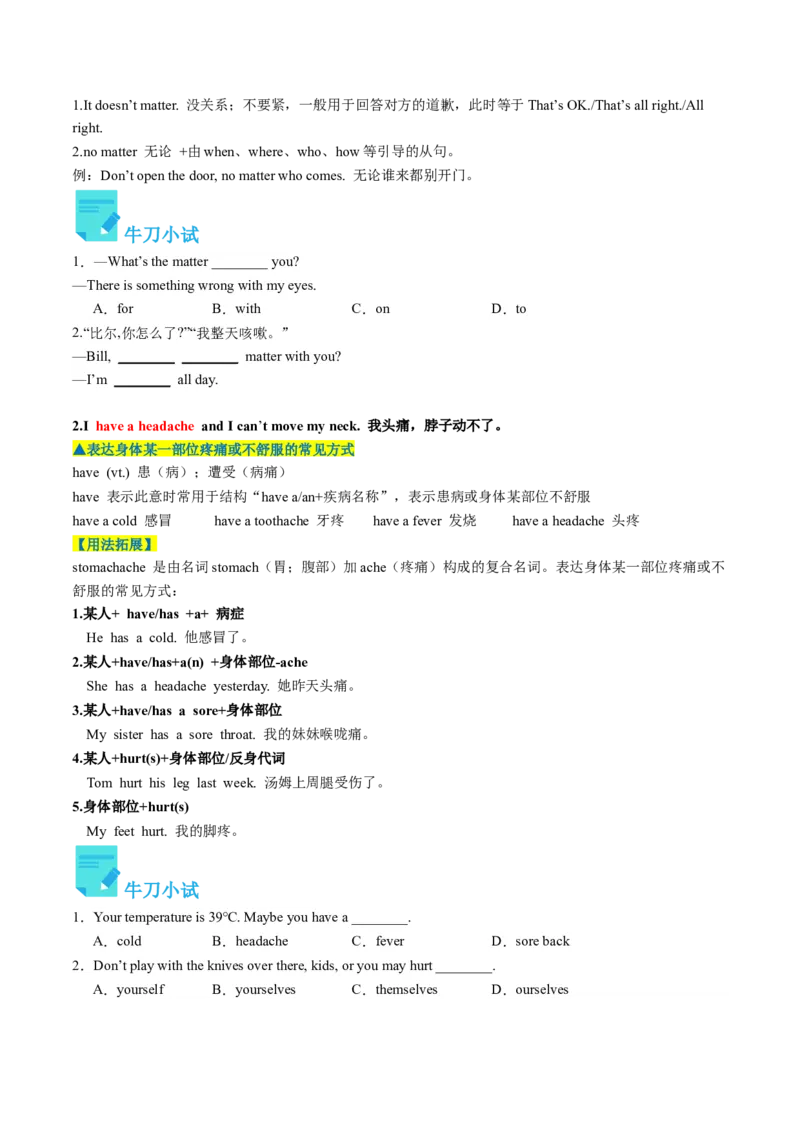
I think I sat for too long .1.What’s the matter? 怎么了?
▲表达“怎么了?”相关句型
这是人们特别是医生和护士询问病人病情时的常用问句, 意思是“怎么了?”,其后常与with连用。
What’s the matter (with you)?
=What’s the trouble (with you)?
=What’s the problem (with you)?
=What’s wrong (with you)?
=What’s up?
=What happened?
此类句型中,matter,problem 前需加定冠词the,trouble前可加the或形容词性物主代词;wrong是形容
词,其前不加任何修饰词。
【拓展】1.It doesn’t matter. 没关系;不要紧,一般用于回答对方的道歉,此时等于That’s OK./That’s all right./All
right.
2.no matter 无论 +由when、where、who、how等引导的从句。
例:Don’t open the door, no matter who comes. 无论谁来都别开门。
牛刀小试
1.—What’s the matter ________ you?
—There is something wrong with my eyes.
A.for B.with C.on D.to
2.“比尔,你怎么了?”“我整天咳嗽。”
—Bill, ________ ________ matter with you?
—I’m ________ all day.
2.I have a headache and I can’t move my neck. 我头痛,脖子动不了。
▲表达身体某一部位疼痛或不舒服的常见方式
have (vt.) 患(病);遭受(病痛)
have 表示此意时常用于结构“have a/an+疾病名称”,表示患病或身体某部位不舒服
have a cold 感冒 have a toothache 牙疼 have a fever 发烧 have a headache 头疼
【用法拓展】
stomachache 是由名词stomach(胃;腹部)加ache(疼痛)构成的复合名词。表达身体某一部位疼痛或不
舒服的常见方式:
1.某人+ have/has +a+ 病症
He has a cold. 他感冒了。
2.某人+have/has+a(n) +身体部位-ache
She has a headache yesterday. 她昨天头痛。
3.某人+have/has a sore+身体部位
My sister has a sore throat. 我的妹妹喉咙痛。
4.某人+hurt(s)+身体部位/反身代词
Tom hurt his leg last week. 汤姆上周腿受伤了。
5.身体部位+hurt(s)
My feet hurt. 我的脚疼。
牛刀小试
1.Your temperature is 39℃. Maybe you have a ________.
A.cold B.headache C.fever D.sore back
2.Don’t play with the knives over there, kids, or you may hurt ________.
A.yourself B.yourselves C.themselves D.ourselves3. She talked too much yesterday and didn’t drink enough water. 昨天她说话太多,并且没有喝足够
的水。
▲much too/too much/too many/so many/so much辨析
much too 太 关键词为too, This dish is much too salty.
修饰形容词/副词 这道菜太咸了。
too much 太多 关键词为much, Today I have too much homework to do.
修饰不可数名词/动 今天我有太多家庭作业要做。
词 Don't speak too much at the meeting.
不要在会议上说太多。
too many 太多的 关键词为many, I have too many questions to ask.
修饰复数名词 我有太多问题要问。
so many 如此多 关键词为many, There are so many cars on the street.
修饰复数名词 街上有太多的汽车。
so much 如此多 关键词为much, There was so much food that we couldn't eat it
修饰不可数名词 all.
有如此多的食物以至于我们吃不完。
牛刀小试
The teacher said there was ________ ice in the river, so it was ________ cold.
A.too much; much tooB.too much; many too
C.much too; too muchD.much too; too many
▲enough用法
①enough (adj.)足够的,充足的 enough+名词
例:We have enough money to buy a car. 我们有足够的钱买一辆车。
②enough (adv.)足够地,充分地 副词/形容词+enough
例:She is brave enough to fight with the robber. 她足够勇敢到可以和抢劫犯斗争。
牛刀小试
1.— Let’s go and see Avatar: The Way of Water.
— Oh, it is too long a film and I don’t think I’ll have _________ to watch it today.
A.many time B.time enough C.much time D.enough time
2.You aren’t ________ to drive a car.
A.old enough B.enough old
C.young enough D.enough young
4. I think you should lie down and rest. 我认为你应该躺下休息。
▲lie相关用法
(1) v.躺 lie-lay-lain-lying 搭配:lie down 躺下You'd better lie down and rest. 你最好躺下休息。
(2) v.位于
All the motels lie beside the road. 所有的汽车旅馆都位于公路两边。
(3)v.说谎 lie-lied-lied-lying 搭配:lie to sb.对某人撒谎
You are lying to me.你在对我撒谎。
n.谎言 搭配:tell lies/tell a lie 说谎
A half truth is often no better than a lie. 半真半假的话不见得比说谎要好。
【图解】
【拓展】
lay v.下蛋;放置 lay-laid-laid-laying 搭配:lay out 摆放
He laid out some food on the table. 他在桌子上摆放了些食物。
牛刀小试
1.Being tired after the training, the player ________ down on the bed and fell asleep.
A.lie B.lay C.will lie D.is lying
2.When I arrived home, I found my pet cat ________ in bed.
A.lies B.lying C.lied D.lie
3.—Is your home near your school, Jack?
—No, my home ________ in the east of our city, ________ my school is in the west.
A.lie; but B.lies; but C.lays; so D.lay; and
5.It doesn’t sound like you have a fever. 听起来你不像发烧。
▲sound相关用法
【拓展】注意:以上所有感官系动词后都接形容词。
牛刀小试
1.Oh, your idea ________ interesting. I love it.
A.sounds like B.is sounding C.is sounding like D.sounds
2.That __________ a good plan (计划).
A.sound B.sounds like C.sounds D.sound like
6. I think I sat take my temperature take for too long without moving.
我想我以同样的姿势一动不动地坐得太久了。
▲without相关用法
①without意为“没有;缺乏”,后接名词、代词宾格或v.ing作宾语,其反义词为with。
例:We got there without any trouble. 我们没有任何困难就到那里了。
She left the room without saying a word. 她一言不发地离开了房间。
②without 用于否定句,表示条件,意为“如果没有”,可与if引导的否定条件状语从句转换。
例:We can’t finish the work without your help.
=We can’t finish the work if you don't help us. 如果没有你们的帮助,我们完不成工作。
牛刀小试
1.Nowadays black coffee is becoming popular, many people prefer a cup of coffee ________ nothing in it.
A.with B.without C.for D.to
2.My dream hometown is a wonderful place ________ any pollution.
A.with B.without C.for D.in一、单项选择
1.I had ________ sore leg and the doctor advised me to get ________ X-ray of my leg.
A.a; the B.a; an C.the; an D./; the
2.— Andy practiced hardest among us and he won first prize in the competition.
— A dream can’t come true ________ hard work.
A.by B.across C.over D.without
3.—What’s the matter with you?
—I have a________.
—Maybe you should see a dentist.A.headache B.fever C.cold D.toothache
4.Look! There are ________ sheep on the hill.
A.so many B.so much C.too much D.much too
5.Never lose your heart. If you work ________, I believe you will be successful.
A.hardly enough B.enough hardly C.hard enough D.enough hard
6.—Can you ________ anything strange?
— It ________ a small mouse.
A.listen, sounds B.hear, sounds like
C.hear, sounds D.listen, sounds like
7.The man fell off the tree and ________on the ground.
A.lie B.lay C.lied D.laid
8.—I can’t go to school because of the serious epidemic.
—_________.
A.I’m sorry to hear that B.Thank you
C.That sounds great D.That’s OK
9.I have ________ things to do today, so I’m ________ busy.
A.too many; much too B.too many; too many
C.too much; much too D.too much; too many
10.—Hi, John. ______ ?
—It's Lucy, my dog. Her leg is hurt.
A.How are you B.What's the matter
C.Who's that D.What's Lucy like
二、根据所给提示填空
根据所给提示完成句子。每空一词
1.I think giraffes have the longest (neck) in the world.
2.Emma (hurt) her back when she fell off her horse.
3.Bill didn’t finish the work because he had a terrible (head).
4.—Cindy, you didn’t sleep well?
—Yes, I (cough) all night long.
5.My father’s (stomach) stopped after he took the medicine.
6.The manager asked the workers to stop digging and take (break).
7.This is a machine to warm our (foot) in winter.
8.—Why are you still (lie)in bed, dear?
—Because I’m angry now. My best friend Betty didn’t tell me the truth.
9.Just now Mrs. Smith left here without (say) goodbye to us.
10.It’s natural to have butterflies in your (胃)before an exam.
三、根据句意及所给汉语提示,用恰当的短语填空。
1.When you (感冒), food has very little flavor (味道) to you.2. (躺下) on your bed and make yourself comfortable.
3.You shouldn’t go outside, for you still (发烧).
4.We have walked for two hours. Can we (休息)?
5.It sounds like you’re coming down with the flu. Let me (量体温).
四、情景交际
根据对话内容,选择恰当的选项补全对话,其中有两项多余。
A: Hey, Bill. 1
B: My back hurts.
A: 2
B: No, I didn’t.
A: 3
B: I practiced riding my bike.
A: 4
B: About two hours.
A: I see. You just strained your muscles (拉伤肌肉).
B: Really? 5
A: Lie down and relax for two hours, and you will feel better.
B: OK. Thanks.
A.Did you move anything heavy yesterday?
B.What should I do?
C.Well, what did you do yesterday?
D.What’s the matter?
E.That sounds great.
F.How can I help you?
G.How long did you do that?
五、完形填空
I believe listening is powerful medicine.
It was Sunday. I had the last patient (病人) to see and I got into her room. She was an old woman, sitting on the
bed and trying to 1 her socks. I said, “How are you feeling? The nurse says your 2 is visiting you today.
I’m sure you’ll be happy to see him.”
She 3 me with a serious voice, “Sit down, doctor. This is my story.”
I was surprised. She began to tell me that her only son lived not far from her, 4 she had not seen him for
five years. She believed 5 health problems were worse because of missing her son. After hearing her story and
helping her put on her socks, I asked if there was anything I could do for her. She said “No” and smiled. All she
wanted me to do was to 6 .
Each story is 7 . Some are clear. Others are not. But all those things do not really 8 . What matters to
the storyteller is that the story is heard.
Listening to someone’s story is easy but it is 9 the key to healing (康复). I always tell myself the 10of stopping, sitting down and truly listening. I believe in the power of listening.
1.A.put off B.take off C.clean out D.put on
2.A.son B.daughter C.sister D.father
3.A.showed B.stopped C.asked D.hit
4.A.or B.so C.but D.if
5.A.her B.his C.your D.my
6.A.see B.wait C.listen D.feel
7.A.sad B.true C.terrible D.different
8.A.happen B.mean C.matter D.change
9.A.really B.well C.badly D.loudly
10.A.risk B.spirit C.difficulty D.importance