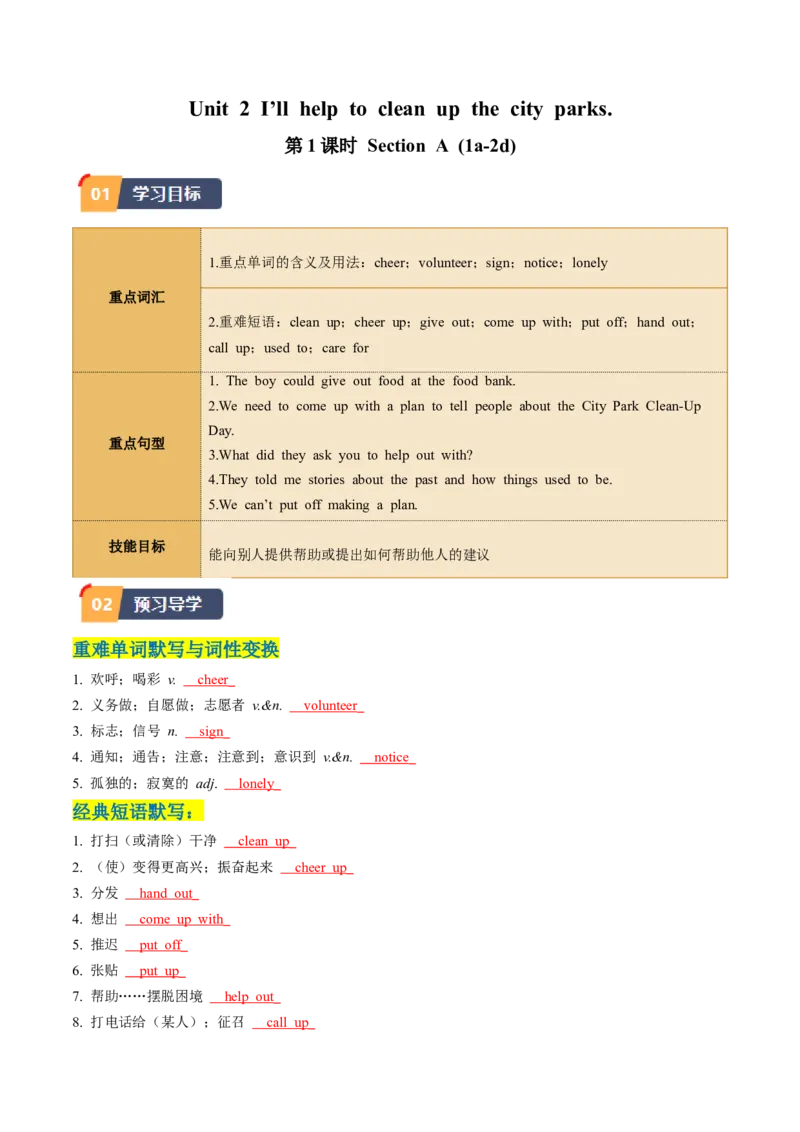
Unit 2 I’ll help to clean up the city parks.
第1课时 Section A (1a-2d)
1.重点单词的含义及用法:cheer;volunteer;sign;notice;lonely
重点词汇
2.重难短语:clean up;cheer up;give out;come up with;put off;hand out;
call up;used to;care for
1. The boy could give out food at the food bank.
2.We need to come up with a plan to tell people about the City Park Clean-Up
Day.
重点句型
3.What did they ask you to help out with?
4.They told me stories about the past and how things used to be.
5.We can’t put off making a plan.
技能目标
能向别人提供帮助或提出如何帮助他人的建议
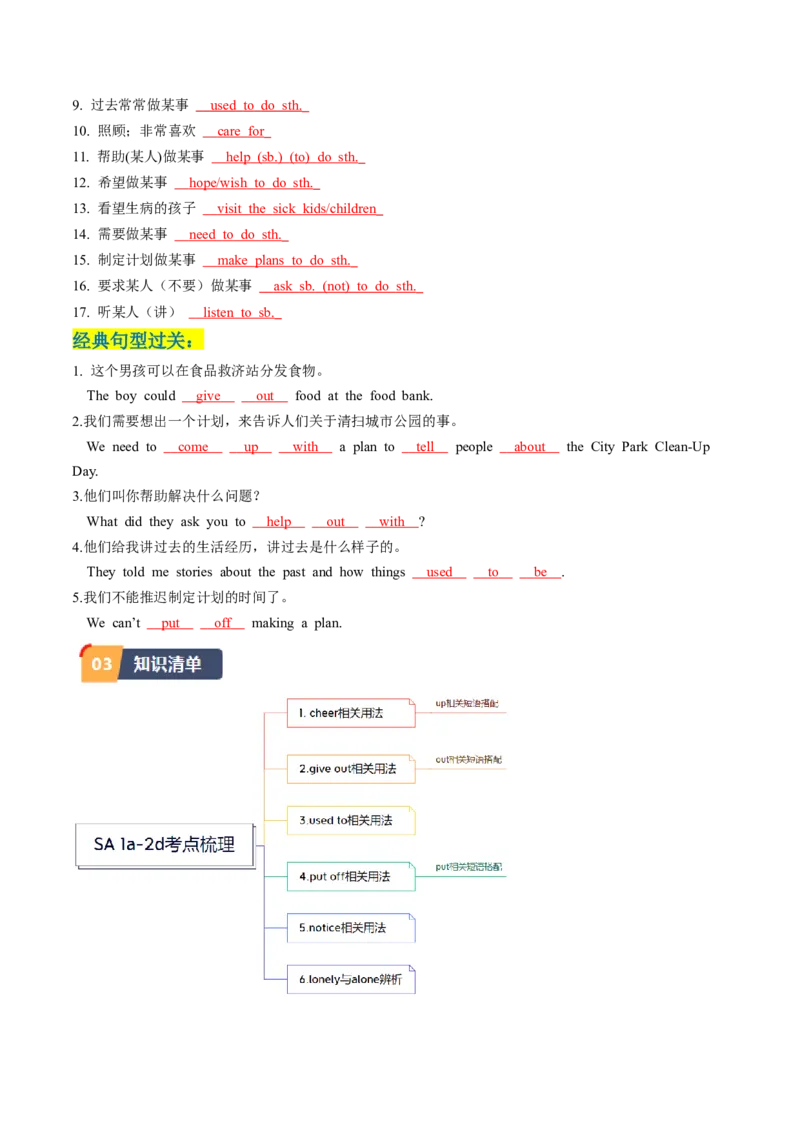
重难单词默写与词性变换
1. 欢呼;喝彩 v. chee r
2. 义务做;自愿做;志愿者 v.&n. voluntee r
3. 标志;信号 n. sig n
4. 通知;通告;注意;注意到;意识到 v.&n. notic e
5. 孤独的;寂寞的 adj. lonel y
经典短语默写:
1. 打扫(或清除)干净 clea n u p
2. (使)变得更高兴;振奋起来 chee r u p
3. 分发 han d ou t
4. 想出 com e u p wit h
5. 推迟 pu t of f
6. 张贴 pu t u p
7. 帮助……摆脱困境 hel p ou t
8. 打电话给(某人);征召 cal l u p9. 过去常常做某事 use d t o d o sth .
10. 照顾;非常喜欢 car e fo r
11. 帮助(某人)做某事 hel p (sb. ) (to ) d o sth .
12. 希望做某事 hope/wis h t o d o sth .
13. 看望生病的孩子 visi t th e sic k kids/childre n
14. 需要做某事 nee d t o d o sth .
15. 制定计划做某事 mak e plan s t o d o sth .
16. 要求某人(不要)做某事 as k sb . (not ) t o d o sth .
17. 听某人(讲) liste n t o sb .
经典句型过关:
1. 这个男孩可以在食品救济站分发食物。
The boy could giv e ou t food at the food bank.
2.我们需要想出一个计划,来告诉人们关于清扫城市公园的事。
We need to com e u p wit h a plan to tel l people abou t the City Park Clean-Up
Day.
3.他们叫你帮助解决什么问题?
What did they ask you to hel p ou t wit h ?
4.他们给我讲过去的生活经历,讲过去是什么样子的。
They told me stories about the past and how things use d t o b e .
5.我们不能推迟制定计划的时间了。
We can’t pu t of f making a plan.1.The girl could visit the sick kids in the hospital to cheer them up. 这时司机看到一位老人正躺在路
边。
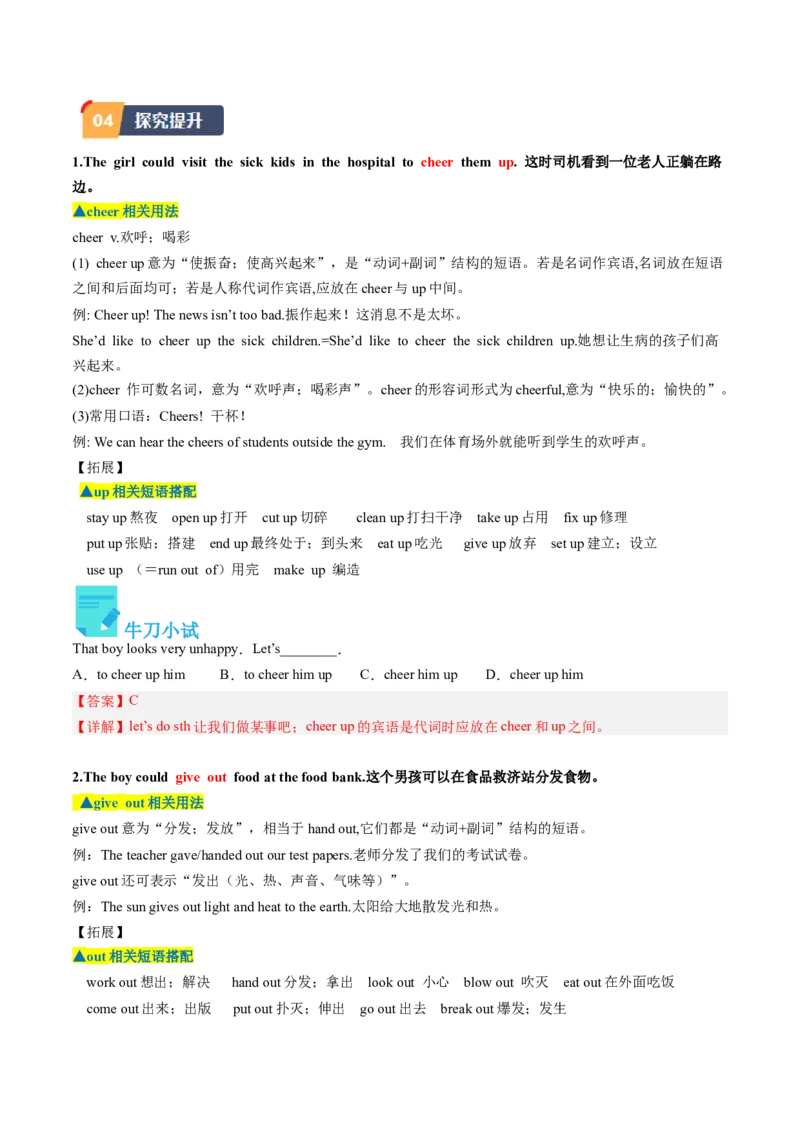
▲cheer相关用法
cheer v.欢呼;喝彩
(1) cheer up意为“使振奋;使高兴起来”,是“动词+副词”结构的短语。若是名词作宾语,名词放在短语
之间和后面均可;若是人称代词作宾语,应放在cheer与up中间。
例: Cheer up! The news isn’t too bad.振作起来!这消息不是太坏。
She’d like to cheer up the sick children.=She’d like to cheer the sick children up.她想让生病的孩子们高
兴起来。
(2)cheer 作可数名词,意为“欢呼声;喝彩声”。cheer的形容词形式为cheerful,意为“快乐的;愉快的”。
(3)常用口语:Cheers! 干杯!
例: We can hear the cheers of students outside the gym. 我们在体育场外就能听到学生的欢呼声。
【拓展】
▲up相关短语搭配
stay up熬夜 open up打开 cut up切碎 clean up打扫干净 take up占用 fix up修理
put up张贴;搭建 end up最终处于;到头来 eat up吃光 give up放弃 set up建立;设立
use up (=run out of)用完 make up 编造
牛刀小试
That boy looks very unhappy.Let’s________.
A.to cheer up him B.to cheer him up C.cheer him up D.cheer up him
【答案】C
【详解】let’s do sth让我们做某事吧;cheer up的宾语是代词时应放在cheer和up之间。
2.The boy could give out food at the food bank.这个男孩可以在食品救济站分发食物。
▲give out相关用法
give out意为“分发;发放”,相当于hand out,它们都是“动词+副词”结构的短语。
例:The teacher gave/handed out our test papers.老师分发了我们的考试试卷。
give out还可表示“发出(光、热、声音、气味等)”。
例:The sun gives out light and heat to the earth.太阳给大地散发光和热。
【拓展】
▲out相关短语搭配
work out想出;解决 hand out分发;拿出 look out 小心 blow out 吹灭 eat out在外面吃饭
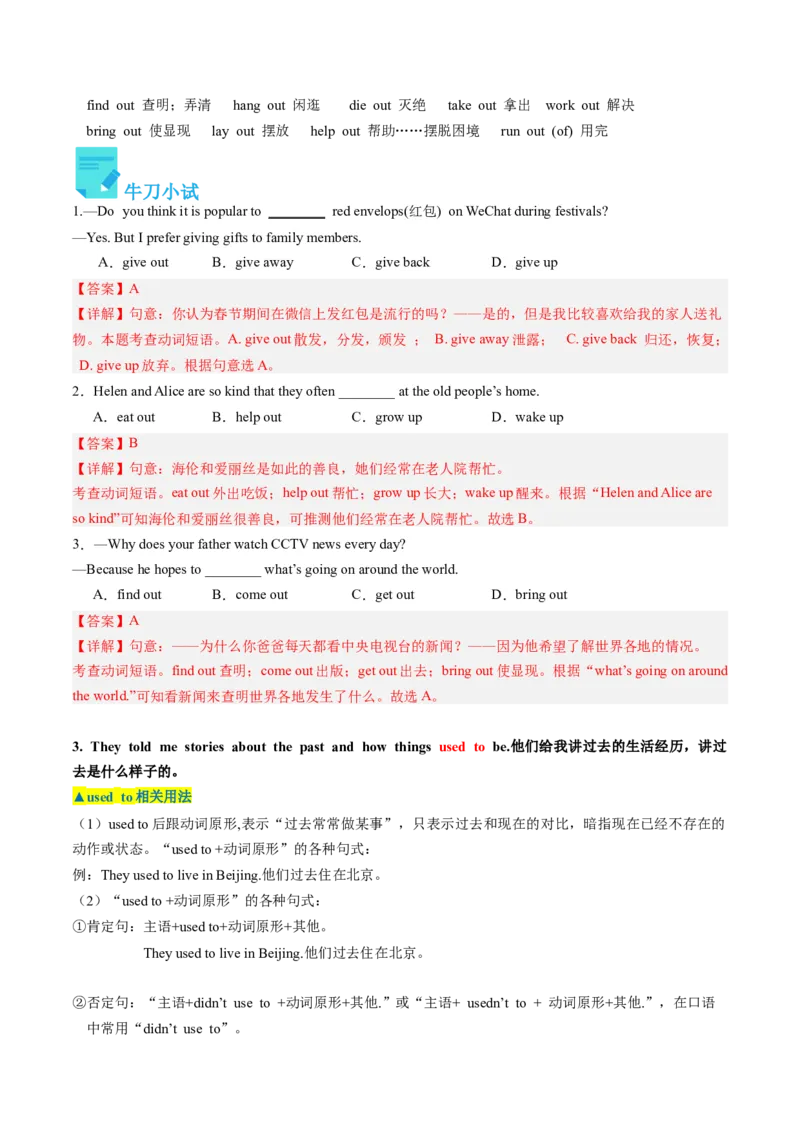
come out出来;出版 put out扑灭;伸出 go out出去 break out爆发;发生find out 查明;弄清 hang out 闲逛 die out 灭绝 take out 拿出 work out 解决
bring out 使显现 lay out 摆放 help out 帮助……摆脱困境 run out (of) 用完
牛刀小试
1.—Do you think it is popular to ________ red envelops(红包) on WeChat during festivals?
—Yes. But I prefer giving gifts to family members.
A.give out B.give away C.give back D.give up
【答案】A
【详解】句意:你认为春节期间在微信上发红包是流行的吗?——是的,但是我比较喜欢给我的家人送礼
物。本题考查动词短语。A. give out散发,分发,颁发 ; B. give away泄露; C. give back 归还,恢复;
D. give up放弃。根据句意选A。
2.Helen and Alice are so kind that they often ________ at the old people’s home.
A.eat out B.help out C.grow up D.wake up
【答案】B
【详解】句意:海伦和爱丽丝是如此的善良,她们经常在老人院帮忙。
考查动词短语。eat out外出吃饭;help out帮忙;grow up长大;wake up醒来。根据“Helen and Alice are
so kind”可知海伦和爱丽丝很善良,可推测他们经常在老人院帮忙。故选B。
3.—Why does your father watch CCTV news every day?
—Because he hopes to ________ what’s going on around the world.
A.find out B.come out C.get out D.bring out
【答案】A
【详解】句意:——为什么你爸爸每天都看中央电视台的新闻?——因为他希望了解世界各地的情况。
考查动词短语。find out查明;come out出版;get out出去;bring out使显现。根据“what’s going on around
the world.”可知看新闻来查明世界各地发生了什么。故选A。
3. They told me stories about the past and how things used to be.他们给我讲过去的生活经历,讲过
去是什么样子的。
▲used to相关用法
(1)used to后跟动词原形,表示“过去常常做某事”,只表示过去和现在的对比,暗指现在已经不存在的
动作或状态。“used to +动词原形”的各种句式:
例:They used to live in Beijing.他们过去住在北京。
(2)“used to +动词原形”的各种句式:
①肯定句:主语+used to+动词原形+其他。
They used to live in Beijing.他们过去住在北京。
②否定句:“主语+didn’t use to +动词原形+其他.”或“主语+ usedn’t to + 动词原形+其他.”,在口语
中常用“didn’t use to”。例:I didn’t use to have long hair.=I usedn’t to have long hair.我过去不留长发。
③一般疑问句:“Did+主语+use to+动词原形+其他?”或“Used+主语+to+动词原形+其他?”
例:Did you use to play the piano? =Used you to play the piano? 你过去经常弹钢琴吗?
(2)used to用于there be句型中,构成句型“There used to be...”,表示“过去曾有……”。
例:There used to be a beautiful park.过去这里有一个美丽的公园。
(3)get/used to doing sth.意为“习惯做某事”,注意区分。
例:He got used to taking risks. 他习惯了冒险。
牛刀小试
1.— How do you like living here?
— A little cold. You know, I ________ live in a warm place.
A.use B.used C.use to D.used to
【答案】D
【详解】句意:——你喜欢住在这里吗?——有点冷。你知道,我以前住在温暖的地方。
考查动词短语。use使用;used使用,过去式;use to用……来做……;used to过去常常做某事。根据
“live in warm places”可知,此处表示过去常常住在温暖的地方,也强调现在没有,因此应用动词短语used
to do sth.表示“过去常常做某事”。故选D。
2.Mr. Smith told me that he wasn’t used to ________ by plane and he used to ________ sick a lot.
A.traveling; feel B.travel; feeling C.travel; feel D.traveling; feeling
【答案】A
【详解】句意:史密斯先生告诉我他不习惯坐飞机旅行,过去他常常感觉很不舒服。
考查动词短语。be used to doing sth.习惯于做某事;used to do sth.过去常常做某事。前句表示不习惯坐飞机,
用动名词,后句表示过去常常感到不舒服,用动词原形。故选A。
4.We can’t put off making a plan. 我们不能推迟制定计划的时间了。
▲put off相关用法
put off意为“推迟”,是“动词+副词”结构的短语,其后可跟名词、代词或动词-ing形式作宾语。
例:They put off the match because of the heavy rain. 因为大雨他们推迟了比赛。
Please don't put off doing your homework. 请你们不要拖着不做作业。
Never put off till tomorrow what you should do today. 今日事今日毕。
【拓展】
▲put相关短语搭配
put away 将……收起来 put on 穿上;上演;增重 put down 放下;记下 put out 扑灭;伸出
put up 张贴;搭建 put one’s heart into 用心去做
牛刀小试1.Because of the bad weather, we have to ________ the sports meeting.
A.put off B.put out C.put away D.put down
【答案】A
【详解】句意:由于天气不好,我们不得不推迟运动会。
考查动词短语。put off推迟;put out扑灭;put away收起来;put down放下。根据“Because of the bad
weather”可知,应是因为天气不好,所以得推迟运动会,故选A。
2.—Excuse me, sir. We can’t smoke here.
—Sorry, I ________ see the sign. I’ll ________ my cigarette (香烟) at once.
A.don’t; put awayB.didn’t; put out C.can’t; put up D.won’t; put off
【答案】B
【详解】句意:——不好意思,先生。我们这儿不能吸烟。——对不起,我没看见这个标识。我马上把烟
熄灭。
考查一般过去时和动词短语词义辨析。don’t没有(一般现在时);put away把……收好;didn’t没有(一
般过去时);put out熄灭;can’t不能;put up张贴;won’t不会;put off推迟。根据语境可知,第一空表示
刚刚或者过去没看见不能吸烟的标识,所以用一般过去时,所以第一空填didn’t;根据“I’ll...my cigarette”
可知,我会熄灭香烟,所以第二空填put out。故选B。
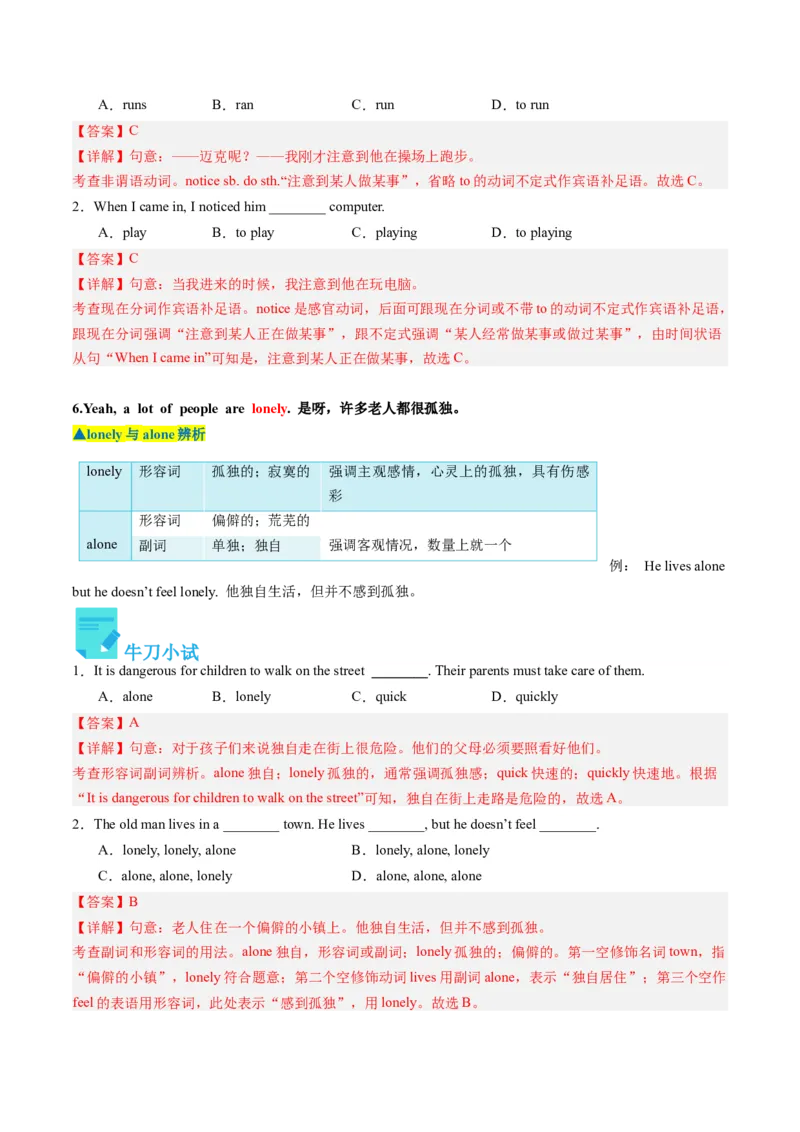
5. Let’s make some notices,too. 咱们也做一些公告牌吧。
▲notice相关用法
例: There are some notices on the wall. 墙上有些公告。
I noticed him leave the school. 我注意到他离开了学校。
I notice Peter entering his office. 我注意到Peter正走进办公室。
I noticed that he left the room. 我注意到他离开了房间。
牛刀小试
1.—Where’s Mike?
—I noticed him ________ in the playground just now.A.runs B.ran C.run D.to run
【答案】C
【详解】句意:——迈克呢?——我刚才注意到他在操场上跑步。
考查非谓语动词。notice sb. do sth.“注意到某人做某事”,省略to的动词不定式作宾语补足语。故选C。
2.When I came in, I noticed him ________ computer.
A.play B.to play C.playing D.to playing
【答案】C
【详解】句意:当我进来的时候,我注意到他在玩电脑。
考查现在分词作宾语补足语。notice是感官动词,后面可跟现在分词或不带to的动词不定式作宾语补足语,
跟现在分词强调“注意到某人正在做某事”,跟不定式强调“某人经常做某事或做过某事”,由时间状语
从句“When I came in”可知是,注意到某人正在做某事,故选C。
6.Yeah, a lot of people are lonely. 是呀,许多老人都很孤独。
▲lonely与alone辨析
lonely 形容词 孤独的;寂寞的 强调主观感情,心灵上的孤独,具有伤感
彩
形容词 偏僻的;荒芜的
alone 副词 单独;独自 强调客观情况,数量上就一个
例: He lives alone
but he doesn’t feel lonely. 他独自生活,但并不感到孤独。
牛刀小试
1.It is dangerous for children to walk on the street ________. Their parents must take care of them.
A.alone B.lonely C.quick D.quickly
【答案】A
【详解】句意:对于孩子们来说独自走在街上很危险。他们的父母必须要照看好他们。
考查形容词副词辨析。alone独自;lonely孤独的,通常强调孤独感;quick快速的;quickly快速地。根据
“It is dangerous for children to walk on the street”可知,独自在街上走路是危险的,故选A。
2.The old man lives in a ________ town. He lives ________, but he doesn’t feel ________.
A.lonely, lonely, alone B.lonely, alone, lonely
C.alone, alone, lonely D.alone, alone, alone
【答案】B
【详解】句意:老人住在一个偏僻的小镇上。他独自生活,但并不感到孤独。
考查副词和形容词的用法。alone独自,形容词或副词;lonely孤独的;偏僻的。第一空修饰名词town,指
“偏僻的小镇”,lonely符合题意;第二个空修饰动词lives用副词alone,表示“独自居住”;第三个空作
feel的表语用形容词,此处表示“感到孤独”,用lonely。故选B。一、单项选择
1.— Nick looks unhappy today!
— Let’s go to ________.
A.cheer him up B.wake him up
C.dressed him up D.pick him up
【答案】A
【详解】句意:—— Nick今天看起来很不开心!——我们去让他振作起来。
考查短语辨析。cheer him up让他振作起来;wake him up让他醒来;dressed him up为他装扮;pick him up
接他。因为上句说Nick不开心,可推断应让他振作起来。故选A。
2.I ________ play computer games, but now I ________ swimming in my free time.
A.use to; am use to B.am used to; used to
C.used to; am used to D.used to; am use to
【答案】C【详解】句意:我过去常玩电脑游戏,但现在我习惯了在空闲时间游泳。
考查动词短语。used to do过去常常做某事;be used to doing习惯做某事;use to和be use to表达错误。根
据“I ... play computer games, but now I ... swimming in my free time.”可知,过去常玩电脑游戏,但现在习惯
游泳。故选C。
3.Do you often notice them ________ basketball on the playground?
A.play B.playing C.to play D.played
【答案】A
【详解】句意:你经常注意到他们在操场上打篮球吗?
考查动词的非谓语形式。notice是感官动词,后面可跟现在分词或不带to的动词不定式,notice sb. doing
sth.强调“注意某人正在做某事”,notice sb. do sth.强调“注意到某人经常做某事或做过某事”,根据
“often”可知,此处使用“notice sb. do sth.”结构,故选A。
4.Although my grandfather lives ________, he never feels ________ because he loves living in the beautiful
country.
A.lonely; alone B.alone; lonely C.lonely; lonely D.alone; happy
【答案】B
【详解】句意:尽管我的祖父独自一个人居住,但是他从不感到孤独,因为他喜欢住在漂亮的乡村。
考查形容词副词辨析。alone独自,孤独;lonely孤独的;happy快乐的。第一空用alone,意为“独自;单
独”,在此处作副词,修饰lives;第二空用lonely,意为“孤独的”,用在feels后,表示孤独的感受,做
表语,构成系表结构。故选B。
5.I ________ sleep very well, but then I started doing yoga and it really helps.
A.didn't use to B.used to C.was used to D.wasn't used to
【答案】A
【详解】句意:我以前睡得不好,不过后来我开始做瑜伽,这真的很有帮助。
考查used to的否定句。didn’t use to是used to do sth.的否定形式,意为“过去不……”;used to表示“过
去常常……”;was used to do sth.意为“被用来做某事”;wasn’t used to do…“不被用来做某事”。根据句
意可知,这里表示过去的情况,应用used to do sth.这一结构,排除C和D。结合句中“but then I started
doing yoga and it really helps”可知,这里是说过去睡眠不好,应该是否定的形式。故选A。
6.Some volunteers are going to ________ the central park. Let's join them.
A.put up B.clean up C.look up D.give up
【答案】B
【详解】句意:一些志愿者打算去清扫中央公园。让我们加入他们吧。
考查动词短语。put up张贴;clean up清扫;look up向上看,查阅;give up放弃。根据空后“the central
park”,结合选项可推出是说清扫中央公园,用clean up符合题意。故选B。
7.—Can I park here?
—No. Look at the _________. It says “No parking”.
A.sign B.paper C.magazine D.message
【答案】A【详解】句意:——我能停在这儿吗?——不能。看这个指示牌。上面写着“禁止停车”。
考查名词辨析。sign指示牌;paper纸;magazine杂志;message信息。根据“It says “No parking”.”可知,
这是一个指示牌。故选A。
8.Don't ________ what should be done today till tomorrow.
A.put off B.cut off C.take off D.turn off
【答案】A
【详解】句意:今日事,今日毕。
考查动词短语辨析。put off推迟;cut off切断;take off脱下;turn off关闭。根据what should be done today
till tomorrow及所给选词,可知,不要把今天的事推到明天,即“今日事,今日毕”,所以空格处填put
off。故选A。
9.Could you ________ the restaurant and order sortie take-away food for me?I’m a little hungry.
A.call up B.call on C.call at D.call for
【答案】A
【详解】句意:你能打电话给餐馆为我叫些外卖吗?我有点饿了。call up sb.意为“打电话给某人”;call
on sb.意为“拜访某人”;call at sp.意为“拜访某地”;call for意为“要求”。
10.We believe scientists will ________ a way to solve the air pollution.
A.set off B.put off C.come up with D.catch up with
【答案】C
【详解】句意:我们相信科学家们会想出一个办法来解决空气污染的。set off意为“动身,出发”;put off
意为“推迟,拖延”;come up with意为“想出,提出”;catch up with意为“赶上”。
二、根据所给提示填空,每空一词
1.More than 200 (志愿者) in our university are sent to teach in the poor areas every year.
【答案】volunteers
2.—Didn’t you see the red light?
—Sorry, sir. I was checking the map and didn’t (注意到) it.
【答案】notice
3.—May I fish here?
—Sorry, you mustn’t. Look at the s “No Fishing”!
【答案】(s)ign
4.—Sam looks very sad. Let’s go and c him up.
—OK. I think we can give him a surprise.
【答案】(c)heer
5.When she first went to university, she felt very l because she knew no one there.
【答案】(l)onely
6.Let’s go to watch the football match and (喝彩) for our team.
【答案】cheer7.She moved back home to (care) for her mother.
【答案】care
8.I hope (get) a new job next year.
【答案】to get
9.We ask people (not catch) birds for any reason.
【答案】not to catch
10.He needs (meet) his e-friend at the gate of the park.
【答案】to meet
三、完成句子
1.请把这些阅读材料分发给那些学生。
Please the reading materials to the students.
【答案】 give/hand out
2.昨天他们想出了一个保持教室干净整洁的好主意。
They a good idea of keeping their classroom clean and tidy yesterday.
【答案】 came up with
3.如今,人们更关心食品安全。
Nowadays, people more the food safety.
【答案】 care about
4.因为天气不好,我们不得不推迟举行足球比赛。
We had to the soccer game because of the bad weather.
【答案】 put off having
5.他们请你帮助做什么了?
did they ask you ?
【答案】 What to help out with
四、选词填空
根据语境,从方框中选择恰当的单词填空,有的需要变换形式。
hand out, clean up, come up with, care for, call up
1.Mary her grandparents because they are old.
2.Please me when you arrive in Wuhan.
3.Jack is the math papers in the classroom.
4.We should some ways to solve the problems.
5.The students their classroom every day.
【答案】1.cares for 2. call up 3.handing out 4.come up with 5.clean up【分析】1.句意:玛丽照顾她的祖父母,因为他们年纪大了。根据“because they are old”并结合备选短语
可知,此处使用care for,表示“祖父母年纪大了,所以需要照顾”;主语Mary是第三人称单数形式,所
以动词care使用第三人称单数形式。故填cares for。
2.句意:你到了武汉请给我打电话。根据“when you arrive in Wuhan”并结合备选短语可知,此处使用call
up,表示“到了武汉给我打电话”;call up是“动词+副词”短语,所以代词me要置于call和up中间,
call me up给我打电话;根据句中please可知,该句为祈使句,所以动词call使用原形。故填call up。
3.句意:杰克正在教室里分发数学试卷。根据“the math papers in the classroom”并结合备选短语可知,此
处使用hand out,表示“在教室分发试卷”;结合句中is可知,此处是现在进行时,结构为be doing,所以
动词hand使用现在分词。故填handing out。
4.句意:我们应该想一些办法解决这些问题。根据“some ways to solve the problems”并结合备选短语可知,
此处使用come up with,表示“想出解决问题的办法”;句中should是情态动词,后接动词原形,所以动
词come使用原形。故填come up with。
5.句意:学生们每天都打扫教室。根据“their classroom”并结合备选短语可知,此处使用clean up,表示
“打扫教室”;根据“every day”可知,句中时态为一般现在时,而且主语“the students”是复数,所以动
词clean使用原形。故填clean up。
五、补全对话
选取适当的句子完成对话(有多余项)。
A: Hello, Bob! 1
B: I was in the old people’s home.
A: Really? 2
B: No. Linda and Bill went there with me.
A: 3
B: We cleaned the rooms, washed the clothes and made the bed for the old.
A: 4
B: We also sang many songs to the old to make them happy.
A: Sounds great! 5
B: We’ll go there again next weekend.
A: Can I join you? I also want to do something for the old.
B: Sure.
A.What did you do there?
B.What do you need to help with?
C.Where were you yesterday?
D.When will you go there again?
E.How often do you visit the old people’s home?
F.Did you go there alone?
G.What else did you do?【答案】1.C 2.F 3.A 4.G 5.D
【解析】这是一段Bob和说话者A之间的对话,主要内容关于志愿活动。
1.根据下文“I was in the old people’s home.”可知此处在问地点。C选项“你昨天在哪里?”符合语境,故
选C。
2.根据下文“No. Linda and Bill went there with me.”可知此处应为一般疑问句,询问对方是否独自去的那
里。F选项“你是一个人去的吗?”符合语境,故选F。
3.根据下句提到的“We cleaned the rooms, washed the clothes and made the bed for the old.”都是在养老院做
的具体事情,据此可知此处询问在养老院做了什么。A选项“你在那里做了什么?”符合语境,故选A。
4.根据回答中的“also”一词可知此处在问还做了什么。G选项“你还做了什么?”符合语境,故选G。
5.根据下句“We’ll go there again next weekend.”可知此处询问下次去的时间。D选项“你什么时候再去那
里?”符合语境,故选D。
六、阅读理解
Have you been asked for money by some disabled beggars (乞丐) while you're enjoying shopping? Do you have
any pity on (同情) them who are so poor and lonely or do you just feel afraid of their terrible shapes? As one of the
most special groups, disabled people's living conditions (条件)—not only their material (物质的) conditions, but
their mental (精神的) world, really need improvement. The treatment for disabled people should go like this: First,
don't look down upon them. Don't be afraid of looking at the terrible shapes of the disabled. Try to treat them equally.
Because they are a part of society (社会), we can't discard (抛弃) them. The second is to help them as much as we
could. If you can be a volunteer and do some work for disabled people, that would be very nice. That does help not
only to the disabled people but also to yourself because you will feel good after your kind action.
If every one of us gives a little love, the world will become a beautiful wonderland!
1.From the passage we can see that ________.
A.disabled people are poor, but they are happy
B.all disabled people ask for money from those who are shopping
C.disabled people's living conditions are not good
D.no one would like to help disabled beggars
2.The underlined word “equally” means “________” in Chinese.
A.平等地 B.确切地 C.正确地 D.恰当地
3.Most disabled people are begging (乞讨) along the streets because ________.
A.it's their job B.they want to make a living in this way
C.more people love to help them D.they are a part of society
4.People have pity on disabled beggars because ________.
A.they are homeless B.they are poor and lonely
C.they have terrible shapes D.they are discarded
5.Which of the following statements is TRUE?
A.The disabled like to beg in streets.B.Disabled beggars cannot work to make a living.
C.Disabled beggars are not usually treated equally.
D.The best way to help disabled beggars is to give them lots of money.
【答案】1.C 2.A 3.B 4.B 5.C
【解析】这篇短文中作者给我们讲述了现在残疾人生活的现状,作者认为他们的生活条件还有待提高。作
者还建议我们要平等地对待残疾人,还要尽我们的可能去帮助他们,这样我们的世界才更美好。
1.细节理解题。根据短文第一段中“As one of the most special groups, disabled people’s living conditions —
not only their material conditions, but their mental world — really need improvement.”可知,作者认为,残疾人
的生活条件,不管是物质的,还是精神的,都需要改善,可见,残疾人的生活条件是比较差的,故选C。
2.词义猜测题。根据短文第二段中“try to treat them equally. Because they are a part of the society, we can’t
discard them.”可知,我们要平等地对待残疾人,因为他们也是这个社会的一部分。equally平等地。故选
A。
3.推理判断题。根据短文的大意和第一段的内容可知,很多残疾人去街上乞讨,他们是用这种方式谋生,
故选B。
4.细节理解题。根据短文中“Do you have any pity on them who are so poor and lonely or do you just feel
afraid of their terrible shapes?”可知,很多人对残疾人表示怜悯和同情是因为他们非常穷,非常孤独。故选
B。
5.推理判断题。根据短文的大意可知,作者认为残疾人的生活条件还是非常差的,还呼吁我们应该平等
地对待残疾人,可见现实生活中,残疾人并没有被平等的对待,故选C。