Unit 4 Why don’t you talk to your parents?
第2课时 Section A (3a-4c)
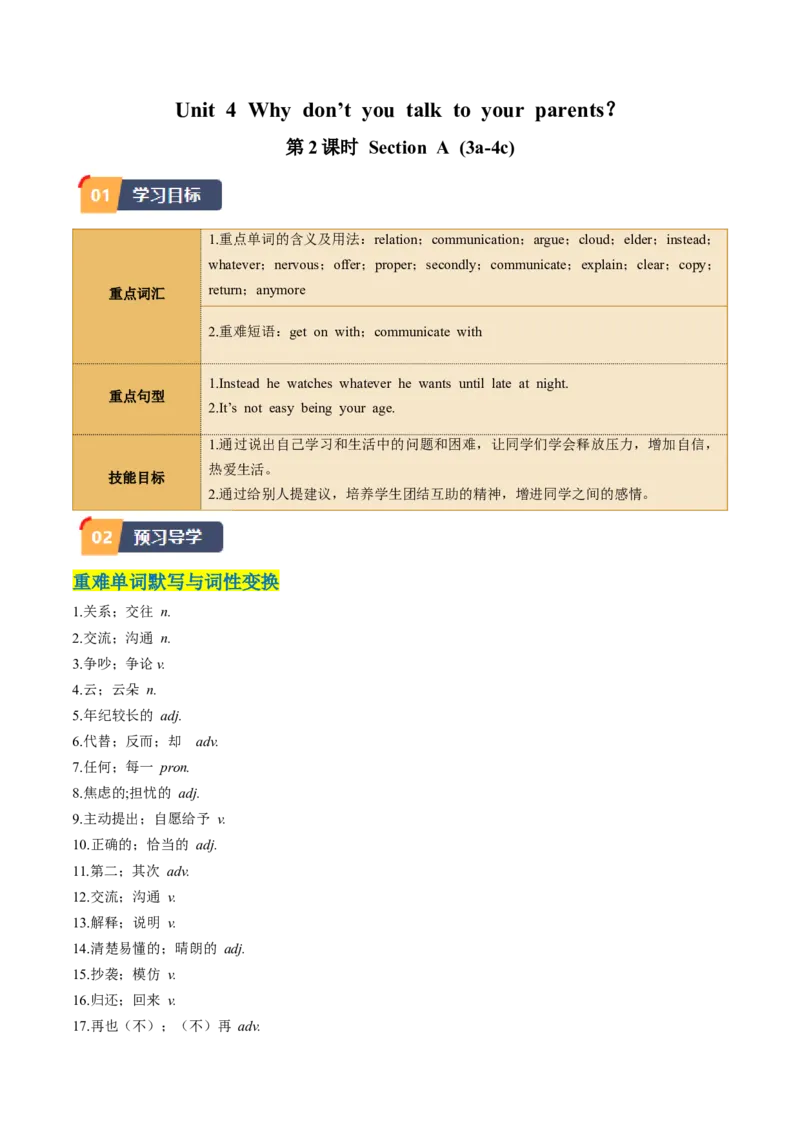
1.重点单词的含义及用法:relation;communication;argue;cloud;elder;instead;
whatever;nervous;offer;proper;secondly;communicate;explain;clear;copy;
重点词汇 return;anymore
2.重难短语:get on with;communicate with
1.Instead he watches whatever he wants until late at night.
重点句型
2.It’s not easy being your age.
1.通过说出自己学习和生活中的问题和困难,让同学们学会释放压力,增加自信,
热爱生活。
技能目标
2.通过给别人提建议,培养学生团结互助的精神,增进同学之间的感情。
重难单词默写与词性变换
1.关系;交往 n.
2.交流;沟通 n.
3.争吵;争论v.
4.云;云朵 n.
5.年纪较长的 adj.
6.代替;反而;却 adv.
7.任何;每一 pron.
8.焦虑的;担忧的 adj.
9.主动提出;自愿给予 v.
10.正确的;恰当的 adj.
11.第二;其次 adv.
12.交流;沟通 v.
13.解释;说明 v.
14.清楚易懂的;晴朗的 adj.
15.抄袭;模仿 v.
16.归还;回来 v.
17.再也(不);(不)再 adv.经典短语默写:
1. 和睦相处;关系良好
2. 与……交流
经典句型过关:
1.而他却看任何他想看的节目直到深夜。
he watches he wants late at night.
2.在你这个年龄不容易。
It’s your age.1.My problem is that I can’t get on with my family. 我的问题是我不能和我的家人和睦相处。
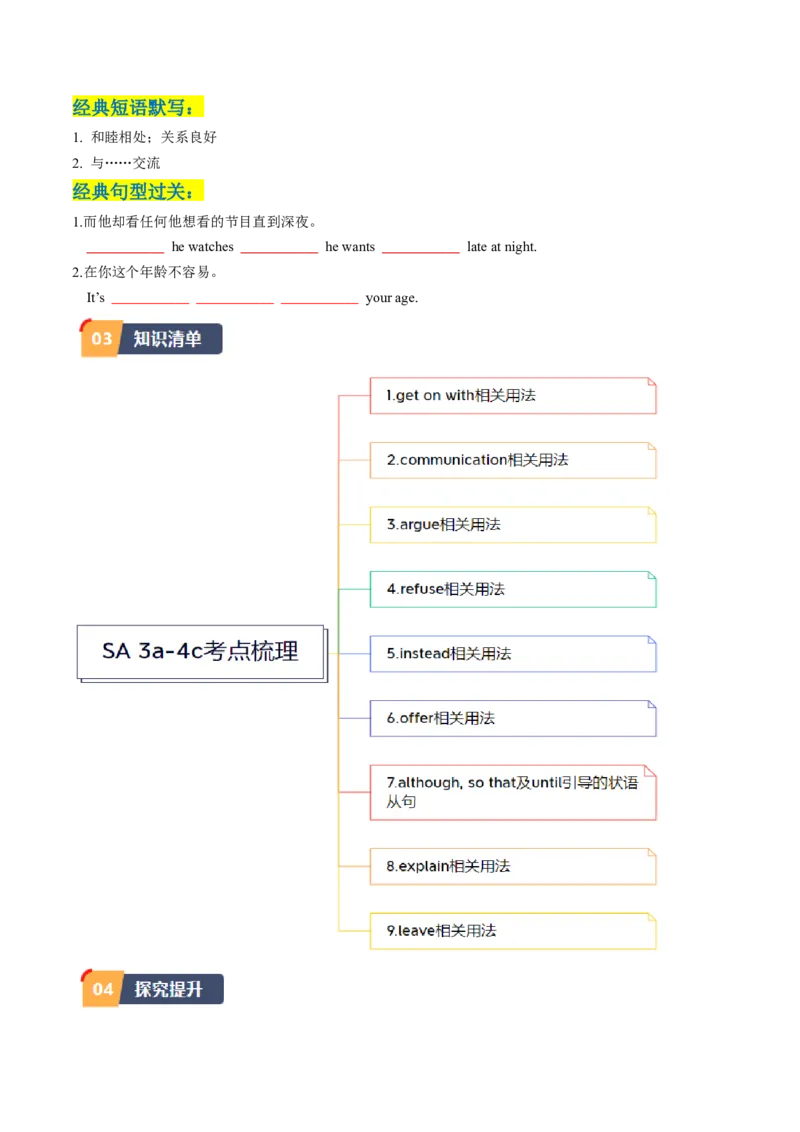
▲get on with相关用法
本句含有表语从句,I can’t get on with my family在句子中作表语,对My problem进行说明。
get on /along with sb.“和某人相处”
get on /along well with sb.“和某人相处得融洽”
get on badly with sb.“和某人相处得不融洽”
例:He gets on well with his boss. 他和他的老板相处融洽。
Mrs. Black gets along well with her neighbors. 布莱克太太和她的邻居们相处得很融洽。
get on with sth.“某事进展、进行”
例:How are you getting on with your studies? 你的学习进展如何?
牛刀小试
We should think of others if we want to ________them.
A.get on well with B.hear of
C.get ready for D.hear from
2.It’s the only communication they have. 这是他们唯一的交流。
▲communication相关用法
communication (n.),意为“交流:沟通”。
例:Speech and writing are man's most important methods of communication.
言语和书写是人类进行交流的最重要的方法。
communication的动词形式 communicate意为“通话;交际;交流”。
常用结构
communicate with sb..表示“与某人交流/沟通/联络”;
例:We learn a language in order to communicate. 我们学习一种语言是为了交流。
We communicate with each other by e-mails. 我们通过电子邮件和相互交流。
牛刀小试
青少年应该多与他们的父母沟通交流并自己做决定。
Teenagers should more their parents and make their own decisions.
3.When they argue, it’s like a big, black cloud hanging over our home. 我真的很累,因为昨晚一直学
习到半夜。
▲argue相关用法
(1) argue (v.) 争吵;争论
argue with sb.( about sth.) “(为某事)与某人争吵”例:They’re always arguing with each other about their kid’s education. 他们总是在孩子的教育上相互争吵。
(2) argue 的名词形式为argument。
短语:have an argument with sb. 与某人争吵。
例:You shouldn’t have an argument with your teacher about the homework.
你不应该和你的老师就家庭作业争吵。
牛刀小试
His parents always argue________each other________a small question.
A.with;with B.about;about
C.with;about D.about;with
4.He always refuses to let me watch my favorite TV show. 他总是拒绝让我看我最喜欢的电视节目。
▲refuse相关用法
refuse (v.)拒绝。
refuse to do sth.拒绝做某事。
例:If he offers you a good suggestion, don’t refuse it. 如果他给你提出好的意见,不要拒绝。
She refused to let me go. 她拒绝让我走。
牛刀小试
I find it difficult to refuse ________ this meaningful ceremony with him.
A.attend B.to attend
C.attending D.will attend
5.Instead he watches whatever he wants until late at night. 而他却看任何他想看的节目直到深夜。
▲instead相关用法
instead (adv.) 代替;反而;却
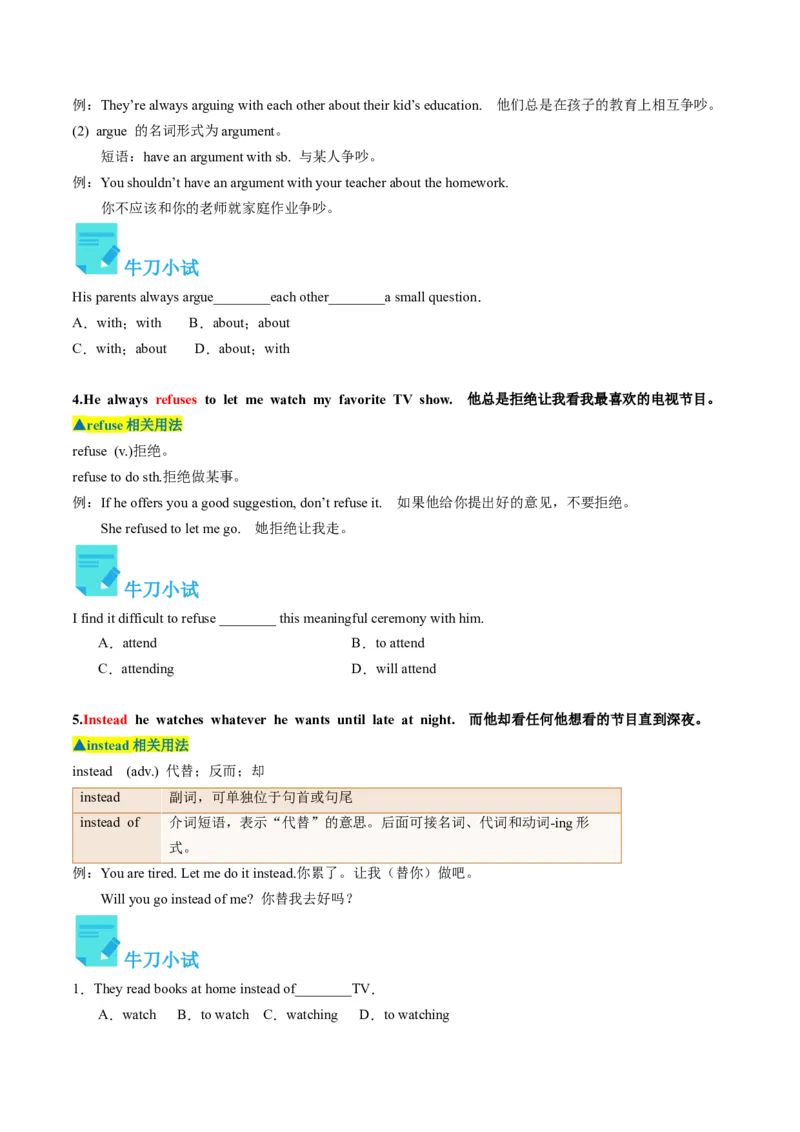
instead 副词,可单独位于句首或句尾
instead of 介词短语,表示“代替”的意思。后面可接名词、代词和动词-ing形
式。
例:You are tired. Let me do it instead.你累了。让我(替你)做吧。
Will you go instead of me? 你替我去好吗?
牛刀小试
1.They read books at home instead of________TV.
A.watch B.to watch C.watching D.to watching2.Tom doesn’t study hard. ___________, he plays the drums all day.
A.Instead B.Instead of C.But D.At once
3.It will be sunny tomorrow, and I will ride my bike ________ taking the bus.
A.because B.because of C.instead D.instead of
6.If your parents are having problems, you should offer to help. 如果你的父母有问题,你应该主动
提出帮助。
▲offer相关用法
offer (v.)主动提出
offer 后可接双宾语,常用结构:
offer sb. sth./offer sth. to sb. 向某人提供某物;
offer to do sth. (主动) 提出做某事。
例:She offers to give him a piece of advice. 她主动提出给他一条建议。
offer 侧重表示“自愿给予”,常用于offer sb. sth.(=offer sth. to sb.)或offer to do sth.
结构。
provide 指有远见,为应付意外、紧急情况等作好充分准备而“供给、提供”,常用于
provide sb. with sth. 或provide sth. for sb.结构。
例:I offered him a cup of tea. 我提供给他一杯茶。
=I offered a cup of tea to him.
Policemen provide people with help. 警察给人们提供帮助。
=Policemen provide help for people.
牛刀小试
It is reported that China has offered much help ________ African children already.
A.to B.with C.for D.at
7.Maybe you could do more jobs around the house so that they have more time for proper
communication. 或许你可以在家里做更多工作以便他们有更多时间进行适当的交流。
▲although, so that及until引导的状语从句
1.although引导让步状语从句连词
although意为“虽然;尽管”,引导让步状语从句,可以放在主句前面,也可以放在主句后面。
例:Although she's wrong, it's not a big deal.尽管她不对,但这也不是什么大不了的事。
You could help him although you didn't let him copy your homework.
尽管你不让他抄你的作业,但你可以帮助他。
2.so that引导目的状语从句和结果状语从句
(1)so that意为“以便”,引导目的状语从句,一般放在主句后,且不用逗号隔开。目的状语从句表示动机(即一种可能性),而非事实。因此,从句中常带有can, will, could, would, should等情态动词。
例:He should talk to his friend so that he can say he\'s sorry.
他应当和他的朋友谈一谈,以便他能说声抱歉。
You must go now so that you won't be late.你必须现在就去,以便不会迟到。
(2)so that意为“以至于;结果”,引导结果状语从句,陈述的是客观事实,常常不带情态动词。
例:He got up early so that he caught the early bus.他起得早,因此赶上了早班车。
My friend was ill so that she didn't come to school yesterday.我朋友生病了,所以她昨天没来上学。
3.until引导时间状语从句
连词until意为“直到……为止;到……时”,引导时间状语从句,常放在主句之后,也可以放在主句
之前。主句为一般将来时,从句要用一般现在时表示将来。
until用于肯定句中,意为“直到……为止”,主句谓语动词须用延续性动词;用于否定句中,意为
“直到……才”,主句谓语动词通常用非延续性动词,也可用延续性动词。
例:They talked on and on until four o'clock in the morning.他们一直谈到凌晨四点。
The letter passed from one to another until everyone had read it.
这封信从一个人转手另一人直到每个人都看过。
I won't believe it until I see it with my own eyes.直到亲眼看见,我才会相信。
牛刀小试
The teacher asked me to read aloud________all the students could hear me.
A.so that B.for C.because D.in order to
8.Can you explain to me how to do this math problem? 你能给我解释以下怎么做这个数学题吗?
▲explain相关用法
explain(vt.),解释;说明(不能接双宾语)
例:I don't want to explain anything. 我不想解释任何事。
explain sth. to sb./explain to sb. sth. 向某人解释某事
例:He explained to me how the machine was used. 他跟我解释如何使用这个机器。
牛刀小试
Our teacher is explaining the use of the robot ________ us.
A.at B.of C.for D.to
9.You left your homework at home. 你把你的家庭作业忘在家里了。
▲leave相关用法
leave遗忘;留下。常用结构:leave sth. somewhere把某物忘/留在某地;leave sb. by oneself把某人单独留下。
例:Unluckily,I left my passport in the hotel. 不幸的是,我把护照忘在旅馆了。
leave与forget辨析
leave 意为“遗忘;忘带”时,为及物动词,后接名 The boy left his hat on the train.这个男孩把帽子
词、代词作宾语,再接地点状语。也可意为“离 忘在火车上了。
开;舍弃”,此时后面可直接接地点。 She left New York in a hurry.她匆忙离开了纽
约。
forge 为及物动词,意为“忘记”,表示忘记做某事或 I forgot her name.我忘了她的名字。
t 忘记某物,不强调地点状语,其后可接名词、不 She forgot to close the window.她忘了关窗户。
定式、动名词。
牛刀小试
—I’m sorry I ________ my exercise book at home this morning.
—It doesn’t matter. Don’t forget ________ it here this afternoon.
A.left; to take B.forgot; bringing
C.left; to bring D.forgot; to bring一、单项选择
1.—Did you go to the park yesterday? —No, I didn’t. I went to the museum by shared bike, ________.
A.instead B.instead of C.anyway D.although
2.—In the past five years, China has played an important role in the Belt and Road Initiative.
—It has ___________ many nations a great chance to communicate.
A.offered B.supported C.included D.provided
3.___________ I do, I do it for you. Do not ever doubt that, my boy.
A.Whatever B.Wherever C.Whenever D.Whoever
4.I didn’t understand what he said about the math problem. I wanted him to ________ it to me again.A.make B.explain C.look D.return
5.—What should I do if my parents don’t agree ________ me?
—You’d better find a chance to communicate________ them.
A.with;on B.to;with C.to;to D.with;with
6.Last night,he offered ________ me home,but I refused.
A.drive B.to drive C.driving D.to driving
7.She’s never got on well________her classmates.
A.for B.at C.in D.with
8.She always refuses________me________my favorite TV shows.
A.to let;watch B.to let;to watch C.let;watch D.to let;watches
9.________ he is very tired, ________ he still help his mom do the housework.
A.Although, but B.but, ∕ C.Although, ∕ D.Although, however
10.This spring morning in bed I’m lying, not wake up ________ I heard birds singing everywhere.
A.until B.next C.however D.because
二、根据所给提示填空
1. (无论什么)I say, he doesn’t believe me.
2.I’m in the 400-meter race. It’s in two hours, and I’m very (紧张的).
3.Terry doesn’t quite understand this school rule. Can you e it to him?
4.Mattew Chimudzi wants to study Chinese so that he can have a good (communicate) with people in
China one day.
5.It is really important for us to dress (proper) in public places.
6.My grandpa put on his glasses, but he still couldn’t see the small-size words (clear)in this
newspaper.
7.Firstly, I don’t have enough money. (second) ,I don’t have free time.
8.Don’t c others’ homework. You must do it by yourself.
9.My father (return) from Beijing last Friday.
10.If it is cloudy, there must be a lot of (cloud) in the sky.
11. (relation) between my sister and I have become difficult.
12.Mr. Wang left without (say)goodbye.
13.Teenagers should (allow) to choose their own clothes.
14.Wang Hui is my (old) sister and she is two years older than me.
15.We should have a (恰当的) discussion about the problem before having a meeting.
三、完成句子
1.我将步行去上学而不是乘公交车。
I'll go to school on foot by bus.2.我们乘出租车吧,以便我们能按时到达那里。
Let's take a taxi we can get there on time.
3.等他冷静下来再跟他争论。
Don’t try to________ ________him until he’s cooled down.
4.露西是个中国通,她和邻居们用中文交流毫不费力。
Lucy is an old China hand. She has no trouble her neighbors in Chinese.
5.但是萨姆一直待到下周五才会离开。(完成译句)
But Sam leaving next Friday.
四、选词填空
A
instead;offer;elder;second;clear
1.I don't buy that dress. Firstly,it was too expensive. ,it was ugly.
2.Mr. Smith asked us not to talk in the room. ,he talked loudly.
3.When our classmates have problems at school,we should some help.
4.I know Alice's younger sister and I also know her sister.
5.The sky was dark blue and when the moon came up.
B
argue should proper you until do without allow relation wrong
I am a reporter from TEENS MAGAZINE. Recently, we received many teenagers’ letters about their problems
with parents. Jack is one of them. Last week, he was 1 homework when his mother came in his room and asked
him to have dinner. He got angry and 2 with his mother. He said he would not talk to her 3 she sttoa tratelkd to
him. But is that OK?
You often complain that your parents do not understand you. When something goes 4 , most parents
think it’s all your mistakes 5 asking for any reasons. Many parents don’t 6 you to make
decisions or do things by yourselves. 7 between children and their parents are becoming worse and worse.
Maybe you need to find more time to communicate with your parents 8 . Also, you need to try hard to
find out a nicer way to get what you want. If you want to stay out late, you 9 speak out what you want to
do and why it is important for you to do so. Then they might just agree with 10 request(请求). So if all
of us can be peaceful, communication will be easier.
五、完形填空
When we asked about brothers and sisters,more than 2,000 children wrote to tell us about their brothers or
sisters. Many children told us that fights often 1 .More than half of the children 2 their brothers or sisters
at least once a day. Most children said they shouted at their sisters or brothers when they fought. 3 half said
they hit each other. But some of the children,about 20%,said they asked their mom or dad to help them solve the4 And even more children said that after a fight,they said 5 to their brothers or sisters.
For now,you are 6 a child. You may be unhappy sometimes 7 the fights with your brothers or
sisters,but you will think they are funny experiences when you grow up. You will be the parent who will have to
8 the fights! So stop shouting when you get angry with your brothers or sisters. It is not always easy, 9
maybe you can start with just making one day “No Fight Day”.Then your mom and dad will be very 1 0 .
Remember that it is never OK to shout at your brothers or sisters and hurt them.
1.A.ended B.happened C.developed D.started
2.A.fought with B.wrote to C.looked after D.communicated
3.A.Instead B.However C.Almost D.Hardly
4.A.hobby B.skill C.deal D.problem
5.A.hello B.sorry C.thanks D.goodbye
6.A.too B.still C.already D.even
7.A.such as B.instead of C.for example D.because of
8.A.stop B.win C.show D.remember
9.A.or B.and C.but D.so
10.A.happy B.crazy C.tired D.angry