文档文本内容
基于课程标准的“教-学-评”一致性课堂教学设计
科目 英语 授课教材 人教版八年级下册
授课题目 Unit 4 Why don’t you talk to your parents? 课时 第 1课时
主题情境 人际关系 授课教师
本课内容是义务教育教科书人教版英语八年级下册第四单元听说课。学习本
节课内容学生能用英语谈论人际关系遇到的困扰并且能够提出合适的建议。
内容分析
八年级的学生已经有了一定的词汇基础,同时前三单元结束之后,对询问他人
状况和困扰的句型已经给建议的话题也较熟悉,这对本节课奠定了良好的基
础。但对于连词although,until,so that 引导状语从句的的语用功能,由于英
学情分析
汉差异,学生掌握起来是有一定难度的,因此在设计课堂教学活动时,本节课
利用情境体验和课堂活动,提高学习兴趣,从而引入到实际生活中,知识多次
复现,从而达到运用掌握。
能听懂接近自然语速、熟悉话题的简单语段,识别主题,获取主要信息。
课标要求 能引出话题进行几个话轮的交流。
能在教师的指导下参与角色表演。
1. 语言能力:能掌握本课时出现的新词汇;能够运用学过的句型人
际交往方面的困扰;围绕日常活动编写对话,能以角色扮演的形式,以正
确的语音、语调运用恰当的结构提供建议。
2. 学习能力:学生能够听前看主题图推测话题;听中,运用微策
略-“理解细节”和“信息多层处理”策略,获取活动信息,了解对话中人
的所遇到的压力和困扰;听后,模仿输出Role-play 巩固所学;在学习中
善于利用图片等非语言信息理解主题;能够运用任务链听力活动谈论人际
交往遇到的困扰,口头输出目标语言,综合输出目标语言。
教学目标
3. 思维品质:学生通过主人公和朋友发生矛盾的情境,学会和朋友
一同探讨人际交往所遇到的困扰并且给出适当的建议,感受英美国家不同
的文化差异,可以从跨文化视角去观察和认识社会与生活,分析和解决一
些人际交往方面中遇到的问题,培养逻辑性和创新性。
4. 文化意识:在学校生活的情境下,学生能够体验不同的人际交往
的矛盾和困扰,在放松之余收获更多的知识,提高社会交往,学会自我提
升。
重点:The vocabulary:
wrong,guess,deal,allow sb.to do sth.,work out
Target language:
教学 1.Why don’t you talk to your parents?
重难点 2.My parents don’t allow me to hang out with my friends.
3.You should call him so that you can say you’re sorry.
难点:
Use the target language above to talk about problems and give advice.
1.Teaching aims:
1.Words and expressions:
allow,allow sb. to do… allow doing…, wrong, midnight, look through, guess,
deal, big deal,
学习目标 deal with…, work out, give sth. back to sb. be good at, surprise sb. be angry
with , have/get
into a fight with
2. Sentences:
1).Why don’t you talk to your parents?2).I have to study too much so I don’t get enough sleep.[来源:Zxxk.Com]
3).I don’t have any free time to do things I like.
4).My parents don’t allow me to hang out with my friends.
5).I got into fight with my best friend.
6).I am not good at writing letters.
2.Ability aims:
Ss can use the knowledge they learned to talk about the problems and
difficulties they had.
Ss can give others advice and learn to choose the right advice.
Ss can improve their listening, speaking and reading skills.
3.Emotional aims:
Ss will learn to express their ideas and willings bravely.
Ss will learn to solve the problems in their lives properly.
PPT,教材
教学工具
教学策略 情景体验式教学、启发式教学,任务型教学,游戏教学法
预设问题 学生在创编对话时可能会产生无话可说的现象
分别通过跟读录音,原文内容角色扮演,看图填空半辅助进行对话,
解决方案 提供对话素材和框架辅助创编对话,自主创编对话一系列循序渐进的
活动达到引导学生灵活运用目标语言进行对话的教学效果。
教学过程
教学环节 教学活动 学生活动 设计意图
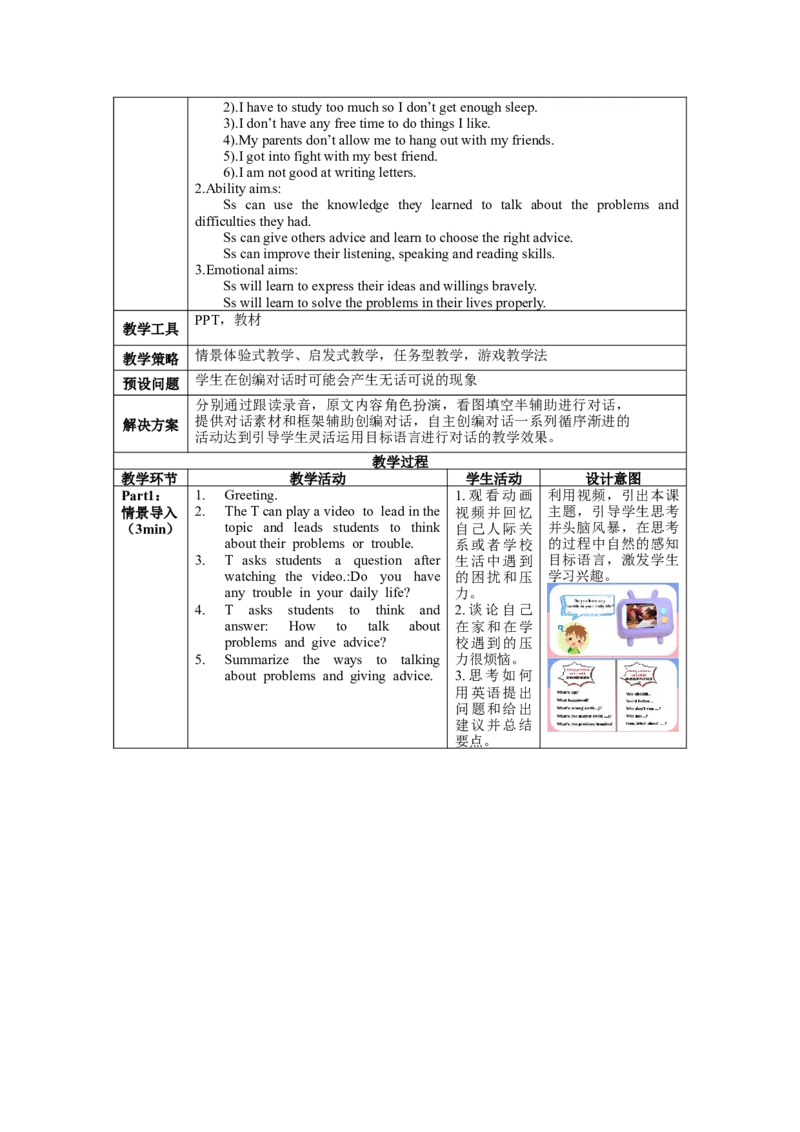
Part1: 1. Greeting. 1.观看动画 利用视频,引出本课
情景导入 2. The T can play a video to lead in the 视频并回忆 主题,引导学生思考
(3min) topic and leads students to think 自己人际关 并头脑风暴,在思考
about their problems or trouble. 系或者学校 的过程中自然的感知
3. T asks students a question after 生活中遇到 目标语言,激发学生
watching the video.:Do you have 的困扰和压 学习兴趣。
any trouble in your daily life? 力。
4. T asks students to think and 2.谈论自己
answer: How to talk about 在家和在学
problems and give advice? 校遇到的压
5. Summarize the ways to talking 力很烦恼。
about problems and giving advice. 3.思考如何
用英语提出
问题和给出
建议并总结
要点。Part 2: 6. T teaches the new phrases. Then 1.跟随老师 听前将新单词和句型
学习理解 asks students to do some exercise 一起学习新 进行操练,为听力训
(7min) and practice the sentence 词组,并感 练降低难度。
structures. And review the past 知句型完成 将句型操练式融入单
tense of verbs. 练习。 词教学中进行教授,
7. T asks Ss to finish the task in 2.完成书本 有助于应用。
1a:Look at these problems. Do 1a与1b部分 书本任务有利于学生
you think they are serious or not? 任务。 更好的掌握词汇和句
Write them in the appropriate box. 3.教师口头 型的用法。
8. T asks Ss to finish the task in 总结本课要
1b:Listen and circle the problems 点:如何谈
you hear in 1a,then,Listen again 论遇到的困
and fill the blanks. 扰,以及如
何给他人提
供建议。
Part 3: 9. T asks students to work in 1.完成书本 通过听力策略的教
应 用 实 pairs:Look at the problems in 1a 1c 任务:根 授,帮助学生更好的
践 - 听 说 and make conversations. 据1a材料组 把握听力侧重点。
活动 10. T asks students to listen again 织对话。 将听力文本拆解,使
( 12min and repeat 1a. 2.听对话并 学生巩固目标词汇和
) 11. Predicet what happend to the boy 跟 读 复 重点句型的使用。
and know:Peter had a fight with 述 。 、 跟 通过预测的方法帮助
his best friend. 读。 学生减小听力任务的
12. Think about :What should I he 3.根据图片
do? 猜测peter的
13. Listen. Peter’s friend is giving him 遭遇,思考
advice. Fill in the blanks with could 假 如 你 是
or should. Peter,你应
14. Listen again. Why doesn’t Peter like 该怎么做。 难度。角色扮演任
his friend’s advice? Write the letters 4.听听力, 务,大大激发学生的
(a-e) next to the advice in 2a. 完 成 2a,2b 学习兴趣。
15. T asks students to make
的任务型听
conversations according to the chart 力。
and sample in pairs. 5.完成书本
2c 部分:角
色扮,创建
新对话。
Part 4: 16. Read the conversation and guess 1. 阅读对话 先完整感知对话,再
迁移创新 the meanings of the underlined 内容,猜测 根据提示完成任务,
( 10min expressions. 词义,完成 最后根据目标单词和
) 17. Learn the key phrases about 2d 阅读任务 句型创编对话,循序
and Role-play the conversation. 2. 读前先看 渐进,轻松掌握。
18. Sum up the key points in this 图预测,降 模仿并角色扮演,培
lesson,and master the reading skills . 低学习难度 养了学生的口语能力
和应用能力。
Part 5: Summarize the key content in this 跟随老师一 总结本课所学内容,
回顾总结 lesson. 起进行内容 巩固加深印象。
(4min) 总结回顾
Part6: T explains knowledge points. 将知识点做 将教学落到实处,交
考点速递 好笔记进行 际意识培养之后,知(5min) 理解消化。 识点的教授也跟上,
保证学生在理解的同
时能够运用到具体题
型中去。
Part 7: T assigns the test. 完成课堂练 让学生在课上练习消
随堂小练 习。 化知识点,及时操
(3min) 练。
Part 8: 1. Remember what we learnt today. 将家庭作业 作业布置落实双减政
家庭作业 2. Preview the new words and phrases 做好记录。 策,减量不减质,重
in 3a. 视实际场景的交际应
3. Finish the exercises in weekly paper. 用,减轻机械操练。
板书设计 Unit 4 Why don’t you talk to your parents?
Section A 1a-2d
1.The vocabulary:
wrong,guess,deal,allow sb.to do
sth.,work out
2.Target language:
( 1 ) Why don’t you talk to your
parents?
(2)My parents don’t allow me to
hang out with my friends.
(3)You should call him so that you
can say you’re sorry.
评价反馈 1.能够听懂有关描述困难,提出建议的材料,获取关键信息。
2.通过谈论人际关系中的各种问题,并能针对问题提出自己的建议。
3.正确认识生活中的一些困难,感受中外文化差异、学会加强交流沟通。
教学反思 任务型教学法的采用强化了学生对文本的理解; 以学生为本,构建有效的对话
情境,引导学生自主合作;突出语言的语用功能,通过学科整合进行拓展,让
学生学以致用,提升了学生的综合语言运用能力。不同形式的朗读及角色扮
演,训练了学生使用正确的语音、语调,并在具体的语境中落实了核心句型的
运用。板书简洁清晰,重点突出,对学生的复述起到了很好的辅助作用。