文档文本内容
基于课程标准的“教-学-评”一致性课堂教学设计
科目 英语 授课教材 人教版八年级下册
Unit 7 What’s the highest mountain 课时 第 2课时
授课题目
in the world?
主题情境 地理自然环境与动物保护 授课教师
本课内容是义务教育教科书人教版英语八年级下册第7单元Section A
阅读课。这是一篇关于珠穆朗玛峰的说明文,属于“人与自然”主题范畴中
“自然生态”这一主题群,涉及“热爱与敬畏自然,与自然和谐共生”的子
内容分析 主题内容。通过视频、图片使学生走近珠穆朗玛峰,了解登山的危险,登山
者
的成就,进而让学生体会人类克服困难、挑战极限的勇气与实践精神,从而
在生活中塑造勇敢面对困难、坚持不放弃的人格力量。
在第一课时,学生已经学习并能熟练谈论地理与自然,会表达较大数字。在阅
读策略上,八年级的学生已初步具备了运用略读、寻读技巧获取主要信息的能
力,但是对于寻求细节信息方面的能力还需要加强。这篇文章的教学强化对本
学情分析 单元主题内容及语言项目的学习及理解,发展学生的阅读技能,在练习活动的
设计上紧密练习快读和细读阅读策略。
能听懂接近自然语速、熟悉话题的简单语段,识别主题,获取主要信息。
课标要求 能围绕话题,运用所学语言结构,与他人进行日常交流。
能在教师的指导下参与角色表演。
1. 语言能力:学习掌握词汇achieve, include, succeed, in the face
of, even though等;.能阅读地理和自然话题的文章。
2. 学习能力:.通过标题与插图,读前预测文章内容;学会总结段落
大意,罗列各段要点;培养学生对阅读中细节题的考查。
教学目标
3. 思维品质:鼓励学生在实现理想的道路上勇于面对困难,永不言
弃。
4. 文化意识:学习攀登者们所传达的永不言弃和战胜自然的精神品
质。增强战胜苦难的、挑战自我的信心,培养民族自豪感。
重点:
1. 培养在英语阅读中获取细节信息的能力,提高阅读的效率。
教学 2. 能够阅读有关“地理和自然话题”话题的说明文并培养获取文章大意和细
重难点 节信息的能力。
难点:通过小组合作方式讲述身边的“攀登山脉”励志故事,进一步感悟坚持
梦想、永不放弃的精神并在学习生活中运用。
1. 通过略读、精读等方式,能够运用寻找关键词等阅读技能,列举各段要点
及寻找细节信息,并能深入理解文本,提升阅读能力;
2. 通过阅读了解珠穆朗玛峰有关信息,并能熟练运用形容词和副词的比较
学习目标
级、最高级对比谈论珠穆朗玛峰;
3. 通过小组合作方式讲述身边的“攀登山脉”励志故事,进一步感悟坚持梦
想、永不放弃的精神并在学习生活中运用。
PPT,教材
教学工具教学策略 情景体验式教学、启发式教学,任务型教学,游戏教学法
预设问题 学生在寻找文章细节内容时可能会没有头绪从而逐字逐句费时间阅读
解决方案 在快读环节划分好文章结构和板块,精准定位文章内容。
教学过程
教学环节 教学活动 学生活动 设计意图
Part1: 1. Greeting.
情景导入 2. Show the picture.Suppose you
(3min) and your guide are traveling. 课堂的连贯一致性,
Guide:Did you know Where it is? Look at the 继续导游模式,情景
S1:Himalayas. pictures and 创设。引入本节课阅
Guide:Yes,and there is one of the answer. 读主题--珠穆朗玛
most popular places for climbers. 峰。激发学生学习的
Qomolangma !Did you know 兴趣。
anything about the mountain?
S1:Yes, I do. It’s the highest
mountain in the world.
Guide:Did you know how high it is
?
S1:It’s 8,848.86 meters high.
Guide:Yes,This time I’d like to take
you to Qomolangma for mountain
climbing.Let’ go!
Part 2: 1. Before reading,Look at Look at the 通过图片和标题帮助
读前感知 the picture and title in 3a.,then pictures and 学生养成读前预测的
(7min) finish tasks. title 好习惯。
The article may about_______ then prediction
What might be the dangers of and discussion.
mountain climbing?Play a video.
Discuss dangers of Mountain
Climbing.
Why does the writer use a “?”
in the title?
Part 3: 1. Fast-reading.Go through the Read the 通过快速浏览,了解
读中操练 passage and finish the task. passage 篇章类型,再次快读
( 16min This passage is a/an_______. quickly.Pay 理清文章的段落大
) A: Exposition (说明文) attention to 意。
B: Narrative(记叙文) numbers,dates,
C: Argumentation(议论文) times, examples.
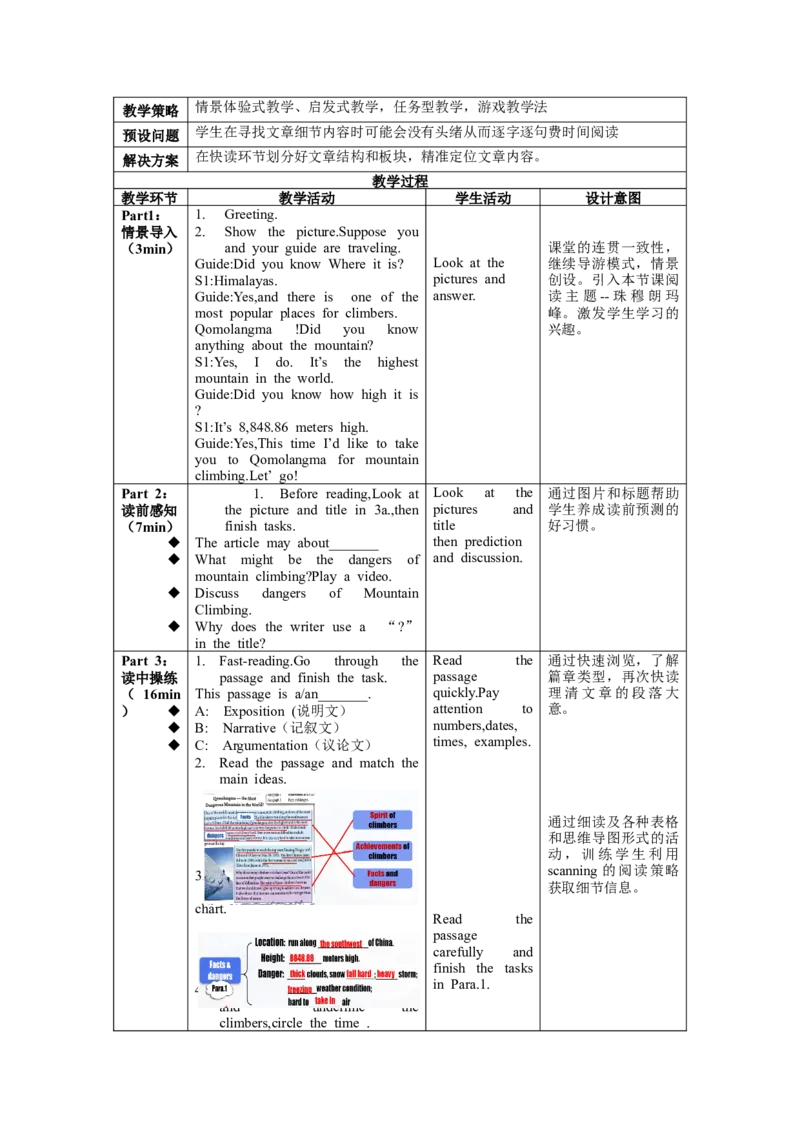
2. Read the passage and match the
main ideas.
通过细读及各种表格
和思维导图形式的活
动,训练学生利用
scanning 的阅读策略
3. Careful-reading.
获取细节信息。
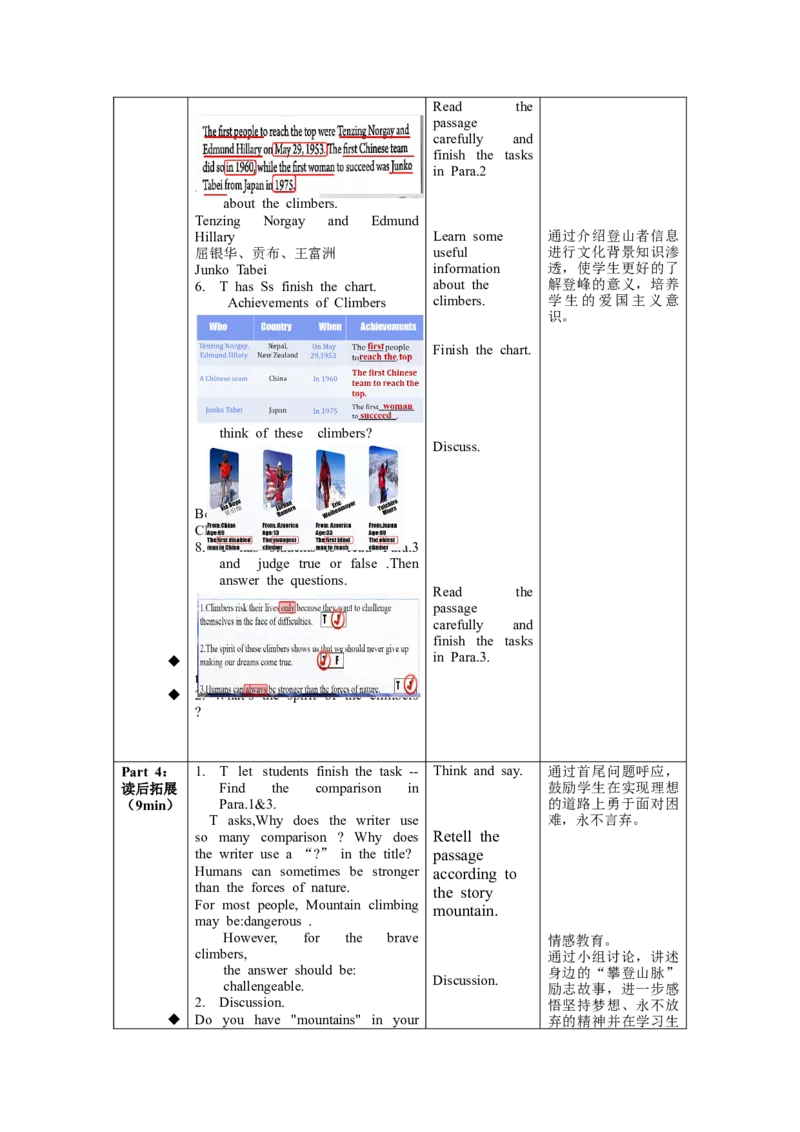
Read Para.1 and finish the
chart.
Read the
passage
carefully and
finish the tasks
in Para.1.
4. T has students to read Para.2
and underline the
climbers,circle the time .Read the
passage
carefully and
finish the tasks
in Para.2
5. T has Ss learn the information
about the climbers.
Tenzing Norgay and Edmund
Hillary Learn some 通过介绍登山者信息
屈银华、贡布、王富洲 useful 进行文化背景知识渗
Junko Tabei information 透,使学生更好的了
6. T has Ss finish the chart. about the 解登峰的意义,培养
Achievements of Climbers climbers. 学生的爱国主义意
识。
Finish the chart.
7. Look and say.Did you know
who they are ? what do you
think of these climbers?
Discuss.
Be brave.Never give up.
Challengeable.fearless.
8. T has students to read Para.3
and judge true or false .Then
answer the questions.
Read the
passage
carefully and
finish the tasks
1.Why do so many climbers risk
in Para.3.
their lives ?
2. What’s the spirit of the climbers
?
Part 4: 1. T let students finish the task -- Think and say. 通过首尾问题呼应,
读后拓展 Find the comparison in 鼓励学生在实现理想
(9min) Para.1&3. 的道路上勇于面对困
T asks,Why does the writer use 难,永不言弃。
so many comparison ? Why does Retell the
the writer use a “?” in the title? passage
Humans can sometimes be stronger according to
than the forces of nature. the story
For most people, Mountain climbing
mountain.
may be:dangerous .
However, for the brave 情感教育。
climbers, 通过小组讨论,讲述
the answer should be: 身边的“攀登山脉”
Discussion.
challengeable. 励志故事,进一步感
2. Discussion. 悟坚持梦想、永不放
Do you have "mountains" in your 弃的精神并在学习生life? 活中运用。
How do you solve it ?Make a
report in groups.
The “mountains” in my life is
that
___________________________.
In order to overcome it,
I __________________________
______________________.
No matter what difficulties we
meet,
we will never give up!
Have a correct attitude!
Try your best! Challenge yourself!
Part 5: Summarize the key content in this 跟随老师一起进 总结本课所学内容,
回顾总结 lesson. 行内容总结。 巩固加深印象。
(2min) 利用将思维导图给学
生进行有序的梳理。
Part6: T explains knowledge points. 将知识点做好笔 将教学落到实处,交
考点速递 记进行理解消 际意识培养之后,知
(5min) 化。 识点的教授也跟上,
保证学生在理解的同
时能够运用到具体题
型中去。
Part 7: T assigns the test. 完成课堂练习。 让学生在课上练习消
随堂小练 化知识点,及时操练
(3min) 重点知识点和目标语
言,让教师把握学
情。
Part 8: 1.Review the new words and 将家庭作业做好 作业布置落实双减政
家庭作业 phrases . 记录。 策,减量不减质,重
2.Draw a mind map of the passage. 视实际场景的交际应
3.(Optional) Write a passage about 用,减轻机械操练。
the “mountains” in your lives.
板书设计 Unit 7 What’s the highest mountain in the world?
Section A 3a-3c
评价反馈教学反思 本节课是第二课时的阅读语篇,按照科普说明文的风格进行叙述,语言精练准
确,描述上层层递进,先说危险再说事实最后表达原因和精神,使全文形成一
个整体。第一部分和第三部分中作者用珠穆朗玛峰的危险和人类登顶珠峰的事
实做对比,衬托出人们勇敢、坚持和不放弃的精神品质。同时,语标题中的问
号和文末的“sometimes”等词也准确表达了作者认为人类可以战胜自然,但有
时要敬畏自然,放弃盲目挑战的意图和目的。本节课的教学活动层层递进,并
贴近生活,具有可实践性,虽然设计了多个任务让学生来学习本课的内容,学
生也能够掌握,但在实际阅读过程中,由于时间有限,没有留给学生充分的时
间再次细读语篇,有些活动处理的稍微仓促一些。