Unit 6 Crossing Cultures
完形填空10篇
内容导航
单元话题 基础语篇练习 重难语篇练习
单元话题聚焦
文化差异
基础语篇练习
稳扎稳打 必拿分数:聚焦稳拿分数题目,确保基础分值
重难语篇练习
突破瓶颈 争夺高分:聚焦高难度题目,争夺关键分数
基础语篇练习
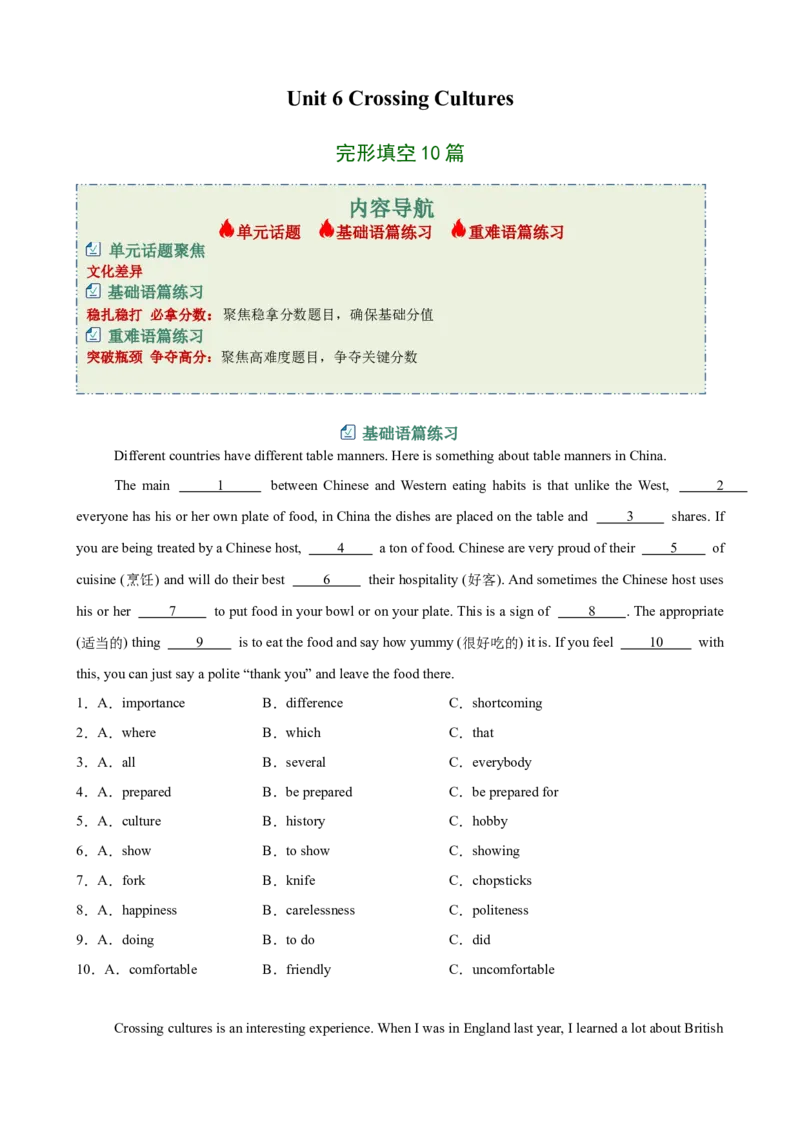
Different countries have different table manners. Here is something about table manners in China.
The main 1 between Chinese and Western eating habits is that unlike the West, 2
everyone has his or her own plate of food, in China the dishes are placed on the table and 3 shares. If
you are being treated by a Chinese host, 4 a ton of food. Chinese are very proud of their 5 of
cuisine (烹饪) and will do their best 6 their hospitality (好客). And sometimes the Chinese host uses
his or her 7 to put food in your bowl or on your plate. This is a sign of 8 . The appropriate
(适当的) thing 9 is to eat the food and say how yummy (很好吃的) it is. If you feel 10 with
this, you can just say a polite “thank you” and leave the food there.
1.A.importance B.difference C.shortcoming
2.A.where B.which C.that
3.A.all B.several C.everybody
4.A.prepared B.be prepared C.be prepared for
5.A.culture B.history C.hobby
6.A.show B.to show C.showing
7.A.fork B.knife C.chopsticks
8.A.happiness B.carelessness C.politeness
9.A.doing B.to do C.did
10.A.comfortable B.friendly C.uncomfortable
Crossing cultures is an interesting experience. When I was in England last year, I learned a lot about British1 and manners. For example, people in England usually 2 each other with a smile and a “Hello”
when they meet on the street. They don’t 3 at others with their fingers, and they always say “Sorry”
when they bump into someone.
It’s important to be 4 when eating in England. You should use a knife and fork correctly, and you
shouldn’t talk with food in your 5 . Also, it’s a custom to say “Thank you” after eating. When I received
a 6 from my British friend, I said “Thank you” and opened it at once. But my friend told me that in
England, people usually open gifts 7 when they are alone. That’s a big difference from China!
I also learned that British people like to talk about the 8 . It’s a safe topic for them. You should
avoid talking about age, money or personal life. This experience made me know that learning about different
cultures is very 9 . It can help us communicate better with people from all over the world and avoid
10 mistakes.
1.A.culture B.food C.sports
2.A.bow B.greet C.point
3.A.look B.smile C.point
4.A.rude B.polite C.careless
5.A.mouth B.hand C.plate
6.A.book B.gift C.flower
7.A.quickly B.slowly C.privately
8.A.weather B.age C.money
9.A.boring B.important C.difficult
10.A.making B.make C.to make
“The grass looks greener on the other side of the fence (篱笆).” That is an old 1 in English. It
means other places often look better, more interesting than the place 2 you live. Some people worry that
young Chinese are beginning to feel like that. They see young Chinese paying no attention to Chinese culture and,
3 , buying Japanese cartoon books, watching Korean soap operas and even 4 Western holidays.
Foreign books and soap operas are good, 5 Chinese writers and actors are just as good. As for
holidays, some may be nice, but for Chinese, they 6 have the special meaning like the Spring Festival,
and the West has 7 to compare with the Mid-Autumn Festival. Don’t forget the best part of Chinese
culture: Friendliness! Not all countries are as 8 as China.
It’s good to enjoy other cultures and 9 from them, but they can’t take the place of your own
culture. It’s good to look on the other side of the fence, but 10 you look carefully and closely, and youwill find that the grass isn’t always greener on the other side of the fence.
1.A.word B.saying C.sentence D.rule
2.A.when B.where C.why D.how
3.A.beside B.besides C.instead D.then
4.A.celebrating B.to celebrate C.celebrated D.celebrate
5.A.if B.so C.but D.or
6.A.still B.never C.always D.ever
7.A.everything B.something C.anything D.nothing
8.A.warm B.warmer C.cold D.colder
9.A.learns B.learning C.in learning D.to learn
10.A.make up B.make up of C.make sure D.be sure to
Bill and Jill were going to visit Dawei and Li Hua in Taiwan for several days. Before they 1
America, they tried to learn about Taiwanese food and Taiwanese ways of doing things. They 2 to be
polite. They learned that most people in Taiwan 3 rice, drink tea, and take off their shoes when they go
into a friend’s home. Bill and Jill even learned to 4 chopsticks.
At the same time, Dawei and Li Hua 5 American food and American ways of doing things. They
wanted to be 6 . When Bill and Jill came to Li Hua’s 7 , Dawei and Li Hua told them to keep
their shoes on. Later they went out for dinner. They ate pizza and drank Coke. The next few 8 , they had
breakfast in a coffee shop and ate hamburgers in a fast-food restaurant.
On their way back to America, Bill and Jill were thinking about why they had 9 eaten rice or
drunk tea or eaten with chopsticks. They didn’t need to take off their 10 when they visited Li Hua’s
family. They thought that living in Taiwan was just like living in America.
1.A.reached B.visited C.found D.left
2.A.asked B.lived C.wanted D.hated
3.A.drink B.grow C.sell D.eat
4.A.make B.use C.buy D.break
5.A.talked about B.heard from C.learned about D.felt like
6.A.friendly B.angry C.excited D.happy
7.A.school B.office C.house D.restaurant
8.A.days B.minutes C.years D.centuries
9.A.often B.usually C.sometimes D.never10.A.shirts B.blouses C.shoes D.socks
Chinese food is very famous in the world. Chinese people think 1 is one of the most important
things during their lives. They do not 2 each other with “How are you?”, but they ask “Have you
eaten?”
Since table manners are part of Chinese cooking culture, Chinese people still 3 their table manners
today.
There is a seat for the “guest of honour” or the 4 person in the family. In most parts of China, the
“seat of honour” is 5 the one facing the front door of the room. The 6 of honour can also be
the one in the middle facing the east of the room if there is no seat facing the door.
As for the host, he or she may take the most 7 seat. It is always the nearest to the kitchen or the
service (服务) door. It is better to sit after the elder or the “guest of honour” sits down. Guests should 8
the host to invite them to sit down.
Chinese people like having meals together and they 9 all the dishes on a round table. There is
sometimes a round rotating disc (旋转盘) in the 10 of the dining table. It makes sure that all the diners
can enjoy the meal and feel respected.
1.A.knowledge B.money C.food D.health
2.A.greet B.introduce C.attract D.teach
3.A.break B.follow C.create D.explore
4.A.richest B.youngest C.poorest D.oldest
5.A.slowly B.normally C.finally D.quickly
6.A.seat B.friend C.map D.time
7.A.convenient B.expensive C.different D.comfortable
8.A.talk with B.think of C.wait for D.look for
9.A.show B.grow C.wash D.put
10.A.corner B.west C.east D.centre
阅读下面短文, 从每题所给的A、B、C、D四个选项中选出最佳选项。
A gift is necessary when one is invited to visit friends in China. After greetings, the gift should be passed
immediately to the host. Remember that usually Chinese people will not open the gift in front of the person who
gave 1 . To show the respect, it may be 2 to explain what the gift is. Bringing some nutrients
(营养品) and tonics (补品) to the elders in the family is a good idea. You can 3 prepare some smallgifts for the spouse (配偶) or kids of the host. The host usually makes full 4 by carefully tidying up the
house. Also, 5 a lot of delicious dishes is necessary. 6 the meal is well prepared, the host
may say to the guest politely, “I haven’t prepared enough. Please excuse me for my poor treat. “As a guest, you
should praise the food to show the host that you think the meal is abundant (丰盛的) and delicious.
While eating, the elders will use chopsticks to 7 food for guests as a tradition and ask them to eat
8 . As a guest, you should accept their goodwill readily. But nowadays, the younger people do the traditional
way less.
After dinner, tea and fruit are usually served. When the guests are to leave, the host may still politely ask
them to stay. They don’t have to take it 9 and can try to find a good time to leave. This doesn’t mean
that leaving early is always a good idea as the host may feel that the guests are not satisfied with the treat. Finding
the right time to leave 10 the situation.
1.A.it B.them C.that D.us
2.A.necessary B.careful C.comfortable D.exciting
3.A.too B.also C.either D.neither
4.A.plans B.decisions C.preparations D.weeks
5.A.enjoying B.cooking C.washing D.taking
6.A.But B.Although C.Because D.If
7.A.cut up B.eat up C.pick up D.take up
8.A.more B.less C.most D.least
9.A.completely B.seriously C.probably D.carefully
10.A.works out B.sticks to C.depends on D.turns on
In China, drinking hot water is very common. We all know that in China, when we are waiting for the food
in a restaurant, the waiter 1 gives us hot water to drink, but foreign friends don’t know it. They may be
2 and ask, “Why is the water so hot?” They usually ask the waiter 3 some cold water to drink.
For Chinese people, drinking more hot water can make us 4 and strong. When we are ill, doctors
5 us to drink hot water. Our parents tell us not to eat 6 ice cream. They think cold food can cause
illness easily. But in foreign countries, some people may not have the 7 of drinking hot water. So when
they see many Chinese people 8 a cup with hot water, they feel surprised. Next time when you go to a
friend’s 9 in America, don’t be surprised if he or she gives you a cup of cold water. Different histories
and cultures lead to different eating habits. We can’t understand the difference between each other, but we can
10 it.1.A.usually B.seldom C.never
2.A.happy B.sad C.surprised
3.A.to B.for C.at
4.A.cute B.clever C.healthy
5.A.choose B.wish C.ask
6.A.too many B.too much C.much too
7.A.dream B.chance C.habit
8.A.take B.buy C.pick
9.A.classroom B.school C.home
10.A.become B.respect C.lose
British people are famous for apologizing in almost every situation.
British people take pride in 1 on their polite manners towards one another in public. As a result,
they often use the word “sorry”—even when they don’t really 2 it! Usually, if they want to ask a
stranger for the time, they will 3 by saying “Sorry to trouble you.” If they’re five minutes late 4
an appointment, they will generally greet the person by saying “Sorry I’m late!” If they’re 15 minutes late, they
might want to be even more apologetic and say, “I’m 5 sorry I’m late!”
6 do British people use “sorry” so much? Well, in the British culture, saying “sorry” is a way to
be polite, 7 to people whom they don’t know very well. It’s also a very smart way to get what they
want. In recent research, an actor got close to 8 strangers on a rainy day to ask if he could use their
mobile phones. When he walked to one group of strangers and asked them without apologizing first, he was only
9 percent successful in 9 their phones. 10 , when he said “Sorry” or “Excuse me” to another
group of strangers before asking, he was 47 percent successful.
1.A.themselves B.yourselves C.ourselves
2.A.prefer B.mean C.know
3.A.stop B.leave C.start
4.A.before B.for C.of
5.A.just B.only C.so
6.A.When B.Why C.How
7.A.recently B.especially C.suddenly
8.A.same B.strange C.different
9.A.buying B.keeping C.borrowing10.A.However B.Because C.So
重难语篇练习
Most cultures in the world have some similarities. However, there are often some big differences that go
with these similarities. These 1 differences can cause some very embarrassing moments. It is something
that 2 wants to experience.
My grandfather is from Italy, so I live in an environment rich in Italian culture. In Italian culture, kissing
each other hello and goodbye is 3 . You’ll see family members hug and kiss each other goodbye, 4
you’ll see best friends give a kiss on the cheek. I do this all the time to my family members. 5 , one
night I decided I’d try it among all my friends who are mainly Irish people and come from a strong American
background. What 6 was really embarrassing.
A girl, who I have known for a long time, came up to me to say hello at a party. I gave her a hug and a 7
on the cheek. The reaction (反应) I got was something out of a comedy movie. She gave me a 8 as if to
say, “Joe, what the hell was that?” All my friends began to think I 9 her past the point of friends, but in
fact it was not that case. Rumours (谣言) began to spread, and I had to 10 myself. It was such a(n)
11 situation if you ask me.
I often 12 cultural differences. They’re not fun, 13 when someone from a different
background misunderstands the total situation. The best thing to do is to try and understand the other person’s
cultural norms (行为规范), and try not to 14 them. However, every person is different and it’s fairly
difficult to read a person when you’re just meeting them. As life goes on, we’ll have the 15 to learn
about other people and their cultures.
1.A.normal B.cultural C.boring D.special
2.A.no one B.someone C.anyone D.everyone
3.A.helpful B.private C.common D.polite
4.A.as B.so C.but D.or
5.A.Actually B.However C.Luckily D.Besides
6.A.happened B.disappeared C.changed D.continued
7.A.kiss B.smile C.touch D.look
8.A.choice B.try C.look D.suggestion
9.A.believed B.liked C.trusted D.worried
10.A.protect B.explain C.control D.train
11.A.exciting B.unreasonable C.dangerous D.uncomfortable12.A.deal with B.agree with C.turn down D.stick to
13.A.only B.probably C.especially D.even
14.A.discover B.break C.miss D.waste
15.A.decision B.argument C.trouble D.chance
先通读短文,掌握其大意,然后从A、B、C、D四个选项中选出一个可以填入相应空白处的最佳选项,
并在答题卡上将该项涂黑。
Kimi was a middle school student. He had always been attracted by Chinese culture. He loved learning
about the 1 , traditions, and customs of his country. One day, while looking through the Internet, he
noticed some information 2 Western culture. He was surprised to find that there were many differences
between Chinese and Western 3 .
Kimi couldn’t believe what he was reading. He found it 4 to understand why people in the West
did things so differently from people in China. He thought that Western culture was strange. He decided to 5
about it with his best friend, Jack.
“Jack, have you ever noticed how different Western culture is from Chinese culture?” Kimi asked.
“Yeah, I have,” Jack replied. “But that doesn’t mean we should think it’s strange. We should try to 6
and appreciate (欣赏) it.”
“But 7 do they do things so differently?” Kimi asked.
“Well, different cultures have 8 values,” Jack explained. “For example, in the West,
individualism (个人主义) is 9 valued, while in China, collectivism (集体主义) is more important.”
Kimi thought about what Jack had 10 . He found that he had been too quick to judge (评价)
Western culture. He decided to learn more about it.
Over the next few weeks, Kimi tried many 11 to help himself understand Western culture, such
as reading books and watching movies about it. And he had learned a great deal. He knew that things could not be
said to be strange and bad just because they were different from yours. Kimi 12 that it was very
common to find differences. Everyone is different, so how could two countries with totally different backgrounds
be the same?
In the end, Kimi changed 13 attitude (态度) towards Western culture. By learning about the
differences, he could understand the 14 better and become a more open-minded person. He was 15
to continue learning about different cultures and exploring the world around him.
1.A.art B.math C.science D.history
2.A.about B.with C.for D.like3.A.songs B.pictures C.cities D.cultures
4.A.hard B.special C.brave D.safe
5.A.think B.talk C.learn D.worry
6.A.imagine B.explain C.understand D.receive
7.A.what B.where C.why D.When
8.A.similar B.different C.common D.important
9.A.lightly B.slowly C.highly D.totally
10.A.made B.said C.looked D.asked
11.A.ways B.skills C.plans D.moments
12.A.heard B.realized C.suggested D.guessed
13.A.their B.his C.her D.its
14.A.life B.world C.nature D.mood
15.A.happy B.sorry C.moved D.surprised