Unit 6 Crossing Cultures
选词填空10篇
内容导航
单元话题 基础语篇练习 重难语篇练习
单元话题聚焦
文化差异
基础语篇练习
稳扎稳打 必拿分数:聚焦稳拿分数题目,确保基础分值
重难语篇练习
突破瓶颈 争夺高分:聚焦高难度题目,争夺关键分数
基础语篇练习
请从方框内选择适当的词并用其正确形式填空,使文章完整连贯。注意每空一词,每词仅用一次,有两
词为多余项。
culture, polite, different, but, can, learn, friend, happy, with, show, hike, they
My name is Lisa. I love learning about different 1 around the world. Last year, I made a pen pal
from Canada. Her name is Emma. We often talk 2 each other online.
In her country, it’s 3 to say “sorry” if you bump into someone. I used to think it was not a big
deal, 4 now I know it’s important. Emma told me that people there love outdoor activities, so we often
go 5 together when I visit her.
I also 6 a lot from her about Canadian festivals. She said Thanksgiving in Canada is 7
from that in the US. I hope I 8 join her family’s Thanksgiving dinner someday. Making friends from
other countries makes me feel 9 . I think everyone should make a 10 from a different culture
to learn more about the world.
【答案】
1.cultures 2.with 3.polite 4.but 5.hiking 6.learn 7.different 8.can
9.happy 10.friend
【导语】本文主要通过作者与加拿大笔友Emma的交流经历,介绍了不同国家的文化习俗,说明跨文化
交往能帮助人们增长见识、获得快乐。
1.句意:我喜欢了解世界各地不同的文化。根据“I love learning about different…around the world.”的语
境并结合备选词汇可知,此处表示“不同的文化”;culture意为“文化”,为可数名词,different后接复数形式。故填cultures。
2.句意:我们经常在网上彼此交谈。根据“We often talk…each other online.”及备选词汇可知,此处指彼
此交谈,考查固定搭配talk with“和……交谈”。故填with。
3.句意:在她的国家,如果你撞到别人,说“对不起”是有礼貌的。根据“it’s…to say ‘sorry’”的语境并
结合备选词汇可知,此处指如果你撞到别人,说“对不起”是有礼貌的,polite“有礼貌的”符合。故填
polite。
4.句意:我过去认为这没什么大不了的,但现在我知道它很重要。根据“I used to think it was not a big
deal, …now I know it’s important.”的语境并结合备选词汇可知,前后句为转折关系;but“但是”符合。故
填but。
5.句意:Emma告诉我那里的人喜欢户外活动,所以当我去看她时,我们经常可以一起去远足。根据
“we often go...together”的语境并结合备选词汇可知,此处指当我去看她时,我们经常可以一起去远足;
hike“远足”符合。go hiking为固定搭配,故填hiking。
6.句意:我也从她那里学到了很多关于加拿大节日的知识。根据“I also…a lot from her”的语境并结合备
选词汇可知,此处指我也从她那里学到了很多关于加拿大节日的知识,learn from“向……学习”,本句陈
述客观情况,用一般现在时,主语是I,用动词原形。故填learn。
7.句意:她说加拿大的感恩节和美国的感恩节不同。根据“Thanksgiving in Canada is…from that in the
US.”的语境并结合备选词汇可知,此处指加拿大的感恩节和美国的感恩节不同,be different from“与……
不同”。故填different。
8.句意:我希望有一天我可以参加她家的感恩节晚餐。根据“I hope I…join her family’s Thanksgiving
dinner someday.”的语境并结合备选词汇可知,此处指我希望有一天我可以参加她家的感恩节晚餐,can“能
够,可以”符合。故填can。
9.句意:结交来自其他国家的朋友让我感到很开心。根据“makes me feel…”的语境并结合备选词汇可知,
此处指结交来自其他国家的朋友让我感到很开心,happy“开心的”符合。故填happy。
10.句意:我认为每个人都应该结交一位来自不同文化的朋友,以更多地了解这个世界。根据“make a…
from a different culture”的语境并结合备选词汇可知,此处指每个人都应该结交一位来自不同文化的朋友,
make a friend“交朋友”,前面有a,用单数,故填friend。
阅读短文,从方框中选择适当的词并用其正确形式填空,使短文通顺、意思完整。每空限填一词,每词
限用一次。
between, health, however, share, encourage, family, culture, notice, another, theyMany users from the US joined Xiaohongshu recently, and Chinese users jokingly (开玩笑地) asked them
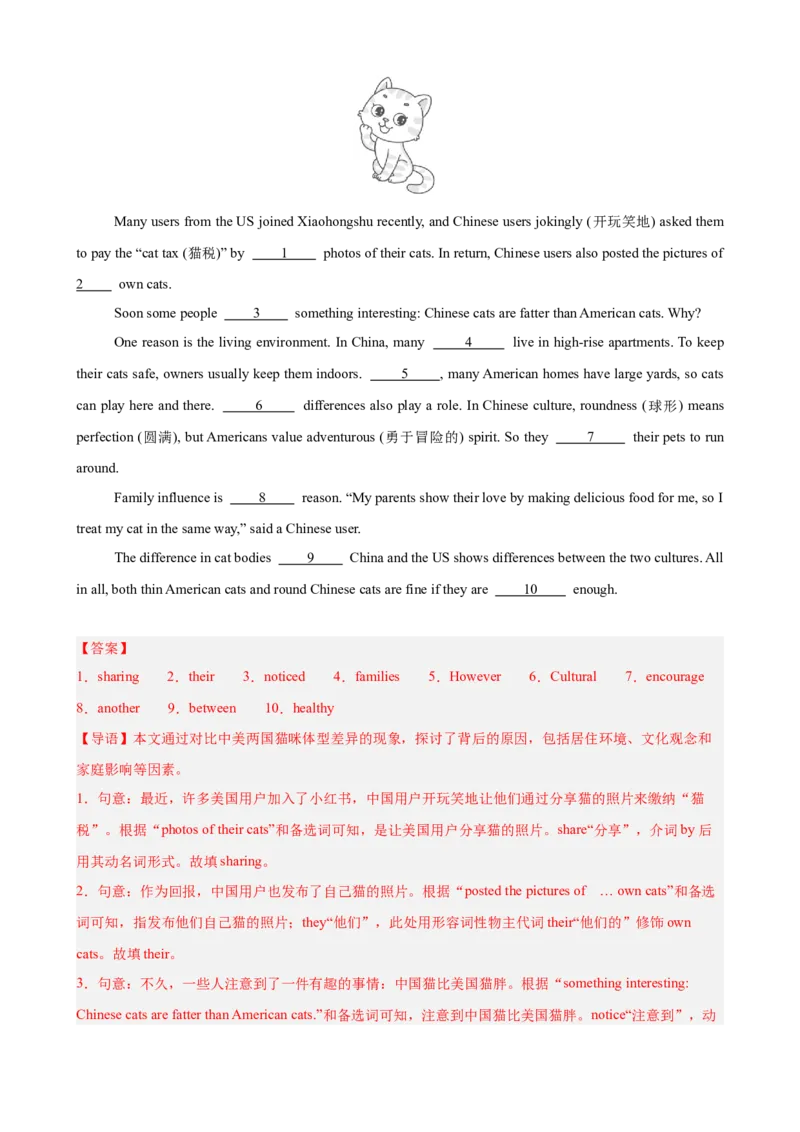
to pay the “cat tax (猫税)” by 1 photos of their cats. In return, Chinese users also posted the pictures of
2 own cats.
Soon some people 3 something interesting: Chinese cats are fatter than American cats. Why?
One reason is the living environment. In China, many 4 live in high-rise apartments. To keep
their cats safe, owners usually keep them indoors. 5 , many American homes have large yards, so cats
can play here and there. 6 differences also play a role. In Chinese culture, roundness (球形) means
perfection (圆满), but Americans value adventurous (勇于冒险的) spirit. So they 7 their pets to run
around.
Family influence is 8 reason. “My parents show their love by making delicious food for me, so I
treat my cat in the same way,” said a Chinese user.
The difference in cat bodies 9 China and the US shows differences between the two cultures. All
in all, both thin American cats and round Chinese cats are fine if they are 10 enough.
【答案】
1.sharing 2.their 3.noticed 4.families 5.However 6.Cultural 7.encourage
8.another 9.between 10.healthy
【导语】本文通过对比中美两国猫咪体型差异的现象,探讨了背后的原因,包括居住环境、文化观念和
家庭影响等因素。
1.句意:最近,许多美国用户加入了小红书,中国用户开玩笑地让他们通过分享猫的照片来缴纳“猫
税”。根据“photos of their cats”和备选词可知,是让美国用户分享猫的照片。share“分享”,介词by后
用其动名词形式。故填sharing。
2.句意:作为回报,中国用户也发布了自己猫的照片。根据“posted the pictures of … own cats”和备选
词可知,指发布他们自己猫的照片;they“他们”,此处用形容词性物主代词their“他们的”修饰own
cats。故填their。
3.句意:不久,一些人注意到了一件有趣的事情:中国猫比美国猫胖。根据“something interesting:
Chinese cats are fatter than American cats.”和备选词可知,注意到中国猫比美国猫胖。notice“注意到”,动词;结合“Chinese users also posted the pictures”“Soon”可知,时态为一般过去时,此处用notice的过去式
noticed。故填noticed。
4.句意:在中国,许多家庭住在高层公寓里。根据“live in high-rise apartments”和备选词可知,中国许
多家庭住在高层公寓里。family“家庭”,many后用名词复数形式。故填families。
5.句意:然而,许多美国家庭都有大院子,所以猫可以在这里和那里玩耍。“许多美国家庭都有大院子,
所以猫可以在这里和那里玩耍”与“在中国,许多家庭住在高层公寓里”是转折关系,用however“然
而”承接句子。故填However。
6.句意:文化差异也有影响。根据“In Chinese culture, roundness (球形) means perfection (圆满), but
Americans value adventurous (勇于冒险的) spirit.”和备选词可知,指中美文化差异也影响猫的体型。
culture“文化”,此处用其形容词形式cultural“文化的”修饰名词differences。故填Cultural。
7.句意:所以他们鼓励他们的宠物到处跑。根据“Americans value adventurous (勇于冒险的) spirit”和备
选词可知,美国人重视冒险精神,他们鼓励宠物到处跑。encourage“鼓励”,时态为一般现在时,主语为
“they”,动词用原形。故填encourage。
8.句意:家庭影响是另一个原因。根据“One reason is the living environment.”和备选词可知,此处指家
庭影响是另一个原因。one … another“一个……另一个”。故填another。
9.句意:中美猫咪体型的差异显示了两国文化的不同。根据“China and the US”“between the two cultures”
和备选词可知,此处指中美猫咪体型的差异。between … and …“在……和……之间”;between“在……之
间”。故填between。
10.句意:总的来说,无论是瘦的美国猫还是圆的中国猫,只要它们足够健康,都很好。根据“both thin
American cats and round Chinese cats are fine if they are … enough”和备选词可知,只要猫咪足够健康,就都
好。health“健康”,名词,此处用其形容词形式healthy“健康的”作表语。故填healthy。
with one after shake impolite country Italy kind you pay
When the Americans meet each other, it’s not necessary 334 hands. They just give a smile. Even a few
seconds 335 they meet for the first time, they can just call each other’s first names to show 336 .
For Japanese, bowing is quite acceptable. But you should not have eye contact (接触) with the Japanese
guests. It is rather 337 .
People from most European 338 usually embrace (拥抱) each other and sometimes kiss the cheek.
But you should 339 attention that you’d better make no sound while kissing. Women should embrace men
340 and sometimes men are supposed to (应该) kiss women’s hands.
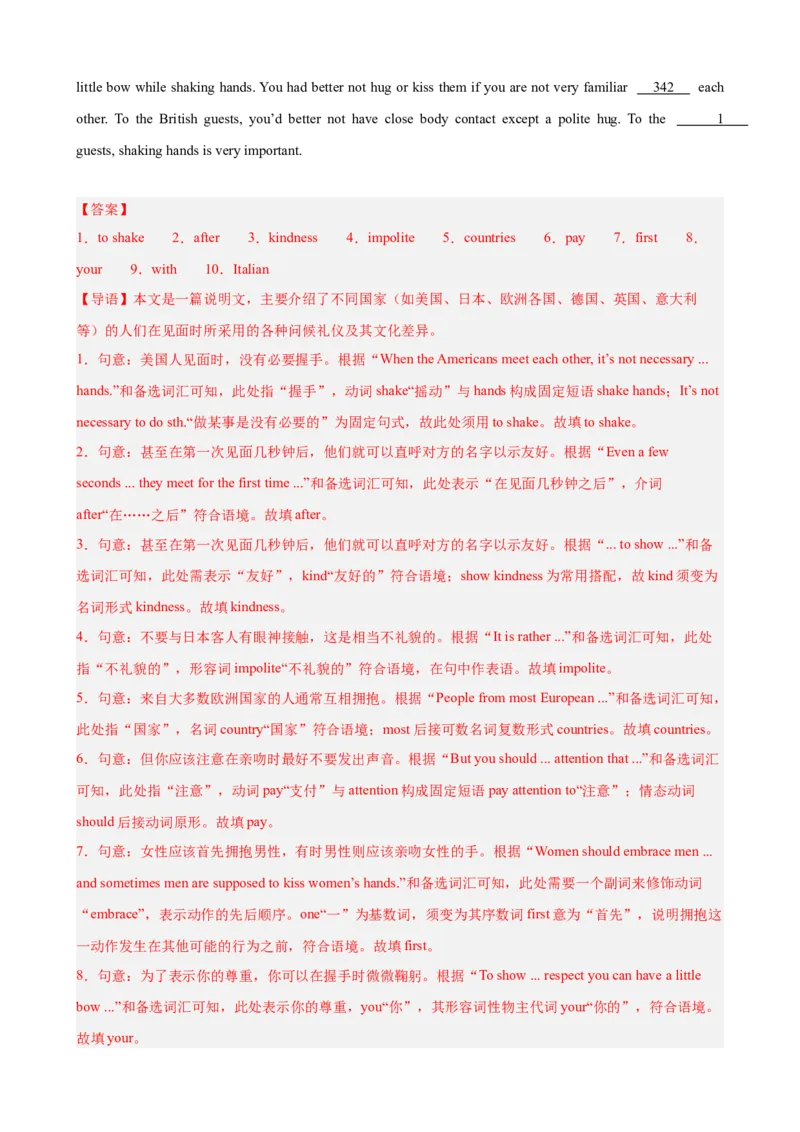
To the German guests, you should shake hands to greet them. To show 341 respect you can have alittle bow while shaking hands. You had better not hug or kiss them if you are not very familiar 342 each
other. To the British guests, you’d better not have close body contact except a polite hug. To the 1
guests, shaking hands is very important.
【答案】
1.to shake 2.after 3.kindness 4.impolite 5.countries 6.pay 7.first 8.
your 9.with 10.Italian
【导语】本文是一篇说明文,主要介绍了不同国家(如美国、日本、欧洲各国、德国、英国、意大利
等)的人们在见面时所采用的各种问候礼仪及其文化差异。
1.句意:美国人见面时,没有必要握手。根据“When the Americans meet each other, it’s not necessary ...
hands.”和备选词汇可知,此处指“握手”,动词shake“摇动”与hands构成固定短语shake hands;It’s not
necessary to do sth.“做某事是没有必要的”为固定句式,故此处须用to shake。故填to shake。
2.句意:甚至在第一次见面几秒钟后,他们就可以直呼对方的名字以示友好。根据“Even a few
seconds ... they meet for the first time ...”和备选词汇可知,此处表示“在见面几秒钟之后”,介词
after“在……之后”符合语境。故填after。
3.句意:甚至在第一次见面几秒钟后,他们就可以直呼对方的名字以示友好。根据“... to show ...”和备
选词汇可知,此处需表示“友好”,kind“友好的”符合语境;show kindness为常用搭配,故kind须变为
名词形式kindness。故填kindness。
4.句意:不要与日本客人有眼神接触,这是相当不礼貌的。根据“It is rather ...”和备选词汇可知,此处
指“不礼貌的”,形容词impolite“不礼貌的”符合语境,在句中作表语。故填impolite。
5.句意:来自大多数欧洲国家的人通常互相拥抱。根据“People from most European ...”和备选词汇可知,
此处指“国家”,名词country“国家”符合语境;most后接可数名词复数形式countries。故填countries。
6.句意:但你应该注意在亲吻时最好不要发出声音。根据“But you should ... attention that ...”和备选词汇
可知,此处指“注意”,动词pay“支付”与attention构成固定短语pay attention to“注意”;情态动词
should后接动词原形。故填pay。
7.句意:女性应该首先拥抱男性,有时男性则应该亲吻女性的手。根据“Women should embrace men ...
and sometimes men are supposed to kiss women’s hands.”和备选词汇可知,此处需要一个副词来修饰动词
“embrace”,表示动作的先后顺序。one“一”为基数词,须变为其序数词first意为“首先”,说明拥抱这
一动作发生在其他可能的行为之前,符合语境。故填first。
8.句意:为了表示你的尊重,你可以在握手时微微鞠躬。根据“To show ... respect you can have a little
bow ...”和备选词汇可知,此处表示你的尊重,you“你”,其形容词性物主代词your“你的”,符合语境。
故填your。9.句意:如果你们彼此不是很熟悉,最好不要拥抱或亲吻他们。根据“... you are not very familiar...each
other.”和备选词汇可知,此处需介词与familiar搭配,with“和”,介词,familiar with“熟悉”为固定短语,
符合语境。故填with。
10.句意:对于意大利客人来说,握手非常重要。根据“To the ... guests, shaking hands is very important.”
和备选词汇可知,此处指“意大利的”,Italy“意大利”须变为形容词Italian修饰名词guests。故填
Italian。
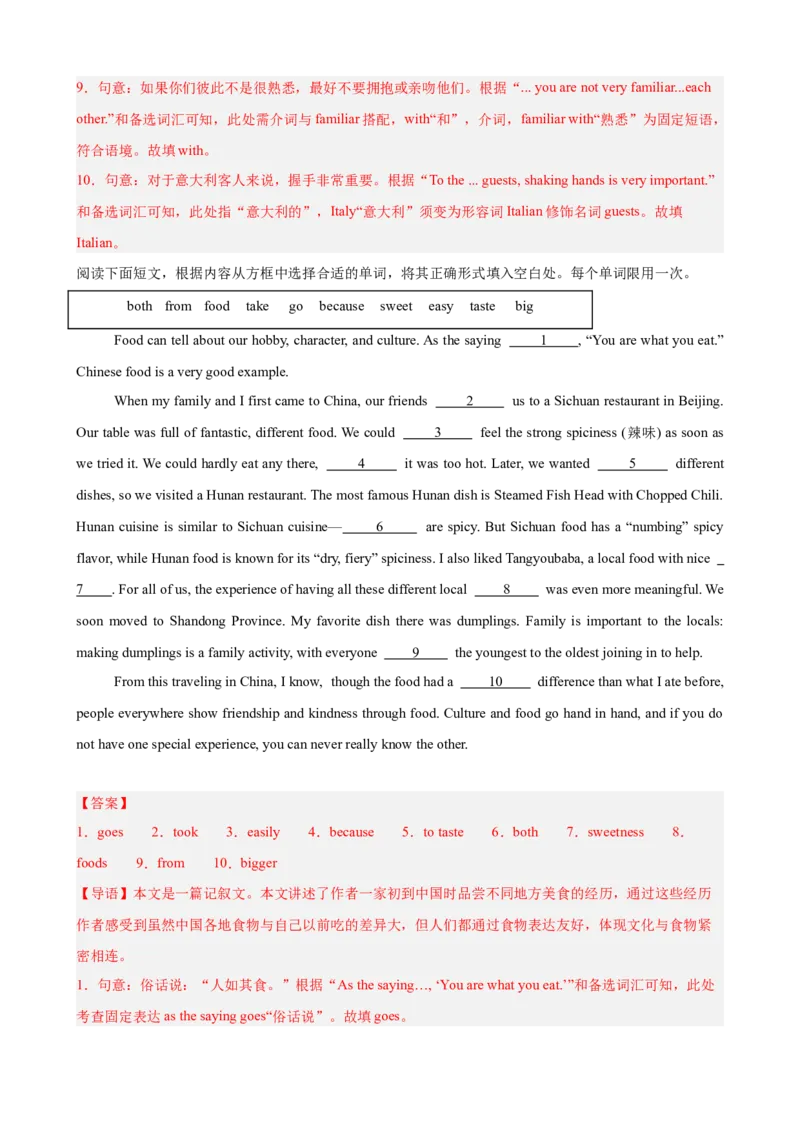
阅读下面短文,根据内容从方框中选择合适的单词,将其正确形式填入空白处。每个单词限用一次。
both from food take go because sweet easy taste big
Food can tell about our hobby, character, and culture. As the saying 1 , “You are what you eat.”
Chinese food is a very good example.
When my family and I first came to China, our friends 2 us to a Sichuan restaurant in Beijing.
Our table was full of fantastic, different food. We could 3 feel the strong spiciness (辣味) as soon as
we tried it. We could hardly eat any there, 4 it was too hot. Later, we wanted 5 different
dishes, so we visited a Hunan restaurant. The most famous Hunan dish is Steamed Fish Head with Chopped Chili.
Hunan cuisine is similar to Sichuan cuisine— 6 are spicy. But Sichuan food has a “numbing” spicy
flavor, while Hunan food is known for its “dry, fiery” spiciness. I also liked Tangyoubaba, a local food with nice
7 . For all of us, the experience of having all these different local 8 was even more meaningful. We
soon moved to Shandong Province. My favorite dish there was dumplings. Family is important to the locals:
making dumplings is a family activity, with everyone 9 the youngest to the oldest joining in to help.
From this traveling in China, I know, though the food had a 10 difference than what I ate before,
people everywhere show friendship and kindness through food. Culture and food go hand in hand, and if you do
not have one special experience, you can never really know the other.
【答案】
1.goes 2.took 3.easily 4.because 5.to taste 6.both 7.sweetness 8.
foods 9.from 10.bigger
【导语】本文是一篇记叙文。本文讲述了作者一家初到中国时品尝不同地方美食的经历,通过这些经历
作者感受到虽然中国各地食物与自己以前吃的差异大,但人们都通过食物表达友好,体现文化与食物紧
密相连。
1.句意:俗话说:“人如其食。”根据“As the saying…, ‘You are what you eat.’”和备选词汇可知,此处
考查固定表达as the saying goes“俗话说”。故填goes。2.句意:当我和家人第一次来到中国时,我们的朋友带我们去北京的一家川菜馆。根据“our friends…us
to a Sichuan restaurant”和备选词汇可知,此处考查take sb. to…“带某人去……”,句子陈述过去的事情,
时态应用一般过去时,动词take的过去式为took。故填took。
3.句意:我们一尝就能很容易地感觉到强烈的辣味。根据“feel the strong spiciness”和备选词汇可知,此
处是指很容易感觉到辣味,应用副词修饰动词feel,easy的副词形式为easily“容易地”。故填easily。
4.句意:我们在那里几乎吃不下任何东西,因为它太辣了。根据“We could hardly eat any there…it was
too hot.”和备选词汇可知,前后是因果关系,前果后因,应用because“因为”引导原因状语从句。故填
because。
5.句意:后来,我们想品尝不同的菜肴,所以我们去了一家湘菜馆。根据“we wanted…different dishes”
和备选词汇可知,此处是指品尝不同的菜肴,考查want to do sth.“想要做某事”,应用动词不定式作宾语,
taste“品尝”,动词。故填to taste。
6.句意:湘菜和川菜很相似——两者都很辣。根据“Hunan cuisine is similar to Sichuan cuisine—…are
spicy.”和备选词汇可知,此处指湘菜和川菜两者都很辣,考查both“两者都”。故填both。
7.句意:我也喜欢糖油粑粑,一种有美妙甜味的当地食物。根据“a local food with nice…”和备选词汇可
知,此处是指有美妙甜味的食物,应用名词作宾语,sweet的名词形式为sweetness“甜味”。故填
sweetness。
8.句意:对我们所有人来说,品尝所有这些不同的当地食物的经历更有意义。根据“the experience of
having all these different local…”和备选词汇可知,此处是指品尝当地食物,应用名词作宾语,food“食物”,
可数名词;空格前有“these”,这里应用名词复数形式foods。故填foods。
9.句意:家庭对当地人来说很重要:包饺子是一项家庭活动,从最小的到最大的每个人都参与帮忙。根
据“with everyone…the youngest to the oldest joining in to help”和备选词汇可知,此处考查固定短语from…
to…“从……到……”。故填from。
10.句意:从这次在中国的旅行中,我知道,虽然这里的食物和我以前吃的有很大的不同,但各地的人
们都通过食物表达友谊和善意。根据“the food had a…difference than what I ate before”和备选词汇可知,
此处是指食物有很大的不同,应用形容词修饰名词difference,big“大的”,结合“than”可知,此处应用
比较级bigger。故填bigger。
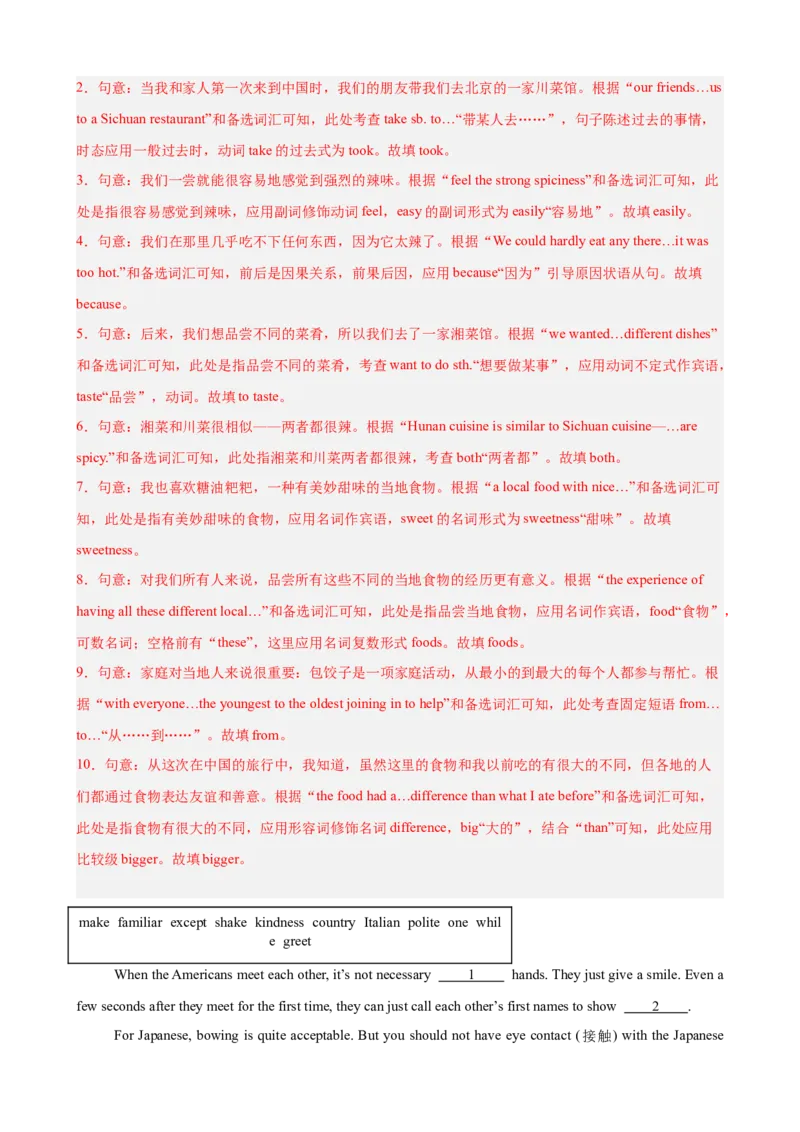
make familiar except shake kindness country Italian polite one whil
e greet
When the Americans meet each other, it’s not necessary 1 hands. They just give a smile. Even a
few seconds after they meet for the first time, they can just call each other’s first names to show 2 .
For Japanese, bowing is quite acceptable. But you should not have eye contact (接触) with the Japaneseguests. It is rather 3 .
People from most European 4 usually embrace (拥抱) each other and sometimes kiss the cheek.
But you should pay attention that you’d better 5 no sound while kissing. Women should embrace men
6 and sometimes men are supposed to (应该) kiss women’s hands.
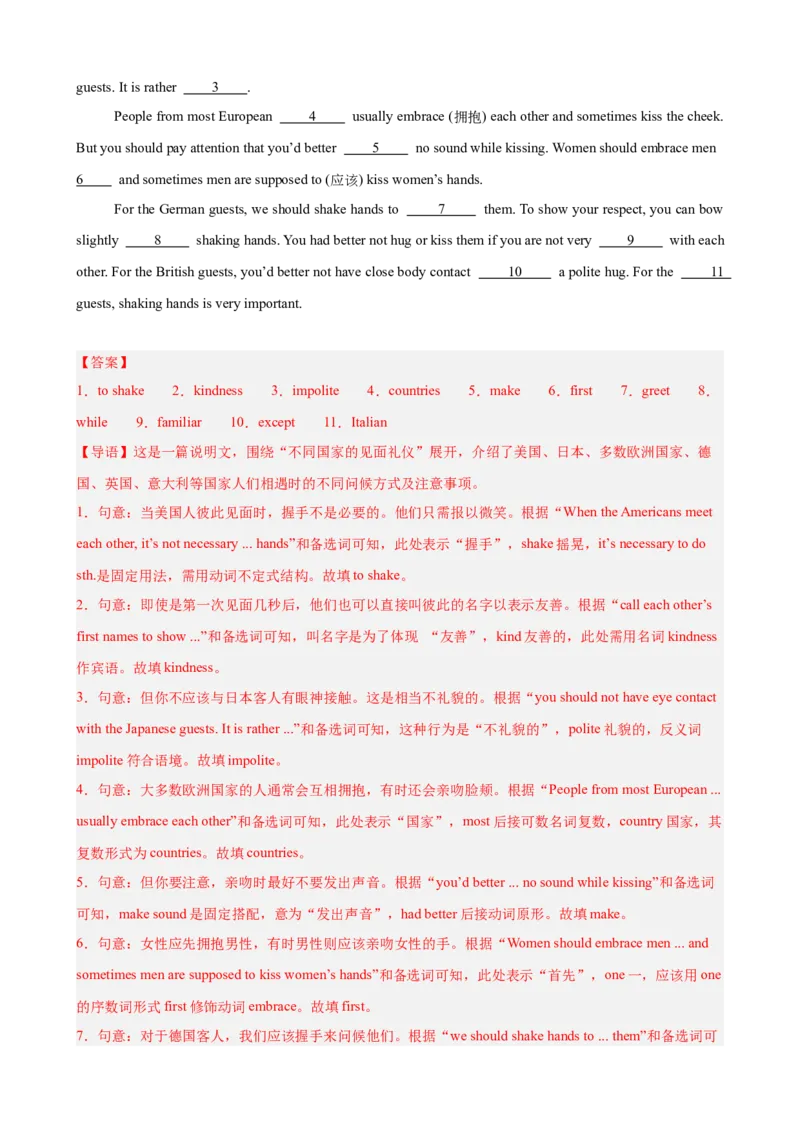
For the German guests, we should shake hands to 7 them. To show your respect, you can bow
slightly 8 shaking hands. You had better not hug or kiss them if you are not very 9 with each
other. For the British guests, you’d better not have close body contact 10 a polite hug. For the 11
guests, shaking hands is very important.
【答案】
1.to shake 2.kindness 3.impolite 4.countries 5.make 6.first 7.greet 8.
while 9.familiar 10.except 11.Italian
【导语】这是一篇说明文,围绕“不同国家的见面礼仪”展开,介绍了美国、日本、多数欧洲国家、德
国、英国、意大利等国家人们相遇时的不同问候方式及注意事项。
1.句意:当美国人彼此见面时,握手不是必要的。他们只需报以微笑。根据“When the Americans meet
each other, it’s not necessary ... hands”和备选词可知,此处表示“握手”,shake摇晃,it’s necessary to do
sth.是固定用法,需用动词不定式结构。故填to shake。
2.句意:即使是第一次见面几秒后,他们也可以直接叫彼此的名字以表示友善。根据“call each other’s
first names to show ...”和备选词可知,叫名字是为了体现 “友善”,kind友善的,此处需用名词kindness
作宾语。故填kindness。
3.句意:但你不应该与日本客人有眼神接触。这是相当不礼貌的。根据“you should not have eye contact
with the Japanese guests. It is rather ...”和备选词可知,这种行为是“不礼貌的”,polite礼貌的,反义词
impolite符合语境。故填impolite。
4.句意:大多数欧洲国家的人通常会互相拥抱,有时还会亲吻脸颊。根据“People from most European ...
usually embrace each other”和备选词可知,此处表示“国家”,most后接可数名词复数,country国家,其
复数形式为countries。故填countries。
5.句意:但你要注意,亲吻时最好不要发出声音。根据“you’d better ... no sound while kissing”和备选词
可知,make sound是固定搭配,意为“发出声音”,had better后接动词原形。故填make。
6.句意:女性应先拥抱男性,有时男性则应该亲吻女性的手。根据“Women should embrace men ... and
sometimes men are supposed to kiss women’s hands”和备选词可知,此处表示“首先”,one一,应该用one
的序数词形式first修饰动词embrace。故填first。
7.句意:对于德国客人,我们应该握手来问候他们。根据“we should shake hands to ... them”和备选词可知,握手是为了“问候”对方,此处需用动词greet问候,不定式符号to后接动词原形。故填greet。
8.句意:为了表示尊重,你可以在握手的同时微微鞠躬。根据“you can bow slightly ... shaking hands”和
备选词可知,此处表示“在……期间”,用连词while在……期间,引导时间状语。故填while。
9.句意:如果你们彼此不太熟悉,最好不要拥抱或亲吻他们。根据“You had better not hug or kiss them if
you are not very ... with each other”和备选词可知,familiar熟悉的,be familiar with是固定短语,意为“熟
悉……”。故填familiar。
10.句意:对于英国客人,除了礼貌的拥抱外,你最好不要有亲密的身体接触。根据“you’d better not
have close body contact ... a polite hug”和备选词可知,此处表示“除……之外”,except除……之外,符合
语境。故填except。
11.句意:对于意大利客人来说,握手非常重要。根据“For the ... guests, shaking hands is very important”
和备选词可知,Italian意大利的,此处需用形容词Italian修饰名词guests,指“意大利的客人”。故填
Italian。
coast usually take fifth if communicate pretty between capital nicely east
Do you know Brazil? Brazil is the world’s 365 largest country after Russia, Canada, China and the
United States. It lies in the 366 part of South America and covers an area of 8.51 million square kilometers.
The 367 of Brazil used to be Rio de Janeiro, the second largest city in the country on the South Atlantic
368 , but now it is Brasilia.
Brazil is a beautiful country and is worth (值得) visiting. Every year a lot of people from all over the world
pay a visit to it. Would you also like to travel there? 369 so, here is a suggestion for you—to learn as many
Brazilian customs as possible.
The communication style of Brazilian locals is 370 relaxing. It is known that Brazilians are 371
direct in their manner of speaking as well as in what they say. When 372 , locals will often touch one another
lightly and stand close together. Sticking the thumb (拇指) 373 the middle and index finger (食指) is a
symbol of wishing someone good luck in Brazil. Women are generally expected 1 care of all chores.
Brazilians are generally 375 dressed. In a work-related environment, it is not acceptable to wear jeans.
【答案】
1.fifth 2.eastern 3.capital 4.coast 5.If 6.usually 7.pretty 8.
communicating 9.between 10.to take 11.nicely【导语】本文是一篇说明文,主要介绍了巴西的地理概况、首都变迁以及当地的社交礼仪与文化习俗。
1.句意:巴西是世界第五大国家,仅次于俄罗斯、加拿大、中国和美国。根据“after Russia, Canada,
China and the United States”及备选词可知,巴西是第五大国家,需用序数词fifth“第五”。故填fifth。
2.句意:它位于南美洲的东部,面积851万平方公里。根据“the … part of South America”及备选词可知,
此处表示“东部的”,因此应用形容词eastern“东部的”,修饰名词part。故填eastern。
3.句意:巴西的首都曾经是里约热内卢,这座位于南大西洋沿岸的全国第二大城市,但现在是巴西利亚。
根据“used to be Rio de Janeiro... but now it is Brasilia”及备选词可知,里约热内卢是巴西的首都,因此应填
capital“首都”。故填capital。
4.句意:巴西的首都曾经是里约热内卢,这座位于南大西洋沿岸的全国第二大城市,但现在是巴西利亚。
根据“South Atlantic”及备选词可知,此处指“海岸”,因此应填coast“海岸”。故填coast。
5.句意:如果是这样,这里有一个建议给你——尽可能多地了解巴西习俗。根据“Would you also like to
travel there? … so”可知,此处表示“如果”,因此应用If“如果”,位于句首首字母大写。故填If。
6.句意:巴西当地人的交流方式通常很放松。根据“The communication style … relaxing”及备选词可知,
此处表示交流方式的特点,因此应用副词usually“通常”,修饰形容词relaxing。故填usually。
7.句意:众所周知,巴西人在说话方式和内容上都相当直接。根据“are … direct”及备选词可知,巴西
人说话的方式和表达的内容都很直接,因此用副词pretty“十分”修饰形容词direct。故填pretty。
8.句意:交流时,当地人经常轻轻触碰彼此,站得很近。根据“when”可知,此处指“交流”,“when
+现在分词”是省略结构,因此应用现在分词communicating“当交流时”。故填communicating。
9.句意:在巴西,拇指夹在中指和食指之间是祝别人好运的象征。根据“the thumb … the middle and
index finger”可知,拇指夹在中指和食指之间是祝别人好运的象征,between … and …“在……和……之
间”,是固定搭配,因此用between 。故填between。
10.句意:女性通常被期望负责所有家务。根据“are generally expected … care of”及备选词可知,女性通
常要负责所有的家务,take care of“照顾;负责”,是固定搭配,且be expected to do“被期望做某事”,是
固定搭配,因此应填动词不定式to take。故填to take。
11.句意:巴西人通常穿着得体。根据“are generally … dressed”及备选词可知,此处需用副词修饰形容
词dressed ,表示“得体地”,因此应填nicely“得体地”。故填nicely。
用方框中所给词的适当形式填空,使短文通顺、完整。每空仅限一次,每次限用一次。
connect during them easy different bring country challenge danger encourage
Some things have different meanings in different cultures. Here are some words about animals that are used
1 in Western and Chinese cultures—understanding them is a little 2 but fun for learners.
Most dog phrases (习语) in Chinese, like “a homeless dog” and “a dog catching mice”, have negative (消极的) meanings. But in Western 3 , dogs are honest friends of humans. The word “dog” has positive
meanings. For example, “you are a lucky dog”, which means you are lucky. “Every dog has its day” means
everyone gets lucky sometimes, and the saying 4 people in hard times.
Dragons are important in Chinese culture. In ancient times, they 5 people hope and good luck.
Emperors (皇帝) thought of 6 as dragons, and now parents want kids to be dragons. But in Western
culture, dragons were 7 animals. Heroes killed them to protect people.
Some things have similar meanings across cultures, and these similarities make us more closely 8
The rose is a symbol of love in both Western and Chinese cultures. People also think the rose stands for peace,
courage and friendship 9 special festivals and celebrations. When we pay more attention to the cultural
meanings of words, communication will become much 10 for us.
【答案】
1.differently 2.challenging 3.countries 4.encourages 5.brought 6.themselves
7.dangerous 8.connected 9.during 10.easier
【导语】本文主要介绍了中西方文化中一些与动物相关词汇的不同含义,同时提及部分事物在跨文化中
的相似含义,强调关注词汇文化含义对沟通的重要性。
1.句意:这里有一些关于动物的词汇,它们在西方和中国文化中使用方式不同——理解它们对学习者来
说有点挑战但很有趣。根据“Some things have different meanings in different cultures.”和备选词汇可知,此
处需用副词修饰动词used,different的副词形式differently符合语境,指使用方式不同。故填differently。
2.句意:这里有一些关于动物的词汇,它们在西方和中国文化中使用方式不同——理解它们对学习者来
说有点挑战但很有趣。根据“but fun”和备选词汇可知,此处需用形容词作表语,challenge的形容词形式
challenging符合语境,指理解起来有挑战性。故填challenging。
3.句意:但在西方国家,狗是人类诚实的朋友。根据“Western”和备选词汇可知,此处需用名词复数表
示泛指,country的复数形式countries符合语境,指多个西方国家。故填countries。
4.句意:“人人皆有得意时”意思是每个人都有运气好的时候,这句谚语在人们困境中鼓励他们。根据
“people in hard times”和备选词汇可知,此处需用动词作谓语,文章叙述客观事实用一般现在时,主语
“the saying”是第三人称单数,encourage的三单形式encourages符合语境。故填encourages。
5.句意:在古代,它们给人们带来希望和好运。根据“hope and good luck”和备选词汇可知,此处需用动
词作谓语,“In ancient times”提示用一般过去时,bring的过去式brought符合语境。故填brought。
6.句意:皇帝们把自己视为龙,现在父母希望孩子们成为龙。根据“Emperors”和备选词汇可知,此处需
用反身代词作宾语,them的反身代词themselves符合语境,指皇帝们自身。故填themselves。
7.句意:但在西方文化中,龙是危险的动物。根据“Heroes killed them to protect people.”和备选词汇可知,此处需用形容词修饰名词animals,danger的形容词形式dangerous符合语境,指龙是危险的。故填
dangerous。
8.句意:有些事物在不同文化中有相似的含义,这些相似之处使我们联系得更紧密。根据“more
closely”和备选词汇可知,此处考查固定搭配“be connected”(被联系),connect的过去分词connected符
合语境,表被动含义。故填connected。
9.句意:在特殊的节日和庆祝活动中,人们也认为玫瑰代表和平、勇气和友谊。根据“special festivals
and celebrations”和备选词汇可知,此处需表示“在……期间”,during符合语境。故填during。
10.句意:当我们更关注词汇的文化含义时,沟通对我们来说会变得容易得多。根据“much”和备选词汇
可知,此处需用形容词比较级,easy的比较级easier符合语境,指沟通变得更容易。故填easier。
阅读短文,从方框中选择适当的词并用其正确形式填空,使短文通顺、意思完整。每空限填一词,每词
限用一次。
relax culture different traditional practice family peace hobby around bring
People 1 the world have various ways to relax. These ways are often linked to their 2
and customs. In Japan, the tea ceremony is a 3 relaxation activity. People 4 it to find inner
5 . Every step of the ceremony, from making tea to drinking it, is slow and careful.
In Mexico, 6 gatherings are the most popular way to relax. On weekends, families get together to
eat, talk and play games. It 7 people close and makes them feel happy.
In China, many old people love gardening as a 8 . They grow flowers and vegetables in their
yards. It’s not just about growing plants—it’s a way to 9 and enjoy life.
No matter how 10 these ways are, they all help people reduce stress and feel better.
【答案】
1.around 2.culture 3.traditional 4.practice 5.peace 6.family 7.brings
8.hobby 9.relax 10.different
【导语】本文是一篇说明文。文章介绍了世界各地(日本、墨西哥、中国)人们通过不同的传统文化活
动(茶道、家庭聚会、园艺)来放松身心的方式。
1.句意:世界各地的人们有各种放松的方式。根据“People…the world have various ways to relax”及备选
词汇可知,此处表示“围绕”世界,即全世界,around符合语境。故填around。
2.句意:这些方式通常与他们的文化和习俗相关。根据“their…and customs”及备选词汇可知,此处表示
“文化”,与“customs”并列,作介词“to”的宾语,culture符合语境。故填culture。
3.在日本,茶道是一种传统的放松活动。根据“a…relaxation activity”及备选词汇可知,此处表示“传统
的”,形容词修饰名词短语“relaxation activity”,traditional符合语境。故填traditional。4.句意:人们实践它以寻求内心的平静。根据“People…it to find inner…”及备选词汇可知,第一个空格
表示“实践”茶道,作谓语动词,主语“People”为复数,practice符合语境。故填practice。
5.句意:人们实践它以寻求内心的平静。根据“People…it to find inner…”及备选词汇可知,第二个空格
表示“平静”,作动词“find”的宾语,peace符合语境。故填peace。
6.句意:在墨西哥,家庭聚会是最受欢迎的放松方式。根据“…gatherings are the most popular way to
relax”及备选词汇可知,此处表示“家庭”聚会,形容词修饰名词“gatherings”,family符合语境。故填
family。
7.句意:它使人们关系亲密,并让他们感到快乐。根据“It…people close and makes them feel happy”及备
选词汇可知,此处表示“使”人们关系亲密,“bring sb./sth.+形容词”意为“使…处于某种状态”,bring
符合语境,主语“It”为单数,应用第三人称单数形式brings。故填brings。
8.句意:在中国,许多老年人喜欢把园艺作为一种爱好。根据“as a…”及备选词汇可知,此处表示“爱
好”,作介词“as”的宾语,hobby符合语境。故填hobby。
9.句意:这不仅仅是种植植物——更是一种放松和享受生活的方式。根据“it’s a way to…and enjoy life”
及备选词汇可知,此处表示“放松”,与“enjoy”并列,作不定式“to”的宾语,relax符合语境。故填
relax。
10.句意:无论这些方式有多么不同,它们都帮助人们减压并感觉更好。根据“No matter how…these
ways are”及备选词汇可知,此处表示“不同的”,作表语,different符合语境。故填different。
重难语篇练习
阅读下面的短文,用方框中所给词的适当形式填空,使语意通顺,结构正确(每个单词限用一次)。
culture respect like because be feel communicate different they way
The world is full of 1 cultures. Each culture has its own traditions, customs, and values. Crossing
cultures means opening our minds to these 2 and learning to live in harmony with others.
My favorite part of cross-cultural communication 3 communicating with people from different
countries. I made a pen pal from Brazil last year. At first, we had some misunderstandings because of cultural
differences. For example, she often sent me long messages, but I preferred short ones. Later, we talked about it
and realized that it’s just a 4 of communication in different cultures.
I 5 learning about her culture very much 6 it’s so interesting. She told me that
Brazilians are very friendly and love to celebrate festivals. Last month, she invited me to join her family’s festival
online. I saw people dancing and singing, and I 7 very happy for her.
My teacher often tells us that 8 for other cultures is the key to good communication. We should
not judge others’ customs by our own standards. Instead, we should try to understand why 9 do things
in certain ways.Crossing cultures is a wonderful journey. It helps us grow as people and makes the world a smaller place.
Let’s keep learning about different cultures and 10 with the world.
【答案】
1.different 2.cultures 3.is 4.way 5.like 6.because 7.felt 8.respect
9.they 10.communicating
【导语】本文主要阐述了跨文化交流的内涵与价值。通过作者与巴西笔友的亲身经历,说明了文化差异
可能引发的误解以及通过沟通和理解得以化解的过程,最后强调尊重不同文化是良好沟通的关键,并鼓
励人们持续学习和交流。
1.句意:这个世界充满了不同的文化。根据“The world is full of...cultures.”可知,此处需用形容词修饰名
词,因此用different“不同的”。故填different。
2.句意:跨文化意味着敞开心扉接纳这些文化,并学会与他人和谐共处。根据“Crossing cultures means
opening our minds to these...and learning to live in harmony with others.”可知,此处需用可数名词复数形式,
因此用cultures“文化”。故填cultures。
3.句意:跨文化交际中我最喜欢的部分就是与来自不同国家的人交流。根据“My favorite part of cross-
cultural communication ... communicating with people from different countries.”可知,空处缺少be动词,主语
“My favorite part”是单数,且陈述一般事实,动词需用一般现在时第三人称单数形式,因此用is“是”。
故填is。
4.句意:后来,我们谈起此事,才意识到这只是不同文化中的一种沟通方式罢了。根据“we talked about
it and realized that it’s just a...of communication in different cultures.”可知,“a way of...”表示“一种……的方
式”,固定搭配,因此用way“方法”。故填way。
5.句意:我非常喜欢了解她的文化,因为它是如此有趣。根据“I...learning about her culture very much”可
知,空处缺少动词,主语为“I”,时态为一般现在时。因此用like“喜欢”。故填like。
6.句意:我非常喜欢了解她的文化,因为它是如此有趣。根据“I...learning about her culture very much ...
it’s so interesting.”可知,前后句为因果关系,因此用because“因为”。故填because。
7.句意:我看到人们载歌载舞,由衷为她感到高兴。根据“I saw people dancing and singing, and I...very
happy for her.”可知,空处缺少动词,因此用feel“感到”。句子时态为一般过去时,“feel”的过去式为
“felt”。故填felt。
8.句意:我的老师经常告诉我们,尊重其他文化是良好沟通的关键。根据“My teacher often tells us
that...for other cultures is the key to good communication.”可知,尊重其他文化是良好沟通的关键,因此用
respect“尊重”。故填respect。
9.句意:相反,我们应该试着去理解他们为何以特定的方式行事。根据“We should not judge others’customs by our own standards. Instead, we should try to understand why...do things in certain ways”可知,空处
指代前文提到的“others”,在从句中作主语,需用主格代词。因此用they“他们”。故填they。
10.句意:让我们继续学习不同的文化,并与世界交流下去。根据“Let’s keep learning about different
cultures and...with the world.”可知,“keep doing sth.”为固定搭配,意为“继续做某事”,因此用
communicating“交流”。故填communicating。
阅读短文,用方框中所给词的正确形式填空。
or when remember lonely avoid feeling culture acceptance by
shock
In 1954, an American named Kalervo Oberg invented the term Culture Shock. He wanted to describe the
common 1 of a visitor to a new country. Oberg said that there were four common stages (阶段). Many
people experience these stages 2 they arrive in a new country.
Stage One: tourist
This happens at the beginning of your trip. You feel nervous but happy about the new 3 . Maybe
you think the food is better, the people are nicer and the customs are more interesting than at home.
Stage Two: 409
In this stage, you begin to feel strange. You feel 4 and are sadder than before. You feel like a
foreigner and are sometimes angry about the new culture. Things are more expensive 5 more dangerous
than at home.
Stage Three: adjustment (调整)
Culture shock doesn’t last forever. Things get better, little 6 little. You are happier. You are
learning to live in a different way.
Stage Four: 413
You are now living the new culture and you aren’t angry, or lonely or sad. Things aren’t better or worse,
only different.
Some advice to 7 culture shock:
Read about the country and culture you will go to.
8 you are a guest and try not to offend (冒犯) local people.
Be open to the new culture.
【答案】
1.feelings 2.when 3.culture 4.shock 5.lonely 6.or 7.by 8.acceptance
9.avoid 10.Remember
【导语】本文主要介绍了文化冲击的四个阶段以及如何避免文化冲击的建议。1.句意:他想描述一个游客到一个新国家的常见感受。根据“the common...of a visitor to a new country”
可知,描述游客的感受,feeling“感受”符合语境,此处用复数形式表示泛指。故填feelings。
2.句意:许多人在到达一个新国家时会经历这些阶段。根据“Many people experience these stages...they
arrive in a new country”可知,当他们到达新国家时,when“当……时”符合语境。故填when。
3.句意:你对新文化感到紧张但又开心。根据“You feel nervous but happy about the new”可知,对新文化
感到紧张和开心,culture“文化”符合语境。故填culture。
4.句意:第二阶段:冲击。根据“In this stage, you begin to feel strange”和标题“Culture Shock”可知,第
二阶段是冲击阶段,shock“冲击”符合语境。故填shock。
5.句意:你感到孤独,比以前更悲伤。根据“You feel...and are sadder than before”可知,感到孤独,
lonely“孤独的”符合语境。故填lonely。
6.句意:东西比家里更贵或更危险。根据“Things are more expensive...more dangerous than at home”可知,
更贵或更危险,or“或者”符合语境。故填or。
7.句意:情况会逐渐好转。根据“Things get better, little...little”可知,little by little“逐渐地”是固定短语。
故填by。
8.句意:第四阶段:接纳。根据“You are now living the new culture and you aren’t angry, or lonely or sad”
可知,第四阶段是适应并接纳新文化,acceptance“接纳”符合语境。故填acceptance。
9.句意:一些避免文化冲击的建议。根据“Some advice to...culture shock”和下文的具体建议可知,避免
文化冲击,avoid“避免”符合语境。故填avoid。
10.句意:记住你是一个客人,尽量不要冒犯当地人。根据“...you are a guest and try not to offend local
people”可知,记住自己是客人,remember“记住”符合语境,位于句首首字母大写。故填Remember。