文档文本内容
八年级下册英语 Unit 2 知识点与语法精讲精练
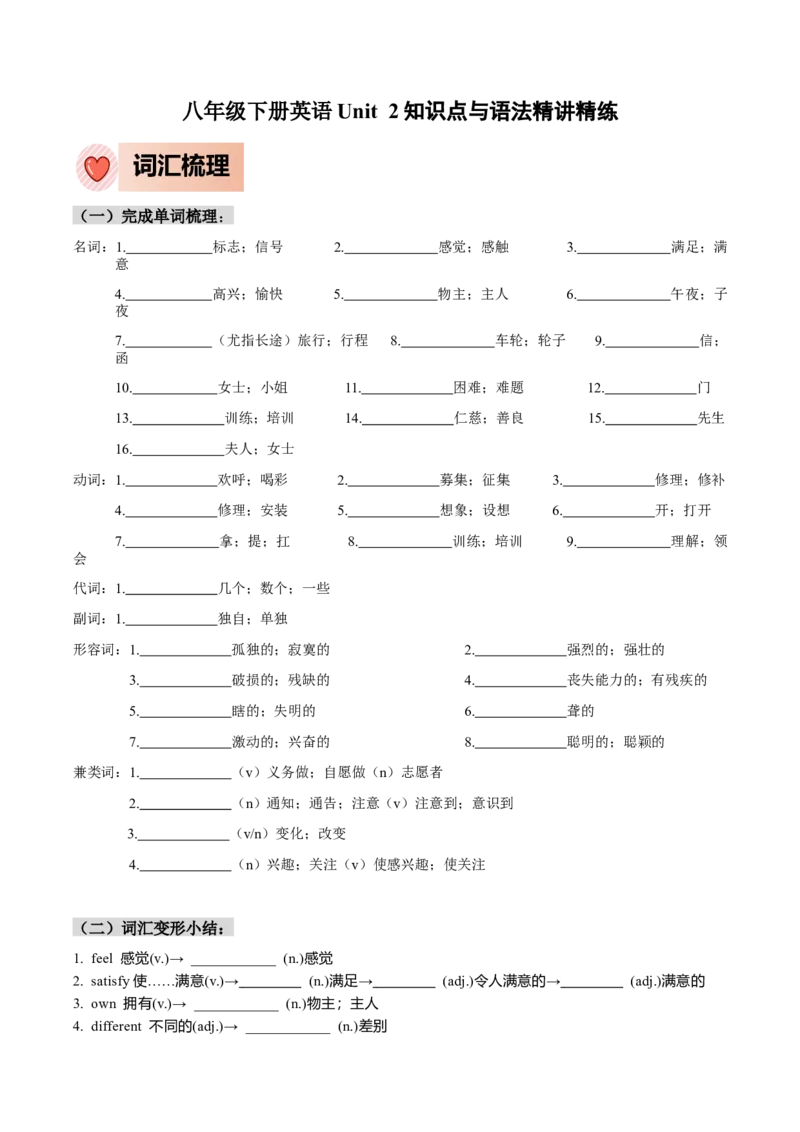
词汇梳理
(一)完成单词梳理:
名词:1. 标志;信号 2. 感觉;感触 3. 满足;满
意
4. 高兴;愉快 5. 物主;主人 6. 午夜;子
夜
7. (尤指长途)旅行;行程 8. 车轮;轮子 9. 信;
函
10. 女士;小姐 11. 困难;难题 12. 门
13. 训练;培训 14. 仁慈;善良 15. 先生
16. 夫人;女士
动词:1. 欢呼;喝彩 2. 募集;征集 3. 修理;修补
4. 修理;安装 5. 想象;设想 6. 开;打开
7. 拿;提;扛 8. 训练;培训 9. 理解;领
会
代词:1. 几个;数个;一些
副词:1. 独自;单独
形容词:1. 孤独的;寂寞的 2. 强烈的;强壮的
3. 破损的;残缺的 4. 丧失能力的;有残疾的
5. 瞎的;失明的 6. 聋的
7. 激动的;兴奋的 8. 聪明的;聪颖的
兼类词:1. (v)义务做;自愿做(n)志愿者
2. (n)通知;通告;注意(v)注意到;意识到
3. (v/n)变化;改变
4. (n)兴趣;关注(v)使感兴趣;使关注
(二)词汇变形小结:
1. feel 感觉(v.)→ ____________ (n.)感觉
2. satisfy使……满意(v.)→ (n.)满足→ (adj.)令人满意的→ (adj.)满意的
3. own 拥有(v.)→ ____________ (n.)物主;主人
4. different 不同的(adj.)→ ____________ (n.)差别5. imagine 想象(v.)→ ____________ (n.)想象力
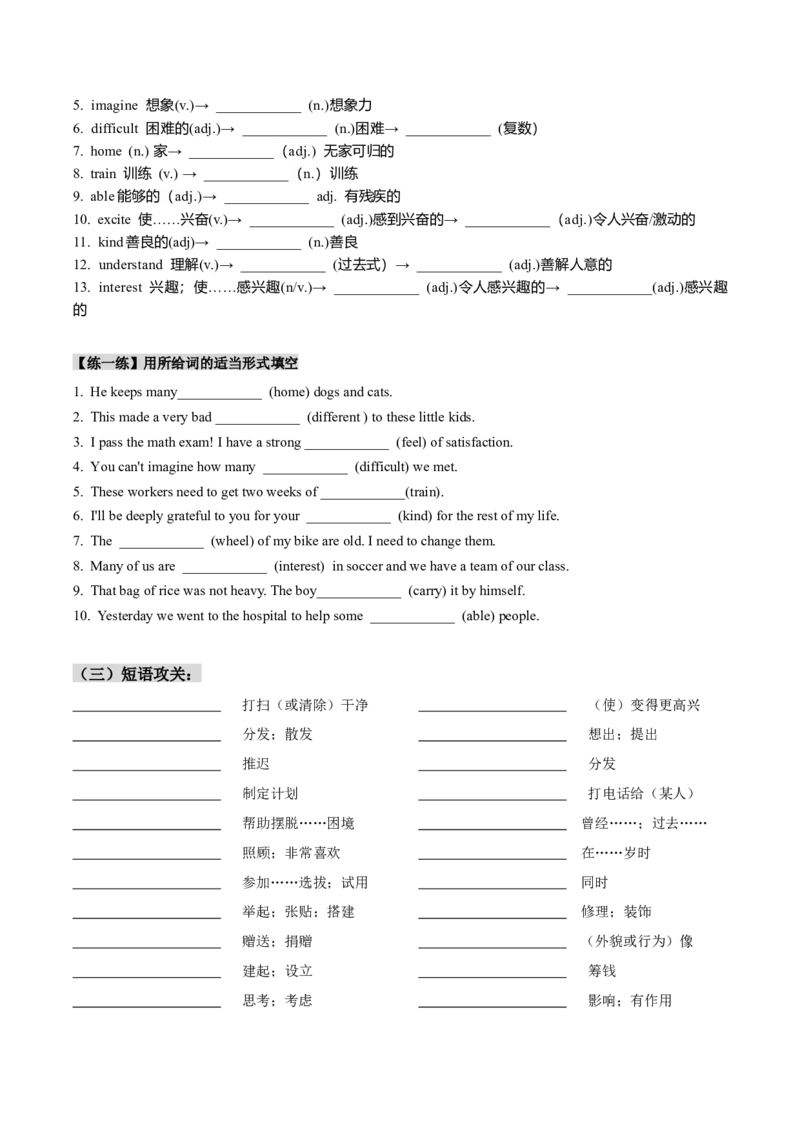
6. difficult 困难的(adj.)→ ____________ (n.)困难→ ____________ (复数)
7. home (n.) 家→ ____________(adj.) 无家可归的
8. train 训练 (v.) → ____________(n.)训练
9. able能够的(adj.)→ ____________ adj. 有残疾的
10. excite 使……兴奋(v.)→ ____________ (adj.)感到兴奋的→ ____________(adj.)令人兴奋/激动的
11. kind善良的(adj)→ ____________ (n.)善良
12. understand 理解(v.)→ ____________ (过去式)→ ____________ (adj.)善解人意的
13. interest 兴趣;使……感兴趣(n/v.)→ ____________ (adj.)令人感兴趣的→ ____________(adj.)感兴趣
的
【练一练】用所给词的适当形式填空
1. He keeps many____________ (home) dogs and cats.
2. This made a very bad ____________ (different ) to these little kids.
3. I pass the math exam! I have a strong ____________ (feel) of satisfaction.
4. You can't imagine how many ____________ (difficult) we met.
5. These workers need to get two weeks of ____________(train).
6. I'll be deeply grateful to you for your ____________ (kind) for the rest of my life.
7. The ____________ (wheel) of my bike are old. I need to change them.
8. Many of us are ____________ (interest) in soccer and we have a team of our class.
9. That bag of rice was not heavy. The boy____________ (carry) it by himself.
10. Yesterday we went to the hospital to help some ____________ (able) people.
(三)短语攻关:
打扫(或清除)干净 (使)变得更高兴
分发;散发 想出;提出
推迟 分发
制定计划 打电话给(某人)
帮助摆脱……困境 曾经……;过去……
照顾;非常喜欢 在……岁时
参加……选拔;试用 同时
举起;张贴;搭建 修理;装饰
赠送;捐赠 (外貌或行为)像
建起;设立 筹钱
思考;考虑 影响;有作用忙于…… 担心……
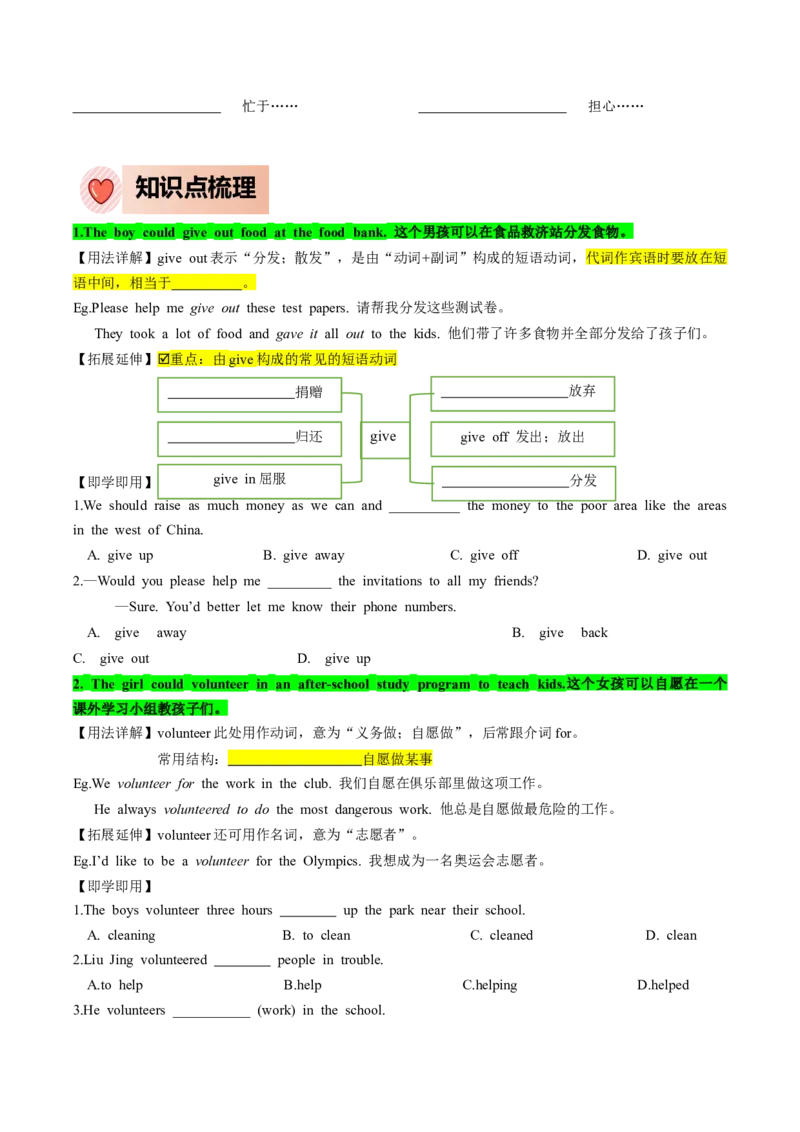
知识点梳理
1.The boy could give out food at the food bank. 这个男孩可以在食品救济站分发食物。
【用法详解】give out表示“分发;散发”,是由“动词+副词”构成的短语动词,代词作宾语时要放在短
语中间,相当于 。
Eg.Please help me give out these test papers. 请帮我分发这些测试卷。
They took a lot of food and gave it all out to the kids. 他们带了许多食物并全部分发给了孩子们。
【拓展延伸】重点:由give构成的常见的短语动词
捐赠 放弃
归还 give give off 发出;放出
【即学即用】 give in屈服 分发
1.We should raise as much money as we can and __________ the money to the poor area like the areas
in the west of China.
A. give up B. give away C. give off D. give out
2.—Would you please help me _________ the invitations to all my friends?
—Sure. You’d better let me know their phone numbers.
A. give away B. give back
C. give out D. give up
2. The girl could volunteer in an after-school study program to teach kids.这个女孩可以自愿在一个
课外学习小组教孩子们。
【用法详解】volunteer此处用作动词,意为“义务做;自愿做”,后常跟介词for。
常用结构: 自愿做某事
Eg.We volunteer for the work in the club. 我们自愿在俱乐部里做这项工作。
He always volunteered to do the most dangerous work. 他总是自愿做最危险的工作。
【拓展延伸】volunteer还可用作名词,意为“志愿者”。
Eg.I’d like to be a volunteer for the Olympics. 我想成为一名奥运会志愿者。
【即学即用】
1.The boys volunteer three hours up the park near their school.
A. cleaning B. to clean C. cleaned D. clean
2.Liu Jing volunteered people in trouble.
A.to help B.help C.helping D.helped
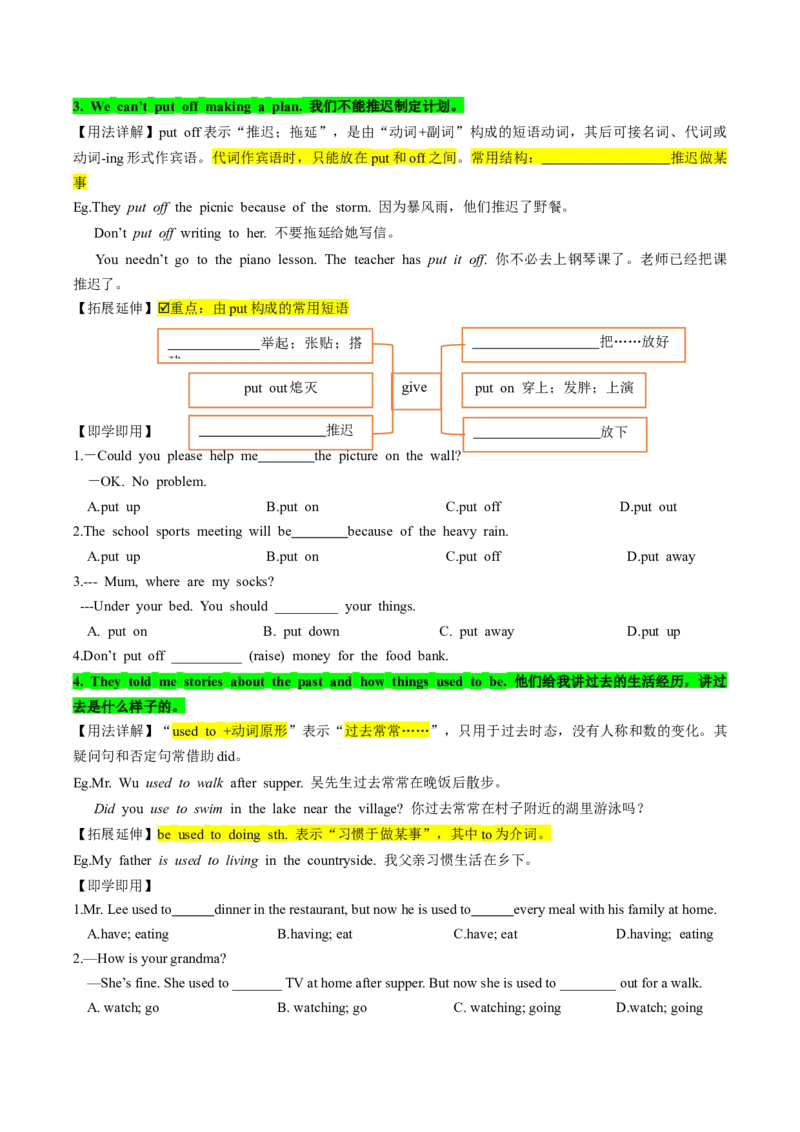
3.He volunteers ___________ (work) in the school.3. We can’t put off making a plan. 我们不能推迟制定计划。
【用法详解】put off表示“推迟;拖延”,是由“动词+副词”构成的短语动词,其后可接名词、代词或
动词-ing形式作宾语。代词作宾语时,只能放在put和off之间。常用结构: 推迟做某
事
Eg.They put off the picnic because of the storm. 因为暴风雨,他们推迟了野餐。
Don’t put off writing to her. 不要拖延给她写信。
You needn’t go to the piano lesson. The teacher has put it off. 你不必去上钢琴课了。老师已经把课
推迟了。
【拓展延伸】重点:由put构成的常用短语
举起;张贴;搭 把……放好
建
put out熄灭 give put on 穿上;发胖;上演
【即学即用】 推迟 放下
1.-Could you please help me the picture on the wall?
-OK. No problem.
A.put up B.put on C.put off D.put out
2.The school sports meeting will be because of the heavy rain.
A.put up B.put on C.put off D.put away
3.--- Mum, where are my socks?
---Under your bed. You should _________ your things.
A. put on B. put down C. put away D.put up
4.Don’t put off __________ (raise) money for the food bank.
4. They told me stories about the past and how things used to be. 他们给我讲过去的生活经历,讲过
去是什么样子的。
【用法详解】“used to +动词原形”表示“过去常常……”,只用于过去时态,没有人称和数的变化。其
疑问句和否定句常借助did。
Eg.Mr. Wu used to walk after supper. 吴先生过去常常在晚饭后散步。
Did you use to swim in the lake near the village? 你过去常常在村子附近的湖里游泳吗?
【拓展延伸】be used to doing sth. 表示“习惯于做某事”,其中to为介词。
Eg.My father is used to living in the countryside. 我父亲习惯生活在乡下。
【即学即用】
1.Mr. Lee used to dinner in the restaurant, but now he is used to every meal with his family at home.
A.have; eating B.having; eat C.have; eat D.having; eating
2.—How is your grandma?
—She’s fine. She used to _______ TV at home after supper. But now she is used to ________ out for a walk.
A. watch; go B. watching; go C. watching; going D.watch; going3.My family used to _______ vegetables and flowers in the yard.
A. grow B. growing C. grows D. grew
5. We should listen to them and care for them. 我们应该倾听他们,关爱他们。
【用法详解】care for表示“照顾;照料”,相当于 或take care of,其宾语常为表示人的名词
或代词。(“三个照顾”)
Eg.She cares for/takes care of/looks after her sick daughter patiently. 她耐心地照顾她生病的女儿。
【即学即用】
1.Many students in our school ________ the old and they usually offer their seats to them on buses.
A. worry about B. care for C. agree with D.take after
6. Some people even stop doing their jobs for a few months to a year to move to another place...有
些人甚至停下他们的工作几个月到一年,移居到另一个地方……
【易混辨析】重点:stop doing sth.与stop to so sth.
stop doing sth. 意为“ ”,指停止正在做的事情
stop to do sth 意为“ ”,指停止正在做的事情而去做另外一件事情
Eg.They were very tired, but they didn’t stop working. 尽管很累,但是他们没有停止工作。
She stopped to look and smile at us. 她停下来微笑地看着我们。
【即学即用】
1.Suddenly the house began to shake. He stopped music and rushed out.
A.to listen to B.to listen C.listening D.listening to
2.—I think you should stop him in English.
—I see. He can’t understand English at all. Let me try in French.
A.talking to B.to talk to C.talk to D.to talking to
3. All the students will go out and play if it stops __________ (rain) later.
7. I want to travel alone. 我想独自旅游。
【用法详解】alone副词,意为“独自;单独”,在句中作状语,相当于by oneself。
Eg.He likes living alone. = He likes living by himself. 他喜欢独自生活。
【易混辨析】重点:alone与lonely
单词 含义 用法 图解助记
副词,
“独自;
侧重于说明独自一人,强调客观情况
单独”
alone 常用搭配: 独自生
形容词,
活
“单独
的”形容词, 侧重指因缺少陪伴所产生的一种悲伤
“孤独 的情感,强调主观感觉
的;寂寞 常用搭配: 感到孤
lonely 的” 单
形容词,
“荒凉 多修饰表示地点的名词
的”
Eg.She often feels lonely when she is alone at home. 独自一个人在家的时候她常感到孤独。
He lives alone in a lonely mountain village. 他独自生活在一个偏僻的山村。
【即学即用】
1.When you feel hopeless and_______, just remember you are not_______ in the world because your
friends are around you.
A.alone; alone B.alone; lonely C.lonely; alone D.lonely; lonely
2.-I know Old Joe lives_______.
-We are supposed to visit him from time to time. Then, he won't feel_______.
A.alone; alone B.lonely; lonely C.lonely; alone
D.alone;lonely
8. I take after my mother. 我像我妈妈。
【用法详解】take after表示“(外貌或行为)像”,相当于be similar to,其中after是介词,其后接名词
或代词。
Eg.His daughter does not take after him in any way. 它的女儿一点儿也不像他。
【易混辨析】take after与look like
take after 指由于血缘关系而在外貌、性格等方面相似
look like 意为“看起来像……”,尤指外貌相像
Eg. Lucy is warm-hearted. She really takes after her mother very much. 露西为人热心,这点真是很像她
妈妈。
Eg. The girl looks like her aunt very much. 那个女孩长得很像她姑姑。
【即学即用】
1.Jack_______his father. They are both friendly.
A. looks after B. looks like C. takes after D. looks
up
9. You helped to make it possible for me to have Lucky. 有了你的帮助,我才有可能拥有“幸运儿”
(狗名)。
【用法详解】“make it +形容词(+ for sb.)+动词不定式(短语)”是一个固定句型,其中it是形式宾
语,真正的宾语时后面的动词不定式短语,形容词作宾语补足语。
Eg.Sports can make it easier for people to unify. 体育可以让人们更容易地统一起来。【拓展延伸】类似此用法的动词还有feel, find, consider, think等。
Eg. I feel it possible to get there before eight. 我觉得八点前到那里是有可能的。
I think it easy to make up a sentence with the word. 我认为用这个单词造句很简单。
10. ... I was excited about the idea of having a dog. ……我对于有一只狗的想法感到激动。
【用法详解】excited形容词,意为“激动的;兴奋的”,常用短语:be excited about“对……感到激动/兴
奋”。
Eg.I was very excited about the good news. 我对这个好消息感到非常兴奋。
【易混辨析】重点:excited与exciting
excited “激动的;兴奋的”,通常在句中作表语,一般修饰 (人/物)
exciting “令人激动的;令人兴奋的”,在句中既可作表语,也可作定语,一般修饰
(人/物)
Eg.We are excited about the exciting match. 这场令人兴奋的比赛让我们热血沸腾。
【即学即用】
1.Don’t be so_______. Is the news so_______?
A.excited ; excited B.exciting ; exciting C.excited ; exciting D.exciting ;
excited
2.—Do you know the final will be played between Wang Lili and Ma Qing?
—Yes. I felt_______when I heard the_______news.
A.excited ; excited B.exciting ; excited C.exciting ; exciting D.excited ;
exciting
3.The children were all __________(excite) because of the games.
课堂小测
一、单项选择
1.A lot of old people feel _______ because they usually have to live _______.
A. alone; alone B.alone; lonely C.lonely; alone D.lonely;
lonely
2.--- Do you know Mo Yan?
--- Of course. He won the 2012 Nobel Prize for Literature ________ the age of 57.
A.in B. at C. on D.with
3.Although many great people ever failed, they never ________ and managed (设法) to succeed.
A. gave away B. gave out C. gave up D.gave in
4.The Internet makes ________ possible for everyone to get education anywhere and anytime.
A.it B. this C. that D. them
5.---Mary takes ________ her mother.
---Yes. She is similar ________ her mother.A. for;as B. to; with C. after; to D. away; from
6.A smart phone makes a big ________ to our life.
A.difference B.decision C.progress D.prediction
7.Our plane is ________ in a few minutes. Please be seated and keep your safe belt fastened.
A. turning off B. putting off C. taking off D. getting
off
8. Kate didn’t go to the movies last night because she had to ________ her sick dog at home .
A. look at B. care about C. look for D. care for
9.I didn’t use to ________ early when I was in Grade One , but now I am used to ________ early .
A. get up ; getting up B. getting up ; get up
C. get up ; get up D. getting up ; getting up
10. We have a strong ________ of pride(自豪)when talking about the great changes in the past 70
years .
A . training B . feeling C . saying D . meeting
11.He was so ________ when he heard the ________ news that he got the first prize in the contest.
A. exciting; exciting B. exciting; excited C. excited; excited D. excited;
exciting
12.You must be tired now. Why not ________ a rest?
A. to stop to have B. to stop to having C. stop to have D. stop
having
13.We must _______ a way to stop people from looking down at their mobile phones while driving cars.
A.come up with B.come from C.come out D.come true
14. They arrived at the finishing line _______ the same time. We didn't know who the winner was.
A.on B.in C.at D.for
15.Mary, your bedroom is dirty. You should _______ at once.
A. clean it up B. clean up it C. clean them up D. clean
up them
二、用所给词的适当形式填空
1. The school provides after-school basketball __________ (train) and health programs.
2. The __________ (able) won’t feel that lonely if everyone can do something to help them.
3. We had to put off __________ (have) the soccer game because of the bad weather.
4. I didn’t watch TV last night, because my TV set was __________(break).
5. They were very tired, but they didn’t stop __________(work).
6. There are several pet dogs in the park. Where are their ___________ (own)?
7. Mrs. Temple always treats children and animals with ___________(kind).
8. They don’t mind __________ (climb) the mountain.
9. Can you tell me the ___________ (different) between this book and that one?
10. Their help makes me feel ___________ (excite) and happy.三、完形填空
Last summer , we had a volunteer activity in a village school. In the school, I saw a name Feng Aiguo on a list
(名单). This man offered much money to the school. I thought he must be a 1 man.
One day, on my way home from school, my bike was broken. Luckily I found a repairing stand(修车摊)
across from the street. An old man was 2 a bike. He was wearing a clean suit. While waiting, I knew 3 about
him from the old men chatting there. He was Lao Feng and 4 to repair bikes after he retired(退休). Two
months ago, his family moved to a new house. His son didn’t want him to repair bikes any longer. He bought him
suits and asked him to 5 them and rest at home. But it didn’t work. The old man continued his repairing work in
his suits.
After a while, the old man got my bike repaired. 6 I was leaving, an old lady came and called him “ Aiguo
”. Suddenly the name on the list of the village school came into my mind. But how could such a common repairman
7 so much money? I asked him if he knew that village. He told me it was his hometown and the 8 there
still needed help. So he always saved money 9 repairing bikes to help them. Then I was sure that he was the
person on the 1 0 .
( )1. A. rich B. poor C.healthy D. unhealthy
( )2. A. selling B. washing C. riding D. repairing
( )3. A. everything B. something C. anything D. nothing
( )4. A. started B. failed C. feared D. remembered
( )5. A. wear B.lose C. make D. lend
( )6. A. Unless B. When C. If D. Though
( )7.A. give away B. throw away C. take back D. give back
( )8.A. workers B. visitors C. riders D. villagers
( )9.A. with B. by C. on D. in
( )10.A. way B. map C. list D.book
语法精讲
一、动词不定式
一、语法概述
动词不定式是非谓语动词的一种形式,通常由“to +动词 ”构成。其中to是动词不定式符号,
在有些情况下可以省略。动词不定式的否定形式为: 。Eg.Mr.Li told me to listen carefully in class. 李老师要求我上课认真听讲。
Please tell Jim not to come late next time. 请告诉吉姆下次别迟到了。
二、动词不定式的用法
动词不定式在句中可以用作宾语、宾语补足语、状语、主语、定语、表语等,没有人称和数的变化。
功能 示例
作宾语:v.+ to do Tony wants to find a job as a teacher in
want、decide、hope、ask、agree、learn、plan、need、 China.
expect、refuse等动词后常接to do 作宾语(to 不可以 托尼想在中国找一份做老师的工作。
省略) I decided to help the homeless people.
我决定帮助那些无家可归的人。
作宾语补足语:v.+ sb.+ to do
want、ask、allow、expect、wish等+ sb.(宾语)+ to do He asked me to help him with his
sth. English.
【注】跟不带to的不定式作宾语补足语的动词主要有感 他请求我帮他学英语。
官动词(see、feel、watch、hear)和使役动词(let、 Her words made me feel happy.
make、have)等。 她的话让我感到开心。
如: 让某人做某事
作状语: He came to Beijing to have a meeting.
动词不定式作状语表示目的、结果或原因。考查动词不 他来北京开会。
定式作目的状语较多,动词不定式表目的时,to do翻译 He is too young to look after himself.
成“为了”。 他太小,不能照顾自己。
作主语:
动词不定式作主语时,谓语动词用第三人称单数形式; To give is better than to take.
为了避免句子头重脚轻,常用it作形式主语,常用于以 奉献比索取好。
下固定句型中: It’s necessary for us to learn English
It’s + adj + for/of + sb + to do sth 做某事对某人来说…… well.
对我们来说,学好英语是必要的。
作定语: He is the first man to walk on the moon.
此时,要放在它所修饰的名词或代词后。 他是第一个在月球上行走的人。
作表语: His wish is to be a policeman.
一般表示具体的动作或说明主语的内容、性质、特征 他的愿望是当一名警察。
等。
疑问词+ to do:
I don’t know what to do next.
动词不定式可以和疑问词what、which、who、how、
我不知道接下来该做什么。
when、where等连用,构成不定式短语。
【即学即用】
1.I bought a big box ________ books for kids in the poor areas.A.collects B.to collect C.collect D.collected
2.The children decide ________ their schoolyard this Friday afternoon.
A.clean B.to clean C.cleaning D.cleaned
3.---Was it necessary ________ John ________ some photos before the old man?
---I think so. In this way, he could protect himself later.
A.of; taking B. for; taking C. of; to take D. for; to take
4.Remember ________ some fruit when you come back.
A.buying B.to buy C.buy D.buys
5.Our teacher often asks us _______ time.
A.not waste B.don’t waste C.not to waste D.doesn’t waste
6.He wants to know how __________ (speak ) English well.
7.Joan hopes __________ (study) law(法律) at Harvard University.
8.It is very easy for me __________ (play) ping-pong well because my father has been teaching me for
three years.
9.My dream is __________ (become) a reporter in the future.
10.Tom's mother told him __________ (not spend) too much time playing computer games.
二、短语动词
一、语法概述
在英语中,许多动词和介词或副词连用,构成一个固定词组,这个词组可以看作一个整体,与实义动
词用法相同,这类词组叫作短语动词。
二、短语动词的分类
类型与说明 示例
look after __________ think of __________ take after __________
动词+介词
come from __________ ask for __________ look at __________
cheer up __________ clean up __________ put up __________
fix up __________ give away __________ give out __________
动词+副词
give up __________ get up __________ put off __________
turn down __________ set up __________ take away __________
come up with __________ run out of __________ look forward to
动词+副词+介词
__________
have a rest __________ take a walk __________ make a decision
动词+名词
__________
动词+名词+介词 have a look __________ make a friend with __________ take care of__________
be late for __________ be busy with __________ be good at __________
be+形容词+介词
be good for __________ be similar to __________
【注意】在“动词+副词”构成的短语动词中,宾语是名词时,可以置于短语中间也可置于副词之后;宾
语是代词时,只能放在动词和副词之间。
Eg.I have used up my exercise books. = I have used my exercise books up. 我已经用完了我的练习本。
Tom looks sad. Let’s cheer him up. 汤姆看上去很难过。让我们使他高兴起来吧。
【即学即用】
1.Can you look after the children? Do you know how to _______?
A. cheer them up B.cheer up them C.give them up D.give up them
2.Because of the bad weather, we have to _______ the sports meeting till next week.
A.take off B.get off C.put off D.set off
3.We have raised some books. We’ll _______ to the poor children.
A. put them up B. give them away
C. put up them D.give away them
语法小测
一、单项选择
1. I ________ some clothes to charities(慈善机构)because they are too small for me.
A.take after B.hang out C.give away D.put
off
2. (宜昌中考) ---The Organization Wild Aid(野生救援组织)is _______ to protect wild animals.
---It has done a lot so far.
A.cheered up B.picked up C.given up D.set up
3.(常州中考) Our teacher _______ a bookshelf at the back of our classroom to make a small reading
corner.
A.picked up B.put up C.cleaned up D.got up
4. (莱芜中考)Don't forget _______ the rubbish out when you leave.
A.taking B.bring C.to take D.to bring
5.(辽宁铁岭中考)My cousin volunteers in the Children's Home. His job is to _______ food and
clothes.
A. sell out B. work out C. hand out D. find out
6. Don’t worry . We will meet next Monday _______ the project again .
A. discuss B. discussed C. discussing D. to discuss
7.—Can you help me _______ my camera now ?
—What about tomorrow? I am too busy today.
A. put up B. fix up C. set up D. look up
8.(山东东营中考)---Could we _______ the arriving time for school to 8:00 am, Mr. Li?---You mean 7:30 is a little earlier? Let's discuss it with the headmaster.
A. find out B. give up C. put off D cut out
9. (泰州中考)---Mr. Ling, I have some difficulty_______ the article.
---Remember _______ it three or four times at least.
A.to understand; reading B.understanding; reading
C.understanding;to read D.to understand; to read
10. You had better ask your brother _______ playing computer games. It’s bad for him.
A. to give up B. not to give up C. to give it up D. giving
up
11.If you love animals, you can volunteer _______ animals
A. protect B. protecting C. to protect D. protected
12.We must _______ everyone _______ that keeping our city clean is our duty.
A.let; to know B.make; understand C.make; to understand D.have; to
know
13.Hello, everyone, attention, please. Now let me tell you _______ to the Changsha park.
A.how to get B.what to get C.whom to get D.where to
get
14.The boy _______ that man.Maybe that man is the boy’s father.
A. looks after B. takes after C. takes break D. looks for
15.He fails the math test and looks sad. Let’s _______.
A.put him up B.set him up C.cheer him up D.clean him
up
二、用所给词的适当形式填空
1. In people’s free time, they think about what _________ (do) for fun.
2. Would you like _________ (go) and have a picnic with us tomorrow?
3. The joke made all of us want _________ ( laugh).
4. Ben Smith is very lucky _________ (have) a special trained dog because of Miss Li’s kindness.
5. Mike taught his grandpa how _________ (use) the computer.
三、书面表达
为了营造和谐的社会环境,引导中学生学会关爱他人,某学校举行了以“Let’s Be Volunteers!”为主
题的公益活动。请结合下面的活动内容,写一篇英语短文号召学生们参与到活动当中。
要点:1. 星期天早上8:30在校门口集合,乘公共汽车前往;
2. 给老人们赠送礼物;
3. 打扫卫生,整理房间;
4. 唱歌、跳舞、讲故事、聊天,给老人们带去快乐;
5. 活动很有意义,希望积极参与公益活动(welfare activities)。
要求:1.要点齐全;2.词数80词左右。
Let’s Be Volunteers !____________________________________________________________________________________________
____________________________________________________________________________________________
____________________________________________________________________________________________
____________________________________________________________________________________________
____________________________________________________________________________________________
____________________________________________________________________________________________