八年级下册英语 Unit 6 知识点与语法精讲精练
词汇梳理
(一)完成单词梳理:
名词:1. ston e 石头 2. go d 神;上帝 3. bi t 一点;小块
4. objec t 物体;物品 5. tai l 尾巴 6. stic k 棍;
条
7. stepsiste r 继姐(妹) 8. princ e 王子 9. coupl e (尤指)夫妻;两人;两件事
物
10. empero r 皇帝 11. silk 丝绸;丝织物 12. underwea r 内
衣
13. stepmothe r 继母 14. wif e 妻子;太太 15. husban d 丈
夫
16. scen e (戏剧或歌剧的)场;场景 17. moonligh t 月光 18. ground 地;地
面
19. voic e 声音
动词:1. shoo t 射击;发射 2. remind 提醒;使想起 3. hid e 隐藏;隐
蔽
5. excit e 使激动;使兴奋 5. fi t 适合;合身 6. marr y 结婚
7. shin e 发光;照耀 8. lea d 带路;领路
形容词:1. wea k 虚弱的;无力的 2. silly 愚蠢的;不明事理
的
3. magi c 有魔力的;有神奇力量的 4. Wester n 西方国家的
5. stupi d 愚蠢的 6. whol e 全部的;整体的
7. brav e 勇敢的;无畏的
兼类词:1. smil e (v/n)笑;微笑 2. gold (n)金子;金币(adj)金色
的
3. nobody (pron)没有人(n)小人物 4. chea t (v)欺骗;蒙骗(n)骗
子
5. brigh t (adv)光亮地;明亮地(adj)明亮的;光线充足的(二)词汇变形小结:
1. shoot 射击;发射(v.) →____shot_____ (过去式)
2. hide 隐藏(v.) → ____ hid _ _____ (过去式)
3. magic 有魔力的;有神奇力量的(adj.) → ___magician____ (n.)魔术师
4. excite 使激动;使兴奋(v.) →___exciting____ (adj.)令人激动的;令人兴奋的 →___excited____ (adj.)
激动的;兴奋的 → __excitement__ (n.)激动;兴奋
5. western 西方国家的;西方的(adj.)→____west_____ (n.)西方
6. gold 金子;金色的(n./adj.) →____golden____ (adj.)金的
7. wife 妻子;太太(n.) →___wives_____ (复数形式)
8. shine 发光;照耀(v.) →____shone____ (过去式) →___shining____ (现在分词)
9. lead 带路;领路(v.) →____led______ (过去式)
10. marry 结婚(v.) →____married____ (adj.)结婚的
11. brave 勇敢的(adj.) →____bravely____ (adv.)勇敢地
【练一练】用所给词的适当形式填空
1. Leo wanted to catch the cat, but it ran away and ____hid______ (hide) behind the bushes in the garden.
2. They were discussing the problems of ___western____ (west) countries.
3. It is reported that the number of working ____wives_____ (wife) is becoming larger and larger.
4. These boys were very ___excited____ (excite) when they saw their favorite soccer star.
5. Look! The moon tonight is ___shining____ (shine) in the sky.
6. What could you do instead of ____playing____ (play) computer games?
7. In the story, Hou Yi ____shot_____ (shoot) down nine suns.
8. Where is the ___magician____ (magic) from? I like his show very much.
9. They got ___married____ (marry) many years ago and they still love each other deeply.
10. The beautiful girl has long curly ___golden____ (gold) hair.
(三)短语攻关:
tr y t o d o sth . 努力做某事 wor k o n 致力于
tak e awa y 带走 a littl e bi t 有点儿;稍微
instea d o f 代替;反而 kee p doin g sth . 持续做某事fo r exampl e 例如 fo r th e firs t tim e 首次
i n fac t 事实上 turn...int o 变成
onc e upo n a tim e 从前 fal l i n lov e 爱上;喜欢上
ge t marrie d 结婚 al l ove r th e worl d 全世界
lea d sb . to. .. 把某人带到…… ge t los t 迷路
知识点梳理
1.Finally, a god was so moved by Yu Gong that he sent two gods to take the mountains away. 最后,一位神
仙被愚公(的精神)所感动,于是他派了两位神仙搬走了大山。
【用法详解】知识点1: move在此处用作及物动词,意为“感动”,句中was moved by为被动语态,表
示“被……感动”。
Eg.The speech moved them to tears. 那场演说把他们感动得落泪。
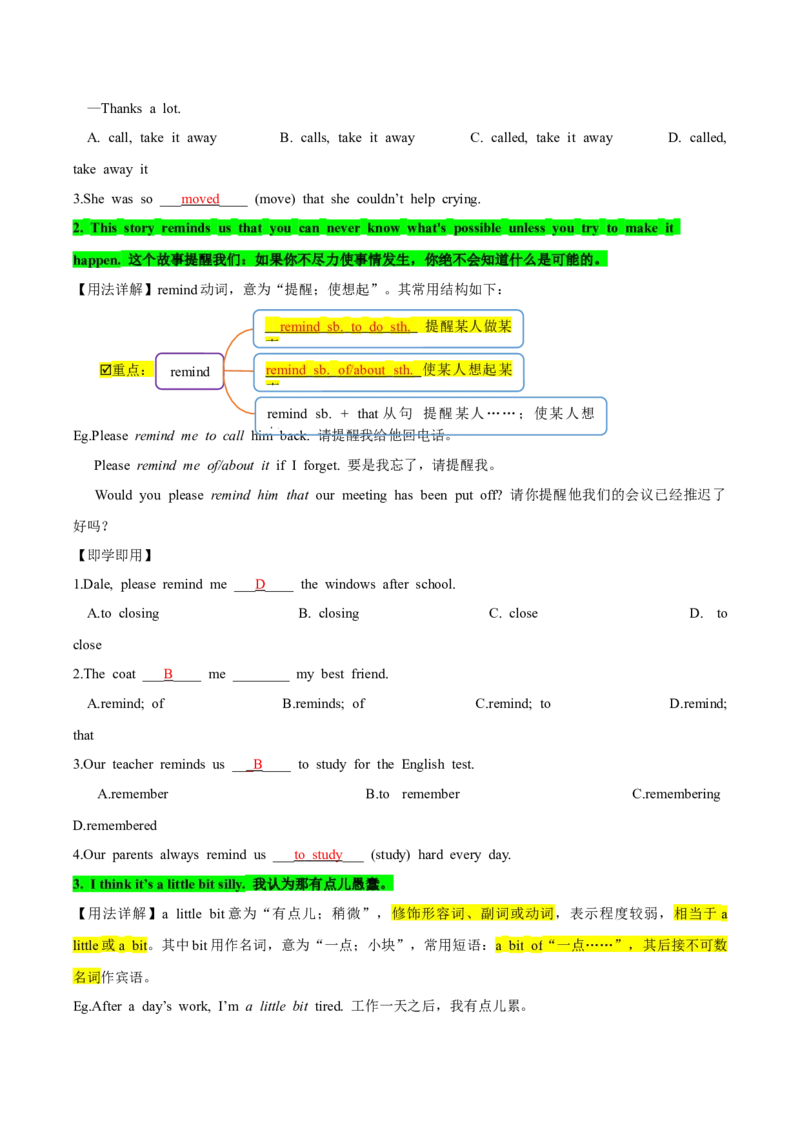
【拓展延伸】move的词性转换:
moved (adj.) “感动的”,常用来修饰 人
(人/物)
move
moving (adj.) “令人感动的;感人的”,常用来修饰 物
(人/物)
Eg. I was so moved that I couldn’t help crying. 我如此感动,以至于忍不住哭了起来。
The movie is quite moving, so I will watch it once again. 这部电影相当感人,所以我会再看一次。
知识点2: take away意为“带走;拿走”,是“动词+副词”结构的短语。名词作宾语时,放在away前
后均可;代词作宾语时,只能放在take和away之间。
Eg.You can take away these books. = You can take these books away. 你可以把这些书带走。
I don’t like the clothes. Take them away. 我不喜欢这些衣服。把它们拿走吧。
【即学即用】
1.—Why are you so happy, Mr. Wu?
—Because the movie yesterday evening was so ___B____ and it made me ________.
A.moving; moving B. moving; moved C. moved; moving D. moved;
moved
2.—I have a book ___C____ the Emperor’s New Clothes. If you like it, you can ________.—Thanks a lot.
A. call, take it away B. calls, take it away C. called, take it away D. called,
take away it
3.She was so ___moved____ (move) that she couldn’t help crying.
2. This story reminds us that you can never know what's possible unless you try to make it
happen. 这个故事提醒我们:如果你不尽力使事情发生,你绝不会知道什么是可能的。
【用法详解】remind动词,意为“提醒;使想起”。其常用结构如下:
remind sb . to do sth . 提醒某人做某
事
重点: remind remind sb. of/about sth. 使某人想起某
事
remind sb. + that 从句 提醒某人……;使某人想
Eg.Please remind me to call him起 b…ac…k. 请提醒我给他回电话。
Please remind me of/about it if I forget. 要是我忘了,请提醒我。
Would you please remind him that our meeting has been put off? 请你提醒他我们的会议已经推迟了
好吗?
【即学即用】
1.Dale, please remind me ___D____ the windows after school.
A.to closing B. closing C. close D. to
close
2.The coat ___B____ me ________ my best friend.
A.remind; of B.reminds; of C.remind; to D.remind;
that
3.Our teacher reminds us ___B____ to study for the English test.
A.remember B.to remember C.remembering
D.remembered
4.Our parents always remind us ___ to study ___ (study) hard every day.
3. I think it’s a little bit silly. 我认为那有点儿愚蠢。
【用法详解】a little bit意为“有点儿;稍微”,修饰形容词、副词或动词,表示程度较弱,相当于a
little或a bit。其中bit用作名词,意为“一点;小块”,常用短语:a bit of“一点……”,其后接不可数
名词作宾语。
Eg.After a day’s work, I’m a little bit tired. 工作一天之后,我有点儿累。I’m afraid you speak a little bit fast. 恐怕你说得有点儿快。
He knows a bit of French. 他懂一点儿法语。
【拓展延伸】a little bit = a little/a bit/ kind of + 形容词/副词/比较级时,表示“一点儿”。
【即学即用】
1.Many people think Yu Gong is ___D____ silly. It’s too difficult to move the mountain.
A.a kind of B.a few C.a bit of D.a bit
2.She was ___A____ tired. She said that she needed to have a rest.
A. a little bit B. a bit of C. a few D. a
little of
4. It doesn’t seem very possible to move a mountain. 搬走一座山似乎不是很可能。
【用法详解】句中seem possible为“seem + 形容 词”的系表结构,其中seem为 系动 词,意为“似
乎;好像”。
Eg.She seems lonely. Let’s talk with her. 她似乎很孤独,咱们和她说说话吧。
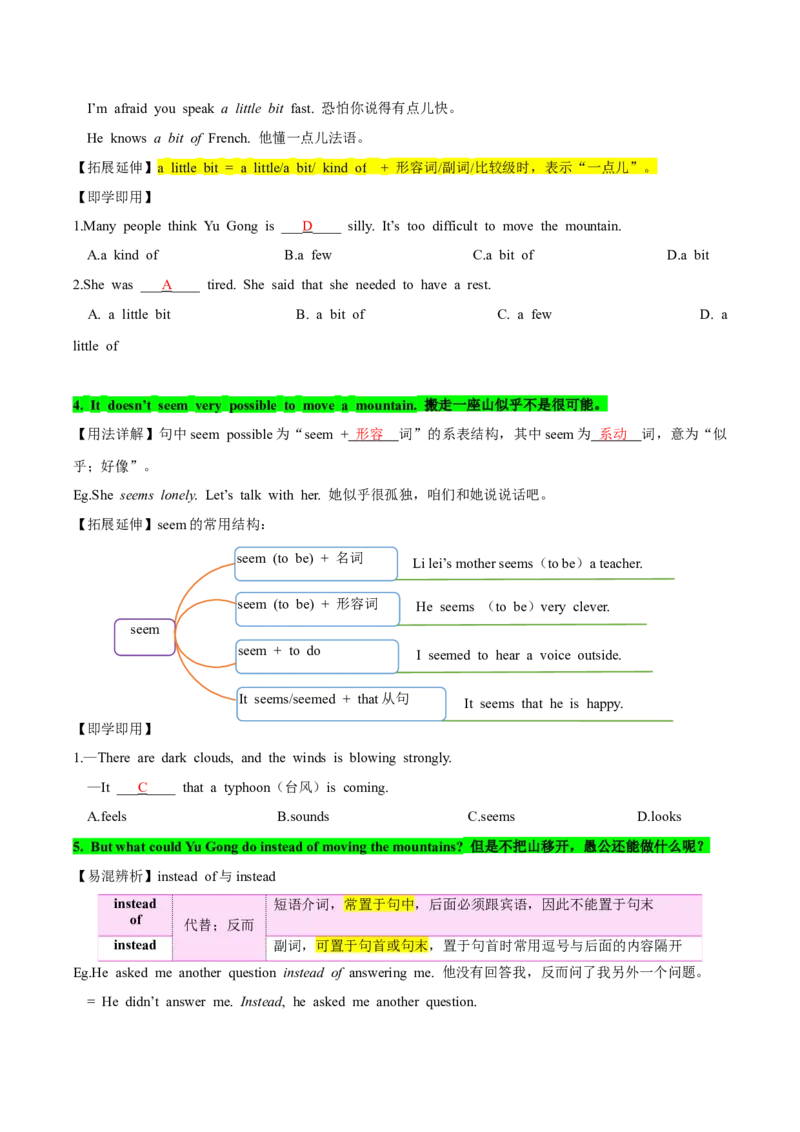
【拓展延伸】seem的常用结构:
seem (to be) + 名词 Li lei’s mother seems(to be)a teacher.
seem (to be) + 形容词 He seems (to be)very clever.
seem
seem + to do
I seemed to hear a voice outside.
It seems/seemed + that从句
It seems that he is happy.
【即学即用】
1.—There are dark clouds, and the winds is blowing strongly.
—It ___C____ that a typhoon(台风)is coming.
A.feels B.sounds C.seems D.looks
5. But what could Yu Gong do instead of moving the mountains? 但是不把山移开,愚公还能做什么呢?
【易混辨析】instead of与instead
instead 短语介词,常置于句中,后面必须跟宾语,因此不能置于句末
of
代替;反而
instead 副词,可置于句首或句末,置于句首时常用逗号与后面的内容隔开
Eg.He asked me another question instead of answering me. 他没有回答我,反而问了我另外一个问题。
= He didn’t answer me. Instead, he asked me another question.【即学即用】
1. He plays games instead of __studying___ (study) hard on weekends.
2. He only laughed at us instead of ___giving____ (give) us a hand.
3.—What did you do last night?
—I stayed at home ___B____ going to a movie.
A.instead B. instead of C. rather than D. better than
3.He didn’t go to party. He stayed at home. (合并为一句话)
He stayed at home ___instead___ ____of_____ ___going____ to the party.
6. This is because he can make 72 changes to his shape and size, turning himself into different
animals and objects. 这是因为他能对自己的外形和大小进行七十二般变化,把自己变成不同的动物和物
体。
【用法详解】turn ... into ...意为“把……变成”,相当于change ... into ...。
Eg.The teacher asked us to turn/change the sentences into English. 老师让我们把这些句子译成英文。
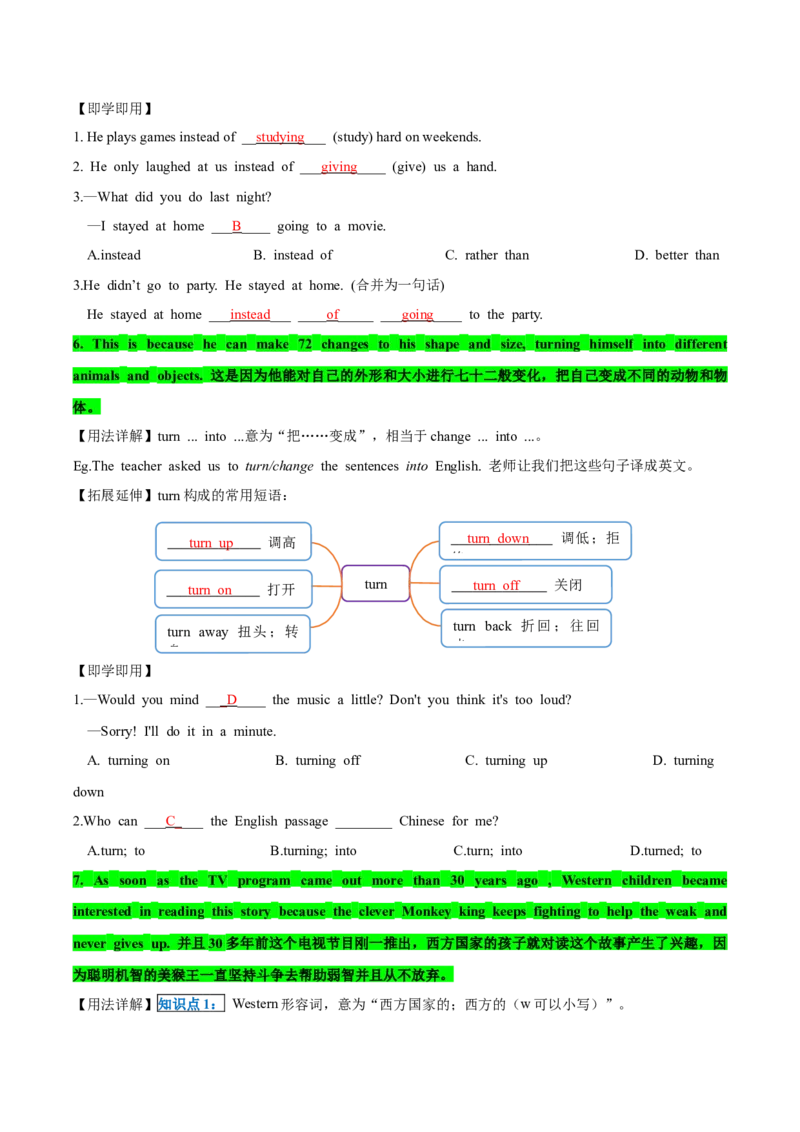
【拓展延伸】turn构成的常用短语:
tur n u p 调高 turn down 调低;拒
绝
tur n o n 打开 turn tur n of f 关闭
turn back 折回;往回
turn away 扭头;转
走
身
【即学即用】
1.—Would you mind ___D____ the music a little? Don't you think it's too loud?
—Sorry! I'll do it in a minute.
A. turning on B. turning off C. turning up D. turning
down
2.Who can ___C____ the English passage ________ Chinese for me?
A.turn; to B.turning; into C.turn; into D.turned; to
7. As soon as the TV program came out more than 30 years ago , Western children became
interested in reading this story because the clever Monkey king keeps fighting to help the weak and
never gives up. 并且30多年前这个电视节目刚一推出,西方国家的孩子就对读这个故事产生了兴趣,因
为聪明机智的美猴王一直坚持斗争去帮助弱智并且从不放弃。
【用法详解】知识点1: Western形容词,意为“西方国家的;西方的(w可以小写)”。Eg.People in Western countries like this kind of sport. 西方国家的人喜欢这种运动。
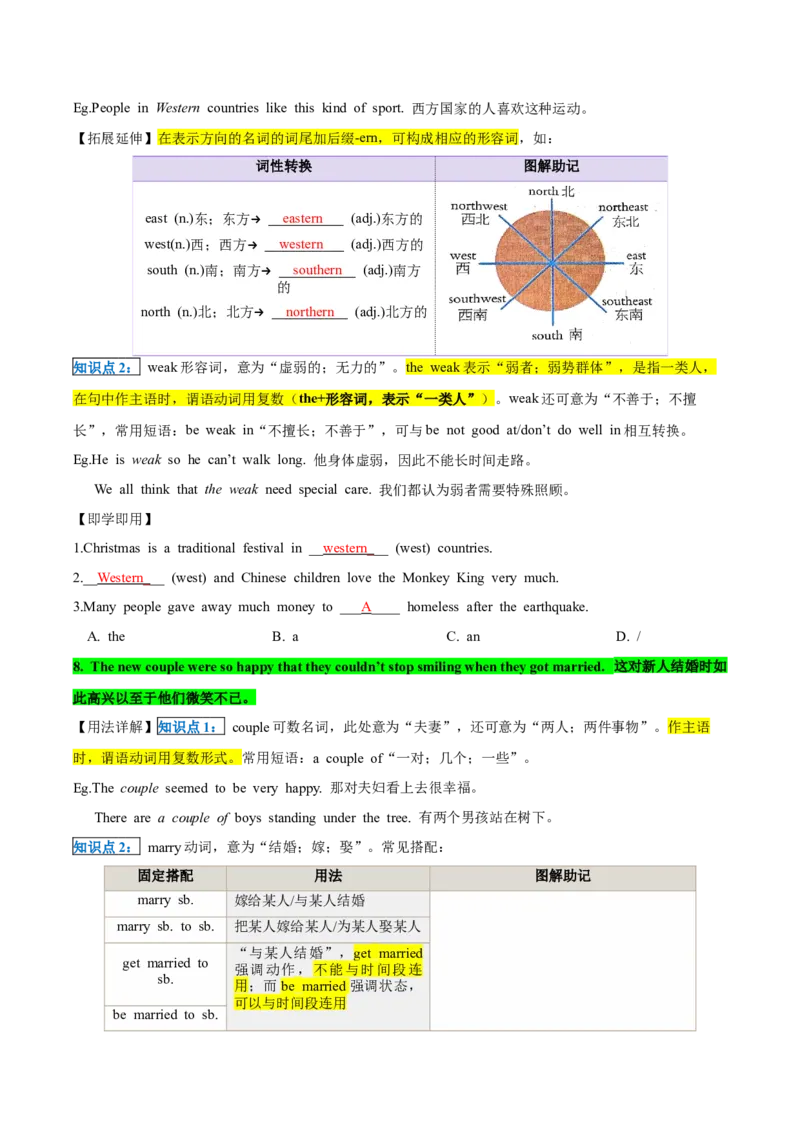
【拓展延伸】在表示方向的名词的词尾加后缀-ern,可构成相应的形容词,如:
词性转换 图解助记
east (n.)东;东方→ easter n (adj.)东方的
west(n.)西;西方→ wester n (adj.)西方的
south (n.)南;南方→ souther n (adj.)南方
的
north (n.)北;北方→ norther n (adj.)北方的
知识点2: weak形容词,意为“虚弱的;无力的”。the weak表示“弱者;弱势群体”,是指一类人,
在句中作主语时,谓语动词用复数(the+形容词,表示“一类人”)。weak还可意为“不善于;不擅
长”,常用短语:be weak in“不擅长;不善于”,可与be not good at/don’t do well in相互转换。
Eg.He is weak so he can’t walk long. 他身体虚弱,因此不能长时间走路。
We all think that the weak need special care. 我们都认为弱者需要特殊照顾。
【即学即用】
1.Christmas is a traditional festival in __western___ (west) countries.
2.__Western___ (west) and Chinese children love the Monkey King very much.
3.Many people gave away much money to ___A____ homeless after the earthquake.
A. the B. a C. an D. /
8. The new couple were so happy that they couldn’t stop smiling when they got married. 这对新人结婚时如
此高兴以至于他们微笑不已。
【用法详解】知识点1: couple可数名词,此处意为“夫妻”,还可意为“两人;两件事物”。作主语
时,谓语动词用复数形式。常用短语:a couple of“一对;几个;一些”。
Eg.The couple seemed to be very happy. 那对夫妇看上去很幸福。
There are a couple of boys standing under the tree. 有两个男孩站在树下。
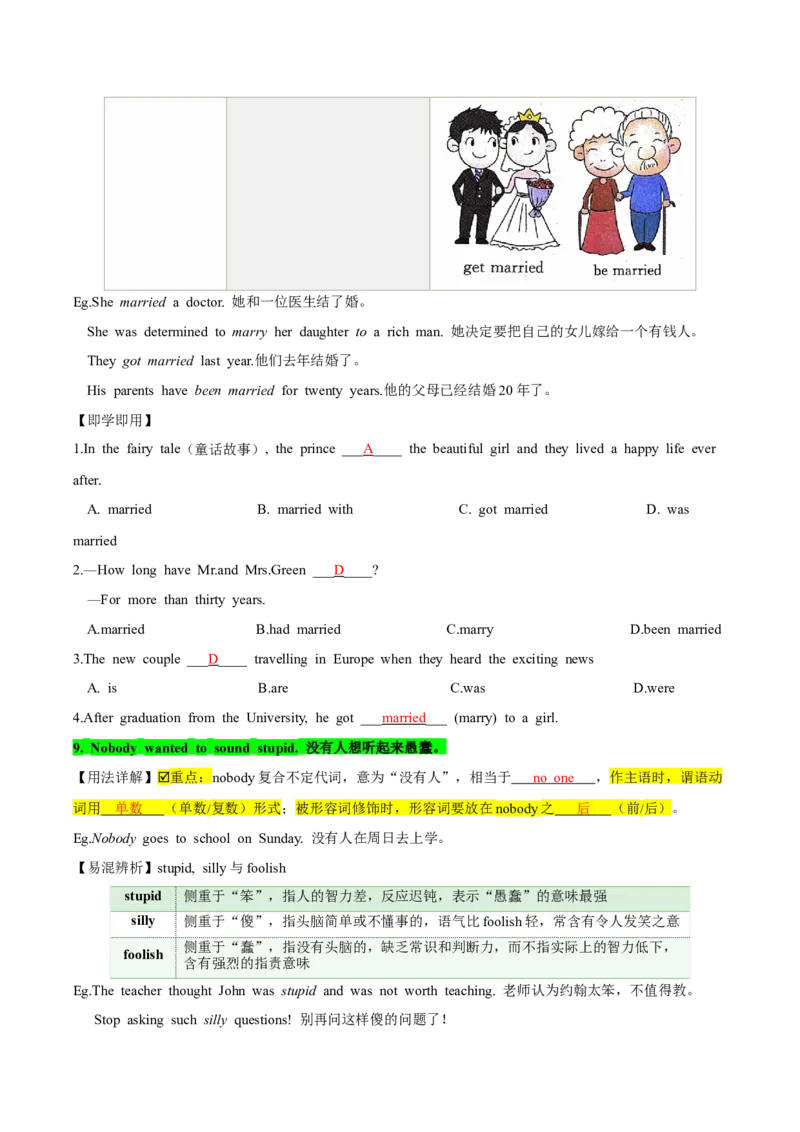
知识点2: marry动词,意为“结婚;嫁;娶”。常见搭配:
固定搭配 用法 图解助记
marry sb. 嫁给某人/与某人结婚
marry sb. to sb. 把某人嫁给某人/为某人娶某人
“与某人结婚”,get married
get married to
强调动作,不能与时间段连
sb.
用;而be married强调状态,
可以与时间段连用
be married to sb.Eg.She married a doctor. 她和一位医生结了婚。
She was determined to marry her daughter to a rich man. 她决定要把自己的女儿嫁给一个有钱人。
They got married last year.他们去年结婚了。
His parents have been married for twenty years.他的父母已经结婚20年了。
【即学即用】
1.In the fairy tale(童话故事), the prince ___A____ the beautiful girl and they lived a happy life ever
after.
A. married B. married with C. got married D. was
married
2.—How long have Mr.and Mrs.Green ___D____?
—For more than thirty years.
A.married B.had married C.marry D.been married
3.The new couple ___D____ travelling in Europe when they heard the exciting news
A. is B.are C.was D.were
4.After graduation from the University, he got ___married___ (marry) to a girl.
9. Nobody wanted to sound stupid. 没有人想听起来愚蠢。
【用法详解】重点:nobody复合不定代词,意为“没有人”,相当于 n o on e ,作主语时,谓语动
词用 单数 (单数/复数)形式;被形容词修饰时,形容词要放在nobody之 后 (前/后)。
Eg.Nobody goes to school on Sunday. 没有人在周日去上学。
【易混辨析】stupid, silly与foolish
stupid 侧重于“笨”,指人的智力差,反应迟钝,表示“愚蠢”的意味最强
silly 侧重于“傻”,指头脑简单或不懂事的,语气比foolish轻,常含有令人发笑之意
侧重于“蠢”,指没有头脑的,缺乏常识和判断力,而不指实际上的智力低下,
foolish
含有强烈的指责意味
Eg.The teacher thought John was stupid and was not worth teaching. 老师认为约翰太笨,不值得教。
Stop asking such silly questions! 别再问这样傻的问题了!You are foolish to agree to the advice. 你同意那个建议是不明智的。
【即学即用】
1.—Let’s play basketball this afternoon.
—Sorry, I have ___D____ to do and I am busy.
A.important anything B.important something C.anything important D.something
important
2.---I found ___A____ in the room. Where have they gone?
---They’ve gone to Dave’s birthday party.
A.nobody B.somebody C.anybody D.everybody
3.Everything ____tastes____ (taste) very good. I like it very much.
4.Did you see ___anyone____ (someone) on the hill this morning?
10. The wife told her husband that unless he left the children to die in the forest,the whole family
would die. 妻子告诉丈夫,如果他不把孩子们丢弃在森林里让他们自生自灭,全家都会死。
【用法详解】whole形容词,意味“全部的;整体的”,放在名词的前面,常和定冠词the连用。
Eg.She spent the whole day shopping in the mall. 她花了一整天在商场里购物。
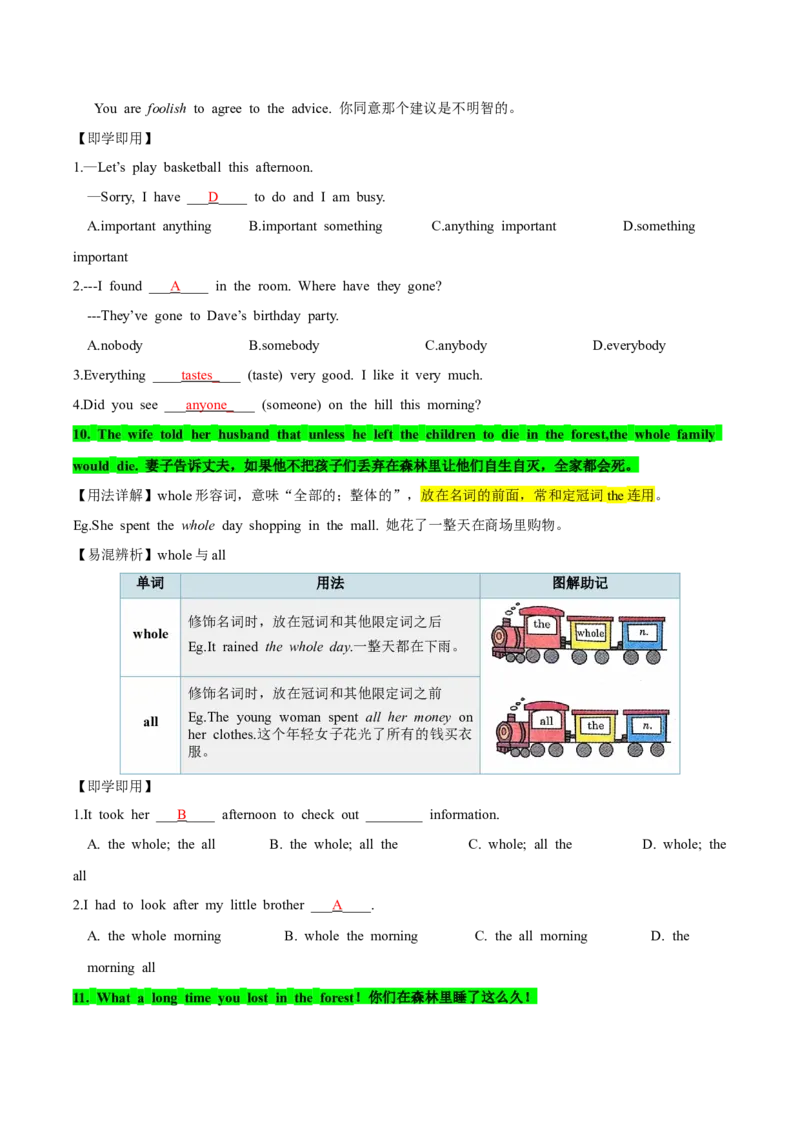
【易混辨析】whole与all
单词 用法 图解助记
修饰名词时,放在冠词和其他限定词之后
whole
Eg.It rained the whole day.一整天都在下雨。
修饰名词时,放在冠词和其他限定词之前
Eg.The young woman spent all her money on
all
her clothes.这个年轻女子花光了所有的钱买衣
服。
【即学即用】
1.It took her ___B____ afternoon to check out ________ information.
A. the whole; the all B. the whole; all the C. whole; all the D. whole; the
all
2.I had to look after my little brother ___A____.
A. the whole morning B. whole the morning C. the all morning D. the
morning all
11. What a long time you lost in the forest!你们在森林里睡了这么久!【用法详解】此句是what引导的感叹句,其结构为“What (+ a/an) + 形容词+名词(+主语+谓语)!”。
Eg.What a hot day (it is)! 好热的天啊!
What nice music (it is)! 多好听的音乐啊!
What tall buildings (they are)! 多么高的楼啊!
【拓展延伸】how引导的感叹句:
How +主语+谓语!
how How +形容词/副词+主语+谓语!
How +形容词+ a/an +单数可数名词+主语+谓语!
Eg.How time flies! 时光飞逝!
How beautiful your car is! 你的小汽车多漂亮啊!
How beautiful a park it is! 多么漂亮的公园啊!
【归纳总结】 wha t 修饰名词, how 修饰形容词和副词,永远没有 how a/a n !
【做题技巧】
1.永远没有How a/an;
2.形(形容词)名(名词)紧相连,what放句前。
►当形容词和名词中间没有任何其他词时,用What引导;
►当形容词和名词中间有其他词隔开时,用How引导。
注意:用What引导感叹句时,要注意名词的单复数问题,从而判断用What a/an还是What。
【即学即用】
1.___B____ delicious these beef noodles are!
A. What B. How C. What a D. How a
2.Look at the sky! ___C____ bad weather it is! Let’s stay at home and watch TV.
A. How B. How a C. What D. What
a
3.—___B____ wonderful the opening of the Beijing Winter Olympics is!
—So it is.
A. How a B. How C. What a D. What
12. It's leading us to that wonderful house made of bread, cake and candy. 它在把我们引向那座由面
包、蛋糕和糖果做成的美妙房屋。
【用法详解】lead动词,意为“带路;领路”,其过去式是 le d 。常用短语:lead sb. to/into ...“把某人带到或带进……”;lead to“(道路等)通往……;引起;导致”。
Eg.She led the boy into the large building. 她把那个男孩领进了大楼。
This path leads to the next village. 这条小路通往下个村子。
【易混辨析】be made of, be made from与be made in
be made of 意为“由……制成”,制成成品后仍可看出原材料 The chair is made of wood.
be made from 意为“由……制成”,制成成品后看不出原材料 The paper is made from
wood.
be made in 意为“在……制造”,in后面接地点 The chair is made in
Shanghai.
【即学即用】
1.—Your sweater looks nice. Is it made ___B____ wool(羊毛)?
—Yes, and it's made ________ Shanghai.
A.of; by B. of; in C. from; in D. from; by
2.Half an hour ago, I ___D____ the old woman ________ the street.
A.lead; through B.led; through C.lead; across D.led; across
13. Then they hear an old woman’s voice from inside the house. 然后他们听到从屋内传出一位老妇人
的声音。
【用法详解】voice名词,意为“声音”,常用搭配:in a ... voice“用……声音”。
Eg.The girl has a beautiful voice. 那个女孩嗓音很美。
The man was talking with his daughter in a low voice. 那个人正低声和他的女儿说话。
【易混辨析】重点:voice与sound
单词 用法 图解助记
主要指人的嗓音,如说话声、歌唱声等
voice Eg.They could hear voices in the next room.
他们能听到隔壁说话的声音。
泛指自然界中能够听到的各种声音
sound Eg.I like the sound of pianos.我喜欢钢琴的声
音。
noise 主要指嘈杂的声音,“噪音”Eg.I can’t stand the noise. 我不能忍受这种噪
音。
【即学即用】
1.“Listen! Can you hear the strange ___D____ outside our house?”he said in a low ________.
A. voice; sound B. voice; voice C.sound; sound D. sound;
voice
2.The girl sang a beautiful song in a sweet ___B____.
A. sound B. voice C. noise D. shout
课堂小测
一、单项选择
1.He only ate ___B___ food in the morning, so he feels _______ hungry now.
A. a little; a bit of B. a bit of; a little bit C. a few; a little D. few; a
little bit
2.The couple ___C___ a couple of _______ now.
A. have; son B. has; sons C. have; sons D. has; son
3.Journey to the West is very ___A___. Tom is very _______ when he watches it.
A.exciting; excited B.excited; exciting C.exciting; exciting D.excited;
excited
4.We spent ___B___ buying food and water while traveling.
A. our whole money B. all our money C. our all money
D.whole money
5.—Listen, his ___D___ is too terrible.
—He sings really badly. And I can’t stand the _______ of the rainstorm, either.
A. noise; voice B. sound; voice C. voice; sound D. voice;
noise
6.Pick up your pen and draw your own invention. Maybe it will be ___D___ a real product one day!
A. turned on B.turned down C.turned off D.turned into
7.Tina wants to lose a little weight, so she starts using the stairs at work ___D___ taking the lift.A. instead B. either of C. neither of D. instead of
8.—Where is my umbrella? I put it here just now.
—Maybe ___C___ took it by mistake.
A.nobody B.anybody C.somebody D.everybody
9.My favorite writer's new book has ___D___. Let's go and buy one.
A. come over B. come down C. come on D. come out
10.My aunt ___A___ to an excellent player on March 18, 2020. They are very happy now.
A. got married B.is married C. married D. married
with
11.—Mom, I want to drive to my grandparents’ home by myself.
—Don’t be ___A___. You are too young to drive.
A. silly B. noisy C. nervous D. sad
12.—All of my classmates have passed the PE test.
—___C___ exciting the news is!
A. What B. What an C. How D. How an
13.--Where would you like to go this Mid-Autumn Festival?
--I'd like to go ___B___.
A. everywhere relaxing B. somewhere relaxing C. peaceful anywhere D. peaceful somewhere
14.—I'm afraid I might forget to buy the bread after work.
— Don't worry.I will ___C___ you then.
A. notice B. allow C. remind D. promise
15.—Do you know anything about C919?
—Of course . It’s a kind of plane which ___B___ China.
A. is made of B. is made in C. is made from D. is
made up of
二、用所给词的适当形式填空
1. Grandma likes making clothes instead of ___buying____ (buy) them in the shops.
2. It doesn't seem ___ to have ____ (have) much difficulty in solving the problem.
3. The old man was deeply ____moved____ (move) by the nurses who cared for him while he was sick.
4. Remind me ___ to buy __ ___ (buy) a bag of salt after work.I am always forgetful.
5. In some ___western_____ (west) countries, Christmas Day is the most important festival.6. I was tired, but he kept ____talking____ (talk) to me for long.
7. The shy boy ____hid_____ ( hide) behind his mother and never said anything.
8. I was so ___excited____ (excite) when I heard the exciting news.
9. All the husbands are working in the fields while the ___wives____ (wife) are working at home.
10. No matter what difficult problems we meet, please face them ___bravely___ (brave).
11.The frog asked the girl,“ Would you marry me?”Then they got ___married___ (marry).
12.His dad ____fell____ (fall) in love with his mother the first time he met her.
13.Our teacher ____led_____ (lead) us to a quiet place to rest yesterday.
14.These ___objects____ (object) in my grandma’s room are all old but they’re useful.
15.Houyi was the hero who ____shot____ (shoot) the suns in the ancient mythology(神话) of China.
三、阅读理解
While I was waiting for a bus at a bus stop,I saw a young man get into the telephone box nearby.
After a short while, however, he came out and looked very worried. As he saw me standing there, he
walked up to me in a hurry.
“Good morning, sir,”he said,“When was Abraham Lincoln born, do you know?”I felt a little
surprised at his words.“Something must be wrong with the poor young man.”I thought.“Could you tell
me just in which year Abraham Lincoln was born?”He repeated politely. Now I could see that he was
not joking, so I thought for a minute and told him that Abraham Lincoln was born in 1809.“Oh, yes!
That's it!Thank you.”He turned around and rushed into the telephone box again.
A few minutes later, he came out with a smile. He thanked me again and explained that he wanted
to make a telephone call to his friend, but he forgot his telephone number.“You helped me to recall(回
想起) it,”he said“You see, his telephone number is 180909, and it can be easily remembered if you
know when the great man was born.”
根据短文内容,判断句子正(T)、误(F)。
( F )1. The young man looked very happy when he came out of the telephone box at the first time.
( T )2. The writer thought there was something wrong with the young man at the beginning.
( F )3. The young man was playing a joke on the writer.
( F )4. The young man thanked the writer for telling him when Abraham Lincoln was born.
( T )5. The telephone number of the young man's friend could be easily remembered if he knew
Abraham Lincoln's year of birth.
四、语法填空It was about 11:00 at night. After 1.___finishing___(finish) my homework, I saw bright light in my neighbor’s
kitchen. I thought he was cooking, so I went to bed. Before I fell 2.___asleep____(sleep), there was a terrible smell
in the air and I thought something was wrong. I jumped out of the bed at once 3.____and_____went out to have a
look. I saw the fire 4.___coming____(come) out of my neighbor’s kitchen. I shouted “Fire! Fire!”, but no one
heard my shouts.
I ran 5.__quickly____(quick) into my house to call 119. and then I rang my neighbor’s doorbell and called his
name, but there was no answer. I tried my best 6.___ to get ____(get) into the house and saved a cat and a dog.
Then I poured water through one of the kitchen7.__windows___(window), but it was no use. The fire was too
heavy.8.___Luckily___( luck), the firemen arrived in time and put out the fire.
When my neighbor returned, he was sad because his kitchen was broken, but he thanked me for calling 119
and saving 9.____his_____(he) pets.
Five days later, my neighbor invited me to his house for dinner. In his new kitchen, he took a photo of me.
Later on, he gave the photo to me as 10.____ _ a _____ gift. I was very happy.
语法精讲
unless、as soon as、so...that引导的状语从句
一、语法概述
在主从复合句中,用作状语的句子叫状语从句。unless、as soon as、so...that分别引导条件状语从句、
时间状语从句和结果状语从句。
二、unless、as soon as、so...that引导的状语从句的用法
引导词 用法及示例
意为“ 除非;如果不 ”,相当于if...not。引导条件状语从句,句中的谓语动词常用一
般现在时代替一般将来时,即遵循“ 主将从现 ”原则。
unless Eg.如果明天不下雨,我们将去游泳。
If it doesn’t rain tomorrow, we will go swimming.
= Unless it rains tomorrow , we will go swimming .
意为“一……就……”,引导时间状语从句,若主句是一般将来时,从句用一般现在时
表示将来,即遵循“ 主将从现 ”原则;若主句是一般过去时或过去将来时,从句用一
般过去时。
as soon as
Eg.我一吃完饭就会做作业。
I will do my homework as soon as I finish the meal .意为“如此……以至于……”,引导结果状语从句,其结构如下:
►so +形容词/副词+ that从句
►so +形容词+ a/an +可数名词单数+ that从句
►so + many/few +可数名词复数+ that从句
►so + much/little +不可数名词+ that从句
【口诀】“多多少少(many/much/few/little)要用
so...that
so”
Eg.他如此强壮以至于能搬动这个箱子。
He is so strong that he can carry the box .
她是如此漂亮的一个女孩,以至于我们都喜欢她。
She is so beautiful a girl that we all like her .
【拓展延伸】
1.在 so...that 中,当 that 引导的结果状语从句是肯定句且从句主语与主句主语相同时,so...that 可以
与...enough to do 进行转换;当that引导的结果状语从句是否定句时,可与too...to...或not...enough to do
进行转换。
Eg.He is so strong that he can carry the box.他如此强壮,能搬动这个箱子。
= He is strong enough to carry the box.
Jimmy is so young that he can’t go to school. 吉米(年龄)太小了,不能去上学。
= Jimmy is too young to go to school.
= Jimmy is not old enough to go to school.
2.such...that也可以引导结果状语从句,其结构为:
►such + a/an +形容词+可数名词单数+ that从句
►such +形容词+可数名词单数+ that从句
►such +形容词+不可数名词+ that从句
Eg.They are such good students that the teacher likes them. 他们是很好的学生,所以老师喜欢他们。
【即学即用】
一、用括号中所给的连词将两个简单句合并成一句话
1.You have to speak very slowly. He won't be able to understand you. (unless)
__ He won ’ t be able to understand you unless you have to speak very slowly .__
2. It was very cold. We stayed at home all day. (so ... that)
__ It was so cold that we stayed at home all day .________________________
3. I will tell Eric the good news. I will see Eric. (as soon as)__ I will tell Eric the good news as soon as I see him .____________________
二、词汇运用。(用unless, until, as soon as, so...that, such...that, if 填空)
1.He didn’t go to bed ___until____ his mother came back.
2.__ As soon as __ he saw her, he fell in love with her.
3.She is ___so____ beautiful ___that____ everyone likes her.
4.I’ll feel sad ____if____ you don’t go together with me.
5.My daughter won’t eat dumplings ___unless___ she is very hungry.
6.This is ___such___ an interesting book ___that____ many students in my class want to read it.
7.You will fall behind your classmates __unless___ you study harder than others.
8.He was ___so_____ crazy about rock music ___that____ he almost spent all his free time listening to
it.
语法小测
一、单项选择
1.The movie Nezha is ___A___ educational ________ I want to see it again.
A. so; that B. such; that C. too; to
D.enough;to
2.My family always go somewhere interesting ___A___ the holiday begins.
A. as soon as B. unless C. since D. because
3.In summer, food will go bad quickly ___B___ we put it into a fridge.
A. if B. unless C. as soon as D. when
4.The problems were ___C___ easy _______ all of us finished them in just half an hour.
A. too; to B. such; that C. so; that D. very;
that
5.When you are in your school dining hall during lunchtime, you may feel lonely ___B___ you can find
someone to have lunch with.
A.if B.unless C.after D.because
6. As soon as the rain ___A___, they will go out to pick apples.
A. stops B. stopped C. will stop D. is
stopping
7.Jack’s mother was so tired. She felt asleep ___B___ she lay down on the bed.A.until B.as soon as C.unless D.although
8.I’ll go to the store with you as soon as my mother ___B___ back.
A.come B.comes C.is coming D.will come
9.I believe ___D___ his new book _______, it will _______ many young people.
A.if; comes out; excited B. as soon as; will come out; exciting
C.if; came out; excite D. as soon as; comes out; excite
10.Tom won’t go to the zoo unless he ___B___ his homework.
A.finish B.finishes C.will finish D.finishing
11.Table tennis is ___C___ an interesting game _______ people all over the world play it.
A.so; that B. too; to C. such; that D. as; as
12.Mary will make a plan as soon as she ___B___ her homework.
A. finish B. finishes C. finished D. will finish
13.It was ___D___ difficult a question _______ people couldn't answer it.
A. too; to B. such; that C. enough; to D.
so; that
14.Mom won’t let Dick go out ___D___ he promises to be back by 10:00 tonight.
A.if B.when C.since D.unless
15.—He has ___C___ much courage that he wants to challenge himself.
—He is _______ a brave boy!
A. such; so B. so; so C. so; such
D.such; such
16.Jim, remember to tell me the news as soon as your cousin ___B___.
A. arrive B. arrives C. arrived D.will arrive
17.You won’t feel happy at school ___C___ you get on well with your classmates.
A. if B. until C. unless D. because
18.The elephant has ___B___ a strong body _______ it can do heavy work for people.
A. so; that B. such; that C. too; to D. so;
and
19.Wu Yi will help with the housework ___C___ he gets home after school.
A.since B.while C.as soon as D.unless
20.---Why didn’t you write down what the teacher said?---He spoke ___A___ fast _______ I didn’t follow him.
A. so; that B. too; to C. very; that D. such; that
二、用所给词的适当形式填空
1.Be sure to let tom know the news as soon as he ___arrives___ (arrive).
2.I will go swimming unless it ___rains____ (rain).
3.Her dream will come true unless she never ___gives____ (give) it up halfway.
4.The young man was brave enough ___ to fight ____ (fight) bad people.
5.As soon as Lucy ____feels____ (feel) better, she will go to school.
三、完形填空
Long long ago, there lived a ___1___ monkey. It had two heads and they faced ___2___ directions (方向).
One day, one head of the monkey saw a nice red ___3___. The head ate it and kept ___4___ how delicious it was.
The other head asked, "Can I taste it?" The first head said, "Though I ate it in my mouth, it will go into our
___5___." The other head still wanted to taste the fruit. The first head ___6___, "I saw the fruit and I have the
right(权利) to eat it ___7___ sharing."
Later, the second head saw a beautiful pink fruit on a tree. It tried to pick the fruit and eat it. The birds living in
the tree said, "Don't eat it. It will ___8___ you. "
The first head also shouted, "Don't eat it!" But the second head didn't ___9___ them, "I saw it, and I have the
right to eat it. It will go into our stomach later. "And it ate the fruit. In a few minutes, the strange monkey with two
heads died!
A family should ___10___ each other instead of working for one's own good (好处).
( D )1. A. common B. short C. big D. strange
( B )2. A. same B. different C. right D. wrong
( A )3. A. fruit B. vegetable C. meat D. bread
( B )4. A. thinking B. saying C. writing D. missing
( C )5. A. heart B. mind C. stomach D. head
( D )6. A. agreed B. promised C. shared D. refused
( A )7. A. without B. with C. by D. through
( A )8. A. kill B. help C. improve D. save
( D )9. A. hear from B. look for C. fight with D. listen to
( C )10. A. take after B. compare with C. care for D. learn from