2024-2025 学年八年级下学期期中模拟卷(济南卷)
英语试题
本试题共分为四部分, 满分为150分, 考试用时120分钟。
答题前, 请考生务必将自己的姓名、座号和准考证号填写在答题卡上, 并同时将考点、姓名、
准考证号和座号填写在试卷规定的位置。
答题时, 选择题部分每小题选出答案后, 用2B铅笔把答题卡上对应题目的答案标号涂黑; 如
需改动, 用橡皮擦干净后, 再选涂其他答案标号。非选择题部分, 用0.5毫米黑色签字笔在答
题卡上题号所提示的答题区域作答。直接在试题上作答无效。
考试结束后, 将本试题和答题卡一并交回。
第一部分 听力(共四节, 满分30分)
第一节听录音, 从每组句子中选出一个你所听到的句子。每个句子听一遍。(共5小题, 每
小題1.5分, 满分 7.5分)
1.
A.What’s the matter with you?
B.What’s wrong with your brother?
C.Who’s your brother?
2.
A.Could you please wash the dishes?
B.Could you please take out the dishes?
C.Let’s go to the City Park tomorrow.
3.
A.Maybe you could go to his home.
B.He should talk to his friend.
C.He decided to try out for a volunteer.
4.
A.Why don’t you talk to your parents?
B.What were you doing at eight?
C.What was Ben doing when it began to rain?
5.A.I worked until midnight last night.
B.You can learn some great jokes.
C.You could ask hospitals to let you visit the kids and cheer them up.
第二节在录音中, 你将听到五段对话, 每段对话后有一个小题, 从每小题A、B、C中选出能
回答所给问题的正确答案。每段对话听两遍。(共5小题, 每小题1.5分, 满分7.5分)
6.What should the boy do?
A.Have a talk with her teacher.B.Make other new friends. C.Say sorry to Kate.
7.When does the boy have to come back home?
A.Before 9:00 p.m. B.Before 9:30 p.m. C.Before 10:00 p.m.
8.How could the boy help the old people in old people’s home?
A.He could clean for them.B.He could sing for them. C.He could listen to them and care for them.
9.Why did Jane feel tired?
A.Because she kept having dreams.
B.Because she studied until midnight last night.
C.Because she watched TV until midnight last night.
10.Where was Sally when the rainstorm came?
A.In the classroom. B.In the sports hall. C.In the library.
第三节在录音中, 你将听到一段对话, 对话后有五个小题, 从每小题A、B、C中选出能回答
所给问题的正确答案。听对话前, 你将有40秒钟的读题时间; 听完后, 你将有40秒钟的答题
时间。对话听两遍。(共5小题, 每小题1.5分, 满分7.5分)
11.What was Linda doing at four o’clock yesterday afternoon?
A.Playing soccer with her friends.
B.Flying kites with her friends.
C.Playing basketball with her friends.
12.How was the weather yesterday?
A.It was windy. B.It was rainy. C.It was sunny.
听一段对话,回答下面三个小题。
13.What was wrong with Mary?
A.She didn’t finish homework.
B.She had a fight with Lily.C.She hurt Lily.
14.What did Lily do?
A.She took some of Mary’s new magazines.
B.She argued with her friend.
C.Her mother asked her to do so.
15.How did Mary feel when Lily look through her things?
A.Happy. B.Angry. C.Sorry.
第四节在录音中, 你将听到一篇短文, 短文后有五个小题, 从每小题A、B、C中选出能回答
所给问题的正确答案。听短文前, 你将有 40 秒钟的读题时间; 听完后, 你将有40 秒钟的答
题时间。短文听两遍。(共5小题, 每小题 1.5分, 满分 7.5分)
16.What’s this passage about?
A.seasons B.weather and rice C.students
17.Which season does the rice grow quickly?
A.spring B.summer C.winter
18.Why does the rice grow quickly?
A.The weather is hot. B.It rains a lot. C.The weather is hot and there is enough rain.
19.Why do students often go to help the farmers?
A.The farmers are too busy. They need help.
B.The farmers are lazy.
C.The students want to enjoy themselves.
20.Can good weather bring a good harvest?
A.Yes, it can. B.No, it can’t. C.I don’t know
第二部分 阅读(共两节, 满分50分)
第一节 阅读理解 阅读下列短文, 从每题A、B、C、D四个选项中, 选出一个能回答所提问
题或完成所给句子的最佳答案。(共20小题, 每小题2分, 满分40分)
A
Each country in the world has its own traditional clothes, which show us the country’s traditional aesthetics
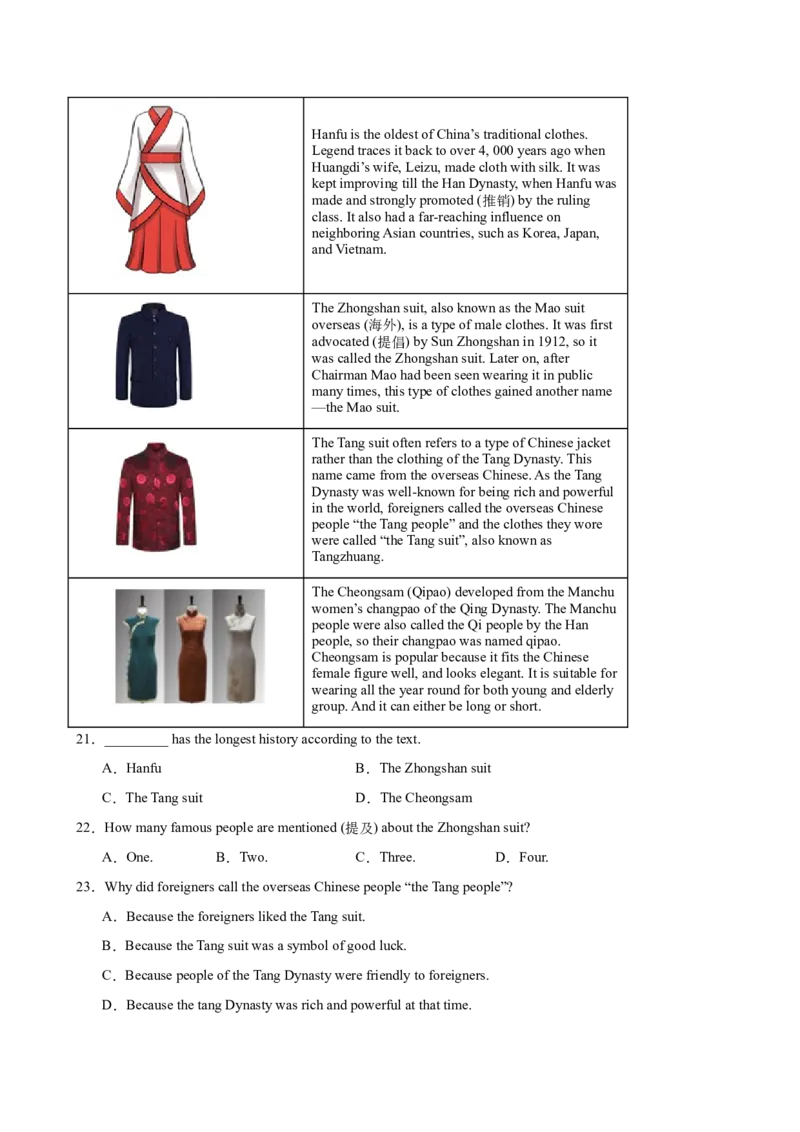
(美学) and social values in special ways. Here are the four most well-known types of traditional Chinese clothing.Hanfu is the oldest of China’s traditional clothes.
Legend traces it back to over 4, 000 years ago when
Huangdi’s wife, Leizu, made cloth with silk. It was
kept improving till the Han Dynasty, when Hanfu was
made and strongly promoted (推销) by the ruling
class. It also had a far-reaching influence on
neighboring Asian countries, such as Korea, Japan,
and Vietnam.
The Zhongshan suit, also known as the Mao suit
overseas (海外), is a type of male clothes. It was first
advocated (提倡) by Sun Zhongshan in 1912, so it
was called the Zhongshan suit. Later on, after
Chairman Mao had been seen wearing it in public
many times, this type of clothes gained another name
—the Mao suit.
The Tang suit often refers to a type of Chinese jacket
rather than the clothing of the Tang Dynasty. This
name came from the overseas Chinese. As the Tang
Dynasty was well-known for being rich and powerful
in the world, foreigners called the overseas Chinese
people “the Tang people” and the clothes they wore
were called “the Tang suit”, also known as
Tangzhuang.
The Cheongsam (Qipao) developed from the Manchu
women’s changpao of the Qing Dynasty. The Manchu
people were also called the Qi people by the Han
people, so their changpao was named qipao.
Cheongsam is popular because it fits the Chinese
female figure well, and looks elegant. It is suitable for
wearing all the year round for both young and elderly
group. And it can either be long or short.
21._________ has the longest history according to the text.
A.Hanfu B.The Zhongshan suit
C.The Tang suit D.The Cheongsam
22.How many famous people are mentioned (提及) about the Zhongshan suit?
A.One. B.Two. C.Three. D.Four.
23.Why did foreigners call the overseas Chinese people “the Tang people”?
A.Because the foreigners liked the Tang suit.
B.Because the Tang suit was a symbol of good luck.
C.Because people of the Tang Dynasty were friendly to foreigners.
D.Because the tang Dynasty was rich and powerful at that time.24.Which is the right order of the development of the clothes?
①Hanfu
②The Zhongshan suit
③The Tang suit
④The Cheongsam
A.③④②① B.①②③④
C.①③④② D.④③①②
25.Which of the following is NOT true according to the text?
A.Hanfu was strongly promoted by Han ruling class.
B.Chairman Mao wore the Zhongshan suit in public many times.
C.The Cheongsam came from the overseas Chinese.
D.Qipao developed from the Manchu women’s changpao of the Qing Dynasty.
B
You may receive lots of gifts on your birthday. But have you ever thought about giving your birthday gifts
to people in need? Kyle Breede, a 12-year-old boy from Maryland, the USA, has done that ever since he was six
years old. On November 19th every year, Kyle invites his friend to his birthday celebration. He asks each friend to
bring new toys to donate to Toys for Tots.
Toys for Tots is a project which gives out toys to children whose parents cannot usually buy them toys.
Kyle has donated more than 2000 toys to the project. And he plans to continue collecting toys for other kids for
years to come.
When Kyle was five, he asked his parents how he could help others. Kyle’s parents were excited to hear
that and they helped him get in touch with Toys for Tots. From then on, he has looked forward to his birthday, but
only to get toys. Then he collects the toys and goes to the Toys for Tots celebration to donate them.
John Minadakis, who hosted a Toys for Tots celebration, said he had never seen someone give so much at
such a young age. He believed the ability to put others before himself could take the boy far in life.
Kyle hopes that through his example, other kids will be inspired (激励) to give back. “Many people around
my age don’t have toys to play with. I want to do something,” Kyle said. “Even the smallest toy can make a kid’s
day.”
26.Where does Kyle come from?
A.England. B.America. C.France. D.Australia.
27.What does the underlined word “donate” probably mean in Paragraph 1?A.give away B.deal with C.put on D.throw away
28.What is Toys for Tots?
A.It’s a factory to make toys.
B.It’s a supermarket to sell toys.
C.It’s a project to give away toys.
D.It’s a club to collect old toys.
29.What did Kyle’s parents do to help him when he was 5 years old?
A.They helped him get in touch with Toys for Tots.
B.They helped him repair his bike.
C.They helped him collect stamps.
D.They taught him to get on with other kids.
30.From the last two paragraphs, we can know _________.
A.Kyle advised his friends to sell toys
B.John Minadakis liked to play with Kyle
C.Kyle wants to help more kids
D.John Minadakis thought it was easy to collect toys
C
Across China, museums were filled with visitors during the past winter vacation. To many museums, they
never had such crowds before. So, what was behind this “museum craze (狂)”?
“Part of the reason is a growing interest in traditional Chinese culture, especially among young Chinese.”
said Guo Sike from the Confucius Museum in Qufu. He added that modern technologies (现代技术) have also
played an important role. They make it possible for people to experience traditional culture in a more lovable and
lively way.
One Sunday morning in February, there was a long line of visitors waiting in front of the Shanxi Museum
in Taiyuan before its opening hour. “This museum is so popular that we needed to book tickets a week before. A
large number of historical things are on show here.” Wang Bin, a visitor with his family from Beijing said, “After
the visit, my kid will have a better understanding about the long history of Shanxi Province, which helps to enrich
his knowledge.”The Shaanxi History Museum in Xi’an can only hold 12,000 people to visit each day. But its ticket booking
app got over 600,000 clicks (点击) a day. To solve the problem, the museum gave up its Monday break, and
opened 7 days a week during the winter vacation. It was also open for more hours on Sundays.
“Museums are bridges connecting (连接) the past, now and future,” said Yang Chaoming, an expert at
Shandong University. “More and more people wish to learn more about traditional Chinese culture through
museum visits. And that’s what museums will work on in the future.”
31.What were the museums like during the past winter vacation in China?
A.Boring. B.Cold. C.Crowded. D.Serious.
32.Guo Sike talked about ________ reason(s) for the “museum craze” in Paragraph 2.
A.one B.two C.three D.four
33.How does the writer develop Paragraph 4?
A.By listing numbers. B.By telling stories.
C.By explaining words. D.By using sayings.
34.The writer describes the “museum craze” in Paragraphs ________.
A.1,3,4 B.1,2,4 C.2,3,4 D.1,4,5
35.Where is the text probably taken from?
A.A map. B.A story book. C.A dictionary. D.A newspaper.
D
January 20, 2025, a Chinese tech company named DeepSeek made a new AI called DeepSeek-R1. This
smart program can solve math problems, write code (代码), and answer questions like top models such as
OpenAI’s GPT-4o, but it costs much less to build. The team spent only $5.58 million (1/70 of OpenAI’s cost) and
used 2,048 computer chips (芯片) for two months to make it. This shows that good ideas can beat big money.
DeepSeek-R1 learns by trying many times and getting better, like how students practice maths. Other AIs
need lots of prepared examples, but R1 improves by itself. In a global math test, it got 79.8% right, a little higher
than OpenAI’s model. A simple version (版本) of R1 can even run on low-cost computers, helping schools and
small companies.
DeepSeek-R1 is free to use and change. On its first day online, over 19,000 programmers worldwide started
projects to study it. A German scientist said experiments with R1 cost $10 instead of $300 with other AIs. Even
Meta (a famous U.S. tech company) top scientist said, “This kind of free AI could change the world.”
U.S. tech companies are worried. Meta planed to spend $65 billion more on AI research. Experts said China
was catching up fast. A report in Nature magazine called R1 a “big step forward”, confirming that smart ideasbeat expensive tools.
As a DeepSeek engineer said, “We want AI to be a friend, not something only rich people can use.” With
R1, China shows the world that great things come from new ideas and hard work, not just money.
36.How much did it cost to build DeepSeek-R1?
A.$5.58 million. B.$65 billion. C.$10. D.$300.
37.What can we learn about DeepSeek-R1 from paragraph 2?
A.It needs programmers to fix mistakes. B.It becomes better through practice.
C.It copies answers from other AIs. D.It only works with expensive tools.
38.Why did Meta plan to spend more money on AI research?
A.To help Chinese companies. B.To build more computer chips.
C.To compete with DeepSeek-R1. D.To hire German scientists.
39.What does the underlined word “confirming” mean in paragraph 5?
A.Proving. B.Exploring. C.Refusing. D.Connecting.
40.Which of the following can be the best title for the text?
A.Competition between GPT-4o and DeepSeek-R1
B.Comparison of Chinese and American AI Models
C.Appearance of Chinese AI Model DeepSeek-R1
D.Disadvantages of Chinese AI Model DeepSeek-R1
第二节 阅读理解七选五 (共5小题, 每小题2分, 满分10分)
根据短文内容,从短文后的选项中选出能填入空白处的最佳选项,选项中有两项为多余选项。
Every year, there’s a colour that leads the fashion trend. What about the colour in 2024? Pantone, the global
authority (全球权威) on colour, chose Peach Fuzz. 41 Pantone said it brings “a feeling of kindness,
communicating a message of caring and sharing, community and working together.
42 So they need a peaceful future and to look after themselves and find time to be creative, get
together with friends and get away from the busy modern (现代的) life.
43 As Time magazine noted, when people hear the name of the colour, they always think of how
soft peaches feel to touch, the softness of bird feathers, and the feeling of silk. “It’s a warm and comfortable
shade. And it’s very tactile (有触感的). We feel that at a time like this, tactility is really important to touch other
people and get them into our homes,” Pantone colour expert Leatrice Eiseman told CNN in a video call.
The colour of Peach Fuzz was chosen, according to Time magazine, because it shows the past has been
developed with modern things. 44“We think of peach as being a nostalgic (怀旧的) colour,” said Eiseman. “More often a woman’s colour.
45 I think that speaks to the modernity of the shade.”
Peach Puzz is Pantone’s 25th colour of the Year, The first was created in 1999 to get the design community
and colour lovers around the world in a conversation around colour.
A.It brings a new modernity.
B.The colour of Peach Fuzz is what humans need.
C.Humans have gone through many hard times last year.
D.Many people may use this colour for their living rooms.
E.It is a soft peach colour between pink and orange.
F.Time seems to pass quickly in a room with warm colour.
G.But it’s been changed and put into men’s life.
第三部分 语言运用(共两节, 满分35分)
第一节 补全对话(共5小题, 每小题1分, 满分5分)
阅读对话,从每题 A、B、C、D 四个选项中, 选出一个最佳答案完成对话。
Molly: Hi, David. What are you busy doing here?
David:
Molly: What?
David: A toy plane.
Molly: Sounds interesting. You can make toys by yourself. Do you sell them?
David: No. I often hand them out when I visit sick children.
Molly: They must be very happy. But it looks so difficult to make the toy plane.
David: My grandpa taught me a lot. Do you want to learn it? I can teach you.
Molly: Really?
46.A.I want to watch TV. B.I’m making a plane.
C.we are eating lunch. D.It was sunny outside.
47.A.Peter and I have bad colds now. B.They want to play chess.
C.I like making toys when I’m free. D.They came here by bike.
48.A.We can sell it at our school. B.I do it to cheer them up.
C.I don’t have enough water. D.Let me have a look at it.
49.A.How did you learn it? B.Why do you want to come?C.Where are the shops? D.What do you need to do?
50.A.That’ll be great! B.I’m afraid not.
C.That’s too bad! D.Don’t worry.
第二节 完形填空
阅读短文, 从每题A、B、C、D四个选项中, 选出一个能填入文章中相应空白处的最佳
答案。(共 15 小题, 每小题 1 分, 满分 15 分)
Once there was a girl, named Kate. She was very polite and ready to help everybody. One day she found a
pink paper bag on the way to school. She opened it and saw there was a lot of 51 in it. She thought she
should hand it in to the teacher, so she 52 it in her schoolbag.
When she went to the teacher’s office, her teacher wasn’t 53 . As it was time for class, she hurried
to the classroom.
After class, she told her friend, Mary, about the money that she 54 . Then, her greedy (贪婪的)
friend took away the bag.
After school, Kate wanted to go to the 55 office again, but she found the money was missing.
The next day when the children were playing a game, Mary fell down and was hurt very badly. The other
children stood around her and didn’t know 56 to do. Kate kept calm and did something to stop bleeding.
She told the others to go to teachers for 57 . Soon a teacher took Mary to the 58 and the
doctor examined her carefully. Within a week she was all right again. Kate became very popular in the school.
Two weeks later, Mary came to Kate’s house. Her eyes were red. She was crying. She gave Kate the 59
paper bag with the money in it and said. “Kate, I have taken the money away. That day when you helped me, I felt
very sad and now I decide to tell you the 60 , you are such a nice friend! 61 please don’t tell
the school about this. Please!” Then Kate said, “You are now 62 , but you have done a bad thing.
Though I will not tell anyone, I want you not to be greedy and 63 to do anything wrong.” The girl
thanked Kate and 64 .
At the end of the term Kate was given a 65 for being a very helpful girl in the school. Mary
became an honest girl and was never greedy again.
Once wrong, never be wrong forever.
51.A.bread B.money C.paper D.fruit
52.A.got B.caught C.kept D.sent
53.A.out B.away C.off D.in
54.A.found B.lost C.saved D.made55.A.worker’s B.doctor’s C.teacher’s D.headmaster’s
56.A.how B.what C.when D.where
57.A.help B.treatment C.action D.leave
58.A.school B.classroom C.office D.hospital
59.A.red B.pink C.white D.black
60.A.lie B.story C.truth D.result
61.A.And B.But C.Or D.So
62.A.friendly B.polite C.lucky D.honest
63.A.never B.seldom C.sometimes D.usually
64.A.got up B.woke up C.gave up D.cheered up
65.A.prize B.laugh C.joke D.reply
第三节 阅读填空 (共10小题, 每小题1.5分, 满分15分)
阅读下面短文,在空白处填入一个适当的单词或括号内单词的正确形式。
If an old man suddenly falls down in front of you, will you help him? Most of us would choose to help him
66 we know it’s the right thing to do. But others might refuse 67 (do) so. In my opinion, we
should not only think about 68 (we) but others as well.
I’ve had an experience like this before. I saw a woman walking with a baby in her arms while it 69
(rain) heavily. They were both wet because they don’t have 70 umbrella. I held out my umbrella for
them 71 (quick) and I walked several miles with them till they got home. The woman thanked me a lot
for 72 I did for her. Offering help to people 73 trouble can make them feel really warm. And
perhaps one day we’ll become the ones who need help. So why don’t we just reach out a helpful hand whenever
we can? The more we trust and help each other, the 74 (good) our world will be.
It’s time for us to show our 75 (kind) to others.
第四部分 书面表达(共两节, 满分 35 分)
第一节 情境运用 (共5小题, 每小题2分, 满分 10 分)
根据所提供的图片,用一个完整的句子提问或应答。
76.
A: What’s the matter with the boy?
B: .77.
A: I got into a fight with my friend. What’s your advice?
B:
78.
A: ?
B: Sure.
79.
A: ?
B: I was reading in the library when the rainstorm came.
80.
A: .
B: You could give out food at the food bank to help feed them.
第二节 写作(25分)
81.为落实国家教育部提出的对中小学加强劳动教育的实施意见,你们学校安排了丰富多彩的劳动
教育活动。假如你是李华,你的英国笔友Linda对你参加的活动很感兴趣,她发来邮件想了解有关情况。
请你根据以下提示,给Linda回一封邮件,内容包括:
1. 劳动的重要性;
2. 具体活动:做家务、志愿者活动……;
3. 你的看法。注意:
1. 词数100左右,开头和结尾已给出,不计入总词数;
2. 可以适当增加细节,以使行文连贯;
3. 不得出现真实的人名、校名等相关信息。
相关词汇:劳动 labor
Dear Linda,
I’m glad to hear from
you.________________________________________________________________________________________
___________________________________________________________________________________________
___________________________________________________________________________________________
___________________________________________________________________________________________
___________________________________________________________________________________________
___________________________________________________________________________________________
___________________________________________________________________________________________
___________________________________________
Yours,
Li Hua《八年级济南期中1》参考答案
题号 1 2 3 4 5 6 7 8 9 10
答案 A B B C C C A C B C
题号 11 12 13 14 15 16 17 18 19 20
答案 B A B A B B B C A A
题号 21 22 23 24 25 26 27 28 29 30
答案 A B D C C B A C A C
题号 31 32 33 34 35 36 37 38 39 40
答案 C B A A D A B C A C
题号 41 42 43 44 45 51 52 53 54 55
答案 E C B A G B C D A C
题号 56 57 58 59 60 61 62 63 64 65
答案 B A D B C D D A D A
1.A
【原文】略
2.B
【原文】Could you please take out the dishes?
3.B
【原文】略
4.C
【原文】略
5.C
【原文】略
6.C
【原文】略
7.A
【原文】M: Could I go to the movies tonight?
W: Yes, you can. But you have to come back home before nine.
8.C
【原文】M: I’d like to help the old people.
W: You could listen to them and care for them.
9.B
【原文】略
10.C
【原文】略
11.B 12.A【原文】略
13.B 14.A 15.B
【原文】略
16.B 17.B 18.C 19.A 20.A
【原文】Farmers grow rice so much in China. They begin to grow it in spring. In summer, rice
often gets much rain, so it grows quickly at this time of year. The weather in autumn is usually
quite nice. It’s harvest time. The farmers are busy. Sometimes students go to their farms and help
them with the rice harvest. But when it rains too much, rice can’t grow well. The farmers will not
have a good harvest. The farmers hope the weather is always nice for rice.
21.A 22.B 23.D 24.C 25.C
【导语】本文讲述了四种最著名的中国传统服装。
21.细节理解题。根据“Hanfu is the oldest of China’s traditional clothes.”可知汉服是中国最
古老的传统服装。故选A。
22.细节理解题。根据“It was first advocated (提倡) by Sun Zhongshan in 1912, so it was
called the Zhongshan suit. Later on, after Chairman Mao had been seen wearing it in public many
times”可知提到了孙中山和毛主席。故选B。
23.细节理解题。根据“As the Tang Dynasty was well-known for being rich and powerful in
the world, foreigners called the overseas Chinese people ‘the Tang people’”可知外国人称华侨
为”唐人”是因为当时的唐朝富强。故选D。
24.推理判断题。根据“Hanfu is the oldest of China’s traditional clothes.”可知汉服是中国最
古老的传统服装,是最先出现的,故①排一位,排除AD;根据“The Zhongshan suit, also
known as the Mao suit overseas (海外), is a type of male clothes. It was first advocated (提倡) by
Sun Zhongshan in 1912”“As the Tang Dynasty was well-known for being rich and powerful in the
world...the clothes they wore were called ‘the Tang suit’ , also known as Tangzhuang.”可知中山
装是孙中山在1912年首先倡导的,而唐装是唐朝的服装,故③在②之前,排除B。故选
C。
25.推理判断题。根据“The Cheongsam (Qipao) developed from the Manchu women’s
changpao of the Qing Dynasty”可知旗袍是从清朝满族妇女的旗袍发展而来的,选项C描述
错误。故选C。
26.B 27.A 28.C 29.A 30.C
【导语】本文讲述了男孩Kyle Breeden在过生日时为其他贫穷孩子筹集玩具的故事。26.细节理解题。根据第一段“Kyle Breede, a 12-year-old boy from Maryland, the USA, has
done that ever since he was six years old.”可知,Kyle是一位来自美国的12岁大的男孩。故选
B。
27.词句猜测题。根据第一段“But have you ever thought about giving your birthday gifts to
people in need...has done that ever since he was six years old.”可知Kyle从六岁起开始把生日礼
物送给那些有需要的人们,再由“He asks each friend to bring new toys to donate to Toys for
Tots”可推知,他要求朋友带新玩具是为了捐赠。故选A。
28.细节理解题。根据第二段“Toys for Tots is a project which gives out toys to children
whose parents cannot usually buy them toys.”可知,Toys for Tots是一个赠送玩具的项目。故
选C。
29.细节理解题。根据第三段“When Kyle was five, he asked...they helped him get in touch
with Toys for Tots.”可知,当Kyle五岁的时候,他的父母帮助他与Toys for Tots取得了联系。
故选A。
30.推理判断题。通读最后两段,再根据最后一段“Kyle hopes that through his example,
other kids will be inspired to give back.”可知,Kyle想帮助更多的孩子。故选C。
31.C 32.B 33.A 34.A 35.D
【导语】本文主要讲述了“博物馆狂热”的现象。
31.细节理解题。根据“Across China, museums were filled with visitors during the past winter
vacation.”可知,在过去的寒假里中国的博物馆是拥挤的。故选C。
32.细节理解题。根据“Part of the reason is a growing interest in traditional Chinese culture,
especially among young Chinese.”以及“He added that modern technologies (现代技术) have
also played an important role. They make it possible for people to experience traditional culture in
a more lovable and lively way.”可知,郭思科讲述了“博物馆狂热”的两个理由。故选B。
33.推理判断题。根据“The Shaanxi History Museum in Xi’an can only hold 12,000 people to
visit each day. But its ticket booking app got over 600,000 clicks (点击) a day.”可知,作者在第
四段通过列出数字来写作的。故选A。
34.细节理解题。根据“Across China, museums were filled with visitors during the past winter
vacation. To many museums, they never had such crowds before.”;“One Sunday morning in
February, there was a long line of visitors waiting in front of the Shanxi Museum in Taiyuan
before its opening hour.”以及“The Shaanxi History Museum in Xi’an can only hold 12,000people to visit each day. But its ticket booking app got over 600,000 clicks (点击) a day.”可知,
作者在1,3,4段描述了”博物馆狂热”。故选A。
35.推理判断题。根据“Across China, museums were filled with visitors during the past winter
vacation. To many museums, they never had such crowds before. So, what was behind this
‘museum craze (狂)’?”并结合全文内容,本文主要讲述了“博物馆狂热”的现象,因此本文
可能来源于报纸。故选D。
36.A 37.B 38.C 39.A 40.C
【导语】本文是一篇新闻报道。文章主要介绍了中国科技公司DeepSeek研发的一款新的人
工智能模型DeepSeek-R1,该模型能以较低的成本完成与顶级模型相似的任务,并受到了
广泛关注和好评。
36.细节理解题。根据第一段中的“The team spent only $5.58 million (1/70 of OpenAI’s cost)
and used 2,048 computer chips (芯片) for two months to make it.”可知,制造DeepSeek-R1花
费了558万美元。故选A。
37.推理判断题。根据第二段中的“DeepSeek-R1 learns by trying many times and getting
better, like how students practice maths.”可知,DeepSeek-R1通过实践变得更好。故选B。
38.推理判断题。根据第四段中的“U.S. tech companies are worried. Meta planed to spend
$65 billion more on AI research.”和“Experts said China was catching up fast.”可推知,Meta计
划再投入更多钱用于人工智能研究是为了与DeepSeek-R1竞争。故选C。
39.词义猜测题。根据画线词上文“A report in Nature magazine called R1 a ‘big step
forward’”可知,杂志上的这篇报道是证明(proving)了“聪明的想法胜过昂贵的工具”这
一观点。故画线词意思是“证明”。故选A。
40.主旨大意题。通读全文,并根据第一段“January 20, 2025, a Chinese tech company
named DeepSeek made a new AI called DeepSeek-R1.”可知,文章主要介绍了中国科技公司
DeepSeek研发的一款新的人工智能模型DeepSeek-R1,该模型能以较低的成本完成与顶级
模型相似的任务,并受到了广泛关注和好评。所以C选项“中国人工智能模型DeepSeek-
R1的出现”最适合作为文章标题。故选C。
41.E 42.C 43.B 44.A 45.G
【导语】本文主要介绍了2024年的“Peach Fuzz”这种色彩被全球色彩权威选为了年度颜色。
41.根据“What about the colour in 2024? Pantone, the global authority (全球权威) on colour,
chose Peach Fuzz.”可知,空处应该说明Peach Fuzz这种颜色是什么,选项E“它是一种介于粉色和橙色之间的柔和桃红色。”符合语境。故选E。
42.根据“So they need a peaceful future and to look after themselves and find time to be
creative, get together with friends and get away from the busy modern (现代的) life.”可知,此处
应该解析为什么他们需要一个和平的未来,选项C“去年人类经历了许多艰难时期。”符合
语境。故选C。
43.根据“As Time magazine noted, when people hear the name of the colour, they always think
of how soft peaches feel to touch, the softness of bird feathers, and the feeling of silk”可知,此处
介绍Peach Fuzz这种颜色的特点和能为人们带来什么,选项B“Peach Fuzz这种颜色是人类
所需要的。”符合语境。故选B。
44.根据“because it shows the past has been developed with modern things.”可知,空处应与
现代氛围有关,选项A“它带来了一种新的现代性。”符合语境。故选A。
45.根据“More often a woman’s colour.”可知,空处应与这种颜色的归属有关,选项G“但
它已经被改变了,并进入了男人的生活。”符合语境。故选G。
46.B 47.C 48.B 49.A 50.A
【导语】本文是大卫和莫莉在谈论制造玩具飞机的对话。这是大卫送给生病的孩子的玩具。
46.根据“What are you busy doing here?”可知,大卫回答他正在做的事,根据后文的
“David: A toy plane.”可知,此处表示他正在做玩具飞机,故选B。
47.根据“Sounds interesting. You can make toys by yourself.”可知,此处大卫回答他喜欢制
作玩具,故选C。
48.根据“I often hand them out when I visit sick children.”和“They must be very happy.”可知,
他把玩具分发给他们是为了让他们高兴,故选B。
49.根据“My grandpa taught me a lot.”可知,此处询问大卫是如何学会制作玩具的,故选
A。
50.根据“I can teach you.”可知,大卫要教她做玩具飞机,她认为这是太好了,故选A。
51.B 52.C 53.D 54.A 55.C 56.B 57.A 58.D 59.
B 60.C 61.D 62.D 63.A 64.D 65.A
【导语】本文是一篇记叙文。文章讲述了凯特是一个有礼貌且乐于助人的人,有一天她捡
到了钱并打算交给老师,但是却被玛丽拿走了。最后玛丽因受到了凯特的帮助把钱归还给
了凯特,玛丽也变成了一个诚实的孩子的故事。
51.句意:她打开粉红的纸包,看见里面有很多钱。bread面包;money钱;paper纸;fruit水果。根据下文“After class, she told her friend,
Mary, about the money”可知,包里是钱。故选B。
52.句意:她认为她应该把包交给老师,所以她把它装在了书包里。
got获得;caught抓住;kept保存;sent发送。根据“she should hand it in to the teacher”可知,
此处凯特把包保存在书包里以便到学校交给老师。故选C。
53.句意:当她去老师办公司时,老师不在。
out外出;away离开;off离开;in在屋里。根据下文“After school, Kate wanted to go to the
office again”可知,老师不在办公室。故选D。
54.句意:下课后,凯特跟她的朋友玛丽说了她捡到钱的事。
found发现;lost丢失;saved节省;made制作。根据上文“one day she found a pink paper
bag on the way to school.”可知,这个钱是她发现的。故选A。
55.句意:放学后,凯特想再次去老师的办公室,但是却发现钱不见了。
worker’s工人的;doctor’s医生的;teacher’s老师的;headmaster’s校长的。根据上文
“When she went to the teacher’s office”可知,此处应是老师办公室。故选C。
56.句意:别的孩子围着她站不知道做什么。
how怎样;what什么;when什么时候;where哪里。根据语境可知,应该是不知道做什么,
用what作do的宾语。故选B。
57.句意:她告诉其他的孩子去找老师寻求帮助。
help帮助;treatment治疗;action行动;leave离开。根据下文“soon a teacher took Mary
the... and the doctor examined her carefully”可知,是向老师寻求帮助。故选A。
58.句意:很快老师就带着玛丽去了医院,医生给她做了仔细得检查。
school学校;classroom教室;office办公室;hospital医院。根据“the doctor examined her
carefully.”可知,是去了医院。故选D。
59.句意:她归还给凯特里面装着钱的粉红色纸袋。
red红色的;pink粉红色的;white白色的;black黑色的。根据上文“One day she found a
pink paper bag on the way to school.”可知,这个纸袋是粉红色的。故选B。
60.句意:那天你帮助了我,我感到非常抱歉,现在我决定告诉你真相。
lie谎言;story故事;truth真相;result结果。根据上文“Kate, I have taken the money
away.”可知,玛丽告诉了凯特钱丢失的真相。故选C。
61.句意:所以请不要把这件事告诉学校。
and和;but但是;or否则;so所以。根据上文“you are such a nice friend! ”可知,因为凯特是一个很好的人,所以请她不要告诉学校。故选D。
62.句意:虽然你现在很诚实,但是你做过不好的事。
friendly友好的;polite有礼貌的;lucky幸运的;honest诚实的。根据上文玛丽告诉了凯特
真相可知,她现在也是诚实的人。故选D。
63.句意:虽然我不会再说这件事,但是我希望你不要再贪婪,不要再做错事。
never从不;seldom很少;sometimes有时候;usually经常。根据“I want you not to be
greedy”可知,应是不再做错事。故选A。
64.句意:玛丽感谢了凯特并变得很开心。
got up起床;woke up醒来;gave up 放弃;cheered up变得开心。根据上文可知,凯特答应
了玛丽的请求,故玛丽很开心。故选D。
65.句意:学期末凯特被学校授予了乐于助人的奖项。
prize奖项;laugh大笑;joke玩笑;reply回复。根据“for being a very helpful girl in the
school”可知,凯特是被授予奖项。故选A。
66.because/since 67.to do 68.ourselves 69.was raining 70.an 71.
quickly 72.what 73.in 74.better 75.kindness
【导语】本文主要讲述了作者帮助陌生人的经历和感受。
66.句意:我们大多数人都会选择帮助他,因为我们知道这样做是正确的。分析句意可知,
前后句是因果关系,空格后句子表示原因,用because/since引导原因状语从句,故填
because/since。
67.句意:但其他人可能会拒绝这样做。refuse to do sth.意为“拒绝做某事”,故填to
do。
68.句意:在我看来,我们不仅应该考虑自己,也应该考虑他人。根据“but others as well”
可知,这里指考虑自己,主语为we,其反身代词为ourselves,故填ourselves。
69.句意:我看见一个女人怀里抱着一个婴儿在倾盆大雨中行走。根据“I saw a woman
walking with a baby in her arms”可知,连词while后应用过去进行时,其结构为
“was/were+动词现在分词”,主语为it,be动词用was,故填was raining。
70.句意:她们都淋湿了,因为她们没有雨伞。此处表泛指,用不定冠词,umbrella以元
音音素开头,用不定冠词an,故填an。
71.句意:我很快为他们撑开了伞,和他们一起走了几英里直到他们到家。空处修饰动词
held,应用副词形式,形容词quick的副词为quickly,故填quickly。72.句意:那个女人非常感谢我为她所做的一切。此处指为她所做的一切,所以用what作
宾语,故填what。
73.句意:向有困难的人提供帮助可以让他们感到非常温暖。in trouble意为“在困难中”,
作后置定语修饰people,故填in。
74.句意:我们越是相互信任和帮助,我们的世界就会越好。该句为句型“the+比较级,
the+比较级”,意为“越……越……”,所以此处用good的比较级better,故填better。
75.句意:现在是我们向他人表达善意的时候了。形容词性物主代词our后跟名词形式,
形容词kind的名词为kindness,故填kindness。
76.He has a toothache. 77.Why don’t you write a letter to your friend? Why not write a
letter to your friend? You could/ should write to your friend. 78.Could you please take out
the rubbish? 79.What were you doing when the rainstorm came? 80.I’d
like/want/hope to help homeless people.
【解析】76.根据图片所示可知,这个男孩牙疼。have a toothache“牙疼”,此句是一般现
在时,主语是he,动词用三单。故填He has a toothache.
77.根据“What’s your advice?”及图片可知,建议写信给朋友,why don’t you do sth/why
not do sth都是表达建议的句子,could“可以”,should“应该”,情态动词后接动词原形。
write a letter to“给某人写信”。故填Why don’t you write a letter to your friend? Why not write
a letter to your friend? You could/should write to your friend.
78.根据图片以及“Sure”可知,询问是否可以扔垃圾,could you please do sth“你可以做某
事吗”,take out the rubbish“扔垃圾”。故填Could you please take out the rubbish?
79.根据“I was reading in the library when the rainstorm came”及图片所示可知,询问当暴
雨来临时你正在做什么,用过去进行时表示过去某一刻正在发生的事情,特殊疑问词用
what。故填What were you doing when the rainstorm came?
80.根据“You could give out food at the food bank to help feed them.”可知,空处应是表达想
要帮助无家可归的人的想法,would like to do sth=want to do sth“想要做某事”,hope to do
sth“希望做某事”,help homeless people“帮助无家可归的人”。故填I’d like/want/hope to
help homeless people.
81.例文
Dear Linda,
I’m glad to hear from you. Recently my school has arranged rich and colorful laboreducation activities. I know you are interested in it, so I’d like to tell you something about it.
Labor is important for students. It can help students develop the habit of independence and
learn to do many things by themselves. I often do housework at home when I am free. I help my
mother do the dishes and take out the trash. I also help clean the house. Besides, there are some
volunteer activities, such as clean up the park, pick up the rubbish and so on.
I think these activities are good for us. We not only experienced the pleasure of labor, but
also made a lot of friends.
Yours,
Li Hua
【详解】1.题干解读:这篇作文要求学生们以李华的身份给Linda写信,给她介绍学校安排
的劳动教育活动。内容应包括:劳动的重要性;具体的活动:做家务、志愿者活动及你的
看法。学生们可以此为根据,补充细节信息,并用正确的英语进行表达。
2.写作指导:审题可知,这篇作文应用第一人称、一般现在时和一般过去时叙述,注意谓
语动词的正确形式。写作时应注意将题目中规定的内容都包括在内,不要遗漏要点;注意
英语句式结构和汉语的不同,以简单句结构为基础,穿插并列句、复合句以及其他复杂句
式,提升作文档次。同时注意上下文的衔接,使文意连贯。