2024-2025 学年八年级英语下学期期末押题卷
(重庆专用)
(考试时间:100分钟 试卷满分:115分)
注意事项:
1.本试卷分第Ⅰ卷(选择题)和第Ⅱ卷(非选择题)两部分。答卷前,考生务必将自己的姓名、准
考证号填写在答题卡上。
2.回答第Ⅰ卷时,选出每小题答案后,用2B铅笔把答题卡上对应题目的答案标号涂黑。如需改动,
用橡皮擦干净后,再选涂其他答案标号。写在本试卷上无效。
3.回答第Ⅱ卷时,将答案写在答题卡上。写在本试卷上无效。
4.考试结束后,将本试卷和答题卡一并交回。
第Ⅰ卷(共65分)
Ⅰ. 听力测试。(略)
Ⅱ. 语法选择。(每小题1分,共10分)
根据短文内容,从A、B、C三个选项中选出一个语法正确的答案,并把答题卡上对应题目
的答案标号涂黑。
Einstein liked to hang out with a group of crazy kids. Because he was so busy 1 , he did not study
hard enough and failed the test. One morning, when Einstein 2 a fishing tool and was about to go fishing
with his friends, his father stopped him and said, “Einstein, you were so crazy about playing that you failed your
test. I’m worried about your future.” “ 3 are you worrying about? Jack and Robert also failed, but 4
still go fishing.” “My boy, there is 5 story that people tell in our hometown. Listen to it now.”
“There were two cats playing on the top of a house. One cat was careless and fell down the chimney (烟囱)
while holding the other cat. When the two cats climbed out 6 the chimney, one of the cats had soot (烟灰)
on his face, while the other 7 face was clean. Seeing the soot-faced cat, the clean cat thought its face must
be dirty, so it ran to the riverside and washed its face. The soot-faced cat saw the clean-faced cat 8 thought
its face was also clean. It just walked down the street happily.”
“Einstein, no one can be your mirror. You have to think for yourself. If you 9 others, you will never
learn anything.” Hearing this, Einstein laid down his fishing tool and returned to his room. He studied hard from
then on. This helped him be 10 .
1.A.play B.to play C.playing
2.A.is holding B.holds C.was holding
3.A.Why B.What C.Who4.A.them B.they C.themselves
5.A.a B.the C./
6.A.behind B.of C.in
7.A.cat’s B.cats’ C.cats
8.A.but B.so C.and
9.A.follow B.follows C.will follow
10.A.success B.successful C.successfully
Ⅲ. 完形填空。(每小题1.5分,共15分)
根据短文内容,从A、B、C、D四个选项中选出一个能填入相应空格内的最佳答案,并把
答题卡上对应题目的答案标号涂黑。
There once lived a poor man near the forest. He owned a horse and he used to collect 11 from the
forest and take it to the market to sell.
One day, the man went deep inside the forest to collect more wood. As it got dark, he lost his way. He
found a house which belonged to a Saint (圣人) in that forest. He asked the Saint if he could stay there that night.
Luckily, the Saint 12 him to do so. However, he had another problem: his horse had to be tied (系) , but
there was no rope for that.
The man asked the Saint how to 13 the problem. But the Saint had no rope, either. “Do you tie the
horse every day? ” The Saint asked. “Yes, ” the man answered. Then the Saint said, “Now you take your horse
near that big tree and just act like you are tying it to that tree. ” 14 , the man didn’t believe the idea, but he
later thought maybe the Saint had some magic power so that the horse would stay safe even without being tied. So
he did 15 the Saint told him.
The next morning, the man was going to leave. 16 he thanked the Saint, he went to his horse and
started pulling. But it made him 17 that the horse didn’t move. The man had to go back to the Saint and
asked, “What’s wrong with my horse? It’s not moving.” The Saint thought for a while and answered 18 a
smile, “Have you freed your horse from the tree? If not, how will it go?” The man replied, “But I didn’t 19
tie it.” “So what? Your horse doesn’t know it. Just go and ‘free’ it.” The man acted just as the Saint said and the
horse started to move. The man thanked the Saint again and left.
Sometimes, we are just like the 20 , thinking that we are tied by something or someone, but the
truth is that we are not. The only thing that ties us is our fixed thinking patterns (模式) .
11.A.grass B.wood C.silk D.gold12.A.questioned B.disagreed C.allowed D.refused
13.A.deal with B.talk with C.help with D.argue with
14.A.In the end B.At first C.All the time D.All of a sudden
15.A.how B.why C.what D.that
16.A.Until B.While C.Before D.After
17.A.excited B.surprised C.interested D.scared
18.A.with B.on C.by D.in
19.A.terribly B.hardly C.happily D.really
20.A.Saint B.man C.horse D.rope
Ⅴ. 阅读理解。(每小题2分,共30分)
阅读下列材料,从A、B、C、D四个选项中选出最佳答案,并把答题卡上对应题目的答案
标号涂黑。
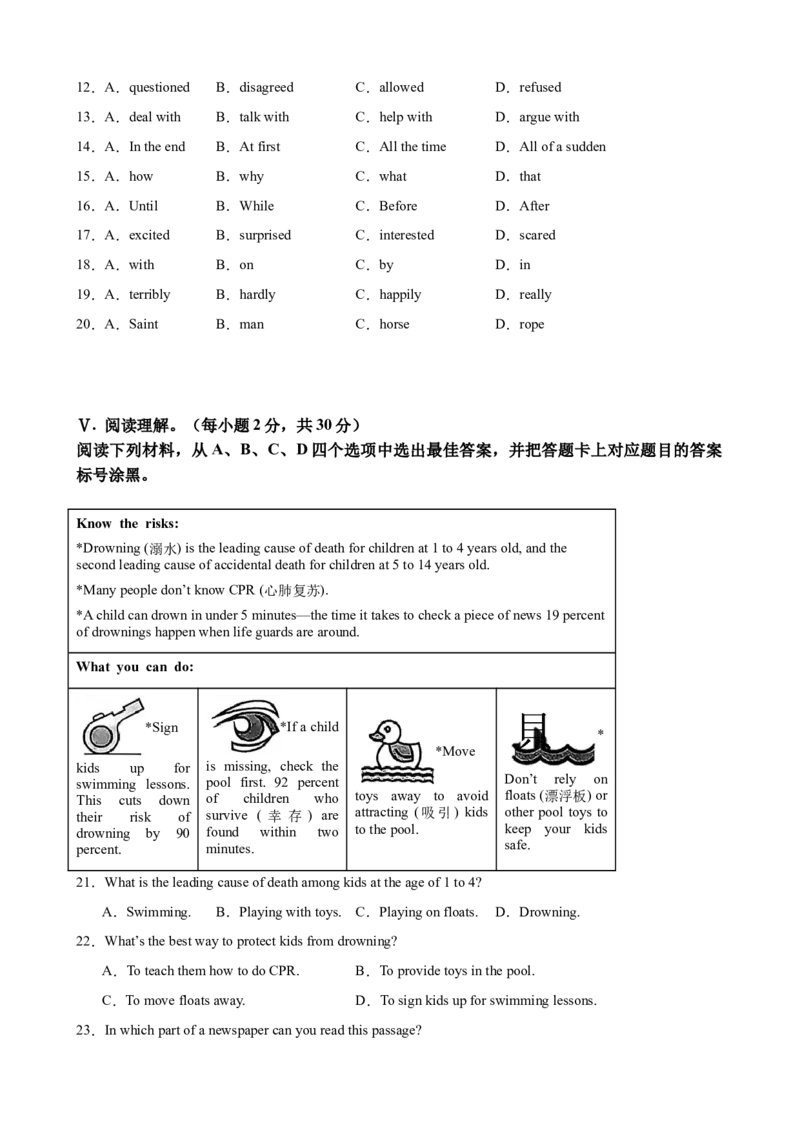
Know the risks:
*Drowning (溺水) is the leading cause of death for children at 1 to 4 years old, and the
second leading cause of accidental death for children at 5 to 14 years old.
*Many people don’t know CPR (心肺复苏).
*A child can drown in under 5 minutes—the time it takes to check a piece of news 19 percent
of drownings happen when life guards are around.
What you can do:
*Sign *If a child
*
*Move
kids up for is missing, check the
swimming lessons. pool first. 92 percent Don’t rely on
This cuts down of children who toys away to avoid floats (漂浮板) or
their risk of survive ( 幸 存 ) are attracting (吸引) kids other pool toys to
drowning by 90 found within two to the pool. keep your kids
percent. minutes. safe.
21.What is the leading cause of death among kids at the age of 1 to 4?
A.Swimming. B.Playing with toys. C.Playing on floats. D.Drowning.
22.What’s the best way to protect kids from drowning?
A.To teach them how to do CPR. B.To provide toys in the pool.
C.To move floats away. D.To sign kids up for swimming lessons.
23.In which part of a newspaper can you read this passage?A.History. B.Culture. C.Health. D.Science.
Sitting on the side of the highway waiting to catch speeding drivers, a police officer saw a car running
along at 22 miles per hour.
He thought to himself, “This driver is just as dangerous as a speeder!” So he turned on his lights and pulled
the driver over.
Getting closer to the car, he noticed that there were five old ladies, two in the front seats and three in the
back, wide eyed and pale faced.
The driver, who knew nothing about what happened, said to him, “Officer, I don’t understand. I was doing
exactly the speed limit (限制)! What seems to be the problem?”
“Ma’am,” the officer replied, “you weren’t speeding, but you should know that driving slower than the
speed limit can also be a danger to other drivers. The same as a speeder.”
“No, sir. I was doing the speed limit—exactly twenty-two miles an hour!” The old woman said in a proud
voice. The officer, almost unable to control his chuckle (低声轻笑), explained to her that “22” was the route (路
线) number, not the speed limit.
Feeling a bit embarrassed, the woman smiled widely and thanked the officer for pointing out her
misunderstanding.
“But before I let you go, ma’am, I have to ask… Is everyone in this car OK? These women seem to be
shaking badly and they haven’t made a single sound this whole time,” the officer asked.
“Oh, it doesn’t matter. They’ll be fine in a minute. We just got off Route 119.” The driver said lightly.
24.What did the officer want to do when he sat on the side of the highway?
A.To take a rest. B.To wait for the old ladies.
C.To catch the old driver. D.To catch speeding drivers.
25.Why were the old ladies in the back shaking badly?
A.Because they were shocked by the speed limit.
B.Because they were excited to meet the officer.
C.Because they were scared to drive at a high speed.
D.Because they were worried about being punished.
26.How did the driver’s feelings change according to the passage?
A.unsure————proud————embarrassed————relaxed
B.unsure————proud————embarrassed————nervous
C.proud————unsure————embarrassed————relaxedD.proud————unsure————embarrassed————nervous
27.What can we learn from the passage?
A.The old ladies drove the car from Route 119 to Route 22.
B.The car ran along the highway at 119 miles per hour just now.
C.The officer thought the old ladies were dangerous and stupid.
D.The driver understood what the number “119” meant in the beginning.
The traditional Chinese sachets (香包) are little bags used by the ancients to hold small objects at the very
beginning. The wearing of sachets has a long and rich history. In the Shang Dynasty, young boys and girls wore
them to show respect (尊敬) to their parents and elders. During the Spring and Autumn Period, people put herbs
(香草) and spices (香料) into sachets to make their living environment cleaner. In the Han Dynasty, people wore
them both to give off nice smell and make themselves look more beautiful.
There are many kinds of pictures on Chinese traditional sachets. Each picture has a different meaning. For
kids, common pictures are tigers, lions and other strong animals. That’s because parents want their children to be
lively and healthy. But for old people, the best wish is to live long. So, pictures like pine trees (松树) or cranes
(鹤) are popular with them. Newly married couples or women often wear sachets with peaches or lotus flowers.
It’s a wish for a happy marriage and good luck for the woman.
In ancient times, sachets were also an important object for women to show their love. If a woman likes a
man, she will make a sachet and give it to him to show her feelings. Ancient women didn’t often talk about their
feelings openly. As their personal object, the sachet became one of the best ways to show love.
In modern life, sachets are also very popular! People often hang them in their cars to make driving more
enjoyable. They also put them in closets to keep their clothes smelling fresh. Sometimes, people put them in the
office to make it more relaxing.
28.In what order does the writer develop his idea in Paragraph 1?
A.Space order. B.Time order. C.Order of importance.D.Problem-solution order.
29.Which sachet will a mom most probably buy for her 5-year-old son according to the passage?
A. B. C. D.
30.According to the passage, what are sachets used to do in modern life?
①To show love to a man. ②To make driving enjoyable.
③To keep clothes smelling fresh. ④To make offices relaxing.
A.①② B.②③ C.①②③ D.②③④31.What is the best title for the passage?
A.Many Uses of Herbs and Spices B.Different Pictures on Chinese Sachets
C.Interesting Facts About Chinese CultureD.The Culture of Chinese Sachets
Recently, a Douyin influencer (网红) named “Xiao Zhang the worker” has got popular because of her
“How-to” videos. In the videos, she teaches the simplest life skills, such as how to see a concert and how to take
the subway. She has quickly won over 2 million followers on Douyin.
In some way, the rising popularity of “How-to” videos shows that young people’s search habits have
changed. More and more people turn to social media (媒体) like Douyin and Bilibili for information.
Li Zhouzi, a 14-year-old from Shanxi, likes to search on Bilibili. She says that by doing this, she gets
information more quickly and easily. For example, when using traditional search engines ( 搜索引擎) for
something about math, she will always lose her way because of too much difficult information. Instead, videos by
creators on Bilibili can offer clearer explanations than those she can find in other ways.
Being able to communicate with real people can also give searchers a strong feeling of trust. Hu Tian is a
13-year-old girl from Sichuan. She likes searching for how to cook on Xiaohongshu. She can see photos and
words by people who also like it. “I trust them more than the information I get on search engines,” she said to
Teens.
Like Hu, many young people search for more relaxing topics on social media. They leave the more serious
topics to traditional search engines. Zhou Yaokai, a Junior 3 student from Chongqing is one of them. He turns to
social media for preparations for trips, while Baidu for government news reports.
32.How does the writer begin the passage?
A.By asking a question. B.By telling a story. C.By comparing two facts. D.By
listing numbers.
33.What can we learn from the experience of Xiao Zhang?
A.Xiao Zhang makes Douyin get more and more popular.
B.People used to know nothing about living skills.
C.People’s searching habits don’t always stay the same.
D.A lot of people are interested in making “How-to” videos.
34.What can you infer (推断) from the passage?
A.Xiao Zhang now has more than 2 millions on Douyin.
B.People never talk about heavier topics on Douyin or Bilibili.
C.Hu Tian thinks people trust real people more than unknown ones online.D.Video-teaching is an easier way to understand difficult explanations online.
35.What’s the best title for this passage?
A.Different Kinds of Searching Engines B.“How-to” Videos
C.A New Way to Search for information D.Douyin Changes Your Life
Ⅴ. 口语运用。(每小题2分,共10分)
阅读下面对话,从7个选项中选择5个恰当的句子完成此对话,并把答题卡上对应题目的答案标号涂黑。
Amy: Hi, Bob. Long time no see. 36
Bob: Hi, Amy. I’ve just returned from my hometown.
Amy: 37
Bob: Wonderful. I couldn’t believe my eyes when I got there.
Amy: Really? What is it like at present?
Bob: It’s so beautiful with clean streets and many tall trees.
Amy: 38
Bob: Sure. Look! Here they are.
Amy: Wow! So great! 39
Bob: I agree. I wish to work and live there when I finish college, too.
Amy: Hope your dream can come true. But could you take me there next time?
Bob: No problem. 40
Amy: That’s great. Thanks a lot.
A.I went there with my parents.
B.Where have you been?
C.I think a lot of people must want to live there.
D.I’ll certainly take you if I go there again.
E.What do you think of your hometown?
F.When did you get there?
G.Did you take any photos there?
第Ⅱ卷(共50分)
Ⅵ. 任务型阅读。(41-42小题,每小题2分,43-44小题,每小题3分,共10分)
阅读下文并回答问题。Do you know the escape room (密室逃脱)? It is becoming more and more popular among students. Here
are some escape room experiences from three players:
Sam, aged 14, Chongqing, China Theme (主题): A Science Experiment
I once tried an escape room that was in a science lab. The room was filled with strange equipment. We were
deeply into the theme. Some of the problems were very hard and needed us to use our knowledge and thinking.
There were also some surprises that made it exciting. With teamwork and careful thinking, we finally succeeded
in finding the way out and we felt so happy.
John, aged 13, London, UK Theme: A Fairy Tale
On a weekend, my friend Lisa invited me to an escape room based on a fairy tale because it was her
birthday. I didn’t like the game, and thought it would be boring. We had to follow the clues (线索) to find the way
out. We had to talk with different people and objects. It tested our imagination and creativity. In the end, we didn’t
succeed for sure. I would never play it again.
May, aged 13, Malaga, Spain Theme: A Treasure Hunt
My family love escape rooms, so we visited one during the summer holidays. There were four teams, and
we needed to find the prince’s ring. It was exciting to work against time. One of the problems was hard, so we
asked the Game Master to put a clue on a TV screen to help us. Luckily, we found the ring in time, so we went to
have dinner together to celebrate our success.
41.Did Sam succeed in finding the way out?
42.Why did Lisa invite John to an escape room?
43.What do the three escape rooms have in common?
44.After reading the experiences, do you want to try the escape room? Why or why not?
Ⅶ. 完成句子。(共10分)
45.When the rainstorm came, Ben was helping his mother cook dinner, too. (改为否定句)
When the rainstorm came, Ben helping his mother cook dinner,
46.Why don’t you spend more time on your health?(改为同义句)
spend more time on your health?47.I have had my pet dog for two years.(对划线部分提问)
have you had your pet dog?
48.上周我把我的旧自行车捐赠给了孤儿院。(完成译句)
Ι my bike to the children’s home last week.
49.我们应该永不放弃实现我们的梦想。(完成译句)
We should never give up our .
Ⅷ. 读写综合。(50、51小题,每空2分;52、53小题,每空3分,共10分)
阅读短文,然后在文后思维导图内完成内容摘要,每空一词。
When winter arrives, our hands can get cold easily. Thick gloves are a good option, but they can be
inconvenient. However, ancient Chinese people had a great tool for warming their hands—hand warmers (暖手
炉).
There is a story about how hand warmers were invented. In winter, Emperor Yang of the Sui Dynasty
visited Jiangsu. As it was very cold, a local official asked craftsmen (工匠) to make a small warmer that the
emperor could hold in his hands. And so, the hand warmer was created.
By the Song Dynasty, hand warmers became popular among the common people. The skills for making
them were widely used during the Ming and Qing Dynasties. Many poets at that time wrote about people using
hand warmers.
In the early days, copper (铜) was commonly used to make hand warmers. It was better than silver and iron.
Copper transferred heat well and was less likely to break or get corroded (腐蚀). Inside the hand warmers, there
were coals. Some coals were mixed with flowers, and they gave out a nice smell when burning.
Ancient hand warmers had different designs. Round, square, and octagonal (八角形) shapes were common.
There were also some special shapes like pumpkins, flowers, and turtle shells. The patterns on the warmers were
often animals or symbols with good meanings, such as deer, flowers, or the Chinese characters for long life.50.
51.
52.
53.
54.
Ⅸ. 书面表达。(20分)
55.假期是一个适合旅行的好时候,你曾经去过哪些有趣且让人印象深刻的地方?某英语网站以
“难忘的旅行”为主题发起分享活动,请讲述你过去的旅行中最难忘的经历。
要求:
1. 80—120词;
2. 文中不能出现自己的姓名和所在学校的名称。
参考信息:The vacations are a good time for us to travel to some interesting places.
___________________________________________________________________________________________
___________________________________________________________________________________________
___________________________________________________________________________________________
___________________________________________________________________________________________
___________________________________________________________________________________________
______________________________________________________________________________________________________________________________________________________________________________________
___________________________________________________________________________________________
________