文档文本内容
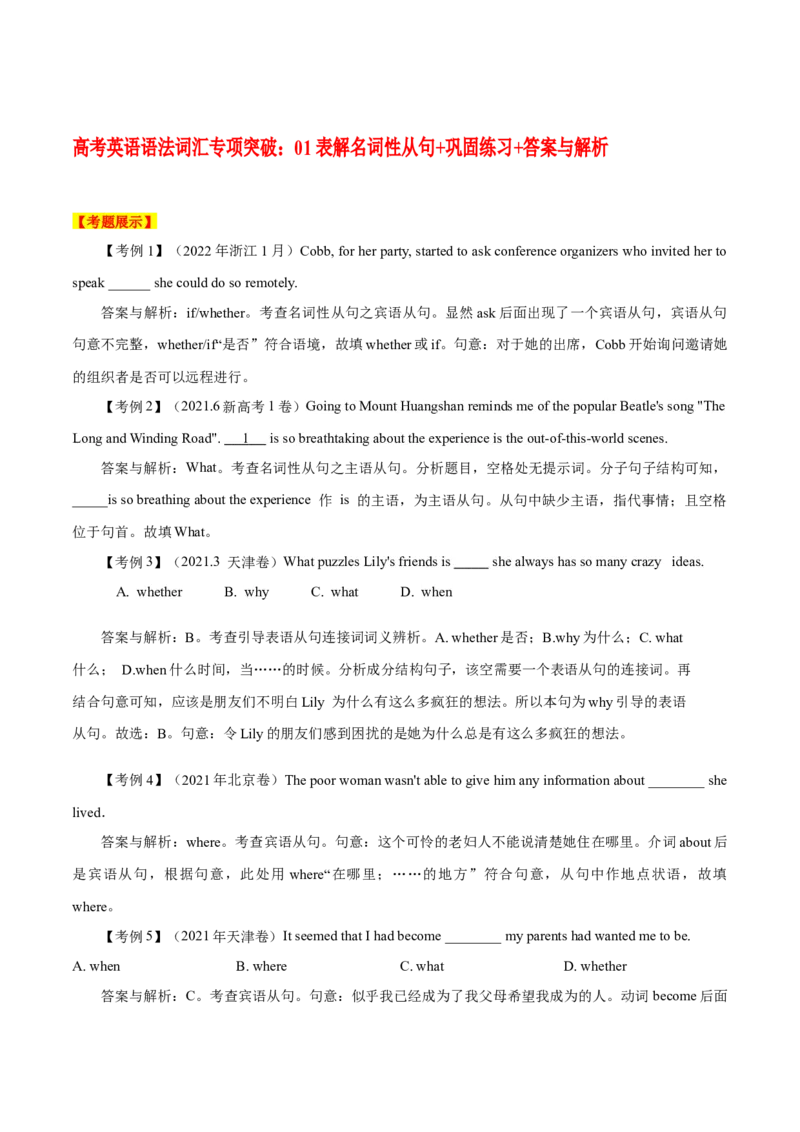
高考英语语法词汇专项突破:01 表解名词性从句+巩固练习+答案与解析
【考题展示】
【考例1】(2022年浙江1月)Cobb, for her party, started to ask conference organizers who invited her to
speak ______ she could do so remotely.
答案与解析:if/whether。考查名词性从句之宾语从句。显然ask后面出现了一个宾语从句,宾语从句
句意不完整,whether/if“是否”符合语境,故填whether或if。句意:对于她的出席,Cobb开始询问邀请她
的组织者是否可以远程进行。
【考例2】(2021.6新高考1卷)Going to Mount Huangshan reminds me of the popular Beatle's song "The
Long and Winding Road". 1 is so breathtaking about the experience is the out-of-this-world scenes.
答案与解析:What。考查名词性从句之主语从句。分析题目,空格处无提示词。分子句子结构可知,
_____is so breathing about the experience 作 is 的主语,为主语从句。从句中缺少主语,指代事情;且空格
位于句首。故填What。
【考例3】(2021.3 天津卷)What puzzles Lily's friends is she always has so many crazy ideas.
A. whether B. why C. what D. when
答案与解析:B。考查引导表语从句连接词词义辨析。A. whether是否;B.why为什么;C. what
什么; D.when什么时间,当……的时候。分析成分结构句子,该空需要一个表语从句的连接词。再
结合句意可知,应该是朋友们不明白Lily 为什么有这么多疯狂的想法。所以本句为why引导的表语
从句。故选:B。句意:令Lily的朋友们感到困扰的是她为什么总是有这么多疯狂的想法。
【考例4】(2021年北京卷)The poor woman wasn't able to give him any information about ________ she
lived.
答案与解析:where。考查宾语从句。句意:这个可怜的老妇人不能说清楚她住在哪里。介词about后
是宾语从句,根据句意,此处用 where“在哪里;……的地方”符合句意,从句中作地点状语,故填
where。
【考例5】(2021年天津卷)It seemed that I had become ________ my parents had wanted me to be.
A. when B. where C. what D. whether
答案与解析:C。考查宾语从句。句意:似乎我已经成为了我父母希望我成为的人。动词become后面是宾语从句,从句缺少引导词,且从句中的be缺少表语,所填词应该起双重作用。故选C。
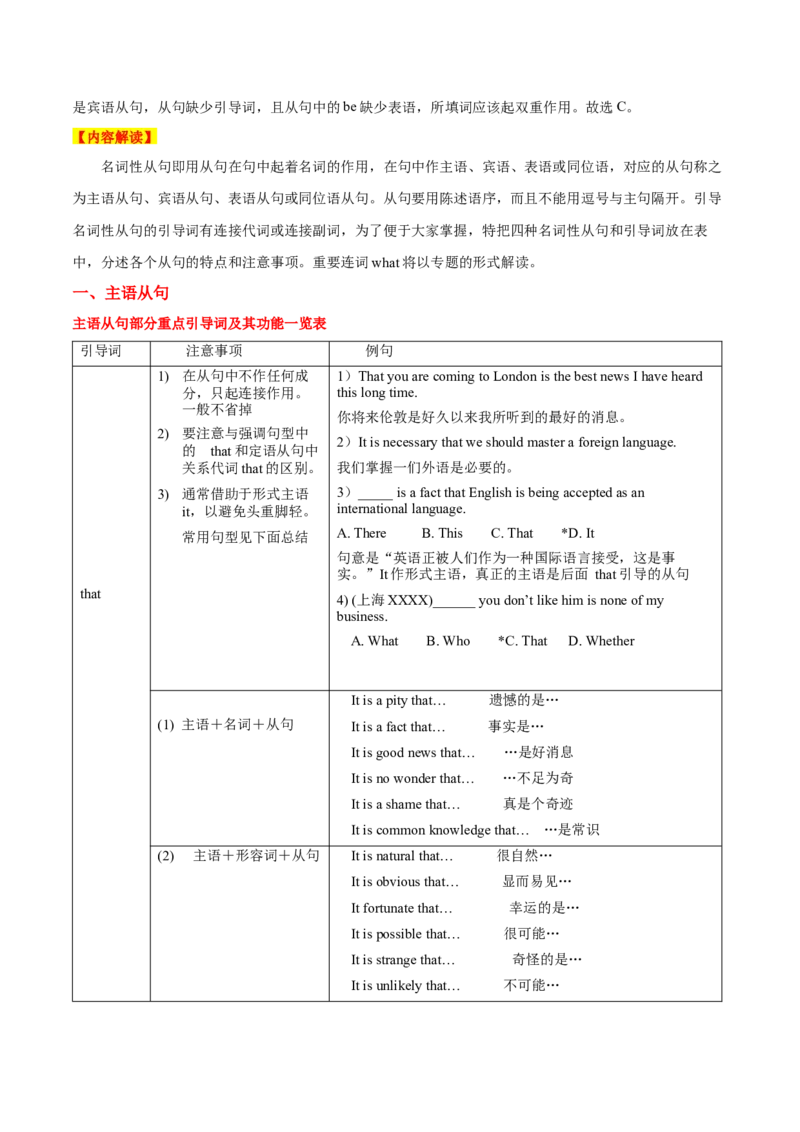
【内容解读】
名词性从句即用从句在句中起着名词的作用,在句中作主语、宾语、表语或同位语,对应的从句称之
为主语从句、宾语从句、表语从句或同位语从句。从句要用陈述语序,而且不能用逗号与主句隔开。引导
名词性从句的引导词有连接代词或连接副词,为了便于大家掌握,特把四种名词性从句和引导词放在表
中,分述各个从句的特点和注意事项。重要连词what将以专题的形式解读。
一、主语从句
主语从句部分重点引导词及其功能一览表
引导词 注意事项 例句
1) 在从句中不作任何成 1)That you are coming to London is the best news I have heard
分,只起连接作用。 this long time.
一般不省掉
你将来伦敦是好久以来我所听到的最好的消息。
2) 要注意与强调句型中
2)It is necessary that we should master a foreign language.
的 that和定语从句中
关系代词that的区别。 我们掌握一们外语是必要的。
3) 通常借助于形式主语 3)_____ is a fact that English is being accepted as an
it,以避免头重脚轻。 international language.
常用句型见下面总结 A. There B. This C. That *D. It
句意是“英语正被人们作为一种国际语言接受,这是事
实。”It作形式主语,真正的主语是后面 that引导的从句
that
4) (上海XXXX)______ you don’t like him is none of my
business.
A. What B. Who *C. That D. Whether
It is a pity that… 遗憾的是…
(1) 主语+名词+从句 It is a fact that… 事实是…
It is good news that… …是好消息
It is no wonder that… …不足为奇
It is a shame that… 真是个奇迹
It is common knowledge that… …是常识
(2) 主语+形容词+从句 It is natural that… 很自然…
It is obvious that… 显而易见…
It fortunate that… 幸运的是…
It is possible that… 很可能…
It is strange that… 奇怪的是…
It is unlikely that… 不可能…(3) 主语+不及物动词+ It seems that… 似乎…
从句
It turned out that 结果…
It appears that… 看来…
It happened that… 碰巧…
(4) 主语+被动语态+从 It is not known that… …不得而知
句
It is not decided that… …尚未决定
It is said that… 据说…
It is reported that… 据报道
It must be pointed that… 必须指出…
It is to be discussed that… …有待讨论
It has been proved that… 已经证明…
It is believed that… 据认为
It is announced that… 据宣布
It can thus be concluded that…可以由此得出结论
(5) 其它 It doesn’t matter… …是无关紧要的
It makes no difference… 毫无区别
It doesn’t need to be bothered that…不必担忧…
It suddenly occurred to me that… 我突然想到…
what 见下面what用法专题
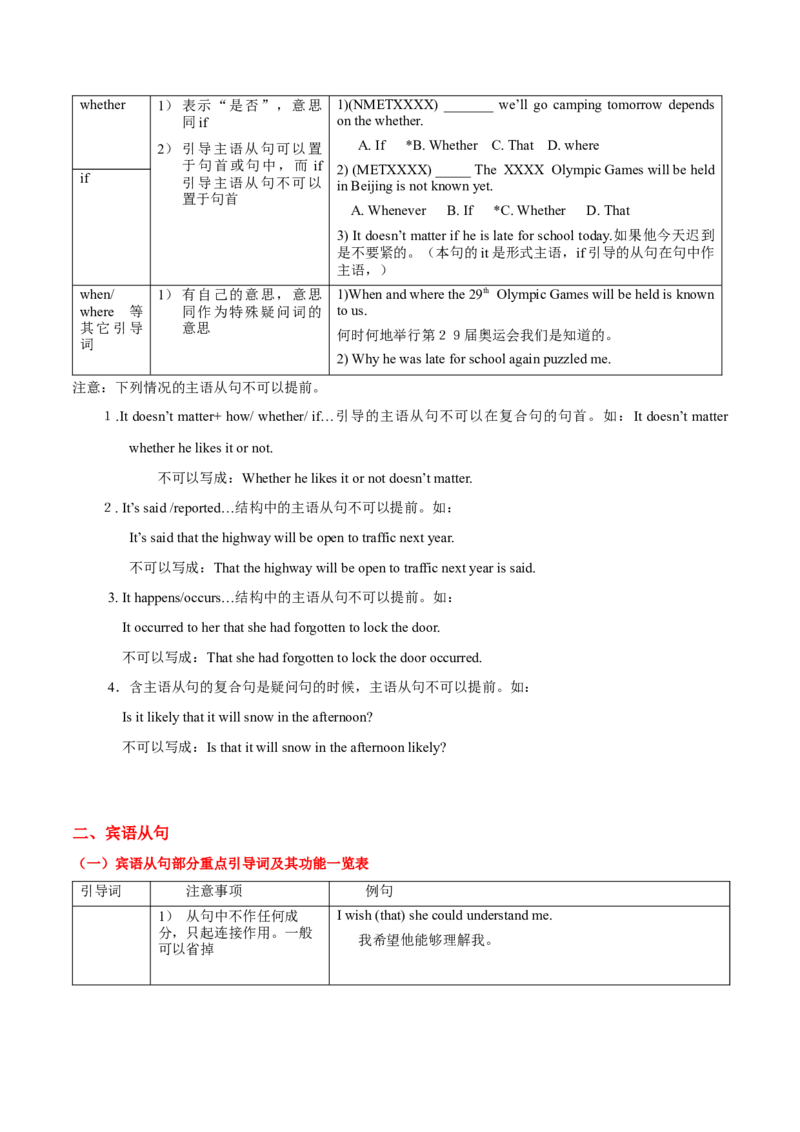
who 1)意思是“谁” Who has broken the window is not found yet.
2)在从句中作主语,也可 是谁打破玻璃这件事情还没有查清楚。
以代替whom作宾语
wh-+ever, 1) 意思是“无论/不管是 1).(上海XXXX)_______ has helped to save the drowning girl is
如 谁/什么…” worth praising.
whoever
2) 在从句中作主语、宾 A. Who B. The one C. Anyone *D. Whoever
whatever 语等
凡是帮助救助这位落水姑娘的人都应该得到表扬。
whoever Whoever=Anyone who; the person who
等
2)(NMETXXXX) It is generally considered unwise to give a child
_____he or she wants.
A. however *B. whatever C. whichever D. whenever
句意是“通常认为孩子要什么就给什么是不明智的”,
whatever引导宾语从句,并在从句中作宾语。
which 1)意思是“哪一个” (NMET 春招 XXXX)I read it in some book or other, does it
matter _____ it was?
2)在从句中作主语、宾
语或表语等 A. where B. what C. how *D. whichwhether 1)表示“是否”,意思 1)(NMETXXXX) _______ we’ll go camping tomorrow depends
同if on the whether.
2)引导主语从句可以置 A. If *B. Whether C. That D. where
于句首或句中,而 if 2) (METXXXX) _____ The XXXX Olympic Games will be held
if
引导主语从句不可以 in Beijing is not known yet.
置于句首
A. Whenever B. If *C. Whether D. That
3) It doesn’t matter if he is late for school today.如果他今天迟到
是不要紧的。(本句的it是形式主语,if引导的从句在句中作
主语,)
when/ 1)有自己的意思,意思 1)When and where the 29th Olympic Games will be held is known
where 等 同作为特殊疑问词的 to us.
其它引导 意思
何时何地举行第29届奥运会我们是知道的。
词
2) Why he was late for school again puzzled me.
注意:下列情况的主语从句不可以提前。
1.It doesn’t matter+ how/ whether/ if…引导的主语从句不可以在复合句的句首。如:It doesn’t matter
whether he likes it or not.
不可以写成:Whether he likes it or not doesn’t matter.
2. It’s said /reported…结构中的主语从句不可以提前。如:
It’s said that the highway will be open to traffic next year.
不可以写成:That the highway will be open to traffic next year is said.
3. It happens/occurs…结构中的主语从句不可以提前。如:
It occurred to her that she had forgotten to lock the door.
不可以写成:That she had forgotten to lock the door occurred.
4.含主语从句的复合句是疑问句的时候,主语从句不可以提前。如:
Is it likely that it will snow in the afternoon?
不可以写成:Is that it will snow in the afternoon likely?
二、宾语从句
(一)宾语从句部分重点引导词及其功能一览表
引导词 注意事项 例句
1) 从句中不作任何成 I wish (that) she could understand me.
分,只起连接作用。一般
我希望他能够理解我。
可以省掉2)常借助于形式宾语 I find it essential/necessary that you should give him some advice
it,以避免头重脚轻。 on how to learn English well.
我认为你给他提一些如何学好英语的建议是必要的。
(上海春招XXXX) The suit fitted him well ____ the color was a
little brighter.
that 3)不可以作介词的宾
语,但是 except/ besides/ A. except for *B. except that
but等表示“除……之外” B. C. except when D. besides
的介词可以
本题实际上考查的是一组“除..之外”的近意介词的区
别,except that可以看作是一个整体,但是要是再细分,就可
以理解是介词except跟that引导的宾语从句。
4)doubt用于否定句时跟 I don’t doubt that he will be punished for robbery.我不怀疑他会因
that从句 为抢劫而受到处罚。
5)insist/suggest I required that all the students in my class should hand in their
/order/remember/ homework ahead of time.
request/require 等后的宾语
我要求班里的所有同学都要提前把家庭作业交上来。
从句的谓语动词要用虚拟
语气 should+ do(动词原 (句中的谓语动词require后的宾语从句的谓语动词should hand
形) 是虚拟语气形式)
6)动词后常跟 that 引导宾
1) He never admits that he is wrong.
语从句的及物动词有:
admit/ agree/ believe 他从不承认自己错了。
/decide/declare/ expect/
2) I declared at the meeting that I did not support him. 我在会上声
explain/ feel/ hear/ hope/
明我不支持他。
imagine/ notice/reply/
answer /say/ 3) She declared that she didn't want to see him again. 她宣称她再
也不愿见到他
4) He imagines that people don't believe him.
他总是认为人们不信任他
what 见what专题
whether 表示“是否”,whether可 1) I don’t know if/ whether he will come here or not.(不是与or
以作动词宾语或介词宾 not直接连用,if/ whether都可以)
if
语,可以与 or not 连用;
2) I know nothing about whether the novel has been published.(介
而if引导的宾语从句不可
词宾语不用if)
以作介词宾语,而且不可
以与 or not 直接连用,动 3) We discussed whether we should accept his offer.(一般不用if)
词 多 是 doubt/ discuss/
4) I don’t know whether or not he will come here.(与or not直接
know/ question/ wonder/ be
连用,if不可以)
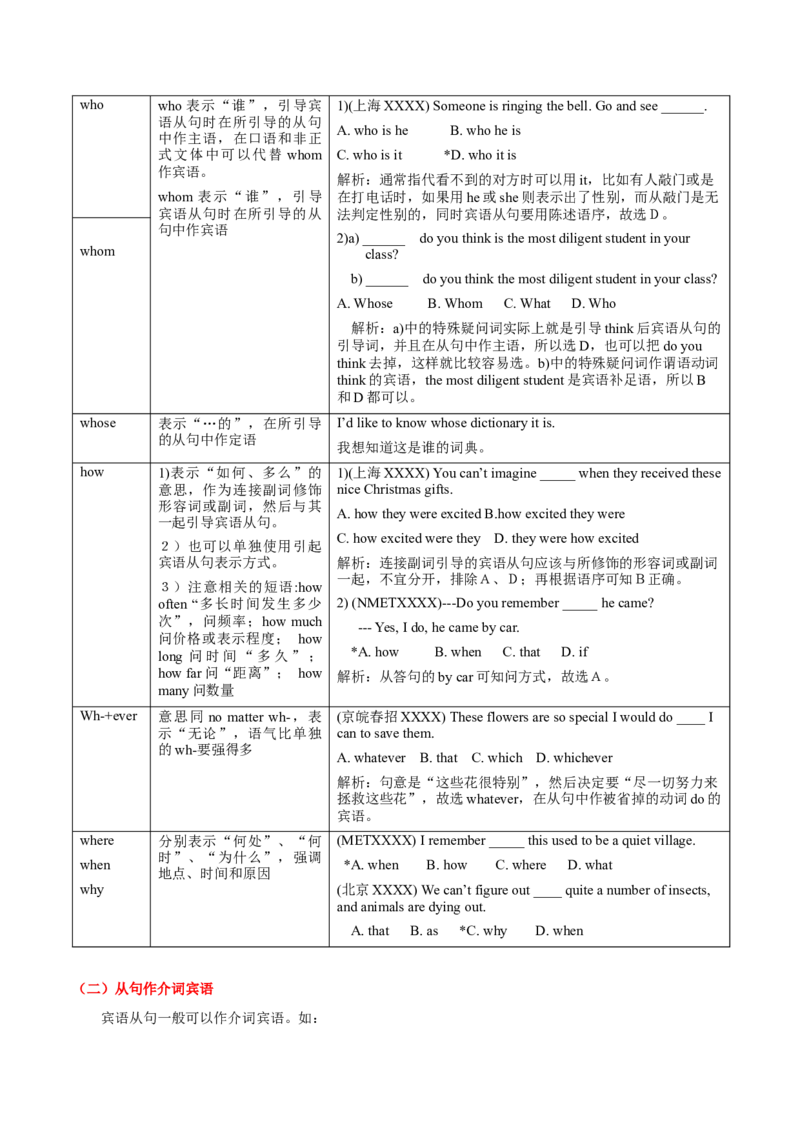
not sure等who who表示“谁”,引导宾 1)(上海XXXX) Someone is ringing the bell. Go and see ______.
语从句时在所引导的从句
A. who is he B. who he is
中作主语,在口语和非正
式文体中可以代替 whom C. who is it *D. who it is
作宾语。
解析:通常指代看不到的对方时可以用it,比如有人敲门或是
whom 表示“谁”,引导 在打电话时,如果用he或she则表示出了性别,而从敲门是无
宾语从句时在所引导的从 法判定性别的,同时宾语从句要用陈述语序,故选D。
句中作宾语
2)a) ______ do you think is the most diligent student in your
whom class?
b) ______ do you think the most diligent student in your class?
A. Whose B. Whom C. What D. Who
解析:a)中的特殊疑问词实际上就是引导think后宾语从句的
引导词,并且在从句中作主语,所以选D,也可以把do you
think去掉,这样就比较容易选。b)中的特殊疑问词作谓语动词
think的宾语,the most diligent student是宾语补足语,所以B
和D都可以。
whose 表示“…的”,在所引导 I’d like to know whose dictionary it is.
的从句中作定语
我想知道这是谁的词典。
how 1)表示“如何、多么”的 1)(上海XXXX) You can’t imagine _____ when they received these
意思,作为连接副词修饰 nice Christmas gifts.
形容词或副词,然后与其
A. how they were excited B.how excited they were
一起引导宾语从句。
C. how excited were they D. they were how excited
2)也可以单独使用引起
宾语从句表示方式。 解析:连接副词引导的宾语从句应该与所修饰的形容词或副词
一起,不宜分开,排除A、D;再根据语序可知B正确。
3)注意相关的短语:how
often “多长时间发生多少 2) (NMETXXXX)---Do you remember _____ he came?
次”,问频率;how much
--- Yes, I do, he came by car.
问价格或表示程度; how
long 问时间“多久”; *A. how B. when C. that D. if
how far问“距离”; how 解析:从答句的by car可知问方式,故选A。
many问数量
Wh-+ever 意思同 no matter wh-,表 (京皖春招XXXX) These flowers are so special I would do ____ I
示“无论”,语气比单独 can to save them.
的wh-要强得多
A. whatever B. that C. which D. whichever
解析:句意是“这些花很特别”,然后决定要“尽一切努力来
拯救这些花”,故选whatever,在从句中作被省掉的动词do的
宾语。
where 分别表示“何处”、“何 (METXXXX) I remember _____ this used to be a quiet village.
时”、“为什么”,强调
when *A. when B. how C. where D. what
地点、时间和原因
why (北京XXXX) We can’t figure out ____ quite a number of insects,
and animals are dying out.
A. that B. as *C. why D. when
(二)从句作介词宾语
宾语从句一般可以作介词宾语。如:1)Whether we can succeed depends on how well we cooperate.
我们能否成功取决于我们合作的情况。
2)He was not conscious of what an important role he had played in the match.
他没有意识到他在比赛当中起着多么重要的作用。
3)I was curious as to what we would do next.我很想知道下一步我们该做什么。
4) (上海XXXX)It is a matter of _____ would take the position.
*A. who B. whoever C. whom D. whomever
但是在使用时要注意,通常if和that从句不可以作介词宾语,部分虽然可以用that,应该看作是固定
搭配,如in that的意思是“因为、在于”;but that “要不是”;except that“除了”等。如:
1) The higher income tax is harmful in that it may discourage people from trying to earn more.
所得税过高是有害的,以为它可能使人不愿意多赚钱。(in that=because)
2) I would have come to see you but that I had something important to do then.
要不是当时有要事要办,我本来会来看你的。
3)He differed from his colleagues in that he spent all his spare time learning English.
他与同事们的不同之处在于他把业余时间都花在学习英语上。
(三)形容词宾语
一些语法家把像glad, delighted, sorry等形容词后面跟的从句说成是状语从句,但是我们从形容词后从
句的意义和与宾语从句进行比较可以看出,把它理解成宾语从句更容易接受,它具有宾语从句的特点,本
书把其编入宾语从句中。如:
1) I’m afraid (that) there are some misprints.我担心有一些印刷错误。
2) We are not sure whether(if) we can persuade him out of smoking.
我们不敢肯定能否说服他戒烟。
3) (METXXXX) Can you make sure _____ the gold ring?
A. where Alice had put B. where had Alice put
*C. where Alice has put D. where has Alice put
4) (METXXXX) No one can be sure _____ in a million years.
*A. what man will look like B. what will man look like
C. what look will man like D. man will look like what
可以用于本结构的形容词有 anxious/ certain/ surprised/ proud/ worried/ thankful/ determined/ pleased/
satisfied/ contend/ ashamed/ confident等。(四)不可以直接跟宾语从句的及物动词。
有些及物动词后面不可以直接跟从句作宾语,而是通过the fact或it作为媒介,然后再跟宾语从句,常
见的有:refuse/ like/ admire/ celebrate/ dislike/ love/ hate/ want/take(认为)/overlook(忽视)等。如:
1. (NMETXXXX) I hate _____ when people talk with their mouth full.
*A. it B. that C. these D. them
思路点拨:it代指when从句所表达的内容,其本身无实义。
2. I take it that you should rewrite your paper. 我认为你的论文应该重写。
3. She overlooked the fact that he had made another mistake.
她忽视了他又犯了一个错误的事实。(本句可以看作fact后跟同位语从句)
(五)宾语从句中的否定转移问题
当谓语动词是think/ believe/ suppose/ imagine/ guess/ expect/ consider等表示“认为、相信、猜测”意义
的词,并且主语是第一人称,时态是一般现在时。如:
1)I don’t think he can do it better than his little sister.
我想他不会比他小妹妹做得好。
2)I don’t believe he treated the child like that.
我相信他不会那样对待那个孩子的。
3)I don’t suppose she likes the book. 我认为她不喜欢这本书。
三、表语从句
表语从句部分重点引导词及其功能一览表
引导词 注意事项 例句
that 1) 在从句中不作成分 The reason why he didn’t tell you the truth was ______ he was not
allowed to.
2) that一般不省掉
3) 句 型 the reason is
A. because B. which C. why *D. that 题中的reason作主
that…
语时,表语从句不可以用because或why,以避免语意重复。
whether 引导表语从句时不可以换 (上海春招XXXX) What the doctors really doubt is __________
成if,即if不引导表语从 my mother will recover from the serious disease soon. A.
句 when B.how *C.whether D.why 表语从句实际上就是主
语从句中谓语动词 doubt的动作对象,故选C。as if 意思是“似乎、好像”, (NMETXXXX) When a pencil is partly in a glass of water, it looks
引导的表语从句如果与事 as if it ____.
as though
实相反,或表示实现的可
A. breaks B. has broken
能性较小时,从句谓语动
词用虚拟语气 *C. were broken D. had been broken
why why从句内容表示结果; (NMETXXXX) --- I drove to Zhuhai for the air show last week.
because从句内容表示原因 --- Is that _____ you had a few days off. *A. why B. when
because
C. what D. where
what 参见what专题
引导表语从句表示“在某 (NMETXXXX.I) You are saying that everyone should
地方”,也可以指“在某
be equal, and this is ____ I disagree.
方面”或是“在某种情况
where 或状况下”等,要考虑具 A. why *B. where C. what D. how
体的上下文确定其具体含
(METXXXX) Go and get your coat. It’s ____you left it.
义。
A. there *B. where C. there were D. where there
which The problem is which will be chosen as No 1.
how等 问题是哪一个做第一。
四、同位语从句
同位语从句部分重点引导词及其功能一览表
项目 注意事项 例句
that 引 1)在从句中不作任何成分 (上海春招 XXXX) Along with the letter was his promise
导的同 _____ he would visit me this coming Christmas. A. which
2)从句表示前面名词的具体内容
位语从 *B. that C. what D. whether 解析:横线后面的句
句最常 3)可跟同位语从句的名词有: 子比较完整,句中不缺成分,并且句子的表示promise的
见 belief/ fact/ hope/ idea/ doubt/ 具体内容,因此判定是同位语从句,故选B。
news/ conclusion/ possibility/
explanation/ information/thought/
feeling/opinion/problem/ (上海春招 XXXX)_____ is no possibility ______ Bob can
evidence/ rule/ decision/ truth等 win the first prize in the match. A.There … that B.It
… that C.There … whether D.It … whether 解析:根据
句意是there be句型,从句表示possibility的具体内容,
故选A。同位语 order/advice/ request/ suggestion/ Her suggestion that the school match should be put off till
从句中 proposal等表示建议、命令、要求 next month hasn’t been accepted.她提出的学校运动会推迟
的虚拟 的名词后的同位语从句要用虚拟语 到下个月召开的建议还没有被采纳。
语气 气。
和定语 注意与定语从句的区别:就是第 The proposal that he put forward is to be discussed at the
从句的 1)、2)条为同位语从句的特点, meeting.他提出的建议将在会上讨论。(that在句中作宾
区别 定语从句的that在从句中作成分, 语,是定语从句) 比较:The proposal that we should
作主语、宾语或表语,而且指物时 import equipment from abroad is to be discussed at the
可以用 which替换,作宾语可以省 meeting. 我们应当从国外进口更多的设备这个建议将在
掉,相反同位语从句中的that不作 会上讨论。
成分,而且一般不省掉。
当名词 肯定句用whether引导,否定句用 I have no doubt that he will attend the meeting on time 我一
是 that引导 点都不怀疑他会准时到会。
doubt
同位语 同位语从句有时候并不是紧跟在它 (NMETXXXX) A story goes _____ Elizabeth I of English
从句被 说明的名词的后面,而是被别的成 liked nothing more than being surrounded by clever and
隔离的 分隔开,这一点与隔离定语从句的 qualified noblemen at court. A. when B. where C. what
情况 情况基本相似,原因是同位语从句 *D. that 解析:横线后句子表示story的具体内容, 谓
显得过长,目的是为了保持句子的 语动词goes太短,而同位语从句过长,所以同位语从句
平衡。在解题中的关键是要把握住 后置。
同位的名词,找出同位的名词与从
(上海XXXX) Information has been put forward _____ more
句之间的同位关系特别重要。通常
middle school graduates will be admitted into universities.
可以隔开同位语从句的成分有后置
定语、谓语动词、状语等。
A. while *B. that C. when D. as
解析:that引导的同位语从句被谓语动词隔开,同位名
词是Information。
连接副 1)在have (no) idea of的句型中介 1)Nobody can explain the mystery why he suddenly
词 词 of 跟宾语从句时常把 of 省 disappeared.没有人能解开他突然消失这个迷。
where 掉,此时可以把原来的宾语从
2)(METXXXX) They have no idea at all _________.
when 句看作是同位语从句。
*A. where he has gone B. where did he go C.
how 等
2)同位语从句的名词不同于定语 which place has he gone D. where was he gone
从句中的先行词,不能用定语
从句中的先行词理解同位名
词。
牛刀小试
1.(上海XXXX.27) ______ she couldn’t understand was _____ fewer and fewer students showed interest in her
lessons.A. What; why B. That; what C. What; because D. Why; that
2. (上海XXXX.5) It was _____ he said______ disappointed me.
A. what…that B. that…that
C. what…what D. that…what
3. (安徽春招XXXX.24) People have heard what the President has said; they are waiting to see _____ he will do.
A. how B. what C. when D. that
4. (NMETXXXX.31) A computer can only do ____ you have instructed it to do.
A. how B. after C. what D. when
5. (上海春招XXXX.32) ______ has been announced, we shall have our final exams next month.
A. That B. As C. It D. What
6. (NMETXXXX.13) --- I drove to Zhuhai for the air show last week.
--- Is that _____ you had a few days off?
A. why B. when C. what D. where
7. (上海春招XXXX.38) When you answer question in a job interview, please remember the golden rule: Always
give the monkey exactly ______ he wants.
A. what B. which C. when D. that
8. (北京春招XXXX.28) --- I think it’s going to be a big problem.
--- Yes, it could be.
--- I wonder _____ we can do about it.
A. if B. how C. what D. that
9. (上海春招XXXX.36) A fast food restaurant is the place ____ , just as the name suggests, eating is performed
quickly.
A. which B. where C. there D. what
10. (NMETXXXX.22) ______ we can’t get seems better than _____ we have.
A. What; what B. What; that C. That; that D. That; what
11. --- I went to see you at about eight o’clock yesterday but you were not at home.
--- Oh, that was probably _____ I was watching TV in my neighbour’s.
A. why B. what C. when D. that
12. _____ is troubling me is______ I don’t know ______ is to be done with the portable computer.
A. What; that; what B. What; that; how
C. What; because; which D. That; what; that;13. It makes no difference ___ the meeting will be held this month or next month.
A. if B. whether C. either D. that
14. The fact _____ Chen Yanqing won the gold in the women’s 58 kg class at the 28th Athens Olympic Games made
her comeback after two years of retirement a successful one.
A. which B. that C. why D. in which
15. _____ Lily will get better soon is _____ her father is worrying about now.
A. What; that B. If; that C. Whether; what D. What; what
16. A decision was made _____ those who once lied to the factory in order to get a job would not be allowed to
stay.
A. once B. that C. whether D. when
17. ______ in the world is a question scientists have yet to answer.
A. How many kinds of living things there are
B. There are how many kinds of living things
C. That there are how many kinds of living thing
D. How many kinds of living things are there
18. _____ she was invited to the party made my parents very happy.
A. When B. Because C. What D. That
19. His suggestion ____ to the cinema excited us all.
A. that we go B. that we would go
C. when we should go D. which we had gone
20. The reason why he was late for school was ____ his father fell ill unexpectedly.
A. why B. because C. what D. that
21. The reason why he was late for school was ____ his father fell ill unexpectedly.
A. why B. because C. what D. that
22. (上海春招XXXX) When you answer questions in a job interview, please remember the golden rule: Always
give the monkey exactly _____ he wants.
A. what B. which C. when D. that
23. _____ do you think is to blamed for breaking the window?
A. Whom B. Who C. That D. Which
24. (METXXXX)_______ leaves the room last ought to turn off the light.
A. Anyone B. The person C. Whoever D. Who25. (上海XXXX)He asked ______ for the violin.
A. did I pay how much B. I paid how much
C. how much did I pay D. how much I paid
参考答案与解题思路点拨:
KEY:1-5 AABCB 6-10 AACBA 11-15 CABBC 16-20 BADAD 21-25 CABCD
11. 点拨:被选项中的四个连词都可以引导表语从句,根据第一句的“昨天八点”可知指时间,故选C。
12. 点拨:第一空主语从句缺主语,用what,第二空的表语从句的引导词在从句中不作成分,用 that;第三
空宾语从句引导词在从句中作主语,实际上是句型“what…do with”,故选A。
13. 点拨:it是形式主语,从后面主语从句中“or”可知表示“是否”之意,所以与whether连用,whether…
or的意思是“不管……还是……”,故选B。
14. 点拨:that引导同位语从句,其本身在从句中不作成分,故选B。
15. 点拨:主语从句是主系表结构,根据句意可知表“是否”的意思,而if一般不引导主语从句,表语从
句的介词about缺少宾语,而that又不可以作成分,故选C。
16. 点拨:横线后的句子说明decision的具体内容,而句中也不缺少必要的成分,因此可以断定是同位语
从句,该同位语从句与名词decision之间被谓语动词部分隔开了,故选B。
17. 点拨:主语从句要用陈述语序,本题是 there be句型,而引导词当然要置于所引导的从句之前,故选
A。
18. 点拨:主语从句中缺少连词,不缺成分,故选D。
19. 点拨:名词suggestion后从句说明其具体内容,是同位语从句,根据suggest可知从句要用虚拟语气,
即“should+动词原形”,而且should可以省掉,故选A。
20. 点拨:本题包含一个很有用的句型:the reason is that…,其中的that不可以用why或because,以避免
语意重复,故选D。