高考英语语法词汇专项突破:02 省略在并列句、复合句、特定句型及其不定式结构中的十二条应用与考查
【考点导航】
【考例1】(2023▪全国乙卷)As a photographer, I have spent the last two years (record) everything
I discovered.
答案与解析:recording。考查非谓语动词和介词省略。根据句子的 I have spent the last two years看出
是“sb. spend time”,括号内给的是动词,结合句意看出是sb. spend time (in) doing sth结构。spend time (in)
doing sth.花费时间做某事,其中的介词in可以省掉,介词后面的动词应该用其动名词作宾语。故填
recording。句意:作为一名摄影师,我花了两年时间记录我发现的一切。
【考例2】(2021全国甲卷) After (spend) some time looking at all the defensive equipment at the
wall, we decided it was time for some action and what better than to ride on a piece of history!
答案与解析:spending。考查非谓语动词和状语从句的省略结构。连词after引导时间状语从句,从句
的逻辑主语就是句子的主语we,即从句的spend的动作就是we发出的,因此时间状语从句可以用“连词
+分词”的省略形式。本句的连词是after,其本身也是可以作介词,该结构的省略结构把其看作介词,因
此跟动名词作宾语。故填spending。句意:在花了一些时间查看了城墙上所有的防御设备之后,我们决定
是时候采取一些行动了,还有什么比骑在历史上更好的呢。
【考例3】(2020浙江6月卷)Some time after 10,000 BC,people made the first real attempt to control
the world they lived ,through agriculture.
答案与解析:in。考查介词和定语从句的关系代词省略。分析可知,“they lived _____”应是之前名词
the world 的定语从句,引导定语从句的关系代词作宾语被省略,可推知先行词应是在从句中作宾语,即:
they lived in the world. live in+名词,意为“居住在某地”。故填in。句意:公元前10000年以后,人们第
一次真正尝试通过农业来控制他们所居住的世界。
【考例4】(2018·新课标II卷)China's approach to protecting its environment while _________ (feed) its
citizens "offers useful lessons for agriculture and food policymakers worldwide." says the bank's Juergen Voegele.
答案与解析:feeding。考查省略句。空格处表示正在进行的动作,while后面省略掉了China is,省略
句的原则:在时间状语从句、条件状语从句、让步状语从句中,如果从句的主语和主句的主语一致且含有
be动词时,那么可以把主语和be动词一块省略。故填feeding。句意:中国在养活了中国人民的同时又保
护了环境。这一做法为全世界的农业和粮食政策制定人提供了很有用的经验。【基本概念】
省略句是英语的一种习惯用法。一个分句或句子通常包含多种成分,主语和谓语是最基本的。如果谓
语为及物动词,则宾语也是必须的。这种句子叫做完全句。另外有一些句子却缺少一种或几种成分,也就
是说在结构上是不完整的,可是它们仍然能够为听话者所理解, 也就是说,说话者和听话者对句子缺少
的成分有共同的认识,或者说出于修辞上的需要没有在句中出现。这些句子符合句子的定义,“能表达一
个比较完整的独立的概念。”这种句子就叫做省略句(ellipsis or leaving words out)。
省略形式多样,从单词、短语到分句,都可以省略,而且各有一定的衔接关系,不容臆断。“省略”
不但是一种“以无为有”的最简便的表达方法,而且也是一种简便至极,“虽无胜有”的修辞手段。如:
1. Francis Bacon:Some books are to be tasted, others (are) to be swallowed, and some few (are) to be
chewed and digested; that is some books are to be read only in parts, others (are) to be read but not curiously,
and some few (are) to be read wholly, and with diligence and attention.
培根:有些书可浅尝辄止,有些书可囫囵吞枣,但有少量书需细细咀嚼,慢慢消化;换言之,有些书
可只读其章节,有些书则可大致浏览,有少量书则需通篇细读并认真领悟。
2. I want to improve, but I don’t know how (to improve)= 我想提高,但是不知道如何提高。(并列句)
3. --- What time is it by your watch, please? --- (It is) A quarter to eight.
【高考热点】
1. 状语从句中的省略 1)状语从句通过省略变成非谓语形式 2)If条件句的省略 3)比较状语as与than
后的相同成分省略
2. 定语从句中的省略 1)关系代词的省略 2)the way做先行词时引导词省略的情况
3. 固定句型中小品词in, from, to, should等的省略。
4. 不定式符号to的及其不定式结构中动词的省略。
【重难点解读】
一、特定句型中的介词省略
1. 和一些动词搭配构成的短语中的介词,consider... (as)..., prevent / stop... (from) doing..., have trouble /
difficulty/ a hard time... (in) doing..., spend/waste... (in) doing..., be busy (in) doing sth.等中的介词可以省略。其
中prevent /stop如果用于被动语态则from不可以省掉。如:
Trees can prevent the earth (from) being washed away.树能阻止泥土被冲走。
Can you stop him (from) going swimming in the river? 你能阻止他下河洗澡吗?
I have some difficulty (in) answering the question.回答这个问题我有点困难。2. 在现在完成时表持续和重复的句型中,一段时间前的介词for可以省略。如:
These shoes are worn out. They have lasted (for) a long time. 这双鞋穿破了,已经穿了很长一段时间了。
二、非谓语动词不定式标志to省略
1. 使役动词let, make, have,感官动词see, hear, feel, watch, notice, observe, listen to, look at等后作宾补
的动词不定式,其中的不定式符号to要省略,但变为被动结构时,to必须保留。help后作宾补的动词不定
式中的to可以省略也可保留。如:
What she did made us feel as if we were crazy. 她的所作所为让我们觉得自己疯了。
They made the boy go to bed early.他们强迫这个男孩早睡。
The boy was made to go to bed early. 这个男孩被迫早睡。(使役动词make本身用于被动语态,作其宾
语补足语的不定式to不可以省掉。)
She noticed a young woman enter the classroom. 她注意到一个年轻女子进了教室。
【考例】(XXXX北京卷)--- Excuse me sir, where is Room 301?
---- Just a minute. I’ll have Bob ______ you to your room.
A. show B. shows C. to show D. showing
答案与解析:A。考查固定短语及其不定式省略。have sb.do sth.意为"命令或安排(某人做某
事)"。根据所提供的情景"Excuse me,where is Room 301?"可判断出让Bob带你到你房间去.而have
sb.doing sth.表示"使某人一直处于某中状态",所以答案选A.句意是:--对不起,先生,请问301房间
在哪里?---请稍等,我让鲍勃带你去你的房间。
2. 在what, all作主语的时候,作为表语的不定式的to可以省掉。
All that she could do is (to) run to his coach and thank him for his help.
她所做的就是跑向他的教练,感谢教练的帮助。
What I want to do is (to) have a good rest this afternoon.
我下午要做的事情就是好好休息。
3. 在can not but, can not choose but, can not help but之后的动词不定式一般不带to;句型have no choice
…but…中but之前有实义动词do的某个形式do, does, did, done 时,也不带to, 否则要带to。如:
We have nothing to do now but wait.我们现在除了等没有别的事可做。
I can not but admire his courage. 我不能不钦佩他的勇敢。
He has no choice but to accept the fact.除了接受这个事实他别无选择。
4. 在had better, would rather…than…, 句型中,跟动词原形, 不带to。如:
I'm not clear about this matter, so I had better keep quiet.我对这个问题不清楚, 只能不置一词。
I would rather be laughed at than quarrel with him. 我宁愿被嘲笑,也不愿和他吵架。
5. 有些动词,believe, find, think, feel, consider, imagine, prove等后跟to be + n. / adj.作宾补的结构中,
其中的to be可以省略。如:
I consider him (to be) lazy.我认为他懒。
His mother found him (to be) a clever boy.他母亲发觉他是一个很聪明的孩子。
6. 在并列结构中为了避免重复,后面的不定式的to常省掉。如:
I'm really puzzled what to think or say. 我真不知道该怎么想,怎么说才好。
但两个不定式有对照或对比的意义时,则后一个to不能省。
I came not to scold but to praise you. 我来不是责备你,而是赞美你。
三、非谓语动词不定式后动词的省略
为了避免重复,常常会在上下文意义比较清楚时候省略动词不定式中的动词及其后面的部分。主要分
为以下三种情况:
1. 像love,like, mean, expect, want, intend, seem, wish, hope,try, intend, plan, refuse, prefer, 及be glad
(pleased, delighted, happy, anxious, willing, ready) to 等后面接不定式时,为避免重复,常省略与上文相同的
动词,只保留to不定式符号。如果是否定句则在to前加上not,即省略到not to即可。
He didn't give me the chance, though he had promised to (give me the chance).
---Are you going there? —你要去那儿吗? ---Yes, I'd like to (go there). —是的,我想(去那里)。
--- Would you like some bananas? --- Yes, I’d love to.
--- Will you join us in a discussion? --- Yes, I’ll be glad to.
【考例】--- You should have thanked her before you left.
--- I meant _____, but when I was leaving I couldn’t find her anywhere.
A. to do B. to C. doing D. doing so
分析:B。本句补全是:I meant to thank her before I left…
【考例】--- I’ll be away on a business trip. Would you mind looking after my cat?
--- Not at all. _________.
A. I’ve no time B. I’d rather not C. I’d like it * D. I’d be happy to
答案与解析:D。考查交际用语。A我没有时间;B我宁愿不要这样;D我很高兴这样做;C项确实厉
害不定式符号to;句意:—我要出差几天,你介意帮助我照顾我的猫吗?—不介意,我很高兴能这样做。
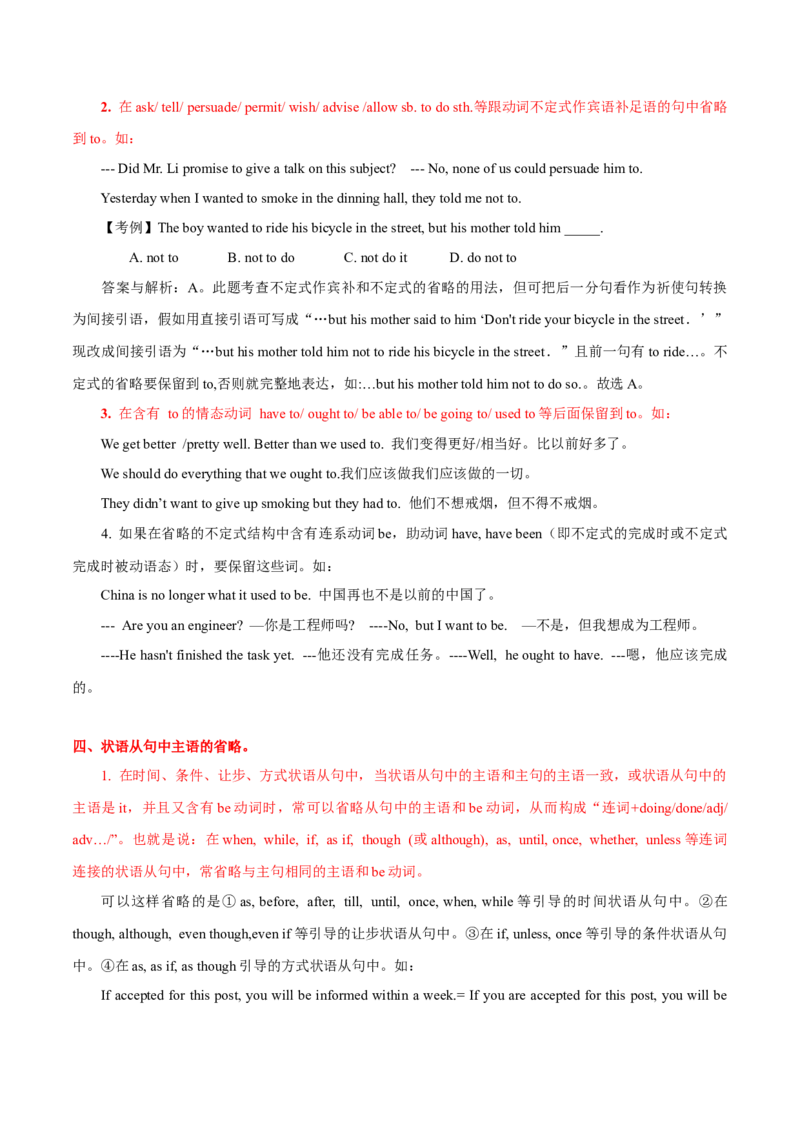
根据句意说明D正确。补全就是:I’d be happy to look after your cat.。2. 在ask/ tell/ persuade/ permit/ wish/ advise /allow sb. to do sth.等跟动词不定式作宾语补足语的句中省略
到to。如:
--- Did Mr. Li promise to give a talk on this subject? --- No, none of us could persuade him to.
Yesterday when I wanted to smoke in the dinning hall, they told me not to.
【考例】The boy wanted to ride his bicycle in the street, but his mother told him _____.
A. not to B. not to do C. not do it D. do not to
答案与解析:A。此题考查不定式作宾补和不定式的省略的用法,但可把后一分句看作为祈使句转换
为间接引语,假如用直接引语可写成“…but his mother said to him ‘Don't ride your bicycle in the street.’”
现改成间接引语为“…but his mother told him not to ride his bicycle in the street.”且前一句有to ride…。不
定式的省略要保留到to,否则就完整地表达,如:…but his mother told him not to do so.。故选A。
3. 在含有 to的情态动词 have to/ ought to/ be able to/ be going to/ used to等后面保留到to。如:
We get better /pretty well. Better than we used to. 我们变得更好/相当好。比以前好多了。
We should do everything that we ought to.我们应该做我们应该做的一切。
They didn’t want to give up smoking but they had to. 他们不想戒烟,但不得不戒烟。
4. 如果在省略的不定式结构中含有连系动词be,助动词have, have been(即不定式的完成时或不定式
完成时被动语态)时,要保留这些词。如:
China is no longer what it used to be. 中国再也不是以前的中国了。
--- Are you an engineer? —你是工程师吗? ----No, but I want to be. —不是,但我想成为工程师。
----He hasn't finished the task yet. ---他还没有完成任务。----Well, he ought to have. ---嗯,他应该完成
的。
四、状语从句中主语的省略。
1. 在时间、条件、让步、方式状语从句中,当状语从句中的主语和主句的主语一致,或状语从句中的
主语是it,并且又含有be动词时,常可以省略从句中的主语和be动词,从而构成“连词+doing/done/adj/
adv…/”。也就是说:在when, while, if, as if, though (或although), as, until, once, whether, unless等连词
连接的状语从句中,常省略与主句相同的主语和be动词。
可以这样省略的是①as, before, after, till, until, once, when, while等引导的时间状语从句中。②在
though, although, even though,even if等引导的让步状语从句中。③在if, unless, once等引导的条件状语从句
中。④在as, as if, as though引导的方式状语从句中。如:
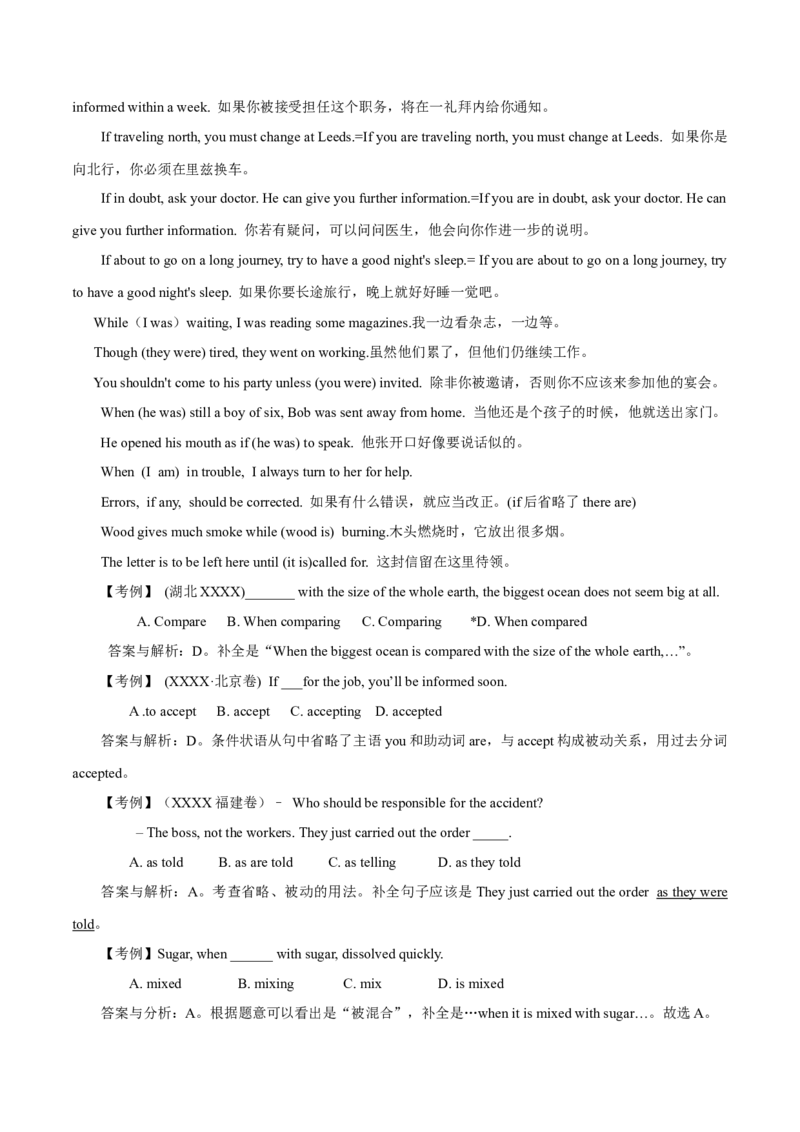
If accepted for this post, you will be informed within a week.= If you are accepted for this post, you will beinformed within a week. 如果你被接受担任这个职务,将在一礼拜内给你通知。
If traveling north, you must change at Leeds.=If you are traveling north, you must change at Leeds. 如果你是
向北行,你必须在里兹换车。
If in doubt, ask your doctor. He can give you further information.=If you are in doubt, ask your doctor. He can
give you further information. 你若有疑问,可以问问医生,他会向你作进一步的说明。
If about to go on a long journey, try to have a good night's sleep.= If you are about to go on a long journey, try
to have a good night's sleep. 如果你要长途旅行,晚上就好好睡一觉吧。
While(I was)waiting, I was reading some magazines.我一边看杂志,一边等。
Though (they were) tired, they went on working.虽然他们累了,但他们仍继续工作。
You shouldn't come to his party unless (you were) invited. 除非你被邀请,否则你不应该来参加他的宴会。
When (he was) still a boy of six, Bob was sent away from home. 当他还是个孩子的时候,他就送出家门。
He opened his mouth as if (he was) to speak. 他张开口好像要说话似的。
When (I am) in trouble, I always turn to her for help.
Errors, if any, should be corrected. 如果有什么错误,就应当改正。(if后省略了there are)
Wood gives much smoke while (wood is) burning.木头燃烧时,它放出很多烟。
The letter is to be left here until (it is)called for. 这封信留在这里待领。
【考例】 (湖北XXXX)_______ with the size of the whole earth, the biggest ocean does not seem big at all.
A. Compare B. When comparing C. Comparing *D. When compared
答案与解析:D。补全是“When the biggest ocean is compared with the size of the whole earth,…”。
【考例】 (XXXX·北京卷) If ___for the job, you’ll be informed soon.
A .to accept B. accept C. accepting D. accepted
答案与解析:D。条件状语从句中省略了主语you和助动词are,与accept构成被动关系,用过去分词
accepted。
【考例】(XXXX福建卷)– Who should be responsible for the accident?
– The boss, not the workers. They just carried out the order _____.
A. as told B. as are told C. as telling D. as they told
答案与解析:A。考查省略、被动的用法。补全句子应该是They just carried out the order as they were
told。
【考例】Sugar, when ______ with sugar, dissolved quickly.
A. mixed B. mixing C. mix D. is mixed
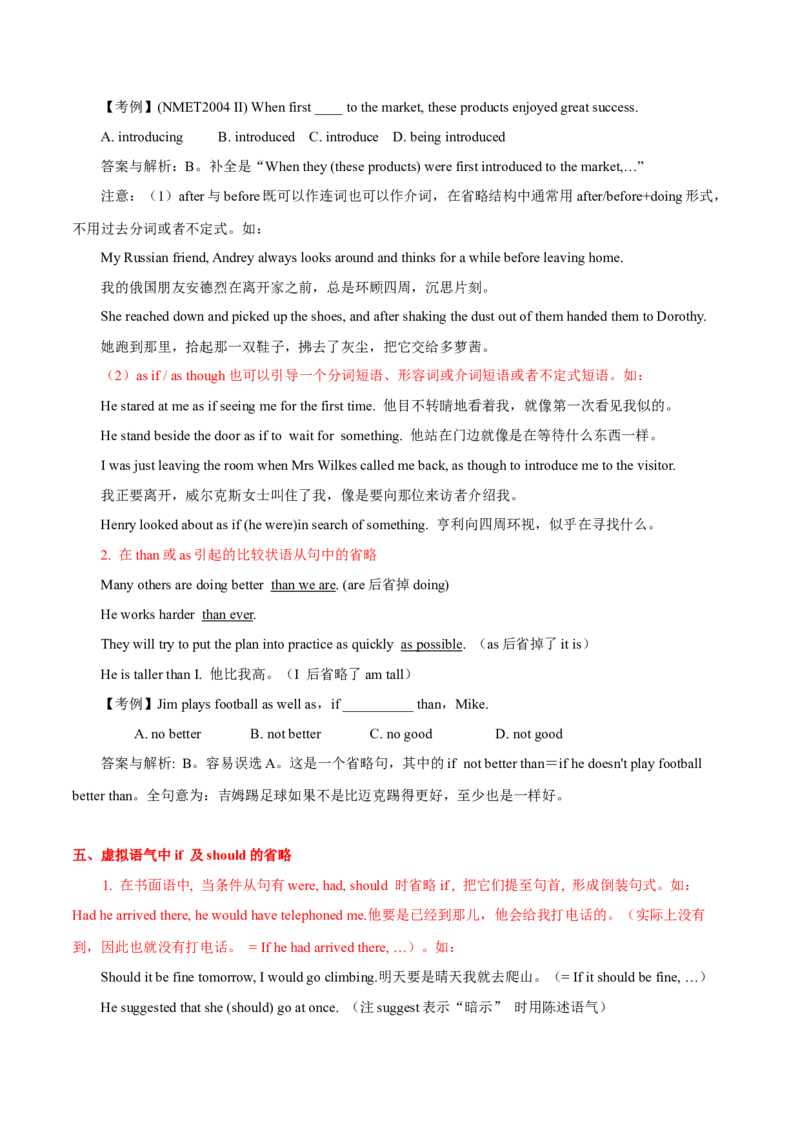
答案与分析:A。根据题意可以看出是“被混合”,补全是…when it is mixed with sugar…。故选A。【考例】(NMET2004 II) When first ____ to the market, these products enjoyed great success.
A. introducing B. introduced C. introduce D. being introduced
答案与解析:B。补全是“When they (these products) were first introduced to the market,…”
注意:(1)after与before既可以作连词也可以作介词,在省略结构中通常用after/before+doing形式,
不用过去分词或者不定式。如:
My Russian friend, Andrey always looks around and thinks for a while before leaving home.
我的俄国朋友安德烈在离开家之前,总是环顾四周,沉思片刻。
She reached down and picked up the shoes, and after shaking the dust out of them handed them to Dorothy.
她跑到那里,拾起那一双鞋子,拂去了灰尘,把它交给多萝茜。
(2)as if / as though也可以引导一个分词短语、形容词或介词短语或者不定式短语。如:
He stared at me as if seeing me for the first time. 他目不转睛地看着我,就像第一次看见我似的。
He stand beside the door as if to wait for something. 他站在门边就像是在等待什么东西一样。
I was just leaving the room when Mrs Wilkes called me back, as though to introduce me to the visitor.
我正要离开,威尔克斯女士叫住了我,像是要向那位来访者介绍我。
Henry looked about as if (he were)in search of something. 亨利向四周环视,似乎在寻找什么。
2. 在than或as引起的比较状语从句中的省略
Many others are doing better than we are. (are后省掉doing)
He works harder than ever.
They will try to put the plan into practice as quickly as possible. (as后省掉了it is)
He is taller than I. 他比我高。(I 后省略了am tall)
【考例】Jim plays football as well as,if __________ than,Mike.
A. no better B. not better C. no good D. not good
答案与解析: B。容易误选A。这是一个省略句,其中的if not better than=if he doesn't play football
better than。全句意为:吉姆踢足球如果不是比迈克踢得更好,至少也是一样好。
五、虚拟语气中if 及should的省略
1. 在书面语中, 当条件从句有were, had, should 时省略if , 把它们提至句首, 形成倒装句式。如:
Had he arrived there, he would have telephoned me.他要是已经到那儿,他会给我打电话的。(实际上没有
到,因此也就没有打电话。 = If he had arrived there, …)。如:
Should it be fine tomorrow, I would go climbing.明天要是晴天我就去爬山。(= If it should be fine, …)
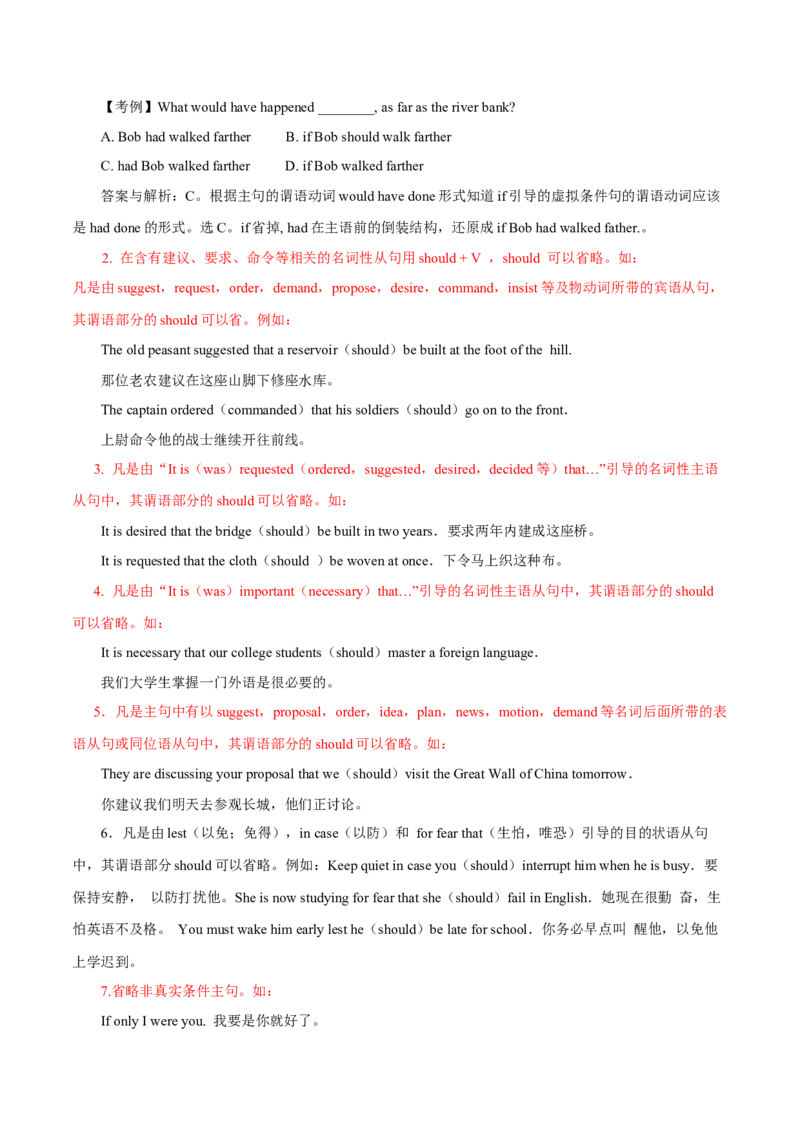
He suggested that she (should) go at once. (注suggest表示“暗示” 时用陈述语气)【考例】What would have happened ________, as far as the river bank?
A. Bob had walked farther B. if Bob should walk farther
C. had Bob walked farther D. if Bob walked farther
答案与解析:C。根据主句的谓语动词would have done形式知道if引导的虚拟条件句的谓语动词应该
是had done的形式。选C。if省掉, had在主语前的倒装结构,还原成if Bob had walked father.。
2. 在含有建议、要求、命令等相关的名词性从句用should + V ,should 可以省略。如:
凡是由suggest,request,order,demand,propose,desire,command,insist等及物动词所带的宾语从句,
其谓语部分的should可以省。例如:
The old peasant suggested that a reservoir(should)be built at the foot of the hill.
那位老农建议在这座山脚下修座水库。
The captain ordered(commanded)that his soldiers(should)go on to the front.
上尉命令他的战士继续开往前线。
3. 凡是由“It is(was)requested(ordered,suggested,desired,decided等)that…”引导的名词性主语
从句中,其谓语部分的should可以省略。如:
It is desired that the bridge(should)be built in two years.要求两年内建成这座桥。
It is requested that the cloth(should )be woven at once.下令马上织这种布。
4. 凡是由“It is(was)important(necessary)that…”引导的名词性主语从句中,其谓语部分的should
可以省略。如:
It is necessary that our college students(should)master a foreign language.
我们大学生掌握一门外语是很必要的。
5.凡是主句中有以suggest,proposal,order,idea,plan,news,motion,demand等名词后面所带的表
语从句或同位语从句中,其谓语部分的should可以省略。如:
They are discussing your proposal that we(should)visit the Great Wall of China tomorrow.
你建议我们明天去参观长城,他们正讨论。
6.凡是由lest(以免;免得),in case(以防)和 for fear that(生怕,唯恐)引导的目的状语从句
中,其谓语部分should可以省略。例如:Keep quiet in case you(should)interrupt him when he is busy.要
保持安静, 以防打扰他。She is now studying for fear that she(should)fail in English.她现在很勤 奋,生
怕英语不及格。 You must wake him early lest he(should)be late for school.你务必早点叫 醒他,以免他
上学迟到。
7.省略非真实条件主句。如:
If only I were you. 我要是你就好了。六、限制性定语从句中关系词的省略
1. 在限制性定语从句中作宾语的关系代词that, which,whom, who可以省掉,注意在“介词+关系代
词”结构中的关系代词虽然是介词的宾语,但是关系代词不可以省掉。如:
Is there anything (that) you wanted? 想要什么东西吗?
Who is the man (that /whom) you were talking to? 刚才和你讲话的人是谁?
He read the book (which) I got yesterday. 他看过我昨天买的书了。
【考例】(XXXX江西卷)--- Do you have anything to say for yourselves?
--- Yes, there’s one point ______ we must insist on.
A. why B. where C. how D. /
答案与解析:D。句意是“有一点(point)我们必须要坚持的”。先行词point在定语从句中作宾语,用关
系代词。此处的关系代词that省略了,故答案为D。
2. 当关系代词that在定语从句中用作表语和宾语补足语时,可以省略。如:
Perter is no longer the naughty boy (that) he used to be. 皮特再也不是过去那样调皮的孩子了。(that作表
语)
I’m not the madman (that) you thought me. 我并不是你所认为的那个疯子。(that 作宾语补足语)
China is not the country (that) it was. 中国已不是过去的中国了。(that 作表语)
3. the way后面的定语从句中,可以省略作方式状语的关系词that或in which。如:
How do you like the way (in which/that) we are talking now? 你觉得我们现在谈话的方式怎么样?
The way (in which/that) you answered the questions was admirable. 你回答问题的方式,是让人佩服的。
七、并列句中的省略
在并列句中,后一个分句常省略与前一分句中相同的部分,如主语,谓语,宾语等,以使句子更加清
晰明了。如:
My brother is a doctor and my sister-in-law (is) a lawyer.
This beeper works well, but that one doesn’t (work well). 这个寻呼机工作正常,但那个就不行。
All uranium atoms do not have the same atomic weight. Some of them weigh 234 units, some (of them)
(weigh) 235 units, and some (of them) (weigh) 238units. 不是所有的铀原子都有相同的原子量。其中有的重
234,有的重235,而有的重238。
They learn French and we (learn) English.
My father planned and (he) built all these houses.John won the first prize and Jimmy the second (prize).
Coral is not a plant but (it is) a variety of animal life.
My office was on the tenth floor, and his (office was) on the twelfth (floor).
【典例】One of the sides of the board should be painted yellow, and ________ .
A. the other is white B. another white C. the other white D. another is white
【答案与解析】C。一共两面,一面是yellow,另一面是white,所以用the other。another是另一个的
意思,用在有好多种情况的时候,承前省略了 should be painted而不是is。
八、宾语从句中的省略
1. 引导宾语从句的从属连词that通常都可省略,但是如果是两个以上的宾语从句并列,最后一个and
及其that不可以省掉。如:
He told me (that) he would join the English Club. 他告诉我说他将要加入英语俱乐部。
Everybody could see what an important person he was, and that they ought to be careful not to offend him.
大家都清楚他是一个多么重要的任务,他们应该小心,不要冒犯他。
2. 如果宾语从句中的谓语部分与主句的谓语部分或上文的谓语部分相同,可将从句部分的谓语省略。
We will do what we can (do) to help you.
—Is Mr. King in his office? —Sorry, I don’t know (whether he is in his office or not).
九、疑问词why引导的省略句
疑问词why引导的省略句中的不定式一般须省去to。在肯定句子直接用why do...? 表示反问;在否定
句用why not do..? 表示建议、赞同、坚持等。如:
--- I think I ought to tidy this place up. 我想我应该把这地方清扫一下。--- Why bother? 何必麻烦呢?
Why ask me? How should I know? 为什么问我? 我怎么知道?
Why not try again? 干嘛不再试呢?
Why not use Valentine's Day as a reminder to spend the rest of the year letting people know how much they
mean to you. 为什么不用情人节作为一种提醒,将剩下的一年花在让别人知道自己对你有多重要上。
Next time you're getting ready to jog but don't feel 100 percent eager to do it, why not go out for a skip
instead?
下次你准备去慢跑时,不要觉得非这项锻炼不可,为什么不改在室外跳绳呢?
Why not try to expand your story into a novel? 你怎么不把你的故事扩展成小说呢?
Why not wait till the winter sales to buy a new coat? 为什么不等到冬季大贱卖时再买一件新外衣呢?--- I'm not going to work today. 一Why not? 我今天不去上班了。——为什么不呢?
--- Let's eat out tonight. --- Yes, why not? 我们今晚出去吃饭吧。——对,为什么不呢?
--- Are you really going to sue them? ---Yes, why not? 你真的打算控告他们吗?——是的,为什么不呢?
Why not do...?相当于 why don’t you do...? 其它时态不可以简略为 why not do...?。如:Why not find
something to do, like cleaning the car for me?=Why don't you find something to do, like cleaning the car for me?你
为什么不找点事干,比如给我擦洗汽车?
比较:Why not tell me John had left you?= Why don’t you tell me John had left you? ≠Why didn't you tell
me John had left you? 为什么你没告诉我约翰已经离开了你?
十、疑问词what引导的省略句
what引导的结构有时可用于省略形式,与其相关的连接代词no matter what引导的结构有时也可用于
省略形式如:
Something is the matter, but I don't know what. 总有点不对劲,但我不知道是什么。(句中的what=what
it is。)
I'll tell you what. 让我告诉你怎么办。(句中的what=what to do。)
I'll always love you, no matter what. 我爱你,不管发生什么事情。(句中的no matter what=no matter what
happens。)
I've decided to leave tomorrow, no matter what. 不管发生什么情况,我已决定明天走。(句中的no matter
what=no matter what happens。)
十一、高考英语陷阱题中的省略
在英语考试中,也经常会采用微型语境的方法,使用省略手段来设计考试陷阱,增加考试的难度。在
考试陷阱中,所涉及的省略情况一般有:词的省略、句子成分的省略、多个成分的同时省略等。
1. 承前省略陷阱
所谓承前省略指的是当前后两句结构相同时,通常可将后一结构与前一结构相同的部分省略,从而使
句子更简洁。一般说来,这种省略考生是可以根据上下文的语境做出正确理解的,但是,当这种省略与其
他英语句型相似并很容易发生混淆时,就可能张冠李戴,步入误区。如果命题者刚好抓住这一点来巧妙设
题,就很可能构成有一定难度的陷阱题。如:
【典例】My friend Mary is______beautiful girl and______girl everyone likes to work with.
A. a, a B. a, the C. the, a D. the, the答案与解析:A。此题很容易误选B,认为第一次提到girl用不定冠词,第二次提到就应该用定冠
词。但其实最佳答案是A。句中第二次提到girl 时并不是特指的,此句实为一省略句,补充完整为 My
friend Mary is a beautiful girl and she is a girl everyone likes to work with.请再看两道题。
2. 语境省略陷阱
这里所说的语境省略指的是在一定的语境中,为了表达的简洁可省略有些不言而喻的信息。有时命题
者巧妙地运用这一省略手段可编制出一些非常高明的语境省略陷阱题。如:
【典例】She’s too thin. She______gain some weight but she______too little.
A. would; ate B. will; eats C. would; eats D. will; ate
答案与解析:C。此题有些难度,许多同学不知如何分析。我们先根据题目所提供的选项将句意大致
勾出来:她太瘦了。她会增加体重的,但她吃得太少了。根据句首She’s too thin 这一所给信息可知,“她
瘦”应是客观事实。按照一般的常识,“吃得少”就会引致“瘦”,“吃得多”就会导致“胖”,根据句
首的信息,“她瘦”是客观事实,所以她“吃得少”也应是事实,因此第二空应填 eats(即用一般现在时表
示客观事实)。根据上面的分析:“她瘦”和“她吃得少”均为客观事实,那么“她体重会增加”就应是假
设(注意句中的转折连词but),所以第一空应填would。其实,此句可理解为but前省略了一个条件状语 if
she ate more (如果她多吃一点的话)。所以,此题最佳答案选C。
3. 结构省略陷阱
【考例】 —Who has eaten all the cake,Jim?—Oh,________must be your two pet dogs.
A. it B. they C. that D. which
【答案与解析】A。许多学生可能认为此题应选 B,因为其后的 your two pet dogs 为复数。但实际上,
此题的最佳答案就是 A,此句实为强调句型 It must be your pet dogs that have eaten all the cake 的省略形
式。
十二、主句的省略
1. 在简短对话中,为了简洁可以省掉主句。如:
---Are you going to buy the house? ---(We are going to buy the house)Unless my wife objects.
---You all like the story? ---Yes, (we all like the story) except that the end is too surprising.
【考例】(XXXX山东卷) -----Shall we have our picnic tomorrow?
-----______it doesn’t rain.
A. Until B. While C. Once D. If答案与答案与解析:D。句意:我们明天去野餐吗?如果不下雨就去。本题考查交际用语和省略。第
二句话补充完整是:We shall have our picnic tomorrow if it doesn’t rain.
2. 在虚拟语气中,if only可以单独使用,省掉意思明确的主句。如:
If only we knew where to look for him! 如果我们知道上哪里去找他就好了!
He failed in the exam again. If only he had worked harder. 他考试又失败了。要是他努力些就好了。
附件、表解省略要点
为了便于总体把握省略结构的要点,可以参考下表:
项目 用法简析 例题(句)
省略主语, 像祈使句 (You) Tell me why. (I) Beg you pardon?
或在有上下文的对话
考例:(XXXX 湖北卷)---- I was wondering if we could go skiing on the
中等。
weekend. ----- _______good.
A. Sound B. Sounded C. Sounding D. Sounds
省略主谓或主谓的一 (It’s a) Beautiful day, isn’t it? Forgotten my name?
部分;省略了句子的
考例:(XXXX全国卷II)----Did you forget about my birthday?
主语,有时还连同谓
语动词一起省略。
-----_____ I’ve booked a table at Michel's restaurant for this evening.
简单 A. What then? B. I'm afraid so.C. How could I? D. For sure.
句的 析:C项=How could I (forget about your birthday)?
省略
省略表语、宾语,通 --- Is Chinese your favourite subject?
常省掉与前面有同样
--- Yes, it is (my favourite subject).
的表语或宾语,也可
以 用 代 动 词 do 表 ---Do you like English? --- Yes, I do(=like) (English).
示。
考例:(XXXX天津卷)---I need to advertise for a roommate for next
term.
---________? Mary is interested.
A. Why bother B. Why not C. So what D. What for
析:A项=Why (do you) bother to advertise for …
并列 两个并列句中,后一 典 题 : One of the sides of the board should be painted yellow, and
个分句常省略与前一 ________.
句的
分句中相同的部分。
省略 A. the other is white B. another white
C. the other white D. another is white
1. 主句中有一些成分 (It’s) Too bad she won’t be able to go to the party.
被省略,或是有一些
-Are you leaving for Beijing this Sunday?
省略成分被so或not
-I think so. (so=I’m leaving for Beijing this Sunday.)
来代替。
考例:(XXXX·江苏卷) It sounds like something is wrong with the car’s
engine. , we’d better take it to the garage immediately.
A. Otherwise B. If not C. But for that D. If so复合
句中 2. 宾语从句中常省略 Tell Peter that I'll call to see him and (that I’ll) have talk with him.
连词that,但在与之
的省 Mary said (that) she is from American and that she is 16 years old.
并列的最后的宾语从
略 句中、宾语从句前有 He can’t go to school, but I don't know why (he can't go to school).
插入语、有间接宾
Her parents don’t know when (she was born) and where she was born.
语、位于句首、 that
从句单独回答问题时
不省。其它连词引导
宾语从句可以省掉与
前面或后面相同部
分。
3. 在定语从句中, 考例:(XXXX江西卷) The house I grew up ________ has been taken down
that, which, who在从 and replaced by an office building.
句中作宾语时可省
A. in it B. in C. in that D. in which
略,“介词+which/
析:B项=The house (which/that) I grew up in…
whom”结构除外。
4.状语从句中如主语 When (he was) still a boy, Bob was sent away from home.
与主句主语一致,或
They will be arriving either before (the film begins) or after the film begins.
主语是it,可省略从
句的主语和 be 助动 考例:(XXXX福建卷)–Who should be responsible for the accident?
词,只保留分词和其
– The boss, not the workers. They just carried out the order __.
它成分。
A. as told B. as are told C. as telling D. as they told
考例:(XXXX·湖南卷) Every evening after dinner, if not from work, I
will spend some time walking my dog.
A. being tired B. tiring C. tired D. to be tired
动词不定式中为了避 考例:(XXXX陕西)—My mother is preparing my favorite dishes. Go with me
免重复,省去与前面 and have a taste, okay?
出现的相同部分,只
保留to,但如果在省 -- . And I’ll be glad to meet your parents.
略的不定式结构中含
A. I think so B. I’d love to C. I’m sure D. I hope so
有 be , have, have
不定 been时,要保留这些 考例:(XXXX·江苏卷) --- What’s the matter with Della?
词。
式中 --- Well, her parents wouldn't allow her to go to the party, but she still
__
的省
A. hopes to B. hopes so C. hopes not D. hopes for
略
典例:– He hasn’t finished the task yet.
– Well, he ______.
A. should do B. ought to C. has to D. ought to have
使役动词 have, let, 典例: A computer does only what thinking people _________.
make及感官动词see,
A. have it do B. have it done
hear, watch, look at,
listen to, observe 等 C. have done it D. having it done
跟不定式作宾补省去
I noticed a man enter the classroom when I passed by.
to,被动语态中须带
to。 比较:A man was noticed to enter the classroom.1. 在 以 含 有 were, Had it not been for the captain, the ship would have sun.
had, should 的if引导
= If it hadn’t been for the captain, …
虚拟条件句中常可以
虚拟 省 略 if 而 将 were, Should it rain tomorrow, we should have to put off the match.
条件 had, should 置 于 句
= If it should rain tomorrow, …
首。
句中
2. 表“命令、要求、 The teacher advised that we make good use of every minute here.
的省
建议、许可”或“禁
The teacher’s advice is that we make good use of every minute here.
略 止”等意义的名词性
从句中用“should+动
词原形”,should常
可省略。
【即时演练】根据汉语提示用省略结构完成下列句子。
1. We still have shortcomings, and_______(我们有很大的缺点).
2. -It is going to rain, isn’t it?
-_____(我希望天不要下雨).
3. He advised me not to say anything _______(直到被要求说).
4. My office was on the tenth floor, and______(他的办公室在十二层).
5. ______(要是我还年轻十岁的话), I would study abroad.
6. --- Have you finished your composition?
---- _______(还没有).
7. ---- How about going to France for our holidays?
---- _______(听起来是个好主意). Let’s do that.
8. She is still reading the English novel________(那本从你这儿借的英语小说).
9. We all know ______(地球绕着太阳转).
10. The boy wanted him to ride his bicycle in the street but _______(他母亲告诉他不要在街上骑自行车).
Keys:
1. very big ones 2. I hope not 3. until asked
4. his on the twelfth 5. Were I ten years younger 6. Not yet
7. Sounds like a good idea 8. she borrowed from you 9. the earth runs around the sun
10. his mother told him not to