【同步 100 分背默】 Module 5 Cartoons 知识清单
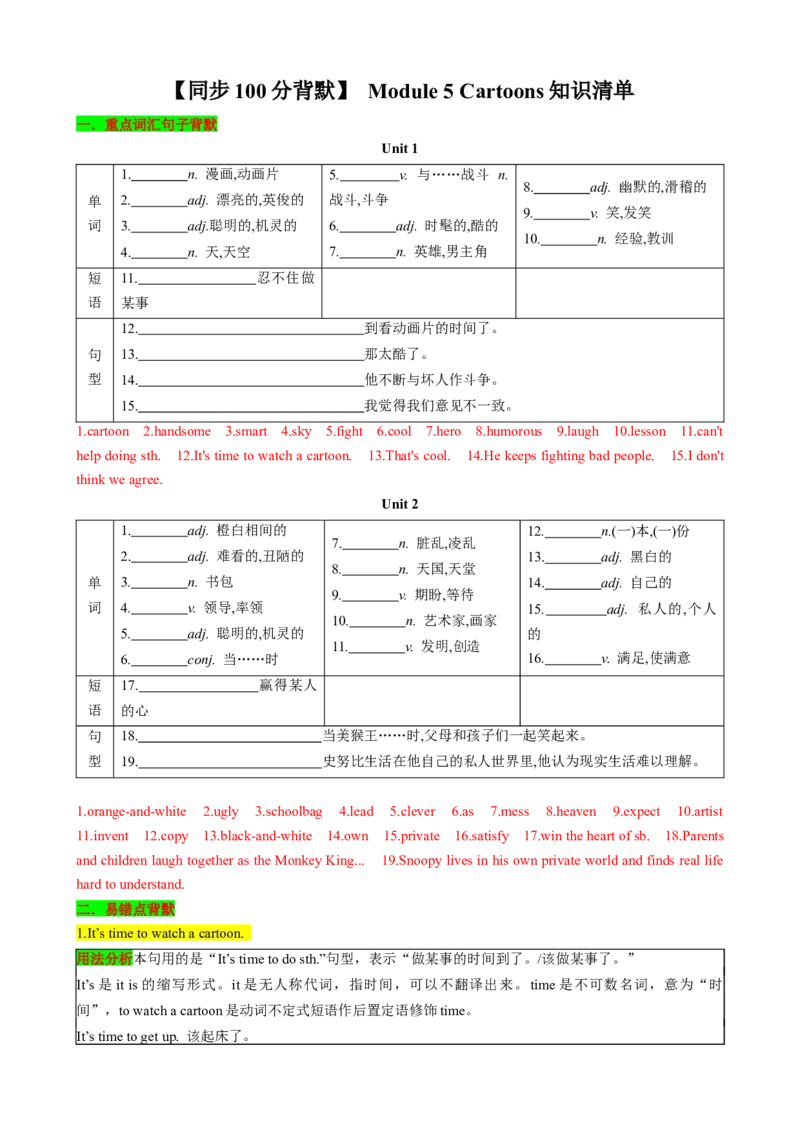
一.重点词汇句子背默
Unit 1
1. n. 漫画,动画片 5. v. 与……战斗 n.
8. adj. 幽默的,滑稽的
单 2. adj. 漂亮的,英俊的 战斗,斗争
9. v. 笑,发笑
词 3. adj.聪明的,机灵的 6. adj. 时髦的,酷的
10. n. 经验,教训
4. n. 天,天空 7. n. 英雄,男主角
短 11. 忍不住做
语 某事
12. 到看动画片的时间了。
句 13. 那太酷了。
型 14. 他不断与坏人作斗争。
15. 我觉得我们意见不一致。
1.cartoon 2.handsome 3.smart 4.sky 5.fight 6.cool 7.hero 8.humorous 9.laugh 10.lesson 11.can't
help doing sth. 12.It's time to watch a cartoon. 13.That's cool. 14.He keeps fighting bad people. 15.I don't
think we agree.
Unit 2
1. adj. 橙白相间的 12. n.(一)本,(一)份
7. n. 脏乱,凌乱
2. adj. 难看的,丑陋的 13. adj. 黑白的
8. n. 天国,天堂
单 3. n. 书包 14. adj. 自己的
9. v. 期盼,等待
词 4. v. 领导,率领 15. adj. 私人的,个人
10. n. 艺术家,画家
5. adj. 聪明的,机灵的 的
11. v. 发明,创造
6. conj. 当……时 16. v. 满足,使满意
短 17. 赢得某人
语 的心
句 18. 当美猴王……时,父母和孩子们一起笑起来。
型 19. 史努比生活在他自己的私人世界里,他认为现实生活难以理解。
1.orange-and-white 2.ugly 3.schoolbag 4.lead 5.clever 6.as 7.mess 8.heaven 9.expect 10.artist
11.invent 12.copy 13.black-and-white 14.own 15.private 16.satisfy 17.win the heart of sb. 18.Parents
and children laugh together as the Monkey King... 19.Snoopy lives in his own private world and finds real life
hard to understand.
二.易错点背默
1.It’s time to watch a cartoon.
用法分析本句用的是“It’s time to do sth.”句型,表示“做某事的时间到了。/该做某事了。”
It’s是it is的缩写形式。it是无人称代词,指时间,可以不翻译出来。time是不可数名词,意为“时
间”,to watch a cartoon是动词不定式短语作后置定语修饰time。
It’s time to get up. 该起床了。知识回顾
1.It’s time for(doing)sth.表示“做某事的时间到了。//该做某事了。” 可以与It’s time to do sth.互换使
用。
It’s time for housework.=It’s time to do housework.该做家务了。
It’s time for having breakfast. =It’s time to have breakfast. 吃早饭的时间到了。
2.It’s time for sb to do sth.表示“某人该做某事了。”(动词不定式是由sb发出的动作)
It’s time for them to have the test.他们该进行测试了。
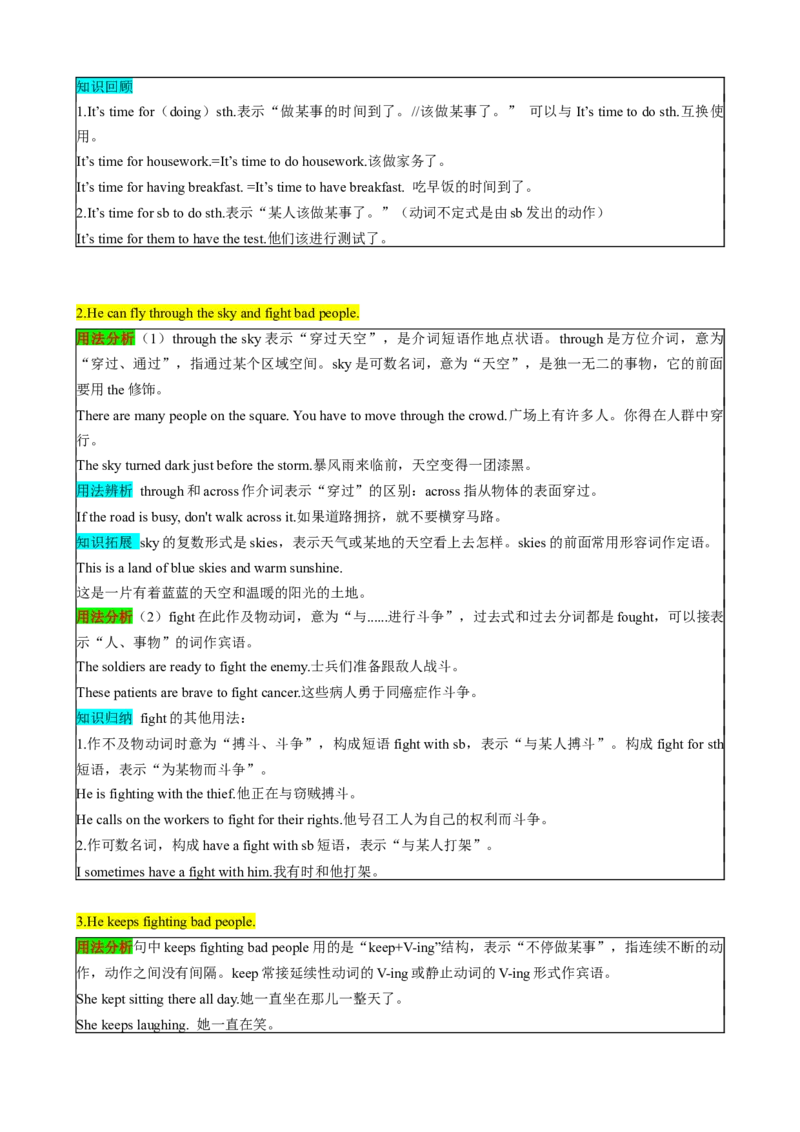
2.He can fly through the sky and fight bad people.
用法分析(1)through the sky表示“穿过天空”,是介词短语作地点状语。through是方位介词,意为
“穿过、通过”,指通过某个区域空间。sky是可数名词,意为“天空”,是独一无二的事物,它的前面
要用the修饰。
There are many people on the square. You have to move through the crowd.广场上有许多人。你得在人群中穿
行。
The sky turned dark just before the storm.暴风雨来临前,天空变得一团漆黑。
用法辨析 through和across作介词表示“穿过”的区别:across指从物体的表面穿过。
If the road is busy, don't walk across it.如果道路拥挤,就不要横穿马路。
知识拓展 sky的复数形式是skies,表示天气或某地的天空看上去怎样。skies的前面常用形容词作定语。
This is a land of blue skies and warm sunshine.
这是一片有着蓝蓝的天空和温暖的阳光的土地。
用法分析(2)fight在此作及物动词,意为“与......进行斗争”,过去式和过去分词都是fought,可以接表
示“人、事物”的词作宾语。
The soldiers are ready to fight the enemy.士兵们准备跟敌人战斗。
These patients are brave to fight cancer.这些病人勇于同癌症作斗争。
知识归纳 fight的其他用法:
1.作不及物动词时意为“搏斗、斗争”,构成短语fight with sb,表示“与某人搏斗”。构成fight for sth
短语,表示“为某物而斗争”。
He is fighting with the thief.他正在与窃贼搏斗。
He calls on the workers to fight for their rights.他号召工人为自己的权利而斗争。
2.作可数名词,构成have a fight with sb短语,表示“与某人打架”。
I sometimes have a fight with him.我有时和他打架。
3.He keeps fighting bad people.
用法分析句中keeps fighting bad people用的是“keep+V-ing”结构,表示“不停做某事”,指连续不断的动
作,动作之间没有间隔。keep常接延续性动词的V-ing或静止动词的V-ing形式作宾语。
She kept sitting there all day.她一直坐在那儿一整天了。
She keeps laughing. 她一直在笑。结构辨析 keep+V-ing和keep on+V-ing表示“不停地做某事”的区别:
keep on常接短暂性动词的V-ing形式,强调动作反复,动作与动作之间有间隔。
He kept on ringing me up, but I don't want to keep in touch with him any more.
他不断地给我打电话,可我不想和他保持联系了。
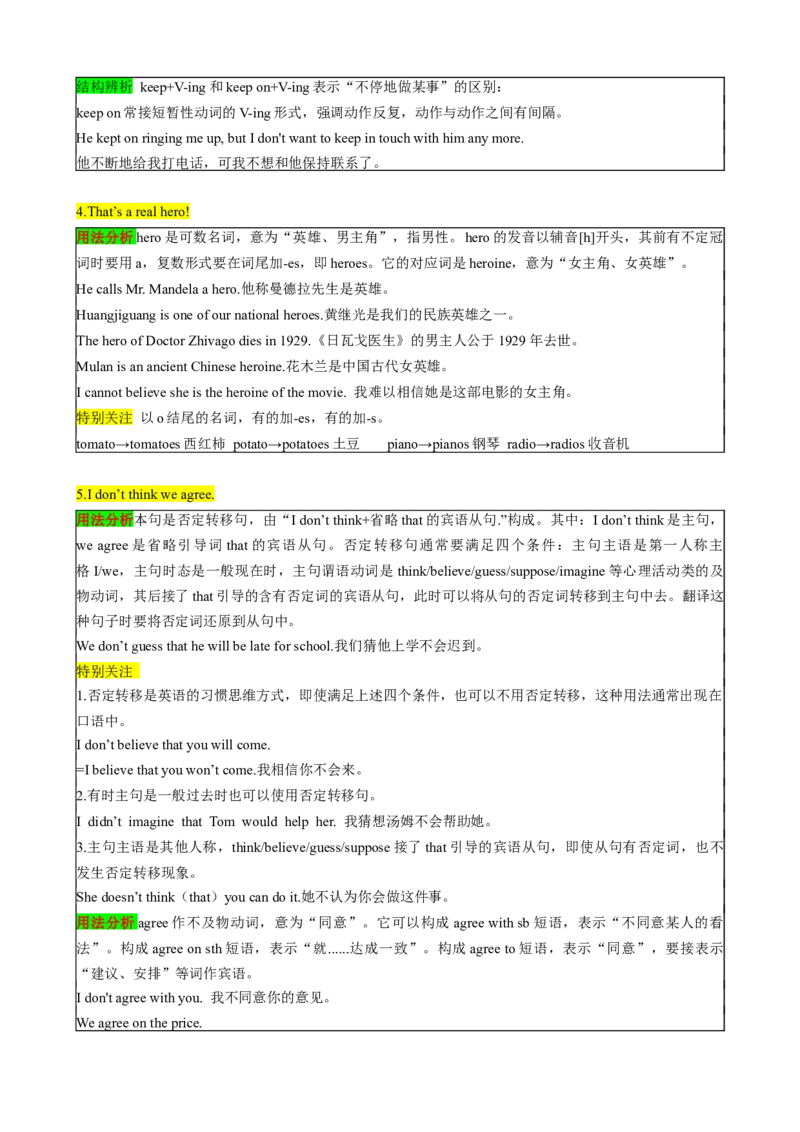
4.That’s a real hero!
用法分析hero是可数名词,意为“英雄、男主角”,指男性。hero的发音以辅音[h]开头,其前有不定冠
词时要用a,复数形式要在词尾加-es,即heroes。它的对应词是heroine,意为“女主角、女英雄”。
He calls Mr. Mandela a hero.他称曼德拉先生是英雄。
Huangjiguang is one of our national heroes.黄继光是我们的民族英雄之一。
The hero of Doctor Zhivago dies in 1929.《日瓦戈医生》的男主人公于1929年去世。
Mulan is an ancient Chinese heroine.花木兰是中国古代女英雄。
I cannot believe she is the heroine of the movie. 我难以相信她是这部电影的女主角。
特别关注 以o结尾的名词,有的加-es,有的加-s。
tomato→tomatoes西红柿 potato→potatoes土豆 piano→pianos钢琴 radio→radios收音机
5.I don’t think we agree.
用法分析本句是否定转移句,由“I don’t think+省略that的宾语从句.”构成。其中:I don’t think是主句,
we agree是省略引导词 that的宾语从句。否定转移句通常要满足四个条件:主句主语是第一人称主
格I/we,主句时态是一般现在时,主句谓语动词是 think/believe/guess/suppose/imagine等心理活动类的及
物动词,其后接了that引导的含有否定词的宾语从句,此时可以将从句的否定词转移到主句中去。翻译这
种句子时要将否定词还原到从句中。
We don’t guess that he will be late for school.我们猜他上学不会迟到。
特别关注
1.否定转移是英语的习惯思维方式,即使满足上述四个条件,也可以不用否定转移,这种用法通常出现在
口语中。
I don’t believe that you will come.
=I believe that you won’t come.我相信你不会来。
2.有时主句是一般过去时也可以使用否定转移句。
I didn’t imagine that Tom would help her. 我猜想汤姆不会帮助她。
3.主句主语是其他人称,think/believe/guess/suppose接了that引导的宾语从句,即使从句有否定词,也不
发生否定转移现象。
She doesn’t think(that)you can do it.她不认为你会做这件事。
用法分析agree作不及物动词,意为“同意”。它可以构成 agree with sb短语,表示“不同意某人的看
法”。构成agree on sth短语,表示“就......达成一致”。构成agree to短语,表示“同意”,要接表示
“建议、安排”等词作宾语。
I don't agree with you. 我不同意你的意见。
We agree on the price.我们就价格达成了一致意见。(它的主语是表示“人”的复数可数名词或复数人称代词的宾格)
We have agreed to their arrangement. 我们同意了他们的安排。
知识拓展 agree的反义词是disagree,表示“不同意”。
—I think teenagers should be allowed to play some computer games.我觉得青少年英语被允许玩一些电脑游
戏。
—I disagree.我不同意。
6.I can’t help laughing when I watch them!
用法分析(1)can’t help laughing用的是“can’t help+V-ing”结构,表示“忍不住做某事”。
When I hear the bad news, I can’t help crying.
我听到这个坏消息时忍不住哭了起来。
知识拓展 can’t help to do sth表示“不能帮忙做某事”(动词不定式符号to也可以省略)。
I can’t help(to)cook the meal.我不能帮忙做饭。
(2)句中laughing是不及物动词laugh的V-ing形式,意为“笑、发笑”,强调有声音的笑。表示“嘲笑
某人”用laugh at sb。
The funny story made the children laugh.这个滑稽可笑的故事使孩子们笑了。
Don’t laugh at me. I am just a beginner.别笑我。我只是个初学者。
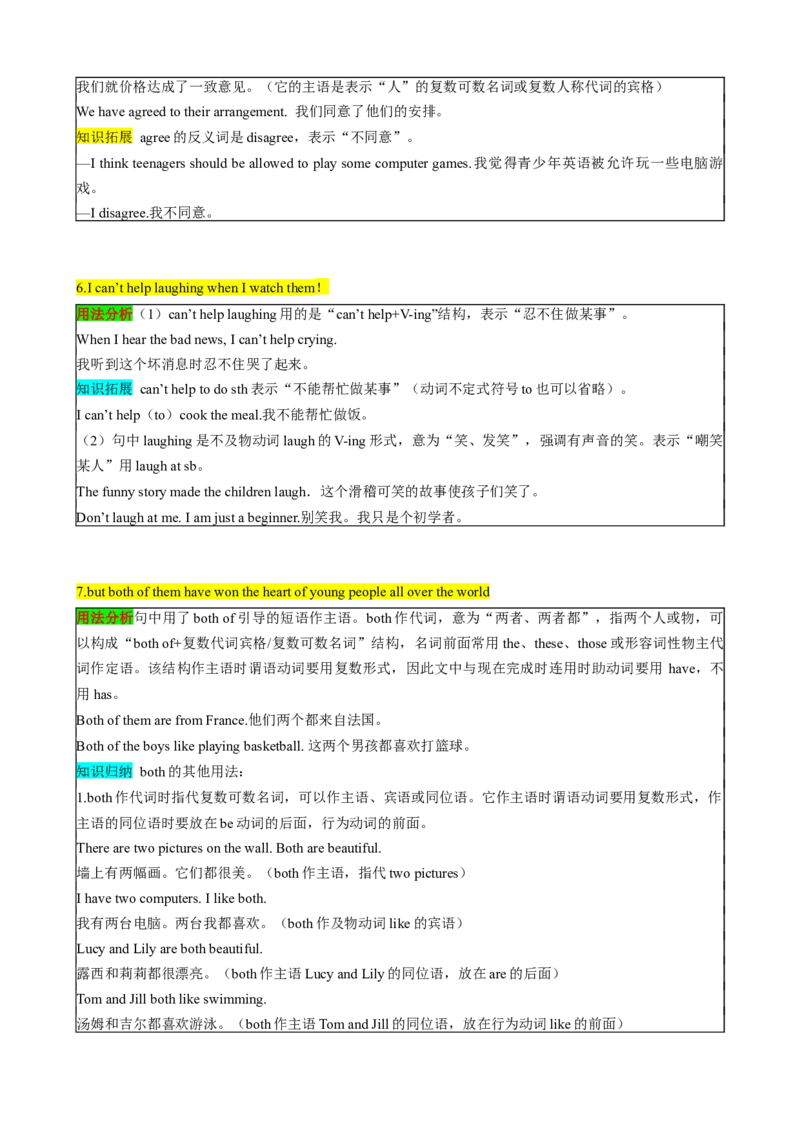
7.but both of them have won the heart of young people all over the world
用法分析句中用了both of引导的短语作主语。both作代词,意为“两者、两者都”,指两个人或物,可
以构成“both of+复数代词宾格/复数可数名词”结构,名词前面常用the、these、those或形容词性物主代
词作定语。该结构作主语时谓语动词要用复数形式,因此文中与现在完成时连用时助动词要用 have,不
用has。
Both of them are from France.他们两个都来自法国。
Both of the boys like playing basketball. 这两个男孩都喜欢打篮球。
知识归纳 both的其他用法:
1.both作代词时指代复数可数名词,可以作主语、宾语或同位语。它作主语时谓语动词要用复数形式,作
主语的同位语时要放在be动词的后面,行为动词的前面。
There are two pictures on the wall. Both are beautiful.
墙上有两幅画。它们都很美。(both作主语,指代two pictures)
I have two computers. I like both.
我有两台电脑。两台我都喜欢。(both作及物动词like的宾语)
Lucy and Lily are both beautiful.
露西和莉莉都很漂亮。(both作主语Lucy and Lily的同位语,放在are的后面)
Tom and Jill both like swimming.
汤姆和吉尔都喜欢游泳。(both作主语Tom and Jill的同位语,放在行为动词like的前面)2.both作形容词时意为“两者”,要修饰复数可数名词。它修饰复数可数名词作主语时谓语动词要用复数
形式。
Not both answers to the problem are right.
并非两个答案都正确。
3.both...and...表示“......和......都”,要连接两个并列成分。它连接两个并列成分作主语时谓语动词用复数
形式。
Both my mother and my grandmother enjoy watching TV in the evening.
我妈妈和外婆都喜欢晚上看电视。
用法分析句中用了“win the hearts of sb”短语,表示“赢得某人的心”,of的后面要接表示“人”的复数
可数名词或复数代词。
This hero has won the hearts of the people in this city.
这个英雄赢得了这座城市的人们的心。
知识归纳 win the heart of 要接表示“人”的单数可数名词,表示“深受......的喜爱”。
Ms Lin wins the heart of every student in her class.林老师深受她班上每位学生的喜爱。
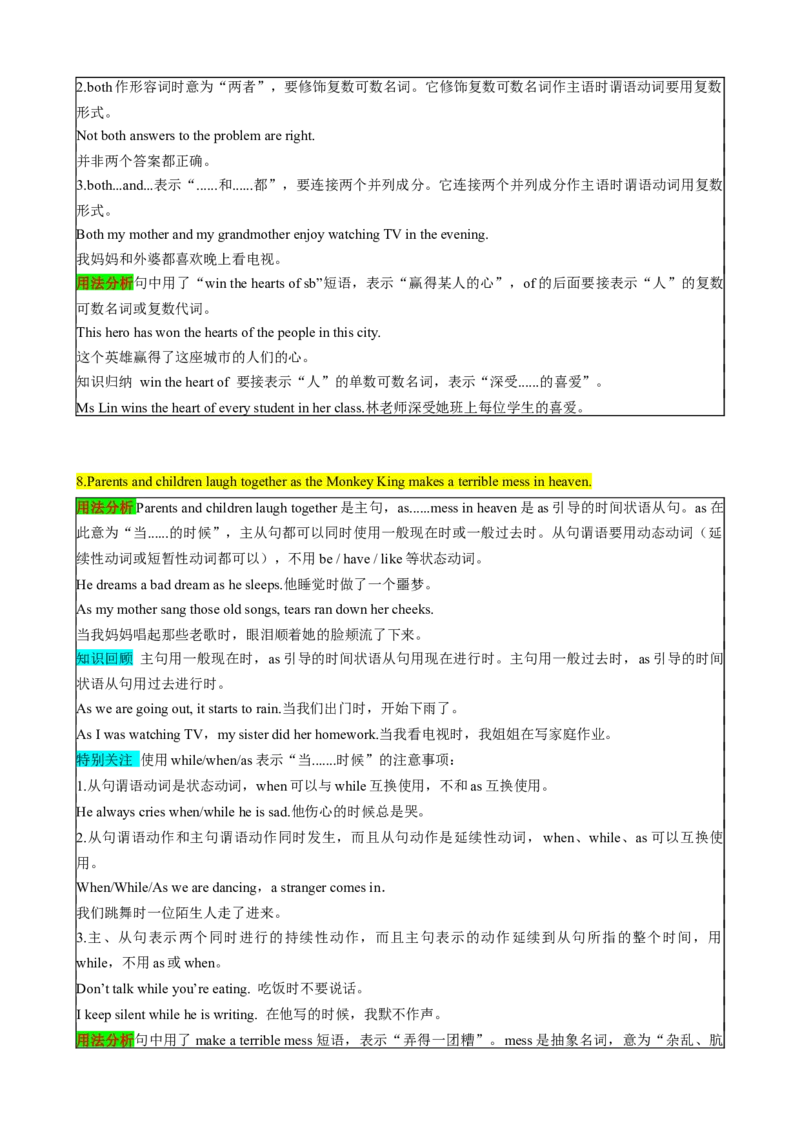
8.Parents and children laugh together as the Monkey King makes a terrible mess in heaven.
用法分析Parents and children laugh together是主句,as......mess in heaven是as引导的时间状语从句。as在
此意为“当......的时候”,主从句都可以同时使用一般现在时或一般过去时。从句谓语要用动态动词(延
续性动词或短暂性动词都可以),不用be / have / like等状态动词。
He dreams a bad dream as he sleeps.他睡觉时做了一个噩梦。
As my mother sang those old songs, tears ran down her cheeks.
当我妈妈唱起那些老歌时,眼泪顺着她的脸颊流了下来。
知识回顾 主句用一般现在时,as引导的时间状语从句用现在进行时。主句用一般过去时,as引导的时间
状语从句用过去进行时。
As we are going out, it starts to rain.当我们出门时,开始下雨了。
As I was watching TV,my sister did her homework.当我看电视时,我姐姐在写家庭作业。
特别关注 使用while/when/as表示“当.......时候”的注意事项:
1.从句谓语动词是状态动词,when可以与while互换使用,不和as互换使用。
He always cries when/while he is sad.他伤心的时候总是哭。
2.从句谓语动作和主句谓语动作同时发生,而且从句动作是延续性动词,when、while、as可以互换使
用。
When/While/As we are dancing,a stranger comes in.
我们跳舞时一位陌生人走了进来。
3.主、从句表示两个同时进行的持续性动作,而且主句表示的动作延续到从句所指的整个时间,用
while,不用as或when。
Don’t talk while you’re eating. 吃饭时不要说话。
I keep silent while he is writing. 在他写的时候,我默不作声。
用法分析句中用了make a terrible mess短语,表示“弄得一团糟”。mess是抽象名词,意为“杂乱、肮脏、不整洁”,用a修饰它时是将抽象名词mess具体化。表示“杂乱不堪”用in a mess。表示“把......弄
糟”用make a mess of sth。
The house is in a mess.这个房子又脏又乱。
If you interfere in that matter, you'll make a mess of it. 如果你干预那件事,你一定会把事情搞糟。
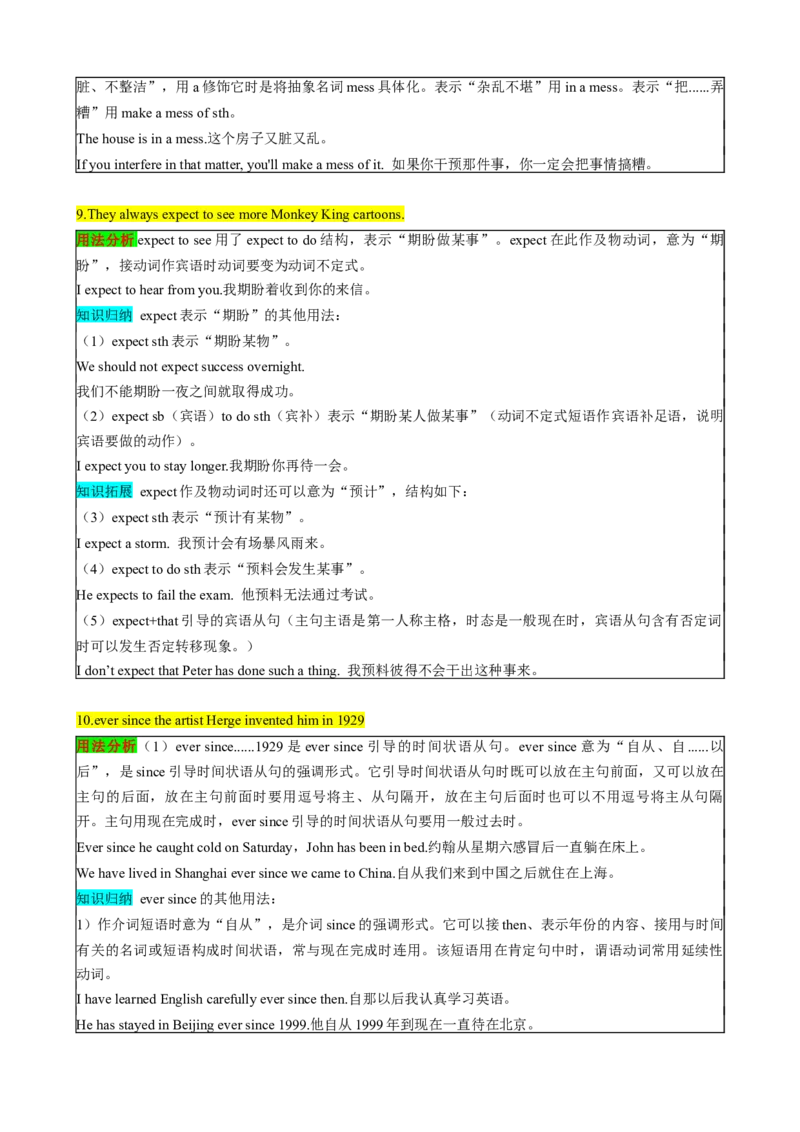
9.They always expect to see more Monkey King cartoons.
用法分析expect to see用了expect to do结构,表示“期盼做某事”。expect在此作及物动词,意为“期
盼”,接动词作宾语时动词要变为动词不定式。
I expect to hear from you.我期盼着收到你的来信。
知识归纳 expect表示“期盼”的其他用法:
(1)expect sth表示“期盼某物”。
We should not expect success overnight.
我们不能期盼一夜之间就取得成功。
(2)expect sb(宾语)to do sth(宾补)表示“期盼某人做某事”(动词不定式短语作宾语补足语,说明
宾语要做的动作)。
I expect you to stay longer.我期盼你再待一会。
知识拓展 expect作及物动词时还可以意为“预计”,结构如下:
(3)expect sth表示“预计有某物”。
I expect a storm. 我预计会有场暴风雨来。
(4)expect to do sth表示“预料会发生某事”。
He expects to fail the exam. 他预料无法通过考试。
(5)expect+that引导的宾语从句(主句主语是第一人称主格,时态是一般现在时,宾语从句含有否定词
时可以发生否定转移现象。)
I don’t expect that Peter has done such a thing. 我预料彼得不会干出这种事来。
10.ever since the artist Herge invented him in 1929
用法分析(1)ever since......1929 是ever since引导的时间状语从句。ever since意为“自从、自......以
后”,是since引导时间状语从句的强调形式。它引导时间状语从句时既可以放在主句前面,又可以放在
主句的后面,放在主句前面时要用逗号将主、从句隔开,放在主句后面时也可以不用逗号将主从句隔
开。主句用现在完成时,ever since引导的时间状语从句要用一般过去时。
Ever since he caught cold on Saturday,John has been in bed.约翰从星期六感冒后一直躺在床上。
We have lived in Shanghai ever since we came to China.自从我们来到中国之后就住在上海。
知识归纳 ever since的其他用法:
1)作介词短语时意为“自从”,是介词since的强调形式。它可以接then、表示年份的内容、接用与时间
有关的名词或短语构成时间状语,常与现在完成时连用。该短语用在肯定句中时,谓语动词常用延续性
动词。
I have learned English carefully ever since then.自那以后我认真学习英语。
He has stayed in Beijing ever since 1999.他自从1999年到现在一直待在北京。They have been close friends ever since childhood. 他们从小就是紧密的朋友。
2)作副词短语时意为“此后一直”,可以单独作时间状语,常与现在完成时连用。
Lily and Lucy had a big quarrel last month. They have not talked to each other ever since.
莉莉和露西上个月大吵了一架。此后两个人就一直不说话了。
(2)artist在此作可数名词,意为“艺术家、画家”,由名词“art(艺术、美术)+后缀-ist”派生而成。
artist以元音[ɑ:]发音开头,用不定冠词修饰它时要用an。
There is an artist making a speech in the hall.大厅里有一位艺术家在做演讲。
I want to be an artist in the future.我将来想当画家。
小贴士 -ist可以放在某些事物名词的后面将它们变成表示“职业”的名词。
journal(杂志)+ist→journalist记者
(3)invented是及物动词invent的过去式,意为“发明”,要接表示“事物”的词作宾语。该词主要用
于科技领域,指通过思考、研究或实验制造出新的前所未有、极为有用的东西。
He invented the first electric clock.
他发明了第一个电动钟。
知识归纳 invent的派生词如下:
1)invention作可数名词时意为“发明物”。它以元音[ɪ]发音开头,其前有不定冠词时要用an。
They have never heard of such an invention.
他们从没有听说这样一个发明。
2)inventor是可数名词,意为“发明家”。它以元音[ɪ]发音开头,其前有不定冠词时要用an。
He is not only a writer, but also an inventor. 他不仅是一位作家,还是一位发明家。
11.He works for a newspaper and has lots of exciting experiences.
用法分析experience在此作可数名词,意为“经历”。它以元音[ɪ]发音开头,其前有不定冠词时要用an。
它的复数形式是experiences。
They say the only value in an experience is what you learn from it.他们说一次经历中唯一的价值是你从中学到
了什么东西。
Please tell us about your experiences in Africa. 请跟我们谈谈你在非洲的经历。
知识归纳 experience的其他用法:
(1)作不可数名词时意为“经验”。
Have you had any experience of teaching English? 你有过教英语的一些经验吗?
(2)作及物动词时意为“经历”,接表示“事物”的词作宾语。
We had never experienced this kind of holiday before.我们以前从未经历过这种假期。
11.Charles Schulz created Snoopy and his friends,and drew the cartoons to satisfy older people as well as
children.
用法分析(1)句中created是及物动词create的过去式,意为“创造”,指创造出新东西,其对象往往是
精神上的,比如艺术、文学作品中的人物以及新的科学领域等,也可以指独具特色的创作。Shakespeare has created many famous characters.莎士比亚创造了许多有名的人物。
知识拓展 creation是可数名词,由动词create去掉e,再加上名词后缀ion派生而成,意为“创造、创
作”。
The bathroom is my own creation.这个浴室是我自己的创作。
用法分析(2)to satisfy... as children是动词不定式作目的状语。satisfy作及物动词,意为“满足、使满
意”,指完全达到预定的条件、要求、标准或期望、心愿等。
This kind of programme always satisfies the public.这种类型的节目总能令大众满意。
知识拓展satisfied是形容词,意为“满意的”,固定短语是be satisfied with sb/sth,表示“对某人/物满
意”。
That's because you're never satisfied with me. 那是因为你总是对我不满意。
We are not satisfied with these results.我们对这些结果不满意。
用法分析(3)as well as连接older people和children。as well as意为“不但.....而且......、以及”,连接两
个并列成分。它引导的短语可以作主语、表语、宾语等成分,强调的重点是第一个as前面的内容。它连
接两个主语时谓语动词的单复数形式根据第一个主语来确定。as well as连接两个动词时,通常第二个动
词用V-ing形式。如果第一个动词的前面有动词不定式符号to或情态动词,第二个动词要用动词原形。
He can speak French as well as English.
他不但会讲英语, 而且会讲法语。(as well as连接两个宾语French和English,强调French)
The girl is lovely as well as pretty.
那个女孩不但漂亮, 而且可爱。(as well as连接两个表语lovely和pretty,强调lovely)
The teacher as well as his students likes the movie.
那位老师以及他的学生喜爱这部电影。(as well as连接两个主语the teacher和his students,第一个主语是
单数可数名词,谓语动词要用第三人称单数形式)
He sings as well as playing the piano. 他不但会弹钢琴,而且会唱歌。
The robot is able to dance as well as sing.这个机器人不但会唱歌,而且会跳舞。
Students should pursue their own interests, as well as do their school work.
学生不仅应该做家庭作业,而且还要有自己的兴趣。
特别关注:as well as意为“除了......以外”时要接V-ing,引导的短语要放在句首。
As well as walking, he likes fishing and hunting. 他除散步之外还喜欢钓鱼和打猎。
用法分析(4)older是形容词old的比较级,意为“年长的”,作定语修饰people。它可以描述“人、动
物”,可以作表语或定语。
I live with my mom and my older sister. 我和我的妈妈和姐姐住在一起。
This dog is older than any other dogs here.这条狗在这里是最老的一条。
用法辨析 elder和older表示“年长的”的区别:
elder只描述人,仅用于同一家庭成员的比较,只能放在名词前面作定语。older没有这种限制。
My elder sister is three years older than I.我的姐姐比我大3岁。
五.语法点记忆
一般现在时、一般过去时和现在完成时时态 常见时间状语 例句
yesterday (morning, afternoon)昨天(早上下午) 1.I saw the film yesterday.
the day before yesterday前天 强调看电影的时间是昨天。
last+时间名词:上一个… last 2.I taught here for eight years.我在这教
night/week/month/year 过八年书(只陈述过去的事实,现在不
一
时间段+ ago:在…之前 three days ago:三天前 在这教书了)
般
this morning/afternoon今天早上/ 今天下午
过
when+ 过去时的句子:当…的时候 when I got up
去
just now 刚刚
时
before 以前 或 before+时间点
at the age of 10 (过去年龄段):在10岁的时候
in the old days 在古时候
at that time/ moment在那时候
for + 时间段: 持续了一段时间 1.I have seen the film.
since + 过去时间点/ 过去时句子:自从…开始 我已经看过这部电影了。(我现在知道
现 since + 时间段 + ago:自从…开始 电影的内容/ 我不想在看这电影了,我
在 already (“已经”用于肯定句的中间和末尾处) 们选其他的吧。)
2.I have taught here for eight years. 我
完 never (“从不” 用于中间处)
在这教书八年了。(现在还在教,还可
成 ever (“曾经” 用于疑问句和肯定句的中间处)
能继续教下去)
时 just (“刚刚” 用于中间处)
yet (“还”用于否定句的末尾处)
so far 到目前为止In the past + 时间段
现在完成时表示与现在有关系的发生在
过去的动作,到现在为止这个动作可能结
时
束也可能继续下去。
态
一般过去时表示过去某个时间发生的
对
事、存在的状态或经常发生的动作,说话
比
的侧重点在于陈述一件过去的事情,与现
在没有关系。
一、请用所给词的合理的时态完成下面的句子。
1. A: Did you like the movie "Star Wars?"
B: I don't know. I __________ (see, never) that movie.
2. Sam __________ (arrive) in San Diego a week ago.
3. My best friend and I _________ (know) each other for over fifteen years. We still get together once a week.
4. Stinson is a fantastic writer. He _________ (write) ten very creative short stories in the last year. One day, he'll
be as famous as Hemingway.
5. I _________ (have, not) this much fun since I _________ (be) a kid.
6. Things _________ (change) a great deal at Coltech, Inc. When we first _________ (start) working here three
years ago, the company only_________ (have) six employees. Since then, we _________ (expand) to include
more than 2000 full-time workers.
7. I _________ (tell) him to stay on the path while he was hiking, but he _________ (wander) off into the forest
and _________ (be) bitten by a snake.
8. Listen Donna, I don't care if you _________ (miss) the bus this morning. You _________ (be) late to work too
many times. You are fired!
9. Sam is from Colorado, which is hundreds of miles from the coast, so he _________ (see, never) the ocean. He
should come with us to Miami.
10. How sad! George _________ (dream) of going to California before he died, but he didn't make it. He
_________ (see, never) the ocean.
11. In the last hundred years, traveling _________ (become) much easier and very comfortable. In the 19th
century, it _________ (take) two or three months to cross North America by covered wagon. The trip _________
(be) very rough and often dangerous. Things _________ (change) a great deal in the last hundred and fifty years.
Now you can fly from New York to Los Angeles in a matter of hours.
12. Jonny, I can't believe how much you _________ (change) since the last time I _________ (see) saw you. You
_________ (grow) at least a foot!
13. This tree ______ (be) planted by the settlers who ________ (found) our city over four hundred years ago.
14. This mountain _________ (be, never) climbed by anyone. Several mountaineers _________ (try) to reach the
top, but nobody _________ (succeed, ever). The climb is extremely difficult and many people _________ (die)
trying to reach the summit.
15. I _________ (visit, never) Africa, but I _________ (travel) to South America several times. The last time I
_________ (go) to South America, I _________ (visit) visited Brazil and Peru. I _________ (spend) two weeks inthe Amazon, _________ (hike) for a week near Machu Picchu, and _________ (fly) over the Nazca Lines.
16. Millie ___________(finish) her homework just now. But I __________ (finish) mine. I shouldn’t watch TV
first.
17.—Have you ever climbed Mount Tai, Carol?
—Yes, I ____________(stay) in Taian for a week last year and reached the top of it twice.
18.—Hello, Tom. Where is Jack now?
—Maybe he ____________(go) to the library. But he ________ (stay) here an hour ago.
19. Shanghai Disneyland has attracted millions of people since it ____________(open) in 2016.
20. —How long ________ the play ________? (over)
— It ________ half an hours ago. (finish)
1. have never seen 2. arrived 3. have known 4. has written
5. haven't had, was 6. have changed, started, had, have expanded 7. told, wandered, was
8. missed, have been 9. has never seen 10. never saw (had never seen)
11. has become, took, have changed 12. have changed, saw, have grown
13. was, founded 14. has never been, have tried, has ever succeeded, have died
15. have never visited, have travelled, went, visited, spent, hiked, flew
16. finished, haven’t finished 17.stayed 18.has gone, stayed
19. opened 20.has, been over, finished
四.写作背默
本模块的话题是"谈论卡通人物和卡通故事"。具体到写作上,通常是描述自己喜欢的卡通人物和卡通故
事。写作时,首先要交代卡通形象是谁,来自什么作品,有什么特点;继而介绍自己喜欢他的原因有哪
些;最后表达他对自己的启发或自己的美好愿景。
你喜欢卡通吗?请根据下面的要点提示,
以"My favourite cartoon hero"(人称:以第一、三人称为主语篇类型:说明文)为题写一篇短文,在英语
课上与同学们分享。
要点:
要求:内容包含所有要点,可适当补充,使行文连贯。词数80—100。素材积累
词汇
brave勇敢的 cute 可爱的 ugly 丑陋的never give up 从不放弃 be popular with受……欢迎
fight with bad men 与坏人作斗争not only... but also...不仅……而且…… keep doing sth. 坚持做某事
句子
1.Among all the cartoon heroes, my favourite is...在所有的卡通角色里面,我最喜爱的是……
2.He is not only cute but also brave. 他不仅可爱还很勇敢。
3.Although others think he is not good at kung fu, he never gives up. 尽管其他人认为他不擅长功夫,他却从
不放弃。
4.At the same time, he also brings us so much pleasure. 与此同时,他也给我们带来了许多乐趣。
5.His courage and humor impress me a lot. 他的勇气和幽默给我留下了深刻的印象。
6.I believe you will fall in love with him as long as you have a chance to see it. 我相信如果有机会一看,你肯
定会爱上他的。
My favourite cartoon hero
Among all the cartoon heroes, my favourite one is Po, a fantastic panda. He is the hero of the cartoon film
called "Kung Fu Panda".
He has won the hearts of many children in China.
In the film,he is not only cute but also brave. As a student of Master Wugui, he has difficulty in learning kung
fu. Although others think he is not good at kung fu,he never gives up. He keeps training no matter how hard it is.
At last he makes it and becomes a master.
His courage and humor impress me a lot. At the same time, he also brings us so much pleasure. I believe you
will fall in love with him as long as you have a chance to see it.