【同步 100 分背默】Unit3 Could you please clean your room 知识清
单
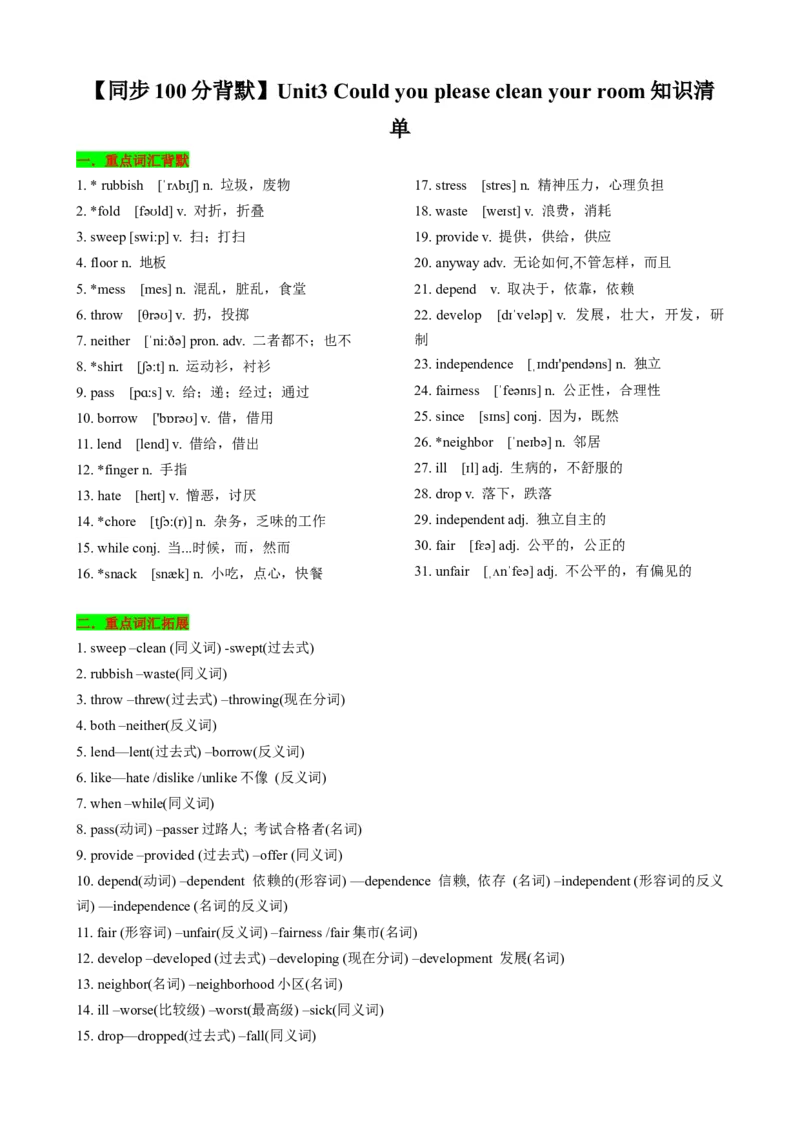
一.重点词汇背默
1. * rubbish [ˈrʌbɪʃ] n. 垃圾,废物 17. stress [stres] n. 精神压力,心理负担
2. *fold [fəʊld] v. 对折,折叠 18. waste [weɪst] v. 浪费,消耗
3. sweep [swi:p] v. 扫;打扫 19. provide v. 提供,供给,供应
4. floor n. 地板 20. anyway adv. 无论如何,不管怎样,而且
5. *mess [mes] n. 混乱,脏乱,食堂 21. depend v. 取决于,依靠,依赖
6. throw [θrəʊ] v. 扔,投掷 22. develop [dɪˈveləp] v. 发展,壮大,开发,研
7. neither [ˈni:ðə] pron. adv. 二者都不;也不 制
8. *shirt [ʃə:t] n. 运动衫,衬衫 23. independence [ˌɪndɪ'pendəns] n. 独立
9. pass [pɑ:s] v. 给;递;经过;通过 24. fairness [ˈfeənɪs] n. 公正性,合理性
10. borrow ['bɒrəʊ] v. 借,借用 25. since [sɪns] conj. 因为,既然
11. lend [lend] v. 借给,借出 26. *neighbor [ˈneɪbə] n. 邻居
12. *finger n. 手指 27. ill [ɪl] adj. 生病的,不舒服的
13. hate [heɪt] v. 憎恶,讨厌 28. drop v. 落下,跌落
14. *chore [tʃɔ:(r)] n. 杂务,乏味的工作 29. independent adj. 独立自主的
15. while conj. 当...时候,而,然而 30. fair [fɛə] adj. 公平的,公正的
16. *snack [snæk] n. 小吃,点心,快餐 31. unfair [ˌʌnˈfeə] adj. 不公平的,有偏见的
二.重点词汇拓展
1. sweep –clean (同义词) -swept(过去式)
2. rubbish –waste(同义词)
3. throw –threw(过去式) –throwing(现在分词)
4. both –neither(反义词)
5. lend—lent(过去式) –borrow(反义词)
6. like—hate /dislike /unlike不像 (反义词)
7. when –while(同义词)
8. pass(动词) –passer过路人; 考试合格者(名词)
9. provide –provided (过去式) –offer (同义词)
10. depend(动词) –dependent 依赖的(形容词) —dependence 信赖, 依存 (名词) –independent (形容词的反义
词) —independence (名词的反义词)
11. fair (形容词) –unfair(反义词) –fairness /fair集市(名词)
12. develop –developed (过去式) –developing (现在分词) –development 发展(名词)
13. neighbor(名词) –neighborhood小区(名词)
14. ill –worse(比较级) –worst(最高级) –sick(同义词)
15. drop—dropped(过去式) –fall(同义词)16. anyway—anyhow(同义词)
17. stress –worry /pressure(同义词)
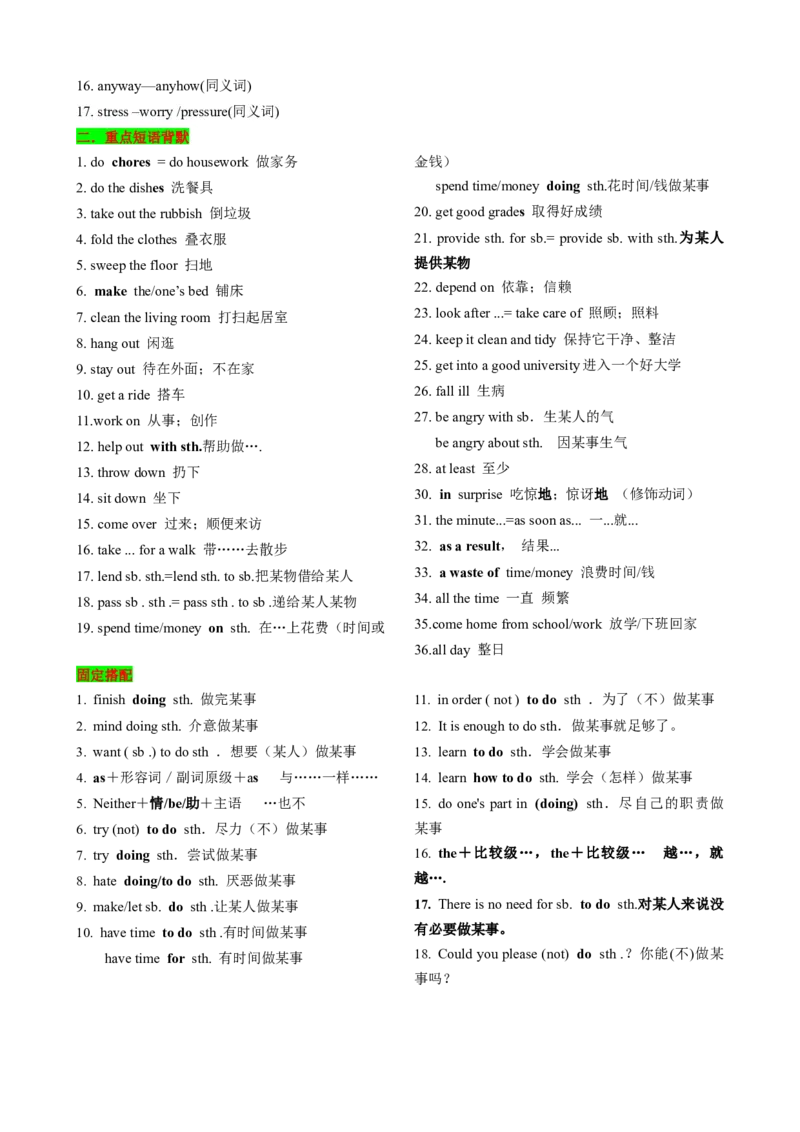
二.重点短语背默
1. do chores = do housework 做家务 金钱)
2. do the dishes 洗餐具 spend time/money doing sth.花时间/钱做某事
3. take out the rubbish 倒垃圾 20. get good grades 取得好成绩
4. fold the clothes 叠衣服 21. provide sth. for sb.= provide sb. with sth.为某人
5. sweep the floor 扫地 提供某物
6. make the/one’s bed 铺床 22. depend on 依靠;信赖
7. clean the living room 打扫起居室 23. look after ...= take care of 照顾;照料
8. hang out 闲逛 24. keep it clean and tidy 保持它干净、整洁
9. stay out 待在外面;不在家 25. get into a good university进入一个好大学
10. get a ride 搭车 26. fall ill 生病
11.work on 从事;创作 27. be angry with sb.生某人的气
12. help out with sth.帮助做…. be angry about sth. 因某事生气
13. throw down 扔下 28. at least 至少
14. sit down 坐下 30. in surprise 吃惊地;惊讶地 (修饰动词)
15. come over 过来;顺便来访 31. the minute...=as soon as... 一...就...
16. take ... for a walk 带……去散步 32. as a result, 结果...
17. lend sb. sth.=lend sth. to sb.把某物借给某人 33. a waste of time/money 浪费时间/钱
18. pass sb . sth .= pass sth . to sb .递给某人某物 34. all the time 一直 频繁
19. spend time/money on sth. 在…上花费(时间或 35.come home from school/work 放学/下班回家
36.all day 整日
固定搭配
1. finish doing sth. 做完某事 11. in order ( not ) to do sth .为了(不)做某事
2. mind doing sth. 介意做某事 12. It is enough to do sth.做某事就足够了。
3. want ( sb .) to do sth .想要(某人)做某事 13. learn to do sth.学会做某事
4. as+形容词/副词原级+as 与……一样…… 14. learn how to do sth. 学会(怎样)做某事
5. Neither+情/be/助+主语 …也不 15. do one's part in (doing) sth.尽自己的职责做
6. try (not) to do sth.尽力(不)做某事 某事
7. try doing sth.尝试做某事 16. the+比较级…,the+比较级… 越…,就
8. hate doing/to do sth. 厌恶做某事 越….
9. make/let sb. do sth .让某人做某事 17. There is no need for sb. to do sth.对某人来说没
10. have time to do sth .有时间做某事 有必要做某事。
have time for sth. 有时间做某事 18. Could you please (not) do sth .?你能(不)做某
事吗?三.重点句子背默
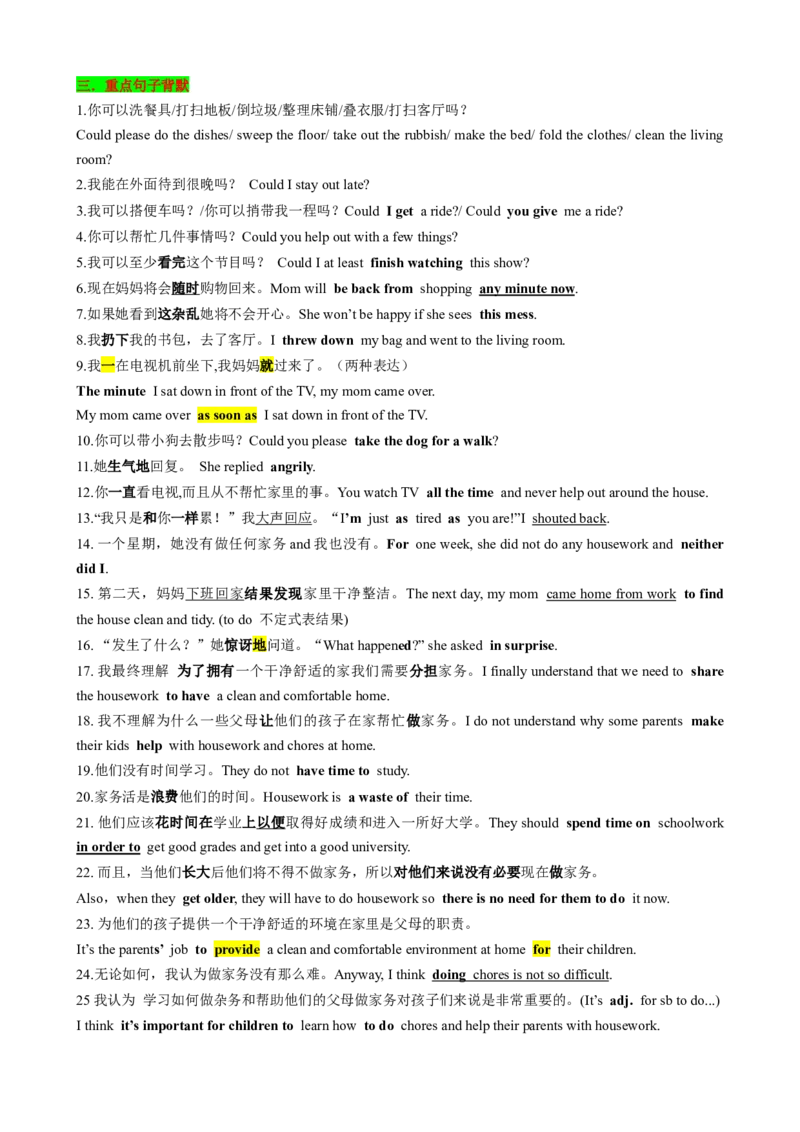
1.你可以洗餐具/打扫地板/倒垃圾/整理床铺/叠衣服/打扫客厅吗?
Could please do the dishes/ sweep the floor/ take out the rubbish/ make the bed/ fold the clothes/ clean the living
room?
2.我能在外面待到很晚吗? Could I stay out late?
3.我可以搭便车吗?/你可以捎带我一程吗?Could I get a ride?/ Could you give me a ride?
4.你可以帮忙几件事情吗?Could you help out with a few things?
5.我可以至少看完这个节目吗? Could I at least finish watching this show?
6.现在妈妈将会随时购物回来。Mom will be back from shopping any minute now.
7.如果她看到这杂乱她将不会开心。She won’t be happy if she sees this mess.
8.我扔下我的书包,去了客厅。I threw down my bag and went to the living room.
9.我一在电视机前坐下,我妈妈就过来了。(两种表达)
The minute I sat down in front of the TV, my mom came over.
My mom came over as soon as I sat down in front of the TV.
10.你可以带小狗去散步吗?Could you please take the dog for a walk?
11.她生气地回复。 She replied angrily.
12.你一直看电视,而且从不帮忙家里的事。You watch TV all the time and never help out around the house.
13.“我只是和你一样累!”我大声回应。“I’m just as tired as you are!”I shouted back.
14.一个星期,她没有做任何家务and我也没有。For one week, she did not do any housework and neither
did I.
15.第二天,妈妈下班回家结果发现家里干净整洁。The next day, my mom came home from work to find
the house clean and tidy. (to do 不定式表结果)
16.“发生了什么?”她惊讶地问道。“What happened?” she asked in surprise.
17.我最终理解 为了拥有一个干净舒适的家我们需要分担家务。I finally understand that we need to share
the housework to have a clean and comfortable home.
18.我不理解为什么一些父母让他们的孩子在家帮忙做家务。I do not understand why some parents make
their kids help with housework and chores at home.
19.他们没有时间学习。They do not have time to study.
20.家务活是浪费他们的时间。Housework is a waste of their time.
21.他们应该花时间在学业上以便取得好成绩和进入一所好大学。They should spend time on schoolwork
in order to get good grades and get into a good university.
22.而且,当他们长大后他们将不得不做家务,所以对他们来说没有必要现在做家务。
Also,when they get older, they will have to do housework so there is no need for them to do it now.
23.为他们的孩子提供一个干净舒适的环境在家里是父母的职责。
It’s the parents’ job to provide a clean and comfortable environment at home for their children.
24.无论如何,我认为做家务没有那么难。Anyway, I think doing chores is not so difficult .
25我认为 学习如何做杂务和帮助他们的父母做家务对孩子们来说是非常重要的。(It’s adj. for sb to do...)
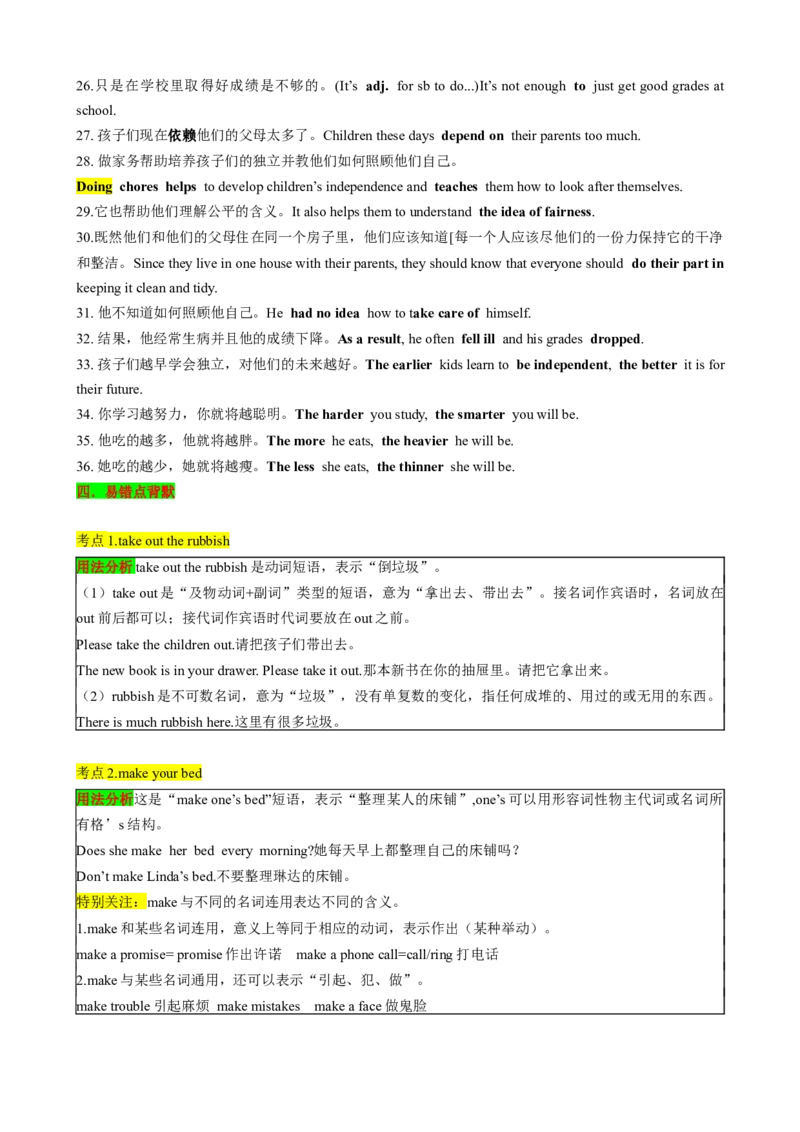
I think it’s important for children to learn how to do chores and help their parents with housework.26.只是在学校里取得好成绩是不够的。(It’s adj. for sb to do...)It’s not enough to just get good grades at
school.
27.孩子们现在依赖他们的父母太多了。Children these days depend on their parents too much.
28.做家务帮助培养孩子们的独立并教他们如何照顾他们自己。
Doing chores helps to develop children’s independence and teaches them how to look after themselves.
29.它也帮助他们理解公平的含义。It also helps them to understand the idea of fairness.
30.既然他们和他们的父母住在同一个房子里,他们应该知道[每一个人应该尽他们的一份力保持它的干净
和整洁。Since they live in one house with their parents, they should know that everyone should do their part in
keeping it clean and tidy.
31.他不知道如何照顾他自己。He had no idea how to take care of himself.
32.结果,他经常生病并且他的成绩下降。As a result, he often fell ill and his grades dropped.
33.孩子们越早学会独立,对他们的未来越好。The earlier kids learn to be independent, the better it is for
their future.
34.你学习越努力,你就将越聪明。The harder you study, the smarter you will be.
35.他吃的越多,他就将越胖。The more he eats, the heavier he will be.
36.她吃的越少,她就将越瘦。The less she eats, the thinner she will be.
四.易错点背默
考点1.take out the rubbish
用法分析take out the rubbish是动词短语,表示“倒垃圾”。
(1)take out是“及物动词+副词”类型的短语,意为“拿出去、带出去”。接名词作宾语时,名词放在
out前后都可以;接代词作宾语时代词要放在out之前。
Please take the children out.请把孩子们带出去。
The new book is in your drawer. Please take it out.那本新书在你的抽屉里。请把它拿出来。
(2)rubbish是不可数名词,意为“垃圾”,没有单复数的变化,指任何成堆的、用过的或无用的东西。
There is much rubbish here.这里有很多垃圾。
考点2.make your bed
用法分析这是“make one’s bed”短语,表示“整理某人的床铺”,one’s可以用形容词性物主代词或名词所
有格’s结构。
Does she make her bed every morning?她每天早上都整理自己的床铺吗?
Don’t make Linda’s bed.不要整理琳达的床铺。
特别关注:make与不同的名词连用表达不同的含义。
1.make和某些名词连用,意义上等同于相应的动词,表示作出(某种举动)。
make a promise= promise作出许诺 make a phone call=call/ring打电话
2.make与某些名词通用,还可以表示“引起、犯、做”。
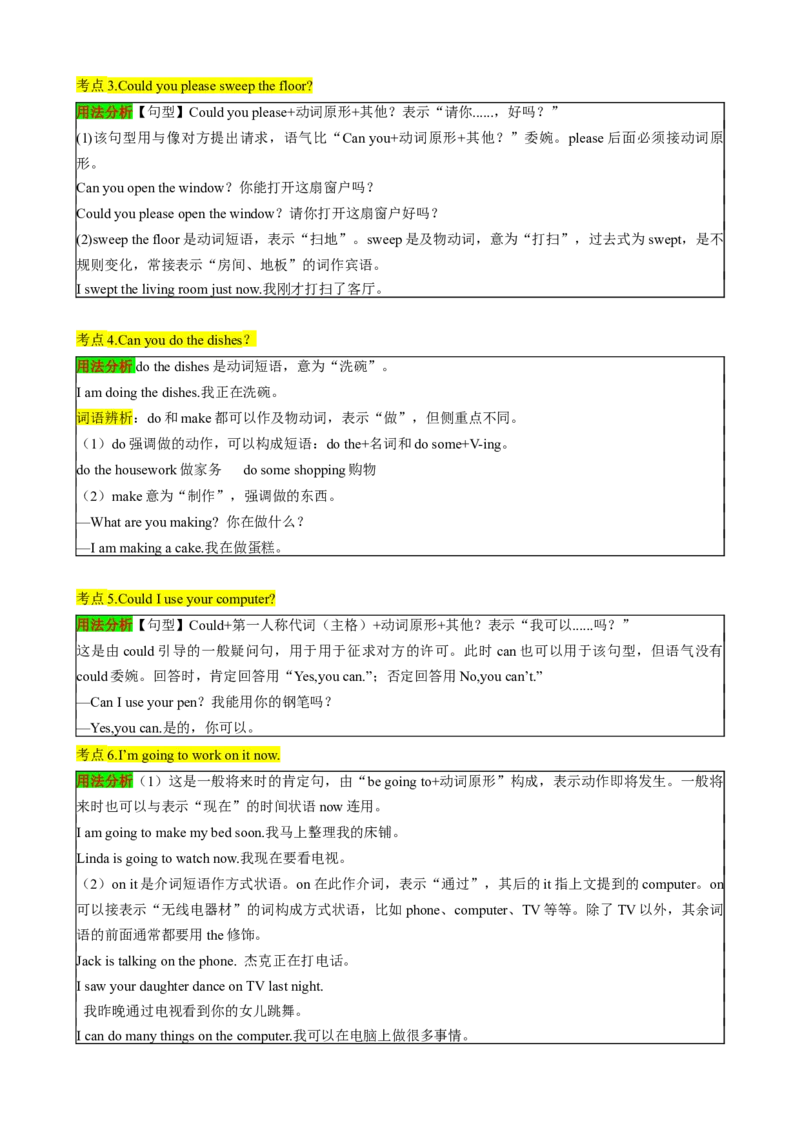
make trouble引起麻烦 make mistakes make a face做鬼脸考点3.Could you please sweep the floor?
用法分析【句型】Could you please+动词原形+其他?表示“请你......,好吗?”
(1)该句型用与像对方提出请求,语气比“Can you+动词原形+其他?”委婉。please后面必须接动词原
形。
Can you open the window?你能打开这扇窗户吗?
Could you please open the window?请你打开这扇窗户好吗?
(2)sweep the floor是动词短语,表示“扫地”。sweep是及物动词,意为“打扫”,过去式为swept,是不
规则变化,常接表示“房间、地板”的词作宾语。
I swept the living room just now.我刚才打扫了客厅。
考点4.Can you do the dishes?
用法分析do the dishes是动词短语,意为“洗碗”。
I am doing the dishes.我正在洗碗。
词语辨析:do和make都可以作及物动词,表示“做”,但侧重点不同。
(1)do强调做的动作,可以构成短语:do the+名词和do some+V-ing。
do the housework做家务 do some shopping购物
(2)make意为“制作”,强调做的东西。
—What are you making? 你在做什么?
—I am making a cake.我在做蛋糕。
考点5.Could I use your computer?
用法分析【句型】Could+第一人称代词(主格)+动词原形+其他?表示“我可以......吗?”
这是由could引导的一般疑问句,用于用于征求对方的许可。此时 can也可以用于该句型,但语气没有
could委婉。回答时,肯定回答用“Yes,you can.”;否定回答用No,you can’t.”
—Can I use your pen?我能用你的钢笔吗?
—Yes,you can.是的,你可以。
考点6.I’m going to work on it now.
用法分析(1)这是一般将来时的肯定句,由“be going to+动词原形”构成,表示动作即将发生。一般将
来时也可以与表示“现在”的时间状语now连用。
I am going to make my bed soon.我马上整理我的床铺。
Linda is going to watch now.我现在要看电视。
(2)on it是介词短语作方式状语。on在此作介词,表示“通过”,其后的it指上文提到的computer。on
可以接表示“无线电器材”的词构成方式状语,比如phone、computer、TV等等。除了TV以外,其余词
语的前面通常都要用the修饰。
Jack is talking on the phone. 杰克正在打电话。
I saw your daughter dance on TV last night.
我昨晚通过电视看到你的女儿跳舞。
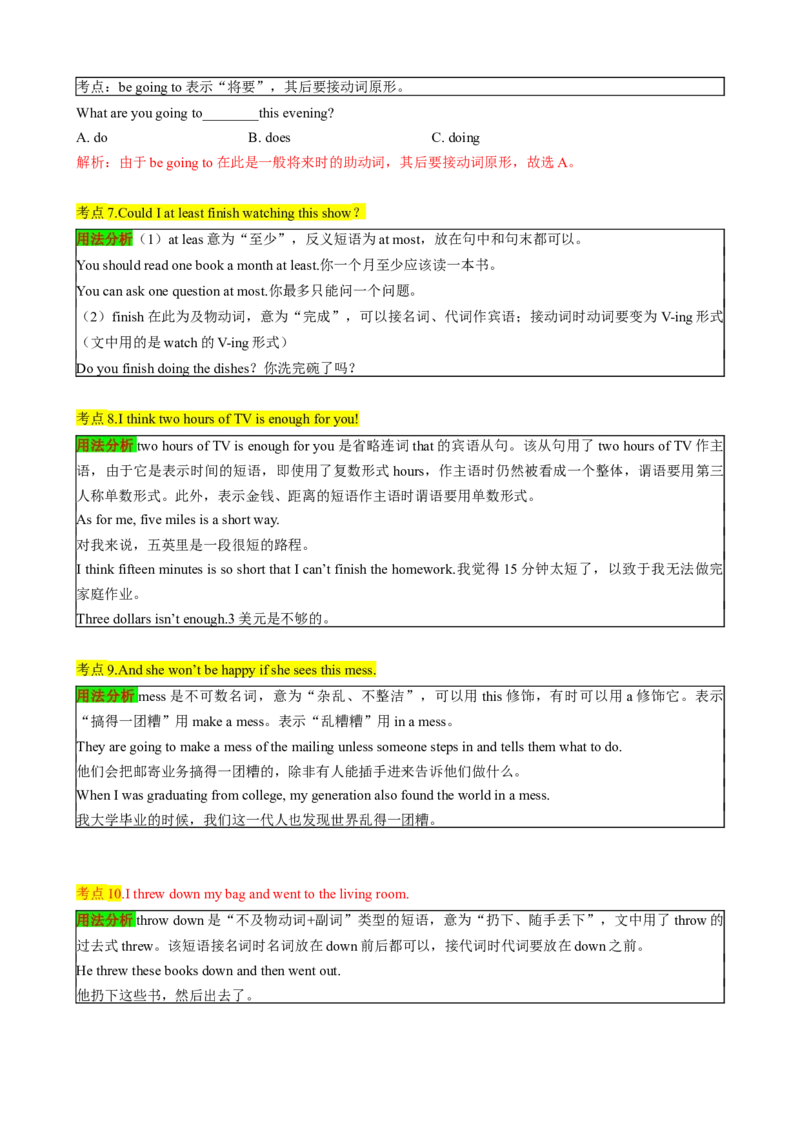
I can do many things on the computer.我可以在电脑上做很多事情。考点:be going to表示“将要”,其后要接动词原形。
What are you going to________this evening?
A. do B. does C. doing
解析:由于be going to在此是一般将来时的助动词,其后要接动词原形,故选A。
考点7.Could I at least finish watching this show?
用法分析(1)at leas意为“至少”,反义短语为at most,放在句中和句末都可以。
You should read one book a month at least.你一个月至少应该读一本书。
You can ask one question at most.你最多只能问一个问题。
(2)finish在此为及物动词,意为“完成”,可以接名词、代词作宾语;接动词时动词要变为V-ing形式
(文中用的是watch的V-ing形式)
Do you finish doing the dishes?你洗完碗了吗?
考点8.I think two hours of TV is enough for you!
用法分析two hours of TV is enough for you是省略连词that的宾语从句。该从句用了two hours of TV作主
语,由于它是表示时间的短语,即使用了复数形式hours,作主语时仍然被看成一个整体,谓语要用第三
人称单数形式。此外,表示金钱、距离的短语作主语时谓语要用单数形式。
As for me, five miles is a short way.
对我来说,五英里是一段很短的路程。
I think fifteen minutes is so short that I can’t finish the homework.我觉得15分钟太短了,以致于我无法做完
家庭作业。
Three dollars isn’t enough.3美元是不够的。
考点9.And she won’t be happy if she sees this mess.
用法分析mess是不可数名词,意为“杂乱、不整洁”,可以用this修饰,有时可以用a修饰它。表示
“搞得一团糟”用make a mess。表示“乱糟糟”用in a mess。
They are going to make a mess of the mailing unless someone steps in and tells them what to do.
他们会把邮寄业务搞得一团糟的,除非有人能插手进来告诉他们做什么。
When I was graduating from college, my generation also found the world in a mess.
我大学毕业的时候,我们这一代人也发现世界乱得一团糟。
考点10.I threw down my bag and went to the living room.
用法分析throw down是“不及物动词+副词”类型的短语,意为“扔下、随手丢下”,文中用了throw的
过去式threw。该短语接名词时名词放在down前后都可以,接代词时代词要放在down之前。
He threw these books down and then went out.
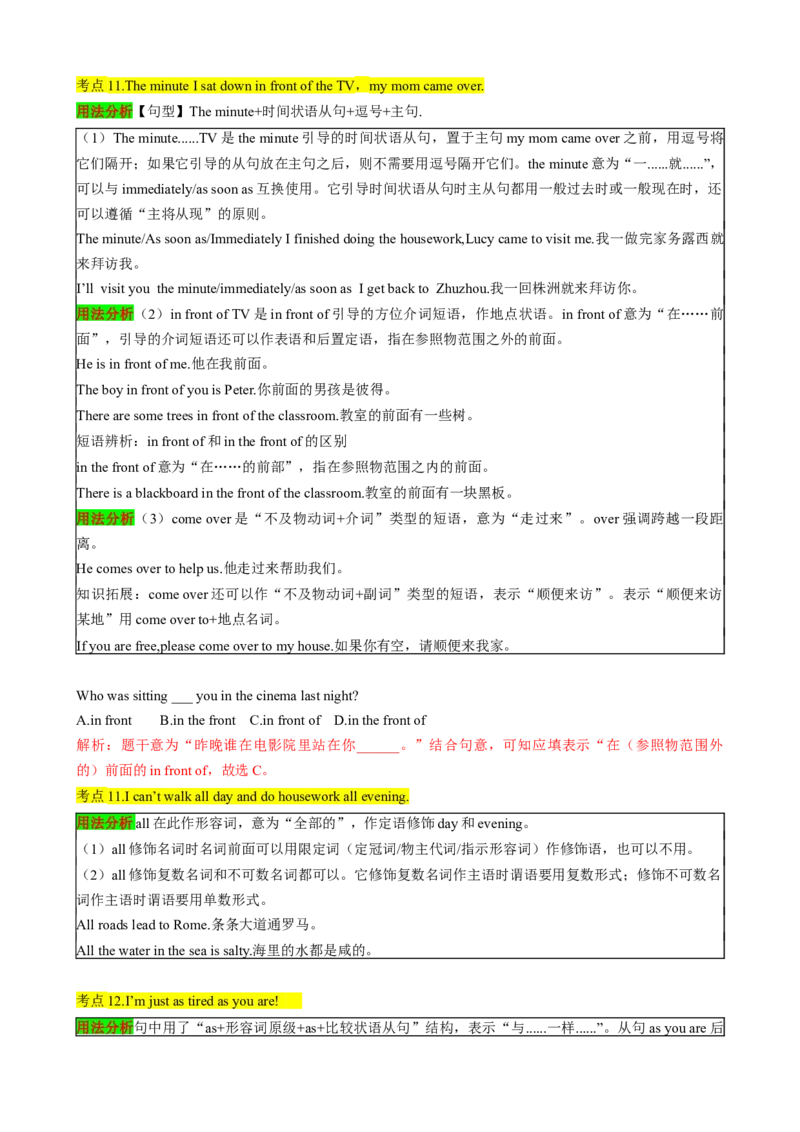
他扔下这些书,然后出去了。考点11.The minute I sat down in front of the TV,my mom came over.
用法分析【句型】The minute+时间状语从句+逗号+主句.
(1)The minute......TV是the minute引导的时间状语从句,置于主句my mom came over之前,用逗号将
它们隔开;如果它引导的从句放在主句之后,则不需要用逗号隔开它们。the minute意为“一......就......”,
可以与immediately/as soon as互换使用。它引导时间状语从句时主从句都用一般过去时或一般现在时,还
可以遵循“主将从现”的原则。
The minute/As soon as/Immediately I finished doing the housework,Lucy came to visit me.我一做完家务露西就
来拜访我。
I’ll visit you the minute/immediately/as soon as I get back to Zhuzhou.我一回株洲就来拜访你。
用法分析(2)in front of TV是in front of引导的方位介词短语,作地点状语。in front of意为“在……前
面”,引导的介词短语还可以作表语和后置定语,指在参照物范围之外的前面。
He is in front of me.他在我前面。
The boy in front of you is Peter.你前面的男孩是彼得。
There are some trees in front of the classroom.教室的前面有一些树。
短语辨析:in front of和in the front of的区别
in the front of意为“在……的前部”,指在参照物范围之内的前面。
There is a blackboard in the front of the classroom.教室的前面有一块黑板。
用法分析(3)come over是“不及物动词+介词”类型的短语,意为“走过来”。over强调跨越一段距
离。
He comes over to help us.他走过来帮助我们。
知识拓展:come over还可以作“不及物动词+副词”类型的短语,表示“顺便来访”。表示“顺便来访
某地”用come over to+地点名词。
If you are free,please come over to my house.如果你有空,请顺便来我家。
Who was sitting ___ you in the cinema last night?
A.in front B.in the front C.in front of D.in the front of
解析:题干意为“昨晚谁在电影院里站在你______。”结合句意,可知应填表示“在(参照物范围外
的)前面的in front of,故选C。
考点11.I can’t walk all day and do housework all evening.
用法分析all在此作形容词,意为“全部的”,作定语修饰day和evening。
(1)all修饰名词时名词前面可以用限定词(定冠词/物主代词/指示形容词)作修饰语,也可以不用。
(2)all修饰复数名词和不可数名词都可以。它修饰复数名词作主语时谓语要用复数形式;修饰不可数名
词作主语时谓语要用单数形式。
All roads lead to Rome.条条大道通罗马。
All the water in the sea is salty.海里的水都是咸的。
考点12.I’m just as tired as you are!
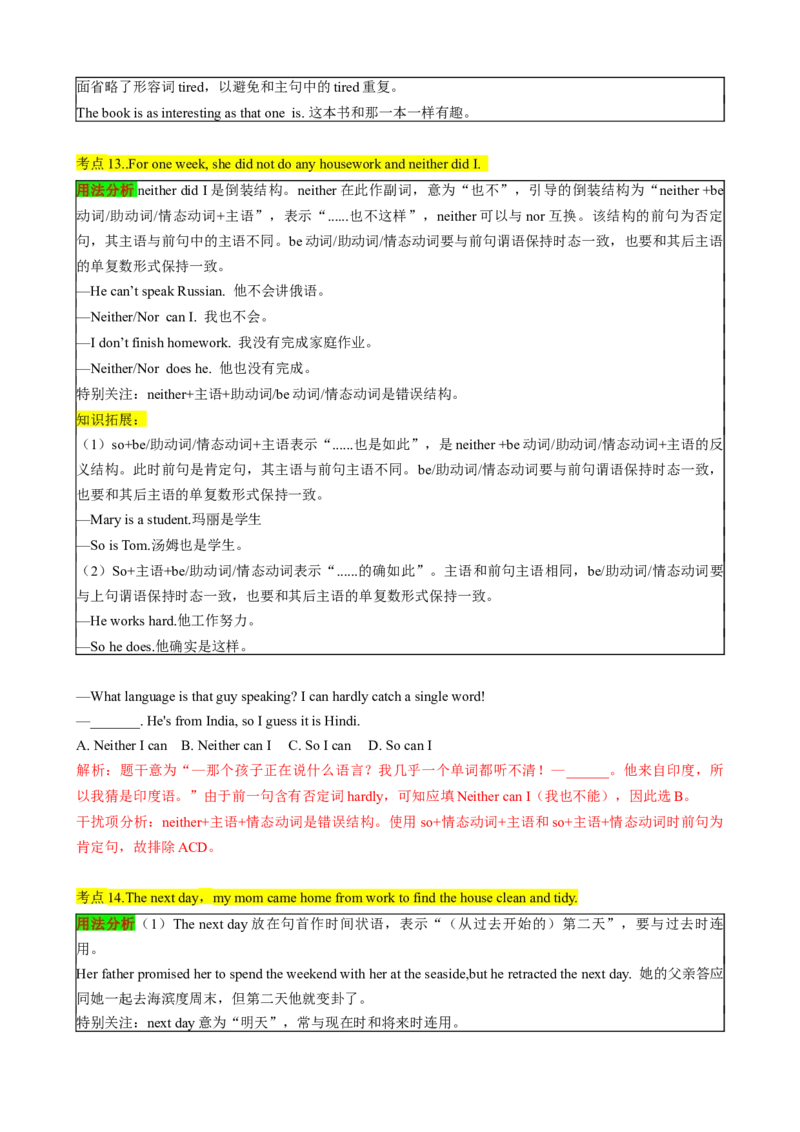
用法分析句中用了“as+形容词原级+as+比较状语从句”结构,表示“与......一样......”。从句as you are后面省略了形容词tired,以避免和主句中的tired重复。
The book is as interesting as that one is. 这本书和那一本一样有趣。
考点13..For one week, she did not do any housework and neither did I.
用法分析neither did I是倒装结构。neither在此作副词,意为“也不”,引导的倒装结构为“neither +be
动词/助动词/情态动词+主语”,表示“......也不这样”,neither可以与nor互换。该结构的前句为否定
句,其主语与前句中的主语不同。be动词/助动词/情态动词要与前句谓语保持时态一致,也要和其后主语
的单复数形式保持一致。
—He can’t speak Russian. 他不会讲俄语。
—Neither/Nor can I. 我也不会。
—I don’t finish homework. 我没有完成家庭作业。
—Neither/Nor does he. 他也没有完成。
特别关注:neither+主语+助动词/be动词/情态动词是错误结构。
知识拓展:
(1)so+be/助动词/情态动词+主语表示“......也是如此”,是neither +be动词/助动词/情态动词+主语的反
义结构。此时前句是肯定句,其主语与前句主语不同。be/助动词/情态动词要与前句谓语保持时态一致,
也要和其后主语的单复数形式保持一致。
—Mary is a student.玛丽是学生
—So is Tom.汤姆也是学生。
(2)So+主语+be/助动词/情态动词表示“......的确如此”。主语和前句主语相同,be/助动词/情态动词要
与上句谓语保持时态一致,也要和其后主语的单复数形式保持一致。
—He works hard.他工作努力。
—So he does.他确实是这样。
—What language is that guy speaking? I can hardly catch a single word!
—_______. He's from India, so I guess it is Hindi.
A. Neither I can B. Neither can I C. So I can D. So can I
解析:题干意为“—那个孩子正在说什么语言?我几乎一个单词都听不清!—______。他来自印度,所
以我猜是印度语。”由于前一句含有否定词hardly,可知应填Neither can I(我也不能),因此选B。
干扰项分析:neither+主语+情态动词是错误结构。使用so+情态动词+主语和so+主语+情态动词时前句为
肯定句,故排除ACD。
考点14.The next day,my mom came home from work to find the house clean and tidy.
用法分析(1)The next day放在句首作时间状语,表示“(从过去开始的)第二天”,要与过去时连
用。
Her father promised her to spend the weekend with her at the seaside,but he retracted the next day. 她的父亲答应
同她一起去海滨度周末,但第二天他就变卦了。
特别关注:next day意为“明天”,常与现在时和将来时连用。Next day,I will go shopping with him.明天我将和他一起去购物。
(2)to find the house clean and tidy是动词不定式短语作结果状语,表示的结果出人意料。动词不定式作
结果状语时常在to前面加上only。
He hurried home only to find nobody in.他急忙回家却发现一个人都没有。
考点15.I finally understand that we need to share the housework to have a clean and comfortable home
用法分析(1)that we need to......home是连词that引导的宾语从句,含有两个动词不定式结构。
第一个动词不定式短语to share the housework作need的宾语。need在此作及物动词,意为“需要”,接
动词不定式作宾语时表示“需要做某事”。第二个动词不定式短语to have a...home作目的状语。
I need to buy a new pen.我需要买一支新钢笔。
用法分析(2)share在此作及物动词,意为“分担”,常接表示“事物”的词作宾语。
I am willing to share the cost of the flowers 我愿意分担买花的费用。
知识拓展:share的其他用法
(1)作可数名词时意为“股票”。
For some months the share price remained very stable.
有那么几个月,股票价格一直非常稳定。
(2)作不及物动词时意为“分享、分担”,常与介词in搭配。
I will share in the cost with you.我与你共同担负费用。
1.Could you please pass me the salt?
pass为及物动词,意为“传递”,在此用了pass sb sth短语,表示“把某物传递给某人”,可以与pass
sth to sb互换。
Pass me the sugar.=Pass the sugar to me.把糖递给我。
特别关注:当pass的直接宾语为代词时,要用pass sth to sb,不用pass sb sth。
That is my pen.Please pass it to me.那是我的钢笔。请把它递给我。
考点16.Could I borrow that book?
用法分析borrow在此作及物动词,意为“借、借用”,指主语借用他人的物品,常构成短语borrow sth
和borrow sth from sb。
May I borrow your bike?我能借用你的自行车吗?
He borrowed a book from me.他从我这儿借走了一本书。
考点17.Could you lend me some money?
用法分析lend是及物动词,意为“借给、借出”,过去式是lent,指主语把东西借给他人。句中用了lend
sb sth短语,表示“把某物借给某人”,可以与lend sth to sb互换。
I lend my bike to him. = I lend him my bike.我把自行车借给他了。
特别关注:borrow和lend都是短暂性动词,在肯定句中通常不与延续性时间状语连用,也不能与 how
long(多久)引导的疑问句连用。如果要连用,它们都要转换成对应的延续性动词keep。
I have kept this book for a week.这本书我借了一周。How long can I keep this book?我可以借这本书多久?
考点18. I’m trying not to get it wet
用法分析(1)句中用了try not to do sth短语,表示“尽力不做某事”。
I try not to make a noise.我尽力不发出声音。
知识回顾:try接动词不定式作宾语时表示“尽力做某事”,接 V-ing作宾语时表示“尝试做某事”,对
动词不定式和V-ing作否定时要在它们的前面加not。
The government is trying to help the poor children go to school.政府正在竭力帮助贫困儿童就学。
He tries cleaning the spot with alcohol.他试着用酒精擦拭污迹。
I try not wasting time.我尝试不浪费时间。
用法分析(2)get it wet用的是“get sb/sth(宾语)+形容词(宾补)”结构。get在此作使役动词,意为
“使得”,it指前句中的finger,形容词wet作宾语补足语,描述it的状态。
Please get everything ready. 请把一切准备好。
They try to get the people interested in the matter.他们试图使人们对这件事感兴趣。
考点19.I hate some chores too
用法分析hate表示“讨厌”的用法hate在此作及物动词,意为“讨厌”,是描述心理状态的动词,不能
与进行时连用。它可以接表示“人、事物”的词作宾语。
I hate you.我讨厌你。
Pat hates her job.帕特不喜欢她的工作。
结构拓展:hate的其他用法
1.hate可以接动词不定式和 V-ing形式作宾语。hate to do sth表示“(具体一次)讨厌做某事”,hate
doing sth表示“(习惯上)讨厌做某事”。
I don’t hate swimming,but today I hate to swim.
我不讨厌游泳,但是今天我讨厌游泳。
2.hate sb doing sth表示“讨厌某人做某事”,doing sth作hate的宾语补足语,是由sb发出的动作。
His mother hates him staying out late.他妈妈不喜欢他晚上在外面呆得太晚。
考点20.I do not understand why some parents make their kids help with housework and chores at home.
用法分析(1)why some......home是疑问词why引导的宾语从句。why引导宾语从句时从句要用陈述语
序,在宾语从句中作原因状语。
I know why he likes swimming.我知道他为什么喜欢游泳。
用法分析(2)make their kids help用的是“make sb(宾语)do sth(宾语补足语)”结构,表示“使某人
做某事”。make在此作使役动词,意为“使得”,help是由their kids发出的动作,表示主动,此时help
的前面必须省略动词不定式符号to。
I often make him laugh.我常常逗他笑。
He made the baby ________.
A. crying B. to cry C. cry D. cried解析:空所在句用了“make sb+所填词”结构。make在此作使役动词,所填词cry是由the baby发出的动
作,要用不带to的动词不定式结构,故选A。
考点21.They don’t have time to study and do housework,too.
用法分析句中用了“have time+动词不定式”结构,表示“有时间做某事”。动词不定式部分 to study and
do housework是由they发出的动作,表示主动。该动词不定式作后置定语修饰time。
I have time to relax.我有放松的时间。
小贴士:否定句中常用or代替and,either代替too,但此句没这样用,这是因为本句是对time的否定,
其后的动词不定式to study...too是肯定结构,因此不能用or和either。
考点22.Housework is a waste of their time.
用法分析句中用了a waste of短语,表示“浪费”。waste为不可数名词,意为“浪费”,用在该结构中
指一种具体的浪费行为,of后面要接名词。
It’s a waste of time and energy. 那是浪费时间和精力。
知识拓展:waste作不可数名词时还可以意为“废弃物”。作及物动词时意为“浪费”。
Don’t waste money.不要浪费钱。
They dispose of the city's waste in the sea. 他们把城市的废物倒入大海处理掉。
考点23.They should spend their time on schoolwork in order to get good grades and get into a good university.
用法分析(1)句中用了“人+spend time on sth”结构,表示“某人花时间在某事上”。
I am willing to spend much time on my study.我愿意把很多时间花在学习上。
知识拓展:spend表示“花费”时还可以构成下面两个句型:
1)人+spend+钱/时间+(in) doing sth.表示“某人花费钱/时间做某事。”(介词in可以省略)。
We spend two hours(in)finishing this task.
我们花两个小时完成了这项任务。
I spend twenty yuan(in)buying this book.
我花20元买这本书。
2)人+spend+钱+on sth.表示“某人花费钱/时间在某物上。”
I spend 5 yuan on this notebook.我花了5元在这个笔记本上。
用法分析(2)in order to......university是由“in order to+动词原形”构成的短语作目的状语,表示“为
了......”。in order to引导的目的状语是to引导的目的状语的强调形式,可以放在句首、句中、句末,放在
句首时要用逗号将其与后面内容隔开,否定形式是在to前面加not。
Jim talks loudly in order to get the girl’s attention.吉姆大声讲话,以吸引那个女孩的注意。
In order not to wake the children,they whispers.为了不弄醒孩子们他们小声说话。
特别关注:so as to也可以引导目的状语,不能放在句首,可以放在句中和句末,此时可以与in order to互
换。
I get up early so as to/in order to catch the first bus.我早起是为了赶上头班车。In order ____ for the meeting, my sister forced herself to get up early this morning.
A. not to be late B. not being late C. to be late D. being late
解析:题干意为“_____迟到,我姐姐强迫自己今天早上早起。”由于in order to+动词原形是固定结构,
又根据句意,可判断这里要用in order to的否定结构,表示“为了开会不迟到”,故选A。
考点24.so there is no need for them to do it now
用法分析这是“there is no need for sb to do sth”句型,表示“对某人来说不需要做某事”。
(1)need在此作可数名词,意为“需要”。for them是for引导的介词短语,动词不定式部分to do it是
them发出的动作。
(2)该句型可与sb don’t / doesn’t need to do sth.互换。
There’s no need for me to break the window.
=I don’t need to break the window.我没必要打破这扇窗户。
考点25.It is the parents’ job to provide a clean and comfortable environment at home for their children.
用法分析【句型】It’s +名词+ to do sth.表示“做......是......”。
(1)it是形式主语,真正的主语是动词不定式to provide... environment。,名词前面可以用定冠词、形容
词性物主代词、名词所有格’s结构作修饰语。
It’s my pleasure to have dinner with you.与你共进晚餐是我的荣幸。
用法分析(2)provide在此作及物动词,意为“提供”,用了provide sth for sb短语,表示“为某人提供
某物”,可以与provide sb with sth互换。
The Internet provides people with a new outlet to express their views.=The Internet provides a new outlet for
people to express their views.互联网为人们提供了一个表达自己观点的新渠道。
知识回顾:offer作及物动词意为“提供”时,固定结构为offer sb sth/offer sth to sb,表示“为某人提供某
物”。
She offers me a cup of coffee.
=She offers a cup of coffee to me. 她给我提供一杯咖啡。
考点26.And anyway
用法分析anyway是副词,在此意为“而且、加之”,用于追加评论。它放在句首、句中、句末都可以,
放在句首时常用逗号将其与后面内容隔开。
I hate the color of this bike.Anyway,it is too old.我讨厌这辆自行车的颜色。而且它太旧了。
知识拓展:anyway意为“无论如何”时可以与anyhow互换。
Anyway/Anyhow, I must finish this task today.无论如何,今天我必须完成这项任务。
考点27.I think it is important for children to learn how to do chores and help their parents with housework.
用法分析【句型】I think it is+形容词+for sb to do sth.表示“我觉得做......是......。”
(1)it is important...housework是省略连词that引导的宾语从句。此时最后带上连词that,因为在书面语
中,如果that引导的宾语从句很长时,通常不省略连词that。(2)从句用了“it is+形容词+for sb+动词不定式.”结构。it是形式主语,真正的宾语是动词不定式部分。
for引导的介词短语说明该动词不定式是由children发出的动作。
It is important for me to do more exercise.对我来说多做运动很重要。
特别关注:think接that引导的宾语从句时,如果从句用了“it is+形容词+(for sb)+动词不定式.”句型,
从句可以转换为it+(for sb)+动词不定式(it为形式宾语)。
I think that it is necessary to learn Chinese well.
=I think it necessary to learn Chinese well.我觉得学好汉语是很有必要的
用法分析(3)how to do...housework是“疑问词+动词不定式”结构,作to learn的宾语。“疑问词+动词
不定式”是固定表达方式,疑问词中除了why以外,都可以用于该结构。该结构相当于一个名词,可以
充当主语、宾语、表语等成分。
How to do it is still a question. 该怎样做仍旧是一个问题。(how to do作主语)
I don’t know where to go. 我不知道去哪里。(where to go作宾语)
The question is who to do it. 问题是谁能去做这件事。(who to do it作表语)
He doesn’t know_______.
A. how to do B. to do how C. do how D. what to do
解析:由于疑问词+动词不定式是固定结构,do在此为行为动词,所填词要用to do的宾语,故选D。
考点28.Children these days depend on their parents too much.
用法分析(1)depend on是“不及物动词+介词”类型的短语,在此意为“依靠、信赖”,on可以与upon
互换,其后要接表示“人”的词作宾语。
You can’t depend upon/on your parents forever.你不能永远依靠你的父母。
知识拓展:depend on/upon的其他用法
(1)意为“指望”时构成depend on / upon sb to do sth结构,表示“指望某人做某事”。
I depend on you to do it.这件事我就指望你做了。
(2)意为“取决于”时可以接表示“人、事物”的词以及宾语从句。
It depends on/upon you.这取决于你。
The price depends on/upon the quality.价格取决于质量。
Our success depends on/upon whether everyone works hard or not.我们的成败取决于每个人是否努力工作。
—How long are we staying here?
—That the weather.
A.leaves for B.depends on C.decides on
解析:题干意为“我们在这里呆多久?这____天气。”根据句意和选项,可知要填表示“取决于”的
depends on,故选B。
考点29.They are always asking
用法分析这是“be always doing”结构,表示“总是在做某事”,在此含有批评的感情色彩。always与进
行时连用时,表示说话人的一种情绪,比如赞扬、批评、抱怨等等。She is always thinking of others.她总是为别人着想。(赞扬)
They are always making loud noise.他们总是发出这么大的噪音。(抱怨)
考点30.Doing chores helps to develop children’ s independence
用法分析(1)develop在此作及物动词,意为“培养”,常接表示“习惯、独立性”等抽象名词作宾语。
I find it important to develop a good habit.我发现养成一个好习惯很重要。
知识拓展:develop作不及物动词时意为“发育”。作及物动词时意为“开发、发展、患病”。
The child is developing normally.这个孩子发育正常。
He intends to develop the new computer software.他打算开发一种新的计算机软件。
We have to develop our economy.我们必须发展经济。
It is said that he develops asthma.据说他患上了哮喘。
(2)independence在此作不可数名词,意为“(个人生活的)独立”。
You can maintain your independence.你可以保持独立。
知识拓展:independence对应的形容词是independent,可以与介词of搭配,表示“不依赖”,反义短语
是dependent on/upon。
You shouldn’t be dependent on you.你不应该依赖我。
考点31.It also helps to understand the idea of fairness.
用法分析fairness是不可数名词,意为“公平”,反义词为unfairness,意为“不公平”。
Our teacher is known for her fairness in grading pupils. 我们的老师以给学生评分公平著称。
After all, fairness is good and unfairness is bad.毕竟,公平是好事,不公平是不好的。
知识拓展:fairness的形容词是fair,意为“公平的”,反义词为unfair,意为“不公平的”。
It's not fair/unfair to blame me for that. 为那件事埋怨我是不公平的。
考点32.Since they live in one house with their parents,they should know that everyone should do their part in
keeping it clean and tidy.
用法分析【注释1】Since they...parents是since引导的原因状语从句,置于主句they should ...tidy之前,用
逗号将它们隔开。since在此意为“由于”,语气比because弱,表示显然的理由。
Since he was lazy, he didn’t finish his homework.由于他懒,他没有完成家庭作业。
用法辨析:because、since、as、for表示原因的区别
(1)because意为“因为”,引导原因状语从句时语气最强,指事情发生的直接原因。
Because he was ill, he was late for school.他生病了,所以迟到了。
(2)as的语气比since弱,意为“由于、鉴于”, 引导原因状语从句时表示附带说明的双方已知的原
因。
As there was no answer, I wrote again.鉴于没回复,我又写了一封信。
(3)for作并列连词,引导并列句,语气最弱。它表示推断的理由, 只放于主句之后。
He could not have seen me, for I was not there. 他不可能见过我, 因为我不在那里。
【注释2】主句they should know that...... tidy包含了一个that引导的宾语从句that everyone ... and tidy。该宾语从句中用了do one’s part in doing sth短语,表示“尽某人的职责做某事”。由于in是介词,接动词时
必须用动词的V-ing形式。
The President asked them to do their part in fighting inflation.总统要求他们尽自己的本份对付通货膨胀。
【注释3】keeping it clean and tidy用的是“keep sth+形容词”短语。keep作使役动词,意为“使得”。it
指上文中的house。clean and tidy作宾语补足语,描述it的状态。
Don’t close the door. Keep it open.别关门。让它开着。
考点33. As a result, he often fell ill and his grades dropped.
用法分析(1)as a result是介词短语,意为“结果”,作结果状语,指上文的原因或动作造成本句的结
果。它放在句首时要用逗号将其与后面内容隔开。
He got up very late today. As a result, he missed the first bus.
他今天起晚了,结果没赶上头班车。
知识拓展:as a result of是短语介词,表示“由于......的原因”,相当于because of。
The train was delayed as a result of/because of the heavy rain.
由于大雨的缘故主,火车晚点了。
(2)fell ill表示“生病”,由“fall+形容词”构成(fell是fall的过去式)。fall在此作连系动词,意为
“陷入(某种状态)”,常接形容词作表语。由于它是短暂性动词,在肯定句和疑问句中不与延续性时
间状语连用。
He fell ill yesterday.他昨天生病了。
He fell asleep just now.他刚才睡着了。
用法分析(3)drop在此作不及物动词,意为“下降”,是无意识行为,指数量、价格、温度下降。由于
它是以一个元音+一个辅音结尾的动词,变过去式要双写p,再加ed。
Stock prices dropped sharply last month.上个月股票价格暴跌。
The temperature dropped to zero the next morning.第二天早上温度降到了零度。
考点34.The earlier kids learn to be independent, the better it is for their future.
用法分析【句型】The+比较级+主语+谓语+其他,the+比较级+主语+谓语+其他.表示“越......,就
越......”。
(1)两个比较级前面的the不能省略。谓语是be动词/连系动词/感官动词,the后面用形容词比较级。谓
语是其他行为动词,the后面用副词比较级。
(2)前一个部分相当于条件状语从句,后一个部分相当于主句。前一个部分用一般现在时,后一个部分既
可以用一般现在时,又可以用一般将来时。
The harder you work,the more you will learn.你越刻苦学习,你学的知识就越多。
The busier he is,the happier he feels.他越忙越快乐。
Boys and girls,believe in yourself.The you are,the better grades you’ll get.
A.more careful B.more carefully C.most carefully
解析:由于“The +比较级+主语+谓语,the +比较级+主语+谓语.”是固定句型,而且所填词作are的表语,应填形容词比较级,故选A。
五.语法点记忆
情态动词
一.情态动词could用于征求许可时要用在一般疑问句中,句型为“Could+I/we+动词原形+其他?”用于表
达请求别人允许自己做某事。回答该句型时要借助情态动词can/can’t,不能用could/couldn’t。肯定回答可
以用“Sure./Of course./Certainly./Yes,you can.”,否定回答用“Of course not./Certainly not./No,you can’t.”。
—Could I go to school now?我现在可以去上学吗?
—Sure.可以。
—Could we go skating with you?我们可以跟你一起去滑冰吗?
—No,you can’t. 不可以。
考点:could引导一般疑问句用于征求许可,回答时要用can,不能用couldn’t。
—Could I use your eraser for a while?
—Yes, of course you_____.
A.could B. can C. will D. Should
解析:这是could引导的一般疑问句,用于请求别人允许自己做某事,回答时要用can,因此选A。
二.情态动词could可以用于委婉地提出请求,句型为“Could you(please)+动词原形+其他?”
(1)如果you的后面带上please,则语气更为有礼貌。
(2)“Could you please......?的否定形式要在please后面加not。
(3)回答该句型时情态动词要借助 can,不能用 could。肯定回答用“Yes,I/we can.”,否定回答用
“No,I/we can’t.”。
—Could you go out for dinner with us?你可以和我们一起去外面吃晚餐吗?
—No,I can’t.不行。
—Could you please not make a noise?请你们不要弄出噪音,好吗?
—Yes,we can.好的。
特别关注:“Will/Would/Could you please+(not)+动词原形+其他?”都可以提出请求,但would/could
比will委婉。please可以置于句尾,用逗号将其与前面内容隔开。
Could / Would/Will you please calm down?
=Could / Would/Will you calm down,please?请你冷静点好不好?
考点:回答“Could you please+动词原形+其他?”时,可以用can,不能用could。
—Could you please turn off the TV?
—____,I_____.I want to watch the sports news.
A.No;couldn’t B.Sorry;can’t C.Sure;can D.Sorry;couldn’t
解析:题干意为“—请你关掉电视,可以吗?—____,我想要看体育新闻。”根据句意,可判断所填词
具有否定含义。由于对Could you please......句型作否定回答时要用can’t,不用couldn’t,因此选B。
常考情态动词
用法和例句(1)can常用来表示能力,意为“能够,会”。
—Can you speak English?——你会说英语吗?
—No,I can,t. ——不,我不会。
can
(2)can表示请求、允许,意为“可以”。
Can you go shopping with us?你可以和我们一起去购物吗?
Can I help you?我有什么可以为你效劳的吗?
(1)may表示请求、许可,意为“可以”,比 can 更委婉。
You may go now. 你现在可以走了。
may May I go now?我现在可以走了吗?
(2)may表祝愿。
May you succeed!祝你成功!
(1)must表示主观看法,意为“必须,一定”。
You must stay here until I come back.
你必须待在这儿,直到我回来为止。
Must I hand in my paper right now?
must
我必须现在交论文吗?
(2)其否定形式 mustn‘t 表示“一定不要;千万别;禁止;不许”。
You mustn‘t play with fire. 你不许玩火。
You mustn‘t be late. 你一定不要迟到。
need 表示“需要”, 主要用于否定句和疑问句中,其否定形式为 needn‘t,意为“没有必要,不必”。
注意:need还可以作实义动词,此时有人称、数和时态的变化,后边多接动词不定式。如:He needs to
need learn more about the girl. 他需要多了解那个女孩儿。对 need 的词性的判断常为难点,need后加 to
do 说明 need 为实义动词,用助动词构成疑问句或否定句;need后加 doing 表示被动意义;若 need后
加 do,则need为情态动词。
考点二 表推测
可能性
句式
有可能 一定
肯定句 may must
续表
否定句 may not Can’t
疑问句 can
1.肯定句中表推测常用may 和must
This book may be Lily,s. I,m not sure. 这本书可能是莉莉的,我不太确定。
This book must be Lily‘s. Look, her name is on the cover.这本书一定是莉莉的。看,书皮上有她的名字。2.否定句中常用can‘t 表推测,意为“不可能”。此处重点区分mustn‘t,mustn‘t意为“禁止,不允许”,不可
以表示否定的推测
The man over there can‘t be Mr. Zheng, because he has gone to Beijing. 那边的那个人不可能是郑先生,因
为他去北京了。
3.疑问句中只用can 表推测
Can the news be true?
这消息是真的吗?
考点三 答语
确定情态动词答语的基本原则为用哪个情态动词提问就用哪个情态动词作答。但也有一些例外情况,
这些例外情况也是考试的常见考点。
1.May I...?句型的否定回答常用can‘t或 mustn’t
—May I play computer games now, Mum?——我现在可以玩电脑游戏吗,妈妈?
—No, you can‘t/mustn’t.——不,你不可以。
2.Must I...?句型的否定回答常用needn’t或don‘t have to
—Must I finish my homework tonight?——我今晚必须完成我的作业吗?
—No, you needn’t/don‘t have to. You can do it tomorrow.
——不,你不必。你可以明天再写。
3.Could I...?句型的答语常用can
—Could I use your bike for a while?
——我可以用一会儿你的自行车吗?
—Sure, you can.——当然,你可以。
4.Need I...?句型的答语,肯定回答一般用must, 否定回答一般用need not
—Need I leave so soon?——我有必要那么快就走吗?
—Yes, you must.——是的,你必须这样。
1.My elder sister is good at learning languages. She speak five languages.
A.shall B.must C.can D.may
【答案】C 句意:我姐姐擅长学语言。她会说五种语言。本题考查情态动词的基本用法。A选项意为“将
要”;B选项意为“必须,一定”;C选项意为“能,会”;D选项意为“可以,可能”。由句意可知本题选择
C。
can表能力时可替换为be able to,如本题题干第二句话也可表达为“She is able to speak five languages.”。
2.—I‘m afraid I have to leave now, for Mum is waiting for me.
—Well, if you , at least wait till the heavy rain stops.
A.can B.may C.need D.must
【答案】D 句意:——恐怕我现在不得不走了,因为妈妈正在等着我。——好吧,如果你必须走,至少等到大
雨停了。本题考查情态动词的基本用法。A选项意为“能,会”;B选项意为“可能,可以”;C选项意为“需
要”;D选项意为“必须,一定”。由句意可知本题选择D。
3.—What will happen to me if I take the medicine?
—You have pains all over. If so, please come to me and I‘ll change to another kind of medicine to treatyou.
A.must B.may C.should D.need
【答案】B 句意:——我如果吃了这种药会发生什么?——你可能全身疼。如果那样的话,请来找我,我会换
另一种药来给你治病。本题考查情态动词表推测的用法。此处表示“可能”,故本题选择B。must一
定,should应该,need需要,不符合句意。
4.The boy in the corner be Tom. He‘s gone to China.
A.may B.must C.can‘t D.mustn’t
【答案】C 句意:角落里的那个男孩不可能是汤姆。他已经去中国了。由“He‘s gone to China.”可知说话
人非常确定那个男孩不是汤姆,故选择C。
六.写作背默
本单元以"家务、杂务"为话题,围绕这一话题,引导学生学习掌握情态动词could表示委婉地请求
以及请求许可的用法。以谈论家务以及对家务喜欢与不喜欢的原因和理由为话题的作文或是请求他人帮
忙的电子邮件之类的书面表达是单元测试或中考所常考查的。
常用句型
1. The students of our class have different ideas about...
2. Some parents think...
3. These years, some students are interested in...
4. I like... but I hate...
5. Firstly, ... secondly, ... Thirdly ...
6. In my opinion...
7. In a word...
例
Dear Sir,
I agree that children should learn how to do chores and help their parents with housework.
Every family has a lot of housework. I think all of us should learn to do housework at home. I often help my
parents do housework such as doing the dishes, washing clothes, cleaning the room and watering flowers. I have
learned to take good care of myself and my family by doing housework. Sometimes cleaning all the rooms is an
enjoyable experience. When I look at the clean and bright windows, I really feel proud of myself. And doing
housework is also a good kind of exercise.
I think we students should spend some time on the housework, no matter how busy we are.
Your truly,
Li Hua
一
某英文报社就家务劳动(housework)这一话题征文,请你投稿。
每个家庭都有很多家务,人人都应该学做一些。谈谈你经常帮父母做哪些家务,有什么体会,并打
算在寒假为家里做什么。
根据以上提示,写一篇意思连贯,符合逻辑,不少于80词的短文。文章中请不要出现真实的姓名。
参考词汇:lots of housework,learn to do,be\feel proud of___________________________________________________________________________________________
___________________________________________________________________________________________
___________________________________________________________________________________________
___________________________________________________________________________________________
___________________________________________________________________________________________
_____
【答案】
Every family has lots of housework. Everyone should learn to do some of housework. I often help my parents
do housework, such as washing clothes, cleaning the room and watering the flowers. I think I’ve learned how to
take care of myself and my family by doing housework. Sometimes cleaning all the windows is an enjoyable
experience. I really feel proud of myself. And doing housework is also a kind of exercise. The winter holiday is
coming. I’m going to learn how to cook some dishes. My parents will be happy to enjoy them.