课程主题 : 6B U6同步复习 授课时间:
学习目标 掌握第六单元的重点词汇,句型及语法
教学内容
【进门测试】
一、单项选择
( ) 1. The children______ learn about Chinese culture next week.
二、
A. will to B. will C. is going to
按要
( ) 2. —______ did you know about the UK? —I asked my e-friend.
求,
A. When B. What C. How
改句
( ) 3. A lot of ______ come to China every year.
子
A. visitor B. visit C. visitors
1.
( ) 4. —There are so many ______ in our school. —Yes, they are cool.
A. Australia B. Australian C. Australians
( ) 5 —What’s Liu Tao going to do? —He______ a model ship.
A. is making B. makes C. is going to make
( ) 6. —Where do you usually chant______ Ben? —We chant______ the Internet.
A. to; on B. with; on C. with; in
( ) 7. ______ is the capital(首都)of Australia.
A. Sydney B. Canberra C. Melbourne
( ) 8. People ______ Australian football games because they are_______.
A. loves; excitedly B. love; exciting C.love; excited
( ) 9. The weather is sometimes ______in the UK
A. rain B.rains C. rainy
( ) 10. —Where can we ______the Big Ben? —In ______.
A. find; the UK B. find; the US C. look for; the UK
Nancy is going to go camping.(改为否定句)
Nancy ________ going to go camping.
2. I’ll go and join them.(改为否定句)
I _______ go ______ join them.
3. I’m going to get up at 6:30 tomorrow.(改一般疑问句)
________ _______ ________ to get up at 6:30 tomorrow?
4. We will meet at the bus stop at 10:30.(改一般疑问句)
_______ ________ meet at the bus stop at 10:30?
5. She is going to listen to music after school.(对划线部分提问)
________ _______ she ________ ________ _________ after school?
6. My father and mother are going to see a play next week. (对划线部分提问)
_________ _________ going to see a play next week?
三、用所给动词的适当形式填空
1.Liu Tao will_______(finish) primary school soon and go to middle school.
2.Nancy is going to______ ( play ) the piano at the concert.3.Listen! Nancy_______ ( sing ) an English song now.
[来源:学_科_网Z_X_X_K]
4.They______(talk)about the plan at the weekends at the moment.
5.I_____(go) to the supermarket to buy some gifts for my parents soon .
6.My father is ______(write)a letter in his study(书房).
7.Look!What are they doing in the park? They ________(talk).
8. --What are you going to do this weekend?
--I______(watch) a film.
【多元导学】
各个国家的标志性建筑你都知道吗?
【互动精讲】
建议70min
上半部分知识点
Story time-Fun time
知识点1:重点单词、词组
单词
1.国家 (复数: ) 2. 学习 (过去式: )
3.关于 4. 澳大利亚 (澳大利亚人 )
5.将要 6. 下一个
7.网友 8. 发送 (过去式: )
9.互联网 10. 杂志
11.动物 12. 袋鼠 (复数: )
13.考拉 14. 运动爱好者
词组
1. 一个有趣的国家 2. 学习有关… 3. 下周
4. 找到 5. 在这些课前
6. 询问在澳大利亚的网友 7. 发给我一些照片
8. 来自 9. 读关于澳大利亚的书 10. 在网上
11. 去图书馆 12. 寻找 13. 在家
14. 许多趣事 15. 喜欢动物
16. 喜欢我们的袋鼠和考拉 17. 澳式橄榄球
18. 非常令人激动的 19. 一个美丽城市 20. 许多人知识点2:Story time词汇讲解
1.country 国家
短语:一个大国家 一个有趣的国家
复数:
例句:How many countries are there in the World?
Welcome to our country.
例题:China is a very large _____.(国家)
[来源:学,科,网]
2.learn 学习
短语:学习英语 学习关于
例句:Do you like learning cooking?
例题:Let’s ______ Maths. (学习)
3.magazine 杂志
复数:magazines
短语:读杂志 买一本杂志
例句:What’s the magazine about?
Do you like reading magazines?
例题:This is a m_______.(杂志)
These are m_______.(杂志)
[来源:学_科_网]
4.lover 爱好者
复数:lovers
动词:love
短语:书爱好者 舞蹈爱好者
例句:Some dance lovers are going to have a party.
例题:I love reading very much, so I am a book l______.(爱好者)
5.exciting 令人激动的
短语: 一场令人激动的比赛
拓展:exciting 形容词 “ ” ,修饰
excited 形容词 “ ” ,修饰
例句:Australian Football game is very exciting.
I’m excited about the match.6.welcome 欢迎
第三人称单数:
现在分词:
过去式:
短语:欢迎到我家 欢迎回家
例题:We ______ (欢迎) book lovers to our school.
7.visitor 名词,拜访者,游客
动词:visit
短语:许多游客
例句:There are a lot of visitors in our school.
8.like 介词,像
搭配:看起来像
例句:I look like my father.
例题:Do you look _____(像)your mother?
回顾:like 动词,喜欢,后加名词、代词或doing
例题:你喜欢打篮球吗?
知识点3:一般将来时
1.一般将来时的概述
1) 含义:表示将要发生的动作或存在的状态及打算、计划或准备做某事。
2)常与一般将来时连用的时间:tomorrow, next day (week, month, year…), soon, the day after tomorrow(后
天), this evening/ afternoon, tonight等。
e.g.: She is going to swim tomorrow.
They will be at home soon.
2.一般将来时的用法
1)表示将来某个时间存在的状态,常与be动词连用,如:
They will be students next year.
2)表示将来或者计划做的事情,常含实义动词,如:
He is going to pick carrots this afternoon.
3.一般将来时的结构1) 一般将来时的结构有两种,且两种结构可以进行同义句转换:
①be (am/ is/ are) going to + do e.g.: I am going to watch TV tomorrow morning.
②will+ do e.g.: They will come to Nanjing next year.
注意:be going to中be动词的变化根据主语的不同而不同;而will则是所有人称都可以。
I am going to swim tomorrow. = I will swim tomorrow.
例题:用所给词的适当形式填空。
1. Today is a sunny day. We ___________________ (have) a picnic this afternoon.
2. My cousin _______ (play) the piano next Sunday.
3. My uncle told me a funny story last night. He _________(tell) me another one this evening.
4. Mary usually gets up at seven o’clock. But tomorrow morning she _______ (get) up at six o’clock.
5. The boys are busy now. They __________ (be) going to have a football match this afternoon.
2) 句式转换
①一般将来时的否定句:在be动词或者will后面直接加not. (缩写为won’t)
e.g.: I’m going to have a picnic this afternoon.→ I’m not going to have a picnic this afternoon.
We will listen to music next lesson. → We will not (won’t) listen to music next lesson.
②一般将来时的一般疑问句:直接将be动词或will提前放到句首。
[来源:Z_xx_k.Com]
e.g.: We are going to go on an outing this weekend. → Are you going to go on an outing this weekend?
They will have a picnic next week. → Will they have a picnic next week?
③一般将来时的特殊疑问句:特殊疑问词开头,后面加一般疑问句。
e.g.: When will you finish your homework?
= When are you going to finish your homework?
下半部分知识点
知识点1:重点单词、词组
单词
1. 悉尼 2. 欢迎 3. 游客 4. 植物 5. 天气
6. 新鲜的 7. 风景 8. 更多的 9. 信息 10. 如
11. 伦敦 12. 牛津 13. 沙拉 14. 厨师 ( 炊具)
词组
1. 每年 2. 在澳大利亚的人 3. 欢迎参观者
4. 读有关...的书 5. 植物和动物 6. 告诉某人关于某事 7. 有时有雨的
8. 一些有趣的城市 9. 在这个国家 10. 例如 11. 大本钟
12. 伦敦眼
13. (伦敦)塔桥 14. 新鲜空气 15. (美国)黄石国家公园 16. 美丽的
风景 17. (澳大利亚)大堡礁 18. (英国)巨石阵 19. 做份土豆色拉 20.一名出色的厨师 21. 一些水果 22. 做一些三明治 23. 迫不及待做某事
知识点2:重点讲解
1.You’ll find interesting places like Big Ben, the London Eye and Tower Bridge.你会发现有趣的地方如大本
钟,伦敦眼和塔桥。
interesting places ,interesting 形容词,意为“ ”, 元音音标开头的单词,前面
出现不定冠词,用 .
例: an interesting place 一个有趣的地方
2.fresh air 新鲜的空气
空气air是一个 名词,形容数量多要用 来修饰。
例题:现在没有多少新鲜的空气了。
3. Billy likes eating nice food. 比利喜欢吃美味的食物。
喜欢做……
喜欢吃美味的食物
4.Billy wants to find out about cooking.比利想要查阅有关烹饪的知识。
想要做…… 例:我想要看电视。
想要某物 例:我想要一个自行车
find out about cooking
5. I’ll learn about cooking on the Internet. 我将在网上学习有关烹饪的知识。
learn about cooking 学习烹饪
6. Will you cook fish for me? 你将会为我烧鱼吗 Yes, I will. 是的,我将会。 No, I won’t. 不,我不会
cook…for… 烧鱼
7.make a potato salad 做一份土豆沙拉
例题:做一份水果沙拉
8.a good cook 一名出色的厨师
cook 名词 ; 动词
cooker 名词
9.can’t wait to do sth 迫不及待做某事
例题:我迫不及待想见到我的奶奶了。
知识点3:语音: “air”的发音
air chair fair hair
例题:选出画线部分读音不同的一项
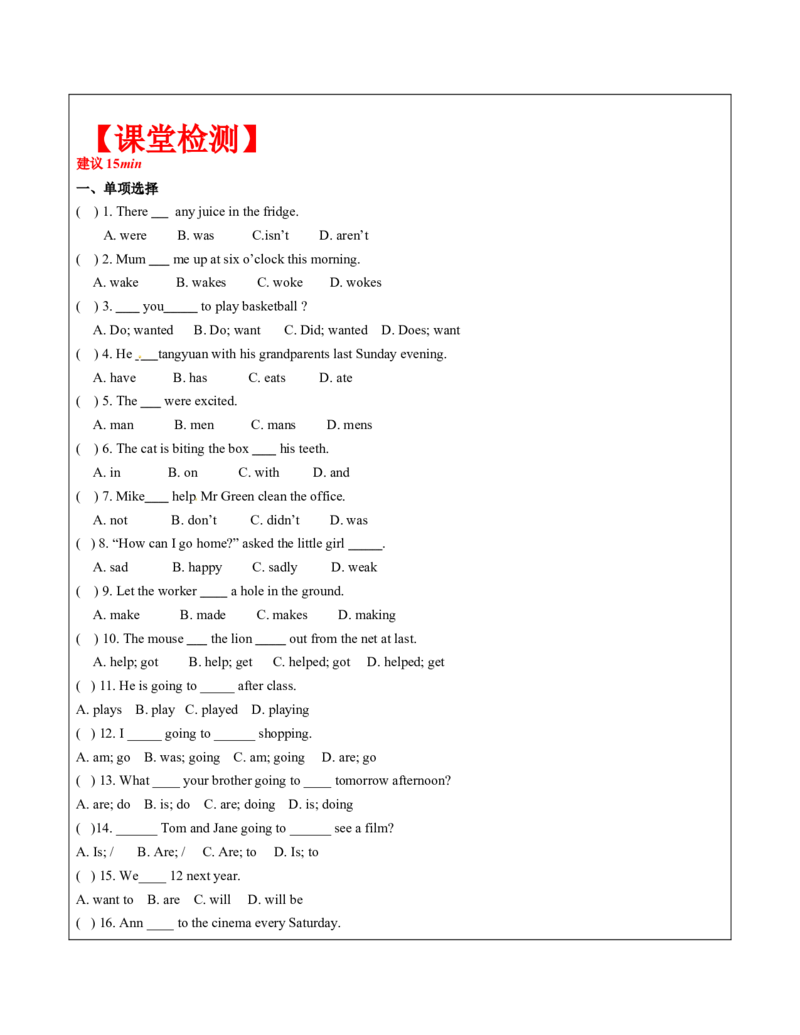
( )A. hair B. pear C. here D. there【课堂检测】
建议15min
一、单项选择
( ) 1. There any juice in the fridge.
A. were B. was C.isn’t D. aren’t
( ) 2. Mum me up at six o’clock this morning.
A. wake B. wakes C. woke D. wokes
( ) 3. you to play basketball ?
A. Do; wanted B. Do; want C. Did; wanted D. Does; want
( ) 4. He tangyuan with his grandparents last Sunday evening.
A. have B. has C. eats D. ate
( ) 5. The were excited.
A. man B. men C. mans D. mens
( ) 6. The cat is biting the box his teeth.
A. in B. on C. with D. and
( ) 7. Mike help Mr Green clean the office.
A. not B. don’t C. didn’t D. was
( ) 8. “How can I go home?” asked the little girl .
A. sad B. happy C. sadly D. weak
( ) 9. Let the worker a hole in the ground.
A. make B. made C. makes D. making
( ) 10. The mouse the lion out from the net at last.
A. help; got B. help; get C. helped; got D. helped; get
( ) 11. He is going to _____ after class.
A. plays B. play C. played D. playing
( ) 12. I _____ going to ______ shopping.
A. am; go B. was; going C. am; going D. are; go
( ) 13. What ____ your brother going to ____ tomorrow afternoon?
A. are; do B. is; do C. are; doing D. is; doing
( )14. ______ Tom and Jane going to ______ see a film?
A. Is; / B. Are; / C. Are; to D. Is; to
( ) 15. We____ 12 next year.
A. want to B. are C. will D. will be
( ) 16. Ann ____ to the cinema every Saturday.
[来源:学.科.网Z.X.X.K]A. goes B. go C. will go D. went
二、从Ⅱ栏中找出与Ⅰ栏相对应的句子,将其序号填在题前括号里
Ⅰ
Ⅱ
( ) 1. Where are you going? A. We have three.
( ) 2. What are you doing? B. Yes,I do.
( ) 3. How many apples do you have? C. No,but I have a cute cat.
( ) 4. Do you like apples? D. Yes,I did.
( ) 5. Do you have a dog? E. Some milk.
( ) 6. Did you go to the Summer Palace? F. The girl in red.
( ) 7. What did you do on Monday? G. I’m going to the bookshop.
( ) 8. What’s in the bottle? H. The brown dog’s.
( ) 9. Who is the lollipop(棒棒糖)for? I. I’m making a fruit salad.
( )10. Whose tail is short? J. I climbed the mountain with my classmates.
三、句型转换
1.Helen is going to catch the insects in the park this Sunday.(改为同义句)
Helen catch the insects in the park this Sunday.
2. I’m going to visit my uncle this evening. (对划线部分提问)
are you going to this evening?
3. He will play the piano . (对划线部分提问)
play the piano?
4. She watched TV just now. (改为一般将来时)
She is to ________ TV this evening.
四、判断正误,正确的用T表示,错误的用F表示
A
Once upona time(很久很久以前),a wolf was lapping the water(舔水) at a spring(泉水) on a hillside. When
he looked up,he saw a lamb(羔羊) drinking a little lower down. “There’s my supper,”he thought . “I will find some
excuses to catch him.”Then he called out to the lamb, “How dare you smear(弄脏) the water I am drinking?”
“No,” said the lamb.“I cannot smear your water baceuse the water runs down from you to me.”
“Well, then,”said the wolf. “Why did you call me bad names last year?”
“That couldn’t be,”said the lamb.“I was only six months old then.”
“I don’t care,”shouted the wolf. “If it was not you,it must be your father.”After that he rushed at the poor littlelamb and ate it up.
( )1. This story is from a story book.
( )2. The wolf wanted to make friends with the lamb.
( )3. The lamb didn’t smear the water.
( )4. The lamb called the wolf bad names last year.
( )5. The lamb was six years old.
B
Last Saturday I went to the cinema. I had a good seat. The film was very interesting. But I didn’t enjoy it. A
young man and a young woman were sitting behind me. They were talking loudly. I got very angry. I could not hear
the film. I turned round. I looked at them angrily. But they didn’t see me. At last I could not hear it. I said to them.
“I couldn’t hear a word!”
“It’s none of your business(没你的事),”the young man said rudely,“this is a private conversation(私人谈话).”
( )1. Last Sunday I went to the cinema.
( )2. A young man and a young woman were sitting in front of me.
( )3. They weren’t watching the film.
( )4. The young man thought the author(作者) would like to listen to their private conversation.
( )5. From this story we can see that the two young people were polite.
【要点回顾】
建议15min
一般将来时中will的句型是怎样变换的呢?
【温故知新】
一、选择填空
( ) 1. We will a film and a picnic tonight.
A. watch, have B. watched, had C. watch, had D. watched, have
( ) 2. I think that the weather _ hot this summer.
A. will be B. is C. become D. be
( ) 3. --Where _ she _ from? -- She China.
A. is, come, comes from B. is, /, is from C. does, /, is from
( ) 4. Yesterday my father a book about America.
A. readed B. reads C. read D. is going to read
( ) 5. --What Helen ? --She’s writing an e-mail.
A. is, going to do B. will, do C. is, doing D. are, doing
( ) 6. Welcome _ our country.
A. visit B. visitor C. to visit D. visits( ) 7. The basketball match is very . All the children are very .
A. excited, excited B. excited, exciting C. exciting, excited
( ) 8. is famous in the UK.
A. Yellowstone National Park B. the Great Barrier Reef
C. Sydney Opera House D. Stonehenge
( ) 9. There an English party in our school next week.
A. will have B. will be C. is going to have D. is going to
( ) 10. --______ are you going to see the film? --This weekend.
A. What B. How C. When D. Where
二、 用单词的适当形式填空
1. I ________ (like) flying kites, but Nancy _________ (not).
2. It is __________(cloud) now.
3. Let the boy _______ (sing) the song first.
4. The _________( Australia) girl is coming. I would like ________ (be) her friend.
5. There _________(not) any fruit on the table a moment ago.
6. My mother _______________ (go) for a walk next Sunday morning.
7. There are many _ in Sydney every year. I’d like __ (visit) it next year.
三、选择合适的短语填空, 填序号
A. next week B. cook nice food C. fresh air D. find out
E. on the Internet F. look for G . wait and see
1. My mother will go to Hong Kong ___________.
2. People will__________ a lot of interesting things in the museum.
3. My father is a cook, he can __________.
4. They want to __________about Australia before class.
5. You can read some interesting news__________.
6. My grandpa lives in the town. It always has __________.
四、根据要求完成句子,每空一词
1. We are going to buy some kites in the supermarket. (改为同义句)
We ________ buy some kites in the supermarket?
2. He’ll go to the supermarket tomorrow. (对划线部分提问)
________ he do tomorrow?
3. There are some interesting places in the UK. (改成一般疑问句)
________ ________ ________ interesting places in the UK?
4. I found some interesting books.(改成否定句)
I ________ ________ any interesting books.
5. I’ll read a book about the king. (用now改写)
________ ________ a book about the king now.
五、完型填空
Mary is an American school girl. Now she ___1___ in Beijing ___2___ her parents. Mary doesn’t know
Chinese, ___3___she likes learning Chinese. She often ___4___Chinese to her Chinese friends. Usually they
___5____understand her because she can’t speak Chinese ___6___. It’s Sunday morning. She goes out. She ___7___
in the street. She ___8___ the zoo to see elephants and monkeys, but she doesn’t know how to ___9___. She asks a
Chinese boy, the boy can’t understand her. Then she takes out a pen and a piece of paper. She draws an elephant
___10___ it, and shows the picture to the boy. The boy understands now, he shows Mary the way to the zoo.
( ) 1. A. live B. lives C. lived
( ) 2. A. with B. for C. and( ) 3. A. but B. or C. so
( ) 4. A. speaks B. tells C. says
( ) 5. A. aren’t B. don’t C. doesn’t
( ) 6. A. good B. well C. nice
( ) 7. A. walks B. is walking C. walked
( ) 8. A. is going to B. go C. going
( ) 9. A. get to there B. gets there C. get there
( ) 10. A. in B. on C. at
六、根据中文完成句子
1.杨玲擅长游泳。
Yang Ling is .
2. 同学们正在教室里大声地读英语书。
The students are English books in the classroom.
3. 他迅速的打开了他的书包。
He his schoolbag .
4. 森林里有这么多强壮的动物。
There are so animals in the forest.
5. 雷锋喜欢帮助他人。
Lei Feng likes other people.
七、完形填空
阅读下面的对话,掌握大意,从所给的四个选项中选出一个最佳答案。
C = Conductor(乘务员) P = Passenger(乘客)
C: All fares, please!
P: I'd like a ticket to the Children's Playground. 1 is it?
C: One yuan. But it's in the People's Park. You must 2 at the fifth bus stop and 3 more than two miles.
P: 4 . Can you tell me how I can 5 there?
C: Well, you can go along the street, 6 at the first turning and you'll 7 the park.
P: I 8 . Thanks a lot.
C: That's all right.
1. A. How many B. How many money C. How much D. How money
2. A. get on B. get off C. get out D. leave
3. A. go B. move C. run D. walk
4. A. Thank you B. Sorry C. Listen to me D. Excuse me
5. A. get B. get to C. get in D. get at
6. A. turn left B. turn the left C. turn to left D. turning to the left
7. A. find B. find out C. look D. look for8. A. think B. watch C. look D. see
6BU5-6复习