2023-2024学年小学英语六年级下册同步听力专项系列(译林版三起)
期中模拟冲刺听力专项
重点单词:
Unit 1 The lion and the mouse
1) mouse 老鼠 13) sharp 锋利的,尖的
2) large 大的 14) sadly 难过地,伤心地
3) strong 强壮的 15) just then 就在那时
4) wake...up 吵醒,叫醒 16) soon 不久,很快
5) some day 某一天 17) happily 开心地,高兴地
6) quiet 安静的 18) from then on 从那时起
7) weak 弱的,软弱的 19) cheer 欢呼
8) loudly 大声地 20) hit 打,击
9) let…go 释放,放开 21) deep 深的
10) the next day 第二天 22) reach 够得着
11) net 网 23) quickly 迅速地,快地
12) bite 咬 pour…into 把……倒入
Unit 2 Good habits
1) habit 习惯 8) sleepy 困的,困倦的
2) never 从不 9) last night 昨夜
3) late 迟,晚 10) fast 快地
4) put…in order 把……整理得井井有条 11) go into 走进,走入
5) finish 完成 12) slowly 慢速地
6) tidy 干净的,整齐的 13) badly 差地,不好
7) bad 不好的,坏的
Unit 3 A healthy diet
1) healthy 健康的 3) a little 一点
2) diet 饮食 4) a few 几个5) at a time 一次 7) need 需要
6) cola 可乐
Unit 4 Road safety
1) road 马路,公路 8) pavement 人行道
2) safety 安全 9) look out for 当心,提防
3) cross 穿过,穿行 10) easily 容易地
4) safely 安全地 11) follow 遵守
5) must 必须 12) rule 规则
6) zebra crossing 斑马线 13) stay 保持
7) safe 安全的 14) light 灯
重点词组:
Unit 1 The lion and the mouse
1) large and strong又大又强壮 11) walk by走过,路过
2) some day某一天 12) wake…up吵醒,叫醒
3) let…go释放,放开 13) the next day第二天
4) sharp teeth锋利的牙齿 14) small and weak又小又弱
5) get out from从……出来 15) laugh loudly大声地笑
6) say quietly小声地说 16) just then就在那时
7) from then on从那时起 17) cheer for them为他们欢呼
8) too excited太兴奋 18) pour…into把……倒入
9) become friends成为朋友 19) hit the ball hard用力地击球
10) a hole in the ground地上的一个洞 20) reach the ball够到球
Unit 2 Good habits
1) many good habits许多好习惯 9) show…around…带……参观……
2) never go to bed late从不晚睡 10) on the floor在地板上
3) brush one's teeth刷牙 11) sing badly唱得不好
4) finish one's homework完成某人的家庭作业 12) get up early早起
5) do well at home在家做得好 13) before bedtime睡觉前
6) feel sleepy犯困 14) put….in order把……整理得井井有条
7) last night昨晚 15) listen to his teachers听他的老师们的话
8) run through the grass跑过草地 16) help his parents帮助他的父母17) know sb well很了解某人 20) go into the living room走进客厅
18) have breakfast on time准时吃早餐 21) walk slowly走得慢
19) run very fast跑得很快
Unit 3 A healthy diet
1) a healthy diet健康的饮食 9) like eating sweets喜欢吃糖果
2) drink a little water喝一点儿水 10) have a lot of rice吃许多米饭
3) only a little只有一点儿 11) some meat一些肉
4) a few eggs几个鸡蛋 12) at a time一次
5) get out出去 13) have some porridge喝一些粥
6) steamed buns馒头;蒸包 14) go to the supermarket去超市
7) come with me跟我来 15) take a small bottle拿一小瓶
8) drink too much cola喝太多可乐 16) be good for…对……有好处
Unit 4 Road safety
1) road safety道路安全 12) wait for the green man等待绿灯
2) look for寻找 13) wait on the pavement在人行道上等待
3) look at the traffic lights看交通信号灯 14) look left/right向左/右看
4) see the red man看见红灯 15) see you easily容易看见你
5) look out for cars and bikes 当心小汽车和 16) follow the rules遵守规则
自行车 17) cross the road safely安全地过马路
6) with other people和其他人一起 18) on the left/right side of the road 在马路
7) on the road在马路上 左/右边
8) stay safe保持安全 19) except Hong Kong除了香港
9) run quickly快速地跑 20) get on the bus上公共汽车
10) many busy roads很多繁忙的马路 21) take the bus乘坐公共汽车
11) a zebra crossing斑马线 22) stop and wait停下来等
重点句型:
Unit 1 The lion and the mouse
1) One day,a mouse walked by and woke the lion up.有一天,一只老鼠从旁边走过,把狮子吵醒了。
2) The lion asked sadly.狮子伤心地问。The mouse said happily.老鼠高兴地说。
3) How can you help me?你能怎么帮助我?How can I get out?我怎么才能出去?
4) The next day,two men caught the lion with a large net.第二天,有两个人用一张大网把狮子抓住了。
5) The lion could not get out from the net.狮子无法从网里出来。
Unit 2 Good habits
1) He gets up early in the morning and never goes to bed late.他早上起得早,从不晚睡。
2) He usually finishes his homework before dinner.他通常在晚饭之前完成他的作业。
3) He also does well at home.他在家也做得好。
4) He sometimes feels sleepy in the morning.他有时候在早上犯困。
5) Wang Bing knows Liu Tao well.王兵很了解刘涛。
6) The old man is walking slowly.那位老人正慢慢地走。
Unit 3 A healthy diet
1) He only drinks a little water every day.他每天只喝一点儿水。
2) Mike has some bread and milk for breakfast.迈克早餐吃一些面包,喝一些牛奶。
3) He has a few eggs every week.他每周吃几个鸡蛋。
4) Do you have a healthy diet?你有健康的饮食吗?
5) —What do you have for breakfast?你早餐吃什么?
—I have some noodles.我吃一些面条。
6) You shouldn't drink too much cola.你不应该喝太多可乐。
7) Milk is good for your body.牛奶对你的身体有好处。
Unit 4 Road safety
1) How can you cross the road safely?你怎样才能安全地过马路?
2) You must look at the traffic lights.你必须看交通信号灯。
3) You mustn't run on the road.你绝不能在马路上奔跑。
4) Follow the rules and stay safe on the road!遵守规则,保持路上安全!
5) What must you do/not do on the road?你在马路上必须做什么/禁止做什么?
6) You can cross the road with other people.你可以和其他人一起过马路。
7) You cannot find a zebra crossing.你找不到斑马线。
语法易错:
知识考点一:副词的含义及用法
(1)副词的含义
副词指在句子中表示行为或状态特征的词,用以修饰动词、形容词、其他副词或句子,表示
时间、地点、程度、方式等概念。(2)副词的用法
①当副词修饰动词时,通常位于动词的后面。也有一些副词在修饰动词时通常位于动词前面,
如really。
例句:The mouse said quietly.老鼠小声地说。
I really want to be a scientist in the future.我将来真的想做一名科学家。
②当副词修饰形容词时,通常位于形容词的前面,也有一些副词在修饰形容词时位于形容词
后面,如enough(足够地)。
例句:It was very hot last Sunday.上周日非常热。
He is tall enough to get the books on the shelf.他足够高去拿到书架上的书。
知识考点二:形容词变副词的规则
(1)一般情况下直接在形容词后加“ly”。
示例:quick—quickly sad—sadly
(2)以辅音字母+y结尾的形容词,先将“y”改成“i”,再加“ly”。
示例:happy—happily angry—angrily
(3)绝大多数以辅音字母+e结尾的形容词直接加“ly”。
示例:polite—politely wide—widely
(4)以“le”结尾的形容词,去“e”加“y”。
示例:possible—possibly terrible—terribly
知识考点三:a little, a few, some, much的区
别
1.a little表示“一些;一点”,与不可数名词连用。
例句:There is a little milk on the table.桌子上有一点儿牛奶。
2.a few表示“一些,几个”,与可数名词连用。
例句:There are a few eggs in the basket.篮子里有些鸡蛋。
3.some表示“一些”,既可以与可数名词连用,也可以与不可数名词连用。
例句:Have some vegetables,please.请吃些蔬菜吧。
I want to have some bread for dinner.我晚饭想吃一些面包。
4.much表示“许多,大量”,与不可数名词连用,还可以与so,too等词连用。
例句:How much water do you have?你有多少水?
Don't eat too much sweet food.It's bad for your teeth.不要吃太多的甜食。对你的牙齿不好。
知识考点四:must,can,should的用法1.must意为“必须”,表示一定要做某事,语气强烈。
例句:You must follow your school rules.你必须遵守你们的校规。
(1)must的否定形式为must not(mustn't),表示禁止做某事。
例句:We mustn't shout or run in class.我们不能在课上大叫或跑。
(2)must引导的一般疑问句的否定回答,要用needn't。
例句:—Must I finish my homework today?我今天必须完成家庭作业吗?
一Yes,you must./No,you needn't.是的,你必须要完成。/不,你不必。
2.can意为“会,能;可以”,表示能力或允许。
例句:You can cross the road now.你现在可以过马路了。
3.should意为“应该,应当”,表示劝告或建议。
例句:You should study hard from now on.从现在开始你应该努力学习。
(一)
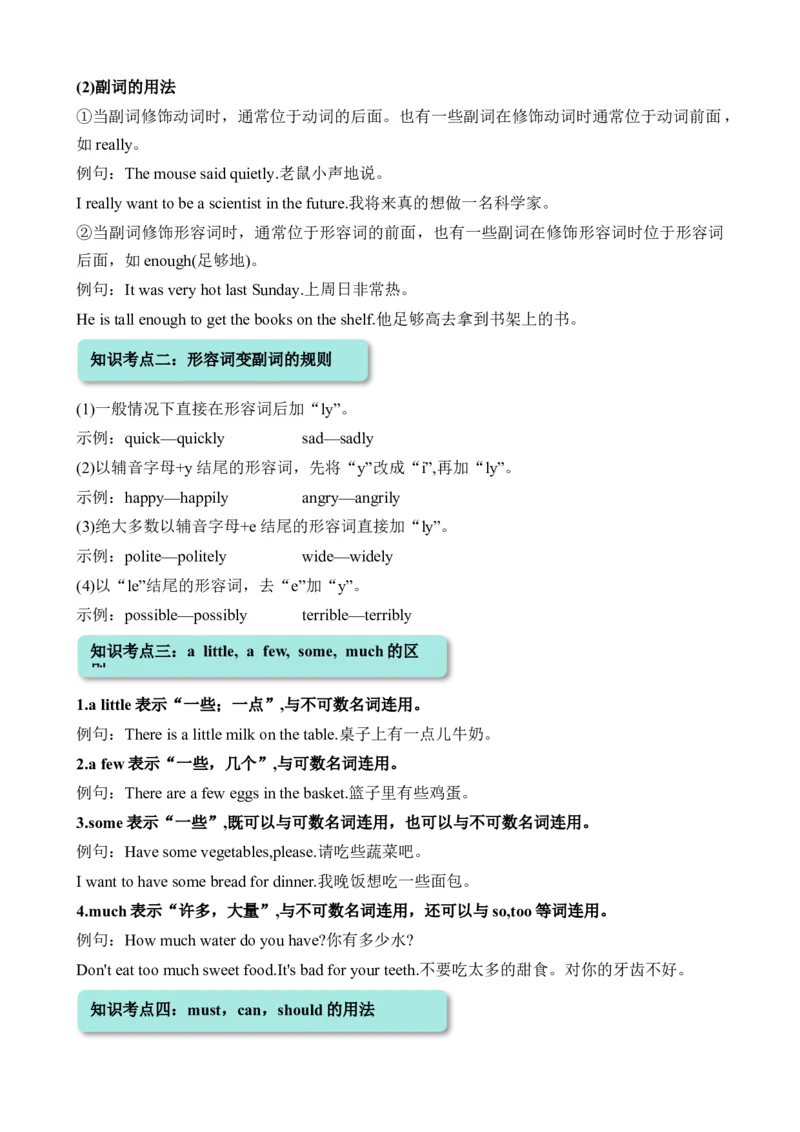
一、 听录音,判断下列图片是否与录音内容相符,相符的写T,不相符的写F。
( ) 1. ( ) 2. ( ) 3. ( ) 4. ( ) 5.
二、 听录音,选出你所听到的内容。
( ) 1. A.At the party B.have a party C.In the library
( ) 2. A.safe B.safety C.safely
( ) 3. A.put on a play B.tell a story C.play the piano
( ) 4. A.health B.healthy C.teeth
( ) 5. A.quickly B.quietly C.quiet
三、 根据所听问句,选择适当的答语。(听两遍)
( ) 1. A.Yes, he didn’t. B.Yes, he did C.No, he didn’t.
( ) 2. A.Yes, they are. B.Yes, there are. C.No, they aren’t.
( ) 3. A.I have some rice. B.He has some meat. C.I had a hamburger.
( ) 4. A.Yes, they are. B.No, it isn’t. C.Yes, it is.
( ) 5. A.Yes, we mustn’t. B.Yes, we must. C.We must keep quiet.四、 听录音,用数字给下列图片排序。(听两遍)
( ) ( ) ( ) ( ) ( )
五、 听录音,选择合适的答句。
( ) 1. A.At seven. B.In the morning. C.On Sunday.
( ) 2. A.I am singing. B.I danced. C.I am going to play football.
( ) 3. A.Yes, I do B.No, I didn’t. C.Yes, I am.
( ) 4. A.Yes, he did B.Yes, she did. C.Yes, they did.
( ) 5. A.My mother is. B.My mother does. C.My mother did.
六、 听短文,根据所听内容判断正误。听三遍
( ) 1. Bill’s family are sport-lovers.
( ) 2. Bill goes swimming on Saturdays.
( ) 3. Bill’s parents go walking every day.
( ) 4. Bill can play computer games after dinner.
( ) 5. Bill’s family always talk about some yummy food after dinner.
(二)
一、 听录音,选出你所听到的内容。(听两遍)
( ) 1. A.housework B.homework C.hard work
( ) 2. A.let B.late C.net
( ) 3. A.but B.cuts C.puts
( ) 4. A.sleeps B.sleepy C.sleeping
( ) 5. A.clever B.never C.fever
( ) 6. A.clean and tidy B.get up early C.messy and dirty
( ) 7. A.brush my teeth B.put things in order C.finish my homework
( ) 8. A.a good habit B.some good habits C.some bad habits
( ) 9. A.my birthday presents B.help my parents C.a parrot show
( ) 10. A.in the evening B.at last C.at night
二、 听录音,根据所听内容给图片排序。A. B. C. D. E.
1. 2. 3. 4. 5.
三、 听录音,选出与所听内容相符的图片。(听两遍)
( ) 1.A. B. C.
( ) 2. A. B. C.
( ) 3. A. B. C.
( ) 4. A. B. C.
( ) 5. A. B. C.
四、 听录音,根据所听对话及问题,选择正确的答案。(听两遍)
( ) 1. A.He watched TV at home. B.He made the bed.
C.He helped his mother cook food.
( ) 2. A.At nine. B.At eight thirty.
C.At ten.
( ) 3. A.No, she didn't. B.Yes, she did.
C.We don't know.
( ) 4. A.Yes, she does. B.No, she doesn't.
C.It's not a good habit.
( ) 5. A.He is doing his homework. B.He is brushing his teeth.C.He is putting his things in order.
五、 听录音,根据所听对话,选择正确的答案。(听两遍)
听下面一段对话,回答第1~3小题。
( ) 1. What did Mike do last night?
A.He watched TV. B.He washed clothes. C.He cleaned the car.
( ) 2. Does Mike often help his parents do housework at home?
A.Yes, he does. B.No, he doesn't. C.We don't know.
( ) 3. Does Mike often help his teachers at school?
A.Yes, he does. B.No, he doesn't. C.We don't know.
听下面一段对话,回答第4~5小题。
( ) 4. What time can it be now?
A.It can be seven in the morning. B.It can be eleven in the morning.
C.It can be six in the evening.
( ) 5. What should Jim do before dinner?
A.He should finish his homework. B.He should help his parents do housework.
C.He should watch TV.
六、 听录音,补全下面表格。(每空一词)
Free activities
Watching TV It is a activity. It is relaxing and to do.
friends People have with friends.
Doing sports It’s for people of all .
Other activities Listening to music. Going .(一)
参考答案:
一、 T T F F T
【听力原文】1. The boys and girls are talking happily.
2. To keep safe on the road, people should look at the traffic lights.
3. At the party, my brother sang very well.
4. This little mouse is very happy to see the large lion.
5. Yang Ling always keeps her bedroom clean and tidy.
二、 B C C C C
【听力原文】1. Where are you going to have a party?
2. Here is a green man.You can cross the road safely.
3. The children are going to play the piano at the Music lesson.
4. Don’t eat too many sweets.They are bad for your teeth.
5. We must keep quiet in the library.
三、 B B C C C
【听力原文】1. Did the mouse help the lion?
2. Are there a lot of vegetables on the table?
3. What did you have for lunch?
4. Is milk good for our health?
5. What must we do in the library?
四、 3 1 5 4 2
【听力原文】1. A: Why does the bus stop here?
B: Because there’s a red light.
2. A: Look, the boys are playing football on the road.
B: Oh, it’s dangerous.
3. A: There is no zebra crossing on the road.
B: You can wait on the pavement and look out for cars and bikes.
4. A: What’s on the road?
B: There are so many cars.
5. A: We should cross the road together.
B: Yes, then the drivers can see us easily.
五、 A C A A A
【听力原文】略
六、 T T F F T【听力原文】
Bill has a happy family. There are some rules in his family keep healthy. Being healthy is
important. Bill has swimming lessons on Saturdays. his parents go running every morning.
Sometimes they go walking after dinner. evening time is family time. They can’t watch TV or play
computer games. After dinner, they usually sit on the sofa. Bill always talk about his school and
friends. His parents listen to him happily. Sometimes they talk about some yummy food.
(二)
参考答案:
一、 A B C B B A A A B C
【听力原文】1. Liu Tao often helps his mother do housework.
2. She sometimes goes to school late.
3. My sister always puts her things in order.
4. Miss Li sometimes feels sleepy.
5. He is never late for school.
6. My friend keeps his room clean and tidy.
7. I always brush my teeth in the morning and before bedtime.
8. Su Hai has a good habit
9. I often help my parents at home.
10. He goes to bed early at night.
二、 C B D E A
【听力原文】1. The lion caught the mouse.
2. The lion wanted to eat the mouse.
3. Two men caught the lion with a large net.
4. The mouse made a big hole in the net with his teeth.
5. The lion and the mouse became friends.
三、 B A B A A
【听力原文】1. For dinner, Mike has a lot of rice and some fish.
2. I only drink a little water every day.
3. Su Yang has a few eggs every week.
4. I want to buy some tomatoes.
5. I usually have some steamed buns for breakfast.
四、 C A B B A
【听力原文】1. A: What did you do last night, Mike?
B: I helped my mother cook food.Q: What did Mike do last night?
2. A: What time do you go to bed every day, Sue?
B: I usually go to bed at nine, but yesterday I went to bed at ten.
Q: What time does Sue usually go to bed?
3. A: I’m sorry, Miss Li. I’m late.
B: Come in, Su Yang.
Q: Did Su Yang go to school late?
4. A: When do you usually go to bed at night, Helen?
B: I usually go to bed at eleven.
Q: Does Helen have a good habit?
5. A: Bob, it’s time for dinner.
B: Mum, I’m doing my homework.
Q: What is Bob doing before dinner?
五、 C A C C A
【听力原文】听下面一段对话,回答第1~3小题。
A: What did you do last night, Mike?
B: I helped my father clean the car.
A: Do you often help your parents do housework?
B: Yes. And I often help my classmates do something at school too.
听下面一段对话,回答第4~5小题。
A: Jim, it’s time for dinner.
B: Mum, I’m doing my homework. I should finish my homework before dinner.
A: That’s a good habit.
六、 popular easy Visiting often dinner good ages
interesting shopping
【听力原文】What do people usually do in their free time? Watching TV is a popular activity. It is
relaxing and easy to do. Television programs are about news, sports, animals, vacations and
cooking. Visiting friends is popular, too. People often have dinner with friends on weekends. Some
people like to do sports in their free time. It’s good for people of all ages. They can go swimming,
play soccer or basketball, or do some running in the park. There are also other interesting activities,
such as listening to music and going shopping. You can take one you like.