文档文本内容
2024-2025学年小学英语六年级下册同步听力专项系列(译林版三起)
期中模拟提升听力专项
知识回顾
词汇
Unit1 The lion and the mouse
1.mouse 老鼠 13.sharp 锋利的,尖的
2.large 大的 14.sadly 难过地,伤心地
3.strong 强壮的 15.just then 就在那时
4.wake...up 吵醒,叫醒 16.soon 不久,很快
5.some day 某一天 17.happily 开心地,高兴地
6.quiet 安静的 18.from then on 从那时起
7.weak 弱的,软弱的 19.cheer 欢呼
8.loudly 大声地 20.hit 打,击
9.let…go 释放,放开 21.deep 深的
10.the next day 第二天 22.reach 够得着
11.net 网 23.quickly 迅速地,快地
12.bite 咬 24.pour…into 把……倒入
Unit2 Good habits
1.habit 习惯 8.sleepy 困的,困倦的
2.never 从不 9.last night 昨夜
3.late 迟,晚 10.fast 快地
4.put…in order 把……整理得井井有条 11.go into 走进,走入
5.finish 完成 12.slowly 慢速地
6.tidy 干净的,整齐的 13.badly 差地,不好
7.bad 不好的,坏的
Unit3 A healthy diet
1.healthy 健康的 5.at a time 一次
2.diet 饮食 6.cola 可乐
3.a little 一点 7.need 需要
4.a few 几个
Unit4 Road safety
1.road 马路,公路 8.pavement 人行道
2.safety 安全 9.look out for 当心,提防
3.cross 穿过,穿行 10.easily 容易地
4.safely 安全地 11.follow 遵守
5.must 必须 12.rule 规则
6.zebra crossing 斑马线 13.stay 保持
7.safe 安全的 14.light 灯短语
Unit1 The lion and the mouse
1.large and strong又大又强壮 11.wake…up吵醒,叫醒
2.some day某一天 12.the next day第二天
3.let…go释放,放开 13.small and weak又小又弱
4.sharp teeth锋利的牙齿 14.laugh loudly大声地笑
5.get out from从……出来 15.just then就在那时
6.say quietly小声地说 16.cheer for them为他们欢呼
7.from then on从那时起 17.pour…into把……倒入
8.become friends成为朋友 18.hit the ball hard用力地击球
9.a hole in the ground地上的一个洞 19.reach the ball够到球
10.walk by走过,路过
Unit2 Good habits
1.many good habits许多好习惯 10.sing badly唱得不好
2.never go to bed late从不晚睡 11.get up early早起
3.brush one's teeth刷牙 12.before bedtime睡觉前
4.do well at home在家做得好 13.put….in order把……整理得井井有条
5.feel sleepy犯困 14.listen to his teachers听他的老师们的话
6.last night昨晚 15.help his parents帮助他的父母
7.run through the grass跑过草地 16.have breakfast on time准时吃早餐
8.show…around…带……参观…… 17.run very fast跑得很快
9.on the floor在地板上 18.go into the living room走进客厅
Unit3 A healthy diet
1.a healthy diet健康的饮食 9.like eating sweets喜欢吃糖果
2.drink a little water喝一点儿水 10.have a lot of rice吃许多米饭
3.only a little只有一点儿 11.some meat一些肉
4.a few eggs几个鸡蛋 12.at a time一次
5.get out出去 13.have some porridge喝一些粥
6.steamed buns馒头;蒸包 14.go to the supermarket去超市
7.come with me跟我来 15.take a small bottle拿一小瓶
8.drink too much cola喝太多可乐 16.be good for…对……有好处
Unit4 Road safety
1.road safety道路安全 9.run quickly快速地跑
2.look for寻找 10.a zebra crossing斑马线
3.the traffic lights交通信号灯 11.wait for the green man等待绿灯
4.see the red man看见红灯 12.follow the rules遵守规则
5.look out 当心 13.cross the road safely安全地过马路
6.with other people和其他人一起 14.get on the bus上公共汽车
7.on the road在马路上 15.take the bus乘坐公共汽车
8.stay safe保持安全 16.stop and wait停下来等
句子
Unit1 The lion and the mouse
1.One day,a mouse walked by and woke the lion up. 有一天,一只老鼠从旁边走过,把狮子吵醒了。
2.The lion asked sadly. 狮子伤心地问。
3.The mouse said happily. 老鼠高兴地说。
4.How can you help me? 你能怎么帮助我?
5.How can I get out? 我怎么才能出去?
6.The lion could not get out from the net. 狮子无法从网里出来。
Unit2 Good habits
1.He gets up early in the morning and never goes to bed late. 他早上起得早,从不晚睡。
2.He usually finishes his homework before dinner. 他通常在晚饭之前完成他的作业。
3.He also does well at home. 他在家也做得好。
4.He sometimes feels sleepy in the morning. 他有时候在早上犯困。
5.Wang Bing knows Liu Tao well. 王兵很了解刘涛。
6.The old man is walking slowly. 那位老人正慢慢地走。
Unit3 A healthy diet
1.He only drinks a little water every day.他每天只喝一点儿水。
2.Mike has some bread and milk for breakfast.迈克早餐吃一些面包,喝一些牛奶。
3.He has a few eggs every week.他每周吃几个鸡蛋。
4.Do you have a healthy diet?你有健康的饮食吗?
5.What do you have for breakfast?你早餐吃什么?
6.I have some noodles.我吃一些面条。
7.You shouldn't drink too much cola.你不应该喝太多可乐。
8.Milk is good for your body.牛奶对你的身体有好处。
Unit4 Road safety
1.How can you cross the road safely? 你怎样才能安全地过马路?
2.You must look at the traffic lights. 你必须看交通信号灯。
3.You mustn't run on the road. 你绝不能在马路上奔跑。
4.Follow the rules and stay safe on the road! 遵守规则,保持路上安全!
5.What must you not do on the road? 你在马路上禁止做什么?
6.You can cross the road with other people. 你可以和其他人一起过马路。
7.You cannot find a zebra crossing.你找不到斑马线。
语法
Unit1 The lion and the mouse
1.形容词和副词的区别
(1)形容词是表示人或事物的性质、状态和特征的词,它常和名词或系动词连用。
例如:
She has a beautiful dress.她有一条漂亮的连衣裙。(形容词用在名词前面作定语)
He is/looks sad.他很伤心/看起来很伤心。(形容词用在系动词后面作表语)
常见系动词:
be动词:am,is,are,was,were
感官系动词:look,feel,sound,smell,taste
变得:get,become(2)副词一般用来表示某一动作的特征,可用在行为动词后。
例如:
Look!I can dance beautifully.看!我能跳舞跳得很优美。
They often talk loudly.他们经常大声谈话。
副词也可以用来修饰形容词或其他副词,通常放在被修饰词的前面。例如:
This sandwich is really delicious.这个三明治真的很美味。
I like this book very much.我非常喜欢这本书。
2.形容词变副词的规则:
一般情况,加ly。
slow-slowly careful-carefully
以y结尾的单音节词,加ly。
dry-dryly shy-shyly
以y结尾的双音节词,变y为i,再加ly。
lucky-luckily heavy-heavily
以e结尾的词:
①开音节,加ly。
polite-politely wide-widely
②以元音字母加e结尾,去e加ly。
true-truly due-duly
③以(a)ble结尾,变(a)ble为bly。
terrible-terribly
Unit2 Good habits
频度副词:
一般用来表示动作发生的频率,任何时态下都可以使用。常见的频度副词有(按照频率由高
到低排列):always>usually>often>sometimes>seldom(很少)>never。
易错:never和don’t(doesn’t)都表示否定,但词性不同。never不影响动词在句子中的形
式,而don't(doesn't)后面的动词必须是原形。它们的意思也有差异。
例如:
Su Yang never cleans the room.苏洋从不打扫房间。
Su Yang doesn't clean the room.苏洋不打扫房间。
对频率提问用how often或how many times。
Unit3 A healthy diet
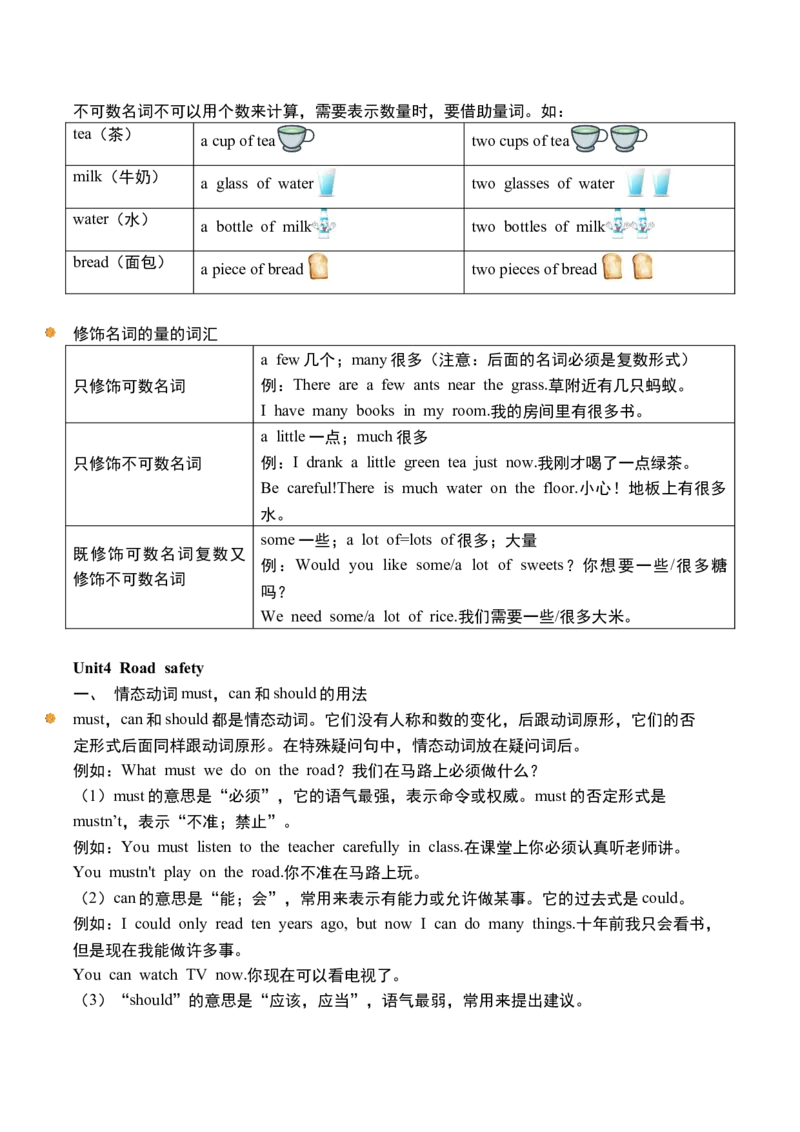
不可数名词的数量变化:不可数名词不可以用个数来计算,需要表示数量时,要借助量词。如:
tea(茶)
a cup of tea two cups of tea
milk(牛奶)
a glass of water two glasses of water
water(水)
a bottle of milk two bottles of milk
bread(面包)
a piece of bread two pieces of bread
修饰名词的量的词汇
a few几个;many很多(注意:后面的名词必须是复数形式)
只修饰可数名词 例:There are a few ants near the grass.草附近有几只蚂蚁。
I have many books in my room.我的房间里有很多书。
a little一点;much很多
只修饰不可数名词 例:I drank a little green tea just now.我刚才喝了一点绿茶。
Be careful!There is much water on the floor.小心!地板上有很多
水。
some一些;a lot of=lots of很多;大量
既修饰可数名词复数又
例:Would you like some/a lot of sweets?你想要一些/很多糖
修饰不可数名词
吗?
We need some/a lot of rice.我们需要一些/很多大米。
Unit4 Road safety
一、 情态动词must,can和should的用法
must,can和should都是情态动词。它们没有人称和数的变化,后跟动词原形,它们的否
定形式后面同样跟动词原形。在特殊疑问句中,情态动词放在疑问词后。
例如:What must we do on the road?我们在马路上必须做什么?
(1)must的意思是“必须”,它的语气最强,表示命令或权威。must的否定形式是
mustn’t,表示“不准;禁止”。
例如:You must listen to the teacher carefully in class.在课堂上你必须认真听老师讲。
You mustn't play on the road.你不准在马路上玩。
(2)can的意思是“能;会”,常用来表示有能力或允许做某事。它的过去式是could。
例如:I could only read ten years ago, but now I can do many things.十年前我只会看书,
但是现在我能做许多事。
You can watch TV now.你现在可以看电视了。
(3)“should”的意思是“应该,应当”,语气最弱,常用来提出建议。例如:You should take some medicine now.你现在应当吃一些药。
You shouldn't talk loudly.你不应该大声讲话。
二、 safe,safely和safety的用法
safe是形容词,意为“安全的”,常放在系动词之后,名词之前。safely是副词,意为“安全
地”,常用来修饰动词。safety是名词,意为“安全”。
例如:Road safety is important,We must cross the road safely.We should keep us safe.马路
安全是重要的。我们必须安全地过马路。我们应该保证自已安全。
听力训练
一、 听录音,选择你所听到的内容。
( ) 1. A.bite B.bit C.hit
( ) 2. A.habit B.happy C.rabbit
( ) 3. A.safe B.safety C.safely
( ) 4. A.have breakfast B.eat vegetables C.drink milk
( ) 5. A.just now B.from then on C.just then
二、 根据所听内容,给下列图片排序。
( ) ( ) ( ) ( ) ( )
三、 听录音,选择正确的图片。
( ) 1. A. B. C.
( ) 2. A. B. C.
( ) 3. A. B. C.
( ) 4. A. B. C.( ) 5. A. B. C.
( ) 6. A. B. C.
( ) 7. A. B. C.
( ) 8. A. B. C.
( ) 9. A. B. C.
( ) 10. A. B. C.
四、 听录音,根据所听内容选择合适答句。
( ) 1. A.Porridge. B.Bread. C.Sausages.
( ) 2. A.Yes, he doesn’t. B.Yes, she does. C.No, he doesn’t.
( ) 3. A.It’s my brother’s. B.He’s my uncle. C.They’re Liu Tao’s.
( ) 4. A.Play football. B.keep the floor clean. C.Listen to the teachers.
( ) 5. A.They are friends. B.They become friends. C.They became friends.
五、 听录音,根据短文内容判断正误,正确的写T,错误的写F。
( ) 1. England and China have different traffic rules.
( ) 2. The traffic drives on the left in the UK.
( ) 3. In England, you must look at the left first and then the right.
( ) 4. If the traffic light is green, people mustn’t cross on foot in England.
( ) 5. In England, there are many buses with three floors.
六、 听录音,完成句子。
1. We must look at the .
2. The knife isn’t . We a new one.3. The two men the lion with a net.
4. is good for our .
5. Amy for the green man before she the road.参考答案及听力原文:
一、 听录音,选择你所听到的内容。
B A A A B
【听力材料】1. The lion bit the net,but it didn’t work.
2. Reading in bed is not a good habit.
3. We must not listen to music on the road. It’s not safe.
4. I have breakfast every day.
5. The two girls became good friends from then on.
二、 根据所听内容,给下列图片排序。
4 5 1 2 3
【听力材料】1. To cross the road safely, you can wait on the pavement.
2. The boy is brushing his teeth now.
3. The two men caught the lion with a large net.
4. Look! The children are running fast.
5. Wang Bing is going to bring some fruit from home to the party.
三、 听录音,选择正确的图片。
A B B C C B C B B C
【听力材料】1. Mike’s mother took photos yesterday.
2. Li Tao wears a T-shirt.
3. The National Day of China is in October.
4. In winter, it sometimes snows in Xuzhou.
5. Tom’s father is sleeping.
6. The sigh means the floor is wet.
7. The horse runs quickly in the forest.
8. I can see kangaroos in Australia.
9. The lion is large and strong.
10. Look, there is a hole.
四、 听录音,根据所听内容选择合适答句。
A C A A C
【听力材料】1. What do Chinese people often have for breakfast?
2. Does he go to school early in the morning?
3. Whose football is this?
4. What must you not do in the classroom?5. What did the lion and mouse become?
五、 听录音,根据短文内容判断正误,正确的写T,错误的写F。
T T F T F
【听力材料】
The traffic rules in the UK are different from those in China. When you are in the UK, you
must be very careful in the street. Because the traffic drives on the left. You must look at the right
first and then the left. If the traffic lights are red, the traffic must stop. Then people can cross the road
on foot. If the traffic lights are green, the traffic can go. People mustn’t cross on foot. When you go
by bus in the UK, you have to be careful too. Always remember the traffic moves on the left. You
mustn’t go the wrong way. In many English cities, there are big buses with two floors. You can sit on
the second floor. From there, you can see the city very well. It’s very interesting.
六、 听录音,完成句子。
1.traffic lights 2.sharp need 3.caught large 4.Milk health
5.waits crosses
【听力材料】1. We must look at the traffic lights.
2. The knife isn’t sharp. We need a new one.
3. The two men caught the lion with a large net.
4. Milk is good for our health.
5. Amy waits for the green man before she crosses the road.