人教版(新标准)初中英语知识点精析
八年级下册 UNIT 5
What were you doing when the rainstorm came?
暴风雨来临时你在做什么?
重点
● 熟练运用谈论过去事情的交际用语
● 掌握过去进行时
难点
● 过去进行时的构成、基本句式及用法
语法
● 过去进行时
Section A
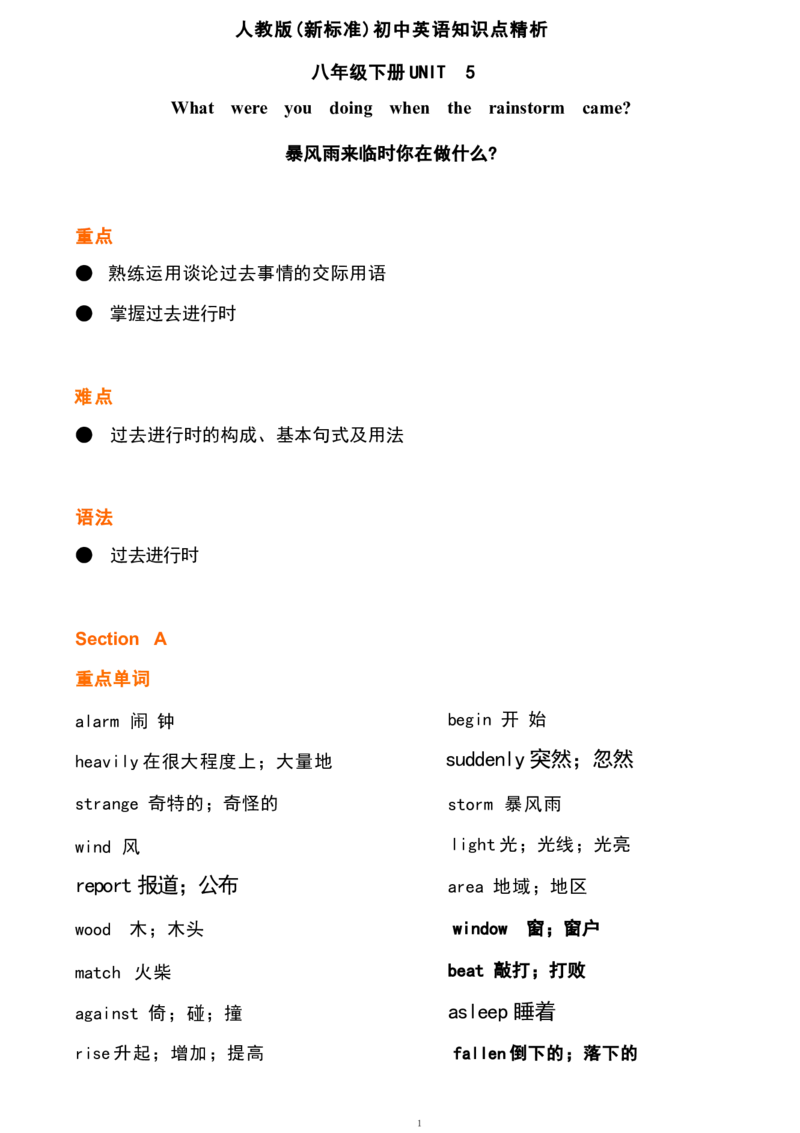
重点单词
alarm 闹 钟 begin 开 始
suddenly 突然;忽然
heavily在很大程度上;大量地
strange 奇特的;奇怪的 storm 暴风雨
wind 风 light光;光线;光亮
report 报道;公布 area 地域;地区
wood 木;木头 window 窗;窗户
match 火柴 beat 敲打;打败
against 倚;碰;撞 asleep 睡着
rise升起;增加;提高 fallen倒下的;落下的
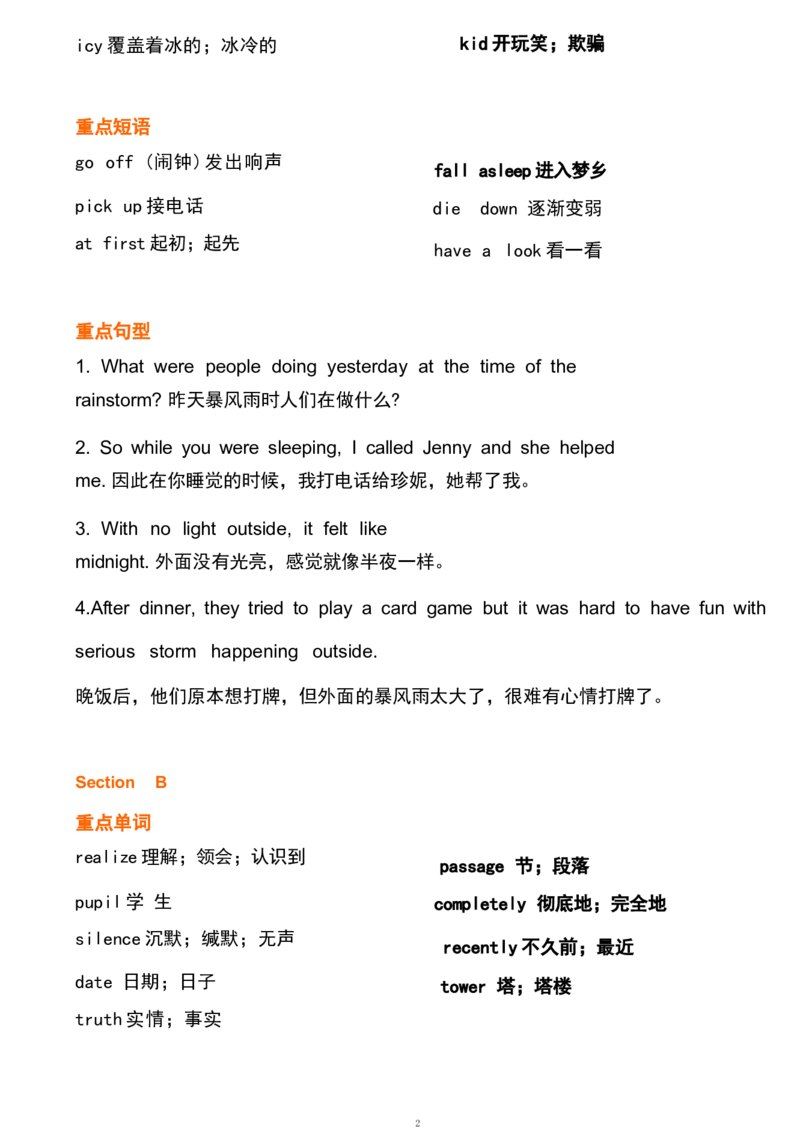
1icy覆盖着冰的;冰冷的 kid开玩笑;欺骗
重点短语
go off (闹钟)发出响声
fall asleep进入梦乡
pick up接电话 die down 逐渐变弱
at first 起初;起先
have a look看一看
重点句型
1. What were people doing yesterday at the time of the
rainstorm? 昨天暴风雨时人们在做什么?
2. So while you were sleeping, I called Jenny and she helped
me. 因此在你睡觉的时候,我打电话给珍妮,她帮了我。
3. With no light outside, it felt like
midnight. 外面没有光亮,感觉就像半夜一样。
4.After dinner, they tried to play a card game but it was hard to have fun with
serious storm happening outside.
晚饭后,他们原本想打牌,但外面的暴风雨太大了,很难有心情打牌了。
Section B
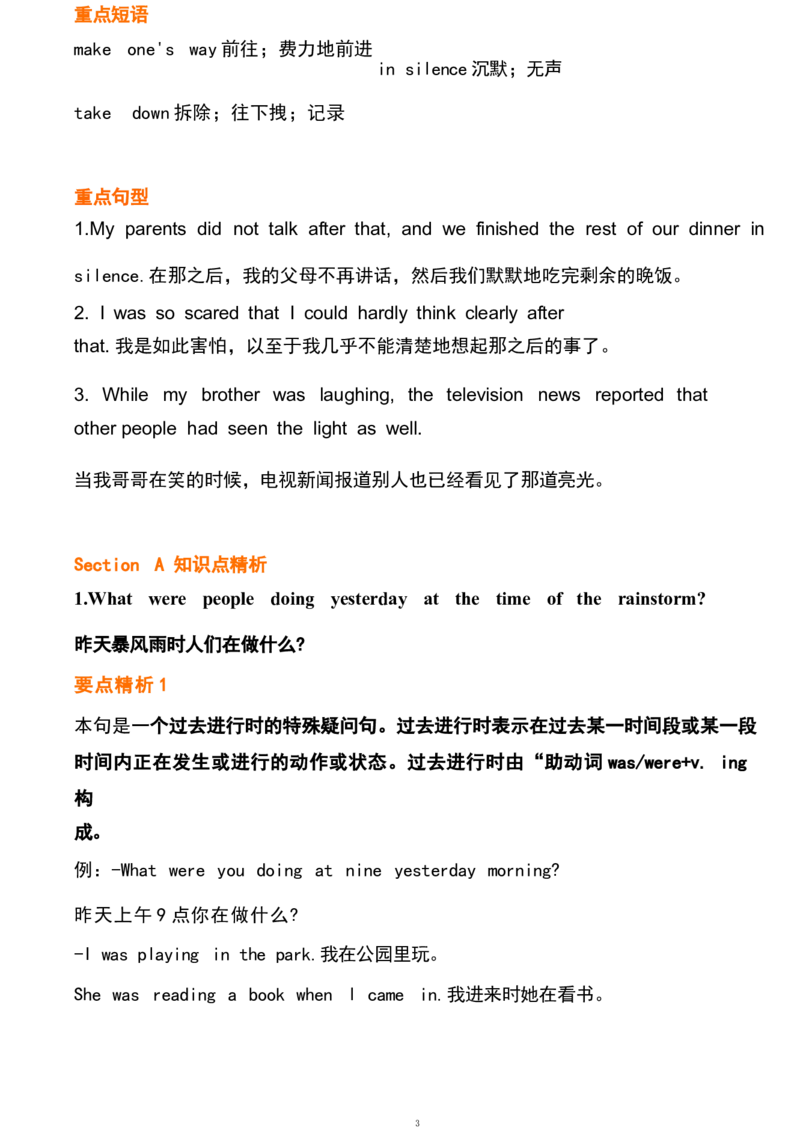
重点单词
realize理解;领会;认识到
passage 节;段落
pupil学 生 completely 彻底地;完全地
silence沉默;缄默;无声
recently不久前;最近
date 日期;日子
tower 塔;塔楼
truth实情;事实
2重点短语
make one's way前往;费力地前进
in silence沉默;无声
take down拆除;往下拽;记录
重点句型
1.My parents did not talk after that, and we finished the rest of our dinner in
silence.在那之后,我的父母不再讲话,然后我们默默地吃完剩余的晚饭。
2. I was so scared that I could hardly think clearly after
that. 我是如此害怕,以至于我几乎不能清楚地想起那之后的事了。
3. While my brother was laughing, the television news reported that
other people had seen the light as well.
当我哥哥在笑的时候,电视新闻报道别人也已经看见了那道亮光。
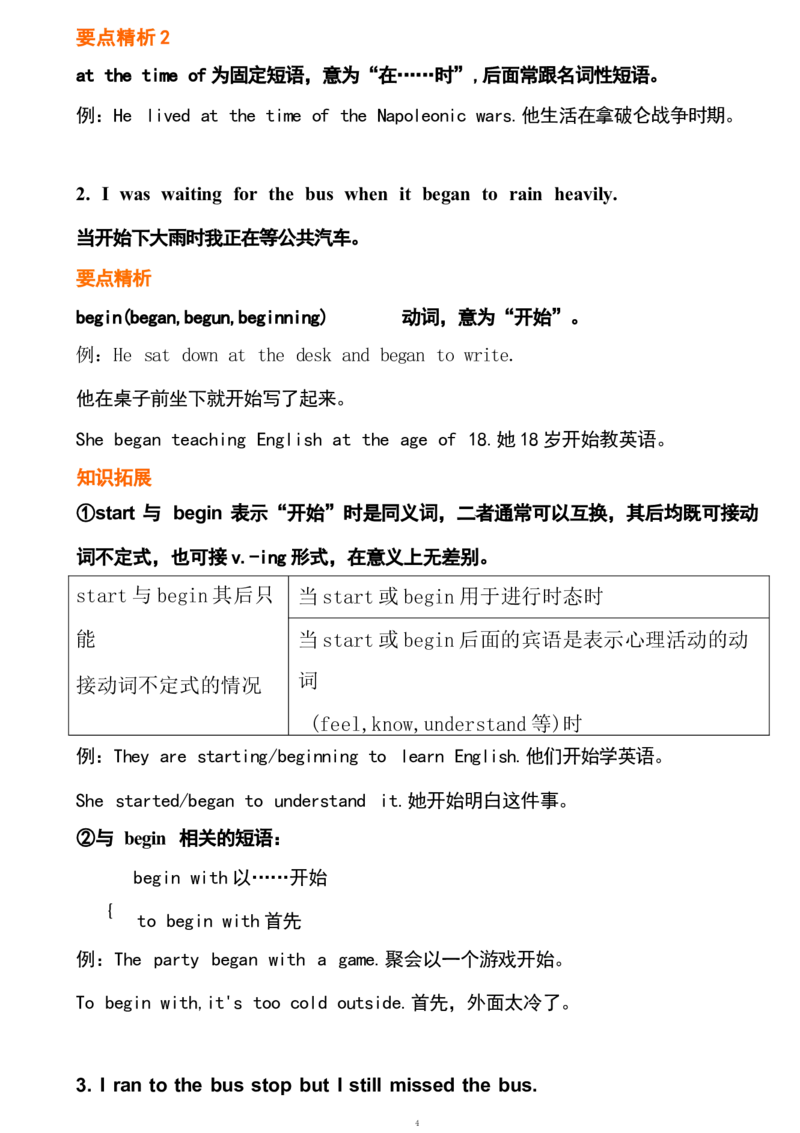
Section A 知识点精析
1.What were people doing yesterday at the time of the rainstorm?
昨天暴风雨时人们在做什么?
要点精析 1
本句是一个过去进行时的特殊疑问句。过去进行时表示在过去某一时间段或某一段
时间内正在发生或进行的动作或状态。过去进行时由“助动词 was/were+v. ing
构
成。
例:-What were you doing at nine yesterday morning?
昨天上午 9 点你在做什么?
-I was playing in the park.我在公园里玩。
She was reading a book when l came in.我进来时她在看书。
3要点精析 2
at the time of 为固定短语,意为“在……时”,后面常跟名词性短语。
例:He lived at the time of the Napoleonic wars.他生活在拿破仑战争时期。
2. I was waiting for the bus when it began to rain heavily.
当开始下大雨时我正在等公共汽车。
要点精析
begin(began,begun,beginning) 动词,意为“开始”。
例:He sat down at the desk and began to write.
他在桌子前坐下就开始写了起来。
She began teaching English at the age of 18.她 18 岁开始教英语。
知识拓展
①start 与 begin 表示“开始”时是同义词,二者通常可以互换,其后均既可接动
词不定式,也可接 v.-ing 形式,在意义上无差别。
start 与 begin 其后只 当 start 或 begin 用于进行时态时
能 当 start 或 begin 后面的宾语是表示心理活动的动
词
接动词不定式的情况
(feel,know,understand 等)时
例:They are starting/beginning to learn English.他们开始学英语。
She started/began to understand it.她开始明白这件事。
②与 begin 相关的短语:
begin with 以……开始
{
to begin with 首先
例:The party began with a game.聚会以一个游戏开始。
To begin with,it's too cold outside.首先,外面太冷了。
3. I ran to the bus stop but I still missed the bus.
4我跑到公共汽车站,但我还是错过了公共汽车。
要点精析
此处 miss 作及物动词,意为“没赶上;错过“。
例:Hurry up,or you will miss your train.快点儿,要不你就赶不上火车了。
She was upset at missing all the excitements.错过了所有精彩之处,她很失望。
知识拓展
①miss 作及物动词,意为“想念;思念”。
例:I miss my family very much.我非常想念我的家人。
②miss 作及物动词,意为“缺(课)”。
例:The boy often missed classes last term.那个男孩儿上学期经常缺课。
4.So, when the rainstorm suddenly came, what were you doing?
那么,当暴风雨突然来临时,你正在做什么?
要点精析
此处 when 作从属连词,意为“当……的时候”,引导时间状语从句,其谓语动词既
可以是非延续性动词,也可以是延续性动词;谓语动词表示的动作发生的时间可以
与主句谓语动词表示的动作是同时、之前或之后。
例:My mother was cooking supper when I got home.
当我到家的时候,我妈妈正在做晚饭。
She began to play the piano when she was five years old.
当她 5 岁的时候,她开始弹钢琴。
I'll tell you when she comes.当她来了的时候,我会告诉你。
He stopped his car when he saw me.当他看到我的时候,他把车停了下来。
5.I called at seven and you didn't pick up.我7点钟打电话,你没有接。
要点精析
5pick up 为“动词+副词“型短语,意为“接电话”,相当于 pick up the phone,
当用代词作宾语时,代词必须放中间。
例:The phone is ringing. Could you please pick up for me?
电话响了。请你帮我接一下,好吗?
知识拓展
pick up 还可意为“捡起;接(某人)”。
例:My ruler is under your desk. Please pick it up for me.
我的尺子在你的桌子底下。请帮我捡起来。
Can you pick me up at the airport? 你能到机场接我吗?
6. I called again at eight and you didn't answer then either.
我 8 点钟又打电话,你那时也没接。
要点精析
此处 either 作副词,意为“也”,用于否定句中。
例:Jenny won't go and Bill won't go, either.珍妮不去,比尔也不去。
辨析: either,also 与 too
“也”,用于否定句中, 一般放在句末
either
“也”,一般用于肯定句或疑问句中,常放在句中
also
“也”,一般用于肯定句或疑问句中,常放在句末,其前常用逗号隔开
too
例:Mary didn't come to school yesterday, either.玛丽昨天也没来学校。
She speaks English and she also speaks French.她说英语,也说法语。
Are you going to work,too? 你也去上班吗?
知识拓展
either 作代词,意为“(两者中的)一个”。
例:You can keep one of the photos. Either of them——whichever you like.
6你可以保留一张照 1。两张里任选一张——拣你喜欢的。
7.So while you were sleeping, I called Jenny and she helped me.
因此在你睡觉的时候,我打电话给珍妮,她帮了我。
要点精析
此处 while 作从属连词,意为“当 …… 的时候,在 ……期间”,引导时间状语从句,
其谓语动词必须为延续性动词。它强调主句的动作在从句动作的过程中发生,或者
主句的动作与从句的动作同时发生,且持续时间一般较长。
例:He fell asleep while he was listening to music.他在听音乐时睡着了。
While we were talking, he came in.我们在谈话时,他进来了。
辨析:while 与 when
“当 …… 的时候”“在 ……期间”,其谓语动词必须为延续性动词,常用
while
于
过去进行时态中
“当 …… 的时候”,其谓语动词可以是延续性动词,也可以是非延续性动词
when
知识拓展
while 与 when 在过去进行时中位置的转换:
例:While John was playing the piano, Mary left the house.
约翰在弹钢琴时,玛丽离开了家。
=John was playing the piano when Mary left the house.
当玛丽离开家时,约翰在弹钢琴。
链接中考
(黑龙江哈尔滨中考)-What were you and your father doing at 7:00 yesterday
evening?
-I was doing my homework my father was reading newspapers.
A.when B. as soon as C. while
7解析:when 意为“当……时”; as soon as 意为“一……就……”; while 意为
“当……时”。结合问句句意“昨天晚上 7 点钟你和你的父亲在做什么?”可
知答语句意为“我在做家庭作业,我父亲在看报纸”。此处主句和从句的动作同时发
生,且均用了过去进行时,应用 while 引导时间状语从句,而不用 when。 选 C。
8.With no light outside, it felt like midnight.
外面没有光亮,感觉就像半夜一样。
要点精析 1
light 作不可数名词,意为“光;光亮;光线”。
例:He read the letter by the light of the candle in the past.
他过去在烛光下读那封信。
知识拓展
①light 作可数名词,意为“电灯;光源”。
例:Ahead of us we could see the lights of the city.
在我们的前方,我们能看到城市的灯光。
②light 作形容词,意为“轻的;浅色的”。
例:Is the box heavy or light? 那个箱子是重的还是轻的?
You look nice in light colors.你穿浅色很好看。
③light(lit/lighted) 作动词,意为“点燃;照亮”。
例:I couldn't get the candles to light.我点不着蜡烛。
要点精析 2
outside 作副词,意为“在外面”,其反义词为 inside。
例:Please wait outside.请在外面等候。
It's warmer outside than in this room.外面比在这间屋子里暖和。
知识拓展
8outside 还常作介词,意为“在……的外面”。
例:You can park your car outside our house.
你可以把小汽车停在我们家外面。
9.Ben's dad was putting pieces of wood over the windows while his mom
was making sure the flashlights and radio were working.
本的爸爸正在把一块块木头钉在窗户上(加固),同时他妈妈正在确认手电筒和收音
机都能正常使用。
要点精析 1
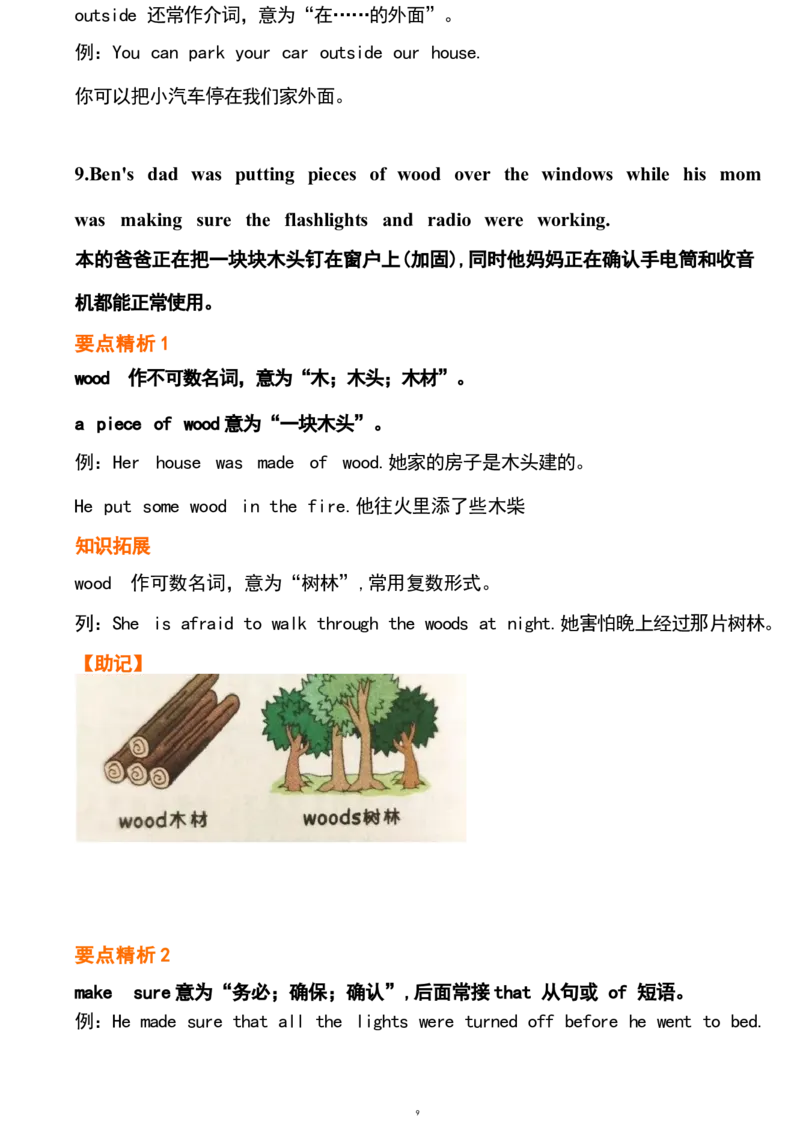
wood 作不可数名词,意为“木;木头;木材”。
a piece of wood 意为“一块木头”。
例:Her house was made of wood.她家的房子是木头建的。
He put some wood in the fire.他往火里添了些木柴
知识拓展
wood 作可数名词,意为“树林”,常用复数形式。
列:She is afraid to walk through the woods at night.她害怕晚上经过那片树林。
【助记】
要点精析 2
make sure 意为“务必;确保;确认”,后面常接 that 从句或 of 短语。
例:He made sure that all the lights were turned off before he went to bed.
9他确保所有的灯都关了才上床睡觉。
We must make sure of it.我们必须把这件事弄明白。
10.Ben was helping his mom make dinner when the rain began to beat
heavily against the windows.
当雨开始对着窗户猛烈地敲打时,本在帮助他的妈妈做晚饭。
要点精析 1
beat(beat,beaten) 作不及物动词,意为“敲打;(多次或连续)撞击,拍打;
(心脏脉搏等)跳动”。
例:Sid beat on the door with his hand.锡德用手拍门。
The rain is beating heavily against the window.雨在猛击窗户。
Jennifer's heart was beating fast.珍妮弗的心跳得很快。
知识拓展
beat 作及物动词,意为“打;敲;打败”。
例:Who's beating the drum? 谁在敲鼓?
We beat them by 11:2.我们以 11 比 2 打败了他们。
辨辨析:beat 与 win
指“打败”“击败“,后面常跟人或某个队
beat
指“赢了”“获胜”,后面常跟奖品或名次
win
例:He beat me at chess.他下国际象棋赢了我。
Britain won five gold medals.英国夺取了五块金牌。
要点精析 2
against 作介词,此处意为“碰;撞;倚;靠”。
例:The rain beat against the car windscreen.雨打在汽车挡风玻璃上。
Put the piano there, with its back against the wall.
10把钢琴放在那里,背靠着墙。
He leaned against the tree.他靠着树。
知识拓展
against 作介词,还可意为“反对;违反;对抗”。
例:They are against the plan.他们反对这个计划。
That is against the law.那是违法的。
They are playing basketball against Class 4.他们在和 4 班打篮球对抗赛。
链接中考
(浙江杭州中考) Ben was helping his mother when the rain began to beat
heavily the windows.
A. below B. across C. behind D.against
解析: below 意为“在 ……下面“; across 意为“横过;在 ……对面”; behind 意
为 “在……后面”;against 意为“碰,撞”。句意为“本正在帮他妈妈,这时雨开
始重
重地拍打在窗户上"。 beat against意为“反复在 ……上拍打,拍击”,故选 D。
11. After dinner, they tried to play a card game, but it was hard to have
fun with a serious storm happening outside.
晚饭后,他们原本想打牌,但外面的暴风雨太大了,很难有心情打牌了。
要点精析 1
此处 try 作及物动词,意为“试图;努力”。
例:He tried to control his voice.他尽量控制他的声音。
Try not to break it.尽量不要弄破它。
知识拓展
① try 作不及物动词,意为“尝试”。
例:He tried but didn't succeed.他试了试,但没成功。
11②try 作可数名词,意为“尝试;努力”。
例:I'm going to have try.我想试试。
③常见的与 try 相关的短语有: try on “试穿,试戴”; try out “试验”。
辨辨析:try to do sth.与 try doing sth.
try to do sth. “努力去做某事;试图去做某事”,但不一定能成功
try doing sth. “试着(用某种方法或手段)做某事”
要点精析 2
have fun 为固定短语,意为“玩得开心;玩得愉快”,相当于短语 have a good time
或 enjoy oneself。
例:Have fun! 尽情玩吧!
We are having great fun boating in the lake.我们在湖里划船很开心。
12.He finally fell asleep when the wind was dying down at around 3:00
a.m. 在大约凌晨 3 点风正逐渐变弱时他终于睡着了。
要点精析 1
fall asleep 为固定短语,意为“进入梦乡,睡着”。
例:She was very tired so she fell asleep soon.她很累,因此很快就睡着了。
要点精析 2
die down 为固定短语,意为“逐渐变弱;逐渐消失”。
例:The loud music died down after the police came.
警察来了之后,吵闹的音乐声逐渐变弱了。
Don't worry. The gossip will soon die down.别担心。流言蜚语不久就会平息。
13. When he woke up, the sun was rising. 当他醒来时,太阳正在升起。
12要点精析 1
wake up是“动词+副词”型短语,意为“醒来;把……弄醒”,可以不带宾
语,也可以接名词或代词作宾语。
例:She wakes up early every morning.她每天早晨醒得很早。
I'll wake you up when it's time to leave.到走的时候我会叫醒你。
要点精析 2
rise(rose,risen) 作不及物动词,意为“上升;升起”。
例:The river rose yesterday afternoon.昨天下午河水上涨了。
The moon was rising when l went home.我回家时,月亮正在升起。
辨析:rise 与 raise
“升起;提高;增加“,作不及物动词,主语常为物
rise
“使 ……升起;提高;增加”,作及物动词,主语常为人
raise
14.Although the storm broke many things apart, it brought fam ilies and
neighbors closer together.
虽然这场暴风雨破坏了许多东西,但是它把家人和邻居们的距离拉得更近了。
要点精析
break… apart 意为“把……打断;把……分开”。
例:The strong wind broke the branches apart.强风把树枝折断了。
Rumors broke the two close friends apart.谣言把两个亲密的朋友分开了。
15. leave the house离开家
要点精析
leave 动词,意为“离开”。
例:The bus leaves at 8:00 a.m.every day.公共汽车每天上午8点离开。
13知识拓展
leave 的常用搭配:
① “leave for+地点”动身前往某地
例:When will he leave for Beijing? 他将什么时候动身去北京?
② “leave+ 地点+for …” 离开某地前往
例:Mary is leaving Dalian for Jinan tomorrow.玛丽明天要离开大连去济南。
16. The roads were icy because of the heavy snow from the night before.
由于前天晚上的大雪,路面是结满冰的。
要点精析
icy 形容词,意为“结满冰的;冰冷的;冷淡的”。
例:It's not easy to walk on the icy roads.在结满冰的路面上行走不容易。
Because of the icy street, they can't drive the car. 因为街上结满了冰他们不能开
车。
知识拓展
英语中, 一些与天气有关的名词,加后缀-y 可构成相应的形容词。
frost 霜 →frosty 结霜的
cloud 云 →cloudy 多云的
rain 雨 →rainy 下雨的
snow 雪 →snowy 下雪的
wind 风 → windy 有风的
Section A 即学即试
根据汉语意思完成下列句子
1.妈妈打电话时我正在做作业。
I was doing my homework my mother on the phone.
142.今天早上我给玛丽打电话,但是没人接。
This morning I called up Mary, but nobody .
3.上星期日上午九点你在做什么?
you at 9: 00 last Sunday morning?
4.在暴风雨到来时,我弟弟正在看电视。
My brother was watching TV the rainstorm.
5.尽管大雨破坏了许多东西,但是它把人们拉得更近了。
Although the heavy rain many things ,it brought people closer.
Section B 知识点精析
1. When the school basketball competition started, Kate was still making
her way to school.当学校篮球比赛开始的时候,凯特还在去学校的路上。
要点精析
make one's way to 意为“(艰难地)前进;朝……前行”。
例:We slowly made our way to the mall through the crowd.
我们穿过人群慢慢地朝商场走去。
知识拓展
有关 way 的短语:
by the way 顺便说一下
in a way 在某种程度上
lose one's way 迷路
in the/one's way 挡路;妨碍
on the way 在路上
on one's way to 在去……的路上
2.On this day, Dr.Martin Luther King was killed.
15在这一天,马丁 ·路德 ·金博士被杀害了。
要点精析 1
was killed 意为“被杀害”,是一般过去时的被动语态。 一般过去时的被动语态由
“助 动词 was/were+ 过去分词”构成。当句子的主语为动作的承受者或不清楚动
作的执
行者是谁时,可用被动语态来表示。
例:A lot of people were killed in the accident.许多人在事故中丧生了。
The bridge was built last year by workers.这座桥是去年被工人们修建的。
3. My parents did not talk after that, and we finished the rest of
our dinner in silence.在那之后,我的父母不再讲话,然后我们默默地吃完剩余
的晚
饭。
要点精析 2
the rest of 意为“剩余的……”。“the rest of+名词”作主语时,谓语动词的数应
与 of 后的名词的数保持一致。
例:Does anyone want the rest of this pizza? 有人想要这剩余的比萨饼吗?
Tom is from Britain and the rest of us are from China.
汤姆来自英国,我们其余的人来自中国。
要点精析 3
in silence意为“沉默,无声”。其中silence 是不可数名词,意为“沉默;缄默;
无声”,其形容词形式为 silent, 意为“寂静的;无声的”。
例:The four men sat in silence.这四个人沉默地坐着。
She is eating dinner in silence.她默默地吃着晚饭。
4. More recently, most Americans remember what they were doing when
16the World Trade Center New York was taken down by terrorists.
16更近地,大多数美国人都记得当纽约世贸大楼被恐怖分子摧毁时,他们正在做
什么。
要点精析
take down意为“拆掉;拆除“。 was taken down是一般过去时的被动语态,意
为 “被拆除”。
例:Could you please help me take down this tent? 你能帮我拆除这顶帐篷吗?
知识拓展
take down 还可意为“写下,记下”。
例:I forgot to take down his telephone number.我忘了记下他的电话号码了。
5. I didn't believe him at first, but then I looked out of the window and
realized that it was true.
起初,我不相信他,但随后我朝窗外看去,才意识到情况是真的。
要点精析 1
at first 意为“首先;最初”,多用于句首或句末,暗示与后来的情况或动作不同,
其反义短语为 at last。
例:The work was hard at first, but got used to it.
起初这活儿很累,不过我习惯了。
要点精析 2
realize动词,意为“认识到;了解到”,不用于进行时态,其后可接名词、代词或
从句作宾语。
例:He didn't realize his mistake.他没有认识到自己的错误。
The man laughed when he realized what happened.
当那个人意识到发生了什么时,便笑了起来。
知识拓展
17realize动词,意为“实现(梦想、愿望等)”。
例:Mike finally realized his dream of being an actor.
迈克当演员的梦想终于实现了。
6. I was so scared that I could hardly think clearly after that.
我是如此害怕,以至于我几乎不能清楚地想起那之后的事了。
要点精析 1
scared 形容词,意为“害怕的;恐惧的”,常作表语,近义词为 afraid。
例:She is scared of mice.她害怕老鼠。
I am scared to go out alone at night.我害怕晚上独自出去。
辨析:scared 与 scary
形容词,主语一般是人,意为“感到害怕的”
scared
scary 形容词,主语一般是“事或“物”,意为“令人害怕的”
要点精析 2
hardly 副词,意为“几乎不;几乎没有”,表示否定含义。
例:He hardly watches TV.他几乎不看电视。
She was so excited that she could hardly sleep.
她如此兴奋,以至于几乎不能入睡。
辨析:hardly 与 hard
hardly 副词,意为“几乎不”
作形容词,意为“难的;硬的“;作副词,意为“努力
hard
地;猛烈地”
链接中考
18(山东滨州中考) I could control my feelings at the moment.
The song brought back so many childhood memories.
A. hardly B. really C.clearly D. nearly
解析:hardly 意为“几乎不”; really 意为“真正地”;clearly 意为“清楚地”;
nearly 意为“几乎”。由下句句意“这首歌带回了如此多的童年记忆”及所给选项
可知此处
应表示“此刻我几乎不能控制我的感情”,故用 hardly。 选 A。
7. September 11,2001—the date alone means some- thing to m ost
people in the US.
2001 年 9 月 11 日——仅是这个日期对美国的大多数人来说就意味着某事。
要点精析
此处 alone 作副词,意为“只有;仅仅”,常用于名词或代词之后。
例:You alone can help me.只有你才能帮助我。
辨析:alone 与 only
“只有;仅仅”,要放在被修饰的名词或代词之后
alone
only “只有;仅仅”,要放在所修饰的名词或代词之前
8.I had trouble thinking clearly after that because was very afraid.
我难以清楚地想起那之后的事,因为我很害怕。
要点精析
have trouble(in)doing sth.为固定结构,意为“做某事有困难或麻烦”。表示类
似意思的结构还有: have problems/difficulty(in)doing sth.。
例:Thousands of people have trouble falling asleep.
成千上万的人都有难以入睡的困扰。
He had no trouble finding a job.他毫不费劲地找到了一份工作。
199. But when I pointed it out to my friend, it went away .
但当我向朋友指出它时,它消失了。
要点精析 1
point out 意为“指出”,是“动词+副词”型短语,人称代词作宾语时应放在动词
之后、副词之前。
例:There is a mistake in this sentence. Can you point it out?
这个句子中有一处错误。你能把它指出来吗?
要点精析 2
go away 意为“离去”。
例:I went away wondering if I'd said the wrong thing.
我走开了,想着我是否说错了话。
He went away from his family.他离家出走了。
10.While my brother was laughing, the television news reported that
other people had seen the light as well.
当我哥哥在笑的时候,电视新闻报道别人也已经看见了那道亮光。
要点精析 1
had seen 为过去完成时结构,过去完成时表示在过去某个时间或动作之前就已经发
生或完成了的动作,由“助动词 had+ 过去分词”构成。
例:I realized that I had left my homework at home.
我意识到我已经把作业忘在家里了。
The film had begun when he got to the cinema.
当他到达电影院时,电影已经开始了。
要点精析 2
20as well意为“也,还”,只用于疑问句或肯定句中,常放在句末。
例: Why don't you come along as well? 你为什么不也一起来呢?
She speaks Japanese as well.她也说日语。
辨析:as well与 as well as
“也,还”,相当于一个副词
as well
“既 …又 …… ;不仅 ……而且 …… ”,作并列连词
as well as
Section B 即学即试
单项选择
1. His father was too tired. He lied down
A. in silent B. in silence C. keep silent D.keep silence
2.-Are you of the flight?
-No, just a little anxious.
A.angry B. serious C. scared D. calm
3. (山东临沂中考) David was so excited at the good news that he could
say a word.
A. nearly B. hard C. ever D. hardly
4. What do you mean asking such a
question? A. for B.on C. with
D.by
5 . (贵州毕节中考) -I have in learning English and I'm so worried.
Could you help me with it?
-Sure, I'd love to.
A.joy B.interest C. trouble D.fun
21人教版(新标准)初中英语知识点归纳
八年级下册 UNIT 5
What were you doing when the rainstorm came?
暴风雨来临时你在做什么?
单词归纳:
alarm 闹钟
against 倚;碰;撞
begin( began, begun) 开始
asleep 睡着
heavily 在很大程度上;大量地
rise(rose, risen) 升起;增加;提高
suddenly 突然;忽然
fallen 倒下的;落下的
strange 奇特的;奇怪的
icy 覆盖着冰的;冰冷的
storm 暴风雨
realize 理解;领会;认识到
wind 风
kid 开玩笑;欺骗
light 光;光线;光亮
completely 彻底地;完全地
report 报道;公布
passage 章节;段落
wood 木;木头
recently 不久前;最近
window 窗;窗户
silence 沉默;缄默;无声
match 火柴 truth 实情;事实
beat(beat,beat) 敲打;打败
date 日期;日子
短语归纳
right away 立刻;马上
pick up 接电话
go off (闹钟)发出响声 take down 拆除;往下拽;记录
make one's way 前往;费力地前进
die down 逐渐变弱;逐渐消失
take shower 洗淋浴
tell the truth 说实话
in silence 沉默;无声
in mess 凌乱不堪;乱七八糟
22clean up 打扫干净
point out 指
用法归纳
1. be busy doing sth. 忙于做某事
2.see sb./sth.doing sth. 看见某人/某物正在做某事
3.begin/start to do sth. 开始做某事
4. try to do sth. 努力做某事
5.It's+adj.+ to do sth. 做某事是……的。
6.have trouble(in) doing sth.做某事有困难或麻烦即学即试参考答案与解析
Section A
即学即试
1.while, was talking 2. picked up 3. What were, doing
4. at the time of 5. broke, apart
Section B
即学即试
1.B 句意:他的父亲太累了。他静静地躺下了。 in 后接名词 silence,表示“静静地”。
keep silent与 keep silence都表示“保持沉默”。
2.C 句意:“你害怕飞行吗?”“不,只是有点儿紧张。”表示“害怕“用scared。
3.C nearly “几乎”; hard “努力地; ever “曾经”;hardly “几乎不”。本句
是一 个 so…that… 型,由主句句意“戴维对这个好消息感到如此激动”可知,从
句句意为
“以至于他几乎说不出话来”,故用副词 hardly。
4.D 句意:你问这一个问题是什么意思? What do you mean by? 是询问意思或意
图的句型,意为“你……是什么意思?”。
5.Cjoy “快乐"; interest “兴趣”;trouble “困难”;fun “乐趣”。 have trouble
(in) doing sth.意为“做某事有困难”。根据句意可知选C。