初中英语知识框架体系及中考英语考点分布
第一部分 新目标英语教材知识一览表
初中(新目标)英语 全程一览表
预备篇
Unit Title Topic Functions
Unit 1 Good morning! Meeting friends Greet people
Unit 2 What’s this in English? Things around you Identify things
Spell words
Unit 3 What color is it? Colors Identify colors
七年级 上
Unit 1 My name’s Gina. Making new friends Introduce yourself
Greet people
Ask for and give telephone
numbers
Unit 2 Is this your pencil? Things in the classroom Identify ownership
Unit 3 This is my sister. The family Introduce people
Identify people
Unit 4 Where’s my backpack? Things around the house Talk about where things are
Unit 5 Do you have a soccer ball? Spending time with friends Talk about ownership
Make suggestions
Unit 6 Do you like bananas? Food Talk about likes and dislikes
Unit 7 How much are these pants? Shopping Ask about prices
Talk about clothing
Thank someone
Unit 8 When is your birthday? Dates Talk about dates
Unit 9 Do you want to go to a movie? Movies Talk about preferences
Make plans
Unit 10 Can you play the guitar? Joining a club Talk about abilities
Unit 11 What time do you go to school? Daily routines Talk about daily routines
Ask about and say times
Unit 12 My favorite subject is science. School subjects Talk about preferences
Give reasons
七年级 下
Unit 1 Where’s your pen pal from? Countries, nationalities and Talk about countries
languages nationalities and languages
Ask and tell where people live
Unit 2 Where’s the post office? The neighborhood Ask for and give directions on
the street
Unit 3 Why do you like koalas? Animals in a zoo Describe animals
Express preferences
Unit 4 I want to be an actor. Occupations Talk about jobs
Unit 5 I’m watching TV. Everyday activities Talk about what people are
doing
Unit 6 It’s raining! The weather Describe the weather
Describe what you are doing
Unit 7 What does he look like? Physical appearance Describe people’s looks
Unit 8 I’d like some noodles. Food Order food
Unit 9 How was your weekend? Weekend activities Talk about recent past events
Unit 10 Where did you go on vacation? Holidays and vacations Talk about past events
Unit 11 What do you think of game shows? Popular culture Give opinions
Talk about likes and dislikes
Unit 12 Don’t eat in class. Rules Talk about rules
八年级上
Unit 1 How often do you exercise? Free time activities Talk about how often you do
things
Unit 2 What’s the matter? Health Talk about your health
Give adviceUnit 3 What are you doing for vacation? Vacation plans Talk about future plans
Unit 4 How do you get to school? Transportation Talk about how to get to places
Unit 5 Can you come to my party? Invitation Make , accept and decline
invitations
Talk about obligations
Unit 6 I’m more outgoing than my sister. Personal traits Talk about personal traits
Compare people
Unit 7 How do you make a banana milk Cooking at home Describe a process
shake? Follow instructions
Unit 8 How was your school trip? School trips Talk about events in the past
Unit 9 When was he born? People we admire Talk about famous people
Unit 10 I’m going to be a basketball player. Life goals Talk about future intentions
Unit 11 Could you please clean your room? Chores Make polite requests
Ask for permission
Unit 12 What’s the best radio station? Your town Discuss preferences
Make comparisons
八年级下
Unit 1 Will people have robots? Opinions Make predictions
Unit 2 What should I do? Advice Talk about problems
Give advice
Unit 3 What were you doing when the Interesting events Talk about past events
UFO arrived? Talk a story
Unit 4 He said I was hard-working. Telling a story Report what someone said
Unit5 If you go to the party, you’ll have a Decision making Talk about consequences
great time!
Unit 6 How long have you been collecting Hobbies Talk about how long you have
shells? been doing things
Unit 7 Would you mind turning down the Complaints Make requests
music? Apologize
Unit 8 Why don’t you get her a scarf? Gift giving Compare qualities
Give advice
Unit 9 Have you ever been to an Fun places Talk about past experiences
amusement park?
Unit 10 It’s a nice day, isn’t it? Small talk Make small talk
九年级
Unit 1 How do you study for a test? Learning how to learn Talk about how to study
Unit 2 I used to be afraid of the dark. How we have changed Talk about what you used to be
like
Unit 3 Teenagers should be allowed to Rules Talk about what you are allowed
choose their own clothes. to do
Agree and disagree
Unit 4 What would you do? Interesting and embarrassing Talk about imaginary situations
situations
Unit 5 It must belong to Carla. A picnic Make inferences
Unit 6 I like music that I can dance to. Music Express preferences
Unit 7 Where would you like to visit? vacations Talk about places you would like
to visit
Unit 8 I’ll help clean up the city parks. volunteering Offer help
Unit 9 When was it invented? inventions Talk about the history of
inventions
Unit 10 By the time I got outside, the bus Bad days Narrate past events
had already left.
Unit 11 Could you please tell me where the Getting around Ask for information politely
restrooms are?
Unit 12 You’re supposed to shake hands. Customs Tell what you are supposed to do
Unit 13 Rainy days make me sad. Feelings Talk about how things affect you
Unit 14 Have you packed yet? Preparing for a vacation Talk about recent events
Unit 15 We’re trying to save the manatees! Protecting the environment Debate an issue
第二部分 初中英语语法项目一览表语法项目 构 成 用 法 象 征 词 规则变化 不规则变化 例
Every often always on 天 in一般-s –es 辅音have----has
一般现在时 动词用原形 表示经常性的 月、季、节、年。 +y---ies He goes to school every day.
三人称单数-s / es 动作或状态 I often have lunch at home.
ago/just now /In1998一 般/去 e 双go-went come-came
动词用过去时 表过去某个、段时间内 He wrote a letter yesterday.
一般过去时 last/yesterday 等 写/辅+y 结尾do-did leave-left等
Be—was/ were 动作及状态 I studied hard last year.
-ied
tomorrow / after Go come leave stay
be going to+V原 在将来某个时间或 next / tonight in 2010 fly等用进行表将来 Are you going to read ?
一般将来时
will / shall + V原 某段时要做的事 He is coming tomorrow .
listen look now 一般去e 双写 tie die lie –
表此时此刻正进行的动all the time Don’t… +ing 变ie为y加ing Tom is writing now .
现在进行时 be+doing
作或状态 They are lying on the bed .
含糊的频率副词 already just ne分词规则的同不规则的动词的过去分I have been teaching for 8
现在完成时 have / has +PP 发生在过去影响在现在
ver ever 过去式是一样词需逐个记忆 years.
现在完成进行 have/has been+doing的动作或状态等
的 He has slept for two days.
at this time yesterday 一般去e 双写 tie die lie –
过去进行时 was / were +doing 表在过去某时间正在进 last Sunday evening +ing 变ie为y加ing He was reading at that time
多用于复合句中 行的动作 last Friday
by the time+过去时 规则的分词构需要逐个记忆
had+动过去分词 该动作发生在过去的过 We had learnt 2000 words
过去完成时 when after before 成与过去时一详见不规则动词表
多用于复合句中 去 by the end of
样的
would + V 原形 过去看来将要发生的动 He said that he would come
过去将来时 He said that he… the next day .
多用宾语从句中 作或状态 here the next day .
一般/去 e 双good/well —better
比较级形式 后--er 前加more 表示两个人、物 than /much/ a little She is the tall in the two.
写/辅+y 结尾 much/many—more
形容副词名词 名词比较用more 之间进行比较时 far / in the two 等 He runs faster than Tom .
-ier
一般/去 e 双bad/ill/badly-worst
最高级形式 后-est 前加most 大于等于三个人、物之in the +比较范围 She is the most beautiful
写/辅+y 结尾far-farther-farthest
形容副词名词 名词比较用most 间进行比较 of the 具体的数字 in her class.(最高级加
-iest
作表语 作状语
动词不定式 作主语 作宾语 作宾补 作定语
His job is to He’ll go to see a doctor
没有人称To read is helpful forH e wants to buy aI hear him sing yesterday He has much homework
take care oft omorrow .
和数的变化 anybody now . dictionary. Tom told me to open it. to do every day .
children .
状语从句 宾语从句
定语从句
句子作状语 (时间地点原因条件让步比句子作宾语(语序、时态、引导词、客观事
主从复合句 句子作定语(修饰名词或代词的句子、注意先行词)
较) 实)
I saw the man who was stealing my bike yesterday
He was writing a letter when I came in。 He asked me if I had been to Beijing before.
主动语态:主语(人、物)+ 谓语 + 宾语 We speak English . 主动变被动,先找主、谓、宾,宾改主、主
主动结构
动作执行者 + 及物动词 + 动作承受者 主语 谓语 宾语 代词变格要细心,谓语动词be pp,时态随主、数随被
被动语态:主语(人、物)+be PP + by宾语 English is spoken by us PP 是及物动词的过去分词加ed 或不规则详见表
被动结构
动作承受者 + be PP + by动作执行者 被动句的时态(be)随主动句的时态(
在被动语态中没有可以省to 的不定式 宾改主 谓语动词 be PP 主by 宾 应随被动句的主语(am、is、are、was第三部分 新目标英语各年级重点内容概览
《英语(新目标)》教材重点句型、短语一览表
*标记为听力材料语句七年级(上册)
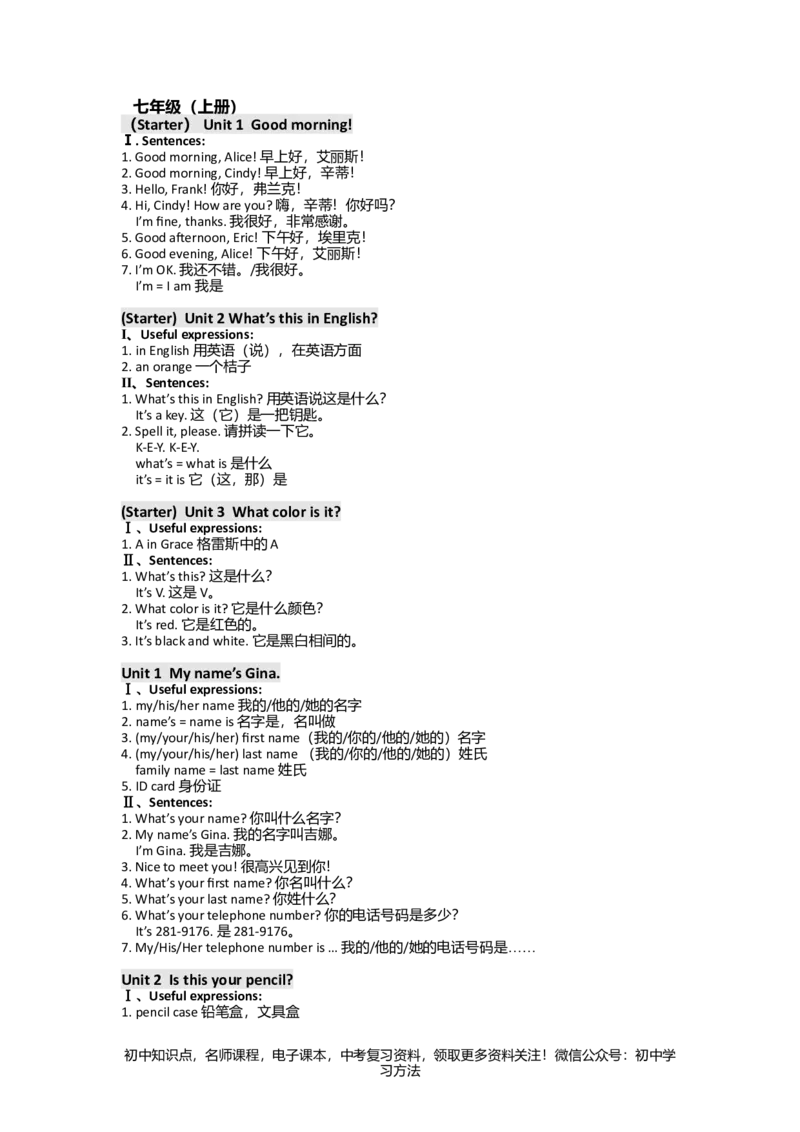
(Starter) Unit 1 Good morning!
Ⅰ. Sentences:
1. Good morning, Alice! 早上好,艾丽斯!
2. Good morning, Cindy! 早上好,辛蒂!
3. Hello, Frank! 你好,弗兰克!
4. Hi, Cindy! How are you? 嗨,辛蒂!你好吗?
I’m fine, thanks. 我很好,非常感谢。
5. Good afternoon, Eric! 下午好,埃里克!
6. Good evening, Alice! 下午好,艾丽斯!
7. I’m OK. 我还不错。/我很好。
I’m = I am 我是
(Starter) Unit 2 What’s this in English?
Ⅰ、Useful expressions:
1. in English 用英语(说),在英语方面
2. an orange一个桔子
Ⅱ、Sentences:
1. What’s this in English? 用英语说这是什么?
It’s a key. 这(它)是一把钥匙。
2. Spell it, please. 请拼读一下它。
K-E-Y. K-E-Y.
what’s = what is 是什么
it’s = it is 它(这,那)是
(Starter) Unit 3 What color is it?
Ⅰ、Useful expressions:
1. A in Grace 格雷斯中的A
Ⅱ、Sentences:
1. What’s this? 这是什么?
It’s V. 这是V。
2. What color is it? 它是什么颜色?
It’s red. 它是红色的。
3. It’s black and white. 它是黑白相间的。
Unit 1 My name’s Gina.
Ⅰ、Useful expressions:
1. my/his/her name 我的/他的/她的名字
2. name’s = name is 名字是,名叫做
3. (my/your/his/her) first name(我的/你的/他的/她的)名字
4. (my/your/his/her) last name (我的/你的/他的/她的)姓氏
family name = last name 姓氏
5. ID card 身份证
Ⅱ、Sentences:
1. What’s your name? 你叫什么名字?
2. My name’s Gina. 我的名字叫吉娜。
I’m Gina. 我是吉娜。
3. Nice to meet you! 很高兴见到你!
4. What’s your first name? 你名叫什么?
5. What’s your last name? 你姓什么?
6. What’s your telephone number? 你的电话号码是多少?
It’s 281-9176. 是281-9176。
7. My/His/Her telephone number is … 我的/他的/她的电话号码是……
Unit 2 Is this your pencil?
Ⅰ、Useful expressions:
1. pencil case 铅笔盒,文具盒
初中知识点,名师课程,电子课本,中考复习资料,领取更多资料关注!微信公众号:初中学
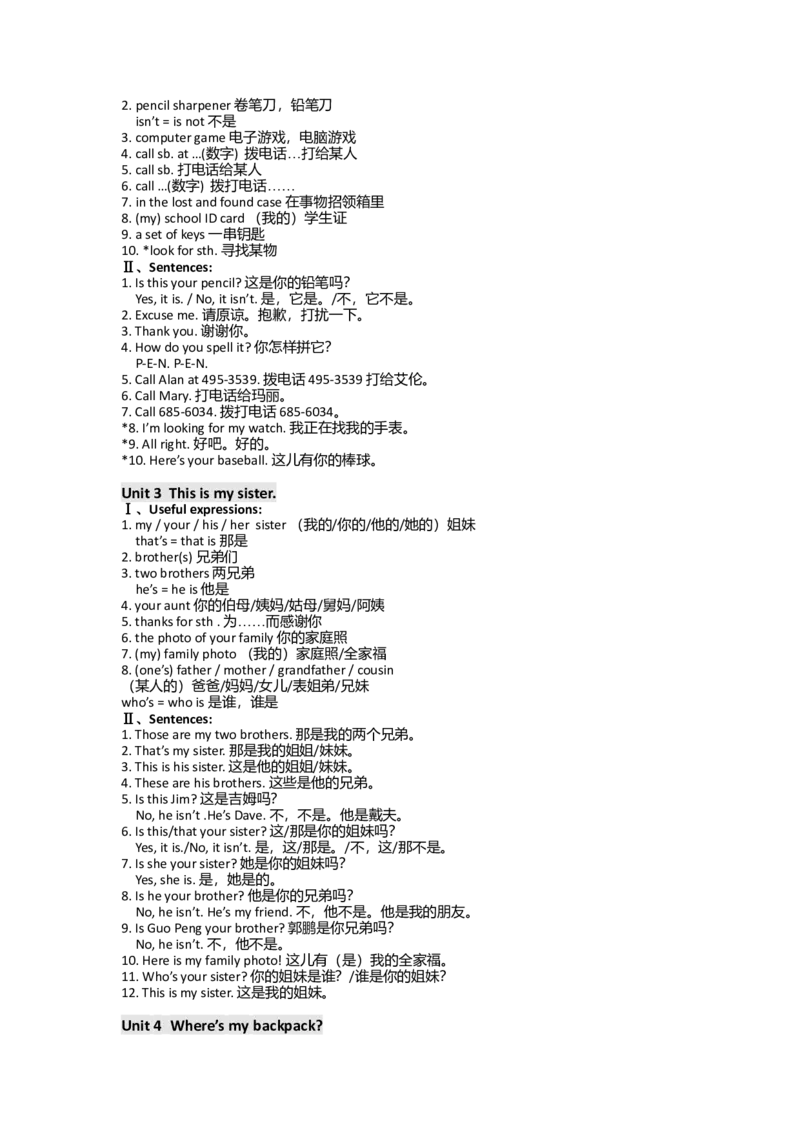
习方法2. pencil sharpener 卷笔刀,铅笔刀
isn’t = is not 不是
3. computer game 电子游戏,电脑游戏
4. call sb. at …(数字) 拨电话…打给某人
5. call sb. 打电话给某人
6. call …(数字) 拨打电话……
7. in the lost and found case 在事物招领箱里
8. (my) school ID card (我的)学生证
9. a set of keys 一串钥匙
10. *look for sth. 寻找某物
Ⅱ、Sentences:
1. Is this your pencil? 这是你的铅笔吗?
Yes, it is. / No, it isn’t. 是,它是。/不,它不是。
2. Excuse me. 请原谅。抱歉,打扰一下。
3. Thank you. 谢谢你。
4. How do you spell it? 你怎样拼它?
P-E-N. P-E-N.
5. Call Alan at 495-3539. 拨电话495-3539打给艾伦。
6. Call Mary. 打电话给玛丽。
7. Call 685-6034. 拨打电话685-6034。
*8. I’m looking for my watch. 我正在找我的手表。
*9. All right. 好吧。好的。
*10. Here’s your baseball. 这儿有你的棒球。
Unit 3 This is my sister.
Ⅰ、Useful expressions:
1. my / your / his / her sister (我的/你的/他的/她的)姐妹
that’s = that is 那是
2. brother(s) 兄弟们
3. two brothers 两兄弟
he’s = he is 他是
4. your aunt 你的伯母/姨妈/姑母/舅妈/阿姨
5. thanks for sth . 为……而感谢你
6. the photo of your family 你的家庭照
7. (my) family photo (我的)家庭照/全家福
8. (one’s) father / mother / grandfather / cousin
(某人的)爸爸/妈妈/女儿/表姐弟/兄妹
who’s = who is 是谁,谁是
Ⅱ、Sentences:
1. Those are my two brothers. 那是我的两个兄弟。
2. That’s my sister. 那是我的姐姐/妹妹。
3. This is his sister. 这是他的姐姐/妹妹。
4. These are his brothers. 这些是他的兄弟。
5. Is this Jim? 这是吉姆吗?
No, he isn’t .He’s Dave. 不,不是。他是戴夫。
6. Is this/that your sister? 这/那是你的姐妹吗?
Yes, it is./No, it isn’t. 是,这/那是。/不,这/那不是。
7. Is she your sister? 她是你的姐妹吗?
Yes, she is. 是,她是的。
8. Is he your brother? 他是你的兄弟吗?
No, he isn’t. He’s my friend. 不,他不是。他是我的朋友。
9. Is Guo Peng your brother? 郭鹏是你兄弟吗?
No, he isn’t. 不,他不是。
10. Here is my family photo! 这儿有(是)我的全家福。
11. Who’s your sister? 你的姐妹是谁?/谁是你的姐妹?
12. This is my sister. 这是我的姐妹。
Unit 4 Where’s my backpack?Ⅰ、Useful expressions:
1. under the table/chair/bed 桌子/椅子/床下面
2. on the sofa/chair/dresser/table/bed/desk/floor
在沙发/椅子/橱柜/桌子/床/书桌/地板上面
3. in the backpack/drawer 双肩背包/抽屉里边
don’t = do not 不;没(否定助动词)
4. math book 数学书
5. alarm clock 闹钟
6. video tape 录像带
7. take sth. to sp./sb. 带某物到某地/某人那儿去
8. bring sth. to sp./sb. 把某物带到某地/某人这儿来
9. need sth. 需要某物
10. in my backpack 在我的背包里
*11. how about sth. 某物呢?某物怎么样?
*12. take it back to… 把它带回……去
*13. after school 放学后
Ⅱ、Sentences:
1. Where’s my backpack? 我的双肩背包在哪儿?
It’s under the table.它在桌子下面。
2. Where are my books? 我的书在哪儿?
They’re on the sofa .它们在沙发上。
3. Are they on the bed? 它们在床上吗?
Yes, they are. /No, they’re not. 是的。/不是的
4. Is it on the dresser? 它在梳妆台/碗柜上吗?
Yes, it is. /No, it isn’t. 是的/不是的。
5. I don’t know. 我不知道。
6. Please take these things to your sister. 请把这些东西带去给你姐姐。
7. Can you bring some things to school? 你能带些东西来学校吗?
8. It’s on your back! 它在你的背上!
*9. How about my pencil case and my baseball? 我的文具盒和棒球呢?
where’s = where is 在哪儿
they’re = they are 他们/她们/它们是
Unit 5 Do you have a soccer ball?
Ⅰ、Useful expressions:
1. tennis racket 网球拍
2. ping-pong ball/bat 乒乓球/球拍
3. soccer ball (英式)足球
doesn’t = does not 不;没(否定助动词)
let’s = let us 让我们
4.play ping-pong/tennis/volleyball/basketball
/soccer
打(踢/玩)乒乓秋/网球/排球/篮球/足球
5. many sports clubs 许多运动俱乐部
…, and more … 和更多
6. play computer games 打电子游戏
7. watch TV 看电视
8. a great sports collection 一个很棒的运动品收藏
9. he/she has 他/她有
10. play sports 做运动
11. watch them on TV 在电视上看它们
12. every day 每天
13. have a computer game 玩电子游戏
14. be boring 无聊
15. an eraser 一块橡皮擦
Ⅱ、Sentences:
1. Do you have a ping-pong ball? 你有乒乓球吗?
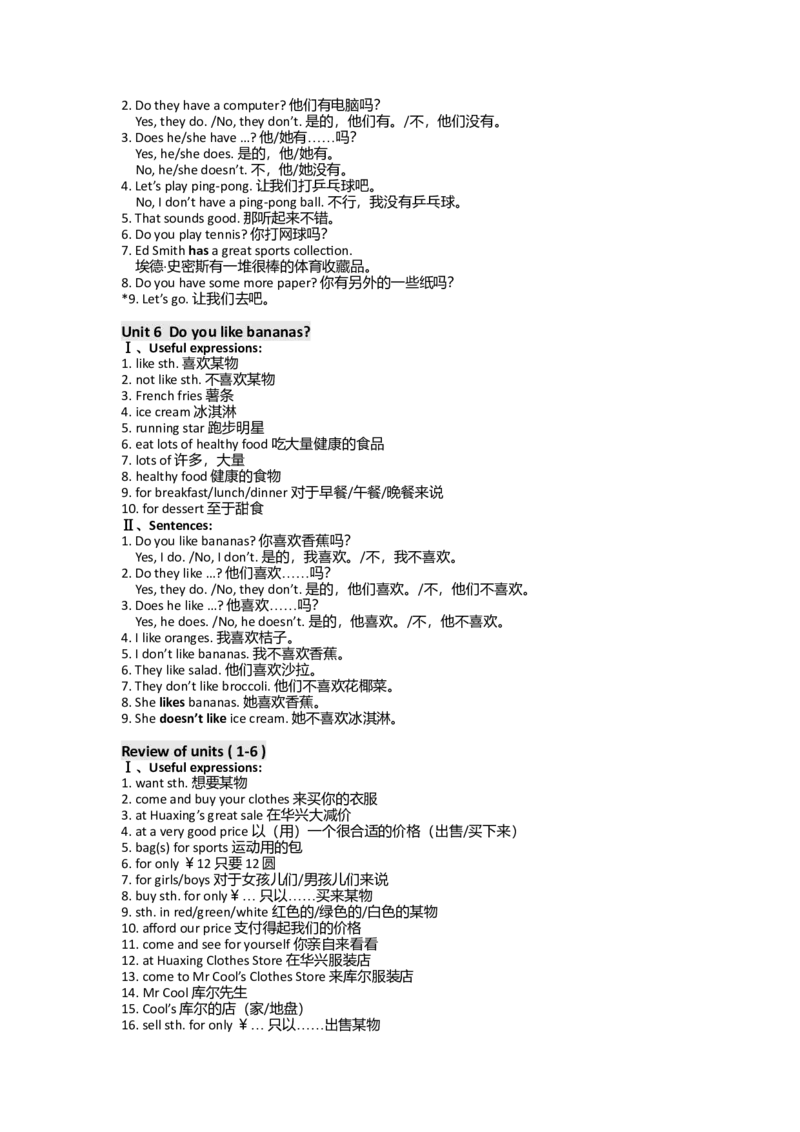
Yes, I do. /No, I don’t. 是的,我有。/不,我没有。2. Do they have a computer? 他们有电脑吗?
Yes, they do. /No, they don’t. 是的,他们有。/不,他们没有。
3. Does he/she have …? 他/她有……吗?
Yes, he/she does. 是的,他/她有。
No, he/she doesn’t. 不,他/她没有。
4. Let’s play ping-pong. 让我们打乒乓球吧。
No, I don’t have a ping-pong ball. 不行,我没有乒乓球。
5. That sounds good. 那听起来不错。
6. Do you play tennis? 你打网球吗?
7. Ed Smith has a great sports collection.
埃德·史密斯有一堆很棒的体育收藏品。
8. Do you have some more paper? 你有另外的一些纸吗?
*9. Let’s go. 让我们去吧。
Unit 6 Do you like bananas?
Ⅰ、Useful expressions:
1. like sth. 喜欢某物
2. not like sth. 不喜欢某物
3. French fries 薯条
4. ice cream 冰淇淋
5. running star 跑步明星
6. eat lots of healthy food 吃大量健康的食品
7. lots of 许多,大量
8. healthy food 健康的食物
9. for breakfast/lunch/dinner 对于早餐/午餐/晚餐来说
10. for dessert 至于甜食
Ⅱ、Sentences:
1. Do you like bananas? 你喜欢香蕉吗?
Yes, I do. /No, I don’t. 是的,我喜欢。/不,我不喜欢。
2. Do they like …? 他们喜欢……吗?
Yes, they do. /No, they don’t. 是的,他们喜欢。/不,他们不喜欢。
3. Does he like …? 他喜欢……吗?
Yes, he does. /No, he doesn’t. 是的,他喜欢。/不,他不喜欢。
4. I like oranges. 我喜欢桔子。
5. I don’t like bananas. 我不喜欢香蕉。
6. They like salad. 他们喜欢沙拉。
7. They don’t like broccoli. 他们不喜欢花椰菜。
8. She likes bananas. 她喜欢香蕉。
9. She doesn’t like ice cream. 她不喜欢冰淇淋。
Review of units ( 1-6 )
Ⅰ、Useful expressions:
1. want sth. 想要某物
2. come and buy your clothes 来买你的衣服
3. at Huaxing’s great sale 在华兴大减价
4. at a very good price 以(用)一个很合适的价格(出售/买下来)
5. bag(s) for sports 运动用的包
6. for only ¥12 只要12圆
7. for girls/boys 对于女孩儿们/男孩儿们来说
8. buy sth. for only¥… 只以……买来某物
9. sth. in red/green/white 红色的/绿色的/白色的某物
10. afford our price 支付得起我们的价格
11. come and see for yourself 你亲自来看看
12. at Huaxing Clothes Store 在华兴服装店
13. come to Mr Cool’s Clothes Store 来库尔服装店
14. Mr Cool 库尔先生
15. Cool’s 库尔的店(家/地盘)
16. sell sth. for only ¥… 只以……出售某物17. buy sth. from … 从…那儿买来某物
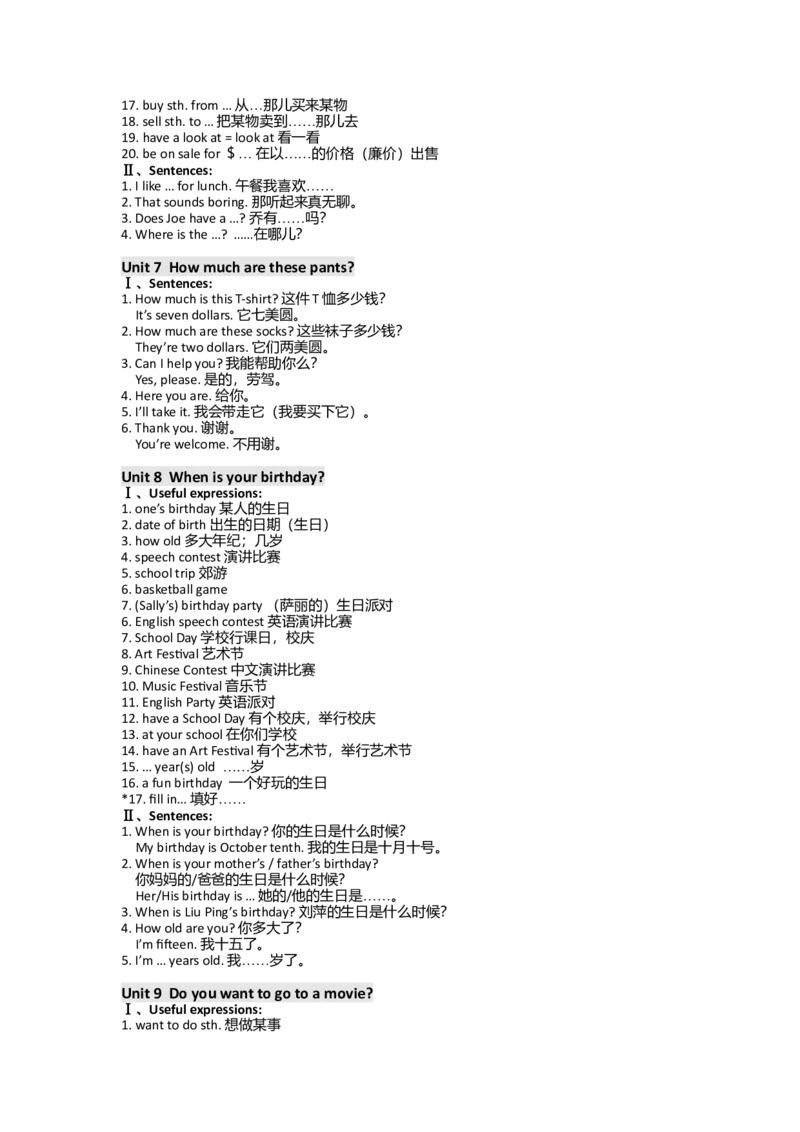
18. sell sth. to … 把某物卖到……那儿去
19. have a look at = look at 看一看
20. be on sale for $… 在以……的价格(廉价)出售
Ⅱ、Sentences:
1. I like … for lunch. 午餐我喜欢……
2. That sounds boring. 那听起来真无聊。
3. Does Joe have a …? 乔有……吗?
4. Where is the …? ……在哪儿?
Unit 7 How much are these pants?
Ⅰ、Sentences:
1. How much is this T-shirt? 这件T恤多少钱?
It’s seven dollars. 它七美圆。
2. How much are these socks? 这些袜子多少钱?
They’re two dollars. 它们两美圆。
3. Can I help you? 我能帮助你么?
Yes, please. 是的,劳驾。
4. Here you are. 给你。
5. I’ll take it. 我会带走它(我要买下它)。
6. Thank you. 谢谢。
You’re welcome. 不用谢。
Unit 8 When is your birthday?
Ⅰ、Useful expressions:
1. one’s birthday 某人的生日
2. date of birth 出生的日期(生日)
3. how old 多大年纪;几岁
4. speech contest 演讲比赛
5. school trip 郊游
6. basketball game
7. (Sally’s) birthday party (萨丽的)生日派对
6. English speech contest 英语演讲比赛
7. School Day 学校行课日,校庆
8. Art Festival 艺术节
9. Chinese Contest 中文演讲比赛
10. Music Festival 音乐节
11. English Party 英语派对
12. have a School Day 有个校庆,举行校庆
13. at your school 在你们学校
14. have an Art Festival 有个艺术节,举行艺术节
15. … year(s) old ……岁
16. a fun birthday 一个好玩的生日
*17. fill in… 填好……
Ⅱ、Sentences:
1. When is your birthday? 你的生日是什么时候?
My birthday is October tenth. 我的生日是十月十号。
2. When is your mother’s / father’s birthday?
你妈妈的/爸爸的生日是什么时候?
Her/His birthday is … 她的/他的生日是……。
3. When is Liu Ping’s birthday? 刘萍的生日是什么时候?
4. How old are you? 你多大了?
I’m fifteen. 我十五了。
5. I’m … years old. 我……岁了。
Unit 9 Do you want to go to a movie?
Ⅰ、Useful expressions:
1. want to do sth. 想做某事2. go to a movie/movies 去看电影
3. see a comedy/comedies 看喜剧片
4. see an action movie / action movies 看动作片
5. an action movie 一部动作片
6. what kind of movies 哪种电影
7. also like 也喜欢
8. Beijing Opera 京剧
9. often do sth. 经常做某事
10. go to do sth. 去做某事
11. Chinese action movies 中国动作片
12. think + that从句 想……;认为……
13.be(very)exciting/boring/scary/interesting/
funny
(非常)振奋人心/无聊/可怕/有趣/好玩
14. learn about 学会关于某方面的知识
15. Chinese history 中国历史
16. see Beijing Opera with sb. 和某人一起看京剧
17. do sth. with sb. 和某人一起做某事
18. my friend , Mike 我的朋友——迈克
19. (my) favorite actor (我)最喜爱的演员
20. a new movie 一部新电影
21. a (very) successful thriller 一部(非常)成功的恐怖片
22. on weekends 在周末
23. like it, too 也喜欢它
24. a great actor 一个很棒的演员
25. Shaolin Temple 少林寺
26. in the movie 在这部电影里
*27. how about sb. 某人呢?某人怎么样?
*28. like it a lot 非常喜欢它
*29. a lot = very much 非常地
Ⅱ、Sentences:
1. Do you want to go to a movie? 你想去看电影吗?
Yes, I do. I want to see a comedy. 是的,我想去。我想看喜剧片。
2. Does he/she want to go to a movie? 他/她想去看电影吗?
Yes, he/she does. 是的,他/她想去。
No, he/she doesn’t. 不,他/她不想去。
3. What kind of movies do you like? 你喜欢哪种电影?
I like action movies and comedies. 我喜欢动作片和喜剧片。
4. I like thrillers and I like action movies.
我喜欢恐怖片而且我还喜欢动作片。
5. I like thrillers but I don’t like comedies.
我喜欢恐怖片但我不喜欢喜剧片。
6. Mike is English. 迈克是英国人。
*7. How about you? 你呢?
Unit 10 Can you play the guitar?
Ⅰ、Useful expressions:
1. play chess 下象棋
2. play the guitar/piano/drums/trumpet 弹(打/吹/演奏)钢琴/鼓/喇叭
3. speak English 说英语
4. join the art/music/English/chess/basketball/swimming club
加入美术/音乐/英语/象棋/篮球/游泳俱乐部
can’t = can not 不能;不会;不可能
5. what club 什么俱乐部
6. play it (very) well 做某活动做得(非常)好
7. help wanted 求助
8. be good with sb. 和某人相处得好,对人很好
9. need help for our Beidaihe School Trip为了我们的北戴河之旅需要帮助
10. help with… 在……(方面)帮忙
11. help sb. with sth. 帮助某人干某事
12. musicians wanted for School Music Festival 为学校音乐节招收音乐家
13. be in our school music festival 加入我们的学校音乐节
14. want two good musicians for our rock band
为了我们的摇滚乐队想要两名音乐家
15.(our) rock band (我们的)摇滚乐队
16. school show 校园才艺展示
17. in the music room 在音乐室里
18. do Chinese kung fu 耍中国工夫
19. a little 一点儿
20. a lot = very much 非常
21. have an e-mail address 有电子邮箱
*22. all the clubs 所有俱乐部
Ⅱ、Sentences:
1. I want to join the music club. 我想加入音乐俱乐部。
2. Can you sing? 你会唱歌吗?
Yes, I can. /No, I can’t. 是的,我会。/不,我不会。
3. Can he paint? 他会画画吗?
Yes, he can. /No, he can’t. 是的,他会。/不,他不会。
4. Can she speak English? 她会说英语吗?
Yes, she can. /No, she can’t. 是的,她会。/不,她不会。
5. Can you speak English? 你们会说英语吗?
Yes, we can. /No, we can’t. 是的,我们会。/不,我们不会。
6. What club do you want to join? 你们/你想加入什么俱乐部?
We want to join the chess club. 我们想加入象棋俱乐部。
I want to join the basketball club. 我想加入篮球俱乐部。
7. What can you do? 你会做什么?
I can play the guitar. 我会弹吉他。
8. Tom can play the guitar but he can’t play it very well.
汤姆会弹吉他,但他不能弹得很好。
9. Come and join us! 来加入我们吧!
10. Come and show us! 来展示给我们看吧!
11. May I know your name? 我能知道你的名字吗?
12. Thanks a lot. 非常感谢。
13. Why do you want to join the club? 你为什么想加入这个俱乐部?
*14. I can’t sing or dance. 我不会唱歌和跳舞。
Unit 11 What time do you go to school?
Ⅰ、Useful expressions:
1. get up 起床
2. take a shower = have a shower 洗澡
3. go to school 去上学
4. eat (one’s) breakfast/lunch/dinner 吃(某人的)早餐/午餐/晚餐
5. at five o’clock 在五点钟
6. at 8:00 在八点钟
7. work very long hours 工作很长时间
8. brush one’s teeth 刷某人的牙
9. after breakfast 早餐后
10. after… ……之后
11. play one’s guitar弹某人的吉他
12. go to work 去上班
13. get to work 开始工作
14. take the number 17 bus to a hotel 乘坐17路公车去一间旅馆
15. take sb. to work 带某人去工作
16. (work) all night 整夜工作
17. love to do sth. 爱做某事18. listen to him 听某人(说话/唱歌)
19. get home 到家
20. watch morning TV 看早间电视节目
21. go to bed 去睡觉
22. think + 从句 想想……
23. in the morning / afternoon / evening 在早上/下午/晚上
24. do (one’s) homework 做(某人的)家庭作业
25. go home回家
26. know about sth. 知道关于某方面的事
27. at around six-fifteen 在大约六点十五分(一刻)
28. at six-thirty 在六点半
29. write sb. about sth. 写给某人关于某方面的事
30. tell sb. about sth. 告诉某人关于某方面的事
31. best wishes 最美好的祝愿(给你)
*32. a big family 一个大家庭
*33. a shower schedule 一份洗澡时间表
Ⅱ、Sentences:
1. What time do you usually get up? 你通常什么时间起床?
I usually get up at five o’clock. 我通常在五点起床。
2. Rick’s family has one shower. 瑞克家有一个淋浴。
3. What time does Alicia take a shower? 阿莉西亚什么时候洗澡?
She takes a shower at 8:00. 她在八点洗澡。
4. What a funny time to eat breakfast! 真是个吃早餐的好时候!
5. Can you think what his job is? 你能想想他的职业是什么吗?
6. What time is it? 几点了?
It’s eight-thirty. 八点三十分(半)了。
7. When do people usually eat dinner? 人们通常什么时候吃晚餐?
8. When does Tom usually get up? 汤姆通常什么时候起床?
He usually gets up at … 他通常在……起床。
9. School starts at nine o’clock. 学校在九点开始上课。
10. Please write and tell me about your morning.
请来信告诉我关于你的早晨(的情况)。
11. Please write soon. 请快点回信。
12. Are you awake? 你醒着吗?
13. What time is it there? 那边几点了?
*14. What time do you usually shower? 你通常什么时候洗澡?
*15. You have a big family, don’t you, Rick?
瑞克,你有个大家庭,不是吗?
*16. How many showers do you have? 你们有多少个淋浴?
We only have one shower. 我们只有一个淋浴。
*18. That’s early. 那可真早。
*19. Thanks for the interview, Tom. 汤姆,非常感谢你接受这个采访。
Unit 12 My favorite subject is science.
Ⅰ、Useful expressions:
1. (one’s) favorite subject 最喜欢的学科
2. (one’s) science/art/music teacher 自然/美术/音乐老师
3. Mrs Jones琼斯太太
4. (one’s) favorite teacher 某人最喜欢的老师
5. favorite city/food/color/TV show/sport
最喜欢的城市/食物/颜色/电视节目/运动
6. have math/science/art/P.E./music
上数学课/自然课/美术课/体育课/音乐课
7.onMonday/Tuesday/Wednesday/Thursday/Friday/Saturday
在星期一/二/三/四/五/六
8. on Sunday 在星期天
9. be (really) busy 十分繁忙
10. be difficult/relaxing 很困难/轻松11. after lunch 午餐后
12. last class 最后一节课
13. after class 放学后
14. have volleyball 进行排球运动
15. for two hours 持续两个小时
16. be (very) strict (非常)严格
17. be (usually very) tired (通常非常)累
18. have Chinese history club 去参加中国历史俱乐部
19. Miss Wang 王小姐
20. ask me 问我
21. not like any subject 不喜欢任何学科
22. play with my dog 和我的狗一起玩
23. around with sb. 在某人周围
*24. be so boring 这么的无聊
Ⅱ、Sentences:
1. What’s your favorite subject? 你最喜欢的科目是什么?
My favorite subject is science. 我最喜欢的科目是自然科学。
2. Why do you like P.E.? 为什么你喜欢体育?
Because it’s fun. 因为它好玩。
3. What’s his/her favorite subject? 他/她最喜欢的学科是什么?
4. Why does he /she like …? 为什么他/她喜欢……?
5. Because it’s interesting/fun/exciting. 因为它有趣/好玩/刺激。
6. Who is your science teacher? 你的自然科学老师是谁?
My science teacher is Mr Wang. 我的自然科学老师是王先生。
7. When do you have math? 你什么时候上数学课?
8. It’s Tuesday, November 11. 这是十一月十一号,星期二。
9. I don’t like any subject. 我不喜欢任何科目。
10. But his “subject” is only running around with me.
但是他的“学科”只是在我周围跑步。
11. Do you really not like school? 你真的不喜欢学校吗?
*12. My favorite subject is science. What’s yours?
我最喜欢的学科是自然科学。你的呢?(你最不喜欢的学科呢?)
*13. It’s such fun. 那是如此的有趣。
*14. Art, I guess. 我猜,是美术。
Review of units ( 7-12 )
Ⅰ、Useful expressions:
1. in August 在八月里
2. have a Chinese friend 有一个中国朋友
3. in America 在美国
4. in China 在中国
5. before … 在……之前
6. like to do sth. 喜欢做某事
Ⅱ、Sentences:
1. May is the 5th month of the year. 五月是一年中的第五个月。
2. I’m English. 我是英国人。
3. It’s very exciting to have a Chinese friend.
拥有一个中国朋友是非常激动人心的。
4. It’s + adj. + to do sth. 做某事是……的。
5. I have breakfast at seven-thirty, but before that I take a shower.
我在七点半吃早餐,但在那之前我要洗个澡。
6. What are your hobbies? 你的嗜好是什么?
七年级下册
Unit 1 Where’s your pen pal from?
Ⅰ、Useful expressions:
1. be from 来自于
2. New York 纽约
3. the United States 美国4. he United Kingdom 英国
5. one’s (new) pen pal 某人的(新)笔友
6. in Paris 在巴黎
7. want a pen pal 想要一个笔友
8. a pen pal in China 一个在中国的笔友
9. a very interesting country 一个很有趣的国家
10. in November 在十一月
11. a little (French) 一点儿法语
12. like doing sth. 喜欢做某事
13. go to the movies 去看电影
14. in school 在学校里
15. too difficult 太困难
16. write to sb. (soon) (尽快)给某人写信
17. pen pal wanted 征招笔友
18. on weekends 在周末
19. at school 在学校;在上学
20. the long weekend 漫长的周末
21. tell sb. about yourself 告述某人关于你自己的情况
Ⅱ、Sentences:
1. Where is your pen pal from? 你的笔友来自哪儿?
She’s from Japan. 她来自日本。
2. Where does he live? 他住在哪儿?
He lives in Paris. 他住在巴黎。
3. What language(s) does he speak? 他说哪(几)种语言?
4. Where is Sydney? 悉尼在哪儿?
5. Does she have brothers or sisters? 她有兄弟和姐妹吗?
6. Does she speak English? 她说英语吗?
7. I think + 从句 我觉得……;我认为……;我想……
8. What does he want? 他想要什么?
9. What does he like? 他喜欢什么?
Unit 2 Where’s the post office?
Ⅰ、Useful expressions:
1. (the) post office 邮局
2. (the) pay phone 公用电话
3. near here 在这儿附近
4. on the street 在这条街
5. on Center Street 在中心街
6. be across from 在……对面
7. be next to 在……旁边;贴近……
8. be between … and … 在……和……之间
9. be in front of 在……之前
10. on Green Street 在格林街
11. be behind 在……之后
12. in the neighborhood 在附近
13. go straight 直走
14. turn left/right 坐/右转
15. be down Bridge Street 沿着大桥街
16. on the right 在右边
17. a clean/dirty park 一个清洁的/肮脏的公园
18. a quiet/busy street 一条宁静的/繁忙的街道
19. a new hotel 一家新旅馆
20. an old hotel 一家旧旅店
21. welcome to sp. 欢迎到某地
22. the garden district 花园小区
23. on fifth Avenue 在第五大道
24. enjoy the city’s quiet streets 喜欢/享受这城市静谧的街道
25. take a walk 散步26. through the park 穿过公园
27. on Center Avenue 在中心大道
28. across from the park 在公园对面
29. a small house with an interesting garden
一栋有个引人注目的花园的小房子
30. the beginning of … ……的开始
31. visit Bridge Street 游览大桥街
32.have fun 玩得开心
33. a good place to have fun 一个好玩的地方
34. be hungry 饿了
35. buy some food 买点食物
36. be arriving 就要到达了
37. next Sunday 下周六
38. let me tell you sth. 让我告诉你某事
39. the way to sp. 去某地的路
40. take a taxi 乘出租车
41. from the airport 来自机场
42. pass a bank 经过一间银行
43. on your right/left 在你的右/左侧
44. go down … 沿着……去
45. go through … 穿过……
46. at New Park 在新公园
47. have a good trip 旅途愉快
48. around here 在这附近
*49. a quiet street off Fifth Avenue 一条远离第五大道的静谧的街道
*50. on the corner 在街角;在拐角处
Ⅱ、Sentences:
1. Is there a …? 有……吗?
Yes, there is. /No, there isn’t. 是,有的。/不,没有。
2. Where is the supermarket? 超市在哪儿?
It’s next to the library. 它在图书馆旁边。
3. Thank you very much. 非常感谢你。
4. It’s there. 它在那儿。
5. if + 从句 如果……
6. I know + 从句 我知道……
7. When + 从句 当……的时候
8. I hope + 从句 我希望……
*9. What are you doing? 你在做什么?
Reading a book. 正读着书呢。
Unit 3 Why do you like koalas?
Ⅰ、Useful expressions:
1. be (very) cute (非常)可爱的
2. see the lions 看狮子
3. very + adj. 非常……
4. kind of + adj. 有点……
5. be friendly and clever 友好而聪明的
6. play with sb. 和……一起玩
7. eat grass 吃草
8. be very beautiful/shy/quiet 非常美丽/害羞/安静的
9. during the day 在一天当中;在白天
10. at night 在晚上;在夜里
11. eat leaves 吃树叶
12. eat meat 吃肉
13. relax 20 hours 放松/休息20个钟头
*14. over there 在那儿
Ⅱ、Sentences:
1. Let’s see the pandas first.让我们先看熊猫吧。
2. Why do you want to see the lions? 为什么你想看狮子?Because … 因为……
3. What animals do you like? 你喜欢什么动物?
4. What other animals do you like? 你还喜欢别的什么动物?
5. Isn’t he cute? 他可爱吗?
6. Why are they looking at me? 为什么他们在看着我?
*7. Where do you want to go now? 你现在想去哪儿?
Unit 4 I want to be an actor.
Ⅰ、Useful expressions:
1. a shop assistant 一名店员
2. a bank clerk 一个银行职员
3. work in that restaurant 在那间餐馆工作
4. want to be a / an 想成为一个……
5. work with sb. 和某人一起工作;跟某人打交道
6. give me their money 给我他们的钱
7. give sb. sth. 给某人某物
8. get their money from me 从我这儿拿到他们的钱
9. get sth. from sb./sp. 从某人/某地得到某物
10. wear a white uniform 穿着一套白色制服
11. in the day 在白天
12. TV station 电视台
13. talk to sb. 和某人说话
14. meet interesting people 见有趣的人
15. ask them questions 问他们问题
16. ask sb. sth. 问某人某事
17. work late 工作得晚
18. be very busy 非常忙
19. go out to dinners 外出用餐;出去吃饭
20. police station 警察局
21. in a hospital 在一家医院里
22. an exciting/interesting job 一个刺激/有趣的职业
23. a newspaper reporter 一个报社记者
24. work hard努力地工作
25. meet people 与人见面;结交人
26. have a job for you as a waiter 有一份做侍者的工作给你
27. summer job 暑期工
28. talk with sb. 和某人一起谈话
29. write stories 写故事
30. work for a magazine 为一份杂志工作
31. work for us as a reporter 为我们当记者工作
32. a busy but exciting job 一份忙碌却刺激的工作
33. other interesting people 其他有趣的人
34. be in the school play 在校园剧中
35. happy children school 快乐儿童学校
36. an international school for children of 5-12
一个针对5到12岁儿童办的国际学校
37. children of …(岁数) ……岁的孩子们
38. want a P.E. teacher to teach soccer 想要个体育老师教足球
39. want sb. to do sth. 想要某人去做某事
*40. so many 很多的;如此/那么多的
*41. at the TV studio 在这间电视录音室;在这家电视电影制片厂
Ⅱ、Sentences:
1. I want to be an actor. 我想成为一名演员。
2. What does he do? 他是做什么的?
He’s a waiter. 他是个服务员。
3. What does Anna’s mother want to be? 安娜的妈妈想成为什么样的人?
She wants to be a policewoman. 她想成为一个女警察。
4. Sometimes … 有时,……5. Where does your sister work? 你姐姐(妹妹)在哪儿工作?
*6. Dear sir or Madam, 亲爱的先生或女士,
Unit 5 I’m watching TV.
Ⅰ、Useful expressions:
1. watch TV 看电视
2. talk on the phone 在电话上聊天
3. TV show 电视节目
4. write a letter 写封信
5. read a book/books 读书;看书
6. wait for 等候;等待
7. talk about sth./sb. 谈论某事(物)/某人
8. some of … ……中的一些;一些……
9. in the first/second/next/last photo
在第一张/第二张/下一张/最后一张照片里
10. at the pool在这个(那个)水池
11. at home 在家
12. be with sb. 和某人在一起
13. in this photo 在这张相片里
Ⅱ、Sentences:
1. What are you doing? 你在过什么?
I’m watching TV. 我正在看电视。
2. What’s he doing? 他在干嘛?
He’s reading. 他正在阅读。
3. That sounds good. 那听起来不错。
4. What’s he taking? 他正在拿什么?
5. What’s he waiting for? 他在等什么?
6. What’s he reading? 他在读什么?
7. Who are Ben and Tim talking to? 本和蒂姆在和谁说话?
8. What are they talking about? 他们正谈论什么?
9. Where are they all going? 他们将要去哪?
10. Where is he swimming? 他正在哪游泳?
11. Is Tina there? 蒂娜在那儿吗?
No, she isn’t. 不,她没在。
12. Here are some … 这儿有一些……
13. Are you surfing? 你在冲浪吗?
No, I’m not. 不,我没有。
Unit 6 It’s raining!
Ⅰ、Useful expressions:
1. how’s = how is ……怎样
2. the weather in Shanghai 上海的天气
3. in Shanghai/Beijing 在上海/北京
4. play computer games 玩电子(电脑)游戏
5. Uncle Joe 乔叔叔
6. in picture d 在图片d中
7. Around The World 环绕世界;世界各地
8. join CCTV’s Around The World show 参加中央电视台世界各地栏目
9. on vacation 在度假;在假期
10. take photos / a photo 照相;拍照
11. lie on the beach 躺在海滩上
12. look at 看着……
13. this group of people 这群人
14. people playing beach volleyball 正在打沙滩排球的人
15. look cool 看起来很酷
16. in this heat 在这种热度下
17. have a good time 玩得开心;玩得愉快
18. in restaurant(s) 在餐馆里*19. as usual 像往常一样,照例
*20. my whole family 我全家
Ⅱ、Sentences:
1. How’s the weather in … /there? 那儿天气任何?
It’s raining/snowing. 正下着雨/雪呢。
It’s cloudy/sunny/windy. 是多云的天气(阴天)/晴天/刮风的天气。
2. How’s it going?近来怎么样?
Great. /Not bad. /Pretty good. /Terrible!
很好。/还不坏。/相当好。/太糟(可怕)了!
3. some, others … 一些……,其他的……
4. I’m surprised + 从句 我对……很吃惊。
5. It’s winter in France. ( 这时)在法国是冬天。
6. What do you do when it’s raining? 当天下雨时你做些什么?
*7. What is the weather like? 天气怎么样?
*8. Happy New Year! 新年好!
Review of units ( 1-6)
Ⅰ、Useful expressions:
1. in the blank 在空格里;在空白处
2. look for 寻找
3. eat one’s lunch 吃某人的午餐
4. not very good 不大好
5. ask for 请求;要求;寻求;索取
6. describe sth. 描述某物
7. the most interesting 最有趣的
8. the most difficult 最困难的
9. the following three things 下述的三件事(物)
10. in order to 为了
11. improve one’s English 提高某人的英语(水平)
12. improve sth. 提高/改进某物
Ⅱ、Sentences:
1. Is the library between the hotel and the mall?
图书馆在酒店和购物街之间吗?
No, it’s not! 不,它没在那儿!
2. Do you work in a hospital? 你在一家医院工作吗?
3. Please tell your pen pal what your neighborhood is like.
请告述你的笔友你的邻居是什么样的人。
4. Talk about where people are from. 谈论一下人们来自哪儿。
5. Talk about what people are doing. 谈论一下人们正在干什么。
Unit 7 What does he look like?
Ⅰ、Useful expressions:
1. look like 看上去像;长得如何
2. have short/curly/long/straight hair 留着短发/卷发/长发/直发
3. be of medium height 是属于中等身高
4. be of medium build 是属于中等身材
5. in Class Five 在五班
6. have big eyes 有一双大眼睛
7. wear a red dress 穿着一条红裙子
8. wear white shoes 穿着白鞋子
9. the captain of the basketball team 篮球队队长
10. have short straight hair 留着短短的直发
11. be very popular 非常受欢迎
12. be thin and be of medium height 长得瘦瘦的,中等身高
13. have short curly blonde hair 留着短短的金色卷发
14. be (very) good-looking 非常漂亮
15. a little bit 有点儿
16. be a little bit quiet 有点儿文静17. tell jokes 讲笑话
18. be a little bit heavy 有点儿重;有点儿笨拙
19. have beautiful long black hair 有着美丽的黑色长发
20. never do sth. 决不做某事;从不做某事
21. stop talking 停止说话
22. stop doing sth. 停止做某事
23. have curly brown hair 留着棕色卷发
34. play chess 下象棋
35. this person 这个人
36. wear glasses 戴着眼镜
37. have a beard 留着大胡子
38. remember sb. 记得某人
39. the pop singer with funny glasses and long curly hair
戴着滑稽的眼镜还留着常常的卷发的流行歌手
40. have a new look 有个新形象
41. not … any more 不再……
42. Ruth(人名) from New York 来自纽约的鲁思
43. go shopping 购物
*44. last month 上个月
Ⅱ、Sentences:
1. What does your friend look like? 你的朋友长什么样?
She is of medium build, and she has long hair.
她是属于中等身材,并留着长头发。
2. Do you remember …? 你记得……吗?
3. I don’t think he’s so great. 我不认为他是那么的棒。
4. Nobody knows me. 没人认识我。
*5. Here come the movie actors. 电影明星过来了。
Unit 8 I’d like some noodles.
Ⅰ、Useful expressions:
1. I’d like = I would like 我想要
2. what kind of … 哪种……
3. beef and tomato noodles 牛肉西红柿面
4. what size bowl of … 多大碗的……
5. he’d like = he would like 他想要
6. a small/medium/large bowl of … 一份儿小碗的 / 中号的 / 大碗的……
7. orange juice 橙汁
8. green tea 绿茶
9. at the House of Dumplings 饺子馆
10. have some great specials 有些很棒的特色餐
11. lunch special 特色午餐
12. get dumplings 吃饺子
13. ice cream 冰淇淋
14. a small orange juice 一小杯桔子汁儿
Ⅱ、Sentences:
1. I’d like some noodles . 我想要点面条。
2. What kind of noodles would you like? 你想要哪种面条?
3. What size bowl of noodles would you like? 你想要多大碗的面条?
4. What kind of noodles do you have? 你这儿有哪种面条?
5. What size do you have? 你这有多大份的?
6. I like … and … 我喜欢……和……
7. I don’t like … or … 我不喜欢……和……
8. Special 1 has beef and onions. 一号特色餐有牛肉和洋葱。
9. Special 2 is just/only RMB 8 for 15. 二号特色餐是要8到15元。
10. Orange juice is only 2 RMB.橙汁只需两元。
11. Come and get your dumplings today! 今天来吃饺子吧!
12. What kind of dessert would you like? 你想要那种甜食?
13. We have 2 great new specials. 我们这儿有两款很棒的新套餐。14. What size of dessert would you like? 你想要多大份儿的甜点?
15. I’d like a vacation. 我想要个假期。
*16. Anything else? 还有什么吗?
*17. Would you like any drinks? 你想喝点儿什么吗?
Unit 9 How was your weekend?
Ⅰ、Useful expressions:
1. clean one’s room 打扫某人的房间
2. go to the beach/pool/mountains 去海滩/泳池/山里
3. go to sp. 去某地(玩或做事)
4. last weekend/week/month 上个周末/星期/月
5. on Saturday morning/evening/night/afternoon
在星期六的上午/晚上/夜里/下午
6. visit sb. 拜访/看望某人
7. do some homework/sports 做作业/运动
8. study for the science/math test 为理科/数学考试学习(复习)
9. stay at home 留在家里
10. have a party 举行派对
11. do some reading 阅书;进行阅读
12. practice English 练习英语
13. play the guitar 弹吉他
14. study geography 学地理
15. spend the weekend 度过周末
16. middle school 中学
17. at No.3 Middle School 在第三中学
18. for most kids 对于大多数孩子来说
19. have a (really) busy weekend 有个(相当)忙的周末
20. cook dinner for me 为我做晚餐
21. read a book about history 读一本关于历史的书
22. talk show 访谈节目
23. see an interesting talk show 看一场有趣的脱口秀节目
24. write a new song 写首新歌
25. enjoy one’s weekend 享受(喜欢)某人的周末
26. go for a walk (with sb.) (和某人一起)去散步
27. sit down 坐下
28. watch sb. do sth. 看某人做某事(的全过程)
29. wasn’t = was not 不是(过去时)
30. have no dog and no family 没有狗也没有家人
31. not want to do anything 不想做任何事
32. look tired 看起来很累
33. play soccer on my computer 在电脑上提足球
34. watch an exercise video 看一盘体操录像带
35. listen to the baseball game 听棒球赛
*36. have lots of things to do 有许多是要做
Ⅱ、Sentences:
1. What did you do? 你做了什么?
I played tennis. 我打过网球。
2. What about your friend? 你的朋友怎么样?
What about …? ……怎么样?
3. How was your weekend? 你的周末怎样?
It was great/OK. 很棒/很不错。
It wasn’t very good. 不大好。
4. We asked sb. what he did last weekend.
我们问某人他上周周末干了什么事。
5. Do you think everyone enjoys their weekends?
你认为每个人都喜欢他们的周末吗?
6. It was time to go home. 是时候回家了。
It is / was time to do sth. 是该做某事了。Unit 10 Where did you go on vacation?
Ⅰ、Useful expressions:
1. go to New York City 去纽约市
2. summer camp 夏令营
3. go to summer camp 去参加夏令营
4. visit museums 参观博物馆
5. visit sp. 参观(走访)某地
6. go on one’s vacation 进行某人的假期
7. go to Central Park 去中心公园
8. study for exams 为考试学习(复习)
didn’t = did not 不;没(否定词助动词的过去时)
9. think of 思考;考虑
10. a bus trip 一次(长途)汽车旅行
11. be awful 很讨厌的;糟糕的
12. all day 整天
13. go to a beautiful beach 去漂亮的海滩(玩)
14. have great fun doing sth. 做某事很开心;高兴地做某事
15. play in the water 在水里玩
16. go to a museum 去博物馆
17. find sb. doing sth. 发现某人正在做某事
18. in the corner 在角落里
19. help sb. do sth. 帮助某人做某事
20. make sb. feel + adj. 使某人觉得……
21. make sb. do sth. 促使某人做某事
22. walk back to sp. 走回某地
23. decide to do sth. 决定做某事
24. all morning 整个上午
25. have Sichuan food for dinner 晚餐吃川菜
26. the Great Wall 万里长城
27. the Palace Museum 故宫博物馆
28. Tian’an Men Square 天安门广场
29. make questions about sth. 对某方面提问;提关于某方面的问题
30. ask sb. sth. 问某人某事
31. discuss (sth.) with sb. 和某人讨论(某事)
32. the best place for a vacation 去度假的最好地方
33. write a report on sth. 写一篇关于某方面的报道
34. stay here 留在这儿
35. go out 出去
Ⅱ、Sentences:
1. Where did you go on vacation? 你去哪儿度假了?
I went to the mountains. 我去爬山了。
2. Did you/he/she/they go to Central Park?
你/他/她/他们去中心公园了吗?
Yes, I/he/she/they did. 是的,我/他/她/他们去了。
No, I/he/she/they didn’t. 不,我/他/她/他们没去。
3. How was your vacation? 你的假期怎么样?
It was pretty good . 相当好。
4. How was the weather? (那时的)天气怎么样?
It was hot and humid. 闷热而潮湿。
5. How were the beaches? 沙滩怎么样?
They were fantastic. 太好了。
6. How were the people? 人们怎么样?
They were unfriendly. 他们不大友善。
7. Great weather! 好棒的天气呀!
8. The shops were too crowded. 这艘船太拥挤了。
9. He was lost. 他迷路(走丢)了。
10. That made me feel very happy. 那使我感到非常高兴。11. I didn’t have any money for a taxi.
我没有那么多钱打车(坐出租车)。
Unit 11 What do you think of game shows?
Ⅰ、Useful expressions:
1. talk show(s) 访谈节目
2. soap opera 肥皂剧;连续剧
3. sports show(s) 体育节目
4. sitcom (situation comedy) 情景喜剧
5. game show(s) 游戏(比赛)节目
6. stand sb./ sth. 忍受某人/某事(物)
7. can’t stand … 不能忍受……
8. don’t mind … 不介意;不反感;不反对;无所谓……
9. in fact 实际上;其实;确切地说
10. English Today 今日英语
11. Sports News 体育新闻
12. Healthy Living 健康生活(方式)
13. Culture China 文化中国;中国文化
14. Chinese Cooking 中国饮食
15. Animal World 动物世界
16. 9 o’clock Weekend Talk 九点钟的周末访谈
17. a thirteen-year-old boy 一个十三岁大的男孩儿
18. …-year-old ……(几)岁大的
19. agree with sb. 同意某人(的观点)
20. key ring 钥匙链
21. this week 这周
22. ask sb. about sth. 问某人关于某方面的事
23. show sb. sth. 给某人展示某物
24. mind the watch 反感手表
25. enjoy doing sth. 喜欢做某事
26. in the school magazine 在校园杂志上
27. put my letter in next month’s magazine 把你的信放到下个月的杂志里
28. wear colorful clothes 穿着五颜六色的衣服
Ⅱ、Sentences:
1. What do you think of soap operas? 你觉得肥皂剧怎么样?
I can’t stand them . 我不能忍受它们。
2. How about …? ……怎么样?
3. Welcome to the show. 欢迎参加这个节目
4. I do, too! 我也是;我也一样!
5. Cooking is for moms! 做饭是妈妈们的事!
6. Thanks for doing sth. 非常感谢你做了某事。
7. Tell it like it is! 如它所是地说它;实话实说!
8. Her friend Jeff says he can’t stand the scarf.
她的朋友杰夫说他不能忍受围巾。
9. I can’t stand the idea that old people can’t be beautiful.
我无法忍受说老年人不能美丽的观念。
10. I enjoy nice words about my looks.
我喜欢(听)关于(赞扬)我相貌的好话。
11. I don’t mind what young people think of me!
我不介意年轻人怎么想(看)我。
12. What kind of TV show do you like? 你喜欢哪种电视节目?
*13. What’s up? 怎么了;发生什么事了?
*14. I don't, either. 我也不;我也如此(不……)
Unit 12 Don’t eat in class.
Ⅰ、Useful expressions:
1. in class 在课堂上
2. School (Library/Family) Rules 校规(图书馆规章制度/家规)3. arrive late for class 上课迟到
4. in the hallways 在走廊里
5. in the classrooms 在教室里
6. listen to music 听音乐
7. Ms Clark 克拉克女士
8. wear a hat 戴着帽子
9. listen to music outside 在外面听音乐
10. in the music room 在音乐房里
11. in the dining hall 在餐厅里
12. eat outside 在外边儿吃
13. sports shoes 运动鞋
14. gym class 体育课
15. the rules at your school 学校的规章制度
16. have to 不得不;必须
17. after school 放学后
18. go out on school nights 在学校行课日(有课)的晚上外出
19. too many rules太多规矩
20. every morning 每天早上
21. be in bed 睡觉
22. by ten o’clock/10:00 在十点钟之前
23. wash my clothes 洗我的衣服
24. make dinner 做晚餐
25. the Children’s Palace 少年宫
26. learn the piano 学钢琴
27. never have any fun 从未有任何乐趣;从来都不开心
28. go to bed去睡觉
29. talk loudly 大声地说话
30. ride one’s bike 骑某人的自行车
31. wear a helmet戴着头盔(防护帽)
*32. so many 很多;如此多的
*33. hang out with sb. 和某人一起闲逛
Ⅱ、Sentences:
1. What else do you have to do? 你还要干别的什么事?
2. Later I have to go to the Children’s Palace to learn the piano.
然后(稍后)我必须去少年宫学钢琴。
3. No talking! 不许讲话!
*4. You’re lucky! 你好幸运啊!
Review of units ( 7-12 )
Ⅰ、Useful expressions:
1. in my wallet 在我的钱包里
2. wear a uniform to school 穿着一身校服
3. the hallway in my school 我们学校的走廊(过道)
4. go to Shanghai with my family 和我的家人一起去上海
5. last vacation 上次假期
6. order food 订餐
*7. teach geography 教地理
*8. the tall man with glasses 戴眼镜的高个儿男人
*9. just right 正好
Ⅱ、Sentences:
1. There is snow on the mountains. 在大山里有雪。
2. She is short with curly hair. 她留着短短的卷发。
3. I went to the movies a lot.我多次去看电影。
4. Describe people’s looks. 描述人们的相貌。
5. Give opinions about things I like or dislike.
给出我喜欢或不喜欢某事(物)的看法
*6. That’s right. 对了;是的。
八年级上册Unit 1 How often do you exercise?
Ⅰ、Useful expressions:
1. on weekends 在周末
2. go to the movies 去看电影
3. watch TV 看电视
4. surf the Internet 上网冲浪
5. twice a week 一周两次
6. once a month 一月一次
7. three times a day 一天三次
8. be good for 对……有好处
9. junk food 垃圾食品
10. how often 多久一次
11. try to do 试着做
12. a lot of 许多
13. of course 当然
14. look after 照看
15. eating habit 饮食习惯
16. as for 就…而言
17. stay/keep healthy 保持健康
18. help sb. (to) do sth. 帮助……做……
Ⅱ、Sentences:
1. What does she do on weekends? 她在周末常干什么?
2. She often goes to the movies. 她经常去看电影。
3. I watch TV every day. 我每天都看电视。
4. We often surf the Internet. 我们经常上网。
5. I read English books about twice a week. 我大约一周两次看英语书。
6. I shop once a month. 我每月购物一次。
7. She says it’s good for my health. 她说这对我的健康有利。
8. How often do you eat junk food? 你多久一次吃垃圾食品?
9. I look after my health. 我照看我的健康。
10. My eating habits are pretty good. 我的饮食习惯相当好。
Unit 2 What’s the matter?
Ⅰ、Useful expressions:
1. have a sore throat 喉咙痛
2. see a dentist 看牙医
3. yang foods 阳性食物
4. be stressed out 压力大
5. a balanced died 平衡饮食
6. healthy food 健康食品
7. go to bed 上床睡觉
8. listen to music 听音乐
9. conversation practice 对话练习
10. a lot of 很多、很厉害
Ⅱ、Sentences:
1. I have a sore throat. 我喉咙痛。
2. Maybe you should see a dentist. 也许你应该看看牙医。
3. You should eat hot yang foods, like beef.
你应该吃热的阳性食品,像牛肉。
4. I’m stressed out. 我压力太大。
5. It’s important to eat a balanced diet. 平衡饮食很重要。
6. You should eat fruit and other healthy food.
你一个吃水果和其它的健康食品。
7. You should lie down and rest. 你应该躺下来休息。
8. I like to listen to music. 我喜欢听音乐。
9. I really need some conversation practice. 我真的需要一些对话练习。
10. I have a lot of headaches. 我头痛得很厉害。
11. What’s the matter (with you )? (你)怎么啦?I’m not feeling well. 我感觉不舒服。
12. That’s a good idea. 好主意。
13. I hope you feel better soon. 我希望你尽快好起来。
Unit 3 What are you doing for vacation?
Ⅰ、Useful expressions:
1. for vacation 度假
2. babysit sb. 照顾(婴儿)
3. how long 多久
4. go sightseeing 去观光
5. go fishing 去钓鱼
6. rent videos 租赁录像带
7. go camping 去野营
8. on Monday 在周一
9. go hiking 去远足
10. go bike riding 去骑车
11. take walks 散步
12. an exciting vacation 一个令人激动的假期
13. a no-stress vacation 一个没有压力的假期
Ⅱ、Sentences:
1. What are you doing for vacation? 你假期要干什么?
2. He's going camping with his parents. 他要和父母去野营。
3. She's babysitting her sister. 她要照看她妹妹。
4. I'm going on Monday. 周一我要去。
5. How long are you staying? 你要呆多长时间?
6. I'm going hiking in the mountains. 我要到山中远足。
7. I'm going sightseeing. 我要去观光。
8. I'm taking walks, going fishing, and going bike riding.
我要散步,钓鱼,骑自行车。
9. I'm renting videos and sleeping a lot. 我要租赁录像带并且要大睡一觉。
10. I want an exciting vacation! A no-stress vacation!
我要过一个令人激动的假期!一个没有压力的假期!
Unit 4 How do you get to school?
Ⅰ、Useful expressions:
1. get to school 到达学校
2. how far多远
3. from…to… 从……到……
4. ride one's bike 骑自行车
5. the subway station 地铁站
6. take the bus 坐公共汽车
7. the most popular 最流行的
8. think of 看待,认为
9. North America 北美
10. be different from 与……不同
11. depend on 依靠,依赖
Ⅱ、Sentences:
1. How does Emilio get to school? 爱米丽欧怎么去学校?
2. How far is it from your home to school? 从你家到学校有多远?
3. How long does it take you to get from home to school?
从家到学校你花费多长时间?
4. I ride my bike to the subway station. 我骑车去地铁车站。
5. In North America,not all students take the bus to sch001.
在北美,并非所有学生坐公共汽车去学校。
6. In China, bikes and buses are the most popular means of transportation.
在中国,自行车和公共汽车是最流行的交通方式。
7. What do you think of the transportation in your town?
你认为你们镇上的交通情况如何?8. Other parts of the world are different from the United States.
世界上其他地方与美国不同。
9. It depends on where you are. 它取决于你在哪里。
Unit 5 Can you come to my party?
Ⅰ、Useful expressions:
1. come to 来到
2. have/take a piano lesson 上一节钢琴课
3. would love to… 愿意……
4. too much 太多
5. play soccer 踢足球
6. go to the doctor 去看医生,去看病
7. study for a test 准备考试
8. have to 不得不;必须
9. the day after tomorrow 后天
10. the science report 科学报告
Ⅱ、Sentences:
1. Can you come to my party on Wednesday?
你星期三能来参加我的晚会吗?
2. Sorry, I can't. I have a piano lesson. 对不起,我不能。我要上钢琴课。
3. Sure. I'd love to. 当然,我愿意。
4. I'm playing soccer. 我在踢足球。
5. I have too much homework (to do) this weekend.
这个周末我有太多家庭作业(要做)。
6. I have to go to the doctor. 我得去看医生。
7. On Thursday,I'm studying for a test. 周四,我要备考。
8. I can't join you because I have to help my mom.
我不能参加,因为我要帮我妈妈干活。
9. I'm having a piano lesson the day after tomorrow. 后天我要上钢琴课。
10. Can you come over to my house to discuss the science report.
你能来我家讨论这份科学报告吗?
Unit 6 I’m more outgoing than my sister.
Ⅰ、Useful expressions:
1. be outgoing 爱抛头露面
2. short hair 短发
3. more athletic更健美
4. as…as 同……一样…..
5. the same as 同……一样
5. lots of 许多
6. look the same 看起来一样
7. be good at /do well in 擅长 ……
8. make sb. laugh 使……发笑
9. 3 centimeters taller 高了三厘米
Ⅱ、Sentences:
1. I'm more outgoing than my sister. 我比我妹妹更爱出风头。
2. He has shorter hair than Sam. 他的头发比山姆的短。
3. Tom is more athletic than Sam. 汤姆比山姆更健美。
4. Liu Ying is not as good at sports as her sister. 刘莹不如她姐姐擅长体育。
5. Both girls go to lots of parties. 两个女孩都参加了许多晚会。
6. In some ways we look the same,and in some ways we look different.
在某些方面,我们看起来一样,在某些方面,我们看起来不同。
7. My good friend is good at schoolwork. 我的好朋友爱好干学校事务。
8. I think a good friend makes me laugh. 我认为好朋友会使我发笑。
9. I'm about 3 centimeters taller now. 我现在(比以前)高了3厘米。
Review of units (1-6)
Unit 7 How do you make a banana milk shake?Ⅰ、Useful expressions:
1. turn on打开
2. pour…into… 把……倒入
3. put…into… 把……放入……内
4. 2 teaspoons of relish 两茶匙调味品
5. cut up 切碎
6. put…on… 把……放到……上
7. add…to… 把……加入……中
8. mix up 混合在一起
9. make a banana smoothie 做香蕉思木西
Ⅱ、Sentences:
1. Turn on the blender. 打开果汁搅拌机。
2. Cut up the bananas. 切开香蕉。
3. Pour the milk into the blender. 将牛奶倒入果汁机里。
4. Put some relish on a slice of bread. 将调味品涂到一片面包上。
5. Put the bananas and yogurt into the blender. 将香蕉和酸奶倒人果汁机。
6. How do you make a banana smoothie? 你如何做香蕉思木西饮料?
7. First, put 1 teaspoon of mayonnaise on the sandwich.
首先,在三明治上放一茶匙蛋黄酱。
Unit 8 How was your school trip?
Ⅰ、Useful expressions:
1. go to the aquarium 去水族馆
2. take photos 照相
3. hang out with one’s friends 与朋友闲逛
4. buy a souvenir 买纪念品
5. a famous actor 一个著名演员
6. go to the zoo 去动物园
7. eat some ice cream 吃些冰淇淋
8. go for a drive 开车兜风
9. win a/(the first )prize 赢得奖品(第一名)
10. have a yard sale 进行庭院旧货出售
11. school trip 学校组织的旅行
Unit 9 When was he born?
Ⅰ、Useful expressions:
1. a great Chinese ping—pong player 一位了不起的中国乒乓球运动员
2. be born in 出生于……
3. for example 例如……
4. too…to… 太……而不能……
5. a professional soccer star 一个专业的足球明星
6. a movie star 一位影星
7. a loving grandfather 一位慈爱的爷爷
8. free time 业余时间;空余时间
9. a skating champion 一位溜冰冠军
10. the first prize 第一名
11. the 70-year history 七十年的历史
12. the International Piano Competition 国际钢琴比赛
13. major in sth. 主修某科目
Ⅱ、Sentences:
1. Deng Yaping is a great Chinese ping—pong player.
邓亚萍是一位了不起的中国乒乓球运动员。
2. She was born in 1973. 她出生于1973年。
3. For example , Tiger Woods started golfing when he was only ten months old.
例如,泰德。伍德十个月大时就开始打高尔去球。
4. Pele,became a professional soccer star when he was fifteen.
比利, 在他十五岁时成了一位专业的足球明星。
5. When did she become a movie star? 她何时成了一名影星?6. Arthur is a loving grandfather. 亚瑟是一位慈爱的爷爷。
7. He spends all his free time with his grandchildren.
他全部业余时间都跟他的孙子在一起。
8. She become a skating champion when she was ten.
当她十岁时,她成了一位溜冰冠军。
9. He won the first prize in his group. 他在小组里赢得了第一名。
10. He was also the first Chinese pianist in the 70-year history of the Chopin
International Piano Competition to win this prize.
在有七十年历史的肖邦国际钢琴比赛中他也是第一位获此荣誉的中国钢琴家。
Unit 10 I’m going to be a basketball player.
Ⅰ、Useful expressions:
1. grow up 成长
2. a basketball player 一位篮球运动员
3. a computer programmer 一位电脑程序设计师
4. take lessons 上课
5. somewhere interesting 有趣的地方
6. a fashion show 一次时装展示会
7. a part-time job 一份零工一份业余工作
8. save some money 省钱;攒钱
9. make money 挣钱、赚钱
10. at the same time 同时
11. all over the world 全世界
12. send…to… 送……到……
13. get good grade 取得好分数
14. communicate with sb. 与……交际;与……交流
15. a teaching job 教学工作
16. a foreign language teacher一位外语教师
Ⅱ、Sentences:
1. What are you going to be when you grow up? 你长大了要干什么?
2. I'm going to be a basketball player. 我要成为一名篮球运动员。
3. I’m going to be a computer programmer. 我要成为一名电脑程序设计师。
4. I'm going to take acting lessons. 我要去上表演课。
5. I’m going to move somewhere interesting. 我要搬到有意思的地方去。
6. I want to be an art editor for a fashion show.
我想成为一名时装展示会的艺术指导。
7. I'm going to find a part-time job for a year or two and save some money.
我想找一份可干一、两年的零工,攒下点儿钱。
8. I’m going to study economics at the same time. 同时,我要学习经济。
9. I'm going to travel all over the world. 我要到全世界去旅行。
10. I'm going to write articles and send them t0 magazines and newspapers. 我要写文章,发
给报纸和杂志。
11. I’m going to get good grades. 我要得一个好分数(成绩)。
12. They want to communicate better with their kids.
他们想要更好地与孩子进行交流。
13. She is going to look for a teaching job in China next year.
明年,她想要在中国找一份教书的工作。
14. An old lady said she found a job as a foreign language teacher.
一位老太太说她找了一份作外语教师的工作。
Unit 11 Could you please clean your room?
Ⅰ、Useful expressions:
1. take out 拿出来
2. make the bed 整理床铺
3. sweep the floor 扫地,清洁地面
4. fold your clothes 叠衣服
5. clean the living room 清理起居室(打扫)
6. like to do sth. 喜欢干……
7. invite…to… 邀请……到……8. take care of/look after 照顾
9. forget to do sth. 忘记要去干……
10. forget doing sth. 忘记做过某事
11. work on 从事
12. on vacation 度假
Ⅱ、Sentences:
1. Could you please take out the trash? 请把垃圾拿出去好吗?
2. Could you please sweep the floor/make the bed/fold your clothes/ cleaning the living
room?
你扫地/整理床铺/叠衣服/清扫起居室好吗?
3. Do you like to make your bed? 你喜欢整理床铺吗?
4. Could you invite your friends to my party?
你能邀请你的朋友来参加我的晚会吗?。
5. Thanks for taking care of my dog. 谢谢你照看我的狗。
6. Don't forget to clean his bed. 不要忘了清扫他的床。
7. I'm going to work on my English project and then meet my friends.
我要做英语功课,然后见我的朋友。
8. I'm going on vacation tomorrow.明天我度假。
Unit 12 What’s the best radio station?
Ⅰ、Useful expressions:
1. close to home 靠近家的
2. movie theater 影院
3. comfortable seats 舒适的座位
4. do a survey of 做一个调查
5. play a piano piece 弹一支钢琴曲
6. the price of… ……的价格
7. the radio station 广播电台
8. think about 考虑
9. talent show 才能展示
10. boring TV show乏味的电视节目
11. a lot许多
Ⅱ、Sentences:
1. What's the best movie theater? 哪个是最好的影院?
2. What is the best radio station? 哪个是最好的广播电台?
3. It has the most comfortable seats. 它拥有最舒适的座位。
4. What do young people think about places in town?
年轻人关于镇上的位置是什么看法?
5. We did a survey of our readers. 我们做了一个读者涮查。
6. Last week's talent show was a great success.
上周的才能展示是一个成功。
7. She played a beautiful piano piece. 她演奏了一支优美的钢琴曲。
8. What is the most boring TV show? 最乏味的电视剧是什么?
9. The price of a hotel room is about 320 yuan a night.
一个旅馆房间的价格是每晚320元。
10. There's a lot things to do. 有许多事情要做。
Review of units (7-12)
Ⅰ、Useful expressions:
1. make mushroom soup 做蘑菇汤
2. a speech contest 一次演讲比赛
3. live in 居住在……
4. creative job 富有创造性的工作
5. arrive in 到达
6. elementary school 小学
7. funniest movie actor 最有意思的电影演员
Ⅱ、Sentences:
1. How do you make mushroom soup? 你怎么做蘑菇汤?2. I won a speech contest. 我演讲比赛获胜。
3. Are you going to live in Beijing? 你是要住在北京吗?
4. No, not an actor, another kind of creative job.
不,不是做演员,而是另一种富有创造性的工作。
5. We arrived in Australia 0n August 20th.
我们在八月二十日到达澳大利亚。
6. What is the best elementary school? 最好的小学是哪个?
7. Who do you think is the funniest movie actor?
你认为谁是最有意思的电影演员?
八年级下册
Unit 1 Will people have robots?
Ⅰ、Useful expressions:
1. study at home on computers 在家通过电脑学习
2. in the future 将来
3. live to be 200 years old 活到200 岁
4. in 100 years 一百年之后
5. a piece of paper 一张纸
6. more/few trees 更多/更少的树
7. more/less pollution 更多/更少的污染
8. space station 太空站
9. agree with sb. 同意某人的意见
10. talk to/with sb. 与…谈话
11. fall in love with… 爱上……
12. live alone 独自居住
13. go skating 去滑冰
14. be able to do sth. 能够做某事
15. go to Hong Kong on vacation 去香港度假
16. one day 有朝一日
17. World Cup 世界杯
18. come true 实现
19. in space 在太空
Ⅱ、Sentences:
1. Do you think there will be robots in people’s homes?
你认为人们的家里会有机器人吗?
2. Will kids go to school? 孩子们会去上学吗?
3. There will only be one country. 将只有一个国家?
4. People will live to be 200 years old. 人们将活到二百岁。
5. Will people use money in 100 years? 一百年后人们还用前钱吗?
6. There will be more/fewer people. 人们将会更多/更少。
7. There will be less free time. 闲暇时间会更少。
8. What do you think Sally will be in five years?
你认为五年后萨莉会干什么工作?
9. I’ll live in Shanghai, because I went to Shanghai last year and fell in love with it.
将来我要在上海定居,因为去年我去了上海并喜欢上了这座城市。
10. One day I might even visit Australia.
有一天我甚至会去澳大利亚游览。
11. What will teenagers do for fun twenty years from now?
从现在算起,二十年后十几岁的年轻人会做什么来娱乐呢?
Unit 2 What should I do?
Ⅰ、Useful expressions:
1. keep out 不让......进入
2. argue with ... 和……争吵
3. out of style 过时
4. in style 流行的
5. call sb. up = call sb. 给某人打电话6. talk on the phone 用电话交谈
7. a ticket to a ball game 一场球赛的票
8. pay for 付款
9. find out 查明……
10. be surprised at sth./doing sth. 对……感到惊讶
11. get a part time job 找到一份兼职工作
12. borrow sth. from … 从……借到……
13. lend sth. to sb. 把……借给……
14. ask sb. for sth. 向某人请求
15. buy sth. for sb. = buy sb. sth 为某人买……
16. the same as 与......同样的
17. invite sb. to do sth. 邀请某人做某事
18. get on well with sb. 和某人相处得好
19. have a fight with sb. 与某人打架
Ⅱ、Sentences:
1. What should I do? 我应该做什么?
2. You could borrow some money from your brother.
你可以向你的哥哥借点钱。
3. I think you should ask your parents for some money.
我想你应该向你的父母要些钱。
4. He could get a tutor to come to his home.
他可以请一个家庭教师到他的家里来。
5. They are the same as my friends’ clothes.它们和我朋友的衣服是一样的。
6. But I just found out that my friends were planning a birthday party for my best friend.
但我刚刚发现我的朋友们正在为我最好的朋友筹备生日聚会。
7. I can’t think what I did wrong. 我想不出我做错了什么。
8. I’m very upset and don’t know what to do.我很不安,不知道该做些什么。
9. You left your homework at home. 你把作业忘在家里了。
Unit 3 What were you doing when the UFO arrived?
Ⅰ、Useful expressions:
1. in front of… 在……的前面(范围外)
2. get out of … 从……出来
3. take off 起飞
4. barber shop 理发店
5. an unusual experience 一次不寻常的经历
6. shout to\at sb. 朝某人喊叫
7. at the doctor’s 在医生的诊所
8. land on … 降落……
9. call the police 报警
10. follow sb. to do sth. 跟随某人做某事
11. walk down … 沿着……走
12. jump down 跳下来
13. train station 火车站
14. come in 进来
15. run away 逃跑
16. think about … 考虑……
Ⅱ、Sentences:
1. What were you doing when the UFO arrived?
飞碟来的时候你正在做什么?
2. I was standing in front of the library. 我正站在图书馆的前面。
3. While the boy was walking down the street, the UFO landed.
当这个男孩这沿着街道走时,飞碟着陆了。
4. The girl was shopping when she saw the alien get out.
这个女孩正在购物,这时她看见外星人走了出来。
5. Isn’t that amazing! 这多么令人吃惊啊?
6. I was sleeping. How about you? 我在睡觉,你呢?
7. Davy met another dog outside the station.戴维在火车站外遇到了另一只狗。
8. She didn’t think about looking outside the station.
她没有想到去车站外面看看。
Unit 4 He said I was hard-working.
Ⅰ、Useful expressions:
1. have a surprise party 举行一个惊喜的聚会
2. be mad at sb. 生某人的气
3. on Friday evening 在星期五晚上
4. first of all 首先
5. at the bus stop 在公共汽车站
6. be supposed to do sth. 被期望或被要求
7. pass on传递
8. do well in 在……方面做得好
9. have a cold 感冒
10. in good health 保持健康
11. end-of-year exams 年终考试
12. report card 成绩单
13. get over 克服
Ⅱ、Sentences:
1. She said she was having a surpring party for Lana on Friday night.
她说她星期五晚上要为拉娜举办一个惊喜晚会。
2. Lana thinks she’s coming to my house to study. 拉娜想来我家学习。
3. I’m mad at Marcia. 我要被玛西娅气疯了。
4. Lana said she would go to Marcia’s house on Friday night.
拉娜说她星期五晚上会去玛西娅的家。
5. I’m good at speaking. 我擅长口语。
6. How’s it going? 一切进展如何?
7. I hope that grandpa is well now. 我希望爷爷现在康复了。
8. I’m sorry to hear that he had a cold last week.
很遗憾,我听说他上周感冒了。
9. My history teacher said I could do better. 我的历史老师说我能做得更好。
10. That’s all about all the news I have for now. 目前我就有这么多消息。
Unit 5 If you go to the party, you’ll have a great time!
Ⅰ、Useful expressions:
1. go to the party 去参加聚会
2. have a great/good time 玩得高兴,过得愉快
3. let sb. in 让某人进入
4. take away 拿走
5. all the time 总是,一直
6. make a living 谋生
7. go to college 上大学
8. travel around the world 环游世界
9. make a lot of money 赚很多钱
10. get an education 受教育
11. get injured 受伤
12. mobile phone 手机
13. in fact 事实上
14. spend time with sb. 与某人度过时光
Ⅱ、Sentences:
1. If you go to the party, you’ll have a great time!
如果你去参加聚会,你会玩的很高兴。
2. Half the class won’t come. 班上一半的学生不会来。
3. I’m going to the school party. 我要去参加学校的晚会。
Me, too. 我也参加。
4. Don’t bring friends from other schools. If you do, the teachers will ask them to leave.
不要把其他学校的朋友带来。如果那样,老师会要求他们离开。5. For many young people, becoming a professional athlete might seem like a dream job.
对于许多年轻人而言,成为一名职业运动员可能看起来像是一份理想的工作。
6. If you become a professional athlete, you’ll be able to make a living doing something you love.
如果你成了一位职业运动员,你将可以做你喜欢做的事来谋生。
7. This can make life difficult. 这会使生活很困难。
8. If you become rich, you will have a difficult time knowing who your real friends are.
如果你变得富有,你将难于辨认谁才是你真正的朋友。
Unit 6 How long have you been collecting shells?
Ⅰ、Useful expressions:
1. raise money 筹钱
2. collect stamps 集邮
3. run out of… 用尽
4. by the way 顺便说一下
5. be interested in 对……感兴趣
6. fly kites 放风筝
7. three and a half years 三年半
8. a pair of skates 一双滑冰鞋
9. the first…to do sth. 做某事的第一个人
10. the whole five hours 整整五个小时
11. by the way 顺便说,顺便问一下
12. on my seventh birthday 在我第七个生日
13. finish doing sth. 做完某事
Ⅱ、Sentences:
1. How long have you been skating? 你滑冰有多长时间了?
I’ve been skating for five hours. 我一直滑了五小时 。
2. When did you get your first pair of skates?
你是什么时候拥有第一双溜冰鞋的?
3. For every hour they skate, each student raises ten yuan for charity.
他们每溜冰一个小时,每名学生就可以筹措到十元的慈善款。
4. The skating marathon has been going for five hours.
这场马拉松滑冰到现在已经持续了五个小时。
5. Alison was the first one to start, and has been skating for the whole five hours.
艾利森是第一个开始滑冰的,而且整整滑了五个小时。
6. Thanks for sending me the snow globe of the monster.
谢谢你送我这个装有怪物的冰雪球。
7. The first one I ever got was a birthday cake snow globe on my seventh birthday.
我得到的第一个冰雪球时我七岁生日时的蛋糕冰雪球。
8. I have a big one with bears in it, and another one with penguins.
我有一个雪花球里面有北极熊,另一个里面有企鹅。
9. If you know anyone else who collects them, please tell me.
如果你认识其他任何收集它们的人,请告诉我。
Unit 7 Would you mind turning down the music?
Ⅰ、Useful expressions:
1. mind doing sth. 介意(反对)做某事
2. turn down 调低
3. not at all 根本不,一点也不
4. right away 立刻
5. in a minute 马上
6. do the dishes 洗盘子
7. put on 穿上
8. wait in line/cut in line 插队
9. sth. happen to sb. 某人发生某事
10. go back to… 回到……
11. get annoyed 变得生气
12. welcome to… 欢迎到……
13. a bit 一点……Ⅱ、Sentences:
1. Would you mind turning down the music? 你介意把音乐声关小一点吗?
No, not at all. I’ll do it right away. 不,一点也不,我马上就去。
2. Would you mind not playing baseball here. 你介意不要在这打棒球吗?
Sorry, we’ll go and play in the park. 对不起,我们到公园去打。
3. Sure, that’s no problem. 当然,没问题。
4. OK. I’ll put another pair. 好的,我穿另一条。
5. Could you (please) make dinner? 请做晚饭好吗?
6. The pen you bought didn’t work. 你买的这支笔不能用。
7. I get annoyed when someone talks to me while I’m reading.
使我恼怒的是当我在看书时别人跟我说话。
8. This happens to me all the time in the school library.
在学校图书馆这种事总是发生在我的身上。
9. Perhaps in the future I should try not to be so polite.
或许在将来,我应当尽力做到别这么有礼貌了。
Unit 8 Why don’t you get her a scarf?
Ⅰ、Useful expressions:
1. get sth. for sb. 买某物给某人
2. receive sth. from sb. 从某人处收到某物
3. a lucky guy! 一个幸运的小伙子!
4. leave school 毕业,离校
5. not interesting enough 不够有趣
6. make a special meal 做一顿特别的饭
7. an 80-year-old grandmother 一个80岁的老奶奶
8. hear of… 听说
9. make friends with 和……交友
10. these days 目前
11. not…at all 根本不
12. different kinds of 不同种类
13. give away 赠送
14. fall asleep 入睡
15. make sb. happy 使某人高兴
16. someone else 别人
17. rather than 胜于
Ⅱ、Sentences:
1. What should I get my mom for her birthday? 我应该为我的妈妈买什么?
How about a scarf ? (买)一条围巾怎么样?
No, that’s too boring. 不行,那太没意思了。
2. What’s the best gift you have ever received?
你曾收到的最好的礼物是什么?
3. Why don’t you get her a scarf? 你为什么不送她一条围巾呢?
4. That’s not interesting enough. 那不够有趣。
5. What a lucky guy! 真是个幸运的家伙!
6. Dogs are too difficult to take care of. 狗太难照料了。
7. Sometimes I don’t have enough time to spend with her.
有时我没有足够的时间和她一起玩耍。
Unit 9 Have you ever been to an amusement park?
Ⅰ、Useful expressions:
1. have been to 曾经到过某个地方
2. have gone to 到某个地方去了
3. have been in 呆在某个地方
4. space museum 太空博物馆
5. water park 水上公园
6. neither… nor… 既不……也不……
7. a theme park 一个主题公园
8. walk around 四处走动9. on board 在船上
10. a flight attendant 空中乘务员
11. take a ride 兜风
12. end up 结束
13. all year round 全年
14. such as 例如
15. during the daytime 在白天
16. wake up 醒来
Ⅱ、Sentences:
1. Have you ever been to an amusement park? 你曾去过游乐园吗?
2. Me, neither. 我也没去过。
3. Disneyland is an amusement park, but we also call it a theme park.
迪斯尼是一个游乐园,但我们也可以把它称为主题公园。
4. You can see Disney characters walking around Disneyland all the time.
在迪斯尼乐园,你随时随地都可以看到迪斯尼人物。
5. I want to study in an English-speaking country.
我想在一个以英语为母语的国家学习。
6. It’s fun to learn another language. 学另一门语言很有趣。
7. I decided that the best way to do this was to become a flight attendant.
我觉得做这份工作最好的途径是成为一名机组乘务人员。
8. It was because I could speak English that I got the job.
是因为我会说英语我才得到这份工作的。
9. Maybe when I leave school I’ll think about becoming an English teacher rather than a tour
guide!
或许我毕业后,我考虑当一名英语教师,而不愿做导游。
Unit 10 It’s a nice day, isn’t it?
Ⅰ、Useful expressions:
1. look through 浏览
2. come along 出现
3. get along 相处
4. by noon 到中午为止
5. have a good day 祝一天愉快
6. thank-you note 感谢信
7. think of 想起
8. have a family dinner 有一个家宴
9. heavy traffic 交通拥挤
10. at least 至少
11. be careful 小心
Ⅱ、Sentences:
1. He’s really good, isn’t he? 他真棒啊,是不是?
He sure is. 确实是。
2. I hope so. 我希望如此。
3. It’s a nice day, isn’t it? 今天天气真好,是不是?
4. Do you think it’ll stop by noon? 你觉得中午的时候它会停吗?
5. What do you think of the school? 你认为这所学校怎么样?
6. Sometimes it isn’t easy being the new kid at school.
有时候在学校里当一名新来的学生很不容易。
7. I feel like part of the group now. 现在我觉得是小组的一部分了。
8. I was having a hard time finding it until you came along.
在你出现之前我一直在艰难地寻找它。
9. Friends like you make it a lot easier to get along in a new place.
有像你这样的朋友使得(我)在一个新地方和睦相处容易得多。
九年级全册
Unit 1 How do you study for a test?
Ⅰ、Useful expressions:1. not at all = not in the slightest 根本不
2. end up (with…/doing…) 结束……
3. make mistakes in… 在某方面出错
4. later on 随后
5. be afraid to do … 害怕做某事
be afraid of… 害怕……
6. laugh at … 嘲笑某人
7. take notes = write down the notes 做笔记
8. make up 组成
9. deal with = do with 处理
10. be angry with 对……感到生气
11. go by(时间)过去、消逝
Time goes by. 时间流逝。
12. try/do one’s best to do … 尽力做谋事
13. break off 突然终止
14. make/use flashcards 制作/使用抽认卡
15. make a vocabulary list 制作词汇表
16. read/speak aloud = read loudly 大声说
play the CD too loud 把CD放太大声
17. practice the pronunciation 练习发音
18. get the pronunciation right = pronounce right 发音准确
19. specific advice/suggestions 详细而精确的建议
20. memorize/recite the words/text 背书
21. read the textbook 读课本
22. English grammars 英语语法
23. feel differently 感觉不同
24. frustrate sb.= make sb. frustrated 使某人沮丧
find … frustrating 发现某事令人沮丧
25. speak quickly/fast 说得很快
26. get/be excited 激动
an exciting match/game 一场刺激的比赛
look excited 看起来很激动
look at sb sadly 伤心地看某人
27. spoken/oral English 英语口语
28. full comma 句号
29. regard … as a challenge 把某事视为挑战
30. impress sb. 感动某人
be impressed 被感动
be impressed deeply by… 被某人深深感动
31.have trouble/difficulty(in)doing做事有困难
32. look up the words in a dictionary 用字典查
阅单词
33. feel/touch soft 感觉/触摸柔软
34. study for a text 为考试作准备
36. work with … 与某人一起工作
35. listen to tapes 听磁带
listen to the teacher carefully 认真听课
36. ask … for help 寻求帮助
He is asking for help. 他正在求救。
ask … to do … 叫某人做某事
tell … about … 告诉某人某事
37. improve my listening/speaking skills 提高听力/口语技能
38. enlarge the vocabulary 扩大词汇量
39. watch English news 看英语新闻
40. understand the voices 听懂(说的内容)
41. learn a lot/much 学了很多
42. join an English club 参加英语俱乐部
43. keep a diary in English 用英语写日记44. review notes 复习笔记
45. write original sentences 写新颖的句子
46. practice conversations with 与某人练习对话
47. do well/OK 做得好
48. get mad at … 生某人的气
49. the best way to learn English 学英语的最好方法
50. be fair/unfair 公平、不公平
51. on duty 值日
It’s one’s duty to do …做某事是某人的职责
It’s our duty to distribute to the society.
52. be lost/missing 丢失
53. young adults 青少年
54. see a psychologist 看心理医生
55. get a lot of practices 得到许多练习
56. end up doing … 最后做某事
57. become unhappy 变得不高兴
58. behave with sb. 与某人相处的方式
59. stay angry 持续生气
60. change problems/troubles/difficulty into challenge 把困难变成挑战
61. solve the problem 解决问题
62. realize sth.= sth. come true 实现
63. make a complete sentence 造完整的句子
64. complete/finish doing sth. 结束做某事
65. the secret of sth. ……的秘密
the secret of becoming a good language learner is practicing .
成为一个优秀语言学家的秘密是练习。
66. an important part of sth. 最重要的一部分
67. developing country 发展中国家
developed country 发达国家
68. with the help of sb. 在某人帮助下
help sb. (to) do sth. = help sb. with sth. 帮助某人做某事
69. compare A to B 把A与B进行对比
70. physical problems 生理缺陷
71. find a pen pal 找笔友
72. in a positive way 用积极的方法
73. last for a long time 持续很长时间
74. first of all 首先
75. to begin with 以……开始
76. make sb. laugh 使某人笑
77. help a lot/a little 帮助很大/一点
78. have disagreement 意见不合
79. decide not to do 决定不做某事
80. talk to each other 互相谈话
81. too much + n. 太多……
much too + adj. 太
82. be strict with sb. 对某人严厉
83. regard sth. as a challenge 把……视为挑战
Ⅱ、Sentences:
1、询问他人有关学习状况:
How do you learn English?
How do you study for a test?
Have you ever studied with a group?
Do you learn English by reading aloud?
2、回答对方提出有关学习问题:
I study English by (working with a group…)
Yes, I do that sometimes/often….
Yes, I have. I’ve learned a lot that day.
3、给出有关学习建议:You can always do….
You (Maybe you) should find a pen pal.
Why don’t you (not) join an English club to practice speaking English?
What about listening to tapes?
4. I study by working with friends. Mary said they learnt by using English.
by doing…
5. Unless we deal with our problems, we can easily become unhappy.
Unless = if … not
6. Let’s not worry about our problems.
Let’s face the challenges instead.
instead; instead of
Unit 2 I used to be afraid of the dark.
Ⅰ、Useful expressions:
1. used to 过去常常
He used to be thin.
I used to like riding.
I didn’t use to like tests.
2. be interested in = take an interest in 感兴趣
3. be afraid of = be terrified of 害怕
4. go to sleep with the light on 开着灯睡觉
5. eat candy [U] 吃糖
6. chew gum [U] 嚼口香糖
7. chat with sb.= have a chat with sb. 与…聊天
8. Fuzhou Daily 福州日报
9. daily life 日常生活
10. die(v.)-dead (adj.) -death(n.) 死
He died in 1990. He has been dead for 3 years.
He is dying. 他将死/临终。
11. afford sth./to do sth. 负担得起
He couldn’t afford to pay for his child’s education.
12. cause a lot of trouble (for sb.) 引起很多麻烦
13. get into trouble with the police 陷入警察手
14. be patient with sb. 对……有耐心
15. finally = in the end = at last 最后
16. make a decision on sth./doing sth.决定做…
=make up one’s mind to do sth
=decide to do sth
17. head teacher 班主任
head master 校长
head group leader 组长
monitor 班长
18. It’s necessary to do sth. 必须做某事
19. to one’s surprise 使某人吃惊
be surprised at sth. 吃惊于……
To my surprise, a phone call changed his life.
20. even though = even if (+让步状语从句)即使
Even though he is eighty, he looks young
and healthy
21. no longer = not...any longer 不再(延续性)
no more = not…any more 不再(短暂性)
22. take pride in = feel/be proud of 为…而自豪
I take pride in being a Chinese.
I am/feel proud of being a Chinese.
23. pay attention to sth./the grammar 注意语法
24. give up 放弃
Don’t give up. 不要放弃
25. a couple of days 两天26. look different 看起来不同
look the same 看起来一样
27. waste water 浪费水
waste one’s time 浪费时间
28. wear glasses/contact lenses戴眼镜/隐型眼镜
29. have a good memory 记性很好
30. have long/straight/curly hair 留着……发型
31. on the swim team 在游泳队
32. People sure change. 人的确在变。
33. for a long time 很久
34. make sb. stressed out 使某人筋疲力尽
35.have/like/hate gym class上/喜欢/讨厌体育课
36. paint/draw pictures 画画
37. be/live alone 独处/单独居住
feel lonely 觉得孤独
38. walk to school = get to school on foot 步行上学
take a bus = go by bus = go on a bus 乘车
ride a bike = go by bike = riding 骑车
39. worry about sth./sb.= be worried about sth./sb. 担心
40. study all the time = study all along 一直学习
41. a six-year-old brother 一个6岁的兄弟
42. spend time (in) doing sth. 花时间做某事
43. take sb. to a concert 带某人去音乐会
44. hardly ever 几乎不
45. change a lot 改变了许多
46. in the last few years 近几年
47. can’t stop doing sth. 忍不住做某事
48. problem child 问题小孩
49. give sb. sth. = give sth. to sb. 给某人某物
50. look after = take care of = care for 照顾
51. as…as 与……一样
as well as… 与……一样好,也
as well as she could 尽她全力
52. send sb. to + 地点 送某人去某地
53. It’s + adj.+ to do sth.
54. make sb. do sth. 使某人做某事
55. lose weight 减肥
56. make a diet 节食
57. make terrible noise 吵闹
58. a top student 尖子生
59. take a deep breath 深呼吸
60. shout at the top of one’s voice 高声喊
61. be used to doing 习惯于做某事
The boy is used to telling a lie. 那男孩习惯撒谎。
62. be used to do 被使用于
Money is used in many ways.
Wood is used to make paper.
Ⅱ、Sentences:
1、意外重逢:
–…, is that you? –Yeah, it is. It’s….
–Hey, …. Don’t you remember me? –Oh, you’re …, aren’t you?
2、回忆过去的状况:
You used to have long hair.
But you used to be really quiet, didn’t you?
You were always friendly.
3、想了解或确认对方过去的情况:
Did you use to be thin (fat, tall, short….)?
I used to do….4、介绍自己的过去:
I used to be….
I used to do….
I wasn’t very outgoing.
5. Don’t you remember me? = Do you not remember me?
6. I play soccer and I’m on the swim team.
7. I go to sleep with my bedroom light on.
8. My life has changed a lot in the last few years.
9. It seems that Yu Mei has changed a lot.
10. His mother couldn’t afford to pay for her child’s education.
11. The head teacher said it was necessary to talk with his mother.
It is necessary for sb. to do….
= sb. need to do….
= There is need for sb. to do….
12. I realize that since my father died, I have been afraid of being alone and have tried to make
my mother pay more attention to me.
( Realize + 从句)
13. My biggest problem is that I’m too busy. (表语从句)
14. To do this, she had to work, and so was not often at home.
15. His mother looked after him as well as she could.
As + adj./adv. + as… can/could = as + adj./adv. + as possible
Unit 3 Teenagers should be allowed to choose their own clothes.
Ⅰ、Useful expressions:
1. choose one’s own sth. 选择某人自己东西
have one’s own sth. 有某人自己的某物
2. should do sth. 应该做
shouldn’t do sth. 不应该做
3. allow sb. to do sth. 允许某人做某事
be allowed to do sth. 被允许做某事
should be allowed to do sth. 应该被允许做某事
4. get one’s driver’s license 获得某人的驾驶执照
5. have/get/find/look for a part-time job 找/有/得到一个兼职工作
6. a fifteen-year-old student 一个15岁的学生
fifteen-year-olds 15岁的学生/孩子们
the + adj./old/young 一类人(复数)
7. get one’s ears pierced=pierce one’s ears穿耳
have/get sth. done 使……被做
have/get one’s hair cut = cut one’s hair 剪头发
have/get the shoes repaired = repair the shoe 补鞋
8. go to the mall with sb. 和某人去购物/商业街
9. be sure (of/about sth.) 确信......
be sure that + 从句 确信
make sure 确认
10. too wild = not serious enough 太鲁莽,不够冷静
too young = not old enough 太年青,不够老
too silly/foolish = not smart/clever enough 太愚蠢, 不够聪明
11. too...to = not + adj. + enough to = so...that... 太……而不能
enough money/ + n.
12. work at night 在晚上工作
work every night 每天晚上工作
13. stop wearing that silly earring 停止戴那个愚蠢的耳环
14. seem to (do) 似乎
15. look cool/clean/smart 看起来酷/干净/聪明
16. spend time with friends/sb. 花时间与某人在一起
17. So do we.= We do, too. 我们也是。
18. would like to do 想要做
19. wear one’s own clothes 穿某人自己衣服20. concentrate on 全神贯注
concentrate energies on studying 把力量贯注于学习
21. feel comfortable 感觉舒适
22. be good for 对……有益
23. design one’s own uniforms/sth. 设计某人自己校服/某物
24. a good way to do/of doing sth. 一个做……的好方法
25. keep + n.+ adj. 保持……怎么样
26. study in group 在团队学习
27. learn a lot from sb./each other从…学到许多
28. have an opportunity to do 有机会做……
= have a chance to do
29. go back to school 回校
30. a good experience for sb.是一个好经历
31. have hobbies 有爱好/有兴趣
32. as much as sb. want 尽某人想要
as much as one would like to尽某人想要做......
33. a running star 一个田径队员
34. on/in one’s school running team 在田径队
35. a professional athlete 一个职业运动员
36. achieve one’s dream = realize 实现某人理想
37. in every one of one’s races 某人每场比赛
38. make decisions for sb./oneself为某人做决定
39. be serious about sth. 对……过度认真
40. on school nights 上学晚上
41. seem strict 似乎严格
42. spend time on sth. 花时间在某物上
spend time in doing sth. 花时间做某事
43. a chance of achieving one’s dream 实现梦想的一个机会
44. get in the way of sth./doing sth. 妨碍某事
45. get to class late = be late for class 上课迟到
46. study with sb. 和某人学习
47. at least 至少
48. finish a test early 很早完成考试
take the test 参加考试
pass the test 考试过关
fail a test 考试不及格
49. eight hours’ sleep a night 一晚上8小时睡眠
50. have a special day 有特别的一天
51. sing songs 唱歌
52. perform a play 表演
53. visit a primary school 参观小学
54. help (to) teach young student 帮助教小学生
55. be a great experience for sb. 对某人来说是一个很棒的经历
56. do other jobs 做其他工作
57. write to a newspaper office 写给报社(投稿)
58. volunteer in a newspaper office 在报社做自愿者
59. both A and B 两个……都
60. be sleepy 困倦的
61. a long week of classes 上一周的长课
62. have Friday afternoons off 星期五下午休息
63. reply to sb. = answer the letter 给某人回信
Ⅱ、Sentences:
1、表达应不应该允许:
I think teenagers should be allowed to do sth.
I don’t think teenagers should be allowed to do sth.
Six-year-olds should (not) be allowed to drive.
You have to be 18 years old before you are allowed to drive a car.
2、想知道对方是否允许:Do you think teenagers should to be allowed to ( work at night; go out on school nights;…)?
3、赞同或反对:
I agree with you.
I disagree with you. I don’t agree.
4. He doesn’t seem to behave many friends.
= He seems not to have many friends.
That might seem strict.
5. Our teacher believeed that if we did that, we would concentrate more on our clothes than our
studies.
6. The other day, my friends and I talked about the rules that we have in school. (定语从句)
7. I can’t choose which pair of jeans to buy, They both look on me.
Teenagers often think they should be allowed to practice their hobbies as much as they want.
8. Only then will I have a chance of achieving my dream.(倒装句)
Unit 4 What would you do?
Ⅰ、Useful expressions:
1. what if 如果……将会怎么样
2. not…in the slightest 一点也不,根本不
3. plenty of +可数n./enough + n.很多的,足够的
4. get along with 与……相处
5. let down 使……失望或沮丧
6. come up with 针对问题提出想法
7. first-aid book 急救书
8. come out 出版, 发表
9. have/find a million dollars 拥有100美元
10. medical research 医学研究
11. wear a tie/necktie 戴领带
12. worry about = be worried about 担心
13. get pimples 长了小脓疱
14. what if 如果......将会怎么样
15. feel/be confident 感到自信
have confidence in sth/doing sth. 做某事有自信
16. a shy person 一个害羞的人
17. without permission 不允许
18. permit (allow) sb. to do sth.允许某人做某事
19. be permitted to do sth. 被允许做某事
20. bother sb. 打扰某人
21. not…in the slightest 根本不
not…at all 根本不
22. get/be annoyed at sb. 对某人生气
annoy sb. 使某人生气
27. fairly confident 相当自信
28. plenty of + 可数名词(复) 足够
enough + 可数或不可数名词 足够
29. a good listener 一个好的听众
30. represent our class 代表我们班
31. let sb. down 使某人失望
32. run up with sb. 赶上某人
33. come up with 提出
34. get the medical help 取得医护帮助
35. make sb. + adj. (comfortable) 使某人舒服
36. stay with sb. 与某人呆在一起
37. put sth. under sth. 把某物放在某物下面
38. the burned area 受伤的面积
39. (cold) running water (冰)自来水
40. stop doing sth. 停止做某事
41. have a lot of experience 有许多经验
42. be confident of sth. 对某物自信43. millions of 成百上万
44. hundreds of 成百上千
45. be dangerous of/doing sth. 做某事危险
46. talk to sb about sth. 与某人谈论某事
47. hide oneself from sb. 藏起来让人找不到
48. internet friend 网友
49. in a public place 在公共场所
50. make a speech 发表演讲
51. in the front of (在内部) 在……前面
52. in front of (在外部) 在……前面
53. talk a lot 健谈
54. get nervous 紧张的
55. look terrible 看上去糟糕的
56. lucky you 你非常幸运
57. introduce sb. to sb. 把某人介绍给某人
58. do a personality survey 做一个个性调查
59. speak in public 在公共场合说话
61. give a speech 给一个演讲
62. do sth. better 做某事更好
63. have a cold 患感冒
64. borrow sth. from sb. 从某人那借某物
65. without permission 没经允许
66. ask for one’s permission 请求某人的允许
67. be in a movie 演电影
68. with a new student 和一个新学生
69. have dinner at one's house 在某人家吃晚饭
70. pretty/rather/fairly confident 相当自信
71. social situations 社会情况
72. …what you want 你想要的内容
73. catch up with sb. 赶上, 追上(学习)
74. the rest of sth. 剩余的东西
75. have a rest/break 休息
76. have a first-aid book 有一本急救书
77. on a nearby shelf 在靠近书架的位子
79. cover sth. with sth. 用某物盖住某物
80. be covered with sth. 被……覆盖
81. press sth. hard 用力挤压
82. go upstairs 上楼
83. go downstairs 下楼
84. fall downstairs 从楼上摔下
85. burn /hurt/injure oneself by accident 自己在事故中烧伤/受伤
86. be burned 被烧伤
87. injure one's knee 某人的膝盖受伤
88. feel some pain 感到有些疼
89. feel painful 感到疼痛
90. offer sb. sth. 提供某人某物
91. refuse sb. sth. 拒绝某人某事
92. refuse to do sth. 拒绝做某事
93. be helpful 有帮助的
94. treat sb. as sth. 对待某人为……
95. give money to charity 给慈善机构捐钱
96. give money to medical research 给医学研究捐钱
97. put money in the bank 把钱存入银行
98. watch it grow 看着它上涨增值
99. buy snacks 买小吃
100. build a school 建立学校
101. buy a big house for my family 为我家买一个大房子
102. travel around the world 游览全世界103. help other people 帮助其他人
104. newspaper article 报纸文章
105. do with = deal with 处理
106. give advice on sth. different situations 不同情况下给某物一些建议
107. ask sb. for advice 向某人寻求建议
108. clean cloth 纱布
109. a deep cut 一个深的伤口
110. hurry to do sth. 快速做某事
111. how to get 怎么样得到
112. annoy people 使人们生气
133. the rest of the student 剩余的学生
134. the rest of ……的剩余的部分
115. plenty/enough friends 许多朋友
116. a company of … 一群……
117. be easy to get along with 容易交往/相处
118. rather than 胜于
119. A rather than B A胜于B
120. would rather do A than do B 宁愿做A也不愿做B
121. think of 思考
122. say something bad 说坏话
123. have a problem 有一个问题
124. English speech contest 英语演讲比赛
125. represent the class 代表班级
126. come top 名列前茅
127. in the school exams 在校考试
128. a top student 一个尖子生
129. let sb. down 使人失望
130. be terrified of doing sth. 害怕做某事
Ⅱ、Sentences:
1、和别人谈论有关想象的情景:
What would you do if you have a lot of money.
What would you do if you won a million dollars.
2、回答对方的想象:
I’d give it to charities.
I’d put it to the bank.
3、给建议:
If I were you, I’d buy some expensive things.
If I were you, I’d give it to medical research.
4. He doesn’t know what to wear.
He doesn’t know what he should wear.
5. What if everyone else brings a present.
What if…. = What shall we/I do if…. = What will happen if….
6. You would also rather stay at home and read a good book than go to a party.
Unit 5 It must belong to Carla.
Ⅰ、Useful expressions:
1. belong to 属于
2. hair band 发带
3. use up 用完
4. belong to (sb.) = must be one’s 属于某人的
5. have a picnic =go on a picnic =at a picnic野餐
6. possible/impossible (形)-possibly/impossibly (副) 不可能maybe/probably/perhaps 可能
7. listen to symphony 听交响乐
8. in a symphony hall 在交响乐大厅
9. at an optometrist appointment/date 与配镜师有约
have an appointment/date with sb.与某人有约
10. have a math test on algebra 数学考试考代数
11. be crucial to sb. 对某人来说至关重要12. be crucial for sth. 对某事来说至关重要
13. It’s crucial to do/that从句
14. count 30% to the final exam 在期末考占30%
15. count from 1 to 100 从1数到100
16. discount 打折
17. final exam 期末考试
18. finally = at last = in the end 最后
19. be/get/feel anxious about sb./sth. 对…忧虑
20. be/get/feel worried about = worry about
21. the owner of ……的主人
22. chase sb. = run after sb. to catch him/her 追赶某人
23. in the shy 在天空中
24. a strange creature/animal 一种奇怪的动物
25. catch sth./the bus 赶上某物/公共汽车
26. catch up with sb. 赶上某人
27. extreme fellow/kid/guy 极端的人
28. make noise (不可数) 吵闹
29. be noisy (adj.) 吵闹的
30. in the neighborhood (of….) 在……附近
31. footsteps in the hallway 走廊上的脚步声
32. the director of….. 主管
33. escape (from + 地点) 从……逃跑
34. The dog is barking. 那只狗在叫。
35. strange smell 奇怪的味道
36. smell strange 闻起来奇怪
37. lift a big stone 举起一块大石头
38. pretend to do sh. 假装做某事
39. pretend to be doing sth. 假装正在做某事
40. attempt to do sth. 试图做某事
41. whose + n./which + n.
42. favorite author 最喜欢的作家
43. little kid 小孩
44. because of + n./doing sth. 因为……
because + 从句
45. strange people 陌生人
46. next door neighbor 邻居
47. little by little 一点一点地
48. capital letter 大写字母
49. strange event 奇怪的事
50. used to 过去常常
51. in our neighborhood 在我们的附近
52. local school teacher 当地学校的老师
53. strange noise 奇怪的声音
54. extremely worried 非常担心
55. be interviewed 被采访
56. local newspaper 当地报纸
57. call the police 报警
58. have fun 开玩笑
59. anything strange 许多异同
60. at first 首先
71. have one`s own idea 有某人自己的主意
72. get in the window 从窗户进来
73. escape from + 地点 从……逃跑
74. get off 下车
get on 上车
75. be less of a problem to do sth. 做某事不成问题
It is less of a problem to help her.
Ⅱ、Sentences:1、表推测:
It must be one’s .= It must belong to sb.
sb. must be…
sb. must be doing…
There must be….
sb. must have done…
2、推测不可能:
It can’t be one’s.
sb. can’t be …
There can’t be….
sb. can’t be doing…
sb. can’t have done…
3、认为可能或许是真:的
It could be Ali’s. She studies French.
It might belong to Alice. She plays the guitar.
Might/could be doing….
There might /could be….
Might/could have done….
4、对未来作出推测:
It might be put off by rain.
It could rain this evening.
5. Whose book is this? = Whose is this book?
6. It is less of a problem to be poor than to be dishonest.
It is + adj. + n. + to do….
Unit 6 I like music that I can dance to.
Ⅰ、Useful expressions:
1. Yellow River 黄河
2. on display 展览;陈列
3. remind of 提醒
4. to be honest 老实说;说实在的
5. be bad for 对……有害
6. stay away from 与……保持距离
7. be in agreement 意见一致的
8. barbecued meat 烧烤肉
9. tag question 反意疑问句
10. music that I can dance to 随着音乐翩翩起舞
dance to the music
11. have great lyrics 极大抒情
12. music that I can sing along with 可以跟唱的音乐
sing along with 跟唱
13. play different/all/some/many kinds of music
弹奏不同/各种/一些/种类的音乐
14. write one’s own songs/lyrics 写自己的歌/自写作词
15. loud and energetic 大声并且有活力
16. be full of energy 充满活力
be full of = be filled with 充满
17. play quiet and gentle songs 弹奏轻柔典雅的歌曲
18. like sth./dislike sth. 喜欢/不喜欢……
prefer A to B 比起B来更喜欢A
prefer to do A (rather than do B)
= would rather do A than do B 比起B来宁愿作A
19. take sth./sb. to + 地点 带某人/某物去某地
20. remind sb. of sth. 使某人想起某事
21. Brazilian dance music 巴西舞曲
22. Heart String 心弦
learn sth. by heart 用心学会作某事
23. latest movie/book 最近的电影/书24. over the years 多年来
25. look for entertainments 寻找乐趣
26. have a few good features 有一些优点
27. be sure to do sth. 肯定做某事
28. one of… ……之一
29. best known = the most famous 最杰出的
30. in the world today 在当今世界上
31. the best loved sth./sb. 最忠爱的人/事
32. photos of people and the countryside 人物与乡村风景照
a photo of people and the countryside
33. interest sb. 使某人感兴趣
be interested in = take an interest in 对……感兴趣
34. a world class sb./musician 世界级人物/音乐家
35. miss this exhibition 错过展览
36. musical group 乐队
37. pretty strange 十分奇怪
a pretty girl 一个漂亮的女孩
38. come and go 潮起潮落
39. have lots of energetic 充满活力
40. in the morning 在早上
on Monday morning 在星期一早上
41. have a great time 玩得愉快
42. a good place to visit 一个参观的好地方
43. lucky to be here 很幸运能在这儿
44. six-month English course 六个月的英语课程
45. so much to see and do 如此多要看和要做的
46. a Chinese music concert 一个中式音乐会
47. most of… ……中大多数
48. traditional music 传统的音乐
49. suit sb. fine 非常适合某人
50. go for +目的地 去某地
51. lots of 许多
52. different kinds of 不同种类
53. what to try 尝试什么
54. film festival 电影节
55. go on a vacation 去度假
56. feel sick 感到恶心
57. a movie poster 一张电影海报
58. taste good/delicious/bad/sweet 尝起来美味/难吃/甜
59. keep healthy = stay healthy 保持健康
60. a group of young people 一群年青人
61. get together 聚在一起
62. discuss this question 讨论问题
63. be good for 对……有好处
63. be good at = do well in 擅长于……
64. prefer (not) to do sth. 更(不)喜欢做某事
65. fast food 快餐
66. take care of 照顾
67. sweet desserts 甜品
68. actually = in fact 实际上
69. in laboratory testing 实验室测验
70. some types of oil 一些类型的油
71. in oil 用油
in ink 用墨水
72. increase the risk of cancer 增大致癌机率
73. the risk of doing sth. 做某事的危害
74. even if 即使
75. eat nuts 吃坚果76. eat a balanced diet 饮食均衡
77. eat biscuits and hamburgers 吃饼干和汉堡包
78. have a good balance 饮食平衡
Ⅱ、Sentences:
1、询问他人有关爱好:
What kind of music do you like?
Do you like music?
How do you like music?
What do you think of music?
What do you like?
What’s your hobby?
2、回答有关爱好:
I like music that I can sing along with.
Yes. I like music that’s quiet and gentle.
I like (love) music very much.
I can’t stand music that isn’t too loud.
I like (love) singing.
I prefer music that has great lyrics.
3. It does have a few good features, though. (强调)
4. Whatever you do, don’t miss this exhibition. (让步状语从句)
Unit 7 Where would you like to visit?
Ⅰ、Useful expressions:
1. take it easy 从容,轻松
2. Niagara Falls 尼亚加大瀑布
3. Eiffel Tower 埃菲尔铁塔
4. Notre Dame Cathedral 巴黎圣母院
5. in general 通常
7. provide with 给......提供
8. as soon as possible = as soon as you can 尽快地
9. come true 实现
10. I'd love to = want to do sth. 想要
11. sail across the Pacific 横渡太平洋
12. dream about things = dream of doing sth. 梦想做某事
13. the finding of …...的发现
14. hopes and dreams 希望与梦想
15. hang out 闲逛
16. finish your education 完成你的学业
17. have a good education 得到好教育
18. start work 开始工作
19. so … that 如此......以致
20. provide sth. for sb.
= provide sb. with /about sth. 提供......给......
21. continue doing = go on doing 继续做某事
22. go to university 上大学
23. according to the survey 根据调查
24. the most popular choice of job 最受欢的职业选择
25. computer programming 电子设计
26. all kinds of dreams 各种梦想
27. to be volunteers 当志愿者
28. the 2008 Olympics 2008年奥运会
29. go to the moon 登月
30. one day = some day 总有一天
31. be willing to do 愿意做某事
32. achieve one's dreams 实现梦想
33. have similar hope 有相同的梦想
34. find a good job 找个好工作
35. hold on 坚持36. travel posters 旅游景点海报
37. go on a vacation 去度假
38. go trekking 徒步旅行
39. trek through the jungle 徒步穿过热带雨林
40. go/walk through the park 穿过公园
41. relax on a beach 去海滩度假
42. beautiful views 漂亮的风景
43. pay for 付钱
44. interests of places 名胜古迹
45. be stressed out 紧张
46. Amazon jungle 亚马逊丛林
47. consider doing sth. 考虑做某事
consider sb. to be sth. 把......视为......
consider sb. as 认为……
48. travel spotlight 旅游胜地
49. the capital of sth. …...的首都/省会
50. one of the liveliest cities in Europe 欧洲最有活力的城市之一
51. fantastic sights 奇妙的景色
52. one of the most famous churches in the world
世界上最著名的教堂之一
53. in the church 在教堂
54. underground train = subway 地铁
55. an expensive place 一个高消费的地方
56. travel with someone 与某人一起旅行
57. translate things for sb. 为某人翻译事情
58. pack light clothes 打包轻薄的衣服
59. have lots of wonderful sights 有一些美丽的风景
60. go out for half an hour 出去半小时
61. answer the phone 接电话
62. call people back 回电
63. out of the office 不在办公室
64. get some information 得到一些信息
65. find out 弄明白
66. vacation packages 旅行指南
67. go on a nature tour 去亲近大自然的旅行
68. have a great whale watch tour 举行一次大型亲近鲸的旅游
69. depend on 取决于
70. advertisement for vacations 假日广告
71. visit Hollywood 参观好莱坞
72. take a trip = have a trip 去郊游
73. in the east of China 在华东
74. cook one's own meals 自己煮饭
= cook meals by oneself
75. save money 省钱
76. give me some suggestions for vacation spots 给我一些旅游景点好提议
77. be away 离开
78. cook Beijing Duck 做北京烤鸭
79. stay in an inexpensive hotel 住在便宜的旅馆
80. how far 多远
81. botanical park 植物园
82. amusement park 游乐园
Ⅱ、Sentences:
1、询问有关喜欢参观的地方:
Where would you like to visit/travel/go?
Where do you want to visit/travel/go?
2、回答想参观的地方:
I hope to go to France some day.
I’d love to visit Mexico?I’d like to go somewhere relaxing.
I want visit Kunming.
3、介绍想参观的地方的情况:
It’s very hot, but it’s also beautiful, and it has lots of interesting museums.
It has beautiful and fantastic beaches.
Because I like exciting vacation.
4. I do, too. I like places where the weather is always warm.
5. I’d like to go somewhere relaxing.
6. And quite a few said they dream of going to the moon one day.
Unit 8 I’ll help clean up the city park.
Ⅰ、Useful expressions:
1. clean up 打扫干净
2. cheer up 使振奋
3. give out 分发
4. put off 推迟
5. set up 建立
6. think up sth. 想出
7. look after = take care of = care for 照顾
8. fix up = repair sth. 修理
9. give away 赠送
10. put up = put sth. on the wall 张贴
11. hand out 分发
12. work out fine 结果很好
13. at once 马上
14. part of speech 词性
15. work outside 在外工作
16. help homeless people 帮助无家可归的人
17. cheer up sib. 使某人振奋
18. give/hand out sth. 分发某物
19. help sb. with sth. 在什么方面帮助某人
20. come up with a plan 提出一个计划
21. put up sth./advertisements 张贴广告
22. put off sth./making a plan 推迟某事
23. write down sth. 写下某事
24. set up a food bank 建立一个食物储蓄站
25. call sb. up 打电话给某人
26. put sth. to use 把……投入使用
27. take after/be similar to sb.
= look like sb. 与……相象
28. give away sth. to sb. 赠送某人某物
29. use up sth./run out of sth.
= don’t have any more sth. 用完某物
30. spend time doing sth.
= It take sb. + 时间 to do sth. 发时间做某事
31. tell sb. about sth. 告诉某人关于某事
32. donate sth. to sb. = give away sth. to sb. 向某人赠送某物
33. be hungry 饥饿的
34. less (后缀表否定) — ful (表肯定)
homeless 无家可归的 nameless 匿名的
careless 粗心的 careful 细心的
35. a major/great commitment 一个重大奉献
major in + 学科
36. at the elementary school 在小学
37. become/be a veterinarian 成为一名兽医
38. coach a football team for sb. 为某人训练一支足球队
39. help disabled people 帮助残疾人
blind/deaf people 盲人/聋人40. It’s one’s pleasure to do sth. 很乐意做某事。
41. be able/unable to do sth. 可能/不能做某事
42. shut up 闭嘴
43. support sb. 支持某人
44. appreciate sb. 感激某人
45. Volunteer Day 志愿日
Clean-up Day 清洁日
46. not only …but also… 不仅……而且……
47. be home to ..….的家
48. volunteer to do sth. 志愿做某事
49. each of them 他们中的每个人
50. plan to do sth. 计划做某事
51. in an animal hospital 一家动物医院
52. be a professional singer 一个职业歌手
53. volunteer project 志愿项目
54. test paper 考卷
55. make a pen pal 交一个笔友
56. sport club 运动俱乐部
57. a photo of sb. 某人的一张照片
58. send sth. to sb. 送某人某物
59. make it possible 使……成为可能
60. fill sth. with sth. 使……充满……
61. face the challenge 面对挑战
62. use one’s arm well 很好的使用某人的手
63. answer the telephone 接电话
64. open/shut doors 开/关门
65. carry sth. 搬运某物
66. be difficult for sb. 对某人来说很困难
67. a friend of mine (双重所有格) 我的一个朋友
= one of my friends
68. get a specially trained dog 得到一只特别训练的狗
69. because of 因为
70. kind donation 慈善募捐
71. train to do sth. 训练做某事
72. understand different instructions 懂得不同的指示
73. fetch one’s book 取来某人的书
74. be used to do 被用于做某事
75. an amazing dog 一只迷人的狗
76. bring home 带回家
77. feel lucky 感到幸运
78. take after = look like
Ⅱ.Sentences:
1、询问对方想提供那些帮助:
What are you going to do when you see hungry people?
What kind of volunteer work do you think you could do?
What would you like to do to help homeless people?
If you see these things or problems, what will you do.
2、回答对方提出的有关帮助方面的问题:
I’m going to set up a food bank to help hungry people.
I could help coach a football team for little kids.
I’d like to set up a charity to help homeless people.
I will work out side.
3、给出有关帮助的建议:
You could help clean up the city parks.
You could help kids with their schoolwork.
You could start a Chinese History Club.
4. Not only do I feel good about helping others, but (also) I get to spend time doing what I love to
do.Unit 9 When was it invented?
Ⅰ、Useful expressions:
1. be used for 用来做
2. light bulb 电灯泡
3. microwave oven 微波炉
4. by mistake 错误的
5. by accident 偶然/意外
6. fall into 落入
7. in this way 这样
8. knock into sb. 撞上某人
9. invent sth. 发明某物
be (was/were) invented by sb. 被……发明
the most helpful invention 最有用的发明
10. be used for doing = be used to do sth. 用来做某事
used to 过去常常
be used to doing sth. 习惯做某事
use up 用光
the use of sth. …...的用途
11. scoop ice cream 舀冰淇淋
heated ice cream scoop 舀冰淇淋的勺子
12. shoes with adjustable heels 带有可调整后跟的鞋 shoes with high heels
高跟鞋
13. battery-operated slippers/sneakers 电动拖鞋
operate on sb. 给某人做手术
operation 手术
14. do sth. by mistake 错误的做某事
make mistakes in sth. 在某方面犯错误
15. sprinkle salt on sth. 把盐撒在......上面
16. an ancient Chinese legend 一个古老的中国传说
ancient culture 古代文化
17. boil drinking water 煮开水
18. produce sth. 制造某物
be produced 被制造
19. pie plate 馅饼盘子
flying disk 飞碟
20. throw flying disk 扔飞碟
throw sth. 扔某物
throw sth. away 把某物扔掉
throw sth. about 到处乱扔
throw sth. to sb. 扔给某人
throw sth. at the dog 朝狗扔……
21. one hundred years = one century 一百年/一世纪
early in the 21st century 在21世纪初
22. including sth. 包括某事
23. create sth. 创造某物
24. be made from 由......制成(看不出原材料)
be made of 由......制成(能看出原材料)
25. on a hard wooden floor 在一个坚硬的木制地板上
26. knock into sb. 撞上某人
knock at the door 敲门
27. divide sth. into 把......分成......部分
28. the aim of sth. …...的目标
29. get/throw a ball into the basket 把球投入篮筐
a basket of apples 一篮苹果
30. a metal hoop 一个金属环
31. be shot 被射死新 课标 第 一 网
32. tour guide 导游33. move/run towards 朝......方向移动/跑
34. a developing country 一个发展中国家
a developed country 一个发达国家
35. the popularity of …...的流行性
36. rise worldwide 引起全世界广泛传播
37. NBA = National Basketball Association 国家篮球协会
38. equip sth. with sth. 用......来装备
39. in 1891 在1891年
in the 1891s 在19世纪90年代
40. have a history class 上一节历史课
41. a friend of mine 我的一个朋友
some partners of mine 我的一些伙伴
42. hand--held calculators 手提计算器
43. play indoors 室内运动
44. create a game 发明一种游戏
45. the safety of …...的安全
46. fall down 跌倒
47. It's believed that…. 人们相信......
It's heard that…. 人们听说......
It's said that.... 据说......
It's thought that…. 人们认为
48. travel around China 游览中国
49. since then 自从那以后
50. notice sth. 注意……
51. the number of …...的数字
a number of sth. = many 许多
52. dream about of doing sth. 梦想做某事
53. much-loved and active sport 深受人们喜爱的运动
54. a doctor called/named… 一个名叫......的医生
55. be born in/on 出生于
56. the first basketball game in history 历史上第一场篮球赛
57. take park in 参加
58. in the dark 在黑暗中
59. change the style of sth. 改变......的风格
60. from casual to dressy 从休闲到正式
61. in a bad mood = be moody 心情糟糕
62. not...until 直到......才
63. be discovered 被发现
64. oven on open fire 在篝火上的炉
Ⅱ、Sentences:
1、谈论发明:
When was/were… invented?
It was /They were invented in….
Who were they invented by?
They were invented by….
2、谈论用途:
What is/are it/they used for?
They’re used for….
What do you think it is used for?
Well, it gives people….
Unit 10 By the time I got outside, the bus had already left.
Ⅰ、Useful expressions:
1. by the time 到……时候
2. go off 闹响xkb 1. co m
3. run off/run away 跑掉, 离开
4. on time 准时
5. break down 损坏6. show up 出席, 露面
7. April Fool's Day 愚人节
8. set off 激起, 引起
9. get married 结婚
10. a piece of 一片 一块
11. Qomolangma mountain 珠穆朗玛峰
12. by mistake 错误的,失误的
by the time 到......时候
13. He often oversleeps 他经常睡过头
14. The alarm clock went off just now. 刚才闹钟响了。
15. rush at sb. 朝某人冲奔
rush out of 冲出……
16. on time 准时
in time 及时
17. The door is locked. 门被锁上了。
18. break out 爆发
19. feel/be/get exhausted = feel stressed out 筋疲力尽
20. announce sth./that 从句 宣布某事
Flowers announce that spring is coming.花朵
宣告春天的来临
21. convince sb. of sth. 使某人相信某事
22. set off 激起
set off = set out 出发/起程
23. reveal a hoax 揭露一个谎言
24. flee-fled-fled 逃离
flee from + 地点 从某地逃离
flee away 逃离, 逃跑
25. marry sb.= get/be married to sb. 和某人结婚
26. ask sb. to marry sb. 求婚
27. in one's forties 在某人的四十多岁
28. have a happy ending 有个美好的结局
have a sad ending 有个悲伤的结局
29. feel embarrassed 感觉尴尬
an embarrassing thing 一件尴尬的事
30. get up 起床
31. fall asleep 睡着
32. look stressed out 看上去筋疲力尽
33. have a bad morning 有个糟糕的早上
34. first of all 首先
35. get in the shower 洗澡
= go into the bathroom 洗澡
get out of the shower 洗完澡
take a quick show 洗一个快澡
36. get dressed 穿衣
37. run all the way to school 一路跑向学校
38. no wonder 难怪
39. run back to school 跑回学校
40. get outside 出去
41. get to school 到达学校
42. leave one's sth. at + 地点 把某人的某物落在某地
43. make it (to sth.) 来得及做某事
1) The train will arrive at 10:15.
I think we'll make it. 及时赶到/到达目的
2) We've almost made it. 我们几乎成功
3) Keep on and you'll make it. 坚持就会成功
4) I think we should make it another time. 约时间 44. be late
for school 上学迟到
45. come very close 来的非常紧凑be close to sb. 与某人亲密 46. wait for sb. 等待某人
47. come out 出版/出来
48. run off to 迅速离开去
49. start doing sth. 开始做某事
50. in one's car = by car 乘车
51. give sb. a ride 顺便载某人一程
52. the final bell 最后的铃声
53. invite sb. to do sth. 邀请某人做某事
54. stay up late 熬夜到很晚
55. April Fool 傻瓜
56. costume party 服装派对
57. fool sb. 愚弄某人
58. happen to sb. 发生在某人身上
59. change the clock to an hour earlier 调整闹钟提前一个小时
60. stay up all night studying 熬夜学习
61. a radio program 一个广播节目
62. land on the earth 在地球着陆
63. move across 穿过
64. so convinced that… 如此确信以致……
65. hundreds of 成百上千
thousands of 成千上百
66. across the whole country 遍及整个城市
67. in England 在英格兰
68. no more 不再
69. stop doing sth. 停止做某事
70. run to the local supermarket 跑去当地超市
71. across the country 整个城市
72. TV star 电视明星
73. invite sb. onto one's show邀请…上…的节目
74. be thrilled 非常兴奋
75. want to do sth. 想做某事
76. lose both A and B 失去A和B
Ⅱ、Sentences:
1、询问别人过去的事情:
Have you ever overslept?
Have you ever forgotten to bring your homework to school?
Had the train already arrived by the time you got outside?
How many words had you learned by last term?
2、回答对方提出的以上的问题:
I have ever overslept and been late for school.
When I got to school, I realized I had left my homework at home.
By the time I go outside, the train had already arrived.
I had learned 3000 words by last term.
3、Have you ever forgotten to bring your homework to school?
Unit 11 Could you please tell me where the restrooms are?
Ⅰ、Useful expressions:
1. hang out 闲荡
2. water slide 水滑道
3. hand in 上交
4. buy/sell shampoo 买/卖香波
5. drugstore/book store 药店/书店
furniture store 家具店
music store 音响店
department store 百货商场
6. Chinese Education Department 中国教育部
= the Education Department of China
7. hang out with sb. 和某人闲荡8. fresh air/milk/meat 新鲜空气/牛奶/肉
9. be uncrowded/crowded 不拥挤的/拥挤
10. dress up 装饰
get dressed 穿衣服
dress oneself 给自己穿衣服
11. lend sb. sth.= lend sth. to sb. 借某人某物
borrow sth. from sb. 向某人借某物
12. No parking. 不要停车。
13. no wonder 难怪
14. (n.) trouble = problem/matter/difficulty 问题
What’s the trouble? 有什么问题?
have some trouble (in) doing sth.做某事困难
take some trouble to sb. 给某人带去麻烦
= take sb. some trouble
trouble (v.) sb. 麻烦
15. offend sb. 冒犯
16. hand out = give out 分发
17. buy some stamps 买一些邮票
18. post office 邮电局
19. on Center Street 在中心街
20. on Main Street 在主要街道
21.go past the bank = pass the bank/经过银行
come by = go by (不及物) 经过
22. on the left/right(of) 在……的左边/右边
23. save money 存钱
24. on the second floor 在第二楼
25. between…and… 在……和……之间
in the front of 在……前面(内部)
across from 在……对面
26. go out of the front door 走出前门
27. take a right = turn right 向右转
turn right onto Oak Street
walk about three blocks 走大约3个街区
28. in Watertown 在水镇
29. take a vacation 度假
30. the world’s largest water slide世界最大水道
31. rock band 摇滚乐队
32. dress up as clowns 打扮成小丑
33. both …and… ……与……都(两者都)
34. take dance lessons 上舞蹈课
35. on the beach 在沙滩上
36. Sports Museum 体育博物馆
Science Museum 科学博物馆
History Museum 历史博物馆
37. exchange A for B 用A换B
38. take the escalator to the second floor
乘电梯去二楼
39. look for 寻找
look at 朝……看
40. go straight ahead 一直往前走
go up/down 向下/上走
41. at the corner of 在...…的角落
42. ask for information/help 寻求信息/帮助
43. be common 共同的
be necessary 必要的
44. visit a foreign country 参观外国
45. similar requests 同样的要求
46. sound rude 听起来粗鲁47. be polite 有礼貌
48. make requests 提出要求
49. change the way we speak 改变我们说话的方式
50. talk with sb. 与某人谈话
51. depend on 取决于
52. speak/say to 与……讲话
53. on the other hand 另一方面
54. a direct order 一个直接的命令
55. lead in to a question 引入一个问题
56. be sorry to do 遗憾做……
57. It seems that从句…. 是乎……
58. in a way 在一方面
59. in order (not) to do sth. 为了(不)做某事
60. language etiquette 语言礼节
Ⅱ、Sentences:
1、向陌生人询问时的礼节用语:
Excuse me. Can you please tell me where…?
Do you know where I can change my money?
Excuse me. I wonder if you can help me.
I’m sorry to trouble you but….
Do you know if there are any public restrooms around here?
Do you mind…?
2、回答求助:
Oh, sorry, I don’t know.
Of course. / Sure. Go past….
Yes, you’ll find some at….
Oh, let me think. Take the….
3. There be:
There is / are….
There was /were….
There will be….
There is / are going to be….
There have / has been….
There used to be….
There must /may be….
There lies /lives/stands/enters/appears/seems to be….
Unit 12 You’re supposed to shake hands.
Ⅰ、Useful expressions:
1. shake hands 握手
2. drop by one's home 拜访
= drop in at + 地点
3. after all 毕竟
4. pick up 捡起,拾起,开车接某人
5. make noise 发出不愉快的声音、制造噪音
6. table manners 餐桌礼仪
7. learn by oneself 自学
8. be supposed to do 被期望做某事
should do 应该做某事
9. greet sb. (in a right/wrong way ) 问侯
10. shake hands (with sb.) 和某人握手
11. different customs 不同的风俗
12. kiss sb. (on the face/cheek/forehead) 亲吻脸/脸颊/前额
13. feel/be relaxed/nervous 觉得轻松/紧张
have relaxed/strict rules 有松/紧的规则
14. drop by 访问
visit sb. 拜访x k b1.c o m
come over 顺便来访15. the land of sth./watches ……王国
16. after all 毕竟
first of all 首先
17. point at sb. 指向
18. mind one's (table ) manners 注意……礼仪
(1) eat with hands 用手抓着吃
(2) talk at the table 在餐桌上讲话
(3) pick up one's bowl of rice 端起饭碗
(4) start eating first 先开始吃
(5) wipe one’s mouth with the napkin 用餐巾纸檫嘴
(6) make noise while eating 吃时发出声音
(7) stick chopsticks into the food 用筷子插进食物里
(8) point at sb with the chopsticks 用筷子指向某人
(9) eat or drank while walking down the street 边走边喝
(10) put the hands in/on one's lap 把手放在大腿上
(11) say you're full 说吃饱了
(12) sit down from the left side 从右手边坐下
19. be/get used to sb./doing sth. 习惯于
be used to do sth. 被于用做某事
used to do sth. 过去常常
20. eat sth. with a fork/knife/spoon/chopsticks 用(餐具)吃
21. feel/be full/hungry/empty 感觉很饱/饿
be full of sth. = be filled with sth 充满/装满……
22. sth. occur (in sth.) 发生
happen to sb. 发生在某人身上
23. give sb. compliments 称赞某人
24. toast sb. = make a toast to sb. 向某人敬酒
25. be unfamiliar to sb./sth. 不熟悉某人/某物
He looks familiar to me.
26. hold the spoon in the left/right hand 用左/右手握餐叉
27. Questions crowded my mind . 我脑袋里充满问题。
be crowded with people 挤满了人
28. take out the rubbish/junk/garbage/litter/trash
把垃圾拿出去
drop litter about 乱丢垃圾
29. seek sb./sth. 寻找/某人某物
I seek you. 我找你。
30. e-mail chat line 网上聊天热线
31. have online conversations with friends 和朋友上网聊天
32. type quickly /slowly 打字快\慢
33. form good habits 养成好习惯
34. combine sth. to sth. 把…和…结合
35. use punctuation marks 使用标点符号记号
36. show the emotion you are feeling 把你正感觉着的感情表现出来
37. e-mail sb./a friend (v.) 传送电子邮件给某人
send an e-mail to sb. (n.)
e-mail English 电子邮件英语
38. write riddles 写迷语
39. learn sth. by oneself 自学
teach oneself
teach + sb.+ 学科 教某人学科
40. at the proper/right time 在合适的时间
41. be pleased/happy/pleasant (物) = nice/pleasure
42. cut in line = jump in a queue 插队
wait in line = wait in a queue 排队等待
43. seat oneself = have a seat = sit down 就坐
44. arrive a bit/a little late 迟到一点点
45. be relaxed about sth. 对某事放松46. make plans to do sth.= plan to do sth. 计划做某事
47. walk around 随意走, 四处走
48. as many friends as I can/possible 尽可能多的朋友
49. be + 分钟 + late 迟到(多久)
50. get/be angry with sb. 对某人生气
get/be angry at sth. 对某事生气
51. wear a fancy dress 穿一条迷人的裙子
52. make some mistakes 犯错
53. a disaster 一个灾难
54. wear the wrong clothes 穿错衣服
55. be excited about sth. 对某事很激动
56. leave for +目的地 离开去……
57. how to use chopsticks 怎样使用筷子
how to behave at the dinner table 怎样在餐桌上表现
58. be allowed to do sth. 被允许做sth
59. what's more 而且
60. thanks for 为……感谢
61. exchange program 交换生项目
62. no reason 没有理由
63. host family 房东家
64. be different from 不同于
65. find/feel it + adj.+ to do sth. 发现\感觉某事
66. have a good school year 过愉快的一学年
67. older people 长辈
68. eat meals 吃饭
69. give compliments 称赞
70. make appointments 约会
71. give sb. lesson on sth. 给某人上关于……的课
72. be made in + 地点 由某地制造
be made of/from 由……制成
73. in a western restaurant 在一个西餐厅
74. eat with + 餐具 用……来吃
75. begin with 从……开始
76. hold the spoon in one's left hand 把汤匙放在左手边
77. get/be bored 觉得厌烦
78. can't stop doing sth. 忍不住做某事
79. in the traditional way 用传统的方法
80. make faces 做鬼脸
81. a left/right bracket 左/右括号
82. send a message to sb. on a mobile phone 用手机发短息给某人
83. save time 省时
84. written English 书面英语
Ⅱ、Sentences:
1、向他人请教:
Can you tell me the things I’m supposed to do?
What should I say?
2、给出礼仪建议:
I could give you a little lesson on … if you’d like.
You shouldn’t /should do….
The most important thing you need to know is….
You are not supposed to do….
3、向他人询问:
What are you supposed to do when you meet someone?
What are you supposed to wear?
What are people in Korea supposed to do when they meet for the first?
When were you supposed to arrive?
4. I don’t supposed they all agree with us?
(suppose + 从句)5. I guess you should have asked what you were supposed to wear.
6. Often we just walk around the town center, seeing as many of our friends as we.
7. The first thing is to greet the teacher.
8. In Brazil, you should wipe your mouth with your napkin every time you take a drink. (时间状语
从句)
9. It’s polite to make noise while eating noodles. (=while you’re eating noodles.)
10. It’s even better than I thought it would be.
11. You can imagine how different the table manners here are from ours.
12. E-mail English mostly uses two types of word.
Mostly = mainly = generally
Unit 13 Rainy days make me sad.
Ⅰ、Useful expressions:
1. the uses of "make"
(1) make a kite/plane 制作
(2) make money 赚钱
(3) make up ( be made up of ...) 组成
(4) make sure 确定
(5) make friends 交朋友
(6) make faces 做鬼脸
(7) be made of/from 由……制成
(8) make noise 吵闹
(9) make it 及时赶到
(10) make the bed 整理床铺
(11) make a decision = make up one's mind 做决定
(12) make mistakes 犯错
(13) make a speech 作演讲
(14) make breakfast / dinner 煮饭
(15) make a plan 定计划
(16) make a toast to sb. 向某人敬酒
(17) be made in + sp. 由某地制造
(18) make a living 谋生
(19) make a conversation with sb. 与某人对话
(20) make/keep + n. + adj. 使…..怎样
make me energetic
make him/them relaxed/comfortable
(21) make sb. do sth. 使某人做某事
(22) make sb. doing sth. 使某人一直做某事
2. scientific research / study 科学研究
science (n.) 科学
scientist (n.) 科学家
3. soft lighting/colors 柔和的光线\颜色
4. hard/soft seats 坚硬/柔软的座椅
hard = difficult 硬/艰难的
work hard 努力地
5. serve sb./be served by sb. 为某人服务/被服务
6. join a clean-up campaign 参加一个大扫除活动
president campaign 总统竞选
7. endangered animals 濒危动物
8. look mysterious 看起来神秘
mystery (n.) 神秘
9. have shiny hair 有着一头光亮的头发
10. have silky skin 有如丝般的肌肤
11. lookout sunglasses 太阳镜
12. beauty cream 香皂
13. make sb. confused 使某人困惑
Some ads are confusing and misleading. 一些广告使人困惑并且误导。
14. mislead sb. to do sth. 误导某人做某事lead sb. to do sth. 引导某人做某事
lead into sth./a question 引入某事/一个问题
15. to start/begin with sth. 作为开始/以……为开端
16. home-made cake/cookie 自制的蛋糕\饼干
17. a purple parse 一个紫色的钱包
a girl in purple 一个穿着紫色衣服的女孩
18. make sb. guilty 使某人有犯罪感
Receiving money makes me guilty. 收到钱让我觉的有犯罪感。
19. taste good 尝起来很好
have different taste from sb. 和某人有不同的感受
20. think - thought - thought (v.) 认为
21. restaurant owners 店主
22. stay very long 逗留很久
23. as usual 像往常一样
24. an ad for sth. 一则...…的广告
25. keep out the sun/rain/cold 遮阳/挡雨/御寒
26. I'll bet + ( that ) 从句 我打赌……
27. in the modern world 在现代社会
28. so that = in order to + 不定式 为了/以致
so ... that ... ( not) = too ...to… 如此…… 以致不能
29. the quality of the product 产品的质量
look a lot better than 看上去比……好的多
30. at times = sometimes 有时
31. have sales 促销
32. leave sb. a note 给某人留张字条
33. early morning 大清早
34. bring sth. with sb. 随身带……
35. jump out of a plane 跳伞
36. write about 写关于……
37. the art of giving/receiving 给予/接受的艺术
38. buy sb. sth. = buy sth. for sb. 为某人买某物
39. pretend + that 从句 假装……
pretend to do sth. 假装做某事
pretend to be doing sth. 假装正在做某事
40. take off/put on 脱掉/穿上
41. would rather do sth. 宁愿做某事
prefer to do sth. 更喜欢做某事
42. have a deep love (for sb. ) 给……深深的热爱
43. true enough 足够真实
Ⅱ、Sentences:
1、想知道别人对某事物的感受:
How do you feel about….
=What do you think of….
=How do you like /find …?
Loud music makes me tense. How about you?
Did you have fun with Amy last night ?
2、表达自己的感受:
Waiting for her made me angry.
Sad movies don’t make me cry.
3、知道对方的感受,表达自己的感受:Me too.
I agree.
Not me.
4. I’d rather go to the Blue Lagoon Restaurant because I like to listen to quiet music while I’m
eating.
5. It was so sad that it made us cry.
6. It’s the thought that counts.(强调句)
Unit 14 Have you packed yet?Ⅰ、Useful expressions:
1. clean out 清除
2. some day = one day 来日/有一天
3. be off = go away 离开
4. so far 到目前为止
5. thousands of 成千上万
hundreds of 成百上千
millions of 上百亿的
two hundred people 两百人
6. go for a walk 去散步
have a walk with sb. 和某人去散步
7. thanks to sb. 多亏了某人
thank sb. for doing sth. 为……而感谢某人
8. pack sth./your clothes 打包某物/衣服
9. buy/have a city map/street map 买/有一张城市地图/街道地图
10. take/have a bath 洗澡
bathing suit 泳装
11. a suit of clothes 一套衣服
12. travel guidebook 旅游指南
13. clean out the refrigerator/cupboard 洗冰箱/橱柜
clean up the park 清扫公园
14. put sth. in (to)… 把某物放入……里
15. store sth. in… 把某物存在……
16. put sth. in the garage 把某物放在车库中
lock/open the garage 锁/开车库
17. water flower 浇花
18. put sth. in the suitcase 把……放在小提箱里
19. chop wood/trees 砍树/木头
cut sth. down 砍倒某物
20. light the fire for breakfast 生火做饭
light n. 电灯
light adj. 浅的
lighting 闪电
lighter 打火机
21. collect the water from the well 从井中取水
drink from the well 从井中取水喝
22. live/work on the farm 住在农场/在农场工作
23. sail across the ocean 横渡海洋
24. the Pacific ocean 太平洋
25. make a hit CD/movie 制作一张非常成功的CD/电影
26. appear on TV 在电视上出现
show up 出现
27. lead singer/actor 主唱/主演
lead sb. to do sth. 引导某人做某事
28. write a poem 写一首诗
29. It’s one’s turn to do sth. 轮到某人做某事
do sth. in turns 轮流做某事
turn right/left 向右/左转
30. look for one’s families’ roots 寻找某人家族的根源
in search of roots 追述根源
the tall tree of long roots 有很长根的树
31. overseas Chinese 华侨
32. local government 当地政府
33. in southern China 在华南
= in the south of China
34. the purpose of sth./doing sth. 做某事的目的
35. step by step 一步一步地
36. look forwards to doing sth. 期待做某事37. get back to + 地点 回到某地
get back to sb. =answer the letter
= reply to sb. 给某人回信
38. do chores = do the housework 做家务
have many chores to do 有许多家务要做
39. do some cleaning/reading 阅读/清扫
do some shopping = go shopping 购物
40. chat to/with sb 与某人聊天
41. start/begin ding/to do sth. 开始做某事
42. tell sb. about sth. 告诉某人关于某事
43. feed the animals 喂动物
44. in a minute = immediately=at once立即/马上
= right away/now
in a minute = for/after a white 过一会儿
45. be/get for sth/doing sth 准备好做某事
46. write original songs 写新颖的歌
47. win an award of any kind 获得……的奖项
48. go on a beach vacation/a city vacation 海滩/城市旅游
49. turn on/off/up/down 开/关/开大/关小
50. be ready for 为……做准备
be ready to do 准备做……
54. in the last twelve months 在最近12 个月
56. be sure (not) to do 肯定(不)做......
57. go on a world tour 环游世界
58. in the top ten 在前10名
Ⅱ、Sentences:
1、询问他人有关最近事件的问题:
I’m doing a survey about recent events. Can I ask you aome questions?
Have you watered the plants yet?
How long have you been in Beijing?
Have you seen them in the concert hall yet?
2、回答有关最近事件的问题:
Yes. I have already watered them. (= Yes, I have.)
No, I haven’t.
I have been in Beijing for two weeks.
I have seen them in the concert hall lots of times.
3. Don’t miss the New Ocean Waves!
= You’d better not miss the New Ocean Waves!
4. Do you like pop music? Most people do!
5. Did you know that they give half of the money they made to a charity for homeless children.
6. The program leaders believe strongly in the program and say that purpose of it is to give young
overseas Chinese the chance to learn more about themselves.
Unit 15 We’re trying to save the manatees!
Ⅰ、Useful expressions:
1. present progressive 现在进行时
2. present simple 一般现在时
3. passive voices 被动时态
4. present perfect 现在完成时
5. care for 关怀
6. spotted animals/dog 斑点动物/狗
7. in the mangrove swamp 在红树林沼泽地
8. weigh 100 pounds 称100磅
9. lose one’s weigh 减肥
10. be polluted 被污染
11. polluted 被污染的水
12. be suitable for sb. 对某人适合
13. tiny germs 微小的细菌14. in the cage 在笼子中
15. take good care of sb. 照顾好某人
look after sb. well 好好照顾某人
care for sb. well
16. urge sb to do sth. 强烈要求某人做某事
17. recycle sth./paper 循环使用纸/某物
18. be built out of sth 由……制造
be made of/from 由……制成
19. be glued 被胶合
20. discarded tile/kid 被丢弃的瓦片/孩子
discard sth. 丢弃某物
be discarded 被丢弃
give up 放弃
21. cola/soda can 可乐/汽水罐头
a can of beer 一听啤酒
22. the Help Save Our Planet 帮助拯救我们星球的社团
23. be an inspiration to sb. 对某人是一个灵感
24. in one’s spare/free time 在某人空闲时间
25. model plan/toy 模型玩具/飞机
26. raise money for charity 为慈善机构筹钱
27. on business 经商
28. be proud of = take pride in sth. 对……感到自豪
29. aquatic feed 水下生物
30. in the pond 在池塘中
31. There used to be…. 过去常常有…。
32. be endangered 濒临灭绝
endangered animals 濒临灭绝的动物
33. a number of = a lot of = many/much 许多
the number of ……的数目(谓语用单数)
34. pass laws to do sth. 通过法律做某事
35. protect sth. 保护某物
36. as you can see 正如你所见
37. ten feet long 10英尺长
eight meters high 8米高
1.75 meters tall 1.75米高
twenty meters wide 20米宽
38. be against doing 反对做某事
be for doing 赞成做某事
Are you for or against? 你赞成还是反对?
39. in one’s life 在某人的一生中
40. be surprised to do 惊奇做……
be surprised at 吃惊于……
to one’s surprise 使某人吃惊的是
41. stop doing sth. 停止正在做的事
stop (doing sth.) to do sth. 停止正在做的事去做另一事
42. wash one’s hair 洗(某人的)头
43. paper towels/napkins 纸巾
beach towels 沙滩毛巾
44. save electricity 省电
save money 省钱
use up all of his savings 用光他的储蓄
45. in a hurry 匆匆忙忙
hurry up = quickly = be quick 快点
46. be interested in = take an interest in 对……感趣
interest sb. 引起某人的兴趣/注意力
47. average person 普通人
48. take one’s own bag 带某人自己的包
49. live close to 住得离……很近close the door 关门
The door is closed. 门是关着的。
be closed to sb. 与某人亲密
come very close 来得紧迫
50. living textbook 活生生的教材
51. hear of 听说
52. He is the most careful student in the class. 他是班上最认真的学生。
She is a most/very unusual woman. 她是一个非常不寻常的女士。
53. glass bottles 玻璃瓶
54. win an award 赢得一个奖项
55. make/build out of trash 用垃圾制造……
Ⅱ、Sentences:
1、在谈话过程中表明自己的观点:
I think/believe that….
I don’t think so.
I feel that….
I agree/disagree with you.
We really shouldn’t …, you know?
2、在交流过程中向对方提问:
How do you feel about…?
What are these things you are supposed to do?
Have you heard of…?
3. There used to be a lot of manatees?
4. In 1972, it was discovered that they were endangered.
It + be + adj./n./pp. + that 从句
5. There aren’t many of them left.
There be sth. doing (主动)/done (被动)
第四部分 中考英语语法项目明细表
一、语法项目表
注:标*号的项目是八级要求,其余为五级要求。二级语法项目暂不具体规定。
1、名词
(1)可数名词及其单复数
(2)不可数名词
(3)专有名词
(4)名词所有格
2、代词
(1)人称代词
(2)物主代词
(3)反身代词
(4)指示代词
(5)不定代词
(6)疑问代词
3、数词
(1)基数词
(2)序数词
4、介词和介词短语
5、连词
6、形容词 (比较级和最高级)7、副词 (比较级和最高级)
8、冠词
9、动词
(1)动词的基本形式
(2)系动词
(3)及物动词和不及物动词
(4)助动词
(5)情态动词
10、时态
(1)现在进行时
(2)一般现在时
(3)一般过去时
(4)一般将来时
(5)过去进行时
(6)现在完成时
*(7)过去完成时
*(8)过去将来时
11、被动语态 (一般现在时,一般过去时,含有情态动词,一般将来时)
12、非谓语动词
(1)动词不定式 (全部掌握)
*(2)动词的-ing形式
*(3)动词的-ed形式
13、构词法
(1)合成法
(2)派生法
(3)转化法
(4)缩写和简写
14、句子种类
(1)陈述句 (肯定式和否定式)
(2)疑问句:一般疑问句、特殊疑问句、选择疑问句、反意疑问句
(3)祈使句
(4)感叹句
15、句子成分
(1)主语
(2)谓语 (主谓一致)
(3)表语
(4)宾语 (直接宾语和间接宾语)
*(5)补语
(6)定语
(7)状语
16、简单句的基本句型
(1)主语 + 系动词 + 表语
(2)主语 + 不及物动词
(3)主语 + 及物动词+宾语(4)主语 + 及物动词 + 间接宾语 + 直接宾语
(5)主语 + 及物动词 + 宾语 + 宾语补足语
(6)there be句型
17、并列复合句
18、主从复合句
(1)宾语从句
(2)状语从句
(3)定语从句
*(4)主语从句
*(5)同位语从句
*(6)表语从句
19、直接引语与间接引语
*20、省略
*21、倒装
*22、强调
*23、虚拟语气
第五部分 中考英语考点分布
专题一 名词的分类 专有名词
普通名词 可数名词 个体名词 随着新课改对英语功能性,交际性的重
视,对名词的考查已经淡化了语法,而是注重实际应用和情景交际,对于一些日常标志的
含义,考查频率很高。
集体名词
不可数名词 物质名词
抽象名词
名词的数 可数名词的数 规则变化
不规则变化
不可数名词的数
名词单数,复数的特殊用法
名词的所有格 名词的所有格概述
’S所有格的构成
’S所有格的用法
’S所有格与“名词+OF+名词性物主代词
双重所有格
专题二 数词的分类 基数词 规则构成 近几年中考对数词的考查重点是熟练掌
握年月日的表达方法以及千以内数字的表示方法;掌握日常交际活动中常见的数词表示方
法,掌握基数词和序数词的构成及其用法,理解数词的某些特殊用法。以单项选择题,填
词题或完形填空等形式出现,所占分值为2-3分。
不规则构成
序数词 规则构成不规则构成
与冠词连用的不同意义
分数 构成
读法
小数(百分数) 构成
读法
数词的句法功能
数词的应用 近几年中考对数词的考查重点是不定冠词,定冠词,和零
冠词的用法。以单项选择题,填词题或完形填空等形式出现,所占分值为1-2分。
专题三 冠词的分类 不定冠词a,an
定冠词the
不定冠词的用法 用于可数名词前
用于表示数量
序数词前的不定冠词
特殊搭配中的不定冠词
定冠词的用法 表示特指
表示“独一无二”
“the+年份的复数“表示某年代
乐器前加the
由普通名称构成的专有名次前加the
the +形容词表示一类人
固定搭配中的定冠词
不用冠词的场合
有无定冠词的区别
专题四 代词的分类 人称代词 主格 近几年中考对代词的考查重点是不定代词,
物主代词,反身代词和关系代词。以单项选择题,填词题或者完形填空等形式出现,所占
分值为2-5分。
宾格
物主代词 形容词性物主代词
名词性物主代词
反身代词 第一人称反身代词
第二人称反身代词
第三人称反身代词
指示代词 this that these those
不定代词 普通的不定代词
个体不定代词
数量不定代词
疑问代词 (who whom whose what which)
关系代词 who whose whom that which…)
相互代词 each other ,one another)
代词 it的特殊用法
专题五 比较等级 定义 近几年对形容词的考查重点是比较等级的用法,作表语,
宾语补足语和修饰不定代词时的用法。以单选题,完成句子和完形填空等形式出现,所占
分值为3-7分在句中的位置
多个形容词的排列顺序
原级
比较级
最高级
含形容词的一些重要句型 必须用原级的
必须用比较级的
必须用最高级的
形容词与其他词构成的 固定短语 be +形容词+介词
be +形容词+动词 不定式
动名词
专题六副词 定义 近几年中考对副词的考查重点是副词的比较等级与最高级,副词与动词
构成的固定搭配或者是习惯用法,形容词与副词的词义辨析等。以单选题,完成句子和完
形填空等形式出现,所占分值为2-5分
分类 时间副词 today now already soon yet…
地点副词 here there home out
方式副词 well quietly quickly…
程度副词 much rather too enough …
频率副词 usually often never …
疑问副词 when where how how often
其他副词 perhaps also only…
功能
位置
比较等级 原级
比较级
最高级
专题七 介词 介词的分类 时间介词 介词内涵丰富,搭配灵活,是历年中考的重点。
主要一单项选题和完形填空的形式出现。
地点介词
方式介词
介词的功能 定语
状语
表语
宾补
介词短语 介词+名词
动词+介词
be +形容词+介词
专题八 连词 连词的分类 并列连词 联合关系 and not only…but also..连词的考查
在中考试题中经常出现,常见于单选题和完形填空。学习连词不仅要记住词义,还要根据
句子结构,正确理解句意从而正确选择连词
转折关系 but however
因果关系 so for…
选择关系 or either…or….
从属连词 引导宾语从句 that if whether…引导主语从句 that what whether…
引导表语从句 that whether…
引导状语从句 since though where…
连词在句中的位置
连词的特殊用法
专题九 动词的时态 一般现在时态 谓语用动词原形形式或者是第三人称单数 动
词的时态是必考内容,是考试的重点。强调在不同语境下,动词的不同含义。在真实的语
境中考查动词词组和习惯用法。
过去时态 谓语用动词的过去式
将来时态 谓语用will/be going to +动词原形
现在 进行时 谓语用am /is /are +动词的现在分词
完成时 谓语用have/has +动词的过去分词
过去 进行时 谓语用were/was +动词的现在分词
完成时 谓语用had +动词的过去分词
将来时 谓语用would或者was/were +going to +动词原形
专题十 动词的语态 主动语态 被动语态在近几年的考题中频繁出现,
测试内容主要包括一般现在时,一般过去时,现在完成时态的被动语态和含有情态动词的
被动语态。测试的题型主要以单选题和完形填空等形式出现
被动语态
主动形式表被动意义
被动形式表主动意义
专题十一 非谓语动词 动词不定式 构成 在动词不定式,现在分词和过去分词中,对不定
式和现在分词的考查最多,尤其是不定式的否定形式,省去 TO和不省去TO的情况,及只
能用ving形式作宾语的情况。在具体的语境中考查非谓语动词的用法。
在句中的作用
动名词 构成
用法
分词 构成 现在分词的构成
过去分词的构成
用法
专题十二 情态动词 can 表示能力,意为“能,会” 情态动词是历年中考的测
试点之一,主要以单选题,完形填空题形式出现,经常考查的内容有:情态动词的意义和
用法。情态动词表示推测和可能。情态动词引出的一般疑问句的回答。
表示推测意为可能,常用于否定句很疑问句中
表示请求,允许,意为“可以”
could can的过去式,意为能,会,表示过去的能力
在疑问句中表示委婉的请求
may 表示请求,许可,意为“可以 ”
表示推测,常用于肯定句中,意为“可能,也许”
might may的过去式
表示推测,常用于肯定句中,意为“可能,也许”
must 表示主观看法,意为:必须,应该
表示有把握的推测,用于肯定句
need 表示需要,必须,主要永远否定句和疑问句中dare表示敢于,主要用于否定句中和疑问句中
should 应该,表示要求和命令
表示劝告,建议
had better 最好,表示建议
used to 意为“过去常常”,表示过去的动作,行为
专题十三 反意疑问句 反意疑问句的构成 基本概念 中考侧重考查学生的
综合运用能力,历年来对反义疑问句的测试屡见不鲜,尤其是考试反义疑问句在具体语境
中的灵活运用尤为突出。主要以单选题和句型转换等形式出现。
基本形式
主语,谓语的确定
反意疑问句的答语
一些特殊句式的反意疑问句 祈使句,感叹句
含有宾语从句的复合句
带have的反意疑问句
主语是不定代词
谓语部分含有否定词,情态动词
专题十四 主谓一致 语法一致 谓语动词的数要与主语一致,与表语无关
历年中考试题中总有出现这些知识点,主要以单选和完形填空的形式出现。
用one,each ,none等+of +复数名词作主语时
用each作代词在句中作主语时
不定式,动名词作主语时
主语后有with ,except,together with等连接词的短语时
意义一致 主语为表示事物总称的名词
主语为集体名词
主语形式为复数而意义却为单数
表示时间,长度,价格,质量等的短语作主语时
由every ,some and ,on等构成的复合不定代词在句中作主语时
主语被定语从句修饰时
就近一致 由or either…or,neither…nor,not only…but also...连接的并列主语
there be句型中,并列的两个名词作主语时
专题十五 倒装句 SO起首的倒装句 倒装句主要也是以单选题和完形填空形
式出现
NEITHER NOR 起首的倒装句
THERE BE句型的倒装句
方位副词起首的倒装句
专题十六 简单句 陈述句 肯定句 这主要是考查学生的综合运用能力,特别是
在具体语境中的灵活运用尤其突出,主要以单选题句型转换等形式出现
否定句
疑问句 一般疑问句 一般疑问句的结构
一般疑问句的答语
特殊疑问句 特殊疑问句的构成极其用法
特殊疑问词 疑问代词疑问副词
选择疑问句 选择疑问句的结构
选择疑问句的答语
反义疑问句 反义疑问句的构成
反义疑问句的答语
一些特殊句式的反义疑问句
祈使句 祈使句的结构
LET引导的祈使句
祈使句的强调式
祈使句的否定形式
感叹句 感叹句的构成
感叹句的省略
专题十七 并列句与复合句 并列句 表示并列关系的并列句
表示转折关系的并列句
表示选择关系的并列句
表示因果关系的并列句
宾语从句 宾语从句的引导词疑问词
宾语从句的时态
宾语从句与简单句的转换
宾语从句的语序
状语从句 时间状语从句(由引导 when while as before after until/till) 并
列句和复合句是历年中考的重点测试内容,也是中考的必考题。主要以单选题和完形填空
的形式出现。所占分值为2-4分
地点状语从句 where 引导
原因状语从句 because since as引导
目的状语从句 so that in order that引导
结果状语从句 so so that 引导
条件状语从句 if unless引导
方式状语从句 as引导
让步状语从句 though although引导
定语从句 关系代词引导的定语从句
关系副词引导的定语从句
限制性定语从句和非限制性定语从句
专题十八 完形填空 完形填空越来越降低了对单词本身词义的考查,注重上下文联系突
出综合考查运用英语的能力,全面测试学生的阅读理解能力,词汇运用能力,逻辑分析能
力和推理判断能力。未来的完形填空测试题要朝着语言交际化,情景生活化,词汇运用灵
活化的方向发展,语言运用与情景交际融为一体。
专题十九 阅读理解 阅读理解题目的难读是在逐渐增大。占24分。话说“得阅读者得天
下”,目前考试阅读的内容更加丰富,涉及生活中的各个方面,形式也将会更加新颖。注意
阅读量的积累,只有量的积累达到一定程度才会有质的飞跃,阅读理解能力的提高贵在坚
持不懈的练习。
专题二十 写作 书面表达在中考中占十五分,主要考查学生的综合运用英语的能力,测试的题型主要有应用文,看图作文和提示作文。测试内容常常与学生的生活密切相关,也
可能是环保或社会焦点。总之,近几年来,教材难得有加深的趋势,对书面表达的要求也
提高了,“看图作文”较多,但提示作文有增加的趋势。文体以应用文为主,兼有记叙文,
说明文,描写文,议论文。难度将增大。