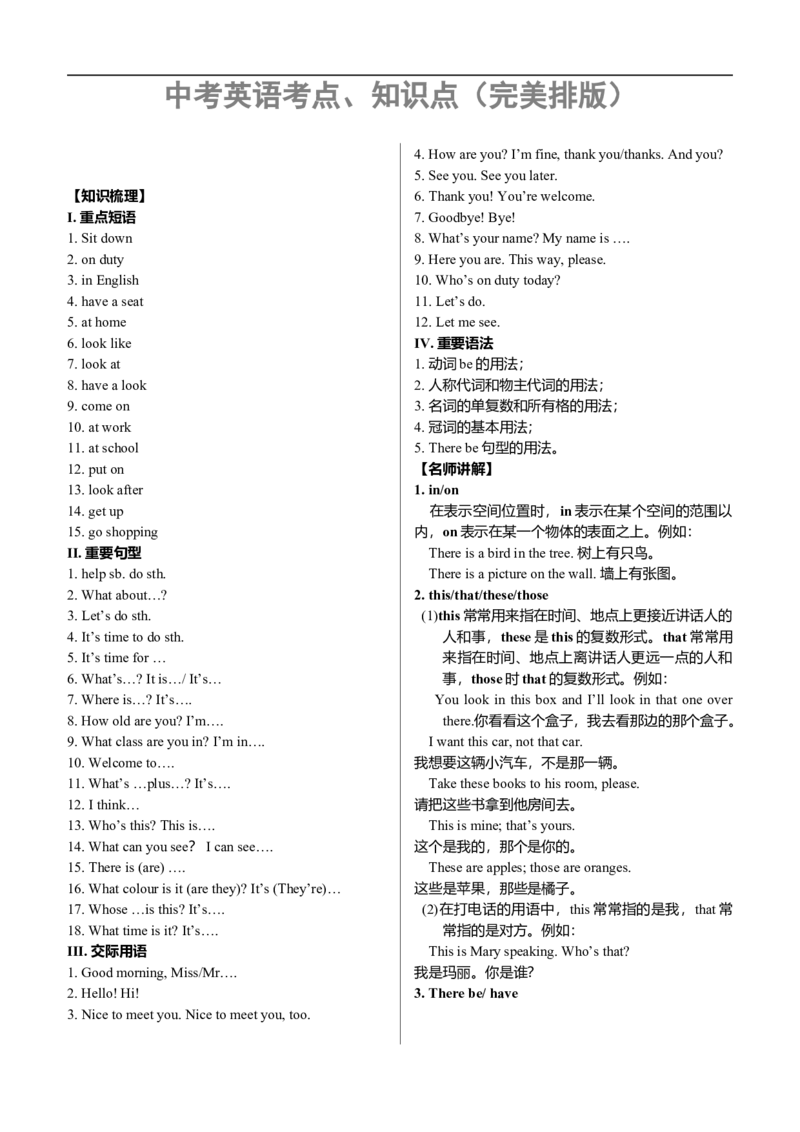
中考英语考点、知识点(完美排版)
4. How are you? I’m fine, thank you/thanks. And you?
5. See you. See you later.
【知识梳理】 6. Thank you! You’re welcome.
I. 重点短语 7. Goodbye! Bye!
1. Sit down 8. What’s your name? My name is ….
2. on duty 9. Here you are. This way, please.
3. in English 10. Who’s on duty today?
4. have a seat 11. Let’s do.
5. at home 12. Let me see.
6. look like IV. 重要语法
7. look at 1. 动词be的用法;
8. have a look 2. 人称代词和物主代词的用法;
9. come on 3. 名词的单复数和所有格的用法;
10. at work 4. 冠词的基本用法;
11. at school 5. There be句型的用法。
12. put on 【名师讲解】
13. look after 1. in/on
14. get up 在表示空间位置时,in表示在某个空间的范围以
15. go shopping 内,on表示在某一个物体的表面之上。例如:
II. 重要句型 There is a bird in the tree. 树上有只鸟。
1. help sb. do sth. There is a picture on the wall. 墙上有张图。
2. What about…? 2. this/that/these/those
3. Let’s do sth. (1)this常常用来指在时间、地点上更接近讲话人的
4. It’s time to do sth. 人和事,these是this的复数形式。that常常用
5. It’s time for … 来指在时间、地点上离讲话人更远一点的人和
6. What’s…? It is…/ It’s… 事,those时that的复数形式。例如:
7. Where is…? It’s…. You look in this box and I’ll look in that one over
8. How old are you? I’m…. there.你看看这个盒子,我去看那边的那个盒子。
9. What class are you in? I’m in…. I want this car, not that car.
10. Welcome to…. 我想要这辆小汽车,不是那一辆。
11. What’s …plus…? It’s…. Take these books to his room, please.
12. I think… 请把这些书拿到他房间去。
13. Who’s this? This is…. This is mine; that’s yours.
14. What can you see? I can see…. 这个是我的,那个是你的。
15. There is (are) …. These are apples; those are oranges.
16. What colour is it (are they)? It’s (They’re)… 这些是苹果,那些是橘子。
17. Whose …is this? It’s…. (2)在打电话的用语中,this常常指的是我,that常
18. What time is it? It’s…. 常指的是对方。例如:
III. 交际用语 This is Mary speaking. Who’s that?
1. Good morning, Miss/Mr…. 我是玛丽。你是谁?
2. Hello! Hi! 3. There be/ have
3. Nice to meet you. Nice to meet you, too.There be "有",其确切含意为"某处或某时存在 昨天我们从电视上看了一场足球比赛。
某人或某物。"其结构是:There be + 某人或某物 + 4. put on/ / in
表示地点或时间的状语。There be 后面的名词实际
put on意为“穿上,戴上”。主要指“穿上”这一
上是主语,be 动词的形式要和主语在数上保持一致,
动作, 后面接表示服装、鞋帽的名词。
be动词后面的名词是单数或不可数名词时用is,名
in 是介词,表示“穿着”强调状态。在句中可以
词是复数时用are。例如:
(1) There is a big bottle of coke on the table. 做定语、标语和状语。如:
桌上有一大瓶子可乐。 It’s cold outside, put on your coat.
(2) There is a doll in the box.
外面冷,穿上你的外衣。
那个盒子里有个娃娃。
He puts on his hat and goes out.
(3) There are many apples on the tree.
他戴上帽子,走了出去。
那树上有许多苹果。
The woman in a white blouse is John’s mother.
总之,There be结构强调的是一种客观存在
的"有"。have表示"拥有,占有,具有",即:某人
穿白色衬衣的那个妇女是John的妈妈。
有某物(sb. have / has sth.)。主语一般是名词或代词, 5. house/ home/family
与主语是所属关系。例如: house :“房子”,指居住的建筑物; Home: “家”,
(4) I have two brothers and one sister. 指一个人同家人共同经常居住的地方; Family: “家
我有两个兄弟,一个姐姐。 庭“,“家庭成员”。例如:
(5) That house has four rooms. Please come to my house this afternoon.
那所房子有四个房间。 今天下午请到我家来。
4. look/ see/ watch He is not at home. 他不在家。
My family all get up early.
(1)look 表示“看、瞧”,着重指认真看,强调看
我们全家都起得很早。
的动作,表示有意识地注意看,但不一定看
6. fine, nice, good, well
到,以提醒对方注意。,如:
四者都可用作形容词表示"好"之意,但前三者
Look! The children are playing computer games.
既可作表语又可作定语,而后者仅用作表语。主要
瞧!孩子们在玩电脑游戏。
区别在于:
Look! What’s that over there?
(1) fine指物时表示的是质量上的"精细",形容人
看!那边那个是什么?
时表示的是"身体健康",也
单独使用是不及物动词,如强调看某人/物,其
可以用来指"天气晴朗"。例如:
后接介词at,才能带宾语,如:
Your parents are very fine.
He’s looking at me。他正在看着我。
你父母身体很健康。
(2)see强调“看”的结果,着重的是look这个动
That's a fine machine. 那是一台很好的机器。
作的结果,意思是“看到”,see是及物动词,后面能
It's a fine day for a walk today.
直接跟宾语。如:
今天是散步的好时候。
What can you see in the picture?
(2)nice主要侧重于人或物的外表,有"美
你能在图上看到什么?
好","漂亮"的意思,也可用于问候或赞扬
Look at the blackboard. What did you see on it?
别人。例如:
看黑板!你看到了什么?
Lucy looks nice. 露西看上去很漂亮。
(3)watch“观看,注视”,侧重于场面,表示全
These coats are very nice. 那些裙子很好看。
神贯注地观看、观察或注视某事务的活动,强调过
Nice to meet you. 见到你很高兴。
程,常用于“看电视、看足球、看演出”等。如:
It's very nice of you. 你真好。
Yesterday we watched a football match on TV.(3)good形容人时指"品德好",形容物时指"质 There _______ a football match on TV this evening.
A. will have B. is going to be C. has D. is going to
量好",是表示人或物各方面都好的普通用
have
语。例如:
【解析】答案:B。该题考查的是There be…句
Her son is a good student. 她儿子是一个好学
型和动词have用法区别。There be句型本身就表示
生。 “在某个地方存在某个人或物”,不能和动词have混
The red car is very good. 那辆红色小汽车很 在一起用。
好。 【满分演练】
一. 单项填空
(4)well只可用来形容人的"身体好",但不能作
1. ---What colour is the bike?
定语,它也能用作副词作状语,多放在所
---It’s _______ orange.
修饰的动词之后。例如:
A. an B. a C. / D. the
I'm very well, thanks. 我身体很好,谢谢。 2. That isn’t her bag. It’s ________.
My friends sing well. 我的朋友们歌唱得好。 A. my B. I C. mine D. me
3. ---Oh, your kite is very nice.
【考点扫描】
---__________________.
中考考点在本单元主要集中在:
A. That’s right B. No, it’s not nice
1. 动词be的用法;
C. Yes, it is D. Thank you
2. 人称代词和物主代词的用法;
4. The woman is sixty, but she _______ young.
3. 名词的单复数和所有格的用法;
A. is B. sees C. looks D. watches
4. 冠词的基本用法;
5. It’s time ________ lunch. Let’s go home.
5. There be句型的用法。
A. to B. in C. for D. on
6. 本单元学过的词汇、短语和句型;
6. ---________ is your coat?
7. 本单元学过的日常交际用语。
---The black one.
考试形式可以是单项填空、完型填空、短文填空、
A. What B. Where C. Which D. How
完成句子。
7. ---________ is the toy?
【中考范例】
---It’s on the bed.
1. (2004年北京市中考试题)
A. Who B. Where C. What D. Whose
Mary, please show ________ your picture.
8. The shoes are too old. Put ________ over there.
A. my B. mine C. I D. me
A. it B. they C. their D. them
【解析】答案:D。该题考查的是人称代词和
9. Excuse me. Can you _______ my watch, please?
物主代词的用法。本题中动词show后面跟双宾语,
A. look B. look like C. look after D. look at
空白处应填入人称代词的宾格me作宾语。
10. Look _______ the blackboard and listen _______
2. (2004年上海市徐汇区中考试题)
the teacher.
_________ orange on the desk is for you, Mike.
A. / / B. at; to C. after; / D. on; after
A. A B.An C. / D. The
11. ---Whose dress is this?
【解析】答案:D。该题考查的是冠词的基本
---It’s _________.
用法。因为是特指课桌上的那个橘子,所以用定冠
A. Lucy B. Lucy’s C. Jim D. Jim’s
词the。
12. The girl ______ the purple coat is his sister.
3. (2004年哈尔滨市中考试题)
A. at B. in C. on D. with
---What _______ the number of the girls in your class?
13. There is a bird ______ the tree.
---About twenty.
A. in B. on C. to D. of
A. is B. am C. are D. be
14. There are many ________ in our school.
【解析】答案:A。该题考查的是动词be的用
A. woman teachers B. woman teacher
法和主谓一致。the number作主语,应该是单数第
C. women teacher D. women teachers
三人称,动词be变为is。
15. ---Is there a ball under the desk?
4. (2004年陕西省中考试题)---______________________. 6. Nice to meet you. F. I am 14.
A. Yes, it is B. Yes, there’s 7. How old are you? G. Wang Ping is.
C. No, there isn’t D. No, there is 8. Who’s not here? H. It’s here.
16. There _______ some books and a pencil on the 9. Where is the bag? I. It’s a book.
desk. 10. What is this in English? J. How do you do?
A. am B. is C. are D. be
17. ---Let me help you. 四. 完成对话:在对话后面的句子中选出正确的填入
---_______________. 空白处
A. You’re welcome B. Thanks very much Jim: Excuse me, Ann. Whose black dog is this? Is it
C. Don’t worry D. Yes, thanks yours?
18. ______ old man is ______ English teacher. Ann: Let me have a look.________1_______. I think
A. The; an B. An; an C. The; the D. A; a it’s Sam’s. My dog is brown.
19. ---What _____ five plus six? Jim: Sam, look at the dog behind the
---It’s eleven. tree.________2__________?
A. am B. is C. are D. / Sam: Sorry, it isn’t mine. My dog is black and white. I
20. ---What ______ you see in the picture? think it looks like Mary’s.
---I can see some flowers. Jim: _____________3______________?
A. must B. can C. are D. Do Sam: She’s my friend. Look! She’s over there. Let’s go
and ask her.
二. 完形填空 Jim: _______________4_______________.
This is a picture of Kat’s ____1____. What can we Sam: Hi, Mary! Is that dog yours?
____2_____ in the picture? Look ____3____ it, please. Mary: _______________5_______________.
The man ____4____ the black coat is Kate’s father, Mr. Sam: It’s a lovely dog! Don’t lose it!
Green. The ____5____ in the red sweater is Mrs. Green. Mary: Yes, thank you.
They ____6____ young. The baby is Kate. The little A. Who’s Mary
boy is Kate’s ____7_____, Jim. ___8____ the man B. OK, let’s go
behind Mrs. Green? Oh, he’s ____9___ brother, Mr. C. Oh, no it’s not mine
Read. He ____10____ young, too. D. Oh, yes. It’s mine
1. A. families B. family C. parents D. brothers E. Is it yours
2. A. look B. do C. see D.put
3. A. at B. after C. for D. up 五. 用所给单词的适当形式填空
4. A. on B. of C. in D. to 1. ________ (He) pen is in ______ (I) pencil-box.
5. A. man B. girl C. women D. woman 2. ________ (You) shoes ________ (be) under the bed.
6. A. are B. is C. look like D. looking 3. ________ (Who) new ruler is this?
7. A. sister B. brother C. father D. aunt 4. ---Are these trousers _______ (you)?
8. A. What’s B. Where’s C. Who’s D. How is ---No, they aren’t ________ (we)
9. A. his B. her C. our D. their 5. It’s time ________ (go) and play games.
10. A. looks B. am C. look D. Very 6. This is my pen. Please give it to ________ (I).
7. I have two ________ (baby).
三. 在B栏中找出A栏英语句子的正确答语 8. Look! That is a ________ (China) car.
(A) (B) 9. It is __________ (my teacher) sweater.
1. How are you? A. I am in Row 6. 10. Now her ________ ( parent) are in America.
2. Can you spell it, please? B. Fine, thank you.
3. How do you do? C. Yes, b-o-o-k, book.
4. What row are you in? D. It is ten. 六. 阅读理解
5. What’s two plus eight? E. Nice to meet you, too. (A)Bob was born in a big and rich family. His father is a 4. How many beds are there in the room? ________.
university professor. He teaches American history. His A. only one B. three C. two
mother is a very capable woman. She is the manager of
5. Are there any things on Lily's bed? ________.
a big company. She earns a lot of money, of course.
A. Yes, there is a hat on it
Bob has two sisters and a brother. His elder sister,
B. No, there is not anything on it
Jenny, is fourteen. She studies in a middle school. His
C. Sorry, I don't know
younger sister, Ann, is ten. She studies in a private
primary school. She has a very good memory. She is (C)
clever. His younger brother, Dick, is only six. He has It's a fine Sunday morning. Ann and her mother
just started going to school. Bob gets on well with his
are in a big bus. There are many people in it. Some of
family. He is on good terms not only with his parents,
them come from America, and some come from
but also with his sisters and brother. (have a friendly
England and Canada. They are all their friends. They
relationship with sb.) He is, in a word, an apple in their
eyes. are going to the Great Wall.
根据短文的内容,判断下列句子的正误:正确地答 There are two Chinese in the bus. One is woman. She
“A”,错误的答“B”。
is driving the bus. The other is a young man. He speaks
1. Bob was born in a small and rich family.
good English. He is now talking about the Great Wall.
2. He has two brothers and a sister.
The other people are all listening to him. They like the
3. There are five people in his family.
4. Dick is only six. He studies in a private primary Great Wall. They want to see it very much.
school. 1. Ann and mother are going to the Great Wall
5. “He is an apple in their eyes” means “They love him
__________.
very much”.
A. by bike B. by car C. by plane D. by bus
(B)
2. There are __________.
Look at the clothes line in the twins' bedroom.
A. only one Chinese in the bus
There are some clothes on it. You can see a green
B. only two Chinese in the bus
blouse and a yellow skirt. The trousers on the clothes
C. only two Chinese on the bike
line are black. They are not new but clean. Are they
D. only one Chinese in the car
Lily's clothes? No. I know they are Lucy's. Lily's
3. The driver is __________.
clothes are on a clothes tree near the window. Her
A. a man B. a woman
trousers are brown, her blouse is white and her skirt is
C. a Canadian D. an American
blue. There is a new hat on the clothes tree, but it's not
4. The people __________.
Lily's, it's Lucy's. There is an old hat on Lucy's bed in
A. are singing B. are talking
the room, it's Lily's. There are no clothes on the other
C. are listening D. are looking at the wall
bed, the bed is Lily's.
5. They __________.
1. What can you see in the bedroom? I can see
A. can see the Great Wall
__________.
B. can speak English very well.
A. a clothes line B. a tree C. a bed
C. want to talk with the man very much
2. What colour are Lucy's trousers? They are
D. want to see the Great Wall very much
________.
A. green B. black C. brown
初一年级(下)
3. Where is Lucy's hat? It's on _________.
【知识梳理】
A. the clothes tree B. the clothes line C. lily's bedI. 重点短语 5. I want to take some books to the classroom.
1. a bottle of 6. Give me a bottle of orange juice, please.
2. a little Please give it / them back tomorrow. OK.
3. a lot (of) 9. What's your favourite sport?
4. all day 10. Don't worry.
5. be from 11.I’m (not) good at basketball.
6. be over 12. Do you want a go?
7. come back 13. That's right./ That‘s all right./ All right.
8. come from 14. Do you have a dictionary / any dictionaries?
9. do one’s homework Yes, I do. / No, I don’t.
10. do the shopping 15. We / They have some CDs.
11. get down We / They don’t have any CDs.
12. get home 16. ---What day is it today / tomorrow?
13. get to ---It’s Monday.
14. get up 17. ---May I borrow your colour pens, please?
15. go shopping ---Certainly. Here you are.
16. have a drink of 18. ---Where are you from?
17. have a look ---From Beijing.
18. have breakfast 19. What's your telephone number in New York?
19. have lunch 20. ---Do you like hot dogs?
20. have supper ---Yes, I do. ( A little. / A lot. / Very much.)
21. listen to ---No, I don't. ( I don't like them at all.)
22. not…at all 21. ---What does your mother like?
23. put…away ---She likes dumplings and vegetables very much.
24. take off 22. ---When do you go to school every day?
25. throw it like that ---I go to school at 7:00 every day.
26. would like 23. ---What time does he go to bed in the evening?
27. in the middle of the day ---He goes to bed at 10:00.
28. in the morning / afternoon/ evening IV. 重要语法
29. on a farm 1.人称代词的用法;
30. in a factory 2. 祈使句;
II. 重要句型 3. 现在进行时的构成和用法;
1. Let sb. do sth. 4.动词have的用法;
2. Could sb. do sth.? 5.一般现在时构成和用法;
3. would like sth. 6.可数名词和不可数名词的构成和用法
4. would like to do sth. 【名师讲解】
5. What about something to eat? 1. That's right./ That‘s all right./ All right.
6. How do you spell …? That’s right意为“对的”,表示赞同对方的意见、
7. May I borrow…? 看法或行为,肯定对方的答案或判断。例如:
III. 交际用语 "I think we must help the old man.""我想我们应该
1. —Thanks very much! 帮助这位老人。"
—You're welcome. "That's right."或 "You're right.""说得对"。
2. Put it/them away. That’s all right.意为“不用谢”、“没关系”,
3. What's wrong? 用来回答对方的致谢或道歉。例如:
4. I think so. "Many thanks." "That's all right."
I don't think so. "Sorry. It's broken." "That's all right."All right.意为“行了”、“可以”,表示同意对方的 do some washing 洗些衣服
建议或要求。有时还可以表示“身体很好” do some shopping 买些东西
"Please tell me about it." "请把此事告诉我。" do some reading 读书
"All right.""好吧。" do some writing 写些东西
do some fishing 钓鱼
Is your mother all right?你妈身体好吗
从以上短语可引申出另一类短语,不能用some,
2. make/do
much或定冠词。
这两个词都可以解释为“做”,但含义却不同,
go shopping 去买东西
不能混用。make指做东西或制东西,do指做一件
go fishing 去钓鱼
具体的事。
go boating 去划船
Can you make a paper boat for me? 你能为我做个纸
go swimming 去游泳
船吗?
5. like doing sth./ like to do sth.
He’s doing his homework now.他正在做他的作业。
like doing sth. 与like to do sth. 意思相同,但用
3. say/speak/talk/tell
法有区别。前者强调一般性的爱好或者表示动作的
say:是最口语化的最普通的一个词,意为
习惯性和经常性;后来表示一次性和偶然性的动作。
“说出”、“说道”,着重所说的话。如:
例如:
“I want to go there by bus” , he said . 他说,“我要坐
He likes playing football, but he doesn‘t like to play
汽车到那里去。”
football with Li Ming.
Please say it in English .请用英语说。
他喜欢踢足球,但是他不喜欢和李明踢。
speak : “说话”,着重开口发声,不着重所说
6. other/ others/ the other/ another
的内容,一般用作不及物动词 (即后面不能直接
other表其余的,别的,
接宾语 ) 。如:
Have you any other questions?你还有其他问题吗?
Can you speak about him? 你能不能说说他的情况?
others 别的人,别的东西
I don’t like to speak like this. 我不喜欢这样说话。
In the room some people are American, the others are
speak 作及物动词解时,只能和某种语言等
French.在屋子里一些人是
连用,表达在对话中恰当使用词汇的能力。如:
美国人,其他的是法国人。
She speaks English well.她英语说得好。
the other表另一个(二者之中)one…,the other…
talk : 与 speak 意义相近,也着重说话的动作,
One of my two brothers studies English, the other
而不着重所说的话,因此,一般也只用作不及物
studies Chinese.
动词, 不过,talk 暗示话是对某人说的,有较强
我两个哥哥中的一个学习英文,另一个学中文。
的对话意味,着重指连续地和别人谈话。如:
another表三者以上的另一个,另一些
I would like to talk to him about it . 我想跟他谈那件
There is room for another few books on the shelf.书
事。
架上还可以放点书。
Old women like to talk with children.老年妇女喜欢
7. in the tree/ on the tree
和孩子们交谈。
in the tree 与 on the tree.译成中文均为"在树
tell : “告诉”,除较少情况外,一般后面总接
上"但英语中有区别。in the tree表示某人、某事
双宾语。如:
(不属于树本身生长出的别的东西)落在树上,表
He’s telling me a story.他在给我讲故事。
示树的枝、叶、花、果等长在树上时,要使用on
tell a lie 撒谎
the tree.如:
tell sb. to do sth. /tell sb. not to do sth.
There are some apples on the tree. 那棵树上有些苹果。
Miss Zhao often tells us to study hard.
There is a bird in the tree. 那棵树上有只鸟。
4. do cooking/ do the cooking
8. some/ any
do cooking 作“做饭”解,属泛指。do the
(1)some和 any既可修饰可数名词,也可修饰不
cooking 特指某一顿饭或某一家人的饭。cooking为
动名词,不能用作复数,但前面可用 some, much修 可数名词。但有以下两点需要
饰。从do some cooking可引出许多类似的短语:注意。 had lunch.汤姆,你不可能饿得这么快,你刚
some常用于肯定句中,any常用于否定句和 吃过午饭。
疑问句中。如: What can he mean?他会是什么意思?
There is some water in the glass. 在日常会话中,can可代替may表示"允许",
Is there any water in the glass? may比较正式。例如:
There isn't any water in the glass. You can come in any time.你随时都可以来。
(2)在说话者希望得到肯定答复的一般疑问句中, --- Can I use your pen?我能用你的钢笔吗?
或在表示请求,邀请的疑问句中,我们依然用 --- Of course,you can.当然可以。
some。如: You can have my seat,I'm going now.我要走了,
Would you like some tea? 你坐我的座位吧。
9. tall/ high (3) could
(1)说人,动物,树木等有生命的东西,主要用 could 是 can的过去式,表示过去有过的能力和可能
tall,不用high,例如 性(在否定和疑问句中)。例如:
a tall woman 一个高个子妇女 The doctor said he could help him.(能力)医生说
a tall horse 一个高大的马 他能帮助他。
(2)说一个不与地面接触的人和物的高时,要用 Lily could swim when she was four years old.(能
high,而不用tall,比如人站在桌子上时,飞机 力)
飞上天时,例如: 当丽丽四岁的时候她就会游泳。
He is high up in the tree. 他高高地爬在树上。 At that time we thought the story could be true.(可能
The plane is so high in the sky. 飞机在空中这么高。 性)
那时我们以为所说的可能是真的。
(3)指建筑物、山时要tall或high都可以,不过 could可代替can表示现在时间的动作,但语气较
high的程度比tall高。 为婉转。例如:
(4)high可作副词,tall不能。 Could I speak to John,please?我能和约翰说话吗?
(5)tall的反义词为short, high的反义词为low.
Could you?在口语中表示请求对方做事。例如:
10. can/ could
Could you wait half an hour?请你等半个小时好吗?
(1) can表示体力和脑力方面的能力,或根据客观
Could you please ring again at six?六点钟请你再打
条件能做某种动作的"能力
电话好吗?
"。例如:
(4) can的形式
Can you ride a bike? 你会骑自行车吗?
只有现在式can和过去式could两种形式。能表示一
What can I do for you? 要帮忙吗?
般现在和一般过去两种时态,有时也能表示将来。
Can you make a cake?你会做蛋糕吗?
所有其他时态(包括将来时)须用be able to加动词
(2) can用在否定句和疑问句中时有时表示说话
不定式来表示。例如:
人的"怀疑""猜测"或不肯定。例如:
They have not been able to come to Beijing.
Where can he be?他会在什么地方呢?
他们没有能到北京来。
Can the news be true?这个消息会是真的吗?
11. look for/ find
It surely can't be six o'clock already?不可能已
look for 意为“寻找”,而find意为“找到,发
经六点钟了吧?
现”,前者强调“找”这一动作,并不注重“找”的结果,
You can't be hungry so soon,Tom,you've just
而后者则强调“找”的结果。例如:She can’t find her ruler. 她找不到她的尺子啦。 Miss Li is good to all of us.李老师对我们所有的人
Tom is looking for his watch,but he can’t find it. 都很友好。
The boss is bad to his workers.这个老板对他的工人
汤姆正在寻找他的手表,但没能找到。
不好。
12. be sleeping/ be asleep
Li Lei is good at drawing, but I'm bad at it.李雷擅长
be sleeping 表示动作,意思是“正在睡觉”;be
画画,但是我不擅长。
asleep 表示状态,意思是“睡着了”。如: 16. each/ every
---What are the children doing in the room? 孩子 each 和every都有"每一个"的意思,但含义和
用法不相同。each从个体着眼,every从整体着眼。
们在房间里做什么?
each 可用于两者或两者以上,every只用于三者或三
---They are sleeping.他们正在睡觉。
者以上。
The children are asleep now.现在孩子们睡着了。
We each have a new book.
13. often/ usually/sometimes
我们每人各有一本新书。
often表示"经常",sometimes表示"有时候",
There are trees on each side of the street.
在表示发生频率上often要高于usually,usually
街的两旁有树。
要高于sometimes。这三个词表示的是经常性,
He gets up early every morning.
一般性的动作或情况,常与一般现在时连用,常
每天早晨他都起得早。
位于主要谓语动词的前面,其他谓语动词(be动
each可以用作形容词、副词和代词;every只
词,情态动词和助动词)的后面,有时也可位于
能用作形容词。
句尾。如果要加强语气,则放在句首。
Each of them has his own duty.
We usually play basketball after school.我们通
他们各人有各人的义务。
常放学后打篮球。
They each want to do something different.
Sometimes I go to bed early.有时,我睡觉很早。
他们每个人都想做不同的事情。
He often reads English in the morning.他经常在
17. 一般现在时/现在进行时
早晨读英语。
一般现在时表示经常性的或习惯性的动作或存
14. How much/ How many
在的状态,也表示说话者的能力,还有自然现象;
how much常用来询问某一商品的价格,常见
而现在进行时表示正在进行或发生的动作(构成方
句式是How much is / are…? 式为am/is /are/+doing)。
How much is the skirt? 这条裙子多少钱? I do my homework in the evening.
我在晚上做作业。
How much are the bananas? 这些香蕉多少钱?
I'm doing my homework now.
how much后加不可数名词,表示数量,意为
我现在正在做作业。
“多少“,how many后加可数名词的复数形式。
现在进行时常与now, these days, at the moment
How much meat do you want? 你要多少肉呀? 或Look, listen等词连用;而一般现在时常与often,
How many students are there in your class? 你们 always, sometimes, usually, every day, in the morning,
班有多少人?
on Mondays等连用。
We often clean the classroom after school.
15. be good for/ be good to/ be good at
我们经常放学后打扫教室。
be good for 表示"对……有好处",而be bad for
Look! They are cleaning the classroom .
表示"对……有害";be good to表示"对……友好",
看!他们正在打扫教室呢。
而be bad to表示"对……不好";be good at表示"擅
【考点扫描】
长,在……方面做得好",而be bad at表示"在……
中考考点在本单元主要集中在:
方面做得不好"。
1.动词一般现在时和现在进行时的用法,人称代词
Doing eye exercises is good for your eyes.做眼保健
的用法,可数名词和不可数
操对你的眼睛有好处。
名词的构成和用法。
Eating too much is bad for you health.吃的太多对你
2.本册书中常见的交际用语
的身体有害。3.本册书中一些重点的词组和短语 6. Hurry up, ______ we'll be late for the meeting.
考试形式往往是单项填空、完形填空、短文改错和 A. and B. but C. then D. or
短文填空。
7. People usually ______ "hello" to each other when
【中考范例】
they make a phone call.
1.(2004年安徽省中考试题)
A. say B. speak C. tell D. talk
---Hurry up! We’re all waiting for you.
---I ________ for an important phone call. Go without 8. Look! She ________ a kite for her son.
me. A. makes B. is making C. make D. making
A. wait B. was waiting C. am waiting D. waited
9. These shoes are yours. Please ________.
【解析】答案:C。表示现在正在进行的动作,用
A. put on them B. put on it
现在进行时。
C. put them on D. put it on
2. (2004年长春市中考试题)
10. She often gets ______ very late.
Could you help ____ with _______ English, please?
A. I, my B. me, me C. me, my D. my, I A. home B. at home C. to home D. in home
【解析】答案:C。第一个空作宾语,应用人称代 11. I think the shop is closed ________ this time of day.
词的宾格me, 第二个空作定语,应用形容词性物 A. in B. on C. at D. for
主代词my。 12. I want ______ of meat, please.
3.(2004年长春市中考试题) A. half kilo B. a half kilo
Dr. White can _______ French very well. C. half a kilo D. a kilo half
A. speak B. talk C. say D. tell 13. --- Is this black ruler ________?
【解析】答案:A。说什麽语言常用动词speak。 --- No. It's ________.
4.(2004年黄冈中考试题)
A. yours, his B. your, his
English is spoken by ______ people.
C. yours, him D. you, he
A. a lot B. much many
14. ________ book on the desk is a useful(重要的)
C. a large number of D. a great deal of
one.
【解析】答案:C。只有a large number of 能用来
修饰复数可数名词people。 A. A B. An C. The D. /
【满分演练】 15. Grandma is ill. We have to take her to the
一. 单项选择
________.
1. There is some ______ on the plate.
A. farm B. post office C. hotel D. hospital
A. cakes B. meat C. potato D. pears
16. Liu Mei often helps her mother ________
2. Uncle Wang wants ______ the machine like a bike.
housework.
A. ride B. riding C. rides D. to ride
A. does B. do C.doing D. to doing
3. Tom usually goes to bed ________ ten o'clock in the
17. We watch evening news on ________ at 7:00 in the
evening.
evening.
A. at B. in C. on D. of
A. CCTV B. CAAC C. WTO D. MTV
4. ______ picture books in class, please.
18. There ________ a box of apples on the desk.
A. Not read B. No read
A. are B. is C. has D. have
C. Not reading D. Don't read
19. Would you like ________ with me?
5. The box is too heavy. Let ________ help you to
A. go B. to go C. going D. goes
carry it.
A. we B. us C. ours D. our20. Sometimes his brother ________ TV after supper. D. Thank you very much.
E. Black and red, and it's not very new.
A. watch B. sees C. watches D. is watching
二. 填空 A: Excuse me, Lin Tao!
A. 根据句义和首字母写出所缺的单词 B: Yes?
1. Kate's glass is empty. She wants a f______ one. A: My bike is broken. Can I borrow yours?
2. I think my father can help you m______ your B: __1____.
broken bike. A: This afternoon.
3. I have two pencils. One is short, the other is B: OK. Here's the key.
l______. A: ____2__. But where is it?
4. Please open the w______. It's getting hot here. B: __3____.
5. Something is w______ with my bike. May I A: What colour is it?
borrow yours? B: __4____.
B. 根据句意,用括号中所给词的适当形式填空 A: I see. I think I can find it.
1. There are some ________ there, talking loudly. B: ___5___.
(woman) A: All right. See you!
2. This blouse isn't hers. It's ________. (my) 四. 完型填空
3. The people on the farm are very ________. These days men and women , young and old are
(friend) ___1_____ the same kind of ___2____, and a lot of
4. Do you know ________? (he) ___3_____ have long hair(头发). We often can't
5. Tom's uncle can drive cars. He is a good ___4_____whether they are boys or girls, men or
________. (drive) women.
C. 选词并用其适当形式填空 ___5_____ old man often goes to walk in the park.
work, close, look, have, teacher, pen, eat, He is sitting on a chair now. A young person is
China, play, climb
___6_____ ___7_____ him.
1. This is our ________ desk. Ours are over there.
"Oh, goodness!" the old man says to the other one.
2. Bill has three ________. One is new and the
"Do you ___8_____ that person with long hair? Is it a
other two are old. boy or a girl?"
3. His uncle ________ very young but he is over "A boy," says the other one. "He is my son." "Oh,"
says the old man, "Please ____9____ me. I don't know
forty.
you are his ____10____." "I'm not his mother, I'm his
4. Let's ________ basketball after class.
father," says the other one.
5. Look! The cats are ________ up the trees.
1. A. having B. wearing C. putting D. buying
6. The shop isn't open. It's ________.
2. A. clothes B. trees C. pictures D. Bags
7. My brother ________ some new picture books. 3. A. we B. your C. them D. Theirs
8. In our classroom there is a large map of 4. A. talk B. teach C. say D tell
5. A. An B. A C. The D. /
________.
6. A. running B. flying C. standing D. driving
9. Mum, please give me something to ________.
7. A. on B. beside C. in D. At
I'm very hungry.
8. A. see B. watch C. look D. Read
10. Does Mr Green like ________ in this Chinese
9. A. help B. excuse C. teach D. Ask
school? 10. A. baby B. sister C. father D. Mother
三. 根据对话内容,从方框中选择恰当的句子完成对 五. 阅读理解
话 ( A )
A. Please give it back soon. Mr Li teaches Chinese in the USA. He comes back
B. It's over there
to China every year. He gives us a talk. He says," K
C. Certainly. When do you want it?Day in the USA is very interesting. All children like it 10. Which is wrong?
very much. It is on March 7th. When you go out on that A. Paula goes to school from Monday to Friday.
day, you can see children running with kites in the open B. Paula goes to bed after ten o'clock.
air(露天). When you look up, you can see different C. Paula has sports in the afternoon.
kites in the sky(天空). Some are big, and some are D. Paula usually has Pizza for lunch.
small. They are in different colours. Every kite has a 六. 根据中文提示和英文词语提示,写出意思连贯、
long string(长线). The children begin to run when they 符合逻辑的英文文段:(所有英文提示语必须用上。
get the kites up. Every child has a good time that day. 这位老人来自悉尼。他很热爱中国。他现在在
1. Mr Li is _______________. He works in the USA. 北京教英语。他喜欢在北京工作。
A. a worker B. an English teacher 1. this, man, come, Sydney
C. a doctor D. a Chinese teacher 2. he, China, very much
2. Mr Li says something about _______________. 3. now, teach, in Beijing
A. how to study English B. K Day in the USA 4. he, say, Beijing, big, beautiful, like, work, here
C. his work in the USA D. playing in the open air
3. March 7th is _________________. 初二年级(上)
A. Children's Day B. Teachers' Day 【知识梳理】
C. K Day D. Tree planting Day(植树节) I. 重点短语
4. Every kite has _____________________. 1. on time
A. a short string B. a long string 2. best wishes
C. the same colour D. the same size(大小) 3. give a talk
5. There are _______________ kites in the sky on that 4. for example
day. 5. short for
A. all kinds of B. one kind of 6. a waste of time
C. three kinds of D. three 7. go on a field trip
( B ) 8. go fishing
Monday Tuesday Wednesday Thursday Friday9. I agree
Get up 7:10 a.m. 7:10 a.m. 7:10 a.m. 7:10 a.m. 7:10 a.m.
10. next week
morning school school school school school
11. the day after tomorrow
pizza rice rice rice rice
12. have a picnic
afternoon Yo-yo Table-tennis Table-tennis Table-tennis football
evening homework homework television homework clothes13. have some problems doing sth.
Go to sleep 10:15 p.m. 10:15 p.m. 10:15 p.m. 10:15 p.m. 10:15 p1.4m. .go the wrong way
根据表格内容选择最佳答案。 15. hurry up
6. On _______________, Paula usually gets up at 7:10 16. get together
am. 17. in the open air
A. Thursdays B. Wednesdays 18. on Mid-Autumn Day
C. weekdays D. weekends 19. come over
7. Pizza is a kind of _________________. 20. have to
A. drink B. fruit C. toy D. food 21. get home
8. Paula's favourite sport is _________________. 22. agree with
A. volleyball B. table-tennis 23. in the country
C. yo-yo D. football 24. in town
9. On Wednesday evenings Paula usually 25. all the same
___________________. 26. in front of
A. watches TV B. does her homework 27. on the left/right side
C. washes her clothes D. goes to see her friends 28. next to
29. up and down30. keep healthy 21.Which do you like best, dogs, cats or chickens?
31. grow up 22.Shall we go at ten? Good idea!
32. at the same time 23.---Let’s make it half past one. ---OK.
33. the day before yesterday 24.---Why not come a little earlier? ---All right.
35. last Saturday 25.Excuse me. Where’s the nearest post office, please?
36. half an hour ago 26.It’s over there on the right.
37. a moment ago 27.I’m sorry I don’t know.
38. just now 28.You’d better…
39. by the way 29.Thank you all the same.
40. all the time 30.Which bus do I take?
41. at first 31.Go along this road.
II. 重要句型 32.What day was it yesterday?
1. have fun doing sth. 33.I’m sorry to hear that.
2. Why don’t you…? 34.I hope you’re better now.
3. We’re going to do sth. 35.Why did you call me?
4. start with sth. 36.I called to tell…
5. Why not…? IV. 重要语法
6. Are you going to…? 1.be going to的用法;
7. be friendly to sb. 2.形容词的比较级、最高级;
8. You’d better do sth. 3.形容词和副词的比较
9. ask sb. for sth. 4.一般过去时
10. say goodbye to sb. 【名师讲解】
11. Good luck(with sb)! 1. on the street / in the street
III. 交际用语 表示“在街上”时,on the street 和 in the street
1.Welcome backto school! 都可以,在美国多用on the street, 在英国多用in the
2.Excuse me. I’m sorry I’m late, because the traffic is street. 例如:
bad. We have a house in the street. 我们在街上有座房子。
3.It doesn’t matter. I met him on the street. 我在街上遇见了他。
4.Happy Teachers’ Day ! 2. would like / like
5.That’s a good idea. would like 和 like含义不同。like 意思是“喜欢”,
6.What are you going to do? “爱好”,而 would like 意思是“想要”。试比较:
7.Where are we going ? I like beer.=I’m fond of beer. 我喜欢喝啤酒。
8.What are we going to do ? I’d like a glass of beer= I want a glass of beer. 我想
9.I’m good at… 要一杯啤酒。
10.It’s not far from… Do you like going to the cinema? 你喜欢看电影吗?
11. Are you free tomorrow evening? Would you like to go to the cinema tonight? 你今
12.Would you and Lily like to come over to my 晚想去看电影吗?
home for Mid-Autumn Festival? 3. another / the other
13.I’m glad you can come. (1)another 通常用于三个或三个以上或不确定数
14.Thanks for asking us. 量中的任意一个人或 物体。 例如:
15.How about another one? May I have another apple, please? 请在给我一个
16.May I have a taste? 苹果好吗?
17.Let me walk with you. This coat is too small for me. Please show me
18.What do you have to do? another这件外套我穿太小,请再给我拿一件看
19.Do you live on a farm? 看。
20.Which do you like better, the city or the country? (2)the other 通常指两者中的另一个。例如:He has two rulers. One is short. The other is long. I don’t have any money. 我一点钱也没有。
他有两把尺子,一把短的,另一把长的。 some 有时也用于疑问句,表示说话人期待一个
I have two brothers. One works in Xi’an . The 肯定回答或鼓励人家说“是”。例如:
other works in Beijing. 我有两个兄弟,一个在 Would you like some more beer?请你再来点啤酒
西安工作,另一个在北京工作。 好吗?
4. have to /must Could I have some rice, please?请给我来点米饭
(1)have to和 must 都可以用来谈论义务,但用 好吗?
法略有不同。如果某人主观上觉得必须去做 7. hear /listen to
而又想去时,常用must。如果谈论某种来自 listen to 和hear 都有“听”的意思,但含义有所
“外界”的义务,常用have to。例如: 不同。Listen to强调“听”的动作,hear 强调“听”的
I must stop smoking. 我必须戒烟。(自己想戒 结果。例如:
烟) Listen to me ,please! I’m going to tell you a story. 请
They have to work for the boss. 听我说!我给你们讲个故事。
他们不得不为那个老板工作。(条件逼得他们 Listen! Can you hear someone crying in the next
去工作) room? 听!你能听见有人在隔壁房间里哭吗?
(2)have to 可用于多种时态,must 只能用于一般 I listened, but heard nothing.我听了听,但什么也听
现在时。例如: 不见。
I’ll have to get up early tomorrow morning.明天 hear 后面如果接宾语从句,常常表示“听说”。
早晨我必须早早起床。 例如:
We had to work long hours every day in order to I hear some foreign students will visit our school.我
get more money. 听说一些外国学生将要访问我们学校。
为了多挣钱,我们不得不每天长时间地工作。 I hear there is going to be a film in our school this
(3)用于否定句时,mustn’t意思是“决不能”,“禁 evening.我听说今晚我们学校要演一场电影。
止”,而don’t have to意思是“不必”,相当于 8. Let’s… /Let us…
needn’t。例如: Let’s… 和Let us… 都表示“让我们……”, 如果
You mustn’t be late again next time.下一次你决不 us 包括听话人在内,其含义相同,附带问句用shall
能再迟到。 we. 如果us 不包括听话人在内,其含义不同,Let
You don’t have to go there today. You can go there us…的附带问句要用will you。例如:
tomorrow. Let’s go shopping, shall we? 我们去购物好吗?
你今天不必到那里去了。你可以明天去。 9. take/ bring/ carry /get
5. hear sb. or sth.doing sth. / herar sb. or sth. do sth. 这四个动词都有“拿”和“带”的意思,但含义有
hear sb. or sth.doing sth.意思是“听到某人或某 所不同。take意为“带走”,“拿走”,bring意为“带
物在做某事”,而hear sb. or sth. do sth.意思是“听到 来”,“拿来”, get表示“到别的地方把某人或某物带
某人或某物做过某事”。试比较: 来或拿来”,carry不强调方向,带有负重的意思。
I hear him singing an English song.听见他在唱英 试比较:
歌曲。 My parents often take me there on holidays.我父
I heard him sing an English song.我听见他唱一首 母常常带我到那里去度假。
英文歌。 I’m going to take you to Beijing.我准备带你去北
类似hear 这种用法的还有see, watch, listen, feel 京。
等感官动词。 Bring me a cup of tea, please.请给我端杯茶来。
6. any /some I’ll bring the book to you tomorrow.明天我把那本
any和some 都可以同不可数名词和可数名词的 书给你带来。
复数形式连用,但some一般用在肯定句中;any用 The waiter carried the me to the table服务员把肉
在疑问句和否定句中。试比较: 送到桌上。
I want some money. 我想要点钱。 The monkey carried the bag on her back.猴子把那
Have you any money? 你有钱吗? 个包背在背上。She went back to get her handbag.他折回去拿他 A. carefully, little B. more carefully, fewest
的手提包。 C. more careful, fewer D. more careful, less
Let me get the doctor.让我去请医生吧。 【解析】答案:C。该题考查的是形容词和副
10. far away /faraway 词的比较以及他们的比较等级的用法。第一个空应
(1)far away是一个副词短语,意思是“很远”。例如: 填形容词careful的比较级,因为它在句中作表语,
Some are far away. Some are nearer.有些离得很远 第二个空应填few的比较级,因为它修饰的是复数
有些离得近一些的。 可数名词。
The village is far away from here.那个村子离这儿很 2. (2004年河北省中考试题)
远。 Bob never does his homework _________ Mary. He
(2)faraway是一个形容词,意思是“遥远的”,可以 makes lots of mistakes.
在句中作定语。例如: A. so careful B. as carefully as C. carefully D. as
He lives in faraway mountain village.他住在一个遥 careful as
远的小山村。 【解析】答案:B。该题考查的是形容词和副
11. find / look for 词的用法比较。该空应填副词,因为它修饰的是动
find和look for 都有“找”的意思,但含义不同。 词does。该题用的是not as+副词+as的结构,所以
find 强调“找”的结果,而look for 强调“找”的过程。 答案应是B。
请看下列例句: 3. (2004年重庆市中考试题)
He is looking for his bike.他在找他的自行车。 That day I saw some parents _________ at the back of
I’m looking for my watch, but can’t find it.我在找 the classroom, ________ to the teacher.
我的手表,但是找不到。 A. sitting, listened B. sat, listened
I hope you will soon find your lost ring.希望你尽 C. sitting, listening D. sat, listening
快找到丢失的戒指。 【解析】答案:C。该题考查的是see sb. doing
另外,find还有“发现”;“感到”等意思。例如: sth.的句型结构和分词作状语的用法。第一个空
I found a wallet in the desk.我在课桌里发现了一 stting 在句中作 saw 的宾语补足语,第二个空
个钱包。 listening做伴随状语。
I find this book very interesting.我觉得这本书很 4. (2004年杭州市中考试题)
有意思。 You ________ open the door before the train gets into
12. in front of /in the front of the station.
In front of 表示在某物的前面,不在某物的范 A. don’t have to B. mustn’t
围内。In the front of 表示在某物的前部,在某物的 C. needn’t D. may not
范围内。试比较: 【解析】答案:B。该题考查的是几个情态动
My seat is in front of Mary’s.我的座位在玛丽座 词否定式的用法区别。don’t have to和needn’t的意
位的前面。 思都是“不必”,may not的意思是“可以不”,只有
He is sitting in the front of the car with the driver. mustn’t表示“不许”,“禁止”。
他和司机坐在小车的前部。
【考点扫描】 【满分演练】
1. be going to的用法; 一. 单项填空
2. 形容词的比较级、最高级; 1. Welcome back ________school.
3. 形容词和副词的比较 A. in B. at C. to D. on
4. 一般过去时 2. Miss Gao is our new Chinese teacher ________.
5. 本单元学过的词汇、短语和句型; A. in this term B. this term
6. 本单元学过的日常交际用语。 C. on this term D. that term
【中考范例】 3. ---I’m sorry I’m late.
1. (2004年烟台市中考试题) ---_____________.
In the exam, the ________ you are, the ________ A. OK B. It doesn’t matter
mistakes you’ll make. C. All right D. Thank you4. Li Mu and Jill are talking _________where they are
going. 二. 完形填空
A. about B. to C. with D. for The Xingqing Palace Park(兴庆宫公园)is
5. There is very ______food in the house. __1___ park in Xi’an.__2__ Saturdays or Sundays,
A. a few B. little C. a little D. few children like ___3___ there __4___ their parents. There
6. You’d better take a raincoat ____you. they can play games. There is a lake and a hill in the
A. to B. with C. on D. for park. Today is Sunday. Many children are playing in
7. The children are going to the Great Wall ______a the park. Look! Some children __5___ on the lake.
field trip. They are good __6___ it. Is the boat ___7___ a
A. to B. with C. on D. for chicken? No. It looks like a duck. Some boys are
8. I’m______hungry. May I have a mooncake? playing __8___ football on the grass(草地)。A few
A. a little B. little C. a few D. few boys __9___the hill over there. All the children are
9. I’m still hungry. I’d like _________one. having a good time. They think playing in the park
A. other B. another C. an other D. the other is___10___ than having classes at school.
10.The moon looks ____than the sun, but in fact the 1.A. bigger B. the biggest C. smaller D. the smaller
sun is ______than the moon. 2.A. In B. On C. At D. With
A. big; big B. bigger; bigger 3.A. walking B. going C. running D.flying
C. small; small D. smaller; smaller 4.A. with B. for C. on D. in
11. I can see them_____football on the playground. 5.A. is swimming B. is boating
A. play B. playing C. to play D. are playing C. are running D. are boating
12. Ji Wei runs_________than I. 6.A. In B. with C. from D. at
A. fast B. faster C. fastest D. the fastest 7.A. look B. likes C. looks D. like
13. I think steamed bread is ____________ hamburger. 8.A. a B. / C. an D. the
A. more delicious than B. most delicious than 9.A. are running B. are walking
C. more delicious to D. most delicious to C. are climbing D. are jumping
14. ---What are you going to do this afternoon? 10.A. little better B. much better
----__________. I’m free. C. many better D. the best
A. To do my homework B. To clean my house 三. 阅读理解
C. To do some shopping D. Nothing much (A)
15. ---May I speak to Jack? Mark Twain is traveling to Dijon by train. He wants
---____________. Who’s that? to sleep very much, so he asks the conductor(服务员)to
A. I’m Jack B. That is Jack wake him up when the train gets to Dijon. The he goes
C.This is Jack speaking D. I’m Jack speaking to sleep. Later, when wakes up, it is early the next
16. ----Why not _________ and see the play? morning and the train has got to Paris. He knows at
---Good idea. once that the conductor doesn’t wake him up at Dijon.
A.go B. going C. to go D. goes He is very angry. He runs up to the conductor and says,
17. It’s cold outside. Please keep the door_________. “Why didn’t you wake me up and put me off the train at
A. close B. closing C. closes D. closed Dijon? I am very angry about it!”
18. My home is about two hundred metres_____our The conductor smiles and looks at him, “Another
school. American is more angry than you. But you can’t see
A. from B. far from C. away D. to him now. I put him off the train at Dijon last night.”
19. There are some apple trees ________her house. 根据短文内容,判断下列各句的正误:正确的答
A. in the front of B. at the back of “A”,错误的答“B”。
C. in the middle of D. at the front of 1.Mark twain asks the conductor to wake him up in
20. Which floor do you ________? Paris.
A. live B. live on C. live at D. live in 2.The train got to Dijon at night.3.Mark Twain was very angry with the conductor. A. To the east. B. To the south.
4.The conductor made a mistake(错误). He put
C. To the west D. To the north.
another American off the train at Dijon.
3. Why was Mr Scotti so sure that he was in Rome?
5.Mark Twain can’t see that American because the
A. Because he traveled a lot.
American doesn’t like him.
B. Because he knew little about the US.
(B)
The worst tourist in the world is Nicholas Scotti C. Because he knew little about Italy.
of San Francisco . Once he flew from the US to his D. Because he didn't travel much.
home town in Italy to see someone at home. The plane 4. At last Mr Scotti _________.
made a one-hour stop to get oil at Kennedy Airport of A. knew he did something wrong
New York. As he thought he had arrived home, Mr B. still thought he was
Scotti got off the plane. He thought he was in Rome . C. knew he was wrong
When nobody was there to meet him, Mr Scotti D. knew he was home
thought maybe they were held up by heavy traffic. 5. Do you think many people do the same thing as Mr
While looking for their addresses, Mr Scotti found that Scotti did?
the old "Rome" had changed a lot. Many old buildings A. Nobody but Mr Scotti made this kind of mistake.
were replaced by high modern ones. B. Many people make this kind of mistake.
He also found that many people spoke English C. Few people make this kind of mistake.
instead of Italian and that many street signs were D. 50% of people will make the same mistake.
written in English. (C)
My wife and I stayed in London for a few weeks
Mr Scotti knew very little English, so he asked a
last year. We went there in the autumn. We think it is
policeman(in Italian) the way to the bus station. He
the best season to visit England. The weather is usually
happened to meet a policeman who was also born in
quite good and there are not too many visitors in
Italy and answered him in the same language.
October.
After twelve hours' traveling round on a bus, the
We stayed in a small restaurant in the West End.
driver handed him over to a second policeman. He
We did most of our sightseeing on foot. We went to
asked the policeman why the Rome police employed so
look at all the places. We went shopping and spent too
many people as policemen speaking English of Italian.
much money. We liked going to the theatre . We don't
To get him on a plane back to San Francisco, He
was sent to the airport in a police car with sirens(警报)
have the chance to see such good plays (戏剧) at home.
A lot of people say English food is very bad. We didn't
on. "Look," said Scotti to his interpreter , "I know I'm in
think so. Most of the restaurants are French or Chinese,
Italy. That's how they drive."
1. When Mr Scotti arrived at the airport, nobody met but we had some very good meals.
We enjoyed our holiday very much. We want to
him because ____________.
go there again this year. We are going to take our
A. he was in New York
umbrellas . I'm sure we'll need them sometimes.
B. he was in Rome
1. “We went shopping and spent too much money”
C. policemen could help him
means _________.
D. he was in an Italian city
A. they didn't enjoy shopping and spent too much
2. In what direction (方向) did the plane fly when Mr
money
Scotti went to Italy from the US?B. prices were high in England 2. fall down
3. go on
C. there were so many good things in the shops and
4. at the end of
they bought a lot
5. go back
D. they liked to go shopping with lots of money
6. in ahurry
2. They didn't have the chance to see such good
7. write down
plays_________. 8. come out
A. in their small restaurant B. in their home town 9. all the year round
10. later on
C. in France D. in England
11. at times
3. You can get _______ in a restaurant.
12. ring sb. up
A. meals B. clothes C. books D. cakes
13. Happy New Year!
4. I'm sure we'll need umbrellas sometimes
14. have a party
because__________. 15. hold on
A. umbrellas can be very good presents for their 16. hear from
17. be ready
friends in London
18. at the moment
B. it often rains in London
19. take out
C. the English people like to bring umbrellas with
20.the same as
them 21. turn over
D. the English people protect (保护) themselves 22. get-together
23. put on
with umbrella
24. take a seat
5. The two visitors came from________.
25. wait for
A. England B. France
26. get lost
C. America D. a country we don't know 27. just then
四. 根据所给汉语完成下列英语句子 28. first of all
1. Yesterday afternoon Miss Li came here _________ 29. go wrong
(向你道歉). 30. make a noise
2. I did everything ___________ (他要求我做的). 31. get on
3. We saw the old scientist ____________ (在花园里散 32. get off
步) just now. 33. stand in line
4. My grandpa has ___________ (好记忆). He can 34. at the head of
remember many things. 35. laugh at
5. Do you know who _______ (发明了机器人)? 36. throw about
6. I find ____________ (记住这些单词很难). 37. in fact
7. I enjoy ____________ (吃大肉). 38. at midnight
8. Don’t stand ___________ (一直). Please give me a 39. enjoy oneself
hand. 40. have a headache
9. Wang Zheng __________ ( 出 身 在 )a worker’s 41. have a cough
family. 42. fall asleep
10. ________________ (祝你们好运), all the boys. 43. again and again
初二年级(中) 44. look over
【知识梳理】 45. take exercise
I. 重点短语 II. 重要句型
1. give a concert 1. be good for sth.2. I think … 27.What's the matter?
3. I hope…
28.It'll take you half an hour to ...
4. I love…
29.We'd better catch a bus.
5. I don’t like…
30.It may be in ... Ah, so it is
6. I’m sure…
31.You must be more careful!
7. forget to do sth.
32.You mustn't cross the road now.
8. take a message for sb.
33.If you want to cross a street, you must wait for the
9. give sb. the message
green light.
10. help yourself to sth.
34.Please stand in line.
11. be famous for sth.
35.You must wait for your turn.
12. on one’s way to…
36.If you don't go soon, you'll be late.
13. make one’s way to…
37.I don't feel very well.
14. quarrel with sb.
38.My head hurts.
15. agree with sb.
39.You mustn't eat anything until you see the doctor.
16. stop sb. from doing sth.
40.What's the trouble?
III. 交际用语
41.What's the matter with…?
1.What’s the weather like today?
42.She didn't feel like eating anything.
2.It’s cold, but quite suuny.
43.Nothing serious.
3.How cold it is today!
44.Have/get a pain in…
4.Yes, but it’ll be warmer later on.
45.No problem.
5.Shall we make a snowman?
46.Take this medicine three times a day.
6.Ok. Come on!
IV. 重要语法
7.Happy New Year!
1. 一般过去时;
8.May I speak to Ann, please??
2. 反意疑问句的用法;
9.Hold on, please.
3. 一般将来时;
10.Thanks a lot for inviting me to your party.
4. 感叹句;
11.Ok. But I’m afraid I may be a little late.
5. 简单句的五种基本句型;
12.Can I take a message for you?
6. 情态动词can, may和must, have to的用法;
13.That’s OK. It doesn’t matter.
7. 时间状语从句和条件状语从句。
14.I’m very sorry, but I can’t come.
【名师讲解】
15.I’m sorry to hear that.
1. above/ over/ on
16.Happy birthday!
这三个介词都表示“在……之上”,但含义不同。
17.Would you like ...? Would you like to ...?
on指在某物的表面上,和某物接触;above指在某
18.Do you think ...? Yes, I think so. / No, I don't think
物的上方,不和某物接触,但也不一定在某物的正
so.
上方;over指在某物的正上方,不和某物接触。试
19.Do you agree? Yes, I agree. / No, don't really agree.
比较:
I really can't agree. There is a book on the desk.课桌上有一本书。
20.There are a few / a lot of ... / on it. I raise my right hand above my head. 我把右手高举
过头。
21.So do we.
There is a stone bridge over the river. 河面上有座石
22.I'm happy you like it.
桥。
23.Which is the way to ..., please?
2. forget to do sth./forget doing sth.
24.Turn right/left at the ... crossing.
forget to do sth.意思是“忘记做某事”,实际上
25.Go on until you reach ... 还没做;forget doing sth,意思是“忘记做过某事”,
26.How can I get to ...? Go down/up/along this road. 实际上已经做过了。试比较:I forgot to tell him the news.我忘记告诉他这条消息 上个月我受到了美国笔友的来信。
了。 I heard from her last week. 我上周接到了她的来信。
I forgot telling him the news.我已经把这条消息告 hear of和和hear from含义不同。hear of 意思
诉他了,我却忘了。 是“听说”,“得知”(某事或某人的存在),常用在
类似的词还有:remember, regret等。 疑问句和否定句里。例如:
3. hope/wish Who is he? I’ve never heard of him.他是谁?我从来
hope和wish 在汉语中都有“希望”的意思,但 没有听说过他。
其含义和用法有所不同。主要区别如下: I never heard of such a thing! 这样的事我从来没有
(1)wish可以用来表示不可实现的愿望;hope只 听说过。
能用来表示可能实现的愿望。例如: 6. It’s a pleasure./With pleasure.
I wish I were 20 years younger.我但愿自己能年 It’s a pleasure这句话常用作别人向你表示致谢
轻二十岁。 时的答语,意思是“那是我乐意做的”。例如:
I hope you’ll be better soon. 我希望你能很快好起 ---Thank you for helping me. 谢谢你地帮助。
来。 ---It’s a pleasure. 那是我乐意做的。
I wish the weather wasn’t so cold. 但愿天气不这 ---Thanks a lot. Bye.非常感谢。 再见。
麽冷。 ---It’s a pleasure. 那是我乐意做的。再见。
I hope he will come, too. 我希望他也能来。 类似的话还有 “Not at all.” “You are welcome.”
(2)wish可以接sb. to do sth. 的结构,而hope不可 “That’s all right.”
以。例如: With pleasure也用作客气的答语,主要用在别人
Do you wish me to come back later? 你是否希望 要你做某事,而你又非常愿意去做的场合。例如:
我再来? ---Will you please pass me the newspaper, please?
4. be sure to do sth./ be sure of/about sb. or sth. 请你把报纸递给我好吗?
(1)be sure to do sth.可以用来表示说话人给对方提 ---With pleasure.
出要求,意思是“务必”,也可以用来表示说话 当然可以。
人做出的推断,意思是“一定”,“肯定”。例如: 7. seem/look
Be sure to lock the door when you leave.你离开时 (1)二者都可以作“看起来”讲,但seem暗示凭借
务必把门锁好。
一些迹象作出的有根据的判断,这种判断往往接近
It’s a good film. You are sure to enjoy it.这是一
事实;look着重强调由视觉得出的印象。两者都可
部好电影,你肯定会喜欢的。
跟(to be)+形容词和as if从句。如:
(2)be sure of/about sb.or sth. 可用来表示“某人对
某事有把握”。例如: He seems / looks (to be) very happy today. 他今
I’m sure of his success.我相信他会成功。 天看起来很高兴。
I think it was three years ago, but I’m not sure
It looks (seems) as if it it is going to rain. 好像要
about it.我想那是三年前的事情,但我没有把握。
下雨了。
5. hear from/hear of
(2)但下列情况中只用seem不用look:
hear意思是“听到”,从哪里听到要用from来表
示。例如:
1)后跟不定式to do时。如:
I’ve heard from Xiao Wu that we’ll start out military He seems to know the answer. 他似乎知道
training tomorrow.
答案。
我听小吴说,我们明天开始军训。
2)在It seems that ...结构中。如:
Listen to the tape and write out what you hear from
It seems that he is happier now than
Han Mei.
yesterday.他像比昨天高兴些了。
听录音,并写出你从韩梅那里听到的内容。
hear from还有一个意思是“收到某人的来信” 8. be ready to do/be ready for/ get ready to do/get
(=receive a letter from sb.)。例如: ready for
I heard from my pen friend in the U.S.A. last month.(1)be ready to do和be ready for…表示“已作 He's an ill man.
好…的准备”,强调状态 My grandfather was sick for a month last year. (作
表语)我祖父去年病了一个
(2)get ready to do和get ready for…表示“为…做
月。
准备”,强调行为。如:
12. in time/on time
I'm ready to do anything you want me to do. 我
in time是"及时"的意思,on time是"准时,按
愿意/随时准备做一切做你要我做的事。 时"。如:
I'm ready for any questions you may ask.我愿 I didn't get to the bus stop in time. 我没有及时赶
上汽车。
意/随时准备回答你可能问的问题。
We'll finish our job on time. 我们要按时完成任务。
He's getting ready to leave for Tokyo.他正准备
13. may be/maybe
动身去东京。
It may be in your inside pocket. = Maybe it is in your
Let's get ready for the hard moment.我们为这一
inside pocket. 也许在你里边的口袋里。第一句中
艰难时刻作好准备吧。 may be是情态动词+be 动词构成的谓语部分,意思
(3)be ready to do 通常可理解“乐于做某事”,即 是"也许是","可能是";第二句中的maybe是副词,
意思是"可能",常位于句首,不能位于句中,相当
思想上总是有做某事的准备。be not ready to
于另一副词perhaps。再如:
do表示
Maybe you put it in that bag.也许你放在了那只包
“不轻易做某事”。如:
里。(不能说You maybe put it
He's usually not ready to listen to others.他通常 in that bag.)
不轻易听从别人。 It may be a hat.那可能是顶帽子。(不能说It
9. at table/at the table maybe a hat. 或It maybe is a hat.)
14. noise/ voice/ sound
at table在吃饭,at the table在桌子旁边。
noise 指嘈杂声,噪音大的吵杂声。voice是指说
例如:
话的声音,嗓音,嗓子。sound是指耳朵能够听到
The Greens are at table. 格林一家人在吃饭。
的声音、闹声等。它是表示声音之意的最普通的字。
Mr. Black is sitting at the table and reading a book. 有时还用作科学上的声音。例如:
布莱克先生坐在桌旁读书。 Don't make so much noise! 别那么大声喧哗!
I didn't recognize John's voice on the telephone. 在电
10. reach, arrive/get to
话里我听不出约翰的声
三者都有"到达"之意。reach是及物动词,后直接
音。
加名词,get和arrive是不及物动词,不能直接加名
He spoke in a low voice. 他低声说话。
词,须借助于介词。get to后加名词地点,若跟副词
We heard a strange sound. 我们听到了一种奇怪
地点时,to去掉;arrive at +小地方,arrive in+大地
的声音。
方。如:
Sound travels fast, but light travels faster. 声音传
Lucy got to the zoo before 8 o'clock. 露西8点前到了
得快,但是光传得更快。
动物园。
【考点扫描】
When did your parents arrive in Shanghai? 你父母何
中考考点在本单元主要集中在:
时到上海的?
1. 一般过去时;
It was late when I got home. 我到家时天色已晚。
2. 反意疑问句的用法;
11. sick/ill
3. 一般将来时;
二者都是形容词。当“生病的,患病“之意时,ill
4. 感叹句;
只作表语,不作定语;而sick既可作表语也可作定
5. 简单句的五种基本句型;
语。sick有"呕吐,恶心"的意思,只能作表语,而
6. 情态动词can, may和must, have to的用法;
ill无此意。如:
7. 时间状语从句和条件状语从句;
Li Lei was ill last week. (只作表语)李磊上周生病了。
8. 本单元学过的词汇、短语和句型;
He's a sick man. (作定语)他是病人。不能说成:9. 本单元学过的日常交际用语。 4. ---Happy New Year!
考试形式可以是单项填空、完型天空、短文填空和 ---____________.
完成句子。 A. The same to you B. I’m glad to hear that
【中考范例】 C. I’m very happy D. Thank you. It’s very kind
1. (2004年长沙市中考试题) of you.
---Do you know if we will go to the cinema tomorrow? 5. I got up late yesterday. There _________no time to
---I think we’ll go if we ________ too much have breakfast.
homework. A. has B. had C. was D. is
A. will have B. had C. won’t have D. don’t have 6. Thank you for ______me to your party.
【解析】答案:D。该题考查的是条件状语从 A. invite B. inviting C. to invite D. invited
句的时态。在条件和时间状语从句里通常用一般现 7. ---I’m sorry I took your pen by mistake yesterday.
在是表示将来的动作。 ---______________.
2. (2004年佛山市中考试题) A. All right B. That’s right C. Right D. That’s
You have been to Tibet, _________? I was told that all right
the snow-covered mountains were very beautiful. 8. ---Thank you for showing me the way!
A. have you B. haven’t you C. don’t you ---________________.
【解析】答案:B。该题考查的是反意疑问句 A. The same to you B. It doesn’t matter
的构成。反意疑问句的前一部分是肯定句,后一部 C. It’s a pleasure D. That’s right
分就应该是否定的疑问部分,而且要和前一部分保 9. ---Could I use your computer for a moment?
持时态上的一致。 ---_____________.
3. (2004年扬州市中考试题) A. Sure B. Really C. Right D. It doesn’t matter
---Jacky, look at that Japanese sumoist(相扑手). 10. ---I just lost my bike.
---Wow, ______________! ---________________.
A. How a fat man B. What a fat man A. I wish you to buy a new one
C. How fat man D. What fat man B. You’d better buy a new one
【解析】答案:B。该题考查的是感叹句的构 C. I’m sorry to hear that
成。这个感叹句省略了主谓部分,只保留了感叹部 D. It’s always nice to ride a new one
分。如果以What开头,就应该是What a fat man! 如
果是How开头,就应该是How fat! 二. 选择能代替句中划线部分的词语或短语
4. (2004年福建省泉州市中考试题) 1.What’s the matter with your mother?
---Thanks for your help. A.problem B. question C. message D. wrong
---__________________ 2.---Thank you very much.
A. It doesn’t matter B. Don’t thank me ---It’s a pleasure.
C. You’re welcome D. That’s right A. I’m very glad. B. That’s right.
【解析】答案:C。该题考查的是日常交际用 C. It doesn’t matter D. Not at all
语。回答别人的道谢通常用“That’s all right.” 3.What is he doing at the moment?
或”You’re welcome.” A.now B. a moment ago C. late D later on
4.Did you have a good time at the party?
【满分演练】 A.stay long B. sing and dance
一. 选择填空 C. enjoy yourself D. eat enough
1. Don’t forget _________your book here tomorrow. 5.---May I speak to John, please?
A. to take B. to bring C. taking D. bringing ---Certainly.
2. Mrs Brown went to the cinema, ______she? A.Sure. B. I think so.
A. didn’t B. doesn’t C. wasn’t D. isn’t C. I’d love to D. That’s all right.
3. It was half past four. Everything _______ready. 6.---Could I speak to Jim, please?
A. is B. was C. are D. were ---Sorry,he isn’t in.A.is at home B. is not at work rests she came over to him. She touched him on
the head with a smile and said, “My boy, why
C. is out D. is free
don’t you play us what you know well?”
7.There is nothing but an old table in the room.
根据短文内容判断正误:正确的答“A”,错误的
A. many B. Some C. any D. only 答“B”。
1.John once played the piano at a party when he was
8.What’s the weather like?
only a little boy.
A. When B. Where C. why D. How
2.John began to play the piano at the age of eight.
9.Please let me look at your photo. 3.In each of the rests John took his hands from the
A.give me B. pass me C. bring me D. show me piano because he felt tired.
4.The rich man’s mother did not think John played the
10.Please ask him to ring me up when he comes
piece well.
back.
5.I n fact the mother of the rich man knew the piece
A. see B. help C. call D. thank well.
(B)
三. 完形填空 One day, we had an English class. The teacher saw a
When I __1__ in London last year, it had one of the boy reading a picture book and said, “Tom, what do
thickest fogs(雾) in years. You could __2____ see you usually do after lunch?” Tom nervously(紧张
your hand in __3___ of your face. When evening fell, 地)got up from his seat, but he did not know what to
it became even __4___ . All traffic __5___ to a stop. answer. He thought for some time and then said,
I decided to walk. “Wait for supper.”
A few minutes __6___ , I couldn’t find my__7___ . The teacher was displeased and just at that moment,
Then I saw a young man and asked him to help me. he saw another boy asleep. The teacher was getting a
He agreed. As I was following him __8__ the streets, little angry now, but he was trying not to show it.
he told me, “I know this part of London quite well. Then he asked, “And you, Joke?”
And the thick fog ___9__ to me. You see, I’m As Joke was asleep, of course, he could not hear what
__10___ .” the teacher had said. His deskmate(同桌) woke him
1.A. is B. was C. am D. are up. Joke stood up quickly and answered in a loud
2. A. easily B. hard C. hardly D. even voice, “So do I”.
3. A. front B. the front C. back D. the back 1.This story happened____________.
4. A. bad B. worse C. good D. better A. in the teacher’s office B. after lunch
5.A. began B. started C. went D came C. in class D. a home
6.A. late B. later C. early D. earlier 2.Tom’s answer made the teacher __________.
7.A. road B. way C. street D. home A. angry B. displeased C. surprising D. laughing
8.A. along B. in C. through D. by 3.The teacher asked Joke ________.
9.A. is not good B. does good A.what he wanted to do after class
C. is nothing D. has something B.what he did in class
10.A. strong B. week C. blind D. Clever C.the same question as he asked Tom
D.to help Tom
四. 阅读理解 4.Joke’s answer meant that_______.
(A)
A.he knew what to do and what not to do after lunch
John was a very famous pianist. When he was a small
B.he did the same thing as Tom did
boy, he once played at a party at the home of a rich
man. He was only eight years old. But he had C.he read a picture-book
played for several years. At the party he played a D.he did many things after lunch
famous piece by Beethoven (贝多芬). He played
5.From the above story we can see that ________.
wonderfully.
A. Joke did not know what question the teacher had
The famous piece has in it several very long rests. In
each of these rests he took his hands from the asked
piano and waited. To him this was very exciting.
B.Tom did well in his lessons
But it seemed that the mother of the rich man
C.Joke was good at his lessons
thought differently. Finally during one of theseD.Tom and Joke worked hard at their lessons B.She worried about her friends.
(C)
C.She was sure that her fish was bad.
Mrs Black, the wife of a rich business man, invited
D.She didn’t know how the cat died.
some of her friends to have lunch. She wanted to try
5.Finally________________.
a new way of cooking a fish, and she was very
A.Mrs Black found that all her friends were all
pleased with herself when the dish was ready. As the
right
dish was very hot, she put it near the open window to
B.a visitor told her that the cat was killed by
cool for a few minutes. But, five minutes later, when
someone in a car
she came back for it, she was shocked(震惊)to find
C.Mrs Black felt happy as all her friends were safe
the neighbour’s cat at the dish. She was in time to
D.Mrs Black met all her friends at the hospital
stop the car. That afternoon was successful and
五. 根据汉语句子的意思完成下列英语句子
everyone enjoyed the dish very much. They talked 1. 收音机里说今天晚些时候雨会停的。
and laughed till four o’clock. The radio says the rain____ ____ ____ ____today.
2. 我不喜欢冬天,因为天气太冷了。
At the end of the afternoon, when she was alone
I don’t like winter, _____it’s ____ _____.
again, Mrs Black felt tired and happy. She was in a
3. 西安位于中国的西北部。
chair just near the window. She looked out of the Xi’an is ______the ______of China.
4. 多好吃的面包啊!
window and shocked to see the neighbour’s cat dead
_____ _____ bread it is!
in her garden. Why, the fish dish must be bad! What
5. 明天白天温度将保持在零度以上。
would happen to her friends? She at once telephoned The temperature will _____ ____ _____ in the
the family doctor for advice. The doctor told her to daytime tomorrow.
六. 句型转换,使第二个句子和第一个句子的意思相
telephone each of the visitors to meet him at the
近或相同
hospital as soon as he could. Finally the danger was
1.What a hot day today!
over. Once again Mrs Black was alone in her chair in _____ _____ it is today!
2. Most of North and South China will have a cold wet
the sitting-room, still tired but no longer happy. Just
day .
then the telephone rang. It was her neighbour. “Oh,
____ will be cold and wet _____ most of North and
Mrs Black,” her neighbour cried, “My cat is dead. South China.
She was killed by someone in a car and put it in your 3. The radio says it will be cloudy sometimes.
The radio says it will be cloudy ____ ____.
garden.”
4. The snow will be heavy in some places.
1.Mrs Black invited _______to lunch. It _____ _____ _____ in some places.
A. Mr Black’s friends B. her neighbour 5. Shall we go out for a walk?
_____ _____ going out for a walk?
C. her parents D. some of her friends
2.Why was Mrs Black not happy after she had a good
初二英语(下)
party?
【知识梳理】
A.She was sad about the dead cat.
I. 重点短语
B.She found her fish dish was bad.
1. on time
C.She never thought that she would have so much
2. out of
trouble.
3. all by oneself
D.She felt tired after she had a busy day.
4. lots of
3.Mrs Black________________________.
5. no longer
A.stopped the cat before it began to eat the fish
6. get back
B.was too late to stop the cat in time
7. sooner or later
C.stopped the cat before it ate the fish up
8. run away
D.stopped the cat but it was too late
9. eat up
4.Why was Mrs Black so shocked to see the cat dead in
10. take care of
her garden?
11. turn off
A.She liked the cat very much.
12. turn on13. after a while 2. leave one. oneself
14. make faces 3. find one’s way to a place
4. stand on one’s head
15. teach oneself
5. make sb. Happy
16. fall off
6. catch up with sb.
17. play the piano
7. pass on sth. to somebody
18. knock at
8. spend time doing sth.
19. to one's surprise
9. go on doing sth.
20. look up
10. get on well with sb.
21. enjoy oneself
22. help yourself 11. be angry with sb.
23. tell a story / stories 12. be fed up with sth.
24. leave....behind …… 13. not…until…
25. come along
14. make room for sb.
26. hold a sports meeting
III. 交际用语
27. be neck and neck
1. We’re all by ourselves.
28. as ... as
2. I fell a little afraid.
29. not so / as ... as
3. Don’t be afraid.
30. do one's best
4. Help!
31. take part in
5. Can’t you hear anything?
32. a moment late
6. I can’t hear anything / anybody there.
33. Bad luck!
7. Maybe it’s a tiger.
34. fall behind
8. Let’s get it back before they eat the food.
35. high jump
9. Did she learn all by herself?
36. long jump
10. Could she swim when she was …years old?
37. relay race
11. She didn’t hurt herself.
38. well done!
12. He couldn’t buy himself many nice things.
39. take off
13. Did he enjoy himself?
40. as usual
14. Help yourselves.
41. a pair of 15. Bad luck!
42. at once 16. Come on!
43. hurry off 17. Well done! Congratulations (to…)!
18. It must be very interesting.
44. come to oneself
19. I don’t think you’ll like it.
45. after a while
20. It seems to be an interesting book.
46. knock on
21. I’m sure (that)… I’m not sure if… I’m not sure
47. take care of
what to…
48. at the moment 22. I hope so.
49. set off 23. What was he/she drawing when…?
24. I’m sorry to trouble you.
50. here and there
25. Would you please…?
51. on watch
26. What were you doing at ten o’clock yesterday
52. look out
morning?
53. take one’s place
27. You look tired today.
II. 重要句型 28. You’d better go to bed early tonight, if you can.
1. We’d better not do sth. 29. How kind!30. Let’s move the bag, or it may cause an accident. (2)listen to 为listen的及物形式,后面一定要接
31. It’s really nice of you.
人或物做宾语,这里的to是介词。如:
32. Don’t mention it.
Do you like listening to light music?你喜欢听轻
33. Don’t crowd around him.
音乐吗?
IV. 重要语法
(3)hear 可用作及物动词,也可用作不及物动词,
1. 不定代词/副词的运用;
2. 反身代词的用法; 意思是“听到、听见”,指用耳朵听到了某个声
3. 并列句; 音,表示无意识的动作,着重于听的能力和结
4. 形容词和副词的比较等级;
果。如:
5. 冠词的用法;
We hear with our ears.我们用耳朵听。
6. 动词的过去进行时;
She listens but hears nothing.她听了听,但是什
【名师讲解】
1. bring/take 么也没有听见。
Bring表示“带来、拿来”,指从别处朝说话人 4. many/ much/ a few/ a little/ few/ little
所在或将在的地方“带来、拿来”。而take则表示“拿 (1)many修饰可数名词,much修饰不可数名词;
去、带走”,它表示的方向与bring相反,指从说话 都表示许多。例如:
人所在地“拿走、带走”。如: He has many books.他有许多书。
Bring me the book, please. 把那本书给我拿来。 He drank much milk.他喝了许多牛奶。
Take some food to the old man. 给那位老人带去些 (2)a few和a little都表示"有一点儿",侧重于肯
食物。 定,相当于"some",但a few修
2. somebody/ anybody/nobody 饰可数名词,a little修饰不可数名词,例如:
一般说来,somebody用于定句,anybody用 He has a few friends in London.他在伦敦有一些
于否定句、疑问句和条件状语从句。例如: 朋友。
Somebody came to see you when you were out. 你出 Would you like some coffee? Yes, just a little.喝
来时有人来见你。 点咖啡好吗?好的,只要一点。
Does anybody live on this island? 有人在这岛上住 (3)few和little表示"几乎没有",侧重否定。few
吗? 后接可数名词,little后接不可数名词。例如:
I didn't see anybody there. 我在那儿谁也没看见。 He is a strange man. He has few words.他是个怪
Don't let anybody in. I'm too busy to see anybody. 别 人,他几乎不说什么话。
让任何人进来。我太忙,谁也不想见。 Hurry up, there is little time left.赶快,没什么时
There is nobody in the room. 房间里没人。 间了。
Nobody told me that you were ill, so I didn't know 5. either/ neither/ both
about it . 谁也没告诉我你病了。所以我不知道。 either可作形容词,一般指"两者中的任何一个"。
有时也可表示"两个都……"的意思,后跟名词的单
3. listen, listen to, hear
数形式;neither: 指两者中没有一个,全否定;
这三个词意思都是“听”,但是它们的用法不完
both: 指两者都,肯定。句中可作主语、宾语和定语,
全相同。它们的区别在于:
both后面应跟名词的复数形式。如:
(1)listen 只用于不及物动词,后面接人或人物做
Neither of the films is good.两部电影都不好。(没
宾语,着重于“倾听”,指的是有意识的动作, 有一部是好的)
至于是否听到,并非强调的重点。如: Either of the films is good. 两部电影都不错。(谓语
动词用单数)
Listen! Someone is singing in the classroom. 听!
Both the teachers often answer the questions.这两个老
有人在教室唱歌。
师都常常解答问题。6. take part in/join 【中考范例】
take part in参加某种活动; join参加,加入某 1. (2004年江西省中考试题)
---I called you yesterday evening, but there was no
一政党或组织。例如:
answer.
Can you take part in my party.你能来参加我的派对
---Oh, I am sorry I ___________ dinner at my friend’s
吗?
home.
We often take part in many school activities.我们经 A. have B. had C. was having D. have had
常参加学校里的一些活动。 【解析】答案:C。该提考查的是动词的时态。
He joined the party in 1963. 他1963年入的党。 表示过去某一时刻正在进行的动作应用过去进行
时。
My little brother joined the army last year. 我小弟去
2. (2004年北京市中考试题)
年参的军。
---Which is _________, the sun, the moon or the
7. quite/ rather/ very
earth?
(1)quite 表示程度“很,十分,完全地”,“相当”。 ---Of course the moon is.
如: A. small B. smaller C. smallest D. the smallest
【解析】答案:D。该提考查的是形容词的比较
She is quite right.她对极了。
等级。三者进行比较,其中最小的应用最高级,
That's not quite what I want . 那并不完全是我所
而形容词最高级之前必须加顶冠词the。
要的。
3. (2004年河北省中考试题)
(2)rather 表示程度上的“相当”,比预想地程度要
Bob never does his homework _________ Mary. He
大,通常用在不喜欢的情况下。如:It's rather makes lots of mistakes.
cold today.今天的天气相当冷。 A. so careful as B. as carefully as C. carefully as D.
as careful as
(3)very表示程度“很,甚,极其,非常”,用于修
【解析】答案:B。该提考查的是形容词和副词
饰形容词或副词,既可用在喜欢的情况下,也
的用法区别。空白处所缺的词是修饰动词短语
可用于不喜欢的情况下。应注意“a very +形容
does his homework的,应该用副词。另外,表示
词+可数名词的单数”结构中,"a"应置 “某人做事不如某人细心”应用“not as carefully as”
于"very"之前,该结构相当“quite a/an +形容词 这样的结构。
4. (2004年吉林省中考试题)
+名词”的结构。如:
---I like riding fast. It’s very exciting.
Two months is quite a long time. / a very long
---Oh! You mustn’t do it like that, ________ it may
time. 两个月是一段很长的时间。
have an accident.
It's a very nice day / quite a nice day. 今天天气很 A. and B. or C. so D. but
好。 【解析】答案:B。该提考查的是连接并列句的并
【考点扫描】 列连词的选择。And通常连接两个意思一致的并列
中考考点在本单元主要集中在: 句,so连接两个有因果关系的并列句,but连接两个
1. 不定代词/副词的运用; 有转折关系的并列句,or相当于if not意思是“否则”。
2. 反身代词的用法;
3. 并列句; 【满分演练】
4. 形容词和副词的比较等级; 一. 单项选择
5. 冠词的用法; 1. Who jumps ________ in your class?
6. 动词的过去进行时; A. far B. farther C. farthest D. longer
7. 本单元学过的词汇、短语和句型;
2. ---I made the cake by ________. Help __________,
8. 本单元学过的日常交际用语。
Tom.
考试形式可以是单项填空、完型填空、短文填空和
---Thanks, Jane.
完成句子。A. ourselves; yourself B. myself; yourself A. and B. but C. or D. at
C. myself; yourselves D. ourselves; yourselves 16. _______ , Li Lei was far behind the others at first.
3. There ________ a football game on TV this A. At the 800-metre race B. In the 800-metres race
afternoon. C. In the 800-metre rece D. At the 800-metres race
A. is going to have B. will be 17. My parents are teachers. They _________ teach
C. is going to play D. will play English.
4. Wu Dong was _______ tired that he couldn't keep A. Both B. all C. both D. are
his eyes_________. 18. Kate is an __________ girl.
A. too, open B. so, closed C. too, closed D. so, open A. eight-year-old B. eight-years-old
5. Can you hear __________? C. six-year-old D. six-years-old
A. something B. anything C. nothing D. somebody 19. Who jumped _________ of all in the long jump?
6. The students stop __________ when the teacher A. longest B. longer C. farther D. farthest
came in. 20. The runner fell, but he quickly got up and _______.
A. to talk B. talking C. talked D. talk A. went on running B. went on to run
7. I told him ________ story. C. went on run D. went on ran
A. the whole B. the all C. whole the D. all
8. Please _________ early tomorrow, mum. 二. 完型填空
Mr Smith left his car 1 his house one night, but when
A. wake up me B. wakes me up
he came down the nest_2 to go to his office, he found
C. wake me up D. will wake me up
the car 3 there. He called the police and told them the 4
9. He will go to the Great Wall if it __________
. And they said they must 5 him to find the car.
tomorrow. 6 Mr Smith came home from his office that evening,
A. won't rain B. doesn't rain C. don't rain D. isn't the car was back again in its usual (通常的) place 7 his
house, He examined (检察) it carefully to see if (是否)
raining
it was damaged (损坏), and found 8 theatre (剧院)
10. Can you tell us _________?
tickets on one of the seats (座位) and a letter, It said,
A. where have you gone B. where you have gone
“We feel very 9 . We took your car because we had an
C. where have you been D. where you have been mergency (急诊).”
11. Li Lei, sit down, please. I'll ________ you some Mr and Mrs Smith went to the theatre with the two
tea. tickets the next night and 10 themselves very much.
When they got home, they found thieves (贼) took
A. take B. to bring C. get D. give
away everything in their house.
12. Don't forget to _________ your dictionary here
1. A inside B. outside C. from D. under
tomorrow.
2. A. evening B. morning C. afternoon D. night
A. take B. bring C. carry D. borrow 3. A. wasn't B. was C. left D. went
13. He couldn't wash ________ when he was five years 4. A. wrong B. matter C. thing D. idea
5. A. made B. let C. help D. ask
old.
6. A. If B. Because C. When D. Before
A. his B. him C. himself D. herself
7. A. in the front of B. in front of
14. Why did you leave your daughter at home all by
C. on the front of D. on front of
________.
8. A. many B. no C. two D. one
A. yourself B. himself C. herself D. myself 9. A. sorry B. afraid C. happy D. sad
15. I bought my son a bike, _________ he like it a lot. 10. A. helped B. taught C. hurt D. Enjoyedvisitor paid not attention. He went on talking. Finally
三. 阅读理解 Jack got angry. He went out of the room and came back
(A)
a few minutes later. He sat down again in front of the
Do you live in a city? Do you know how cities
visitor, but this time he took the visitor's cap in his
begin? Long ago, the world had only a few thousand
mouth.
people. These people moved from place to place. They
moved over the land, hunting (打猎) animals for food. 1. The young visitor stayed a long time, didn't he?
No one knows how or where these people learned __________.
about growing food. But when they did, their lives (生
A. Yes, he did B. Yes, he didn't
活) changed. They didn't have to look for food any
C. No, He didn't D. No, he did.
more. They could stay in one place and grow it.
2. Jack became very worried because ____________.
People began to live near one another. And so the
first villages grew. A. he wanted to have something to eat
Many people came to work in the village. These B. he wanted to play with him
villages grew very big.
C. he wanted to go out
When machines came along (出现), life in the
D. he didn't know the young man
villages changed again. Factories were built (建立).
3. Jack sat down in front of the visitor because
More and more people lived near the factories. The
cities grew very big. _____________.
Today, some people are moving back to small towns. A. he wanted to join the talk
Can you tell why?
B. he wanted the visitor to leave
根据短文内容判断正误:正确的答“A”,错误的答
C. he wanted the visitor to talk with him
“B”。
D. he wanted to show the visitor how clever he was
1. Long ago, a few people could stay in one place,
4. The visitor went on talking and ________________.
hunting animals for food.
2. When these people learned to grow food, their lives A. he didn't like Jack
changed. B. he paid no attention to Jack
3. Factories were built after the cities grew big.
C. he paid no attention to his cap
4. Today, some people don't live to live in big cities.
D. he didn't care that his cap was his cap was taken
5. Everyone knows how and where cities began.
away by Jack
(B)
5. Jack went out of the room with nothing, but came
Almost everyone likes dogs, and almost everyone
back with ________ in his mouth.
likes to read stories about dogs. I have a friend. He has
A. something B. nothing
a large police dog named Jack. Police dogs are very
C. the visitor's cap D. the visitor's shoe
clever. Every Sunday afternoon my friend takes Jack for
(C)
a long walk in the park. Jack like these long walks very
Mr White and his wife wanted to paint(油漆) the
much.
outside of their house. To save( 节省) money they
One Sunday afternoon a young man came to visit
wanted to do it themselves. On Saturday morning they
my friend. He stayed a long time. He talked and talked.
bought some paint and two brushes(刷子). They began
Soon it was time for my friend to take Jack for his walk.
that afternoon with the back ol the house. The next
But the visitor still stayed. Jack became very worried.
Saturday Mr White went to a football match(比赛) but
He walked around the room several times and then sat
his wife painted the front of the house. On Sunday they
down in front of the visitor and looked at him. But the
found they couldn't open any of the front windows.They got them all open in the end. But they broke three 5.What are they doing ? They’re _______________do
some cleaning.
of the seven. They were very dear to mend. Next time
6.The runner from Class 2 _____________his
when they want to save money they’ll certainly ask
slick .Bad luck.
somebody to do the work.
7.LingFeng and Jim were __________________at first.
l. Mr White wanted to paint ___________________ .
8.____________________ the students ran very fast,
A. the front of the house B. the back of the house but on the second lap they were too tired to ran farther.
C. the front windows D. the outside of the house 9.Look! The short girl from Class 3 is beginning to
______________the girls in front.
2. They wanted to do the work themselves
10.At last Class One ____________________the boys’
because_________________ .
relay race.
A. the windows were very easy to break
B. the windows were very hard to open
五. 完成句子
C. nobody could do this work well 1. 英语是我班最受欢迎的科目之一。
D. they didn't want to give more money English is _____________ in our class.
3. The work lasted for about ___________________. 2.请把这只盒子带到办公室去。
Please __________ to the office.
A. two days B. less than a week
3.我们应该向雷锋同志学习。
C. three days D. more than a week
We should _____________ comrade Lei Feng.
4. They have to ask somebody to mend the
4.她正打算去看电影。
________________ windows. She _________ see a film.
A. three B. four C . five D. seven 5.莉莉于1987年6月29日出生在上海。
5. Next time they will ask somebody to work for them Lily _______________.
6.见到你我很高兴。
because
I _________ to see you.
A. they want to go to football matches
7.看上去她不舒服。
B. it is no longer an interesting thing for them
She seems __________sell.
C. they have no more paint and brushes 8.他也喜欢开妹妹的玩笑。
D. they really want to save some money He also likes to __________ his younger sister.
四. 据句意,用方框中所给词或短语填空 9.我很难算出这道题。
It is hard for me to _________ the problem.
10.你能确定他拿了第一名吗?
_______________ he got the first prize?
A. catch up with F. a moment later
B. fell behind G. passing …on to
初三年级(上)
C. getting ready to H. At the same time
【知识梳理】
D. dropped I. neck and neck
I. 重点短语
E. On the first lap J. won
1. at the moment
1._________________ the boys and the girls passed the 2. used to
ball to each other. 3. for a while
2.The teacher shouted to the runners_______________, 4. walk away with sth.
“Come on! Come on!” 5. leave for some place
3.The Class 4 runner fell and 6. sooner or later
___________________the others. 7. pay for
4.The monkey is ___________the hat 8. come up with an idea
_____________the other small monkeys. 9. think of10. have a try 56 go scuba diving
11. all over the world 57. write down
12. be famous for 58. by oneself
13. large numbers of 59. walk along
14. all the year round 60. get a chance to do sth
15. no matter what 61. have a wonderful time
16. give up 62. book a room
17. for example 63. have an accident
18. by the way 64. be interested in
19. on business 65. use sth. to do sth.
20. so far 66. make a TV show
21. come true 67. be amazed at
22. set off 68. take part in
23. slow down 69. feed on
24. go on doing 70. get out of
25. wait for II. 重要句型
26. be proud of 1. Why don’t you do sth.?
27. be afraid of 2. make sb. Happy
28. speak highly of 3. borrow sth. from sb.
29. a year and a half 4. forget to do sth.
30. half a year 5. pay fro sth.
31. pick up 6. return sth. To sb.
32. as soon as 7. learn sth. from sb.
33. keep… clean 8. be famous for sth.
34. take care of 9. No matter what…
35. cut down 10. be with sb.
36. make a contribution to 11. go on doing sth.
37. base on 12. speak highly of sb.
38. make sure 13. keep doing sth.
39. take away 14. allow sb. To do sth.
40. begin with 15. encourage sb. to do sth. 16. It is said that…
41. right now III. 交际用语
42. as soon as possible 1. --- Excuse me, have you got …?
43. leave a message --- Yes, I have. (Sorry, I haven’t.)
44. all kinds of things 2. --- Why don’t you …?
45. walk around --- Thanks, I will.
46. fall asleep 3. --- Thanks a lot. (Thank you very much.)
47. wake up --- You are welcome.
48. go on a trip 4. --- Have you ever done…?
49. have a good time --- Yes, I have, once. (No, never.)
50. take photos 5. --- I’ve just done…
51. come out --- Really?
52. come on 6. ---What’s …like ?
53. have a family meeting 7. --- How long have you been…?
54. talk about --- Since…
55. go for a holiday 8. --- Have you ever been to…?--- I’ve never been there. (None of us has./ Only … (1) borrow表示的是从别人那里借来东西,即我
has. )
们通常所说的“借进来”。
9. --- Would you like to have a try?
We often borrow books from our school library.
--- I don’t think I can…
我们经常从学校图书馆借书。
10. --- What have you done since…?
11. --- How long have you been at this …? I borrowed this dictionary from my teacher. 我
--- For… 从老师那儿借来了这本字典。
12. --- How long has she/ he worked there…? borrow是一个瞬间完成的动作,因此不能
--- She’s / He’s worked there for… / all her / his
与时间段连用。
life.
You can borrow my recorder for three days. (
13. --- I’m sorry he isn’t here right now.
错误 )
14. --- May I help you?
15. --- That’s very kind of you. I have borrowed this book for only one week. (
16. ---Could we go scuba diving? 错误 )
17. --- Could you tell us how long we’re going to be
(2) lend表示的是把自己的东西借给别人,即我
away?
们通常所说的“借出去”。
18. --- Let’s try to find some information about it, OK?
Thank you for lending me your bike.谢谢你把
19. --- Could you please tell me how to search the
Internet? 自行车借给我。
20. --- Go straight along here. He often lends money to his brother.他经常借
21. ---Please go to Gate 12.
钱给他弟弟。
22. --- Please come this way.
lend与borrow一样,也是一个瞬间完成的
23. --- Could you tell me what you think about Hainan
动作,不能与一段时间连用。
Island?
24. --- That sounds really cool!
(3) keep的意思也是“借”,但一般是指借来后的
IV. 重要语法 保存或使用阶段,是一段持续的时间,因此
1. 宾语从句 可以与时间段连用。
2. 现在完成时
You can keep my recorder for three days.我的
3. 一般过去时与现在完成时的用法比较:
录音机你可以借用三天。
【名师讲解】
1. Maybe/ may be
I have kept this book for only one week.这本书
(1) maybe是副词,意思是“大概,也许”,常用作 我才刚借了一星期。
状语。
(4) use也可以当“借用”讲,但它的本意是“用,
Maybe you put it in your bag.也许你把它放在包 使用”。
里了。 May I use your ruler? 我能借你的尺子用一下
“Will he come tomorrow?”“Maybe not.” “他明 吗?
天来吗?”“也许不”。
He had to use this public telephone.他不得不使
(2) may be相当于是情态动词may与be动词搭配 用这部公用电话。
3. leave/ leave for
一起作谓语,意思是“也许是…,可能是…”。
It may be 9:00 when they arrive.他们可能于九 (1) leave意思是“离开,留下”。
点到达。
We left Shanghai two years ago.我们两年前离开
The man may be a lawyer. 那人也许是律师。 了上海。
2. borrow/ lend/ keep/ use He left his cell phone in the taxi last week.他上周
把手机落在出租车里了。(2) leave for意思是“前往”,表示要去的目的地。 示 “既不…也不”。作主语时,谓语动词也遵循就近
We will leave for Tibet next month.我们将于下 原则。
月去西藏。 She neither ate nor drank yesterday. 她昨天既不
The train is leaving for Moscow.这趟火车即将 吃也不喝。
开往莫斯科。 Neither he nor we play football on Sundays. 他和
4. since/ for 我们星期天都不踢球。
(1) since用于完成时态,既能用作介词,也能用 (2) either作代词时,是指两者中的任意一方,(两者
作连词,后常接时间点,意思是“自从”。 之)每一个,故作主语时谓语动词用单数.
He has been a worker since he came into this city. Either of the books is new.这两本书任何一本都
自从他来到这个城市,他就是工人了。 是新的.
I have never seen him since we last met in She doesn’t like either of the films.这两部电影她
Shanghai . 都不喜欢.
自从我们上次在上海见过之后,我再也没见过 either作形容词, 用来修饰单数名词,意思与作
他。 介词时相同.
since作连词,还有“既然”的意思。 Either school is near my home. (这两所学校中
Since you are interested in it, just do it. 既然你对 的)任何一所学校都离我家很近.
它感兴趣,那就做吧。 Either question is difficult.两个问题(中的任何一
You can have fun now since you’ve finished your 个)都难.
work. either作连词时,一般与or搭配,表示两者选其
既然你已经做完了功课,就开心玩会儿吧。 一,意思是“不是…就是”。作主语时,谓语动词遵
(2) for用于完成时,用作介词,后常接一段时间,
循就近原则。
意思是“经过…”。 Either he or I am right.不是他就是我是对的。
I have learned English for five years.我已经学了 Either my sister or my parents are coming to see
五年英语了。 me.不是我姐姐就是我父母要来
They have waited for you for 30 minutes.他们已 看我。
经等了你三十分钟了。 (3) both作代词时,指的是所涉及到的“两者都”,
for也可以用作连词,但意思是“因为”。 故作主语时,谓语动词用复数形式。
They missed the flight for they were late.他们由 I like both of the stories.这两个故事我都喜欢。
于完到了而误了航班。 Both of my parents are teachers.我父母两人都是
He fell ill for many reasons.他由于多种原因病 老师。
倒了。 both作形容词时,用来修饰两者,意思与作代
5. neither/ either/ both 词时相同.
(1) neither作代词是对两者都进行否定,意思为 Both his arms are hurt.他的两只胳膊都受伤了。
“两者都不”,作主语时谓语动词用单数. Both these students are good at English. 这两个学
Neither of the boys is from England.这两个男孩都 生都擅长英语。
不是来自英国。 both用作连词时,多与and搭配,表示“既…
I know neither of them. 他们两个我都不认识。 又, 不仅…而且”, 作主语时,谓语动词仍用复数形式。
neither用作形容词,也修饰单数名词,意思与
作代词时相同;用作连词时,一般与nor搭配,表Both piano and violin are my bobbies.钢琴和小提 8. stop doing/ stop to do
琴都是我的爱好。 (1) stop doing是指停止做某事,即doing这个动
They study both history and physics. 他们既学历 作不再继续。
史,又学物理。 They stopped debating.他们停止了辩论。(不
6. find/look for/ find out 辩论了)
(1) find强调找的结果,意思是“找到”。此外还有 He had to stop driving as the traffic lights
“发现,发觉”的意思,后可接宾语从句。 changed in to red. 由于交通灯变成了红色,他
Jim couldn’t find his hat.吉姆找不着帽子了。 不得不停车。
Have you found your lost keys? 你找到丢失的钥 (2) stop to do是指停下来开始做另一件事,即停
匙了吗? 止原先的事,开始做do这个动作。
He found the lights were on along the street.他发 She stopped to have a rest.她停下来休息会儿。
现沿街的灯都亮了 (开始休息)
(2) look for的意思为“寻找”,指的是找的动作而非 They stopped to talk.他们停下来开始交谈。
结果。另外,还有“盼望,期待”的意思。 9. except/ besides
She is looking for her son.她正在找她的儿子。 (1) except是指不包括后面所提人或物在内的“除
We’ve been looking for the car since early this 了”,可以理解为“撇开…不谈”,表示两部分的
morning.我们从今天一大早就开始找这辆车了。 不同。
I look for the coming holiday.我期待着即将来临 Everyone is excited except me.
的假期。 除我以外的每个人都很激动。(他们激动,而
(3) find out含有经过观察、研究或探索而得知的 我却不激动)
意思,后常接较抽象的事物,意思是“找出, All the visitors are Japanese except him.
发现,查明(真相)”等。 除他以外的所有游客都是日本人。(其他人是
I can find out who took my money away.我能查 日本人,可他不是)
出谁拿了我的钱。 (2)besides是包括后面所提人或物在内的“除了”,
Could you find out when the plane arrives? 你能 可以理解为“除之外…还、除之外…又”,表示
设法知道飞机何时到吗? 两部分
7. forget to do/ forget doing 的相似性。
(1) forget to do是指忘记去做某件事了,即该事 Twenty-five students went to the cinema besides
还没有做。 him.
Please don’t forget to call this afternoon.今天下 除他以外,还有25个学生去看了电影。(他
午不要忘了给我打电话。 和另外25人都去了)
I forgot to take some small change with me.我身 We like biology besides English.
上忘了带零钱了。 除了英语外,我们还喜欢生物。(生物和英
(2) forget doing是指忘记某件已经做过的事情, 语都喜欢)
即该事已经做了,但被忘记了。 besides还可用作副词,意思是“此外;而且”,
He forgot telling me his address.他忘了告诉过我 常用于句首或句尾。
地址了。 He is a great thinker, and besides, he is a
They forgot having been here before.他们忘了以 politician.
前曾来过这儿。 他是一名伟大的思想家,除此以外,他还是一位政治家。 (1)such常用作形容词,用来修饰名词。
They encouraged me, and they supported me Don’t be such a fool.别这么傻。
with money, besides. He is such a clever boy.他是如此聪明的一个男
他们不仅鼓励我,而且与我以金钱上的支持。 孩。
(2) so是副词,用来修饰形容词或副词。
10. keep doing/ keep on doing He is so kind! 他真好心!
Why did you come so late? 你为何回来得如此
(1) keep doing指的是连续地、坚持不断地做某事,
晚?
中间不间断。
当名词前有many, much, few, little等表示多、
It kept blowing for a whole day.刮了一整天风
少时,应该用so。
了。
He has so many friends.他有如此多的朋友。
The temperature keeps dropping.温度持续下降。
Only so little time is left! 才剩这么一点儿时间!
(2) keep on doing是指反复坚持做某事,但动作
13. either/ too/ also
之间略有间隔。
(1)either用作“也”时是副词,常用于否定句句尾。
They have kept on writing to each other for
She is not a Japanese, I’m not, either.她不是日本
many years.他们已经互相通信多年了。
人,我也不是。
After drinking some water, he kept on talking.喝
My sister doesn’t like this song, either.我妹妹也
了一些水后,他坚持讲话。
不喜欢这首歌。
11. seem/ look
(2)too常用于肯定句或疑问句尾,表示“也”。
(1) seem一般着重于以客观迹象为依据,意思是
He likes China, too.他也喜欢中国。
“似乎、好象、看起来…”。
Are you in Grade 3, too? 你也在三年级吗?
The baby seems to be happy.婴儿看上去似乎很
(3)also也常用于肯定句或疑问句,但一般位于句
高兴。
He seemed to be sorry for that.他似乎为那件事 中。
感到抱歉。 We are also students.我们也是学生。
seem能与to do结构连用,而look不能。
He also went there on foot.他也是走着去的。
It seems to rain. 似乎要下雨了。
Did you also want to have a look? 你也想看看吗?
They seemed to have finished their work.他们似
乎已经完成了工作。
14. if/ whether
在it作形式主语的句型中只能用seem。
在下列情况下只能用whether而非if:
It seems that he is quite busy now.他现在看起来
(1)与or not连用时,只能用whether.
很忙。
We want to know whether you are ill or not. 我们
It seems to us that there is nothing serious.在我
想知道你是否生病了。
看来没什么大不了的。 Please tell me whether or not you have finished
(2) look用作“看起来;好像”时,常从物体的外
your work.
观或样貌上来判断,是以视觉所接受的印象为
请告诉我们你是否完成了工作。
依据的。
The room looks clean.这间房看起来很干净。
The girl looks like her mother.那女孩看起来向
她的妈妈。
12. such/ so(2)后接动词不定式时,只能用whether. They succeeded at the cost of hard work.他们辛
Adam didn’t know whether to go or stay.亚当不 苦地工作换来的成功。
知道是走还是留。 (2) spend一般用某人来作主语,表示“(某人)
He hasn’t decided whether to have dinner with 花费…,付出…”,也能指时间或金钱,指时间时常
me.他还没决定是否和我共进晚 与 in搭配,指金钱时常与on或for搭配。
餐。 We spent two days in repairing this machine.我们花
(3)所引导的宾语从句放在主句之前时,只能用 了两天时间修理这台机器。
whether. Mr. Lee spends $20 on books every month.李先生每
Whether it will rain or snow, we don’t mind. 我们 月花二十美元在书上。
不在乎将要刮风还是下雨。 (3) pay用作动词时,一般也以某人作主语,但一
Whether I won or lost, she didn’t want to know. 般指花钱、付款等,很少用来指花费时间。常与for
我是赢是输她不想知道。 搭配使用。
(4)引导主语从句或表语从句时,一般用whether. They paid 70 yuan for the tickets.他们花了七十
The most important was whether they had gone. 元买票。
最重要的是他们是不是已经 He was too poor to pay for his schooling.他穷得
走了。 交不起学费。
Whether he will go with me is a secret.他是否会 pay还可以用作名词,意思为“薪水、工资”等。
和我一起去还是个秘密。 It’s hard for me to live with such low pay.我很难
if能引导条件状语从句,表示“如果,假如”, 靠这么低的薪水生活下去。
而whether没有此用法。 (4)take也指“花费(时间、金钱)”,但通常用某事、
We’ll have a football match if it doesn’t rain 某物做主语,或用形式主语it.
tomorrow.如果明天不下雨,我们 How long will the meeting take? 会议要开多久?
要进行足球赛。 It took me several hours to get there. 我花了几个
I’ll tell him if I sees him.我看见他就告诉他。 小时才到那儿。
If you’re in danger, please call 110.如果你遇到 16. bad/ badly
危险,请拨打110。 这两个词的意思含有“坏、糟、严重”等意思,
15. cost/ spend/ pay/ take 且它们有共同的比较级worse和最高级worst
(1) cost一般用某物来做主语,表示“(某物) 。
值…、花费…”,既能指花费时 (1) bad是一个形容词,意思是“坏的,糟糕的,
间也能指金钱。 差的,严重的”。
The new bike costs me 300 yuan.这辆新自行车 I don’t think he is a bad person.我并不认为他是
花了我三百元。 一个坏人。
It will cost you a whole to read through this book. I had a bad headache.我的头疼得很厉害。
通读这本书将会花费你整整 (2)badly是一个副词,意思是“不好地,差”,也
一周时间。 可以表示程度,意为“严重地,非常,极度”。
cost 还可以用作名词,表示“成本、费用、价 We need help badly.我们急需帮助。
格、代价”等。 His arm was badly hurt.他的胳膊严重受伤了。
What’s the cost of this TV set? 这台电视机的成 17. interested/ interesting
本是多少钱?(1) interested是指“对…产生兴趣的,对…感兴 【中考范例】
趣的”,一般用人做主语,后常用介词in.
1. (2004年北京市海淀区中考试题)
---Do you know ________________?
He was interested in biology before.他以前对生
---Only ten months old.
物感兴趣。
A. when does Tiger Woods start golfing
I’m not interested in art.我对艺术不感兴趣。
B. when did Tiger Woods start golfing
(2)interesting的意思是“有趣的”,指能够给人带 C. when Tiger Woods starts golfing
来兴趣的某人或某事物。 D. when Tiger Woods started golfing
【解析】答案:D。该题考查的是宾语从句的
He is an interesting old man.他是个有趣的老头。
时态和语序。这个宾语从句的时态应用一般过去时,
The interesting story attracted me. 这个有趣的
应为这里说的是过去的事情。语序应用陈述句的语
故事吸引了我。
序,所以正确答案是: when Tiger Woods started
18. dead/ die/ death/ dying golfing。
(1) dead是形容词,意思为“死了的、无生命的”, 2. (2004年北京市海淀区中考试题)
I’m interested in animals, so I _____________
表示状态,可以与一段时间连用。
every Saturday working in an animal hospital.
The tree has been dead for ten years.这棵树死了
A. pay B. get C. take D. spend
有十年了。
【解析】答案:D。该题考查的是pay, get, take
The rabbits are all dead. 这些兔子都是死的。 和spend这四个动词的用法区别。只有动词spend可
(2) die是动词,意思为“死、死亡”,是一个瞬间 以用在sb. spends time doing sth. 这个句型里,所以
动词,不能与一段时间连用。 正确答案影视spend。
3. (2004年天津市中考试题)
My grandpa died two years ago.我爷爷两年前去
Could I ________ your telephone? I have something
世了。
important to tell my parents.
The old man died of cancer.老人死于癌症。
A. keep B. borrow C. use D. lend
(3) death是名词,意思为“死亡、去世”等。 【解析】答案:C。该题考查的是keep, borrow,
The memorial hall was built one year after his use和lend四个动词的用法区别。keep的真正含义
death. 是“保留”,borrow的含义是“借入”,lend的含义是
“借出”,只有use的含义是“使用”。在这个句子里实
他死后一年,纪念馆建成了。
际上是“使用”的意思,所以应选use。
His death is a great loss to us.他的死是我们的巨
4. (2004年鄂州市中考试题)
大损失。
---Hi, Ann. Where’s your brother? I need his help.
(4) dying 是die的现在分词,用作形容词,意思
---He left home two weeks ago and ________away
是“垂死的、即将死去的”。 ever since.
The doctors have saved the dying man.医生们救 A. is B. was C. has been D. had been
活了那个垂死的人。 【解析】答案:C。该题考查的是动词时态的
The poor dog had no food, it was dying.可怜的狗 用法区别。一般现在时表示经常发生的动作或现在
没有食物,快要饿死了。 所处的状态;一般过去时表示过去的动作或过去所
【考点扫描】 处的状态;过去完成时表示过去的动作或过去的时
中考考点在本单元主要集中在: 间以前发生的事情;现在完成时表示动作或状态从
1. 宾语从句的时态和语序; 过去某一时间开始一直延续到现在或刚刚结束。这
2. 一般过去时和过去完成时的用法区别; 里只能用现在完成时。
3. 本单元学过的词汇、短语和句型;
4. 本单元学习的日常交际用语。 【满分演练】
考试形式可以是单项填空、完型填空、短文填空和 一. 单项填空
完成句子。1. Mr Green asked the children to _____the words in 二. 完形填空
the dictionary.
Children like to copy(模仿) what they hear. They
copy their parents,their friends and even the TV. This
A. look at B. look up C. look for D. look after
teaches them how to speak the language. Copying also
2. May I _____ your bike? Certainly, but you can't
does good to students of a second ____1______. When
_____it to other.
you listen to foreigners speak English,_____2_____
A. lend, lend B. borrow, lend C. borrow, borrow D. what they say as loudly as you can.
lend, borrow Children don’t practise grammar, but use the
language to ____3_____ that interests them. They
3. Mr Brown _____in China since 20 years ago.
don’t ____4_____ their vocabulary or poor grammar.
A. worked B. works C. is working D. has worked
They find ways to ____5_____ themselves,and they
4. There______ be many trees here two years ago.
do it successfully.
A. is B. are C. use to D. used to Students of English should also pay their attention to
5. Neither my brother nor I ____a doctor. ______6______. Look for chances to talk with people
A.is B.am C.are D.be in English. If you can’t find a ____7____ to talk to,
6. ____of my parents ____ watching TY. talk with other students of English instead.
A.Both, likes B.Either, like C.Neither, like D.Neither, _____8_____ an English discussion and talk about
likes music, movies or whatever _____9_____you. Don’t
7. I really don't know ____ next. Can you tell me ? worry about _____10___. The objective(目标) is to
A.how to do B.what to do earn how to communicate( 交 流 ) easily and
C.how will I do it D.what to do it comfortably. Remember that you can communicate
8. He has lived here ___ 1965. successfully even with a small vocabulary.
A. since B. for C. in D. from 1. A. year B. grade C. language D. country
9. If you are tired, please stop ___ a rest. 2. A. repeat B. hear C. believe D. remember
3. A. write letters B. keep diaries
A. having B. have C. to have D. has
C. talk to people D. talk about things
10.She has never come to the farm before, _____ she?
4. A. look for B.complain about C.laugh at D.go over
A. has B. hasn't C. does D. doesn't
5. A. enjoy B. help C. relax D. express
11. It is ____book that I have ____ it twice.
6. A. grammar B. vocabulary
A.such an interesting…seen
C. communication D. English
B.so an interesting…read
7. A. Foreigner B. topic C. chance D. visitor
C.so interesting…looked
8. A. Start B. Build C. Use D. Make
D.such an interesting…read
9. A. understands B. interests C. improves D. allows
12. The doctor was busy ____ on the boy at that time.
10. A. lessons B. exams
A.operate B.to operate C.operated D.operating
C. wasting time D. making mistakes
13. The policeman told the children _____play in the
三. 阅读理解
street.
(A)
A. didn't B. to not C. not to D. don't
We can see walls everywhere in the world. But
14. Mother returned home _____earlier than Father that
evening. the Great Wall of China is the
A. very B. too C. more D. much biggest of all. The Chinese call it "The Ten-thousand-Li
15. I won't go to see the film tonight, because I ______ Great Wall". It is in fact
my ticket. more than 6,000 kilometres long. It is 4-5 metres wide.
A. lost B. have lost C. will lose D. didn't lose In most places, five horses or
ten men can walk side by side.When you visit the Great Wall, you can't help In 776 B.C. the first Olympic Games were held at
wondering how the Chinese the foot of Mount Olympus to honor Greeks' chief god,
people were able to build such a great wall thousands Zeus(向希腊主要神祗宙斯献礼). The Greeks praised
of years ago. Without any modern machine, it was (注重)physical fitness and strength in their education of
really very difficult to build it. They had to do all the youth. Therefore, running, boxing, horse-racing, discus
work by hand. It took millions of men hundreds of throwing and so on were held in each city and the
years to build it. winners competed every four years at Mount Olympus.
The Great Wall has a history of over two thousand Winners were greatly honored by having olive
years. The kings began to build the first parts of it wreaths(橄榄枝花环)placed on their heads and having
around two thousand seven hundred years ago. Then poems sung about their deeds. Originally(起初)these
Qin Shihuang had all the walls joined up. He thought were held as games of friendship, and any wars that
that could keep the enemy out of the country. were going on were stopped to allow the games .
Today the Great Wall has become a place of interest. The Greeks regarded these games as so important
Not only Chinese people but also people from all over that they counted time in four-year cycles called
the world come to visit it. "Olympiads" dating from 776 B.C.
1. The Great Wall is the biggest of all walls in 1. Which of the following is NOT true?
_________. A. The first Olympic Games were held to celebrate.
A. China B. Europe C. the world D. Asia (亚洲) B. Winners were greatly honored by having olive
2. How long is the Great Wall? wreaths placed on their heads.
A. It's less than six hundred kilometres. C. Battles were stopped to let the games take place.
B. It's over six million kilometres. D. Poems were sung in the honor of winners.
C. It's six thousand kilometres. 2 Nearly how many years ago did these games start?
D. It's more than six thousand kilometres. A. 776 years. B. 1250 years. C. 2278 years. D. 2760
3. It took _____ men ______ years to build the Great years.
Wall. 3. Which of the following matches was not mentioned
A. millions; millions B. hundreds of; hundreds of in the passage ?
C.millions of; hundreds of D hundreds of; millions of A. Discus throwing B. Boxing C. Skating D.
4.The Great Wall was built ______________. Running
A. by people all over the world 4. What conclusion can we reach about the ancient
B. without any modern machines Greeks ?
C. with some other countries' help A. They liked to fight.
D. by all Chinese kings B. They were very good at sports.
5. Qin Shihuang thought the Great Wall could C. They liked a lot of ceremony (仪式).
_________. D. They couldn't count, so that they used
A. keep the enemy out of his country "Olympiads" for dates.
B. keep his body in it (C)
C. be visited by all the people Over thirty thousand years ago people from
D. make his country beautiful northern Asia went to America. Today, we call these
(B) people Indians.The Indians went to America because the weather
began to change. Northern Asia became very cold. 四. 补全对话: 给下面对话的空白处填上适当的词,
Everything froze. They had to move or die. How did the 使对话通顺,符合逻辑。
first Indians go to America? They walked! ( Jim and Han Li are talking about the coming summer
Later Columbus found the New World in 1492. At holiday.)
first, only a few Europeans followed. They traveled to Ben: Hello, Han li, where are you going for your
America in boats. For the next three hundred years, summer holiday?
about 500,000 people went there. Then the number Han Li: I'm ___1___ sure. I'm thinking ___2___ going
grew very quickly. From 1815 to 1915, over thirty-two to Guilin. What about you?
million Europeans left their countries and went to the Ben: I'm going to Chongqing and Wuhan ___3___ my
United States. The biggest groups were from Germany parents.
and Italy. These Europeans spoke many different Han Li: ___4___ are you going there?
languages. Most of them took almost no money. They Ben: First we'll fly to Wuhan, and then go to
went to America so that they could find a better life. Chongqing ___5___ ship.
1. __________ went to America first. Han Li: That's a good idea. I'm sure you'll enjoy it.
A. People from northern Asia Wish you a pleasant journey!
B. People from Europe Ben: Thank you!
C. People from Germany 五. 完成句子: 根据汉语句子的意思,完成下列英语
D. Columbus 句子。
2. Why did the Indians go to America? Because 1. 你为什么把收音机开这么大声?
________. ______ do you turn your radio so loud _____ ?
A. northern Asia became very hot 2. 整个会议将持续3个小时。
B. northern Asia became very cold The whole meeting will ______ ______ 3 hours.
C. they were interested in America 3. 我们都喜欢跟那只小狗玩。
D. they liked traveling We all like ______ ______ with the dog.
3. The New World was ___________. 4. 很抱歉,我没有带食物。
A. Italy B. northern Asia C. Germany D. America I'm sorry, I don't ______ any food ______ me.
4. The first Europeans went to America 5 .你的新录音机是什么样?
_______________. What ______ your new recorder ______ ?
A. by ship B. by bike C. by boat D. by train 6. 谢谢你告诉我这个消息。
5. These Europeans ______________. Thank you ______ ______ me the news.
A. didn't speak the same language 7. 昨晚他们直到十一点才停止谈话。
B. spoke English only They ______ stop talking ______ 11 o'clock last
C. spoke German only night.
D. spoke both English and German 8. 这是一封露茜写给小帆的信。
6. The Europeans went to America in order to This is a letter ______ Lucy ______ Xiaofan.
_________.
A. find the New World B. find a better life 初三年级(中)
C. build more boats D. learn English 【知识梳理】I. 重点短语 40. send up
1. give up
41. put off
2. try out
II. 重要句型
3. most of 1.set one's mind to do sth.
4. not…any more 2. put … together
3. stop…from…
5. at the age of
4. keep…from…
6. at that time
5. be filled with sth.
7. send message by telegraph
6. give birth to
8. graduate from
7. be covered with
9. turn down
8. be made of
10. put up
9. fill…with…
11. at the top of
10. match…with
12. get together
11. be used for
13. from house to house
12. have nothing to do with
14. at the end of
13. come up with
15. on top of
14. no matter how…
16. as well
15. keep sb./sth.warm
17. climb down
18. in a single night III. 交际用语
1. ---I'm trying to …
19. even though
20. live on 2. --- I'll …
3. --- Which of these would you like most to …?
21. once upon a time
4. --- What do you want to … ?
22. according to
5. --- I want to…
23. keep warm
24. on the other hand 6. --- I hope to …
25. on show 7. --- I plan to…
26. on display 8. --- I'm going to…
27. in the future 9. --- I'm so happy that …
28. look up 10. --- I'm glad ….
29. Tree Planting Day 11. --- me too.
30. just right 12. --- What's this called in English?
31. as often as possible 13. --- What's it made of?
32. wash away 14. --- It's made of …
33. in this way 15. --- What's it used for?
34. in a few years' time 16. --- It's used for …
35. point to 17. --- English is widely used for business/ …
36. thanks to 18. --- It is one of the world's most important languages
37. more or less as it is so widely used.
38. so far 19. --- Where is / are … grown / produced / made ?
39. shut down 20. --- The (ground ) must be just right…21. --- It's best to … 是我们的新老师。
22. --- The hole should not be too deep. The exam can’t be too difficult.考试不会太难。
23. --- The Great Green Wall is 7000 kilometres long, 2. bring/ take/carry/fetch
and between 400 and 1700 kilometres wide. (1) bring一般是指拿来,即从别处往说话人这里
24. --- The more, the better. 拿,翻译成“带来”。
25. --- More or less! He brought us some good news.他给我们带来
26. --- The (ground ) must be just right… 了一些好消息。
27. --- The hole should not be too deep. Please don’t forget to bring your homework
28. 掌握以下常见标志: tomorrow.
ENTRANCE EXIT PUSH PULL NO SMOKING 明天请别忘了把家庭作业带来。
NO PARKING (2) take一般是指从说话人这里往别处拿,翻译成
FRAGILE THIS SIDE UP NO PHOTOS “带走”。
DANGER BUSINESS HOURS Please take the umbrella with you. It’s going to
PLAY STOP PAUSE ON OFF rain.要下雨了,请把伞带上。
IV. 重要语法 She took the dictionary away.她把字典拿走了。
1. 动词被动语态的结构和用法;
2. 动词不定式的功能和用法。
(3) carry不强调方向,表示“携带、背着、运送、
【名师讲解】
搬扛”等意思。
1. be able to/ can
They carried the boxes into the factory. 他们把
(1) 都能表示“能够,具备干某件事的能力”这个含
箱子搬进了工厂。
义,此时可以互换。
A taxi carried them to the station. 出租车送他
Mr. Green is able to finish the work on time.
们到了车站
= Mr. Green can finish the work on time.
(4) fetch表示的是“去取来、去拿来、去叫来”等
格林先生能够按时完成这项工作。
意思,包含去和来两趟。
(2) be able to可以用于各种时态,而can 为情态
The waiter fetched them some apples.侍者为他
动词,多用于现在时,其过去式为could。
们取来了一些苹果。
We are sure he will be able to be an artist when
Mother fetched the doctor for her ill son.妈妈为
he grows up.
生病的儿子请来了医生。
我们相信他长大后能够成为一名画家。
3. whole/ all
Miss Lin has been able to pay the car by
(1) whole强调一个完整如一,互不分割的整体。
herself.
The whole country is suffering the war. 整个国家
林小姐已经能够自己负担那辆车了。
正遭遇战争。
(4) Can除了表示“能够,有能力做某事”以外,
还有如下用法,而be able to 则没有。表示请
I just want to know the whole story.我仅仅只想
求,但语气没有could委婉 知道完整的故事。
Can I have a look at this picture? 我能看看这张 whole在句中的位置是放在所有格,冠词和指
图片吗?
示代词的之后。
Can we leave school after 6:00 p.m. ?我们可以
They will spend their whole holiday in Canada.
在下午6点之后再离开学校吗?
他们将到加拿大渡过整个假期。(所有格
表示可能性。
后)
That man can’t be our new teacher. 那人不可能She has finished writing the whole book. 她已 (1) be made of表示"由…制成", 一般指能够看出
经写完了整本书。(冠词后 原材料,或发生的是物理变化。
whole用来修饰可数名词(名词用单数)。 This table cloth is made of paper.这张桌布是由
He ate the whole cake. 他把整个蛋糕都吃了。 纸做的。
(强调整整一个蛋糕) This salad is made of apples and strawberries.这
(2) all强调由一个个部分组成的“全部”。 种沙拉是由苹果和草莓做的。
Miss Green knew all the students in the class. (2) be made from也表示"由…制成",但一般指
格林小姐认识这个班上的所有人。(一个一个 看不出原材料,或发生的是化学变化。
全认识) Bread is made from corn.面包是小麦做的。
all在句中的位置是放在所有格,定冠词和指 The lifeboat is made from some special material.
示代词的之前。 这个救生艇是由某种特殊材料制成的。
Jim finished all his homework in twenty minutes. (3) be made in指的是产地,意思为"于…制造"。
吉姆在20分钟之内完成了所有的作业。(所 The caps are made in Russia.这些帽子产于俄罗
有格前) 斯。
Of all the boys here, he sings best.在这里所有的 My mother likes to buy things which are made in
男孩之中,他唱的最好。(定冠词前) China.
The boy can answer all these questions.那个男孩 我妈妈喜欢买中国产的东西。
能够回答所有的这些问题。(指示代词前) (4) be made into的意思为"被制成为…"。
all既能修饰可数名词(名词须用复数),又 This piece of wood will be made into a small
能修饰不可数名词。 bench. 这块木头将要被制成一个小凳。
All these five books are mine.这五本书都是我 The paper has been made into clothes for the doll.
的。(修饰可数名词) 纸被做成了洋娃娃的衣服。
She was worried about her son all the time.她总 6. none/ no one/ neither
在为她的儿子担心。(修饰不可数名词) (1) none既能指人,又能指物,意思是"没有一个,
4. fill/ full 无一",常用作代词,与of连用。
(1) fill常作动词,与with连用,意思是“注满、 None of us has heard of him before.我们没有一
装满”,也能表示“填空;补缺”的意思。 个人以前听说过他。
He filled the box with chalk.他把粉笔装满了盒 I like none of the coats. 那些外套我一件都不喜
子。 欢。
The bucket is filled with water.水桶里装满了水。 none用作主语时,谓语动词用单复数皆可。
(2) full是形容词,翻译成“满的,装满的”,常与 None of the answers is true.没有一个答案是正
of连用。此外还能表示“完全的”和“吃饱的, 确的。
过饱的”。 None of the rooms are mine.没有一间房子是我
All the rooms are full of people.所有的房间都满 的。
人了。 (2) no one只能用来指人,且不能与of连用。
The bus was full. He had to wait for the next one. No one is absent.没有人缺席。
这辆车人满了,他只有等下一辆。 I knew no one there.那里我一个人也不认识。
5. be made of/ be made from/ be made in/ be made no one用作主语时,谓语动词只能用单数。
into No one agrees with you. 没有人同意你的说法。(3) neither作代词是对两者都进行否定,意思 (2) send for意思是"召唤;派人去取;派人去拿",
为"两者都不",作主语时谓语动词用单数。 而非本人亲自去。
Neither of the boys is from England. 这两个男孩 They have sent for a repairman.他们已经派人去请
都不是来自英国。 了一名修理工。
I know neither of them.他们两个我都不认识。 She sent for some flowers.她派了人去买花。
7. found/ find 10. get to/ arrive/ reach
(1) find的意思是"找到、发现",其过去式和过去 (1) arrive后不能直接接地点,是一个不及物动词。
分词都是found. 若表示到达一个相对大的地点,用arrive in ; 若表
I can't find my glasses.我找不着我的眼镜了。 示相对小的地点,用arrive at .
He found it boring to sit here alone.他发现独自坐在 The delegation will arrive in China at 5:00 p.m.代表
这里很没劲。 团将于下午5:00到达北京。
(2) found是另外一个词,与find并没有关系,意 It was dark when they arrived at the railway station.
思是"成立、建设",常用作及物动词。 当他们到达火车站的时候,天已经黑了。
The People's Republic of China was founded in When did she arrive here last time? 她上次是什么时
1949.中华人民共和国成立于1949年。 候到这儿的?(副词前省略介词)
The school was founded by the local residents.这所 (2) reach能直接接所到达的地点,是一个及物动
学校是由当地居民修建的。 词。
8. hear / hear of/ hear from They reached London on Friday.他们星期五到达
(1)hear的意思是"听见;听说,得知",后面能接 了伦敦。
名词、代词或宾语从句。 The news only reached me yesterday.我于昨天才
We heard the news just a moment ago.我刚听说这个 接到这个消息。
消息。 reach还有"伸手去取,伸手触及,联络"等意
Can you hear me? 能听见我说话吗? 思。
(2) hear of的意思是"听说",一般指非直接的听见, Can you reach that apple on the tree? 你能够到树
而是听别人说的。后不能接宾语从句。 上的哪个苹果吗?
I have never heard of her.我从未听说过她。 He can always be reached on the phone.可随时打电
They heard of the film long time ago.他们很久以前 话跟他联系。
就听说过这部电影。 (3) get在表示"到达"时是不及物动词,应与to搭配
(3) hear from的意思是"收到来信",与"听"无关。 使用。
I often hear from him. 我经常收到他的来信。 We often get to school on foot.我们经常步行到学
He hasn't heard from his mother for a long time.他 校。
很久没有收到妈妈的信了 They got to the top of the hill at noon.他们于中午
9. send/ send for 到达了山顶。
(1) send意思是"送往,派遣",还有"发信,寄 【考点扫描】
中考考点在本单元主要集中在:
信"的意思。
1. 动词被动语态的结构和用法;
The company sent him to study abroad.公司派他到
2. 动词不定式的功能和用法;
国外学习去了。
3. 本单元的词汇、短语和句型;
Mr. Brown sent her children away.布郎夫人送走了 4. 本单元学过的交际用语。
孩子们。 考试形式可以是单项填空、完型填空、短文填空和完成句子。 morning.
【中考范例】 A. from; to B. at; at C. between; and D. from; and
1. (2004年北京市中考试题)
5. When _______ his uncle _________?
Aunt Li often asks her son ________ too much meat.
A.did; dead B.has; died C.did; die D. has; been dead
It’s bad for his health.
6. They ________ this city last week.
A. don’t eat B. not to eat C. not eat D. to not eat
【解析】答案:B。该题考查的是动词不定式 A. reached to B. got C. arrived D arrived in
的构成和用法。这个句子的基本句型是ask sb. not to 7. The TV set doesn't ______ too much. I can afford it.
do sth. 这里,not to eat 是不定式的否定式做宾语补
A. take B. spend C. cost D. pay
足语。
8. His father will be back from Beijing ________a
2. (2004年嘉兴市中考试题)
month.
China is becoming stronger and stronger, so Chinese
A. between B. after C. in D. for
________ in more American schools now.
9. He read nothing, _________he?
A. was taught B. is taught C. teaches D. taught
A. does B. doesn’t C. did D. didn’t
【解析】答案:B。该题考查的是动词的语态
10. There’s _____ milk in the bottle, is there?
和时态。Chinese 是一种语言,只能被人教,因此要
A. little B. few C. a little D. a few
用被动语态。又因为说的现在的情况,动词要用一
11. Look, there is a map of China ______ the two
般现在时。所以选B。
windows.
3. (2004年河北省中考试题)
A. between B. among C. about D. in
This painting ________ to a museum in New York in
12. Two languages are very _____ used. One is English,
1977.
Chinese is ______ one.
A. sells B. sold C. was sold D. is sold
A. wide, another B. widely, the others C. wide, the
【解析】答案:C。该题考查的是动词的语态
other D. widely, the other
和时态。This painting只能被卖,所以用被动语态,
13. I was badly ill yesterday. That's ______ I didn't go
又因为是1977年卖的,所以用一般过去时。
to school.
4. (2004年扬州市中考试题)
A. why B. because C. as D. since
---If you ________ a new idea, please call me as soon
14. " Have a good time this weekend!" " ________."
as possible.
A. That's OK B. Thanks. The same to you.
---Sure, I will.
C. That's all right. D. Have a better time than me.
A. keep up with B. catch up with C. feed up with D.
15. ______ of the money is yours.
come up with
A. None B. No one C. Neither D. Nothing
【解析】答案:D。该题考查的是短语动词用
16. ______ of the apples are red.
法。本单元学习的短语动词come up with a new idea
A. One thirds B. First third C.Two third D.Two thirds
意思是想出新主意,正符合题意。
17. It's getting dark. You'd better ______ out alone.
A. don't go B. not to go C. not going D. not go
【满分演练】
18. His home is ______ the northeast of China.
一. 选择填空。
A. among B. in C. at D. to
1. The boy is too hungry, he has already eaten an apple,
19. All the old things were invented ______ ago.
but he asks for_______ one.
A. hundreds of year B. hundreds of years
A. the other B. other C. another D. others
C. a hundreds of years D. a hundred of years
2. It’s going to rain. You’d better __________ there.
20. Jack likes to ______ others, but never writes to
A. don’t go B. to not go C. not to go D. not go
them.
3. He spent much time __________ the work.
A. hear of B. hear about C. hear from D. Hear
A. at B. in C. on D. for
4. Mr Green would like to meet the headmaster
二. 用括号内所给词的适当形式填空.
_______ 8:00 ______ 9:00 tomorrow1. This job can _________ quite quickly. (do) 10. A. smiles B. smile C. a smile D. an smile
2. ________ you ________ your homework yet?
(finish) 四. 阅读理解
3. That pen isn't yours. It's _________ .(her) (A)
4. Can you help __________ with my English?(I) The war finally ended in 1945. During the next
5. Lin Lin is the __________ in our class.(young) years, two great things
6. Who is _____________, Mike or Jack ? (tall) happened-my dad came home from the army, and I was
7. We live on the ___________floor. (twenty) born! I was the first child, but I wasn't alone for long. In
8. English _________ in many countries today. (speak) the next four years, my mother had three more boys.
9. I __________ born on July 2nd, 1989. ( be) It was great having a big family! The four of us were
10. You’d better __________ here as soon as possible. very close in age, so we played
(leave) together all the time. We liked the game “policemen
and thieves” best. It was exciting.
三. 完型填空 Everybody always wanted to be a thief. Of course,
One day a poor farmer was taking a bag of wheat someone had to be the policeman,
to town. Suddenly the bag 1__ from his horse onto and it was usually me.
the road. He did not know 2_ to do about it because it Well, I have grown up now, but I still love the
was 3__ heavy for him to lift by himself. He only game. There is only one thing
hoped that someone would soon pass by and 4__ him different. I'm a real policeman, Policeman Joe, so it's
a hand. not a game any more.
Just at this moment a man 5__ a horse came up to 判断下列句子是否符合短文内容。符合的用“A”表
him. But the farmer’s heart 6__ when he saw who he 示;不符合的用“B”表示.
was. It was the __7___ man living nearby. The 1. Joe's father was once a soldier.
farmer had hoped to ask another farmer or a poor 2. During the war his father came back home.
man like him to come along and help him. He 3. Joe was the youngest child in the family.
couldn’t ask such a great man to help him. But to his 4. He got on well with his brothers.
8__ , the great man got off his horse as soon as he 5. He always had to be the thief in the game.
came nearer. He said to the farmer, “I see you 9_ (B)
help, friend. How good it is that I’m here just at the Michael Jordan is the most famous basketball
right time.” Then he took one end of the bag, the player in the world. He was born in Brooklyn, New
farmer took the other, they together raised it and put York. He didn’t like to talk to other people about
it on the horse. himself. He was very short. He didn’t play very well
“Sir,” asked the farmer, “how can I pay you?” when he joined the basketball team in his high school at
“It’s quite easy.” The great man replied with 10_ . first. But the next year things changed greatly for him
“Wherever you see anyone else in trouble, do the as he grew much taller.
same for him.” Michael Jordan became famous when he joined the
1. A. fall B. fell C. falling D. fallen university basketball team in North Carolina. Michael
2. A. what B. how C. that D. it used his speed and strength(力量) to reach the basket
3. A. very B. so C. quite D. too again. He played so well that people called him “Air
4. A. lend B. ask C. borrow D. gave Jordan”.
5. A. riding B. ride C. rode D. rides After college, Michael became a basketball team
6. A. falls B. sinks C. sank D. rose member in the Chicago Bulls. The NBA was very
7. A. poor B. great C. good D. bad surprised at this high-flying player. He was named
8. A. surprised B. surprising “Rookie”( 新 秀 ) of the year in 1985 and “Most
C. surprise D. surprises Valuable(价值的) Player” in 1987. He once set
9. A. needs B. need C. to need D. needed a record(创纪录) by getting 63 points in one game.1. Jordan is a basketball superstar in _______________.
____________________. A. have just been held in our country
A. England B. America C. Canada D. Japan B. will be held in our country for the first time
2. When he joined the basketball team in his high C. are held in our country every four years
school, he ___________ at first. D. were held in our country four years ago
A. didn’t play very well B. Pla yed very well 3. The passage tells us that everyone in the capital
C. grew much taller D. set a record ____________ for the Olympic Games.
3. He began to become famous in A. is busy building roads
__________________________. B. is studying English
A. the university basketball team C. is designing buildings
B. the NBA D. is having sports and games
C. his high school at first 4. The whole area with hotels, stadiums, swimming
D. the Chicago Bulls pools is called ___________.
4. He is often called “_________________”. A. Buildings B. stadium
A. Rookie B. the NBA C. Olympic City D. Olympic Games
C. Air Jordan D. Most Valuable Player 5. “Go up” in the last passage means ______________.
5. The NBA was very surprised at the superstar when A. 建起 B.上涨 C.增长 D.上升
__________________.
A. he was young 五. 补全对话。
B. he joined the basketball in his high school 1.---How are you? ---I’m _______________.
C. he joined the university basketball team 2 .---Shall I call you Jim or James ? ---It doesn’t
D. he joined the Chicago Bulls ___________.
(C) 3.---I didn’t win in the sports meeting. ---Bad
The 29th Olympic Games will be held in our __________.
country in 2008. As a great many people will visit our 4.---What does that word mean? ---______________
country, the government(政府) will build new hotels, a one?
large stadium(体育馆), and a fine new swimming pool. 5. ---I think foreign languages are more important than
They will also build new roads. The games will be held science.
just outside the capital and the whole area(地区) will be ---I really can’t _________ with you.
called “Olympic City”. Workers will build a railway 6. ---What were you doing at that time when your father
and some new roads by the end of 2005. The fine came back yesterday?
modern buildings have been designed(设计) by the best ---I was ___________ the floor.
designers. 7. ---Thank you for your help. ---That’s all
The people, old and young, in the capital are ____________.
getting ready for the Olympic Games by learning 8. ---Have you found my ruler yet? ---I’m __________ I
English. We will be very glad to see the new buildings haven’t.
go up. We are very excited and looking forward to the 9. ---Is Bill as tall as Li Lei? ---No, he isn’t _________
Olympic Games because they have never tall as Li Lei.
been held in our country before. 10. ---Well _________. Congratulations. ---Thank you.
1. Because of the 29th Olympic Games,
_________________________. 六. 句型转换。按要求填词完成句型转换。
A. a lot of new buildings have been finished (A)在下面各题B句的每个空格里写上一个单词,
B. a large number of people visited our country 使B句的意思与A句的相近。
C. many new roads and a railway line have been built 1. A: My eyes started to fail at the age of seven.
D. a lot of new buildings have been planned B: My eyes started to fail when _________
2. From the passage we know that the Olympic Games _________ ________ _______ old.2. A: He is so tired that he can’t do anything else. 13. at least
B: He is _____________ tired ___________ do 14. by the time
anything else.
15. carry on
3. A: We’ll remember Comrade Lei Feng for ever.
16. never mind
B: Comrade Lei Feng ________ _______ ______
17. from now on
by us for ever.
18. come down
4. A: How expensive the car is!
B: ___________ ____________ expensive car it is! 19. hands up
5: A: We use computers in many ways. 20. before long,
B: Computers ____________ __________ in many
21. no one,
ways.
22. not…any longer
(B)按照下面各题的汉语意思用英语完成句子,把答
II. 重要句型
案写在横线上,词数不限。
1. be busy doing sth.
1.明天我们要尽力打赢这场足球赛。’
2. prefer to do sth.
Tomorrow we will ________________________ to
3. regard... as...
win the football game.
4. be pleased with sth./sb.
2.教师走进来时,学生们停止了谈话。
5. be angry with sb.
When the teacher came in, the students
III. 交际用语
______________________________.
1. ---How much does… cost …?
3.我们的国家变得越来越强大了。
2. ---It can cost as little as … yuan and as much as …
Our country has become
__________________________________________. yuan.
4.他的画将于明天在我们学校展出。 3. ---It costs ….
His picture ______________________________ at
4. ---It's worth ….
our school tomorrow.
5. ---I don't agree with ….
5. 我花费了两个小时看完这本书。
6. ---I wasn't sure whether….
It ________ me two hours _______ _______
7. ---I wonder if ….
reading the novels.
8. ---What size …?
初三年级(下) 9. ---Have you got any other colour / size / kind?
【知识梳理】 10. ---Have you got anything cheaper?
I. 重点短语
11. ---How much are they?
1. beg one's pardon
12. ---How much does it cost?
2. multiply …by…
13. ---How much is it?
3. slow down
14. ---That's a bit expensive.
4. wear out
15. ---Even though they're a little expensive, I'll take
5. try on
them.
6. make a decision,
16. ---I'll think about ….
7. a place of interest
17. ---I don't think I'll take ….
8. make a mistake
18. ---I like ….
9. drop off
19. ---I don't really like ….
10. think about
20. ---Can I help you, girl?
11. make up one's mind,
21. ---Would you like me to look in the back?
12. at all,
22. ---We can find ….23. ---Do you like being …? (3)think of 表示"认为", 一般用于疑问句中,与
24. ---Can I ask you some questions? what 连用。
25. ---Sure. What do you think of the TV play? = How do you
26. ---It was great. like the TV play?
27. ---Wow! 2. big/ large/ great
28. ---Yeah! 上述形容词都表示"大",但侧重点及程度不同。
29. ---Oh dear! (1) big指具体事物的大小,强调比正常形体的标准
30. ---Hands up! 大,既可用在普通场合, 也可用在正式场合。它可
31. ---I’ll shoot anyone who moves. 用来指人的身材高大或"长大了",还可表示"伟
32. ---There’s no need to thank me. 大","重要"之意。如:
33. ---Can you remember anything else about him? Can you lift up this big stone?
34. ---Come down, Polly!
On the last day I made a big decision.
35. ---There is a little traffic accident.
(2) large特别强调远远超过标准的大,指体积、
36. ---There's a big traffic jam.
面积、容积、数量之大。如:
37. ---Well, I'm sure he'll be here before long.
A whale is a large animal.
38. ---I'm beginning to get angry with him!
39.---Yes, we can't wait any longer. Let's go without A large crowd collected at the gate of the theatre.
him. (3) great除了表示数量体积之大外,又指抽象的
40. ---That's terrible!
程度,意味着伟大性,重要性, 优越性;常
41. ---That's a really bad excuse!
用于抽象或无形的东西;用于有形的东西时,
IV. 重要语法
常带有"伟大","大得令人吃惊"等意思,含有
1. 过去将来时
一定的感情色彩。如:
2. 过去完成时
China is a great country with a long history.
3. 动词不定式
He was one of the greatest scientists.
4. 定语从句
3. cost/ take/ spend/ pay
【名师讲解】
1. think/ think/about/ think of (1) cost表示"花钱",花费,付出(只能用于钱、
(1) think 单独使用时表示"思考", 接that 宾语从句 精力、生命等;主语必须是物。)
时意为"认为","觉得"。 The book cost me five yuan.
I am thinking how to work out the problem. (2) take的主语是动词不定式, 通常用it做形式主
I think she is a good student. 语。
当宾语从句含有否定概念时,通常形式上否定 It took me five yuan to buy the book..
think ,但意义上却是否定宾语从句。 (3) spend,在主动语句中主语是人
I don't think he can come. I spent five yuan on (for) the book.或I spent five
I don't think it will be windy. yuan (in) buying the book.
(2)think about 可接一个名词,动词-ing 形式或由 (4) pay的主语是人。
疑问词引导的不定式或宾语从句,意思是"考 I paid five yuan for the book.
虑……"。 4. expensive/ high/ cheap/ low
I have thought about it for a long time. 这四个词在谈论到价格的高低时,要注意使用。
Please think about how to tell her the bad news. expensive与high涉及到价格"高",而cheap 与low
涉及到价格"低"。(1) expensive昂贵的,花钱多的。这个单词若谈 6. before long/ long before
到"价格高,货贵"时,其主语不能是价格,必须是 (1)before long 作“不久以后”讲,切不要按字面译
货物、物品本身。如: 为“长时间以前”或“好久以前”。如:
This watch is expensive. 这只表很贵。 We hope to finish our experiment before long. 我
These glass-products are not expensive. 这些玻璃制 们希望不久(以后)就把实验做完。
品不是很值钱。 (2)long before 作"很久以前"讲。原意为"……以
注意:cheap表示"价廉","便宜的",其主语也 前很久",故也可译为"老早"。long before 跟
不能是价格,必须是物品本身。如: before long
The cheap table was bought from him. 这张便宜 不同,前者在其后面可以接名词或一个从句;当上
的桌子是他卖给我们的。 下文明确时,名词或从句还可以省略。Before long
This cloth doll is very cheap. 这只布娃娃很便宜。 则没有上述搭配用法。
(2)high在表示价格时,含义是"高",low在表示价 They began the test yesterday, but we had made
格时,含义是"低",这两个词不能用于物品本 experiment long before.
身,只能用在价格上。如: 我们昨天开始做实验,但我们在那以前很久就
The price of this watch is very high. 这只表的价格 已经做准备了。
太高了。 7. as/ when/ while
The price of this book is not low for me. 这本书的 (1)as 是连词,意思是"当……的时候,一面……
价格对我来说是不低。 一面",(强调同时,一般连续时间不长),如:
下面我们试看几个句子的正误对照: As we were talking about Titanic, our teacher came
The price of this computer is expensive. in.
(宜改为:This computer is expensive. 或The 正当我们谈论"泰坦尼克号"这部电影时,教师进
price of this computer is high. ) 来了。
The price of this pen is not cheap for him to buy. The students sing as they go along. 学生们边走边唱。
(宜改为:This pen is not cheap for him to buy. (2)When和as一样都是连词,注意它们的不同。
或 The price of this pen is not low for him. ) 如when"当……的时候"(一般表示动作紧接
5. alone/ lonely 着发生);"那时"(等立连词,前有逗号分
lonely 与alone的意思比较接近,但在使用时有 开)
所区别: I stayed till sunset, when it began to rain. 我一直
(1)lonely用作形容词,意思是"孤单的;寂寞 呆到太阳下山,那时天开始下雨了。
的"。可指心灵上的寂寞,也可指偏僻的地点。 (3)while是"当……时候;和……同时"(强调同
在句中既可作表语,也可作定语。 时发生,一般连续时间较长)
(2)alone 可作形容词和副词,意思是"单独; While I was watching TV, he was reading. 当我在看
独自",不指心理上寂寞的感觉。 电视的时候,他正在看书。
She was taken to a lonely island, lived alone, but While there is life, there is hope. 有生命就有希望。
8. beat/win/ hit
she never felt lonely.
(1)beat 是动词,意思是"连续地打; 打败; 敲打"。
她被带到一个荒岛上,自己居住,但她从不
beat后可接人或队名。意思是"击败对手。"如:
感到寂寞。
I can beat you at swimming.(2)win意思是"赢得某个项目",后面常接"match, look意为“看”,表示有意识地观看,强调“看”
game"。如: 的动作。
He won a game. 他胜一局。 watch意为“观看,注视”,指以较大的注意力观看。
We won a match. 我们比赛得胜。 notice意为“看到,注意到”,指有意识的注意,
(3)hit意思是"击中"(有时可表示"打一下")。如: 含有从不注意到注意的变化的意义。例如:
The mother hit her child out of anger. 妈妈生气, What can you see in the picture?在图画中你能
打了她孩子一下。 看到什么?
9. keep doing/keep on doing Look! How happily they are playing!看!他们玩
(1)keep doing侧重表示"持续不停地做某事"或"持 得多高兴啊!
续某种状态"。如: He’s watched TV for over two hours.他看了两
The girl kept crying all the time. 那个女孩一直在 个多小时的电视。
哭。
He noticed a purse lying on the road.他注意到地
The baby kept sleeping about four hours. 这个婴儿 上有个钱包。
13. Shoot/ shoot at
连续睡了大约四个小时。
shoot是及物动词,意思是“射中,射死”,宾
(2)keep on doing 表示"总不断做某事",不表示静
语多为人或动物等。而shoot at是一个动词词组,
止状态。不能与sitting, sleeping, lying, standing
意为“向……射击”,至于射中或射死与否不得而知。
这类词连用。如:
如:
It kept on raining for seven days.
The man shot five birds in the forest.那个人在森
Don't keep on asking such silly questions.
林里射死(中)了五只鸟。
10. get/ turn/ become
这三个词都可作系动词用,表示状态的变化, The hunter shot at the bear.猎人朝熊射击了。
后跟表语,但三个词的用法稍有不同。get强调情感 They shot at the she-wolf, but didn't shoot
气候和环境的变化;turn 强调色彩的变化;而
her.他们向那只母狼射击,但是没有射中/死。
become则强调职务、职称等的变化。如:
14. escape/ run away
The days are getting shorter and shorter in
(1)escape作“逃跑”、“逃脱”或“逃避”讲时,往往
winter.冬天的白天越来越短。
She couldn't answer the question and her face 会有成功之意。如:
turned red.她回答不出问题,脸红了。 The old man escaped death.那个老人死里逃生。
When did you become a teacher? - Ten years ago. The thief escaped from prison.那个小偷越狱了。
你什么时候当的老师?十年前。
11. steal / rob
(2)run away作“逃跑”、“跑走”讲时,往往强调动
从意思上讲steal表示偷窃的意思。而rob表示
作。如:
抢劫的意思;从搭配上来讲,steal sth from sb/sth ;而
Don't let him run away. 别让他跑了。
rob则用rob sb/sth of sth; 例如:
口语中escape和run away可以互用。
He stole money from the rich to give it to the poor.
15. so that..../ so... that....
They robbed the bank of one million dollars.
(1) so that....为了,以便 。引导一个目的状语从
12. see/look/watch/notice
句,从句中往往有情态动词。也可引导一个结
在英语中,see,look,watch,notice都有“看”
果状语从句。如:
的意思,要注意他们的区别。
I left at 5:00 so that I could catch the early bus.
see意为“看到”,表示视觉器官有意识或无意
Speak loudly, so that they can hear what you say.
识地看到物体,强调“看到”的结果。He didn't study English so that he lost a chance to 不与人或队连用,因此可以排除A和C。beat是个
work in a foreign company. 及物动词,既然我们的运气不好,就是输了,应该
用被动语态。
(2) so... that....既可引导一个结果状语从句,也可
4. (2004年广州市中考试题)
引导一个目的状语从句。
---Who is the man ________ was talking to our
如:The classroom was so noisy that I could
English teacher?
hardly study. ---Oh! It’s Mr Baker, our maths teacher.
I got up so early in the morning that I could catch A. he B. that C. whom D. which
【解析】答案:B。该题考查的是引导定语从
the train.
句关系代词的选择。由于先行词是人,可以排除A
【考点扫描】
和D。而该词在定语从句中作主语,只有B合适。
中考考点在本单元主要集中在:
1. 过去将来时;
【满分演练】
2. 过去完成时;
一. 单项选择
3. 动词不定式;
1. Though he is ____________ seventy years old, he
4. 定语从句; takes exercise every day.
5. 本单元学过的词汇、短语和句型; A.past B.above C.on D.over
6. 本单元学过的交际用语。 2. The sun rises ___________ and goes down
考试形式可以是单项填空、完型填空、短文填空和 ____________.
完成句子。 A.in the east, in the west B.in the west, in the east
【中考范例】 C.to the east,to the west D.from the east,from the west
1. (2004年济宁市中考试题) 3. Which would you like, Madam, tea or coffee?
He wanted to know ______________. ____________, thanks. I’d like a glass of water,
A. whether he speaks at the meeting please.
B. when the meeting would start A.Either B.Both C.Neither D.OK
C. what he’s going to do at the meeting 4. One of the boys is ________, all the other boys are
D. where would the meeting be held _________.
【解析】答案:B。该题考查的是宾语从句的 A.English , China B.an English, Chinese
语序和时态。因为主句的时态是一般过去时,所以 C.England,China D.English, Chinese
从句应用过去将来时,这就排除了 A和B。宾语从 5. ---How soon will you finish the building?
句的时态应该是陈述句的语序,所以只有B是对的。 --- __________________________.
2. (2004年烟台市中考试题) A.In two months B.Two months
---Why didn’t you go to the movie yesterday? C.About two months D.After two months
---Because I ___________ it before. 6. They did ______________ their father told them.
A. had watched B. have seen C. have watched D. A.like B.as C.about D.with
had seen 7. The fish smells ______________. You mustn’t eat it.
【解析】答案:D。该题考查的是动词的搭配 A.nicely B.heavily C.terrible D.terribly
以及现在完成时和过去完成时的用法区别。看电影 8. Either you or he _______________ the team.
习惯商用see a movie, 又因为说的昨天以前发生的事 A.is in B.are on C.is on D.are in
情,应该用过去完成时。只有D正确。 9. He was made _____________ thirteen hours a day by
3. (2004年重庆市中考试题) his boss.
---Did you win the football game? A.to work B.work C.is on D.are in
---Bad luck. Our team __________ in the final one. 10. ___________ you work, ___________ you will do.
A. won B. beat C. was won D. was beaten A.Harder, better B.The harder, the worse
【解析】答案:D。该题考查的是动词搭配和 C.Hardest, best D.The harder, the better
动词的语态。动词win通常和比赛一类的词连用, 11. Mrs Hu asked Liu Fang and __________ to takepart in the English meeting. 10. Look! A group of policemen ______ (run) into that
A.I B.my C.me D.mine room.
12. Tell the students _____________ their English 三. 改写句子
books. 1. None of the doctors knows about the matter.
A.to take B.to carry C.to bring D.bring _____ _____ know about the matter.
13. It _____________ us two hours’ walk to get to our 2. Tom is taller than John.
school. Jonh is not _____ _______ _____ Tom.
A.take B.takes C.spend D.paid 3. The jacket cost so little that he bought it.
14. My little sister is so tired, she can hardly walk, The jacket _____ ______ _____ for him to buy.
____________? 4. Jim had a good journey home.
A.does she B.can she C.doesn’t she D.can’t she Jim ______ _____ very much ____ ____
15. __________ Yellow River is the second longest _______ home.
river is our country. 5. I didn’t finish my work in time because my pen was
A./ B.The C.An D.A broken.
16. ---Do you want to _____ at the meeting. The ____ pen stopped ______ _____ finishing
---No, I have nothing to ______________. my work in time.
A.say, speak B.tell, talk C.say, say D.speak, say 四. 完形填空
17.---You need something to drink, don’t you? Hundreds of years ago, life was 1 than 2 today.
--- ________________________________. People didn’t have modern machines. There 3 modern
A.Not at all B.I needn’t C.No, please D.Yes, please medicine, 4 .
18. She asked me _____ he could dance or sing. Life today 5 new problems. One of the biggest is
A.if B.what C.whether D.that pollution (污染). Water pollution has 6 our rivers and
19. ---Aren’t you Mary’s sister? lakes dirty. It kills our fish and affects (影响) our
---_____________________ I’m her aunt. drinking water. Noise pollution makes us 7 louder and
A.Yes, I am B.No, I’m not C.Yes, I’m not 8 . Air pollution is the most serious kind of pollution. It
D.No, I am affects 9 living thing in the world.
20. _____________, no man has travelled farther than Cars, planes and factories all pollute (污染) our air
the moon. every day. Sometimes the pollution is so 10 that it is
A.To now B.To far C.So far D.Till now like a quilt (被状物)over a city. This kind of quilt is
called smog. (烟雾)
二. 用所给动词的适当形式填空 1. A.more hard B.more harder
1. Class 3 won the football match and our class _____ C.much harder D.much more harder
by them. (beat) 2. A.they are B.they were C.it was D.it is
2. By last Friday the students _____ (learn)all their new 3. A.were not B.was no C.were D.was
lessons. 4. A.either B.too C.also D.neither
3. He will be a worker after he _____ (finish) middle 5. A.bring B.have
school. C.have got D.has brought
4. I felt like ______ (have) a rest after lunch. 6. A.made B.let C.taken D.changed
5. Is there another way of ______ (answer) the 7. A.say B.talk C.tell D.spoke
question? 8. A.feel happy more happily
6. I’ll tell him the news that our class ______ (win). B.get angry much more easier
7. Jim made us ______ (agree) with him. C.get angry much easier
8. The teacher _____ (give) us a lesson when Tom D.feel and more slowly
walked into the room. 9. A.most B.all C.one D.every
9. Someone saw him ______ (fall) off the horse just 10. A.thin B.thick C.hard D.light
now.五. 阅读理解 it, so he had to work harder.
(A) Joe worked five and a half day a week. His shop
Since the beginning of time, man has invented many shut at one o’clock on Thursday, and it was shut the
interesting things. Some of these inventions, like whole of Sunday. Saturdays were the busiest days.
numbers and the radio have certainly changed history. Joe had a big refrigerator (冰箱)in his shop, but he
Since 1946, one of the most important inventions has tried not to buy too much meat at a time.
been the computer. It will change all our lives. One Thursday a woman came into the shop at five
The first computer was built at Harvard University minutes to one. “I’m sorry I’m very late,” she said, “but
(哈佛大学) in 1944. it was as large as a room and some people have just telephoned to say that they are
quite difficult and slow to operate(运行). But since going to come to dinner tonight, and I need some more
the invention of the silicon chip(硅片), computer meat.”
have become smaller, easier to use, and faster to Joe only had one piece of good meat in the shop. He
operate. Some computers are as small as television sets. had sold all the rest earlier in the day. He took the piece
Some computers can be made smaller than a book. And out and said to the woman. “This is £7.15.”
computers are getting smaller all the time. “That piece is too small,” the woman answered.
There are several reasons(原因) why computer is “Haven’t you got anything bigger?”
useful to us. First it can store(储藏) very, very large Joe went into the room behind his shop, opened the
amount(数量) of information(信息). Second, the refrigerator, put the piece of meat into it, took it out
computer can operate very quickly. Third, modern again and shut the door of the refrigerator with a lot of
computer can be built into other kinds of machines, like noise. Then he brought the piece of meat back to the
radios, cars, and planes. They can do a lot of work for woman and said, “This piece is bigger and more
us. expensive. It’s £9.30.”
Soon, almost everyone, either at home or at work, “Good,” the woman answered with a smile. “give
will use some kind of computer. The lives of all of us me both of them, please.”
will be changed by this invention. 6. Joe worked alone in the shop ________.
判断下列句子是否符合短文内容。符合的用 A.on Saturdays B.on Thursdays
“A”表示;不符合的用“B”表示. C.afer his father died D.after his father stopped working
1. According to(根据)this passage, many inventions 7. Joe sold meat in his shop _______.
have changed history and A.on Thursday afternoons B.on Sundays
people’s life. C.on Fridays D.every day
2. The first computer was built in the middle of the 19th 8. One day a woman came to his shop ________.
century(世纪). A.at 1:55, Tuesday B.at 1:05
3. A modern computer can be made smaller than silicon C.to say sorry to him
chip. D.because someone had suddenly telephoned her
4. The computer has been made much better since the 9. Which of the following is true?
invention of the silicon chip. A.People bought all the meat from him.
5. The computer is useful because it can store lots of B.The woman didn’t want the expensive piece of
information, it can operate very meat.
quickly and can be built into other machines. C.Joe brought the woman a different piece.
D.The woman wanted to buy the two pieces of meat
(B) together.
Joe Biggs was a butcher (屠夫). His shop was in a 10.Joe only had one piece of good meat because
village in one of the most beautiful parts of southern ______.
England . He worked in it for many years while his A.Joe’s refrigerator had broken.
father was there. Then, when his father reached the age B.he tried not to buy too much meat at a time.
of 65, he stopped working in the shop. Joe was alone in C.he knew that the meat would go bad (变质).D.he had no money to buy more. C.three; people will soon come to help you
(C) D.two; someone is asking for help
If you go into the forest with friends, stay with 14. When you are lost in the forest, but you want to
them always. If you don’t, you may get lost. If you leave your place to get water, you should ________.
really get lost, this is what you should do. Sit down and A.just go to the river
stay where you are. Don’t try to find your friends.Let B.find a bowl or a glass, and then go
them find you by staying in one place. C.make a fire so that you might make yourself some
There is another way to help your friends or other hot tea
nearby people to find you. Give them a signal by D.leave marks (标志)as you go to the river so that you
shouting or whistling (打口哨) three times. Stop. Then can find your way back
shout or whistle three times. Any signal given three 15. This story mainly (主要地)tells you _______.
times is a call for help. A.that when someone gives a signal always three
Keep up the shouting or whistling always three times, it is a call for help
times together. When people hear you, they will know B.What you should do if you get lost in the forest
that you are not just making noise for fun. They will let C.that when any signal given twice means an answer
you know that they have heard your signal. They will to a call for help
give two shouts, two whistles or two gun shots (枪声). D. What you should do if you get lost in the street
When someone gives a signal, it is an answer to a call 六. 书面表达
for help. 根据提示写一篇有关你今天活动的日记
If you don’t think that you will get help before 要求:1、字数在60—80个单词左右。
night comes, try to make a little house — cover up the 2、日期、天气状况等放在日记行文格式上。
holes with branches(树枝) with lots of leaves. Make 3、今天是2005年3月3日,星期六早晨6点45
yourself a soft bed with leaves and grass. 分起床,匆忙去上学,
What should you do if you get hungry or need 学校停课。然后和几个同学去公园野餐,乘车
drinking water? You would have to leave your little 回家。9点睡觉。
branch house to look for a river. Don’t just walk away.
Pick off small branches and drop them as you walk so
that you can find your way back.
The most important thing to do when you are lost
is — stay in one place.
11. If you got lost in the forest,you should _______.
A.stay where you are and give a signal three times
B.walk around the forest and shouted so that your
friends might hear you
C.try to find your friends as soon as possible
D.try to get out of the forest and shouted for help
12. If you want to let people believe that you are not
just making noise for fun you should ________.
A.shout that you are lost
B.keep up the shouting or whistling
C.shout at the top of your voice
D.shout or whistle once in a while 初一年级(上)
13. When you hear _______ shouts or whistles or gun 【练习答案】
shots,you know that _______. 一. 1.C 2.C 3.D 4.C 5.C 6.C 7.B 8.D 9.C 10.B 11.B
A.two; people will soon come to help you 12.B 13.A 14.D 15.C 16.C 17.D 18.A 19.B 20.B
B.three; some one is asking for help 二. 1.B 2.C 3.A 4.C 5.D 6.A 7.B 8.C 9.B 10.A三. 1.B 2.C 3.J 4.A 5.D 6.E 7.F 8.G 9.H 10.I 7.eating meat 8.all the time 9.was born in 10. Good
四. 1.C 2.E 3.A 4.B 5.D luck
五. 1.His; my 2.Your; are 3.Whose 4.yours; ours 5.to go 初二英语(下)
6.me 7.babies 8.Chinese 9.my teacher’s 10.parents 【练习答案】
六. (A)1.B 2.B 3.B 4.B 5.A 一. 1. C 2 B 3 B 4 D 5 B 6.B 7 A 8.C 9.B 10.D 11.C 12
(B)1. A 2 B 3 A 4 C 5 B
B 13.C 14.C 15.A 16. C 17. C 18. B 19. D 20. A
(C)1.D 2.B 3.B 4.C 5.D
二. 1.B 2.B3.A 4.B 5.C 6.C 7.B 8.C 9.A 10.D
初一年级(下) 三. (A) 1. B 2.A 3.B 4.A 5.B
【练习答案】 (B) . 1. A 2. C 3. B 4. B 5. C
一. 1. B.2. D.3. A.4. D.5.B.6. D. 7. A.8. B.9.C.10.A. 11. (C) 1. D 2.D 3.D 4.A 5.D
C.12.C. 13. A. 14. C. 15. D.16. B 17. A.18. B.19. 四. 1.H 2.F 3.B 4.G 5.C 6.D 7.I 8.E 9.A 10.J
B.20. C.
五. 1. one of the most popular subjects
2. take the box
二. A.1. full 2. mend 3. Long 4. window 5. wrong
B. 1. women 2. mine 3. friendly 4. him 5. driver 3. learn from
C. 1. teacher's 2. pens 3. looks 4. play 5. climbing 4. is planning to
6. closed 7. has 8. China 9. eat 10. working 5. was born in Shanghai, on June 29, 1987.
三. 1.C 2.D 3.B 4.E 5.A 6. am happy/pleased
四. 1.B 2.A 3.C 4.D 5.A 6.C 7.B 8.A 9.B 10.D 7. not to be
五. 1.D 2.B 3.C 4.B 5.A 6.C 7.D. 8 B.9.A 10.D
8. play jokes on
六. This old man comes from Sydney. He likes China
9. work out
very much. Now, he is teaching in Beijing. He says
10. Are you sure
Beijing is big and beautiful, he likes working here.
初三年级(上)
初二年级(上)
【练习答案】
【练习答案】
一. 1.B 2. A 3. B 4. A 5. C 6. B 7. D 8. C 9. A 10. C 一. 1.B 2.B 3D 4.D 5. B 6.D 7.B 8. A 9. C 10. A 11. D
二. I. 1. D 2. D 3. A 4. C 5. A 6. C 7. D 8. D 9. D 10. C 12.D 13. C 14. D 15. B
三. 1. B 2. C 3. A 4. B 5. D 6. B 7. B 8. C 9. C 10. C 二. 1.C 2.A 3.D 4.B 5.D 6.C 7.A 8.A 9.B 10.D
四. (A) 1.A 2.B 3.B 4.A 5.B
三. (A) 1. C 2. C 3. C 4. B 5. A
(B) 1.C 2.B 3.C 4.B 5.A
(B) 1. A 2. C 3. C 4. B
(C) 1.D 2.C 3.A 4.B 5.A
五. 1. will stop later on 2. because, too cold 3. in, (C) 1. A 2. B 3. D 4. C 5. A 6. B
northwest 4.What delicious
四. 1. not 2. about 3. with 4. How 5. by
5.stay above zero
六. 1. How hot 2. It, in 3. at times 4. will snow heavily 五. 1. What, for 2. last for 3. playing with 4. take, with
5.How about 5. is like 6. for telling 7. didn't, until 8. from, to
初二年级(上)
初三年级(中)
【练习答案】
【练习答案】
一. 1.C 2.B 3.B 4.A 5.B 6.B 7.D 8.A 9.B 10.B 11.B
一. 1.C 2.D 3.C 4.A 5.C 6.D 7.C 8.C 9.C 10.A 11. A
12.B 13.A 14.D 15.C 16.A 17.D 18.A 19.B 20.B
12. D 13. B 14. B 15. A 16. D 17. D 18. B 19. B
二. 1. B 2. B 3. B 4. A 5. D 6. D 7. D 8. B 9. C 10. B
20.C
三. (A) 1. B 2.A 3.A 4. A 5. B
二. 1.be done 2.Have, finished 3.hers 4.me 5.youngest
(B) 1. A 2. C 3. B 4. B 5. A
6.taller 7.twentieth 8.is spoken
(C) 1.C 2.B 3.A 4.B 5.D 9.was 10.leave
四. 1.to say sorry to you 2.he asked me to do 3.walking 三. 1.B 2.A 3.D 4.A 5.A 6.C 7.B 8.C 9.B 10.C
in the garden 4.a good memory 5.invented the 四. (A) 1.A 2.B 3.B 4.A 5.B
robot 6.it difficult to remember these words (B) 1.B 2.A 3.A 4.C 5.D(C) 1.D 2.B 3.B 4.C 5.A 三. 1.No doctors 2. so/as tall as 3. was cheap enough 4.
五. 1.fine 2.matter 3.luck 4.Which 5.agree 6.sweeping enjoyed himself; when he travelled 5.broken; me
7.all right 8.sorry 9.so 10.done from
六 . (A) 1.I was seven years 2.too, to 3.will be 四. 1.C 2.D 3.B 4.A 5.D 6.A 7.B 8.C 9.D 10.B
remembered 4.What a 5. are used 五. 1.A 2.B 3.B 4.A 5.A 6.D 7.C 8.D 9.D 10.B 11.A
(B) 1.do our best 2.stopped talking 3.stronger and 12.B 13.A 14.D 15.B
stronger 4.will be on display 六.Saturday Mar3,2005 Sunny
5.took, to finish Today is Saturday. I got up at 6:45 this morning. I
初三年级(下) had a quick breakfast and then went to school in a
【练习答案】 hurry, but we don’t have classes on Saturday. Then I
一. 1.D 2.A 3.C 4.D 5.A 6.B 7.C 8.C 9.A 10.D 11.C telephoned some classmates and asked them to have a
12.C 13.B 14.B 15.B 16.D 17.D 18.C 19.B 20.C picnic. They were very pleased. We got to the park and
二.1. was beaten 2. had learnt/learned 3. finishes 4. enjoyed ourselves. At about 5:00 in the afternoon, we
having 5. answering 6. has/have won 7. agree 8. was went home by bus. I was too tired, so I’ll go to bed at
giving 9. fall 10. are running 9:00.
一、词类、句子成分和构词法:
1、词类:英语词类分十种:
名词、形容词、代词、数词、冠词、动词、副词、介词、连词、感叹词。
1、名词(n.): 表示人、事物、地点或抽象概念的名称。如:boy, morning, bag, ball, class, orange.
2、代词(pron.): 主要用来代替名词。如:who, she, you, it .
3、形容词(adj..):表示人或事物的性质或特征。如:good, right, white, orange .
4、数词(num.): 表示数目或事物的顺序。如:one, two, three, first, second, third, fourth.
5、动词(v.): 表示动作或状态。如:am, is,are,have,see .
6、副词(adv.): 修饰动词、形容词或其他副词,说明时间、地点、程度等。如:now, very, here, often,
quietly, slowly.
7、冠词(art..):用在名词前,帮助说明名词。如:a, an, the.
8、介词(prep.): 表示它后面的名词或代词与其他句子成分的关系。如in, on, from, above, behind.
9、连词(conj.): 用来连接词、短语或句子。如and, but, before .
10、感叹词(interj..)表示喜、怒、哀、乐等感情。如:oh, well, hi, hello.
2、句子成分:英语句子成分分为七种:主语、谓语、宾语、定语、状语、表语、宾语补足语。
1、主语是句子所要说的人或事物,回答是“谁”或者“什么”。通常用名词或代词担任。如:I’m Miss Green.
(我是格林小姐)
2、谓语动词说明主语的动作或状态,回答“做(什么)”。主要由动词担任。如:Jack cleans the room every
day. (杰克每天打扫房间)
3、表语在系动词之后,说明主语的身份或特征,回答是“什么”或者“怎么样”。通常由名词、代词或形容词担
任。如:My name is Ping ping .(我的名字叫萍萍)
4、宾语表示及物动词的对象或结果,回答做的是“什么”。通常由名词或代词担任。如:He can spell the
word.(他能拼这个词)
有些及物动词带有两个宾语,一个指物,一个指人。指物的叫直接宾语,指人的叫间接宾语。间接宾语
一般放在直接宾语的前面。如:He wrote me a letter . (他给我写了一封信)
有时可把介词to或for加在间接宾语前构成短语,放在直接宾语后面,来强调间接宾语。如:He wrote
a letter to me . (他给我写了一封信)
5、定语修饰名词或代词,通常由形容词、代词、数词等担任。如:
Shanghai is a big city .(上海是个大城市)
6、状语用来修饰动词、形容词、副词,通常由副词担任。如:He works hard .(他工作努力)
7、宾语补足语用来说明宾语怎么样或干什么,通常由形容词或动词充当。如:They usually keep their
classroom clean.(他们通常让教室保持清洁) / He often helps me do my lessons.(他常常帮我做功课) /
The teacher wanted me to learn French all by myself.(老师要我自学法语)
☆同位语通常紧跟在名词、代词后面,进一步说明它的情况。如:Where is your classmate Tom ?(你的同学汤
姆在哪里?)3、构词法:英语构词法主要有:合成法、派生法和转换法。
1、合成法:如:spaceship, headache, basketball, playground等等。
2、派生法:
(1)派生名词:①动词+er/or ②动词+ing ③动词+(t)ion ④形容词+ness ⑤其他,如:inventor, learner,
swimming, congratulation, kindness, carelessness, knowledge
(2)派生形容词:①名词+y ②名词+ful ③动词+ing/ed ④friendly ⑤dangerous ⑥Chinese; Japanese
⑦ English ⑧ French ⑨ German ⑩国名+(i)an 如:snowy, sunny, hopeful, beautiful, interesting,
follwing, daily(每日的),nervous, delicious
(3)派生副词:①形容词+ly ②其它,如:slowly, angrily, full→fully, good→well, possible→possibly等等。
3、转换法:
(1)形容词→动词,如:dry(干燥的)→dry(弄干), clean(干净的)→clean(打扫,弄干净),等等。
(2)动词→名词,如:look, walk, rest, work, study, swim, go, talk等等。
(3)名词→动词,如:hand(手)→(传递),face(脸)→(面对)等等。
(4)形容词→副词,如:early→early, fast→fast等等。
(5)副词→连词,如:when(什么时候)→(当……时候),等等。
(6)介词→副词,如:in(到……里)→(在里面;在家),on(在…上)→(进行,继续),等等。
二、名词:
1、英语名词可分专有名词和普通名词两大类:
1、专有名词是个别的人、地、物、团体、机构等的专用名称。
专有名词中实词的第一个字母要大写。
如:Beijing, Tom, the People’s Republic of China(中华人民共和国)
专有名词如果是含有普通名词的短语,则必须使用定冠词the。如:the Great Wall(长城)
姓氏名如果采用复数形式,则表示该姓氏一家人(复数含义),如:the Greens( 格林一家人)。
2、普通名词是许多人或事物的共有名称。如:pupil, family, man, foot.
普通名词又分为可数名词和不可数名词。
▲可数名词是可以用简单的数词进行计数的名词,如: box, child, orange;
▲不可数名词是不可以用简单的数词进行计数的名词。如:water, news, oil, population, information .
2、英语可数名词的单复数:英语可数名词有单数和复数两种形式。
1、名词由单数变复数的基本方法如下:
①在单数名词词尾加s。如:map → maps,boy→ boys,horse→ horses, table→ tables.
②s,o,x ,sh,ch结尾的词加es.如:class→classes, box→boxes, hero→heroes, dish→dishes, bench→benches.
[注]:少数以o结尾的词,变复数时只加s。如:photo→photos, piano→pianos.
③以辅音字母加y结尾的名词,变y为i,再加es。如:family→families, city→cities, party→parties.
④以f或fe结尾的名词,变f或fe为v,再加es。如:shelf→shelves, wolf→wolves, life→lives, knife→knives.
2、不规则变化:man→men, woman→women, sheep→sheep,tooth→teeth, fish→fish, child→children,
ox→oxen, goose→geese
不可数名词一般没有复数形式,说明其数量时,要用有关计量名词。如:a bag of rice→two bags of rice, a
piece of paper→three pieces of paper, a bottle of milk→five bottles of milk.
3、名词所有格:
1、名词所有格表示所属关系,相当于物主代词,在句中作定语、宾语或主语。其构成法如下:
(1)表示人或其它有生命的东西的名词常在词尾加’s。如:Childern’s Day(儿童节), my sister’s book(我姐
姐的书)
(2)以s或es结尾的复数名词。只在词尾加’。如:Teachers’ Day(教师节)
(3)有些表示时间、距离以及世界、国家、城镇等无生命的名词,也可在词尾加’s. 如:
today’s newspaper(今天的报纸), ten minutes’ break(十分钟的课间休息),
China’s population(中国的人口).
(4)无论表示有生命还是无生命的东西的名词,一般均可用介词of短语来表示所有关系。如:
a fine daughter of the Party(党的好女儿).
2、[注解]:
① ‘s还可以表示某人的家或者某个店铺,如:my aunt’s(我阿姨家), the doctor’s(诊所)
② 两人共有某物时,可以采用 A and B’s 的形式,如:Lucy and Lily’s bedroom(露西和丽丽合住的卧室)
③ “of+名词所有格/名词性物主代词”,称为双重所有格,如:a friend of my father’s(我父亲的一位朋友), a
friend of mine(我的一位朋友)
4、名词或代词作主语时和谓语之间的单复数的一致问题:
1、谓语和谓语基本保持单复数的一致,即:主语是可数名词单数或不可数名词时,谓语动词用单数形式:如:The computer was a great invention.(计算机是个了不起的发明)The water in the glass is very cold.(玻璃
杯里的水很冷)
2、集体名词(如family, class, team, group, row, police, school等)做句子主语时,
①如果表示整体概念,则谓语用单数形式,如:Class Three is a very good class.(三班是好班)
②如果表示其中的所有成员时,则谓语用复数形式,如:Class Three have a map of China.(三
班有张中国地图)
3、Chinese, Japanese, fish, sheep, people等表示单个时谓语用单数,表示许多时,谓语用复数。如:There is a
sheep in the yard.(院子里有只绵羊) / There are some sheep in the yard.(院子里有一些绵羊)
4、maths, news等虽然有s结尾,但不是复数,因此谓语仍用单数:The news is very exciting. (这个消息令人
兴奋)
5、glasses, shoes, socks, trousers, gloves等名词往往用复数形式,故谓语用复数。如:
The trousers are very cheap and I want to take them.(裤子很便宜,我想买)
6、a lot of 后跟名词复数时谓语用复数形式,跟不可数名词时谓语用单数形式。如:A lot of students are
playing baseball now.(现在有许多学生在打垒球) A lot of time was wasted on that work.(大量的时间花
在了那个工作上)(被动句)
7、and 连接两个名词做主语时,谓语原则上用复数,但是两个名词若构成一个整体事物时,谓语则用单数。如:
The teacher and his son are pick ing apples now.(老师和他的儿子在摘苹果) / Fish and chips is very
famous food. (鱼和薯条是一种出名的食品)
8、 there be 句型中be的单复数一般由靠近的名词决定。如:There is a table and four chairs in the room.
(房间里有一张桌子和四张椅子)
9、用both…and…连接两个事物做主语时,谓语一般用复数。如:Both you and I are required to be here
tomorrow.(你和我明天要求都来)
10、主语中含有with的短语时,谓语单复数由with之前的人物决定。如:A woman with a 7-year-old child
was standing at the side of the road. (一名妇女带着一个七岁的孩子(当时)就站在路边)
11、either…or…或者 neither…nor…连接两个人物做句子主语时,谓语采用就近原则。如:Either you or he
is right.(要么是你对,要么是他对。/你和他有一个人是对的) / Neither you nor I am going there.(你和
我都不打算去那里)
12、表示一段时间或长度概念的复数名词做主语时,谓语一般用单数。如:Two months is not a short time.
(两个月不是个短时间)Two thousand kilometers is quite a long distance(距离).(两千千米是相当长的一段
距离)
13、主语中含有half of… / (three quarters)of… / all (of) the ….等词语时,谓语的单复数由名词确定,如:Over
three quarters of the information on the Internet is in English.(因特网上四分之三以上的信息是用英语写
的) / A third of the students were playing near the lake.(学生的三分之一(当时)正在湖边玩耍) / All of the
water in these rivers has been polluted.(这些河流中的水已经被污染了)(被动句)
但是,population一词又有特殊情况: What’s the population of China?(中国人口是多少?)(句子用单数) /
Three quarters of the population in this city are Arabs(阿拉伯人).(这个城市四分之三的人口是阿拉伯人)
(句子用复数)
5、部分名词用法辨析:
1、sport、game、match、race 的区别:sport通常指“户外运动”,以锻炼为主,概念较大;game意思是“运
动、比赛”,不管户内户外还是脑力体力,指以胜负为主的运动;match意为“竞赛、比赛”,多指正式比赛;
race主要表示“赛跑、赛马、赛车”。如:People all around the world enjoy sports.(全世界的人都喜爱运
动) / The 2008 Olympic Games will be held in Beijing.(2008奥运会将在北京举行)(被动句) / Our school
football team won the league match(联赛).(我们学校足球队取得了联赛冠军) / They were strong and won
the boat race.(汤他们很棒,赢得了划艇比赛)
2、festival、holiday、vacation的区别:festival“节日”,指喜庆的日子或持续一段时间的文娱活动;holiday(假
日、休息日),指法定假日或风俗习惯,复数可以表示一个较长的假期;vacation“假期”,指学习或工作中一
段长时间的休息。如:The Shanghai Television Festival will be held next month.(上海电视节将在下个月
举行) / Sunday is a holiday and most people do not work.(星期天是个假日,多数人不工作) / What are you
going to do during the summer vacation/holidays?(在暑期你打算做什么事情?)
3、journey、tour、trip、travel的区别:journey指在陆地上(或海上或空中)进行的长途旅行,不知终点,含有
辛苦的意思;tour指途中作短期逗留的巡回旅行,强调游览多处,常用来指观光等;trip通常指往返定时
的短途旅行,如出差度假等;travel多指长期或长途的观光旅行,尤其指到国外,没有明确目的地,也作不
可数名词,指旅行这一行为。如:He made up his mind to make the journey to Dunhuang.(他拿定主意要
去敦煌旅行)/ He has gone on a walking tour.(他步行观光去了) / He took several trips to Shanghai last
yeaar.(去年他去了上海好几次) / Did you go to Santiago(圣地亚哥) during your travels?(旅行期间你去圣
地亚哥了吗?) / Travelling through thick forests is dangerous.(在密林里边穿行是很危险的)
4、sound、noise、voice的区别:sound指各种声音;noise主要指“噪音”;voice指人的“嗓音”。如:The
noise of the street kept me awake in the night.(街上的喧嚣声让我彻夜难眠) / All of a sudden there was
the sound of shots and a cry.(突然间传来几声枪响和一声尖叫) / The singer has lost her ringing voice asa result of a bad cold.(因为感冒的缘故,这个歌唱家失去了她银铃般的嗓音)
5、fish的问题:指许多条鱼且不管种类时,用fish,单复数相同;fishes 指许多种类的鱼;fish指“鱼肉”时是
不可数名词。如:There are many kinds of fishes in the pool. (池子里有很多种类的鱼)/ I prefer fish to
meat.(与肉相比我更喜欢鱼)
三、代词:
1、代词的分类:英语中代词分为:人称代词、物主代词、反身代词、指示代词、关系代词、疑问代词、连
接代词和不定代词等等。
2、人称代词:人称代词代替人和事物的名称,分为主格和宾格两种形式。
第一人 第 三 人 称 单 数 第 一 第 二
第二人
称 单 阳 性 阴 性 中 性 人 称 人 称 第三人称复数
称单数
数 复数 复数
主 I you (你) he she it we you they (他们,
格 (我) (他) (她) (它) (我们) (你们) 她们,它们)
宾 me you (你) him her it us you them (他们,
格 (我) (他) (她) (她) (我们) (你们) 她们,它们)
1、主格用来作句子的主语、表语。如: I often go shopping on Sundays.(星期天我常去购物) / Are they
from Brazil?(他们是巴西人吗?) / Where have they gone?(他们上哪儿去了?) / That’s it.(就那么回事)
/ It’s he!(是他!)
2、宾格用来作及物动词或者介词的宾语。如:Who teaches you English this year?(今年谁教你们的英
语?) / Help me!(救救我!) / We often write letters to her.(我们常给他写信)
3、人称代词作表语或者放在比较状语从句连词than或as之后时,可以用主格形式,也可以用宾格形式,口
语中大多用宾格。如:--Who is it?(是谁?) –It’s I/me.(是我。)
4、三个不同人称同时出现,或者主语中包含“我”时,按照“you→he→I”的顺序表达。如:
Both he and I are working at that computer company.(我和他都在那家电脑公司上班) –Who will go
there?(谁要去那儿?) –You and me.(你和我)
5、人称代词it除了可以指人指物之外,还可以表示“时间、天气、温度、距离、情况”等含义,此外还可以
作“非人称代词”使用,替代作主语或者宾语的不定式、动名词或者名词性从句。如:--What’s the
weather like today?(今天天气怎样?)—It’s fine.(天气晴好) / --What’s the time?(几点啦?) –It’s 12:
00.(12点) / It’s a long way to go.(那可要走好长的路) / It took him three days to clean his house.(打扫屋
子花了他三天的时间) / It is very clear that the public want to know when these men can go into space.
(很显然,公众想知道这些人什么时候能进入太空) / We found it very difficult to learn a foreign
language well.(我们发觉要学好一门外语是非常困难的)
3、物主代词:说明事物所属关系的代词,分为形容词性和名词性两种。
第一人 第 三 人 称 单 数 第一人
第二人 第二人
称单 阳 性 阴 性 中 性 称复 第三人称复数
称单数 称复数
数 数
形容 my your his her its our your their (他们的,她们
词 (我的) (你的) (他的) (她的) (它的) (我们 (你们 的,它们的)
性 的) 的)
名词 mine Yours his hers its ours yours theirs(他们的,她们
性 (我的) (你的) (他的) (她的) (她的) (我们 (你们 的,它们的)
的) 的)
1、形容词性物主代词只能作句子中名词的修饰语,后面要跟名词。如:
Is that your umbrella?(那是你的伞吗?) / I often go to see my aunt on Sundays.(我经常在星期天去看
望阿姨) / They are their books.(是他们的书)
2、名词性物主代词相当于名词,既代替事物又表明所属关系,在句子中往往独立地作主语、宾语或者表语,
后面千万不可以跟名词。如:
This is your cup,but where is mine?(这是你的杯子,可我的在哪儿?) / Your classroom is very big, but
ours is rather small.(你们的教室很大,我们的相当小)
3、“of + 名词性物主代词”称为双重所有格,作定语时放在名词的后面。如:
A friend of mine came to see me yesterday.(我的一个朋友昨天来看我了) (指若干朋友中有一个来看
我。)
[试比较] My friend came to see me yesterday.(我的朋友昨天来看我了)(指我的那个特定的朋友来看
我。)4、反身代词:表示谓语的动作与主语有关或者宾语补足语的动作与宾语有关。
第一人 第 三 人 称 单 数
第二人 第一人称 第二人称
称 单 阳 性 阴 性 中 性 第三人称复数
称单数 复数 复数
数
myself yourself himself herself itself ourselves yourselves themselves
(我自己) (你自己) (他自己) (她自己) (它自己) (我们自己) (你们自己) ( 他 们 / 她
们/它们自
己)
1、反身代词在句子中作宾语表示反射(指一个动作回到该动作执行者本身)。如:
Don’t play with the knife, you might hurt yourself.(不要玩刀子,那会割伤你的)
2、在句子中作同位语表示强调(即用来强调名词或代词的语气)。如:
The story itself is good. Only he didn’t tell it well.(故事本身是好的,只是他没有讲好)
6、指示代词: 指示说明近处或者远处、上文或者下文、以前或者现在的人或事物。
单数 复数 含义
this(这个) these(这些) 指较近的人和物
that(那个) those(那些) 指较远的人和物
such (这样的人/物) 指上文提过的人和物
same (同样的人/物) 指和上文提过的相同的人和物
it (这人/这物) 指不太清楚是谁或者是什么时
指示代词既可以单独使用做句子的主语、宾语或表语,也可以作定语修饰名词。如:
What’s this?(这是什么?) / That model plane is made of plastic.(那只模型飞机是塑料做的)(被动句) /
Remember never to do such things.(记得永远不要做这样的事情) / Do the same as the teacher tells you.
(按老师说的做)/ ---Who is it?(是谁?) ---It’s me!(是我!)
6、关系代词:用来引导定语从句的代词叫关系代词,参见后面的定语从句。
1、关系代词who 、which、 that 、whom 等,将定语从句和主句连接起来。英语中的关系代词一方面在
从句中担任一定的成分,另一方面又起连接作用。
如:The student who is drawing a picture is in Grade One.(正在画画的学生是一年级的)
2、关系代词who / whom指人,如果作从句的宾语,则有时省略。如:
Do you know the man who is wearing a red hat? (你认识那个戴着红帽子的男人吗?)
3、关系代词which 指物,如果作从句的宾语,则有时省略。如:Have you found the book which you lost
several days ago?(你找到几天前丢失的那本书了吗?)
4、关系代词that既可指人也可指物,如果作从句的宾语,则有时省略。如:Can you see the man/dog that is
running along the river bank ?(你看得见顺着河跑的男人/狗了吗?)
7、连接代词:用来引导宾语从句、主语从句或表语从句的连接词称连接代词。
英语中连接代词主要有:what(什么),who(谁),whom(谁),which(哪个),whose(谁的)。详见相应从句。
8、不定代词:代替或修饰不特指的人或事物的代词叫不定代词。
单数 each either, the other, 复合不
/ / one so
含义 (every) neither another 定代词
不可数 some no little,
much / / /
含义 any none a little
all / /
复数 few, others,
many ones both
含义 a few the others
※注:复合不定代词有12个:something(某事), someone(某人), somebody(某人), anything
(任何事), anyone(任何人), anybody(任何人), nothing(没事),nobody(没有人), no one(没有人),
everything(一切), everyone(每个人), everybody(每个人).
(1)some和 any 的用法:
some一般用于肯定句中,意思是“几个”、“一些”、“某个”作定语时可修饰可数名词或不可数名词。如:
I have some work to do today. (今天我有些事情要做)/ They will go there some day.(他们有朝一日
会去那儿)
some 用于疑问句时,表示建议、请求或希望得到肯定回答。如:Would you like some coffee with sugar?
(你要加糖的咖啡吗?)
any 一般用于疑问句或否定句中,意思是“任何一些”、“任何一个”,作定语时可修饰可数或不可数名词。
如:They didn’t have any friends here. (他们在这里没有朋友)/ Have you got any questions to ask?
(你有问题要问吗?)
any 用于肯定句时,意思是“任何的”。Come here with any friend.(随便带什么朋友来吧。)
(2)no和none的用法:
no是形容词,只能作定语表示,意思是“没有”,修饰可数名词(单数或复数)或不可数名词。如:There is notime left. Please hurry up.(没有时间了,请快点) / They had no reading books to lend.(他们没有阅读用
书可以出借)
none只能独立使用,在句子中可作主语、宾语和表语,意思是“没有一个人(或事物)”,表示复数或单数。
如:None of them is/are in the classroom.(他们当中没有一个在教室里) / I have many books, but none
is interesting.(我有很多的书,但没有一本是有趣的)
(3)all和both的用法:
all指三者或三者以上的人或物,用来代替或修饰可数名词;也可用来代替或修饰不可数名词。
both指两个人或物,用来代替或修饰可数名词。all和both在句子中作主语、宾语、表语、定语等。如:
I know all of the four British students in their school.(他们学校里四个英国学生我全认识) / --Would
you like this one or that one? –Both.(你要这个还是那个?两个都要。)
all和both既可以修饰名词(all/both+(the)+名词),也可以独立使用,采用“all/both + of the +名词(复数)”的
形式,其中的of 可以省略。如:All (of) (the) boys are naughty.(是男孩都调皮)
(4)every和each用法:
every是形容词,只能作定语修饰单数名词,意思是“每一个”,表示整体概念;
each是形容词、代词,可用作主语、宾语、定语等,意思是“每个”或者“各个”,表示单个概念;each可以
放在名词前,可以后跟of短语,与动词同时出现时要放在“be动词、助动词、情态动词”之后或者行
为动词之前
every和each都用作单数理解,但是下文中既可以用单数的代词(如he/him/his)也可以用复数的代词(如
they/them/their)替代。如:Every one of the students in his class studies very hard.(他班上每个学生
学习都很用功) / They are very busy. Each of them has something to do.(他们很忙,人人都有事干)
(5)either和neither的用法:
either意思是“两个中间的任何一个”;neither是either的否定形式,意思是“两个都不”。
neither和either在句子中可作主语、宾语和定语等,都用作单数。如:I don’t care much for what to
drink. Either of the two will do. (我不介意喝些什么,两个之中随便哪个都行) / --Will you go there by
bus or by car? –Neither. I will go there by train.(你坐公车去还是坐轿车去?一个都不坐,我坐火车
去。)
(6)other、the other和another的用法:
other意思是“另一”、“另一些”,有复数形式。在句子中可作主语、宾语和定语。another意思是“另外”、
“又一个”,表示增加,在句中可作宾语和定语。如:
Some girls are singing under the big apple tree and others are sitting on the grass talking.(有些女孩在
大苹果树下唱歌,别的就躺在草地上说话) / You have had several cakes. Do you really want another
one?(你已经吃了好几块饼子了,你真的还要一块?) / I want another four books.(我还要四本书)
another(另外的,再一,又一)与the other(另外的一个) 主要从数量上区分,只有两个时用the other,在原先
基础上增加用another。如: This is one of your socks. Where is the other one?(这是你的一只袜子,
还有一只呢?) / I have eaten 4 cakes, but I still want another.(我已经吃了4块蛋糕,但是我还要以
块。)
others与the others的主要区别:others指“剩余的人/物”(指大部分);the others指“其余的人/物”,(指全
部)。如:A few students are playing soccer while others are watching them.(有几个学生在踢足球,其
他一些人在观看) / Two of the ten boys are standing and the others are sitting round them.(十个男孩
中有两个站着,其他人都围着他们坐着。)
(7)many和much的用法:
many意思是“很多”,与可数名词复数连用;much意思是“很多”,与不可数名词连用。它们在句中可作主
语、宾语和定语等。如:I don’t have many friends here.(在这里我没有很多的朋友。) /Many died
in the bus accident.(许多人在公交车祸中丧失) / We can learn much with the help of him.(在他的帮
助之下我们能学到很多)
many和much一般用于否定句,肯定句中通常用a lot of 或者lots of; many / much用于肯定句时可以在
前面加上so、very或too.如: There are a lot of people on the playground.(操场上有许多的人)/
They haven’t got much work to do.(他们没有多少事情可做) / There are too many people in the room.
(房间里人太多了。)
(8)few、little、a few、a little的用法:
few、little意思是“很少几个”、“几乎没有”,有否定的意思,a few、a little意思是“有几个”、“有些”,有肯
定的意思 ;few、a few与可数名词连用或代替可数的事物, little、a little与不可数名词连用或代替不
可数的事物。它们在句中可作主语、宾语和定语。如:
He is very poor and he has little money.(他很穷,几乎没有什么钱。) / Don’t worry. There is still a little
time left.(别着急,还有一点儿时间呢。) / In that polar region there live few people.(在那个极地地区几
乎不住人) / You can get a few sweets from him.(你可以从他那儿弄到一些糖果)
(9)复合不定代词somebody ,something ,anything, nothing ,everything, everybody 等是由some , any ,no ,every,
加上body, thing 构成的,叫做复合不定代词,在句子中当单数使用。
somebody, something, someone 一般用于肯定句中;anything, anybody,anyone一般用于疑问句、否定句和条件状语从句中。修饰复合不定代词的定语,应放在它们的后面。如:Hey,Lily. There is someone
outside the door.(嗨,丽丽,门外有人。) /Di(每个人)d you meet anyone when you came to school last
Sunday?(上个星期天你来学校时见到什么人了吗?)/He has nothing much to do today.(他今天没有多少
事情做)
(10)one与ones用来代替上文的一个或多个人或事物,前面可以加冠词、形容词、指示代词、which等。如:
Which jacket would you like, this one or that one?(你要哪件夹克,这件还是那件? / I don’t like the green
ones.(我不喜欢绿色的那些)
(11)so可以代替一件事情,作句子的宾语或表语。如: I don’t think so.(我认为不是这样的。) / He lost a book.
So did I.(他丢失了一本书,我也是。)
(12)a lot of、lots of、a number of( /large numbers of)、a great deal of、plenty of的区别:五个“名词+介词”短
语都表示“大量,许多”,a lot of(或lots of)既可以修饰不可数名词也可以修饰可数名词的复数形式,可以相
应地换为much和many;plenty of“足够、大量”,既可以修饰不可数名词也可以修饰可数名词的复数形
式。 a number of / large numbers of只可以修饰可数名词复数形式(它修饰的词作主语时谓语用复数形
式)可以换为some、many、a lot of、plenty of。 a great deal of只可以修饰不可数名词(它修饰的词作主
语时谓语用单数形式)可以换为much。
如:A lot of people think that time is money.(许多的人认为时间就是金钱。) / I don’t have to do it in a
hurry because I have plenty of time.(我用不着赶忙,因为我有充足的时间。) / I have a number of letters to
write today.(今天我有好多信要写) / I spend a great deal of time/money on shopping.(在购物方面我花费
了大量的时间/金钱。)
(13)none、no one、nobody的区别:no one和nobody都表示“没有人”,仅指人,后面不跟of 短语,作主语时谓
语用单数形式;none表示“没有一个人/物”,可指人也可以指物,后面可跟of短语,作主语时谓语可用单
数也可用复数。如:No one knows how he managed to get the ticket.(没有人知道他是怎样搞到那张票
的) / Nobody handed in his/their composition(s) yesterday.(昨天没有一个人交作文。) / None of my
friends came to see me that day.(那天没有一个朋友来看我。)
9、相互代词:表示相互关系的词叫相互代词。
each other ,one another是相互代词,译成“互相”,可以通用。each other表示两者之间,而one anther表示
许多人之间。它们有所有格形式 each other’s ,one another’s。如: We must help each other when we
are in trouble.(我们身处困境时要互相帮助。) / They sat there without talking to one another / each
other.(他们坐在那儿,互相都不说话。)
10、疑问代词:用来提出问题的代词称为疑问代词。
1、who、whom、whose、what、which、whoever、whatever、whichever主要用于特殊疑问句中,一般放
在句首。口语中也常用who代替whom作宾语,但在介词后则只能用whom。如:
Who(m) did you invite to your birthday party?(你都邀请了谁参加你的生日聚会的?) / What does she
want to be when she grows up?(她长大了想干什么?)
2、who 和whom只能独立使用,其中who可以作句子的主语、表语或动词的宾语,whom只能作谓语动词
的宾语;而what、which、whose等既可以独立使用作主语、表语和宾语,也可以与名词构成疑问短
语。如: Who is that man?(那男的是谁?) / What colour are their hats?(他们的帽子是什么颜色?) /
Which car was made in Germany?(哪辆车是德国造的?)(被动句)
注意这个提问:The man in the car is my father.(车里的男人是我父亲)
→Which man is your father?(哪个男人是你的父亲?)
3、which除了可以询问指代的情况之外,还可以针对说明人物的时间、地点、岁数、颜色、大小、状况
等进行提问。如:People there live a very sad life.(那里的人生活凄惨) →Which people live a sad life?
(哪些人生活凄惨?)/ --Which hotel have you booked for your holiday?(为了度假你预订了哪家旅馆?)
—The biggest one in Haikou.(海口最大的那家旅馆)
4、疑问代词不分单复数,视它所替代的人或事物决定单复数,但是通常用单数;如果修饰名词,则以名词
的单复数为准。如:Who is (are) in that playhouse?(谁在游戏房里?) / What is that? (那是什么?)/
What are those? (那些是什么?) / What colours do they have?(它们有哪些颜色?)
四、数词:
1、分类:数词有基数词和序数词两种。英语的数词可以作句子的主语、宾语、表语和定语。
2、基数词:表示数目的词叫基数词。
1、 英语中常用的基数词有:1 one
2 two 20 twenty
3 three 13 thirteen 30 thirty 23 twenty-three
4 four 14 fourteen 40 forty
5 five 15 fifteen 50 fifty 35 thirty-five
6 six 16 sixteen 60 sixty
7 seven 17 seventeen 70 seventy
8 eight 18 eighteen 80 eighty
9 nine 19 nineteen 90 ninety
10 ten 100 one(a) hundred
11 eleven 101 one hundred and one
12 twelve
1000→one(a) thousand,10000→ ten thousand,100000→ one hundred thousand ,1000000→ one
million,10000000→ten million, 100000000→one hundred million,
108→one hundred and eight, 146→one hundred and forty-six, 500→five hundred , 1001→one thousand
and one, 1813→one thousand eight hundred and thirteen.
2、[注]:(1)百位与十位之间要加and;十万位和万位,亿位和千万位之间通常也要加and。
(2)英语用千、百万等单位计数,大数字从右向左看, 每隔三位划一逗号,倒数第一个逗号之前要用
thousand,倒数第二个逗号之前要用million,倒数第三的逗号之前要用billion表示。
(3) hundred、 thousand、 million作数词时,不用复数,前面可以加上one, two, …等其它数词。用作
名词时复数表示“成…上…”,后面必须要有of,前面可以加上some,many,several等词。如:five
hundred(五百), hundreds of(成百上千的), ten thousand(一万), thousands of(成千上万的),
millions of(成百万的)
3、序数词:表示顺序的数词叫序数词。
1、 英语的序数词基本变法:
(1) 一般在基数词后加th,(2)-ve结尾的改为-fth,(3)-ty结尾的改为-tieth,(4)熟记特殊词。
2、序数词如下:
1st ※first 21st twenty-first
2nd ※secon 20th twentieth 22nd twenty-second
3rd d 13th thirteenth 30th thirtieth 23rd twenty-third
4th ※third 14th fourteenth 40th fortieth
5th fourth 15th fifteenth 50th fiftieth 35th thirty-fifth
6th fifth 16th sixteenth 60th sixtieth
7th sixth 17th seventeent 70th seventieth
8th seventh 18th h 80th eightieth
9th eighth 19th eighteenth 90th ninetieth
10th ninth nineteenth 100th one
11th tenth undredth 101st one hundred and
12th eleventh first
twelfth
1000th→one thousandth, 1000000th →one millionth., 第703→the seven hundred and third,
第5480→the five thousand four hundred and eightieth.
3、注:(1)两位以上的序数词仅个位数部分用序数词,其余部分仍用基数词。如:thirty-sixth,
(2) 使用序数词时一般加定冠词the. 如:I’m in the third grade.
(3) 序数词作“几分之几”讲时,有复数形式。如:1/5→one fifth ; 2/3→ two thirds ; 4/7→ four
sevenths ; 1/2→ a half ; 1/4→a quarter ; 3/4→ three quarters ; 50%→ fifty hundredths ( fifty per
cent).
4、数词的用法:
1、表示年份:2002: twenty thousand and two ; 1976 : nineteen seventy-six.
2、表示日期: 12月1日: Dec.1st或the first of December;2002年11月8日: Nov. 8th, 2002.
3、表示时刻: 5:15→ five fifteen或a quarter past five ; 8:30→ eight thirty或half past eight ; 10:45→
ten forty-five或a quarter to eleven.
4、表示编号:Room 105→Room one 0 five; Bus No.13→Bus Number Thirteen; P.5→Page Five;
Tel.No.7658659→Telephone Number seven-six-five-eight-six-five-nine
5、小数的读法:5.7→ five point seven, 0.16 →zero point one six.
6、“半”的表达: 1/2→half, 半小时→half an hour, 1.5小时→one and a half hours或one hour and a half.
7、序数词前面加the时,表示顺序,加a/an时表示“再一、又一”。如:The third lesson is rather difficult.(第三课相当难)/ Shall we read the text a third time?(我们把课文读第三遍,好吗?)
五、冠词
1、冠词分类及读法:
英语中冠词有不定冠词和定冠词两种,常放在名词的前面,用来限定名词的意义,起泛指或特指的作用。定
冠词the读法:单独念时读[Ti:],在句子中常发[Ti ](元音之前)或者[T[](辅音之前);
不定冠词a/an的读法:单独念时读 [ei ]/[An ];在句子中常发 [[]/[[n]。
2、不定冠词a / an的用法:
不定冠词a / an用在单数名词的前面,a用在辅音开头的词前面; an用在元音开头的词的前面。
不定冠词的基本用法:
(1) 表示某一个人或东西,但不具体说明何人或何物。如:There is a dog lying on the ground.(有一只狗躺
在地上。)
(2) 表示某类人或事物,以区别于其他种类。如:A elephant is much stronger than a man.(大象比人强壮多
了。)(不能译为:一头大象比一个人强壮。)
(2) 表示某类人或事物中的任何一个。如:He is a teacher of English.(他是英语教师。)
(4) 表示“一”这个数量。如:There is a table and four chairs in that dining-room.(在那个餐厅里有一张桌
子和四把椅子。)
(5) 几个用不定冠词的习语:a bit(一点), a little(一点), a few(几个), a lot (许多), a kind of(一种), a pair
of(一副、一双), a number of(大量的), a piece of (一张、一片), half an hour(半小时), have a good
time(玩得开心), have a cold(感冒), make a noise(发出嘈杂声), have/take a (rest等)(休息)一会儿,等等。
3、定冠词the的用法:定冠词the用在可数名词的单数或复数或不可数的名词前面。
定冠词的基本用法:
(1) 表示特指的人或事物。如:The man with a flower in his hand is Jack..(手上拿着一朵花的男人是杰克)
(2) 指谈话双方都熟悉的人或事物。如:Look at the blackboard,Lily.(莉莉,请看黑板。)
(3) 复述前面提到过的人或事物。如:There is a man under the tree. The man is called Robert.(树下有个人,
那个人叫罗伯特。)
(4) 表示世界上独一无二的事物。如:The earth turns around the sun.(地球绕太阳旋转。)
(5) 用在表示方位的名词前面。如:There will be strong wind to the south of the Yangtze River.(长江以南地
区将会刮大风。)
(6) 在序数词和形容词最高级的前面。如:Who is the first one to go?(谁第一个去?) / Of all the stars, the
sun is the nearest to the earth.(在所有的恒星之中太阳离地球最近)
(7) 常用在乐器名称的前面。如:He began to play the violin at the age of 5.(五岁时他开始拉小提琴)
(8) 用在江河、海洋、山脉等名称的前面。如:I have never been to the Himalaya Mountains.(我从来没有
去过喜马拉雅山)
(9) 用在含有普通名词的专有名词的前面。如:He is from the United States of America.(他来自美利坚合
众国)
(10)用在姓氏之前表示一家人。如:The Greens are going to Mount Emei next month.(下个月格林一家要去
峨眉山)
(11)same之前一般用the。如:Lucy and Lily look the same.(露西和莉莉看上去长得一样)
(12)几个用定冠词的习语:at the same time (与此同时),make the bed(铺床),in the end(最后),all the time(一
直),by the way(顺便说一下),on the way(在路上)等等。
4、一些不用冠词的情况:
(1) 专有名词和(第一次使用)一些不可数名词时前面通常不用。如:China is a very large country.(中国是
个大国) / Man needs air and water.(人类需要空气和水)
(2) 名词前已有指示、物主或不定代词作定语时不用。如:My pen is much more expensive than yours.(我
的钢笔比你的昂贵多了)
(3) 周名,月名或季节名前一般不用。如:He was born on Monday, February 18,1995.(他出生在1995年二
月十八日,星期一) / They usually plant trees on the hills in spring.(春天他们通常在山上植树)
(4) (第一次使用)复数名词表示人或事物的类别时不用。如:Men are cleverer than monkeys.(人比猴子聪
明)
(5) 三餐饭前不用。如:We have breakfast at home and lunch at school.(我们在家吃早饭,在校吃午饭)
(6) 节、假日前一般不用。如:On Children’s Day the boys often get presents from their parents.(在儿童
节,这些男孩经常得到父母的礼物)
(7) 球类名词前不用。如:The children play football on Saturday afternoons.(孩子们星期六下午踢足球)
(8) 城市的重要/主要建筑物名称前不用。如:They are now at People’s Cinema.(他们此刻在人民电影院)(9) 一些习惯用语中不用。如:⑴ at / to / from / out of / after / for school; ⑵ in / to / for / after class; ⑶in /
to / out of / into bed; ⑷ after / at/ from / out of / to work; ⑸ at / to sea; ⑹ in / from / down / to town; ⑺
at / from home; ⑻ at / for / to breakfast/lunch/supper; ⑼ at night/noon/midnight; ⑽ on foot; ⑾ go to
school/bed; ⑿ on top of; ⒀ in front of; ⒁ on show/display/duty/watch; ⒂ in / out of hospital; ⒃ at all;
⒄ on/in time; ⒅ at first/last/once; ⒆ in Chinese/English,etc.; ⒇ take care of
六、形容词、副词:
1、形容词:用来说明或修饰名词、代词的词称为形容词。
1、形容词的句法作用:作句子中名词的定语、句子的表语以及宾语补足语。
2、形容词在句子中的位置:
⑴作定语时放在名词的前面,且音节少的词放在音节多的词之前。如:a big yellow wooden wheel(一个
黄色的大木轮)
⑵作表语时放在连系动词之后。如:The price sounds reasonable.(这个价格听起来算是合理)
⑶作宾语补足语时放在宾语之后。如:We must try our best to keep our environment clean.(我们必须尽
力保持我们的环境清洁)
⑷后置的情况:
①修饰复合不定代词时放在代词之后。如:Something serious has happened to him.(他发生了严重的
事故)
②与表示“长、宽、高、重、老、远离”的词连用时形容词后置。如:He’s 1.8 metres tall.(他身高1.8
米。)The moon is about 380,000 kilometres away from the earth.(月球离地38万公里)
3、有关形容词的用法辨析:
⑴ whole与all:记住两个词序:① the whole + 名词; ②all (of) the + 名词。如:He was busy the whole
morning.(整个早晨他都很忙) / He can remember all the words he learns.(他能记住学过的所有单词)
⑵ tall与high, short与low:指人的个子时用tall与short;指其他事物时一般用high与low。如:He’s
very tall/short.(他个子高/矮) / Tall trees are standing on both sides of that avenue.(大道的两侧有高大的
树木) / A few people live on high mountains.(少量的人住在高山上)
⑶ real与true:real一般指东西的真假,译为“真的”;而true则指事情或消息的可靠性,译为“真实的”。
如:This is a real diamond(钻石) and it’s very expensive.(这是货真价实的钻石,非常贵) / --Is that true?
—Yes. I heard it with my own ears.(那真实吗? 是的,我亲耳所听)
⑷ interested与interesting的区别:interesting指人或东西“有趣的”,作定语或表语,而interested则表示人
对别的事物“感兴趣的”,只能作表语。如:The man is very interesting and all the children like him. (这
个人很有趣,孩子们都喜欢他)/ This book is interesting and you can really enjoy yourself.(这本书很有趣,
你会真正获得享受) / I am interested in science.(我对自然科学感兴趣)
⑸ such用法: such + a(n) + 名词(单数)(+that从句)。如:I have never seen such a foolish(愚蠢的) boy.
(我从来没有见过这么蠢的男孩) / He had such a terrible accident that he could never forget it.(他遭遇了
这么可怕的事故,他永远也不会忘记)
⑹ good与well:表示“好”时,作定语或表语用good,作状语用well;表示“(身体)好”时用well.如:Doing
sports is good for us.(进行运动对我们有益) / Study well and make progress every day.(好好学习,天天向
上) / --How are you?—I am very well.(你好吗?我很好。)
⑺ nice与fine:的区别:nice表示令人愉快的,可以指东西、人物外表等;fine一般指身体或天气好。
如:Let’s go and share(分享) the nice cake.(我们去分享那块美味的蛋糕吧) / She is a nice girl.(他是个
漂亮的姑娘) / What a fine day!(多好的天气!) /He’s fine recently(最近).(近来他身体不错)
⑻ too much与much too:too much表示“太多的”,修饰事物数量;much too表示“太过,过分”,修饰形容
词或副词。如:I am full because I have had too much rice.(我饱了,因为我吃了太多的米饭) / That coat
is much too dear.(那件大衣太贵了)
⑼ quick、fast与soon:quick与fast基本同义,quick往往指反应速度快,fast往往指运动速度快,而soon
则表示时间上很快即将发生。如:After a quick breakfast, he hurried to school leaving his bag at home.
(匆匆地吃过早饭,他朝学校赶去,却把书包忘记在家) / A train is much faster than a bus.(火车比公共汽
车快得多) / His father will be back to China very soon.(他父亲很快就要返回中国)
⑽lonely与alone:lonely是表示心理活动的形容词,意思是:“孤独的,寂寞的”,作定语或表语;alone的意
思是:“独自的,单独的”,指无人陪伴,仅作表语,(作为副词的alone可作状语)。如:He lives alone but he
doesn’t feel lonely.(他一人独住,但是并不感到孤独)/ He is a lonely person. You can not easily get on well
with him.(他是个孤独的人,你要和他相处好实在不易)
⑾ other与else的区别:两个词都可以作形容词,但是用法不同,other放在名词前;else修饰不定代词、疑
问词、little、much,后置,另外,or else表示“否则”,是连词。如:The other students are on the playground.
(其他学生在操场上) / Who else can work out this maths problem?(还有谁能解出着道数学题?) / This isnobody else’s money. It’s mine.(这不是别的什么人的钱,是我的。) / Do you have anything else to say for
yourself?(你还有什么要为自己说的吗?
⑿ special与especial的区别:表示事件不同寻常、过分或特殊时,两个词可互换,但special较为常用。另
外,special还可以表示特别的目的。如: She pays (e)special attention to clothes.(她非常注重着装) /
These are special chairs for small children.(这些是专门给小孩子的椅子)
⒀ gone、lost、missing的区别:gone表示“丢了,没了”,含一去不复返的意思,也可以表示“死了”,作表语或
宾补,不可以作定语;lost表示“丢失”,含难以找回的意思,可作定语、表语或宾补;missing表示“失踪了,
不见了”,强调某人物不在原处,可作定语、表语或宾补。如:My fever(高烧) is gone, but I still have a
cough.(发烧消退了,但我仍然咳嗽) / The parents found the lost child at last.(家长终于找到了迷路的孩子)
/ My dictionary is missing.Who’s taken it away?(我的字典不见了,谁拿走了?) / For more detailed
information(详情) of the missing girls, please visit our website(网址).(如果想知道失踪女孩们的详情,请访
问我们的网站)
⒁ living、alive、live、lively的区别:四个词都来源于动词live“生活、居住”。
living读[‘liviN]有三个意思:①“活着的、现存的”,作表语或定语,②“一模一样的、逼真的”,③相当于
lively,意思是“强烈的、活泼的”;
live读[laiv],指东西“活的”,可以替换为living;
alive读[[‘laiv]作表语,指人“活着的”,如果作定语,则放在名词的后面;
lively读[‘laivli]有三个意思:①有生气的、活泼的、快活的,②(色彩)鲜艳的,③生动的、真实的。
例如:A living language should be learned orally(口头上).(活的语言应该从口头上学)(被动句) / We have
a living hope that you will succeed.(我们强烈地希望你能成功) / Is she still alive?(她还活着吗?) /
They are the happiest children alive.(他们是活着的最开心的孩子) / This is a live fish.(这是条活鱼) /
A live wire(电线) is dangerous.(有电的电线是危险的) / She is as lively as a kitten(小猫).(她像小猫一
样可爱) / He gave a lively description of the football match.(他生动地描述了那场足球赛)
⒂ sick与ill区别:sick和ill都表示“生病的”,但是,sick可以做定语、表语,而ill只能做表语。如:He has
been ill/sick for a long time and he is very weak now.(他病了很久,现在非常虚弱) / Vets help treat sick pets
and most of the pets’ owners like them.(兽医帮助诊治患病的宠物,很受宠物主人们的喜爱)
⒃ the poor(穷人们) / the rich(富人们)等用法:“the+形容词”这一结构可以表示一类人物,复数含义。如:
We must try our best to help the poor.(我们应该尽力帮助穷人们) / The rich never know how the poor are
living.(有钱人哪知穷人怎么过日子)
2、副词:用来说明事情发生的时间、地点、原因、方式等含义或说明其它形容词或副词程度的词叫做副词。
1、副词的分类:(见下表)
频度副 地点/方位副 方式副 疑问/连接副
时 间 副 词 程度副词 其他副词
词 词 词 词
today, tomorrow, once, here, there, very, too, well, how, too, also,
yesterday, now, twice, home, below, enough, hard, where, nor, so,
rather,
then, early, late, always, anywhere, alone, when, as, on,off,
quite,
once, soon, just, usually, above, outside, how, so, fast, why, either,
tonight, long, often, in, inside, out, much, just, together, whether yes, no,
already, yet, sometime back, up,
nearly, only suddenly, however, etc. not, neither
before, s, down,
ago, later, ever almost,
never, away, off, far, -ly结尾 关系副词 maybe,
since hardly,
as long as
after, whenever (seldom), near, nearby, 的副词 where, perhaps,
等,
first, someday, ever, wherever even, all, why, how certainly,
sometime, last, everywhere, a little, a bit when,
2、副词在句子中的位置以及作用:
⑴作状语:
① 时间副词:一般放在句首或句尾,注意,early、late、before、later、yet等一般放在句尾,already、
just一般放在动词的前面。如:We will visit the Great Wall tomorrow.(我们明天要去参观长城) /
They have already been to the UK twice.(他们去过英王国两次) / Soon the lost boy found his way
back home.(不久迷路的孩子找到了回家的路)
② 频度副词:一般放在be动词之后或者助动词与主要动词之间,但sometimes、often等还可以放在
句首或句尾,usually可放在句首,once可放在句尾,twice、three times等一般放在句尾。如:
Sometimes I get up early.(我有时起得早)/ The workers usually have lunch at the factory.(工人们通常在厂里吃午饭) / Take this medicine twice a day.(这种药一天吃两次)
③ 方式副词:一般放在行为动之后,suddenly可以放在句首、句尾或动词之前。如:Old people can
hardly walk as quickly as young people.(老年人几乎不可能走得和年轻人一样快) / Suddenly he
saw a light in the dark cave(山洞).(突然,在黑黢黢的山洞里,他看见了一丝亮光)
④ 地点副词:一般放在句尾,但here、there还可放在句首。如:There you can see thousands of
bikes running in all directions(方向).(在那里,你可以看到成千上万的自行车朝各个方向流动) /
The frightened wolf ran away.(受到惊吓的狼逃开了)/ He walked out quietly and turned back soon.
(他悄悄地走了出去,很快又返回)
⑤ 程度副词:修饰动词时,放在动词之前;修饰形容词或副词时,放在形容词或副词之前。但注意,
enough总是放在被修饰的形容词或动词的后面;only位置比较灵活,总是放在被修饰的词的前
面。如:I nearly forgot all about it if he did not tell me again.(如果他不再次告诉我,我几乎把那
事全忘了) / It was so strange that I could hardly believe my ears.(它那么奇怪一直我都不能相信我
的耳朵) / She got to the station early enough to catch the first bus.(她早早地赶到车站赶上了首班
车)
⑥ 疑问副词:用于对句子的状语进行提问,位置总是在句首。如:When and where were you born?
(你何时何地出生?)/ Why did little Edison sit on some eggs?(小爱迪生为什么要坐在鸡蛋上?)/
How do you do?(你好!)
⑦ 连接副词:用来引导主语从句、宾语从句和表语从句,在从句中作状语。How I am going to kill
the cat is still a question.(我打算怎样杀死那只猫还是个问题)/ That is why everyone is afraid of
the tiger.(那就是人人都害怕老虎的原因) / He wondered how he could do it the next day.(他不知道
第二天怎样做那事)
⑧ 关系副词:用来引导定语从句,在从句中作状语。如:This is the place where Mr Zhang once
lived.(这就是张先生曾经住过的地方)/ Please tell me the way how you have learned English so
well.(请告诉我你的英语是怎样学得这么好的方法)
⑨ 其它副词:too“也”,用在句尾;also放在动词前;either “也不”,放在句尾;nor“也不”,放在句首
so“如此,这样”,放在形容词、副词前;on/off“开/关”放在动词之后;not放在be之后、助动词之
后、不定式或动名词之前;maybe/perhaps放在句首;certainly放在句首或动词之前。如:He
went to the Palace Museum and I went there,too.(他去了故宫博物院,我也去了) / Maybe your ticket
is in your inside pocket.(也许你的票就在你的里边衣袋里) / --Tom doesn’t have a computer. –Nor
do I.(汤姆没有计算机,我也没有。)
(2)作表语:地点副词一般可以作表语,放在be等连系动词之后,说明人物所处的位置。如:I’m very
sorry he isn’t in at the moment.(很抱歉,他此刻不在家)/ I have been away from my hometown for
nearly 20 years.(我离开家乡有将近20年了) / Jim is over there.(吉姆就在那边)
(3)作定语:时间副词(如now、then)以及许多地点副词都可以作名词的定语,放在名词的后面。如:
People now often have their festival dinners at restaurants.(现在的人们经常在餐馆里吃节日晚
宴) / Women there were living a terrible life in the 1920s.(在二十世纪20年代那儿的女人过着可怕
的日子)
(4)作宾语补足语:地点副词一般可以作宾语补足语。如:Put your dirty socks away, Jim! They are
giving out bad smell!(吉姆,把你的脏袜子拿开!它们在散发着臭气。) / Father kept him in and
doing his lessons.(父亲把他关在家里做作业)
[注意] “动词+副词”的宾语如果是代词,则该副词应该放在代词之后。如:He wrote down the word.(他
写下了那个词。)→He wrote it down.(他把它写了下来。)
3、有关副词的重要注释:
⑴ as…as…常构成一些词组:as soon as…(一旦…就…), as well as…(同样), as+形容词/副词+as
possible(尽可能……地)。如:Please ring me up as soon as you get to Beijing.(请你一到北京就给我写
信。)/ Miss Gao hurried to the school gate as quickly as possible.(高小姐尽快地赶到了校门口。)
[注释] “as long / much as + 名词”可以表示“长达/多达…”的含义。如:The house costs as much as five
hundred thousand yuan.(那幢房子花费 高达 50 万元 。)/ They stayed in the cave(山洞)as long as two
weeks.(他们呆在山洞里长达两周。)
⑵ later、after、ago、before的用法:①“一段时间+later/ago”分别表示“(多久)以后/以前”,主要用于过
去时态。②“after/before+某个时刻”分别表示“在某时刻之后/之前”,此时两个词是介词。③ago与
before:ago只能用于过去时,before用于完成时。如:He had an accident a week ago.(一周前出了一
个事故)/ Some years later, the boy became a very famous singer.(数年后这个男孩成了著名的歌唱家)/
Have you been there before?(你从前到过那儿吗?)/ After a few years he gave up smoking.(过了几年他
戒了烟。)
⑶ above、below、over、under的用法:在上下方用above和below,在高低处用over和under.如:The
stars are high above in the sky.(星星高挂在空中) / A plane flew over quickly.(一架飞机从头顶飞过。)
当above、below、over、under是介词性质时,意义相似。
⑷ too、also、either、nor的用法:too(“也”)用于肯定句和疑问句的末尾,且用逗号隔开;also(“也”)用于肯定句句子谓语动词之前;either(“也”)用于否定句末尾,也用逗号隔开;nor(“也不”)用于倒装句句
首;如:Are you American,too?(你也是美国人吗?)/ He is not happy and I am not happy, either.(他不
愉快,我也不。) / He didn’t watch the football game. Nor did I.(他没有看足球赛,我也没有。)/ You can
also find the market is very good.(你还可以发觉那个市场很好。)
⑸ enough、too、so、very、quite、very much的用法: enough (“足够,十分”)放在形容词或副词之后;
too(“太”)、very(“非常”)、quite(“相当”)、so(“如此地”)等放在形容词或副词之前,very much(“非常”)
放在动词之后。如:It’s too/so/very/quite expensive.(它太贵/那么贵/非常贵/相当贵。)/ I don’t like
sweets very much.(我不很喜欢糖果)
[注意] very与 much的区别:very修饰形容词、副词的原级和现在分词形容词,much修饰形容词和副词
的比较级;much还可以修饰疑问句和否定句中的动词,very不可以。如:He is very stupid.(他很笨)/
The film was very moving and everyone swept.(电影非常动人,大家都哭了)/ You must work much
harder or you will fail to enter the good school.(你得学习更努力,不然你考不进那所好学校)/ I don’t
like him much.(我不太喜欢他)
⑹ sometimes、 sometime、 some times 、some time 的用法:sometimes(有时)用于一般现在时、
sometime(在将来某时)用于将来时、 some times(数次)表示次数、some time(一些时间)表示一段时间。
如:Sometimes they go hiking in the mountains.(他们有时徒步旅行到山里去)/ I will stay here some
time.(我会在这儿呆些时候的。)/ I will meet your father sometime.(我什么时候要见见你的父亲。)
⑺ how、what用于感叹句的用法:对句子中的形容词或副词感叹时用how,对人或事物(可能含有形容
词作修饰语)进行感叹用what. 如:What a fine day (it is) today!(今天天气真好!) / How difficult (the
problem is)!((问题)真难呀!)
⑻ already、yet的用法:在完成时中,already一般用于肯定句,yet一般用于否定句和疑问句。如:Have
you done it already?(你已经做好了?) / I have not had my breakfast yet.(我还没有吃早饭呢。)
⑼ hard与hardly的用法:hard作为副词意思是:“努力地,猛烈地”,hardly是否定词,意思是:“几乎不”,
一般与情态动词can/could连用。如:They study English very hard.(他们英语学得很刻苦)/ You can
hardly see a person spit in a public place.(在公共场所你几乎看不到一个人随地吐痰)
⑽ like...very much、like...better(=prefer)、like...best的用法:三个短语分别表示“非常喜欢”、“更喜欢”、
“最喜欢”。如:I like baseball very much.(我非常喜欢棒球)/ Do you like butter better than cheese?( /
They like hamburgers best.
⑾“quite/what+a+形容词+名词”的用法:记住:①quite/such/what...+a+形容词+名词;②too/so/how+形
容词+a+名词;③rather+a+形容词+名词 = a+ rather+形容词+名词。如:I have never seen such a
strange guy(家伙).(我从未见过这样奇怪的家伙) / It is quite a nice day for a walk.(这真是散步的好日
子)
⑿ how 的几个短语:how often“多常,每隔多久”,用于一般时态,对表示频度的词语进行提问; how
soon“多久以后”,用于将来时态; how long“多久”,用于过去时、完成时或其他时态; how many
times“多少次”,用于过去时或完成时,对总计次数进行提问; how much“多么,多少”,对程度进行提问,
也可以对数量(不可数)或金钱进行提问。如:How long have you been like this?(你这样已经多久
了?)/ How often does he wash his face?(他每隔多久洗一次脸?)
⒀ much、more与most的用法:这三个词除了是形容词作名词的修饰语之外,还是程度副词,much表示
“很”,修饰原级形/副,more表示“更”用来构成多音节形/副的比较级,most表示“最”用来构成多音节
形/副的最高级。此外,much也可以修饰比较级形/副。如:This park is much more beautiful than that
one.(这个公园比那个漂亮多了)/ It is the most instructive film I have ever seen.(这是我看过的最有教育
意义的电影)
⒁ no more、no longer、not...any more、no...any longer的用法:表示时间,可以用no longer、not...ny
more、no...any longer,而且no longer只能放在谓语动词之前;表示程度,可以用no more、not...any
more.如:He no longer lived there.(他不再住在那里) / Tom wanted no more cakes.(他不想再要蛋糕) /
He didn’ t smoke any more/longer.(他不再抽烟)
⒂ 被动语态中,方式副词一般放在be与谓语动词之间。如: The runner was badly hurt.(赛跑运动员受
了重伤) / English is widely spoken in the world today.(如今世界上英语说得很广泛)
⒃ too...to...与so...that...的问题:副词too/so后面跟形容词或副词,to后面跟动词,that后面跟从句。
Too...to... (“太.……以致不……”)是否定的结构,用于简单句;so...that...(“如此…以致…”)是肯定结构,
用于复合句。如:The child is too young to join the army.(这孩子年龄太小还不能参军)/ He is so
strong that he can lift the heavy box.(他这么强壮,搬得动那个重箱子。)
⒄ 既是形容词也是副词的单词有:early, late, long, last, next, first, near, enough, much, all, hard, alone,
fast, slow, high, low, straight等等。如:It was a long holiday.(那是个长假)/ He stayed there very long.
(他在那儿呆了好久)/ Think hard then you will find a way.(好好想你就会找到办法)/ He is a very
hard(难对付的) person.(他是个难玩的家伙)
⒅ farther与further的用法区别:表示地点、方向或距离时两个词同义,意思为“更远、较远”,但是
further 还表示“更多、进一步、额外”等意思,此时不能换为 farther. 如:They decided to go
farther/further the next day.(他们决定第二天走得再远些)/ This problem will be further discussed.(这个问题还要进一步讨论)/ Every one of them had their further studies after they left college.(他们每个人大
学毕业后继续进修)
⒆ rather与quite的用法区别:同very一样,两个词都表示形容词或副词的程度,quite表示“不到最高程
度但是比预料的好”,rather比quite更接近very的含义,含有令人惊讶的意思。见下图对“nice”程度的
描绘:
not nice (fairly) nice quite nice rather nice very nice
如:It’s quite a nice film.(这是部好片子)。(可能意味着不是一部最好的电影) / It’s rather a nice film.(这
是部很不错的电影。)(意味着比大多数电影都好)
[注意]注意quite与rather后面的次序词序。
⒇ maybe、possibly、perhaps的区别:maybe“可能、也许”,比另外两个词更不正式、更随便、可能性
不大;possibly“可能地、或者、也许”,可能性较大,在否定句和疑问句中表示“无论如何”;
perhaps“可能”,较为常用而且正式,可能性也不大。如:You could put it over there,maybe.(也许你可以
把它放在那边) / I couldn’t possibly have finished such a long book in such a short time.(我不可能在这
么短的时间内完成这么长的一本书)/ I thought perhaps it was the letter you have been expecting.(我以
为那也许就是你期盼的信件)
(21) most、mostly的区别:most作为形容词和名词时意思是“大多数的、大部分的”,作为副词时意思为
“最,十分、很”;mostly仅为副词,意思为“主要地、多半地、大部分地”。如:I was at home most of
the time when I was free.(我有空时大部分时间都在家)Most children are naughty.(大部分的孩子都
淘气)/ This is the most exciting part of the film.(这是电影中最令人兴奋的部分)/She is mostly out on
Sundays.(星期天她一般不在家)
(22) (be) worth、(be) worthy of的区别:worth一般被看作是介词,后面接名词或者动名词,用主动表示被
动含义,还可以用副词well修饰;worthy of表示“值得的、配得上的”,后面跟动名词的被动形式。如:
What is worth doing at all is worth doing well(凡是值得做的,就值得好好去做). / The house is worth
¥300,000.(房子价值30万元)/ This book is well worth reading several times.(这本书值得好好读几遍)/
It is a thing worthy of being seen.(这是一个值得看的东西)
(23)almost、nearly的区别:两个词意思相近,都表示“几乎、将近”,大多数情况下可以互换,与否定词连用
时用almost不用nearly. almost no 相当于hardly any(几乎没有)。如:He had done almost nothing
today.(他今天几乎没有干什么) / We are almost/nearly there.(我们几乎就到那里了)/ Almost
nobody/Hardly anybody understood his words.(几乎没有人懂他的话)
(24) a bit与a little的区别:这两个名词短语经常当作副词使用,修饰形容词或副词的原级或比较级,可以
互换,语气比rather弱。如:This digital camera is a bit(a little) expensive.(这台数码相机有点贵)/ It
is a little(a bit) colder than yesterday.(今天比昨天冷了点)
另外,a little可以直接加不可数名词,a bit 则采用“a bit + of +名词(不可数或可数名词复数)”的形式。如:
I have got a bit of a cold.(我有点感冒)/ Go and get a little water for me, please.(请你去给我搞点水来)
[注意] not a bit(=not at all)意为“根本不”,而 not a little则意为“非常,不是一点”。
3、形容词、 副词的原级、比较级和最高级
1、分类:形容词和副词有原级、比较级和最高级三级。
原级变为比较级和最高级有规则变化和不规则变化两种。
2、规则变化:
(1)单音节和部分双音节形容词和副词,在原级的后面加上er,est构成比较级和最高级。
a)直接加er,est :
b)以重读闭音节结尾的,要双写最后一个辅音字母,后加er,est:
c)以辅音字母+y结尾的,先把y改为i再加上er,est:
(2)两个音节或两个以上的音节的,在原级前加more / most.
3、不规则变化:
原级 比较级 最高级
good好的
better更好的 best最好的
well好;(身体)好的,
bad,badly糟糕的,糟糕地 worse更糟糕的,更糟糕地; worst最糟糕的,最糟糕地;
ill(身体)不舒服的 (身体)更不舒服的 (身体)最不舒服的
many许多的(可数)
more更多的;更 most最多的;最
much许多的(不可数);非常
little少的 less更少的 least最少的
farther更远的;更远地 farthest最远的;最远地
far远的;远地
further进一步的(地) furthest最深刻的(地)
4、形容词和副词的原级、比较级和最高级的用法:
(1)讲述某人/物自身的情况时,用原级。基本句型是:主语(sb./sth) + 谓语动词 + (very/too/so/quite/rather…) + 形容词/副词原级 +….
如:He is very old now.(他现在很老了) / They ran quite fast.(它们跑得相当快) / The weather looks rather
bad.(天气看上去相当糟) / I am so happy!(我是如此的快乐)
☆表示两者之间没有差别时,使用句型:
主语(第一个人物) + 谓语动词 + as + 形容词/副词原级 + as + 第二个人物 +….
如:He is as excited as his younger sister.(他和他妹妹一样兴奋)/ Lily rode her bike as slowly as an old
lady.(莉莉骑车像老太太一样慢)/ They picked as many apples as the farmers (did).(他们摘的苹果和
农民一样多)
☆表示第一个人比不上第二个人时,使用句型:
主语(第一个人物) + 谓语动词(否定式) + as / so + 形容词/副词原级 + as + 第二个人物+….
如:He is not so / as excited as his younger sister.(他没他妹妹那么兴奋) / Lily did not ride her bike so / as
slowly as an old lady. (莉莉骑车不像老太太那样慢) / They didn’t pick so / as many apples as the
farmers (did). (他们摘的苹果不如农民多)
(2) 讲述两者有差异,第一个人物超过第二个人物时,用比较级。基本句型:
主语(‘A’)+谓语动词+(much/a little/even/still)+形容词/副词比较级+than+第二个人物(‘B’)+….
如:A modern train is much faster than a car.(现代的火车比轿车快多了) / This book didn’t cost me more
than that one.(这本书花费我的钱不比那本多)
讲述两者有差异,第一个人物不及第二个人物时,用比较级。句型是:
主语(‘A’) + 谓语动词 + less+ (多音节形/副)比较级 + than + 第二个人物(‘B’) +….
如:I think English is less difficult than maths.(我认为英语不比数学难)/ Do you think it less important to
learn a foreign language?(你认为学外语不那么重要吗?)
(3)讲述某人/物是一群之中最突出的一个时,用最高级。句型是:
主语(sb./sth) + 谓语动词 +(the) +形容词/副词最高级 +in / of ….
如:The Changjiang River is the longest in China.(长江是中国最长的河流) / He jumped (the) highest of
the three (boys).(三个男生中他跳得最高)
4、关于比较等级的重要注释:
1、以上六个句型中,如果动词是及物或不及物动词,则后面用副词;如果后面是连系动词,则后面用形容词。
如:This car is the fastest of the four.(形容词)(这辆汽车是四辆之中最快的)/ This car runs (the) fastest of
the four.(副词)(这辆汽车是四辆之中跑得最快的)
2、“比较级+and+比较级”表示“越来越……”。如:The weather is getting warmer and warmer.(天越来越温
暖了)
3、“the+比较级…,the+比较级…”表示“越…就越…”。如:The more trees we plant,the better it will be.(我们
栽的树越多,情况就会越好)/ The harder you try,the greater your progress is.(你越是努力,进步就越大)
4、一般的形容词或副词的比较级前面可以加much/a little/even/still,而表示数量的more之前还可以加some/
any/ no/ one/ two/ many/ several/ a lot 等词。如:It is much colder today than yesterday.(今天比昨天冷多
了)/ Would you like some more coffee?(你还要些咖啡吗?)/He did not eat any more.(他没有再吃)
5、more than / less than分别可以理解为“多于/少于”,相当于副词,more than=over; less than=under.如:I
lived in New York for more than four months.(我在纽约生活了四个多月)
6、“one of the +最高级+名词(复数)”整个短语为单数含义,谓语要用单数形式。如:One of the oldest houses
has been burnt in a fire.(最古老的一幢房子在一场大火中被烧毁了)
7、“Which / Who+动词+形/副,□,□or□?”句型中,如果有两个选项,形/副用比较级,如果有三个选项,形/副用最
高级。如:Who has more books, Lin Tao or Han Mei?(林涛和韩梅谁的书最多?)/ Which is the heaviest,a
pig,a horse or an elephant?(猪、马、象哪个最重?)
8、上下文中含有both/either/neither/two/twins等表示两个事物的词时,用比较级,而且往往还要加the;含有
all/none/no one/ every 等表示三个或三个以上事物时,用最高级。如: --Do you like the smaller one?—
Neither.(小一点的那个你喜欢吗?一个都不喜欢)/ --Which do you like best? –All of them!(你最喜欢哪个?
全部。)
七、介词:
1、介词的主要用法:
介词是一种虚词,不能独立使用。介词之后一般有名词或代词(宾格)或相当于名词的其他词类、短语或
从句作它的宾语,即构成介词短语。有些介词是由两个以上的词构成的短语介词,如:out of(从…中出
来), because of(因为), away from(距离…), on top of(在…顶上), ever since(自从…), next to(在…隔壁),
according to(根据…), in front of(在…前方)等。
2、介词的分类表: (见下表)
地点(位置、范围)介词:above在…前, about在…附近, across在…对面, after在…后面, against倚着..., along在…近旁, among在…中间, around在…周围, round在….周围, at在…处, before在...前, behind在...后,
below低于..., beside在...旁边, between在...之间, by在...旁, down在...下面, from来自..., in在...里面, inside
在...里面, near靠近..., of在...之中, on在...上面, out of在...之外, outside在....外面, over在....上方, under在...
下方, up在...上面, on top of在...顶部, in front of在...前, close to靠近..., in the middle of在...的中间, at the
end of在...的末端,等等。
方向(目标趋向)介词:across横越..., against对抗..., along沿着..., around绕着..., round环绕..., at朝着...,
behind向…后面, etween…and…从…到...,by路过/通过..., down向…下, for向..., from从/离..., in进入...,
into进入..., inside到...里面, near接近..., off脱离/除..., on向...上, out of向...外, outside向....外, over跨过...,
past经过/超过..., through穿过..., to向/朝..., towards朝着..., on to到...上面, onto到...上面, up向...上, away
from远离...
时间介词:about大约..., after在…以后, at在… (时刻), before在…以前, by到…为止, during在…期间, for
有…(之久), from从…(时)起, in在(上/下午);在(多久)以后, on在(某日), past过了…(时), since自从…(至今),
through 贯穿…(期间), till 直到…时, until 直到…时, to 到(下一时刻), ever since 从那时起至今,at the
beginning of在...开始时 ,at the end of在...末 , in the middle of在...当中 ,at the time of在...时
方式介词:as作为/当作..., by用/由/乘坐/被..., in用…(语言), like与…一样, on骑(车)/徒(步),通过(收音机/电
视机), over通过(收音机), through通过..., with用(材料),用(手/脚/耳/眼), without没有…
涉及介词: about关于..., except除了…, besides除了…还... for对于/就…而言, in在…(方面), of…的,有关...,
on关于/有关..., to对…而言, towards针对..., with就…而言
其它介词:
【目的介词】 for为了..., from防止…, to为了…
【原因介词】 for因为..., with由于…, because of因为...
【比较介词】 as与…一样,like象…一样,than比...,to与…相比, unlike与…不同
【伴随/状态介词】 against和…一起(比赛),at在(上班/休息/上学/家,etc.),in穿着…(衣服/颜色),into变
成...,on在(值日), with与…一起,有/带着/长着..., without没有/无/不与…一起
3、介词短语的句法作用:
介词短语相当于一个形容词或副词,可用作状语、定语和表语。如:The man came <down the stairs>.(状)
(那个人走下楼来)/The woman <with a flower on her head> is from the countryside.(定)(头上戴花的妇女来
自乡下)/The teacher is now with the pupils.(表)(老师现在和学生在一起)
4、介词短语在句子中的位置:
介词短语做状语时,如果表示时间/地点,可以放在句首或句尾,如果表示方向/方式/伴随/涉及/原因/目的/比较,
一般放在句尾; 介词短语作表语时放在连系动词之后;介词短语作定语时,只能放在被修饰的名词之后。
如:He wanted to find a good job in Shanghai the next year.(状语)(他想来年在上海找份好工作)/ They
searched the room for the thief.(他们在房间里搜索小偷) / The letters are for you.(表语)(信是给你的)/ Have
you seen a cat with a black head and four white legs?(定语)(你看见一只黑头白腿的猫了吗?)
5、重要注释:
⑴ this / that / these / those / last / next / a / every / each 等词构成的时间短语,前面不用任何介词。如:
Every year travellers from abroad come to visit Pingyao.(每年都有国外的游客来游览平窑镇)/ He had a
bad cold that week.(那个星期他患重感冒)
⑵ for有时用来引出动词不定式的逻辑主语,常翻译成“对于…而言”。如:It’s too hard for me to finish the
work in only one hour.(让我在区区一个小时内完成这项工作太难了)/ The house is big enough for 10
men to live in.(房子够大的可以容10个人住)
⑶ of有时用来表示后面的人物正好是前面的表语的逻辑主语。如:It’s very nice/kind of you to do so.(你
这么做真是太好了)
⑷ 介词有时会与它的宾语分离,而且宾语前置。
① 当宾语是疑问词时。Who are you talking about?(你们在谈论谁?)
②宾语在从句中当连接词时。He has a younger brother who he must take good care of.(他有 一个需要
他照顾的小弟。) / Do you know who our teacher is talking with over there?(你知道我们的老师在那边
和什么人谈话吗?)
③动词不定式作定语且该动词为不及物动词,后面有介词。I finally found a chair to sit on.(我 最终找
到了一张椅子坐。)
(5) 记住一些固定词组:arrive at/in(到达…),on foot(步行),not…at all(根本不),to the north of(在…以北),in the
east of(在…的东部),in the night(在夜间),at night(在晚上),be afraid of(害怕…),be full of(充满/ 装满….),
be filled with(充满/ 装满….),be good/bad for(对…有益/有害),be made of(由…做成),be made from(由…制
造),play with(玩耍……),look out of(朝…外面看),at the end of(在…末梢/结束时),by the end of(不迟
于…/到…末为止),with the help of或with one’s help(在…的帮助下),look after(照料…),look for(寻找…),
on a bike(=by bike)骑车, help sb. with(帮某人做…),get on (well) with(与某人相处[融洽]),等等。
6、某些介词的用法辨析:
⑴ 时间或地点介词in、on、at的用法区别:表示时间时, in表示在一段时间里(在将来时句子中则表示在一
段时间之后), on表示在具体的某一天或者某天的上下午等, at表示在某个时刻或者瞬间; 表示地点时,in表示在某个范围之内, on表示在某个平面上或与一个面相接触,at则表示在某个具体的场所或地点。
如:He was born on the morning of May 10th.(他出生于五月十日的早晨)/ I usually get up at 7 : 00 in
the morning.(我通常在早上的七点钟起床) / His glasses are right on his nose.(他的眼镜就架在他的鼻子
上)/ He is at the cinema at the moment.(此刻他正在电影院)
⑵ after与in表示时间的用法区别:“after+(具体时刻/从句)”表示“在…时刻之后”常用于一般时态;“in+(一
段时间)”表示“在(多久)之后”,常用于将来时态。如:He said that he would be here after 6 : 00 .(他说他
六点钟之后会来这儿)/ My father is coming back from England in about a month.(我父亲大约一个月以
后从英国回来)
⑶ since与for表示时间的用法区别:“since+(具体时刻/that-从句)”表示“自从…起一直到现在”,“for +(一段
斶间)”表示“总共有…之久”,都常用于完成时态;如:Uncle Li has worked in this factory since 1970.(李
叔叔自从1970年起就在这家工厂工作了)/ Uncle Li has worked in this factory for over 30 years. (李叔叔
在这家工厂已经工作了30多年)
⑷ by、in与with表示方式的用法区别:都可以表示“工具、手段”,但是by主要表示“乘坐”某个交通工具或
“以……方式”,在被动句中可以表示动作的执行者;in表示“使用”某种语言/文字,with表示“使用”某个
具体的工具、手段。如:We see with our eyes and walk with our feet.(我们用眼睛看东西,用双脚走路)/
Please write that article(文章) in English.(请你用英语写那篇文章)/ Let’s go to the zoo by taxi.(我们打的
去动物园吧。)/ It was written by Lao She.(那是老舍写的)
⑸ about与on的用法区别:都可以表示“有关…”,但是about的意义比较广,而on主要表示“有关…(专题/课
程)”。如:Tom is going to give a talk on the history of America.(汤姆要作一个美国历史的报告)/ They
are very excited talking about the coming field trip.(他们兴致勃勃地谈论着即将来到的野外旅游)
⑹ through与across、over的用法区别: through指“穿过…(门洞/人群/树林)”; across和over可以指“跨
越…(街道/河流)”,可互换,但是表示“翻过…”时只能用over. 如:Just then a rat (鼠)ran across the road .
(就在那时一只老鼠跑过路面)/ There is a bridge across/over the river.(河上有座桥)/ They climbed over
the mountain and arrived there ahead of time.(他们翻过大山提前到达了那里)/ The visitors went through
a big gate into another park.(参观者们穿过一个大门来到另一个公园)
(7)as与like的区别:两个词都表示“像……”,但是as译为“作为……”,表示的是职业、职务、作用等事实,而
like译为“像……一样”,表示外表,不是事实。如:Let me speak to you as a father.(我以父亲的身份和你
讲话。)(说话者是听者的父亲) / Let me speak to you like a father.(让我像一位父亲一样和你讲话)(说话
者不是听者的父亲)
(8)at the end of、by the end of、to the end、in the end的用法区别:at the end of…既可以表示时间也可以表
示地点,译为“在…末;在…尽头”,常与过去时连用;by the end of…只能表示时间,译为“在…前;到…
为止”,常用于过去完成时; in the end与at last基本等义,表示“终于、最后”,通常用于过去时;to the
end译为“到…的终点为止”,前面往往有表示运动或连续性的动词。如:By the end of last term we had
learned 16 units of Book III.(到上学期期末我们已经学习了第三册16个单元)/ At the end of the road you
can find a big white house with brown windows.(在路的尽头你能找到一幢有棕色窗户的白房子)/ They
left for Beijing at the end of last week.(上周末他们动身去了北京)/ In the end he succeeded in the final
exams.(他最终在期末考试中考及格了)/ We should go on with the work to the end.(我们应该把工作干到
底)/ Follow this road to the end and you will see a post office.(沿这条路走到底就能看见一家邮电局)
(9)for a moment、for the moment、in a moment、at the moment的区别:for a moment“一会儿、片刻”(=for
a while),常与持续性动词连用;for the moment“暂时、目前”,常用于现在时;in a moment“一会儿、立
即、马上”(=soon; in a few minutes),一般用于将来时;at the moment“此刻,眼下”(=now),用于现在进行
时。如:Please wait for a moment.(请稍等)/ Let’s leave things as they are for the moment.(暂时就维持现
状吧!) / I’ll come back in a moment.(我过会儿回来)/ I am very busy at the moment.(眼下我很忙)
(10)but的问题:用介词but引出另一个动词时,要注意:如果前面有do,后面就用原形动词,前面没有do时,
后面的动词要加to。如:I could do nothing but wait.(我什么也做不了只能等) / They had no choice(选
择) but to fight.(他们没有选择只有战斗)
(11)in front of 与in the front of: in front of“在…的前面”, 与in the front of“在…的前部”。如:A car was
parking in front of the hall.(大厅跟前停着一辆汽车)/ In the front of the hall stood a big desk.(大厅前部立
着一个大讲台)
(12)except与besides的区别:except“除了”,表示排除掉某人物,即不包含;而besides“除了”则表示包含,即
“不仅……又……”。如:Everyone went to the Palace Museum except Tom.(除了Tom,大家都去了故宫
博物院)(Tom没有去故宫)/ Besides Chinese he also studied many other subjects.(除了汉语之外,他还学其
他许多功课)(“汉语”也是他学的功课之一)八、动词
1、动词的分类:
类 别 意 义 例 句
含有实在的意义,表示动作或状态,在句子She has some bananas. 她吃些香蕉。
中能独立作谓语。 They eat a lot of potatoes. 他们常吃土豆。
实义动词
I’m reading an English book now.
我现在正看一本英文书。
本身有一定的词义,但不能独立作谓语,必His father is a teacher.他父亲是教师。
须和表语一起构成谓语。 Twins usually look the same.
连系动词 双胞胎通常看起来一样。
The teacher became very angry. 老师变得很
生气。
本身没有词义,不能独立作谓语,只能和主He doesn’t speak English. 他不说英语。
要动词一起构成谓语动词,用来表示否定、We are playing basketball. 我们在打篮球。
助动词
疑问、时态、语态或其它语法形式,助动词Do you have a brother? 你有兄弟吗?
自身有人称、单复数和时态的变化。
本身有一定的意义,不能独立作谓语,只能You can keep the books for two weeks.
和主要动词一起构成谓语动词,表示说话人 这些书你可以借两个星期。
情态动词
的语气和情态。情态动词没有人称和单复 May I smoke here? 我可以在这儿抽烟吗?
数的变化,有些情态动词有过去式。 We must go now. 我们现在得走了。
★重要注解:
(1) 关于实义动词:
① 英语的实义动词又可分为及物动词和不及物动词两大类:
后面必须跟宾语意义才完整的叫及物动词;本身意义完整,后面不需跟宾语的叫不及物动词。
② 有些动词通常只作不及物动词。如:go,come,happen,lie,listen,rise,arrive,hall等。
有些动词通常用作及物动词。如:say, raise, lay, find, buy等。
③ 大多数动词可以兼作及物动词和不及物动词。如:study, sing等。
④ 有些动词作及物动词与作不及物动词时的意义有所不同。如:know, wash等。
⑤ 有些动词常和介词 、副词或其它词类一起构成固定词组,形成短语动词。如:listen,reply,wait,look.
(2) 关于连系动词:
① 连系动词用来连接主语和表语,连系动词后面常为形容词。
② 常见的连系动词有:be、become、look、feel、sound、smell、taste、seem、turn、grow、get、
go、fall、sit、stand、lie 等。
③ 有些连系动词来源于实义动词,意思也跟着变化:look(看→看起来)、feel(感觉、摸→感到)、
smell(闻、嗅→闻起来)、taste(尝→尝起来)、turn(翻转、转动→变得)、grow(生长→变得)、get(得到、
到达→变得)、go(去→变得),所不同的是,作为实义动词时,后面不能跟形容词。
[注释]
become、get、go、be、grow、turn的用法区别:become表示“变成”,比较正式,通常不用将来时表示动
作已经完成。get也表示动作已经完成,但是更加口语化,通常表示温度、时间、岁数等变化。go表示
“变得”,常见于某些短语中,后面常有形容词bad、blind、hungry等。be表示“是、成为、当”,多用于将
来时、祈使句或不定式中。grow表示“变得”,常指逐渐的变化,表示身高、岁数的增长。turn表示“变
得”,指变为与原先不同的情况,通常指颜色等变化。如:I was caught in the rain and I became ill.(我淋
雨感冒了)/ He has got rich.(他变富了)/ He will be a scientist in the future.(将来他将成为科学家)/ My
little brother has grown much taller in the past year.(在过去的一年里我的弟弟长得高多了)/ The
sandwich has gone bad.(那块三明治已经变坏)/ Her face turned red after her mother criticized(批评) her.
(妈妈批评了他以后他的脸变红了)
(3) 关于助动词:
①常见的助动词有:用于进行时和被动语态的 be (am, is, are ,was, were, been, being ) ;用于完成时的
have(has,had,having) ;用于将来时的shall (should) ; will (would)和用于一般时的do(does,did) .
②助动词必须同主语的人称和数一致,也就是说因主语人称、数的不同而采用不同的形式,其中有些助动
词也可作情态动词。如:shall, will, should, would.
(4) 关于情态动词:
①常见的情态动词有:can (could) ,may (might), must ,shall (should), will (would), dare (dared) , need等,另外,have to、had better也当作情态动词使用。情态动词后面必须加动词的原形。
②can表示体力、脑力方面的能力或客观的可能性。口语中, 在询问或说明一件事可不可以做时,常用
“can”代替“may”。情态动词“can”的过去式是“could”,否定式是“cannot”通常缩写成“can’t”,“could”的否
定式是“could not”,通常缩写成“couldn’t”。如:Can I help you?(要帮忙吗?)/ He can swim.(他会游泳)/
That can’t be Mr Li.(那不可能是李先生)
③ may表示允许、请求或可能性,用may提问时,肯定回答一般用Certainly或Yes,you may.;否定回答一般
用can’t或mustn’t. 如:May I ask you a question?—Certainly.(可以问你一个问题吗?当然可以)/ You
may go now.(现在你可以走了)/ It may be in your pocket.(它可能在你的衣袋里)
④ must表示“必须”、“一定”的意思。表示“必须”时否定形式是 mustn’t;表示“一定”时,否定形式是
“can’t” 如:We must be very careful when we cross the road.(我们过马路时一定要非常小心)/ It must be
Jack.(那准是杰克)/ I haven’t seen Kate today. She can’t be here.(我今天没有看到过凯特,她不可能在这
里)
[注意]用must(必须)进行提问时,肯定回答用must,否定回答用needn’t;用must(一定)进行提问时,肯定
回答仍用must,但是否定回答用can’t.如:Must we clean the room before we leave? –Yes,you must.或
No,you needn’t.(我们走之前必须要打扫房间吗?是的,必须打扫。/ 不,不需要。) / Must she be in the
romm? –Yes,she must.或No,she can’t.(她一定在房间里吗?是的,一定。/ 不,不可能在。)
⑤ “have to”表示“不得不”、“必须”。We’ll have to leave now for it is very late at night.
have to的疑问形式是:助动词+…+have to,否定形式是:助动词+not+have to或者用needn’t.如:Do
you have to stay until 8 o’clock?(你得呆到8点钟吗?)/ You don’t have to do so.(=You needn’t do so.)(你
不用这么做)
⑥ shall在问句中,可表示征求对方意见,与第一人称连用;在陈述句的第二、三人称的主语后或表示“命
令”、“警告”、“允许”等。如:Shall we go to the zoo this weekend?(我们这个周末去动物园好吗?)/ He
shall bring his own book next time.(他下次必须带自己的书来)
⑦ should可表示“劝告”、“建议”、“惊奇”等意思。We should speak to old people politely.(我们应该礼貌地
对老人讲话)
⑧ will表示“意愿”、“决心”等意思,一般与第二人称连用。如:Will you please close the door for me?(请你
替我把门关上好吗?)/ I will teach you a lesson.(我要教训你一顿)
⑨would表示过去的“意愿”、“决心”等。He would sit near the fire every time he returned home.(每次他回
到家中总要坐在火炉边)
would也可以表示现在的情况,表达说话人向对方提出的要求,语气比“will”婉转、客气。在日常会话中,
“我想要…”通常用“I would like to”或“I should(I’d) like to”来表示。如:Would you like to have a
rest at the moment?(你现在想要休息一下吗?)
would还可以表示过去经常发生的事情。如:Every year parents would tell their children about the boy
who would save his people.(每一年父母们总是向孩子们讲述这个将会拯救他的人民的男孩的事)
⑩ need表示“需要”,用于疑问句或否定句。“need”作实义动词时,在肯定、否定、疑问句中都可以用。如:
He needn’t do it in such a hurry.(他不需要如此匆忙地做这件事)/ He needs some help.(他需要一些帮助)/
He doesn’t need to bring his football socks then.(那么他就无须带上足球袜了)
⑾ dare是“敢”的意思,用法几乎与“need”完全相同,即在疑问句和否定句中,可以作情态动词,后面用不带
“to”的动词不定式。在肯定句中和实义动词一样,后面的动词不定式要带“to”。How dare you say I am a
fool?(你竟敢说我是个傻瓜?)/ He didn’t dare to touch the red button.(他不敢触碰那个红色的按钮)
⑿ ‘d better (do)(“最好是”)一般也当作情态动词使用,否定式是:’d better not (do). 如:You’d better sit here
and say nothing.(你最好坐在这儿不讲话)/ You’d better not speak because he is sleeping.(你最好不要讲话
因为他正在睡觉)
2、动词词形变化一览表:
(1)规则动词变化表:
原形动词结尾情况 现在时单三人称 现 在 分 词 过去式和过去分词
规 一般情况 +s +ing +ed
s,x,ch,sh,o结尾 +es +ing +ed
则 辅音字母+y结尾 y→i,+es +ing y→i,+ed
变 重读闭音节一元一辅 +s 双写辅音字母,+ing 双写辅音字母,+ed
结尾
化
不发音的e结尾 +s 去掉e,+ing +d
ie结尾 +s ie→y,+ing +dhave→ has ; (无) (见不规则动词变化
不 规 则 变 化
be→is 表)
注意:①在加ing或ed时动词如果以“r”结尾,尾音节又重读的动词,“r”应双写。
②s/es的读音规则:在清辅音后读[s];在浊辅音后和元音后读[z];在[ s ]、[ F]、[z]、[tF]、[dV]后
读[iz].
③ed的读音规则:在清辅音后读[t];在浊辅音后和元音后读[d];在[t]、[d]后读[id].
(2)不规则动词变化表:( 原形 → 过去式 → 过去分词)
be(am,is) was been lose lost lost
be(are) were been make made made
beat beat beaten may might
become became become mean meant meant
begin began begun meet met met
blow blew blown mistake mistook mistaken
break broke broken must must
bring brought brought pay paid paid
build built built put put put
buy bought bought read read Read
can could ride rode ridden
catch caught caught ring rang rung
choose chose chosen rise rose risen
come came come run ran run
cost cost cost say said said
cut cut cut see saw seen
dig dug dug sell sold sold
do did done send sent sent
draw drew drawn set set set
drink drank drunk shall should
drive drove driven shine shone shone
eat ate eaten show showed shown
fall fell fallen shut shut shut
feel felt felt sing sang sung
find found found sink sank/sunk sunk/sunken
fly flew flown sit set set
forget forgot forgot/forgotten sleep slept slept
freeze froze frozen smell smelt smelt
get got got speak spoke spoken
give gave given spend spent spent
go went gone spill spilt spilt
grow grew grown spoil spoilt spoilt
hang hung/hanged hung/hanged stand stood stood
have(has) had had sweep swept swept
hear heard heard swim swam swum
hide hid hidden take took taken
hit hit hit teach taught taught
hold held held tell told toldhurt hurt hurt think thought thought
keep kept kept throw threw thrown
know knew known understand understood understood
lay laid laid wake woke/waked woken/waked
learn learnt/learned learnt/learned wear wore worn
leave left left will would
lend lent lent win won won
let let let write wrote witten
lie lay lain
3、be(“是/存在”)动词的各种时态变化:
一 般 现 在 时 一 般 将 来 时 现 在 完 成 时
I am…. (I等各人称) will be…. I have been….
You are.… I am You have been….
She/he/It has been….
He/She/It is…. He/She/It is going to be…
We/You/They have been….
We/You/They are…. We/You/They are
一 般 过 去 时 过 去 将 来 时 过 去 完 成 时
I was…. (I等各人称) would be…. I had been….
You were.… I was You had been….
He/She/It was…. He/She/It was going to be… She/he/It had been….
We/You/They were…. We/You/They were We/You/They had been….
注意:句型变化时,
否定句在am /is /are /will /have /has /was /were /had /would 后面加not,而且not都可以缩写为n’t (am
后面not不可以缩写);
疑问句将am /is /are /will /have /has /was /were /had /would 提前到句首。
4、其它谓语动词(主动语态)的时态变化一览表:
现在 时
一 般 现 在 时 现 在 进 行 时 一 般 将 来 时 现 在 完 成 时
态
动词用原形(单三am will + 动词原形 have +过去分词
谓语动 加s / es) is +动词-ing am has
词构成 (问句和否定句借 are is +going to+动词原形
用助词do / does) are
过去 时
一 般 过 去 时 过 去 进 行 时 过 去 将 来 时 过 去 完 成 时
态
动词用过去式 was would + 动词原形 had +过去分词
谓语动 (问句和否定句借 +动词-ing was
词构成 用助词did) were +going to+动词原形
were
5、八种时态的具体用法:
(1) 一般现在时 表示现阶段经常或习惯发生的动作或存在的状态,或说明主语的特征。
① 一般现在时句子中常有的时间状语: often,usually,sometimes,always,every (day 等),
once/twice,a (week 等), on (Sunday 等),never,in the (morning 等)。如:They go to the Palace
Museum once a year.(他们每年去一次故宫)/ They often discuss business in the evening.(他们经常在晚上商谈生意)
② 表示客观真理、事实、人的技能或现在的状态时句子里一般不用时间状语。如:The earth
turns round the sun.(地球绕着太阳转)/ Light travels faster than sound.(光传播比声音快)
③ 表示十分确定会发生(如安排好的事情)或按照时间表进行的事情,用一般现在可以表达将来,句子
中可以有将来时间。如:The train for Haikou leaves at 8:00 in the morning.(开往汉口的列车
上午8点开车)
④ 在时间状语从句中(以when, after, before, while, until, as soon as 等引导)和条件状语从句中(以
if,unless引导),用一般现在时代替一般将来时,句子可以有将来时间。如:Please ring me up as
soon as you arrive in Germany.(你一到德国就给我打电话) / If it rains tomorrow,we will have to
stay at home.(如果明天下雨我们就只好呆在家)
⑤ 一般现在时用于倒装句中可以表示正在发生的动作,动词以come, go为主。如:Here comes the
bus. (车来了) / There goes the bell.(铃响了)。
⑥ 一般现在时常用于体育比赛的解说或寓言故事中。Now the midfield player catches the ball and he
keeps it.
⑦ 人的心理活动和感官动作一般用一般现在时而不用现在进行时表达,常见动词有:like, love, hate,
dislike, want, wish, hope, think(认为),understand, remember, forget, mean, need, hear, feel, see. 如:
I think it is going to snow.(我想天要下雪了)/ I really hope you can enjoy your stay here.(我真的希
望你愉快地呆在这儿)
(2) 一般过去时 表示过去某时发生的动作或状态,这种动作或状态可能是一次性,也可能经常
发生。
① 表示过去具体时刻发生的一次性动作时,时间状语有:at (eight) (yesterday morning),(ten
minutes) ago, when引导的时间状语从句。如:I got up at 6:00 this morning.(我是早上六点钟
起床的)/ Little Tom broke the window at half past nine this morning.(小汤姆今天早上九点半把窗
子打破了)/ When he went into the room,he saw a stranger talking with his father.(他走进房间时发
现一个陌生人正和他父亲谈话)
② 表示过去一段时间内不知何时发生的一次性动作时,时间状语有:yesterday, last (year等), in
(1998 等)。如:He came to our city in the year 2000.(他2000年来到我们市)
③ 表示过去一个阶段中经常发生的事情时,时间状语有:last…, in…, from…to…, for(10
years),often,usually, sometimes, always, never 等。如:Mr Jackson usually went to evening
schools when he was young. / Every day he went to the rich man and borrowed books from him.
④ 讲故事、对过去经历的回忆、双方都明白的过去事件等一般用过去时,而且经常省略时间状语。
如:I happened to meet Rose in the street.(我正好在街上遇到露西)
(3) 一般将来时 表示将来某一时刻或经常发生的动作或状态。
①一般将来时的时间状语有:tomorrow,this (afternoon),next (year),one day,now,soon,
someday,sometime, in the future, when引导的从句等。
② 用will构成的将来时,表示动作与人的主观愿望无关。“shall”用于第一人称,“will”
用于所有人称。如:I will graduate from this school soon.(我很快就要从这所中学毕业了)/ You
will stay alone after I leave.(我走了之后你就要一个人过了)
③ “am/is/are going to+动词原形”表示打算或准备要做的事情,或者主观判断即将要发生的事情,而
“am/is/are to +动词原形”表示安排或计划中的动作。如:A man told them that the woman was to
give birth to the special baby.(有一个人告诉他们那个妇女就会生下那个特别的男孩)/ It’s going
to rain soon.(天快要下雨了)
④ 表示一个人临时决定要做某事,可以用will表达。如:I will go to the lab to get some
chemicals(化学药剂). So please wait until I return.(我要到化学实验室去取些药品,请等我回头)
⑤ 现在进行时、一般现在时也可以表示将来。(见相应时态)
⑥ shall和will 在口语的一些疑问句中相当于情态动词。Shall一般与第一人称连用,will与第二人
称连用。如:Shall we go to the zoo next Saturday?(我们下周六去动物园好吗?)/ Will you please
open the door for me?(替我把门打开好吗?)
⑦ “be to +动词原形”表示按照计划将要发生的事情。如:An angel came to tell her that she was to have
this special boy.
(4)现在进行时 现在进行时表示现在正在进行的动作或是现阶段正发生而此刻不一定在进行的动作。
① 现在进行时由“助动词be (am is are ) +现在分词”构成。
② 现在进行时的时间状语有: now, this …, these…等,但经常不用。如:What are you doing up in
the tree?(你在树上干什么?)/ I am writing a long novel these days.(我最近在写一本长篇小说)
③ 表示即将发生的动作,一般指近期安排好的事情。常见的动词有:come, go, stay, leave, spend, do
等。如:I’m coming now.(我就来)/ What are you doing tomorrow?(你明天干什么?)/ He is
leaving soon.(他就要走了)
④ 表示频繁发生或反复进行的动作,常与always等频度副词连用,以表示赞扬、不满或讨厌等感情色彩。如:He is always borrowing money from me and forgetting all about it some time later.(他老
是向我借钱,过一些时候就忘得一干二净)
(5)过去进行时 过去进行时表示过去某一时刻或某阶段正在进行的动作。
① 过去进行时由“was(第一、三人称单数)或were(第二人称单数和各人称的复数)+现在分词”构成。
② 过去进行时的时间状语有:then, at that time, this time yesterday, at (eight) yesterday (morning),(a
year) ago, 以及由when引出的时间状语从句。如:He was cooking supper this time yesterday.(昨
天这个时候他正在做晚饭)/ The little girl was playing with her toy when I saw her.(我看到小女孩
的时候她正在玩玩具)
③ 用于宾语从句或时间状语从句中,表示与主句动作同时进行而且是延续时间较长。句子中通常不
用时间状语。如:She was it happen when she was walking past.(她路过时看到事情的发生)/
They sang a lot of songs while they were walking in the dark forest.(他们在黑暗的森林里走时唱了
很多歌)
④ 也可以表示过去一个阶段频繁发生或反复进行的动作,常与always等频度副词连用,以表示赞扬、
不满或讨厌等感情色彩。如:He was always borrowing money from me when he lived here.(他住
在这里时老向我借钱)
(6)现在完成时 现在完成时表示一个发生在过去的、对现在仍有影响的动作,或表示开始在过去,并且一直
延续到现在,甚至还可能延续下去的动作。
①在完成时由“助动词have (has)+动词的过去分词”构成。
②表示发生在过去的对现在仍有影响的动作时,时间状语有:already, yet, just, once, twice,ever,
never,three times, before等。如:I have never seen such fine pictures before. (我以前从来没有看过
这么好的画)/ He has just gone to England.(他刚去英国)
③表示在过去开始一直延续到现在(可能延续下去)的动作或状态时,时间状语有:for (two
years),since 1990, since (two weeks ago)和since引导的状语从句。如:I have been away from my
hometown for thirty years.(我离开家乡有 30年了)/ Uncle Wang has worked in the factory since it
opened.(自从这家工厂开张,王叔叔一直在那儿工作)
④口语中have got往往表示have(有)的意思。如:They have got thousands of books in their library.
(他们图书馆有上万本书)
⑤have been to与have gone to的区别:have gone to(“已经去了”)表示人不在这里,have been to(“去
过”)表示人在这里。如:--Where is Mr Li? –He has gone to the UK.(李先生在哪里?他去了英
国。)/ --Do you know something about Beijing? –Yes,I have been to Beijing three times. (你知道北京
的情况吗?是的,我去过那里三次。)
⑥在完成时中,一个瞬间性动词(一次性动作)不能与表示一段时间的状语连用,此时须将该瞬间动词改
为延续性动词或状态动词。具体变化见下表:
瞬间性动词的完成时 延续性动词或状态动词的完成时
have (already) gone to… have been in / at … for (two years)
has come to… has been here since (1990)
(had) left… (had) been away from…
arrived… been in…
died → been dead
begun been on
ended been over
bought... had…
borrowed… kept…
joined… been in …
或者使用下面这个句型:
It is / has been + (多久)+ since + 主语(人)+谓语(过去时)+……+过去时间状语
[注意] 在其它的时态中也存在类似问题,记住,关键是:瞬间动词不能和表达一段时间的状语连用。如:
How long may I keep the book?(这本书我能借多久?)(句子中keep取代了borrow)
(7) 过去完成时 过去完成时表示过去某一时间或某一动作发生之前已经完成的动作。简言之, 过去完成时
所表示的时间是“过去的过去”。
①过去完成时由“助动词had+动词的过去分词”构成。②过去完成时时间状语有:by (yesterday), by then, by the end of (last…)或者由when,before等引出状
语从句。有时句子中会有already, just, once, ever, never等词语,也会有for… 或since…构成的时间
状语。如:They had already finished cleaning the classroom when their teacher came.(当老师来的时
候他们已经打扫完了教室)/ The woman had left before he realized she was a cheat.(在他发觉那个妇
女是个骗子时她已经走掉了)
③过去完成时常用于宾语从句中、after引导的从句中,或者从句是before引导的主句中。如:After I
had put on my shoes and hat,I walked into the darkness.(我穿上鞋子戴上帽子走进了黑暗之中)/ He
said that he had never seen a kangaroo before.(他说他以前从来没有见过袋鼠)
(8) 过去将来时 过去将来时表示在过去预计将要发生的动作或存在的状态。
①过去将来时由“助动词should(第一人称)或would(第二、三人称)+动词原形”构成。在美国英语中,
过去将来时的助动词一律用“would +动词原形”。
②过去将来时常由于宾语从句中,时间状语有:later, soon, the next (day).
③在时间状语从句和条件状语从句中不可以使用过去将来时,而应该使用一般过去时。如:He
promised that he would pay me a lot if I helped him with the project.(他答应付给我许多钱如果我帮
助他搞那个项目)/ Every time when he was free,he would sit down and read some books.(每次只要他
有空他就会坐下来看看书)
④表示纯粹的将来时用would或should,表示打算或主观认为的事情用was/were going to (+动词原
形)。如:She told me she would be 18 the next month.(她告诉我她下个月就18岁了)/ She told me
that she was going to have a walk with her pet dog.(她告诉我她打算带她的宠物狗去散步)
⑤过去将来时还可以表示一个过去经常性的动作。如:When it rained in the day, he would bring an
umbrella with him.(白天下雨时他会随身带一把雨伞)
(9)现在完成进行时:现在完成进行时指一个从过去就开始一直延续到现在并由可能继续下去的动作,它具有
现在完成时和现在进行时双重特征,结构是:“have/has + been +动词的现在分词”。如:I have been
swimming in the cold water for about two hours.(我已经在冰冷的水里游了将近两个小时)/ How long
have you been waiting here?(你在这里一直等了多久?)
6、被动语态:
(1)被动语态定义:被动语态是动词的一种特殊形式,用来说明主语与谓语动词之间的关系。如果主语是
动作的执行者(即某人做某事),便叫主动语态;如果主语是动作的承受者(即某事被做),便叫被动语态。
主动与被动的区别不是词序的区别,而是主语与谓语意义上的区别。在英语中只有及物动词和一些相
当于及物动词的词组才有被动语态的形式。
(2)英语中被动语态由“助动词be +动词的过去分词”构成。助动词be有时态、人称和数的变化。被动语
态后的by短语有时可省去。具体结构见下表:
现在时态 一般现在时 现在进行时 一 般 将 来 时 现在完成时
am am will + be+p.p. have(has)
谓语动词 is +p.p. is +being+p.p. am +been+p.p.
构 成 are are is +going to+ be + p.p.
are
过去时态 一般过去时 过 去 进 行 时 过 去 将 来 时 过去完成时
was +p.p. was would +be+p.p. had +been+p.p.
谓语动词
were +being+p.p. was +going to+be+p.p.
构 成
were were
[注] p.p.表示过去分词。
(1) 被动语态的用法:
① 不知道谁是动作的执行者(即不知道谁做)时用被动语态,省略by短语。如:A man was killed in the
accident.(一个人死于事故)/ This window was broken yesterday.(这扇窗子是昨天被打破的)
②不说或者众所周知是谁做时,用被动语态,省略by短语。如:Rice is also grown in this place.(这个地
方也种水稻)/ A railroad will be built here in three years.(三年之后这里将要修建一条铁路)
③强调动作的承受者,句尾加by短语。如:It was written by Lu Xun.(它(书)是鲁迅写的)/ A pet dog is
never killed by its owner.(宠物狗是不会被主人宰杀的)
(2) 主动语态如何改写为被动语态:主动句: 主语(人/物) + 谓语(及物动词) + 宾语(人/物) + 其他 + 状语
(动作的执行者) (各种时态形式) (动作的承受者)
被动句: 主语(人/物) + 谓语(及物动词) + by +人 / 物 + 其他 + 状语
(动作的承受者) (be +过去分词) (动作的执行者)
(3) 注意点:
①“动词+间接宾语+直接宾语”改为被动时,可以用间接宾语做被动句的主语。如:
His teacher gave him a dictionary.→He was given a dictionary by his teacher.(老师给他一本字典→他得到
老师一本字典)
也可以用直接宾语做被动句的主语,但是需用to或者for引出原句的间接宾语。如:His teacher gave
him a dictionary.→A dictionary was given to him by his teacher.(老师给他一本字典→一本字典由老师
送给了他)/His father made him a kite.→A kite was made for him by his father.(他的父亲给他做了一个
风筝→一个风筝由他的父亲做给了他)
②“动词+宾语+动词原形”改为被动时,动词原形前要加to.如:The boss made the poor man work 12
hours a day.→The poor man was made to work 12 hours a day.(老板让这个可怜的人一天工作12小时
→这个可怜人被迫一天工作12小时)
③“动词+…+介词”改为被动时,介词一般在原位不动。如:The girl takes good care of her little
brother.→The girl’s little brother is taken good care of by her.(女孩照顾小弟弟→女孩的小弟弟由她照
顾着)
④“be+过去分词”未必表示被动语态,而可能是系表结构。如:
He is pleased / worried / tired /…….(系表)(他高兴/焦虑/疲劳……)
He was hit / knocked down / told / shot / …….(被动)(他被击中/撞倒/关照/射中……)
7、动词的非谓语形式:动词不做谓语时的固定形式。
(1)动词的非谓语形式包括动词不定式、动名词和分词三种形式;其中分词又包含现在分词和过去分词两种
形式。它们在句子中不能单独作谓语。
(2)动词不定式:
① 形式:动词不定式基本形式由“不定式记号to+动词原形”构成。它的否定形式只要在“to” 前面加上
“not”。它的疑问形式是:“wh-疑问词+to+动词原形”。*它的被动形式:“to be +过去分词”。*它的
完成形式:“to have +过去分词”。
② 动词不定式具有名词、形容词和副词的特征,即可以在句子中作主语、宾语、定语、状语、表语和宾
语补足语。但不定式也保留动词的某些特征,即不定式后面可以跟宾语、表语和状语。动词不定式
加上相关成分就构成不定式短语。
③ 动词不定式可以放在谓语前句子作主语。但是通常将作主语的动词不定式或不定式短语放在谓语后
面,而在主语位置用“it”作形式主语(有时在不定式的前面还会用for sb.表示不定式的逻辑主语)。如:
To help animals is helping people.(帮助动物就是帮助人)/ It is very difficult (for us) to learn Chinese
well.((对于我们而言)学好汉语是非常的困难)/ It took me half an hour to work out this problem.(解出
这道题花了我一个小时的时间)
④ 动词不定式可以作谓语动词(及物动词)的宾语。
[A] 及物动词+不定式一般形式:
+不定式
谓语动词(vt.) [说 明]
(作宾语)
want(想) / try(试图) / decide(决定) / would (无)
like(想要) / hope(希望) / love(喜爱) / learn(学
会) / afford(提供) / agree(同意) / fail(失败、未 + to (do)
能) / mean(意味着) / prefer(宁愿) / wish(希望)help(帮助) to可以省略
begin(开始)/ start(开始)/hate(憎恨) 也可跟动名词,意义变化不大
forget(忘记) / remember(记得)/ like(总爱) 也可跟动名词,意义变化较大
如:I would like to have a rest at the moment.(我现在想休息一下)/ They began to search the room for the
thief.(他们开始在屋子里搜寻小偷)/ He liked to have a swim in the pool near his house.(他喜爱在靠家
的水塘里面游泳)/ When did you learn to speak English?(你什么时候开始学英语的?)/ Don’t forget to
close the door when you leave.(你离开时别忘了关门
[比较] He forgot to turn off the light.(他忘了关灯.) (没关)/ He forgot turning off the light.(他忘记关过灯.)
(关了) / Please remember to ring me up.(记得给我打电话.)(还没打电话) / I remember calling you
yesterday but you forgot.(我记得昨天给你打电话了,但是你忘记了.)(打过电话)
[B] 及物动词+疑问词+不定式:
谓语动词(vt.) +wh-疑问词+不定式 (作宾语) [说明]
tell (告诉) / show (显示) / know (知道) / what 不定式疑问
ask (问) / find out (发现) / understand where 形式还可以
(明白) / wonder(疑惑) / learn(学会) / + how + to (do) 作句子的主
forget(忘记) / remember(记得) / teach who 语 、 表 语
sb.(教某人) / discuss(商讨) which 等。
……
如:He does not know which one to take.(他不知道该选哪个)/ Tell me how to get to the station.(告诉我怎
么样去火车站)/ She asked me what to do for today’s homework.(她问我今天家庭作业做什么)/ Can
you teach me how to search the internet ?(你能教我怎样上网吗?)
[C] 不定式作宾语而后面又有宾语补足语时,通常用it代替作形式宾语,而不定式则后置。如: I found
it not very easy to learn to ride a bike.(我发现学骑车不很容易)
⑤ 动词不定式可以在句子中用作定语,放在名词或代词后面。
[A] 记住下面的一些结构:
被修饰部分 + 不定式(作后置定语) 汉 语 意 思
a key to lock the door 锁门的钥匙
a box to hold these things 装这些东西的箱子
give her a book to read 给她一本书读
Is there any (+名词/代词) to (do)? 有…要(做的)吗?
It’s time to go. 是走的时间了。/ 该走了。
Do you have any work to do? 你有工作要做吗?
I’d like something to eat. 我要点儿吃的。
I have nothing to say. 我没有话要说。
Would you like something to drink? 你要点儿喝的吗?
[B] 在这种情况下,如果不定式动词是不及物动词,则后面必须加介词。如:
They could not find a place to live in.(他们找不到住的地方)/ Please give me a chair to sit on.(请给我
一张椅子坐坐)/ He has got a writing brush to write with.((他找到了写字的毛笔)
⑥ 动词不定式可以在句子中用作状语,有下列几种情况:
[A] 放在不及物动词(come, go, stop, finish, wait等词)的后面。如:He came to see her yesterday.(他昨
天来看望她)(表示来的目的)/ I stopped to have a rest.(我停下来休息一会儿)(表示停下来的目的)
[B] 放在完整的谓语之后(即“谓语+宾语”、“谓语+宾语+补语”、“动词+表语”之后)。如:We cleaned
the room to let him play in it.(我们打扫了房间以便让他在里面玩)/ I opened the window to see
more clearly.(我打开窗子以便看得更清楚点儿)
[C] 有时表示目的的不定式短语可以放在句首。如:To arrive there on time,I got up one hour earlier
than usual.(为了按时到达,我们比平时早起了一个小时)(表示早起的目的)
[注意] stop to do 与stop doing的不同。如:They stopped to have a look.(他们停下来看看)(不定式作
“停下来”的目的状语)/ They stopped looking out of the window and began to listen to the teahcher.
(他们停止向窗外望,开始听老师讲课)(动名词作宾语,表示“停止”的内容)
⑦ 动词不定式可以在句子中用作表语,限用于连系动词之后。如:My job is to keep the goal.(我的工作就
是守住球门)
⑧ 动词不定式可以在句子中用作复合宾语中的宾语补足语。
+ 宾语 (人 +不定式 (作宾语
谓 语 动 词(vt.)
/ 物) 补足语)
ask(请) / tell(关照) / teach(教) / want(想要) /
+sb. / sth. + to (do)
would like(想要) / get(让) / help(帮) /invite(邀请) / like(喜欢) / warn(警告) /
make(使得) / let(让) / hear(听) / see(看) /
feel(感觉) / watch(观看)/ have(使得) / +sb. / sth. + ( do)
help(帮助)
如:Mum asked me to help her with the cooking.(妈妈叫我帮助她做饭)/ I would like you to see my
parents.(我想要你见见我的父母)/ The boss often made the workers work 14 hours a day.(老板常
让工人们一天工作14小时)/ Now let me hear you play the violin.(现在让我来听你拉小提琴)
[注意] help之后做宾补的不定式符号to可以省略;hear / see / feel / watch之后的宾补用不定式与现在分
词时,含义不同,需特别注意,(参见现在分词部分)。试比较:
I heard her crying when I walked past.(我路过时听到她正在哭)(指当时瞬间的情况)
I sat near her and heard her sing the new song.(我坐在她附近听她唱新歌)(指整个过程)
(3)动名词
① 动名词由动词原形加词尾“ing”构成。动名词有动词的特征,可以跟宾语,可以被状语修饰;它也有名
词的特征,在句子中可以作主语、宾语(包括介词宾语)等。动名词加相关词语(宾语或状语等)构成
动名词短语。
② 动名词可以作主语。一般可用it作形式主语而将动名词短语后移。如:Learning English all by
yourself is not so easy.(自学好英语不那么容易)(=It is not so easy learning English all by yourself.)
③ 动名词可以作宾语。
[A] want / need之后用动名词时,含有被动意思。如:Your car needs reparing badly.(你的车急需修
理。)(被修)My hair needs cutting.(我要理发。)(头发被理)
[B] remember / forge / stop / finish之后用动名词时,与用不定式含义不同。如:I forgot to write a letter
to him.(我忘了给他写封信)(根本没写) / I forgot writing a letter to him.(我忘了给他写过信)(写了
却忘了) / They stopped to look back.(他们停下来向后看)(停下的目的是向后看) / They stopped
looking back.(他们停止向后看)(不向后看了)
[C] enjoy / mind / keep / hate/ go等词一般用动名词作宾语。如:Do you mind my closing the door?(把
门关上你介意吗?)/ She hates travelling by air.(她讨厌坐飞机旅行)/ They went swimming every
afternoon.(他们每天下午去游泳)/ I enjoy walking around the town.(我喜欢在镇上转悠)
[D] like / love / start / begin / learn后面用动名词时,与用不定式意思相近或相同。如:We began to
study English when we were at primary school.(我们在小学时就开始学英语了) / We began
studying English when we were at primary school. (我们在小学时就开始学英语了)
④ 动名词可以作表语,此时特别注意不要与现在进行时混淆。如:My job is putting these parts
together.(我的事情是把这些部件拼起来) / I am putting these parts together.(我正在把这些部件拼起
来)
⑤ 动名词与现在分词构成相同,但是含义不同,动名词主要表示事情,而现在分词则主要表示进行着的动
作。如:Eating too much is not good for your health. (动名词短语,作主语) / Seeing is believing.(动
名词短语,分别作主语和表语) / He ran after a moving bus and got onto it.(现在分词,作定语) / His
father saw him sitting on some eggs.(现在分词,作宾补)
(4)分词: 包含现在分词和过去分词。(高中学习重点)
① 主要区别:现在分词一般有主动的意思或表示动作正在进行的意思;过去分词有被动或动 作已经
完成的意思。分词可以有自己的宾语或状语。
② 分词或分词短语在句子中作定语、状语和复合宾语等。
[A] 作定语:分词作定语时,一般要放在修饰的名词之前,分词短语作定语时,则要放在所修饰的名词
之后。 如:I have got a running nose.(我流鼻涕) / The woman running after the thief shouted
very loudly,“Stop the thief!”(跟着小偷追的妇女大喊:捉小偷!) / Yesterday I met a man called
Mr. Black.(昨天我遇见了一个名叫布莱克先生的人)/ He only gave me a broken glass,so I was very
angry with him.(他只给了我一个坏玻璃杯,所以我很生他的气)
[B] 现在分词可以作下列动词的宾语补足语。(参考不定式作宾语补足语)
谓语动词(vt.) 宾语 宾语补足语
keep(保持) / see(看到) /
hear(听到) / watch(注意到) / sb./sth. (do)ing
feel(感觉到)
如:Mum kept me working all the week.(妈妈让我一个星期都在工作)/ When I entered the room,I
saw Jack eating a big pear.(我进入房间时看到杰克正在吃一只大梨子)/ In the dark I felt
something very cold moving on my foot.(黑暗之中我感到有个冷的东西在我的脚上移动)
[C] 现在分词可以作状语,表示伴随情况。如:She came into the classroom,holding a pile of papers in
her hand.(他走进教室,手上抓着一沓纸)/ I am very busy these days getting ready for the coming
oral test.(这些日子我正忙着准备即将来到的口语考试)
[D] 过去分词可以作表语,放在连系动词后面,但要注意不要与被动语态混淆,“主系表”主要表示状态,而被动语态则表示动作。常用过去分词作表语的结构有:be worried (焦虑) / be pleased (高兴) /
be tired (疲劳) / get dressed (打扮好) / get lost (迷路) / get caught (遭遇) / beome frustrated (沮丧) /
become intereted in (对…感兴趣)等等。例略。
[E] 过去分词可以作宾语补足语。如:I had my hair cut this morning.(今天早上我让人给我理了发)
(注意:have sth. done表示动作由别人来做,而have done sth.则为现在完成时的结构,两个结构不
可以混淆)
8、动词用法辨析:
(1)“Why not+动词原形+…?”(干嘛不……?)是简略句,完全形式是:Why don’t you +动词原形+…?如:Why
not go and have a look?(干嘛不去看看?)/ Why not try it once again?(为什么不再试试?)
(2) seem(好象)的用法:记住几个结构:①sb./sth. + seem + (to be+)形容词+…;②sb./sth. + seem + like
+…;③sb/sth + seem + to (do);④It seems that + 从句。如:He seemed (to be) very happy when he
was called by the headmaster. (被校长叫到名字时他好象很开心) / It seems that nobody else could do
such a foolish thing except Jim. (除了吉姆好象没有什么人会做出如此愚蠢的事情来)
(3) be afraid(害怕)的用法:记住几个结构:①be afraid of sth; be afraid of (doing); ②be afraid to (do);
③be afraid that+从句。如:She is a little afraid of snakes.(她有点怕蛇)/ Don’t be so afraid to stay at
home alone at night.(别害怕晚上一个人在家)/ I’m afraid that somebody will take his place because of
his serious mistakes.(恐怕有人要取代他了,因为他犯了那么大的错误)
(4) be sorry(抱歉)的用法:记住几个结构:①be sorry for (sth); ②be sorry for (doing sth); ③be sorry to
(do); ④be sorry that+从句。如:I am very sorry for keeping you waiting so long.(不好意思让你久等
了)I am sorry to trouble you.(对不起,麻烦你了)/ I am sorry (that) he isn’t here at the moment.(恐怕他现
在不在)
(5) be sure (确信)的用法:记住几个结构: ①be sure of (sth); ②be sure to(do); ③be sure that+从句。如:
She told me many times that she was sure to come.(她给我讲过多次她一定会来的) / Are you sure of
your answer?Maybe it’s wrong.(你对你的答案有把握吗?也许是错的。)/ I am sure that Dad will help
me with the job.(我确信爸爸会帮着我做这件事情的)
(6) make 与do的用法:一般情况下表示进行活动或者做工作用 do,表示创造建构某事物用make. 如:I
don’t know what to do.(我不知道该干什么)/ I’m not going to do any work.(我不准备做什么)/ My father
and I once made a boat.(我和我爸曾经做过一只船)
此外还要记住一些固定说法:do good / harm / business / one’s best / a favour……
make a decision / an effort / a mistake / a noise / a phone call / money / war / the bed / sure,...
(7)put on、wear、have…on、be in、try on、dress的用法:put on强调“穿、戴”这个动作过程,wear则表
示“穿着、戴着”这一状态,have+衣物+on 主要表示状态,be in(+颜色/衣物)也是表示一个状况,
dress(+人)表示“给…人穿衣”。如:Please put on your new shoes.(请穿上你的新鞋)/ The twins are
wearing the same clothes.(双胞胎穿着相同的衣服)/ Today she has an overcoat on.(今天她穿着一件大
衣) / Do you know the woman who is in black?(你认识那个身穿黑衣的女人吗?)/ Dad is dressing Tom
now.(爹正在给汤姆穿衣)
[注意]dress与wear或put on的区别:wear或put on常用衣物作宾语,而dress常用人作宾语。表示给自
己穿衣时常用“get dressed”或“dress oneself”表达。be dressed in与wear基本同义。dress up意为“穿
上盛装、乔装打扮”。如:Could you dress the baby for me?(你能替我给宝宝穿衣吗?)/ He is eight but
can’t dress himself.(他八岁了,还不会穿衣服)/ She was dressed in a red coat.(她穿着一件红上衣)/ Do I
have to dress up to go to Jim’s party?(我得穿上好衣服去参加吉姆的聚会吗?)
(8)like、love与enjoy的用法:三个词都含有“喜欢”的意思,但是,like和enjoy后面跟动名词,love 后面一般
跟动词不定式。like后面有时跟动词不定式,表示一种习惯或嗜好(往往与具体的时间或地点有关)。
enjoy后面还可以加名词、反身代词,表示“享受…乐趣;玩得开心”。如:Do you like shopping?(你喜
欢购物吗?)/ He likes to have a swim when he gets home every afternoon.(每天下午放学后他总爱游个
泳)/ They love to sing foreign songs.(他们喜爱唱外国歌曲)/ Did you enjoy yourself at the party?(在聚会
上你玩得开心吗?)/ He enjoys living in China.(他喜欢在中国生活)
(9)study、learn的用法: study主要表示“学习、研究”,指过程;而learn主要表示“学会”,指结果。表示
“学”时可以互换。如:How many subjects do you study?(你学多少门课程?) / Have you learned it yet?
(这个你学过了吗?)/ How long have you studied/learned English?(你学英语多久了?)
learn还可以表示“听说”,如:He learned the musician himself was in town.(他听说音乐家本人就在城里)
(10)think、want、would like的用法:三个词都含有“想”的意思,但think指“思考、考虑”,want指“想要、
愿望、企图”,would like指“想要”,think后面一般跟介词短语或从句,want和would like后面跟名词或
动词不定式。如:Do you think that China will become a developed country in 40 years? (你认为中国会
在40年后成为发达国家吗?)/ I am thinking of the money I once lent to Li Min.((我正在想着以前借给
黎敏的钱)/ What do you really want to say?(你到底想干什么?)/ Which of these cakes would you like(to have)?(这些饼子中你想吃哪些?)
(11)look for、search…for、find、find out的用法:前面两个词语表示动作过程,后面两个表示结果,look
for指“寻找”不见的或丢失的东西,但还没有找到;search…for…指“为找…而搜寻…”;find指“找到”
了东西;find out主要指“查明一个事实真相”。如:Hey, Monkey, what are you looking for in the
cupboard?(嘿,猴儿!你在厨子里面找什么呢?)/ Have you found the lost key to your car?(你找着丢失
的车钥匙了吗?)/ The soldiers were searching the room for the spy when they heard a loud noise.(士兵
们正在房间里面搜寻间谍突然间他们听到了衣声巨响)/ Let’s try to find out who broke the window.(让
我们查查谁把窗子打破了)
[注解] find的几个结构:find sb. sth“为某人找到…”,find sth./sb. + adj./n.“发觉某人是…”,find it +adj. + to
do…(或+宾语从句)“发现(做……)如何”。如: His mother found her daughter a very clever girl.(他的
母亲发现她的女儿是个聪明的女孩)(名词作补语补足语) / You can easily find it not good for your
health to eat cold food.(你很容易就会发现吃冷食对你的身体是不利的)
(12)listen to、hear的用法:两个词与听觉有关,listen to指“听”这一过程,hear指“听到”这一结果。如:Are
you listening to me,Jim? Yes,I have heard your words.(吉姆,你在听我说吗?是的,你的话我全听见了)
(13)look、see、watch、read的用法:四个词均与眼睛有关,look指放眼去“看”(不管是否看得到),指“看”的
过程;see指“看见”这一结果,有时see还引申为“明白”,表示“看”时后面加“电影”等词;watch指专注
的看,含有“注视、监视”之义,后面常跟“电视、比赛”等词;read限制为看书面材料,译为“看、阅读”,
后面跟“书、报纸、杂志”等词。如:What are you looking at?(你在看什么?)/ Please look at the
blackboard. (请看黑板)/ Let me go to see the film, mum, will you? (妈妈,让我去看电影吧,好吗?)/ He
won’t feel well until he finishes watching the football match. (要看完了足球赛他才会感觉好些)/
Reading gives us knowledge.(阅读给我们知识)
(14)hear、hear of、hear from、learn的用法: hear“听说”,后面可以跟名词、代词、从句表示听见的内容
hear of“听说”,后面跟人,指对某人有耳闻但没有见过面;hear from“收到……的来信”,后面加人;
learn“听说、得知”,后面跟从句,含义与hear相似。如:I hear Mr Green is coming to see us tonight.
(我听说格林先生今晚要来看望我们)/ Have you ever heard of the man who once went to the Himalaya
Mountains? (你是否听说过那个去过喜马拉雅山的人?)/ How often do you hear from your father? (隔
多久你收到你父亲的信?)/ He learned the musician himself was in town.(他听说音乐家本人就在城里)
(15)speak、talk、say、tell的用法:四个词与“说”有关。speak“讲话、发言、演说”,是不及物动词,涉及人
时要加介词to,speak作及物动词时后面跟语言名称;talk“谈话、闲谈”,是不及物动词,涉及人时用介
词with、to等,涉及事情时后面跟介词about等;say 是及物动词,后面跟名词、代词、从句等,表示说
的内容;tell 是及物动词,后面首先要跟人,然后再跟从句或者介词短语等。如:Do you speak
English? (你讲英语吗?)/ Who spoke at the meeting? (谁在会上发了言?)/ Our teacher is talking to Lin
Tao’s parent. (我们的老师正在跟林涛的家长讲话)/ Can you say it in English? (你能用英语说出它
吗?)/ Please tell me something about the strange flying object. (请跟我讲讲那个奇怪的飞行物的事情
吧)
(16)be able to(do)、can的用法:can是情态动词,有许多含义,表示“可能、可以、会”等意思,只有现在式
can和过去式could两种形式;be able to表示能力上“会”,有多种时态形式,to后面跟动词原形,有时可
以与 can/could 互换。如:Can you speak English? (你会说英语吗?)/ He couldn’t(wasn’t able to)
swim when he was 12. (他十二岁时不会游泳)
(17)there be、have的用法:两个词都可以译为“有”,但是,have表示的是“拥有”,主语必须是人或者物;
there be表示“存在”的概念,主语在there be之后。如:How many brothers and sisters do you have? I
have only one brother. (你有多少兄弟?我只有一个兄弟。)/ How many chairs and desks are there in
their classroom? There is none. (他们教室里有多少张桌椅?一张也没有。)
[注解]there be sb./sth doing与there be sb./sth to do 有所不同:用doing表示一个正在发生的事情,而用
to do 则表示一个滞后或迟于there be的动作。如: Look! There is a dog lying on the stairway. / Take
your time. There is nothing for you to do tonight.
(18)borrow、lend、keep的用法:表示“借”的三个词,borrow“借进”、lend“出借”都是一次性动作,不可以和
表示一段的时间状语连用;keep“保存”用来表示借一段时间。如: I have lost the book I borrowed
from my teacher. What can I do? (我丢掉了从老师那里借来的书)/ How long have you kept my
dictionary,eh?For more than two months! (呃,我的字典你借了多久了?两个多月了!)
(19)bring、take、carry、send、lift的用法:bring指从远处“拿来”;take指从面前“拿走”;carry指一般的
搬运,不涉及方向;send主要指“送、派遣、寄”;lift指把东西由低向高“提起、拎起”。例略。
(20)hope、wish的用法:两个词都表示“希望”,但是,hope表达有把握或信心实现的事情,后面直接跟动词不
定式或者宾语从句,不可以跟动名词或作宾语补足语的不定式;wish表达实现的可能性不大的事情,后
面跟名词、宾语从句(用过去时)或者作宾语补足语的不定式。如:We all hope to see him very soon. (我
们全都希望尽快见到他)/ I hope it will be fine tomorrow so that we can go out. (我希望明天天好,这样我
们就能出去了。)/ How I wish it was not raining at the moment!(我多么希望此刻不在下雨!)(事实上天
正在下雨)(21)take、spend、pay、cost的用法:
spend的宾语通常是金钱或时间,句型:sb.+(spend)+时间/金钱+on sth / (in) doing sth. ;
take的主语通常是事情,句型:sth./It + (take)+sb.+时间+to do… 。(如果是动作则常用it作形式主语将
动词不定式后移);
cost的宾语通常是时间、金钱、力气,句型:sth. +(cost)+sb.+时间/金钱/力气. ;
pay的宾语通常是金钱,句型:sb.+(pay)+金钱+for+事物.
如:She spent the whole night reading the novel. (她花了一个晚上看那本小说)/ This job will take me two
days.=It will take me two days to do the job. (做这件事情要花我两天的时间)/ How much does a house like
this cost? (像这样的房子要花多少钱?)/ I paid him twenty dollars for the book.. (我花了20元从他那儿
买了书)
(22)begin、start的用法:begin在大多数情况下可以替代start,(反义词是end),后面接不定式或动名词时区
别不大,但是start还可以表示“开始、出发、启动”,反义词是stop;某事停止后再重新开始一般用start.
如:When did you begin/start to learn English? (你什么时候开始学英语的?)/ They started getting in the
crops after the rain stopped. (雨停后他们开始收割庄稼) / This time he could not start his car. (这次他没
法启动他的汽车)
(23)arrive in/at、reach、get to的用法:arrive是不及物动词,到达具体地点时后面加介词at,到达一个大的
地方(国家、城市)时后面加介词in,arrive后面可以直接跟地点副词here/there/home等;get表示“到达”
时是不及物动词,涉及地点(无论大小)时后面加to,get后面可以直接跟地点副词here等;reach是及物
动词,后面直接跟地点名词。如:He arrived in San Francisco last Sunday. (上个星期天他抵达旧金山)/
How did you get there in the night? (你是怎样在夜间到达那里的?)/ We hurried all the way and reached
the station just five minutes before the train left. (我们一路狂奔在火车启动前5分钟到达车站)
(24)be made of、be made from、be made into、be made in、be made by、be made for的区别:be made of指
从制成品中可以看得出原材料,而be made from则指从制成品中看不出原材料,口语中都可以换成be
made out of。 be made into表示“被制成……”,be made in表达被制造的地点,be made by表达制造的人,
be made for表达被制造的目的。如:This kind of paper is made from bamboo. (这种纸是由竹子生产
的)/ The desk is made of wood and metal. (桌子是铁和木头打的)/ A lot of paper has been made into paper
birds. (许多纸被折叠成了小鸟)/ Computers are made in these cities. (计算机是在这几个城市制造的)/
This kite was made by Uncle Wang. (这个风筝是王叔叔做的)/ A big bag was made for me to hold my
waste things.(一只大包做好了让我装废物)
(25)be used for、be used to、used to、get used to的区别:be used for + 名词/代词或动名词, be used to + 动词
原形,表示两个短语意思相近,表示“用于…”。 used to + 动词原形,表示“过去常常”,否定式可以是“didn’t
use to”也可以是“usedn’t to”;get/be used to + 动名词,表示“习惯于….”。如:A knife can be used for
cutting things.(刀可以用来割东西)/ A knife can be used to cut things.(刀可以用来割东西)/ He used to
borrow novels from the library when he was at school. (他上学时常常在图书馆借书)/ He is used to getting
up early in the morning. (他习惯早起)
(26)beat,win与lose: beat (打败),后面跟“人”,而win(赢得),后面跟“比赛、竞赛”等。如:Who won at last?
(最后谁赢了?)/ Class Three beat us 5-0. (三班以5∶0打败了我们)/ I am sure to win the match. (我一定
能赢得比赛)
而lose则表示“输了”,常用句型:lose sth. to sb. 如:Unluckily we lost the match to Class Three. (不幸的是
我们比赛输给了三班)
(27)grow、plant、keep的区别:plant着重讲“栽、种植”这个动作,grow则指种植以后的“栽培”、“管理”,
而keep则主要指“喂养”、“赡养”一个人或者动物。如 :He grew vegetables in his garden. (他在园子里
种菜)/ I planted ten trees last year,but four of them died. (去年我栽了10棵树,但是死了4棵)/ Old women
enjoy keeping cats or dogs to kill the time. (老年的妇女喜欢养猫养狗打发时间)
(28)fall 、drop的区别:fall指东西由高处向下坠落,不及物动词;也可以作连系动词,意思是“变得,进入某
种状态”。drop表示物体由高处往低处落下,不及物动词;或让物体落向低处,及物动词。如:The man
fell off the tractor and hurt himself. (那个人从拖拉机上摔下来跌伤了)/ Soon after they touched the
pillows they fell (系动词) fast asleep. (他们头挨枕头不久就睡着了)/ He felt as if he had to drop maths.(他
觉得似乎要放弃数学)/ He dropped a letter into the mail-box.(他向邮箱里丢了一封信)
(29)join、join in、take part in的区别:join多指参加组织、团体、党派等,后面跟人时表示和某人一起参
加某项活动;join in指参加某项游戏或活动;take part in多指参加群众性的活动、运动、会议等。如:
He joined the army in 2001.(他2001年参军)/ They joined me in congratulating you.(他们和我一起向你
祝贺)/ Do join us in the game.(千万参加我们的比赛) / He took an active part in the students’ movement in
the 1940s.(在二十世纪40年代他积极参加学生运动)
(30)beat、hit、strike的用法区别:beat指“连续不断地打击;(心脏的)跳动”;hit指“一次性地撞击、命中”;strike与hit基本同义,还可以理解为“划(火柴)、给……深刻的印象”。如:The man looks dead,but
his heart is still beating weakly. (那个人看上去死了可心脏还在微弱地跳动) / He hit the ball so hard that
it flew over their heads and fell into the lake. (他踢球的劲太大球飞过他们的头顶落入水中) / He went
into the room and struck a match(火柴). (他走进房间划着了一根火柴)
(31)carry on、carry out的区别:carry on表示“进行、继续”;carry out表示“进行、贯彻、实现”。如:I
will carry on the work. (我会继续工作)/ I have some difficulties in carrying out his orders. (对于执行他的
命令我有问题)
(32)be amazed与be surprised的区别:be amazed“感到惊讶”,指人对某个不可能发生却实际发生了的事情
感到极其的讶异;be surprised“感到吃惊”指人对突发的事件感到惊讶。如:When he dived deep into
the sea, he was amazed at the colours of all the beautiful coral reefs. (他深潜到海中时被所有美丽的珊瑚
礁惊呆了) / He was very surprised when he heard a loud noise from inside the room. (听到房间里传出一
个很大的声音他非常地吃惊)
(33)warn的用法:“warn sb. of/about sth”意思是“针对…而警告某人”;“warn sb (not) to do sth”意思是“告
戒某人(不)要做某事”;“warn sb. + that 从句”意思是“警告某人说……”。如:They warned the
passengers of thieves. (他警告路人小心窃贼) / I warn you that you will fail in the coming exams if you are
still so lazy. (我警告你:如果你还这么懒在即将来到的考试中你会不及格的。) / He was warned not to
go out in the late night. (他受到警告不要在深夜出去)
(34)think of与think about等短语的区别:think of表示“考虑、思念、认为、想起、建议”等;“think
about”表示“看待、认为”;“think much /highly /a lot of”表示“高度评价…”;“think over”表示“仔细考
虑”;“think out”表示“想出”。如:The headmaster thought highly of this boy. (校长高度地评价了这个
男孩) / We’re thinking of going to France for our holiday. (我们在考虑去法国度假的事情) / Think it over
and you will have a way. (仔细考虑就有办法) / I cannot think of his name. I forgot it. (我想不起他的名字
我忘了) / -What do you think about his composition? -Very good! (他的作文你觉得怎么样? 很好。)
(35)agree with/ agree to / agree on等词语用法:“agree to+动词”表示“同意做某事”,“agree with + sb./观点”
表示“赞同…的观点”/ agree about表示“对…话题有相同看法”/“agree to +建议”表示“同意”某人的建议,
“agree on + 决定”表示“赞成某人的决定”。例略。
(36)deserve(应该,应得)的用法:deserve后面可以加不定式,也可以加名词。如:They had tried their best
and they deserved to win. (他们尽力了该赢。) / The little boy always made troubles around and deserved
beating. (小男孩总是处处惹麻烦活该被打) / The girl did a good deed and deserved praise. (女孩做了好事
应该受到表扬)
九、连接词
1、连词的含义:连接词与词、短语与短语、或引导从句的词叫连接词。
2、连词的分类:连词分为并列连接词和从属连接词两种。
1、并列连接词连接并列的词、短语、从句或句子。常见的并列连接词有:and(和),but(但是),or(或者,否
则),nor(也不), so(所以), however(然而,无论如何),for(因为),still(可是),as well as(也),both..and...(...和...),
not only ...but also...(不但…而且…), either… or…(或…或…),neither… nor…(既不…也不…)等。
2、从属连接词用于引导从句,常见的从属连接词有:
when(当…时候), while(正当…时候), after(在…之后), before(在…之前), since(自从), until(直到),
although/though(虽然), if(假如), as(如…一样;由于), as …as…(和…一样), as far as(就…而言), as long
as(只要), as soon as(一…就…), even if(即使), because(因为), unless (除非), than(比…), whether (是否…),
in order that…(为了), so…that…(如此…以致), so that…(以便), now that…(现在既然), by the time…
(到…时候), every time…(每当), as if…(仿佛),no matter when(或 whenever)(无论何时),no matter
where(或wherever)(无论在哪里)等。
[辨析]
(1) because、as、since、for的用法:because(因为)表示原因的语气最强,常表示必然的因果关系,从句一
般放在主句后面;另外,回答why的问句只能用because. as(因为)表示一般的因果关系,语气比because
弱,说明比较明显的原因,它引导的从句可以放在句首也可以放在句尾。since(既然)表示对方已经知道、
无需加以说明的原因或事实。for(因为)是并列连词,语气较弱,用来补充说明理由或提供一种解释。如:
He is not at school today because he is seriously ill.(他今天没有上学因为他病得厉害)/ As all of you
have got here, now, let’s go to the zoo.(既然大伙儿都到了我们就去动物园吧)/ I will ask Lin Tao to go
with me since you are very busy.(既然你很忙我就叫林涛和我一起去吧)/ We must be off now for the
match starts at 7:00.(我们得走了因为比赛在七点开始)(2)if、whether的区别:表示“是否”时,if和whether同义,引导宾语从句,另外,whether还可以引导主语从
句、表语从句(以及同位语从句)等名词性从句或者让步状语从句;而if还可以表示“如果”,引导条件状
语从句,(主句与从句遵循主将从现的原则)。如:I don’t know if/whether he will arrive on time.(我不知
道他是不是会按时到达)/ I will ring you up if he arrives on time.(如果他按时到达我会给你打电话
的)
[注意]下列情况只能用whether不能用if:①引导主语从句,②引导表语从句,③引导从句作介词宾语,④
引导不定式短语,⑤引导让步状语从句,⑥在动词discuss之后,⑦在wonder / not sure 之后,⑧在if与
whether含义易混时。如:Whether it is a fine day next Sunday is still a question.(下个星期天是不是个
好天还是个问题)(引导主语从句) / Please ask him whether to go there with a raincoat or not.(请问一
下带不带雨衣去那儿)(作动词的宾语) / Hainan is the place to be, whether it’s summer or winter.(海南
是个该去的地方无论冬夏)(引导让步状语从句)/ Please let me know whether you need my help.(请告
诉我你是否需要我的帮助)(引导宾语从句)(如果换成if则还可能表示“如果你需要我的帮助请告知”)
(3)while、when、as的用法区别:while常表示一个较长的动作,它引导的从句动作与主句的动作是同时
发生的、是平行的;when可以表示较短的动作也可以表示较长的动作,主句和从句的动作可以同时发
生也可以先后发生;as与上两词同义,可替换while和when, 表示主句和从句的动作同时发生,常译为
“一边……一边……”。如:Please do not trouble me while I am writing my homework.(我写作业时请
不要打扰我)/ I’ll go home when I have finished my job.(我干完了活儿就回去)/ They were running
quickly across the road when they heard the sound of a truck coming.(他们正快速地穿过马路忽然听到
了卡车开来的声音)/ As we walked in the dark street, we sang songs and talked loudly.(当我们在黑洞
洞的街上走路时我们高声地唱歌说话)
(4)till/until与not…till/until的区别:前者表示一个延续性的动作,后者表示一个才开始的动作。如:I will
stay here and watch the baby until you return.(我会呆在这里看着娃娃直到你回来)(stay这个动作一直
进行到你return) / They won’t go on working until they get what they think is reasonable.(他们要到获得
了他们认为合理的东西时才会继续干下去的)
另外till与until基本可以互换,但是在句首时只能用 until,不能用till. 如:Until the last minute of the
match we kept playing.(我们坚持到比赛的最后一分钟)/ Not until he had finished his work did he go
home.(直到做完工作他才回家)(倒装句)
(5)though与although的区别:两个词都表示“虽然”,均不可以与but同时使用,但在句中可加still或yet连
用。although“尽管、虽然”仅作连词,比较正式,一般可以换为though; though“虽然、尽管、即使”,还
可以与even连用(=even if),表示“即使、纵然”,作副词时意思是“然而、不过”,不能放在句首。如:He
passed the exams although illness prevented him from going to classes.(尽管疾病使他无法上课但是他
还是通过了考试)/ she won’t leave the TV set,even though her husband is waiting for her for the supper.
(她不愿离开电视机虽然丈夫在等她吃饭)/ It was a quiet party. I had a good time, though.(这是个不
热闹的聚会尽管如此我还是玩得很开心)
(6)prefer to…rather than…与prefer…to…的区别:prefer to…rather than…后面都是用动词原形,prefer…
to…都是用动名词或名词。如:I prefer English to Japanese.(与日语相比我更喜欢英语)/ I prefer to
learn English rather than learn Japanese. (与日语相比我更喜欢学英语)
十、简单句
1、简单句的特点:简单句通常只由一个主语(或并列主语)和一个谓语(或并列谓语)构成。
2、简单句的种类:简单句一般分为陈述句、疑问句、感叹句和祈使句四种。
3、陈述句:
用来说明一个事实的句子叫陈述句。它有肯定式和否定式两种形式。
▲陈述句的肯定式: He is a middle school student.(他是个中学生)/ I have a hammer in my hand.(我
手上有把锤子)/ She teaches us geography.(她教我们地理)/ The new play was good enough and
everybody enjoyed it.(新的话剧非常好大家都喜欢)
▲陈述句的否定式:
1)谓语动词如果是to be 、助动词、情态动词时,在它们的后面加“not”。如:My brother is not a teacher.
(我的弟弟不是教师)/ He does not have a cousin.(他没有堂兄弟)/ I will not go there tomorrow.
(明天我不去那儿)/ My mother is not cooking a meal in the kitchen.(我母亲现在不在厨房里做
饭)/ You must not make such mistakes again.(你不该再犯类似错误了) / We haven’t discussed the
question yet(我们还没有讨论那个问题呢).
2)谓语动词如果没有上述词语而是其他动词时,须在它的前面加 do not(don’t).如: I don’t knowanything about it.(此事我一无所知) / Li Ming does not feed pigs in the countryside.(李明不在农村养
猪)/ We didn’t expect to meet her right here.(我们没指望着在这里见到她)/ We didn’t have a
meeting yesterday afternoon.(昨天下午我们没有开会)
3)如果“have”作“有”讲,也可以在它后面加not构成否定式,其形式与have got的否定式相同。 如:I
haven’t (got) any brothers or sisters.(我没有兄弟姐妹)
[注意]
①句子中如果有all、both、very much/well等词时,用not一般构成部分否定,如果要完全否定,则通常使
用none、neither、not…at all等;All of them went there.→None of them went there.(他们全都去了
那里→他们全都没去那里)
②句子中含有little、few、too(太)、hardly、never、neither、nor、seldom等词时, 则视为否定句。如:
Few people live there because life there is very hard.(几乎没有人生活在那里因为那里的生活太艰难
了)
③陈述句(主语+谓语+其他)在口语中可以直接表示疑问,表示惊讶或明知故问。如:That’s your boss?
(那就是你的老板?!)
④陈述句一般情况下应使用正常的语序,即:主语+谓语+其他。但是有时会倒装,详见“倒装句”。
⑤所有的从句一律使用陈述句语序,即在连接词后采用“主语+谓语+其他”的顺序。如:The old man
told me that he would live here for ten more years before he returns home. (老人告诉我说他还要在这
儿住几年然后回家)/ Could you tell me who you saw at the party last night?(能告诉我在聚会上你都
看见了谁吗?)
4、疑问句:
▲一般疑问句: 用“yes”或“no”来回答的疑问句叫做一般疑问句。
1)一般疑问句构成:句中谓语动词是to be、助动词、情态动词时,则将它们(提前)放到主语前面。如:
Is he an engineer?(他是工程师吗?)/ Have you got today’s newspaper? (你有今天的报纸吗?)/
Shall we go to see a film this evening? (我们今晚去看电影好吗?)/ Can you explain it ?(你能解释
它吗?)/ Is there any fish for supper?(晚饭有鱼吗?)/ Would you like to go out for a walk?(你想
出去散步吗?)
谓语动词如果没有上述词语而是其他动词时,则在主语前面加助动词do / does / did, 原来的谓语动词
改为原形。如:Do you get up at six every morning?(你天天早晨六点起身吗?)/ Does she study
hard?(她学习努力吗?)/ Did you go there yesterday?(昨天你去那儿了吗?)
2)一般疑问句的回答:
一般疑问句通常用简略形式来回答。如:
Will you join us in playing basketball?(你加入我们打篮球好吗?)— Yes , we will .(是的我们会。)/
— No , we won’t .(不我们不会。)
Have you got today’s newspaper?(你有今天的报纸吗?)— Yes, I have .(是的有。)/ — No, I
haven ’t .(不没有。)
回答时所用的时态应和问句里的时态一致。
[注意] 回答must或者may开头的疑问句要小心,参见情态动词有关内容。
3)一般疑问句的否定结构(即否定形式的一般疑问句)表示惊奇、责怪、建议、看法等,只要将“not”置于
主语之后或者将“not”放到主语之前与be, have等助动词或情态动词合并在一起就可以了。如:
Will he not come?(他难道不来吗?)/ Isn’t your sister a Party member?(你的姐姐不是党员吗?)/
Haven’t you any brothers?(你没有哥哥吗?)/ Don’t you like the play?(你难道不喜欢这个话剧
吗?)/ Can’t we walk a little farther?(我们不能走远些吗?)/ Won’t you sit down?(你不想坐下
吗?)/ Hasn’t she heard of the matter?(她没听说过这事儿?)
这种否定结构的疑问句的回答与汉语的习惯不同。如果回答是肯定的,就用“yes+肯定结构”;如果回
答是否定的,就用“no+否定结构”。(情况与反意问句类似。)如:
Can’t he answer the question? (他不能回答这个问题吗?)
— Yes,he can .(不,他能回答这个问题。) — No,he can’t . (是的,他不能回答这个问题。)
▲特殊疑问句:要求具体回答的问句。
1)特殊疑问句结构是:
疑问代词
除who以外的疑问代词短语 +一般疑问句+?
疑问副词
如:What do you want?(你要什么?)/ Who(m) are you looking for ?(你在找谁?)/ Whose
magazine is this?(这是谁的杂志?)/Which class are you in?(你在哪班?)/ When did you get up
this morning?(你今早什么时候起身的?)/ Where have you been?(你到哪儿去了?)/ Why did he
go to bed so early?(他为什么这么早睡觉?)/ How did you go there?(你是怎么去的那儿?)
但是,“who”引出的询问主语或主语部分相关词的特殊疑问句的结构与陈述句词序相同:如: W ho is
dancing over there?(谁在那边跳舞?)
有时“what”,“which”,“whose”也可以引出与陈述句词序相同的特殊疑问句。如:What is on the wall?(什么东西在墙上?/墙上有什么?)/ Which is yours?(哪个是你的?)/ Whose book is in your
bag?(谁的书在你的书包里?)
[注意]从陈述句改为特殊问句时,先将句子改为一般问句,再将(划线)提问部分更改为疑问词置于句首,
特别要注意助动词的使用!如果只对主语或主语的修饰词提问,那么只需要将疑问部分改为疑问词
即可。
2)常用疑问代词和疑问副词:
疑问代词: who, whom, whose, which, what,
疑问副词: when, where, why, how,
how构成的短语:how many (多少个) (独立用;或跟可数名词), how much (多少) (独立用;或跟不
可数名词), how old (多大年纪), how far (多远), how often (多常),how long (多久,多长), how soon (多
久以后),how many times (多少次),等等。
3)特殊疑问句有时也用否定式。如:Why don’t you ask Jim instead?(常缩略为Why not…?) (你为什么不转
请Jim呢?)
4) 特殊疑问句疑问部分有时可以有两个以上的疑问词。如:When and where were you born? (你是何
时何地出生的?)
5) 疑问词如果是介词的宾语,则该介词可以在句首,也可以在句尾。如:What do you want a computer
for? = For what do you want a computer? (你干嘛要一台电脑呢?)
▲反意疑问句: 反意疑问句表示对陈述句所说的事实提出相反的疑问,要求对方用“yes”或“no”来进行回
答。
1) 构成:由两部分组成:前一部分是陈述句,后一部分是疑问句,它是由be ,have, 助动词或情态动词
+主语构成。如果陈述句是肯定结构,反意疑问句须用否定结构;反之,陈述句如果是否定结构,
反意疑问句须用肯定结构。反意疑问句的两部分,必须保持人称和时态的一致;反意疑问句
的回答有时会和汉语不同。
陈述句部分 附加问句部分 注 意 点
当陈述句部分含有“是”动词、(“有”动词)、
肯定陈述句 否定的简短一般问句
情态动词和助动词时,简短问句中沿用该
否定陈述句 肯定的简短一般问句 词;否则就使用do/does//did.
如:He is old, isn’t he? (他老了不是吗?) / The man went away, didn’t he? (那个男人走开了不是
吗?) / He isn’t old, is he? (他不老是吗?) / He never went there, did he? (他从没有去过那里是
吗?)
2) 反意问句的回答:
无论哪种形式的反意问句,回答时要遵循:“Yes,+肯定式”或者“No,+否定式”
如:The man went away, didn’t he?(那人走开了,不是吗?)
——Yes, he did.(是的,他走了。)/ No, he didn’t.(不,他没有走。)
The man never went there, did he?(这人从来不去那里,是吗?)
——Yes, he did.(不是呀,他去的。)/ No, he didn’t.(是呀,他不去。)
▲选择疑问句:提出两种或两种以上情况,需要对方作出选择回答的疑问句叫选择疑问句。
1) 构成:(1) 一般疑问句 + or + 第二选项?
(2) 特殊疑问句 + 第一选项(+ 第二选项)+ or + 第三选项?
2)选择疑问句的结构与特殊疑问句相同,即要具体回答,不可以用yes / no回答。如:
Is your friend a boy or a girl? –A girl. (----你的朋友是男孩还是女孩?----是女孩。) / Which do you
prefer, coffee or tea? – Tea, please . (---你要哪一样咖啡还是茶?----请来茶吧。) / Which do you like
best, singing, dancing or skating? -- Dancing , of course . (----唱歌、跳舞和溜冰你最喜欢哪样?----当然
是跳舞啦!)
5、祈使句:祈使句用来表示请求、命令等。它的主语you往往不说出。
▲祈使句的肯定式: 动词(原形) + 其他 如:Please give me a hand. (请帮忙) / Shut up! (住嘴!)
▲祈使句的否定式: Don’t +动词原形 + 其他 如:Please don’t talk in low voices. (请不要低声讲话。) /
Don’t look back! (不要掉头看。)
[注意] 以“let’s”引出的祈使句的否定结构,“not”应放在“let’s”后面。如:Let’s not trouble him. (我们不要打
扰他。)
肯定祈使句前可以用助动词来强调语气。如:Please do help me! (请千万帮帮我。)
6、感叹句:感叹句用来表示喜怒哀乐等强烈感情。句末常用“!”
▲对含有形容词的名词短语感叹的结构通常是:
What + (a /an) + (形容词) +名词+ 陈述句结构(主谓语) ,用来强调句子中的名词,如:What a good, kind
girl (she is)! (她是多么善良的好女孩!) / What bad weather (it is)! (天气真糟糕!)▲仅对形容词或副词进行感叹的结构通常是:How + 形容词/副词 + 陈述句结构(主谓语) ,用来强调句子
中的形容词、副词或动词。How carefully the old man walks! (这老人走路真小心!) / How delicious the
food is! (这食品真好吃!) / How beautiful! (真美呀!)
▲有时,陈述句、祈使句、疑问句、一个词或词组,也带有一定的感情色彩,也可以成为感叹句,此时未必使
用感叹句型。He is sitting on a tiger’s back! (他坐在老虎的背上!) / A nice shot! (漂亮一击!) / Good
goal! (好球!)
十一、句子成分:主语、谓语、宾语、表语、定语、宾语补足语和状
语
1、主语:
(1)由名词、代词(人称代词用主格)、动词不定式、动名词等充当,说明动作是“谁”发出的。如:The
painter painted a very nice picture. (画家画了一幅漂亮的画。) / They fought against SARS bravely. (他们
勇敢地与非典搏斗。) / To see is to believe. (耳听为虚眼见为实). / Helping animals is to help people. (帮
助动物就是帮助人类。)
(2)动词不定式或动名词做主语时可用it代替,而不定式或动名词移至表语或宾语之后。如:It is very
comfortable to have a Class A seat during the long journey. (在长途旅行中能有个甲等座位简直太舒服
了。) / Eating too much is bad for your health.(=It is bad for your health eating too much.) (吃得太多对你
的身体不利。)
(3)口语中常见主语或“主--系”省略:(It is) nothing. ((那)没有什么。)/ (It) doesn’t matter. ((那)没有关系。)
/ (I) thank you. ((我)谢谢你。)
(4)反意问句的附加问句,主语必须是代词:The man looks worried,doesn’t he? (这个人看上去很着急不是
吗?) / Tigers are dangerous animals, aren’t they? (老虎是危险的动物不是吗?)
(5)祈使句一般省略主语。加主语时往往用来指定某个人。Keep the keyboards clean, children. (孩子们请
保持键盘的清洁。) (省略了主语) / You go there and fetch me a glass of water. (你去给我弄一杯水来。)
(6)主语一般在句首,但在问句中会处于第二位和句尾;倒装句及there be句型主语在动词之后。如:
Computers are made in this factory. (计算机生产于这家工厂。) / Where are they? (他们在哪儿?) / Does
the boy like staying home? (这个男孩喜欢呆在家里吗?)
(7)主语与谓语必须保持单、复数的一致, 而谓语与表语或宾语之间没有这一要求。Neither Jim nor Rose
has passed the exam. (Jim和Rose都没有通过考试。) / The Chinese people are a hardworking and brave
people. (中华民族是一个勤劳勇敢的民族。)
(8)主语可以由从句充当,详见“主语从句”。
2、谓语:
(1)由“不及物动词”、“及物动词+宾语”或“系动词+表语”等构成,说明主语所表示的人物“干什么”或“怎么
样”。如:
He travelled in space for the first time.(他首次在太空旅行。) / Who teaches you English this year?(今年谁
教你们的英语?) / The pizza has gone bad. (那块烤馅饼已经变坏。) /
(2)谓语动词必须反映出人称、单复数、时态等信息,谓语动词往往由下列词语依序排列构成:[情态动
词]+[时态助动词]+[语态助动词]+[主要动词](不一定全部出现)。(见动词的时态和语态构成
表) 记住:谓语部分第一个动词往往是变形动词。如:
I am sorry I am making so much noise but I have to. (对不起我发出了太大的声音但是只能这样。) / He
can’t have finished reading the 800-page-long novel. (他不可能读完了那本长达 800 页的小说。) /
Something must be done to stop the fowl flu from spreading out. (该采取措施防止
禽流感蔓延。)
(3)谓语动词切忌用“行为动词 + 原形动词”、“be + 原形动词”。
1
记住使用下列正确形式:①情态动词+原形动词。如:You’d better go over the lesson.(你最好复习这一课。)
②shall/ will/ would+原形动词。如:They should have been there once.(他们应该去过那儿。)
③be+现在分词或者过去分词。如:What are you doing this evening?(今晚你打算做什么?)/ Many
trees have been cut down since 1970s.(自从20世纪70年代大批树木被砍伐。)
④have+过去分词。如:Many trees have been cut down since 1970s.(意思同上)
⑤一般时问句和否定句中:do/does/did+原形动词。如:He does not enjoy himself very much.(他日子
过的不好。)/ Did any of you see dinosaur eggs?(你们当中有谁见过恐龙蛋吗?)
⑥行为动词+行为动词 (不定式、动名词、现在分词、过去分词等形式)。如:He made up his mind to
1 2
be a vet.(他拿定主意要做个兽医。)/ Feeling good about yourself is essential to feeling good about
life.(自尊自爱是享受生活的根本。)/ They wake up the other family members, calling,“Merry
Christmas!”(他们叫醒家庭的其他成员,呼喊着:圣诞快乐!)/ The kings of ancient Egypt had
strong tombs built for themselves.(古代的埃及国王让人给他们自己修建坚固的坟墓。)
(4)不可用形容词、名词、代词、副词、介词短语等独立作谓语,必须在此之前加连系动词。
(5)谓语动词单复数形式:单数形式的动词有:is,was,has,does以及“动词+s”;复数形式的动词有:are,
were,have以及动词原形。其他动词不分单、复数。
谓语部分第一个动词的形式 单数形式 复数形式
一般现在时be(是)动词; am (单一); are (单二); is are
现在某些时态和语态的助动词be (单三);
一般过去时be(是)动词; was (单一); were (单二); was; were
过去某些时态和语态的助动词be (单三)
一般现在时have(有)动词; have (单一); have (单二); has have
现在完成时态的助动词have (单三);
一般现在时行为动词和助动词do do (单一、单二); does (单三) do
实意动词和连系动词的一般现在 原形动词(单一、单二); 动 原形动词
时动词(否定和疑问句除外) 词+s /es (单三)
其他各时态语态的谓语动词 单复数形式相同
记住:主语、谓语单复数必须保持一致。(参见“ 4 、名词或代词作主语时 和谓语之间的单复数的一致
问题:”) Air and water is necessary to us all.(空气和水对于我们大家是必不可少的。)
(6)一般问句和反意问句的回答不使用行为动词,应该使用“是”动词、情态动词、助动词(be,will,have,do以
及变形)。如:The Olympic Games is held every other year, isn’t it? ----Yes, it is.(奥运会每两年举办一次,
是吗?----是的。)
3、宾语:
(1) 由名词、代词(人称代词要用宾格)、不定式、动名词、(宾语)从句充当,表示动作的承受者是“谁”或者是
“何物”。如: The angel also came to Joseph and told him the same thing.(那个天使同样来到约瑟夫面前
并且告诉他同样的事情。)(代词和名词充当两个宾语) / He told me that the company could not afford to
pay him so much money .(他告诉我说公司付不起他那么多的钱。)(不定式作宾语) / They enjoy watching
football games so much that they often forget their lessons.(他们如此喜爱看足球以至于常常忘记了他们的
功课。)(动名词作宾语) / I think to be a children’s doctor is very rewarding.(我认为当个儿童医生是很值
得的。)(从句作宾语)
(2) 只有及物动词或介词才有宾语,不及物动词没有宾语,如果涉及到事物,则必须在不及物动词后面加合适的
介词。Listen to the radio. (listen不是及物动词,故加to。) / Can you hear anything exciting?(你能听到什
么令人兴奋的消息吗?)
(3) 宾语一般放在及物动词或介词的后面,但是在疑问句中,如果宾语是疑问词,则宾语要放在句首。介词的宾
语如果是疑问词,则可以放在介词后或句首。如:What did he see? (他看见了什么?) / What does he
write a letter with? (他用什么写的信?) / With what does he write a letter? (他用什么写的信?)
(4)“动词+副词+宾语”结构中,如果宾语是代词,则代词必须放在“动”“副”之间。如:Please put the shoes
away. (请把鞋子收起来。) / Please put away the shoes. (请把鞋子收起来。) / Please put them away. (请
把它们收起来。)
(5) 动词后面跟双宾语时可以采用两种结构:
①动词+间接宾语(人)+直接宾语(物)。如:He often gives me some help. (他常常帮我。)
②动词+直接宾语+介词+间接宾语。注意,一般情况介词用to,但动词是make, buy, borrow时,介词用for.
如: Please make me a kite. (请给我做个风筝。)或Please make a kite for me.
(6) 在“动词+宾语+宾补”结构中,如果宾语是不定式、动名词、宾语从句,则常用it做形式宾语,而将实际的宾
语移到补语后面去。如:I found the job rather difficult. (我发觉这个工作相当难做。) / I found it ratherdifficult to do the job.
(7) 宾语可以由从句充当,详见“宾语从句”。
4、表语:
(1) 说明主语的身份、性质、状况等含义的成分,通常由形容词、副词、介词短语、名词、代词等充当。如:
He became a doctor after he left high school.(高中毕业他当上了医生。) / The rubber wheels are over
there.(橡胶轮子在那边。) / He does not feel like eating anything today because he has caught a bad cold.
(他今天不想吃任何东西因为他得了重感冒。) / Who is it?(谁呀?)
(2) 表语只能放在连系动词(如:be,look,become,turn get,grow,feel,seem) 之后,对表语进行提问的句子除外。
(3) 代词做表语一般用主格,口语中常用宾。如:It’s I. (It’s me.)是我。
(4) 只能作表语的形容词有:sorry,afraid,alone,asleep,awake,ill,well,sure,interested等等。He was terribly sorry
for his carelessness.(他很为他的粗心而歉疚。) / Please make no noise here; the baby is asleep.(请不要发
出响动,婴儿正熟睡呢。) / I am only interested in sitting in a boat and doing nothing at all!(我只是对独坐
孤舟无所事事感兴趣。) / I am not alone in thinking so.(并非只有我才这样想的。)
(5) 表语也可以由从句充当,详见“表语从句”。
5、定语:
(1) 修饰名词或代词的成分,常由形容词、名词(含所有格)、代词(物主、指示、疑问、不定)、介词短语、
不定式(短语)充当,在初三阶段还学习了定语从句做定语的知识。如:Put it in the top drawer.(把它放在
最上层的抽屉里。) / France and Switzerland are European countries. (法国和瑞士是欧洲国家。) / His
mother and father are both college teachers.(他的父母都是大学教师。) / This is the day that I can never
forget in my life.(这是我一辈子难忘的日子。)
(2) 单词做定语时一般放在被修饰的名词前面,而且有一定的次序:
冠词/ 年龄/形状/ 质地/ 目的/ 被修饰的名
色彩 来源
物代 大小/温度 材料 用途 词(中心词)
a old,young,… red, Chinese, wooden, meeting, box,
the yellow, English, woolen, tennis, shoes,
long,short,
my blue, American, glass, sports, room,
round, square…
his … … silk, reading, pig
… big, large, paper swimming, …
small, little… … …
hot, cold,
warm, cool…
(3) 时间副词(now,then,today,yesterday,...)、地点副词(here,there,back,in,out,home,...作定语时放在被修饰的名
词后面。如:I could not find my way out, so I stayed there all along. (我找不到出去的路,所以就一直呆
在那儿。)
(4) 介词短语修饰名词时只能放在名词的后面:The monkey in the cage was caught yesterday. (笼子里的猴
子是昨天逮着的。)
(5) 形容词修饰复合不定代词时,往往后置。如:He remembered everything unusual. (他记得所有不寻常的
事情。)
(6) 定语还可以用从句充当,详见 定语 从句 。
(7) 注意:由于定语属于修饰性的成分,因此它常归入主语、宾语、表语之中,不作为句子的主要成分。
6、状语:
(1) 说明动作“何时”、“何地”、“如何”发生,或者说明形容词或副词的程度,一般由副词、介词短语、不定
式、状语从句等充当。如:I was not born yesterday .(我又不是昨天才出世的娃娃。)/ For many of
these families a college education was something new.(对其中的许多家庭来说,大学教育是件新事
物。)/ He woke up to find his house on fire.(他醒来发现房子着火了。) / You cannot leave until yourwork is finished .(在你的工作被完成以前你不能离开)
(2) 副词作状语位置较为灵活,详见《六·2》“副词在句子中的位置以及作用”;介词短语作状语,位置基本固
定,详见《七·4》“介词短语在句子中的位置”;不定式作状语,一般表示目的、结果,详见《八·7》“动词
的非谓语形式”;从句作状语,详见《主从复合句》的“状语从句”。
(3) 多个状语相连时,一般先单词、后短语,先地点、后时间,先小概念、后大概念。如:He went ouf of the
room at a quarter to 23:00 last night and then disappeared into the dark.(他昨夜 22 点 3 刻 从房间里出来,
然后消失在黑暗之中。) /
(4) 状语还可以用从句来充当,有时间状语从句、地点状语从句、原因状语从句、目的状语从句、结果状语
从句、比较状语从句、让步状语从句、条件状语从句等。详见“状语从句”。
(5) 注意:由于状语属于修饰性的成分,常归入谓语,因此不作为句子的主要成分。
7、宾语补足语:
(1) 补充说明宾语的动作、状态的成分为宾语补足语,常由名词、形容词、动词非谓语形式(不定式、现在
分词、过去分词等)、介词短语等充当。如:Call him Jim, please. (请叫他Jim。) / I tried my best to
make him happy. (我竭尽所能让他开心。) / Ask her to come to dinner tomorrow. (请他明天来。) / He let
the smaller animals bring food to him. (他让小动物们给他带食物来。)
(2) 部分表示位置、方向的副词也可以作宾语补足语。如:Let him in, I tell you! (我跟你说,让他进来!)/
Please put it away. (请把它收起来。)
(3) 不定式或分词作宾语补足语的情况,详见《八·7》“动词的非谓语形式”相关内容。
十二、简单句五种基本句型:
句子包含主要句子成分(主语、谓语)和次要句子成分(表语、宾语、宾语补足语),按照动词的性质将英语
简单句划分为以下五种基本句型:
1、基本句型的词序: 2、划分符号(没有统一规定,仅供参考):
主谓句型:S-V
i。 主语: 定语:( )
主系表句型:S-V -P
link 谓语: 状语:[ ]
主谓宾句型:S-V -O
t. 宾语: 宾补:〈 〉
主谓双宾句型:S-V-O -O
t 间宾 直宾 表语:
主谓宾补句型:S-V-O-C
t
3、例句:Jim is working [very hard] [now].(他现在正非常努力地工作。)
She is young. (她年轻。) It looks like rain. (天看上去要下雨。)
The boy [always] kicked the dog [with his feet]. (这男孩老是用脚踢那只狗。)
He has [never] bought me a toy [since last year]. (从去年起他没给我买过一个玩具。)
He felt something (cold) <moving up his leg>.(他感到有个冰冷的东西顺着腿上爬。)
4、英语词类与句子成分关系图:
句子成分 词 宾语
主语* 谓语 宾语* 表语* 定语* 状语*
类或短语 补足语
名词 √√√ × √√√ √√ √ × √
代词 √√√ × √√√ √√ √√ × ×
形容词 × × × √√√ √√√ × √√
数词 √ × √ √ √√√ × √
时态语态形式 × √√√ × × × × ×
动 动词不定式 √√ × √√ √ √ √√ √√√
动名词 √√ × √√√ √ √ × ×
动词现在分词 × × × √ √ √√ √√√
词 动词过去分词 × × × √ √ √√ √√
副词 × × × √ √ √√√ √
介词短语 × × × √√ √ √√ √[注释] 1、“√”表示某种词类可以充当某个成分, “√√”表示某种词类经常充当某个成分, “√√√”表示某种词
类最经常充当某个成分。 “×”表示某种词类不能充当某个成分。
2、“ * ”表示该成分可以由从句充当,如主语从句、宾语从句、状语从句等。
十三、并列复合句
1、基本概念:
并列复合句是由两个或两个以上并列而又独立的简单句构成。两个简单句常由并列连接词连在一起;
但有时不用连接词,只在两个简单句之间用一逗号或分号。
2、常见的并列句:
(1) 用来连接两个并列概念的连接词有and , not only…but also…, neither…nor…等,and所连接的前后
分句往往表示先后关系、递进关系。前后分句的时态往往保持一致关系,若第一个分句是祈使句,那
么第二个分句用将来时。
(2) 表示在两者之间选择一个, 常用的连接词有or,otherwise,or else,either…or…等,前后分句的时态往往
保持一致关系,若第一个分句是祈使句,那么第二个分句用将来时。
(3) 表明两个概念彼此有矛盾、相反或者转折, 常用的连接词有but,yet,still ,however等,前后分句时态一
致。
(4) 说明原因, 用连接词for ,前后分句时态一致。
(5) 表示结果,用连接词so, 前后分句时态一致。
十四、主从复合句
1、概念:
主从复合句由一个主句和一个或一个以上的从句构成。主句为句子的主体,从句只用作句子的一个次
要成分,不能独立成为一个句子。从句通常由关联词引导,并由关联词将从句和主句联系在一起。如:
While the grandparents love the children, they are strict with them.(爷爷奶奶们很爱孩子,同时对他们也
严格要求。) / It seemed as if the meeting would never end .(看起来会议没完没了。) / Hurry up, or (else)
you'll be late .(快点, 要不然就来不及了。) / However I cook eggs , the child still refuses to eat them.(不管
我用什么方法煮鸡蛋,小孩还是不肯吃。)
2、分类:
从句按其在复合句中的作用,分为主语从句、表语从句、宾语从句、定语从句和状语从句等。(参见
以下各条)
3、各从句在句子中的位置以及用法:
(1) 表语从句:在句子中作连系动词的表语的从句,它位于主句中的系动词之后。
例如:That is why he did not come to school yesterday. / It is because you are so clever.
(2) 宾语从句:在句子中作及物动词或介词的宾语。
①基本形式:(主句+)连词+从句主语+从句谓语+...
② 关于宾语从句连词的选择:
若从句来源于一个陈述句,那么,连词用that,在口语中that可以省略;
若从句来源于一个一般疑问句,连词则用if 或whether;
若从句来源于一个特殊疑问句,则连词就是疑问词(如what,who,where,when等)
例如:They believe that the computer will finally take the place of human beings.(他们相信计算机终
将代替人类。) (从句本来就是陈述句)/ I wonder whether I should say something for him to the
headmaster. (我不知道是不是该为他在校长跟前说点什么。) (从句来源于一般问句Shall I say
something for him to the headmaster?) / He asked me where he could get such medicine. (他问我在
哪儿能搞到那样的药。) (从句来源于特殊问句Where can he get such medicine? )
③ 宾语从句的时态问题:如果主句是现在时,从句则用现在某一时态,甚至可以用过去时;
如主句是过去时,从句则相应地使用过去某一时态,遇到客观真理时仍然用现在时。如:I think I
will do better in English this term. (我想本学期我的英语会学得好点。) / The teacher asked the
boy if the earth is round. (老师问那个男孩地球是不是圆的。)
④ 下列结构后面的从句一般也作为宾语从句看待:
be sorry / afraid / sure / glad +that从句,如:I’m sorry I’m late. (对不起,我迟到了。) / I’m afraid he
isn’t in at the moment. (恐怕他此刻不在家。)(3) 状语从句:在复合句中作状语,其位置可以在主句前或主句后。状语从句可以分为时间、地点、原因、
目的、结果、比较、让步、条件等几种。状语从句由从属连接词引导。
时间状语从句通常由when ,as ,while, after, before, since, as soon as ,since, till (until), while, whenever
等引导。时间状语从句一般放在句首或句尾,特别注意,时间状语从句不允许使用将来时,而应该
用现在时替代。如: When you finish the work, you may go out to play with Sam. (你完成工作就
可以出去和Jim一起玩了。) / I won’t leave until Mum comes back. (妈妈回来了我才会走。)
地点状语从句通常由 where, wherever等引导。如:Go back where you came from! (哪里来还滚到哪
里去!) / I will never forget to catch the thief who stole my necklace wherever he may be. (我永远也
不会忘记去抓住那个偷我项链的贼,无论他会在哪里。)
原因状语从句通常由because, since, as等引导,一般放在句首或句尾。如:He went abroad because
his father had found a good university for him. (他出国了,因为他父亲给他找了一所好大学。)
目的状语从句通常由so that..., so...hat..., in order that... 等引导,往往放在句尾,从句中通常含有can /
could / may / might等情态动词。如:He got up earlier so that he could catch the first train. (他起
身更早为的是赶上第一班车。)
结果状语从句通常由 so that..., so...that... 等引导,放在句尾。结果状语从句一般表示已经发生的事情,
故多为过去时态。如:He lost so many bikes that he decided never to buy a new one. (他丢了那么
多辆自行车,他决定再也不买新车了。)
比较状语从句通常由as, than, as (so)...as等引导,一般省略从句的谓语部分,只剩下名词或代词(用主
格或宾格均可)。如:Jane is much taller than I/me . (Jane比我高多了。) / I don’t have as many
books as you (do). (我书没有你多)
让步状语从句通常由though (although), as, even if( even though), however, whatever 等引导。如:
Even if you pay the debt(债务) for me, I will not thank you because it has nothing to do with me. (即
使你替我还了债我也不会感谢你,因为它与我毫无关系。) / He wears a T-shirt though it is very
cold. (他穿了一件T恤衫,尽管天很冷。)
条件状语从句通常由if, unless, as long as等引导,条件状语从句一般放在句首或句尾,特别注意,时间
状语从句不允许使用将来时,而应该用现在时替代。You will certainly fail in the coming final
exams unless you work much harder. (即将来到的期末考试你肯定考不及格,除非你更用功。) / If
it doesn’ t rain tomorrow , we shall go hiking. (如果明天不下雨我们就要去徒步旅行。)
[注意] 1、because与so;(al)though与but;if与so不可以同在一个句子中成对出现。
2、时间、条件、原因,让步状语从句放在句首时需要用逗号与主句隔开。
(4) 定语从句:在复合句中作定语用修饰句子中某一名词或代词的从句叫定语从句。
① 定语从句的位置:放在名词或代词的后面。如:The man who has an umbrella in his hand is my
uncle. (手上抓了一把雨伞的人是我的叔叔。)
② 语法术语的改变:被修饰的名词或代词称为先行词;引导定语从句的连接词称为关系词,其中
that、which、who称为关系代词,where、when、how称为关系副词。
③ 关系代词或关系副词的作用:
关系代词 who、whom 和whose指人,分别在从句中作主语、宾语和定语。which指物that多指物,
有时也指人,它们在从句中可以作主语或宾语。定语从句中关系代词作从句宾语时可以省略。
This is the thief (that/who/whom) we have been looking for these days. (这个就是我们近日一直在
找的小偷。) / Please find a room which is big enough for all of us to live in. (请找一间足够大能住
下我们全体的房间。)
关系副词 when或where引导定语从句时,它们在从句中分别作时间状语和地点状语。如:This is
the room where they had a quarrel a week ago. (这是一个星期前他们吵架的房间。) / I can never
forget the day when I first saw you. (我永远不会忘记第一次见到你的日子。)
④ 限制性定语从句和非限制性定语从句。限制性定语从句在句中不能省略,否则主句意思就不完整。
非限制性定语从句和主句之间往往用逗号分开,这种从句是一种附加说明,如果从句子中省去,也
不致于影响主句的意思。如:She spent the whole evening talking about her latest book, which
none of us had heard of. (她一个晚上都在谈论她最近的书,我们一个人都没有听说过那本书。)
[注解]
1、关系代词只能用that的情况:当先行词是指事物的不定代词(all, anything等),或先行词部分含有
最高级,或含有序数词时,不能用其他的关系代词,只能用that. 如:All that Lily told me seems
untrue. (Lily告诉我的话似乎不真实。) / Can you give me anything that has no sugar inside? (能
不能给我点里面没有糖的东西?) / This is the first two-story bus that runs in our city. (这是第一辆
运行于我市的双层公交车。)
2、关系代词在从句中作主语时一般用who(指人)、that(指物),而不用that指人或用which指物。 如:
Do you know the woman who is weeping in the corner? (你认识那个在角落里哭泣的女人吗?) /
Do not tell me any words that have nothing to do with me. (跟我无关的话,请一个字也不要说。)
3、关系代词作从句的宾语时,常用which或whom,较少使用that或who,而且,关系代词常常省略。如:
Tom’s father was the first parent whom our teacher talked to. (Tom的父亲是我们老师第一个谈话的人。)
4、当关系代词紧跟在介词后面时,必须用which或whom,而当介词移到句尾时,则又可以使用that或
who. 如:This is the room in which Miss Li once lived. (= This is the room Miss Li once lived in.)
(这是李小姐曾经居住过的房间。)
(5) 主语从句:在句子中充当句子主语的从句叫主语从句。位于谓语动词之前。通常由 that,whether以
及疑问连词引导。一般情况下,常用it替代主语从句,而将主语从句移到句尾。如:When we
should start is still a question. (我们该在什么时候开始还是个问题呢。)
十五、直接引语和间接引语(初中不作特别要求)
1、直接引语和间接引语:在陈述句中,直接引用说话人原来的语句,称为直接引语。在书写时,直接引语用引
号。用自己的词语来转述表达原来说话人说的内容,称为间接引语。
2、直接引语改变为间接引语:
1、直接引语如果是陈述句,变为间接引语时应注意以下各点:
①不用引号,而用连接词that,但有时可省略。
②人称作相应变化;
③主句里的动词如果是过去时,间接引语中的时态一般应作相应改变: 一般现在时变一般过去时;一
般将来时变过去将来时;现在进行时变过去进行时;现在完成时变成过去完成时;一般过去时变成
过去完成时;但一般过去时如与一个具体的过去时间连用,则时态不变。
如:He says,"I am not from the USA.”→He says that he is not from the USA.
Mr Smith said to his girl friend,“ I haven’ t seen you for a long time.”
→Mr Smith said to his girl friend that he had not seen her for a long time.
2、直接引语如果是一般疑问句,变为间接引语时,需用从属连接词whether或if引导,词序要改变。如:
Lin Tao said to Miss Green, "Is it made in China?” →Lin Tao asked Miss Green if it was made in
China.
3、直接引语如果是特殊疑问句,变为间接引语时,需用疑问词引导,词序是:连词+主语+谓语。
如:Lucy said to me, “How can I help?” →Lucy asked me how she could help .
4、直接引语如是祈使句,变间接引语时,须将祈使句变为动词不定式,并在动词不定式前用tell, ask, order.
如:He said to the little boy,“ Come here, young man! ”
→He asked the little boy to go there.
5、直接引语变为间接引语时,指示代词以及表示时间和地点的词或词组应作相应变化:
在直接引语中 在间接引语中
this that
these those
now then
ago before
today that day
this week(month,etc.) that week ( month,etc.)
next week ( month,etc.) the next week ( month,etc.)
yesterday the day before
the next (following) day
tomorrow
there
here
十六、倒装句: 谓语的一部分或者全部放在主语之前的句子称为倒装
句。
1、THERE BE句型以及以here、there开头的句子。如: There are a lot of children in the showroom. (在展览室里有许多的小孩。)/ Here comes the bus. (公交车来了。) / There goes the bell. (铃响了。) / The door
opened and in came Mr Lee. (门开了,李先生走了进来。)
2、用“So / Nor / Neither + 助动词 + 主语”倒装结构表示第二个人物的情况与上文的人物情况相同。如:Tom
went to the beach last week, and, so did I. (Tom上个星期去了海滩,我也是。) / Li Mei’s bought nothing from
the shop. Neither has Jim. (李梅没有在店里买什么,Jim也没有买。)
3、在疑问句中,通常使用在主语之前安放助动词的倒装方法,对主语提问除外。如:How did he find the lost
book? (他是怎么样找到丢失的书的?) / Where are they going to spend the summer vacation? (他们打算到哪
儿过暑假?)
4、感叹句中通常将被感叹的部分前移,而将句子的主谓语整体后置。 如:What a beautiful flower (it is)! (那是
多漂亮的花!)
5、有引号引用某人的原话时,引号外面的主谓一般采用倒装形式放在句尾,但是,若主语是代词则不倒装。如
“What on earth are you doing up there?” said the father. (父亲说:“你在上边到底干什么?”) / “What on
earth are you doing up there?”he said. (他说:“你在上边到底干什么?”)
十七、附加注释
die、dead、death的用法:die是动词,可以独立做谓语,有各种时态变化,也可以变成非谓语形式作句子的其他
成分;dead是形容词,作句子的定语、表语或宾语补足语;death是名词,作句子的主语、宾语等。如:
I’m going to die! (我要死了!) / The man has been dead for about three months. (那个人死了三个月左
右。) / He is worried to death. (他急得要死。)