初中英语语法梳理和提高 1名词
名 词
表示人、事物、地方、现象或抽象概念等的名称的词。
知识梳理:提纲挈领,抓住重点和难点!
一、 名词的分类
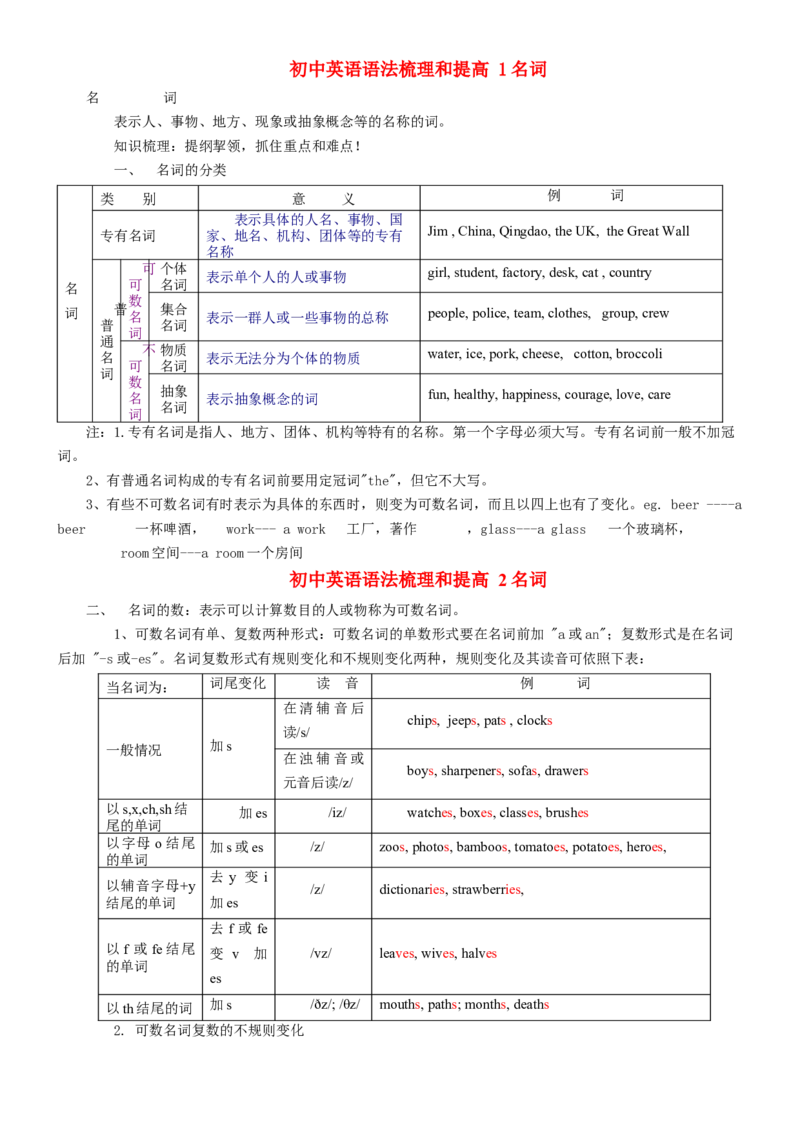
类 别 意 义 例 词
表示具体的人名、事物、国
Jim , China, Qingdao, the UK, the Great Wall
专有名词 家、地名、机构、团体等的专有
名称
可个体 girl, student, factory, desk, cat , country
表示单个人的人或事物
名 可 名词
数
词 普 名 集合 表示一群人或一些事物的总称 people, police, team, clothes, group, crew
普 名词
词
通
名 不物质 表示无法分为个体的物质 water, ice, pork, cheese, cotton, broccoli
可 名词
词
数
名 抽象 表示抽象概念的词 fun, healthy, happiness, courage, love, care
名词
词
注:1.专有名词是指人、地方、团体、机构等特有的名称。第一个字母必须大写。专有名词前一般不加冠
词。
2、有普通名词构成的专有名词前要用定冠词"the",但它不大写。
3、有些不可数名词有时表示为具体的东西时,则变为可数名词,而且以四上也有了变化。eg. beer ----a
beer 一杯啤酒, work--- a work 工厂,著作 ,glass---a glass 一个玻璃杯,
room空间---a room一个房间
初中英语语法梳理和提高 2名词
二、 名词的数:表示可以计算数目的人或物称为可数名词。
1、可数名词有单、复数两种形式:可数名词的单数形式要在名词前加 "a或an";复数形式是在名词
后加 "-s或-es"。名词复数形式有规则变化和不规则变化两种,规则变化及其读音可依照下表:
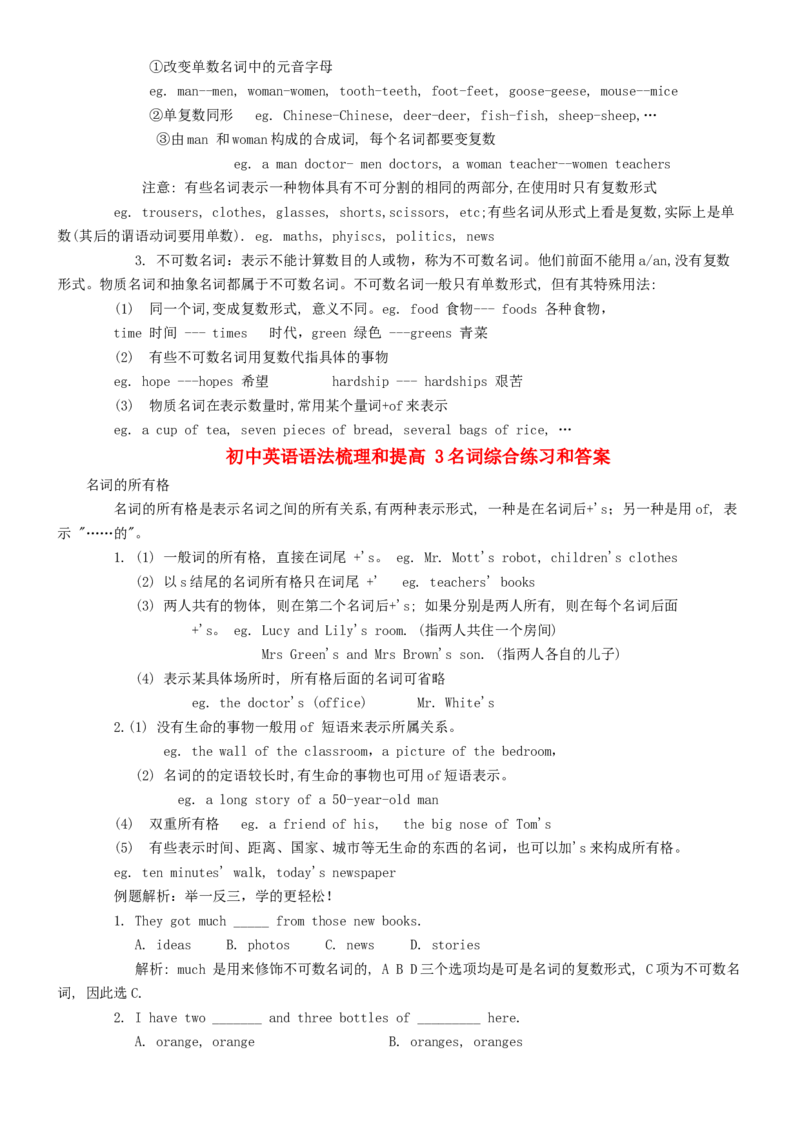
当名词为: 词尾变化 读 音 例 词
在清辅音后
chips, jeeps, pats , clocks
读/s/
一般情况
加s
在浊辅音或
boys, sharpeners, sofas, drawers
元音后读/z/
以s,x,ch,sh结 加es /iz/ watches, boxes, classes, brushes
尾的单词
以字母 o结尾 加s或es /z/ zoos, photos, bamboos, tomatoes, potatoes, heroes,
的单词
去 y 变 i
以辅音字母+y
/z/ dictionaries, strawberries,
结尾的单词 加es
去 f 或 fe
以f 或fe结尾
变 v 加 /vz/ leaves, wives, halves
的单词
es
以th结尾的词 加s /ðz/; /θz/ mouths, paths; months, deaths
2. 可数名词复数的不规则变化①改变单数名词中的元音字母
eg. man--men, woman-women, tooth-teeth, foot-feet, goose-geese, mouse--mice
②单复数同形 eg. Chinese-Chinese, deer-deer, fish-fish, sheep-sheep,…
③由man 和woman构成的合成词, 每个名词都要变复数
eg. a man doctor- men doctors, a woman teacher--women teachers
注意: 有些名词表示一种物体具有不可分割的相同的两部分,在使用时只有复数形式
eg. trousers, clothes, glasses, shorts,scissors, etc;有些名词从形式上看是复数,实际上是单
数(其后的谓语动词要用单数). eg. maths, phyiscs, politics, news
3. 不可数名词:表示不能计算数目的人或物,称为不可数名词。他们前面不能用a/an,没有复数
形式。物质名词和抽象名词都属于不可数名词。不可数名词一般只有单数形式, 但有其特殊用法:
(1) 同一个词,变成复数形式, 意义不同。eg. food 食物--- foods 各种食物,
time 时间 --- times 时代,green 绿色 ---greens 青菜
(2) 有些不可数名词用复数代指具体的事物
eg. hope ---hopes 希望 hardship --- hardships 艰苦
(3) 物质名词在表示数量时,常用某个量词+of来表示
eg. a cup of tea, seven pieces of bread, several bags of rice, …
初中英语语法梳理和提高 3名词综合练习和答案
名词的所有格
名词的所有格是表示名词之间的所有关系,有两种表示形式, 一种是在名词后+'s;另一种是用of, 表
示 "……的"。
1. (1) 一般词的所有格, 直接在词尾 +'s。 eg. Mr. Mott's robot, children's clothes
(2) 以s结尾的名词所有格只在词尾 +' eg. teachers' books
(3) 两人共有的物体, 则在第二个名词后+'s; 如果分别是两人所有, 则在每个名词后面
+'s。 eg. Lucy and Lily's room. (指两人共住一个房间)
Mrs Green's and Mrs Brown's son. (指两人各自的儿子)
(4) 表示某具体场所时, 所有格后面的名词可省略
eg. the doctor's (office) Mr. White's
2.(1) 没有生命的事物一般用of 短语来表示所属关系。
eg. the wall of the classroom,a picture of the bedroom,
(2) 名词的的定语较长时,有生命的事物也可用of短语表示。
eg. a long story of a 50-year-old man
(4) 双重所有格 eg. a friend of his, the big nose of Tom's
(5) 有些表示时间、距离、国家、城市等无生命的东西的名词,也可以加's来构成所有格。
eg. ten minutes' walk, today's newspaper
例题解析:举一反三,学的更轻松!
1. They got much _____ from those new books.
A. ideas B. photos C. news D. stories
解析: much 是用来修饰不可数名词的, A B D三个选项均是可是名词的复数形式, C项为不可数名
词, 因此选C.
2. I have two _______ and three bottles of _________ here.
A. orange, orange B. oranges, orangesC. oranges, orange D. orange, oranges
解析: orange 有两种含义, 一种可数名词橘子, 另一种是不可数名词橘汁, 此题第一空应填可数名词,
第二空填不可数名词, 因此选 C。
3. Every evening M r. King takes a _________ to his home .
A. 25 minutes' walk B. 25 minute's walk
C. 25 minute walk D. 25 minutes walk
解析: 句中的 minute应该用其复数的所有格形式,只+',而不能+s,因此选A。
4. An old _______ wants to see you.
A. people B. person C. the people D. the person
解析: person 与people 都有"人" 的意思, 但用法不同. "一个人"用 "a person",
"两个人" 用 "two persons"; people 泛指 "人们"是集合名词,表示复数, the people 指 "人民", a
people 指 "一个民族". 应选B。
5. Help yourself to __________.
A. chickens and apples B. chickens and apple
C. chicken and apple D. chicken and apples
解析: chicken 可用作可数名词指小鸡,用作不可数名词指鸡肉,根据词题意应理解为鸡肉;apple为可
数名词, 故应+s, 因此选D。
6. Oh, dear. I forgot the two _________.
A. room's number B. rooms' number C. room numbers D.
rooms' numbers
解析: room number 房间号码. room可直接用作定语修饰后面的名词 . 类似的还有my phsics
teacher, two bus drivers 等. 应选C。
7. She has been in Tianjin for ten years. Tianjin has become her second _________.
A. family B. house C. home D. room
解析: family指的是家庭或是家庭成员; house指的是房子(住所); room 指的是房间;而home 指的
是家, 因此选C.
8. ________ mothers couldn't go to the meeting, because they have gone to Shanghai .
A. Mary and Peter's B. Mary and Peter
C. Mary's and Peter D. Mary's and Peter's
解析: 此句中 "mothers"是复数,表示两个人各自的母亲,因此应选D。
9. Li Lei has been to __________ many times this month.
A. her uncle B. her uncle's C. her uncles D. aunt's
解析: 此句意为 "李雷这个去她舅舅家多次". 表示具体场所时, 可省去所有格后面的名词.
因此选B。
10. He is a success as a leader but he hasn't ________ in teaching.
A. many experiences B. much experience
C. an experience D. a lot experience
解析: experience 作 "经验" 讲时是不可数名词, 作 "经历"讲时是可数名词. 本句中应理解为
"经验",因此是不可数名词,排除 A C. 又因 a lot of , lots of, plenty of 只用于肯定句, 不用于否定句,
因此选B。
11. A classmate of _________ was here ten minutes ago.A. you B. your C. your sister D. your
sister's
解析: 此题考查名词的双重所有格.应选D。
12. A group of _________ are talking with two ___________.
A. Frenchmen, Germans B. Germans ,Frenchmans
C. Frenchmans , Germen D. Germen , Frenchmen
解析: Frenchman 是复合词,其复数形式为 Frenchmen; German 的复数为直接在单词末尾+S, 应选
A.
13.The team ________ having a meeting .
A. is B. are C. am D. be
解析: team 是一个集合名词,即可表示复数意义(指整个小组) , 也可指小组中的成员(表示复数), 此
题意为后者, 因此选B。
14. "Would you like _________?" "________, please."
A. drink, Three coffees B. a cup of drink, Coffees
C. a drink, A coffee D. a drink, Three cups of coffees
解析: drink 和coffee是不可数名词, 可以用…of来表示数量, eg, three cups of coffee,
当前面加a 时,则表示 "一杯".因此选C。
15. The Great Wall was made not only by _______, but also the flesh and blood of ________
men.
A.earth and stone, millions of B. earths and stones, millions
C. the earth and stone, million of D. the earths and stones, millions
解析:earth 是不可数名词,因此删除B D,数以百万的应为millions of .
因此选A。
练习与巩固:熟能生巧,取得好成绩!
选择最佳答案:
1. Last night, there was a food accident. The _______ were ill, but no _______ were
lost.
A. child, lives B. children, life C. children, lives D. child, life
2. ---This is a photo of _________ when they were young.
---OK, how happy they both looked!
A. my father and mother B. my mother and father's
C. my mother's and father's D.my father's and my mother
3. The new student is in __________ , Grade Two.
A. Class Third B. Third Class C. Class Three D. Three
class
4. Today is September 10th. It's __________ Day. Let's go and buy some flowers for our
teachers.
A. Teachers B. Teachers' C. the Teachers' D.
Teacher's
5. The market isn't far from here. It's only _________ bicycle ride.
A.half an hours' B. half an hour's C. half an hour D. an hourand a half
6. --- What would you like to drink, girls?
--- _________, please.
A.Two cup of coffee B. Two cups of coffe
C. Two cups of coffee D. Two cups of coffees
7. During Christmas, people get together and sing Christmas songs for _________.
A. fun B. wishes C. interest D. thanks
8. Some _________ are flying kites near the river.
A. child B. boy C. boys D. childs
9. After the exam, we'll have________ holiday.
A. two weeks B. two-weeks C. two weeks' D. two week's
10. They are those _________ bags.Please put them on the bus.
A. visitor B. visitors C. visitor's D.
visitors'
11.--- How many workers are there in your factory?
--- There are two ___________.
A. hundreds B. hundred C. hundred of D. hundreds of
12. ---What do you think of the _______ the Moonlight Sonata by Beethoven?
--- It sounds really wonderful.
A. subject B. music C. book D. animal
13. There is not enough _________ in the corner for the fridge.
A. place B. room C. field D. ground
14. _________ comes from sheep and some people like eating it
A. Wool B. Pork C. Mutton D. Milk
15. If you don't take more ________, you'll get fat.
A. medicine B. lessons C. photos D. exercise
16. My school is about twenty ________ walk from here.
A. minute B. minutes' C. minutes's D. minutes
17. Mum, I have _______ to tell you!
A. a good news B. some good news C. some good newes D. much good news
18. Which is the ________ to the post office?
A. street B. way C. road D. address
19. I stayed at ________ last Sunday.
A. my uncles B. my uncles' C. my uncle's D. my uncle's
family
20. Maths ________ not easy to learn.
A. are B. is C. am D. were
1-5 CBCBB 6-10 CACCD 11-15 ABBCD 16-20 BBBCB
初中英语语法梳理和提高4冠词综合讲解练习和答案
冠 词
冠词分为不定冠词(a, an )和定冠词 (the)知识梳理:提纲挈领,抓住重点和难点!
一、 不定冠词的用法
1)用与可数名词的单数形式前,指人或事物的某一种类:例如:
She is a girl.
Pass me an apple , please.
2)、指某人或某物,但不具体说明何人或何物。例如:
A boy is waiting for you
We work six days a week.
3). 表示 "一"这个数量,但数的概念没有one 强烈.例如:
We are going to have an English lesson tomorrow.
I have a mouth , a nose, two eyes and two ears.
4). 用于某些固定的词组中.例如:
a few, a little, a lot of
注: 用a 还是an, 要看后面的词读音以辅音开头还是以元音开头.
二、定冠词的用法
1) 特指某(些)人或某(些)物.例如: the photo of the boy
2) 指双方都知道的人或物.例如:
-Where are the new books, Jim?
- They are on the small table.
3) 指上文提过的人或物.例如:
Today he is making a machine.
He wants to ride the machine like a bike and fly it like a plane.
4). 用在世界上独一无二的事物前.例如:
The sun is bigger than the moon.
5). 用在序数词或形容词最高级前.例如:
The first truck is carrying a few baskets.
The third one is carrying the fewest of all.
6). 用在由普通名词构成的专有名词前.例如:
the Great Wall
the North Street Hospital
7). 用在一些习惯用语中.例如:
in the morning (afternoon, evening),
on the left(right)
at the end of
三、不用冠词的情况
1)在专有名词前和不可数名词前。例如:
China, Grade Two, Bill Smith, milk
2)名词前已有作定语用的this, that, my, your, some, any 等代词。例如:
The letter is in her pocket.
I think the shop is closed at this time of day.
3)复数名词表示一类人或事物时。例如:My father and mother are teachers.
I like cakes.
4)在星期、月份、季节、节日前。例如:
It is Sunday (Monday, Tuesday, etc.)
Today is Mid-Autumn Day.
It is cold in winter.
5)在称呼语或表示头衔的名词前。例如:
Uncle Wang likes making things.
What colour are Mrs Green's shoes?
6)在三餐饭和球类运动的名称前。例如:
He went to school after breakfast.
Can you play basketball?
注: 在某些固定词组中,如:at home, by bus, go to school 等的名词前不用冠词。
例题解析:举一反三,学的更轻松!
1. _______ milk is food. ________ milk in this cup has gone bad.
2. ---Do you like playing _________ football?
---Yes. But I have only _________ basketball.
3. Do you know _______girl on ________another side of ________ lake?
4. There's ________ "u" and ________ "s" in ________work "use".
5. She says ________animals cant's live without __________air, either.
6. His father, who is ________honest man, is teaching in ________ university.
7. Which is heavier, ________elephant or ________ horse?
8. ________ cold wind was blowing from the north.
9. He is always ready to help _________ old and ________ young.
10. ________ Greens are traveling in _________ South China.
11. Although ________ most of us like to drink beer, those who drink ________most are
_______ least healthy.
12.Xiaomei saw _________ interesting film last night. ________ film was about _________
kind doctor.
13. You can have _________ second try if you fail _______ first time.
14. Tom went to _________ school as usual, but he didn't know his father went to
________school for a parent meeting.
15. ________ knowledge begins with _________ practice.
解析:1./, the (milk 是物质名词,一般不用冠词, 但后面加上一个定语in the cup 后,使
其成为特指,所以需要用定冠词the.)
2. / , the (球类运动前不用the ; 指一个物体要用不定冠词a )
3. the,/, the ( 特指这个女孩用the;名词前已有定语another;)
4. a, an, the ("u" 发音以辅音开头所以用a;"s" 发音以元音开头所以用an; 特指这个单词用the)
5. /,/ (泛指动物所以不用任何冠词; air 不可数名词,其前一般不用冠词)
6. an, the ( honest 发音以元音开头,故用an, 在大学里为in the university)
7. an, a 或the ,the ( 不定冠词a , an 和 定冠词the与名词单数连用表示种类)8. a (物质名词coffee, food, tea, fog, rain, snow, wind等,在表示 "一种"或 "一场"的意义
时,前面要加不定冠词。
9. the, the ( 形容词前加定冠词,表示一类人)
10. The ,/ ( 姓氏的复数前加定冠词the 表示一家人;在华南是in South China)
11. /, the, the ( most当大多数讲时前面不用the;后两空均为形容词的最高级,前面要加the)
12. a, the, a ( 第一空和第三空都指一个事物,第二空是特指前面提到的电影)
13. a, the (a second try 指的是第二次)
14./, the (go to school 去上学, go to the school 去那所学校)
15./,/ (具有单纯意义的物质名词或抽象名词前,一般不用冠词)
练习与巩固:熟能生巧,取得好成绩!
一、在空白处填入a / an 或the。
1. ---Mum, what shall we have for _______dinner?
---Dumplings.
---Oh, what _______ wonderful dinner! I enjoy it very much.
2. _________ PLA was founded on __________August 1st,1927
3. _______ Kings came to us at _________ noon.
4. The scientists from ________ United States live in __________ Ninth Street.
5. The doctor to him, "Take ________ medicine twice ________day. Stay in _________ bed
and you'll be better soon."
6. September 10th is ____________ Teachers' Day.
7. Mr Black arrived here on __________ Tuesday morning.
8. There are four seasons in _______year. ________ first season is spring. It is
__________ best one of __________ four.
9. Some people have been to _________moon, in _______ spaceship.
10. _______ China is _________ old country with _________ long history
答案
1. /, a 2. the, / 3.the , / 4. the, the 5. the, a, / 6. / 7. / 8. a,
the ,the , the 9.the, / 10../,an,/ a
二、选择填空: A. / B. a C. an D. the
1. They are living ______happy life now.
2. ______bag on ______desk is mine.
3. There is ______empty box on the table.
4. Do you like ______music of the film "Titanic"?
5. On ______Saturday, I stay in ______bed till 12:00.
6. ______Browns have been to China twice.
7. Don't make any noise in ______class.
8. This is such ______interesting story that you must listen to it.
9. Next week they will go to Australia by ______air.
10. Which is bigger, ______sun or ______moon?
Key: 1----5 BDCDA 6----10 DACAD
三、在空白处填入a / an或the。1. This morning I bought _____ newspaper and _____ magazine. _______ newspaper is in my
bag but I don't know where I put ______ magazine.
2. I saw ______ accident this morning. ______ car crashed into ______ tree. ______ driver
of ______ car wasn't hurt but ______ car was badly damaged.
3. There are two cars parked outside: ______ blue one and _______ grey one. _______ blue
one is my neighbour's; I don't know who ______ owner of _______ grey one is.
4. My friends live in _______ old house in _______ small village. There is _______
beautiful garden behind _______ house. I would like to have ______ garden like that.
1.a ,a, The the 2.an, a, a, The ,the, the 3. A, a, the the, the
4. an, a, a, the, a
初中英语语法梳理和提高 5代 词
代 词
知识梳理:提纲挈领,抓住重点和难点!
一、 代词的分类英语中常把代词分为人称代词、无主代词、反身代词、指示代词、疑问代词、连接
代词、不定代词和相互代词。
二、 代词的用法
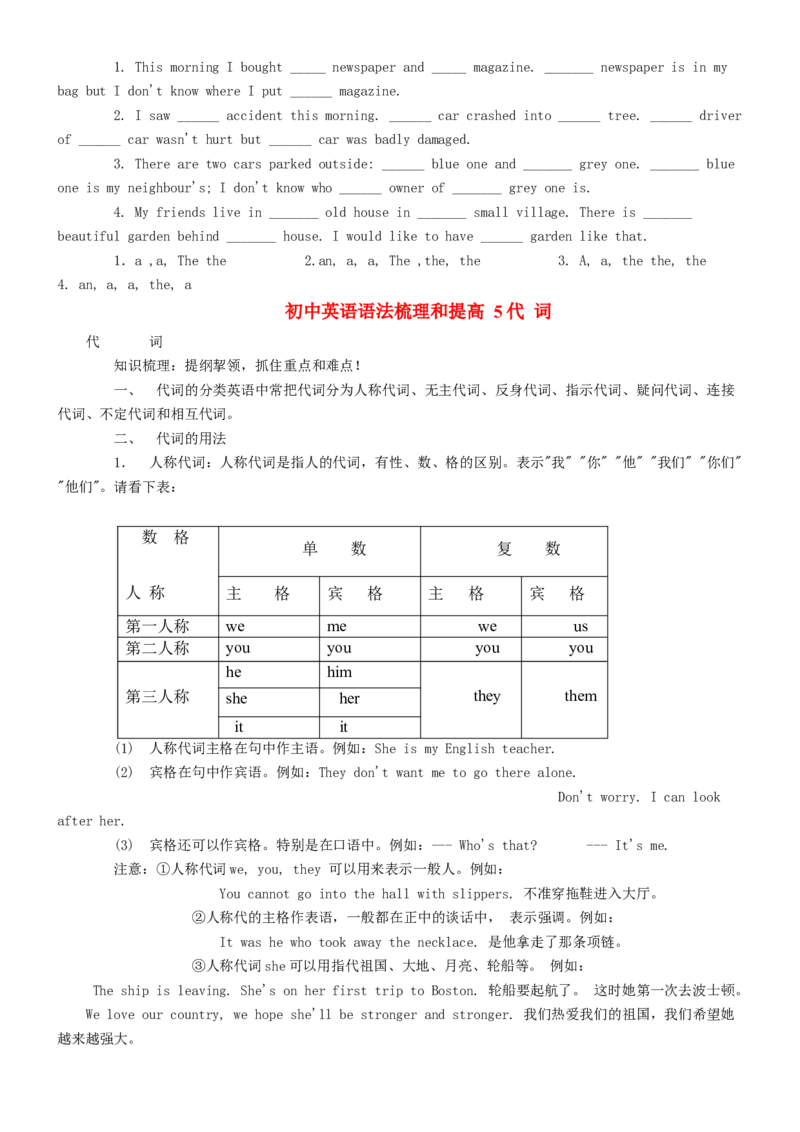
1. 人称代词:人称代词是指人的代词,有性、数、格的区别。表示"我" "你" "他" "我们" "你们"
"他们"。请看下表:
数 格
单 数 复 数
人 称 主 格 宾 格 主 格 宾 格
第一人称 we me we us
第二人称 you you you you
he him
第三人称 she her they them
it it
(1) 人称代词主格在句中作主语。例如:She is my English teacher.
(2) 宾格在句中作宾语。例如:They don't want me to go there alone.
Don't worry. I can look
after her.
(3) 宾格还可以作宾格。特别是在口语中。例如:--- Who's that? --- It's me.
注意:①人称代词we, you, they 可以用来表示一般人。例如:
You cannot go into the hall with slippers. 不准穿拖鞋进入大厅。
②人称代的主格作表语,一般都在正中的谈话中, 表示强调。例如:
It was he who took away the necklace. 是他拿走了那条项链。
③人称代词she可以用指代祖国、大地、月亮、轮船等。 例如:
The ship is leaving. She's on her first trip to Boston. 轮船要起航了。 这时她第一次去波士顿。
We love our country, we hope she'll be stronger and stronger. 我们热爱我们的祖国,我们希望她
越来越强大。④It作为人称代词时,可以表示天气、距离、时间、环境等。 例如:
It is about 10 kilometres from here. 离这儿大约有10公里。
⑤It 还可用作形式主语或形式宾语,来代替由不定式,动词的-ing,形式或主语从句构
成的真正的主语或宾语, 以避免句子头重脚轻。例如:
It is not easy to learn English well.
It is good for you taking a walk after supper.
I found it difficult to sleep.
⑥英语里当主语是并列的几个人时,人称代词的排列顺序和汉语不同, I 在最后, you
在最前;但是, 当受到批评或时承认错误时正好相反,I 在最前, you在最后。 例如:
You, he and I are all the winners.
I, Li lei and you are wrong. We should do more for the project.
2.物主代词:表示所有关系的代词叫物主代词。物主代词包括名词性物主代词和形容词性物主代词。
词 他
我 你 他 她 它 我 你
义 /她/它
的 的 的 的 的 们的 们的
类 型 们的
形容词性物
my your his her its our your their
主代词
名 词性物主
mine yours his hers its ours yours theirs
代词
(1) 形容词性物主代词在句中具有形容词的特征。在句中作定语, 后面跟名词。例如:
To our surprise, he has passed the exam.
(2) 名词性的物主代词具有名词的特征, 在句中作主语、表语、宾语。例如:
May I use your bike? Mine is at school. (作主语)
Whose glasses are these? They are hers. ( 作表语)
My dictionary is lost. Can I use yours? (作宾语)
(3) 名词性物主代词可以与of 连用, 作定语。 例如:A friend of ours are waiting for us.
3.反身带词:用来表示"某人自己"的代词称为反身代词。如下表所示:
我(们)自己 你(们)自己 他/ 她/ 它 自 己 / 他 们 自 己
词 义
单 数 myself yoursel himself herself itself
ourselv yfoursel
复 数 themselves
es ves
(1)反身代词在句中常用宾语,主语或宾语的同位语。例如:
Her sister is too young to dress herself. (作宾语)
He himself is always making such mistakes. (主语同位语)
You'd better ask your wife herself. (宾语同位语)
(2) 反身代词可与其他词构成固定搭配,例如:
make oneself at home, teach oneself, learn by oneself, help oneself to…,etc
4.指示代词:表示时间和空间远近关系的代词叫指示代词。见下表
这,这个 那,那个 这些 那些this that these those
this that these those
指示代词可在句中作主语、宾语、表语、定语等。例如:
Those are my parents. ( 作主语)
Throw it like that. (作表语)
The toys little Tom likes are those in the basket. ( 作表语)
These pictures are drawn by an old blind man. ( 作定语)
注意:(1)前面刚刚提到过的东西, 常用that, those 表示。 例如:
I'm sorry to hear that.
( 2 )下文将要提到的事情, 可用these, this 表示, 起启下的作用。 例如:
Tell the children to do like this: knock the stick into the earth first, then tie the
tree to it.
5.疑问代词:用来构成特殊疑问句的代词叫疑问代词。常用的有:who, what, which, whose,
whom, 在句中常作主语、宾语、定语、表语。
作主语: What make you so happy?
作宾语: Who / Whom is your manager talking with?
在口语中, 作宾语时 who和whom可以通用,但在介词后面只能用whom.例如:
About whom they are talking just now?
作定语: Which subject do you like best?
作表语: What's your mother.
6.相互代词:用于表示相互关系的代词。 常用的有:each other, one another. 相互代词可以作宾
语、定语。例如:
We should help each other.
The villagers have looked after one another these year.
相互代词后可以加's,表示所有关系。 例如:
We put the presents in each other's stocking.
7.连接代词: 用来连接宾语从句、表语从句、主语从句的代词叫连接代词。常用的有:what,
which, who, whom whose, that例如:
I know what he said at the meeting.
The problem is who will mend it.
Could you tell me which is the way to the post office?
8. 不定代词:不定代词没有确定的对象, 常用的有:all, each, every, both, either, neither,
one, none, little, few, many, much, other, another, some any, no以及由some, no, any, every 构成
的复合词。
不定代词通常可以做主语、宾语、表语、定语, 而none及含有some, an every 的合成代词不
能做定语,no和every 只能做定语。
代词
many, few, a few修饰可数名词,much, little, a little修饰不可数名词。both, either,
neither, each用于指两者,all, any, none, every, another用于指三者或三者以上。
初中英语语法梳理和提高 6代词例题解析
例题解析:举一反三,学的更轻松!1. This isn't ______ pencil case. I left ______ at home.
A. my, mine B. me, my C. I, my D. my, myself
解析:此类题主要用于考查学生对人称代词、物主代词和反身代词的掌握情况。要做好这类题,就必
须熟练掌握这三类词的用法。应选A。
2. The English novel is quite easy for you. There are ______ new words in it.
A. a little B. little C. a few D. few
解析:历年来中考始终将little, a little, few, a few作为一个重要考点,要做好这类题,必须明
确几点:(1)little, a little修饰或代替不可数名词;few, a few修饰或代替可数名词复数。(2)few,
little 一般表示否定意义;a few, a little表示肯定意义。应选D。
3. ------ Can I come this evening or tomorrow morning?
------ ______ OK. I'm free today and tomorrow.
A. Either B. Neither C. Both D. None
解析:此类题主要是针对each, every, both, all, either, neither, none等不定代词的考查。
Both指两个人或物;all表示三者或三者以上"都",它们都表示肯定意义,均与of连用,作主语时,谓语动词
用复数形式,作定语修饰复数名词。all也可代替不可数名词或一个整体,这时谓语动词用单数形式,either
指两者只任何一个,表肯定,表示三者或三者以上中的任何一个用any, neither是either的否定形式,表示
两者都不是。应选A。
4. The population of China is much large than ______
A. this B.those C.it D.that
解析:在比较级的句型中,经常用that指代前面提到过的不可数名词,用those指代可数名词的复数。
选D。
5 . ------ When shall we meet again?
------ Make it ______day you like. It's all the same to me.
A. one B.any C.another D.all
解析:any表示任何一个。选B。
He said ______ at the meeting and just sat there silently.
A. something B. anything C. nothing D. everything
解析:此句的意思是"他在会上一言不发,只是静静地坐在那里。"根据句意,应选C。
------ Do you know the lady ______ is interviewing our headmaster?
------ Yes, she is a journalist from CCTV.
A. which B. who C. whom D. whose
解析:先行词指人且在定语从句中作主语,所以应选B。
练习与巩固:熟能生巧,取得好成绩!
一、用适当的代词填空
Help ______ to some ice cream, girls.
He came up with an idea at last, the idea of ______ was very good.
Hurry, up, there's ______ time left.
There is hardly ______ in the basket, it's empty.
Lili and Coco don't know ______ address. Lili has never been to Coco's home and Coco has
never been to Lily's home, either.
He is ______ a kind friend that ______of us like him.He have two English novels, but he has read ______ of them.
I don't like the color of this jacket. Could you show me ______ one?
You may take ______ of them, they're both good.
Don't worry. ______ goes well here.
二、选择最佳答案填空:
1. These two books are very interesting. You can choose _________ of them.
A. both B. each C. either D. any
2. He had ________milk but_________ bread for breakfast.
A. many; few B. much; little C. few; much
D. little; many
3. Is there ________you want to say?
A. something else B. anything else C. else
anything D. else something
4. A: _________ are you going to visit?
B: I am going to visit the Palace Museum.
A. Where B. What C. Why D. When
5. One should keep ________ promise.
A. one's own B. every C. himself D. herself
三、完成句子
1. There's two apples here, you can take ______(任意一个).
2. Lisa has two daughters. ______(没有一个喜欢)traveling.
3. ______ (所有的)girls like singing.
4. To say is ______ (一回事), to do is ______ (另一回事).
5. They keep one black cat and ______ (两只黑的).
6. He has ______ (许多) money, but he has ______ (没有) friends.
7. Can she speak French? ______ (只会一点).
8. ______ (他们中很少有人) can talk in Chinese.
9. ______ (没人) has been reached farther than the moon.
10. We looked at ______ (相互) in great surprise.
Key: 一、1.yourselves 2.his 3.no 4.anything 5.each other's 6.such,all 7.neither 8.another
9.either 10.everything
二、CBBAA
三、1.either 2.neither 3.all 4.one thing, another thing 5.two black ones 6.a lot
of/much, no
7.A little 8.Few of them 9. No one /Nobody 10.each other
初中英语语法梳理和提高 8数词讲解例题解析
数 词
英语数词表示数目或者顺序, 可分为基数词和序数词。基数词表示数量,序数词表示顺序。
知识梳理:提纲挈领,抓住重点和难点!
一、基数词的构成
1.1-12的基数词是独立的单词,即: one,two,three,four,five,six,seven,eight,nine,ten,eleven,twelve。
2.13-19的基数词以-teen结尾。如: fourteen,seventeen等,但13,15,18较特殊, 13-
thirteen 15-fifteen 18-eighteen。
3.20-90的整十位均以-ty结尾。如: sixty,ninety,但20,30,40,50,80较特殊, 20-
twenty 30-thirty 40-forty 50-fifty 80-eighty。
4.十位数与个位数之间要加连字符号"-",如:28-twenty-eight,96-ninety-six。
5.百位和十位(若无十位则和个位)之间加and,如:148-one hundred and forty-eight
406-four hundred and six。
6.hundred(百),thousand(千),million(百万),billion(十亿)等前面即使有具体的
数词,也不能在它们的后面加s。如:600-six hundred,8百万-eight million。
7.1000以上的数字,从后往前数每三位加一个逗号","第一个逗号前为千(thousand),第二
个逗号前为百万(million),第三个逗号前为billion(十亿)。英语中无"万"这个词,我们可以用"几十个
千(thousand)"表示几万,"几百个千(thousand)"表示"几十万"。如:2,510=two thousand five
hundred and ten;84,296=eight-four thousand two hundred and ninety-six;274,350=two hundred
and seventy-four thousand three hundred and fifty。
二、序数词的构成
序数词一般是以与之相应的基数词尾加-th构成,例如 fourth, tenth,但以下的这些基数词变为序数
词时, 有特别之处。
1.one--- first, two --- second, three --- third, five --- fifth, nice --- ninth,
twelve --- twelfth
2. 以ty 结尾的单词, 要先变y为I, 在加-eth. 例如:thirty ---thirtieth, fifty ---fiftieth
3. 以one, two, three 等结尾的多位数词, 要将各位数变成序数词。 例如: twenty-one ---
twenty-first, one hundred and one --- one hundred and first
注意: 序数词前常用定冠词, 有时还可以用不定冠词 a/an 则表示 "又一 "的意思。
例如:Mr Brown has a second car. 布朗先生另外还有一辆车。
He has tried a second time. 他又尝试了一次。
三、数词的应用
1.时刻的表示:小时、点钟、分钟、秒钟要用基数词。
①"几点钟"用基数词加o'clock。o'clock可省略。如: 5点钟-five(o'clock).
②"几点过几分 ",≤30分钟"用介词past。如: 7:05-five past seven;7:15-fifteen
(a quarter)past seven;7:30-half past seven。
③"差几分几点"用介词"to"。如:7:40-twenty to eight;7:45-fifteen(a quarter to
eight。
④日常生活中的时间读法常常简化,直接按基数词的顺序读。如:7:05-seven o five;7:15-
seven fifteen。
2.年月日的表示:
① 年份用基数词,如:1999年-nineteen ninety-nine; 1900年-nineteen hundred; 2000-two
thousand;1905-nineteen o five;
② 年用基数词,日用序数词。如:1998年6月8日 写作:June 8,1998;读作:June the
eighth, nineteen ninety-eight或the eighth of June, nineteen ninety-eight。
3. 世纪、年代表示法:(在)90年代 (in) the nineties
(在)19世纪 (in) the nineteenth century
(在)18世纪30年代 (in) 1730s或1730's
4.编号的表示:
① Lesson One =the first lesson第一课;
② Bus No.3=the No.3bus 3路公共汽车;
③ 表示住所时不用"No."如:302房间-Room 302(读作:room three o two);
④ 如果编号的数词比较长,一般用基数词。如:Page 457第457页;
⑤ 电话号码,用基数词,如:3855633-three eight five five(double five) six three three
(double three)。
5.分数的表达:
分子用基数词,分母用序数词,分子大于"1",分母则加"s"。如:1/3 one third,2/3two
thirds;
另外:1/2 a(one)half; 1/4one fourth或a(one)quarter;3/4threefourths或three
quarters。
half a second; a quarter of a second四分之一秒
6. 表示有小数的词用基数词。
5.5 five point five
12.135 twelve point one three five
7.表示百分数
5℅:five percent (per cent), 0.8℅ zero point eight percent (per cent).
8.表示有小数的词用基数词。
5.5 five point five
12.135 twelve point one three five
9.其他用法:
1)基数词+单数名词+形容词构成合成形容词。如:一个五岁的男孩a five-year-old boy;
一座800米长的桥an 800-metre-long bridge;女子400米接力girls'400-metre relay
race。
2)具体数词+metre(s)/kilometre(s)/kilo(s)long / high /tall /deep /away等。
如:长江长6300公里。The Changjiang River is 6,300 kilometres long.
3)表示"几十岁"用序数词,eg. 在他三十几岁时 in his thirties
4)倍数的表达:(一倍用once,两倍用 twice,两倍以上用基数词+times。如:5倍five times)。
例如:He is as tall a boy as I.
He is a head taller than I .
He is two years older than I
China is four times as large as Europe.
I am twice as old as you. (=I am twice older than you. /I am twice the age of you.)
My books are twice as many as yours.
China is four times larger than Europe.(=China is four times the size of Europe.)
I pay twice as much as it was worth.
I pay twice as much for the house.例题解析:举一反三,学的更轻松!
1. _______ Chinese are looking for ways to learn English well before Beijing 2008
Olympic.
A. Thousand B. Thousands C. Thousand of D. Thousands of
2. Both of the rules are broken. I want to buy a ______ one.
A. three B. third C. forth
D. /
3). --- Which is the smallest number of the four? --- _________.
A. Two- thirds B. A half C. A quarter D. Three-
fourths
4). Please write down the new words in the text of _______.
A. Lesson Eleven B. the Lesson Eleven C. Lesson Eleventh
解析:1.基数词hundred, thousand, million, billion 等前有具体数字时,它们后面不能加s,若这
些词后面有介词of (几百,成百上千) ,thousands of (几千,数千个),millions of, billions of 前不可
用数词修饰。但可用many, some, several 等修饰。故选答案D.
2.答案: B。此题主要考查序数词的运用。
3.答案:C。此题主要考查英语中的分数表示法。英语中表示分数时,分母用序数词,分子
用基数词,当分子大于1时,表示分母的序数词后要加s.
4.答案: A。 此题主要考查基数词的编号。在通常情况下,名词编号有这几种表示法:
1。事物名词+基数词,且每个单词的首字母都要大写。如:Lesson Eleven;2。定冠词+基数词+事物名词。如:
No. 6 Middle School
练习与巩固:熟能生巧,取得好成绩!
选择填空:
1. _______ of people in the world are sending information by E-mail ever day.
A. Many million B. Several million C. Several millions D. Many millions
2. About _______ of the surface of the earth _______ covered with water.
A. three quarter, is B. three quarters, has C. three quarters, is
D. three quarter, are
3. It will take _______ time to finish the work.
A. one and a half years' B. a year and half C. one and a half year's
D. a year and half's
4.--- How long will your stay here ?、
---For ________ .
A. one and two day's B. one and two day C. a day or two D. one or two day
5.When he moved to Germany in ______ , he was already in _______ .
A. the fifties; his sixties B. fifties; his sixties
C. the fifties; his sixty D. fifty; sixty
6.My brother lives in ______ on ______ floor.
A. six Room ;second B. Room six ;the second
C. Room six; two floor D. the room six ; the second
7.December is _______ month of the year.A. twelve B. twelfth C. the twelfth D. the twelve
8.This took place in the ______ .
A. 1940 B. 1940s C. 1940es D. 1940th
9.It is only _____ from my home to the train station.
A. ten minutes walk B. ten-minutes walk C. ten minutes 's walk D. ten minutes'
walk
10.There are ______ in this building , I live on ______.
A. nine floors ,the ninth floor B. nine floor, the ninth floor
C. nine floor , nine floors D.ninth floor,the ninth floor
11.The water behind the Three Gorges Dams (三峡大坝) should be ______ higher than
downstream( 下游)。
A. sixty-five meter B. sixty-fifth meter
C. sixty-five meters D. sixty-fifth meters
12. There are _______ days in a year.
A. three hundred sixty-five B. three hundred and sixty-
five
C. three hundred and sixty -five D. two hundreds and sixty-five
13. ---How many teachers are there in your school?
--- __________. , but I'm not sure.
A. Hundreds B. Hundred C. Hundreds of D. One
hundred
14. There are _________ doctors and nurses working hard in that hospital.
A. thousand B. two thousand C. two thousands
D. two thousands of
15. --- What's one fourth and a half, do you know?
--- Yes, it's _________.
A. two sixths B. three fourths C. one three
D. three sixth
16. Now children, turn to page ________ and look at the _______ picture in Lesson Two.
A. twentieth, one B. twenty, one C. twentieth, first D. twenty,
first
17. Both of the two rulers are broken. I want to buy a _______ one.
A. three B. third C. forth D. /
18. December is the __________ month in year.
A. twenty B. twelve C. twentieth D.
twelfth
19. --- What is the date today?
--- It's _________.
A. Thursday B. June the sixteenth C. the best day D. June
fifteen
20. She knows a lot about China as she has been to China ________.A. for the forth time B. four times C. a fourth time
D. for four times
1-5 CCACA 6-10 BCBD 11-15 CCCDA 16 -20 DBDBB
初中英语语法梳理和提高9动词一般现在是讲解试题
动 词
动词是表示动作(study, find, swim 等)或状态(be, like, feel 等)的词。动词具有人称、数量、
时态、语态和语态变化。
知识梳理:提纲挈领,抓住重点和难点!
动词分类:动词有助动词、情态动词、联系动词和行为动词四类。
一)助动词
助动词没有任何含义,不能单独做谓语,只能和行为动词一起构成谓语,帮助行为动词组成各种时态、
语态、语气以及疑问或否定形式。常见的助动词有be, do, does, did, have, will, shall等。具体用法如下:
1、助动词be的用法如下:
1)构成各种进行时态。如:
It was raining all day yesterday.
昨天整天下雨。
2)构成被动语态。如:
The meeting was held yesterday afternoon.
会议是昨天下午举行的。
3)与不定式连用表示按照计划、预先安排或规定要发生的动作。如:
They are to see an English film this evening.
他们今天晚上看英语电影。
2、助动词do的用法如下:
1)构成疑问式或否定式。如:
Does he think so?
I didn't say anything about the result.
2)在动词前加上do, does, did表示强调,意为"的确,确实"。如:
They do study hard.
She does love him.
He did want to help the old man.
3、have: 助动词have 的过去式是had。have和had均可与动词过去分词一起构成完成时态。如:
He has lived here for three years.
As soon as the sun had set they returned.
4、shall, should: 助动词shall只用于第一人称的将来时态;助动词should 是shall的过去式,构
成过去将来时。如:I shall send ten letters to my good friend.
She wanted to know if I should go to the palace.
二)情态动词
情态动词本身有一定含义,但不能单独作谓语,要和行为动词一起构成谓语。它们也能表明句子的否
定、疑问或时态上的区别。常见的情态动词有:can, may, must, need, should等。
表示能力
表示能力一般用can, could。如:Rose can speak now, but she couldn't a week ago.be able to 也表示能力,它和can 的区别如下:
1)表示做事的能力,两者可通用。但can 只能用于一般现在时和一般过去时。be able to 可用于任
何时态。如:
She could / was able to eat four pieces of bread when she was young.
They will be able to finish the drawing soon.
2) 表示过去经过努力而成功的某一次动作,只能用was/were able to, 但在否定句中可互换。如:
She was weak, but was able to finish the task last night.
can (could) 在疑问句中与第二人称连用时,表示征求对方意见或提出请求,表示委婉语气。虽然
could是can的过去式,但是could 只是表示比can语气更加委婉客气,没有时间上的差别。如:
-Could you lend me your pen?
-Yes, I can.
表示许可
表示许可一般用may/might, can/could, 而且常可互换。Might, could语气比较委婉。要特别注意:
回答以might, could开头的疑问句只能用may, can 给予直截了当的回答。
-Might/Could I borrow your book?
-Yes, you may/can.
表示必需、必要
must和have to都有"必须" ,一般情况下可互换。如:You must / have to finish the work..
但他们有如下区别:
1)must 表示说话人的主观看法;have to 表示客观需要。如:
I must have a talk with him.
He has to give up smoking because of badly cough.
2) 否定式mustn't 表示禁止,意为"不准,不可以做";don't have to 意为"不必"。如:
You mustn't hit her.
You don't have to explain it to me if you dislike the job.
注:表示推测的情态动词有表示"一定"的must, 表示"很有可能"的should, ought to 和表示"可
能"的can, could, may, might。具体用法如下:
must 表示较有把握的推测,只用于肯定句,不能用语否定句或疑问句。用法如下:
1)对目前动作的推测,用must+动词原形。如:
You must lose in the mountain.
2) 对目前状态的推测,用must + be + 表语。如:You speak for 4 hours, you must be thirsty.
在肯定句中,表示对现在或将来把握不大的推测用may (might) +动词原形,might 比 may 的可能
性更小;对过去把握不大的推测用may (might) have+ 过去分词。如:
The package might come tomorrow.
They may have killed the enemies.
3、在疑问句中,对现在表示推测用can (could) …+动词原形,对过去表示怀疑则用can (could) …
have+过去分词;在否定句中,对现在表示推测用can't+动词原形,对过去表示推测用can't (couldn't)
have+过去分词。如:
It can't be John. He has gone to UK.
4、need的双重身份
need 既可作情态动词又可作实意动词,它们的用法不同,如不注意区分,就容易用错。三)系动词
连词动词的种类
联系动词含有一定意义,它们要与其后做表语的形容词、名词或介词(短语)一起构成合成谓语。系
动词按意义可分为三类,而且有自己的特定用法。
1、按意义联系动词有:be, appear, seem, keep, remain, continue, stay, prove 等,如:Jim
appears very old.
2、表示感觉的联系动词有look, feel, smell, sound, taste等。如:It smells bad.
3、表示转变的联系动词有become, fall, get, go, grow, turn等。如:
She becomes more beautiful than three years ago.
四)行为动词
行为动词又称实义动词,它们都含有实在的意义,表示动作或状态,可在句中独立作谓语。行
为动词又分为及物动词和不及物动词。
1、及物动词
及物动词后一定要跟宾语,意思才能完整。如:
My mother told me she wanted to buy some books for me.
2、不及物动词
不及物动词意义完整,不需带宾语,但如果有些不及物动词非要带宾语时,必须先加介词后加宾
语。如:
He only worried about his daughter.
二、动词的时态
动词的时态有很多。初中阶段主要掌握八种:一般现在时、一般过去时、现在进行时、过去进
行时、一般将来时、过去将来时、现在完成时、过去完成时。
1.一般现在时
1)一般现在时态的构成:主语是I, we, you, they和名词复数时作谓语的行为动词用原形。主语是
he, she , it和名词单数时,作谓语的行为动词的词尾变化如下:
一般情况 +s
以s, x, ch, sh 或 o结尾 +es
以辅音+y结尾 去y变i+es
2)一般现在时态的肯定句、否定句和疑问句形式(以be和like为例):
主 语 肯 定 式 否 定 式 疑 问 式
I am a student. I am not a Are you a
We/You/ They student. student.
第一、二人称 are students. We/You/ They Are you/ they
和第三人称复数以 He/ She is a are not students. students?
及名词复数 student. He/ She is not a Is he/ she a
student. student?
I / We/ You/ I / We/ You/
They/ like music. They/ don’t like Do you/ they
music.Many people Many people like music?
like music. don’t like music. Do many
people like music?
3)一般现在时态的用法:
现阶段经常性,习惯性的动作 。例如:
I get up at six every morning.
He plays tennis once a week.
现在的状态 例如:
My mother is a teacher. She teaches English in a school.
客观真理 例如:
The earth goes around the sun.
4)常用于一般现在时态的时间状语:
often usually sometimes always every day never in the morning 等。
例题解析:举一反三,学的更轻松!
1. --- May I help you, sir?
--- Yes, I bought the TV the day before yesterday, but it ______.
A. didn't work B. doesn't work C. won't work D. can't work
解析:电视虽然是前天买的, 但坏了是现在的状态, 应该用一般现在时态。选B.
2.______ the bus until it ______..
A. Get off, stops B. Get off, will stop C. Don't get off, stops D. Don't
get off, will stop
解析:这是一个以until引导的时间状语从句,主句是祈使句,因此从句要用一般现在时表示将要发
生的动作。根据句意此题应用not …until(直到……才)句型。应选C。
3.The 70-year-old man ______ exercises in the morning.
A. takes B. are taking C. took
D. will take
解析:"这个70岁的老人早晨锻炼。"这里锻炼是一个经常性、习惯性的动作。因此,应选A.
初中英语语法梳理和提高10动词现在进行时讲解 试题
现在进行时
1)现在进行时的构成:Am/is/ are+ v-ing是现在进行时的构成形式
v-ing现在分词的构成:
一般情况 +ing
以不发音字母e结尾的单词。去e,加 +ing
ing
以辅音字母+y结尾的单词 去e+ing
以重读闭音节结尾的单词,末尾只有 双写词尾字母
一个辅音字母时. +ing
2) 现在进行时的肯定肯定句、否定句、疑问句形式:
主 语 肯 定 式 否 定 式 疑 问 式第一、二 I am driving. I am not Are you
人称和第三人 He/She/It is working. driving. driving?
称复数以及名 We/You/They are He/She/It is Is he/she/it
词复数 doing something. not working. working?
We/You/They Are you/they
are not doing doing something?
anything.
3)现在进行时的用法:
1. 说话时正在进行或发生的动作(动作是在说话时正在进行)。例如:
She is having a bath now.
2. 现阶段正在进行或发生的动作(但是动作并不是必须在说话时正在进行)。例如:
You are working hard today.
Kate wants to work in Italy, so she is learning Italian.
The population of the world is growing very fast.
频度副词always, forever等词连用时, 表示某种强烈的感情。如:
He is always trying out new ideas. (表示欣赏,表扬)
表示按计划即将发生的动作(仅限于go, come, arrive, leave, start, fly, begin, stay 等动
词)。如:
The party is beginning at 8:00 o'clock.
6) 常用于现在进行时态的时间状语: now 等。
often usually sometimes always every day never in the morning 等。
例题解析:举一反三,学的更轻松!
1.I don't think that it's true. She's always ______ lies.
A. tell B. tells C. telling D. told
解析:always在这里应现在进行时连用, 带有感情色彩, 表示讨厌。选C.
2. How ______ you ______ with the new job?
A. do, do B. do, get along C. are, doing D. are, getting on
解析:表示现阶段正在发生的动作,用现在进行时。选D.
3.--- Are these socks yours?
--- No. Mine ______ outside on the clothes line.
A. are hanging B. have hung C. hang D. hung
解析:hang意为悬挂, hung意为上吊、绞死,先排除答案B、D。根据前后句意可判断出现在的状态,
应用现在进行时。应选 A.
初中英语语法梳理和提高7动词一般将来时讲解 试题
一般将来时1)一般将来时的构成:
1. 助动词will(shall)+动词原形
2. am / is / are +going to +动词原形
2)一般将来时的用法:
1.将要发生的动作。例如:
I will leave for Beijing tomorrow.
2.将要存在的状态。例如:
This time next year I will be in Japan. Where will you be?
3.打算要做的事。 例如:
Are you going to watch the film on television tonight?
3) 常用于一般将来时的时间状语:
tomorrow next week in 2008 等。
例题解析:举一反三,学的更轻松!
1. I______ for Hong Kong on Saturday. Will you go to see me off at the airport?
A. am leaving B. am left C. am going to leaving D. left
解析:趋向动词leave 可用现在进行时表将来。选A。
2.I______ to see grandma and help her with some housework every week.
A. came B. am going come C. come D. will come
解析:此题虽然有every week, 但句意中表达的事将要去做的经常性动作。应该用一般将来时。因此
选D。
3. We Chinese ______ the Olympic Games in 2008.
A. held B. shall holding C. are holding D. are going to hold
解析:本题的时间状语是将来的时间, 所以选用一般将来时,A、D都删去。shall后面应跟动词原型,
故应选D.
初中英语语法梳理和提高11动词一般过去时讲解 试题
4.一般过去时
1)一般过去时的构成:
用动词的过去式。作谓语的行为动词的词尾变化如下:
一般情况 +ed
以e字母结尾的辅音 +d
以辅音字母+y结尾 去y变i+ed
重读闭音节结尾的单词,末尾只有 双写词尾字
一个辅音字母 母+ed
2)一般过去时态的肯定句、否定句和疑问句形式(以be和like为例):
主 语 肯 定 式 否 定 式 疑 问 式
I was a student. I was not a Were you a
We/You/ They student. student.第一、二人称 were students. We/You/ They Were you/ they
和第三人称复数以 He/ She was a were not students. students?
及名词复数 student. He/ She was Was he/ she a
not a student. student?
I / We/ You/ I / We/ You/
They/ liked music. They/ didn’t like Did you/ they
Many people music. like music?
liked music. Many people Did many
didn’t like music. people like music?
3)一般过去时的用法:
1. 过去发生的动作。例如:
The police stopped me on my way home last night.
2. 过去存在的状态。例如:
They weren't able to come because they were so busy.
3. 常用于一般过去时的时间状语:
yesterday,three months ago,last year,in 1979,often,always等。
例题解析:举一反三,学的更轻松!
1. r. Mott is out. But he ______ here a few minutes ago.
A. was B. is C. will be D. would be
解析:时分钟前发生的动作, 应该用一般过去时。 应选 A,
2.---Hi, Tom.
---Hello, Fancy. I ______ you were here.
A.don't know B.won't think C. think D. didn't know
解析:虽然句中没有明确的时间状语, 但是可以通过上下文语境判断出, 这句话指的是我这段时间
并不知道, 你前一阵子在这儿。 所以应选A。
3.He promised to tell me by himself when I ______.
A. come B. would come C. come D. had come
解析:在时间状语从句中,用一般过去时表示过去将来。应选C。
初中英语语法梳理和提高12动词现在完成时讲解 试题
现在完成时
1) 现在完成时的构成:have / has + v-ing
2)现在完成时态的肯定句、否定句和疑问句形式(以be和see为例):
主 语 肯 定 式 否 定 式 疑 问 式
I /We/You/ I /We/You/ Have you/ they
They have been here They haven’t been been here before?
第一、二人称 before. here before. Has he/ she
和第三人称复数以 He/ She has He/ She hasn’t been here before?
及名词复数 been here before. been here before . Have you/ they/.I / We/ You/ .I / We/ You/ many people seen
They/ Many people They/ Many people the film?
have seen the film. haven’t seen the
film.
现在完成时
1) 现在完成时的构成:have / has + v-ing
2)现在完成时态的肯定句、否定句和疑问句形式(以be和see为例):
在完成时的用法:
1、表示过去发生的动作对现在造成的影响或结果.常与already, just, ever, never, before等词连
用. 如:
She has never read this novel.他从未读过这本小说.(他对小说的内容不了解)
2、表示 "过去的动作"一直延续到现在并有可能继续延续下去. 常与for (后跟段时间)或since (后
跟点时间)等连用.如:
I have been a member of the Party for 10 years.
I have been a member of the Party since 10 years ago.
注:在有for 和since 引导时间状语的句子中不能用短暂性动词,应用与之相应的表示状态的词。如:
He has died for 3 years.(F)
He has been dead for 3 years.(T)
注意:①现在完成时不能和表示明确的过去时间连用。如:in 1998, last morning等
②have/has been to 表示"去过"(去了又回来了)
have/has gone to 表示"去过"(去了没回来了)
如:Where has she gone?(句中所指的人不在)
Where has she been?(句中作指的人在)
例题解析:举一反三,学的更轻松!
--How long ______ he ______ a fever?
--- Ever since last night.
A. have, got B. have , had C. have, caught D. did, have
解析:此句表示从昨晚起持续到现在的状态,应用现在完成时,去掉答案D。因为是段时间, 所以不
能用短暂行动词,get和catch 都是短暂行动词。 因此选B.
My bowl is empty. Who ______ all my soup?
A. drinks B. had drunk C. has drunk D. drank
解析:碗是空的了,这里强调的是所发生的动作造成的结果。 "谁把我的汤都喝了。应选C.
3. I ______ you for a long time. Where ______ you ______?
A. Didn't seen; did, go B. didn't see; have, gone C. haven't seen; have,
been D. haven't seen; have gone
解析:for+段时间一般预先在完成时连用。"你去哪儿了? "(在这段时间你不在)应选C。
初中英语语法梳理和提高13过去进行时讲解 试题
过去进行时
1)过去进行时的构成: was / were +v-ing2) 过去进行时的用法:
过去某一阶段或某一时刻正在进行的动作。 例如:
This time last year I was living in Brazil.
What were you doing at 10 o'clock last night?
3)常用于过去进行时的时间状语:
at four yesterday afternoon,then,at that time/moment 等。
例题解析:举一反三,学的更轻松!
Daddy promised me he ______ me a computer
A. was bought B. had bought C bought D. would buy
解析:"爸爸答应我给我买一台电脑"。宾语从句中的动作是以过去为起点将要发生的动作,应用过去
将来时。
选D。
They said they ______ do some sports if it was fine.
A. were going to B. went C. would going D. were going
解析:"他们说如果天气好的话他们打算去运动。"去做运动发生在说话之后,所以应选用过去将来时,
答案B不合适,"打算作某事"为"be going to do ".would 后面应跟动词原形,应选A.
初中英语语法梳理和提高14过去完成时态讲解 试题
初中英语语法梳理和提高14过去完成时态讲解 试题
过去完成时态
1)过去完成时态的构成:
肯定式:had + 动词的过去分词
否定式:hadn't + 动词的过去分词
疑问式:Had … + 动词的过去分词
简略回答: Yes, 主 + have/has had.
No, 主 + had现在完成时的用法
过去完成时的用法:
1、表示在过去某一时间或动作之前已经发生或完成的动作。 他表示的时间是"过去 的过去 "常与by
last year, by the time of yesterday,等连用。如:
She said she had seen the film 4 times.
When Mr Li got to the classroom, all the students had begun reading.
By the time they arrived, the bus had left.
2、表示 从过去某一时间开始一直延续到过去另一时间的动作或状态。常与for (后跟段时间)或
since (后跟点时间)等连用.如:
She had worked in this school since it opened 25 years ago.
例题解析:举一反三,学的更轻松!
1. He ______ in Shanghai University for four years before he ______ Beijing.
A. studied, had gone B. had studied, went
C. has studied, goes D. had studied, had gone
解析:"他去北京之前在上大学学习了4年 "。在上海学习的动作发生在去北京之前,因此第一个空应
用过去完成时。此题选B。2. Mary said it was at least five years since he ______ a good drink.
A. enjoyed B. was enjoying C. had enjoyed D. would enjoy
解析:It was + 时间段+since 引导的从句中用过去完成时。应选C。
3. Xiao Pei said she ______ Hainan for 3 months.
A. has been in B. had been in C. had been to D. had gone to
解析:"小培说她去了海南三个月 "。have been to 和have gone to 都是短暂性的动词短语。所
以适应表示状态的have been in. 应选B.
时态综合例题解析:
1--What are Mr and Mrs Black doing ?
---They _____ tea in the garden.
A. are drinking B. drank C. have drunk D. drink
2. My mother often asks me _____early .
A. get up B. got up C. getting up D. to get up
3. Soon Wu Dong ____ up with Li Lei, then they were neck and neck.
A. taught B. caught C. bought D. brought
4. The car ____and stopped at the red traffic light.
A. got on B. got off C. slowed down D. picked up
5. Tom ____ the CD player for two weeks.
A. has lent B. has borrowed C. has bought D. has had
6. ---Do you know ______?
---Sorry, but if he _____ back, I ____ you know as soon as possible.
A. when will he be back, comes, will let B. when he will be back, will
come, will let
C. what time will he be back, will come, let D. what time he will be back,
comes, will let
7. We ____ to the park if it is fine tomorrow.
A. will go B. have gone C. go
8. A new shoe factory will ______ in this part of the city.
A. be building B. be built C. build
9. ---______ all your things, Tom! I hate them here and there.
---Ok, Mom.
A. Put up B. Put on C. Put down D. Put away
10. --- How about going hiking this weekend?
--- Sorry, I prefer ____ rather than _____.
A. to stay at home, go out B. to go out, stay at home
C. staying at home, go out D. going out, stay at home
解析:
1.根据问句的时态现在进行时,答句时态要一致,故选答案: A
2.根据句中的谓语动词ask的固定搭配 ask sb to do sth. 故答案:D
3.根据第一句的固定动词词组 catch up with sb 及第二句的过去时态,故选答案: B
4.此题主要考查四个动词词组的掌握.根据后半句在红灯时停下来,故选答案: C5.此题主要考查现在完成时的延续和非延续动词,根据for two weeks 时间短语。故选答案: C
6.此题主要考查宾语丛句和状语丛句的习惯用法。第一句是特殊疑问句的宾语丛句,要用陈述句语
序。第二句是if 条件句。丛句用一般现在时,主句用一般将来时。故选答案:B
7.此题考查if 条件句的主句时态,要用一般将来时,故选答案; A
8.此题考查语态。根据全句的意思,使用被动语态。故选答案: B
9.此题考查四个动词词组put up ,张贴,举起; put on 穿上,上演; put away 把---收拾好。
根据后半句"我讨厌到处乱放", 故选答案: D
10.此题主要考查一个固定词组:prefer to do sth rather than do sth. 故选答案:C.
练习与巩固:熟能生巧,取得好成绩!
一、选择最佳答案填空(动词及搭配):
1. A policeman saw two thieves ______a girl's mobile phone on the bus and hecaught them
at once.
A. to steal B. stealing C. stole D. stolen
2. The Chinese pingpong players will join in the match.Let's ______them success.
A. wish B.to wish C.hope D.to hope
3. He is so careless that he always ______his school things at home.
A. forgets B.forgot C.leaves D.left
4. ----Who ______the computer? I want to use it.
----Timmy. He ______ it for a week.
A. borrowed, has borrowed B.has borrowed, bought
C.has borrowed, has kept D.bought, has borrowed
5. Look! One of the girls ______the door.
A. cleans B.is cleaning C.clean D.are cleaning
6. If you don't feel well, you may just ______.
stopped reading B.stop reading C.stopped to read D.stop to read
7. ----Where can we get a baseball?
----Let's ______.
A. lend Jim one B.lend one to Jim
C.borrow one from Jim D.borrow one of Jim
8. ----My model ship doesn't work.
----Don't worry. I'll have it ______this afternoon.
A. repairing B.made C.repaired D.mend
9. You ______wash your hands before meals.
A. need B.must C.can D.may
10. Will you ______the light? It's dark in the room.
A. get on B.get off C.trun on D.turn off
11. My name is Zhang Mingjian. You may ______me Zhang Mingjian or Mr Zhang.
A. ask B.say C.tell D.call
12. There is going to ______a game in our school this afternoon.
A. has B.have C.be D.are
13. You'd better______smoking. It's bad for your health.A. eat up B.give up C.come up D.get up
14. ----How do you like this book?
----I think it has nothing to______with our study.
A. make B.do C.take D.hold
15. ----Where is Mr Brown? I have some questions to ask him.
----He ______the office.
A. has been to B.has been in C.has gone to D.has gone in
16.The bus kept the people ______for twenty minutes.
A. wait B.to wait C.waiting D.waits
17.I believe the scientists will______a better way to heal the disease.
A. get on with B.come up with C.go on with D.catch up with
18.----Why do you often ______this pink blouse?
----Because it fits me well.
A. put on B.wear C.buy D.try on
19. Jack always runs faster than Peter, but this time he ______him.
A. went over B.fell behind C.put off D.dropped off
20. The Internet ______it easy to get much new information in a short time.
A. finds B.makes C.feels D.takes
参考答案:1--5 BACCB 6-10 BCCBC 11--15 DCBBC 16-20 CBBBB
二、选择最佳答案填空(动词时态):
1. We __________out by that time that he_________ a thief for a longtime.
A. had found, had been B. had found, was
C. found, had been D. found, was
2. It so happened that they________ the novel before.
A. had read B. would read C. were reading D. read
3. She________ for nearly two hours.
A. kept talking B. kept to talk C. has kept talking D. kept
to talking
4. Spring_______ after winter.
A. comes B. came C. has come D. had come
5.-I hear some noise in the next room.
-Oh, yes. Your sister_______ there.
A. cries B. is crying C. cried D. was crying
6. All the students__________ to plant trees and there's nobody in the classroom.
A. go B. will go C. have gone D. wound go
7. Stop! A little boy_________ the street.
A. is crossing B. crosses C. crossed D. has crossed
8. The girl________ to milk since last winter.
A. learns B. learned C. has learned D. would learn
9. What__________ to you this morning?
A. happens B. is happened C. happened D. was happened10. -The old man looks healthy.
-Yes. He________ some running after he gets up.
A. does B. did C. has done D. will do
11. She didn't pass the exams because she________ her lessons well.
A. wasn't prepared B. wasn't been prepared
C. hadn't prepared D. was preparing
12. This story_______ in a faraway village in Europe many years ago.
A. is happened B. was happened C. happened D. has been happened
13. -Mr King came back to our village.
-Really? For what?
-The old man________ the noise in the city.
A. is hating B. hates C. was hating D. has hated
14. His father ________ for a week.
A. died B. will die C. has been died D. has been dead
15. My mother is ill. I _______stay at home and look after her.
A. has to B. must C. would D. have to
16.---Do you know the Frenchman?
---Yes. I ______him for two years.
A. know B. have known C. knew D. have been known
17. They______ all their money, so they have to walk home.
A. spend B. had spent C. have spent D. will spend
18. Great changes_______ in the city, and a lot of factories_______.
A.have been taken place, have been set up
B.have taken place, have been set up
C.have taken place, have set up
D.were taken place, were set up
19. ---When did Kate's grandma die?
---While the doctors______ on her.
A. are operating B. were operating C. operate D. operated
20. ---Who are you looking for?
---Mr White.
---Wait here for a while. The class meeting_______ over in half an hour.
A. is B. will be C. was D. has been
21. If she's not at home, you ______ try telephoning her at the office.
A. will B. could C. would D. need
22. All the new words ______ up in the dictionary yet.
A. have looked B. haven't looked C. have been looked D. haven't been
looked
23.I don't want to speak to her, but I ______.
A. do B. have to C. have to speak D. must to
24. Hurry up, or you _____ the train.A. miss B. lose C. will miss D. will lose
25.The new library ____ next week.
A.. will build B . will be built C. would build D. would be built
26.---Where's Mabel?
---She _____ ping pong behind the teaching building.
A. is playing B. was playing C. played D. had played
27. Quite a few tall buildings _______ the last two years.
A. have been put up B. were put up C. had put up D. put up
28. Man-made-satellites______ into space by many countries.
A. was sent up B. is sent up C. have been sent up D. has been sent up
29. I _______ all the words on the black board. May I go home now?
B. copy B. will coup C. copied D. have copied
30. Nobody knew _______ a living in that country.
A. to do B. to make C. how to do D. how to make
31.The old man needs at most five hour's sleep a night ,but he__________ for over seven
hours tonight.
A. has fallen asleep B has slept C has gone to bed D. has gone
to sleep
32.I'm really getting too fat. From now on, I________ more exercise and eat less food.
A have done B do C am doing D will do
33. You don't need__________ her. I_________ her for several times.
A describe, had met B describe, meet C to describe, have met D describe,
met
34. His speech in English was difficult__________.
A in following B for being followed C to follow D to be followed by
35. When he was a child, he tried to find ways_______ people________ life more.
A. to help, enjoy B. help, to enjoy C. help, enjoying D. to be helped,
to enjoy
36.What did your class teacher ________you to _______at the meeting?
A. tell, say B. ask, speak C. tell, speak D. ask, talk
37.______the bus until it _______.
A. Get off, stops B. get off, will stop
C. Don't get off, stops D. Don't get off, will stop
38 The living standard of the people in Shanghai_______ in the last ten years.
A. has raised B. has risen C. has been raised D. has been risen
39 -What did Mr Jones do before he moved here?
-He_______ a city bus for over twenty-five years.
A. has driven B. drove C. drives D. is driving
40. Hurry up! The play _______ for ten minutes.
A. had begun B. began C. has been on D. has begun
1-5 CAAAB 6-10 CACCC 11-15 CCBCD 16-20 BCBBB21-25 ADBCB 26-30 AACDD 31-35 BDCCA 36-40 ACBBC
初中英语语法梳理和提高15形容词和副词讲解 试题
形容词和副词
知识梳理:提纲挈领,抓住重点和难点!
一、形容词
用来修饰名词,表示人或事物的性质、状态和特征的词,叫形容词。
形容词的作用,见下表:
作 用 例 句
定 语 You can see a lot of beautiful flowers in the garden.
表 语 Your coat is too small.
宾语补足语 The old woman keeps everything clean and tidy.
注意:有些形容词只能作表语,如:alone, afraid, asleep 等。例如:
Don't wake the sleeping baby up. He is asleep.
The old man is alone.
形容词用来修饰something, anything, nothing, everything等不定代词,要放在这些词的后面。例
如:
You'd better tell us something interesting.
The police found nothing strange in the room.
多个形容词做定语时排列的先后顺序是:1)冠词或人称代词 2)数词 3)性质 4)大小 5)形
状
6)表示老少,新旧 7)颜色 8)事务、质地、人的国籍、用途。例如:
His grandpa still lives in this small short house.
他爷爷还住在这个矮小的房子里。
The woman bought two beautiful Chinese plates.
那个妇女买了两个漂亮的中国盘子。
形容词名词化:有些形容词前加定冠词后变成名词,表示一类人,谓语常用复数。这类词有:rich /
poor;
good / bad ; young / old ; healthy / ill ; living / dead ; black / white (表示人种等)。例
如:
The young should take good care of the old.
年轻人应该好好照顾老人。
The rich never help the poor in this country.
在这个国家,富人从来不帮助穷人。
表示数量的词组。如:
One day, a young man, twenty-five years old, came to visit the professor.
有一天,一位25岁的年轻人来拜访这位教授。
I live in a building about fifty meters high.
我住在一做大约50米高的大楼里。
形容词短语做定语时要后置。如:They are the students easy to teach.
他们是很容易较的学生。
We live in a house much larger than yours.
我们住的房子比你们的大得多。
else要放在疑问代词或复合不定词之后。如:
Did you see anybody else?
你看到别的人了吗?
二、副词
英语中副词的位置和汉语不尽相同,它的位置比较灵活。通常用作状语修饰动词、形容词、副词等。
下面来介绍一下副词的分类方法:
多数副词都可以放在它所修饰的动词后面。如:
We are living happily.
我们幸福的生活着。
He runs slowly.
他跑的很慢。
时间副词、地点副词和方式副词一般放在句末。如:
They went to the park yesterday morning.
昨天上午他们去公园了。
I heard him sing English songs over there.
我听见他在那边唱英语歌曲。
He drove the jeep carefully.
他小心地开着吉普。
注意: 有时表示时间的副词也可放在句首,起强调作用。如:
Yesterday I got up late.
昨天我起床很晚。
频度副词一般放在be动词、情态动词及第一个助动词之后,实义动词之前
如:He is seldom ill.
他很少生病。
You must always remember this.
你一定要记住这一点。
I often write to my parents.
我经常写信给父母。
Do you usually go to school on foot.
你经常走路去上学?
He has never been to Beijing.
他从来没有去过北京。
注意: 有时为了加强语气,频度副词也可放在句首。如:
Sometimes she goes to school by bus and sometimes she goes to school by bike.
有时她乘公共汽车上学,有时骑自行车去。
程度副词修饰动词时,与频度副词相同,修饰形容词和副词时,放在它所修
饰的词前面。如:That's quite early.
那很早。
I nearly missed the bus.
我几乎错过了公交车。
She did rather badly.
她干得相当糟。
否定副词一般放在动词之前、系动词be或助动词之后。如:
She seldom goes out at night.
她晚上很少出门。
I am never late for school.
我上学从不迟到。
We had hardly got to the station when the train left.
火车离开时,我们差不多/几乎到了车站。
疑问副词放在特殊疑问句的句首。如:
When can you come?
你什么时候来?
How many days are there in a month?
一个月有多少天?
What are you going to do when you grow up?
张大以后,你打算干什么?
Where were you born?
你是在那里出生的?
Why didn't he come?
他为什么没有来?
关系副词when, where, why 引导定语从句时,位于从句之前、所修饰的词之后。如:
Tell me the reason why you did it.
把你这样做的理由告诉我。
It's the sort of day when you'd like to stay in bed.
这是个令人恋床不起的日子。
I don't know the place where we will go.
我不知道我们将要去的地方。
同时存在时间状语和地点状语时,时间状语一般放在后面。如:
The meeting will be held in the classroom tomorrow.
明天会议将在教室里举行。
He watched TV in his room last night.
他作晚在房间里看电视。
They arrived in Beijing at 8 o'clock last evening.
他们昨天晚上8:00到达北京。
注:有些词既可用做形容词也可副词。如:
late, wide, well, fast, easy, early 等
The road is so wide that 8 buses can go throw it at a time.Open your mouth wide.
三、形容词和副词的比较级和最高级
形容词和副词的比较级和最高级的变化方法如下:
1) 符合规则的:
情 况 加 法 例 词
一 般 情 况 直接加 -er ; -est tall-taller-tallest
以e结尾的词 加 –r ; -st nice-nicer-nicest
以“辅音+y”结尾的 dry-drier-driest
变y为i再加-er ; -est
词 heavy-heavier-heaviest
以一个辅音字母结尾 辅音字母双写,再加-
thin-thinner-thinnest
的词 er ; -est
多音节和部分双音节 more delicious
在词前加 more ; most
单词 most delicious
2)几个不规则的形容词和副词的比较级和最高级如下表:
原 级 比较级 最高级
good , well better best
bad , ill worse worst
many , much more most
little less least
far farther / further farthest / furthest
形容词和副词比较级的用法
级
比较程度 表达方式和意义 例 句 备 注
别
肯定 As+原级+as Art is as interesting as music.
原 同 形式 (像……一样) Play as well as you can.
等
English is not so difficult as
程 not + so (as) +原级
否定 science.
级 度 +as
形式 She does not study so well as I
(不如……那样)
do.
不同程度 比较级前面可以加 much,
比较级+than Jim is older than Luky.
(用于两 far, even, still,a
(比……) I like pork better than beef.
者比较) lot, a little, a bit等
比
较
比较级+and+比较级 He is growing taller and
级
(越来越……) taller.
程度加深 The + 比较级,the + He studies better and better.
比较级 The more books she reads, the
(越……, 越……) better she understand.
最高程度 Spring is the best season of
最
(用于三 The +最高级+of (in) the year. 副词最高级前面的the 往
高
者或三者 (最……) Lin Tao jumped (the) farthest 往省略
级
以上) of all.注意:有些形容词,如 dead, empty, round, sure, woolen 等受本身含义的限制,没有比较级。
例题解析:举一反三,学的更轻松!
He is ________ friends than I.
A. much more B. many more C. very more D. too more
解析: 后面有可数名词复数时, many的比较级形式为many more 修饰。 应选B.
2. Which is the _________ country, Japan or Australia?
A. more developed B. more developing C. most developed D. most
developing
解析: 两者比较用比较级, 表示"发达"用 developed, 而developing 是 "发展中的" 意思
3. There were _______ shops in the city in 1982 than in 1990.
A. little B. few C. fewer D. less
解析:little 不能修饰可数名词,两者比较需用比较级, 所以应选C.
4. If you are not free today, come another day __________.
A. too B. so C. instead D. yet
解析:instead 作副词用时意为"代替,顶替", 表示前面的事情没做, 而是做了后面的事。
Instead一般位于句首。应选C.
5.He can't tell us ________, I think.
A. important anything B. anything important
C. important something D. something important.
解析:不定代词与形容词联用需后置,否定句中应该用anything而不是something. 因此应选B
6. The Huang River is the second __________ river in our country.
A. long B. longer C. longest D. the longest
解析:"定冠词the+ 序数词 + 形容词最高级 " 表示"第几大……" 应选C.
7. The light in the office wasn't ________for him to read.
A. enough bright B. bright enough C. brightly D. enough brightly
解析:enough修饰名词时可前可后, 修饰形容词或副词时, 要后置。应选B.
8. There was an accident at the corner. ________, the girl wasn't _________hurt.
A. luckily, badly B. luck, hardly C. Lucky, heavily D. Lucky, strongly
解析:第一空修饰全句需用副词,第二空修饰形容词hurt也要用副词, 因此选A.
9. You must keep your eyes _________ when you do eye exercises.
A. close B. open C. closed D., opened
解析: 此处需用形容词做宾语补足语。 应选C.
10. Five days has passed , but I haven't finished half of the work. ________,
A. already B. still C. too D. yet
解析:already 与 yet 都可用于现在完成时态。Already常用于肯定句, 而yet 常用与否定句。
应选D.
练习与巩固:熟能生巧,取得好成绩!
选择最佳答案填空:
Don't worry, sir. I'm sure I can run _________ to catch up with them.
A. slowly enough B. enough slowly C. fast enough D. enough fast2. The text is very easy for you. There are ________ new words in it.
A. a few B. a little C. few D. little
3. It's such an ________ film that all the students are ______ in it.
A. interesting; interested B. interested; interesting C. interesting;
interesting D. interested; interested; interested
4. Mingming got up very _______,so he came to school half an hour ______.
A. late; lately B. lately; late C. lately; lately D. late; late
5. I am ________ worried about y parents' healthy conditions.
A. some times B. sometime C. sometimes D. some times
6. We don't have ________ every day.
A. a lot of school works B. many school work C. any school works D. much
school work
7. -Look! How fast the two horses are running!
--Oh, yes! They are nearly _______.
A. up and down B. slower and slower C. more or less D. neck and neck
8. ______ children there are in family,_______ their life will be.
A. The less; the better B. The fewer; the better C. Fewer; richer D. More;
poorer
9. Most of the people in Guangdong are getting ________.
A. more and more rich B. more rich and more rich C. richer and richer D.
richer and richest
10. Which lesson is _______, this one or that one?
A. difficult B. much difficult C. more difficult D. the most difficult
11. "A ______ accident happened at 7:30 a.m." said the policeman _______.
A. serious, serious B. seriously, seriously C. seriously, serious D. serious,
seriously
12. ________ is it from our school to Lupu Bridge?
A. How long B. How often C. How far D. How much
13. In our city, it is ______ in July, but it is even _______ in August.
A. hotter; hottest B. hot; hot C. hotter; hot D. hot; hotter
14. This pencil is ______ that one.
A. so long as B. as longer as C. longer than D. not as longest as
15. The station is two kilometers _______ the hospital.
A. away to B. far away C. far from D. away from
16. Beijing has ______ many buses that there is often a traffic jam in rush hours.
A. so B. very C. too D. much
17. This box is ______ heavy ________ I can't carry it.
A. too, to B. so, that C. very, that D. too, that
18. India has the second _______ population in the world.
A. larger B. most C. smallest D. largest
19. Mary received ________ many postcards at Christmas.A. so B. such C. too D. even
20. The cake smells ______. Please throw it away.
A. good B. badly C. bad D. well
21. --- What was the weather like yesterday?
--- It was terrible. It rained so ________ that people could _______ go out.
A. hardly…hard B. hardly… hardly C. hard… hardly D. hard… hard
22. The meeting will be held in half an hour, but they haven't got everything ready_____.
A. ever B. already C. yet D. still
23. --- What about the English novel?
--- It's not very difficult. There are only ________ new words in it.
A. few B. a few C. many D. a little
24. How beautiful she sings! I've never heard ________.
A. the better voice B. a good voice C. the best voice D. a
better voice
25. Mr Smith always has ________ to tell us.
A. some good pieces of news B. some pieces of good news
C.some good piece of news D. some piece of good new
26. I'm afraid the headmaster is _________ busy to meet the visitors.
A. too much B. much too C. so much D. very much
27. - Dad , when will you be free? You agreed to go to the seaside with me four days
ago.
-- I am sorry, Jean. But I think I will have a ______ holiday soon.
A. four-days B. four-day C. four days D. four day
28. The scenery in Sanya looks ________, especially "Tian Ya Hai Jiao" is ________.
A, well, best B. fine, the most famous C. nice, better D.
beautifully, the best
29. What a _______ day it is! Let's go out for a walk.
A. windy B. lovely C. rainy D.cloudy
30. Of the two..Australian students , Masha is ________ one. I think you can find her
easily.
A, tallest B, the taller C. taller D. the tallest
1-5 CCADC 6-10 DDBCC 11-15 DCDCD 16-20 ABDAC
21-25 CCADB 26-30 BBBBB
初中英语语法梳理和提高16介词讲解 试题
介 词
介词是一种虚词,用来表示它后面的名词或代词同句中其他某个成分之间的关系。介词在句中不能单
独使用,必须连用它的宾语即后面的名词或代词构成介词词组后才能作句子成分。
知识梳理:提纲挈领,抓住重点和难点!
常用介词的主要用法意义
地点、方位 时间 动作方向 其他
介词
about 关于、大约
above 在…之上
across 横过
after 在…之后 在…之后
against 反对,对着
along 沿着
among 在…之中
around 在…周围、附近
at 在
before 在…前面 在…点钟
behind 在…后面 在…以前
below 在…以下
beside 在…旁边
between 在…之间
by 在…旁边 在…之间
during 到…为止
for 在…期间
from 长达 为了
in 在…里面 从…起 从…来
inside 在…里面 在…(内、后)
into 进入
like 像…一样
near 靠近 接近
of …的
on 在…上面 在…日
like 像
outside 在…之外
over 越过 超过,在…以上(表
示数目、程度)
past 过了…
since 自从…
till 直到…之时
to 到 到…
towards 对,向,朝
under 在…下面
until 直到…为止
with 用;有
without 没有
例题解析:举一反三,学的更轻松!
1. ---What time did you get there this morning?
--- _________ eight.
A. In B. On C. At D. From
2. He has got a chair to sit _______, but nobody to talk ________.
A. on, to B. / , with C. on, / D. / , to
Where's Lily? We are all here ________ her.A. beside B. about C. except D. with
Shanghai lies ________ the east of China.
A. to B. in C. on D. at
精析: 1. 答案:C.此题考查学生是否掌握了at\in \on 表示时间的用法。表示几点用at.
2. 答案: A.此题考查位置介词on 和词组talk to .
3. 答案: C. 此题考查四个介词的意思。能根据上、下文正确使用。
4. 答案: B. 此题考查学生是否掌握了表达位置的用法。在表达东、西、南、北的
方位时。在范围之内用in , 在范围之外用to,相邻用on。
练习与巩固:熟能生巧,取得好成绩!
用适当的介词填空:
Last Saturday I was busy ______ my homework .
My teacher was very angry ______ me because I was late ______ school again.
Kathy prefers a hula hoop ______ a book.
I will invite some friends ______ my eighteenth birthday party.
How long has he worked ______ an inventor.
My uncle arrived ______ the airport ______ the morning of May 3.
I will always help my friends when they are ______ trouble.
There is nothing ______ air ______ space.
I won't be back ______ June.
______ the age ______ twenty, he had written two books.
Mary fell ______ her bike and hurt her right leg.
He has been away ______ China ______ three years ago.
When I was ______ school, I was ______ the school football team.
I think he will be ______ two o'clock.
The teacher was given some flowers ______ his students.
Look, the birds are singing ______ the tree.
He left the classroom ______ all the windows open.
My sister is ill today. She doesn't feel ______ eating anything.
It's too dangerous. You must keep the children away ______ the fire.
My parents arrived ______ a cold night.
You should apologize ______ her ______ stepping on her foot.
The students are sitting ______ the table, reading the newspaper.
The city is famous ______ its football, and people there are very proud ______ their
city football team.
We are doing better ______ English ______ our teacher's help.
Don't worry ______ me. Everything is going well ______ me.
He was late ______ school today, and she came late ______
school, too.
------ Do you know what happened ______ Peter yesterday?
------ He was hit ______ a car.
I like clothes made ______ cotton.He will go to Hangzhou ______ his car tomorrow.
______ my surprise, the Englishman gave up halfway ______
the end.
I saw the great changes ______ my own eyes.
You look tired. Instead ______ working indoors you should be
out ______ a walk.
Wushu is becoming more and more popular ______ foreigners.
If you are able to get the tickets tomorrow, please tell me ______
phone.
There is going to be a report ______ Chinese history ______ our
school this evening.
Before 1990 there was no airline ______ the two cities.
She is dressed ______ a white skirt ______ red flowers.
It's bad ______ you to go to work ______ breakfast.
It's very nice ______ you to get me two tickets ______ the World
Cup.
------ Where have you been these days?
------ I have been to Bei Daihe ______ a friend ______ Canada.
------ Would you like some coffee?
------ Yes, and please get me some milk, too. I prefer coffee ______ milk.
------ When did Mr Smith come here?
------ ______ nine o'clock yesterday morning.
You must stand ______ line when you are waiting ______ a bus.
------ Jack, will you be home ______ time to see the children before they go to bed?
------ No problem.
China lies ______ the east of Asia and ______ the North of Australia.
46. If you can't pass the exam, you'll fall ______ others.
47. I have a swim every day ______ yesterday.
48. We all know that the earth moves ______ the sun.
49. The sunlight is coming in ______ the window.
50. This room is full______students and that one is filled______ teachers.
Key: 1. with 2. with, for 3. to 4. to 5. as
6. at, in 7. in, 8. but, in 9. until 10.At, of 11. off 12. from,
since 13. in, on/in 14. in 15. by 16. in 17. with 18. like 19. from 20.
on 21. to, for 22. at 23. for, of 24. in, with
25. about, with 26. for, to 27. to, by 28. from 29. in 30. To, in
31. with 32. of, for 33. among 34. by 35. on, in 36.
between
37. in, with 38. without 39. of, for 40. with, from 41.to 42. At 43. in,
for 44. in 45. in, to 46. behind 47. except 48. around
49. through 50. of, with初中英语语法梳理和提高17动词的语态讲解 试题
动词的语态
知识梳理:提纲挈领,抓住重点和难点!
英语动词有两种语态,即主动语态(The Active Voice)和被动语态(The Passive Voice)。主动语
态表示主语是动作的执行者,被动语态表示主语是动作的承受者,例如:
Many people speak English . (主动语态)
English is spoken by many people. (被动语态)
1、被动语态的构成
被动语态由"助动词be +及物动词的过去分词"构成。助动词be 有人称、数和时态的变化,其变化规
则与be作为连系动词时完全一样。被动语态的肯定式、否定式及疑问式列表如下:
肯 定 句: 主语+ be+ 过去分词 +(by…) eg. He is often asked to do
this work (by his boss).
否 定 句:主语+ be not +过去分词 +(by…) eg. I am not invited to the
party (by him).
一般疑问句:Be + 主语+过去分词+ (by…)? eg. Are your clothes washed by
yourself?
特殊疑问句:疑问词+ be+主语 +过去分词+ (by…)? eg. What is this sweater made of?
现以动词give为例,其被动语态的各种时态如下:
式 一 般 进 行 完 成
时
现在 Am / is /are + Am/is/are Have / has
given +being + given +been +given
过去 Was / were + Was / were + Had +been +
given being + given given
将来 Shall/ will + Shall / will +be Should /would
given + given + be + given
含情态 Can / may /must +be +given
词的
3、被动语态的用法:
1)当我们不知道谁是动作的执行者,或者没有必要指出谁是动作的执行者时,或者只需强调动作
的承受者时,要用被动语态。 例如:
This jacket is made of cotton.
English is spoken in many countries in the world.
2) 强调动作的承受者时。如:The boy was saved at last.这个男孩最后得救了。
3) 主动语态变被动语态的步骤:
主动句: The boy broke the window yesterday.
被动句: The window was broken by the boy yesterday.步骤一:原句中的宾语the window变成主语。
步骤二:谓语动词broke改为被动形式:was broken
步骤三:原句中的主语The boy放在介词by的后面。
步骤四:其他成分如:yesterday不变。
5) 有两个宾语的句子的被动语态:
A. 可有两种被动语态的常用动词有:buy,give,leave,lend,offer,pay,teach,tell,show,
等。
1. He gave me the book just now.
The book was given to me( by him) just now. = I was given the book (by him) just now.
2. They show the guard their passports at the entrance to the building.
The passports were shown to the guard by them at the entrance to the building.
= The guard was shown the passports by them at the entrance to the building.
B. 通常用直接宾语作被动语态主语的一些动词有: bring,do,make,pass,sell,send,sing,
write,等。
1. He wrote her a letter.
A letter was written to her.
My mother made me a skirt.
A skirt was made (for me) by my mother.
练习与巩固:熟能生巧,取得好成绩!
一、选择填空
1.The question ______by us soon.
A.is going to discuss B.will discuss
C.is going to be discussed D.has been discussed
2.The old man was quite weak after the accident, so he______.
A.must look after B.must be taken care
C.must be looked after D.must take care of
3. All the new words ______up in the dictionary yet.
A.have looked B.haven't looked
C.have been looked D.haven't been looked
4.There was no room for you. All the seats ______.
A. are taken B.was taken C.had taken D.had been taken
5. A model ship ______his son by Mr More.
A.was made for B.was made to C.made for D.makes for
6.----Dad, please open the door, it ______.
----OK, dear. I am coming.
A.was locked B.locks C.is locked D.locked
7. This kind of sweater______very soft.
A.is felt B.feels C.feel D.is feeling
8.----Have all the students known that our class will visit the factory this afternoon?
----Yes. Every student______about it.
A.told B.has told C.was told D.tells9.The cake ______delicious.
A.smell B.is smelled C.is smelling D.smells
10.My father has given up smoking since he ______on.
A.will operate B.will be operated C.operated D.was operated
11.A new school ______ these days.
A. is building B. is built
C. well build D. is being built
12. The cake ______delicious.
A. smell B. is smelled
C. is smelling D. smells
13.I________there would be a football match on Channel 8 tomato
A. will tell B. have told C. was told D. will be told
14.The librarian told me that the book______for two weeks.
A. can be borrowed B. can be kept C. could be borrowed D. could be kept
15.When______this kind of computer _______?
is; used B. was; used C. did; use D. are; used
16.The new computers_______to the village school as present last month.
are given B. given C. were given D. gave
17.I really don't know_______about it.
A.what to do B.how to do C. to do what D. how can I do
18.Your shoes_______. You'd better come to get them in half an hour.
are mending B. have mended C. are being mended D. have been mended
19.Though he had often made his little sister______,today he was made____by her.
A.cry; to cry B.crying; crying C. cry; cry D.to cry; cry
20.When_____the accident________?
A.was; happened B.has; happened C.was happebeing D.did; happen
Key: 1----5 CCDDA 6----10 CBCDD 11-15 BDCDB 16-20 CACAD
二、用所给动词的正确形式填空。
Some ideas ______(give) to college students by him yesterday.
----Do you like the music "Moonlight"?
----Yes, it ______really beautiful!(sound)
He won't come to the party unless Sue ______.(invite)
The chair needs______.(repair)
"Quick" is another way of ______"fast".(say)
This kind of bike ______in that factory, but you can't buy it now.(make)
Cotton ______in the country.(plant)
Man-made satellites ______by Chinese people.(send)
This kinds of shoes ______out by now.(sell)
The room must ______ clean every day.(keep)
Key: 1.were given 2.sounds 3.is invited 4.repairing/ to be repaired
5.saying 6.is made 7.is planted 8.have been sent 9.have been sold10.be kept
初中英语语法梳理和提高18动词不定式讲解 试题
动词不定式
不定式:to + 动词原形
知识梳理:提纲挈领,抓住重点和难点!
动词不定式的基本形式是"to + 动词原形",有时可以不带to。动词不定式(或不定式短语)没有人
称和数的变化,在句子中不能作谓语。动词不定式仍可保留动词的特点,即可以有自己的宾语和状语。动词不
定式同它的宾语或状语构成不定式短语。如:to read the newspaper, to speak at the meeting 等
动词不定式具有名词、形容词和副词的特征,因此在句子中可以作主语、表语、宾语、宾语补足语、
定语和状语:
句法作用 例 句
作宾语 She wanted to borrowed my radio.
They began to read and write.
作状语 She went to see her grandma last Sunday .
He came to give us a talk yesterday.
Lucy asked him to turn off the radio.
作宾语补足语 She asked me to speak more loudly
Jim told Ling Feng to go home at once .
The father made his son study hard.
作定语 Have you got anything to say?
I had something to eat this morning .
作主语 To learn a foreign language is not easy.
注:作主语用的动词不定式常常为it替代,动词不定式(或短语)放在后面。例如:
It is not easy to learn a foreign language.
It took us three days to do the work.
动词不定式的否定形式由"not+动词不定式"构成. 如:
Tell him not to be late.
The policeman told the boys not to play in the street.
4) 不定式省去to的情况: 在感官动词see,watch,look at,hear, listen to,feel和使役动词
make,have,let等所接的宾语中(不定式做宾语不足语),不定式应省去to。但是在被动语态中不能省。如:
Let me listen to you sing the song.
He watched his son play computer games.
I saw him run away.------He was seen to run away.
The boss make the workers work the whole night.----The workers were made to work the
whole night.
5) 动词不定式和疑问词连用
动词不定式可以和疑问词what ,which, how, where, when 等连用,构成不定式短语。如:
The question is when to start.
I don't know where to go .He showed me how to use a computer.
What to do is a big problem.
例题解析:举一反三,学的更轻松!
翻译下列句子,说出句中不定式的作用:
1. To grow plants is very important.
2. It is so nice to hear your voice.
3. My dream is to be a pilot.
4. He began to read and write at the age of five.
5. The teacher asked me to speak more loudly.
6. Tom came to see me last night.
7. I am glad to see you.
8.Have you got anything to say?
9.There are many places to see in China.
10.I asked him not to open the window.
11. I don't know what to buy for you.
12. I saw him dance.
13. He often helps me clean the room.
14. They are too shy to speak English.
15. He was lucky enough to find his watch.
16. I want you to go there together with me.
解析:1、To grow plants做主语;2、to hear your voice做主语;3、to be a pilot作表语;4、
to read and write作宾语;5、to speak more loudly作宾语补足语;6、to see me作状语;7、to see you
作状语;8、to say作定语;9、to see作定语;10、not to open the window作宾语补足语;11、what to
buy作宾语;12、dance作宾语补足语(省略to);13、clean the room作宾语补足语(省略to);14、to
speak English作状语;15、to find his watch作状语;16、to go there together with me作宾语补足语。
练习与巩固:熟能生巧,取得好成绩!
选择最佳答案填空:
1. Tell him ______ the light.
A. to turn B. not to turn on C. to not turn D. not to turn
2. It took us more than two hours _______ the dinner.
A. prepare B. preparing C. to prepare D. to be prepared
3. We felt the earth _______.
A. move B. moveing C. to move D. be moved
4. The students were made ______ the text ten times.
A. read B. reading C. to read D. to be read
5. The chair looks rather hard _______, but in fact it is very comfortable.
A. to sit B. to sit on C. sitting D. sit
6. Nobody knows __________next.
A. what to do B. to do what C. which to do D. how to do
7. It is very important ______ us ________these words.
A. to, to remember B. for, to remember C. for, remember D. for,remembering
8. _______ English well, one must have a lot practice.
A. For speaking B. Speaking C. To speak D. Speak
9. I'm going to the library ______ the books.
A. return B. borrow C. to return D. to lend
10. We went to town _________ some shopping.
A. doing B. did C. to make D. to do
11. The funny story _______ me laugh.
A. make B. making C. to make D. made
12. After the final exam, I think all the students want _________.
A. stop to have a rest B. to stop having a rest
C. to stop to have a rest D. stopping to have a rest
13. It is very kind _______ you to help me with my housework. It is hard _____me to do
all
the work.
A. of, for B. for, of C. of, to D. to, for
14. Many people think it very difficult _______ English.
A. to say B. to learn C. speak D. for speaking
15. The teacher asked the students __________ her _______ the word again.
A. listen to; to read B. to hear; say
C. to listen to; speak D. to listen to; pronounce
16.Remember ______ the book here tomorrow.
A. bring B. to bring C. take D. to take
17. ---Let's have a rest, shall we?
--- Not now. I don't want to stop _______ the letter yet.
A. write B. to write C. writing D. and write
18. ---This physics problem is too difficult. Can you show me __________, Wang Lin?
--- Sure.
A. what to work it out B. what to work out it
C. how to work it out D. how to work out it
19.--- How can I improve my spoken English?
--- You have to practise ______ as much as you can.
A. speak B. speaking C. spoken D. to
speak
20. --- How about going hiking this weekend?
--- Sorry. I prefer _______ rather than _______.
A. to stay at home, go out B. to go out, stay at home
C. staying at home, go out D. going out, stay at home
1-5 BBACB 6-10 ABCCD 11-15 DCABD 16-20 BCCBA
初中英语语法梳理和提高19宾语从句讲解 试题
知识梳理:提纲挈领,抓住重点和难点!1.在句中担当宾语的从句叫宾语从句,宾语从句可作谓语动词的宾语,也可做介词的宾语。eg, He
said he was good at drawing. (动词宾语)
He asks him how long Mike has been down . (动词宾语)
Miss Zhang is angry at what you said. (介词宾语)
2. 宾语从句的引导词有三类:
(1) 以that 引导的宾语从句,主要用来引导句形式的宾语从句, that可以省略。eg, The radio
says (that) the clouds will lift later on.
She told me (that) she would like to go with us.
(2) 以连接代词which, what, who等或连接副词how, where, why 等引导的宾语从句,从句是陈述
语序
eg, Could you tell me what's the matter with u?
I want to know how soon it will begin.
(3) 以 whether 或 if 引导的宾语从句, 主要用来引导一般疑问句意思或选择疑问句意思的宾语从
句,从句同样是陈述语序
eg, I wonder if /whether u have told the new to Li Lei .
3.宾语从句的时态
(1) 当主句为一般现在时态、现在进行时态、或一般将来时态时,从句可用所需要的任何时态。 eg,
I want to know what time he got up this morning.
You are telling me that you won't stop until tomorrow?
(2) 当主句为一般过去时态时, 从句要用于过去有关的时态。
eg,They asked what Jean was doing now .
Linda said that the train had left.
(3) 当从句表述的是客观真理或自然现象时,宾语从句要使用一般现在时。
eg, Lisa asked whether light travels faster than sound.
Polly said no news is a good news
注意:一般情况下,whether 和if 可以互用, 但有些情况例外。
1. 当从句做介词的宾于是只用whether 不用if
eg, We are talking about whether we'll go on the pinic.
2. 引导词与动词不定式或 not 连用时, 只用whether.
eg, Please let me know what to do next.
Could you tell me whether u go or not?
3. if当如果讲时, 引导的是条件状语从句, 这时不能用whether.
eg, You can't work the plan out if you don't have the meeting .
例题解析:举一反三,学的更轻松!
1. The teacher asked the students ________.
A. if they were interested in dinosaurs B. when was Albert Einstein born
C. what they will do with the computers D. how many trees they have planted
解析:宾语从句中从句应保持陈述语序,答案B首先删去,主句一般过去式,从句要用于过去有关的
时态,删去答案C和D,答案A中的if 意为如果.
应选A
2. Could you tell me _______ ?A. what the matter is with you B. what was the matter with you
C. hat's the matter with you D. what's the wrong with you .
解析:what 就是从句的主语,what's the matter with you 本身就是陈述语序,因此删掉A; 主句
可看作是委婉的请求,并是一般过去式,可删去答案B; wrong 前不用加the, 因此此题选 C.
3.He asked me _______ I could sing the song "My Heart will Go On."
A. if B. weather C.what D. that
解析:此句应选含有疑问意思的关系代词, 故删去D;weather 意为天气,根据句意应选A.
4.Our teacher told us that the moon _________ round the earth.
A. went B. turned C.go D. turns
解析:从句是一个客观真理,因此从句的时态不受主句影响。 应选 D
5. It makes no difference __________.
A. whether will you come tomorrow.
B. Whether or not will be pass the exam
C. If he will come to the meeting or not
D. Whether he will come to the meeting or not
解析:答案A和B从句不是陈述语序先删掉,if 不能与 not 连用。因此此题选D
6. They don't know _______ their parents are.
A.that B. what C. why D. which
解析:what 表示职业, 因此选B.
7. I am sure _______ you said is true.
A. what B. that C. which D. who
解析:根据句意应用what , 做said 的内容, 你所说的话。应选A.
8. The old man told us _______ and ________.
A. to do what , to do how B. what to do it, how to do it
C. what to do, how to do it D. what to do , how to do
解析: 疑问词what 即连接不定式,又做 do 的宾语; 而在how 引导的不定式短语中, how 表示方
式, do 为及物动词, 因此需接宾语才正确
应选C
练习与巩固:熟能生巧,取得好成绩!
1.---Do you know when the World Cup ________ next week?
--- Next Friday. When it ________, I will ring you.
A. begins, begins B. begins, will begin C. will begin, will begin D.
will begin, begins
2.--- Today or tomorrow?
--- What are you talking about?
--- We are talking about _______ to give a talk on WTO.
A. how B. where C. when D. what
3. I wonder _________.
A. where does he live B. where he live
C. he lives where D. where he lives
4. --- Are you sure you have to ? It's been very late.--- I don't know _____ I can do it if not now.
A. where B. why C. when D. how
5. ---Would you please tell me _________?
--- In a small village near Niingbo.
A. where was your mother born B. where your mother was born
C. when was your mother born D. when your mother was born
6. The photograph will show you ________.
A. what does our village look like B. what our village looks like
C. how does our village look like D. how our village looks like
7. --- Can you guess if they _______ to play basketball with us?
--- I think they'll come if they _________ free.
A.will come, will be B. will come, are C. come,
are D. come, will be
8. ---Where does he come from ?
--- Pardon?
--- I asked where_________.
A…. did he come from B. he came from
C. he comes from D. does he come from
9. She wondered __________.
A. how much he cost the computer B. how much he paid for
the computer
C. how much the computer will cost him D. how much did he spend on
the computer
10. ---Do you know ________?
--- I'm not sure. Maybe he is a businessman.
A. who he is B. who is he C. what he
does D. what does he do
1-5 DCDCB 6-10 BBBBA
初中英语语法梳理和提高20状语从句讲解 试题
状语从句在复合句中作状语,修饰动词、形容词或副词等。状语从句可以表示时间、条件、原因、地点、
目的、结果、让步、方式、比较等意义。
知识梳理:提纲挈领,抓住重点和难点!
各类状语从句连接词(短语)一览表:
时间 when, while, as, as soon as, since, until, after, before
条件 If, unless
原因 As, because, since
地点 Where
目的 So that, in order that
结果 So that, so…that, such…that
让步 though, although, even if, however
方式 As比较 than, (not)as…as,
时间状语从句:
Whenever he comes, he brings a friend. 他每次来都带个朋友。
条件状语从句:
As long as I am alive, I will go on studying. 只要我活着, 我就要学习。
原因状语从句:
Since we live near the sea, we enjoy nice weather.由于我们住在海边,能享受到好的天气。
地点状语从句:
Put it where we can all see it.把它放在我们都能看到的位置。
目的状语从句:
Finish this so that you can start another.把这个做完,你可以开始另一个。
结果状语从句:
He was so angry that he couldn't say a word. 他气得说不出话了。
让步状语从句:
Though he is in poor health, he works hard.虽然他身体不好,但是他工作很努力。
方式状语从句:
Students do as the teachers say.学生们按照老师说的去做。
比较状语从句:
The work isn't as easy as I thought.这项工作比我想象得难。
例题解析:举一反三,学的更轻松!
易混引导词while, when, as的区别:
when既可以指"时间点",与瞬间动词连用,也可以指"时间段",与延续性动词连用(=while)。如:
When he came in, his mother was cooking.
When (While) we were at school, we went to the library every day.
While表示时间段,因此,while 从句的谓语动词要用延续性动词。如:
Please don't talk so loud while others are working.
As与when用法相似,但着重强调主句动作与从句动作同时发生,有"随着……"或"一边……一
边……"之意。如:
As you get older, you get more knowledge.随着年龄的增长,你获得的知识就越多。
2.Because,as,since 的区别:
Because用于表示直接原因,回答why提出的问题,语气最强;As用于说明原因, 着重点在主句,常译
成"由于";since表示显然的或已知的理由或事实,常译成"既然"。如:
Water is very important because we can't live without it.
He didn't come yesterday as his mother was ill.
I'll do it for you since you are busy.
3.such…that, so…that, so that 引导结果状语从句的区别:
such是形容词,修饰名词; so 是副词,修饰形容词或副词。其结构如下:
1) such + a (n)+ 形容词+单数可数名词+that……
2) such+形容词+复数可数名词+that ……
3) such +形容词+不可数名词+that……。如:
This was such a good film that I went to see it several times.It was such good books that they sell well.
It was such bad weather that I had to stay at home.
He spoke so fast that I couldn't follow him.
He is such a lovely boy that we all like him.
=He is so lovely a boy that we all like him.
注:在"形容词+可数名词复数/不可数名词"结构中,当名词前有many, much, few, little表示数量
的多少时,名词前用so。如:
She made so many mistakes that she didn't pass the exam.
练习与巩固:熟能生巧,取得好成绩!
选择合适的连接词,完成下列句子。
1.Jim spends a lot of money on books______he is not rich.
2.Kate fell into sleep ______she was listening to the music.
3.----Is David at school today?
----No. He is at home ______he has a bad cold.
4.We won't have supper ______my mother comes back.
5.Speak to him slowly ______he may understand you better.
6. ______ she doesn't come on Sunday, I'll go fishing by myself.
7.It is four years ______I had left that small village.
8. ______the air moves, it is called wind.
9.We will go to the park ______it doesn't rain tomorrow.
10.______little boys did ______much work.
11.There are few new words in the passage ______we can't understand it.
12.Go back ______you come from.
13.He reached the station ______the train had left.
14.----Do you have a swimming pool?
----No, we don't. At least, not ______big ______yours.
15.Give me your paper ______you have finished it.
16.It is raining hard, ______we have to stay at home.
17. ______you work harder, you'll never pass the final exam.
18.Look after te children ______I am out.
19.The village is ______far away ______I can't get there on foot.
20.That is ______an interesting book ______I can't stop reading it.
Keys: 1.though 2.while 3.because 4.until 5. so that
6.Even if 7.since 8.when 9.if 10.Such, do
11.but 12.where 13.before 14.as(so), as 15.after
16.so 17.unless 18.while 19.so, that 20.such, that
初中英语语法梳理和提高22定语从句讲解 试题
在复合句中,修饰某一名词或代词的从句叫做定语从句。
知识梳理:提纲挈领,抓住重点和难点!
定语从句所修饰的词 叫先行词。 定语从句放在先行词后面。定语从句分为限定性定语从句和非限定
性定语从句。本章只介绍限定性定语从句。引导定语从句的词有关系代词that、which、who、 which、 whose和关系副词where 、when,关系代词和关系副词是引导词, 在定语从句中担当某一成份。
关系代词和关系副词的作用:
先行词指物时, 关系代词用that 或which(在句中作主语或宾语)。
如:China is a country which / that has a large population.
The computer game which/ that he is playing is his favorite.
先行词指人时, 关系代词用(who)作主语或宾语,whom (作宾语),whose (作定语),that (作主语
或宾语)。 如:
The man who is mending the machine has been retired.
This is the policeman who/ whom they were talking about yesterday.
I like the girl whose mother is an actor.
注意:下列情况下关系代词只用that 而不用which 或 who。
先行词是指物的不代词,如:all, little, few, much, none, anything, nothing, everything等
时。如:I didn't understand the words all that he said.
2.先行词由最高级、序数词以及any, very, only, all, no, just 等所修饰。如:This
is the most beautiful place that I have been to .
行词既包括人,也包括物。如:They always like to talk about the man and the things that
they see on the road.
当主句是以which 或who 开头的特殊疑问句时。如:who is the man that opened up the lab.
例题解析:举一反三,学的更轻松!
He is a friend ______ can help you in time of need.
A. who he B. whose C. / D. who
解析:引导词在定语从句中做主语,指人。 应选D 。
The most important thing ______ we should pay attention to is the first thing ______ I
have said.
A. which, that B. that, which C. which, which D. that, that
解析:先行词前有序数词, 最高级时,引导次只能用 that. 应选D.
This is the only one of these books that ______worth reading.
A.has B. have C. is D. are
解析:引导词that在句中作主语,代指one ,应选C。
The man ______ talked to you just now is my father.
A. who B. he C. which D. whose
解析:引导词在句中作主语指人,应选A.
They thought too much about ______.
A. which I had said B. what I had said
C. that I had said D. I had said
解析:此题引导词作在从句中作宾语,表示说话的内容,应 选B。
练习与巩固:熟能生巧,取得好成绩!
一、选择最佳答案填空:
1. Did you find the notebook ______ Jim had given me for my birthday?
A. who B. whom C. which D. whose
2. That's all ______ I have seen and heard.A. which B. that C. where D. what
3. Have you seen the man ______ plan we were talking about ______ yesterday ?
A. who, them B. its, them C. whose,/ D. whose, them
4.The Oscar is one of the film prizes ______ offered to any Chinese actor or actress so
far.
A. which are not B. that have not been C. that has not D. that has not been
5. He never reads anything ______ is not worth reading.
A. that B. as C. who D. which
6. The man ________ coat is black is waiting at the gate.
A. who's B. whose C. that D. of which
7. _________ cleans the classroom can go home first.
A. Anyone B. those whoo C. However D. The one who
8. The police caught the man _______ stole my handbag.
A. he B. that C. whom D. which
9. The girl ________ is reading under the tree ________ my sister.
A. which, is B. whom, was C. who , is D. who,
was
10. George Mallory was an English teacher _______ loved climbing.
A. who B. whom C. he D. which
1-5 CDCBA 6-10 BDBCA
初中英语语法梳理和提高23综合练习
初中英语语法梳理和提高23综合练习
综 合 练 习
一、用所给词的适当形式填空:
1.Please make ______for my bike.(room)
2.The beautiful scenery of Qingdao ______a large number of people to visit every year.
(attract)
3.Our room is on the eleventh floor. What about ______? (you)
4.Summer is the ______ season of the year. (hot)
5.We must ______our classroom clean and tidy every day.(keep)
6. ______of Chinese are looking for ways to learn English well before Beijing 2008
Olympic.(thousand)
7.The book is rather interesting. It's ______reading again.(worth)
8.Thank you for ______me your dictionary. I'll return it to you soon.(lend)
9.Hard work brings ______.(successful)
10.We should do something to stop waste water from ______rivers and seas.(pollute)
11.The old man put on his sweater and ______out alone.(go)
12.One of the ______comes from South Africa.(science)
13.I think I can do ______in French this year than last year. (well)
14.After three ______study, we worked out the physics problem.(month)
15. I went upstairs and ______at the door. (knock)16.The children are playing ______in the park. (happy)
17.Her brother enjoys ______very much. (surf)
18.I have ______a seat on the plane, but the flight was canceled.(book)
19.She lay______for hours thinking over her business.(wake)
20.Please turn to another ______. I don't like this show. (channel)
21."Help! Help! I ______!"the little boy cried in the river.(dead)
22.There is a big difference between you and ______.(I)
23.He often ______speaking English with foreigners.(practice)
24.We have some problems______there.(get)
25.Katy thinks ______in town is more exciting than in the country.(live)
26.I heard her ______when I walked past her room.(sing)
27.Telll me the ______number, don't use "about"or "or so".(exactly)
28.We lived in a place ______Gum Tree. (call)
29.My daughter says he's feeling even______today.(ill)
30.The weather gets warmer, and the days get ______. (long)
31.In which country is the weather most like ______?(China)
32.----Jim, have you written a letter to your aunt?
----Yes, Mum. I ______ one last week.(write)
33.Look at the sign:"No ______!". I am afraid you can't smoke here.(smoke)
34.Don't keep me ______for a long time.(wait)
35.The police have caught the thief who matches the man's ______.(describe)
36.Help ______to some fish, children.(you)
37.You'd better go to see the doctor and have your bad teeth______out. (pull)
38.Bad luck!I had my purse______.(steal)
39.The cars made in America are much cheaper than ______in Germany.(that)
40.John became a doctor after he ______up.(grow)
41.The match ______in the league last month was wonderful.(hold)
42.I am sure that our team will ______theirs.(beat)
43.Both of the two rulers are______. I want to buy a third one.(break)
44.----This digital camera is really cheap!
----The cheaper, the ______. I am short of money , you see.(good)
45.How long has your mother ______here?(be)
46.All the students are busy______ ready for the coming exam.(get)
47.The children looked ______.(happy)
48. How ______you are living in Qingdao! (luck)
49.When we arrived here, all the apples had ______up.(eat)
50.Talk about your plan and how to make it ______.(work)
51.I can see______ in the picture.(baby)
52. It has developed a lot because So many______ cities are around it.(satellite)
53.She stopped ______and listened to her mother.(cry)
54.I like ______the dolphin swim and jump.(watch)55.Be ______to others and they will be the same to you.(friend)
56."Nut" ______"jianguo".(mean)
57.They often do some ______in the morning.(clean)
58.----The fridge in the middle is very nice.
----I think so, but it ______too much.(cost)
59.What a poor boy, he was ______ in the forest.(lose)
60.----Don't touch the papers.
----Certainly, I'll not ______the papers be touched.(let)
61.He felt very sorry when he realized what a terrible mistake he ______.(make)
62.I prefer ______(swim) to ______(run).
63.There are a lot ______apples in this basket than in that one.(many)
64.Florence took lessons in music and drawing, and read ______.(wide)
65. ______the button and you can get what you want.(press)
66.He was not the only ______in this terrorist attacks.(victim)
67.Teachers ______our exam papers already.(score)
68.The police have caught then thief who ______our description.(match)
69.They ______me as their family member.(regard)
70.After he graduated from middle school, he ______his education.(continue)
71.I couldn't hear what he said. Ask him to speak more ______, please.(clear)
72.I ______ him to a game of tennis and at last he won.(challenge)
73.Many doctors are ______to the village.(send)
74.The flood ______the old bridge away last night.(wash)
75.How many ______fossils can you see in the museum?(dinosaur)
76.Lessons learned easily are soon ______.(forget)
77.The ______boy hid behind the door.(frighten)
78.The first part of the 20th century ______more great inventions.(see)
79.The past has______with the wind.(go)
80.Last Sunday I spent $20 ______these books.(buy)
81.He appeared to the ______and they were very excited.(audience)
82.He ______to catch the early bus because he got up late.(fail)
83.As a good doctor, he ______a lot of people's lives till now.(save)
84.The hard work made him feel______.(frustrate)
85.Believe me, I have ______in you.(confident)
86.It was the first newspaper ______on the train.(sell)
87.They are very busy these days because they have ______a bookshop.(start)
88.The sharks ______ on fish or other sea animals.(feed)
89.There was no machines ______a person to breathe under water for a long time.(allow)
90.He has ______ a TV show for a long time.(run)
91.Mr Black has taught in our school since 2002. He ______us very well.(teach)
92.September is ______month of a year.(nine)
93.Have you ever ______things about?(litter)94.Can we stop the factory from ______ the waste water into the river?(pour)
95.It's not polite ______in a public place.(spit)
96.She has made a major ______to our work.(contribution)
97.I ______my umbrella on the bus because the rain stopped when I got off the bus.(leave)
98.We were ______of our Chinese players in this Olympic Games.(pride)
99.Some ______are learning Chinese now.(Italy)
100.My good hobby is ______.(read)
Answers:
1.room 2.attracts 3.yours 4.hottest 5.keep 6.Thousands 7.worth
8.lending 9.success 10.polluting 11.went 12.scientists 13.better
14.months' 15.knocked 16.happily 17.surfing 18.booked 19.awake 20.channel 21.am
dying 22.me 23.practises 24.getting 25.living 26.singing 27.exact
28.called 29.worse 30.longer 31.China's
32.wrote 33.smoking 34.waiting 35.description 36.yourselves 37.pulled
38 stolen 39. those 40.grow 41. held 42. beat 43. broken 44. better
45. been 46. getting 47.happy 48.luckily 49.been eaten
50.work 51.babies 52.satellite 53.crying 54.watching 55.friendly
56.means 57.cleaning 58.costs 59.lost 60.let 61.had made 62.swimming,
running 63.more 64.widely 65.Press 66.victim 67.have scored 68.matches
69.regarded 70.continued 71.clearly
72.challenged 73.sent 74.washed 75.dinosaur 76.forgotten/forgot
77.frightened 78.saw 79.gone 80.buying 81.audience
82.failed 83.had saved 84.frustrated 85.confidence 86.sold
87.started 88.feed 89.allowing 90.run 91.teaches
92.the ninth 93.littered 94.pouring 95.to spit
96.contribution 97.left 98.proud 99.Italians 100.reading
二、选择最佳答案填空:
Please ______ a coat with you whenyou go out.
bring B.put C.get D.take
He finished ______the book yesterday evening.
seeing B.watching C.reading D.looking
It's getting warmer and warmer. The flowers start to ______.
come in B.come over C.come out D.come on
They will ______Qingdao tonight.
arrive B.get C.reach D.go
Soon Cathy ______up with me, then we were neck and neck.
taught B.caught C.bought D.brought
Again and again the doctor ______the crying girl, but he couldn't find what was wrong
with her.
looked over B.looked after C.looked for D.looked out
You ______go and ask Lily . She ______know the answer.must, can B.must, may C.need, can D.can, may
8. I bought a new dictionary and it ______me $30.
paid B.spent C.took D.cost
9.The children planted more trees and flowers after they______Greener China.
joined B.took part in C.became D.were
10.Could you tell me something more about Hong Kong?
I am ______going there for a holiday soon.
looking up B.thinking about C.trying out D.finding out
11.What a nice bag! But she ______only thirty dollars for it.
A. cost B.took C.spent D.paid
12.No matter how hard it is, we'll keep ______until we make it.
failed B.failing C.tried D.trying
13.I must return the camera to Cindy. I ______it for two weeks.
keep B.borrowed C.have kept D.have lent
14.I am sure our volleyball team will______the team from No. 3 Middle School.
win B.fail C.lose D.beat
15.Tracy can't play the match now. Please ______instead.
have Gina do it B.have Linda to do it
C.make Jane to do it D.let Daisy to do it
16.----Do you like______a doctor for the children?
----Yes. To be a children's doctor is rewarding.
be B.being C.are D.become
17.----What do you think of her voice?
----It______very sweet, I should say.
hears B.sounds C.listens D.sings
18.----How much does it ______to fly from Beijing to Qingdao one-way?
----About 1,000 yuan.
cost B.pay C.spend D.take
19.----Water-skiing and surfing are my favourite. How about you ?
----I ______surfing to water-skiing.
A. think B.agree C.want D.prefer
20.----It's more and more important to protect our earth.
----I think so. If everyone ______a contribution to it, our world will be more
beautifu..
A. make B.makes C.will make D.make
21.You ______swim in this part of the lake. It's dangerous.
mustn't B.needn't C.won't D.may
22.Jenny is a nurse and ______in Town Hospital.
works B.worked C.had worked D. working
23.----Where is Sandy?
----He ______to anwer the phone. He'll be back in a minute.had gone B.has gone C.has been D.went
24.---- ______all your things, Mary! I hate them here and there!
----OK, Mum.
Put up B.Put on C.Put down D.Put away
25.----How do you go to work every day?
----I ______on my bike.
ride B.drive C.take D.walk
26.----Oh, you painted the walls yourself?
----Yes. It was not hard. The whole work didn't ______.
A.want B.cost C.spend D.pay
27.----How about going hiking this weekend?
----Sorry. I prefer______rather than______.
to stay at home, go out B.to go out, stay at home
C.staying at home, go out D.going out, stay at home
28.----May I ______your Chinese-Russian dictionary?
----Sorry, I ______it at home.
borrow, forgot B.lend,left C.lend, forgot D.borrow, left
29.----Your T-shirt looks nice. Is it ______wool?
----Yes, and it's a ______Inner Mongolia.
made of, made by B.made of, made in
C.made by, made for D.made by, made from
30.Could you tell me how to ______it in French?
say B.speak C.talk D.tell
31.Bob______nearly two hours doing his work yesterday.
A. spent B.took C.paid D.cost
32.----Awould you please______this old lady?
----Sure. Have my seat, please.
take room for B.give a room for C.make room for D.have rooms with
33.Jim was so busy______the answer from Lily's paper that he forgot ______her name into
his.
to copy, to change B.to copy, changing
C.copying, to change D.copying, changing
34.The young man broke his arm in the accident and had to ______his job.
A. send up B.put up C.get up D.give up
35.The woman hasn't heard from her son for months. It______her a lot.
interests B.moves C.worries D.pleases
36.It's rather cold outside. Heree's a coat. ______, please.
A. Pick it up B.Put it on C.Take it off D.Turn it down
37.They are busy______ready for the exam.
A. get B.getting C.to get D.got
38.----What are you doing, Emily?----I'm ______the radio. The music is so beautiful.
watching B.listening to C.hearing D.mending
39.He ______the bus and found a seat next to the window.
A. got down B.got off C.got on D.got out
40.----Do you think Jim will pass the Chemistry exam?
----Sure. He ______a lot of time on it.
A.took B.cost C.paid D.spent
41.We enjoy______the moon in the open air on the Mid-autumn Day.
to see B.seeing C.to watch D.watching
42. A lot of meetings were ______because of the dangerous disease.
taken off B.put off C.turned off D.set off
43.Would you please go and ______some water for me? I am thirsty.
to bring B.to carry C.take D.get
44.----HI, Pete! Why are you in such a hurry?
----______the 7:30 train.
Catch B.To catch C.Catching D.Caught
45.Alice, we are going to spend our holiday in Canada. If you ______, we can go to Italy
instead.
hope B.wish C.prefer D.agree
46.----Awould you like to have a try?
----Yes, very much. It ______to be exciting.
seem B.is looking C.seems D.will look
47.----Mike! What are you doing there?
----Listen, Mum! I hear somebody______upstairs.
going B.goes C.go D.to go
48.It was raining heavily outside. The father made the children ______in the room.
to stay B.stay C.staying D.stayed
49.After years of hard work, his dream______in the end.
came out B.came true C.came over D.came up
50.----Hello! Would you like to go to the concert with me tonight?
----I'm sorry I can't. Mother won't ______me to go out in the evening.
let B.allow C.offer D.ask
51.It took us a long time ______Hawaii but we thought the journey was enjoyable.
to get B.getting C.to reach D.reaching
52.The teacher asked us to stop______because she wanted to tell us something.
talking B.to talk C.hearing D.to hear
53.The car ______and stopped at the red traffic light.
got on B.got off C.slowed down D.picked up
54.I think this is the best way to solve the problem. Do you ______me?
play with B.hear of C.agree with D.get on well with
55.Let him______a rest. I think he must be tired after the long walk.have B.gets C.to take D.has
56.The film ______for ten minutes.
has begun B.has been begun C.has been on D.began
57.----Shall we go and ______hello to foreign teachers?
----Good idea! Let's go.
A. say B.speak C.shout D.talk
58.Our teacher did what she could ______us with English.
A. help B.helped C.helping D.to help
59.We must do something to stop people from ______.
A. to throw litter about B.to throw litter into
C.throwing litter about D.throwing litter into
60.----Have you ever ______Lintong to see the Terra Cotta Warriors?
----Yes, I have.
A. went to B.gone to C.been in D.been to
61.I hope that you ______a good time this evening.
A. have B.are having C.will have D.had
62.----Hi, Carol, how was your trip to Disney World?
----Hi, we ______a good time there.
are having B.have had C.had D.have
63.I won't go to the concert because I ______my ticket.
lost B.don't lose C. will lose D. have lost
64.The bottle is empty. Who ______the juice?
has drunk B.drinks C.drank D.is drinking
65.The world ______. Things never stay the same.
A.changes B.is changing C.was changing D.will change
66._______ a cold morning, I opened the window and was glad to find that It was snowing
outside.
A. By B. In C. At D. On
67. There is ________ today's newspaper.
A. nothing new in B. something new on
C. important something in D. nothing important on
68. The headmaster _________ a noisy boy from the library.
A. sent for B. sent out C. sent back D. sent away
69. _______ it goes on, hour ________ hour.
A. So, after B. Such, by C. That,
after D. / by
70. Silk ________ in _______ China.
A. produce, the southeast B. is produced, southeast
C. is grown, southeast D. is produced, the
southeast of
71. " Do you know if the old man is still living?"" I'm sorry. He _________. He ______ for two months.
A. died, has died B. has died, has been dead
C. has been dead, died D. has died, has dead
72. Don't rush. There's still ______ time left.
A. more B. a lot C. a little D. a few
73. Would you please _______ fill the same bottle _______ full?
A. not, too much B. not to, too much
C. not, much too D. not to, much too
74. He asked ______ they wouild hold the meeting _____ it rained the next day.
A. if, whether B. whether, if C. whether,
whether D. if, whether
75. English is taught _________ a foreign language in almost all school in China.
A. with B. by C. as D. for
76. "Which boy do you want to see now? "
"The _______ in the red hat."
A. man B. person C. people D.
one
77. Peter could hardly see the words on the blackboard, ________?
A. did he B. couldn't he C. didn't he D. could
he
78. The lady always ________ in white at the party.
A. wears B. dresses C. is worn D. gets
dressed
79. Britain is only 30 kilometers _______ from France.
A. far B. far away C. away far D. away
80. Don't ask me to goo with him, ________?
A. shall we B. won't you C. will you D. don't
you
81. " You 've got a new dress, too"
" Yes. Mine is _______ , but not so _______ as yours."
A. better, cheap B. more better, expensive
C. better, more expensive D. good, cheaper
82. Lily was busy _______ ready for the exam and was made ______ in her room the
whole afternoon.
A. getting, study B. get , to study
C. getting, to study D. to get, study
83. She didn't tell me ________.
A. which room she lived B. she lived in which room
C. which room did she lived D. which room she lived in
84. The _______now is that we have lots of ________ to ask.
A. problem, questions B. question, problemsC. question, problem D. problem, question
85. Would you please speak slowly? I can hardly ______ you.
A. talk with B. agree with C. follow D.
hear of
86. Please let me know if you ________ your address.
A. move B. change C. choose D. find
87. The sign " ________" is usually seen on the box with glass in.
A. PULL B. CLOSED C.DANGER D. FRAGILE
88. At weekends I prefer _______ at home to _______out.
A. stay, going B. staying, go C. staying,
going D. to stay, go
89. The tree must ________ three times a week.
A. water B. is watering C. be
watered D. waters
90. They _______ some books from the liarary last week.
A. lend B. lends C. buy D. borrowed
91. ---Do you still have a headache, Billy?
--- No, it's ________. I'm all right now, mum.
A. dropped B. run C. left D. gone
92. He is kind and always _______ his help to others.
A. receives B. brings C.
takes D. offers
93. I'm sure our football team will ________ the team from NO. 3 Middle School.
A. win B. fail C. lose
D. beat
94. ---Most hotels are very full today.
--- Don't worry! I have ______ a room already in the Changjiang Hotel.
A. bought B. booked C. visited D. seen
95. To their _______, they all passed the exam.
A. surprise B. surprised C. surprising D.
surprises
96. ---Our English teacher often _____ us stories in class.
--- Yes, he's so popular.
A. tells B. asks C. says D. speaks
97. They were all out _________ the missing child.
A. found B. to look for C. find out D. to look
after
98. The boy fell off the bike and ___________ on the road.
A. lied B. lie C. lay D. laid
99. I think the headmaster is proud of us because he usually _________ us at thee
school meeting.A. speak loudly B. thinks highly C, is pride of D.
speaks highly of
100. The funny boy _______ his pockets _______ sand.
A. filled … in B. filled…with C. full…
with D. full…of
Key:1----5 DCCCB 6----10 ADDAB 11----15 DDCDA 16----20 BBADB
21--25 AABDA 26--30 BADBA 31---35 ACCDC 36---40 BDBCD
41--45 DBDBC 46--50 CABBB 51-55 CACCA 56-60 CADCD
61---65 CCDAB 66-70 DAAAD 71-75 BCDBC 76-80 DDBDC
81-85 ACDAC 86-90 BDCCD 91-95 DBDBA 96-100 ABCDB
中考语法不得不看:重点语法考前突击大汇总
中考重点语法考前突击(一):after与behind的用法辨析
两者均可表示“在…之后”,其区别是:
1. after 主要用于时间或次序,behind 主要用于位置:
He decided to leave after lunch. 他决定午饭后离开。
Summer comes after spring. 春去夏来。
The hospital is behind the post office. 医院在邮局后面。
【注】behind 有时也用于时间,表示“迟于”,主要用于behind time(迟,晚)这一习语:
The train was 20 minutes behind time. 火车晚点 20 分钟。
2. 两者都可用于引申义,after 侧重指追求、寻找、模仿等;而behind 则侧重指在背后、支持、落后等:
The police are after her. 警察在追捕她。
Many young people are after her. 许多年青人都追求她。
We are behind you completely. 我们完全支持你。
He is behind the others in maths. 他的数学不如别人。
中考重点语法考前突击(二):after与in的区别
两均可与一段时间连用,表示“在…之后”,但 after 表示以过去时间为起点的一段时间以后,因此通常
与过去时连用;而 in 则表示从现在算起的一段时间以后,因此通常用于将来时或含有将来意义的句子:
He came back after three days. 3天后他回来了。
I’ll come back in three days. 我3天后回来。
I think he can come back in three days. 我想他3天后可以回来。
【注】after 除与时间段连用外,还可与时间点连用,此时则可用于将来时(但是in不能与时间点连用):
He will arrive after five o’clock. 他 5 点钟以后到。
另外,after可以与某些表示活动的名词连用,表示“在…之后”(in不能这样用):
after school 放学后 after class 下课后
after the meeting 散会后 after liberation 解放后
中考重点语法考前突击(三):another接复数名词的用法
例题:
—Have you finished your report yet?—No, I’ll finish in ____ ten minutes.
A. another B. other C.
others D. the other
【分析】此题应选A。容易误选B, D。许多考生认为此题首先要排除选项A, 因为:another 只接单数名
词, 而这里ten minutes显然是复数, 所以不能选它。
事实上, 此题答案正是A。确实, 在通常情况下, another之后只能接单数名词:
正:another student 另外一个学生
误:another students (另外一些学生)
正:other students 另外一些学生(其他学生)
但是值得注意的是:若another后的名词有数词或few修饰时, 则也可接复数名词:
正:another few days 另外几天
正:another five chairs 另外五把椅子
正:another ten years 另外10年
正:another two dictionaries 另外两本词典
类似地, every也有以上用法特点:
通常后接单数名词:
正:every boy 每个男孩
误:every boys
但是若every后的名词有数词修饰, 则也可接复数名词:
正:every ten years 每10年
正:every five metres 每5米
正:every three lines 每三行
中考重点语法考前突击(四):不定代词与语境
请看下面这道不定代词考题,它与语境有很大的关系:
A: Is _________ here?
B: No, Bob and Jim have asked for leave.
A. anybody B. everybody C. somebody D. nobody
【分析】此题应选B。容易误选A, 认为这是疑问句, 所以要选 A。还有的考生可能会认为选C, 因为某些
特殊情况下(比如表示邀请或请求等), some(thing)也可用于疑问句中。 此题的正确答案是B, 此题主要考查
的不是不定代词的句型用法, 而是考察在一定的上下文(语境)如何选用适当的不定代词。
该题若不看下句, 选A/C也是可能的, 比如一个人晚上走进一个空房子, 就可能这样问, 其意大致为:这
里有人吗?(用somebody比anybody肯定意味更强), 然而联系下句就很错了:首先, No用得很荒唐(既然回答
No, 说明这里没有人, 那么答话的人又是什么呢?), 其次从后面的 Bob and Jim have asked
for leave(鲍勃和吉姆请假了)来看, 这是显然是一个“查问人数”的情景。这样, 再回头来看看选项B就
顺理成章了(Is everybody here? =大家到齐了吗?)
以下两题都是测试不定代词在一定上下文的运用, 请你试着选一选(注意语境!):
(1) I agree with most of what you said, but I don’t agree with _________.
A. everything B. anything C. something D. nothing
(2) The office is empty because _________ has gone home.
A. everyone B. someone C. no one D. all
答案:1. A 2. A中考重点语法考前突击(五):能说I'm good friends with him吗
请看下面的题目:
— Jim, are you ________ of his?
— Yes, I’m ________ with him.
A. a good friend, a good friend B. good friends, good friends
C. a good friend, good friends D. good friends, a good friend
【分析】此题应选C。容易误选A。第一句应填a good friend, 这对于一般考生来说可能不成问题, 因为
大家比较熟悉这样的句型:
I’m a good friend of hers. 我是她的一位好朋友。
He’s a good friend of mine. 他是我的一位好朋友。
第二句应填good friends, 这则是许多考生不理解的地方, 因为此句主语明显是单数, 而后面的表语又怎
么能用复数呢?按照英美人的看法:两个人交朋友, 关系是彼此的, 即你是我的朋友, 那我就是你的朋友, 所以
他们在这类表达中用复数名词。又如:
He has made friends with her. 他已与她交上朋友。
Do you want to make friends with him? 你想跟他交朋友吗?
类似地, 以下各表达中, 也要用复数:
He stood up and shook hands with us. 他站起来与我们握手。
You have to change trains at Wuhan. 你必须在武汉转车。
The teacher didn’t let the two boys change seats. 老师没有让这两个小男孩换座位。
中考重点语法考前突击(六):hair还是hairs?
先来看一道题:
a. He must be very old. Look, he has grey ________.
b. He found some ________ in his soup.
A. hair, hair B. hairs, hairs C. hair, hairs D. hairs,
hair
【分析】此题应选 C, 容易误选 A, 误认为hair永远不可数。其实hair这个词既可以是可数的, 也可以
是不可数, 只是含义稍有变化:
1. 作为可数名词, 是指一根一根的“头发”或“毛发”:
Look at this, a hair in my soup. 你瞧, 我的汤里有根头发。
The cat has left her loose hairs all over my clothes. 猫掉的毛弄得我衣服上到处都是。
My father has quite a few gray hairs. 我父亲已有不少白发。
There is not a gray hair on his head. 他头上没有一根白头发。
2. 作为不可数名词“头发”的总称, 是集合名词:
I'll have my hair cut. 我要去理发。
He has blond hair. 他有一头金发。
She has a beautiful head of hair. 她有一头漂亮的头发。
The woman likes to do her hair in foreign style. 这个女人喜欢把头发梳成外国式。
试比较以下句子:
He has grey hair. 他满头白发。He has grey hairs. 他有些白发了。
中考重点语法考前突击(七):可以说Two teas, please吗?
有这样一道题,可选含有teas的答案吗?
—Can I help you?—____, please.
A. Two teas B. Two cups of teas C. Two cup teas D. Two cup of tea
【分析】此题应选A。其余几项都容易被误选。要做好此题, 先要弄清tea的两种用法:
1. 表示“茶”, 是物质名词, 不可数:
I don't like to drink tea. 我不喜欢喝茶。
Would you like a cup of tea? 要喝杯茶吗?
2. 在口语中可以表示“一杯茶”, 是可数名词:
--What can I do for you? 你要吃点什么?
--Two teas, please. 请来两杯茶。
但是值得注意的是, 虽然以上两种用法都可以, 但千万不要将这两种用法混杂在一起。如可以说 two
teas, 也可以说two cups of tea, 但是不能说two cups of teas。
【联想】具有类似用法还有 coffee(咖啡):
1. 表示“咖啡”, 是物质名词, 不可数:
I prefer tea to coffee. 我喜欢喝茶不喜欢喝咖啡。
He served us with two cups of coffee. 他用两杯咖啡招待我们。
2. 在口语中可以表示“一杯咖啡”, 是可数名词:
--Can I help you? 你要点什么?
--Two coffees, please. 请来两杯咖啡。
同时也要注意不要将以上两种用法混在一起。如可以说two coffees, 也可以说two cups of coffee, 但
是绝对不能说two cups of coffees。
中考重点语法考前突击(八):名词work的三种用法
请看下面的一道题:
— Where does Mr Smith work?
— He works in a glass ____ around here.
A. work B. works C.
working D. workes
【分析】此题应选B。容易误选C, 误认为:因为其前用了不定冠词a, 所以不能选 work(因为不可数)和
works(因为是复数), D显然是错的。其实此题应选B, work有三个意思很容易弄混:
1. 表示“工作”, 是不可数名词:
He has too much work to do. 他要做的工作太多。
2. 表示“著作”或“作品”, 是可数名词, 但多用复数:
The man gained his wealth by printing works offamous writers. 他通过印刷著名作家的作品而
赢得他的财富。
3. 表示“工厂”, 只用复数形式, 但可表示单数意义:
The glass works is[are] near the station. 玻璃工 厂在车站附近。
类似地注意以下各名词因变为复数形式, 而导致含义有变化:
green 绿色 greens 青菜, 蔬菜wood 木头, 木材 woods 小树林
manner 方式, 方法 manners 礼貌
arm 臂 arms 武器
water 水 waters 河川, 海, 温泉
spirit 精神 spirits 心境
quarter 四分之一 quarters 军营
custom 习惯 customs 关税
force 力气 forces 军队
2009中考英语语法考前冲刺必读:十大状语从句汇编
状语从句有很多,其中时间状语从句、条件状语从句是最主要的。它的时态由主从句相呼应来决定,条件状语
从句表达将来的情况,但主句为一般将来时,从句为一般现在时态;时间状语从句则“主将从现,主过从过”,
过包括一般过去时和过去进行时两种情况。结果状语从句也很重要,其次是原因、目的、让步、方式和比较状
语从句,这些从句的时态主从句一致即可。这些从句已经在“连词”中复习到了。
热身训练
1.The children were leaving school on Tuesday _______ they saw an accident。
A.when B.while
C.because D.after
2.We won't go to the park __ it is fine tomorrow。
A.if B.when
C.because D.unless
3.We'll see Uncle Wang this Sunday if it ___。
A.won't rain B.isn't rain
C.doesn't rain
D.didn't rain
4.——What was the party like?
——Wonderful.It's years ___ I enjoyed myself so much。
A. after B.when
C. before D. since
5.None of them knew it ______ the teacher told them。
A. when B. until
C. after D. though
6.——I hope you'll enjoy your holiday, Tom。
——Thank you, grandma. I'll call you ______ I arrive there。
A.as soon as B.when
C.before D.until
7.She ______ Chinese since she came to China。A.studied B.was studying
C.has studied
D.is studying
8.Someone knocked at the door ______ I was answering the telephone。
A.while B.because
C.but D.as soon as
9.You should make a plan ____ you do everything important。
A.when B.before
C.after D.if
10.——I don't know _____ he will come tomorrow。
——Don't worry. _______ he comes, I'll let you know。
A.when;If
B.if;Whether
C.if;If
D.whether,Whether
初中英语语法口诀1--冠词基本用法
一、冠词基本用法
【速记口诀】
名词是秃子,常要戴帽子,
可数名词单,须用a或an,
辅音前用a, an在元音前,
若为特指时,则须用定冠,
复数不可数,泛指the不见,
碰到代词时,冠词均不现。
【妙语诠释】 冠词是中考必考的语法知识之一,也是中考考查的主要对象。以上口诀包括的意
思有:①名词在一般情况下不单用,常常要和冠词连用;②表示不确指的可数名词单数前要用不定冠词a或
an,确指时要用定冠词the;③如复数名词表示泛指,名词前有this,these,my,some等时就不用冠词。
初中英语语法口诀2 名词单数变复数规则
二、名词单数变复数规则
【速记口诀】
单数变复数,规则要记住,一般加s,特殊有几处:
/s/结尾,es不离后,
末尾字母o,大多加s,
两人有两菜,es不离口,
词尾f、fe,s前有v和e;
没有规则词,必须单独记。
【妙语诠释】 ①大部分单数可数名词变为复数要加s,但如果单词以/t?蘩/、/?蘩/、/s/发音
结尾(也就是单词如果以ch,sh,s,x等结尾),则一般加es;②以o结尾的单词除了两人(negro,hero)
两菜(tomato,potato)加es外,其余一般加s;③以f或fe结尾的单词一般是把f,fe变为ve再加s;④英
语中还有些单词没有规则,需要特殊记忆,如child—children,mouse—mice,deer—deer,sheep—sheep,
Chinese—Chinese,ox—oxen,man—men,woman—women,foot—feet,tooth—teeth。
初中英语语法口诀3 名词所有格用法
三、名词所有格用法
【速记口诀】
名词所有格,表物是“谁的”,
若为生命词,加“’s”即可行,
词尾有s,仅把逗号择;
并列名词后,各自和共有,
前者分别加,后者最后加;
若为无生命词,of所有格,
前后须倒置,此是硬规则。
【妙语诠释】 ①有生命的名词所有格一般加s,但如果名词以s结尾,则只加“’”;②并列
名词所有格表示各自所有时,分别加“’s”,如果是共有,则只在最后名词加“’s”;③如果是无生命的名
词则用of表示所有格,这里需要注意它们的顺序与汉语不同,A of B要翻译为B的A。
初中英语语法口诀4 接不定式作宾语的动词
四、接不定式作宾语的动词
【速记口诀】
三个希望两答应,两个要求莫拒绝;
设法学会做决定,不要假装在选择。
【妙语诠释】 三个希望两答应:hope,wish,want,agree,promise
两个要求莫拒绝:demand,ask,refuse
设法学会做决定:manage,learn,decide
不要假装在选择:petend,choose
初中英语语法口诀5 接动名词作宾语的动词
、接动名词作宾语的动词【速记口诀】
Mrs. P Black missed a beef bag. (P·布莱克夫人丢了一个牛肉袋。)
【妙语诠释】 该句话中每个字母代表了一个动词或短语,这些动词要求后面跟动名词作宾语。
这些动词分别是:
M=mind, r=risk, s=succeed in,P=practice,B=be busy, l=look forward to,a=admit,
c=can’t help, k=keep on, m=miss,i=insist on,s=suggest,s=stop,e=enjoy,d=delay,
a=avoid,b=be worth,a=advise,g=give up。
初中英语语法口诀6 不定式作宾语补足语时省to的动词
六、不定式作宾语补足语时省to的动词
【速记口诀】
一感,二听,三让,四看,半帮助
【妙语诠释】 一感:feel;二听:hear,listen to;三让:make,let,have;四看:see,
notice,watch,ob-serve;半帮助:help。
初中英语语法口诀7 形容词和副词比较等级用法
七、形容词和副词比较等级用法
【速记口诀】
1. 比较级与最高级:两者比较than相连,三者比较the在前。
2.同级比较:同级比较用原形,as…as永不离;as…as加not,只言两者是同一,若是not so…
as,后强前弱不看齐。
【妙语诠释】 ①比较级通常和than连用,而最高级通常跟有定冠词the;②同级比较一般用
as…as表示“与…一样”,这时谁强谁弱不能比较出来,而not so…as则表示后者比前者强,翻译为“不
如……”。
初中英语语法口诀8 反意疑问句用法
八、反意疑问句用法
【速记口诀】
反意问句三要点,前后谓语正相反;
短句not如出现,必须缩写是习惯;
最后一点应注意,短句主语代词填。
【妙语诠释】 ①反意疑问句的构成应该是“肯定的陈述句+否定的疑问”或“否定的陈述句+肯
定的疑问”;②在短句中not必须与do,will,can等组成缩写形式;③在简短问句中,疑问句的主语必须是
代词,而不能用名词形式。
初中英语语法口诀9 感叹句用法
九、感叹句用法
【速记口诀】感叹句,并不难,what、how放句前;
强调名词用what,其余用how很简单。
【妙语诠释】 由what引导的感叹句一般修饰名词,而how引导的感叹句一般修饰形容词、副词
或句子。
初中英语语法 介词用法口诀大全5
同类比较 except,加 for 异类记心间。
He's composition is good, except for some spelling mistakes.
他的这篇作文写得很好,只是有几处拼写错误。(非同类比较用 except for)
She was all alone in the world except for an old aunt. 除了有一个老姑妈,她别无亲人。
Anna felt disappointed when she found out they had gone swimming without her. (without
= except) 当安娜发现除她外,他们都去游泳了,她感到很失望。
Lion Head Hill is not worth seeing except for its old temples.
除了那些古寺以外,狮头山没什么可看的。
Among other things, we are interested in drawing.
我们对图画和别的一些东西很感兴趣。(among 之内即包括在内)
原状 because of, owing to, due to 表语形容词
例:Owing to our joint efforts, the task was fulfilled ahead of schedule.
由于我们的共同努力,任务提前完成了。
注:Owing to 和 because of 都做原因状语,而 due to 只能做表语形容词。所以此句。owing to 的介
词短语做原因状语。
AII our achievements are due to the correct leadership of our Party.
我们的一切成绩都归功于党。(due to 做表语形容词)
Under 后接修、建中,of,from 物化分
例:The road is under repair now.这条路正在修建中。
The now railway is still under construction. 新铁路尚在修筑中。(不能用 in)
under discussion 在讨论中(不能用 in) under considerate 在考虑中(不能用 in)
The desk is made of wood. 桌子是木头做的。(物理变化用 of)
The wine is made from grape. 这种酒是用葡萄酿造的。(化学变化用 from)
The bridge is made of steel. 这座桥是钢制的。(物理变化)
Steel is made from iron. 钢是由铁炼成的。(化学变化)
before, after 表一点,ago, later 表示一段即 before, after 常表示一个点的时间状语,而 ago,later 常表示一段的时间状语。
例如:前天 the day before yesterday; 前年 the year before last; 大上星期 the week before last
等等都表示点状语的。
要想准确无误地使用好 before 和 ago, after 和 later 比较困难,但要是以“点”和“段”来
区别就容易得多。
例:晚饭前 before supper
解放前 before liberation
1970 年前 before 1970
文革前 before cultural revolution
国庆前 before National Day
入大学前 before coming to college
这些都是“点”状语,因为1970年前即1970年1月1日前。国庆节即10月1日前。
ago 表示一段时间。
例:一分钟前 a minute ago
半小时前 half an hour ago
两天前 two days ago
一星期前 a week ago
五年前 five years ago
因为 a minute, half an hour, two days, a week, five years 等都表示一段时间,所以用
ago。以及 ten days later 等皆如此。
before 可接完成时,ago 过去级有限
这时的 before 是连词(也可做介词)
例:We had scarcely left our school before it began to rain.
我们刚离开学校,天就下雨了。(完成时)
I had studied French for four months before I came here.
我来这儿以前就已学了四个月法语了。(before 接完成时)
He fell ill three days ago.
他病了三天了。(ago 则只能接动词过去式,同时注意瞬间动词的问题。)
He left two months ago. 两个月前他离开了。(同上)
I met her a few minutes ago. 我在几分钟前碰到他了。(同上)
Since 以来 during 间,since 时态多变换
与之相比 beside, 除了 last but one。
即 beside 的一般用法是“在……旁边”, 但还有“和……相比”等特殊用法。例:I felt so weak in spoken English beside them. 和他们相比,我感到我的口语太差。
Beside work and study, all else was trivial. 同工作和学习比起来,其他一切都是小事。
除了 last but one,即 but 多指“除了”的意思,也有“倒数第几”的意思。last but one 即
不是最后一个。
例:I haven't told anybody but one. 除了我爱人,我谁也没告诉。(除了)
Who but a fool would study foreign language well if he is a hard working one.
如果他勤奋好学的话,除了傻瓜谁都能学好外语。(除了)
Look at the last page but one. 请看倒数第2页。
He was the last but three in maths examination this time. 他这次数学考试成绩倒数第四。
They live in the next house but one. 他们住在隔壁过去一家。
复不定 for、找,价,原,对,给,段,去,为,作,赞
复不定 for,即用 for 引出的不定式复合结构,也就是 for 加名(代)加不定式;找,意为找到,
提供; 价,意为价格、工资;原,意为原因;段,意为时间或距离; 去,意为去某地或开往某地;作,意为作
为; 赞,意为赞成(用于系表结构。)
例:It is high time for us to start. 我们不该再迟延了。
The most urgent thing is for us to get the preparation done.
最重要的事情是我们要把准备工作做好。
I don't think it advisable for him to study medicine. 我想她学医不适合。
Your parents and relatives are anxious for you to go to college.
你的父母和亲戚渴望你上大学。
My home town has changed too much for me to recognize.
我的家乡变化太大,简直认不出来了。
以上例句都是 for 在不定式复合结构中的用法。
Someone is asking for you on the telephone. 有人找你接电话。(找)
You'd better write to me for more information about it.
如需更多这方面的资科和信息,你最好给我写信。(提问,索要)
They worked in the company for 200 yuan a month. 他们在这个公司干活,每月嫌200元。(价
格)
How much did you pay for the second-hand colour TV? 这台用过的彩电你花了多少钱?(价格)
Thank you very much for your coming. 谢谢您的光临。(原因)
Thank you for your warm hospitality. 谢谢您的热情款待。(原因)
Forgive me for being tardy. 请原谅我迟到了。(原因)
I'm much obliged to you for telling me. 非常感谢你给我谈了这个情况。(原因)
We have boundless admiration for your struggle. 对你们的斗争我们无限钦佩。(对)Listening comprehension materials are good for training our minds.
听力材料对训练我们的脑子根有好处。(对)
Take the bitter medicine. It's good for you. 吃下这药吧,对你有好处。(对)
There is a telegram for Mr. Wang. 这有一份王先生的电报。(给)
May I use it for a minute? 我用一会儿好吗?(一段时间)
I followed the stealer for some distance. 我跟踪那个小偷一段路。(一段距离)
The ship was for Dalian. 这破船开往大连。(去某地)
We are off for Shanghai tomorrow. 明天我们去上海。(去某地)
The medicine is for reducing your temperature. 这药是退烧的。(为……目的)
After breakfast, I'll go for a stroll round the town.
吃完饭我要在城里到处走走。(为……目的)
I'll keep the lighter given by a foreign friend for a souvenir.
我要把外宾送给我的打火机作为纪念。(作为)
It is only meant for a joke. 这只是当笑话说说罢了。(作为)
We are all for cutting down the cost of production. 我们都赞成降低生产成本。(赞成)
快到、对、向 towards,工、学、军、城、上、北、南
例:It's getting on towards the end of term now. 现在已快到学期未了。(快到)
Towards midnight my husband came back. 快到半夜了我的丈夫才回来。(快到)
Our teacher was very lenient towards us. 我们的老师对我们很松。(对)
What you have invented is really a big contribution towards our company.
你所发明的对我们公司确实是一大贡献。(对)
The boy came running towards his mother. 那个男孩向他母亲跑去。(向着)
所谓工、学、军、城、上、北、南,是说 up 和 down 的用法。这也是汉英翻译时要注意的。例如:
招工,上大学,参军,进城,
上山,向北方等都属于 up。而相反的下乡,向南,落榜等都属于 down。“大军南下,北上抗日”
大概由此而来。
but for 否定用虚拟,复合介词待后言。
but for 是“若不是”的意思。
例:But for our great Communist Party, we could never have today's happiness.
若没有伟大的共产党,我们决不会有今天的幸福生活。
But for this chemical the vapour inside the system would not have been absorbed so
completely. 若没有这个化学剂的作用,系统内的蒸汽不可能被吸收得这么彻底。
but for 将在虚拟语气中详讲。以上讲到了某些常用介词 in 用法,但远远不够,就拿做插入语的介词短语来说就数不胜数。以下
固定搭配不可随意改动:
例:in general 一般说来
in short 简言之
in other words 换言之
in my opinion 依我看
in simple words 简言之
on the whole 基本上
for instance 例如
for short 简称
after all 毕竟
above all 首先
此外考试中常出现的成语前置词也须牢记其用法。
by appearance 从外表
by the aid of 借……的帮助
by far ……得多
by course of ……照……常例
by reason of 由于
by request 应邀
by right of 由于凭借
out of date 过时
out of harmony with 与……不一致
out of harmony with 摆脱困境
out of bounds 超出权限
out of proportion to 与……不相称
out of reach 力量不及
out of one's wits 不知所措
out of question 没问题
out of the question 不可能的
to a great extent 很大程度上
to one's taste 合……胃口
to one's thinking 据……看来
to one's heart's content 尽情地
to the utmost 尽力behind schedule 不准时
behind the times 过时的
behind the curtain 在幕后
within reach 能力所及
within a hair's breadth 差—点
within a stone's throw of 在附近
beyond description 无法形容
beyond reason 毫无道理
beyond reproach 无可指责
beyond one's expectation 超出……范围
beyond expression 无法表达
ing 型由于、鉴,除了,除外与包含。
之后,关于,在……方面,有关介词须记全。
最后,英语中 v.-ing 分词转化而成的特殊介词,更须注意,根据其语法功能,把它们同现在分词,
动名词和连同区分开来。即:
respecting 由于, 鉴于; considering 由于, 鉴于; excepting 除了; concerning 关于;
excepting for 除外; excluding 除外; without excepting sb. 包含; including 包括,包含; following
在……之后; regarding 关于; respecting 在……方面; concerning 有关;
例:considering 由于;
Considering that table salt is the commonest source of sodium in food, the diet
usually calls for eating salt-free foods. 由于食盐是钠在食物中普遍的来源,医生给病人规定的,饮食
通常要求吃无盐食品。
respecting 鉴于:
Respecting the heavy rain, we had to put off the match.
鉴于下大雨,我们不得不推迟了这场比赛。
excepting 除了:
excepting 可单独使用,可以与 always 或否定词 not 连用,也可以与 for, without 之类介词
连用。
Excepting one of his close friends, they were present at the party.
除了他的一个挚友外,他们都来赴宴了。
He is an honest man, excepting for his quick temper.
他是个老实人,只是(“除了” 脾气暴躁。(同类比较 except,加 for 异类记心间)。
Everybody is in high spirits, always excepting him. 大家都情绪高昂,唯他“除外”(例外)。
Only a few survivors without excepting him were living in the settlement.
包括他在内,只有几个幸存者住在新拓居地。including 包含:
The new apartment consists of three rooms including the kitchen.
这套公寓有三间,包括厨房。
following 在……之后: 相当于 after
The week following his first visit to the newsroom he was appointed editor of the
important column. 在拜访该报社编辑部的“第二个”星期,他放任命为该报重要专栏的主笔。
regarding 关于:相当于 about
Regarding research investment and number of researchers engaged in this field of
research, the U.S.A. commands an overwhelming position followed by Japan. “关于”投入该领域研究
的投资额和研究人员的数量,美国占压倒优势,其次是日本。
respecting 在……方面:
Respecting education, health, medical care as well as production and labor
technological development will have to be evaluated with due thought given to social systems and
humanism. “在”教育、卫生、生产劳动“方面”, 评价技术的发展需根据社会制度和人道主义。
concerning 有关:
The following are some of the arguments both pros and cons concerning computers,
thinking, and artificial
intelligence. 下面是“有关”计算机、思维和人工智能方面持赞成和反对态度的一些论据。
当然,这些 ing 型的介词,在句子中也有分词、动名词和连词的语法功能。excluding 和
including,表示排除与包含。
Last year British sales to the region were more than $8 billion, while French exports,
excluding arms brought in around $3 billion. 去年,英国对这个地区的销售额达80多亿美元,而法国的
出口额(武器除外)约为30亿美元。
Stress may deplete vitamin C in your body, as can smoking, drinking and a variety of
drugs, not excepting aspirin. 生活紧张会耗尽你体内的维生素C,正如吸烟、饮酒、服用某些药物(包括阿
斯匹林)一样。
至于介词与形容词、动词、名词的搭配以及复合介词(又称复杂介词)、介词词组与从句的变换则涉及更
多的语法内容
英语语法易错题、难题、好题档案
1. By the time you arrive in London, we _____ in Europe for two weeks.
A. shall stay B. have stayed C. will have stayed D. have been staying
这里是将来完成时,表示对将来事情的假设。等你到伦敦的时候,我们已经在欧洲呆了两星期了
下面是将来完成时的用法: 将来完成时用来表示在将来某一时间以前已经完成或一直持续的动作。
经常与before+将来时间或+将来时间连用,也可与before或by the time引导的现在时的从句连
用。 1) 构成will / be going to do sth. 2) 概念 a. 状态完成:表示某事继续到将来某一时
为止一直有的状态。 b. 动作完成:表示将来某一时或另一个将来的动作之前,已经完成的动作
或一获得的经验。 They will have been married for 20 years by then. You will have
reached Shanghai by this time tomorrow. 将来完成时的构成将来完成时的构成是由"shall/will + have +过去分词"构成的。 Before long he will have forgotten all about
the matter. 不久他就会全然忘记这件事的。 He is somebody now. He will not have
remembered his old classmates. 他现在是一个有身份的人了,他可能不会记得老同学了。
Will you have known Kevin for 10 years next month? 到下个月你认识凯文该有10年了吧?
将来完成时的用法 ①表示在将来某一时间之前已完成的动作,并往往对将来某一时间产生影响。
We shall have learned 12 units by the end of this term. 到这个学期末,我们将学完12个
单元。 By the time you get home I will have cleaned the house from top to bottom. 你
到家之前我将把房子彻底打扫一遍。 ②表示推测,相当于"must have done"结构。 You will
have heard of this, I guess. 我想你已经听说过这件事了。 I am sure he will have got
the information. 我相信他一定得到了这个信息。
2. I appreciated ____ the opportunity to study abroad two years ago.
A. having been given B. having given C. to have been given D. to have given
3. Living in the central Australian desert has its problems, _____ obtaining water is not the least.
A. of which B. for what C. as D. whose
4. The heart is ____ intelligent than the stomach, for they are both controlled by the brain.
A. not so B. not much C. much more d. no more
5. _____ the fact that his initial(开始的)experiments had failed, Pro. White persisted (坚持) in his
research.
A. Because of B. As to C. In spite of D. In views of
6. The millions of calculations(计算) involved, had they been don't by hand, _____ all practical
value by the time they were finished.
A. could lose B. would have lost C. might lose D. ought to have lost
假如手工解决成千上万(虚指,表示大量)的计算,(即使)完成了,也是毫无实际价值(没有意义)。
这是一个省略倒装句,而且是虚拟。“had they been”应该是“if they had been",因为虚拟,所以必须用倒装,
所以if也在这里被省略,使句子简洁。补:其中"had they been"中的"they"应该是The millions of calculations
的同位语
7. No bread eaten by man is so sweet as _____ earned by his own labour.
A. one B. that C. such D. what
8. It isn't cold enough for there _____ a frost tonight, so I can leave Jim's car out quite safely.
A. would be B. being C. was D. to be
9. Tom assured (向……保证) his boss that he would _____ all his energies in doing this new
job.
A. call forth B. call at C. call on D. call off10. More than two hundred years ago the United States _____ from the British Empire and
became an independent country.
A. got off B. pulled down C. broke away D. dropped off
11. As your instructor(教师) advised, you ought to spend your time on something ____
researching into.
A. precious B. worth C. worthy D. valuable
12. Without the friction (摩擦力) between feet and the ground, people would ____ be able to
walk. A. in no time B. by all means C. in no way D. on any account
13. We are taught that a business letter should be written in a formal style _____ in a personal
one.
A. rather than B. other than C. better than D. less than
14. ______ is generally accepted, economical growth is determined by the smooth development
of production.
A. What B. That C. It D. As
15. John complained to the bookseller that there were several pages ____ in the dictionary.
A. missing B. losing C. dropping D. leaking
16. Do you enjoy listening to records? I find records are often ____ or better than an actual
performance.
A. as good as B. as good C. good D. good as
17. The article opens and closes with descriptions of two news reports, each _____ one major
point in contrast with (和……相比) the other.
A. makes B. made C. is to make D. making
18. The number of registered participants in this year's marathon was half _____.
A. of last year's B. those of last year's C. of those of last year. D. that of last year's
19. I was speaking to Ann on the phone when suddenly we were _____.
A. hung up B. hung back C. cut down D. cut off20. She wondered if she could have the opportunity to spend ____ here so that she could learn
more about the city.
A. sometimes B. some time C. sometime D. some times.
21. Christmas is a Christian holy day usually celebrated on December 25th ____ the birth of
Jesus Christ.
A. in accordance with B. in terms of C. in favor of D. in honor of
22. The Social Security Retirement Program is made up of two trust funds(基金,资金),
____could go penniless by next year.
A. the larger one B. the larger of which C. the largest one D. the largest of which
23. I would have gone to visit him in the hospital had it been at all possible, but I ____ fully
occupied the whole of last week.
A. were B. had been C. have been D. was
24. When workers are organized in trade unions, employers find it hard to lay them _____.
A. off B. aside C. out D. down
25. I can't _____ what has happened to the vegetables, for they were freshly picked this
morning.
A. figure out B. draw out C. look out D. work out.
26. I worked so late in the office last night that I hardly had time ____ the last bus.
A. to have caught B. to catch C. catching D. having caught
27. As it turned out to be a small house party, we ____ so formally(正式地).
A. needn't dress up B. did not need have dressed up
C. did not need dress up D. needn't have dressed up
28. I apologize if I ____ you, but I assure you it was unintentional(无意的).
A. offend(冒犯) B. had offended C. should have offended D. might have offended.
29. Marlin is a young man of independent thinking who is not about ____ compliments to hispolitical leaders.
A. paying B. having paid C. to pay D. to have paid
30. Although a teenager, Fred could resist _____ what to do and what not to do.
A. to be told B. having been told C. being told D. to have been told
31. _____ for the timely investment from the general public, our company would not be so
thriving(兴旺的) as it is.
A. Had it not been B. Were it not C. Be it not D. Should it not be
32. There were many people present and he appeared only for a few seconds, so I only caught
a _____ of him.
A. glance B. glimpse C. look D. sight
33. I'm very glad to know that my boss has generously agreed to _____ my debt in return for
certain services.
A. take away B. cut out C. write off D. clear up
34. Smoking is so harmful to personal health that it kills ___ people each year than automobile
accidents.
A. seven more times B. seven times more C. over seven times D. seven times
35. This is an exciting area of study, and one ____ which new applications are being discovered
almost daily.
A. from B. by C. in D. through
36. As I'll be away for at least a year, I'd appreciate ____ from you now and thentelling me how
everyone is getting along.
A hearing B. to hear C. to be hearing D. having heard
37. Greatly agitated(激动的), I rushed to the apartment and tried the, ____ to find it locked.
A. just B. only C. hence D. thus
38. If I were in a movie, then it would be about time that I ___ my head in my hands for a cry.
A. bury B. am burying C. buried D. would bury39. According to one belief, if truth is to be known it will make itself apparent, so one ____ wait
instead of searching for it.
A. would rather B. had to C. cannot but D. had best
40. So involved with their computers _____ that leaders at summer computer camps often have
to force them to break for sports and games.
A. became the children B. become the children
C. had the children become D. do the children become
41. One of the requirements for a fire is that the material ____ to its burning temperature.
A. is heated B. will be heated C. be heated D. would be heated
42. Why this otherwise excellent newspaper allows such an article to be printed is ___ me.
A. above B. outside C. beside D. beyond
43. This book will show the readers ___ can be used in other contexts.
A. how that they have observed B. that how they have observed
C. how what they have observed D. that they have observed
44. _____ your opinions are worth considering, the committee finds it unwise to place too much
importance on them.
A. As B. Since C. Provided D. While
45. _____ the claim about German economic might, it is somewhat surprising how relatively
small the German economy actually is.
A. To give B. Given C. Giving D. Having given
46. Rebecca______ me earlier if she did not like her house she bought last month.
A. told B. would tell C. had told D. would have told
47. The world's greatest sporting event, the Olympic Games, upholds the amateur that _____
matters is not winning but participating.
A. anything B. it C. what D. everything48. It has been estimated(估计) that the earth's surface temperature has increased _____ sone
quarter to three quarters of a degree since 1850.
A. to B. by C. at D. with
49. Iceland lies far north in the Atlantic, with its northern most tip actually ____ the Arctic
Circle(北极圈).
A. touched B. touches C. touching D. being touched
50. Colin married my sister and I married his brother, _____ makes Colin and me double in-
laws.
A. what B. which C. that D. it
51. _____ I admit that there are problems, I don't' think that they cannot be solved.
A. Unless B. Until C. As D. While
52. The place is an ideal site for a university ______ it is far from the downtown area.
A. provided that B. now that C. so that D. in that
53. He thought he could talk Mr. Robinson _____ buying some expensive equipment.
A. on B. of C. round D. into
54. Today the public is much concerned about the way ____.
A. nature is being ruined B. which nature is ruined
C. on which to ruin nature D. of nature to be ruined
55. When I said goodbye to her, she _____ the door.
A. saw me at B. set me off C. sent me to D. showed me to
56. In the meantime, the question facing business is whether such research is ____ the costs.
A. worth B. worth of C. worthy D. worthwhile
57. The _____ runner can run 2 miles in fifteen minutes.
A. common B. usual C. average D. general58. David likes country life and has decided to ______ farming.
A. go in for B. go back on C. go through with D. go along with
59. We should be able to do the job for you quickly, ____ you give us all the necessary
information.
A. in case B. provided that C. or else D. as if
60. The detective and his assistant have begun to ____ the mysterious murder.
A. look into B. see to C. make over D. come through
1-5 CAADC 6-10 BBDAC 11-15 BCADA 16-20ADDDB
21-25DBBAA 26-30BDBCC 31-35 ABCBC 36-40 ABCDD
41-45 CDCDB 46-50 DCBCB 51-55 DDDAD 56-60 ACABA